Byers’ Remorse

Well, it’s not remorse, really. I mean, I didn’t do it, but there it is, and….

Identity: What’s Race Got to Do with It?


picture of bikeIt was bound to happen, and it did, early in the campaign so that meausres could be taken.  I refer, of course, to the calls from various entities that Barack Obama is “tryna ac’ white.”  I don’t know exactly what the Obama campaign did to quell this particular complaint, but it seems to have gone away as quickly as it came.

The issue makes one wonder, though.  For example, how would a person go about doing such a thing?  If he or she did so successfully, how would another person tell if he were doing it and if it were intentional?  Apparently, many people see no problem making such judgments.  Also significant, though, is whether a person can be judged too harshly for doing it in the first place.  I mean, lots of white people do it every day, apparently, and it’s hard to condemn a whole race without coming in for some condemnation yourself.

Another question occurs as a natural outgrowth of the conversation:  Assuming that certain behaviors and attitudes still can be recognized as “white” or “black” in 21st century America, why do such racial distinctions still exist after centuries of racial coexistence?  Wouldn’t you think, under normal circumstances, that a certain blending and mellowing would have taken place over the centuries?  Wouldn’t you think that whatever differences existed historically would have by this time become almost imperceptible?  That, clearly, is not the case.  Something must be going on here.  One wonders how intentional this something might be.


Limits? Boundaries? Me?


pic of barbed wireBoundaries and limits. Limits and boundaries. Life is full of these. Why would anyone try to raise a child without a proper grounding in these necessities? We can guess at some of the possible reasons, but people try to do it all the time. Really. All the time.

Sometimes we needn’t guess why certain individuals try to accomplish this trick. Obviously, people exist for whom something went slightly awry in their childhoods, something that made limits and boundaries seem as negative things when they are, rather, quite positive things—when executed properly, that is. It definitely can happen.

My own life provides evidence for how these social constructs can get a bad name. My parents are, as they say, no longer with us, but let’s just say they were no model for how to teach the value and benefit of boundaries and limits. They were inconsistent; they were needlessly harsh from time to time, and often hypocritical, sometimes transgressing the reasonable limits society had placed upon them, and doing so within sight of the kids. To their credit, perhaps, they did so with a certain admirable élan at times, but still, the fact of the violation, in the face of the strictures they applied to the children at home—well, it just didn’t take a juvenile genius to see through it all and come to one’s own conclusions on the matter. One began to see that boundaries and limits could be a pretty fungible commodity, and that is not the most comfortable discovery for a child to make.

And then life went on and put me in a place where, in 25 years as a teacher and coach in various institutions of public instruction, I learned the value of limits and boundaries while dealing with some 3000 young people—other people’s kids, in fact—many of whom had never heard of such a thing as a boundary before and perhaps not even since.


You Can Have All of Mine, Really


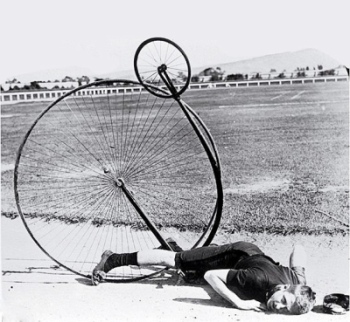
My newly revised faceOK, so I “came off my bike” this afternoon.

Yeah, you can believe me on this: This is not something you want. You can die from this. Even if you just get your bell rung, you still don’t want it.

So, how did this happen, you’re asking. Well, very, very quickly, in fact.  “It all happened so fast!” Heard that one before?  Here it is again, for your delectation. Take it for what you will.  But as to the facts at hand, I was returning from a routine bike ride, one I take every day or so, and as I have done countless times before, I turned into my peaceful little cul-de-sac. Apropos to the topic, the entrance to my street has been furnished with an unnecessary extra divot–somebody’s idea of a way to channel storm runoff alongside a piece of road that already sports a generous existing grade. This makes such a feature altogether superfluous (and in my case, at least a little dangerous). Anyway, when I hit this divot, carrying, perhaps, a bit of exuberant, excess speed, the rubber grip on the right handlebar slipped off, leaving me somewhat in the lurch.

Regardless, the aforementioned combination of mechanical and engineering failures put me in rather immediate contact with the unforgiving asphalt. I’d estimate that less than a second elapsed between hitting the bump and hitting the pavement. That’s not a lot of time to do any planning or prognostication, oh my bruvvers. That’s not even enough time to take a deep breath and get ready for all that you are about to suffer. It’s basically just a blur through which one traverses and tries to do the best one can under the somewhat impromptu circumstances.

A brief, subsequent, anatomical inventory provided a retrospective account of the events that transpired with, shall we say, a smattering of indeliberate haste. Said inventory was informative, however, providing insights into what may have transpired in that split instant, such as the following:

  • I had hit the pavement (did I mention it was unforgiving?) with the knuckles, and palms, of both hands, therefore leading me to assume that I must have bounced at least once.
  • I also, apparently, made contact with the big toe of my left foot. Good thing I was wearing sensible shoes. Good safety tip, that.
  • As to the evidence of contact on my right shoulder, there was a rather prominent tear in my T-shirt, and a corresponding raspberry spread gooily on said shoulder’s apex.
  • I won’t go into detail as to the state of the various knees and elbows; they have seen this territory before and were well prepared to revisit it. Let’s just say, however, that they had to cowboy up considerably to make the grade in this instance, forebearance-wise.


* Having been a victim of a little of the old ultraviolence, I am channeling Alex, from A Clockwork Orange.


OK, I Give!


St. SebastianYeah, that’s the way it is with me. Not one to be a martyr in a lost cause, I give up, already.

See, you don’t know me, but I am one of those people–one of those really disgusting people, apparently–who knows all the words and all the grammar and usage rules, but what’s the use, really? I mean, none of it seems to do anyone any good anymore, does it? It’s certainly nothing to boast about in today’s cultural milieu. One should, rather, hang one’s head in shame for knowing all those words and all those rules. Sign of a misspent youth and all that, what?

“Hey, wait,” you say. “You cocky jerk, isn’t it ‘all of the words’ and ‘all of the rules’”? Not really. Nope. And what about knows? Surely, people know things, don’t they? Well, they do, but one person knows things. This one confuses M$ Word’s grammar checker, too, so give yourself a pass. Score one for you if you marked the cliche near the end there, however.

The fact is, though, I’m tired. Having fought the good fight in an English classroom for a quarter century, I can say rather authoritatively that the fight already is over and the other side has won. The barbarians are at the gates, and we’re trapped inside the walls living in our own filth. We’re obviously correct in everything we say or write, but that doesn’t make the air smell any better in here, does it?

But, as my in-laws from Long Island say, “wadda-ya gonna do?” The forces acting to change language are just too strong. Resistance is futile, or perhaps I should say, feudal. I am going to go ahead and be ass-immolated.


300,000 hits for “I can haz”?


wet-madI don’t know what got into me, exactly, but on a whim, I entered “I can haz” into a Google search. I guess I was becoming aware how often the phrase appears as I surf around. I wondered how pervasive it had become, how much cultural penetration it had achieved. Google came up with almost 300,000 references to the phrase, a statistic that gave me pause. (Check it now. Maybe the total has gone up since the date of this post.)

This “cultural penetration” thing is interesting, though, and we’ve all experienced the phenomenon, usually as the uncomfortable feeling that comes from being with someone who is just picking up on something that we have become tired of ourselves. It’s like you got penetrated a long time ago, but this person has just now gotten nailed. What explains that? Perhaps he was hiding in some cultural backwater? Perhaps he has a life?

But ah, the fads: They begin; they gain currency; they end. But not really, huh? Maybe they just keep penetrating like the old television broadcasts of I Love Lucy, which are some 57 light years out in space now. Bless her, Lucy has been hurtling through the galaxy at the speed of light as long as I have been alive. Some far-off alien is just now saying, “So turn off the conveyor belt already!”


Dolly Lama?


The current Dalai LamaWith the Dalai Lama so much in the news lately, I am struck by how many commentators mangle the pronunciation of his title. I mean, he’s a Nobel Peace Prize winner (1989), for crying out loud. Can we get this right?

It seems that many of them pronounce it “DOLL-lee LAH-muh.” The more approved western pronunciation, however, seems to be something along the lines of “DOLL-eye LAH-mah” (see the resources below). The man himself, heard in recent interviews, seems to say something like “dah-LA-la-ma,” almost as if it were one word with the accent on the second syllable.

One particularly frustrating instance of this confusing pronunciation phenomenon occurred in an interview (3/26/08) on NPR’s Fresh Air. In her discussion with Pico Iyer, author of The Open Road: The Global Journey of the Fourteenth Dalai Lama, Terry Gross continued to call the spiritual leader of Tibetan Buddhists worldwide the “Dolly Lama” despite the fact that the interviewee, a man acquainted with the Dalai Lama for over 30 years, kept pronouncing it in the approved western fashion.

The natural question is, “What’s going on here?”


“Shooting Spree”


Whitman.jpgThis is one “convention” of journalists that could use some some serious reflection. Whenever someone shoots more than one or two victims, members of the chattering class will refer to the incident as a “shooting spree.” The phrase, ringing so close to the more common “shopping spree,” makes it sound as if someone were having just a whole lot of fun killing people.

The phrase is problematic on so many levels. It has become a particularly obnoxious cliché in the vast majority of cases, it is anything but accurate; furthermore, and more to the point, the phrase could encourage impressionable fringe characters by making the actions of a crazy person sound attractive and fun.

I don’t know which is a worse offense, frankly. I hate cliché s, I hate fuzzy, inaccurate prose, but the idea of making a destructive act of utter desperation sound like fun does not strike me as all that useful, either.


Forward Slash?


Or even more nonsensically, forwardslash.

Where in the world has this new trend come from? I refer to the tendency of calling a “slash” a “forward slash.”

The keyboard has always had a slash character. On the “qwerty” keyboard, it’s there in the lower-right corner under the question mark. It’s a slash. It always has been, at least since Civil War days.

Now people in the media are referring to it as a “forward slash,” and the trend is growing. Why would this be? Where did all this unnecessary folderol come from? I’m thinking it has to do with the various marketing departments of many large firms and their constant efforts at idiot-proofing the world.


Why do they act that way?


I mentioned “hand-wringing and indignation” in my previous post about a stripper’s allegations of rape against members of the recently disbanded Duke lacrosse team. These two reactions have been among the most common to the still-evolving mess–I say “still-evolving” because the DA seems determined to bolster his “street cred” with Black voters by sending the case to the grand jury despite the absence of DNA or other evidence that an assault actually occurred.

Oddly enough, the stripper apparently can’t identify anyone as an assailant, so without DNA or eye witness evidence, this rape allegation begins to look more and more spurious. I mean, some “unpleasantness” probably occurred, probably characterized by some racism and angry words, but this is starting to appear like an attempt to bend the legal system to the designs of a few interested parties–the DA and the stripper, most likely.


PC Minefield at Duke


MinefieldThose of us who live in Durham, NC, seldom experience the glow of the national spotlight. We have become accustomed to seeing references to the Research Triangle area in the sports pages, but apparently not much else happens here that is worthy of notice by the rest of the country. Maybe that is what has led to the disequilirium around here, especially among the usually confident voices of the university set who now find a bit of difficulty in hitting their marks and saying their lines in the case of the recent rape accusations against members of the Duke lacrosse team.

Perhaps people have also been put off balance by the complex convergence of factors required to put Durham in the news. Attracting national attention has required a story combining the popular theme of sports and something else newsworthy–or prurient–enough to attract the notice of the national press. In this case it was that a young African American woman is the accuser and the accused are generally privileged white college athletes who have become rather notorious in the area for their rowdiness and run-ins with the law.