Xo
Yo
delay
fps
Use your fingers or mouse to control the model
(hold shift key or use mouse wheel to zoom it).
Canvas is matched to your browser window.
-8 ≤ Xo,Yo ≤ 8.
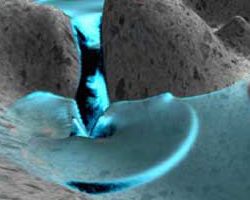
Preliminary CPU based "Shallow water" simulation.
here h(x,y, t) denotes the thickness of the water layer at point
(x, y) at time t, H(x,y) is the bottom topography,
(u, v) is the mass-flow of the water layer,
2g is the gravitational acceleration and t,x,y subscripts
denote partial derivatives.
The shallow-water equations are derived from the depth-averaged
incompressible Navier-Stokes equations for the case where the surface
perturbation is much smaller than the typical horizontal length scale.
The simplest possible scheme is the first-order Lax-Friedrichs
scheme
Qx,y+1 = (Qx+1,y +
Qx-1,y + Qx,y+1 + Qx,y-1)/4 +
Δt Sx,y + [F(Qx+1,y) -
F(Qx-1,y)]Δt/2Δx
+ [F(Qx,y+1) - F(Qx,y-1)]Δt/2Δy This is a very robust scheme, which unfortunately gives excessive smearing
of nonsmooth parts of the solution.
[1] T.R. Hagen, J.M. Hjelmervik, K.-A. Lie,
J.R. Natvig, M. Ofstad Henriksen
Visual
simulation of shallow-water waves
Simulation Modelling Practice and Theory 13 (2005) 716-726
[2] Miguel Lastra, Jose M. Mantas, Carlos Urena,
Manuel J. Castro, Jose A. Garcia-Rodriguez
Simulation of shallow-water systems using graphics processing units Mathematics and Computers in Simulation 80 (2009) 598-618