vii
PREFACE
After the conquest of the South Pole by Amundsen who, by a
narrow margin of days only, was in advance of the British
Expedition under Scott, there remained but one great main object
of Antarctic journeyings—the crossing of the South Polar continent
from sea to sea.
When I returned from the Nimrod Expedition on which we had to turn
back from our attempt to plant the British flag on the South Pole,
being beaten by stress of circumstances within ninety-seven miles
of our goal, my mind turned to the crossing of the continent, for
I was morally certain that either Amundsen or Scott would reach
the Pole on our own route or a parallel one. After hearing of
the Norwegian’s success I began to make preparations to start a last
great journey—so that the first crossing of the last continent
should be achieved by a British Expedition.
We failed in this object, but the story of our attempt is the
subject for the following pages, and I think that though failure
in the actual accomplishment must be recorded, there are chapters
in this book of high adventure, strenuous days, lonely nights,
unique experiences, and, above all, records of unflinching
determination, supreme loyalty, and generous self-sacrifice on
the part of my men which, even in these days that have witnessed
the sacrifices of nations and regardlessness of self on the part
of individuals, still will be of interest to readers who now turn
gladly from the red horror of war and the strain of the last five
years to read, perhaps with more understanding minds, the tale of
the White Warfare of the South. The struggles, the disappointments,
and the endurance of this small party of Britishers, hidden away
for nearly two years in the fastnesses of the Polar ice, striving
to carry out the ordained task and ignorant of the crisis through
which the world was passing, make a story which is unique in the
history of Antarctic exploration.
Owing viii to the loss of the Endurance and the disaster to the Aurora,
certain documents relating mainly to the organization and preparation
of the Expedition have been lost; but, anyhow, I had no intention of
presenting a detailed account of the scheme of preparation, storing,
and other necessary but, to the general reader, unimportant affairs,
as since the beginning of this century every book on Antarctic
exploration has dealt fully with this matter. I therefore briefly
place before you the inception and organization of the Expedition,
and insert here the copy of the programme which I prepared in order
to arouse the interest of the general public in the Expedition.
The Trans-continental Party.
The first crossing of the Antarctic continent, from sea to sea
via the Pole, apart from its historic value, will be a journey
of great scientific importance.
The distance will be roughly 1800 miles, and the first half of
this, from the Weddell Sea to the Pole, will be over unknown
ground. Every step will be an advance in geographical science.
It will be learned whether the great Victoria chain of mountains,
which has been traced from the Ross Sea to the Pole, extends across
the continent and thus links up (except for the ocean break)
with the Andes of South America, and whether the great plateau
around the Pole dips gradually towards the Weddell Sea.
Continuous magnetic observations will be taken on the journey.
The route will lead towards the Magnetic Pole, and the determination
of the dip of the magnetic needle will be of importance in practical
magnetism. The meteorological conditions will be carefully noted,
and this should help to solve many of our weather problems.
The glaciologist and geologist will study ice formations and the
nature of the mountains, and this report will prove of great
scientific interest.
Scientific Work by Other Parties.
While the Trans-continental party is carrying out, for the
British ix flag, the greatest Polar journey ever attempted,
the other parties will be engaged in important scientific work.
Two sledging parties will operate from the base on the Weddell
Sea. One will travel westward towards Graham Land, making
observations, collecting geological specimens, and proving whether
there are mountains in that region linked up with those found on
the other side of the Pole.
Another party will travel eastward toward Enderby Land, carrying
out a similar programme, and a third, remaining at the base, will
study the fauna of the land and sea, and the meteorological
conditions.
From the Ross Sea base, on the other side of the Pole, another
party will push southward and will probably await the arrival of
the Trans-continental party at the top of the Beardmore Glacier,
near Mount Buckley, where the first seams of coal were discovered
in the Antarctic. This region is of great importance to the
geologist, who will be enabled to read much of the history of the
Antarctic in the rocks.
Both the ships of the Expedition will be equipped for dredging,
sounding, and every variety of hydrographical work. The Weddell
Sea ship will endeavour to trace the unknown coast-line of Graham
Land, and from both the vessels, with their scientific staffs,
important results may be expected.
The several shore parties and the two ships will thus carry out
geographical and scientific work on a scale and over an area never
before attempted by any one Polar expedition.
This will be the first use of the Weddell Sea as a base for
exploration, and all the parties will open up vast stretches of
unknown land. It is appropriate that this work should be carried
out under the British flag, since the whole of the area southward
to the Pole is British territory. In July, 1908, Letters Patent
were issued under the Great Seal, declaring that the Governor of the
Falkland Islands should be the Governor of Graham Land (which forms
the western side of the Weddell Sea), and another section of the
same proclamation defines the area of British territory as
“situated in the South Atlantic Ocean to the south x of the 50th
parallel of south latitude, and lying between 20 degrees and
80 degrees west longitude.” Reference to a map will show that this
includes the area in which the present Expedition will work.
How the Continent will be Crossed.
The Weddell Sea ship, with all the members of the Expedition
operating from that base, will leave Buenos Ayres in October,
1914, and endeavour to land in November in latitude 78 degrees
south.
Should this be done, the Trans-continental party will set out on
their 1800-mile journey at once, in the hope of accomplishing
the march across the Pole and reaching the Ross Sea base in five
months. Should the landing be made too late in the season, the
party will go into winter quarters, lay out depots during the autumn
and the following spring, and as early as possible in 1915 set out
on the journey.
The Trans-continental party will be led by Sir Ernest Shackleton,
and will consist of six men. It will take 100 dogs with sledges,
and two motor sledges with aerial propellers. The equipment will
embody everything that the experience of the leader and his expert
advisers can suggest. When this party has reached the area of the
Pole, after covering 800 miles of unknown ground, it will strike due
north towards the head of the Beardmore Glacier, and there it is
hoped to meet the outcoming party from the Ross Sea. Both will join
up and make for the Ross Sea base, where the previous Expedition had
its winter quarters.
In all, fourteen men will be landed by the Endurance on the
Weddell Sea. Six will set out on the Trans-continental journey,
three will go westward, three eastward, and two remain at the base
carrying on the work already outlined.
The Aurora will land six men at the Ross Sea base. They will
lay down depots on the route of the Trans-continental party, and
make a march south to assist that party, and to make geological
and other observations as already described.
Should xi the Trans-continental party succeed, as is hoped, in
crossing during the first season, its return to civilization
may be expected about April, 1915. The other sections in April, 1916.
The Ships of the Expedition.
The two ships for the Expedition have now been selected.
The Endurance, the ship which will take the Trans-continental
party to the Weddell Sea, and will afterwards explore along an
unknown coast-line, is a new vessel, specially constructed for
Polar work under the supervision of a committee of Polar explorers.
She was built by Christensen, the famous Norwegian constructor of
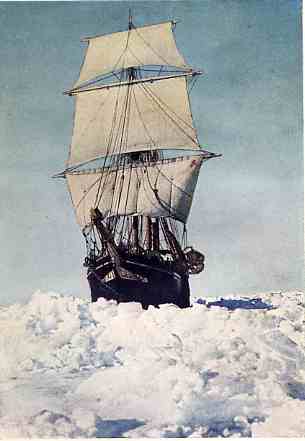
sealing vessels, at Sandefjord. She is barquentine rigged, and
has triple-expansion engines giving her a speed under steam of 9
to 10 knots. To enable her to stay longer at sea, she will carry
oil fuel as well as coal. She is of about 350 tons, and built of
selected pine, oak, and greenheart. This fine vessel, equipped,
has cost the Expedition £14,000.
The Aurora, the ship which will take out the Ross Sea party,
has been bought from Dr. Mawson. She is similar in all respects
to the Terra Nova, of Captain Scott’s last Expedition. She
had extensive alterations made by the Government authorities in
Australia to fit her for Dr. Mawson’s Expedition, and is now at
Hobart, Tasmania, where the Ross Sea party will join her in
October next.
I started the preparations in the middle of 1913, but no public
announcement was made until January 13, 1914. For the last six
months of 1913 I was engaged in the necessary preliminaries, solid
mule work, showing nothing particular to interest the public, but
essential for an Expedition that had to have a ship on each side
of the Continent, with a land journey of eighteen hundred miles to
be made, the first nine hundred miles to be across an absolutely
unknown land mass.
On January 1, 1914, having received a promised financial support
sufficient to warrant the announcement of the Expedition, I made it
public.
The xii first result of this was a flood of applications from all classes
of the community to join the adventure. I received nearly five
thousand applications, and out of these were picked fifty-six men.
In March, to my great disappointment and anxiety, the promised
financial help did not materialize, and I was now faced with the
fact that I had contracted for a ship and stores, and had engaged the
staff, and I was not in possession of funds to meet these liabilities.
I immediately set about appealing for help, and met with generous
response from all sides. I cannot here give the names of all who
supported my application, but whilst taking this opportunity of
thanking everyone for their support, which came from parts as far
apart as the interior of China, Japan, New Zealand, and Australia,
I must particularly refer to the munificent donation of £24,000
from the late Sir James Caird, and to one of £10,000 from the
British Government. I must also thank Mr. Dudley Docker, who enabled
me to complete the purchase of the Endurance, and Miss Elizabeth
Dawson Lambton, who since 1901 has always been a firm friend to
Antarctic exploration, and who again, on this occasion, assisted
largely. The Royal Geographical Society made a grant of £1000;
and last, but by no means least, I take this opportunity of
tendering my grateful thanks to Dame Janet Stancomb-Wills, whose
generosity enabled me to equip the Endurance efficiently, especially
as regards boats (which boats were the means of our ultimate safety),
and who not only, at the inception of the Expedition, gave financial
help, but also continued it through the dark days when we were
overdue, and funds were required to meet the need of the dependents
of the Expedition.
The only return and privilege an explorer has in the way of
acknowledgment for the help accorded him is to record on the
discovered lands the names of those to whom the Expedition owes
its being.
Owing to the exigencies of the war the publication of this book
has been long delayed, and the detailed maps must come with the
scientific monographs; I have the honour to place on the
new land the names of the above and other generous donors to the
Expedition. xiii The two hundred miles of new coast-line I have called
Caird Coast. Also, as a more personal note, I named the three
ship’s boats, in which we ultimately escaped from the grip of the
ice after the three principal donors to the Expedition—the James
Caird, the Stancomb Wills and the Dudley Docker. The two last-named
are still on the desolate, sandy spit of Elephant Island, where
under their shelter twenty-two of my comrades eked out a bare existence
for four and a half months.
The James Caird is now in Liverpool, having been brought home from
South Georgia after her adventurous voyage across the sub-Antarctic Ocean.
Most of the Public Schools of England and Scotland helped the Expedition
to purchase the dog teams, and I named a dog after each school that
helped. But apart from these particular donations I again thank the
many people who assisted us.
So the equipment and organization went on. I purchased the Aurora
from Sir Douglas Mawson, and arranged for Mackintosh to go to
Australia and take charge of her, there sending sledges, equipment,
and most of the stores from this side, but depending somewhat on the
sympathy and help of Australia and New Zealand for coal and certain
other necessities, knowing that previously these two countries had
always generously supported the exploration of what one might call
their hinterland.
Towards the end of July all was ready, when suddenly the war clouds
darkened over Europe.
It had been arranged for the Endurance to proceed to Cowes, to be
inspected by His Majesty on the Monday of Cowes week. But on Friday
I received a message to say that the King would not be able to go to
Cowes. My readers will remember how suddenly came the menace of war.
Naturally both my comrades and I were greatly exercised as to the
probable outcome of the danger threatening the peace of the world.
We sailed from London on Friday, August 1, 1914, and anchored off
Southend all Saturday. On Sunday afternoon I took the ship off
Margate, growing hourly more anxious as the ever-increasing
rumours spread; and on Monday morning I went ashore and xiv read in
the morning paper the order for general mobilization.
I immediately went on board and mustered all hands and told them
that I proposed to send a telegram to the Admiralty offering the
ships, stores, and, if they agreed, our own services to the
country in the event of war breaking out. All hands immediately
agreed, and I sent off a telegram in which everything was placed
at the disposal of the Admiralty. We only asked that, in the event
of the declaration of war, the Expedition might be considered as a
single unit, so as to preserve its homogeneity. There were enough
trained and experienced men amongst us to man a destroyer. Within
an hour I received a laconic wire from the Admiralty saying “Proceed.”
Within two hours a longer wire came from Mr. Winston Churchill, in which
we were thanked for our offer, and saying that the authorities desired
that the Expedition, which had the full sanction and support of the
Scientific and Geographical Societies, should go on.
So, according to these definite instructions, the Endurance sailed
to Plymouth. On Tuesday the King sent for me and handed me the Union
Jack to carry on the Expedition. That night, at midnight, war broke
out. On the following Saturday, August 8, the Endurance sailed from
Plymouth, obeying the direct orders of the Admiralty. I make particular
reference to this phase of the Expedition as I am aware that there was
a certain amount of criticism of the Expedition having left the country,
and regarding this I wish further to add that the preparation of the
Expedition had been proceeding for over a year, and large sums of money
had been spent. We offered to give the Expedition up without even
consulting the donors of this money, and but few thought that the war
would last through these five years and involve the whole world.
The Expedition was not going on a peaceful cruise to the South Sea
Islands, but to a most dangerous, difficult, and strenuous work that
has nearly always involved a certain percentage of loss of life.
Finally, when the Expedition did return, practically the whole of
those members who had come unscathed through xv the dangers of the
Antarctic took their places in the wider field of battle, and the
percentage of casualties amongst the members of this Expedition is
high.
The voyage out to Buenos Ayres was uneventful, and on October 26 we
sailed from that port for South Georgia, the most southerly outpost
of the British Empire. Here, for a month, we were engaged in final
preparation. The last we heard of the war was when we left Buenos
Ayres. Then the Russian Steam-Roller was advancing. According to
many the war would be over within six months. And so we left, not
without regret that we could not take our place there, but secure
in the knowledge that we were taking part in a strenuous campaign
for the credit of our country.
Apart from private individuals and societies I here acknowledge
most gratefully the assistance rendered by the Dominion
Government of New Zealand and the Commonwealth Government of
Australia at the start of the Ross Sea section of the Expedition,
and to the people of New Zealand and the Dominion Government I
tender my most grateful thanks for their continued help which
was invaluable during the dark days before the relief of the Ross
Sea party.
I tender my most grateful thanks to Mr. James Allen (acting
Premier), the late Mr. McNab (Minister of Marine), Mr. Leonard
Tripp, Mr. Mabin, and Mr. Toogood, and many others who
have laid me under a debt of gratitude that can never be repaid.
Sir Daniel Gooch came with us as far as South Georgia. I owe
him my special thanks for his help with the dogs, and we all
regretted losing his cheery presence when we sailed for the South.
This is also the opportunity for me to thank the Uruguayan
Government for their generous assistance in placing the government
trawler, Instituto de Pesca, for the second attempt at the relief
of my men on Elephant Island.
Finally, it was the Chilian Government that was directly
responsible for the rescue of my comrades. This southern
Republic was unwearied in their efforts to make a successful
rescue, and the gratitude xvi of our whole party is due to them.
I especially mention the sympathetic attitude of Admiral Muñoz
Hurtado, head of the Chilian Navy, and Captain Luis Pardo, who
commanded the Yelcho on our last and successful venture.
1
CHAPTER I
INTO THE WEDDELL SEA
I had decided to leave South Georgia about December 5, and in the
intervals of final preparation scanned again the plans for the
voyage to winter quarters. What welcome was the Weddell Sea
preparing for us? The whaling captains at South Georgia were
generously ready to share with me their knowledge of the waters
in which they pursued their trade, and, while confirming earlier
information as to the extreme severity of the ice conditions in
this sector of the Antarctic, they were able to give advice that
was worth attention.
It will be convenient to state here briefly some of the considerations
that weighed with me at that time and in the weeks that followed.
I knew that the ice had come far north that season, and, after
listening to the suggestions of the whaling captains, had decided
to steer to the South Sandwich Group, round Ultima Thule, and work
as far to the eastward as the fifteenth meridian west longitude
before pushing south. The whalers emphasized the difficulty of
getting through the ice in the neighbourhood of the South Sandwich
Group. They told me they had often seen the floes come right up to
the Group in the summer-time, and they thought the Expedition would
have to push through heavy pack in order to reach the Weddell Sea.
Probably the best time to get into the Weddell Sea would be the
end of February or the beginning of March. The whalers had gone
right round the South Sandwich Group and they were familiar with
the conditions. The predictions they made had induced me to take the
deck-load of coal, for if we had to fight our way through to Coats’
Land we would need every ton of fuel the ship could carry.
I hoped that by first moving to the east as far as the fifteenth
meridian 2 west we would be able to go south through looser ice,
pick up Coats’ Land and finally reach Vahsel Bay, where Filchner
made his attempt at landing in 1912. Two considerations were
occupying my mind at this juncture. I was anxious for certain
reasons to winter the Endurance in the Weddell Sea, but the
difficulty of finding a safe harbour might be very great. If no
safe harbour could be found, the ship must winter at South
Georgia. It seemed to me hopeless now to think of making the
journey across the continent in the first summer, as the season
was far advanced and the ice conditions were likely to prove
unfavourable. In view of the possibility of wintering the ship
in the ice, we took extra clothing from the stores at the various
stations in South Georgia.
The other question that was giving me anxious thought was the size
of the shore party. If the ship had to go out during the winter,
or if she broke away from winter quarters, it would be preferable
to have only a small, carefully selected party of men ashore after
the hut had been built and the stores landed. These men could proceed
to lay out depots by man-haulage and make short journeys with the dogs,
training them for the long early march in the following spring.
The majority of the scientific men would live aboard the ship, where
they could do their work under good conditions. They would be able
to make short journeys, if required, using the Endurance as a base.
All these plans were based on an expectation that the finding of winter
quarters was likely to be difficult. If a really safe base could
be established on the continent, I would adhere to the original
programme of sending one party to the south, one to the west
round the head of the Weddell Sea towards Graham Land, and one
to the east towards Enderby Land.
We had worked out details of distances, courses, stores required,
and so forth. Our sledging ration, the result of experience as well
as close study, was perfect. The dogs gave promise, after training,
of being able to cover fifteen to twenty miles a day with loaded
sledges. The trans-continental journey, at this rate, should be
completed in 120 days unless some unforeseen obstacle intervened. 3
We longed keenly for the day when we could begin this march, the
last great adventure in the history of South Polar exploration,
but a knowledge of the obstacles that lay between us and our
starting-point served as a curb on impatience. Everything depended
upon the landing. If we could land at Filchner’s base there was no
reason why a band of experienced men should not winter there in
safety. But the Weddell Sea was notoriously inhospitable, and
already we knew that its sternest face was turned towards us.
All the conditions in the Weddell Sea are unfavourable from the
navigator’s point of view. The winds are comparatively light,
and consequently new ice can form even in the summer-time.
The absence of strong winds has the additional effect of allowing
the ice to accumulate in masses, undisturbed. Then great quantities
of ice sweep along the coast from the east under the influence of
the prevailing current, and fill up the bight of the Weddell Sea
as they move north in a great semicircle. Some of this ice
doubtless describes almost a complete circle, and is held up
eventually, in bad seasons, against the South Sandwich Islands.
The strong currents, pressing the ice masses against the coasts,
create heavier pressure than is found in any other part of the
Antarctic. This pressure must be at least as severe as the pressure
experienced in the congested North Polar basin, and I am inclined
to think that a comparison would be to the advantage of the Arctic.
All these considerations naturally had a bearing upon our immediate
problem, the penetration of the pack and the finding of a safe
harbour on the continental coast.
The day of departure arrived. I gave the order to heave
anchor at 8.45 a.m. on December 5, 1914, and the clanking of the
windlass broke for us the last link with civilization. The morning
was dull and overcast, with occasional gusts of snow and sleet, but
hearts were light aboard the Endurance. The long days of preparation
were over and the adventure lay ahead.
We had hoped that some steamer from the north would bring news of
war and perhaps letters from home before our departure. A ship
did arrive on the evening of the 4th, but she carried no letters,
and nothing useful in the way of information could 4 be gleaned from
her. The captain and crew were all stoutly pro-German, and the
“news” they had to give took the unsatisfying form of accounts
of British and French reverses. We would have been glad to have
had the latest tidings from a friendlier source. A year and a
half later we were to learn that the Harpoon, the steamer which
tends the Grytviken station, had arrived with mail for us not more
than two hours after the Endurance had proceeded down the coast.
The bows of the Endurance were turned to the south, and the good
ship dipped to the south-westerly swell. Misty rain fell during
the forenoon, but the weather cleared later in the day, and we had
a good view of the coast of South Georgia as we moved under steam
and sail to the south-east. The course was laid to carry us clear
of the island and then south of South Thule, Sandwich Group. The
wind freshened during the day, and all square sail was set, with
the foresail reefed in order to give the look-out a clear view
ahead; for we did not wish to risk contact with a “growler,” one
of those treacherous fragments of ice that float with surface
awash. The ship was very steady in the quarterly sea, but
certainly did not look as neat and trim as she had done when
leaving the shores of England four months earlier. We had filled
up with coal at Grytviken, and this extra fuel was stored on deck,
where it impeded movement considerably. The carpenter had built a
false deck, extending from the poop-deck to the chart-room. We had
also taken aboard a ton of whale-meat for the dogs. The big
chunks of meat were hung up in the rigging, out of reach but not
out of sight of the dogs, and as the Endurance rolled and pitched,
they watched with wolfish eyes for a windfall.
I was greatly pleased with the dogs, which were tethered about
the ship in the most comfortable positions we could find for them.
They were in excellent condition, and I felt that the expedition
had the right tractive-power. They were big, sturdy animals,
chosen for endurance and strength, and if they were as keen to
pull our sledges as they were now to fight one another all would
be well. The men in charge of the dogs were doing their work
enthusiastically, and the eagerness they showed to study the natures 5
and habits of their charges gave promise of efficient handling and
good work later on.
During December 6 the Endurance made good progress on a
south-easterly course. The northerly breeze had freshened during
the night and had brought up a high following sea. The weather
was hazy, and we passed two bergs, several growlers, and numerous
lumps of ice. Staff and crew were settling down to the routine.
Bird life was plentiful, and we noticed Cape pigeons, whale-birds,
terns, mollymauks, nellies, sooty, and wandering albatrosses in
the neighbourhood of the ship. The course was laid for the passage
between Sanders Island and Candlemas Volcano. December 7 brought
the first check. At six o’clock that morning the sea, which had
been green in colour all the previous day, changed suddenly to a
deep indigo. The ship was behaving well in a rough sea, and some
members of the scientific staff were transferring to the bunkers
the coal we had stowed on deck. Sanders Island and Candlemas were
sighted early in the afternoon, and the Endurance passed between
them at 6 p.m. Worsley’s observations indicated that Sanders Island
was, roughly, three miles east and five miles north of the charted
position. Large numbers of bergs, mostly tabular in form, lay to
the west of the islands, and we noticed that many of them were
yellow with diatoms. One berg had large patches of red-brown soil
down its sides. The presence of so many bergs was ominous,
and immediately after passing between the islands we encountered
stream-ice. All sail was taken in and we proceeded slowly under
steam. Two hours later, fifteen miles north-east of Sanders
Island, the Endurance was confronted by a belt of heavy pack-ice,
half a mile broad and extending north and south. There was clear
water beyond, but the heavy south-westerly swell made the pack
impenetrable in our neighbourhood. This was disconcerting.
The noon latitude had been 57° 26′ S., and I had
not expected to find pack-ice nearly so far north, though the whalers
had reported pack right up to South Thule.
The situation became dangerous that night. We pushed into the pack
in the hope of reaching open water beyond, and found ourselves 6
after dark in a pool which was growing smaller and smaller. The
ice was grinding around the ship in the heavy swell, and I watched
with some anxiety for any indication of a change of wind to the east,
since a breeze from that quarter would have driven us towards
the land. Worsley and I were on deck all night, dodging the pack.
At 3 a.m. we ran south, taking advantage of some openings that had
appeared, but met heavy rafted pack-ice, evidently old; some of it
had been subjected to severe pressure. Then we steamed north-west
and saw open water to the north-east. I put the Endurance’s head
for the opening, and, steaming at full speed, we got clear. Then
we went east in the hope of getting better ice, and five hours later,
after some dodging, we rounded the pack and were able to set sail
once more. This initial tussle with the pack had been exciting at
times. Pieces of ice and bergs of all sizes were heaving and
jostling against each other in the heavy south-westerly swell.
In spite of all our care the Endurance struck large lumps stem on,
but the engines were stopped in time and no harm was done. The
scene and sounds throughout the day were very fine. The swell
was dashing against the sides of huge bergs and leaping right to
the top of their icy cliffs. Sanders Island lay to the south,
with a few rocky faces peering through the misty, swirling clouds
that swathed it most of the time, the booming of the sea running
into ice caverns, the swishing break of the swell on the loose pack,
and the graceful bowing and undulating of the inner pack to the
steeply rolling swell, which here was robbed of its break by the
masses of ice to windward.
We skirted the northern edge of the pack in clear weather with a
light south-westerly breeze and an overcast sky. The bergs were
numerous. During the morning of December 9 an easterly breeze
brought hazy weather with snow, and at 4.30 p.m. we encountered
the edge of pack-ice in lat. 58° 27′ S., long.
22° 08′ W. It was one-year-old ice interspersed
with older pack, all heavily snow-covered and lying west-south-west
to east-north-east. We entered the pack at 5 p.m., but could not
make progress, and cleared it again at 7.40 p.m. Then we steered
east-north-east and spent the 7 rest of the night rounding the pack.
During the day we had seen adelie and ringed penguins, also several
humpback and finner whales. An ice-blink to the westward indicated
the presence of pack in that direction. After rounding the pack we
steered S. 40° E., and at noon on the 10th had reached lat.
58° 28′ S., long. 20° 28′ W. Observations
showed the compass variation to be 1½° less than the chart
recorded. I kept the Endurance on the course till midnight,
when we entered loose open ice about ninety miles south-east of our
noon position. This ice proved to fringe the pack, and progress
became slow. There was a long easterly swell with a light northerly
breeze, and the weather was clear and fine. Numerous bergs lay
outside the pack.
The Endurance steamed through loose open ice till 8 a.m. on the
11th, when we entered the pack in lat. 59° 46′ S.,
long. 18° 22′ W. We could have gone further east,
but the pack extended far in that direction, and an effort to circle
it might have involved a lot of northing. I did not wish to lose
the benefit of the original southing. The extra miles would not have
mattered to a ship with larger coal capacity than the Endurance
possessed, but we could not afford to sacrifice miles unnecessarily.
The pack was loose and did not present great difficulties at this
stage. The foresail was set in order to take advantage of the
northerly breeze. The ship was in contact with the ice occasionally
and received some heavy blows. Once or twice she was brought up
all standing against solid pieces, but no harm was done. The chief
concern was to protect the propeller and rudder. If a collision
seemed to be inevitable the officer in charge would order “slow”
or “half speed” with the engines, and put the helm over so as to
strike the floe a glancing blow. Then the helm would be put over towards
the ice with the object of throwing the propeller clear of it, and
the ship would forge ahead again. Worsley, Wild, and I, with three
officers, kept three watches while we were working through the
pack, so that we had two officers on deck all the time. The
carpenter had rigged a six-foot wooden semaphore on the bridge to
enable the navigating officer to give the seamen or scientists at
the wheel the direction and the exact amount of helm required. 8
This device saved time, as well as the effort of shouting. We were
pushing through this loose pack all day, and the view from the crow’s-nest
gave no promise of improved conditions ahead. A Weddell seal
and a crab-eater seal were noticed on the floes, but we did not
pause to secure fresh meat. It was important that we should make
progress towards our goal as rapidly as possible, and there was
reason to fear that we should have plenty of time to spare later
on if the ice conditions continued to increase in severity.
On the morning of December 12 we were working through loose pack
which later became thick in places. The sky was overcast and
light snow was falling. I had all square sail set at 7 a.m. in
order to take advantage of the northerly breeze, but it had to
come in again five hours later when the wind hauled round to the
west. The noon position was lat. 60° 26′ S., long.
17° 58′ W., and the run for the twenty-four hours
had been only 33 miles. The ice was still badly congested, and
we were pushing through narrow leads and occasional openings with
the floes often close abeam on either side. Antarctic, snow, and
stormy petrels, fulmars, white-rumped terns, and adelies were
around us. The quaint little penguins found the ship a cause
of much apparent excitement and provided a lot of amusement aboard.
One of the standing jokes was that all the adelies on the floe
seemed to know Clark and, when he was at the wheel, rushed along
as fast as their legs could carry them, yelling out “Clark! Clark!”
and apparently very indignant and perturbed that he never waited
for them or even answered them.
We found several good leads to the south in the evening, and
continued to work southward throughout the night and the following
day. The pack extended in all directions as far as the eye could
reach. The noon observation showed the run for the twenty-four
hours to be 54 miles, a satisfactory result under the conditions.
Wild shot a young Ross seal on the floe, and we manœuvred the ship
alongside. Hudson jumped down, bent a line on to the seal, and the
pair of them were hauled up. The seal was 4 ft. 9 in. long and
weighed about ninety pounds. He was 9 a young male and proved very
good eating, but when dressed and minus the blubber made little
more than a square meal for our twenty-eight men, with a few scraps
for our breakfast and tea. The stomach contained only amphipods
about an inch long, allied to those found in the whales at
Grytviken.
The conditions became harder on December 14. There was a misty
haze, and occasional falls of snow. A few bergs were in sight.
The pack was denser than it had been on the previous days. Older
ice was intermingled with the young ice, and our progress became
slower. The propeller received several blows in the early
morning, but no damage was done. A platform was rigged under the
jibboom in order that Hurley might secure some kinematograph
pictures of the ship breaking through the ice. The young ice did
not present difficulties to the Endurance, which was able to smash
a way through, but the lumps of older ice were more formidable
obstacles, and conning the ship was a task requiring close
attention. The most careful navigation could not prevent an
occasional bump against ice too thick to be broken or pushed aside.
The southerly breeze strengthened to a moderate south-westerly
gale during the afternoon, and at 8 p.m. we hove to, stem against
a floe, it being impossible to proceed without serious risk of
damage to rudder or propeller. I was interested to notice that,
although we had been steaming through the pack for three days,
the north-westerly swell still held with us. It added to the
difficulties of navigation in the lanes, since the ice was
constantly in movement.
The Endurance remained against the floe for the next twenty-four
hours, when the gale moderated. The pack extended to the horizon
in all directions and was broken by innumerable narrow lanes.
Many bergs were in sight, and they appeared to be travelling
through the pack in a south-westerly direction under the current
influence. Probably the pack itself was moving north-east with
the gale. Clark put down a net in search of specimens, and at
two fathoms it was carried south-west by the current and fouled
the propeller. He lost the net, two leads, and a line. Ten
bergs drove to the south through the pack during the twenty-four 10
hours. The noon position was lat. 61° 31′ S., long.
18° 12′ W. The gale had moderated at 8 p.m., and
we made five miles to the south before midnight and then
stopped at the end of a long lead, waiting till the weather cleared.
It was during this short run that the captain, with semaphore
hard-a-port, shouted to the scientist at the wheel: “Why in
Paradise don’t you port!” The answer came in indignant tones:
“I am blowing my nose.”
The Endurance made some progress on the following day. Long
leads of open water ran towards the south-west, and the ship
smashed at full speed through occasional areas of young ice till
brought up with a heavy thud against a section of older floe.
Worsley was out on the jibboom end for a few minutes while Wild
was conning the ship, and he came back with a glowing account of
a novel sensation. The boom was swinging high and low and from
side to side, while the massive bows of the ship smashed through
the ice, splitting it across, piling it mass on mass and then
shouldering it aside. The air temperature was 37° Fahr.,
pleasantly warm, and the water temperature 29° Fahr. We
continued to advance through fine long leads till 4 a.m. on
December 17, when the ice became difficult again. Very large
floes of six-months-old ice lay close together. Some of these
floes presented a square mile of unbroken surface, and among
them were patches of thin ice and several floes of heavy old ice.
Many bergs were in sight, and the course became devious. The
ship was blocked at one point by a wedge-shaped piece of floe,
but we put the ice-anchor through it, towed it astern, and
proceeded through the gap. Steering under these conditions
required muscle as well as nerve. There was a clatter aft during
the afternoon, and Hussey, who was at the wheel, explained that:
“The wheel spun round and threw me over the top of it.” The noon
position was lat. 62° 13′ S., long. 18°
53′ W., and the run for the preceding twenty-four hours had
been 32 miles in a south-westerly direction. We saw three blue
whales during the day and one emperor penguin, a 58-lb. bird, which
was added to the larder.
The morning of December 18 found the Endurance proceeding amongst
large floes with thin ice between them. The leads were few. 11 There
was a northerly breeze with occasional snow-flurries. We secured
three crab-eater seals—two cows and a bull. The bull was a fine
specimen, nearly white all over and 9 ft. 3 in. long; he weighed
600 lb. Shortly before noon further progress was barred by heavy
pack, and we put an ice-anchor on the floe and banked the fires.
I had been prepared for evil conditions in the Weddell Sea, but had
hoped that in December and January, at any rate, the pack would be
loose, even if no open water was to be found. What we were actually
encountering was fairly dense pack of a very obstinate character.
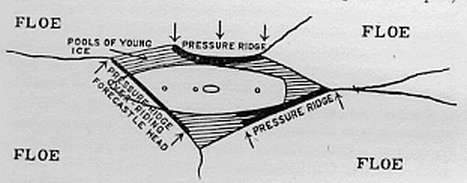
Pack-ice might be described as a gigantic and interminable jigsaw puzzle
devised by nature. The parts of the puzzle in loose pack
have floated slightly apart and become disarranged; at numerous
places they have pressed together again; as the pack gets closer
the congested areas grow larger and the parts are jammed harder
till finally it becomes “close pack,” when the whole of the jigsaw
puzzle becomes jammed to such an extent that it can with care and
labour be traversed in every direction on foot. Where the parts
do not fit closely there is, of course, open water, which freezes
over in a few hours after giving off volumes of “frost-smoke.”
In obedience to renewed pressure this young ice “rafts,” so
forming double thicknesses of a toffee-like consistency. Again
the opposing edges of heavy floes rear up in slow and almost silent
conflict, till high “hedgerows” are formed round each part of the
puzzle. At the junction of several floes chaotic areas of piled-up
blocks and masses of ice are formed. Sometimes 5-ft. to 6-ft. piles
of evenly shaped blocks of ice are seen so neatly laid that it seems
impossible for them to be Nature’s work. Again, a winding canyon
may be traversed between icy walls 6 ft. to 10 ft. high, or a dome
may be formed that under renewed pressure bursts upward like a
volcano. All through the winter the drifting pack changes—grows by
freezing, thickens by rafting, and corrugates by pressure. If,
finally, in its drift it impinges on a coast, such as the western
shore of the Weddell Sea, terrific pressure is set up and an inferno
of ice-blocks, ridges, and hedgerows results, extending possibly for
150 or 200 miles off shore. Sections of pressure ice may 12 drift
away subsequently and become embedded in new ice.
I have given this brief explanation here in order that the reader
may understand the nature of the ice through which we pushed our
way for many hundreds of miles. Another point that may require
to be explained was the delay caused by wind while we were in the
pack. When a strong breeze or moderate gale was blowing the ship
could not safely work through any except young ice, up to about
two feet in thickness. As ice of that nature never extended for
more than a mile or so, it followed that in a gale in the pack we
had always to lie to. The ship was 3 ft. 3 in. down by the stern,
and while this saved the propeller and rudder a good deal, it made
the Endurance practically unmanageable in close pack when the wind
attained a force of six miles an hour from ahead, since the air
currents had such a big surface forward to act upon. The pressure
of wind on bows and the yards of the foremast would cause the bows
to fall away, and in these conditions the ship could not be steered
into the narrow lanes and leads through which we had to thread our
way. The falling away of the bows, moreover, would tend to bring
the stern against the ice, compelling us to stop the engines in
order to save the propeller. Then the ship would become unmanageable
and drift away, with the possibility of getting excessive sternway
on her and so damaging rudder or propeller, the Achilles’ heel of a
ship in pack-ice.
While we were waiting for the weather to moderate and the ice to
open, I had the Lucas sounding-machine rigged over the rudder-trunk
and found the depth to be 2810 fathoms. The bottom sample was lost,
owing to the line parting 60 fathoms from the end. During the
afternoon three adelie penguins approached the ship across the floe
while Hussey was discoursing sweet music on the banjo. The
solemn-looking little birds appeared to appreciate “It’s a Long
Way to Tipperary,” but they fled in horror when Hussey treated
them to a little of the music that comes from Scotland. The shouts
of laughter from the ship added to their dismay, and they made off
as fast as their short legs would carry them. The pack opened
slightly at 6.15 p.m., and we proceeded through 13 lanes for three
hours before being forced to anchor to a floe for the night. We
fired a Hjort mark harpoon, No. 171, into a blue whale on this day.
The conditions did not improve during December 19. A fresh
to strong northerly breeze brought haze and snow, and after
proceeding for two hours the Endurance was stopped again by
heavy floes. It was impossible to manœuvre the ship in the ice
owing to the strong wind, which kept the floes in movement and
caused lanes to open and close with dangerous rapidity. The noon
observation showed that we had made six miles to the south-east in
the previous twenty-four hours. All hands were engaged during the
day in rubbing shoots off our potatoes, which were found to be
sprouting freely. We remained moored to a floe over the following
day, the wind not having moderated; indeed, it freshened to a gale
in the afternoon, and the members of the staff and crew took
advantage of the pause to enjoy a vigorously contested game of
football on the level surface of the floe alongside the ship.
Twelve bergs were in sight at this time. The noon position was
lat. 62° 42′ S., long. 17° 54′ W.,
showing that we had drifted about six miles in a north-easterly
direction.
Monday, December 21, was beautifully fine, with a gentle west-north-westerly
breeze. We made a start at 3 a.m. and proceeded
through the pack in a south-westerly direction. At noon we had
gained seven miles almost due east, the northerly drift of the
pack having continued while the ship was apparently moving to
the south. Petrels of several species, penguins, and seals were
plentiful, and we saw four small blue whales. At noon we entered
a long lead to the southward and passed around and between nine
splendid bergs. One mighty specimen was shaped like the Rock of
Gibraltar but with steeper cliffs, and another had a natural dock
that would have contained the Aquitania. A spur of ice closed
the entrance to the huge blue pool. Hurley brought out his
kinematograph-camera, in order to make a record of these bergs.
Fine long leads running east and south-east among bergs were found
during the afternoon, but at midnight the ship was stopped by
small, heavy ice-floes, tightly packed against an unbroken 14 plain
of ice. The outlook from the mast-head was not encouraging.
The big floe was at least 15 miles long and 10 miles wide.
The edge could not be seen at the widest part, and the area of
the floe must have been not less than 150 square miles. It
appeared to be formed of year-old ice, not very thick and with
very few hummocks or ridges in it. We thought it must have been
formed at sea in very calm weather and drifted up from the south-east.
I had never seen such a large area of unbroken ice in
the Ross Sea.
We waited with banked fires for the strong easterly breeze to
moderate or the pack to open. At 6.30 p.m. on December 22, some
lanes opened and we were able to move towards the south again.
The following morning found us working slowly through the pack,
and the noon observation gave us a gain of 19 miles S. 41°
W. for the seventeen and a half hours under steam. Many year-old
adelies, three crab-eaters, six sea-leopards, one Weddell and two
blue whales were seen. The air temperature, which had been down
to 25° Fahr. on December 21, had risen to 34° Fahr.
While we were working along leads to the southward in the afternoon,
we counted fifteen bergs. Three of these were table-topped, and
one was about 70 ft high and 5 miles long. Evidently it had come
from a barrier-edge. The ice became heavier but slightly more open,
and we had a calm night with fine long leads of open water. The
water was so still that new ice was forming on the leads. We had
a run of 70 miles to our credit at noon on December 24, the position
being lat. 64° 32′ S., long. 17° 17′ W.
All the dogs except eight had been named. I do not know who had
been responsible for some of the names, which seemed to represent
a variety of tastes. They were as follows: Rugby, Upton Bristol,
Millhill, Songster, Sandy, Mack, Mercury, Wolf, Amundsen, Hercules,
Hackenschmidt, Samson, Sammy, Skipper, Caruso, Sub, Ulysses, Spotty,
Bosun, Slobbers, Sadie, Sue, Sally, Jasper, Tim, Sweep, Martin,
Splitlip, Luke, Saint, Satan, Chips, Stumps, Snapper, Painful, Bob,
Snowball, Jerry, Judge, Sooty, Rufus, Sidelights, Simeon, Swanker,
Chirgwin, Steamer, Peter, Fluffy, Steward, Slippery, Elliott, Roy,
Noel, Shakespeare, Jamie, 15 Bummer, Smuts, Lupoid, Spider, and Sailor.
Some of the names, it will be noticed, had a descriptive flavour.
Heavy floes held up the ship from midnight till 6 a.m. on
December 25, Christmas Day. Then they opened a little and we made
progress till 11.30 a.m., when the leads closed again. We had
encountered good leads and workable ice during the early part of the
night, and the noon observation showed that our run for the twenty-four
hours was the best since we entered the pack a fortnight earlier.
We had made 71 miles S. 4° W. The ice held us up till the
evening, and then we were able to follow some leads for a couple of
hours before the tightly packed floes and the increasing wind
compelled a stop. The celebration of Christmas was not forgotten.
Grog was served at midnight to all on deck. There was grog again
at breakfast, for the benefit of those who had been in their bunks
at midnight. Lees had decorated the wardroom with flags and had a
little Christmas present for each of us. Some of us had presents
from home to open. Later there was a really splendid dinner,
consisting of turtle-soup, whitebait, jugged hare, Christmas pudding,
mince-pies, dates, figs, and crystallized fruits, with rum and stout
as drinks. In the evening everybody joined in a “sing-song.”
Hussey had made a one-stringed violin, on which, in the words of
Worsley, he “discoursed quite painlessly.” The wind was
increasing to a moderate south-easterly gale and no advance could
be made, so we were able to settle down to the enjoyments of
the evening.
The weather was still bad on December 26 and 27, and the Endurance
remained anchored to a floe. The noon position on the 26th was
lat. 65° 43′ S., long. 17° 36′ W.
We made another sounding on this day with the Lucas machine and
found bottom at 2819 fathoms. The specimen brought up was a
terriginous blue mud (glacial deposit) with some radiolaria.
Every one took turns at the work of heaving in, two men working
together in ten-minute spells.
Sunday, December 27, was a quiet day aboard. The southerly gale
was blowing the snow in clouds off the floe and the temperature had
fallen to 23° Fahr. The dogs were having an uncomfortable 16
time in their deck quarters. The wind had moderated by the
following morning, but it was squally with snow-flurries, and I
did not order a start till 11 p.m. The pack was still close, but
the ice was softer and more easily broken. During the pause the
carpenter had rigged a small stage over the stern. A man was
stationed there to watch the propeller and prevent it striking
heavy ice, and the arrangement proved very valuable. It saved the
rudder as well as the propeller from many blows.
The high winds that had prevailed for four and a half days gave way
to a gentle southerly breeze in the evening of December 29. Owing
to the drift we were actually eleven miles further north than we
had been on December 25. But we made fairly good progress on the
30th in fine, clear weather. The ship followed a long lead to the
south-east during the afternoon and evening, and at 11 p.m. we
crossed the Antarctic Circle. An examination of the horizon
disclosed considerable breaks in the vast circle of pack-ice,
interspersed with bergs of different sizes. Leads could be traced
in various directions, but I looked in vain for an indication of
open water. The sun did not set that night, and as it was
concealed behind a bank of clouds we had a glow of crimson and gold
to the southward, with delicate pale green reflections in the water
of the lanes to the south-east.
The ship had a serious encounter with the ice on the morning of
December 31. We were stopped first by floes closing around us,
and then about noon the Endurance got jammed between two floes
heading east-north-east. The pressure heeled the ship over six
degrees while we were getting an ice-anchor on to the floe in order
to heave astern and thus assist the engines, which were running at
full speed. The effort was successful. Immediately afterwards,
at the spot where the Endurance had been held, slabs of ice 50 ft.
by 15 ft. and 4 ft. thick were forced ten or twelve feet up on
the lee floe at an angle of 45 degrees. The pressure was severe,
and we were not sorry to have the ship out of its reach. The noon
position was lat. 66° 47′ S., long. 15° 52′ W.,
and the run for the preceding twenty-four hours was
51 miles S. 29° E.
“Since noon the character of the pack has improved,” wrote Worsley 17
on this day. “Though the leads are short, the floes are rotten
and easily broken through if a good place is selected with care
and judgment. In many cases we find large sheets of young ice
through which the ship cuts for a mile or two miles at a stretch.
I have been conning and working the ship from the crow’s-nest
and find it much the best place, as from there one can see ahead
and work out the course beforehand, and can also guard the rudder
and propeller, the most vulnerable parts of a ship in the ice.
At midnight, as I was sitting in the ‘tub,’ I heard a clamorous
noise down on the deck, with ringing of bells, and realized that
it was the New Year.” Worsley came down from his lofty seat and
met Wild, Hudson, and myself on the bridge, where we shook hands
and wished one another a happy and successful New Year. Since
entering the pack on December 11 we had come 480 miles, through
loose and close pack-ice. We had pushed and fought the little ship
through, and she had stood the test well, though the propeller had
received some shrewd blows against hard ice and the vessel had been
driven against the floe until she had fairly mounted up on it and
slid back rolling heavily from side to side. The rolling had been
more frequently caused by the operation of cracking through thickish
young ice, where the crack had taken a sinuous course. The ship,
in attempting to follow it, struck first one bilge and then the
other, causing her to roll six or seven degrees. Our advance through
the pack had been in a S. 10° E. direction, and I estimated
that the total steaming distance had exceeded 700 miles. The first
100 miles had been through loose pack, but the greatest hindrances
had been three moderate south-westerly gales, two lasting for three
days each and one for four and a half days. The last 250 miles had
been through close pack alternating with fine long leads and
stretches of open water.
During the weeks we spent manœuvring to the south through the
tortuous mazes of the pack it was necessary often to split floes
by driving the ship against them. This form of attack was effective
against ice up to three feet in thickness, and the process is
interesting enough to be worth describing briefly. When the way 18
was barred by a floe of moderate thickness we would drive the ship
at half speed against it, stopping the engines just before the
impact. At the first blow the Endurance would cut a V-shaped
nick in the face of the floe, the slope of her cutwater often causing
her bows to rise till nearly clear of the water, when she would
slide backwards, rolling slightly. Watching carefully that loose
lumps of ice did not damage the propeller, we would reverse the
engines and back the ship off 200 to 300 yds. She would then be
driven full speed into the V, taking care to hit the centre
accurately. The operation would be repeated until a short dock was
cut, into which the ship, acting as a large wedge, was driven. At
about the fourth attempt, if it was to succeed at all, the floe
would yield. A black, sinuous line, as though pen-drawn on white
paper, would appear ahead, broadening as the eye traced it back to
the ship. Presently it would be broad enough to receive her, and
we would forge ahead. Under the bows and alongside, great slabs
of ice were being turned over and slid back on the floe, or driven
down and under the ice or ship. In this way the Endurance would
split a 2-ft. to 3-ft. floe a square mile in extent. Occasionally
the floe, although cracked across, would be so held by other floes
that it would refuse to open wide, and so gradually would bring the
ship to a stand-still. We would then go astern for some distance
and again drive her full speed into the crack, till finally the floe
would yield to the repeated onslaughts.
19
CHAPTER II
NEW LAND
The first day of the New Year (January 1, 1915) was cloudy, with
a gentle northerly breeze and occasional snow-squalls. The condition
of the pack improved in the evening, and after 8 p.m. we forged ahead
rapidly through brittle young ice, easily broken by the ship. A
few hours later a moderate gale came up from the east, with
continuous snow. After 4 a.m. on the 2nd we got into thick old
pack-ice, showing signs of heavy pressure. It was much hummocked,
but large areas of open water and long leads to the south-west
continued until noon. The position then was lat. 69° 49′
S., long. 15° 42′ W., and the run for the
twenty-four hours had been 124 miles S. 3° W. This was
cheering.
The heavy pack blocked the way south after midday. It would have
been almost impossible to have pushed the ship into the ice, and
in any case the gale would have made such a proceeding highly
dangerous. So we dodged along to the west and north, looking for
a suitable opening towards the south. The good run had given me
hope of sighting the land on the following day, and the delay was
annoying. I was growing anxious to reach land on account of the
dogs, which had not been able to get exercise for four weeks, and
were becoming run-down. We passed at least two hundred bergs
during the day, and we noticed also large masses of hummocky bay-ice
and ice-foot. One floe of bay-ice had black earth upon it,
apparently basaltic in origin, and there was a large berg with a
broad band of yellowish brown right through it. The stain may
have been volcanic dust. Many of the bergs had quaint shapes.
There was one that exactly resembled a large two-funnel liner,
complete in silhouette except for smoke. Later in the day we
found an opening in the pack and made 9 miles to the south-west,
but 20 at 2 a.m. on January 3 the lead ended in hummocky ice,
impossible to penetrate. A moderate easterly gale had come up
with snow-squalls, and we could not get a clear view in any
direction. The hummocky ice did not offer a suitable anchorage
for the ship, and we were compelled to dodge up and down for
ten hours before we were able to make fast to a small floe under
the lee of a berg 120 ft. high. The berg broke the wind and
saved us drifting fast to leeward. The position was lat. 69°
59′ S., long. 17° 31′ W. We made a
move again at 7 p.m., when we took in the ice-anchor and proceeded
south, and at 10 p.m. we passed a small berg that the ship had
nearly touched twelve hours previously. Obviously we were not
making much headway. Several of the bergs passed during this day
were of solid blue ice, indicating true glacier origin.
By midnight of the 3rd we had made 11 miles to the south, and
then came to a full stop in weather so thick with snow that we
could not learn if the leads and lanes were worth entering.
The ice was hummocky, but fortunately the gale was decreasing,
and after we had scanned all the leads and pools within our reach
we turned back to the north-east. Two sperm and two large blue
whales were sighted, the first we had seen for 260 miles. We saw
also petrels, numerous adelies, emperors, crab-eaters, and sea-leopards.
The clearer weather of the morning showed us that the
pack was solid and impassable from the south-east to the south-west,
and at 10 a.m. on the 4th we again passed within five yards of
the small berg that we had passed twice on the previous day. We had
been steaming and dodging about over an area of twenty square miles
for fifty hours, trying to find an opening to the south, south-east,
or south-west, but all the leads ran north, north-east, or north-west.
It was as though the spirits of the Antarctic were pointing us to
the backward track—the track we were determined not to follow.
Our desire was to make easting as well as southing so as to reach
the land, if possible, east of Ross’s furthest South and well east
of Coats’ Land. This was more important as the prevailing winds
appeared to be to easterly, and every mile of easting would count.
In the afternoon we went west in some open water, and 21 by 4 p.m.
we were making west-south-west with more water opening up ahead.
The sun was shining brightly, over three degrees high at midnight,
and we were able to maintain this direction in fine weather till
the following noon. The position then was lat. 70° 28′
S., long. 20° 16′ W., and the run had been 62 miles S.
62° W. At 8 a.m. there had been open water from north round
by west to south-west, but impenetrable pack to the south and east.
At 3 p.m. the way to the south-west and west-north-west was
absolutely blocked, and as we experienced a set to the west, I did
not feel justified in burning more of the reduced stock of coal to
go west or north. I took the ship back over our course for four
miles, to a point where some looser pack gave faint promise of a
way through; but, after battling for three hours with very heavy
hummocked ice and making four miles to the south, we were brought
up by huge blocks and floes of very old pack. Further effort
seemed useless at that time, and I gave the order to bank fires
after we had moored the Endurance to a solid floe. The weather
was clear, and some enthusiastic football-players had a game on
the floe until, about midnight, Worsley dropped through a hole
in rotten ice while retrieving the ball. He had to be retrieved
himself.
Solid pack still barred the way to the south on the following
morning (January 6). There was some open water north of the floe,
but as the day was calm and I did not wish to use coal in a
possibly vain search for an opening to the southward, I kept
the ship moored to the floe. This pause in good weather gave an
opportunity to exercise the dogs, which were taken on to the
floe by the men in charge of them. The excitement of the
animals was intense. Several managed to get into the water,
and the muzzles they were wearing did not prevent some hot fights.
Two dogs which had contrived to slip their muzzles fought
themselves into an icy pool and were hauled out still locked in a
grapple. However, men and dogs enjoyed the exercise. A sounding
gave a depth of 2400 fathoms, with a blue mud bottom. The wind
freshened from the west early the next morning, and we started to
skirt the northern edge of the solid pack in an easterly direction
under sail. We 22 had cleared the close pack by noon, but the outlook
to the south gave small promise of useful progress, and I was anxious
now to make easting. We went north-east under sail, and after making
thirty-nine miles passed a peculiar berg that we had been abreast
of sixty hours earlier. Killer-whales were becoming active around
us, and I had to exercise caution in allowing anyone to leave the
ship. These beasts have a habit of locating a resting seal by
looking over the edge of a floe and then striking through the ice
from below in search of a meal; they would not distinguish between
seal and man.
The noon position on January 8 was lat. 70° 0′ S.,
long. 19° 09′ W. We had made 66 miles in a north-easterly
direction during the preceding twenty-four hours. The
course during the afternoon was east-south-east through loose pack
and open water, with deep hummocky floes to the south. Several
leads to the south came in view, but we held on the easterly course.
The floes were becoming looser, and there were indications of open
water ahead. The ship passed not fewer than five hundred bergs
that day, some of them very large. A dark water-sky extended
from east to south-south-east on the following morning, and the
Endurance, working through loose pack at half speed, reached open
water just before noon. A rampart berg 150 ft. high and a quarter
of a mile long lay at the edge of the loose pack, and we sailed
over a projecting foot of this berg into rolling ocean, stretching
to the horizon. The sea extended from a little to the west of
south, round by east to north-north-east, and its welcome promise
was supported by a deep water-sky to the south. I laid a course
south by east in an endeavour to get south and east of Ross’s
furthest south (lat. 71° 30′ S.).
We kept the open water for a hundred miles, passing many bergs but
encountering no pack. Two very large whales, probably blue
whales, came up close to the ship, and we saw spouts in all
directions. Open water inside the pack in that latitude might have
the appeal of sanctuary to the whales, which are harried by man
further north. The run southward in blue water, with a path
clear ahead and the miles falling away behind us, was a joyful 23
experience after the long struggle through the ice lanes. But,
like other good things, our spell of free movement had to end.
The Endurance encountered the ice again at 1 a.m. on the 10th.
Loose pack stretched to east and south, with open water to the west
and a good water-sky. It consisted partly of heavy hummocky ice
showing evidence of great pressure, but contained also many thick,
flat floes evidently formed in some sheltered bay and never
subjected to pressure or to much motion. The swirl of the ship’s
wash brought diatomaceous scum from the sides of this ice. The
water became thick with diatoms at 9 a.m., and I ordered a cast
to be made. No bottom was found at 210 fathoms. The Endurance
continued to advance southward through loose pack that morning.
We saw the spouts of numerous whales and noticed some hundreds
of crab-eaters lying on the floes. White-rumped terns, Antarctic
petrels, and snow petrels were numerous, and there was a colony of
adelies on a low berg. A few killer-whales, with their characteristic
high dorsal fin, also came in view. The noon position was lat.
72° 02′ S., long. 16° 07′ W., and the run
for the twenty-four hours had been 136 miles S. 6° E.
We were now in the vicinity of the land discovered by Dr. W. S.
Bruce, leader of the Scotia Expedition, in 1904, and named by him
Coats’ Land. Dr. Bruce encountered an ice-barrier in lat. 72°
18′ S., long. 10° W., stretching from north-east to
south-west. He followed the barrier-edge to the south-west for
150 miles and reached lat. 74° 1′ S., long. 22° W.
He saw no naked rock, but his description of rising slopes of snow
and ice, with shoaling water off the barrier-wall, indicated clearly
the presence of land. It was up those slopes, at a point as far
south as possible, that I planned to begin the march across the
Antarctic continent. All hands were watching now for the coast
described by Dr. Bruce, and at 5 p.m. the look-out reported an
appearance of land to the south-south-east. We could see a gentle
snow-slope rising to a height of about one thousand feet. It seemed
to be an island or a peninsula with a sound on its south side,
and the position of its most northerly point was about 72°
34′ S., 16° 40′ W. The Endurance was
passing through heavy loose pack, and shortly before midnight
she broke 24 into a lead of open sea along a barrier-edge. A
sounding within one cable’s length of the barrier-edge gave no
bottom with 210 fathoms of line. The barrier was 70 ft. high,
with cliffs of about 40 ft. The Scotia must have passed this point
when pushing to Bruce’s farthest south on March 6, 1904, and I knew
from the narrative of that voyage, as well as from our own
observation, that the coast trended away to the south-west. The
lead of open water continued along the barrier-edge, and we pushed
forward without delay.
An easterly breeze brought cloud and falls of snow during the
morning of January 11. The barrier trended south-west by south,
and we skirted it for fifty miles until 11 a.m. The cliffs in the
morning were 20 ft. high, and by noon they had increased to 110
and 115 ft. The brow apparently rose 20 to 30 ft. higher. We
were forced away from the barrier once for three hours by a line
of very heavy pack-ice. Otherwise there was open water along the
edge, with high loose pack to the west and north-west. We noticed
a seal bobbing up and down in an apparent effort to swallow a
long silvery fish that projected at least eighteen inches from its
mouth. The noon position was lat. 73° 13′ S., long.
20° 43′ W., and a sounding then gave 155 fathoms at
a distance of a mile from the barrier. The bottom consisted of
large igneous pebbles. The weather then became thick, and I held
away to the westward, where the sky had given indications of open
water, until 7 p.m., when we laid the ship alongside a floe in
loose pack. Heavy snow was falling, and I was anxious lest the
westerly wind should bring the pack hard against the coast and
jam the ship. The Nimrod had a narrow escape from a misadventure
of this kind in the Ross Sea early in 1908.
We made a start again at 5 a.m. the next morning (January 12) in
overcast weather with mist and snow showers, and four hours later
broke through loose pack-ice into open water. The view was
obscured, but we proceeded to the south-east and had gained 24
miles by noon, when three soundings in lat. 74° 4′ S.,
long. 22° 48′ W. gave 95, 128, and 103 fathoms, with
a bottom of sand, pebbles, and mud. Clark got a good haul of
biological specimens 25 in the dredge. The Endurance was now close
to what appeared to be the barrier, with a heavy pack-ice foot
containing numerous bergs frozen in and possibly aground. The
solid ice turned away towards the north-west, and we followed the
edge for 48 miles N. 60° W., to clear it.
Now we were beyond the point reached by the Scotia, and the land
underlying the ice-sheet we were skirting was new. The northerly
trend was unexpected, and I began to suspect that we were really
rounding a huge ice-tongue attached to the true barrier-edge and
extending northward. Events confirmed this suspicion. We skirted
the pack all night, steering north-west; then went west by north
till 4 a.m. and round to south-west. The course at 8 a.m. on
the 13th was south-south-west. The barrier at midnight was low and
distant, and at 8 a.m. there was merely a narrow ice-foot about
two hundred yards across separating it from the open water. By
noon there was only an occasional shelf of ice-foot. The barrier
in one place came with an easy sweep to the sea. We could have
landed stores there without difficulty. We made a sounding 400
ft. off the barrier but got no bottom at 676 fathoms. At 4 p.m.,
still following the barrier to the south-west, we reached a corner
and found it receding abruptly to the south-east. Our way was
blocked by very heavy pack, and after spending two hours in a
vain search for an opening, we moored the Endurance to a floe and
banked fires. During that day we passed two schools of seals,
swimming fast to the north-west and north-north-east. The animals
swam in close order, rising and blowing like porpoises, and we
wondered if there was any significance in their journey northward
at that time of the year. Several young emperor penguins had
been captured and brought aboard on the previous day. Two of them
were still alive when the Endurance was brought alongside the floe.
They promptly hopped on to the ice, turned round, bowed gracefully
three times, and retired to the far side of the floe. There is
something curiously human about the manners and movements of these
birds. I was concerned about the dogs. They were losing condition
and some of them appeared to be ailing. One dog had to be shot on
the 12th.
We 26 did not move the ship on the 14th. A breeze came
from the east in the evening, and under its influence the pack began
to work off shore. Before midnight the close ice that had barred
our way had opened and left a lane along the foot of the barrier.
I decided to wait for the morning, not wishing to risk getting caught
between the barrier and the pack in the event of the wind changing.
A sounding gave 1357 fathoms, with a bottom of glacial mud. The
noon observation showed the position to be lat. 74° 09′
S., long. 27° 16′ W. We cast off at 6 a.m. on the 15th
in hazy weather with a north-easterly breeze, and proceeded along
the barrier in open water. The course was south-east for sixteen
miles, then south-south-east. We now had solid pack to windward,
and at 3 p.m. we passed a bight probably ten miles deep and running
to the north-east. A similar bight appeared at 6 p.m. These deep
cuts strengthened the impression we had already formed that for
several days we had been rounding a great mass of ice, at least
fifty miles across, stretching out from the coast and possibly
destined to float away at some time in the future. The soundings—roughly,
200 fathoms at the landward side and 1300 fathoms at the
seaward side—suggested that this mighty projection was afloat.
Seals were plentiful. We saw large numbers on the pack and several
on low parts of the barrier, where the slope was easy. The ship
passed through large schools of seals swimming from the barrier
to the pack off shore. The animals were splashing and blowing
around the Endurance, and Hurley made a record of this unusual
sight with the kinematograph-camera.
The barrier now stretched to the south-west again. Sail was set to
a fresh easterly breeze, but at 7 p.m. it had to be furled, the
Endurance being held up by pack-ice against the barrier for an
hour. We took advantage of the pause to sound and got 268 fathoms
with glacial mud and pebbles. Then a small lane appeared ahead.
We pushed through at full speed, and by 8.30 p.m. the Endurance
was moving southward with sails set in a fine expanse of open
water. We continued to skirt the barrier in clear weather. I was
watching for possible landing-places, though as a matter of fact I
had no intention of landing north of Vahsel Bay, in 27 Luitpold Land,
except under pressure of necessity. Every mile gained towards the
south meant a mile less sledging when the time came for the
overland journey.
Shortly before midnight on the 15th we came abreast of the
northern edge of a great glacier or overflow from the inland ice,
projecting beyond the barrier into the sea. It was 400 or 500 ft.
high, and at its edge was a large mass of thick bay-ice. The bay
formed by the northern edge of this glacier would have made an
excellent landing-place. A flat ice-foot nearly three feet above
sea-level looked like a natural quay. From this ice-foot a snow-slope
rose to the top of the barrier. The bay was protected
from the south-easterly wind and was open only to the northerly
wind, which is rare in those latitudes. A sounding gave 80
fathoms, indicating that the glacier was aground. I named the
place Glacier Bay, and had reason later to remember it with regret.
The Endurance steamed along the front of this ice-flow for about
seventeen miles. The glacier showed huge crevasses and high
pressure ridges, and appeared to run back to ice-covered slopes or
hills 1000 or 2000 ft. high. Some bays in its front were filled
with smooth ice, dotted with seals and penguins. At 4 a.m. on the
16th we reached the edge of another huge glacial overflow from the
ice-sheet. The ice appeared to be coming over low hills and was
heavily broken. The cliff-face was 250 to 350 ft. high, and the
ice surface two miles inland was probably 2000 ft. high. The
cliff-front showed a tide-mark of about 6 ft., proving that it was
not afloat. We steamed along the front of this tremendous glacier
for 40 miles and then, at 8.30 a.m., we were held up by solid
pack-ice, which appeared to be held by stranded bergs. The depth,
two cables off the barrier-cliff, was 134 fathoms. No further
advance was possible that day, but the noon observation, which gave
the position as lat. 76° 27′ S. long. 28° 51′
W., showed that we had gained 124 miles to the south-west
during the preceding twenty-four hours. The afternoon was not
without incident. The bergs in the neighbourhood were very large,
several being over 200 ft. high, and some of them were firmly
aground, showing tide-marks. A barrier-berg bearing north-west
appeared to be about 25 miles long. 28 We pushed the ship against
a small banded berg, from which Wordie secured several large
lumps of biotite granite. While the Endurance was being held
slow ahead against the berg a loud crack was heard, and the
geologist had to scramble aboard at once. The bands on this
berg were particularly well defined; they were due to morainic
action in the parent glacier. Later in the day the easterly wind
increased to a gale. Fragments of floe drifted past at about two
knots, and the pack to leeward began to break up fast. A low berg
of shallow draft drove down into the grinding pack and, smashing
against two larger stranded bergs, pushed them off the bank. The
three went away together pell-mell. We took shelter under the
lee of a large stranded berg.
A blizzard from the east-north-east prevented us leaving the
shelter of the berg on the following day (Sunday, January 17).
The weather was clear, but the gale drove dense clouds of snow
off the land and obscured the coast-line most of the time.
“The land, seen when the air is clear, appears higher than we
thought it yesterday; probably it rises to 3000 ft. above the
head of the glacier. Caird Coast, as I have named it, connects
Coats’ Land, discovered by Bruce in 1904, with Luitpold Land,
discovered by Filchner in 1912. The northern part is similar in
character to Coats’ Land. It is fronted by an undulating barrier,
the van of a mighty ice-sheet that is being forced outward from
the high interior of the Antarctic Continent and apparently is
sweeping over low hills, plains, and shallow seas as the great
Arctic ice-sheet once pressed over northern Europe. The barrier
surface, seen from the sea, is of a faint golden-brown colour.
It terminates usually in cliffs ranging from 10 to 300 ft. in
height, but in a very few places sweeps down level with the sea.
The cliffs are of dazzling whiteness, with wonderful blue shadows.
Far inland higher slopes can be seen, appearing like dim blue or
faint golden fleecy clouds. These distant slopes have increased
in nearness and clearness as we have come to the south-west, while
the barrier cliffs here are higher and apparently firmer. We are
now close to the junction with Luitpold Land. At this southern end
of the Caird Coast the ice-sheet, undulating over the hidden and
imprisoned land, is bursting down 29 a steep slope in tremendous
glaciers, bristling with ridges and spikes of ice and seamed by
thousands of crevasses. Along the whole length of the coast we
have seen no bare land or rock. Not as much as a solitary nunatak
has appeared to relieve the surface of ice and snow. But the
upward sweep of the ice slopes towards the horizon and the ridges,
terraces, and crevasses that appear as the ice approaches the sea
tell of the hills and valleys that lie below.”
The Endurance lay under the lee of the stranded berg until 7 a.m.
on January 18. The gale had moderated by that time, and we
proceeded under sail to the south-west through a lane that had
opened along the glacier-front. We skirted the glacier till 9.30
a.m., when it ended in two bays, open to the north-west but
sheltered by stranded bergs to the west. The coast beyond trended
south-south-west with a gentle land-slope.
“The pack now forces us to go west 14 miles, when we break through
a long line of heavy brash mixed with large lumps and ‘growlers.’
We do this under the fore-topsail only, the engines being stopped
to protect the propeller. This takes us into open water, where we
make S. 50° W. for 24 miles. Then we again encounter pack
which forces us to the north-west for 10 miles, when we are brought
up by heavy snow-lumps, brash, and large, loose floes. The
character of the pack shows change. The floes are very thick and
are covered by deep snow. The brash between the floes is so thick
and heavy that we cannot push through without a great expenditure of
power, and then for a short distance only. We therefore lie to for
a while to see if the pack opens at all when this north-east wind
ceases.”
Our position on the morning of the 19th was lat. 76° 34′
S., long. 31° 30′ W. The weather was good,
but no advance could be made. The ice had closed around the ship
during the night, and no water could be seen in any direction from
the deck. A few lanes were in sight from the mast-head. We sounded
in 312 fathoms, finding mud, sand, and pebbles. The land showed
faintly to the east. We waited for the conditions to improve, and
the scientists took the opportunity to dredge for biological and
geological specimens. During the night a moderate north-easterly
gale 30 sprang up, and a survey of the position on the 20th showed
that the ship was firmly beset. The ice was packed heavily and
firmly all round the Endurance in every direction as far as the
eye could reach from the mast-head. There was nothing to be done
till the conditions changed, and we waited through that day and
the succeeding days with increasing anxiety. The east-north-easterly
gale that had forced us to take shelter behind the stranded
berg on the 16th had veered later to the north-east, and it
continued with varying intensity until the 22nd. Apparently this
wind had crowded the ice into the bight of the Weddell Sea, and
the ship was now drifting south-west with the floes which had
enclosed it. A slight movement of the ice round the ship caused
the rudder to become dangerously jammed on the 21st, and we had
to cut away the ice with ice-chisels, heavy pieces of iron with
6-ft. wooden hafts. We kept steam up in readiness for a move if
the opportunity offered, and the engines running full speed ahead
helped to clear the rudder. Land was in sight to the east and
south about sixteen miles distant on the 22nd. The land-ice
seemed to be faced with ice-cliffs at most points, but here and
there slopes ran down to sea-level. Large crevassed areas in
terraces parallel with the coast showed where the ice was moving
down over foot-hills. The inland ice appeared for the most part
to be undulating, smooth and easy to march over, but many crevasses
might have been concealed from us by the surface snow or by the
absence of shadows. I thought that the land probably rose to a
height of 5000 ft. forty or fifty miles inland. The accurate
estimation of heights and distances in the Antarctic is always
difficult, owing to the clear air, the confusing monotony of
colouring, and the deceptive effect of mirage and refraction.
The land appeared to increase in height to the southward, where
we saw a line of land or barrier that must have been seventy miles,
and possibly was even more distant.
Sunday, January 24, was a clear sunny day, with gentle easterly
and southerly breezes. No open water could be seen from
the mast-head, but there was a slight water-sky to the west and
north-west. “This is the first time for ten days that the wind
has varied from 31 north-east and east, and on five of these days it
has risen to a gale. Evidently the ice has become firmly packed
in this quarter, and we must wait patiently till a southerly gale
occurs or currents open the ice. We are drifting slowly. The
position to-day was 76° 49′ S., 33° 51′
W. Worsley and James, working on the floe with a Kew magnetometer,
found the variation to be six degrees west.”
Just before midnight a crack developed in the ice five yards wide
and a mile long, fifty yards ahead of the ship. The crack had
widened to a quarter of a mile by 10 a.m. on the 25th, and for three
hours we tried to force the ship into this opening with engines at
full speed ahead and all sails set. The sole effect was to wash
some ice away astern and clear the rudder, and after convincing
myself that the ship was firmly held I abandoned the attempt.
Later in the day Crean and two other men were over the side on a
stage chipping at a large piece of ice that had got under the ship
and appeared to be impeding her movement. The ice broke away
suddenly, shot upward and overturned, pinning Crean between the
stage and the haft of the heavy 11-ft. iron pincher. He was
in danger for a few moments, but we got him clear, suffering merely
from a few bad bruises. The thick iron bar had been bent against
him to an angle of 45 degrees.
The days that followed were uneventful. Moderate breezes from the
east and south-west had no apparent effect upon the ice, and the
ship remained firmly held. On the 27th, the tenth day of
inactivity, I decided to let the fires out. We had been burning
half a ton of coal a day to keep steam in the boilers, and as the
bunkers now contained only 67 tons, representing thirty-three
days’ steaming, we could not afford to continue this expenditure
of fuel. Land still showed to the east and south when the horizon
was clear. The biologist was securing some interesting specimens
with the hand-dredge at various depths. A sounding on the 26th
gave 360 fathoms, and another on the 29th 449 fathoms. The drift
was to the west, and an observation on the 31st (Sunday) showed
that the ship had made eight miles during the week. James and
Hudson rigged the wireless in the hope of hearing the monthly
message from the Falkland Islands. This message would be 32 due
about 3.20 a.m. on the following morning, but James was doubtful
about hearing anything with our small apparatus at a distance of
1630 miles from the dispatching station. We heard nothing, as a
matter of fact, and later efforts were similarly unsuccessful.
The conditions would have been difficult even for a station of
high power.
We were accumulating gradually a stock of seal-meat during these
days of waiting. Fresh meat for the dogs was needed, and
seal-steaks and liver made a very welcome change from the ship’s
rations aboard the Endurance. Four crab-eaters and three Weddells,
over a ton of meat for dog and man, fell to our guns on February 2,
and all hands were occupied most of the day getting the carcasses
back to the ship over the rough ice. We rigged three sledges for
man-haulage and brought the seals about two miles, the sledging
parties being guided among the ridges and pools by semaphore from
the crow’s-nest. Two more seals were sighted on the far side of
a big pool, but I did not allow them to be pursued. Some of the
ice was in a treacherous condition, with thin films hiding cracks
and pools, and I did not wish to risk an accident.
A crack about four miles long opened in the floe to the stern of
the ship on the 3rd. The narrow lane in front was still open,
but the prevailing light breezes did not seem likely to produce
any useful movement in the ice. Early on the morning of the 5th
a north-easterly gale sprang up, bringing overcast skies and
thick snow. Soon the pack was opening and closing without much
loosening effect. At noon the ship gave a sudden start and heeled
over three degrees. Immediately afterwards a crack ran from the
bows to the lead ahead and another to the lead astern. I thought
it might be possible to reeve the ship through one of these leads
towards open water, but we could see no water through the thick
snow; and before steam was raised, and while the view was still
obscured, the pack closed again. The northerly gale had given
place to light westerly breezes on the 6th. The pack seemed to be
more solid than ever. It stretched almost unbroken to the horizon
in every direction, and the situation was made worse by very low
temperatures in succeeding days. The temperature was down to zero
on the 33 night of the 7th and was two degrees below zero on the 8th.
This cold spell in midsummer was most unfortunate from our point
of view, since it cemented the pack and tightened the grip of the
ice upon the ship. The slow drift to the south-west continued,
and we caught occasional glimpses of distant uplands on the eastern
horizon. The position on the 7th was lat. 76° 57′ S.,
long. 35° 7′ W. Soundings on the 6th and 8th found
glacial mud at 530 and 529 fathoms.
The Endurance was lying in a pool covered by young ice on the 9th.
The solid floes had loosened their grip on the ship itself, but
they were packed tightly all around. The weather was foggy.
We felt a slight northerly swell coming through the pack, and the
movement gave rise to hope that there was open water near to us.
At 11 a.m. a long crack developed in the pack, running east and
west as far as we could see through the fog, and I ordered steam
to be raised in the hope of being able to break a way into this lead.
The effort failed. We could break the young ice in the pool, but
the pack defied us. The attempt was renewed on the 11th, a fine,
clear day with blue sky. The temperature was still low, —2°
Fahr. at midnight. After breaking through some young ice the
Endurance became jammed against soft floe. The engines running
full speed astern produced no effect until all hands joined in
“sallying” ship. The dog-kennels amidships made it necessary for
the people to gather aft, where they rushed from side to side in
a mass in the confined space around the wheel. This was a ludicrous
affair, the men falling over one another amid shouts of laughter
without producing much effect on the ship. She remained fast,
while all hands jumped at the word of command, but finally
slid off when the men were stamping hard at the double. We were
now in a position to take advantage of any opening that might
appear. The ice was firm around us, and as there seemed small
chance of making a move that day, I had the motor crawler and
warper put out on the floe for a trial run. The motor worked
most successfully, running at about six miles an hour over slabs
and ridges of ice hidden by a foot or two of soft snow. The
surface was worse than we would expect to face on land or barrier-ice.
The 34 motor warped itself back on a 500-fathom steel wire and
was taken aboard again.
“From the mast-head the mirage is continually giving us false alarms.
Everything wears an aspect of unreality. Icebergs hang upside down
in the sky; the land appears as layers of silvery or golden
cloud. Cloud-banks look like land, icebergs masquerade as islands
or nunataks, and the distant barrier to the south is thrown into
view, although it really is outside our range of vision. Worst of
all is the deceptive appearance of open water, caused by the
refraction of distant water, or by the sun shining at an angle on
a field of smooth snow or the face of ice-cliffs below the
horizon.”
The second half of February produced no important change in our
situation. Early in the morning of the 14th I ordered a good head
of steam on the engines and sent all hands on to the floe with
ice-chisels, prickers, saws, and picks. We worked all day and
throughout most of the next day in a strenuous effort to get the
ship into the lead ahead. The men cut away the young ice before
the bows and pulled it aside with great energy. After twenty-four
hours’ labour we had got the ship a third of the way to the lead.
But about 400 yards of heavy ice, including old rafted pack, still
separated the Endurance from the water, and reluctantly I had
to admit that further effort was useless. Every opening we made
froze up again quickly owing to the unseasonably low temperature.
The young ice was elastic and prevented the ship delivering a strong,
splitting blow to the floe, while at the same time it held the older
ice against any movement. The abandonment of the attack was a great
disappointment to all hands. The men had worked long hours without
thought of rest, and they deserved success. But the task was beyond
our powers. I had not abandoned hope of getting clear, but was
counting now on the possibility of having to spend a winter in the
inhospitable arms of the pack. The sun, which had been above the
horizon for two months, set at midnight on the 17th, and, although
it would not disappear until April, its slanting rays warned us of
the approach of winter. Pools and leads appeared occasionally, but
they froze over very quickly.
We 35 continued to accumulate a supply of seal-meat and blubber,
and the excursions across the floes to shoot and bring in the seals
provided welcome exercise for all hands. Three crab-eater cows
shot on the 21st were not accompanied by a bull, and blood was to
be seen about the hole from which they had crawled. We surmised
that the bull had become the prey of one of the killer-whales.
These aggressive creatures were to be seen often in the lanes and
pools, and we were always distrustful of their ability or
willingness to discriminate between seal and man. A lizard-like
head would show while the killer gazed along the floe with wicked
eyes. Then the brute would dive, to come up a few moments later,
perhaps, under some unfortunate seal reposing on the ice. Worsley
examined a spot where a killer had smashed a hole 8 ft. by 12 ft.
in 12½ in. of hard ice, covered by 2½ in. of snow. Big blocks of
ice had been tossed on to the floe surface. Wordie, engaged in
measuring the thickness of young ice, went through to his waist one
day just as a killer rose to blow in the adjacent lead. His
companions pulled him out hurriedly.
On the 22nd the Endurance reached the farthest south point of her
drift, touching the 77th parallel of latitude in long. 35° W.
The summer had gone; indeed the summer had scarcely been with us at
all. The temperatures were low day and night, and the pack was
freezing solidly around the ship. The thermometer recorded 10°
below zero Fahr. at 2 a.m. on the 22nd. Some hours earlier we
had watched a wonderful golden mist to the southward, where the
rays of the declining sun shone through vapour rising from the ice.
All normal standards of perspective vanish under such conditions,
and the low ridges of the pack, with mist lying between them, gave
the illusion of a wilderness of mountain-peaks like the Bernese
Oberland. I could not doubt now that the Endurance was confined
for the winter. Gentle breezes from the east, south, and south-west
did not disturb the hardening floes. The seals were disappearing
and the birds were leaving us. The land showed still in fair weather
on the distant horizon, but it was beyond our reach now, and regrets
for havens that lay behind us were vain.
“We must wait for the spring, which may bring us better fortune. 36
If I had guessed a month ago that the ice would grip us here, I
would have established our base at one of the landing-places at
the great glacier. But there seemed no reason to anticipate then
that the fates would prove unkind. This calm weather with intense
cold in a summer month is surely exceptional. My chief anxiety is
the drift. Where will the vagrant winds and currents carry the ship
during the long winter months that are ahead of us? We will go west,
no doubt, but how far? And will it be possible to break out of the
pack early in the spring and reach Vahsel Bay or some other suitable
landing-place? These are momentous questions for us.”
On February 24 we ceased to observe ship routine, and the Endurance
became a winter station. All hands were on duty during the day and
slept at night, except a watchman who looked after the dogs and
watched for any sign of movement in the ice. We cleared a space of
10 ft. by 20 ft. round the rudder and propeller, sawing through ice
2 ft. thick, and lifting the blocks with a pair of tongs made by the
carpenter. Crean used the blocks to make an ice-house for the dog
Sally, which had added a little litter of pups to the strength of
the expedition. Seals appeared occasionally, and we killed all that
came within our reach. They represented fuel as well as food for men
and dogs. Orders were given for the after-hold to be cleared and
the stores checked, so that we might know exactly how we stood for
a siege by an Antarctic winter. The dogs went off the ship on the
following day. Their kennels were placed on the floe along the
length of a wire rope to which the leashes were fastened.
The dogs seemed heartily glad to leave the ship, and yelped
loudly and joyously as they were moved to their new quarters.
We had begun the training of teams, and already there was keen
rivalry between the drivers. The flat floes and frozen leads
in the neighbourhood of the ship made excellent training grounds.
Hockey and football on the floe were our chief recreations, and
all hands joined in many a strenuous game.
Worsley took a party to the floe on the 26th and started building a line of
igloos and “dogloos” round the ship. These little buildings 37 were
constructed, Esquimaux fashion, of big blocks of ice, with thin
sheets for the roofs. Boards or frozen seal-skins were placed over
all, snow was piled on top and pressed into the joints, and then
water was thrown over the structures to make everything firm.
The ice was packed down flat inside and covered with snow for the
dogs, which preferred, however, to sleep outside except when the
weather was extraordinarily severe. The tethering of the dogs
was a simple matter. The end of a chain was buried about eight
inches in the snow, some fragments of ice were pressed around it,
and a little water poured over all. The icy breath of the Antarctic
cemented it in a few moments. Four dogs which had been ailing
were shot. Some of the dogs were suffering badly from worms,
and the remedies at our disposal, unfortunately, were not effective.
All the fit dogs were being exercised in the sledges, and they
took to the work with enthusiasm. Sometimes their eagerness to
be off and away produced laughable results, but the drivers
learned to be alert. The wireless apparatus was still rigged,
but we listened in vain for the Saturday-night time signals from
New Year Island, ordered for our benefit by the Argentine
Government. On Sunday the 28th, Hudson waited at 2 a.m. for
the Port Stanley monthly signals, but could hear nothing.
Evidently the distances were too great for our small plant.
38
CHAPTER III
WINTER MONTHS
The month of March opened with a severe north-easterly gale. Five
Weddells and two crab-eaters were shot on the floe during the morning
of March 1, and the wind, with fine drifting snow, sprang up while
the carcasses were being brought in by sledging parties. The men
were compelled to abandon some of the blubber and meat, and they
had a struggle to get back to the ship over the rough ice in the
teeth of the storm. This gale continued until the 3rd, and all
hands were employed clearing out the ’tween decks, which was to be
converted into a living- and dining-room for officers and scientists.
The carpenter erected in this room the stove that had been intended
for use in the shore hut, and the quarters were made very snug.
The dogs appeared indifferent to the blizzard. They emerged
occasionally from the drift to shake themselves and bark, but were
content most of the time to lie, curled into tight balls, under the
snow. One of the old dogs, Saint, died on the night of the 2nd,
and the doctors reported that the cause of death was appendicitis.
When the gale cleared we found that the pack had been driven in
from the north-east and was now more firmly consolidated than
before. A new berg, probably fifteen miles in length, had appeared
on the northern horizon. The bergs within our circle of vision had
all become familiar objects, and we had names for some of them.
Apparently they were all drifting with the pack. The sighting of
a new berg was of more than passing interest, since in that
comparatively shallow sea it would be possible for a big berg to
become stranded. Then the island of ice would be a centre of
tremendous pressure and disturbance amid the drifting pack. We had
seen something already of the smashing effect of a 39 contest between
berg and floe, and had no wish to have the helpless Endurance
involved in such a battle of giants. During the 3rd the seal-meat
and blubber was re-stowed on hummocks around the ship. The frozen
masses had been sinking into the floe. Ice, though hard and solid
to the touch, is never firm against heavy weights. An article left
on the floe for any length of time is likely to sink into the
surface-ice. Then the salt water will percolate through and the
article will become frozen into the body of the floe.
Clear weather followed the gale, and we had a series of mock suns
and parhelia. Minus temperatures were the rule, 21° below
zero Fahr. being recorded on the 6th. We made mattresses for the
dogs by stuffing sacks with straw and rubbish, and most of the
animals were glad to receive this furnishing in their kennels.
Some of them had suffered through the snow melting with the heat
of their bodies and then freezing solid. The scientific members
of the expedition were all busy by this time. The meteorologist
had got his recording station, containing anemometer, barograph,
and thermograph, rigged over the stern. The geologist was making
the best of what to him was an unhappy situation; but was not
altogether without material. The pebbles found in the penguins
were often of considerable interest, and some fragments of rock
were brought up from the sea floor with the sounding-lead and the
drag-net. On the 7th Wordie and Worsley found some small pebbles,
a piece of moss, a perfect bivalve shell, and some dust on a berg
fragment, and brought their treasure-trove proudly to the ship.
Clark was using the drag-net frequently in the leads and secured
good hauls of plankton, with occasional specimens of greater
scientific interest. Seals were not plentiful, but our store of
meat and blubber grew gradually. All hands ate seal-meat with
relish and would not have cared to become dependent on the ship’s
tinned meat. We preferred the crab-eater to the Weddell, which is
a very sluggish beast. The crab-eater seemed cleaner and healthier.
The killer-whales were still with us. On the 8th we examined a
spot where the floe-ice had been smashed up by a blow from beneath,
delivered presumably by a large whale in search of a breathing-place.
The force that had been exercised was astonishing. Slabs 40 of ice 3 ft.
thick, and weighing tons, had been tented upwards over a circular
area with a diameter of about 25 ft., and cracks radiated outwards
for more than 20 ft.
The quarters in the ’tween decks were completed by the 10th, and
the men took possession of the cubicles that had been built. The
largest cubicle contained Macklin, McIlroy, Hurley, and Hussey and
it was named “The Billabong.” Clark and Wordie lived opposite in
a room called “Auld Reekie.” Next came the abode of “The Nuts”
or engineers, followed by “The Sailors’ Rest,” inhabited by
Cheetham and McNeish. “The Anchorage” and “The Fumarole” were
on the other side. The new quarters became known as “The Ritz,”
and meals were served there instead of in the wardroom. Breakfast
was at 9 a.m., lunch at 1 p.m., tea at 4 p.m., and dinner at 6 p.m.
Wild, Marston, Crean, and Worsley established themselves in
cubicles in the wardroom, and by the middle of the month all hands
had settled down to the winter routine. I lived alone aft.
Worsley, Hurley, and Wordie made a journey to a big berg, called
by us the Rampart Berg, on the 11th. The distance out was 7½
miles, and the party covered a total distance of about 17 miles.
Hurley took some photographs and Wordie came back rejoicing with
a little dust and some moss.
“Within a radius of one mile round the berg there is thin young ice,
strong enough to march over with care,” wrote Worsley. “The area
of dangerous pressure, as regards a ship, does not seem to extend
for more than a quarter of a mile from the berg. Here there are
cracks and constant slight movement, which becomes exciting to the
traveller when he feels a piece of ice gradually up-ending beneath
his feet. Close to the berg the pressure makes all sorts of quaint
noises. We heard tapping as from a hammer, grunts, groans and
squeaks, electric trams running, birds singing, kettles boiling
noisily, and an occasional swish as a large piece of ice, released
from pressure, suddenly jumped or turned over. We noticed all
sorts of quaint effects, such as huge bubbles or domes of ice,
40 ft. across and 4 or 5 ft. high. Large sinuous pancake-sheets
were spread over the floe in places, and in one spot we counted
five such sheets, each about 2½ 41 inches thick, imbricated under
one another. They look as though made of barley-sugar and are
very slippery.”
The noon position on the 14th was lat. 76° 54′ S.,
long. 36° 10′ W. The land was visible faintly to
the south-east, distant about 36 miles. A few small leads could
be seen from the ship, but the ice was firm in our neighbourhood.
The drift of the Endurance was still towards the north-west.
I had the boilers blown down on the 15th, and the consumption of
2 cwt. of coal per day to keep the boilers from freezing then
ceased. The bunkers still contained 52 tons of coal, and the daily
consumption in the stoves was about 2½ cwt. There would not be
much coal left for steaming purposes in the spring, but I
anticipated eking out the supply with blubber.
A moderate gale from the north-east on the 17th brought fine, penetrating
snow. The weather cleared in the evening, and a beautiful crimson sunset
held our eyes. At the same time the ice-cliffs of the land were
thrown up in the sky by mirage, with an apparent reflection in
open water, though the land itself could not be seen definitely.
The effect was repeated in an exaggerated form on the following
day, when the ice-cliffs were thrown up above the horizon in double
and treble parallel lines, some inverted. The mirage was due
probably to lanes of open water near the land. The water would
be about 30° warmer than the air and would cause warmed
strata to ascend. A sounding gave 606 fathoms, with a bottom of
glacial mud. Six days later, on the 24th, the depth was 419 fathoms.
We were drifting steadily, and the constant movement, coupled with
the appearance of lanes near the land, convinced me that we must
stay by the ship till she got clear. I had considered the
possibility of making a landing across the ice in the spring,
but the hazards of such an undertaking would be too great.
The training of the dogs in sledge teams was making progress.
The orders used by the drivers were “Mush” (Go on), “Gee” (Right),
“Haw” (Left), and “Whoa” (Stop). These are the words that the
Canadian drivers long ago adopted, borrowing them originally from
England. There were many fights at first, until the 42 dogs learned
their positions and their duties, but as days passed drivers and
teams became efficient. Each team had its leader, and efficiency
depended largely on the willingness and ability of this dog to
punish skulking and disobedience. We learned not to interfere
unless the disciplinary measures threatened to have a fatal
termination. The drivers could sit on the sledge and jog along
at ease if they chose. But the prevailing minus temperatures
made riding unpopular, and the men preferred usually to run or
walk alongside the teams. We were still losing dogs through
sickness, due to stomach and intestinal worms.
Dredging for specimens at various depths was one of the duties
during these days. The dredge and several hundred fathoms of wire
line made a heavy load, far beyond the unaided strength of the
scientists. On the 23rd, for example, we put down a 2-ft. dredge
and 650 fathoms of wire. The dredge was hove in four hours later
and brought much glacial mud, several pebbles and rock fragments,
three sponges, some worms, brachiapods, and foraminiferæ. The
mud was troublesome. It was heavy to lift, and as it froze
rapidly when brought to the surface, the recovery of the specimens
embedded in it was difficult. A haul made on the 26th brought a
prize for the geologist in the form of a lump of sandstone
weighing 75 lbs., a piece of fossiliferous limestone, a fragment of
striated shale, sandstone-grit, and some pebbles. Hauling in the
dredge by hand was severe work, and on the 24th we used the
Girling tractor-motor, which brought in 500 fathoms of line in
thirty minutes, including stops. One stop was due to water having
run over the friction gear and frozen. It was a day or two later
that we heard a great yell from the floe and found Clark dancing
about and shouting Scottish war-cries. He had secured his first
complete specimen of an Antarctic fish, apparently a new species.
Mirages were frequent. Barrier-cliffs appeared all around us
on the 29th, even in places where we knew there was deep water.
“Bergs and pack are thrown up in the sky and distorted into the
most fantastic shapes. They climb trembling upwards, spreading
out into long lines at different levels, then contract and fall
down, leaving nothing but an uncertain, wavering smudge which comes
and 43 goes. Presently the smudge swells and grows, taking shape
until it presents the perfect inverted reflection of a berg on
the horizon, the shadow hovering over the substance. More smudges
appear at different points on the horizon. These spread out into
long lines till they meet, and we are girdled by lines of shining
snow-cliffs, laved at their bases by waters of illusion in which
they appear to be faithfully reflected. So the shadows come and
go silently, melting away finally as the sun declines to the west.
We seem to be drifting helplessly in a strange world of unreality.
It is reassuring to feel the ship beneath one’s feet and to look
down at the familiar line of kennels and igloos on the solid floe.”
The floe was not so solid as it appeared. We had reminders
occasionally that the greedy sea was very close, and that the floe
was but a treacherous friend, which might open suddenly beneath us.
Towards the end of the month I had our store of seal-meat and
blubber brought aboard. The depth as recorded by a sounding on
the last day of March was 256 fathoms. The continuous shoaling
from 606 fathoms in a drift of 39 miles N. 26° W., in thirty
days was interesting. The sea shoaled as we went north, either to
east or to west, and the fact suggested that the contour-lines ran
east and west, roughly. Our total drift between January 19, when
the ship was frozen in, and March 31, a period of seventy-one days,
had been 95 miles in a N. 80° W. direction. The icebergs
around us had not changed their relative positions.
The sun sank lower in the sky, the temperatures became lower,
and the Endurance felt the grip of the icy hand of winter.
Two north-easterly gales in the early part of April assisted to
consolidate the pack. The young ice was thickening rapidly, and
though leads were visible occasionally from the ship, no opening
of a considerable size appeared in our neighbourhood. In the early
morning of April 1 we listened again for the wireless signals
from Port Stanley. The crew had lashed three 20-ft. rickers to
the mast-heads in order to increase the spread of our aerials,
but still we failed to hear anything. The rickers had to come down
subsequently, since we found that the gear could not carry the
accumulating weight of rime. Soundings proved that the sea
continued 44 to shoal as the Endurance drifted to the north-west.
The depth on April 2 was 262 fathoms, with a bottom of glacial mud.
Four weeks later a sounding gave 172 fathoms. The presence of
grit in the bottom samples towards the end of the month suggested
that we were approaching land again.
The month was not uneventful. During the night of the 3rd we
heard the ice grinding to the eastward, and in the morning we saw
that young ice was rafted 8 to 10 ft. high in places. This was
the first murmur of the danger that was to reach menacing
proportions in later months. The ice was heard grinding and
creaking during the 4th and the ship vibrated slightly. The
movement of the floe was sufficiently pronounced to interfere with
the magnetic work. I gave orders that accumulations of snow, ice,
and rubbish alongside the Endurance should be shovelled away, so
that in case of pressure there would be no weight against the
topsides to check the ship rising above the ice. All hands were
busy with pick and shovel during the day, and moved many tons of
material. Again, on the 9th, there were signs of pressure. Young
ice was piled up to a height of 11 ft. astern of the ship, and the
old floe was cracked in places. The movement was not serious, but
I realized that it might be the beginning of trouble for the
Expedition. We brought certain stores aboard and provided space on
deck for the dogs in case they had to be removed from the floe at
short notice. We had run a 500-fathom steel wire round the ship,
snow-huts, and kennels, with a loop out to the lead ahead, where
the dredge was used. This wire was supported on ice-pillars, and
it served as a guide in bad weather when the view was obscured by
driving snow and a man might have lost himself altogether. I had
this wire cut in five places, since otherwise it might have been
dragged across our section of the floe with damaging effect in the
event of the ice splitting suddenly.
The dogs had been divided into six teams of nine dogs each. Wild,
Crean, Macklin, McIlroy, Marston, and Hurley each had charge of a
team, and were fully responsible for the exercising, training, and
feeding of their own dogs. They called in one of the surgeons when
an animal was sick. We were still losing some dogs 45 through worms,
and it was unfortunate that the doctors had not the proper remedies.
Worm-powders were to have been provided by the expert Canadian dog-driver
I had engaged before sailing for the south, and when this man
did not join the Expedition the matter was overlooked. We had fifty-four
dogs and eight pups early in April, but several were ailing, and
the number of mature dogs was reduced to fifty by the end of the month.
Our store of seal-meat amounted now to about 5000 lbs., and I calculated
that we had enough meat and blubber to feed the dogs for ninety days
without trenching upon the sledging rations. The teams were working
well, often with heavy loads. The biggest dog was Hercules, who
tipped the beam at 86 lbs. Samson was 11 lbs. lighter, but he justified
his name one day by starting off at a smart pace with a sledge
carrying 200 lbs. of blubber and a driver.
A new berg that was going to give us some cause for anxiety made
its appearance on the 14th. It was a big berg, and we noticed as
it lay on the north-west horizon that it had a hummocky, crevassed
appearance at the east end. During the day this berg increased
its apparent altitude and changed its bearing slightly.
Evidently it was aground and was holding its position against the
drifting pack. A sounding at 11 a.m. gave 197 fathoms, with a
hard stony or rocky bottom. During the next twenty-four hours
the Endurance moved steadily towards the crevassed berg, which
doubled its altitude in that time. We could see from the mast-head
that the pack was piling and rafting against the mass of ice, and
it was easy to imagine what would be the fate of the ship if she
entered the area of disturbance. She would be crushed like an
eggshell amid the shattering masses.
Worsley was in the crow’s-nest on the evening of the 15th,
watching for signs of land to the westward, and he reported an
interesting phenomenon. The sun set amid a glow of prismatic
colours on a line of clouds just above the horizon. A minute later
Worsley saw a golden glow, which expanded as he watched it, and
presently the sun appeared again and rose a semi-diameter clear
above the western horizon. He hailed Crean, who from a position
on the floe 90 ft. below the crow’s-nest also saw the re-born sun.
A 46 quarter of an hour later from the deck Worsley saw the sun set a
second time. This strange phenomenon was due to mirage or refraction.
We attributed it to an ice-crack to the westward, where the band of
open water had heated a stratum of air.
The drift of the pack was not constant, and during the succeeding
days the crevassed berg alternately advanced and receded as the
Endurance moved with the floe. On Sunday, April 18, it was only
seven miles distant from the ship.
“It is a large berg, about three-quarters of a mile long on the
side presented to us and probably well over 200 ft. high. It is
heavily crevassed, as though it once formed the serac portion of
a glacier. Two specially wide and deep chasms across it from
south-east to north-west give it the appearance of having broken
its back on the shoal-ground. Huge masses of pressure-ice are
piled against its cliffs to a height of about 60 ft., showing
the stupendous force that is being brought to bear upon it by
the drifting pack. The berg must be very firmly aground. We
swing the arrow on the current-meter frequently and watch with
keen attention to see where it will come to rest. Will it point
straight for the berg, showing that our drift is in that direction?
It swings slowly round. It points to the north-east end of the berg,
then shifts slowly to the centre and seems to stop; but it moves
again and swings 20 degrees clear of our enemy to the south-west. . . .
We notice that two familiar bergs, the Rampart Berg and the Peak
Berg, have moved away from the ship. Probably they also have
grounded or dragged on the shoal.”
A strong drift to the westward during the night of the 18th relieved
our anxiety by carrying the Endurance to the lee of the crevassed
berg, which passed out of our range of vision before the end of the
month.
We said good-bye to the sun on May 1 and entered the period of
twilight that would be followed by the darkness of midwinter.
The sun by the aid of refraction just cleared the horizon at noon
and set shortly before 2 p.m. A fine aurora in the evening was
dimmed by the full moon, which had risen on April 27 and would not
set again until May 6. The disappearance of the sun is apt to be
a depressing event in the polar regions, where the long months of
darkness involve mental as well as physical strain. But the 47
Endurance’s company refused to abandon their customary cheerfulness,
and a concert in the evening made the Ritz a scene of noisy merriment,
in strange contrast with the cold, silent world that lay outside.
“One feels our helplessness as the long winter night closes upon us.
By this time, if fortune had smiled upon the Expedition, we would have
been comfortably and securely established in a shore base, with
depots laid to the south and plans made for the long march in the
spring and summer. Where will we make a landing now? It is not
easy to forecast the future. The ice may open in the spring, but
by that time we will be far to the north-west. I do not think we
shall be able to work back to Vahsel Bay. There are possible
landing-places on the western coast of the Weddell Sea, but can we
reach any suitable spot early enough to attempt the overland journey
next year? Time alone will tell. I do not think any member of
the Expedition is disheartened by our disappointment. All hands
are cheery and busy, and will do their best when the time
for action comes. In the meantime we must wait.”
The ship’s position on Sunday, May 2, was lat. 75°
23′ S., long. 42° 14′ W. The temperature
at noon was 5° below zero Fahr., and the sky was overcast.
A seal was sighted from the mast-head at lunch-time, and five men,
with two dog teams, set off after the prize. They had an
uncomfortable journey outward in the dim, diffused light, which
cast no shadows and so gave no warning of irregularities in the
white surface. It is a strange sensation to be running along on
apparently smooth snow and to fall suddenly into an unseen hollow,
or bump against a ridge.
“After going out three miles to the eastward,” wrote Worsley in
describing this seal-hunt, “we range up and down but find nothing,
until from a hummock I fancy I see something apparently a mile away,
but probably little more than half that distance. I ran for it,
found the seal, and with a shout brought up the others at the double.
The seal was a big Weddell, over 10 ft. long and weighing more than
800 lbs. But Soldier, one of the team leaders, went for its throat
without a moment’s hesitation, and we had to beat off the dogs
before we could shoot the seal. We caught five or six gallons 48 of
blood in a tin for the dogs, and let the teams have a drink of
fresh blood from the seal. The light was worse than ever on our
return, and we arrived back in the dark. Sir Ernest met us with
a lantern and guided us into the lead astern and thence to the
ship.” This was the first seal we had secured since March 19,
and the meat and blubber made a welcome addition to the stores.
Three emperor penguins made their appearance in a lead, west of the
ship on May 3. They pushed their heads through the young ice
while two of the men were standing by the lead. The men imitated
the emperor’s call and walked slowly, penguin fashion, away from
the lead. The birds in succession made a magnificent leap 3 ft.
clear from the water on to the young ice. Thence they tobogganed
to the bank and followed the men away from the lead. Their
retreat was soon cut off by a line of men.
“We walk up to them, talking loudly and assuming a threatening
aspect. Notwithstanding our bad manners, the three birds turn
towards us, bowing ceremoniously. Then, after a closer inspection,
they conclude that we are undesirable acquaintances and make off
across the floe. We head them off and finally shepherd them close
to the ship, where the frenzied barking of the dogs so frightens
them that they make a determined effort to break through the line.
We seize them. One bird of philosophic mien goes quietly, led by
one flipper. The others show fight, but all are imprisoned in an
igloo for the night. . . . In the afternoon we see five emperors
in the western lead and capture one. Kerr and Cheetham fight a
valiant action with two large birds. Kerr rushes at one, seizes
it, and is promptly knocked down by the angered penguin, which
jumps on his chest before retiring. Cheetham comes to Kerr’s
assistance, and between them they seize another penguin, bind
his bill, and lead him, muttering muffled protests, to the ship
like an inebriated old man between two policemen. He weighs 85 lbs.,
or 5 lbs. less than the heaviest emperor captured previously.
Kerr and Cheetham insist that he is nothing to the big fellow who
escaped them.”
This penguin’s stomach proved to be filled with freshly caught fish
up to 10 in. long. Some of the fish were of a coastal or littoral
variety. Two more emperors were captured on the following 49 day, and,
while Wordie was leading one of them towards the ship, Wild came
along with his team. The dogs, uncontrollable in a moment, made a
frantic rush for the bird, and were almost upon him when their
harness caught upon an ice-pylon, which they had tried to pass on
both sides at once. The result was a seething tangle of dogs,
traces, and men, and an overturned sledge, while the penguin, three
yards away, nonchalantly and indifferently surveyed the disturbance.
He had never seen anything of the kind before and had no idea at
all that the strange disorder might concern him. Several cracks
had opened in the neighbourhood of the ship, and the emperor penguins,
fat and glossy of plumage, were appearing in considerable numbers.
We secured nine of them on May 6, an important addition to our supply
of fresh food.
The sun, which had made “positively his last appearance” seven
days earlier, surprised us by lifting more than half its disk
above the horizon on May 8. A glow on the northern horizon
resolved itself into the sun at 11 a.m. that day. A quarter of
an hour later the unseasonable visitor disappeared again, only
to rise again at 11.40 a.m., set at 1 p.m., rise at 1.10 p.m.,
and set lingeringly at 1.20 p.m. These curious phenomena were due
to refraction, which amounted to 2° 37′ at 1.20 p.m.
The temperature was 15° below zero Fahr., and we calculated
that the refraction was 2° above normal. In other words,
the sun was visible 120 miles further south than the refraction
tables gave it any right to be. The navigating officer naturally
was aggrieved. He had informed all hands on May 1 that they would
not see the sun again for seventy days, and now had to endure the
jeers of friends who affected to believe that his observations were
inaccurate by a few degrees.
The Endurance was drifting north-north-east under the influence of
a succession of westerly and south-westerly breezes. The ship’s
head, at the same time, swung gradually to the left, indicating that
the floe in which she was held was turning. During the night of
the 14th a very pronounced swing occurred, and when daylight came
at noon on the 15th we observed a large lead running 50 from the north-west
horizon towards the ship till it struck the western lead,
circling ahead of the ship, then continuing to the south-south-east.
A lead astern connected with this new lead on either side of the
Endurance, thus separating our floe completely from the main body
of the pack. A blizzard from the south-east swept down during the
16th. At 1 p.m. the blizzard lulled for five minutes; then the wind
jumped round to the opposite quarter and the barometer rose suddenly.
The centre of a cyclonic movement had passed over us, and the compass
recorded an extraordinarily rapid swing of the floe. I could see
nothing through the mist and snow, and I thought it possible that a
magnetic storm or a patch of local magnetic attraction had caused
the compass, and not the floe, to swing, Our floe was now about
2½ miles long north and south and 3 miles wide east and west.
The month of May passed with few incidents of importance. Hurley,
our handy man, installed our small electric-lighting plant and
placed lights for occasional use in the observatory, the
meteorological station, and various other points. We could not
afford to use the electric lamps freely. Hurley also rigged two
powerful lights on poles projecting from the ship to port and
starboard. These lamps would illuminate the “dogloos” brilliantly
on the darkest winter’s day and would be invaluable in the event
of the floe breaking during the dark days of winter. We could
imagine what it would mean to get fifty dogs aboard without lights
while the floe was breaking and rafting under our feet. May 24,
Empire Day, was celebrated with the singing of patriotic songs
in the Ritz, where all hands joined in wishing a speedy victory
for the British arms. We could not know how the war was progressing,
but we hoped that the Germans had already been driven from France
and that the Russian armies had put the seal on the Allies’ success.
The war was a constant subject of discussion aboard the Endurance,
and many campaigns were fought on the map during the long months of
drifting. The moon in the latter part of May was sweeping
continuously through our starlit sky in great high circles.
The weather generally was good, with constant minus temperatures.
The log on May 27 recorded:
“Brilliantly 51 fine clear weather with bright moonlight throughout.
The moon’s rays are wonderfully strong, making midnight seem as
light as an ordinary overcast midday in temperate climes. The great
clearness of the atmosphere probably accounts for our having eight
hours of twilight with a beautiful soft golden glow to the
northward. A little rime and glazed frost are found aloft. The
temperature is —20° Fahr. A few wisps of cirrus-cloud are
seen and a little frost-smoke shows in one or two directions, but
the cracks and leads near the ship appear to have frozen over again.”
Crean had started to take the pups out for runs, and it was very
amusing to see them with their rolling canter just managing to keep
abreast by the sledge and occasionally cocking an eye with an
appealing look in the hope of being taken aboard for a ride. As
an addition to their foster-father, Crean, the pups had adopted
Amundsen. They tyrannized over him most unmercifully. It was a
common sight to see him, the biggest dog in the pack, sitting out
in the cold with an air of philosophic resignation while a corpulent
pup occupied the entrance to his dogloo. The intruder was
generally the pup Nelson, who just showed his forepaws and face,
and one was fairly sure to find Nelly, Roger, and Toby coiled up
comfortably behind him. At hoosh-time Crean had to stand by
Amundsen’s food, since otherwise the pups would eat the big dog’s
ration while he stood back to give them fair play. Sometimes
their consciences would smite them and they would drag round a
seal’s head, half a penguin, or a large lump of frozen meat or
blubber to Amundsen’s kennel for rent. It was interesting to watch
the big dog play with them, seizing them by throat or neck in what
appeared to be a fierce fashion, while really quite gentle with them,
and all the time teaching them how to hold their own in the world
and putting them up to all the tricks of dog life.
The drift of the Endurance in the grip of the pack continued
without incident of importance through June. Pressure was reported
occasionally, but the ice in the immediate vicinity of the ship
remained firm. The light was now very bad except in the period 52
when the friendly moon was above the horizon. A faint twilight
round about noon of each day reminded us of the sun, and assisted
us in the important work of exercising the dogs. The care of the
teams was our heaviest responsibility in those days. The movement
of the floes was beyond all human control, and there was nothing
to be gained by allowing one’s mind to struggle with the problems
of the future, though it was hard to avoid anxiety at times.
The conditioning and training of the dogs seemed essential,
whatever fate might be in store for us, and the teams were taken
out by their drivers whenever the weather permitted. Rivalries
arose, as might have been expected, and on the 15th of the month
a great race, the “Antarctic Derby,” took place. It was a notable
event. The betting had been heavy, and every man aboard the ship
stood to win or lose on the result of the contest. Some money
had been staked, but the wagers that thrilled were those involving
stores of chocolate and cigarettes. The course had been laid off
from Khyber Pass, at the eastern end of the old lead ahead of the
ship, to a point clear of the jibboom, a distance of about 700
yds. Five teams went out in the dim noon twilight, with a zero
temperature and an aurora flickering faintly to the southward.
The starting signal was to be given by the flashing of a light on
the meteorological station. I was appointed starter, Worsley was
judge, and James was timekeeper. The bos’n, with a straw hat added
to his usual Antarctic attire, stood on a box near the winning-post,
and was assisted by a couple of shady characters to shout the odds,
which were displayed on a board hung around his neck—6 to 4 on
Wild, “evens” on Crean, 2 to 1 against Hurley, 6 to 1 against Macklin,
and 8 to 1 against McIlroy. Canvas handkerchiefs fluttered from an
improvised grand stand, and the pups, which had never seen such
strange happenings before, sat round and howled with excitement.
The spectators could not see far in the dim light, but they heard
the shouts of the drivers as the teams approached and greeted the
victory of the favourite with a roar of cheering that must have
sounded strange indeed to any seals or penguins that happened to
be in our neighbourhood. Wild’s time was 53 2 min. 16 sec., or at
the rate of 10½ miles per hour for the course.
We celebrated Midwinter’s Day on the 22nd. The twilight extended
over a period of about six hours that day, and there was a good
light at noon from the moon, and also a northern glow with wisps
of beautiful pink cloud along the horizon. A sounding gave 262
fathoms with a mud bottom. No land was in sight from the mast-head,
although our range of vision extended probably a full degree to
the westward. The day was observed as a holiday, necessary work
only being undertaken, and, after the best dinner the cook could
provide, all hands gathered in the Ritz, where speeches, songs,
and toasts occupied the evening. After supper at midnight we sang
“God Save the King” and wished each other all success in the days
of sunshine and effort that lay ahead. At this time the Endurance
was making an unusually rapid drift to the north under the influence
of a fresh southerly to south-westerly breeze. We travelled 39
miles to the north in five days before a breeze that only once
attained the force of a gale and then for no more than an hour.
The absence of strong winds, in comparison with the almost unceasing
winter blizzards of the Ross Sea, was a feature of the Weddell Sea
that impressed itself upon me during the winter months.
Another race took place a few days after the “Derby.” The two crack
teams, driven by Hurley and Wild, met in a race from Khyber Pass.
Wild’s team, pulling 910 lbs., or 130 lbs. per dog, covered the 700
yds. in 2 min. 9 sec., or at the rate of 11.1 miles per hour.
Hurley’s team, with the same load, did the run in 2 min. 16 sec.
The race was awarded by the judge to Hurley owing to Wild failing
to “weigh in” correctly. I happened to be a part of the load on
his sledge, and a skid over some new drift within fifty yards of
the winning-post resulted in my being left on the snow. It should
be said in justice to the dogs that this accident, while justifying
the disqualification, could not have made any material difference
in the time.
The approach of the returning sun was indicated by beautiful
sunrise glows on the horizon in the early days of July. We
had nine 54 hours’ twilight on the 10th, and the northern sky, low to
the horizon, was tinted with gold for about seven hours. Numerous
cracks and leads extended in all directions to within 300 yds. of
the ship. Thin wavering black lines close to the northern horizon
were probably distant leads refracted into the sky. Sounds of
moderate pressure came to our ears occasionally, but the ship was
not involved. At midnight on the 11th a crack in the lead ahead of
the Endurance opened out rapidly, and by 2 a.m. was over 200 yds.
wide in places with an area of open water to the south-west.
Sounds of pressure were heard along this lead, which soon closed to
a width of about 30 yds. and then froze over. The temperature at
that time was —23° Fahr.
The most severe blizzard we had experienced in the Weddell Sea
swept down upon the Endurance on the evening of the 13th, and
by breakfast-time on the following morning the kennels to the
windward or southern side of the ship were buried under 5 ft.
of drift. I gave orders that no man should venture beyond the
kennels. The ship was invisible at a distance of fifty yards,
and it was impossible to preserve one’s sense of direction
in the raging wind and suffocating drift. To walk against the
gale was out of the question. Face and eyes became snowed up
within two minutes, and serious frost-bites would have been the
penalty of perseverance. The dogs stayed in their kennels for
the most part, the “old stagers” putting out a paw occasionally
in order to keep open a breathing-hole. By evening the gale
had attained a force of 60 or 70 miles an hour, and the ship
was trembling under the attack. But we were snug enough in our
quarters aboard until the morning of the 14th, when all hands
turned out to shovel the snow from deck and kennels. The wind was
still keen and searching, with a temperature of something like
—30° Fahr., and it was necessary for us to be on guard against
frost-bite. At least 100 tons of snow were piled against the bows
and port side, where the weight of the drift had forced the floe
downward. The lead ahead had opened out during the night, cracked
the pack from north to south and frozen over again, adding 300 yds.
to the distance between the ship and “Khyber Pass.” The
breakdown 55 gang had completed its work by lunch-time. The gale
was then decreasing and the three-days-old moon showed as a red
crescent on the northern horizon. The temperature during the
blizzard had ranged from —21° to —33.5° Fahr.
It is usual for the temperature to rise during a blizzard, and
the failure to produce any Föhn effect of this nature suggested
an absence of high land for at least 200 miles to the south and
south-west. The weather did not clear until the 16th. We saw then
that the appearance of the surrounding pack had been altered
completely by the blizzard. The “island” floe containing the
Endurance still stood fast, but cracks and masses of ice thrown
up by pressure could be seen in all directions. An area of open
water was visible on the horizon to the north, with a water
indication in the northern sky.
The ice-pressure, which was indicated by distant rumblings and
the appearance of formidable ridges, was increasingly a cause of
anxiety. The areas of disturbance were gradually approaching the
ship. During July 21 we could bear the grinding and crashing of
the working floes to the south-west and west and could see cracks
opening, working, and closing ahead.
“The ice is rafting up to a height of 10 or 15 ft. in places, the
opposing floes are moving against one another at the rate of about
200 yds. per hour. The noise resembles the roar of heavy, distant
surf. Standing on the stirring ice one can imagine it is disturbed
by the breathing and tossing of a mighty giant below.”
Early on the afternoon of the 22nd a 2-ft. crack, running south-west
and north-east for a distance of about two miles, approached to
within 35 yds. of the port quarter. I had all the sledges brought
aboard and set a special watch in case it became necessary to get
the dogs off the floe in a hurry. This crack was the result of
heavy pressure 300 yds. away on the port bow, where huge blocks of
ice were piled up in wild and threatening confusion. The pressure
at that point was enormous. Blocks weighing many tons were raised
15 ft. above the level of the floe. I arranged to divide the night
watches with Worsley and Wild, and none of us had much rest.
The ship was shaken by heavy bumps, and we were on the alert 56 to see
that no dogs had fallen into cracks. The morning light showed
that our island had been reduced considerably during the night.
Our long months of rest and safety seemed to be at an end, and a
period of stress had begun.
During the following day I had a store of sledging provisions,
oil, matches, and other essentials, placed on the upper deck handy
to the starboard quarter boat, so as to be in readiness for a
sudden emergency. The ice was grinding and working steadily to
the southward, and in the evening some large cracks appeared on the
port quarter, while a crack alongside opened out to 15 yds. The
blizzard seemed to have set the ice in strong movement towards the
north, and the south-westerly and west-south-westerly winds that
prevailed two days out of three maintained the drift. I hoped that
this would continue unchecked, since our chance of getting clear of
the pack early in the spring appeared to depend upon our making a
good northing. Soundings at this time gave depths of from 186 to
190 fathoms, with a glacial mud bottom. No land was in sight.
The light was improving. A great deal of ice-pressure was heard
and observed in all directions during the 25th, much of it close
to the port quarter of the ship. On the starboard bow huge blocks
of ice, weighing many tons and 5 ft. in thickness, were pushed up
on the old floe to a height of 15 to 20 ft. The floe that held the
Endurance was swung to and fro by the pressure during the day,
but came back to the old bearing before midnight.
“The ice for miles around is much looser. There are numerous cracks
and short leads to the north-east and south-east. Ridges are being
forced up in all directions, and there is a water-sky to the south-east.
It would be a relief to be able to make some effort on our
own behalf; but we can do nothing until the ice releases our ship.
If the floes continue to loosen, we may break out within the next
few weeks and resume the fight. In the meantime the pressure
continues, and it is hard to foresee the outcome. Just before noon
to-day (July 26) the top of the sun appeared by refraction for
one minute, seventy-nine days after our last sunset. A few minutes
earlier a small patch of the sun had been thrown up on one of the
black streaks above the 57 horizon. All hands are cheered by the
indication that the end of the winter darkness is near. . . .
Clark finds that with returning daylight the diatoms are again
appearing. His nets and line are stained a pale yellow, and much
of the newly formed ice has also a faint brown or yellow tinge.
The diatoms cannot multiply without light, and the ice formed since
February can be distinguished in the pressure-ridges by its clear
blue colour. The older masses of ice are of a dark earthy brown,
dull yellow, or reddish brown.”
The break-up of our floe came suddenly on Sunday, August 1, just
one year after the Endurance left the South-West India Docks on
the voyage to the Far South. The position was lat. 72°
26′ S., long. 48° 10′ W. The morning brought
a moderate south-westerly gale with heavy snow, and at 8 a.m.,
after some warning movements of the ice, the floe cracked 40 yds.
off the starboard bow. Two hours later the floe began to break up
all round us under pressure and the ship listed over 10 degrees to
starboard. I had the dogs and sledges brought aboard at once and
the gangway hoisted. The animals behaved well. They came aboard
eagerly as though realizing their danger, and were placed in their
quarters on deck without a single fight occurring. The pressure
was cracking the floe rapidly, rafting it close to the ship and
forcing masses of ice beneath the keel. Presently the Endurance
listed heavily to port against the gale, and at the same time was
forced ahead, astern, and sideways several times by the grinding
floes. She received one or two hard nips, but resisted them
without as much as a creak. It looked at one stage as if the ship
was to be made the plaything of successive floes, and I was
relieved when she came to a standstill with a large piece of our
old “dock” under the starboard bilge. I had the boats cleared
away ready for lowering, got up some additional stores, and set
a double watch. All hands were warned to stand by, get what
sleep they could, and have their warmest clothing at hand.
Around us lay the ruins of “Dog Town” amid the debris of pressure-ridges.
Some of the little dwellings had been crushed flat beneath
blocks of ice; others had been swallowed and pulverized when 58 the
ice opened beneath them and closed again. It was a sad sight,
but my chief concern just then was the safety of the rudder, which
was being attacked viciously by the ice. We managed to pole away
a large lump that had become jammed between the rudder and the
stern-post, but I could see that damage had been done, though
a close examination was not possible that day.
After the ship had come to a standstill in her new position very
heavy pressure was set up. Some of the trenails were started and
beams buckled slightly under the terrific stresses. But the
Endurance had been built to withstand the attacks of the ice,
and she lifted bravely as the floes drove beneath her. The
effects of the pressure around us were awe-inspiring. Mighty
blocks of ice, gripped between meeting floes, rose slowly till
they jumped like cherry-stones squeezed between thumb and finger.
The pressure of millions of tons of moving ice was crushing and
smashing inexorably. If the ship was once gripped firmly her
fate would be sealed.
The gale from the south-west blew all night and moderated during
the afternoon of the 2nd to a stiff breeze. The pressure had
almost ceased. Apparently the gale had driven the southern pack
down upon us, causing congestion in our area; the pressure had
stopped when the whole of the pack got into motion. The gale had
given us some northing, but it had dealt the Endurance what might
prove to be a severe blow. The rudder had been driven hard over
to starboard and the blade partially torn away from the
rudder-head. Heavy masses of ice were still jammed against the
stern, and it was impossible to ascertain the extent of the damage
at that time. I felt that it would be impossible in any case to
effect repairs in the moving pack. The ship lay steady all
night, and the sole sign of continuing pressure was an occasional
slight rumbling shock. We rigged shelters and kennels for the dogs
inboard.
The weather on August 3 was overcast and misty. We had nine hours
of twilight, with good light at noon. There was no land in sight
for ten miles from the mast-head. The pack as far as the eye could
reach was in a condition of chaos, much rafted and 59 consolidated,
with very large pressure-ridges in all directions. At 9 p.m.
a rough altitude of Canopus gave the latitude as 71°
55′ 17″ S. The drift, therefore, had been about
37 miles to the north in three days. Four of the poorest dogs
were shot this day. They were suffering severely from worms,
and we could not afford to keep sick dogs under the changed
conditions. The sun showed through the clouds on the northern
horizon for an hour on the 4th. There was no open water to be seen
from aloft in any direction. We saw from the mast-head to west-south-west
an appearance of barrier, land, or a very long iceberg,
about 20 odd miles away, but the horizon clouded over before we
could determine its nature. We tried twice to make a sounding that
day, but failed on each occasion. The Kelvin machine gave no bottom
at the full length of the line, 370 fathoms. After much labour we
made a hole in the ice near the stern-post large enough for the
Lucas machine with a 32-lb. lead; but this appeared to be too light.
The machine stopped at 452 fathoms, leaving us in doubt as to whether
bottom had been reached. Then in heaving up we lost the lead, the
thin wire cutting its way into the ice and snapping. All hands
and the carpenter were busy this day making and placing kennels
on the upper deck, and by nightfall all the dogs were comfortably
housed, ready for any weather. The sun showed through the clouds
above the northern horizon for nearly an hour.
The remaining days of August were comparatively uneventful. The
ice around the ship froze firm again and little movement occurred
in our neighbourhood. The training of the dogs, including the
puppies, proceeded actively, and provided exercise as well as
occupation. The drift to the north-west continued steadily.
We had bad luck with soundings, the weather interfering at times
and the gear breaking on several occasions, but a big increase in
the depth showed that we had passed over the edge of the Weddell
Sea plateau. A sounding of about 1700 fathoms on August 10 agreed
fairly well with Filchner’s 1924 fathoms, 130 miles east of our
then position. An observation at noon of the 8th had given us lat.
71° 23′ S., long. 49° 13′ W. Minus
temperatures 60 prevailed still, but the daylight was increasing.
We captured a few emperor penguins which were making their way
to the south-west. Ten penguins taken on the 19th were all
in poor condition, and their stomachs contained nothing but
stones and a few cuttle-fish beaks. A sounding on the 17th gave
1676 fathoms, 10 miles west of the charted position of Morell Land.
No land could be seen from the mast-head, and I decided that
Morell Land must be added to the long list of Antarctic islands
and continental coasts that on close investigation have resolved
themselves into icebergs. On clear days we could get an extended
view in all directions from the mast-head, and the line of the
pack was broken only by familiar bergs. About one hundred bergs
were in view on a fine day, and they seemed practically the same
as when they started their drift with us nearly seven months
earlier. The scientists wished to inspect some of the neighbouring
bergs at close quarters, but sledge travelling outside the well-trodden
area immediately around the ship proved difficult and
occasionally dangerous. On August 20, for example, Worsley,
Hurley, and Greenstreet started off for the Rampart Berg and got
on to a lead of young ice that undulated perilously beneath their
feet. A quick turn saved them.
A wonderful mirage of the Fata Morgana type was visible on
August 20. The day was clear and bright, with a blue sky overhead
and some rime aloft.
“The distant pack is thrown up into towering barrier-like cliffs,
which are reflected in blue lakes and lanes of water at their base.
Great white and golden cities of Oriental appearance at close
intervals along these cliff-tops indicate distant bergs, some not
previously known to us. Floating above these are wavering violet
and creamy lines of still more remote bergs and pack. The lines
rise and fall, tremble, dissipate, and reappear in an endless
transformation scene. The southern pack and bergs, catching
the sun’s rays, are golden, but to the north the ice-masses
are purple. Here the bergs assume changing forms, first a
castle, then a balloon just clear of the horizon, that changes
swiftly into an immense mushroom, a mosque, or a cathedral. The
principal characteristic is the vertical lengthening 61 of the object,
a small pressure-ridge being given the appearance of a line of
battlements or towering cliffs. The mirage is produced by
refraction and is intensified by the columns of comparatively
warm air rising from several cracks and leads that have opened
eight to twenty miles away north and south.”
We noticed this day that a considerable change had taken place
in our position relative to the Rampart Berg. It appeared that
a big lead had opened and that there had been some differential
movement of the pack. The opening movement might presage renewed
pressure. A few hours later the dog teams, returning from exercise,
crossed a narrow crack that had appeared ahead of the ship. This
crack opened quickly to 60 ft. and would have given us trouble if
the dogs had been left on the wrong side. It closed on the 25th
and pressure followed in its neighbourhood.
On August 24 we were two miles north of the latitude of Morell’s
farthest south, and over 10° of longitude, or more than 200
miles, west of his position. From the mast-head no land could be
seen within twenty miles, and no land of over 500 ft. altitude could
have escaped observation on our side of long. 52° W. A
sounding of 1900 fathoms on August 25 was further evidence of the
non-existence of New South Greenland. There was some movement of
the ice near the ship during the concluding days of the month. All
hands were called out in the night of August 26, sounds of pressure
having been followed by the cracking of the ice alongside the ship,
but the trouble did not develop immediately. Late on the night of
the 31st the ice began to work ahead of the ship and along the port
side. Creaking and groaning of timbers, accompanied by loud
snapping sounds fore and aft, told their story of strain.
The pressure continued during the following day, beams and deck
planks occasionally buckling to the strain. The ponderous floes
were grinding against each other under the influence of wind and
current, and our ship seemed to occupy for the time being an
undesirable position near the centre of the disturbance; but she
resisted staunchly and showed no sign of water in the bilges,
although she had not been pumped out for six months. The pack
extended to the horizon in 62 every direction. I calculated that we
were 250 miles from the nearest known land to the westward, and
more than 500 miles from the nearest outpost of civilization,
Wilhelmina Bay. I hoped we would not have to undertake a march
across the moving ice-fields. The Endurance we knew to be
stout and true; but no ship ever built by man could live if taken
fairly in the grip of the floes and prevented from rising to the
surface of the grinding ice. These were anxious days. In the
early morning of September 2 the ship jumped and shook to the
accompaniment of cracks and groans, and some of the men who had
been in the berths hurried on deck. The pressure eased a little
later in the day, when the ice on the port side broke away from
the ship to just abaft the main rigging. The Endurance was
still held aft and at the rudder, and a large mass of ice could
be seen adhering to the port bow, rising to within three feet of
the surface. I wondered if this ice had got its grip by piercing
the sheathing.
63
CHAPTER IV
LOSS OF THE ENDURANCE
The ice did not trouble us again seriously until the end of
September, though during the whole month the floes were seldom
entirely without movement. The roar of pressure would come to us
across the otherwise silent ice-fields, and bring with it a threat
and a warning. Watching from the crow’s-nest, we could see
sometimes the formation of pressure-ridges. The sunshine glittered
on newly riven ice-surfaces as the masses of shattered floe rose
and fell away from the line of pressure. The area of disturbance
would advance towards us, recede, and advance again. The routine
of work and play on the Endurance proceeded steadily. Our plans
and preparations for any contingency that might arise during the
approaching summer had been made, but there seemed always plenty
to do in and about our prisoned ship. Runs with the dogs and
vigorous games of hockey and football on the rough snow-covered
floe kept all hands in good fettle. The record of one or two of
these September days will indicate the nature of our life and our
surroundings:
“September 4.—Temperature, —14.1° Fahr. Light easterly
breeze, blue sky, and stratus clouds. During forenoon notice a
distinct terra-cotta or biscuit colour in the stratus clouds to the
north. This travelled from east to west and could conceivably
have come from some of the Graham Land volcanoes, now about 300
miles distant to the north-west. The upper current of air probably
would come from that direction. Heavy rime. Pack unbroken and
unchanged as far as visible. No land for 22 miles. No animal
life observed.”
“September 7.—Temperature, —10.8° Fahr. Moderate
easterly to southerly winds, overcast and misty, with light
snow till midnight, 64 when weather cleared. Blue sky and fine
clear weather to noon. Much rime aloft. Thick fresh snow on
ship and floe that glistens brilliantly in the morning sunlight.
Little clouds of faint violet-coloured mist rise from the lower
and brinier portions of the pack, which stretches unbroken to the
horizon. Very great refraction all round. A tabular berg about
fifty feet high ten miles west is a good index of the amount of
refraction. On ordinary days it shows from the mast-head,
clear-cut against the sky; with much refraction, the pack beyond
at the back of it lifts up into view; to-day a broad expanse of
miles of pack is seen above it. Numerous other bergs generally
seen in silhouette are, at first sight, lost, but after a closer
scrutiny they appear as large lumps or dark masses well below the
horizon. Refraction generally results in too big an altitude when
observing the sun for position, but to-day the horizon is thrown
up so much that the altitude is about 12′ too small. No land
visible for twenty miles. No animal life observed. Lower Clark’s
tow-net with 566 fathoms of wire, and hoist it up at two and a half
miles an hour by walking across the floe with the wire. Result
rather meagre—jelly-fish and some fish larvæ. Exercise dogs in
sledge teams. The young dogs, under Crean’s care, pull as well,
though not so strongly, as the best team in the pack. Hercules
for the last fortnight or more has constituted himself leader of
the orchestra. Two or three times in the twenty-four hours he
starts a howl—a deep, melodious howl—and in about thirty
seconds he has the whole pack in full song, the great deep,
booming, harmonious song of the half-wolf pack.”
By the middle of September we were running short of fresh meat
for the dogs. The seals and penguins seemed to have abandoned our
neighbourhood altogether. Nearly five months had passed since we
killed a seal, and penguins had been seen seldom. Clark, who was
using his trawl as often as possible, reported that there was a
marked absence of plankton in the sea, and we assumed that the
seals and the penguins had gone in search of their accustomed food.
The men got an emperor on the 23rd. The dogs, which were having
their sledging exercise, became wildly excited 65 when the penguin,
which had risen in a crack, was driven ashore, and the best efforts
of the drivers failed to save it alive. On the following day Wild,
Hurley, Macklin, and McIlroy took their teams to the Stained Berg,
about seven miles west of the ship, and on their way back got a
female crab-eater, which they killed, skinned, and left to be
picked up later. They ascended to the top of the berg, which lay
in about lat. 69° 30′ S., long. 51° W., and from an
elevation of 110 ft. could see no land. Samples of the discoloured
ice from the berg proved to contain dust with black gritty particles
or sand-grains. Another seal, a bull Weddell, was secured on the
26th. The return of seal-life was opportune, since we had nearly
finished the winter supply of dog-biscuit and wished to be able to
feed the dogs on meat. The seals meant a supply of blubber,
moreover, to supplement our small remaining stock of coal when the
time came to get up steam again. We initiated a daylight-saving
system on this day by putting forward the clock one hour.
“This is really pandering to the base but universal passion that
men, and especially seafarers, have for getting up late, otherwise
we would be honest and make our routine earlier instead of flogging
the clock.”
During the concluding days of September the roar of the pressure
grew louder, and I could see that the area of disturbance was
rapidly approaching the ship. Stupendous forces were at work and
the fields of firm ice around the Endurance were being diminished
steadily. September 30 was a bad day. It began well, for we got
two penguins and five seals during the morning. Three other seals
were seen. But at 3 p.m. cracks that had opened during the night
alongside the ship commenced to work in a lateral direction. The
ship sustained terrific pressure on the port side forward, the
heaviest shocks being under the fore-rigging. It was the worst
squeeze we had experienced. The decks shuddered and jumped, beams
arched, and stanchions buckled and shook. I ordered all hands
to stand by in readiness for whatever emergency might arise.
Even the dogs seemed to feel the tense anxiety of the moment.
But the ship resisted valiantly, and just when it appeared that
the limit of her strength was being reached the 66 huge floe that was
pressing down upon us cracked across and so gave relief.
“The behaviour of our ship in the ice has been magnificent,”
wrote Worsley. “Since we have been beset her staunchness and
endurance have been almost past belief again and again. She has
been nipped with a million-ton pressure and risen nobly, falling
clear of the water out on the ice. She has been thrown to and fro
like a shuttlecock a dozen times. She has been strained, her
beams arched upwards, by the fearful pressure; her very sides
opened and closed again as she was actually bent and curved along
her length, groaning like a living thing. It will be sad if such
a brave little craft should be finally crushed in the remorseless,
slowly strangling grip of the Weddell pack after ten months of
the bravest and most gallant fight ever put up by a ship.”
The Endurance deserved all that could be said in praise of her.
Shipwrights had never done sounder or better work; but how long
could she continue the fight under such conditions? We were
drifting into the congested area of the western Weddell Sea,
the worst portion of the worst sea in the world, where the pack,
forced on irresistibly by wind and current, impinges on the
western shore and is driven up in huge corrugated ridges and
chaotic fields of pressure. The vital question for us was whether
or not the ice would open sufficiently to release us, or at least
give us a chance of release, before the drift carried us into the
most dangerous area. There was no answer to be got from the silent
bergs and the grinding floes, and we faced the month of October
with anxious hearts.
The leads in the pack appeared to have opened out a little on
October 1, but not sufficiently to be workable even if we had been
able to release the Endurance from the floe. The day was calm,
cloudy and misty in the forenoon and clearer in the afternoon,
when we observed a well-defined parhelia. The ship was subjected to
slight pressure at intervals. Two bull crab-eaters climbed on to
the floe close to the ship and were shot by Wild. They were both
big animals in prime condition, and I felt that there was no more
need for anxiety as to the supply of fresh meat 67 for the dogs.
Seal-liver made a welcome change in our own menu. The two bulls
were marked, like many of their kind, with long parallel scars
about three inches apart, evidently the work of the killers.
A bull we killed on the following day had four parallel scars,
sixteen inches long, on each side of its body; they were fairly
deep and one flipper had been nearly torn away. The creature
must have escaped from the jaws of a killer by a very small
margin. Evidently life beneath the pack is not always monotonous.
We noticed that several of the bergs in the neighbourhood of
the ship were changing their relative positions more than
they had done for months past. The floes were moving.
Our position on Sunday, October 3, was lat. 69° 14′ S.,
long. 51° 8′ W. During the night the floe holding the ship
aft cracked in several places, and this appeared to have eased the
strain on the rudder. The forenoon was misty, with falls of snow,
but the weather cleared later in the day and we could see that the
pack was breaking. New leads had appeared, while several old leads
had closed. Pressure-ridges had risen along some of the cracks.
The thickness of the season’s ice, now about 230 days old, was
4 ft. 5 in. under 7 or 8 in. of snow. This ice had been slightly
thicker in the early part of September, and I assumed that some
melting had begun below. Clark had recorded plus temperatures at
depths of 150 and 200 fathoms in the concluding days of September.
The ice obviously had attained its maximum thickness by direct
freezing, and the heavier older floes had been created by the
consolidation of pressure-ice and the overlapping of floes under
strain. The air temperatures were still low, —24.5° Fahr. being
recorded on October 4.
The movement of the ice was increasing. Frost-smoke from opening
cracks was showing in all directions during October 6. It had the
appearance in one place of a great prairie fire, rising from the
surface and getting higher as it drifted off before the wind in
heavy dark, rolling masses. At another point there was the
appearance of a train running before the wind, the smoke rising
from the locomotive straight upwards; and the smoke columns
elsewhere gave the effect of warships steaming in line ahead.
During 68 the following day the leads and cracks opened to such an
extent that if the Endurance could have been forced forward
for thirty yards we could have proceeded for two or three miles;
but the effort did not promise any really useful result. The
conditions did not change materially during the rest of that week.
The position on Sunday, October 10, was lat. 69° 21′ S.,
long. 50° 34′ W. A thaw made things uncomfortable for us
that day. The temperature had risen from —10° Fahr. to
+29.8° Fahr., the highest we had experienced since
January, and the ship got dripping wet between decks. The upper
deck was clear of ice and snow and the cabins became unpleasantly
messy. The dogs, who hated wet, had a most unhappy air.
Undoubtedly one grows to like familiar conditions. We had lived
long in temperatures that would have seemed distressingly low
in civilized life, and now we were made uncomfortable by a degree
of warmth that would have left the unaccustomed human being still
shivering. The thaw was an indication that winter was over,
and we began preparations for re-occupying the cabins on the main
deck. I had the shelter-house round the stern pulled down on
the 11th and made other preparations for working the ship as soon
as she got clear. The carpenter had built a wheel-house
over the wheel aft as shelter in cold and heavy weather. The ice
was still loosening and no land was visible for twenty miles.
The temperature remained relatively high for several days. All
hands moved to their summer quarters in the upper cabins on the 12th,
to the accompaniment of much noise and laughter. Spring was in the
air, and if there were no green growing things to gladden our eyes,
there were at least many seals, penguins, and even whales
disporting themselves in the leads. The time for renewed action
was coming, and though our situation was grave enough, we were
facing the future hopefully. The dogs were kept in a state of
uproar by the sight of so much game. They became almost frenzied
when a solemn-looking emperor penguin inspected them gravely from
some point of vantage on the floe and gave utterance to an
apparently derisive “Knark!” At 7 p.m. on the 13th the ship
broke free of the floe on which she had rested to starboard 69
sufficiently to come upright. The rudder freed itself, but the
propeller was found to be athwartship, having been forced into that
position by the floe some time after August 1. The water was very
clear and we could see the rudder, which appeared to have suffered
only a slight twist to port at the water-line. It moved quite
freely. The propeller, as far as we could see, was intact, but it
could not be moved by the hand-gear, probably owing to a film of
ice in the stern gland and sleeve. I did not think it advisable
to attempt to deal with it at that stage. The ship had not been
pumped for eight months, but there was no water and not much ice
in the bilges. Meals were served again in the wardroom that day.
The south-westerly breeze freshened to a gale on the 14th, and the
temperature fell from +31° Fahr. to —1° Fahr. At
midnight the ship came free from the floe and drifted rapidly astern.
Her head fell off before the wind until she lay nearly at right angles
across the narrow lead. This was a dangerous position for
rudder and propeller. The spanker was set, but the weight of the
wind on the ship gradually forced the floes open until the
Endurance swung right round and drove 100 yds. along the
lead. Then the ice closed and at 3 a.m. we were fast again.
The wind died down during the day and the pack opened for five
or six miles to the north. It was still loose on the following
morning, and I had the boiler pumped up with the intention of
attempting to clear the propeller; but one of the manholes
developed a leak, the packing being perished by cold or loosened
by contraction, and the boiler had to be emptied out again.
The pack was rather closer on Sunday the 17th. Top-sails and
head-sails were set in the afternoon, and with a moderate north-easterly
breeze we tried to force the ship ahead out of the
lead; but she was held fast. Later that day heavy pressure
developed. The two floes between which the Endurance was lying
began to close and the ship was subjected to a series of
tremendously heavy strains. In the engine-room, the weakest
point, loud groans, crashes, and hammering sounds were heard.
The iron plates on the floor buckled up and overrode with loud
clangs. Meanwhile the 70 floes were grinding off each other’s
projecting points and throwing up pressure-ridges. The ship
stood the strain well for nearly an hour and then, to my great
relief, began to rise with heavy jerks and jars. She lifted
ten inches forward and three feet four inches aft, at the same
time heeling six degrees to port. The ice was getting below us
and the immediate danger had passed. The position was lat. 69°
19′ S., long. 50° 40′ W.
The next attack of the ice came on the afternoon of October 18th.
The two floes began to move laterally, exerting great pressure on
the ship. Suddenly the floe on the port side cracked and huge
pieces of ice shot up from under the port bilge. Within a few
seconds the ship heeled over until she had a list of thirty
degrees to port, being held under the starboard bilge by the
opposing floe. The lee boats were now almost resting on the floe.
The midship dog-kennels broke away and crashed down on to the lee
kennels, and the howls and barks of the frightened dogs assisted
to create a perfect pandemonium. Everything movable on deck and
below fell to the lee side, and for a few minutes it looked as if
the Endurance would be thrown upon her beam ends. Order was
soon restored. I had all fires put out and battens nailed on the
deck to give the dogs a foothold and enable people to get about.
Then the crew lashed all the movable gear. If the ship had heeled
any further it would have been necessary to release the lee boats
and pull them clear, and Worsley was watching to give the alarm.
Hurley meanwhile descended to the floe and took some photographs
of the ship in her unusual position. Dinner in the wardroom that
evening was a curious affair. Most of the diners had to sit on
the deck, their feet against battens and their plates on their
knees. At 8 p.m. the floes opened, and within a few minutes
the Endurance was nearly upright again. Orders were given for
the ice to be chipped clear of the rudder. The men poled the
blocks out of the way when they had been detached from the floe
with the long ice-chisels, and we were able to haul the ship’s
stern into a clear berth. Then the boiler was pumped up.
This work was completed early in the morning of October 19,
and during that day the engineer lit fires and got up steam
very slowly, 71 in order to economize fuel and avoid any strain
on the chilled boilers by unequal heating. The crew cut up all
loose lumber, boxes, etc., and put them in the bunkers for fuel.
The day was overcast, with occasional snowfalls, the temperature
+12° Fahr. The ice in our neighbourhood was quiet, but
in the distance pressure was at work. The wind freshened in the
evening, and we ran a wire-mooring astern. The barometer at 11 p.m.
stood at 28.96, the lowest since the gales of July. An uproar
among the dogs attracted attention late in the afternoon, and we
found a 25-ft. whale cruising up and down in our pool. It pushed
its head up once in characteristic killer fashion, but we judged
from its small curved dorsal fin that it was a specimen of
Balænoptera acutostrata, not Orca gladiator.
A strong south-westerly wind was blowing on October 20 and the
pack was working. The Endurance was imprisoned securely in the
pool, but our chance might come at any time. Watches were set so
as to be ready for working ship. Wild and Hudson, Greenstreet and
Cheetham, Worsley and Crean, took the deck watches, and the Chief
Engineer and Second Engineer kept watch and watch with three of the
A.B.’s for stokers. The staff and the forward hands, with the
exception of the cook, the carpenter and his mate, were on “watch
and watch”—that is, four hours on deck and four hours below, or
off duty. The carpenter was busy making a light punt, which might
prove useful in the navigation of lanes and channels. At 11 a.m.
we gave the engines a gentle trial-turn astern. Everything worked
well after eight months of frozen inactivity, except that the
bilge-pump and the discharge proved to be frozen up; they were
cleared with some little difficulty. The engineer reported that to
get steam he had used one ton of coal, with wood-ashes and blubber.
The fires required to keep the boiler warm consumed one and a
quarter to one and a half cwt. of coal per day. We had
about fifty tons of coal remaining in the bunkers.
October 21 and 22 were days of low temperature, which caused the
open leads to freeze over. The pack was working, and ever and anon
the roar of pressure came to our ears. We waited for the 72 next move
of the gigantic forces arrayed against us. The 23rd brought a
strong north-westerly wind, and the movement of the floes and
pressure-ridges became more formidable. Then on Sunday, October
24, there came what for the Endurance was the beginning of the end.
The position was lat. 69° 11′ S., long. 51° 5′ W. We
had now twenty-two and a half hours of daylight, and throughout the
day we watched the threatening advance of the floes. At 6.45 p.m.
the ship sustained heavy pressure in a dangerous position. The
attack of the ice is illustrated roughly in the appended diagram.
The shaded portions represent the pool, covered with new ice that
afforded no support to the ship, and the arrows indicate the
direction of the pressure exercised by the thick floes and pressure-ridges.
The onslaught was all but irresistible. The Endurance
groaned and quivered as her starboard quarter was forced against
the floe, twisting the sternpost and starting the heads and ends
of planking. The ice had lateral as well as forward movement,
and the ship was twisted and actually bent by the stresses.
She began to leak dangerously at once.
I had the pumps rigged, got up steam, and started the bilge-pumps
at 8 p.m. The pressure by that time had relaxed. The ship was
making water rapidly aft, and the carpenter set to work to make
a coffer-dam astern of the engines. All hands worked, watch
and watch, throughout the night, pumping ship and helping the
carpenter. By morning the leak was being kept in check. The 73
carpenter and his assistants caulked the coffer-dam with strips
of blankets and nailed strips over the seams wherever possible.
The main or hand pump was frozen up and could not be used at once.
After it had been knocked out Worsley, Greenstreet, and Hudson
went down in the bunkers and cleared the ice from the bilges.
“This is not a pleasant job,” wrote Worsley. “We have to dig
a hole down through the coal while the beams and timbers groan
and crack all around us like pistol-shots. The darkness is
almost complete, and we mess about in the wet with half-frozen
hands and try to keep the coal from slipping back into the bilges.
The men on deck pour buckets of boiling water from the galley down
the pipe as we prod and hammer from below, and at last we get the
pump clear, cover up the bilges to keep the coal out, and rush on
deck, very thankful to find ourselves safe again in the open air.”
Monday, October 25, dawned cloudy and misty, with a minus
temperature and a strong south-easterly breeze. All hands were
pumping at intervals and assisting the carpenter with the coffer-dam.
The leak was being kept under fairly easily, but the outlook
was bad. Heavy pressure-ridges were forming in all directions,
and though the immediate pressure upon the ship was not severe,
I realized that the respite would not be prolonged. The pack within
our range of vision was being subjected to enormous compression,
such as might be caused by cyclonic winds, opposing ocean currents,
or constriction in a channel of some description. The pressure-ridges,
massive and threatening, testified to the overwhelming
nature of the forces that were at work. Huge blocks of ice,
weighing many tons, were lifted into the air and tossed aside as
other masses rose beneath them. We were helpless intruders in a
strange world, our lives dependent upon the play of grim elementary
forces that made a mock of our puny efforts. I scarcely dared hope
now that the Endurance would live, and throughout that anxious
day I reviewed again the plans made long before for the sledging
journey that we must make in the event of our having to take to
the ice. We were ready, as far as forethought 74 could make us,
for every contingency. Stores, dogs, sledges, and equipment were
ready to be moved from the ship at a moment’s notice.
The following day brought bright clear weather, with a blue sky.
The sunshine was inspiriting. The roar of pressure could be heard
all around us. New ridges were rising, and I could see as the day
wore on that the lines of major disturbance were drawing nearer to
the ship. The Endurance suffered some strains at intervals.
Listening below, I could hear the creaking and groaning of her
timbers, the pistol-like cracks that told of the starting of a
trenail or plank, and the faint, indefinable whispers of our ship’s
distress. Overhead the sun shone serenely; occasional fleecy clouds
drifted before the southerly breeze, and the light glinted and
sparkled on the million facets of the new pressure-ridges. The day
passed slowly. At 7 p.m. very heavy pressure developed, with
twisting strains that racked the ship fore and aft. The butts
of planking were opened four and five inches on the starboard side,
and at the same time we could see from the bridge that the ship
was bending like a bow under titanic pressure. Almost like a
living creature, she resisted the forces that would crush her;
but it was a one-sided battle. Millions of tons of ice pressed
inexorably upon the little ship that had dared the challenge of
the Antarctic. The Endurance was now leaking badly, and at
9 p.m. I gave the order to lower boats, gear, provisions, and
sledges to the floe, and move them to the flat ice a little way
from the ship. The working of the ice closed the leaks slightly
at midnight, but all hands were pumping all night. A strange
occurrence was the sudden appearance of eight emperor penguins
from a crack 100 yds. away at the moment when the pressure upon
the ship was at its climax. They walked a little way towards us,
halted, and after a few ordinary calls proceeded to utter weird
cries that sounded like a dirge for the ship. None of us had
ever before heard the emperors utter any other than the most
simple calls or cries, and the effect of this concerted effort
was almost startling.
Then came a fateful day—Wednesday, October 27.
The position was lat. 69° 5′ S., long. 51° 30′ W.
The temperature was —8.5° 75 Fahr., a gentle southerly breeze
was blowing and the sun shone in a clear sky.
“After long months of ceaseless anxiety and strain, after times
when hope beat high and times when the outlook was black indeed,
the end of the Endurance has come. But though we have been
compelled to abandon the ship, which is crushed beyond all hope
of ever being righted, we are alive and well, and we have stores
and equipment for the task that lies before us. The task is to
reach land with all the members of the Expedition. It is hard
to write what I feel. To a sailor his ship is more than a
floating home, and in the Endurance I had centred ambitions,
hopes, and desires. Now, straining and groaning, her timbers
cracking and her wounds gaping, she is slowly giving up her
sentient life at the very outset of her career. She is
crushed and abandoned after drifting more than 570 miles in
a north-westerly direction during the 281 days since she became
locked in the ice. The distance from the point where she
became beset to the place where she now rests mortally hurt in
the grip of the floes is 573 miles, but the total drift through
all observed positions has been 1186 miles, and probably we actually
covered more than 1500 miles. We are now 346 miles from Paulet
Island, the nearest point where there is any possibility of
finding food and shelter. A small hut built there by the Swedish
expedition in 1902 is filled with stores left by the Argentine
relief ship. I know all about those stores, for I purchased them
in London on behalf of the Argentine Government when they asked me
to equip the relief expedition. The distance to the nearest
barrier west of us is about 180 miles, but a party going there
would still be about 360 miles from Paulet Island and there would
be no means of sustaining life on the barrier. We could not take
from here food enough for the whole journey; the weight would be
too great.
“This morning, our last on the ship, the weather was clear,
with a gentle south-south-easterly to south-south-westerly breeze.
From the crow’s-nest there was no sign of land of any sort. The
pressure was increasing steadily, and the passing hours brought no
relief or respite for the ship. The attack of the ice reached its
climax 76 at 4 p.m. The ship was hove stern up by the pressure, and
the driving floe, moving laterally across the stern, split the
rudder and tore out the rudder-post and stern-post. Then, while
we watched, the ice loosened and the Endurance sank a little.
The decks were breaking upwards and the water was pouring in below.
Again the pressure began, and at 5 p.m. I ordered all hands on to
the ice. The twisting, grinding floes were working their will
at last on the ship. It was a sickening sensation to feel the
decks breaking up under one’s feet, the great beams bending and
then snapping with a noise like heavy gunfire. The water was
overmastering the pumps, and so to avoid an explosion when it reached
the boilers I had to give orders for the fires to be drawn and the
steam let down. The plans for abandoning the ship in case of
emergency had been made well in advance, and men and dogs
descended to the floe and made their way to the comparative safety
of an unbroken portion of the floe without a hitch. Just before
leaving, I looked down the engine-room skylight as I stood on the
quivering deck, and saw the engines dropping sideways as the stays
and bed-plates gave way. I cannot describe the impression of
relentless destruction that was forced upon me as I looked down and
around. The floes, with the force of millions of tons of moving
ice behind them, were simply annihilating the ship.”
Essential supplies had been placed on the floe about 100 yds. from
the ship, and there we set about making a camp for the night. But
about 7 p.m., after the tents were up, the ice we were occupying
became involved in the pressure and started to split and smash
beneath our feet. I had the camp moved to a bigger floe about 200
yds. away, just beyond the bow of the ship. Boats, stores, and
camp equipment had to be conveyed across a working pressure-ridge.
The movement of the ice was so slow that it did not interfere much
with our short trek, but the weight of the ridge had caused the
floes to sink on either side and there were pools of water there.
A pioneer party with picks and shovels had to build a snow-causeway
before we could get all our possessions across. By
8 p.m. the camp had been pitched again. We had two pole-tents
and three hoop-tents. I took charge of the small 77 pole-tent,
No. 1, with Hudson, Hurley, and James as companions; Wild had
the small hoop-tent, No. 2, with Wordie, McNeish, and McIlroy.
These hoop-tents are very easily shifted and set up. The eight
forward hands had the large hoop-tent, No. 3; Crean had charge
of No. 4 hoop-tent with Hussey, Marston, and Cheetham; and Worsley
had the other pole-tent, No. 5, with Greenstreet, Lees, Clark,
Kerr, Rickenson, Macklin, and Blackboro, the last-named being
the youngest of the forward hands.
“To-night the temperature has dropped to —16° Fahr., and
most of the men are cold and uncomfortable. After the tents had
been pitched I mustered all hands and explained the position to
them briefly and, I hope, clearly. I have told them the distance
to the Barrier and the distance to Paulet Island, and have stated
that I propose to try to march with equipment across the ice in the
direction of Paulet Island. I thanked the men for the steadiness
and good morale they have shown in these trying circumstances,
and told them I had no doubt that, provided they continued to work
their utmost and to trust me, we will all reach safety in the end.
Then we had supper, which the cook had prepared at the big blubber stove,
and after a watch had been set all hands except the watch
turned in.” For myself, I could not sleep. The destruction and
abandonment of the ship was no sudden shock. The disaster had been
looming ahead for many months, and I had studied my plans for all
contingencies a hundred times. But the thoughts that came to me
as I walked up and down in the darkness were not particularly
cheerful. The task now was to secure the safety of the party,
and to that I must bend my energies and mental power and apply
every bit of knowledge that experience of the Antarctic had given
me. The task was likely to be long and strenuous, and an ordered
mind and a clear programme were essential if we were to come
through without loss of life. A man must shape himself to a
new mark directly the old one goes to ground.
At midnight I was pacing the ice, listening to the grinding floe
and to the groans and crashes that told of the death-agony of the
Endurance, when I noticed suddenly a crack running across our floe 78
right through the camp. The alarm-whistle brought all hands
tumbling out, and we moved the tents and stores lying on what was
now the smaller portion of the floe to the larger portion. Nothing
more could be done at that moment, and the men turned in again;
but there was little sleep. Each time I came to the end of my
beat on the floe I could just see in the darkness the uprearing
piles of pressure-ice, which toppled over and narrowed still
further the little floating island we occupied. I did not notice
at the time that my tent, which had been on the wrong side of the
crack, had not been erected again. Hudson and James had managed
to squeeze themselves into other tents, and Hurley had wrapped
himself in the canvas of No. 1 tent. I discovered this about
5 a.m. All night long the electric light gleamed from the stern
of the dying Endurance. Hussey had left this light switched
on when he took a last observation, and, like a lamp in a
cottage window, it braved the night until in the early morning
the Endurance received a particularly violent squeeze.
There was a sound of rending beams and the light disappeared.
The connection had been cut.
Morning came in chill and cheerless. All hands were stiff and
weary after their first disturbed night on the floe. Just at
daybreak I went over to the Endurance with Wild and Hurley, in
order to retrieve some tins of petrol that could be used to boil
up milk for the rest of the men. The ship presented a painful
spectacle of chaos and wreck. The jibboom and bowsprit had
snapped off during the night and now lay at right angles to the
ship, with the chains, martingale, and bobstay dragging them as
the vessel quivered and moved in the grinding pack. The ice had
driven over the forecastle and she was well down by the head. We
secured two tins of petrol with some difficulty, and postponed the
further examination of the ship until after breakfast. Jumping
across cracks with the tins, we soon reached camp, and built a
fireplace out of the triangular water-tight tanks we had ripped
from the lifeboat. This we had done in order to make more room.
Then we pierced a petrol-tin in half a dozen places with an ice-axe
and set fire to it. The petrol blazed fiercely under the five-gallon
drum we used as a cooker, and the hot milk was ready
in quick time. 79 Then we three ministering angels went round the
tents with the life-giving drink, and were surprised and a trifle
chagrined at the matter-of-fact manner in which some of the men
accepted this contribution to their comfort. They did not quite
understand what work we had done for them in the early dawn,
and I heard Wild say, “If any of you gentlemen would like your
boots cleaned just put them outside!” This was his gentle way
of reminding them that a little thanks will go a long way on
such occasions.
The cook prepared breakfast, which consisted of biscuit and hoosh,
at 8 a.m., and I then went over to the Endurance again and made
a fuller examination of the wreck. Only six of the cabins had
not been pierced by floes and blocks of ice. Every one of the
starboard cabins had been crushed. The whole of the after part of
the ship had been crushed concertina fashion. The forecastle and
the Ritz were submerged, and the wardroom was three-quarters full
of ice. The starboard side of the wardroom had come away. The
motor-engine forward had been driven through the galley. Petrol-cases
that had been stacked on the fore-deck had been driven
by the floe through the wall into the wardroom and had carried
before them a large picture. Curiously enough, the glass of this
picture had not been cracked, whereas in the immediate
neighbourhood I saw heavy iron davits that had been twisted and
bent like the iron-work of a wrecked train. The ship was being
crushed remorselessly.
Under a dull, overcast sky I returned to camp and examined our
situation. The floe occupied by the camp was still subject to
pressure, and I thought it wise to move to a larger and apparently
stronger floe about 200 yds. away, off the starboard bow of the
ship. This camp was to become known as Dump Camp, owing to the
amount of stuff that was thrown away there. We could not afford
to carry unnecessary gear, and a drastic sorting of equipment
took place. I decided to issue a complete new set of Burberrys
and underclothing to each man, and also a supply of new socks.
The camp was transferred to the larger floe quickly, and I began
there to direct the preparations for the long journey across
the floes to Paulet Island or Snow Hill.
Hurley 80 meanwhile had rigged his kinematograph-camera and was
getting pictures of the Endurance in her death-throes. While
he was engaged thus, the ice, driving against the standing rigging
and the fore-, main- and mizzen-masts, snapped the shrouds. The
foretop and t’gallant-mast came down with a run and hung in
wreckage on the fore-mast, with the fore-yard vertical. The
main-mast followed immediately, snapping off about 10 ft. above
the main deck. The crow’s-nest fell within 10 ft. of where Hurley
stood turning the handle of his camera, but he did not stop the
machine, and so secured a unique, though sad, picture.
The issue of clothing was quickly accomplished. Sleeping-bags were
required also. We had eighteen fur bags, and it was necessary,
therefore, to issue ten of the Jaeger woollen bags in order to
provide for the twenty-eight men of the party. The woollen bags
were lighter and less warm than the reindeer bags, and so each man
who received one of them was allowed also a reindeer-skin to lie
upon. It seemed fair to distribute the fur bags by lot, but some
of us older hands did not join in the lottery. We thought we
could do quite as well with the Jaegers as with the furs. With
quick dispatch the clothing was apportioned, and then we turned one
of the boats on its side and supported it with two broken oars to
make a lee for the galley. The cook got the blubber-stove going,
and a little later, when I was sitting round the corner of the
stove, I heard one man say, “Cook, I like my tea strong.”
Another joined in, “Cook, I like mine weak.” It was pleasant
to know that their minds were untroubled, but I thought the time
opportune to mention that the tea would be the same for all hands
and that we would be fortunate if two months later we had any tea
at all. It occurred to me at the time that the incident had
psychological interest. Here were men, their home crushed,
the camp pitched on the unstable floes, and their chance of
reaching safety apparently remote, calmly attending to the
details of existence and giving their attention to such trifles
as the strength of a brew of tea.
During the afternoon the work continued. Every now and then we
heard a noise like heavy guns or distant thunder, caused by the
floes grinding together.
“The pressure caused by the congestion in 81 this area of the pack
is producing a scene of absolute chaos. The floes grind stupendously,
throw up great ridges, and shatter one another mercilessly. The
ridges, or hedgerows, marking the pressure-lines that border the
fast-diminishing pieces of smooth floe-ice, are enormous. The ice
moves majestically, irresistibly. Human effort is not futile,
but man fights against the giant forces of nature in a spirit of
humility. One has a sense of dependence on the higher Power.
To-day two seals, a Weddell and a crab-eater, came close to the camp
and were shot. Four others were chased back into the water, for
their presence disturbed the dog teams, and this meant floggings
and trouble with the harness. The arrangement of the tents has
been completed and their internal management settled. Each tent
has a mess orderly, the duty being taken in turn on an alphabetical
rota. The orderly takes the hoosh-pots of his tent to the galley,
gets all the hoosh he is allowed, and, after the meal, cleans the
vessels with snow and stores them in sledge or boat ready for a
possible move.”
“October 29.—We passed a quiet night, although the pressure was
grinding around us. Our floe is a heavy one and it withstood the
blows it received. There is a light wind from the north-west to
north-north-west, and the weather is fine. We are twenty-eight
men with forty-nine dogs, including Sue’s and Sallie’s five
grown-up pups. All hands this morning were busy preparing gear,
fitting boats on sledges, and building up and strengthening the
sledges to carry the boats. . . . The main motor-sledge, with
a little fitting from the carpenter, carried our largest boat
admirably. For the next boat four ordinary sledges were lashed
together, but we were dubious as to the strength of this
contrivance, and as a matter of fact it broke down quickly under
strain. . . . The ship is still afloat, with the spurs of the
pack driven through her and holding her up. The forecastle-head
is under water, the decks are burst up by the pressure, the wreckage
lies around in dismal confusion, but over all the blue ensign flies
still.
“This afternoon Sallie’s three youngest pups, Sue’s Sirius, and
Mrs. Chippy, the carpenter’s cat, have to be shot. We could not
undertake the maintenance of weaklings under the new conditions.
Macklin, 82 Crean, and the carpenter seemed to feel the loss of their
friends rather badly. We propose making a short trial journey
to-morrow, starting with two of the boats and the ten sledges.
The number of dog teams has been increased to seven, Greenstreet
taking charge of the new additional team, consisting of Snapper
and Sallie’s four oldest pups. We have ten working sledges to
relay with five teams. Wild’s and Hurley’s teams will haul the
cutter with the assistance of four men. The whaler and the other
boats will follow, and the men who are hauling them will be able
to help with the cutter at the rough places. We cannot hope to
make rapid progress, but each mile counts. Crean this afternoon
has a bad attack of snow-blindness.”
The weather on the morning of October 30 was overcast and misty,
with occasional falls of snow. A moderate north-easterly breeze
was blowing. We were still living on extra food, brought from the
ship when we abandoned her, and the sledging and boating rations
were intact. These rations would provide for twenty-eight men for
fifty-six days on full ration, but we could count on getting
enough seal- and penguin-meat to at least double this time. We
could even, if progress proved too difficult and too injurious to
the boats, which we must guard as our ultimate means of salvation,
camp on the nearest heavy floe, scour the neighbouring pack for
penguins and seals, and await the outward drift of the pack to open
and navigable water.
“This plan would avoid the grave dangers we are now incurring of
getting entangled in impassable pressure-ridges and possibly
irretrievably damaging the boats, which are bound to suffer in
rough ice; it would also minimize the peril of the ice splitting
under us, as it did twice during the night at our first camp.
Yet I feel sure that it is the right thing to attempt a march,
since if we can make five or seven miles a day to the north-west
our chance of reaching safety in the months to come will be
increased greatly. There is a psychological aspect to the question
also. It will be much better for the men in general to feel that
even though progress is slow, they are on their way to land, than
it will be simply to sit down and wait for the tardy north-westerly
drift to take us out of this cruel waste of ice. We will 83 make
an attempt to move. The issue is beyond my power either to
predict or to control.”
That afternoon Wild and I went out in the mist and snow to find a
road to the north-east. After many devious turnings to avoid the
heavier pressure-ridges, we pioneered a way for at least a mile
and a half. and then returned by a rather better route to the camp.
The pressure now was rapid in movement and our floe was suffering
from the shakes and jerks of the ice. At 3 p.m., after lunch,
we got under way, leaving Dump Camp a mass of debris. The order
was that personal gear must not exceed two pounds per man, and
this meant that nothing but bare necessaries was to be taken on
the march. We could not afford to cumber ourselves with
unnecessary weight. Holes had been dug in the snow for the
reception of private letters and little personal trifles,
the Lares and Penates of the members of the Expedition,
and into the privacy of these white graves were consigned much
of sentimental value and not a little of intrinsic worth.
I rather grudged the two pounds allowance per man, owing to
my keen anxiety to keep weight at a minimum, but some personal
belongings could fairly be regarded as indispensable. The
journey might be a long one, and there was a possibility of a
winter in improvised quarters on an inhospitable coast at the other
end. A man under such conditions needs something to occupy his
thoughts, some tangible memento of his home and people beyond the
seas. So sovereigns were thrown away and photographs were kept.
I tore the fly-leaf out of the Bible that Queen Alexandra had given
to the ship, with her own writing in it, and also the wonderful
page of Job containing the verse:
Out of whose womb came the ice?
And the hoary frost of Heaven, who hath gendered it?
The waters are hid as with a stone,
And the face of the deep is frozen. |
The other Bible which Queen Alexandra had given for the use of the
shore party was down below in the lower hold in one of the cases
when the ship received her death-blow. Suitcases were thrown 84 away;
these were retrieved later as material for making boots, and some
of them, marked “solid leather,” proved, to our disappointment,
to contain a large percentage of cardboard. The manufacturer would
have had difficulty in convincing us at the time that the deception
was anything short of criminal.
The pioneer sledge party, consisting of Wordie, Hussey, Hudson,
and myself, carrying picks and shovels, started to break a
road through the pressure-ridges for the sledges carrying the
boats. The boats, with their gear and the sledges beneath them,
weighed each more than a ton. The cutter was smaller than the
whaler, but weighed more and was a much more strongly built boat.
The whaler was mounted on the sledge part of the Girling tractor
forward and two sledges amidships and aft. These sledges were
strengthened with cross-timbers and shortened oars fore and aft.
The cutter was mounted on the aero-sledge. The sledges were the
point of weakness. It appeared almost hopeless to prevent them
smashing under their heavy loads when travelling over rough
pressure-ice which stretched ahead of us for probably 300 miles.
After the pioneer sledge had started the seven dog teams got off.
They took their sledges forward for half a mile, then went back
for the other sledges. Worsley took charge of the two boats, with
fifteen men hauling, and these also had to be relayed. It was
heavy work for dogs and men, but there were intervals of
comparative rest on the backward journey, after the first portion
of the load had been taken forward. We passed over two opening
cracks, through which killers were pushing their ugly snouts, and
by 5 p.m. had covered a mile in a north-north-westerly direction.
The condition of the ice ahead was chaotic, for since the morning
increased pressure had developed and the pack was moving and
crushing in all directions. So I gave the order to pitch camp for
the night on flat ice, which, unfortunately, proved to be young and
salty. The older pack was too rough and too deeply laden with
snow to offer a suitable camping-ground. Although we had gained
only one mile in a direct line, the necessary deviations made the
distance travelled at least two miles, and the relays brought 85 the
distance marched up to six miles. Some of the dog teams had
covered at least ten miles. I set the watch from 6 p.m. to 7 a.m.,
one hour for each man in each tent in rotation.
During the night snow fell heavily, and the floor-cloths of the
tents got wet through, as the temperature had risen to +25°
Fahr. One of the things we hoped for in those days was a temperature
in the neighbourhood of zero, for then the snow-surface would be hard,
we would not be troubled by damp, and our gear would not become
covered in soft snow. The killers were blowing all night, and
a crack appeared about 20 ft. from the camp at 2 a.m. The ice
below us was quite thin enough for the killers to break through
if they took a fancy to do so, but there was no other camping-ground
within our reach and we had to take the risk. When morning came
the snow was falling so heavily that we could not see more than
a few score yards ahead, and I decided not to strike camp.
A path over the shattered floes would be hard to find, and to
get the boats into a position of peril might be disastrous.
Rickenson and Worsley started back for Dump Camp at 7 a.m.
to get some wood and blubber for the fire, and an hour later
we had hoosh, with one biscuit each. At 10 a.m. Hurley and
Hudson left for the old camp in order to bring some additional
dog-pemmican, since there were no seals to be found near us.
Then, as the weather cleared, Worsley and I made a prospect to
the west and tried to find a practicable road. A large floe
offered a fairly good road for at least another mile to the
north-west, and we went back prepared for another move. The
weather cleared a little, and after lunch we struck camp.
I took Rickenson, Kerr, Wordie, and Hudson as a break-down gang
to pioneer a path among the pressure-ridges. Five dog teams
followed. Wild’s and Hurley’s teams were hitched on to the
cutter and they started off in splendid style. They needed
to be helped only once; indeed fourteen dogs did as well or
even better than eighteen men. The ice was moving beneath
and around us as we worked towards the big floe, and where
this floe met the smaller ones there was a mass of pressed-up
ice, still in motion, with water between the ridges. But 86 it is
wonderful what a dozen men can do with picks and shovels.
We could cut a road through a pressure-ridge about 14 ft. high
in ten minutes and leave a smooth, or comparatively smooth,
path for the sledges and teams.
87
CHAPTER V
OCEAN CAMP
In spite of the wet, deep snow and the halts occasioned by thus
having to cut our road through the pressure-ridges, we managed
to march the best part of a mile towards our goal, though the
relays and the deviations again made the actual distance
travelled nearer six miles. As I could see that the men were
all exhausted I gave the order to pitch the tents under the
lee of the two boats, which afforded some slight protection from
the wet snow now threatening to cover everything. While so
engaged one of the sailors discovered a small pool of water,
caused by the snow having thawed, on a sail which was lying
in one of the boats. There was not much—just a sip each;
but, as one man wrote in his diary, “One has seen and tasted
cleaner, but seldom more opportunely found water.”
Next day broke cold and still with the same wet snow, and in the
clearing light I could see that with the present loose surface,
and considering how little result we had to show for all our
strenuous efforts of the past four days, it would be impossible
to proceed for any great distance. Taking into account also
the possibility of leads opening close to us, and so of our being
able to row north-west to where we might find land, I decided to
find a more solid floe and there camp until conditions were more
favourable for us to make a second attempt to escape from our icy
prison. To this end we moved our tents and all our gear to a thick,
heavy old floe about one and a half miles from the wreck and there
made our camp. We called this “Ocean Camp.” It was with the utmost
difficulty that we shifted our two boats. The surface was
terrible—like nothing that any of us had ever seen around us
before. We were sinking at times up to our hips, and everywhere
the snow was two feet deep.
I 88 decided to conserve our valuable sledging rations, which would be
so necessary for the inevitable boat journey, as much as possible,
and to subsist almost entirely on seals and penguins.
A party was sent back to Dump Camp, near the ship, to collect as
much clothing, tobacco, etc., as they could find. The heavy snow
which had fallen in the last few days, combined with the thawing
and consequent sinking of the surface, resulted in the total
disappearance of a good many of the things left behind at this
dump. The remainder of the men made themselves as comfortable as
possible under the circumstances at Ocean Camp. This floating lump
of ice, about a mile square at first but later splitting into
smaller and smaller fragments, was to be our home for nearly two
months. During these two months we made frequent visits to the
vicinity of the ship and retrieved much valuable clothing and food
and some few articles of personal value which in our light-hearted
optimism we had thought to leave miles behind us on our dash across
the moving ice to safety.
The collection of food was now the all-important consideration.
As we were to subsist almost entirely on seals and penguins, which
were to provide fuel as well as food, some form of blubber-stove
was a necessity. This was eventually very ingeniously contrived
from the ship’s steel ash-shoot, as our first attempt with a large
iron oil-drum did not prove eminently successful. We could only
cook seal or penguin hooshes or stews on this stove, and so
uncertain was its action that the food was either burnt or only
partially cooked; and, hungry though we were, half-raw seal-meat
was not very appetizing. On one occasion a wonderful stew made
from seal-meat, with two or three tins of Irish stew that had been
salved from the ship, fell into the fire through the bottom of the
oil-drum that we used as a saucepan becoming burnt out on account
of the sudden intense heat of the fire below. We lunched that day
on one biscuit and a quarter of a tin of bully-beef each, frozen
hard.
This new stove, which was to last us during our stay at Ocean Camp,
was a great success. Two large holes were punched, with much
labour and few tools, opposite one another at the wider or top end
of the shoot. Into one of these an oil-drum was fixed, to be 89 used
as the fireplace, the other hole serving to hold our saucepan.
Alongside this another hole was punched to enable two saucepans
to be boiled at a time; and farther along still a chimney made
from biscuit-tins completed a very efficient, if not a very elegant,
stove. Later on the cook found that he could bake a sort of flat
bannock or scone on this stove, but he was seriously hampered for
want of yeast or baking-powder.
An attempt was next made to erect some sort of a galley to protect
the cook against the inclemencies of the weather. The party which
I had sent back under Wild to the ship returned with, amongst other
things, the wheel-house practically complete. This, with the
addition of some sails and tarpaulins stretched on spars, made a
very comfortable storehouse and galley. Pieces of planking from
the deck were lashed across some spars stuck upright into the snow,
and this, with the ship’s binnacle, formed an excellent look-out
from which to look for seals and penguins. On this platform, too,
a mast was erected from which flew the King’s flag and the Royal
Clyde Yacht Club burgee.
I made a strict inventory of all the food in our possession,
weights being roughly determined with a simple balance made from
a piece of wood and some string, the counter-weight being a 60-lb.
box of provisions.
The dog teams went off to the wreck early each morning under Wild,
and the men made every effort to rescue as much as possible from
the ship. This was an extremely difficult task as the whole of
the deck forward was under a foot of water on the port side, and
nearly three feet on the starboard side. However, they managed
to collect large quantities of wood and ropes and some few cases
of provisions. Although the galley was under water, Bakewell
managed to secure three or four saucepans, which later proved
invaluable acquisitions. Quite a number of boxes of flour, etc.,
had been stowed in a cabin in the hold, and these we had been
unable to get out before we left the ship. Having, therefore,
determined as nearly as possible that portion of the deck
immediately above these cases, we proceeded to cut a hole with
large ice-chisels through the 3-in. planking of which it was
formed. As the ship at 90 this spot was under 5 ft. of water and
ice, it was not an easy job. However, we succeeded in making
the hole sufficiently large to allow of some few cases to come
floating up. These were greeted with great satisfaction, and
later on, as we warmed to our work, other cases, whose upward
progress was assisted with a boat-hook, were greeted with either
cheers or groans according to whether they contained farinaceous
food or merely luxuries such as jellies. For each man by now
had a good idea of the calorific value and nutritive and
sustaining qualities of the various foods. It had a personal
interest for us all. In this way we added to our scanty
stock between two and three tons of provisions, about half of
which was farinaceous food, such as flour and peas, of which we
were so short. This sounds a great deal, but at one pound per day
it would only last twenty-eight men for three months. Previous to
this I had reduced the food allowance to nine and a half ounces per
man per day. Now, however, it could be increased, and “this
afternoon, for the first time for ten days, we knew what it was to
be really satisfied.”
I had the sledges packed in readiness with the special sledging
rations in case of a sudden move, and with the other food, allowing
also for prospective seals and penguins, I calculated a dietary
to give the utmost possible variety and yet to use our precious
stock of flour in the most economical manner. All seals and
penguins that appeared anywhere within the vicinity of the camp
were killed to provide food and fuel. The dog-pemmican we also
added to our own larder, feeding the dogs on the seals which we
caught, after removing such portions as were necessary for our
own needs. We were rather short of crockery, but small pieces
of venesta-wood served admirably as plates for seal-steaks; stews
and liquids of all sorts were served in the aluminium sledging-mugs,
of which each man had one. Later on, jelly tins and
biscuit-tin lids were pressed into service.
Monotony in the meals, even considering the circumstances in
which we found ourselves, was what I was striving to avoid, so
our little stock of luxuries, such as fish-paste, tinned herrings,
etc., was carefully husbanded and so distributed as to last as
long as possible. 91 My efforts were not in vain, as one man states
in his diary: “It must be admitted that we are feeding very well
indeed, considering our position. Each meal consists of one course
and a beverage. The dried vegetables, if any, all go into the same
pot as the meat, and every dish is a sort of hash or stew, be it
ham or seal-meat or half and half. The fact that we only have two
pots available places restrictions upon the number of things that
can be cooked at one time, but in spite of the limitation of
facilities, we always seem to manage to get just enough. The
milk-powder and sugar are necessarily boiled with the tea or cocoa.
“We are, of course, very short of the farinaceous element in our
diet, and consequently have a mild craving for more of it. Bread
is out of the question, and as we are husbanding the remaining
cases of our biscuits for our prospective boat journey, we are
eking out the supply of flour by making bannocks, of which we
have from three to four each day. These bannocks are made from
flour, fat, water, salt, and a little baking-powder, the dough
being rolled out into flat rounds and baked in about ten minutes on
a hot sheet of iron over the fire. Each bannock weighs about one
and a half to two ounces, and we are indeed lucky to be able to
produce them.”
A few boxes of army biscuits soaked with sea-water were
distributed at one meal. They were in such a state that they
would not have been looked at a second time under ordinary
circumstances, but to us on a floating lump of ice, over three
hundred miles from land, and that quite hypothetical, and with the
unplumbed sea beneath us, they were luxuries indeed. Wild’s tent
made a pudding of theirs with some dripping.
Although keeping in mind the necessity for strict economy with
our scanty store of food, I knew how important it was to keep the
men cheerful, and that the depression occasioned by our
surroundings and our precarious position could to some extent be
alleviated by increasing the rations, at least until we were more
accustomed to our new mode of life. That this was successful is
shown in their diaries.
“Day by day goes by much the same as one another. We work; we
talk; we eat. Ah, how we eat! No longer on short rations, we are
a trifle more exacting than we were when 92 we first commenced our
‘simple life,’ but by comparison with home standards we are
positive barbarians, and our gastronomic rapacity knows no bounds.
“All is eaten that comes to each tent, and everything is most
carefully and accurately divided into as many equal portions as
there are men in the tent. One member then closes his eyes or
turns his head away and calls out the names at random, as the cook
for the day points to each portion, saying at the same
time, ‘Whose?’
“Partiality, however unintentional it may be, is thus entirely
obviated and every one feels satisfied that all is fair, even
though one may look a little enviously at the next man’s helping
which differs in some especially appreciated detail from one’s
own. We break the Tenth Commandment energetically, but as we are
all in the same boat in this respect, no one says a word. We
understand each other’s feelings quite sympathetically.
“It is just like school-days over again, and very jolly it is too,
for the time being!”
Later on, as the prospect of wintering in the pack became more
apparent, the rations had to be considerably reduced. By that
time, however, everybody had become more accustomed to the idea
and took it quite as a matter of course.
Our meals now consisted in the main of a fairly generous helping
of seal or penguin, either boiled or fried. As one man wrote:
“We are now having enough to eat, but not by any means too much,
and every one is always hungry enough to eat every scrap he can
get. Meals are invariably taken very seriously, and little
talking is done till the hoosh is finished.”
Our tents made somewhat cramped quarters, especially during
meal-times.
“Living in a tent without any furniture requires a little getting
used to. For our meals we have to sit on the floor, and it is
surprising how awkward it is to eat in such a position; it is
better by far to kneel and sit back on one’s heels, as do the
Japanese.”
Each man took it in turn to be the tent “cook” for one day,
and one writes:
“The word ‘cook’ is at present rather a misnomer, for whilst we 93
have a permanent galley no cooking need be done in the tent.
“Really, all that the tent-cook has to do is to take his two
hoosh-pots over to the galley and convey the hoosh and the
beverage to the tent, clearing up after each meal and washing up
the two pots and the mugs. There are no spoons, etc., to wash, for
we each keep our own spoon and pocket-knife in our pockets. We
just lick them as clean as possible and replace them in our pockets
after each meal.
“Our spoons are one of our indispensable possessions here.
To lose one’s spoon would be almost as serious as it is for an
edentate person to lose his set of false teeth.”
During all this time the supply of seals and penguins, if not
inexhaustible, was always sufficient for our needs.
Seal- and penguin-hunting was our daily occupation, and parties
were sent out in different directions to search among the hummocks
and the pressure-ridges for them. When one was found a signal was
hoisted, usually in the form of a scarf or a sock on a pole, and
an answering signal was hoisted at the camp.
Then Wild went out with a dog team to shoot and bring in the
game. To feed ourselves and the dogs, at least one seal a day was
required. The seals were mostly crab-eaters, and emperor penguins
were the general rule. On November 5, however, an adelie was
caught, and this was the cause of much discussion, as the following
extract shows: “The man on watch from 3 a.m. to 4 a.m. caught
an adelie penguin. This is the first of its kind that we have seen
since January last, and it may mean a lot. It may signify that
there is land somewhere near us, or else that great leads are
opening up, but it is impossible to form more than a mere
conjecture at present.”
No skuas, Antarctic petrels, or sea-leopards were seen during our
two months’ stay at Ocean Camp.
In addition to the daily hunt for food, our time was passed in
reading the few books that we had managed to save from the ship.
The greatest treasure in the library was a portion of the
Encyclopædia Britannica. This was being continually used
to settle 94 the inevitable arguments that would arise. The sailors
were discovered one day engaged in a very heated discussion on
the subject of Money and Exchange. They finally came to the
conclusion that the Encyclopædia, since it did not coincide with
their views, must be wrong.
“For descriptions of every American town that ever has been, is,
or ever will be, and for full and complete biographies of every
American statesman since the time of George Washington and long
before, the Encyclopædia would be hard to beat. Owing to our
shortage of matches we have been driven to use it for purposes
other than the purely literary ones, though; and one genius
having discovered that the paper used for its pages had been
impregnated with saltpetre, we can now thoroughly recommend it
as a very efficient pipe-lighter.”
We also possessed a few books on Antarctic exploration, a copy of
Browning and one of “The Ancient Mariner.” On reading the latter,
we sympathized with him and wondered what he had done with the
albatross; it would have made a very welcome addition to our
larder.
The two subjects of most interest to us were our rate of drift
and the weather. Worsley took observations of the sun whenever
possible, and his results showed conclusively that the drift of
our floe was almost entirely dependent upon the winds and not much
affected by currents. Our hope, of course, was to drift
northwards to the edge of the pack and then, when the ice was
loose enough, to take to the boats and row to the nearest land.
We started off in fine style, drifting north about twenty miles
in two or three days in a howling south-westerly blizzard.
Gradually, however, we slowed up, as successive observations showed,
until we began to drift back to the south. An increasing north-easterly
wind, which commenced on November 7 and lasted for twelve
days, damped our spirits for a time, until we found that we had
only drifted back to the south three miles, so that we were now
seventeen miles to the good. This tended to reassure us in our
theories that the ice of the Weddell Sea was drifting round in
a clockwise direction, and that if we could stay on our piece
long enough 95 we must eventually be taken up to the north, where
lay the open sea and the path to comparative safety.
The ice was not moving fast enough to be noticeable. In fact,
the only way in which we could prove that we were moving at all
was by noting the change of relative positions of the bergs around
us, and, more definitely, by fixing our absolute latitude and
longitude by observations of the sun. Otherwise, as far as
actual visible drift was concerned, we might have been on dry
land.
For the next few days we made good progress, drifting seven miles
to the north on November 24 and another seven miles in the next
forty-eight hours. We were all very pleased to know that although
the wind was mainly south-west all this time, yet we had made very
little easting. The land lay to the west, so had we drifted to
the east we should have been taken right away to the centre of the
entrance to the Weddell Sea, and our chances of finally reaching
land would have been considerably lessened.
Our average rate of drift was slow, and many and varied were the
calculations as to when we should reach the pack-edge. On December
12, 1915, one man wrote: “Once across the Antarctic Circle, it
will seem as if we are practically half-way home again; and it is
just possible that with favourable winds we may cross the circle
before the New Year. A drift of only three miles a day would do
it, and we have often done that and more for periods of three or
four weeks.
“We are now only 250 miles from Paulet Island, but too much to
the east of it. We are approaching the latitudes in which we were
at this time last year, on our way down. The ship left South
Georgia just a year and a week ago, and reached this latitude four
or five miles to the eastward of our present position on January
3, 1915, crossing the circle on New Year’s Eve.”
Thus, after a year’s incessant battle with the ice, we had
returned, by many strange turns of fortune’s wheel, to almost
identically the same latitude that we had left with such high
hopes and aspirations twelve months previously; but under what
different conditions now! Our ship crushed and lost, and we
ourselves drifting on a piece of ice at the mercy of the winds.
However, in spite 96 of occasional set-backs due to unfavourable winds,
our drift was in the main very satisfactory, and this went a long
way towards keeping the men cheerful.
As the drift was mostly affected by the winds, the weather was
closely watched by all, and Hussey, the meteorologist, was called
upon to make forecasts every four hours, and some times more
frequently than that. A meteorological screen containing
thermometers and a barograph had been erected on a post frozen
into the ice, and observations were taken every four hours. When
we first left the ship the weather was cold and miserable, and
altogether as unpropitious as it could possibly have been for our
attempted march. Our first few days at Ocean Camp were passed
under much the same conditions. At nights the temperature dropped
to zero, with blinding snow and drift. One-hour watches were
instituted, all hands taking their turn, and in such weather
this job was no sinecure. The watchman had to be continually
on the alert for cracks in the ice, or any sudden changes in
the ice conditions, and also had to keep his eye on the dogs,
who often became restless, fretful, and quarrelsome in the
early hours of the morning. At the end of his hour he was
very glad to crawl back into the comparative warmth of
his frozen sleeping-bag.
On November 6 a dull, overcast day developed into a howling
blizzard from the south-west, with snow and low drift. Only those
who were compelled left the shelter of their tent. Deep drifts
formed everywhere, burying sledges and provisions to a depth of
two feet, and the snow piling up round the tents threatened to
burst the thin fabric. The fine drift found its way in through
the ventilator of the tent, which was accordingly plugged up with
a spare sock.
This lasted for two days, when one man wrote: “The blizzard
continued through the morning, but cleared towards noon, and it
was a beautiful evening; but we would far rather have the screeching
blizzard with its searching drift and cold, damp wind, for we
drifted about eleven miles to the north during the night.”
For four days the fine weather continued, with gloriously warm,
bright sun, but cold when standing still or in the shade. The
temperature 97 usually dropped below zero, but every opportunity
was taken during these fine, sunny days to partially dry
our sleeping-bags and other gear, which had become sodden, through
our body-heat having thawed the snow which had drifted in on to
them during the blizzard. The bright sun seemed to put new heart
into all.
The next day brought a north-easterly wind with the very high
temperature of 27° Fahr.—only 5° below freezing.
“These high temperatures do not always represent the warmth which
might be assumed from the thermometrical readings. They usually
bring dull, overcast skies, with a raw, muggy, moisture-laden wind.
The winds from the south, though colder, are nearly always coincident
with sunny days and clear blue skies.”
The temperature still continued to rise, reaching 33° Fahr.
on November 14. The thaw consequent upon these high temperatures
was having a disastrous effect upon the surface of our camp. “The
surface is awful!—not slushy, but elusive. You step out
gingerly. All is well for a few paces, then your foot suddenly
sinks a couple of feet until it comes to a hard layer. You wade
along in this way step by step, like a mudlark at Portsmouth
Hard, hoping gradually to regain the surface. Soon you do, only
to repeat the exasperating performance ad lib., to the
accompaniment of all the expletives that you can bring to bear on
the subject. What actually happens is that the warm air melts the
surface sufficiently to cause drops of water to trickle down
slightly, where, on meeting colder layers of snow, they freeze
again, forming a honeycomb of icy nodules instead of the soft,
powdery, granular snow that we are accustomed to.”
These high temperatures persisted for some days, and when, as
occasionally happened, the sky was clear and the sun was shining
it was unbearably hot. Five men who were sent to fetch some gear
from the vicinity of the ship with a sledge marched in nothing but
trousers and singlet, and even then were very hot; in fact they
were afraid of getting sunstroke, so let down flaps from their caps
to cover their necks. Their sleeves were rolled up over their
elbows, and their arms were red and sunburnt in consequence.
The 98 temperature on this occasion was 26° Fahr., or 6°
below freezing. For five or six days more the sun continued, and
most of our clothes and sleeping-bags were now comparatively dry.
A wretched day with rainy sleet set in on November 21, but one
could put up with this discomfort as the wind was now from the
south.
The wind veered later to the west, and the sun came out at 9 p.m.
For at this time, near the end of November, we had the midnight
sun. “A thrice-blessed southerly wind” soon arrived to cheer us
all, occasioning the following remarks in one of the diaries:
“To-day is the most beautiful day we have had in the Antarctic—a
clear sky, a gentle, warm breeze from the south, and the most
brilliant sunshine.” We all took advantage of it to strike tents,
clean out and generally dry and air ground-sheets and sleeping-bags.
I was up early—4 a.m.—to keep watch, and the sight was indeed
magnificent. Spread out before one was an extensive panorama of
ice-fields, intersected here and there by small broken leads,
and dotted with numerous noble bergs, partly bathed in sunshine
and partly tinged with the grey shadows of an overcast sky.
As one watched one observed a distinct line of demarcation between
the sunshine and the shade, and this line gradually approached
nearer and nearer, lighting up the hummocky relief of the ice-field
bit by bit, until at last it reached us, and threw the whole camp
into a blaze of glorious sunshine which lasted nearly all day.
“This afternoon we were treated to one or two showers of hail-like
snow. Yesterday we also had a rare form of snow, or, rather,
precipitation of ice-spicules, exactly like little hairs, about a
third of an inch long.
“The warmth in the tents at lunch-time was so great that we had
all the side-flaps up for ventilation, but it is a treat to get
warm occasionally, and one can put up with a little stuffy
atmosphere now and again for the sake of it. The wind has
gone to the best quarter this evening, the south-east, and
is freshening.”
On 99 these fine, clear, sunny days wonderful mirage effects could be
observed, just as occur over the desert. Huge bergs were
apparently resting on nothing, with a distinct gap between their
bases and the horizon; others were curiously distorted into all
sorts of weird and fantastic shapes, appearing to be many times
their proper height. Added to this, the pure glistening white of
the snow and ice made a picture which it is impossible adequately
to describe.
Later on, the freshening south-westerly wind brought mild
overcast weather, probably due to the opening up of the pack in
that direction.
I had already made arrangements for a quick move in case of a
sudden break-up of the ice. Emergency orders were issued; each
man had his post allotted and his duty detailed; and the whole
was so organized that in less than five minutes from the sounding
of the alarm on my whistle, tents were struck, gear and provisions
packed, and the whole party was ready to move off. I now took a
final survey of the men to note their condition both mental and
physical. For our time at Ocean Camp had not been one of unalloyed
bliss. The loss of the ship meant more to us than we could ever
put into words. After we had settled at Ocean Camp she still
remained nipped by the ice, only her stern showing and her bows
over-ridden and buried by the relentless pack. The tangled mass of
ropes, rigging, and spars made the scene even more desolate and
depressing.
It was with a feeling almost of relief that the end came.
“November 21, 1915.—This evening, as we were lying in our tents
we heard the boss call out, ‘She’s going, boys!’ We were out in a
second and up on the look-out station and other points of vantage,
and, sure enough, there was our poor ship a mile and a half away
struggling in her death-agony. She went down bows first, her stern
raised in the air. She then gave one quick dive and the ice closed
over her for ever. It gave one a sickening sensation to see it,
for, mastless and useless as she was, she seemed to be a link with
the outer world. Without her our destitution seems more
emphasized, our desolation more complete. The loss of the ship 100
sent a slight wave of depression over the camp. No one said much,
but we cannot be blamed for feeling it in a sentimental way. It
seemed as if the moment of severance from many cherished associations,
many happy moments, even stirring incidents, had come as she silently
up-ended to find a last resting-place beneath the ice on which we
now stand. When one knows every little nook and corner of one’s
ship as we did, and has helped her time and again in the fight
that she made so well, the actual parting was not without its
pathos, quite apart from one’s own desolation, and I doubt if there
was one amongst us who did not feel some personal emotion when Sir
Ernest, riding on the top of the look-out, said somewhat sadly
and quietly, ‘She’s gone, boys.’
“It must, however, be said that we did not give way to depression
for long, for soon every one was as cheery as usual. Laughter
rang out from the tents, and even the boss had a passage-at-arms
with the storekeeper over the inadequacy of the sausage ration,
insisting that there should be two each ‘because they were such
little ones,’ instead of the one and a half that the latter
proposed.”
The psychological effect of a slight increase in the rations soon
neutralized any tendency to down-heartedness, but with the high
temperatures surface-thaw set in, and our bags and clothes were
soaked and sodden. Our boots squelched as we walked, and we lived
in a state of perpetual wet feet. At nights, before the
temperature had fallen, clouds of steam could be seen rising from
our soaking bags and boots. During the night, as it grew colder,
this all condensed as rime on the inside of the tent, and showered
down upon us if one happened to touch the side inadvertently. One
had to be careful how one walked, too, as often only a thin crust
of ice and snow covered a hole in the floe, through which many an
unwary member went in up to his waist. These perpetual soakings,
however, seemed to have had little lasting effect, or perhaps it
was not apparent owing to the excitement of the prospect of an
early release.
A north-westerly wind on December 7 and 8 retarded our progress 101
somewhat, but I had reason to believe that it would help to open
the ice and form leads through which we might escape to open water.
So I ordered a practice launching of the boats and stowage of food
and stores in them. This was very satisfactory. We cut a slipway
from our floe into a lead which ran alongside, and the boats took
the water “like a bird,” as one sailor remarked. Our hopes were
high in anticipation of an early release. A blizzard sprang up,
increasing the next day and burying tents and packing-cases in the
drift. On December 12 it had moderated somewhat and veered to the
south-east, and the next day the blizzard had ceased, but a good
steady wind from south and south-west continued to blow us north.
“December 15, 1915.—The continuance of southerly winds is
exceeding our best hopes, and raising our spirits in proportion.
Prospects could not be brighter than they are just now. The
environs of our floe are continually changing. Some days we are
almost surrounded by small open leads, preventing us from crossing
over to the adjacent floes.”
After two more days our fortune changed, and a strong north-easterly
wind brought “a beastly cold, windy day” and drove us back three
and a quarter miles. Soon, however, the wind once more veered to
the south and south-west. These high temperatures, combined with
the strong changeable winds that we had had of late, led me to
conclude that the ice all around us was rotting and breaking up
and that the moment of our deliverance from the icy maw of the
Antarctic was at hand.
On December 20, after discussing the question with Wild, I
informed all hands that I intended to try and make a march to
the west to reduce the distance between us and Paulet Island.
A buzz of pleasurable anticipation went round the camp, and every
one was anxious to get on the move. So the next day I set off
with Wild, Crean, and Hurley, with dog teams, to the westward to
survey the route. After travelling about seven miles we mounted
a small berg, and there as far as we could see stretched a series
of immense flat floes from half a mile to a mile across, separated
from each other by pressure-ridges which seemed easily negotiable 102
with pick and shovel. The only place that appeared likely to be
formidable was a very much cracked-up area between the old floe
that we were on and the first of the series of young flat floes
about half a mile away.
December 22 was therefore kept as Christmas Day, and most of our
small remaining stock of luxuries was consumed at the Christmas
feast. We could not carry it all with us, so for the last time
for eight months we had a really good meal—as much as we could
eat. Anchovies in oil, baked beans, and jugged hare made a
glorious mixture such as we have not dreamed of since our
school-days. Everybody was working at high pressure, packing and
re-packing sledges and stowing what provisions we were going to take
with us in the various sacks and boxes. As I looked round at the
eager faces of the men I could not but hope that this time the
fates would be kinder to us than in our last attempt to march
across the ice to safety.
103
CHAPTER VI
THE MARCH BETWEEN
With the exception of the night-watchman we turned in at 11 p.m.,
and at 3 a.m. on December 23 all hands were roused for the purpose
of sledging the two boats, the James Caird and the Dudley Docker,
over the dangerously cracked portion to the first of the young
floes, whilst the surface still held its night crust. A thick
sea-fog came up from the west, so we started off finally at
4.30 a.m. after a drink of hot coffee.
Practically all hands had to be harnessed to each boat in
succession, and by dint of much careful manipulation and
tortuous courses amongst the broken ice we got both safely
over the danger-zone.
We then returned to Ocean Camp for the tents and the rest of the
sledges, and pitched camp by the boats about one and a quarter
miles off. On the way back a big seal was caught which provided
fresh food for ourselves and for the dogs. On arrival at the camp
a supper of cold tinned mutton and tea was served, and everybody
turned in at 2 p.m. It was my intention to sleep by day and
march by night, so as to take advantage of the slightly lower
temperatures and consequent harder surfaces.
At 8 p.m. the men were roused, and after a meal of cold mutton and
tea, the march was resumed. A large open lead brought us to a halt
at 11 p.m., whereupon we camped and turned in without a meal.
Fortunately, just at this time the weather was fine and warm.
Several men slept out in the open at the beginning of the march.
One night, however, a slight snow-shower came on, succeeded
immediately by a lowering of the temperature. Worsley, who had
hung up his trousers and socks on a boat, found them iced-up and
stiff; and it was quite a painful process for him to dress
quickly 104 that morning. I was anxious, now that we had started,
that we should make every effort to extricate ourselves, and
this temporary check so early was rather annoying. So that
afternoon Wild and I ski-ed out to the crack and found that
it had closed up again. We marked out the track with small
flags as we returned. Each day, after all hands had turned
in, Wild and I would go ahead for two miles or so to reconnoitre
the next day’s route, marking it with pieces of wood, tins,
and small flags. We had to pick the road which, though it
might be somewhat devious, was flattest and had least hummocks.
Pressure-ridges had to be skirted, and where this was not
possible the best place to make a bridge of ice-blocks
across the lead or over the ridge had to be found and marked.
It was the duty of the dog-drivers to thus prepare the track
for those who were toiling behind with the heavy boats.
These boats were hauled in relays, about sixty yards at a
time. I did not wish them to be separated by too great a
distance in case the ice should crack between them, and we
should be unable to reach the one that was in rear. Every
twenty yards or so they had to stop for a rest and to take
breath, and it was a welcome sight to them to see the canvas
screen go up on some oars, which denoted the fact that the
cook had started preparing a meal, and that a temporary
halt, at any rate, was going to be made. Thus the ground
had to be traversed three times by the boat-hauling party.
The dog-sledges all made two, and some of them three, relays.
The dogs were wonderful. Without them we could never have
transported half the food and gear that we did.
We turned in at 7 p.m. that night, and at 1 a.m. next day, the
25th, and the third day of our march, a breakfast of sledging
ration was served. By 2 a.m. we were on the march again. We
wished one another a merry Christmas, and our thoughts went back
to those at home. We wondered, too, that day, as we sat down to
our “lunch” of stale, thin bannock and a mug of thin cocoa,
what they were having at home.
All hands were very cheerful. The prospect of a relief from the
monotony of life on the floe raised all our spirits. One man
wrote in his diary: “It’s a hard, rough, jolly life, this
marching and 105 camping; no washing of self or dishes, no undressing,
no changing of clothes. We have our food anyhow, and always
impregnated with blubber-smoke; sleeping almost on the bare snow
and working as hard as the human physique is capable of doing
on a minimum of food.”
We marched on, with one halt at 6 a.m., till half-past eleven.
After a supper of seal steaks and tea we turned in. The surface
now was pretty bad. High temperatures during the day made the
upper layers of snow very soft, and the thin crust which formed at
night was not sufficient to support a man. Consequently, at each
step we went in over our knees in the soft wet snow. Sometimes a
man would step into a hole in the ice which was hidden by the
covering of snow, and be pulled up with a jerk by his harness.
The sun was very hot and many were suffering from cracked lips.
Two seals were killed to-day. Wild and McIlroy, who went out
to secure them, had rather an exciting time on some very loose
rotten ice, three killer-whales in a lead a few yards away poking
up their ugly heads as if in anticipation of a feast.
Next day, December 26, we started off again at 1 a.m. “The
surface was much better than it has been for the last few days,
and this is the principal thing that matters. The route, however,
lay over very hummocky floes, and required much work with pick and
shovel to make it passable for the boat-sledges. These are
handled in relays by eighteen men under Worsley. It is killing
work on soft surfaces.”
At 5 a.m. we were brought up by a wide open lead after an
unsatisfactorily short march. While we waited, a meal of tea and
two small bannocks was served, but as 10 a.m. came and there were
no signs of the lead closing we all turned in.
It snowed a little during the day and those who were sleeping
outside got their sleeping-bags pretty wet.
At 9.30 p.m. that night we were off again. I was, as usual,
pioneering in front, followed by the cook and his mate pulling
a small sledge with the stove and all the cooking gear on. These
two, black as two Mohawk Minstrels with the blubber-soot, were
dubbed “Potash and Perlmutter.” Next come the dog teams, who
soon 106 overtake the cook, and the two boats bring up the rear.
Were it not for these cumbrous boats we should get along at a
great rate, but we dare not abandon them on any account. As it
is we left one boat, the Stancomb Wills, behind at Ocean Camp,
and the remaining two will barely accommodate the whole party
when we leave the floe.
We did a good march of one and a half miles that night before we
halted for “lunch” at 1 a.m., and then on for another mile, when
at 5 a.m. we camped by a little sloping berg.
Blackie, one of Wild’s dogs, fell lame and could neither pull nor
keep up with the party even when relieved of his harness, so had
to be shot.
Nine p.m. that night, the 27th, saw us on the march again. The
first 200 yds. took us about five hours to cross, owing to the
amount of breaking down of pressure-ridges and filling in of leads
that was required. The surface, too, was now very soft, so our
progress was slow and tiring. We managed to get another three-quarters
of a mile before lunch, and a further mile due west
over a very hummocky floe before we camped at 5.30 a.m.
Greenstreet and Macklin killed and brought in a huge Weddell seal
weighing about 800 lbs., and two emperor penguins made a welcome
addition to our larder.
I climbed a small tilted berg nearby. The country immediately
ahead was much broken up. Great open leads intersected the floes
at all angles, and it all looked very unpromising. Wild and I
went out prospecting as usual, but it seemed too broken to travel
over.
“December 29.—After a further reconnaissance the ice ahead proved
quite un-negotiable, so at 8.30 p.m. last night, to the intense
disappointment of all, instead of forging ahead, we had to retire
half a mile so as to get on a stronger floe, and by 10 p.m. we
had camped and all hands turned in again. The extra sleep was much
needed, however disheartening the check may be.”
During the night a crack formed right across the floe, so we
hurriedly shifted to a strong old floe about a mile and a half to
the east of our present position. The ice all around was now too 107
broken and soft to sledge over, and yet there was not sufficient
open water to allow us to launch the boats with any degree of
safety. We had been on the march for seven days; rations were
short and the men were weak. They were worn out with the hard
pulling over soft surfaces, and our stock of sledging food was
very small. We had marched seven and a half miles in a direct
line and at this rate it would take us over three hundred days
to reach the land away to the west. As we only had food for
forty-two days there was no alternative, therefore, but to camp
once more on the floe and to possess our souls with what patience
we could till conditions should appear more favourable for a
renewal of the attempt to escape. To this end, we stacked our
surplus provisions, the reserve sledging rations being kept lashed
on the sledges, and brought what gear we could from our but lately
deserted Ocean Camp.
Our new home, which we were to occupy for nearly three and a half
months, we called “Patience Camp.”
108
CHAPTER VII
PATIENCE CAMP
The apathy which seemed to take possession of some of the men at
the frustration of their hopes was soon dispelled. Parties were
sent out daily in different directions to look for seals and
penguins. We had left, other than reserve sledging rations,
about 110 lbs. of pemmican, including the dog-pemmican, and 300 lbs.
of flour. In addition there was a little tea, sugar, dried
vegetables, and suet. I sent Hurley and Macklin to Ocean Camp
to bring back the food that we had had to leave there. They
returned with quite a good load, including 130 lbs. of dry milk,
about 50 lbs. each of dog-pemmican and jam, and a few tins of
potted meats. When they were about a mile and a half away
their voices were quite audible to us at Ocean Camp, so still
was the air.
We were, of course, very short of the farinaceous element in
our diet. The flour would last ten weeks. After that our
sledging rations would last us less than three months. Our
meals had to consist mainly of seal and penguin; and though this
was valuable as an anti-scorbutic, so much so that not a single
case of scurvy occurred among the party, yet it was a badly
adjusted diet, and we felt rather weak and enervated in consequence.
“The cook deserves much praise for the way he has stuck to
his job through all this severe blizzard. His galley consists
of nothing but a few boxes arranged as a table, with a canvas
screen erected around them on four oars and the two blubber-stoves
within. The protection afforded by the screen is only partial,
and the eddies drive the pungent blubber-smoke in all directions.”
After a few days we were able to build him an igloo of ice-blocks
with a tarpaulin over the top as a roof.
“Our rations are just sufficient to keep us alive, but we all
feel that 109 we could eat twice as much as we get. An average day’s
food at present consists of ½ lb. of seal with ¾ pint of tea for
breakfast, a 4-oz. bannock with milk for lunch, and ¾ pint of
seal-stew for supper. That is barely enough, even doing very little
work as we are, for of course we are completely destitute of bread
or potatoes or anything of that sort. Some seem to feel it more
than others and are continually talking of food; but most of us
find that the continual conversation about food only whets an
appetite that cannot be satisfied. Our craving for bread and
butter is very real, not because we cannot get it, but because
the system feels the need of it.”
Owing to this shortage of food and the fact that we needed all that
we could get for ourselves, I had to order all the dogs except two
teams to be shot. It was the worst job that we had had throughout
the Expedition, and we felt their loss keenly.
I had to be continually rearranging the weekly menu. The
possible number of permutations of seal-meat were decidedly
limited. The fact that the men did not know what was coming gave
them a sort of mental speculation, and the slightest variation was
of great value.
“We caught an adelie to-day (January 26) and another whale was
seen at close quarters, but no seals.
“We are now very short of blubber, and in consequence one stove
has to be shut down. We only get one hot beverage a day, the tea
at breakfast. For the rest we have iced water. Sometimes we are
short even of this, so we take a few chips of ice in a tobacco-tin
to bed with us. In the morning there is about a spoonful of water
in the tin, and one has to lie very still all night so as not to
spill it.”
To provide some variety in the food, I commenced to use the
sledging ration at half strength twice a week.
The ice between us and Ocean Camp, now only about five miles away and
actually to the south-west of us, was very broken, but I decided to
send Macklin and Hurley back with their dogs to see if there was any
more food that could be added to our scanty stock. I gave them
written instructions to take no undue risk or cross 110 any wide-open
leads, and said that they were to return by midday the next day.
Although they both fell through the thin ice up to their waists more
than once, they managed to reach the camp. They found the surface
soft and sunk about two feet. Ocean Camp, they said, “looked like a
village that had been razed to the ground and deserted by its
inhabitants.” The floor-boards forming the old tent-bottoms had
prevented the sun from thawing the snow directly underneath them, and
were in consequence raised about two feet above the level of the
surrounding floe.
The storehouse next the galley had taken on a list of several
degrees to starboard, and pools of water had formed everywhere.
They collected what food they could find and packed a few books
in a venesta sledging-case, returning to Patience Camp by about
8 p.m. I was pleased at their quick return, and as their report
seemed to show that the road was favourable, on February 2 I sent
back eighteen men under Wild to bring all the remainder of the food
and the third boat, the Stancomb Wills. They started off at
1 a.m., towing the empty boat-sledge on which the James Caird had
rested, and reached Ocean Camp about 3.30 a.m.
“We stayed about three hours at the Camp, mounting the boat on the
sledge, collecting eatables, clothing, and books. We left at 6
a.m., arriving back at Patience Camp with the boat at 12.30 p.m.,
taking exactly three times as long to return with the boat as it
did to pull in the empty sledge to fetch it. On the return
journey we had numerous halts while the pioneer party of four
were busy breaking down pressure-ridges and filling in open
cracks with ice-blocks, as the leads were opening up. The sun
had softened the surface a good deal, and in places it was
terribly hard pulling. Every one was a bit exhausted by the
time we got back, as we are not now in good training and are
on short rations. Every now and then the heavy sledge broke
through the ice altogether and was practically afloat. We
had an awful job to extricate it, exhausted as we were.
The longest distance which we managed to make without stopping
for leads or pressure-ridges was about three quarters of a mile.
“About a mile from Patience Camp we had a welcome surprise.
Sir 111 Ernest and Hussey sledged out to meet us with dixies of hot
tea, well wrapped up to keep them warm.
“One or two of the men left behind had cut a moderately good track
for us into the camp, and they harnessed themselves up with us,
and we got in in fine style.
“One excellent result of our trip was the recovery of two cases
of lentils weighing 42 lbs. each.”
The next day I sent Macklin and Crean back to make a further
selection of the gear, but they found that several leads had
opened up during the night, and they had to return when within
a mile and a half of their destination. We were never able to
reach Ocean Camp again. Still, there was very little left
there that would have been of use to us.
By the middle of February the blubber question was a serious one.
I had all the discarded seals’ heads and flippers dug up and
stripped of every vestige of blubber. Meat was very short too.
We still had our three months’ supply of sledging food
practically untouched; we were only to use this as a last
resort. We had a small supply of dog-pemmican, the dogs that
were left being fed on those parts of the seals that we could not
use. This dog-pemmican we fried in suet with a little flour and
made excellent bannocks.
Our meat supply was now very low indeed; we were reduced to just
a few scraps. Fortunately, however, we caught two seals and four
emperor penguins, and next day forty adelies. We had now only
forty days’ food left, and the lack of blubber was being keenly
felt. All our suet was used up, so we used seal-blubber to fry
the meat in. Once we were used to its fishy taste we enjoyed it;
in fact, like Oliver Twist, we wanted more.
On Leap Year day, February 29, we held a special celebration,
more to cheer the men up than for anything else. Some of the
cynics of the party held that it was to celebrate their escape
from woman’s wiles for another four years. The last of our
cocoa was used to-day. Henceforth water, with an occasional
drink of weak milk, is to be our only beverage. Three lumps
of sugar were now issued to each man daily.
One 112 night one of the dogs broke loose and played havoc
with our precious stock of bannocks. He ate four and half of
a fifth before he could be stopped. The remaining half, with
the marks of the dog’s teeth on it, I gave to Worsley, who divided
it up amongst his seven tent-mates; they each received about half
a square inch.
Lees, who was in charge of the food and responsible for its
safe keeping, wrote in his diary: “The shorter the provisions the
more there is to do in the commissariat department, contriving to
eke out our slender stores as the weeks pass by. No housewife
ever had more to do than we have in making a little go a long way.
“Writing about the bannock that Peter bit makes one wish now that
one could have many a meal that one has given to the dog at home.
When one is hungry, fastidiousness goes to the winds and one is
only too glad to eat up any scraps, regardless of their
antecedents. One is almost ashamed to write of all the titbits
one has picked up here, but it is enough to say that when the
cook upset some pemmican on to an old sooty cloth and threw it
outside his galley, one man subsequently made a point of acquiring
it and scraping off the palatable but dirty compound.”
Another man searched for over an hour in the snow where he had
dropped a piece of cheese some days before, in the hopes of
finding a few crumbs. He was rewarded by coming across a piece
as big as his thumb-nail, and considered it well worth the trouble.
By this time blubber was a regular article of our diet—either raw,
boiled, or fried. “It is remarkable how our appetites have
changed in this respect. Until quite recently almost the thought
of it was nauseating. Now, however, we positively demand it.
The thick black oil which is rendered down from it, rather like
train-oil in appearance and cod-liver oil in taste, we drink with
avidity.”
We had now about enough farinaceous food for two meals all round,
and sufficient seal to last for a month. Our forty days’ reserve
sledging rations, packed on the sledges, we wished to keep till
the last.
But, as one man philosophically remarked in his diary:
“It will 113 do us all good to be hungry like this, for we will
appreciate so much more the good things when we get home.”
Seals and penguins now seemed to studiously avoid us, and on
taking stock of our provisions on March 21 I found that we had
only sufficient meat to last us for ten days, and the blubber
would not last that time even, so one biscuit had to be our
midday meal.
Our meals were now practically all seal-meat, with one biscuit at
midday; and I calculated that at this rate, allowing for a certain
number of seals and penguins being caught, we could last for
nearly six months. We were all very weak, though, and as soon as
it appeared likely that we should leave our floe and take to the
boats I should have to considerably increase the ration. One day
a huge sea-leopard climbed on to the floe and attacked one of the
men. Wild, hearing the shouting, ran out and shot it. When it was
cut up we found in its stomach several undigested fish. These we
fried in some of its blubber, and so had our only “fresh” fish
meal during the whole of our drift on the ice.
“As fuel is so scarce we have had to resort to melting ice for
drinking-water in tins against our bodies, and we treat the tins
of dog-pemmican for breakfast similarly by keeping them in our
sleeping-bags all night.
“The last two teams of dogs were shot to-day (April 2), the
carcases being dressed for food. We had some of the dog-meat
cooked, and it was not at all bad—just like beef, but, of course,
very tough.”
On April 5 we killed two seals, and this, with the sea-leopard
of a few days before, enabled us to slightly increase our ration.
Everybody now felt much happier; such is the psychological
effect of hunger appeased.
On cold days a few strips of raw blubber were served out to all
hands, and it is wonderful how it fortified us against the cold.
Our stock of forty days’ sledging rations remained practically
untouched, but once in the boats they were used at full strength.
When we first settled down at Patience Camp the weather was very
mild. New Year’s Eve, however, was foggy and overcast, with some
snow, and next day, though the temperature rose to 38°
Fahr., 114 it was “abominably cold and wet underfoot.” As a rule,
during the first half of January the weather was comparatively
warm, so much so that we could dispense with our mitts, and work
outside for quite long periods with bare hands. Up till the 13th
it was exasperatingly warm and calm. This meant that our drift
northwards, which was almost entirely dependent on the wind, was
checked. A light southerly breeze on the 16th raised all our
hopes, and as the temperature was dropping we were looking forward
to a period of favourable winds and a long drift north.
On the 18th it had developed into a howling south-westerly gale,
rising next day to a regular blizzard with much drift. No one
left the shelter of his tent except to feed the dogs, fetch the
meals from the galley for his tent, or when his turn as watchman
came round. For six days this lasted, when the drift subsided
somewhat, though the southerly wind continued, and we were able
to get a glimpse of the sun. This showed us to have drifted 84
miles north in six days, the longest drift we had made. For weeks
we had remained on the 67th parallel, and it seemed as though some
obstruction was preventing us from passing it. By this amazing
leap, however, we had crossed the Antarctic Circle, and were now
146 miles from the nearest land to the west of us—Snow Hill—and
357 miles from the South Orkneys, the first land directly
to the north of us.
As if to make up for this, an equally strong north-easterly
wind sprang up next day, and not only stopped our northward
drift but set us back three miles to the south. As usual,
high temperatures and wet fog accompanied these northerly winds,
though the fog disappeared on the afternoon of January 25, and
we had the unusual spectacle of bright hot sun with a north-easterly
wind. It was as hot a day as we had ever had.
The temperature was 36° Fahr. in the shade and nearly
80° Fahr. inside the tents. This had an awful effect
on the surface, covering it with pools and making it very
treacherous to walk upon. Ten days of northerly winds rather
damped our spirits, but a strong southerly wind on February 4,
backing later, to south-east, carried us north again. High
temperatures and northerly winds soon 115 succeeded this, so that
our average rate of northerly drift was about a mile a day
in February. Throughout the month the diaries record alternately
“a wet day, overcast and mild” and “bright and cold with
light southerly winds.” The wind was now the vital factor
with us and the one topic of any real interest.
The beginning of March brought cold, damp, calm weather, with
much wet snow and overcast skies. The effect of the weather on
our mental state was very marked. All hands felt much more cheerful
on a bright sunny day, and looked forward with much more hope to
the future, than when it was dull and overcast. This had a much
greater effect than an increase in rations.
A south-easterly gale on the 13th lasting for five days sent us
twenty miles north, and from now our good fortune, as far as the
wind was concerned, never left us for any length of time. On the
20th we experienced the worst blizzard we had had up to that time,
though worse were to come after landing on Elephant Island. Thick
snow fell, making it impossible to see the camp from thirty yards
off. To go outside for a moment entailed getting covered all over
with fine powdery snow, which required a great deal of brushing
off before one could enter again.
As the blizzard eased up, the temperature dropped and it became
bitterly cold. In our weak condition, with torn, greasy clothes,
we felt these sudden variations in temperature much more than we
otherwise would have done. A calm, clear, magnificently warm day
followed, and next day came a strong southerly blizzard. Drifts
four feet deep covered everything, and we had to be continually
digging up our scanty stock of meat to prevent its being lost
altogether. We had taken advantage of the previous fine day to
attempt to thaw out our blankets, which were frozen stiff and could
be held out like pieces of sheet-iron; but on this day, and for
the next two or three also, it was impossible to do anything but
get right inside one’s frozen sleeping-bag to try and get warm.
Too cold to read or sew, we had to keep our hands well inside,
and pass the time in conversation with each other.
“The temperature was not strikingly low as temperatures go down 116
here, but the terrific winds penetrate the flimsy fabric of our
fragile tents and create so much draught that it is impossible
to keep warm within. At supper last night our drinking-water
froze over in the tin in the tent before we could drink it.
It is curious how thirsty we all are.”
Two days of brilliant warm sunshine succeeded these cold times,
and on March 29 we experienced, to us, the most amazing weather.
It began to rain hard, and it was the first rain that we had seen
since we left South Georgia sixteen months ago. We regarded, it
as our first touch with civilization, and many of the men longed
for the rain and fogs of London.
Strong south winds with dull, overcast skies and occasional high
temperatures were now our lot till April 7, when the mist lifted
and we could make out what appeared to be land to the north.
Although the general drift of our ice-floe had indicated to us that
we must eventually drift north, our progress in that direction was
not by any means uninterrupted. We were at the mercy of the wind,
and could no more control our drift than we could control the
weather.
A long spell of calm, still weather at the beginning of January
caused us some anxiety by keeping us at about the latitude that
we were in at the beginning of December. Towards the end of
January, however, a long drift of eighty-four miles in a blizzard
cheered us all up. This soon stopped and we began a slight drift
to the east. Our general drift now slowed up considerably, and by
February 22 we were still eighty miles from Paulet Island,
which now was our objective. There was a hut there and some stores
which had been taken down by the ship which went to the rescue of
Nordenskjold’s Expedition in 1904, and whose fitting out and
equipment I had charge of. We remarked amongst ourselves what a
strange turn of fate it would be if the very cases of provisions
which I had ordered and sent out so many years before were now to
support us during the coming winter. But this was not to be.
March 5 found us about forty miles south of the longitude of Paulet
Island, but well to the east of it; and as the ice was still too much
broken up to sledge over, it appeared as if we 117 should be carried
past it. By March 17 we were exactly on a level with Paulet
Island but sixty miles to the east. It might have been six
hundred for all the chance that we had of reaching it by sledging
across the broken sea-ice in its present condition.
Our thoughts now turned to the Danger Islands, thirty-five miles
away. “It seems that we are likely to drift up and down this
coast from south-west to north-east and back again for some time
yet before we finally clear the point of Joinville Island; until
we do we cannot hope for much opening up, as the ice must be very
congested against the south-east coast of the island, otherwise
our failure to respond to the recent south-easterly gale cannot be
well accounted for. In support of this there has been some very
heavy pressure on the north-east side of our floe, one immense
block being up-ended to a height of 25 ft. We saw a Dominican
gull fly over to-day, the first we have seen since leaving South
Georgia; it is another sign of our proximity to land. We cut
steps in this 25-ft. slab, and it makes a fine look-out. When
the weather clears we confidently expect to see land.”
A heavy blizzard obscured our view till March 23. “ ‘Land in
sight’ was reported this morning. We were sceptical, but this
afternoon it showed up unmistakably to the west, and there can be
no further doubt about it. It is Joinville Island, and its
serrated mountain ranges, all snow-clad, are just visible on the
horizon. This barren, inhospitable-looking land would be a haven
of refuge to us if we could but reach it. It would be ridiculous
to make the attempt, though, with the ice all broken up as it is.
It is too loose and broken to march over, yet not open enough to
be able to launch the boats.” For the next two or three
days we saw ourselves slowly drifting past the land, longing to
reach it yet prevented from doing so by the ice between, and
towards the end of March we saw Mount Haddington fade away into
the distance.
Our hopes were now centred on Elephant Island or Clarence Island,
which lay 100 miles almost due north of us.
If we failed to reach either of them we might try for South
Georgia, but our chances of reaching it would be very small.
118
CHAPTER VIII
ESCAPE FROM THE ICE
On April 7 at daylight the long-desired peak of Clarence Island
came into view, bearing nearly north from our camp. At first it
had the appearance of a huge berg, but with the growing light we
could see plainly the black lines of scree and the high
precipitous cliffs of the island, which were miraged up to some
extent. The dark rocks in the white snow were a pleasant sight.
So long had our eyes looked on icebergs that apparently grew or
dwindled according to the angles at which the shadows were cast
by the sun; so often had we discovered rocky islands and brought
in sight the peaks of Joinville Land, only to find them, after
some change of wind or temperature, floating away as nebulous
cloud or ordinary berg, that not until Worsley, Wild, and Hurley
had unanimously confirmed my observation was I satisfied that
I was really looking at Clarence Island. The land was still
more than sixty miles away, but it had to our eyes something
of the appearance of home, since we expected to find there
our first solid footing after all the long months of drifting
on the unstable ice. We had adjusted ourselves to the life on
the floe, but our hopes had been fixed all the time on some
possible landing-place. As one hope failed to materialize,
our anticipations fed themselves on another. Our drifting home
had no rudder to guide it, no sail to give it speed. We were
dependent upon the caprice of wind and current; we went
whither those irresponsible forces listed. The longing to
feel solid earth under our feet filled our hearts.
In the full daylight Clarence Island ceased to look like land and
had the appearance of a berg not more than eight or ten miles away,
so deceptive are distances in the clear air of the Antarctic.
The sharp white peaks of Elephant Island showed to the 119 west of
north a little later in the day.
“I have stopped issuing sugar now, and our meals consist of
seal-meat and blubber only, with 7 ozs. of dried milk per day for the
party,” I wrote. “Each man receives a pinch of salt, and the
milk is boiled up to make hot drinks for all hands. The diet suits
us, since we cannot get much exercise on the floe and the blubber
supplies heat. Fried slices of blubber seem to our taste to
resemble crisp bacon. It certainly is no hardship to eat it,
though persons living under civilized conditions probably would
shudder at it. The hardship would come if we were unable to get
it.”
I think that the palate of the human animal can adjust itself to
anything. Some creatures will die before accepting a strange diet
if deprived of their natural food. The Yaks of the Himalayan
uplands must feed from the growing grass, scanty and dry though
it may be, and would starve even if allowed the best oats and corn.
“We still have the dark water-sky of the last week with us to the
south-west and west, round to the north-east. We are leaving all
the bergs to the west and there are few within our range of vision
now. The swell is more marked to-day, and I feel sure we are at
the verge of the floe-ice. One strong gale followed by a calm
would scatter the pack, I think, and then we could push through.
I have been thinking much of our prospects. The appearance of
Clarence Island after our long drift seems, somehow, to convey an
ultimatum. The island is the last outpost of the south and our
final chance of a landing-place. Beyond it lies the broad Atlantic.
Our little boats may be compelled any day now to sail unsheltered
over the open sea with a thousand leagues of ocean separating
them from the land to the north and east. It seems vital that we
shall land on Clarence Island or its neighbour, Elephant Island.
The latter island has an attraction for us, although as far as I
know nobody has ever landed there. Its name suggests the presence
of the plump and succulent sea-elephant. We have an increasing
desire in any case to get firm ground under our feet. The floe
has been a good friend to us, but it is reaching the end of its
journey, and it is liable at any time now to break up and fling
us into the unplumbed sea.”
A 120 little later, after reviewing the whole situation in the
light of our circumstances, I made up my mind that we should try
to reach Deception Island. The relative positions of Clarence,
Elephant, and Deception Islands can be seen on the chart. The two
islands first named lay comparatively near to us and were separated
by some eighty miles of water from Prince George Island, which was
about 150 miles away from our camp on the berg. From this island
a chain of similar islands extends westward, terminating in
Deception Island. The channels separating these desolate patches
of rock and ice are from ten to fifteen miles wide. But we knew
from the Admiralty sailing directions that there were stores for
the use of shipwrecked mariners on Deception Island, and it was
possible that the summer whalers had not yet deserted its harbour.
Also we had learned from our scanty records that a small church
had been erected there for the benefit of the transient whalers.
The existence of this building would mean to us a supply of timber,
from which, if dire necessity urged us, we could construct a
reasonably seaworthy boat. We had discussed this point during our
drift on the floe. Two of our boats were fairly strong, but the
third, the James Caird, was light, although a little longer than
the others. All of them were small for the navigation of these
notoriously stormy seas, and they would be heavily loaded, so a
voyage in open water would be a serious undertaking. I fear
that the carpenter’s fingers were already itching to convert pews
into topsides and decks. In any case, the worst that could befall
us when we had reached Deception Island would be a wait until
the whalers returned about the middle of November.
Another bit of information gathered from the records of the west
side of the Weddell Sea related to Prince George Island. The
Admiralty “Sailing Directions,” referring to the South Shetlands,
mentioned a cave on this island. None of us had seen that cave
or could say if it was large or small, wet or dry; but as we
drifted on our floe and later, when navigating the treacherous
leads and making our uneasy night camps, that cave seemed to my
fancy to be a palace which in contrast would dim the splendours
of Versailles.
The 121 swell increased that night and the movement of the ice
became more pronounced. Occasionally a neighbouring floe would
hammer against the ice on which we were camped, and the lesson
of these blows was plain to read. We must get solid ground
under our feet quickly. When the vibration ceased after a heavy
surge, my thoughts flew round to the problem ahead. If the party
had not numbered more than six men a solution would not have been
so hard to find; but obviously the transportation of the whole
party to a place of safety, with the limited means at our
disposal, was going to be a matter of extreme difficulty.
There were twenty-eight men on our floating cake of ice, which was
steadily dwindling under the influence of wind, weather, charging
floes, and heavy swell. I confess that I felt the burden of
responsibility sit heavily on my shoulders; but, on the other
hand, I was stimulated and cheered by the attitude of the men.
Loneliness is the penalty of leadership, but the man who has to
make the decisions is assisted greatly if he feels that there is
no uncertainty in the minds of those who follow him, and that
his orders will be carried out confidently and in expectation of
success.
The sun was shining in the blue sky on the following morning
(April 8). Clarence Island showed clearly on the horizon, and
Elephant Island could also be distinguished. The single snow-clad
peak of Clarence Island stood up as a beacon of safety, though
the most optimistic imagination could not make an easy path of the
ice and ocean that separated us from that giant, white and austere.
“The pack was much looser this morning, and the long rolling swell
from the north-east is more pronounced than it was yesterday. The
floes rise and fall with the surge of the sea. We evidently are
drifting with the surface current, for all the heavier masses of
floe, bergs, and hummocks are being left behind. There has been
some discussion in the camp as to the advisability of making one
of the bergs our home for the time being and drifting with it to
the west. The idea is not sound. I cannot be sure that the berg
would drift in the right direction. If it did move west and
carried us into the open water, what would be our fate when we
tried to launch the boats down the steep sides of 122 the berg in
the sea-swell after the surrounding floes had left us? One must
reckon, too, the chance of the berg splitting or even overturning
during our stay. It is not possible to gauge the condition of a
big mass of ice by surface appearance. The ice may have a fault,
and when the wind, current, and swell set up strains and tensions,
the line of weakness may reveal itself suddenly and disastrously.
No, I do not like the idea of drifting on a berg. We must stay
on our floe till conditions improve and then make another attempt
to advance towards the land.”
At 6.30 p.m. a particularly heavy shock went through our floe.
The watchman and other members of the party made an immediate
inspection and found a crack right under the James Caird and
between the other two boats and the main camp. Within five minutes
the boats were over the crack and close to the tents. The trouble
was not caused by a blow from another floe. We could see that the
piece of ice we occupied had slewed and now presented its long axis
towards the oncoming swell. The floe, therefore, was pitching in
the manner of a ship, and it had cracked across when the swell
lifted the centre, leaving the two ends comparatively unsupported.
We were now on a triangular raft of ice, the three sides measuring,
roughly, 90, 100, and 120 yds. Night came down dull and overcast,
and before midnight the wind had freshened from the west. We could
see that the pack was opening under the influence of wind, wave,
and current, and I felt that the time for launching the boats was
near at hand. Indeed, it was obvious that even if the conditions
were unfavourable for a start during the coming day, we could not
safely stay on the floe many hours longer. The movement of the ice
in the swell was increasing, and the floe might split right under
our camp. We had made preparations for quick action if anything
of the kind occurred. Our case would be desperate if the ice
broke into small pieces not large enough to support our party
and not loose enough to permit the use of the boats.
The following day was Sunday (April 9), but it proved no day
of rest for us. Many of the important events of our Expedition
occurred on Sundays, and this particular day was to see our
forced departure 123 from the floe on which we had lived for nearly
six months, and the start of our journeyings in the boats.
“This has been an eventful day. The morning was fine, though
somewhat overcast by stratus and cumulus clouds; moderate
south-south-westerly and south-easterly breezes. We hoped that
with this wind the ice would drift nearer to Clarence Island.
At 7 a.m. lanes of water and leads could be seen on the horizon
to the west. The ice separating us from the lanes was loose, but
did not appear to be workable for the boats. The long swell from
the north-west was coming in more freely than on the previous day
and was driving the floes together in the utmost confusion.
The loose brash between the masses of ice was being churned to
mudlike consistency, and no boat could have lived in the channels
that opened and closed around us. Our own floe was suffering in
the general disturbance, and after breakfast I ordered the tents
to be struck and everything prepared for an immediate start when
the boats could be launched.”
I had decided to take the James Caird myself, with Wild and eleven
men. This was the largest of our boats, and in addition to her
human complement she carried the major portion of the stores.
Worsley had charge of the Dudley Docker with nine men, and
Hudson and Crean were the senior men on the Stancomb Wills.
Soon after breakfast the ice closed again. We were standing by,
with our preparations as complete as they could be made, when at
11 a.m. our floe suddenly split right across under the boats. We
rushed our gear on to the larger of the two pieces and watched with
strained attention for the next development. The crack had cut
through the site of my tent. I stood on the edge of the new
fracture, and, looking across the widening channel of water,
could see the spot where for many months my head and shoulders
had rested when I was in my sleeping-bag. The depression formed
by my body and legs was on our side of the crack. The ice had
sunk under my weight during the months of waiting in the tent,
and I had many times put snow under the bag to fill the hollow.
The lines of stratification showed clearly the different layers
of snow. How fragile and precarious had been our resting-place!
Yet usage 124 had dulled our sense of danger. The floe had become
our home, and during the early months of the drift we had almost
ceased to realize that it was but a sheet of ice floating on
unfathomed seas. Now our home was being shattered under our feet,
and we had a sense of loss and incompleteness hard to describe.
The fragments of our floe came together again a little later,
and we had our lunch of seal-meat, all hands eating their fill.
I thought that a good meal would be the best possible preparation
for the journey that now seemed imminent, and as we would not
be able to take all our meat with us when we finally moved, we
could regard every pound eaten as a pound rescued. The call to
action came at 1 p.m. The pack opened well and the channels became
navigable. The conditions were not all one could have desired, but
it was best not to wait any longer. The Dudley Docker and the
Stancomb Wills were launched quickly. Stores were thrown in,
and the two boats were pulled clear of the immediate floes towards
a pool of open water three miles broad, in which floated a lone and
mighty berg. The James Caird was the last boat to leave, heavily
loaded with stores and odds and ends of camp equipment. Many things
regarded by us as essentials at that time were to be discarded a
little later as the pressure of the primitive became more severe.
Man can sustain life with very scanty means. The trappings of
civilization are soon cast aside in the face of stern realities,
and given the barest opportunity of winning food and shelter,
man can live and even find his laughter ringing true.
The three boats were a mile away from our floe home at 2 p.m. We
had made our way through the channels and had entered the big pool
when we saw a rush of foam-clad water and tossing ice approaching
us, like the tidal bore of a river. The pack was being impelled to
the east by a tide-rip, and two huge masses of ice were driving
down upon us on converging courses. The James Caird was leading.
Starboarding the helm and bending strongly to the oars, we managed
to get clear. The two other boats followed us, though from their
position astern at first they had 125 not realized the immediate
danger. The Stancomb Wills was the last boat and she was very
nearly caught, but by great exertion she was kept just ahead of
the driving ice. It was an unusual and startling experience.
The effect of tidal action on ice is not often as marked as it
was that day. The advancing ice, accompanied by a large wave,
appeared to be travelling at about three knots, and if we had
not succeeded in pulling clear we would certainly have been
swamped.
We pulled hard for an hour to windward of the berg that lay in
the open water. The swell was crashing on its perpendicular
sides and throwing spray to a height of sixty feet. Evidently
there was an ice-foot at the east end, for the swell broke before
it reached the berg-face and flung its white spray on to the blue
ice-wall. We might have paused to admire the spectacle under
other conditions; but night was coming on apace, and we needed a
camping-place. As we steered north-west, still amid the ice-floes,
the Dudley Docker got jammed between two masses while attempting
to make a short cut. The old adage about a short cut being the
longest way round is often as true in the Antarctic as it is in
the peaceful countryside. The James Caird got a line aboard the
Dudley Docker, and after some hauling the boat was brought clear
of the ice again. We hastened forward in the twilight in search
of a flat, old floe, and presently found a fairly large piece
rocking in the swell. It was not an ideal camping-place by any
means, but darkness had overtaken us. We hauled the boats up,
and by 8 p.m. had the tents pitched and the blubber-stove burning
cheerily. Soon all hands were well fed and happy in their tents,
and snatches of song came to me as I wrote up my log.
Some intangible feeling of uneasiness made me leave my tent about
11 p.m. that night and glance around the quiet camp. The stars
between the snow-flurries showed that the floe had swung round
and was end on to the swell, a position exposing it to sudden
strains. I started to walk across the floe in order to warn the
watchman to look carefully for cracks, and as I was passing the
men’s tent the floe lifted on the crest of a swell and cracked
right 126 under my feet. The men were in one of the dome-shaped
tents, and it began to stretch apart as the ice opened. A
muffled sound, suggestive of suffocation, came from beneath
the stretching tent. I rushed forward, helped some emerging
men from under the canvas, and called out,
“Are you all right?”
“There are two in the water,” somebody answered. The crack
had widened to about four feet, and as I threw myself down at
the edge, I saw a whitish object floating in the water. It
was a sleeping-bag with a man inside. I was able to grasp it,
and with a heave lifted man and bag on to the floe. A few
seconds later the ice-edges came together again with tremendous
force. Fortunately, there had been but one man in the water, or
the incident might have been a tragedy. The rescued bag contained
Holness, who was wet down to the waist but otherwise unscathed.
The crack was now opening again. The James Caird and my tent were
on one side of the opening and the remaining two boats and the rest
of the camp on the other side. With two or three men to help me I
struck my tent; then all hands manned the painter and rushed the
James Caird across the opening crack. We held to the rope while,
one by one, the men left on our side of the floe jumped the
channel or scrambled over by means of the boat. Finally I was
left alone. The night had swallowed all the others and the rapid
movement of the ice forced me to let go the painter. For a moment
I felt that my piece of rocking floe was the loneliest place in
the world. Peering into the darkness; I could just see the dark
figures on the other floe. I hailed Wild, ordering him to launch
the Stancomb Wills, but I need not have troubled. His quick
brain had anticipated the order and already the boat was being
manned and hauled to the ice-edge. Two or three minutes
later she reached me, and I was ferried across to the camp.
We were now on a piece of flat ice about 200 ft. long and 100 ft.
wide. There was no more sleep for any of us that night. The killers
were blowing in the lanes around, and we waited for daylight and
watched for signs of another crack in the ice. The hours passed with
laggard feet as we stood huddled together or walked to and fro in the
effort to keep some warmth in our bodies. We 127 lit the blubber-stove at
3 a.m., and with pipes going and a cup of hot milk for each man, we
were able to discover some bright spots in our outlook. At any rate,
we were on the move at last, and if dangers and difficulties loomed ahead
we could meet and overcome them. No longer were we drifting
helplessly at the mercy of wind and current.
The first glimmerings of dawn came at 6 a.m., and I waited
anxiously for the full daylight. The swell was growing, and at
times our ice was surrounded closely by similar pieces. At 6.30
a.m. we had hot hoosh, and then stood by waiting for the pack to
open. Our chance came at 8, when we launched the boats, loaded
them, and started to make our way through the lanes in a
northerly direction. The James Caird was in the lead, with the
Stancomb Wills next and the Dudley Docker bringing up the
rear. In order to make the boats more seaworthy we had left some
of our shovels, picks, and dried vegetables on the floe, and for
a long time we could see the abandoned stores forming a dark spot
on the ice. The boats were still heavily loaded. We got out
of the lanes, and entered a stretch of open water at 11 a.m. A
strong easterly breeze was blowing, but the fringe of pack lying
outside protected us from the full force of the swell, just as the
coral-reef of a tropical island checks the rollers of the Pacific.
Our way was across the open sea, and soon after noon we swung
round the north end of the pack and laid a course to the westward,
the James Caird still in the lead. Immediately our deeply laden
boats began to make heavy weather. They shipped sprays, which,
freezing as they fell, covered men and gear with ice, and soon it
was clear that we could not safely proceed. I put the James Caird
round and ran for the shelter of the pack again, the other boats
following. Back inside the outer line of ice the sea was not
breaking. This was at 3 p.m., and all hands were tired and cold.
A big floeberg resting peacefully ahead caught my eye, and half
an hour later we had hauled up the boats and pitched camp for the
night. It was a fine big blue berg with an attractively solid
appearance, and from our camp we could get a good view of the
surrounding sea and ice. The highest point was about 15 ft.
above 128 sea-level. After a hot meal all hands, except the watchman,
turned in. Every one was in need of rest after the troubles of the
previous night and the unaccustomed strain of the last thirty-six
hours at the oars. The berg appeared well able to withstand the
battering of the sea, and too deep and massive to be seriously
affected by the swell; but it was not as safe as it looked.
About midnight the watchman called me and showed me that the
heavy north-westerly swell was undermining the ice. A great
piece had broken off within eight feet of my tent. We made what
inspection was possible in the darkness, and found that on the
westward side of the berg the thick snow-covering was yielding
rapidly to the attacks of the sea. An ice-foot had formed just
under the surface of the water. I decided that there was no
immediate danger and did not call the men. The north-westerly
wind strengthened during the night.
The morning of April 11 was overcast and misty. There was a haze
on the horizon, and daylight showed that the pack had closed round
our berg, making it impossible in the heavy swell to launch the boats.
We could see no sign of the water. Numerous whales and killers were
blowing between the floes, and Cape pigeons, petrels, and fulmars
were circling round our berg. The scene from our camp as the
daylight brightened was magnificent beyond description, though I
must admit that we viewed it with anxiety. Heaving hills of pack
and floe were sweeping towards us in long undulations, later to be
broken here and there by the dark lines that indicated open water.
As each swell lifted around our rapidly dissolving berg it drove
floe-ice on to the ice-foot, shearing off more of the top snow-covering
and reducing the size of our camp. When the floes
retreated to attack again the water swirled over the ice-foot,
which was rapidly increasing in width. The launching of the
boats under such conditions would be difficult. Time after time,
so often that a track was formed, Worsley, Wild, and I, climbed
to the highest point of the berg and stared out to the horizon
in search of a break in the pack. After long hours had dragged
past, far away on the lift of the swell there appeared a dark
break in the tossing field of ice. Æons seemed to 129 pass, so
slowly it approached. I noticed enviously the calm, peaceful
attitudes of two seals which lolled lazily on a rocking floe.
They were at home and had no reason for worry or cause for fear.
If they thought at all, I suppose they counted it an ideal day
for a joyous journey on the tumbling ice. To us it was a day
that seemed likely to lead to no more days. I do not think
I had ever before felt the anxiety that belongs to leadership
quite so keenly. When I looked down at the camp to rest my
eyes from the strain of watching the wide white expanse
broken by that one black ribbon of open water, I could see that
my companions were waiting with more than ordinary interest to
learn what I thought about it all. After one particularly heavy
collision somebody shouted sharply, “She has cracked in the
middle.” I jumped off the look-out station and ran to the place
the men were examining. There was a crack, but investigation showed
it to be a mere surface-break in the snow with no indication of a
split in the berg itself. The carpenter mentioned calmly that
earlier in the day he had actually gone adrift on a fragment of ice.
He was standing near the edge of our camping-ground when the ice
under his feet parted from the parent mass. A quick jump over
the widening gap saved him.
The hours dragged on. One of the anxieties in my mind was the
possibility that we would be driven by the current through the
eighty-mile gap between Clarence Island and Prince George Island
into the open Atlantic; but slowly the open water came nearer,
and at noon it had almost reached us. A long lane, narrow but
navigable, stretched out to the south-west horizon. Our chance
came a little later. We rushed our boats over the edge of the
reeling berg and swung them clear of the ice-foot as it rose
beneath them. The James Caird was nearly capsized by a blow
from below as the berg rolled away, but she got into deep water.
We flung stores and gear aboard and within a few minutes were away.
The James Caird and Dudley Docker had good sails and with a
favourable breeze could make progress along the lane, with the
rolling fields of ice on either side. The swell was heavy and
spray was breaking over the ice-floes. An attempt to set a little
rag 130 of sail on the Stancomb Wills resulted in serious delay. The
area of sail was too small to be of much assistance, and while the
men were engaged in this work the boat drifted down towards the
ice-floe, where her position was likely to be perilous. Seeing
her plight, I sent the Dudley Docker back for her and tied the
James Caird up to a piece of ice. The Dudley Docker had to
tow the Stancomb Wills, and the delay cost us two hours of
valuable daylight. When I had the three boats together again
we continued down the lane, and soon saw a wider stretch
of water to the west; it appeared to offer us release from the
grip of the pack. At the head of an ice-tongue that nearly closed
the gap through which we might enter the open space was a wave-worn
berg shaped like some curious antediluvian monster, an icy Cerberus
guarding the way. It had head and eyes and rolled so heavily that
it almost overturned. Its sides dipped deep in the sea, and as it
rose again the water seemed to be streaming from its eyes, as
though it were weeping at our escape from the clutch of the floes.
This may seem fanciful to the reader, but the impression was real
to us at the time. People living under civilized conditions,
surrounded by Nature’s varied forms of life and by all the
familiar work of their own hands, may scarcely realize how
quickly the mind, influenced by the eyes, responds to the unusual
and weaves about it curious imaginings like the firelight fancies
of our childhood days. We had lived long amid the ice, and we
half-unconsciously strove to see resemblances to human faces and
living forms in the fantastic contours and massively uncouth
shapes of berg and floe.
At dusk we made fast to a heavy floe, each boat having its painter
fastened to a separate hummock in order to avoid collisions in the
swell. We landed the blubber-stove, boiled some water in order to
provide hot milk, and served cold rations. I also landed the dome
tents and stripped the coverings from the hoops. Our experience
of the previous day in the open sea had shown us that the tents
must be packed tightly. The spray had dashed over the bows and
turned to ice on the cloth, which had soon grown dangerously
heavy. Other articles off our scanty equipment had to go that
night. We were carrying only the things that had seemed 131
essential, but we stripped now to the barest limit of safety.
We had hoped for a quiet night, but presently we were forced to
cast off, since pieces of loose ice began to work round the floe.
Drift-ice is always attracted to the lee side of a heavy floe,
where it bumps and presses under the influence of the current.
I had determined not to risk a repetition of the last night’s
experience and so had not pulled the boats up. We spent the
hours of darkness keeping an offing from the main line of pack
under the lee of the smaller pieces. Constant rain and
snow-squalls blotted out the stars and soaked us through, and at
times it was only by shouting to each other that we managed
to keep the boats together. There was no sleep for anybody
owing to the severe cold, and we dare not pull fast enough
to keep ourselves warm since we were unable to see more than
a few yards ahead. Occasionally the ghostly shadows of silver,
snow, and fulmar petrels flashed close to us, and all around
we could hear the killers blowing, their short, sharp hisses
sounding like sudden escapes of steam. The killers were a source
of anxiety, for a boat could easily have been capsized by one of
them coming up to blow. They would throw aside in a nonchalant
fashion pieces of ice much bigger than our boats when they rose
to the surface, and we had an uneasy feeling that the white bottoms
of the boats would look like ice from below. Shipwrecked mariners
drifting in the Antarctic seas would be things not dreamed of in
the killers’ philosophy, and might appear on closer examination to
be tasty substitutes for seal and penguin. We certainly regarded
the killers with misgivings.
Early in the morning of April 12 the weather improved and the wind
dropped. Dawn came with a clear sky, cold and fearless. I looked
around at the faces of my companions in the James Caird and saw
pinched and drawn features. The strain was beginning to tell.
Wild sat at the rudder with the same calm, confident expression
that he would have worn under happier conditions; his steel-blue
eyes looked out to the day ahead. All the people, though
evidently suffering, were doing their best to be cheerful, and the
prospect of a hot breakfast was inspiriting. I told all the boats
that immediately we could find a suitable floe the cooker would be 132
started and hot milk and Bovril would soon fix everybody up. Away
we rowed to the westward through open pack, floes of all shapes and
sizes on every side of us, and every man not engaged in pulling
looking eagerly for a suitable camping-place. I could gauge the
desire for food of the different members by the eagerness they
displayed in pointing out to me the floes they considered exactly
suited to our purpose. The temperature was about 10° Fahr.,
and the Burberry suits of the rowers crackled as the men bent to
the oars. I noticed little fragments of ice and frost falling
from arms and bodies. At eight o’clock a decent floe appeared
ahead and we pulled up to it. The galley was landed, and soon
the welcome steam rose from the cooking food as the blubber-stove
flared and smoked. Never did a cook work under more anxious
scrutiny. Worsley, Crean, and I stayed in our respective boats
to keep them steady and prevent collisions with the floe, since
the swell was still running strong, but the other men were able
to stretch their cramped limbs and run to and fro “in the kitchen,”
as somebody put it. The sun was now rising gloriously. The
Burberry suits were drying and the ice was melting off our beards.
The steaming food gave us new vigour, and within three-quarters
of an hour we were off again to the west with all sails set. We
had given an additional sail to the Stancomb Wills and she was
able to keep up pretty well. We could see that we were on the
true pack-edge, with the blue, rolling sea just outside the fringe
of ice to the north. White-capped waves vied with the glittering
floes in the setting of blue water, and countless seals basked
and rolled on every piece of ice big enough to form a raft.
We had been making westward with oars and sails since April 9,
and fair easterly winds had prevailed. Hopes were running high as
to the noon observation for position. The optimists thought that
we had done sixty miles towards our goal, and the most cautious
guess gave us at least thirty miles. The bright sunshine and the
brilliant scene around us may have influenced our anticipations.
As noon approached I saw Worsley, as navigating officer, balancing
himself on the gunwale of the Dudley Docker with his arm around
the mast, ready to snap the sun. He got his observation 133 and we
waited eagerly while he worked out the sight. Then the Dudley
Docker ranged up alongside the James Caird and I jumped into
Worsley’s boat in order to see the result. It was a grievous
disappointment. Instead of making a good run to the westward we
had made a big drift to the south-east. We were actually thirty
miles to the east of the position we had occupied when we left the
floe on the 9th. It has been noted by sealers operating in this
area that there are often heavy sets to the east in the Belgica
Straits, and no doubt it was one of these sets that we had
experienced. The originating cause would be a north-westerly gale
off Cape Horn, producing the swell that had already caused us so
much trouble. After a whispered consultation with Worsley and
Wild I announced that we had not made as much progress as we
expected, but I did not inform the hands of our retrograde movement.
The question of our course now demanded further consideration.
Deception Island seemed to be beyond our reach. The wind was foul
for Elephant Island, and as the sea was clear to the south-west; I
discussed with Worsley and Wild the advisability of proceeding to
Hope Bay on the mainland of the Antarctic Continent, now only
eighty miles distant. Elephant Island was the nearest land, but
it lay outside the main body of pack, and even if the wind had
been fair we would have hesitated at that particular time to face
the high sea that was running in the open. We laid a course
roughly for Hope Bay, and the boats moved on again. I gave
Worsley a line for a berg ahead and told him, if possible, to make
fast before darkness set in. This was about three o’clock in the
afternoon. We had set sail, and as the Stancomb Wills could not
keep up with the other two boats I took her in tow, not being
anxious to repeat the experience of the day we left the reeling
berg. The Dudley Docker went ahead, but came beating down towards
us at dusk. Worsley had been close to the berg, and he reported
that it was unapproachable. It was rolling in the swell and
displaying an ugly ice-foot. The news was bad. In the failing
light we turned towards a line of pack, and found it so tossed
and churned by the sea that no fragment remained big enough 134 to
give us an anchorage and shelter. Two miles away we could see a
larger piece of ice, and to it we managed, after some trouble, to
secure the boats. I brought my boat bow on to the floe, whilst
Howe, with the painter in his hand, stood ready to jump. Standing
up to watch our chance, while the oars were held ready to back the
moment Howe had made his leap, I could see that there would be no
possibility of getting the galley ashore that night. Howe just
managed to get a footing on the edge of the floe, and then
made the painter fast to a hummock. The other two boats were
fastened alongside the James Caird. They could not lie astern
of us in a line, since cakes of ice came drifting round the floe
and gathering under its lee. As it was we spent the next two hours
poling off the drifting ice that surged towards us. The blubber-stove
could not be used, so we started the Primus lamps. There
was a rough, choppy sea, and the Dudley Docker could not get her
Primus under way, something being adrift. The men in that boat
had to wait until the cook on the James Caird had boiled up
the first pot of milk.
The boats were bumping so heavily that I had to slack away the
painter of the Stancomb Wills and put her astern. Much ice was
coming round the floe and had to be poled off. Then the Dudley
Docker, being the heavier boat, began to damage the James Caird,
and I slacked the Dudley Docker away. The James Caird remained
moored to the ice, with the Dudley Docker and the Stancomb Wills
in line behind her. The darkness had become complete, and we
strained our eye to see the fragments of ice that threatened us.
Presently we thought we saw a great berg bearing down upon us, its
form outlined against the sky, but this startling spectacle
resolved itself into a low-lying cloud in front of the rising moon.
The moon appeared in a clear sky. The wind shifted to the south-east
as the light improved and drove the boats broadside on towards
the jagged edge of the floe. We had to cut the painter of the James
Caird and pole her off, thus losing much valuable rope. There was
no time to cast off. Then we pushed away from the floe, and all
night long we lay in the open, freezing sea, the Dudley Docker now
ahead, the James Caird astern of 135 her, and the Stancomb Wills third
in the line. The boats were attached to one another by their
painters. Most of the time the Dudley Docker kept the James Caird
and the Stancomb Wills up to the swell, and the men who were
rowing were in better pass than those in the other boats, waiting
inactive for the dawn. The temperature was down to 4° below
zero, and a film of ice formed on the surface of the sea. When we
were not on watch we lay in each other’s arms for warmth. Our
frozen suits thawed where our bodies met, and as the slightest
movement exposed these comparatively warm spots to the biting
air, we clung motionless, whispering each to his companion our
hopes and thoughts. Occasionally from an almost clear sky came
snow-showers, falling silently on the sea and laying a thin shroud
of white over our bodies and our boats.
The dawn of April 13 came clear and bright, with occasional
passing clouds. Most of the men were now looking seriously worn
and strained. Their lips were cracked and their eyes and eyelids
showed red in their salt-encrusted faces. The beards even of the
younger men might have been those of patriarchs, for the frost
and the salt spray had made them white. I called the Dudley
Docker alongside and found that the condition of the people there
was no better than in the James Caird. Obviously we must make
land quickly, and I decided to run for Elephant Island.
The wind had shifted fair for that rocky isle, then about one
hundred miles away, and the pack that separated us from Hope Bay
had closed up during the night from the south. At 6 a.m. we
made a distribution of stores among the three boats, in view of
the possibility of their being separated. The preparation of
a hot breakfast was out of the question. The breeze was strong
and the sea was running high in the loose pack around us. We
had a cold meal, and I gave orders that all hands might eat as
much as they pleased, this concession being due partly to a
realization that we would have to jettison some of our stores
when we reached open sea in order to lighten the boats. I
hoped, moreover, that a full meal of cold rations would
compensate to some extent for the lack of warm food and shelter.
Unfortunately, some of the men were unable 136 to take advantage
of the extra food owing to seasickness. Poor fellows, it was
bad enough to be huddled in the deeply laden, spray-swept boats,
frost-bitten and half frozen, without having the pangs of seasickness
added to the list of their woes. But some smiles were
caused even then by the plight of one man, who had a habit of
accumulating bits of food against the day of starvation that
he seemed always to think was at hand, and who was condemned
now to watch impotently while hungry comrades with undisturbed
stomachs made biscuits, rations, and sugar disappear with
extraordinary rapidity.
We ran before the wind through the loose pack, a man in the bow
of each boat trying to pole off with a broken oar the lumps of ice
that could not be avoided. I regarded speed as essential.
Sometimes collisions were not averted. The James Caird was in
the lead, where she bore the brunt of the encounter with lurking
fragments, and she was holed above the water-line by a sharp spur
of ice, but this mishap did not stay us. Later the wind became
stronger and we had to reef sails, so as not to strike the ice too
heavily. The Dudley Docker came next to the James Caird and
the Stancomb Wills followed. I had given orders that the boats
should keep 30 or 40 yds. apart, so as to reduce the danger of a
collision if one boat was checked by the ice. The pack was
thinning, and we came to occasional open areas where thin ice had
formed during the night. When we encountered this new ice we had
to shake the reef out of the sails in order to force a way through.
Outside of the pack the wind must have been of hurricane force.
Thousands of small dead fish were to be seen, killed probably by
a cold current and the heavy weather. They floated in the water
and lay on the ice, where they had been cast by the waves. The
petrels and skua-gulls were swooping down and picking them up
like sardines off toast.
We made our way through the lanes till at noon we were suddenly
spewed out of the pack into the open ocean. Dark blue and sapphire
green ran the seas. Our sails were soon up, and with a fair wind
we moved over the waves like three Viking ships on the quest of
a lost Atlantis. With the sheets well out and the sun 137 shining
bright above, we enjoyed for a few hours a sense of the freedom
and magic of the sea, compensating us for pain and trouble in the
days that had passed. At last we were free from the ice, in water
that our boats could navigate. Thoughts of home, stifled by the
deadening weight of anxious days and nights, came to birth once
more, and the difficulties that had still to be overcome dwindled
in fancy almost to nothing.
During the afternoon we had to take a second reef in the sails,
for the wind freshened and the deeply laden boats were shipping
much water and steering badly in the rising sea. I had laid the
course for Elephant Island and we were making good progress.
The Dudley Docker ran down to me at dusk and Worsley suggested
that we should stand on all night; but already the Stancomb Wills
was barely discernible among the rollers in the gathering dusk,
and I decided that it would be safer to heave to and wait for the
daylight. It would never have done for the boats to have become
separated from one another during the night. The party must be
kept together, and, moreover, I thought it possible that we might
overrun our goal in the darkness and not be able to return. So we
made a sea-anchor of oars and hove to, the Dudley Docker in the
lead, since she had the longest painter. The James Caird swung
astern of the Dudley Docker and the Stancomb Wills again had
the third place. We ate a cold meal and did what little we could
to make things comfortable for the hours of darkness. Rest was
not for us. During the greater part of the night the sprays broke
over the boats and froze in masses of ice, especially at the stern
and bows. This ice had to be broken away in order to prevent the
boats growing too heavy. The temperature was below zero and the
wind penetrated our clothes and chilled us almost unbearably.
I doubted if all the men would survive that night. One of our
troubles was lack of water. We had emerged so suddenly from the
pack into the open sea that we had not had time to take aboard ice
for melting in the cookers, and without ice we could not have hot
food. The Dudley Docker had one lump of ice weighing about ten
pounds, and this was shared out among all hands. We sucked small
pieces and got a little 138 relief from the thirst engendered by the salt
spray, but at the same time we reduced our bodily heat. The condition
of most of the men was pitiable. All of us had swollen mouths and
we could hardly touch the food. I longed intensely for the dawn.
I called out to the other boats at intervals during the night,
asking how things were with them. The men always managed to reply
cheerfully. One of the people on the Stancomb Wills shouted,
“We are doing all right, but I would like some dry mitts.” The
jest brought a smile to cracked lips. He might as well have asked
for the moon. The only dry things aboard the boats were swollen
mouths and burning tongues. Thirst is one of the troubles that
confront the traveller in polar regions. Ice may be plentiful
on every hand, but it does not become drinkable until it is melted,
and the amount that may be dissolved in the mouth is limited. We
had been thirsty during the days of heavy pulling in the pack,
and our condition was aggravated quickly by the salt spray. Our
sleeping-bags would have given us some warmth, but they were not
within our reach. They were packed under the tents in the bows,
where a mail-like coating of ice enclosed them, and we were so
cramped that we could not pull them out.
At last daylight came, and with the dawn the weather cleared and
the wind fell to a gentle south-westerly breeze. A magnificent
sunrise heralded in what we hoped would be our last day in the
boats. Rose-pink in the growing light, the lofty peak of Clarence
Island told of the coming glory of the sun. The sky grew blue
above us and the crests of the waves sparkled cheerfully. As
soon as it was light enough we chipped and scraped the ice off
the bows and sterns. The rudders had been unshipped during the
night in order to avoid the painters catching them. We cast off
our ice-anchor and pulled the oars aboard. They
had grown during the night to the thickness of telegraph-poles
while rising and falling in the freezing seas, and had to be chipped
clear before they could be brought inboard.
We were dreadfully thirsty now. We found that we could get
momentary relief by chewing pieces of raw seal-meat and swallowing 139
the blood, but thirst came back with redoubled force owing to the
saltness of the flesh. I gave orders, therefore, that meat was
to be served out only at stated intervals during the day or when
thirst seemed to threaten the reason of any particular individual.
In the full daylight Elephant Island showed cold and severe to the
north-north-west. The island was on the bearings that Worsley had
laid down, and I congratulated him on the accuracy of his navigation
under difficult circumstances, with two days’ dead reckoning while
following a devious course through the pack-ice and after drifting
during two nights at the mercy of wind and waves. The Stancomb
Wills came up and McIlroy reported that Blackborrow’s feet were
very badly frost-bitten. This was unfortunate, but nothing could
be done. Most of the people were frost-bitten to some extent, and
it was interesting to notice that the “oldtimers,” Wild, Crean,
Hurley, and I, were all right. Apparently we were acclimatized to
ordinary Antarctic temperature, though we learned later that we were
not immune.
All day, with a gentle breeze on our port bow, we sailed and pulled
through a clear sea. We would have given all the tea in China for
a lump of ice to melt into water, but no ice was within our reach.
Three bergs were in sight and we pulled towards them, hoping that
a trail of brash would be floating on the sea to leeward; but they
were hard and blue, devoid of any sign of cleavage, and the swell
that surged around them as they rose and fell made it impossible
for us to approach closely. The wind was gradually hauling ahead,
and as the day wore on the rays of the sun beat fiercely down
from a cloudless sky on pain-racked men. Progress was slow, but
gradually Elephant Island came nearer. Always while I attended to
the other boats, signalling and ordering, Wild sat at the tiller of
the James Caird. He seemed unmoved by fatigue and unshaken by
privation. About four o’clock in the afternoon a stiff breeze came
up ahead and, blowing against the current, soon produced a choppy
sea. During the next hour of hard pulling we seemed to make no
progress at all. The James Caird and the Dudley Docker had been
towing the Stancomb Wills in 140 turn, but my boat now took the
Stancomb Wills in tow permanently, as the James Caird could carry
more sail than the Dudley Docker in the freshening wind.
We were making up for the south-east side of Elephant Island, the
wind being between north-west and west. The boats, held as close
to the wind as possible, moved slowly, and when darkness set in
our goal was still some miles away. A heavy sea was running. We
soon lost sight of the Stancomb Wills, astern of the James Caird
at the length of the painter, but occasionally the white gleam of
broken water revealed her presence. When the darkness was complete
I sat in the stern with my hand on the painter, so that I might
know if the other boat broke away, and I kept that position during
the night. The rope grew heavy with the ice as the unseen seas
surged past us and our little craft tossed to the motion of the
waters. Just at dusk I had told the men on the Stancomb Wills
that if their boat broke away during the night and they were unable
to pull against the wind, they could run for the east side of
Clarence Island and wait our coming there. Even though we could
not land on Elephant Island, it would not do to have the third boat
adrift.
It was a stern night. The men, except the watch, crouched and
huddled in the bottom of the boat, getting what little warmth they
could from the soaking sleeping-bags and each other’s bodies.
Harder and harder blew the wind and fiercer and fiercer grew the
sea. The boat plunged heavily through the squalls and came up to
the wind, the sail shaking in the stiffest gusts. Every now and
then, as the night wore on, the moon would shine down through a
rift in the driving clouds, and in the momentary light I could see
the ghostly faces of men, sitting up to trim the boat as she
heeled over to the wind. When the moon was hidden its presence was
revealed still by the light reflected on the streaming glaciers of
the island. The temperature had fallen very low, and it seemed
that the general discomfort of our situation could scarcely have
been increased; but the land looming ahead was a beacon of
safety, and I think we were all buoyed up by the hope that the
coming day would see the end of our immediate troubles. At least
we would get 141 firm land under our feet. While the painter of the
Stancomb Wills tightened and drooped under my hand, my thoughts
were busy with plans for the future.
Towards midnight the wind shifted to the south-west, and this
change enabled us to bear up closer to the island. A little later
the Dudley Docker ran down to the James Caird, and Worsley
shouted a suggestion that he should go ahead and search for a
landing-place. His boat had the heels of the James Caird, with
the Stancomb Wills in tow. I told him he could try, but he must
not lose sight of the James Caird. Just as he left me a heavy
snow-squall came down, and in the darkness the boats parted. I
saw the Dudley Docker no more. This separation caused me some
anxiety during the remaining hours of the night. A cross-sea was
running and I could not feel sure that all was well with the missing
boat. The waves could not be seen in the darkness, though the
direction and force of the wind could be felt, and under such
conditions, in an open boat, disaster might overtake the most
experienced navigator. I flashed our compass-lamp on the sail
in the hope that the signal would be visible on board the Dudley
Docker, but could see no reply. We strained our eyes to windward
in the darkness in the hope of catching a return signal and
repeated our flashes at intervals.
My anxiety, as a matter of fact, was groundless. I will quote
Worsley’s own account of what happened to the Dudley Docker:
“About midnight we lost sight of the James Caird with the
Stancomb Wills in tow, but not long after saw the light of the
James Caird’s compass-lamp, which Sir Ernest was flashing on
their sail as a guide to us. We answered by lighting our candle
under the tent and letting the light shine through. At the same
time we got the direction of the wind and how we were hauling from
my little pocket-compass, the boat’s compass being smashed. With
this candle our poor fellows lit their pipes, their only solace,
as our raging thirst prevented us from eating anything. By this
time we had got into a bad tide-rip, which, combined with the heavy,
lumpy sea, made it almost impossible to keep the Dudley Docker
from swamping. As it was we shipped several bad seas over the
stern 142 as well as abeam and over the bows, although we were ‘on
a wind.’ Lees, who owned himself to be a rotten oarsman, made
good here by strenuous baling, in which he was well seconded by
Cheetham. Greenstreet, a splendid fellow, relieved me at the
tiller and helped generally. He and Macklin were my right and left
bowers as stroke-oars throughout. McLeod and Cheetham were two good
sailors and oars, the former a typical old deep-sea salt and growler,
the latter a pirate to his finger-tips. In the height of the gale
that night Cheetham was buying matches from me for bottles of
champagne, one bottle per match (too cheap; I should have charged
him two bottles). The champagne is to be paid when he opens his
‘pub’ in Hull and I am able to call that way. . . . We had now had
one hundred and eight hours of toil, tumbling, freezing, and
soaking, with little or no sleep. I think Sir Ernest, Wild,
Greenstreet, and I could say that we had no sleep at all.
Although it was sixteen months since we had been in a rough sea,
only four men were actually seasick, but several others were
off colour.
“The temperature was 20° below freezing-point; fortunately,
we were spared the bitterly low temperature of the previous night.
Greenstreet’s right foot got badly frost-bitten, but Lees restored
it by holding it in his sweater against his stomach. Other men
had minor frost-bites, due principally to the fact that their
clothes were soaked through with salt water. . . . We were close to
the land as the morning approached, but could see nothing of it
through the snow and spindrift. My eyes began to fail me.
Constant peering to windward, watching for seas to strike us,
appeared to have given me a cold in the eyes. I could not see
or judge distance properly, and found myself falling asleep
momentarily at the tiller. At 3 a.m. Greenstreet relieved me
there. I was so cramped from long hours, cold, and wet, in the
constrained position one was forced to assume on top of the gear
and stores at the tiller, that the other men had to pull me
amidships and straighten me out like a jack-knife, first rubbing
my thighs, groin, and stomach.
“At daylight we found ourselves close alongside the land, but the
weather was so thick that we could not see where to make for a 143
landing. Having taken the tiller again after an hour’s rest under
the shelter (save the mark!) of the dripping tent, I ran the Dudley
Docker off before the gale, following the coast around to the
north. This course for the first hour was fairly risky, the heavy
sea before which we were running threatening to swamp the boat, but
by 8 a.m. we had obtained a slight lee from the land. Then I was
able to keep her very close in, along a glacier front, with
the object of picking up lumps of fresh-water ice as we sailed
through them. Our thirst was intense. We soon had some ice
aboard, and for the next hour and a half we sucked and chewed
fragments of ice with greedy relish.
“All this time we were coasting along beneath towering rocky
cliffs and sheer glacier-faces, which offered not the slightest
possibility of landing anywhere. At 9.30 a.m. we spied a narrow,
rocky beach at the base of some very high crags and cliff, and
made for it. To our joy, we sighted the James Caird and the
Stancomb Wills sailing into the same haven just ahead of us.
We were so delighted that we gave three cheers, which were not
heard aboard the other boats owing to the roar of the surf.
However, we soon joined them and were able to exchange experiences
on the beach.”
Our experiences on the James Caird had been similar, although
we had not been able to keep up to windward as well as the
Dudley Docker had done. This was fortunate as events proved,
for the James Caird and Stancomb Wills went to leeward of the
big bight the Dudley Docker entered and from which she had to
turn out with the sea astern. We thus avoided the risk of having
the Stancomb Wills swamped in the following sea. The weather
was very thick in the morning. Indeed at 7 a.m. we were right
under the cliffs, which plunged sheer into the sea, before we saw
them. We followed the coast towards the north, and ever the
precipitous cliffs and glacier-faces presented themselves to our
searching eyes. The sea broke heavily against these walls and
a landing would have been impossible under any conditions. We
picked up pieces of ice and sucked them eagerly. At 9 a.m. at
the north-west end of the island we saw a narrow beach at the foot
of the cliffs. Outside 144 lay a fringe of rocks heavily beaten by
the surf but with a narrow channel showing as a break in the
foaming water. I decided that we must face the hazards of this
unattractive landing-place. Two days and nights without drink or
hot food had played havoc with most of the men, and we could not
assume that any safer haven lay within our reach. The Stancomb
Wills was the lighter and handier boat—and I called her
alongside with the intention of taking her through the gap first and
ascertaining the possibilities of a landing before the James Caird
made the venture. I was just climbing into the Stancomb Wills when
I saw the Dudley Docker coming up astern under sail. The sight
took a great load off my mind.
Rowing carefully and avoiding the blind rollers which showed where
sunken rocks lay, we brought the Stancomb Wills towards the opening
in the reef. Then, with a few strong strokes we shot through
on the top of a swell and ran the boat on to a stony beach. The
next swell lifted her a little further. This was the first landing
ever made on Elephant Island, and a thought came to me that the
honour should belong to the youngest member of the expedition, so
I told Blackborrow to jump over. He seemed to be in a state almost
of coma and in order to avoid delay I helped him, perhaps a
little roughly, over the side of the boat. He promptly sat down
in the surf and did not move. Then I suddenly realized what I had
forgotten, that both his feet were frost-bitten badly. Some of
us jumped over and pulled him into a dry place. It was a rather
rough experience for Blackborrow, but, anyhow, he is now able to
say that he was the first man to sit on Elephant Island. Possibly
at the time he would have been willing to forgo any distinction of
the kind. We landed the cook with his blubber-stove, a supply of
fuel, and some packets of dried milk, and also several of the men.
Then the rest of us pulled out again to pilot the other boats
through the channel. The James Caird was too heavy to be beached
directly, so after landing most of the men from the Dudley Docker
and the Stancomb Wills I superintended the transhipment of the
James Caird’s gear outside the reef. Then we all made the passage,
and within a few minutes the three boats were aground. A curious 145
spectacle met my eyes when I landed the second time. Some of the
men were reeling about the beach as if they had found an unlimited
supply of alcoholic liquor on the desolate shore. They were
laughing uproariously, picking up stones and letting handfuls of
pebbles trickle between their fingers like misers gloating over
hoarded gold. The smiles and laughter, which caused cracked lips
to bleed afresh, and the gleeful exclamations at the sight of two
live seals on the beach made me think for a moment of that glittering
hour of childhood when the door is open at last and the Christmas-tree
in all its wonder bursts upon the vision. I remember that
Wild, who always rose superior to fortune, bad and good, came
ashore as I was looking at the men and stood beside me as easy
and unconcerned as if he had stepped out of his car for a stroll
in the park.
Soon half a dozen of us had the stores ashore. Our strength was
nearly exhausted and it was heavy work carrying our goods over the
rough pebbles and rocks to the foot of the cliff, but we dare not
leave anything within reach of the tide. We had to wade knee-deep
in the icy water in order to lift the gear from the boats. When the
work was done we pulled the three boats a little higher on the beach
and turned gratefully to enjoy the hot drink the cook had prepared.
Those of us who were comparatively fit had to wait until the weaker
members of the party had been supplied; but every man had his pannikin
of hot milk in the end, and never did anything taste better.
Seal-steak and blubber followed, for the seals that had been careless
enough to await our arrival on the beach had already given up their
lives. There was no rest for the cook. The blubber-stove flared
and sputtered fiercely as he cooked, not one meal, but many meals,
which merged into a day-long bout of eating. We drank water and
ate seal-meat until every man had reached the limit of his capacity.
The tents were pitched with oars for supports, and by 3 p.m. our
camp was in order. The original framework of the tents had been
cast adrift on one of the floes in order to save weight. Most of
the men turned in early for a safe and glorious sleep, to be broken
only by the call to take a turn on watch. The chief duty of 146 the
watchman was to keep the blubber-stove alight, and each man on duty
appeared to find it necessary to cook himself a meal during his
watch, and a supper before he turned in again.
Wild, Worsley, and Hurley accompanied me on an inspection of our
beach before getting into the tents. I almost wished then that
I had postponed the examination until after sleep, but the sense
of caution that the uncertainties of polar travel implant in one’s
mind had made me uneasy. The outlook we found to be anything but
cheering. Obvious signs showed that at spring tides the little
beach would be covered by the water right up to the foot of the
cliffs. In a strong north-easterly gale, such as we might expect
to experience at any time, the waves would pound over the scant
barrier of the reef and break against the sheer sides of the rocky
wall behind us. Well-marked terraces showed the effect of other
gales, and right at the back of the beach was a small bit of
wreckage not more than three feet long, rounded by the constant
chafing it had endured. Obviously we must find some better
resting-place. I 147 decided not to share with the men the knowledge
of the uncertainties of our situation until they had enjoyed the
full sweetness of rest untroubled by the thought that at any
minute they might be called to face peril again. The threat of
the sea had been our portion during many, many days, and a respite
meant much to weary bodies and jaded minds.
and 210 gave us seats in a warm and comfortable room. We were in no
condition to sit in anybody’s house until we had washed and got
into clean clothes, but the kindness of the station-manager was
proof even against the unpleasantness of being in a room with us.
He gave us coffee and cakes in the Norwegian fashion, and then
showed us upstairs to the bathroom, where we shed our rags and
scrubbed ourselves luxuriously.
Mr. Sorlle’s kindness did not end with his personal care for the
three wayfarers who had come to his door. While we were washing
he gave orders for one of the whaling vessels to be prepared at
once in order that it might leave that night for the other side
of the island and pick up the three men there. The whalers knew
King Haakon Bay, though they never worked on that side of the island.
Soon we were clean again. Then we put on delightful new clothes
supplied from the station stores and got rid of our superfluous hair.
Within an hour or two we had ceased to be savages and had become
civilized men again. Then came a splendid meal, while Mr. Sorlle
told us of the arrangements he had made and we discussed plans for
the rescue of the main party on Elephant Island.
I arranged that Worsley should go with the relief ship to show the
exact spot where the carpenter and his two companions were camped,
while I started to prepare for the relief of the party on Elephant
Island. The whaling vessel that was going round to King Haakon Bay
was expected back on the Monday morning, and was to call at
Grytviken Harbour, the port from which we had sailed in December,
1914, in order that the magistrate resident there might be informed
of the fate of the Endurance. It was possible that letters were
awaiting us there. Worsley went aboard the whaler at ten o’clock
that night and turned in. The next day the relief ship entered
King Haakon Bay and he reached Peggotty Camp in a boat. The
three men were delighted beyond measure to know that we had made
the crossing in safety and that their wait under the upturned
James Caird was ended. Curiously enough, they did not recognize
Worsley, who had left them a hairy, dirty ruffian and had returned
his spruce and shaven self. They thought he was one of the whalers.
When one of them asked why no 211 member of the party had come round
with the relief, Worsley said, “What do you mean?” “We thought
the boss or one of the others would come round,” they explained.
“What’s the matter with you?” said Worsley. Then it suddenly
dawned upon them that they were talking to the man who had been
their close companion for a year and a half. Within a few minutes
the whalers had moved our bits of gear into their boat. They
towed off the James Caird and hoisted her to the deck of their
ship. Then they started on the return voyage. Just at dusk on
Monday afternoon they entered Stromness Bay, where the men of
the whaling-station mustered on the beach to receive the rescued
party and to examine with professional interest the boat we had
navigated across 800 miles of the stormy ocean they knew so well.
When I look back at those days I have no doubt that Providence
guided us, not only across those snow-fields, but across the
storm-white sea that separated Elephant Island from our landing-place
on South Georgia. I know that during that long and racking
march of thirty-six hours over the unnamed mountains and glaciers
of South Georgia it seemed to me often that we were four, not three.
I said nothing to my companions on the point, but afterwards
Worsley said to me, “Boss, I had a curious feeling on the march
that there was another person with us.” Crean confessed to
the same idea. One feels “the dearth of human words, the
roughness of mortal speech” in trying to describe things
intangible, but a record of our journeys would be incomplete
without a reference to a subject very near to our hearts.
212
CHAPTER XI
THE RESCUE
Our first night at the whaling-station was blissful. Crean and I
shared a beautiful room in Mr. Sorlle’s house, with electric light
and two beds, warm and soft. We were so comfortable that we were
unable to sleep. Late at night a steward brought us tea, bread
and butter and cakes, and we lay in bed revelling in the luxury
of it all. Outside a dense snowstorm, which started two hours
after our arrival and lasted until the following day, was swirling
and driving about the mountain-slopes. We were thankful indeed
that we had made a place of safety, for it would have gone hard
with us if we had been out on the mountains that night. Deep
snow lay everywhere when we got up the following morning.
After breakfast Mr. Sorlle took us around to Huvik in a motor-launch.
We were listening avidly to his account of the war
and of all that had happened while we were out of the world of men.
We were like men arisen from the dead to a world gone mad. Our
minds accustomed themselves gradually to the tales of nations in
arms, of deathless courage and unimagined slaughter, of a world-conflict
that had grown beyond all conceptions, of vast red
battlefields in grimmest contrast with the frigid whiteness we
had left behind us. The reader may not realize quite how
difficult it was for us to envisage nearly two years of the most
stupendous war of history. The locking of the armies in the
trenches, the sinking of the Lusitania, the murder of Nurse Cavell,
the use of poison-gas and liquid fire, the submarine warfare,
the Gallipoli campaign, the hundred other incidents of the war,
almost stunned us at first, and then our minds began to compass
the train of events and develop a perspective. I suppose our
experience was unique. No other civilized men could have been
as blankly ignorant 213 of world-shaking happenings as we were when
we reached Stromness whaling-station.
I heard the first rumour of the Aurora’s misadventures in the Ross
Sea from Mr. Sorlle. Our host could tell me very little. He had
been informed that the Aurora had broken away from winter quarters
in McMurdo Sound and reached New Zealand after a long drift, and
that there was no news of the shore party. His information was
indefinite as to details, and I had to wait until I reached the
Falkland Islands some time later before getting a definite report
concerning the Aurora. The rumour that had reached South Georgia,
however, made it more than ever important that I should bring out
the rest of the Weddell Sea party quickly, so as to free myself
for whatever effort was required on the Ross Sea side.
When we reached Huvik that Sunday morning we were warmly greeted
by the magistrate (Mr. Bernsten), whom I knew of old, and the
other members of the little community. Moored in the harbour was
one of the largest of the whalers, the Southern Sky, owned by an
English company but now laid up for the winter. I had no means of
getting into communication with the owners without dangerous delay,
and on my accepting all responsibility Mr. Bernsten made
arrangements for me to take this ship down to Elephant Island.
I wrote out an agreement with Lloyd’s for the insurance of the ship.
Captain Thom, an old friend of the Expedition, happened to be in
Huvik with his ship, the Orwell, loading oil for use in Britain’s
munition works, and he at once volunteered to come with us in any
capacity. I asked him to come as captain of the Southern Sky.
There was no difficulty about getting a crew. The whalers were
eager to assist in the rescue of men in distress. They started
work that Sunday to prepare and stow the ship. Parts of the
engines were ashore, but willing hands made light labour. I
purchased from the station stores all the stores and equipment
required, including special comforts for the men we hoped to
rescue, and by Tuesday morning the Southern Sky was ready to
sail. I feel it is my duty as well as my pleasure to thank here
the Norwegian whalers of South Georgia 214 for the sympathetic hands
they stretched out to us in our need. Among memories of kindness
received in many lands sundered by the seas, the recollection of
the hospitality and help given to me in South Georgia ranks high.
There is a brotherhood of the sea. The men who go down to the sea
in ships, serving and suffering, fighting their endless battle
against the caprice of wind and ocean, bring into their own
horizons the perils and troubles of their brother sailormen.
The Southern Sky was ready on Tuesday morning, and at nine
o’clock we steamed out of the bay, while the whistles of the
whaling-station sounded a friendly farewell. We had forgathered
aboard Captain Thom’s ship on the Monday night with several
whaling captains who were bringing up their sons to their
own profession. They were “old stagers” with faces lined and
seamed by the storms of half a century, and they were even more
interested in the story of our voyage from Elephant Island than
the younger generation was. They congratulated us on having
accomplished a remarkable boat journey. I do not wish to belittle
our success with the pride that apes humility. Under Providence
we had overcome great difficulties and dangers, and it was
pleasant to tell the tale to men who knew those sullen and
treacherous southern seas.
McCarthy, McNeish, and Vincent had been landed on the Monday
afternoon. They were already showing some signs of increasing
strength under a regimen of warm quarters and abundant food.
The carpenter looked woefully thin after he had emerged from a bath.
He must have worn a lot of clothes when he landed from the boat,
and I did not realize how he had wasted till I saw him washed and
changed. He was a man over fifty years of age, and the strain had
told upon him more than upon the rest of us. The rescue came just
in time for him.
The early part of the voyage down to Elephant Island in the
Southern Sky was uneventful. At noon on Tuesday, May 23, we were
at sea and steaming at ten knots on a south-westerly course. We
made good progress, but the temperature fell very low, and the signs
gave me some cause for anxiety as to the probability of 215 encountering
ice. On the third night out the sea seemed to grow silent. I
looked over the side and saw a thin film of ice. The sea was
freezing around us and the ice gradually grew thicker, reducing
our speed to about five knots. Then lumps of old pack began to
appear among the new ice. I realized that an advance through pack-ice
was out of the question. The Southern Sky was a steel-built
steamer, and her structure, while strong to resist the waves, would
not endure the blows of masses of ice. So I took the ship north,
and at daylight on Friday we got clear of the pancake-ice. We
skirted westward, awaiting favourable conditions. The morning
of the 28th was dull and overcast, with little wind. Again the
ship’s head was turned to the south-west, but at 3 p.m. a definite
line of pack showed up on the horizon. We were about 70 miles from
Elephant Island, but there was no possibility of taking the
steamer through the ice that barred the way. North-west again
we turned. We were directly north of the island on the
following day, and I made another move south. Heavy pack formed
an impenetrable barrier.
To admit failure at this stage was hard, but the facts had to be
faced. The Southern Sky could not enter ice of even moderate
thickness. The season was late, and we could not be sure that the
ice would open for many months, though my opinion was that the
pack would not become fast in that quarter even in the winter,
owing to the strong winds and currents. The Southern Sky could
carry coal for ten days only, and we had been out six days. We
were 500 miles from the Falkland Islands and about 600 miles from
South Georgia. So I determined that, since we could not wait about
for an opening, I would proceed to the Falklands, get a more
suitable vessel either locally or from England, and make a second
attempt to reach Elephant Island from that point.
We encountered very bad weather on the way up, but in the early
afternoon of May 31 we arrived at Port Stanley, where the cable
provided a link with the outer world. The harbour-master came out
to meet us, and after we had dropped anchor I went ashore and met
the Governor, Mr. Douglas Young. He offered me his assistance at
once. He telephoned to Mr. Harding, the manager 216 of the Falkland
Islands station, and I learned, to my keen regret, that no ship
of the type required was available at the islands. That evening
I cabled to London a message to His Majesty the King the first
account of the loss of the Endurance and the subsequent adventures
of the Expedition. The next day I received the following message
from the King:
“Rejoice to hear of your safe arrival in the Falkland Islands and
trust your comrades on Elephant Island may soon be rescued.
“George R.I.”
The events of the days that followed our arrival at the
Falkland Islands I will not attempt to describe in detail. My
mind was bent upon the rescue of the party on Elephant Island at
the earliest possible moment. Winter was advancing, and I was
fully conscious that the lives of some of my comrades might be
the price of unnecessary delay. A proposal had been made to send
a relief ship from England, but she could not reach the southern
seas for many weeks. In the meantime I got into communication
with the Governments of the South American Republics by wireless
and cable and asked if they had any suitable ship I could use for
a rescue. I wanted a wooden ship capable of pushing into loose
ice, with fair speed and a reasonable coal capacity. Messages of
congratulation and goodwill were reaching me from all parts of the
world, and the kindness of hundreds of friends in many lands was
a very real comfort in a time of anxiety and stress.
The British Admiralty informed me that no suitable vessel was
available in England and that no relief could be expected before
October. I replied that October would be too late. Then the
British Minister in Monte Video telegraphed me regarding a trawler
named Instituto de Pesca No. 1, belonging to the Uruguayan
Government. She was a stout little vessel, and the Government had
generously offered to equip her with coal, provisions, clothing,
etc., and send her across to the Falkland Islands for me to take
down to Elephant Island. I accepted this offer gladly, and 217 the
trawler was in Port Stanley on June 10. We started south at
once.
The weather was bad but the trawler made good progress, steaming
steadily at about six knots, and in the bright, clear dawn of the
third day we sighted the peaks of Elephant Island. Hope ran high;
but our ancient enemy the pack was lying in wait, and within twenty
miles of the island the trawler was stopped by an impenetrable barrier
of ice. The pack lay in the form of a crescent, with a horn to the
west of the ship stretching north. Steaming north-east, we reached
another horn and saw that the pack, heavy and dense, then trended
away to the east. We made an attempt to push into the ice, but it
was so heavy that the trawler was held up at once and began to grind
in the small thick floes, so we cautiously backed out. The propeller,
going slowly, was not damaged, though any moment I feared we might
strip the blades. The island lay on our starboard quarter, but there
was no possibility of approaching it. The Uruguayan engineer
reported to me that he had three days’ coal left, and I had to give
the order to turn back. A screen of fog hid the lower slopes of the
island, and the men watching from the camp on the beach could not
have seen the ship. Northward we steamed again, with the engines
knocking badly, and after encountering a new gale, made Port Stanley
with the bunkers nearly empty and the engines almost broken down.
H.M.S. Glasgow was in the port, and the British sailors gave us a
hearty welcome as we steamed in.
The Uruguayan Government offered to send the trawler to Punta
Arenas and have her dry-docked there and made ready for another
effort. One of the troubles on the voyage was that according to
estimate the trawler could do ten knots on six tons of coal a day,
which would have given us a good margin to allow for lying off the
ice; but in reality, owing to the fact that she had not been in
dock for a year, she only developed a speed of six knots on a
consumption of ten tons a day. Time was precious and these
preparations would have taken too long. I thanked the Government
then for its very generous offer, and I want to say now that the
kindness of the Uruguayans at this time earned my 218 warmest gratitude.
I ought to mention also the assistance given me by Lieut. Ryan, a
Naval Reserve officer who navigated the trawler to the Falklands
and came south on the attempt at relief. The Instituto de Pesca
went off to Monte Video and I looked around for another ship.
A British mail-boat, the Orita, called at Port Stanley opportunely,
and I boarded her with Worsley and Crean and crossed to Punta
Arenas in the Magellan Straits. The reception we received there
was heartening. The members of the British Association of
Magellanes took us to their hearts. Mr. Allan McDonald was
especially prominent in his untiring efforts to assist in the
rescue of our twenty-two companions on Elephant Island. He
worked day and night, and it was mainly due to him that within
three days they had raised a sum of £1500 amongst themselves,
chartered the schooner Emma and equipped her for our use.
She was a forty-year-old oak schooner, strong and seaworthy,
with an auxiliary oil engine.
Out of the complement of ten men all told, who were manning the ship,
there were eight different nationalities; but they were all good
fellows and understood perfectly what was wanted. The Chilian
Government lent us a small steamer, the Yelcho, to tow us part of
the way. She could not touch ice, though, as she was built of steel.
However, on July 12 we passed her our tow-rope and proceeded on our
way. In bad weather we anchored next day, and although the wind
increased to a gale, I could delay no longer, so we hove up anchor
in the early morning of the 14th. The strain on the tow-rope was
too great. With the crack of a gun the rope broke. Next day
the gale continued, and I will quote from the log of the Emma,
which Worsley kept as navigating officer.
“9 a.m.—Fresh, increasing gale; very rough, lumpy sea.
10 a.m.—Tow-rope parted. 12 noon. Similar weather.
1 p.m.—Tow-rope parted again. Set foresail and forestay-sail
and steered south-east by south. 3 p.m.—Yelcho hailed
us and said that the ship’s bilges were full of water (so
were our decks) and they were short of coal. Sir Ernest told them
that they could return to harbour. After this the Yelcho
steamed into San Sebastian 219 Bay.” After three days of continuous
bad weather we were left alone to attempt once more to rescue the
twenty-two men on Elephant Island, for whom by this time I entertained
very grave fears.
At dawn on Friday, July 21, we were within a hundred miles of
the island, and we encountered the ice in the half-light.
I waited for the full day and then tried to push through. The
little craft was tossing in the heavy swell, and before she had
been in the pack for ten minutes she came down on a cake of ice and
broke the bobstay. Then the water-inlet of the motor choked with
ice. The schooner was tossing like a cork in the swell, and I saw
after a few bumps that she was actually lighter than the fragments
of ice around her. Progress under such conditions was out of the
question. I worked the schooner out of the pack and stood to the
east. I ran her through a line of pack towards the south that night,
but was forced to turn to the north-east, for the ice trended in that
direction as far as I could see. We hove to for the night, which was
now sixteen hours long. The winter was well advanced and the weather
conditions were thoroughly bad. The ice to the southward was moving
north rapidly. The motor-engine had broken down and we were entirely
dependent on the sails. We managed to make a little southing during
the next day, but noon found us 108 miles from the island. That
night we lay off the ice in a gale, hove to, and morning found the
schooner iced up. The ropes, cased in frozen spray, were as thick
as a man’s arm, and if the wind had increased much we would have had
to cut away the sails, since there was no possibility of lowering them.
Some members of the scratch crew were played out by the cold and the
violent tossing. The schooner was about seventy feet long, and
she responded to the motions of the storm-racked sea in a manner
that might have disconcerted the most seasoned sailors.
I took the schooner south at every chance, but always the line of
ice blocked the way. The engineer, who happened to be an American,
did things to the engines occasionally, but he could not keep them
running, and the persistent south winds were dead ahead. It was
hard to turn back a third time, but I realized we could not reach 220
the island under those conditions, and we must turn north in order
to clear the ship of heavy masses of ice. So we set a northerly
course, and after a tempestuous passage reached Port Stanley once
more. This was the third reverse, but I did not abandon my belief
that the ice would not remain fast around Elephant Island during
the winter, whatever the armchair experts at home might say.
We reached Port Stanley in the schooner on August 8, and I learned
there that the ship Discovery was to leave England at once and
would be at the Falkland Islands about the middle of September.
My good friend the Governor said I could settle down at Port Stanley
and take things quietly for a few weeks. The street of that port
is about a mile and a half long. It has the slaughter-house at one
end and the graveyard at the other. The chief distraction is to
walk from the slaughter-house to the graveyard. For a change one
may walk from the graveyard to the slaughter-house. Ellaline
Terriss was born at Port Stanley—a fact not forgotten by the
residents, but she has not lived there much since. I could not
content myself to wait for six or seven weeks, knowing that six
hundred miles away my comrades were in dire need. I asked the
Chilian Government to send the Yelcho, the steamer that had towed
us before, to take the schooner across to Punta Arenas, and they
consented promptly, as they had done to every other request of
mine. So in a north-west gale we went across, narrowly escaping
disaster on the way, and reached Punta Arenas on August 14.
There was no suitable ship to be obtained. The weather was showing
some signs of improvement, and I begged the Chilian Government to
let me have the Yelcho for a last attempt to reach the island.
She was a small steel-built steamer, quite unsuitable for work in
the pack, but I promised that I would not touch the ice. The
Government was willing to give me another chance, and on August 25 I
started south on the fourth attempt at relief. This time
Providence favoured us. The little steamer made a quick run down
in comparatively fine weather, and I found as we neared Elephant
Island that the ice was open. A southerly gale 221 had sent it
northward temporarily, and the Yelcho had her chance to slip
through. We approached the island in a thick fog. I did not dare
to wait for this to clear, and at 10 a.m. on August 30 we passed some
stranded bergs. Then we saw the sea breaking on a reef, and I
knew that we were just outside the island. It was an anxious moment,
for we had still to locate the camp and the pack could not be trusted
to allow time for a prolonged search in thick weather; but presently
the fog lifted and revealed the cliffs and glaciers of Elephant Island.
I proceeded to the east, and at 11.40 a.m. Worsley’s keen eyes
detected the camp, almost invisible under its covering of snow.
The men ashore saw us at the same time, and we saw tiny black figures
hurry to the beach and wave signals to us. We were about a mile and
a half away from the camp. I turned the Yelcho in, and within half
an hour reached the beach with Crean and some of the Chilian sailors.
I saw a little figure on a surf-beaten rock and recognized Wild.
As I came nearer I called out, “Are you all well?” and he answered,
“We are all well, boss,” and then I heard three cheers. As I
drew close to the rock I flung packets of cigarettes ashore; they
fell on them like hungry tigers, for well I know that for months
tobacco was dreamed of and talked of. Some of the hands were in
a rather bad way, but he had held the party together and kept hope
alive in their hearts. There was no time to exchange news or
congratulations. I did not even go up the beach to see the camp,
which Wild assured me had been much improved. A heavy sea was running
and a change of wind might bring the ice back at any time. I hurried
the party aboard with all possible speed, taking also the records of
the Expedition and essential portions of equipment. Everybody was
aboard the Yelcho within an hour, and we steamed north at the
little steamer’s best speed. The ice was open still, and nothing
worse than an expanse of stormy ocean separated us from the
South American coast.
During the run up to Punta Arenas I heard Wild’s story, and
blessed again the cheerfulness and resource that had served the
party so well during four and a half months of privation. The
twenty222-two men on Elephant Island were just at the end of their
resources when the Yelcho reached them. Wild had husbanded the
scanty stock of food as far as possible and had fought off the
devils of despondency and despair on that little sand-spit, where
the party had a precarious foothold between the grim ice-fields
and the treacherous ice-strewn sea. The pack had opened
occasionally, but much of the time the way to the north had been
barred. The Yelcho had arrived at the right moment.
Two days earlier she could not have reached the island, and a few
hours later the pack may have been impenetrable again. Wild had
reckoned that help would come in August, and every morning he had
packed his kit, in cheerful anticipation that proved infectious,
as I have no doubt it was meant to be. One of the party to whom
I had said, “Well, you all were packed up ready,” replied,
“You see, boss, Wild never gave up hope, and whenever the sea was
at all clear of ice he rolled up his sleeping-bag and said to all
hands, ‘Roll up your sleeping-bags, boys; the boss may come to-day’ ”;
and so it came to pass that we suddenly came out of the fog, and,
from a black outlook, in an hour all were in safety homeward
bound. The food was eked out with seal- and penguin-meat, limpets,
and seaweed. Seals had been scarce, but the supply of penguins
had held out fairly well during the first three months. The men
were down to the last Bovril ration, the only form of hot drink
they had, and had scarcely four days’ food in hand at the time
of the rescue. The camp was in constant danger of being buried
by the snow, which drifted heavily from the heights behind, and
the men moved the accumulations with what implements they could
provide. There was danger that the camp would become completely
invisible from the sea, so that a rescue party might look for it
in vain.
“It had been arranged that a gun should be fired from the relief
ship when she got near the island,” said Wild. “Many times when
the glaciers were ‘calving,’ and chunks fell off with a report
like a gun, we thought that it was the real thing, and after a time
we got to distrust these signals. As a matter of fact, we saw the
Yelcho before we heard any gun. It was an occasion one 223 will not
easily forget. We were just assembling for lunch to the call of
‘Lunch O!’ and I was serving out the soup, which was particularly
good that day, consisting of boiled seal’s backbone, limpets, and
seaweed, when there was another hail from Marston of ‘Ship O!’
Some of the men thought it was ‘Lunch O!’ over again, but when there
was another yell from Marston lunch had no further attractions.
The ship was about a mile and a half away and steaming past us.
A smoke-signal was the agreed sign from the shore, and, catching up
somebody’s coat that was lying about, I struck a pick into a tin of
kerosene kept for the purpose, poured it over the coat, and set it
alight. It flared instead of smoking; but that didn’t matter, for
you had already recognized the spot where you had left us and the
Yelcho was turning in.”
We encountered bad weather on the way back to Punta Arenas, and
the little Yelcho laboured heavily; but she had light hearts
aboard. We entered the Straits of Magellan on September 3 and
reached Rio Secco at 8 a.m. I went ashore, found a telephone,
and told the Governor and my friends at Punta Arenas that the men
were safe. Two hours later we were at Punta Arenas, where we were
given a welcome none of us is likely to forget. The Chilian people
were no less enthusiastic than the British residents. The police
had been instructed to spread the news that the Yelcho was coming
with the rescued men, and lest the message should fail to reach some
people, the fire-alarm had been rung. The whole populace appeared
to be in the streets. It was a great reception, and with the strain
of long, anxious months lifted at last, we were in a mood to enjoy
it.
The next few weeks were crowded ones, but I will not attempt here to
record their history in detail. I received congratulations and
messages of friendship and good cheer from all over the world, and my
heart went out to the good people who had remembered my men and myself
in the press of terrible events on the battlefields. The Chilian
Government placed the Yelcho at my disposal to take the men up to
Valparaiso and Santiago. We reached Valparaiso on September 27.
Everything that could swim in the way of a boat was out to meet us,
the crews of Chilian warships were 224 lined up, and at least thirty
thousand thronged the streets. I lectured in Santiago on the
following evening for the British Red Cross and a Chilian naval
charity. The Chilian flag and the Union Jack were draped together,
the band played the Chilian national anthem, “God Save the King,”
and the “Marseillaise,” and the Chilian Minister for Foreign Affairs
spoke from the platform and pinned an Order on my coat. I saw the
President and thanked him for the help that he had given a British
expedition. His Government had spent £4000 on coal alone. In
reply he recalled the part that British sailors had taken in the
making of the Chilian Navy.
The Chilian Railway Department provided a special train to take us
across the Andes, and I proceeded to Monte Video in order to thank
personally the President and Government of Uruguay for the help they
had given generously in the earlier relief voyages. We were
entertained royally at various spots en route. We went also to
Buenos Ayres on a brief call. Then we crossed the Andes again.
I had made arrangements by this time for the men and the staff to go
to England. All hands were keen to take their places in the Empire’s
fighting forces. My own immediate task was the relief of the
marooned Ross Sea party, for news had come to me of the Aurora’s
long drift in the Ross Sea and of her return in a damaged condition
to New Zealand. Worsley was to come with me. We hurried northwards
via Panama, steamship and train companies giving us everywhere the
most cordial and generous assistance, and caught at San Francisco
a steamer that would get us to New Zealand at the end of November.
I had been informed that the New Zealand Government was making
arrangements for the relief of the Ross Sea party, but my
information was incomplete, and I was very anxious to be on the spot
myself as quickly as possible.
225
CHAPTER XII
ELEPHANT ISLAND
The twenty-two men who had been left behind on Elephant Island were
under the command of Wild, in whom I had absolute confidence, and
the account of their experiences during the long four and a half
months’ wait while I was trying to get help to them, I have
secured from their various diaries, supplemented by details which
I obtained in conversation on the voyage back to civilization.
The first consideration, which was even more important than that
of food, was to provide shelter. The semi-starvation during the
drift on the ice-floe, added to the exposure in the boats, and
the inclemencies of the weather encountered after our landing on
Elephant Island, had left its mark on a good many of them.
Rickenson, who bore up gamely to the last, collapsed from heart-failure.
Blackborrow and Hudson could not move. All were frost-bitten
in varying degrees; and their clothes which had been worn
continuously for six months were much the worse for wear. The
blizzard which sprang up the day that we landed at Cape Wild
lasted for a fortnight, often blowing at the rate of seventy to
ninety miles an hour, and occasionally reaching even higher figures.
The tents which had lasted so well and endured so much were torn
to ribbons, with the exception of the square tent occupied by
Hurley, James, and Hudson. Sleeping-bags and clothes were wringing
wet, and the physical discomforts were tending to produce acute
mental depression. The two remaining boats had been turned upside
down with one gunwale resting on the snow, and the other raised
about two feet on rocks and cases, and under these the sailors
and some of the scientists, with the two invalids, Rickenson
and Blackborrow, found head cover at least. Shelter from 226 the
weather and warmth to dry their clothes was imperative, so Wild
hastened the excavation of the ice-cave in the slope which had
been started before I left.
The high temperature, however, caused a continuous stream of water
to drip from the roof and sides of the ice-cave, and as with twenty-two
men living in it the temperature would be practically always
above freezing, there would have been no hope of dry quarters for
them there. Under the direction of Wild they, therefore, collected
some big flat stones, having in many cases to dig down under the
snow which was covering the beach, and with these they erected two
substantial walls four feet high and nineteen feet apart.
“We are all ridiculously weak, and this part of the work was
exceedingly laborious and took us more than twice as long as it
would have done had we been in normal health. Stones that we could
easily have lifted at other times we found quite beyond our
capacity, and it needed two or three of us to carry some that
would otherwise have been one man’s load. Our difficulties were
added to by the fact that most of the more suitable stones lay at
the further end of the spit some one hundred and fifty yards
away. Our weakness is best compared with that which one
experiences on getting up from a long illness; one ‘feels’ well,
but physically enervated.
“The site chosen for the hut was the spot where the stove had been
originally erected on the night of our arrival. It lay between
two large boulders, which, if they would not actually form the
walls of the hut, would at least provide a valuable protection from
the wind. Further protection was provided to the north by a hill
called Penguin Hill, at the end of the spit. As soon as the walls
were completed and squared off, the two boats were laid upside down
on them side by side. The exact adjustment of the boats took some
time, but was of paramount importance if our structure was to be
the permanent affair that we hoped it would be. Once in place they
were securely chocked up and lashed down to the rocks. The few
pieces of wood that we had were laid across from keel to keel, and
over this the material of one of the torn 227 tents was spread and
secured with guys to the rocks. The walls were ingeniously
contrived and fixed up by Marston. First he cut the now useless
tents into suitable lengths; then he cut the legs of a pair of
sea-boots into narrow strips, and using these in much the same way
that the leather binding is put round the edge of upholstered chairs,
he nailed the tent-cloth all round the insides of the outer gunwales
of the two boats in such a way that it hung down like a valance to
the ground, where it was secured with spars and oars. A couple of
overlapping blankets made the door, superseded later by a sack-mouth
door cut from one of the tents. This consisted of a sort of
tube of canvas sewn on to the tent-cloth, through which the men
crawled in or out, tying it up as one would the mouth of a sack
as soon as the man had passed through. It is certainly the most
convenient and efficient door for these conditions that has ever
been invented.
“Whilst the side walls of the hut were being fixed, others proceeded
to fill the interstices between the stones of the end walls with
snow. As this was very powdery and would not bind well, we
eventually had to supplement it with the only spare blanket and
an overcoat. All this work was very hard on our frost-bitten
fingers, and materials were very limited.
“At last all was completed and we were invited to bring in our
sodden bags, which had been lying out in the drizzling rain for
several hours; for the tents and boats that had previously
sheltered them had all been requisitioned to form our new
residence.
“We took our places under Wild’s direction. There was no
squabbling for best places, but it was noticeable that there was
something in the nature of a rush for the billets up on the thwarts
of the boats.
“Rickenson, who was still very weak and ill, but very cheery,
obtained a place in the boat directly above the stove, and the
sailors having lived under the Stancomb Wills for a few days while
she was upside down on the beach, tacitly claimed it as their own,
and flocked up on to its thwarts as one man. There was one ‘upstair’
billet left in this boat, which Wild offered to Hussey and Lees
simultaneously, saying that the first man that got his bag up 228 could
have the billet. Whilst Lees was calculating the pros and cons
Hussey got his bag, and had it up just as Lees had determined that
the pros had it. There were now four men up on the thwarts of the
Dudley Docker, and the five sailors and Hussey on those of the
Stancomb Wills, the remainder disposing themselves on the floor.”
The floor was at first covered with snow and ice, frozen in amongst
the pebbles. This was cleared out, and the remainder of the tents
spread out over the stones. Within the shelter of these cramped
but comparatively palatial quarters cheerfulness once more reigned
amongst the party. The blizzard, however, soon discovered the flaws
in the architecture of their hut, and the fine drift-snow forced
its way through the crevices between the stones forming the end
walls. Jaeger sleeping-bags and coats were spread over the
outside of these walls, packed over with snow and securely frozen
up, effectively keeping out this drift.
At first all the cooking was done outside under the lee of some
rocks, further protection being provided by a wall of provision
cases. There were two blubber-stoves made from old oil-drums,
and one day, when the blizzard was unusually severe, an attempt
was made to cook the meals inside the hut. There being no means
of escape for the pungent blubber-smoke, the inmates had rather
a bad time, some being affected with a form of smoke-blindness
similar to snow-blindness, very painful and requiring medical
attention.
A chimney was soon fitted, made by Kerr out of the tin lining of
one of the biscuit-cases, and passed through a close-fitting tin
grummet sewn into the canvas of the roof just between the keels of
the two boats, and the smoke nuisance was soon a thing of the past.
Later on, another old oil-drum was made to surround this chimney,
so that two pots could be cooked at once on the one stove. Those
whose billets were near the stove suffered from the effects of the
local thaw caused by its heat, but they were repaid by being
able to warm up portions of steak and hooshes left over from
previous meals, and even to warm up those of the less fortunate
ones, for a consideration. 229 This consisted generally of part of
the hoosh or one or two pieces of sugar.
The cook and his assistant, which latter job was taken by each man
in turn, were called about 7 a.m., and breakfast was generally
ready by about 10 a.m.
Provision cases were then arranged in a wide circle round the stove,
and those who were fortunate enough to be next to it could dry
their gear. So that all should benefit equally by this, a sort of
“General Post” was carried out, each man occupying his place at
meal-time for one day only, moving up one the succeeding day.
In this way eventually every man managed to dry his clothes,
and life began to assume a much brighter aspect.
The great trouble in the hut was the absence of light. The canvas
walls were covered with blubber-soot, and with the snowdrifts
accumulating round the hut its inhabitants were living in a state
of perpetual night. Lamps were fashioned out of sardine tins,
with bits of surgical bandage for wicks; but as the oil consisted
of seal-oil rendered down from the blubber, the remaining fibrous
tissue being issued very sparingly at lunch, by the by, and being
considered a great delicacy, they were more a means of conserving
the scanty store of matches than of serving as illuminants.
Wild was the first to overcome this difficulty by sewing into the
canvas wall the glass lid of a chronometer box. Later on three other
windows were added, the material in this case being some celluloid
panels from a photograph case of mine which I had left behind in a
bag. This enabled the occupants of the floor billets who were near
enough to read and sew, which relieved the monotony of the
situation considerably.
“Our reading material consisted at this time of two books of poetry,
one book of ‘Nordenskjold’s Expedition,’ one or two torn volumes
of the ‘Encyclopædia Britannica,’ and a penny cookery book, owned
by Marston. Our clothes, though never presentable, as they bore
the scars of nearly ten months of rough usage, had to be continually
patched to keep them together at all.”
As the floor of the hut had been raised by the addition of loads
of 230 clean pebbles, from which most of the snow had been removed,
during the cold weather it was kept comparatively dry. When,
however, the temperature rose to just above freezing-point, as
occasionally happened, the hut became the drainage pool of all
the surrounding hills. Wild was the first to notice it by
remarking one morning that his sleeping-bag was practically afloat.
Other men examined theirs with a like result, so bailing operations
commenced forthwith. Stones were removed from the floor and a
large hole dug, and in its gloomy depths the water could be seen
rapidly rising. Using a saucepan for a bailer, they bailed out over
100 gallons of dirty water. The next day 150 gallons were removed,
the men taking it in turns to bail at intervals during the night;
160 more gallons were bailed out during the next twenty-four hours,
till one man rather pathetically remarked in his diary, “This is
what nice mild high temperatures mean to us: no wonder we prefer
the cold.” Eventually, by removing a portion of one wall a long
channel was dug nearly down to the sea, completely solving the
problem. Additional precautions were taken by digging away the
snow which surrounded the hut after each blizzard, sometimes
entirely obscuring it.
A huge glacier across the bay behind the hut nearly put an end to
the party. Enormous blocks of ice weighing many tons would break
off and fall into the sea, the disturbance thus caused giving rise
to great waves. One day Marston was outside the hut digging up
the frozen seal for lunch with a pick, when a noise “like an
artillery barrage” startled him. Looking up he saw that one
of these tremendous waves, over thirty feet high, was advancing
rapidly across the bay, threatening to sweep hut and inhabitants
into the sea. A hastily shouted warning brought the men tumbling
out, but fortunately the loose ice which filled the bay damped
the wave down so much, that, though it flowed right under the hut,
nothing was carried away. It was a narrow escape, though, as had
they been washed into the sea nothing could have saved them.
Although they themselves gradually became accustomed to the
darkness and the dirt, some entries in their diaries show that
occasionally 231 they could realize the conditions under which they
were living.
“The hut grows more grimy every day. Everything is a sooty black.
We have arrived at the limit where further increments from the
smoking stove, blubber lamps, and cooking gear are unnoticed.
It is at least comforting to feel that we can become no filthier.
Our shingle floor will scarcely bear examination by strong light
without causing even us to shudder and express our disapprobation
at its state. Oil mixed with reindeer hair, bits of meat, sennegras,
and penguin feathers form a conglomeration which cements the stones
together. From time to time we have a spring cleaning, but a fresh
supply of flooring material is not always available, as all the
shingle is frozen up and buried by deep rifts.
Such is our Home Sweet Home.”
“All joints are aching through being compelled to lie on the
hard, rubbly floor which forms our bedsteads.”
Again, later on, one writes: “Now that Wild’s window allows a
shaft of light to enter our hut, one can begin to ‘see’ things
inside. Previously one relied upon one’s sense of touch, assisted
by the remarks from those whose faces were inadvertently trodden
on, to guide one to the door. Looking down in the semi-darkness
to the far end, one observes two very small smoky flares that dimly
illuminate a row of five, endeavouring to make time pass by reading
or argument. These are Macklin, Kerr, Wordie, Hudson, and
Blackborrow—the last two being invalids.
“The centre of the hut is filled with the cases which do duty for
the cook’s bed, the meat and blubber boxes, and a mummified-looking
object, which is Lees in his sleeping-bag. The near end of the
floor space is taken up with the stove, with Wild and McIlroy on
one side, and Hurley and James on the other. Marston occupies a
hammock most of the night—and day—which is slung across the
entrance. As he is large and the entrance very small, he
invariably gets bumped by those passing in and out. His
vocabulary at such times is interesting.
“In the attic, formed by the two upturned boats, live ten unkempt
and careless lodgers, who drop boots, mitts, and other articles 232
of apparel on the men below. Reindeer hairs rain down
incessantly, day and night, with every movement that they make
in their moulting bags. These, with penguin feathers and a
little grit from the floor, occasionally savour the hooshes.
Thank heaven man is an adaptable brute! If we dwell sufficiently
long in this hut, we are likely to alter our method of walking,
for our ceiling, which is but four feet six inches high at its
highest part, compels us to walk bent double or on all fours.
“Our doorway—Cheetham is just crawling in now, bringing a shower
of snow with him—was originally a tent entrance. When one wishes
to go out, one unties the cord securing the door, and crawls or
wriggles out, at the same time exclaiming ‘Thank goodness I’m in
the open air!’ This should suffice to describe the atmosphere
inside the hut, only pleasant when charged with the overpowering
yet appetizing smell of burning penguin-steaks.
“From all parts there dangles an odd collection of blubbery
garments, hung up to dry, through which one crawls, much as a
chicken in an incubator. Our walls of tent canvas admit as much
light as might be expected from a closed Venetian blind. It is
astonishing how we have grown accustomed to inconveniences, and
tolerate, at least, habits which a little time back were regarded
with repugnance. We have no forks, but each man has a sheath-knife
and a spoon, the latter in many cases having been fashioned from
a piece of box lid. The knife serves many purposes. With it we
kill, skin, and cut up seals and penguins, cut blubber into strips
for the fire, very carefully scrape the snow off our hut walls,
and then after a perfunctory rub with an oily penguin skin, use
it at meals. We are as regardless of our grime and dirt as are the
Esquimaux. We have been unable to wash since we left the ship,
nearly ten months ago. For one thing we have no soap or towels,
only bare necessities being brought with us; and, again, had we
possessed these articles, our supply of fuel would only permit us
to melt enough ice for drinking purposes. Had one man washed, half
a dozen others would have had to go without a drink all day. One
cannot suck ice to relieve the thirst, as at these low temperatures 233
it cracks the lips and blisters the tongue. Still, we are all very
cheerful.”
During the whole of their stay on Elephant Island the weather was
described by Wild as “simply appalling.” Stranded as they were
on a narrow sandy beach surrounded by high mountains, they saw
little of the scanty sunshine during the brief intervals of clear
sky. On most days the air was full of snowdrift blown from the
adjacent heights. Elephant Island being practically on the outside
edge of the pack, the winds which passed over the relatively warm
ocean before reaching it clothed it in a “constant pall of fog
and snow.”
On April 25, the day after I left for South Georgia, the island
was beset by heavy pack-ice, with snow and a wet mist. Next day
was calmer, but on the 27th, to quote one of the diaries, they
experienced “the most wretched weather conceivable. Raining all
night and day, and blowing hard. Wet to the skin.” The following
day brought heavy fog and sleet, and a continuance of the
blizzard. April ended with a terrific windstorm which nearly
destroyed the hut. The one remaining tent had to be dismantled,
the pole taken down, and the inhabitants had to lie flat all night
under the icy canvas. This lasted well into May, and a typical May
day is described as follows: “A day of terrific winds, threatening
to dislodge our shelter. The wind is a succession of hurricane
gusts that sweep down the glacier immediately south-south-west
of us. Each gust heralds its approach by a low rumbling which
increases to a thunderous roar. Snow, stones, and gravel are
flying about, and any gear left unweighted by very heavy stones
is carried away to sea.”
Heavy bales of sennegras and boxes of cooking-gear were lifted
bodily in the air and carried away out of sight. Once the wind
carried off the floor-cloth of a tent which six men were holding on
to, and shaking the snow off. These gusts often came with alarming
suddenness, and without any warning. Hussey was outside in the
blizzard digging up the day’s meat which had frozen to the ground,
when a gust caught him and drove him down the spit towards the sea.
Fortunately when he reached the softer sand 234 and shingle below
high-water mark he managed to stick his pick into the ground and
hold on with both hands till the squall had passed.
On one or two rare occasions they had fine, calm, clear days.
The glow of the dying sun on the mountains and glaciers filled
even the most materialistic of them with wonder and admiration.
These days were sometimes succeeded by calm, clear nights, when,
but for the cold, they would have stayed out on the sandy beach
all night.
About the middle of May a terrific blizzard sprang up, blowing
from sixty to ninety miles an hour, and Wild entertained grave
fears for their hut. One curious feature noted in this blizzard
was the fact that huge ice-sheets as big as window-panes, and about
a quarter of an inch thick, were being hurled about by the wind,
making it as dangerous to walk about outside as if one were in an
avalanche of splintered glass. Still, these winds from the south
and south-west, though invariably accompanied by snow and low
temperatures, were welcome in that they drove the pack-ice away
from the immediate vicinity of the island, and so gave rise on
each occasion to hopes of relief. North-east winds, on the other
hand, by filling the bays with ice and bringing thick misty
weather, made it impossible to hope for any ship to approach them.
Towards the end of May, a period of dead calm set in, with ice
closely packed all round the island. This gave place to
north-east winds and mist, and at the beginning of June came
another south-west blizzard, with cold driving snow. “The
blizzard increased to terrific gusts during the night, causing us
much anxiety for the safety of our hut. There was little sleep,
all being apprehensive of the canvas roof ripping off, and the
boats being blown out to sea.”
Thus it continued, alternating between south-west blizzards, when
they were all confined to the hut, and north-east winds bringing
cold, damp, misty weather.
On June 25 a severe storm from north-west was recorded,
accompanied by strong winds and heavy seas, which encroached
upon their little sandy beach up to within four yards of their hut.
Towards 235 the end of July and the beginning of August they had a
few fine, calm, clear days. Occasional glimpses of the sun, with
high temperatures, were experienced, after south-west winds had
blown all the ice away, and the party, their spirits cheered by
Wild’s unfailing optimism, again began to look eagerly for the
rescue ship.
The first three attempts at their rescue unfortunately coincided
with the times when the island was beset with ice, and though on
the second occasion we approached close enough to fire a gun, in
the hope that they would hear the sound and know that we were safe
and well, yet so accustomed were they to the noise made by the
calving of the adjacent glacier that either they did not hear or
the sound passed unnoticed. On August 16 pack was observed on
the horizon, and next day the bay was filled with loose ice,
which soon consolidated. Soon afterwards huge old floes and many
bergs drifted in. “The pack appears as dense as we have ever seen
it. No open water is visible, and ‘ice-blink’ girdles the horizon.
The weather is wretched—a stagnant calm of air and ocean alike,
the latter obscured by dense pack through which no swell can
penetrate, and a wet mist hangs like a pall over land and sea.
The silence is oppressive. There is nothing to do but to stay
in one’s sleeping-bag, or else wander in the soft snow and become
thoroughly wet.” Fifteen inches of snow fell in the next twenty-four
hours, making over two feet between August 18 and 21. A
slight swell next day from the north-east ground up the pack-ice,
but this soon subsided, and the pack became consolidated once more.
On August 27 a strong west-south-west wind sprang up, and drove all
this ice out of the bay, and except for some stranded bergs, left a
clear ice-free sea through which we finally made our way from Punta
Arenas to Elephant Island.
As soon as I had left the Island to get help for the rest of the
Expedition, Wild set all hands to collect as many seals and
penguins as possible, in case their stay was longer than was at
first anticipated. A sudden rise in temperature caused a whole
lot to go bad and become unfit for food, so while a fair reserve
was kept in hand, too much was not accumulated.
At 236 first, the meals, consisting mostly of seal-meat with one hot
drink per day, were cooked on a stove in the open. The snow and
wind, besides making it very unpleasant for the cook, filled all
the cooking-pots with sand and grit, so during the winter the
cooking was done inside the hut.
A little Cerebos salt had been saved, and this was issued out at
the rate of three-quarters of an ounce per man per week. Some of
the packets containing the salt had broken, so that all did not get
the full ration. On the other hand, one man dropped his week’s
ration on the floor of the hut amongst the stones and dirt. It
was quickly collected, and he found to his delight that he had
enough now to last him for three weeks. Of course, it was not all
salt. The hot drink consisted at first of milk made from milk-powder
up to about one-quarter of its proper strength. This was
later on diluted still more, and sometimes replaced by a drink
made from a pea-soup-like packing from the Bovril sledging
rations. For mid-winter’s day celebrations, a mixture of one
teaspoonful of methylated spirit in a pint of hot water, flavoured
with a little ginger and sugar, served to remind some of cock-tails
and Veuve Cliquot.
At breakfast each had a piece of seal or half a penguin breast.
Luncheon consisted of one biscuit on three days a week, nut-food
on Thursday, bits of blubber from which most of the oil had been
extracted for the lamps, on two days a week, and nothing on the
remaining day. On this day breakfast consisted of a half-strength
sledging ration. Supper was almost invariably seal and penguin,
cut up very finely and fried with a little seal-blubber.
There were occasionally very welcome variations from this menu.
Some Paddies—a little white bird not unlike a pigeon—were snared
with a loop of string, and fried, with one water-sodden biscuit,
for lunch. Enough barley and peas for one meal all round of each
had been saved, and when this was issued it was a day of great
celebration. Sometimes, by general consent, the luncheon biscuit
would be saved, and, with the next serving of biscuit, was crushed
in a canvas bag into a powder, and boiled with a 237 little sugar,
making a very satisfying pudding. When blubber was fairly
plentiful, there was always a saucepan of cold water, made from
melting down the pieces of ice which had broken off from the
glacier, fallen into the sea, and been washed ashore, for them
to quench their thirst in. As the experience of Arctic explorers
tended to show that sea-water produced a form of dysentery, Wild
was rather diffident about using it. Penguin carcasses boiled in
one part of sea-water to four of fresh were a great success, though,
and no ill-effects were felt by anybody.
The ringed penguins migrated north the day after we landed
at Cape Wild, and though every effort was made to secure as
large a stock of meat and blubber as possible, by the end of the
month the supply was so low that only one hot meal a day could
be served. Twice the usual number of penguin-steaks were cooked
at breakfast, and the ones intended for supper were kept hot in
the pots by wrapping up in coats, etc. “Clark put our
saucepanful in his sleeping-bag to-day to keep it hot, and it
really was a great success in spite of the extra helping of
reindeer hairs that it contained. In this way we can make ten
penguin skins do for one day.”
Some who were fortunate enough to catch penguins with fairly large
undigested fish in their gullets used to warm these up in tins hung
on bits of wire round the stove.
“All the meat intended for hooshes is cut up inside the hut, as
it is too cold outside. As the boards which we use for the purpose
are also used for cutting up tobacco, when we still have it,
a definite flavour is sometimes imparted to the hoosh, which,
if anything, improves it.”
Their diet was now practically all meat, and not too much of that,
and all the diaries bear witness to their craving for carbohydrates,
such as flour, oatmeal, etc. One man longingly speaks of the
cabbages which grow on Kerguelen Island. By June 18 there were
only nine hundred lumps of sugar left, i.e., just over forty pieces
each. Even my readers know what shortage of sugar means at this
very date, but from a different cause. Under these circumstances 238
it is not surprising that all their thoughts and conversation
should turn to food, past and future banquets, and second helpings
that had been once refused.
A census was taken, each man being asked to state just what he
would like to eat at that moment, if he were allowed to have
anything that he wanted. All, with but one exception, desired a
suet pudding of some sort—the “duff” beloved of sailors.
Macklin asked for many returns of scrambled eggs on hot buttered
toast. Several voted for “a prodigious Devonshire dumpling,”
while Wild wished for “any old dumpling so long as it was a
large one.” The craving for carbohydrates, such as flour and
sugar, and for fats, was very real. Marston had with him a small
penny cookery book. From this he would read out one recipe each
night, so as to make them last. This would be discussed very
seriously, and alterations and improvements suggested, and then
they would turn into their bags to dream of wonderful meals that
they could never reach. The following conversation was recorded
in one diary:
“Wild: ‘Do you like doughnuts?’
“McIlroy: ‘Rather!’
“Wild: ‘Very easily made, too. I like them cold with a little
jam.’
“McIlroy: ‘Not bad; but how about a huge omelette?’
“Wild: ‘Fine!’ (with a deep sigh).
“Overhead, two of the sailors are discussing some extraordinary
mixture of hash, apple-sauce, beer, and cheese. Marston is in his
hammock reading from his penny cookery book. Farther down, some
one eulogizes Scotch shortbread. Several of the sailors are
talking of spotted dog, sea-pie, and Lockhart’s with great feeling.
Some one mentions nut-food, whereat the conversation becomes
general, and we all decide to buy one pound’s worth of it as soon
as we get to civilization, and retire to a country house to eat
it undisturbed. At present we really mean it, too!”
Mid-winter’s day, the great Polar festival, was duly observed. A
“magnificent breakfast” of sledging ration hoosh, full strength,
and well boiled to thicken it, with hot milk was served. Luncheon
consisted 239 of a wonderful pudding, invented by Wild, made of powdered
biscuit boiled with twelve pieces of mouldy nut-food. Supper was
a very finely cut seal hoosh flavoured with sugar.
After supper they had a concert, accompanied by Hussey on his
“indispensable banjo.” This banjo was the last thing to be saved
off the ship before she sank, and I took it with us as a mental tonic.
It was carried all the way through with us, and landed on Elephant
Island practically unharmed, and did much to keep the men cheerful.
Nearly every Saturday night such a concert was held, when each one
sang a song about some other member of the party. If that other one
objected to some of the remarks, a worse one was written for the
next week.
The cook, who had carried on so well and for so long, was given a
rest on August 9, and each man took it in turns to be cook for one
week. As the cook and his “mate” had the privilege of scraping
out the saucepans, there was some anxiety to secure the job,
especially amongst those with the larger appetites. “The last of
the methylated spirit was drunk on August 12, and from then
onwards, the King’s health, ‘sweethearts and wives,’ and ‘the boss
and crew of the Caird’ were drunk in hot water and ginger every
Saturday night.”
The penguins and seals which had migrated north at the beginning
of winter had not yet returned, or else the ice-foot, which surrounded
the spit to a thickness of six feet, prevented them from coming
ashore, so that food was getting short. Old seal-bones, that had
been used for a meal and then thrown away, were dug up and
stewed down with sea-water. Penguin carcasses were treated
likewise. Limpets were gathered from the pools disclosed between
the rocks below high tide, after the pack-ice had been driven away.
It was a cold job gathering these little shell-fish, as for each
one the whole hand and arm had to be plunged into the icy water,
and many score of these small creatures had to be collected to
make anything of a meal. Seaweed boiled in sea-water was used to
eke out the rapidly diminishing stock of seal- and penguin-meat.
This did not agree with some of the party. Though it was
acknowledged to be very tasty it only served to increase their
appetite—a serious 240 thing when there was nothing to satisfy it
with! One man remarked in his diary: “We had a sumptuous meal
to-day—nearly five ounces of solid food each.”
It is largely due to Wild, and to his energy, initiative, and
resource that the whole party kept cheerful all along, and,
indeed, came out alive and so well. Assisted by the two surgeons,
Drs. McIlroy and Macklin, he had ever a watchful eye for the
health of each one. His cheery optimism never failed, even when
food was very short and the prospect of relief seemed remote.
Each one in their diaries speaks with admiration of him. I think
without doubt that all the party who were stranded on Elephant
Island owe their lives to him. The demons of depression could
find no foothold when he was around; and, not content with merely
“telling,” he was “doing” as much as, and very often more than,
the rest. He showed wonderful capabilities of leadership and more
than justified the absolute confidence that I placed in him.
Hussey, with his cheeriness and his banjo, was another vital factor
in chasing away any tendency to downheartedness.
Once they were settled in their hut, the health of the party was
quite good. Of course, they were all a bit weak; some were light-headed,
all were frost-bitten, and others, later, had attacks
of heart failure. Blackborrow, whose toes were so badly frost-bitten
in the boats, had to have all five amputated while on
the Island. With insufficient instruments, and no proper means of
sterilizing them, the operation, carried out as it was in a dark,
grimy hut, with only a blubber-stove to keep up the temperature
and with an outside temperature well below freezing, speaks volumes
for the skill and initiative of the surgeons. I am glad to be able
to say that the operation was very successful, and after a little
treatment ashore, very kindly given by the Chilian doctors at
Punta Arenas, he has now completely recovered, and walks with only
a slight limp. Hudson, who developed bronchitis and hip disease,
was practically well again when the party was rescued. All trace
of the severe frost-bites suffered in the boat journey had
disappeared, though traces of recent superficial ones remained on
some. All were naturally weak when rescued, owing to having been
on such scanty rations 241 for so long, but all were alive and very
cheerful, thanks to Frank Wild.
August 30, 1916, is described in their diaries as a “day of
wonders.” Food was very short, only two days’ seal- and
penguin-meat being left, and no prospect of any more arriving. The
whole party had been collecting limpets and seaweed to eat with the
stewed seal-bones. Lunch was being served by Wild, Hurley and
Marston waiting outside to take a last long look at the direction
from which they expected the ship to arrive. From a fortnight
after I had left, Wild would roll up his sleeping-bag each day
with the remark, “Get your things ready, boys, the boss may come
to-day.” And sure enough, one day, the mist opened and revealed
the ship for which they had been waiting and longing and hoping
for over four months. “Marston was the first to notice it, and
immediately yelled out ‘Ship O!’ The inmates of the hut mistook
it for a call of ‘Lunch O!’ so took no notice at first. Soon,
however, we heard him pattering along the snow as fast as he
could run, and in a gasping, anxious voice, hoarse with excitement,
he shouted, ‘Wild, there’s a ship! Hadn’t we better light a flare?’
We all made one dive for our narrow door. Those who could not get
through tore down the canvas walls in their hurry and excitement.
The hoosh-pot with our precious limpets and seaweed was kicked over
in the rush. There, just rounding the island which had previously
hidden her from our sight, we saw a little ship flying the Chilian
flag.
“We tried to cheer, but excitement had gripped our vocal chords.
Macklin had made a rush for the flagstaff, previously placed in
the most conspicuous position on the ice-slope. The running-gear
would not work, and the flag was frozen into a solid compact mass;
so he tied his jersey to the top of the pole for a signal.
“Wild put a pick through our last remaining tin of petrol, and
soaking coats, mitts, and socks with it, carried them to the top
of Penguin Hill at the end of our spit, and soon they were ablaze.
“Meanwhile most of us had gathered on the foreshore watching with
anxious eyes for any signs that the ship had seen us, or for any
answering signals. As we stood and gazed she seemed to turn 242 away
as if she had not seen us. Again and again we cheered, though our
feeble cries could certainly not have carried so far. Suddenly she
stopped, a boat was lowered, and we could recognize Sir Ernest’s
figure as he climbed down the ladder. Simultaneously we burst into
a cheer, and then one said to the other, ‘Thank God, the boss is
safe.’ For I think that his safety was of more concern to us than
was our own.
“Soon the boat approached near enough for the boss, who was
standing up in the bows, to shout to Wild, ‘Are you all well?’
To which he replied, ‘All safe, all well,’ and we could see
a smile light up the boss’s face, as he said, ‘Thank God!’
“Before he could land he threw ashore handsful of cigarettes
and tobacco; and these the smokers, who for two months had been
trying to find solace in such substitutes as seaweed, finely
chopped pipe-bowls, seal-meat, and sennegras, grasped greedily.
“Blackborrow, who could not walk, had been carried to a high rock
and propped up in his sleeping-bag, so that he could view the
wonderful scene.
“Soon we were tumbling into the boat, and the Chilian sailors,
laughing up at us, seemed as pleased at our rescue as we were.
Twice more the boat returned, and within an hour of our first
having sighted the boat, we were heading northwards to the outer
world from which we had had no news since October, 1914, over
twenty-two months before. We are like men awakened from a long
sleep. We are trying to acquire suddenly the perspective which
the rest of the world has acquired gradually through two years of
war. There are many events which have happened of which we shall
never know.
“Our first meal, owing to our weakness and the atrophied state
of our stomachs, proved disastrous to a good many. They soon
recovered, though. Our beds were just shake-downs on cushions and
settees, though the officer on watch very generously gave up his
bunk to two of us. I think we got very little sleep that night.
It was just heavenly to lie and listen to the throb of the engines,
instead of to the crack of the breaking floe, the beat of the surf
on the ice-strewn shore, or the howling of the blizzard.
“We 243 intend to keep August 30 as a festival for the rest of our
lives.”
You readers can imagine my feelings as I stood in the little cabin
watching my rescued comrades feeding.
244
CHAPTER XIII
THE ROSS SEA PARTY
I NOW turn to the fortunes and misfortunes of the Ross Sea party
and the Aurora. In spite of extraordinary difficulties occasioned
by the breaking out of the Aurora from her winter quarters before
sufficient stores and equipment had been landed, Captain Æneas
Mackintosh and the party under his command achieved the object
of this side of the Expedition. For the depot that was the main
object of the Expedition was laid in the spot that I had indicated,
and if the transcontinental party had been fortunate enough to
have crossed they would have found the assistance, in the shape
of stores, that would have been vital to the success of their
undertaking. Owing to the dearth of stores, clothing, and sledging
equipment, the depot party was forced to travel more slowly and
with greater difficulty than would have otherwise been the case.
The result was that in making this journey the greatest qualities
of endurance, self-sacrifice, and patience were called for, and
the call was not in vain, as you reading the following pages will
realize. It is more than regrettable that after having gone
through those many months of hardship and toil Mackintosh and
Hayward should have been lost. Spencer-Smith during those long
days, dragged by his comrades on the sledge, suffering but never
complaining, became an example to all men. Mackintosh and
Hayward owed their lives on that journey to the unremitting care
and strenuous endeavours of Joyce, Wild, and Richards, who, also
scurvy-stricken but fitter than their comrades, dragged them
through the deep snow and blizzards on the sledges. I think that
no more remarkable story of human endeavour has been revealed than
the tale of that long march which I have collated from various
diaries. Unfortunately, the diary of the leader of this side
of the Expedition 245 was lost with him. The outstanding feature
of the Ross Sea side was the journey made by these six men.
The earlier journeys for the first year did not produce any sign
of the qualities of leadership amongst the others. Mackintosh
was fortunate for the long journey in that he had these three men
with him—Ernest Wild, Richards, and Joyce.
Before proceeding with the adventures of this party I want to make
clear in these pages how much I appreciate the assistance I received
both in Australia and New Zealand, especially in the latter
dominion. And amongst the many friends there it is not invidious
on my part to lay special stress on the name of Leonard Tripp,
who has been my mentor, counsellor, and friend for many years,
and who, when the Expedition was in precarious and difficult
circumstances, devoted his energy, thought, and gave his whole time
and advice to the best interests of our cause. I also must thank
Edward Saunders, who for the second time has greatly helped me in
preparing an Expedition record for publication.
To the Dominion Government I tender my warmest thanks. To the
people of New Zealand, and especially to those many friends—too
numerous to mention here—who helped us when our fortunes were
at a low ebb, I wish to say that their kindness is an ever-green
memory to me. If ever a man had cause to be grateful for
assistance in dark days, I am he.
The Aurora, under the command of Captain Æneas Mackintosh,
sailed from Hobart for the Ross Sea on December 24, 1914.
The ship had refitted in Sydney, where the State and Federal
Governments had given generous assistance, and would be able,
if necessary, to spend two years in the Antarctic. My instructions
to Captain Mackintosh, in brief, were to proceed to the Ross Sea,
make a base at some convenient point in or near McMurdo Sound, land
stores and equipment, and lay depots on the Great Ice Barrier in the
direction of the Beardmore Glacier for the use of the party that I
expected to bring overland from the Weddell Sea coast. This
programme would involve some heavy sledging, but the ground to be
covered was familiar, and I had not anticipated that the work would
present any great difficulties. The Aurora carried 246 materials for
a hut, full equipment for landing and sledging parties, stores and
clothing of all the kinds required, and an ample supply of sledges.
There were also dog teams and one of the motor-tractors. I had
told Captain Mackintosh that it was possible the transcontinental
journey would be attempted in the 1914–15 season in the event of
the landing on the Weddell Sea coast proving unexpectedly easy,
and it would be his duty, therefore, to lay out depots to the
south immediately after his arrival at his base. I had directed
him to place a depot of food and fuel-oil at lat. 80° S.
in 1914–15, with cairns and flags as guides to a sledging party
approaching from the direction of the Pole. He would place depots
further south in the 1915–16 season.
The Aurora had an uneventful voyage southwards. She anchored off
the sealing-huts at Macquarie Island on Christmas Day, December 25.
The wireless station erected by Sir Douglas Mawson’s Australian
Antarctic Expedition could be seen on a hill to the north-west with
the Expedition’s hut at the base of the hill. This hut was still
occupied by a meteorological staff, and later in the day the
meteorologist, Mr. Tulloch, came off to the ship and had dinner
aboard. The Aurora had some stores for the Macquarie Island
party, and these were sent ashore during succeeding days in the
boats. The landing-place was a rough, kelp-guarded beach, where
lay the remains of the New Zealand barque Clyde. Macquarie Island
anchorages are treacherous, and several ships engaged in the
sealing and whaling trade have left their bones on the rocky shores,
where bask great herds of seals and sea-elephants. The Aurora
sailed from the island on December 31, and three days later they
sighted the first iceberg, a tabular berg rising 250 ft. above the
sea. This was in lat. 62° 40′ S., long. 169° 58′ E.
The next day, in lat. 64° 27′ 38″ S., the Aurora passed
through the first belt of pack-ice. At 9 a.m. on January 7 Mount
Sabine, a mighty peak of the Admiralty Range, South Victoria Land,
was sighted seventy-five miles distant.
It had been proposed that a party of three men should travel
to Cape Crozier from winter quarters during the winter months
in order to secure emperor penguins’ eggs. The ship was to call
at Cape 247 Crozier, land provisions, and erect a small hut of fibro-concrete
sheets for the use of this party. The ship was off the
Cape on the afternoon of January 9, and a boat put off with
Stenhouse, Cope, Joyce, Ninnis, Mauger, and Aitken to search for
a landing-place. “We steered in towards the Barrier,” wrote
Stenhouse, “and found an opening leading into a large bight which
jutted back to eastward into the Barrier. We endeavoured without
success to scale the steep ice-foot under the cliffs, and then
proceeded up the bay. Pulling along the edge of perpendicular ice,
we turned into a bay in the ice-cliff and came to a cul-de-sac, at
the head of which was a grotto. At the head of the grotto and on
a ledge of snow were perched some adelie penguins. The beautiful
green and blue tints in the ice-colouring made a picture as unreal
as a stage-setting. Coming back along the edge of the bight
towards the land, we caught and killed one penguin, much to the
surprise of another, which ducked into a niche in the ice and,
after much squawking, was extracted with a boat-hook and captured.
We returned to our original landing, and were fortunate in our
time, for no sooner had we cleared the ledge where Ninnis had been
hanging in his endeavour to catch the penguin than the barrier
calved and a piece weighing hundreds of tons toppled over into the
sea.
“Since we left the ship a mist had blown up from the south, and
when we arrived back at the entrance to the bay the ship could be
but dimly seen. We found a slope on the ice-foot, and Joyce and
I managed, by cutting steps, to climb up to a ledge of debris
between the cliffs and the ice, which we thought might lead to the
vicinity of the emperor penguin rookery. I sent the boat back to
the ship to tell the captain of our failure to find a spot where we
could depot the hut and stores and then, with Joyce, set out to
walk along the narrow land between the cliffs and the ice to the
southward in hopes of finding the rookery. We walked for about a
mile along the foot of the cliffs, over undulating paths, sometimes
crawling carefully down a gully and then over rocks and debris
which had fallen from the steep cliffs which towered above us,
but we saw no signs of a rookery or any place where a rookery 248 could
be. Close to the cliffs and separated from them by the path on
which we travelled, the Barrier in its movement towards the sea
had broken and showed signs of pressure. Seeing a turn in the
cliffs ahead, which we thought might lead to better prospects,
we trudged on, and were rewarded by a sight which Joyce admitted
as being the grandest he had ever witnessed. The Barrier had come
into contact with the cliffs and, from where we viewed it, it
looked as if icebergs had fallen into a tremendous cavern and
lay jumbled together in wild disorder. Looking down into that
wonderful picture one realized a little the ‘eternalness’ of
things.
“We had not long to wait, and, much as we wished to go ahead, had
to turn back. I went into a small crevasse; no damage. Arriving
back at the place where we left the boat we found it had not
returned, so sat down under an overhang and smoked and enjoyed the
sense of loneliness. Soon the boat appeared out of the mist, and
the crew had much news for us. After we left the ship the captain
manœuvred her in order to get close to the Barrier, but,
unfortunately, the engines were loth to be reversed when required
to go astern and the ship hit the Barrier end on. The Barrier here
is about twenty feet high, and her jibboom took the weight and
snapped at the cap. When I returned Thompson was busy getting the
broken boom and gear aboard. Luckily, the cap was not broken and
no damage was done aloft, but it was rather a bad introduction to
the Antarctic. There is no place to land the Cape Crozier hut and
stores, so we must build a hut in the winter here, which will mean
so much extra sledging from winter quarters. Bad start, good
finish! Joyce and I went aloft to the crow’s-nest, but could see
no opening in the Barrier to eastward where a ship might enter
and get further south.”
Mackintosh proceeded into McMurdo Sound. Heavy pack delayed the
ship for three days, and it was not until January 16 that she
reached a point off Cape Evans, where he landed ten tons of coal
and ninety-eight cases of oil. During succeeding days Captain
Mackintosh worked the Aurora southward, and by January 24 he
was within nine miles of Hut Point. There he made 249 the ship fast
to sea-ice, then breaking up rapidly, and proceeded to arrange
sledging parties. It was his intention to direct the laying of
the depots himself and to leave his first officer, Lieut.
J. R. Stenhouse, in command of the Aurora, with instructions to
select a base and land a party.
The first objective was Hut Point, where stands the hut erected by
the Discovery Expedition in 1902. An advance party, consisting
of Joyce (in charge), Jack and Gaze, with dogs and fully loaded
sledges, left the ship on January 24; Mackintosh, with Wild and
Smith, followed the next day; and a supporting party, consisting
of Cope (in charge), Stevens, Ninnis, Haywood [sic], Hooke, and Richards,
left the ship on January 30. The first two parties had dog teams.
The third party took with it the motor-tractor, which does not
appear to have given the good service that I had hoped to get from
it. These parties had a strenuous time during the weeks that
followed. The men, fresh from shipboard, were not in the best of
training, and the same was true of the dogs. It was unfortunate
that the dogs had to be worked so early after their arrival in
the Antarctic. They were in poor condition and they had not
learned to work together as teams. The result was the loss of
many of the dogs, and this proved a serious matter in the following
season. Captain Mackintosh’s record of the sledging in the early
months of 1915 is fairly full. It will not be necessary here to
follow the fortunes of the various parties in detail, for although
the men were facing difficulties and dangers, they were on well-travelled
ground, which has been made familiar to most readers
by the histories of earlier Expeditions.
Captain Mackintosh and his party left the Aurora on the evening
of January 25. They had nine dogs and one heavily loaded sledge,
and started off briskly to the accompaniment of a cheer from their
shipmates. The dogs were so eager for exercise after their
prolonged confinement aboard the ship that they dashed forward at
their best speed, and it was necessary for one man to sit upon the
sledge in order to moderate the pace. Mackintosh had hoped to get
to Hut Point that night, but luck was against him. The weather
broke after he had travelled about five miles, and snow, which 250
completely obscured all landmarks, sent him into camp on the sea-ice.
The weather was still thick on the following morning, and the party,
making a start after breakfast, missed its way. “We shaped a
course where I imagined Hut Point to be,” wrote Captain Mackintosh
in his diary, “but when the sledge-meter showed thirteen miles
fifty yards, which is four miles in excess of the distance from the
ship to Hut Point, I decided to halt again. The surface was
changing considerably and the land was still obscured. We have
been travelling over a thick snow surface, in which we sink deeply,
and the dogs are not too cheerful about it.” They started again at
noon on January 27, when the weather had cleared sufficiently to
reveal the land, and reached Hut Point at 4 p.m. The sledge-meter
showed that the total distance travelled had been over seventeen
miles. Mackintosh found in the hut a note from Joyce, who had been
there on the 25th, and who reported that one of his dogs had been
killed in a fight with its companions. The hut contained some stores
left there by earlier Expeditions. The party stayed there for the
night. Mackintosh left a note for Stenhouse directing him to place
provisions in the hut in case the sledging parties did not return in
time to be taken off by the ship. Early next morning Joyce reached
the hut. He had encountered bad ice and had come back to consult
with Mackintosh regarding the route to be followed. Mackintosh
directed him to steer out towards Black Island in crossing the head
of the Sound beyond Hut Point.
Mackintosh left Hut Point on January 28. He had taken some
additional stores, and he mentions that the sledge now weighed 1200
lbs. This was a heavy load, but the dogs were pulling well and he
thought it practicable. He encountered difficulty almost at once
after descending the slope from the point to the sea-ice, for the
sledge stuck in soft snow and the party had to lighten the load
and relay until they reached a better surface. They were having
trouble with the dogs, which did not pull cheerfully, and the total
distance covered in the day was under four miles. The weather was
warm and the snow consequently was soft. Mackintosh had decided
that it would be best to travel at night. 251 A fall of snow held up
the party throughout the following day, and they did not get away
from their camp until shortly before midnight. “The surface was
abominably soft,” wrote Mackintosh. “We harnessed ourselves on
to the sledge and with the dogs made a start, but we had a struggle
to get off. We had not gone very far when in deeper snow we stopped
dead. Try as we would, no movement could be produced. Reluctantly
we unloaded and began the tedious task of relaying. The work, in
spite of the lighter load on the sledge, proved terrific for ourselves
and for the dogs. We struggled for four hours, and then set camp to
await the evening, when the sun would not be so fierce and the
surface might be better. I must say I feel somewhat despondent, as
we are not getting on as well as I expected, nor do we find it as
easy as one would gather from reading.”
The two parties met again that day. Joyce also had been compelled
to relay his load, and all hands laboured strenuously and advanced
slowly. They reached the edge of the Barrier on the night of
January 30 and climbed an easy slope to the Barrier surface, about
thirty feet above the sea-ice. The dogs were showing signs of
fatigue, and when Mackintosh camped at 6.30 a.m. on January 31,
he reckoned that the distance covered in twelve and a half hours
had been about two and a half miles. The men had killed a seal
at the edge of the sea-ice and placed the meat on a cairn for
future use. One dog, having refused to pull, had been left behind
with a good feed of meat, and Mackintosh hoped the animal would
follow. The experiences of the party during the days that followed
can be indicated by some extracts from Mackintosh’s diary.
“Sunday, January 31.—Started off this afternoon at 3 p.m.
Surface too dreadful for words. We sink into snow at times up
to our knees, the dogs struggling out of it panting and making
great efforts. I think the soft snow must be accounted for by
a phenomenally fine summer without much wind. After proceeding
about 1000 yds. I spotted some poles on our starboard side.
We shaped course for these and found Captain Scott’s Safety Camp.
We unloaded a relay here and went back with empty sledge for the
second 252 relay. It took us four hours to do just this short distance.
It is exasperating. After we had got the second load up we had
lunch. Then we dug round the poles, while snow fell, and after
getting down about three feet we came across, first, a bag of oats,
lower down two cases of dog-biscuit—one with a complete week’s
ration, the other with seal-meat. A good find. About forty paces
away we found a venesta-lid sticking out of the snow. Smith
scraped round this with his ice-axe and presently discovered one
of the motor-sledges Captain Scott used. Everything was just as
it had been left, the petrol-tank partly filled and apparently
undeteriorated. We marked the spot with a pole. The snow
clearing, we proceeded with a relay. We got only half a mile,
still struggling in deep snow, and then went back for the second
load. We can still see the cairn erected at the Barrier edge and
a black spot which we take to be the dog.
“February 1.—We turned out at 7.30 p.m., and after a meal broke
camp. We made a relay of two and a half miles. The sledge-meter
stopped during this relay. Perhaps that is the cause of our
mileage not showing. We covered seven and a half miles in order to
bring the load two and a half miles. After lunch we decided, as
the surface was getting better, to make a shot at travelling with
the whole load. It was a back-breaking job. Wild led the team,
while Smith and I pulled in harness. The great trouble is to get
the sledge started after the many unavoidable stops. We managed to
cover one mile. This even is better than relaying. We then camped—the
dogs being entirely done up, poor brutes.
“February 2.—We were awakened this afternoon, while in our bags,
by hearing Joyce’s dogs barking. They have done well and have caught
us up. Joyce’s voice was heard presently, asking us the time. He is
managing the full load. We issued a challenge to race him to the
Bluff, which he accepted. When we turned out at 6.30 p.m. his camp
was seen about three miles ahead. About 8 p.m., after our hoosh,
we made a start, and reached Joyce’s camp at 1 a.m. The dogs had
been pulling well, seeing the camp ahead, but when we arrived off
it they were not inclined to go on. After 253 a little persuasion
and struggle we got off, but not for long. This starting business
is terrible work. We have to shake the sledge and its big load
while we shout to the dogs to start. If they do not pull together
it is useless. When we get the sledge going we are on tenterhooks
lest it stop again on the next soft slope, and this often occurs.
Sledging is real hard work; but we are getting along.”
The surface was better on February 2, and the party covered six
miles without relaying. They camped in soft snow, and when they
started the next day they were two hours relaying over one
hundred and fifty yards. Then they got into Joyce’s track and
found the going better. Mackintosh overtook Joyce on the morning
of February 4 and went ahead, his party breaking trail during the
next march. They covered ten miles on the night of the 4th. One
dog had “chucked his hand in” on the march, and Mackintosh
mentions that he intended to increase the dogs’ allowance of food.
The surface was harder, and during the night of February 5
Mackintosh covered eleven miles twenty-five yards, but he finished
with two dogs on the sledge. Joyce was travelling by day, so that
the parties passed one another daily on the march.
A blizzard came from the south on February 10 and the parties were
confined to their tents for over twenty-four hours. The weather
moderated on the morning of the next day, and at 11 a.m. Mackintosh
camped beside Joyce and proceeded to re-arrange the parties. One of
his dogs had died on the 9th, and several others had ceased to be
worth much for pulling. He had decided to take the best dogs from
the two teams and continue the march with Joyce and Wild, while
Smith, Jack, and Gaze went back to Hut Point with the remaining
dogs. This involved the adjustment of sledge-loads in order that
the proper supplies might be available for the depots. He had
eight dogs and Smith had five. A depot of oil and fuel was laid
at this point and marked by a cairn with a bamboo pole rising ten
feet above it. The change made for better progress. Smith turned
back at once, and the other party went ahead fairly rapidly, the
dogs being able to haul the sledge without much assistance from
the men. The party built a cairn of 254 snow after each hour’s
travelling to serve as guides to the depot and as marks for the
return journey. Another blizzard held the men up on February 13,
and they had an uncomfortable time in their sleeping-bags owing
to low temperature.
During succeeding days the party plodded forward. They were able
to cover from five to twelve miles a day, according to the surface
and weather. They built the cairns regularly and checked their
route by taking bearings of the mountains to the west. They were
able to cover from five to twelve miles a day, the dogs pulling
fairly well. They reached lat. 80° S. on the afternoon
of February 20. Mackintosh had hoped to find a depot laid in
that neighbourhood by Captain Scott, but no trace of it was seen.
The surface had been very rough during the afternoon, and for that
reason the depot to be laid there was named Rocky Mountain Depot.
The stores were to be placed on a substantial cairn, and smaller
cairns were to be built at right angles to the depot as a guide
to the overland party. “As soon as breakfast was over,” wrote
Mackintosh the next day, “Joyce and Wild went off with a light
sledge and the dogs to lay out the cairns and place flags to the
eastward, building them at every mile. The outer cairn had a
large flag and a note indicating the position of the depot.
I remained behind to get angles and fix our position with the
theodolite. The temperature was very low this morning, and handling
the theodolite was not too warm a job for the fingers. My whiskers
froze to the metal while I was taking a sight. After five hours
the others arrived back. They had covered ten miles, five
miles out and five miles back. During the afternoon we finished
the cairn, which we have built to a height of eight feet. It is
a solid square erection which ought to stand a good deal of
weathering, and on top we have placed a bamboo pole with a flag,
making the total height twenty-five feet. Building the cairn was
a fine warming job, but the ice on our whiskers often took some ten
minutes thawing out. To-morrow we hope to lay out the cairns to
the westward, and then to shape our course for the Bluff.”
The weather became bad again during the night. A blizzard kept
the men in their sleeping-bags on February 21, and it was not 255
until the afternoon of the 23rd that Mackintosh and Joyce made an
attempt to lay out the cairns to the west. They found that two
of the dogs had died during the storm, leaving seven dogs to haul
the sledge. They marched a mile and a half to the westward and
built a cairn, but the weather was very thick and they did not
think it wise to proceed further. They could not see more than
a hundred yards and the tent was soon out of sight. They returned
to the camp, and stayed there until the morning of February 24,
when they started the return march with snow still falling.
“We did get off from our camp,” says Mackintosh, “but had only
proceeded about four hundred yards when the fog came on so thick
that we could scarcely see a yard ahead, so we had to pitch the
tent again, and are now sitting inside hoping the weather will
clear. We are going back with only ten days’ provisions, so
it means pushing on for all we are worth. These stoppages are
truly annoying. The poor dogs are feeling hungry; they eat their
harness or any straps that may be about. We can give them
nothing beyond their allowance of three biscuits each as we are
on bare rations ourselves; but I feel sure they require more than
one pound a day. That is what they are getting now. . . .
After lunch we found it a little clearer, but a very bad light.
We decided to push on. It is weird travelling in this light.
There is no contrast or outline; the sky and the surface are one,
and we cannot discern undulations, which we encounter with
disastrous results. We picked up the first of our outward cairns.
This was most fortunate. After passing a second cairn everything
became blotted out, and so we were forced to camp, after covering
4 miles 703 yds. The dogs are feeling the pangs of hunger and
devouring everything they see. They will eat anything except
rope. If we had not wasted those three days we might have been
able to give them a good feed at the Bluff depot, but now that
is impossible. It is snowing hard.”
The experiences of the next few days were unhappy. Another
blizzard brought heavy snow and held the party up throughout
the 25th and 26th. “Outside is a scene of chaos. The snow,
whirling along with the wind, obliterates everything. The dogs
are 256 completely buried, and only a mound with a ski sticking up
indicates where the sledge is. We long to be off, but the howl
of the wind shows how impossible it is. The sleeping-bags are
damp and sticky, so are our clothes. Fortunately, the temperature
is fairly high and they do not freeze. One of the dogs gave a
bark and Joyce went out to investigate. He found that Major,
feeling hungry, had dragged his way to Joyce’s ski and eaten off
the leather binding. Another dog has eaten all his harness,
canvas, rope, leather, brass, and rivets. I am afraid the dogs
will not pull through; they all look thin and these blizzards
do not improve matters. . . . We have a week’s provisions and
one hundred and sixty miles to travel. It appears that we will
have to get another week’s provisions from the depot, but don’t
wish it. Will see what luck to-morrow. Of course, at Bluff
we can replenish.”
“We are now reduced to one meal in the twenty-four hours,” wrote
Mackintosh a day later. “This going without food keeps us colder.
It is a rotten, miserable time. It is bad enough having this wait,
but we have also the wretched thought of having to use the
provisions already depoted, for which we have had all this
hard struggle.” The weather cleared on the 27th, and in the
afternoon Mackintosh and Joyce went back to the depot, while Wild
remained behind to build a cairn and attempt to dry the sleeping-bags
in the sun. The stores left at the depot had been two and
a quarter tins of biscuit (42 lbs. to the tin), rations for
three men for three weeks in bags, each intended to last one
week, and three tins of oil. Mackintosh took one of the weekly
bags from the depot and returned to the camp. The party resumed
the homeward journey the next morning, and with a sail on the
sledge to take advantage of the southerly breeze, covered nine
miles and a half during the day. But the dogs had reached almost
the limit of their endurance; three of them fell out, unable to
work longer, while on the march. That evening, for the first time
since leaving the Aurora, the men saw the sun dip to the horizon
in the south, a reminder that the Antarctic summer was nearing its
close.
The 257 remaining four dogs collapsed on March 2. “After lunch we
went off fairly well for half an hour. Then Nigger commenced
to wobble about, his legs eventually giving under him. We took
him out of his harness and let him travel along with us, but he
has given us all he can, and now can only lie down. After Nigger,
my friend Pompey collapsed. The drift, I think, accounts a good
deal for this. Pompey has been splendid of late, pulling steadily
and well. Then Scotty, the last dog but one, gave up. They are
all lying down in our tracks. They have a painless death, for
they curl up in the snow and fall into a sleep from which they
will never wake. We are left with one dog, Pinkey. He has
not been one of the pullers, but he is not despised. We can
afford to give him plenty of biscuit. We must nurse him and
see if we cannot return with one dog at least. We are now
pulling ourselves, with the sail (the floor-cloth of the tent)
set and Pinkey giving a hand. At one stage a terrific gust
came along and capsized the sledge. The sail was blown off
the sledge, out of its guys, and we prepared to camp, but
the wind fell again to a moderate breeze, so we repaired
the sledge and proceeded.
“It is blowing hard this evening, cold too. Another wonderful
sunset. Golden colours illuminate the sky. The moon casts
beautiful rays in combination with the more vivid ones from the
dipping sun. If all was as beautiful as the scene we could
consider ourselves in some paradise, but it is dark and cold in
the tent and I shiver in a frozen sleeping-bag. The inside fur
is a mass of ice, congealed from my breath. One creeps into the
bag, toggles up with half-frozen fingers, and hears the crackling
of the ice. Presently drops of thawing ice are falling on one’s
head. Then comes a fit of shivers. You rub yourself and turn over
to warm the side of the bag which has been uppermost. A puddle of
water forms under the body. After about two hours you may doze
off, but I always wake with the feeling that I have not slept a wink.”
The party made only three and a half miles on March 3. They
were finding the sledge exceedingly heavy to pull, and Mackintosh
decided to remove the outer runners and scrape the bottom. These
runners 258 should have been taken off before the party started, and
the lower runners polished smooth. He also left behind all spare
gear, including dog-harness, in order to reduce weight, and found
the lighter sledge easier to pull. The temperature that night
was —28° Fahr., the lowest recorded during the journey up to that
time. “We are struggling along at a mile an hour,” wrote
Mackintosh on the 5th. “It is a very hard pull, the surface being
very sticky. Pinkey still accompanies us. We hope we can get him
in. He is getting all he wants to eat. So he ought.”
The conditions of travel changed the next day. A southerly wind
made possible the use of the sail, and the trouble was to prevent
the sledge bounding ahead over rough sastrugi and capsizing.
The handling of ropes and the sail caused many frost-bites, and
occasionally the men were dragged along the surface by the sledge.
The remaining dog collapsed during the afternoon and had to be left
behind. Mackintosh did not feel that he could afford to reduce the
pace. The sledge-meter had got out of order, so the distance
covered in the day was not recorded. The wind increased during
the night, and by the morning of the 7th was blowing with blizzard
force. The party did not move again until the morning of the 8th.
They were still finding the sledge very heavy and were disappointed
at their slow progress, their marches being six to eight miles a day.
On the 10th they got the Bluff Peak in line with Mount Discovery.
My instructions had been that the Bluff depot should be laid on this
line, and as the depot had been placed north of the line on the
outward journey, owing to thick weather making it impossible to pick
up the landmarks, Mackintosh intended now to move the stores to the
proper place. He sighted the depot flag about four miles away, and
after pitching camp at the new depot site, he went across with Joyce
and Wild and found the stores as he had left them.
“We loaded the sledge with the stores, placed the large mark
flag on the sledge, and proceeded back to our tent, which was now
out of sight. Indeed it was not wise to come out as we did without
tent or bag. We had taken the chance, as the weather had promised
fine. As we proceeded it grew darker and darker, and 259 eventually
we were travelling by only the light of stars, the sun having dipped.
After four and a half hours we sighted the little green tent.
It was hard pulling the last two hours and very weird travelling in the
dark. We have put in a good day, having had fourteen hours’ solid
marching. We are now sitting in here enjoying a very excellent
thick hoosh. A light has been improvised out of an old tin with
methylated spirit.”
The party spent the next day in their sleeping-bags, while a
blizzard raged outside. The weather was fine again on March 12,
and they built a cairn for the depot. The stores placed on
this cairn comprised a six weeks’ supply of biscuit and three
weeks’ full ration for three men and three tins of oil. Early
in the afternoon the men resumed their march northwards and made
three miles before camping. “Our bags are getting into a bad
state,” wrote Mackintosh, “as it is some time now since we have
had an opportunity of drying them. We use our bodies for drying
socks and such-like clothing, which we place inside our jerseys
and produce when required. Wild carries a regular wardrobe in
this position, and it is amusing to see him searching round the
back of his clothes for a pair of socks. Getting away in the
mornings is our bitterest time. The putting on of the finneskoe
is a nightmare, for they are always frozen stiff, and we have a
great struggle to force our feet into them. The ice sennegras
round one’s fingers is another punishment that causes much pain.
We are miserable until we are actually on the move, then warmth
returns with the work. Our conversation now is principally
conjecture as to what can have happened to the other parties.
We have various ideas.”
Saturday, March 13, was another day spent in the sleeping-bags.
A blizzard was raging and everything was obscured. The men
saved food by taking only one meal during the day, and they felt
the effect of the short rations in lowered vitality. Both Joyce
and Wild had toes frost-bitten while in their bags and found
difficulty in getting the circulation restored. Wild suffered
particularly in this way and his feet were very sore. The
weather cleared a little the next morning, but the drift began
again before the 260 party could break camp, and another day had to
be spent in the frozen bags.
The march was resumed on March 15. “About 11 p.m. last night the
temperature commenced to get lower and the gale also diminished.
The lower temperature caused the bags, which were moist, to freeze
hard. We had no sleep and spent the night twisting and turning.
The morning brought sunshine and pleasure, for the hot hoosh warmed
our bodies and gave a glow that was most comforting. The sun was
out, the weather fine and clear but cold. At 8.30 a.m. we made a
start. We take a long time putting on our finneskoe, although we
get up earlier to allow for this. This morning we were over
four hours’ getting away. We had a fine surface this morning for
marching, but we did not make much headway. We did the usual four
miles before lunch. The temperature was —23° Fahr. A mirage
made the sastrugi appear to be dancing like some ice-goblins.
Joyce calls them ‘dancing jimmies.’ After lunch we travelled well,
but the distance for the day was only 7 miles 400 yds. We are
blaming our sledge-meter for the slow rate of progress. It is
extraordinary that on the days when we consider we are making good
speed we do no more than on days when we have a tussle.
“March 15.—The air temperature this morning was —35° Fahr.
Last night was one of the worst I have ever experienced. To cap
everything, I developed toothache, presumably as a result of
frost-bitten cheek. I was in positive agony. I groaned and
moaned, got the medicine-chest, but could find nothing there to
stop the pain. Joyce, who had wakened up, suggested methylated
spirit, so I damped some cotton-wool, then placed it in the tooth,
with the result that I burnt the inside of my mouth. All this
time my fingers, being exposed (it must have been at least 50°
below zero), were continually having to be brought back. After
putting on the methylated spirit I went back to the bag, which,
of course, was frozen stiff. I wriggled and moaned till morning
brought relief by enabling me to turn out. Joyce and Wild both
had a bad night, their feet giving them trouble. My feet do not
affect me so much as theirs. The skin has peeled off the inside
of 261 my mouth, exposing a raw sore, as the result of the methylated
spirit. My tooth is better, though. We have had to reduce our
daily ration. Frost-bites are frequent in consequence. The surface
became very rough in the afternoon, and the light, too, was bad
owing to cumulus clouds being massed over the sun. We are
continually falling, for we are unable to distinguish the high
and low parts of the sastrugi surface. We are travelling on our
ski. We camped at 6 p.m. after travelling 6 miles 100 yds.
I am writing this sitting up in the bag. This is the first
occasion I have been able to do this for some time, for usually
the cold has penetrated through everything should one have the bag
open. The temperature is a little higher to-night, but still it is
—21° Fahr. (53° of frost). Our matches, among other things,
are running short, and we have given up using any except for
lighting the Primus.”
The party found the light bad again the next day. After stumbling
on ski among the sastrugi for two hours, the men discarded the ski
and made better progress; but they still had many falls, owing to
the impossibility of distinguishing slopes and irregularities in
the grey, shadowless surface of the snow. They made over nine
and a half miles that day, and managed to cover ten miles on the
following day, March 18, one of the best marches of the journey.
“I look forward to seeing the ship. All of us bear marks of our
tramp. Wild takes first place. His nose is a picture for Punch
to be jealous of; his ears, too, are sore, and one big toe is a
black sore. Joyce has a good nose and many minor sores. My jaw
is swollen from the frost-bite I got on the cheek, and I also
have a bit of a nose. . . . We have discarded the ski, which we
hitherto used, and travel in the finneskoe. This makes the
sledge go better but it is not so comfortable travelling as on
ski. We encountered a very high, rough sastrugi surface, most
remarkably high, and had a cold breeze in our faces during the
march. Our beards and moustaches are masses of ice. I will
take care I am clean-shaven next time I come out. The frozen
moustache makes the lobes of the nose freeze more easily than
they would if there was no ice alongside them. . . . I ask myself
why on earth one 262 comes to these parts of the earth. Here we are,
frost-bitten in the day, frozen at night. What a life!”
The temperature at 1 p.m. that day was —23° Fahr., i.e. 55°
of frost.
The men camped abreast of “Corner Camp,” where they had been on
February 1, on the evening of March 19. The next day, after being
delayed for some hours by bad weather, they turned towards Castle
Rock and proceeded across the disturbed area where the Barrier
impinges upon the land. Joyce put his foot through the snow-covering
of a fairly large crevasse, and the course had to be changed to
avoid this danger. The march for the day was only 2 miles 900 yds.
Mackintosh felt that the pace was too slow, but was unable to quicken
it owing to the bad surfaces. The food had been cut down to close
upon half-rations, and at this reduced rate the supply still in
hand would be finished in two days. The party covered 7 miles
570 yds. on the 21st, and the hoosh that night was “no thicker
than tea.”
“The first thought this morning was that we must do a good march,”
wrote Mackintosh on March 22. “Once we can get to Safety Camp
(at the junction of the Barrier with the sea-ice) we are right.
Of course, we can as a last resort abandon the sledge and take a run
into Hut Point, about twenty-two miles away. . . . We have managed
quite a respectable forenoon march. The surface was hard, so we
took full advantage of it. With our low food the cold is
penetrating. We had lunch at 1 p.m., and then had left over one
meal at full rations and a small quantity of biscuits. The
temperature at lunch-time was —6° Fahr. Erebus is emitting large
volumes of smoke, travelling in a south-easterly direction, and
a red glare is also discernible. After lunch we again accomplished
a good march, the wind favouring us for two hours. We are anxiously
looking out for Safety Camp.” The distance for the day was 8 miles
1525 yds.
“March 23, 1915.—No sooner had we camped last night than a
blizzard with drift came on and has continued ever since. This
morning finds us prisoners. The drift is lashing into the sides
of the tent and everything outside is obscured. This weather is
rather alarming, for if it continues we are in a bad way. We have 263
just made a meal of cocoa mixed with biscuit-crumbs. This has
warmed us up a little, but on empty stomachs the cold is
penetrating.”
The weather cleared in the afternoon, but too late for the men to
move that day. They made a start at 7 a.m. on the 24th after a
meal of cocoa and biscuit-crumbs.
“We have some biscuit-crumbs in the bag and that is all. Our
start was made under most bitter circumstances, all of us being
attacked by frost-bites. It was an effort to bare hands for an
instant. After much rubbing and ‘bringing back’ of extremities
we started. Wild is a mass of bites, and we are all in a bad way.
We plugged on but warmth would not come into our bodies. We had
been pulling about two hours when Joyce’s smart eyes picked up a
flag. We shoved on for all we were worth, and as we got closer,
sure enough, the cases of provisions loomed up. Then what feeds we
promised to give ourselves. It was not long before we were putting
our gastronomic capabilities to the test. Pemmican was brought
down from the depot, with oatmeal to thicken it, as well as sugar.
While Wild was getting the Primus lighted he called out to us that
he believed his ear had gone. This was the last piece of his face
left whole—nose, cheeks, and neck all having bites. I went into
the tent and had a look. The ear was a pale green. I quickly put
the palm of my hand to it and brought it round. Then his fingers
went, and to stop this and bring back the circulation he put them
over the lighted Primus, a terrible thing to do. As a result he
was in agony. His ear was brought round all right, and soon the
hot hoosh sent warmth tingling through us. We felt like new beings.
We simply ate till we were full, mug after mug. After we had been
well satisfied, we replaced the cases we had pulled down from the
depot and proceeded towards the Gap. Just before leaving Joyce
discovered a note left by Spencer-Smith and Richards. This told
us that both the other parties had returned to the Hut and
apparently all was well. So that is good. When we got to the
Barrier edge we found the ice-cliff on to the newly formed sea-ice
not safe enough to bear us, so we had to make a detour along
the Barrier-edge and, if the sea-ice was not negotiable, 264 find a
way up by Castle Rock. At 7 p.m., not having found any suitable
place to descend to the sea-ice, we camped. To-night we have the
Primus going and warming our frozen selves. I hope to make Hut
Point to-morrow.”
Mackintosh and his companions broke camp on the morning of March
25, with the thermometer recording 55° of frost, and,
after another futile search for a way down the ice-cliff to the
sea-ice, they proceeded towards Castle Rock. While in this course
they picked up sledge-tracks, and, following these, they found a
route down to the sea-ice. Mackintosh decided to depot the sledge
on top of a well-marked undulation and proceed without gear. A
short time later the three men, after a scramble over the cliffs
of Hut Point, reached the door of the hut.
“We shouted. No sound. Shouted again, and presently a dark object
appeared. This turned out to be Cope, who was by himself. The other
members of the party had gone out to fetch the gear off their sledge,
which they also had left. Cope had been laid up, so did not go with
them. We soon were telling each other’s adventures, and we heard
then how the ship had called here on March 11 and picked up
Spencer-Smith, Richards, Ninnis, Hooke, and Gaze, the present members
here being Cope, Hayward, and Jack. A meal was soon prepared. We
found here even a blubber-fire, luxurious, but what a state of dirt
and grease! However, warmth and food are at present our principal
objects. While we were having our meal Jack and Hayward appeared. . . .
Late in the evening we turned into dry bags. As there are only three
bags here, we take it in turns to use them. Our party have the
privilege. . . . I got a letter here from Stenhouse giving a summary
of his doings since we left him. The ship’s party also have not had
a rosy time.”
Mackintosh learned here that Spencer-Smith, Jack, and Gaze, who had
turned back on February 10, had reached Hut Point without
difficulty. The third party, headed by Cope, had also been out on
the Barrier but had not done much. This party had attempted to
use the motor-tractor, but had failed to get effective service from
the machine and had not proceeded far afield. The motor was now
lying at Hut Point. Spencer-Smith’s party and Cope’s 265 party had
both returned to Hut Point before the end of February.
The six men now at Hut Point were cut off from the winter quarters
of the expedition at Cape Evans by the open water of McMurdo
Sound. Mackintosh naturally was anxious to make the crossing
and get in touch with the ship and the other members of the shore
party; but he could not make a move until the sea-ice became firm,
and, as events occurred, he did not reach Cape Evans until the
beginning of June. He went out with Cope and Hayward on March 29
to get his sledge and brought it as far as Pram Point, on the south
side of Hut Point. He had to leave the sledge there owing to the
condition of the sea-ice. He and his companions lived an uneventful
life under primitive conditions at the hut. The weather was bad,
and though the temperatures recorded were low, the young sea-ice
continually broke away. The blubber-stove in use at the hut seemed
to have produced soot and grease in the usual large quantities, and
the men and their clothing suffered accordingly. The whites of their
eyes contrasted vividly with the dense blackness of their skins.
Wild and Joyce had a great deal of trouble with their frost-bites.
Joyce had both feet blistered, his knees were swollen, and his hands
also were blistered. Jack devised some blubber-lamps, which
produced an uncertain light and much additional smoke. Mackintosh
records that the members of the party were contented enough but
“unspeakably dirty,” and he writes longingly of baths and clean
clothing. The store of seal-blubber ran low early in April,
and all hands kept a sharp look-out for seals. On April 15
several seals were seen and killed. The operations of killing
and skinning made worse the greasy and blackened clothes of the
men. It is to be regretted that though there was a good deal of
literature available, especially on this particular district,
the leaders of the various parties had not taken advantage of
it and so supplemented their knowledge. Joyce and Mackintosh
of course had had previous Antarctic experience: but it was open
to all to have carefully studied the detailed instructions
published in the books of the three last Expeditions in this
quarter.
266
CHAPTER XIV
WINTERING IN McMURDO SOUND
The Aurora, after picking up six men at Hut Point on March 11,
had gone back to Cape Evans. The position chosen for the winter
quarters of the Aurora was at Cape Evans, immediately off the
hut erected by Captain Scott on his last Expedition. The ship
on March 14 lay about forty yards off shore, bow seaward. Two
anchors had been taken ashore and embedded in heavy stone rubble,
and to these anchors were attached six steel hawsers. The hawsers
held the stern, while the bow was secured by the ordinary ship’s
anchors. Later, when the new ice had formed round the Aurora,
the cable was dragged ashore over the smooth surface and made fast.
The final moorings thus were six hawsers and one cable astern, made
fast to the shore anchors, and two anchors with about seventy fathoms
of cable out forward. On March 23 Mr. Stenhouse landed a party
consisting of Stevens, Spencer-Smith, Gaze, and Richards in order
that they might carry out routine observations ashore. These four
men took up their quarters in Captain Scott’s hut. They had been
instructed to kill seals for meat and blubber. The landing of
stores, gear, and coal did not proceed at all rapidly, it being
assumed that the ship would remain at her moorings throughout the
winter. Some tons of coal were taken ashore during April, but
most of it stayed on the beach, and much of it was lost later
when the sea-ice went out. This shore party was in the charge
of Stevens, and his report, handed to me much later, gives a
succinct account of what occurred, from the point of view of
the men at the hut:
“Cape Evans, Ross Island, July 30, 1915.
“On the 23rd March, 1915, a party consisting of Spencer-Smith,
Richards, and Gaze was landed at Cape Evans Hut in my charge. 267
Spencer-Smith received independent instructions to devote his time
exclusively to photography. I was verbally instructed that the
main duty of the party was to obtain a supply of seals for food
and fuel. Scientific work was also to be carried on.
“Meteorological instruments were at once installed, and
experiments were instituted on copper electrical thermometers
in order to supplement our meagre supply of instruments and
enable observations of earth-, ice-, and sea-temperatures to be made.
Other experimental work was carried on, and the whole of the time
of the scientific members of the party occupied. All seals
seen were secured. On one or two occasions the members of the
shore party were summoned to work on board ship.
“In general the weather was unsettled, blizzards occurring
frequently and interrupting communication with the ship across
the ice. Only small, indispensable supplies of stores and no
clothes were issued to the party on shore. Only part of the
scientific equipment was able to be transferred to the shore,
and the necessity to obtain that prevented some members of the
party landing all their personal gear.
“The ship was moored stern on to the shore, at first well over one
hundred yards from it. There were two anchors out ahead and the
vessel was made fast to two others sunk in the ground ashore by
seven wires. The strain on the wires was kept constant by
tightening up from time to time such as became slack, and easing
cables forward, and in this way the ship was brought much closer
inshore. A cable was now run out to the south anchor ashore,
passed on board through a fair-lead under the port end of the
bridge, and made fast to bollards forward. Subsequent strain due
to ice- and wind-pressure on the ship broke three of the wires.
Though I believe it was considered on board that the ship was
secure, there was still considerable anxiety felt. The anchors
had held badly before, and the power of the ice-pressure on the
ship was uncomfortably obvious.
“Since the ship had been moored the bay had frequently frozen over,
and the ice had as frequently gone out on account of blizzards.
The ice does not always go out before the wind has passed its maximum. 268
It depends on the state of tides and currents; for the sea-ice has
been seen more than once to go out bodily when a blizzard had almost
completely calmed down.
“On the 6th May the ice was in and people passed freely between
the shore and the ship. At 11 p.m. the wind was south, backing
to south-east, and blew at forty miles per hour. The ship was
still in her place. At 3 a.m. on the 7th the wind had not increased
to any extent, but ice and ship had gone. As she was not seen to
go we are unable to say whether the vessel was damaged. The shore
end of the cable was bent twice sharply, and the wires were loose.
On the afternoon of the 7th the weather cleared somewhat, but
nothing was seen of the ship. The blizzard only lasted some twelve
hours. Next day the wind became northerly, but on the 10th there
was blowing the fiercest blizzard we have so far experienced from
the south-east. Nothing has since been seen or heard of the ship,
though a look-out was kept.
“Immediately the ship went as accurate an inventory as possible
of all stores ashore was made, and the rate of consumption of
food-stuffs so regulated that they would last ten men for not
less than one hundred weeks. Coal had already been used with the
utmost economy. Little could be done to cut down the consumption,
but the transference to the neighbourhood of the hut of such of the
coal landed previously by the ship as was not lost was pushed on.
Meat also was found to be very short; it was obvious that neither
it nor coal could be made to last two years, but an evidently
necessary step in the ensuing summer would be the ensuring of an
adequate supply of meat and blubber, for obtaining which the winter
presented little opportunity. Meat and coal were, therefore, used
with this consideration in mind, as required but as carefully as
possible.
“A. STEVENS.”
The men ashore did not at once abandon hope of the ship returning
before the Sound froze firmly. New ice formed on the sea whenever
the weather was calm, and it had been broken up and taken out many
times by the blizzards. During the next few days eager 269 eyes looked
seaward through the dim twilight of noon, but the sea was covered
with a dense black mist and nothing was visible. A northerly wind
sprang up on May 8 and continued for a few hours, but it brought no
sign of the ship, and when on May 10 the most violent blizzard yet
experienced by the party commenced, hope grew slender. The gale
continued for three days, the wind attaining a velocity of seventy
miles an hour. The snowdrift was very thick and the temperature
fell to —20° Fahr. The shore party took a gloomy view of
the ship’s chances of safety among the ice-floes of the Ross Sea
under such conditions.
Stevens and his companions made a careful survey of their position
and realized that they had serious difficulties to face. No general
provisions and no clothing of the kind required for sledging had been
landed from the ship. Much of the sledging-gear was also aboard.
Fortunately, the hut contained both food and clothing, left there
by Captain Scott’s Expedition. The men killed as many seals as
possible and stored the meat and blubber. June 2 brought a welcome
addition to the party in the form of the men who had been forced to
remain at Hut Point until the sea-ice became firm. Mackintosh and
those with him had incurred some risk in making the crossing, since
open water had been seen on their route by the Cape Evans party only
a short time before. There were now ten men at Cape Evans; namely,
Mackintosh, Spencer-Smith, Joyce, Wild, Cope, Stevens, Hayward, Gaze,
Jack, and Richards. The winter had closed down upon the Antarctic
and the party would not be able to make any move before the beginning
of September. In the meantime they overhauled the available stores
and gear, made plans for the work of the forthcoming spring and summer,
and lived the severe but not altogether unhappy life of the polar
explorer in winter quarters. Mackintosh, writing on June 5, surveyed
his position:
“The decision of Stenhouse to make this bay the wintering place
of the ship was not reached without much thought and consideration
of all eventualities. Stenhouse had already tried the Glacier Tongue and
other places, but at each of them the ship had been in an exposed
and dangerous position. When this bay was 270 tried the ship withstood
several severe blizzards, in which the ice remained in on several
occasions. When the ice did go out the moorings held. The ship was
moored bows north. She had both anchors down forward and two anchors
buried astern, to which the stern moorings were attached with seven
lengths of wire. Taking all this into account, it was quite a fair
judgment on his part to assume that the ship would be secure here.
The blizzard that took the ship and the ice out of the bay was by no
means as severe as others she had weathered. The accident proves
again the uncertainty of conditions in these regions. I only pray
and trust that the ship and those aboard are safe. I am sure they
will have a thrilling story to tell when we see them.”
The Aurora could have found safe winter quarters further up
McMurdo Sound, towards Hut Point, but would have run the risk of
being frozen in over the following summer, and I had given instructions
to Mackintosh before he went south that this danger must be avoided.
“Meanwhile we are making all preparations here for a prolonged stay.
The shortage of clothing is our principal hardship. The members of
the party from Hut Point have the clothes we wore when we left the
ship on January 25. We have been without a wash all that time, and
I cannot imagine a dirtier set of people. We have been attempting to
get a wash ever since we came back, but owing to the blow during the
last two days no opportunity has offered. All is working smoothly
here, and every one is taking the situation very philosophically.
Stevens is in charge of the scientific staff and is now the senior
officer ashore. Joyce is in charge of the equipment and has undertaken
to improvise clothes out of what canvas can be found here. Wild is
working with Joyce. He is a cheerful, willing soul. Nothing ever
worries or upsets him, and he is ever singing or making some joke
or performing some amusing prank. Richards has taken over the
keeping of the meteorological log. He is a young Australian, a hard,
conscientious worker, and I look forward to good results from his
endeavours. Jack, another young Australian, is his assistant.
Hayward is the handy man, being responsible for the supply 271 of
blubber. Gaze, another Australian, is working in conjunction with
Hayward. Spencer-Smith, the padre, is in charge of photography, and,
of course, assists in the general routine work. Cope is the medical
officer.
“The routine here is as follows: Four of us, myself, Stevens,
Richards, and Spencer-Smith, have breakfast at 7 a.m. The others
are called at 9 a.m., and their breakfast is served. Then the
table is cleared, the floor is swept, and the ordinary work of the
day is commenced. At 1 p.m. we have what we call a ‘counter lunch,’
that is, cold food and cocoa. We work from 2 p.m. till 5 p.m.
After 5 p.m. people can do what they like. Dinner is at 7. The men
play games, read, write up diaries. We turn in early, since we have
to economize fuel and light. Night watches are kept by the scientific
men, who have the privilege of turning in during the day. The day
after my arrival here I gave an outline of our situation and explained
the necessity for economy in the use of fuel, light, and stores, in
view of the possibility that we may have to stay here for two years. . . .
We are not going to commence work for the sledging operations until we
know more definitely the fate of the Aurora. I dare not think any
disaster has occurred.”
During the remaining days of June the men washed and mended
clothes, killed seals, made minor excursions in the neighbourhood
of the hut, and discussed plans for the future. They had six
dogs, two being bitches without experience of sledging. One of
these bitches had given birth to a litter of pups, but she proved
a poor mother and the young ones died. The animals had plenty of
seal-meat and were tended carefully.
Mackintosh called a meeting of all hands on June 26 for the
discussion of the plans he had made for the depot-laying expedition
to be undertaken during the following spring and summer.
“I gave an outline of the position and invited discussion from the
members. Several points were brought up. I had suggested that one
of our party should remain behind for the purpose of keeping the
meteorological records and laying in a supply of meat and blubber.
This man would be able to hand my instructions to the ship 272 and pilot
a party to the Bluff. It had been arranged that Richards should do
this. Several objected on the ground that the whole complement would
be necessary, and, after the matter had been put to the vote, it was
agreed that we should delay the decision until the parties had some
practical work and we had seen how they fared. The shortage of
clothing was discussed, and Joyce and Wild have agreed to do their
best in this matter. October sledging (on the Barrier) was mentioned
as being too early, but is to be given a trial. These were the most
important points brought up, and it was mutually and unanimously
agreed that we could do no more. . . . I know we are doing our best.”
The party was anxious to visit Cape Royds, north of Cape Evans,
but at the end of June open water remained right across the Sound
and a crossing was impossible. At Cape Royds is the hut used by
the Shackleton Expedition of 1907–09, and the stores and supplies
it contains might have proved very useful. Joyce and Wild made
finneskoe (fur boots) from spare sleeping-bags. Mackintosh
mentions that the necessity of economizing clothing and footgear
prevented the men taking as much exercise as they would otherwise
have done. A fair supply of canvas and leather had been found in
the hut, and some men tried their hands at making shoes. Many
seals had been killed and brought in, and the supply of meat and
blubber was ample for present needs.
During July Mackintosh made several trips northwards on the sea-ice,
but found always that he could not get far. A crack stretched
roughly from Inaccessible Island to the Barne Glacier, and the ice
beyond looked weak and loose. The improving light told of the
returning sun. Richards and Jack were weighing out stores in
readiness for the sledging expeditions. Mackintosh, from the hill
behind the hut, saw open water stretching westward from Inaccessible
Island on August 1, and noted that probably McMurdo Sound was never
completely frozen over. A week later the extent of the open water
appeared to have increased, and the men began to despair of getting
to Cape Royds. Blizzards were frequent and persistent. A few
useful articles were found in the neighbourhood of the hut as the
light improved, including some discarded 273 socks and underwear, left
by members of the Scott Expedition, and a case of candied peel,
which was used for cakes. A small fire broke out in the hut on
August 12. The acetylene-gas lighting plant installed in the hut
by Captain Scott had been rigged, and one day it developed a leak.
A member of the party searched for the leak with a lighted candle,
and the explosion that resulted fired some woodwork. Fortunately
the outbreak was extinguished quickly. The loss of the hut at this
stage would have been a tragic incident.
Mackintosh and Stevens paid a visit to Cape Royds on August 13.
They had decided to attempt the journey over the Barne Glacier,
and after crossing a crevassed area they got to the slopes of Cape
Barne and thence down to the sea-ice. They found this ice to be
newly formed, but sufficiently strong for their purpose, and soon
reached the Cape Royds hut.
“The outer door of the hut we found to be off,” wrote Mackintosh.
“A little snow had drifted into the porch, but with a shovel,
which we found outside, this was soon cleared away. We then
entered, and in the centre of the hut found a pile of snow and ice,
which had come through the open ventilator in the roof of the hut.
We soon closed this. Stevens prepared a meal while I cleared the
ice and snow away from the middle of the hut. After our meal we
commenced taking an inventory of the stores inside. Tobacco was
our first thought. Of this we found one tin of Navy Cut and a box
of cigars. Soap, too, which now ensures us a wash and clean clothes
when we get back. We then began to look round for a sleeping-bag.
No bags were here, however, but on the improvised beds of cases we
found two mattresses, an old canvas screen, and two blankets. We
took it in turns to turn in. Stevens started first, while I kept
the fire going. No coal or blubber was here, so we had to use wood,
which, while keeping the person alongside it warm, did not raise
the temperature of the hut over freezing-point. Over the
stove in a conspicuous place we found a notice left by Scott’s party that
parties using the hut should leave the dishes clean.”
Mackintosh and Stevens stayed at the Cape Royds hut over the next 274 day and
made a thorough examination of the stores there. They found outside
the hut a pile of cases containing meats, flour, dried vegetables, and
sundries, at least a year’s supply for a party of six. They found no
new clothing, but made a collection of worn garments, which could be
mended and made serviceable. Carrying loads of their spoils, they set
out for Cape Evans on the morning of August 15 across the sea-ice.
Very weak ice barred the way and they had to travel round the coast.
They got back to Cape Evans in two hours. During their absence Wild
and Gaze had climbed Inaccessible Island, Gaze having an ear badly
frost-bitten on the journey. The tobacco was divided among the
members of the party. A blizzard was raging the next day, and
Mackintosh congratulated himself on having chosen the time for his
trip fortunately.
The record of the remaining part of August is not eventful. All
hands were making preparations for the sledging, and were rejoicing
in the increasing daylight. The party tried the special sledging
ration prepared under my own direction, and “all agreed it was
excellent both in bulk and taste.” Three emperor penguins, the
first seen since the landing, were caught on August 19. By that
time the returning sun was touching with gold the peaks of the
Western Mountains and throwing into bold relief the massive form
of Erebus. The volcano was emitting a great deal of smoke, and
the glow of its internal fires showed occasionally against the
smoke-clouds above the crater. Stevens, Spencer-Smith, and Cope
went to Cape Royds on the 20th, and were still there when the sun
made its first appearance over Erebus on the 26th. Preceding days
had been cloudy, and the sun, although above the horizon, had not
been visible.
“The morning broke clear and fine,” wrote Mackintosh. “Over
Erebus the sun’s rays peeped through the massed cumulus and
produced the most gorgeous cloud effects. The light made us all
blink and at the same time caused the greatest exuberance of spirits.
We felt like men released from prison. I stood outside the hut and
looked at the truly wonderful scenery all round. The West Mountains
were superb in their wild grandeur. The whole outline of peaks, some
eighty or 275 ninety miles distant, showed up, stencilled in delicate contrast
to the skyline. The immense ice-slopes shone white as alabaster
against dark shadows. The sky to the west over the mountains was
clear, except for low-lying banks at the foot of the slopes round
about Mount Discovery. To the south hard streaks of stratus lay
heaped up to 30 degrees above the horizon. . . . Then Erebus commenced
to emit volumes of smoke, which rose hundreds of feet and trailed
away in a north-westerly direction. The southern slopes of Erebus
were enveloped in a mass of cloud.” The party from Cape Royds
returned that afternoon, and there was disappointment at their
report that no more tobacco had been found.
The sledging of stores to Hut Point, in preparation for the depot-laying
journeys on the Barrier, was to begin on September 1.
Mackintosh, before that date, had discussed plans fully with the
members of his party. He considered that sufficient sledging
provisions were available at Cape Evans, the supply landed from
the ship being supplemented by the stores left by the Scott
Expedition of 1912–13 and the Shackleton Expedition of 1907–09.
The supply of clothing and tents was more difficult. Garments
brought from the ship could be supplemented by old clothing found
at Hut Point and Cape Evans. The Burberry wind-proof outer garments
were old and in poor order for the start of a season’s sledging.
Old sleeping-bags had been cut up to make finneskoe (fur boots)
and mend other sleeping-bags. Three tents were available, one
sound one landed from the Aurora, and two old ones left by
Captain Scott. Mackintosh had enough sledges, but the experience
of the first journey with the dogs had been unfortunate, and there
were now only four useful dogs left. They did not make a full team
and would have to be used merely as an auxiliary to man-haulage.
The scheme adopted by Mackintosh, after discussion with the
members of his party, was that nine men, divided into three
parties of three each, should undertake the sledging. One man
would be left at Cape Evans to continue the meteorological
observations during the summer. The motor-tractor, which had
been left at Hut 276 Point, was to be brought to Cape Evans and, if
possible, put into working order. Mackintosh estimated that
the provisions required for the consumption of the depot parties,
and for the depots to be placed southward to the foot of the
Beardmore Glacier, would amount to 4000 lbs. The first depot
was to be placed off Minna Bluff, and from there southward a depot
was to be placed on each degree of latitude. The final depot would
be made at the foot of the Beardmore Glacier. The initial task
would be the haulage of stores from Cape Evans to Hut Point, a
distance of 13 miles. All the sledging stores had to be taken
across, and Mackintosh proposed to place additional supplies there
in case a party, returning late from the Barrier, had to spend
winter months at Hut Point.
The first party, consisting of Mackintosh, Richards, and
Spencer-Smith, left Cape Evans on September 1 with 600 lbs.
of stores on one sledge, and had an uneventful journey to Hut
Point. They pitched a tent half-way across the bay, on the
sea-ice, and left it there for the use of the various parties
during the month. At Hut Point they cleared the snow from the
motor-tractor and made some preliminary efforts to get it into
working order. They returned to Cape Evans on the 3rd. The
second trip to Hut Point was made by a party of nine, with three
sledges. Two sledges, man-hauled, were loaded with 1278 lbs. of
stores, and a smaller sledge, drawn by the dogs, carried the
sleeping-bags. This party encountered a stiff southerly breeze,
with low temperature, and, as the men were still in rather soft
condition, they suffered much from frost bites. Joyce and Gaze
both had their heels badly blistered. Mackintosh’s face suffered,
and other men had fingers and ears “bitten.” When they returned
Gaze had to travel on a sledge, since he could not set foot to the
ground. They tried to haul the motor to Cape Evans on this occasion,
but left it for another time after covering a mile or so. The motor
was not working and was heavy to pull.
Eight men made the third journey to Hut Point, Gaze and Jack
remaining behind. They took 660 lbs. of oil and 630 lbs. of stores.
From Hut Point the next day (September 14) the party 277 proceeded with
loaded sledges to Safety Camp, on the edge of the Barrier. This
camp would be the starting-point for the march over the Barrier to
the Minna Bluff depot. They left the two sledges, with 660 lbs. of
oil and 500 lbs. of oatmeal, sugar, and sundries, at Safety Camp and
returned to Hut Point. The dogs shared the work on this journey.
The next day Mackintosh and his companions took the motor to Cape
Evans, hauling it with its grip-wheels mounted on a sledge. After
a pause due to bad weather, a party of eight men took another load
to Hut Point on September 24, and on to Safety Camp the next day.
They got back to Cape Evans on the 26th. Richards meanwhile had
overhauled the motor and given it some trial runs on the sea-ice.
But he reported that the machine was not working satisfactorily,
and Mackintosh decided not to persevere with it.
“Everybody is up to their eyes in work,” runs the last entry in
the journal left by Mackintosh at Cape Evans. “All gear is being
overhauled, and personal clothing is having the last stitches. We
have been improvising shoes to replace the finneskoe, of which we
are badly short. Wild has made an excellent shoe out of an old
horse rug he found here, and this is being copied by other men.
I have made myself a pair of mitts out of an old sleeping-bag.
Last night I had a bath, the second since being here. . . . I close
this journal to-day (September 30) and am packing it with my papers
here. To-morrow we start for Hut Point. Nine of us are going on
the sledge party for laying depots; namely, Stevens, Spencer-Smith,
Joyce, Wild, Cope, Hayward, Jack, Richards, and myself. Gaze, who
is still suffering from bad feet, is remaining behind and will
probably be relieved by Stevens after our first trip. With us
we take three months’ provisions to leave at Hut Point. I
continue this journal in another book, which I keep with me.”
The nine men reached Hut Point on October 1. They took the last
loads with them. Three sledges and three tents were to be taken
on to the Barrier, and the parties were as follows:
No. 1: Mackintosh, Spencer-Smith, and Wild;
No. 2: Joyce, Cope, and 278 Richards;
No. 3: Jack, Hayward, and Gaze.
On October 3 and 4 some stores left at Half-Way Camp were brought in,
and other stores were moved on to Safety Camp. Bad weather delayed
the start of the depot-laying expedition from Hut Point until
October 9.
279
CHAPTER XV
LAYING THE DEPOTS
Mackintosh’s account of the depot-laying journeys undertaken by
his parties in the summer of 1915–16 unfortunately is not
available. The leader of the parties kept a diary, but he had the
book with him when he was lost on the sea-ice in the following winter.
The narrative of the journeys has been compiled from the notes kept
by Joyce, Richards, and other members of the parties, and I may say
here that it is a record of dogged endeavour in the face of great
difficulties and serious dangers. It is always easy to be wise
after the event, and one may realize now that the use of the dogs,
untrained and soft from shipboard inactivity, on the comparatively
short journey undertaken immediately after the landing in 1915 was
a mistake. The result was the loss of nearly all the dogs before
the longer and more important journeys of 1915–16 were undertaken.
The men were sledging almost continuously during a period of six
months; they suffered from frost-bite, scurvy, snow-blindness,
and the utter weariness of overtaxed bodies. But the they placed
the depots in the required positions, and if the Weddell Sea party
had been able to make the crossing of the Antarctic continent, the
stores and fuel would have been waiting for us where we expected
to find them.
The position on October 9 was that the nine men at Hut Point had
with them the stores required for the depots and for their own
maintenance throughout the summer. The remaining dogs were at
Cape Evans with Gaze, who had a sore heel and had been replaced
temporarily by Stevens in the sledging party. A small quantity
of stores had been conveyed already to Safety Camp on the edge
of the Barrier beyond Hut Point. Mackintosh intended to 280 form
a large depot off Minna Bluff, seventy miles out from Hut Point.
This would necessitate several trips with heavy loads. Then he
would use the Bluff depot as a base for the journey to Mount Hope,
at the foot of the Beardmore Glacier, where the final depot was
to be laid.
The party left Hut Point on the morning of October 9, the nine men
hauling on one rope and trailing three loaded sledges. They
reached Safety Camp in the early afternoon, and, after repacking
the sledges with a load of about 2000 lbs., they began the journey
over the Barrier. The pulling proved exceedingly heavy, and they
camped at the end of half a mile. It was decided next day to
separate the sledges, three men to haul each sledge. Mackintosh
hoped that better progress could be made in this way. The distance
for the day was only four miles, and the next day’s journey was no
better. Joyce mentions that he had never done harder pulling, the
surface being soft, and the load amounting to 220 lbs. per man.
The new arrangement was not a success, owing to differences in
hauling capacity and inequalities in the loading of the sledges;
and on the morning of the 12th, Mackintosh, after consultation,
decided to push forward with Wild and Spencer-Smith, hauling one
sledge and a relatively light load, and leave Joyce and the remaining
five men to bring two sledges and the rest of the stores at their
best pace. This arrangement was maintained on the later journeys.
The temperatures were falling below —30° Fahr., at some hours,
and, as the men perspired freely while hauling their heavy loads
in the sun, they suffered a great deal of discomfort in the damp
and freezing clothes at night. Joyce cut down his load on the 13th
by depoting some rations and spare clothing, and made better
progress. He was building snow cairns as guide-posts for use on
the return journey. He mentions passing some large crevasses
during succeeding days. Persistent head winds with occasional
drift made the conditions unpleasant and caused many frost-bites.
When the surface was hard, and the pulling comparatively easy,
the men slipped and fell continually, “looking much like classical
dancers.”
On 281 the 20th a northerly wind made possible the use of a sail,
and Joyce’s party made rapid progress. Jack sighted a bamboo
pole during the afternoon; and Joyce found that marked a depot
he had laid for my own “Farthest South” party in 1908. He dug
down in the hope of finding some stores, but the depot had been
cleared. The party reached the Bluff depot on the evening of the
21st and found that Mackintosh had been there on the 19th.
Mackintosh had left 178 lbs. of provisions, and Joyce left one sledge
and 273 lbs. of stores. The most interesting incident of the return
journey was the discovery of a note left by Mr. Cherry Garrard for
Captain Scott on March 19, 1912, only a few days before the latter
perished at his camp further south. An upturned sledge at this
point was found to mark a depot of dog-biscuit and motor-oil, laid
by one of Captain Scott’s parties. Joyce reached Safety Camp on the
afternoon of the 27th, and, after dumping all spare gear, pushed on
to Hut Point in a blizzard. The sledges nearly went over a big drop
at the edge of the Barrier, and a few moments later Stevens dropped
down a crevasse to the length of his harness.
“Had a tough job getting him up, as we had no alpine rope and had
to use harness,” wrote Joyce. “Got over all right and had a very
hard pull against wind and snow, my face getting frost-bitten as I
had to keep looking up to steer. We arrived at the hut about 7.30
p.m. after a very hard struggle. We found the captain and his
party there. They had been in for three days. Gaze was also there
with the dogs. We soon had a good feed and forgot our hard day’s
work.”
Mackintosh decided to make use of the dogs on the second journey
to the Bluff depot. He thought that with the aid of the dogs
heavier loads might be hauled. This plan involved the dispatch of
a party to Cape Evans to get dog pemmican. Mackintosh himself,
with Wild and Spencer-Smith, started south again on October 29.
Their sledge overturned on the slope down to the sea-ice, and the
rim of their tent-spread was broken. The damage did not appear
serious, and the party soon disappeared round Cape Armitage.
Joyce remained in charge at Hut Point, with 282 instructions to get
dog food from Cape Evans and make a start south as soon as possible.
He sent Stevens, Hayward, and Cope to Cape Evans the next day, and
busied himself with the repair of sledging-gear. Cope, Hayward,
and Gaze arrived back from Cape Evans on November 1, Stevens having
stayed at the base. A blizzard delayed the start southward, and
the party did not get away until November 5. The men pulled in
harness with the four dogs, and, as the surface was soft and the
loads on the two sledges were heavy, the advance was slow. The
party covered 5 miles 700 yards on the 6th, 4 miles 300 yards on
the 7th, and 8 miles 1800 yards on the 9th, with the aid of a
light northerly wind. They passed on the 9th a huge bergstrom,
with a drop of about 70 feet from the flat surface of the Barrier.
Joyce thought that a big crevasse had caved in. “We took some
photographs,” wrote Joyce. “It is a really extraordinary fill-in
of ice, with cliffs of blue ice about 70 feet high, and heavily
crevassed, with overhanging snow-curtains. One could easily walk
over the edge coming from the north in thick weather.” Another
bergstrom, with crevassed ice around it, was encountered on the 11th.
Joyce reached the Bluff depot on the evening of the 14th and found
that he could leave 624 lbs. of provisions. Mackintosh had been
there several days earlier and had left 188 lbs. of stores.
Joyce made Hut Point again on November 20 after an adventurous
day. The surface was good in the morning and he pushed forward
rapidly. About 10.30 a.m. the party encountered heavy pressure ice
with crevasses, and had many narrow escapes. “After lunch we
came on four crevasses quite suddenly. Jack fell through. We could
not alter course, or else we should have been steering among them,
so galloped right across. We were going so fast that the dogs that
went through were jerked out. It came on very thick at 2 p.m.
Every bit of land was obscured, and it was hard to steer. Decided
to make for Hut Point, and arrived at 6.30 p.m., after doing twenty-two
miles, a very good performance. I had a bad attack of snow-blindness
and had to use cocaine. Hayward also had a bad time.
I was laid up and had to keep my eyes bandaged for three days.
Hayward, 283 too.” The two men were about again on November
24, and the party started south on its third journey to the Bluff
on the 25th. Mackintosh was some distance ahead, but the two
parties met on the 28th and had some discussion as to plans.
Mackintosh was proceeding to the Bluff depot with the intention
of taking a load of stores to the depot placed on lat. 80° S.
in the first season’s sledging. Joyce, after depositing his third
load at the Bluff, would return to Hut Point for a fourth and last
load, and the parties would then join forces for the journey
southward to Mount Hope.
Joyce left 729 lbs. at the Bluff depot on December 2, reached Hut
Point on December 7, and, after allowing dogs and men a good rest,
he moved southward again on December 13. This proved to be the
worst journey the party had made. The men had much trouble with
crevasses, and they were held up by blizzards on December 16, 18,
19, 22, 23, 26, and 27. They spent Christmas Day struggling through
soft snow against an icy wind and drift. The party reached the
Bluff depot on December 28, and found that Mackintosh, who had
been much delayed by the bad weather, had gone south two days
earlier on his way to the 80° S. depot. He had not made
much progress and his camp was in sight. He had left instructions
for Joyce to follow him. The Bluff depot was now well stocked.
Between 2800 and 2900 lbs. of provisions had been dragged to the
depot for the use of parties working to the south of this point.
This quantity was in addition to stores placed there earlier in
the year.
Joyce left the Bluff depot on December 29, and the parties were
together two days later. Mackintosh handed Joyce instructions to
proceed with his party to lat. 81° S., and place a depot
there. He was then to send three men back to Hut Point and proceed
to lat. 82° S., where he would lay another depot. Then if
provisions permitted he would push south as far as lat. 83°.
Mackintosh himself was reinforcing the depot at lat. 80° S.
and would then carry on southward. Apparently his instructions to
Joyce were intended to guard against the contingency of the parties
failing to meet. The dogs were hauling well, and though 284 their number
was small they were of very great assistance. The parties were now
ninety days out from Cape Evans, and “all hands were feeling fit.”
The next incident of importance was the appearance of a defect in one
of the two Primus lamps used by Joyce’s party. The lamps had all
seen service with one or other of Captain Scott’s parties, and they
had not been in first-class condition when the sledging commenced.
The threatened failure of a lamp was a matter of grave moment, since
a party could not travel without the means of melting snow and
preparing hot food. If Joyce took a faulty lamp past the 80° S.
depot, his whole party might have to turn back at lat. 81° S.,
and this would imperil the success of the season’s sledging. He
decided, therefore, to send three men back from the 80° S.
depot, which he reached on January 6, 1916. Cope, Gaze, and Jack
were the men to return. They took the defective Primus and a light
load, and by dint of hard travelling, without the aid of dogs, they
reached Cape Evans on January 16.
Joyce, Richards, and Hayward went forward with a load of 1280 lbs.,
comprising twelve weeks’ sledging rations, dog food and depot
supplies, in addition to the sledging-gear. They built cairns at
short intervals as guides to the depots. Joyce was feeding the
dogs well and giving them a hot hoosh every third night. “It is
worth it for the wonderful amount of work they are doing. If we
can keep them to 82° S. I can honestly say it is through their
work we have got through.” On January 8 Mackintosh joined Joyce,
and from that point the parties, six men strong, went forward
together. They marched in thick weather during January 10, 11,
and 12, keeping the course by means of cairns, with a scrap of
black cloth on top of each one. It was possible, by keeping the
cairns in line behind the sledges and building new ones as old ones
disappeared, to march on an approximately straight line. On the
evening of the 12th they reached lat. 81° S., and built a
large cairn for the depot. The stores left here were three weeks’
rations for the ordinary sledging unit of three men. This quantity
would provide five days’ rations for twelve men, 285 half for the use
of the overland party, and half for the depot party on its return
journey.
The party moved southwards again on January 13 in bad weather.
“After a little consultation we decided to get under way,” wrote
Joyce. “Although the weather is thick, and snow is falling, it
is worth while to make the effort. A little patience with the
direction and the cairns, even if one has to put them up 200 yds.
apart, enables us to advance, and it seems that this weather will
never break. We have cut up an old pair of trousers belonging to
Richards to place on the sides of the cairns, so as to make them
more prominent. It was really surprising to find how we got on in
spite of the snow and the piecrust surface. We did 5 miles 75 yds.
before lunch. The dogs are doing splendidly. I really don’t know
how we should manage if it were not for them. . . . The distance for
the day was 10 miles 720 yds., a splendid performance considering
surface and weather.”
The weather cleared on the 14th; and the men were able to get
bearings from the mountains to the westward. They advanced fairly
rapidly during succeeding days, the daily distances being from
ten to twelve miles, and reached lat. 82° S. on the morning
of January 18. The depot here, like the depot at 81° S.,
contained five days’ provisions for twelve men. Mackintosh was
having trouble with the Primus lamp in his tent, and this made it
inadvisable to divide the party again. It was decided, therefore,
that all should proceed, and that the next and last depot should
be placed on the base of Mount Hope, at the foot of the Beardmore
Glacier, in lat. 83° 30′ S. The party proceeded at once
and advanced five miles beyond the depot before camping on the
evening of the 18th.
The sledge-loads were now comparatively light, and on the 19th the
party covered 13 miles 700 yds. A new trouble was developing, for
Spencer-Smith was suffering from swollen and painful legs, and was
unable to do much pulling. Joyce wrote on the 21st that Smith was
worse, and that Mackintosh was showing signs of exhaustion. A
mountain that he believed to be Mount Hope could be seen right ahead,
over thirty miles away. Spencer-Smith, 286 who had struggled forward
gamely and made no unnecessary complaints, started with the party
the next morning and kept going until shortly before noon. Then
he reported his inability to proceed, and Mackintosh called a halt.
Spencer-Smith suggested that he should be left with provisions and
a tent while the other members of the party pushed on to Mount Hope,
and pluckily assured Mackintosh that the rest would put him right
and that he would be ready to march when they returned. The party
agreed, after a brief consultation, to adopt this plan. Mackintosh
felt that the depot must be laid, and that delay would be dangerous.
Spencer-Smith was left with a tent, one sledge, and provisions, and
told to expect the returning party in about a week. The tent was
made as comfortable as possible inside, and food was placed within
the sick man’s reach. Spencer-Smith bade his companions a cheery
good-bye after lunch, and the party was six or seven miles away
before evening. Five men had to squeeze into one tent that night,
but with a minus temperature they did not object to being crowded.
On January 23 a thick fog obscured all landmarks, and as bearings
of the mountains were now necessary the party had to camp at 11
a.m., after travelling only four miles. The thick weather
continued over the 24th, and the men did not move again until the
morning of the 25th. They did 17¾ miles that day, and camped at
6 p.m. on the edge of “the biggest ice pressure” Joyce had ever
seen. They were steering in towards the mountain and were
encountering the tremendous congestion created by the flow of the
Beardmore Glacier into the Barrier ice.
“We decided to keep the camp up,” ran Joyce’s account of the
work done on January 26. “Skipper, Richards, and myself roped
ourselves together, I taking the lead, to try and find a course
through this pressure. We came across very wide crevasses, went
down several, came on top of a very high ridge, and such a scene!
Imagine thousands of tons of ice churned up to a depth of about 300
ft. We took a couple of photographs, then carried on to the
east. At last we found a passage through, and carried on through
smaller crevasses to Mount Hope, or we hoped it 287 was the mountain
by that name. We can see a great glacier ahead which we take for
the Beardmore, which this mountain is on, but the position on the
chart seems wrong (it was not ‘E.H.S.’). We nearly arrived at
the ice-foot when Richards saw something to the right, which turned
out to be two of Captain Scott’s sledges, upright, but
three-quarters buried in snow. Then we knew for certain this was
the place we had struggled to get to. So we climbed the glacier on
the slope and went up about one and a quarter miles, and saw the
great Beardmore Glacier stretching to the south. It is about
twenty-five miles wide—a most wonderful sight. Then we returned
to our camp, which we found to be six miles away. We left at 8 a.m.
and arrived back at 3 p.m., a good morning’s work. We then had
lunch. About 4 p.m. we got under way and proceeded with the two
sledges and camped about 7 o’clock. Wild, Hayward and myself then
took the depot up the Glacier, a fortnight’s provisions. We left it
lashed to a broken sledge, and put up a large flag. I took two
photographs of it. We did not arrive back until 10.30 p.m. It was
rather a heavy pull up. I was very pleased to see our work completed
at last. . . . Turned in 12 o’clock. The distance done during day
22 miles.”
The party remained in camp until 3.30 p.m. on the 27th, owing to a
blizzard with heavy snow. Then they made a start in clearer
weather and got through the crevassed area before camping at 7 p.m.
Joyce was suffering from snow-blindness. They were now homeward
bound, with 365 miles to go. They covered 16½ miles on the 28th,
with Joyce absolutely blind and hanging to the harness for
guidance, “but still pulling his whack.” They reached Spencer-Smith’s
camp the next afternoon and found him in his sleeping-bag,
quite unable to walk. Joyce’s diary of this date contains a rather
gloomy reference to the outlook, since he guessed that Mackintosh also
would be unable to make the homeward march. “The dogs are still
keeping fit,” he added. “If they will only last to 80° S.
we shall then have enough food to take them in, and then if the ship
is in I guarantee they will live in comfort the remainder of their
lives.”
No 288 march could be made on the 30th, since a blizzard was raging.
The party made 8 miles on the 31st, with Spencer-Smith on one of the
sledges in his sleeping-bag. The sufferer was quite helpless, and
had to be lifted and carried about, but his courage did not fail
him. His words were cheerful even when his physical suffering and
weakness were most pronounced. The distance for February 1 was 13
miles. The next morning the party abandoned one sledge in order to
lighten the load, and proceeded with a single sledge, Spencer-Smith
lying on top of the stores and gear. The distance for the day was
15½ miles. They picked up the 82° S. depot on February 3,
and took one week’s provisions, leaving two weeks’ rations for the
overland party. Joyce, Wild, Richards, and Hayward were feeling fit.
Mackintosh was lame and weak; Spencer-Smith’s condition was alarming.
The party was being helped by strong southerly winds, and the distances
covered were decidedly good. The sledge-meter recorded 15 miles 1700
yds. on February 4, 17 miles 1400 yds. on the 5th, 18 miles 1200 yds.
on the 6th, and 13 miles 1000 yds. on the 7th, when the 81° S.
depot was picked up at 10.30 a.m., and one week’s stores taken, two
weeks’ rations being left.
The march to the next depot, at 80° S., was uneventful. The
party made good marches in spite of bad surfaces and thick weather,
and reached the depot late in the afternoon of February 12. The
supply of stores at this depot was ample, and the men took a
fortnight’s rations (calculated on a three-man basis), leaving
nearly four weeks’ rations. Spencer-Smith seemed a little better,
and all hands were cheered by the rapid advance. February 14, 15,
and 16 were bad days, the soft surface allowing the men to sink to
their knees at times. The dogs had a rough time, and the daily
distances fell to about eight miles. Mackintosh’s weakness was
increasing. Then on the 18th, when the party was within twelve
miles of the Bluff depot, a furious blizzard made travelling
impossible. This blizzard raged for five days. Rations were
reduced on the second day, and the party went on half-rations the
third day.
“Still blizzarding,” wrote Joyce on the 20th. “Things are
serious, 289 what with our patient and provisions running short.
Dog provisions are nearly out, and we have to halve their rations.
We are now on one cup of hoosh among the three of us, with one
biscuit and six lumps of sugar. The most serious of calamities
is that our oil is running out. We have plenty of tea, but no fuel
to cook it with.” The men in Mackintosh’s tent were in no better
plight. Mackintosh himself was in a bad way. He was uncertain about
his ability to resume the march, but was determined to try.
“Still blizzarding,” wrote Joyce again on the 21st. “We are
lying in pools of water made by our bodies through staying in the
same place for such a long time. I don’t know what we shall do if
this does not ease. It has been blowing continuously without a lull.
The food for to-day was one cup of pemmican amongst three of us, one
biscuit each, and two cups of tea among the three.” The kerosene
was exhausted, but Richards improvised a lamp by pouring some spirit
(intended for priming the oil-lamp) into a mug, lighting it, and
holding another mug over it. It took half an hour to heat a mug of
melted snow in this way. “Same old thing, no ceasing of this
blizzard,” was Joyce’s note twenty-four hours later. “Hardly any
food left except tea and sugar. Richards, Hayward, and I, after a
long talk, decided to get under way to-morrow in any case, or else
we shall be sharing the fate of Captain Scott and his party. The
other tent seems to be very quiet, but now and again we hear a
burst of song from Wild, so they are in the land of the living.
We gave the dogs the last of their food to-night, so we shall have
to push, as a great deal depends on them.” Further quotations from
Joyce’s diary tell their own story.
“February 23, Wednesday.—About 11 o’clock saw a break in the
clouds and the sun showing. Decided to have the meal we kept for
getting under way. Sang out to the Skipper’s party that we should
shift as soon as we had a meal. I asked Wild, and found they had
a bag of oatmeal, some Bovril cubes, one bag of chocolate, and
eighteen biscuits, so they are much better off than we are.
After we had our meal we started to dig out our sledge, 290 which we
found right under. It took us two hours, and one would hardly
credit how weak we were. Two digs of the shovel and we were out
of breath. This was caused through our lying up on practically no
food. After getting sledge out we took it around to the Skipper’s
tent on account of the heavy sastrugi, which was very high. Got
under way about 2.20. Had to stop very often on account of sail,
etc. About 3.20 the Skipper, who had tied himself to the rear
of the sledge, found it impossible to proceed. So after a
consultation with Wild and party, decided to pitch their tent,
leaving Wild to look after the Skipper and Spencer-Smith, and
make the best of our way to the depot, which is anything up to
twelve miles away. So we made them comfortable and left them about
3.40. I told Wild I should leave as much as possible and get
back 26th or 27th, weather permitting, but just as we left them it
came on to snow pretty hard, sun going in, and we found even with
the four dogs we could not make more than one-half to three-quarters
of a mile an hour. The surface is so bad that sometimes
you go in up to your waist; still in spite of all this we carried
on until 6.35. Camped in a howling blizzard. I found my left foot
badly frost-bitten. Now after this march we came into our banquet—one
cup of tea and half a biscuit. Turned in at 9 o’clock.
Situation does not look very cheerful. This is really the worst
surface I have ever come across in all my journeys here.”
Mackintosh had stayed on his feet as long as was humanly possible.
The records of the outward journey show clearly that he was
really unfit to continue beyond the 82° S. depot, and other
members of the party would have liked him to have stayed with
Spencer-Smith at lat. 83° S. But the responsibility for the
work to be done was primarily his, and he would not give in. He had
been suffering for several weeks from what he cheerfully called “a
sprained leg,” owing to scurvy. He marched for half an hour on the
23rd before breaking down, but had to be supported partly by Richards.
Spencer-Smith was sinking. Wild, who stayed in charge of the two
invalids, was in fairly good condition. Joyce, Richards, and Hayward,
who had undertaken the relief 291 journey, were all showing symptoms of
scurvy, though in varying degrees. Their legs were weak, their gums
swollen. The decision that the invalids, with Wild, should stay in
camp from February 24, while Joyce’s party pushed forward to Bluff
depot, was justified fully by the circumstances. Joyce, Richards,
and Hayward had difficulty in reaching the depot with a nearly empty
sledge. An attempt to make their journey with two helpless men might
have involved the loss of the whole party.
“February 24, Thursday.—Up at 4:30; had one cup of tea, half
biscuit; under way after 7. Weather, snowing and blowing like
yesterday. Richards, laying the cairns had great trouble in getting
the compass within 10° on account of wind. During the
forenoon had to stop every quarter of an hour on account of our
breath. Every time the sledge struck a drift she stuck in (although
only 200 lbs.), and in spite of three men and four dogs we could
only shift her with the 1—2—3 haul. I wonder if this weather
will ever clear up. Camped in an exhausted condition about 12.10.
Lunch, half cup of weak tea and quarter biscuit, which took over
half an hour to make. Richards and Hayward went out of tent to
prepare for getting under way, but the force of wind and snow drove
them back. The force of wind is about seventy to eighty miles per
hour. We decided to get the sleeping-bags in, which took some
considerable time. The worst of camping is the poor dogs and our
weak condition, which means we have to get out of our wet sleeping-bags
and have another half cup of tea without working for it.
With scrapings from dog-tank it is a very scanty meal. This is the
second day the dogs have been without food, and if we cannot soon
pick up depot and save the dogs it will be almost impossible to
drag our two invalids back the one hundred miles which we have to go.
The wind carried on with unabating fury until 7 o’clock, and then
came a lull. We at once turned out, but found it snowing so thickly
that it was impossible to proceed on account of our weakness. No
chance must we miss. Turned in again. Wind sprang up again with
heavy drift 8.30. In spite of everything my tent-mates are very
cheerful and look on the bright side of everything. After a 292 talk
we decided to wait and turned in. It is really wonderful what
dreams we have, especially of food. Trusting in Providence for
fine weather to-morrow.
“February 25, Friday.—Turned out 4.45. Richards prepared our
usual banquet, half cup of tea, quarter biscuit, which we relished.
Under way at 7, carried on, halting every ten minutes or quarter of
an hour. Weather, snowing and blowing same as yesterday. We are
in a very weak state, but we cannot give in. We often talk about
poor Captain Scott and the blizzard that finished him and party.
If we had stayed in our tent another day I don’t think we should
have got under way at all, and we would have shared the same fate.
But if the worst comes we have made up our minds to carry on and
die in harness. If any one were to see us on trek they would be
surprised, three men staggering on with four dogs, very weak;
practically empty sledge with fair wind and just crawling along;
our clothes are all worn out, finneskoe and sleeping bags torn.
Tent is our worst point, all torn in front, and we are afraid to
camp on account of it, as it is too cold to mend it. We camped
for our grand lunch at noon. After five hours’ struggling I
think we did about three miles. After lunch sat in our tent
talking over the situation. Decided to get under way again as
soon as there is any clearance. Snowing and blowing, force about
fifty or sixty miles an hour.
“February 26, Saturday.—Richards went out 1.10 a.m. and found it
clearing a bit, so we got under way as soon as possible, which was
2.10 a.m. About 2.35 Richards sighted depot, which seemed to be
right on top of us. I suppose we camped no more than three-quarters
of a mile from it. The dogs sighted it, which seemed to electrify
them. They had new life and started to run, but we were so weak
that we could not go more than 200 yds. and then spell. I think
another day would have seen us off. Arrived at depot 3.25; found
it in a dilapidated condition, cases all about the place. I don’t
suppose there has ever been a weaker party arrive at any depot,
either north or south. After a hard struggle got our tent up and
made camp. Then gave the dogs a 293 good feed of pemmican. If ever
dogs saved the lives of any one they have saved ours. Let us hope
they will continue in good health, so that we can get out to our
comrades. I started on our cooking. Not one of us had any appetite,
although we were in the land of plenty, as we call this depot;
plenty of biscuit, etc., but we could not eat. I think it is the
reaction, not only in arriving here, but also finding no news of
the ship, which was arranged before we left. We all think there
has been a calamity there. Let us hope for the best. We decided
to have rolled-oats and milk for a start, which went down very well,
and then a cup of tea. How cheery the Primus sounds. It seems
like coming out of a thick London fog into a drawing-room. After
a consultation we decided to have a meal of pemmican in four hours,
and so on, until our weakness was gone. Later.—Still the same
weather. We shall get under way and make a forced march back as
soon as possible. I think we shall get stronger travelling and
feeding well. Later.—Weather will not permit us to travel yet.
Mended our torn tent with food bags. This took four hours.
Feeding the dogs every four hours, and Richards and Hayward built
up depot. It is really surprising to find it takes two men to lift
a 50-lb. case; it only shows our weakness. Weather still the same;
force of wind at times about seventy to ninety miles an hour;
really surprising how this can keep on so long.
“February 27, Sunday.—Wind continued with fury the whole night.
Expecting every minute to have the tent blown off us. Up 5 o’clock;
found it so thick one could not get out of the tent. We are still
very weak, but think we can do the twelve miles to our comrades in
one long march. If only it would clear up for just one day we
would not mind. This is the longest continuous blizzard I have ever
been in. We have not had a travelling day for eleven days, and the
amount of snow that has fallen is astonishing. Later.—Had a meal
10.30 and decided to get under way in spite of the wind and snow.
Under way 12 o’clock. We have three weeks’ food on sledge, about
160 lbs., and one week’s dog-food, 50 lbs. The whole weight, all told,
about 600 lbs., and also taking an extra sledge to bring back Captain
Mackintosh. To 294 our surprise we could not shift the sledges. After
half an hour we got about ten yards. We turned the sledge up and
scraped runners; it went a little better after. I am afraid our
weakness is much more than we think. Hayward is in rather a bad
way about his knees, which are giving him trouble and are very
painful; we will give him a good massage when we camp. The dogs
have lost all heart in pulling; they seem to think that going south
again is no good to them; they seem to just jog along, and one cannot
do more. I don’t suppose our pace is more than one-half or three-quarters
of a mile per hour. The surface is rotten, snow up to
one’s knees, and what with wind and drift a very bad outlook.
Lunched about 4.30. Carried on until 11.20, when we camped. It
was very dark making our dinner, but soon got through the process.
Then Richards spent an hour or so in rubbing Hayward with methylated
spirits, which did him a world of good. If he were to break up now
I should not know what to do. Turned in about 1.30. It is now calm,
but overcast with light falling snow.
“February 28, Monday.—Up at 6 o’clock; can just see a little
skyline. Under way at 9 o’clock. The reason of delay, had to
mend finneskoe, which are in a very dilapidated condition. I
got my feet badly frost-bitten yesterday. About 11 o’clock came
on to snow, everything overcast. We ought to reach our poor boys
in three or four hours, but Fate wills otherwise, as it came on
again to blizzard force about 11.45. Camped at noon. I think the
party must be within a very short distance, but we cannot go on as
we might pass them, and as we have not got any position to go on
except compass. Later.—Kept on blizzarding all afternoon and night.
“February 29, Tuesday.—Up at 5 o’clock; still very thick.
It cleared up a little to the south about 8 o’clock, when Richards
sighted something black to the north of us, but could not see
properly what it was. After looking round sighted camp to the
south, so we got under way as soon as possible. Got up to the
camp about 12.45, when Wild came out to meet us. We gave him a
cheer, as we fully expected to find all down. He said he had 295
taken a little exercise every day; they had not any food left.
The Skipper then came out of the tent, very weak and as much as
he could do to walk. He said, ‘I want to thank you for saving
our lives.’ I told Wild to go and give them a feed and not to
eat too much at first in case of reaction, as I am going to get
under way as soon as they have had a feed. So we had lunch,
and the Skipper went ahead to get some exercise, and after an
hour’s digging out got everything ready for leaving. When we
lifted Smith we found he was in a great hole which he had melted
through. This party had been in one camp for twelve days.
We got under way and picked the Skipper up; he had fallen down,
too weak to walk. We put him on the sledge we had brought out,
and we camped about 8 o’clock. I think we did about three
miles, rather good with two men on the sledges and Hayward in
a very bad way. I don’t think there has been a party, either
north or south, in such straits, three men down and three of us
very weak; but the dogs seem to have new life since we turned north.
I think they realize they are homeward bound. I am glad we kept
them, even when we were starving. I knew they would have to come
in at the finish. We have now to look forward to southerly winds
for help, which I think we shall get at this time of year. Let us
hope the temperature will keep up, as our sleeping-bags are wet
through and worn out, and all our clothes full of holes, and
finneskoe in a dilapidated condition; in fact, one would not be
out on a cold day in civilization with the rotten clothes we have
on. Turned in 11 o’clock, wet through, but in a better frame of
mind. Hope to try and reach the depot to-morrow, even if we have
to march overtime.
“March 1, Wednesday.—Turned out usual time; a good south wind,
but, worse luck, heavy drift. Set sail; put the Skipper on rear
sledge. The temperature has gone down and it is very cold. Bluff
in sight. We are making good progress, doing a good mileage before
lunch. After lunch a little stronger wind. Hayward still hanging
on to sledge; Skipper fell off twice. Reached depot 5.45. When
camping found we had dropped our tent-poles, so Richards went back
a little way and spotted them through 296 the binoculars about half a
mile off, and brought them back. Hayward and I were very cold by
that time, the drift very bad. Moral: See everything properly
secured. We soon had our tent up, cooked our dinner in the dark,
and turned in about 10 o’clock.
“March 2, Thursday.—Up as usual. Strong south-west wind with
heavy drift. Took two weeks’ provisions from the depot. I think
that will last us through, as there is another depot about fifty
miles north from here; I am taking the outside course on account
of the crevasses, and one cannot take too many chances with two
men on sledges and one crippled. Under way about 10 o’clock;
lunched noon in a heavy drift; took an hour to get the tents up,
etc., the wind being so heavy. Found sledges buried under snow
after lunch, took some time to get under way. Wind and drift very
heavy; set half-sail on the first sledge and under way about 3.30.
The going is perfect; sometimes sledges overtaking us. Carried on
until 8 o’clock, doing an excellent journey for the day; distance
about eleven or twelve miles. Gives one a bit of heart to carry
on like this; only hope we can do this all the way. Had to cook
our meals in the dark, but still we did not mind. Turned in
about 11 o’clock, pleased with ourselves, although we were wet
through with snow, as it got through all the holes in our clothes,
and the sleeping-bags are worse than awful.
“March 3, Friday.—Up the usual time. It has been blowing a
raging blizzard all night. Found to our disgust utterly impossible
to carry on. Another few hours of agony in these rotten bags.
Later.—Blizzard much heavier. Amused myself mending finneskoe
and Burberrys, mitts and socks. Had the Primus while this
operation was in force. Hoping for a fine day to-morrow.
“March 4, Saturday.—Up 5.20. Still blizzarding, but have
decided to get under way as we will have to try and travel
through everything, as Hayward is getting worse, and one
doesn’t know who is the next. No mistake it is scurvy, and
the only possible cure is fresh food. I sincerely hope the ship
is in; if not we shall get over the hills by Castle Rock, which
is rather difficult and 297 will delay another couple of days. Smith
is still cheerful; he has hardly moved for weeks and he has to
have everything done for him. Got under way 9.35. It took some
two hours to dig out dogs and sledges, as they were completely
buried. It is the same every morning now. Set sail, going along
pretty fair. Hayward gets on sledge now and again. Lunched as
usual; sledges got buried again at lunch-time. It takes some time
to camp now, and in this drift it is awful. In the afternoon wind
eased a bit and drift went down. Found it very hard pulling with
the third man on sledge, as Hayward has been on all the afternoon.
Wind veered two points to south, so we had a fair wind. An hour
before we camped Erebus and Terror, showing up, a welcome sight.
Only hope wind will continue. Drift is worst thing to contend with,
as it gets into our clothes, which are wet through now. Camped
8 o’clock. Cooked in the dark, and turned in in our wet sleeping-bags
about 10 o’clock. Distance about eight or nine miles.
“March 5, Sunday.—Turned out 6.15. Overslept a little; very
tired after yesterday. Sun shining brightly and no wind. It seemed
strange last night, no flapping of tent in one’s ears. About 8.30
came on to drift again. Under way 9.20, both sails set. Sledge
going hard, especially in soft places. If Hayward had not broken
down we should not feel the weight so much. Lunch 12.45. Under way
at 3. Wind and drift very heavy. A good job it is blowing some,
or else we should have to relay. All land obscured. Distance about
ten or eleven miles, a very good performance. Camped 7.10 in the
dark. Patients not in the best of trim. I hope to get in, bar
accidents, in four days.
“March 6, Monday.—Under way 9.20. Picked up thirty-two mile depot
11 o’clock. Going with a fair wind in the forenoon, which eased
somewhat after lunch and so caused very heavy work in pulling. It
seems to me we shall have to depot some one if the wind eases at
all. Distance during day about eight miles.
“March 7, Tuesday.—Under way 9 o’clock. Although we turn out
at 5 it seems a long time to get under way. There is double 298 as
much work to do now with our invalids. This is the calmest day
we have had for weeks. The sun is shining and all land in sight.
It is very hard going. Had a little breeze about 11 o’clock, set
sail, but work still very, very heavy. Hayward and Skipper going
on ahead with sticks, very slow pace, but it will buck them up and
do them good. If one could only get some fresh food! About 11
o’clock decided to camp and overhaul sledges and depot all gear
except what is actually required. Under way again at 2, but
surface being so sticky did not make any difference. After a
consultation the Skipper decided to stay behind in a tent with
three weeks’ provisions whilst we pushed on with Smith and Hayward.
It seems hard, only about thirty miles away, and yet cannot get any
assistance. Our gear is absolutely rotten, no sleep last night,
shivering all night in wet bags. I wonder what will be the outcome
of it all after our struggle. Trust in Providence. Distance
about three and a half miles.
“March 8, Wednesday.—Under way 9.20. Wished the Skipper good-bye;
took Smith and Hayward on. Had a fair wind, going pretty good.
Hope to arrive in Hut Point in four days. Lunched at No. 2 depot.
Distance about four and a half miles. Under way as usual after
lunch; head wind, going very heavy. Carried on until 6.30.
Distance about eight or nine miles.
“March 9, Thursday.—Had a very bad night, cold intense.
Temperature down to —29° all night. At 4 a.m. Spencer-Smith
called out that he was feeling queer. Wild spoke to him.
Then at 5.45 Richards suddenly said, ‘I think he has gone.’ Poor
Smith, for forty days in pain he had been dragged on the sledge,
but never grumbled or complained. He had a strenuous time in his
wet bag, and the jolting of the sledge on a very weak heart was
not too good for him. Sometimes when we lifted him on the sledge
he would nearly faint, but during the whole time he never
complained. Wild looked after him from the start. We buried him
in his bag at 9 o’clock at the following position: Ereb. 184°—Obs.
Hill 149°. We made a cross of bamboos, and built a
mound and cairn, with particulars. After that got under way with 299
Hayward on sledge. Found going very hard, as we had a northerly
wind in our faces, with a temperature below 20°. What
with frost-bites, etc., we are all suffering. Even the dogs seem
like giving in; they do not seem to take any interest in their work.
We have been out much too long, and nothing ahead to cheer us up
but a cold, cheerless hut. We did about two and a half miles in
the forenoon, Hayward toddling ahead every time we had a spell.
During lunch the wind veered to the south with drift, just right to
set sail. We carried on with Hayward on sledge and camped in the
dark about 8 o’clock. Turned in at 10, weary, worn, and sad.
Hoping to reach depot to-morrow.
“March 10, Friday.—Turned out as usual. Beam wind, going pretty
fair, very cold. Came into very soft snow about 3; arrived at
Safety Camp 5 o’clock. Got to edge of Ice Barrier; found
passage over in a bay full of seals. Dogs got very excited; had
a job to keep them away. By the glasses it looked clear right to
Cape Armitage, which is four and a half miles away. Arrived there
8 o’clock, very dark and bad light. Found open water. Turned to
climb slopes against a strong north-easterly breeze with drift.
Found a place about a mile away, but we were so done up that it took
until 11.30 to get gear up. This slope was about 150 yds. up, and
every three paces we had to stop and get breath. Eventually camped
and turned in about 2 o’clock. I think this is the worst day I ever
spent. What with the disappointment of not getting round the Point,
and the long day and the thought of getting Hayward over the slopes,
it is not very entertaining for sleep.
“March 11, Saturday.—Up at 7 o’clock; took binoculars and went
over the slope to look around the Cape. To my surprise found the
open water and pack at the Cape only extended for about a mile.
Came down and gave the boys the good news. I think it would take
another two hard days to get over the hills, and we are too weak
to do much of that, as I am afraid of another collapsing. Richards
and Wild climbed up to look at the back of the bay and found the
ice secure. Got under way 10.30, went round the Cape and found
ice; very slushy, but continued on. 300 No turning now; got into hard
ice shortly after, eventually arriving at Hut Point about 3 o’clock.
It seems strange after our adventures to arrive back at the old hut.
This place has been standing since we built it in 1901, and has been
the starting-point of a few expeditions since. When we were coming
down the bay I could fancy the Discovery there when Scott
arrived from his Furthest South in 1902, the ship decorated
rainbow fashion, and Lieutenant Armitage giving out the news that
Captain Scott had got to 82° 17′ S. We went wild that day.
But now our home-coming is quite different. Hut half-full of snow
through a window being left open and drift getting in; but we soon
got it shipshape and Hayward in. I had the fire going and plenty
of vegetables on, as there was a fair supply of dried vegetables.
Then after we had had a feed, Richards and Wild went down the bay
and killed a couple of seals. I gave a good menu of seal-meat at
night, and we turned in about 11 o’clock, full—too full, in fact.
As there is no news here of the ship, and we cannot see her, we
surmise she has gone down with all hands. I cannot see there is
any chance of her being afloat or she would be here. I don’t know
how the Skipper will take it.
“March 12, Sunday.—Heard groans proceeding from the sleeping-bags
all night; all hands suffering from over-eating. Hayward
not very well. Turned out 8 o’clock. Good breakfast—porridge,
seal, vegetables, and coffee; more like a banquet to us. After
breakfast Richards and Wild killed a couple of seals whilst I made
the hut a bit comfy. Hayward can hardly move. All of us in a very
bad state, but we must keep up exercise. My ankles and knees
badly swollen, gums prominent. Wild, very black around joints,
and gums very black. Richards about the best off. After digging
hut out I prepared food, which I think will keep the scurvy down.
The dogs have lost their lassitude and are quite frisky, except
Oscar, who is suffering from over-feeding. After a strenuous day’s
work turned in 10 o’clock.
“March 13, Monday.—Turned out 7 o’clock. Carried on much the
same as yesterday, bringing in seal-blubber and meat. Preparing 301
for departure to-morrow; hope every one will be all right. Made
new dog harness and prepared sledges. In afternoon cooked sufficient
seal-meat for our journey out and back, and same for dogs. Turned
in 10 o’clock, feeling much better.
“March 14, Tuesday.—A beautiful day. Under way after lunch.
One would think, looking at our party, that we were the most ragged
lot one could meet in a day’s march; all our clothes past mending,
our faces as black as niggers’—a sort of crowd one would run away
from. Going pretty good. As soon as we rounded Cape Armitage a
dead head wind with a temperature of —18° Fahr., so we are
not in for a pleasant time. Arrived at Safety Camp 6 o’clock, turned
in 8.30, after getting everything ready.
“March 15, Wednesday.—Under way as usual. Nice calm day. Had
a very cold night, temperature going down to —30° Fahr.
Going along at a rattling good rate; in spite of our swollen limbs
we did about fifteen miles. Very cold when we camped; temperature
—20° Fahr. Turned in 9 o’clock.
“March 16, Thursday.—Up before the sun, 4.45 a.m. Had a very
cold night, not much sleep. Under way early. Going good.
Passed Smith’s grave 10.45 a.m. and had lunch at depot. Saw
Skipper’s camp just after and, looking through glass found him
outside tent, much to the joy of all hands, as we expected him to
be down. Picked him up 4.15 p.m. Broke the news of Smith’s death
and no ship. I gave him the date of the 17th to look out for our
returning, so he had a surprise. We struck his camp and went north
for about a mile and camped. We gave the Skipper a banquet of
seal, vegetables, and black-currant jam, the feed of his life.
He seems in a bad way. I hope to get him in in three days, and
I think fresh food will improve him. We turned in 8 o’clock.
Distance done during day sixteen miles.
“March 17, Friday.—Up at 5 o’clock. Under way 8 a.m. Skipper
feeling much better after feeding him up. Lunched a few yards
past Smith’s grave. Had a good afternoon, going fair. Distance
about sixteen miles. Very cold night, temperature —30° Fahr.
What with wet bags and clothes, rotten.
“March 302 18, Saturday.—Turned out 5 o’clock. Had rather a cold
night. Temperature —29° Fahr. Surface very good. The
Skipper walked for a little way, which did him good. Lunched as
usual. Pace good. After lunch going good. Arrived at Safety Camp
4.10 p.m. To our delight found the sea-ice in the same condition and
arrived at Hut Point at 7 o’clock. Found Hayward still about same.
Set to, made a good dinner, and all hands seem in the best of
spirits. Now we have arrived and got the party in, it remains to
themselves to get better. Plenty of exercise and fresh food ought
to do miracles. We have been out 160 days, and done a distance of
1561 miles, a good record. I think the irony of fate was poor Smith
going under a day before we got in. I think we shall all soon be
well. Turned in 10.30 p.m. Before turning in Skipper shook us by
the hand with great emotion, thanking us for saving his life.”
Richards, summarizing the work of the parties, says that the journeys
made between September 1 and March 18, a period of 160 days, totalled
1561 miles. The main journey, from Hut Point to Mount Hope and
return, was 830 miles.
“The equipment,” he adds, “was old at the commencement of the
season, and this told severely at the later stages of the journey.
Three Primus lamps gave out on the journeys, and the old tent brought
back by one of the last parties showed rents several feet in length.
This hampered the travelling in the long blizzards. Finneskoe were
also in pieces at the end, and time had frequently to be lost through
repairs to clothing becoming imperative. This account would not be
complete without some mention of the unselfish service rendered by
Wild to his two ill tent-mates. From the time he remained behind
at the long blizzard till the death of Spencer-Smith he had two
helpless men to attend to, and despite his own condition he was ever
ready, night or day, to minister to their wants. This, in a
temperature of —30° Fahr. at times, was no light task.
“Without the aid of four faithful friends, Oscar, Con, Gunner, and
Towser, the party could never have arrived back. These dogs from
November 5 accompanied the sledging parties, and, although 303 the pace
was often very slow, they adapted themselves well to it. Their
endurance was fine. For three whole days at one time they had
not a scrap of food, and this after a period on short rations.
Though they were feeble towards the end of the trip, their
condition usually was good, and those who returned with them
will ever remember the remarkable service they rendered.
“The first indication of anything wrong with the general health
of the party occurred at about lat. 82° 30′ S., when Spencer-Smith
complained of stiffness in the legs and discolouration. He
attributed this to holes in his windproof clothing. At lat.
83° S., when he gave way, it was thought that the rest would
do him good. About the end of January Captain Mackintosh showed
very serious signs of lameness. At this time his party had been
absent from Hut Point, and consequently from fresh food, about
three months.
“On the journey back Spencer-Smith gradually became weaker, and
for some time before the end was in a very weak condition indeed.
Captain Mackintosh, by great efforts, managed to keep his feet
until the long blizzard was encountered. Here it was that Hayward
was first found to be affected with the scurvy, his knees being stiff.
In his case the disease took him off his feet very suddenly,
apparently causing the muscles of his legs to contract till they
could be straightened hardly more than a right angle. He had
slight touches in the joints of the arms. In the cases of Joyce,
Wild, and Richards, joints became stiff and black in the rear, but
general weakness was the worst symptom experienced. Captain
Mackintosh’s legs looked the worst in the party.”
The five men who were now at Hut Point found quickly that some of
the winter months must be spent there. They had no news of the
ship, and were justified in assuming that she had not returned to
the Sound, since if she had some message would have been awaiting
them at Hut Point, if not farther south. The sea-ice had broken
and gone north within a mile of the point, and the party must wait
until the new ice became firm as far as Cape Evans. Plenty of seal-meat
was available, as well as dried vegetables, 304 and the fresh food
improved the condition of the patients very rapidly. Richards
massaged the swollen joints and found that this treatment helped a
good deal. Before the end of March Mackintosh and Hayward, the
worst sufferers, were able to take exercise. By the second week
of April Mackintosh was free of pain, though the backs of his legs
were still discoloured.
A tally of the stores at the hut showed that on a reasonable
allowance the supply would last till the middle of June. Richards
and Wild killed many seals, so that there was no scarcity of meat
and blubber. A few penguins were also secured. The sole means of
cooking food and heating the hut was an improvised stove of brick,
covered with two sheets of iron. This had been used by the
former expedition. The stove emitted dense smoke and often made
the hut very uncomfortable, while at the same time it covered the
men and all their gear with clinging and penetrating soot.
Cleanliness was out of the question, and this increased the desire
of the men to get across to Cape Evans. During April the sea froze
in calm weather, but winds took the ice out again. On April 23
Joyce walked four miles to the north, partly on young ice two
inches thick, and he thought then that the party might be able
to reach Cape Evans within a few days. But a prolonged blizzard
took the ice out right up to the Point so that the open water
extended at the end of April right up to the foot of Vinie’s Hill.
Then came a spell of calm weather, and during the first week of May
the sea-ice formed rapidly. The men made several short trips over
it to the north. The sun had disappeared below the horizon in the
middle of April, and would not appear again for over four months.
The disaster that followed is described by both Richards and
Joyce. “And now a most regrettable incident occurred,” wrote
Richards. “On the morning of May 8, before breakfast,
Captain Mackintosh asked Joyce what he thought of his going to
Cape Evans with Hayward. Captain Mackintosh considered the ice
quite safe, and the fine morning no doubt tempted him to exchange
the quarters at the hut for the greater comfort and better food at
Cape Evans.” (Mackintosh naturally would be anxious to know 305 if the
men at Cape Evans were well and had any news of the ship.)
“He was strongly urged at the time not to take the risk, as it was
pointed out that the ice, although firm, was very young, and that a
blizzard was almost sure to take part of it out to sea.”
However, at about 1 p.m., with the weather apparently changing for
the worse, Mackintosh and Hayward left, after promising to turn
back if the weather grew worse. The last sight the watching party
on the hill gained of them was when they were about a mile away,
close to the shore, but apparently making straight for Cape Evans.
At 3 p.m. a moderate blizzard was raging, which later increased in
fury, and the party in the hut had many misgivings for the safety
of the absent men.
On May 10, the first day possible, the three men left behind
walked over new ice to the north to try and discover some trace as
to the fate of the others. The footmarks were seen clearly enough
raised up on the ice, and the track was followed for about two
miles in a direction leading to Cape Evans. Here they ended
abruptly, and in the dim light a wide stretch of water, very
lightly covered with ice, was seen as far as the eye could reach.
It was at once evident that part of the ice over which they had
travelled had gone out to sea.
The whole party had intended, if the weather had held good, to
have attempted the passage across with the full moon about May 16.
On the date on which Mackintosh and Hayward left it was impossible
that a sledge should travel the distance over the sea-ice owing to
the sticky nature of the surface. Hence their decision to go
alone and leave the others to follow with the sledge and equipment
when the surface should improve. That they had actually been
lost was learned only on July 15, on which date the party from
Hut Point arrived at Cape Evans.
The entry in Joyce’s diary shows that he had very strong
forebodings of disaster when Mackintosh and Hayward left. He
warned them not to go, as the ice was still thin and the weather
was uncertain. Mackintosh seems to have believed that he and
Hayward, travelling light, could get across to Cape Evans quickly
before 306 the weather broke, and if the blizzard had come two or three
hours later they probably would have been safe. The two men
carried no sleeping-bags and only a small meal of chocolate and
seal-meat.
The weather during June was persistently bad. No move had been
possible on May 16, the sea-ice being out, and Joyce decided to
wait until the next full moon. When this came the weather was
boisterous, and so it was not until the full moon of July that
the journey to Cape Evans was made. During June and July seals
got very scarce, and the supply of blubber ran short.
Meals consisted of little but seal-meat and porridge. The small
stock of salt was exhausted, but the men procured two and a half
pounds by boiling down snow taken from the bottom layer next to
the sea-ice. The dogs recovered condition rapidly and did some
hunting on their own account among the seals.
The party started for Cape Evans on July 15. They had expected
to take advantage of the full moon, but by a strange chance they
had chosen the period of an eclipse, and the moon was shadowed most
of the time they were crossing the sea-ice. The ice was firm, and
the three men reached Cape Evans without difficulty. They found
Stevens, Cope, Gaze, and Jack at the Cape Evans Hut, and learned
that nothing had been seen of Captain Mackintosh and Hayward.
The conclusion that these men had perished was accepted reluctantly.
The party at the base consisted now of Stevens, Cope, Joyce,
Richards, Gaze, Wild, and Jack.
The men settled down now to wait for relief. When opportunity
offered Joyce led search parties to look for the bodies or any
trace of the missing men, and he subsequently handed me the
following report:
“I beg to report that the following steps were taken to try and
discover the bodies of Captain Mackintosh and Mr. Hayward. After
our party’s return to the hut at Cape Evans, July 15, 1916, it was
learned that Captain Mackintosh and Mr. Hayward 307 had not arrived;
and, being aware of the conditions under which they were last
seen, all the members of the wintering party were absolutely
convinced that these two men were totally lost and dead—that they
could not have lived for more than a few hours at the outside in
the blizzard that they had encountered, they being entirely
unprovided with equipment of any sort.
“There was the barest chance that after the return of the sun some
trace of their bodies might be found, so during the spring—that is,
August and September, 1916, and in the summer, December and January,
1916–17—the following searches were carried out:
“(1) Wild and I thoroughly searched Inaccessible Island at the
end of August, 1916.
“(2) Various parties in September searched along the shore to the
vicinity of Turk’s Head.
“(3) In company with Messrs. Wild and Gaze I started from Hut
Point, December 31, 1916, at 8 a.m., and a course was steered
inshore as close as possible to the cliffs in order to search for
any possible means of ascent. At a distance of half a mile from
Hut Point we passed a snow slope which I had already ascended in
June, 1916; three and a half miles farther on was another snow-slope,
which ended in Blue Ice Glacier slope, which we found
impossible to climb, snow-slope being formed by heavy winter
snowfall. These were the only two places accessible. Distance
on this day, 10 miles 1710 yds covered. On January 1 search was
continued round the south side of Glacier Tongue from the base
towards the seaward end. There was much heavy pressure; it was
impossible to reach the summit owing to the wide crack. Distance
covered 4 miles 100 yds. On January 2 thick weather caused party
to lay up. On 3rd, glacier was further examined, and several
slopes formed by snow led to top of glacier, but crevasses between
slope and the Tongue prevented crossing. The party then proceeded
round the Tongue to Tent Island, which was also searched, a complete
tour of the island being made. It was 308 decided to make for Cape
Evans, as thick weather was approaching. We arrived at 8 p.m.
Distance 8 miles 490 yds.
“I remain, etc.,
“Ernest E. Joyce.”
To Sir Ernest Shackleton, C.V.O.,
Commander, I.T.A.E.
In September Richards was forced to lay up at the hut owing to a
strained heart, due presumably to stress of work on the sledging
journeys. Early in October a party consisting of Joyce, Gaze,
and Wild spent several days at Cape Royds, where they skinned
specimens. They sledged stores back to Cape Evans in case it
should be found necessary to remain there over another winter.
In September, Joyce, Gaze, and Wild went out to Spencer-Smith’s
grave with a wooden cross, which they erected firmly. Relief
arrived on January 10, 1917, but it is necessary now to turn
back to the events of May, 1915, when the Aurora was driven
from her moorings off Cape Evans.
309
CHAPTER XVI
THE AURORA’S DRIFT
After Mackintosh left the Aurora on January 25, 1915, Stenhouse
kept the ship with difficulty off Tent Island. The ice-anchors
would not hold, owing to the continual breaking away of the pack,
and he found it necessary much of the time to steam slow ahead
against the floes. The third sledging party, under Cope, left the
ship on the afternoon of the 31st, with the motor-tractor towing
two sledges, and disappeared towards Hut Point. Cope’s party
returned to the ship on February 2, and left again on February 5,
after a delay caused by the loose condition of the ice. Two days
later, after more trouble with drifting floes, Stenhouse proceeded
to Cape Evans, where he took a line of soundings for the winter
quarters. During the next month the Aurora occupied various
positions in the neighbourhood of Cape Evans. No secure moorings
were available. The ship had to keep clear of threatening floes,
dodge “growlers” and drifting bergs, and find shelter from the
blizzards. A sudden shift of wind on February 24, when the ship
was sheltering in the lee of Glacier Tongue, caused her to be
jammed hard against the low ice off the glacier, but no damage was
done. Early in March Stenhouse sent moorings ashore at Cape Evans,
and on March 11 he proceeded to Hut Point, where he dropped anchor
in Discovery Bay. Here he landed stores, amounting to about two
months’ full rations for twelve men, and embarked Spencer-Smith,
Stevens, Hooke, Richards, Ninnis, and Gaze, with two dogs. He
returned to Cape Evans that evening.
“We had a bad time when we were ‘sculling’ about the Sound, first
endeavouring to make Hut Point to land provisions, and then 310 looking
for winter quarters in the neighbourhood of Glacier Tongue,” wrote
Stenhouse afterwards. “The ice kept breaking away in small floes,
and we were apparently no nearer to anywhere than when the sledges
left; we were frustrated in every move. The ship broke away from
the fast ice in blizzards, and then we went dodging about the
Sound from the Ross Island side to the western pack, avoiding and
clearing floes and growlers in heavy drift when we could see nothing,
our compasses unreliable and the ship short-handed. In that homeless
time I kept watch and watch with the Second Officer, and was hard
pressed to know what to do. Was ever ship in such predicament?
To the northward of Cape Royds was taboo, as also was the coast
south of Glacier Tongue. In a small stretch of ice-bound coast we
had to find winter quarters. The ice lingered on, and all this
time we could find nowhere to drop anchor, but had to keep steam
handy for emergencies. Once I tried the North Bay of Cape Evans,
as it apparently was the only ice-free spot. I called all hands,
and making up a boat’s crew with one of the firemen sent the whaler
away with the Second Officer in charge to Sound. No sooner had the
boat left ship than the wind freshened from the northward, and large
bergs and growlers, setting into the bay, made the place untenable.
The anchorage I eventually selected seemed the best available—and
here we are drifting, with all plans upset, when we ought to be lying
in winter quarters.”
A heavy gale came up on March 12, and the Aurora, then moored off
Cape Evans, dragged her anchor and drifted out of the bay. She
went northward past Cape Barne and Cape Royds in a driving mist,
with a heavy storm-sea running. This gale was a particularly
heavy one. The ship and gear were covered with ice, owing to the
freezing of spray, and Stenhouse had anxious hours amid the heavy,
ice-encumbered waters before the gale moderated. The young ice,
which was continually forming in the very low temperature, helped
to reduce the sea as soon as the gale moderated, and the Aurora got
back to Cape Evans on the evening of the 13th. Ice was forming in
the bay, and on the morning of the 14th Stenhouse took the ship
into position for 311 winter moorings. He got three steel hawsers out
and made fast to the shore-anchors. These hawsers were hove tight,
and the Aurora rested then, with her stem to the shore, in seven
fathoms. Two more wires were taken ashore the next day. Young ice
was forming around the ship, and under the influence of wind and tide
this ice began early to put severe strains upon the moorings.
Stenhouse had the fires drawn and the boiler blown down on the 20th,
and the engineer reported at that time that the bunkers contained
still 118 tons of coal.
The ice broke away between Cape Evans and Cape Barne on the 23rd,
and pressure around the ship shattered the bay-ice and placed
heavy strains on the stern moorings. The young ice, about four
inches thick, went out eventually and left a lead along the shore.
The ship had set in towards the shore, owing to the pressure, and
the stern was now in four-and-a-half fathoms. Stenhouse tightened
the moorings and ran out an extra wire to the shore-anchor. The
nature of the ice movements is illustrated by a few extracts from
the log:
“March 27, 5 p.m.—Ice broke away from shore and started to go
out. 8 p.m.—Light southerly airs; fine; ice setting out to
north-west; heavy pressure of ice on starboard side and great
strain on moorings. 10 p.m.—Ice clear of ship.
“March 28.—New ice forming over bay. 3 a.m.—Ice which went
out last watch set in towards bay. 5 a.m.—Ice coming in and
overriding newly formed bay-ice; heavy pressure on port side of
ship; wires frozen into ice. 8 a.m.—Calm and fine; new ice
setting out of bay. 5 p.m.—New ice formed since morning cleared
from bay except area on port side of ship and stretching abeam and
ahead for about 200 yds., which is held by bights of wire; new
ice forming.
“March 29, 1.30 p.m.—New ice going out. 2 p.m.—Hands on
floe on port quarter clearing wires; stern in three fathoms;
hauled wires tight, bringing stern more to eastward and in four
fathoms; hove in about one fathom of starboard cable, which had
dragged during recent pressure.
“April 10, 1.30 p.m.—Ice breaking from shore under
influence 312 of south-east wind. Two starboard quarter wires parted; all
bights of stern wires frozen in ice; chain taking weight.
2 p.m.—Ice opened, leaving ice in bay in line from Cape to
landward of glacier. 8 p.m.—Fresh wind; ship holding
ice in bay; ice in Sound wind-driven to north-west.
“April 17, 1 am.—Pressure increased and wind shifted to
north-west. Ice continued to override and press into shore until
5 o’clock; during this time pressure into bay was very heavy;
movement of ice in straits causing noise like heavy surf.
Ship took ground gently at rudder-post during pressure;
bottom under stern shallows very quickly. 10 p.m.—Ice-moving
out of bay to westward; heavy strain on after moorings and cables,
which are cutting the floe.”
Stenhouse continued to nurse his moorings against the onslaughts of
the ice during the rest of April and the early days of May. The
break-away from the shore came suddenly and unexpectedly on the
evening of May 6:
“May 6, 1915.—Fine morning with light breezes from east-south-east. . . .
3.30 p.m.—Ice nearly finished. Sent hands ashore for
sledge-load. 4 p.m.—Wind freshening with blizzardy appearance of
sky. 8 p.m.—. . . Heavy strain on after-moorings. 9.45 p.m.—The
ice parted from the shore; all moorings parted. Most fascinating to
listen to waves and chain breaking. In the thick haze I saw the ice
astern breaking up and the shore receding. I called all hands and
clapped relieving tackles (4-in. Manila luff tackles) on to the cables
on the forepart of the windlass. The bos’n had rushed along with his
hurricane lamp, and shouted, ‘She’s away wi’ it!’ He is a good fellow
and very conscientious. I ordered steam on main engines, and the
engine-room staff, with Hooke and Ninnis, turned to. Grady, fireman,
was laid up with broken rib. As the ship, in the solid floe, set to
the north-west, the cables rattled and tore at the hawse-pipes; luckily
the anchors, lying as they were on a strip-sloping bottom, came away
easily, without damage to windlass or hawse-pipes. Slowly as we
disappeared into Sound, the light in the hut died away. At 11.30 p.m.
the ice around us started to break up, the floes 313 playing tattoo on
the ship’s sides. We were out in the Sound and catching the full
force of the wind. The moon broke through the clouds after midnight
and showed us the pack, stretching continuously to northward, and
about one mile to the south. As the pack from the southward came up
and closed in on the ship, the swell lessened and the banging of
floes alongside eased a little.
“May 7, 8 a.m.—Wind east-south-east. Moderate gale with thick
drift. The ice around ship is packing up and forming ridges about
two feet high. The ship is lying with head to the eastward, Cape
Bird showing to north-east. When steam is raised I have hopes of
getting back to the fast ice near the Glacier Tongue. Since we have
been in winter quarters the ice has formed and, held by the islands
and land at Cape Evans, has remained north of the Tongue. If we can
return we should be able now to moor to the fast ice. The engineers
are having great difficulty with the sea connections which are frozen.
The main bow-down cock, from which the boiler is ‘run up,’ has been
tapped and a screw plug put into it to allow of a hot iron rod
being inserted to thaw out the ice between the cock and the ship’s
side—about two feet of hard ice. 4.30 p.m.—The hot iron has
been successful. Donolly (2nd Engineer) had the pleasure of
stopping the first spurt of water through the pipe; he got it in the
eye. Fires were lit in furnaces, and water commenced to blow in the
boiler—the first blow in our defence against the terrific forces
of Nature in the Antarctic. 8 p.m.—The gale has freshened,
accompanied by thick drift.”
The Aurora drifted helplessly throughout May 7. On the morning
of May 8 the weather cleared a little and the Western Mountains
became indistinctly visible. Cape Bird could also be seen. The
ship was moving northwards with the ice. The daylight was no more
than a short twilight of about two hours’ duration. The boiler
was being filled with ice, which had to be lifted aboard, broken
up, passed through a small porthole to a man inside, and then
carried to the manhole on top of the boiler. Stenhouse had the
wireless aerial rigged during the afternoon, and at 5 p.m. was 314
informed that the watering of the boiler was complete. The wind
freshened to a moderate southerly gale, with thick drift, in the
night, and this gale continued during the following day, the 9th.
The engineer reported at noon that he had 40-lb. pressure in the
boiler and was commencing the thawing of the auxiliary sea-connection
pump by means of a steam-pipe.
“Cape Bird is the only land visible, bearing north-east true
about eight miles distant,” wrote, Stenhouse on the afternoon
of the 9th. “So this is the end of our attempt to winter in
McMurdo Sound. Hard luck after four months’ buffeting, for the
last seven weeks of which we nursed our moorings. Our present
situation calls for increasing vigilance. It is five weeks to
the middle of winter. There is no sun, the light is little and
uncertain, and we may expect many blizzards. We have no
immediate water-supply, as only a small quantity of fresh ice
was aboard when we broke drift.
“The Aurora is fast in the pack and drifting God knows where.
Well, there are prospects of a most interesting winter drift. We
are all in good health, except Grady, whose rib is mending rapidly;
we have good spirits and we will get through. But what of the poor
beggars at Cape Evans, and the Southern Party? It is a dismal
prospect for them. There are sufficient provisions at Cape Evans,
Hut Point, and, I suppose, Cape Royds, but we have the remaining
Burberrys, clothing, etc., for next year’s sledging still on
board. I see little prospect of getting back to Cape Evans or
anywhere in the Sound. We are short of coal and held firmly in
the ice. I hope she drifts quickly to the north-east. Then we
can endeavour to push through the pack and make for New Zealand,
coal and return to the Barrier eastward of Cape Crozier. This
could be done, I think, in the early spring, September. We must
get back to aid the depot-laying next season.”
A violent blizzard raged on May 10 and 11. “I never
remember such wind-force,” said Stenhouse. “It was difficult
to get along the deck.” The weather moderated on the 12th, and a
survey of the ship’s position was possible. “We are lying in a
field of ice with our anchors and seventy-five fathoms of cable on 315
each hanging at the bows. The after-moorings were frozen into the
ice astern of us at Cape Evans. Previous to the date of our
leaving our winter berth four small wires had parted. When we
broke away the chain two of the heavy (4-in.) wires parted close
to shore; the other wire went at the butts. The chain and two
wires are still fast in the ice and will have to be dug out. This
morning we cleared the ice around the cables, but had to abandon
the heaving-in, as the steam froze in the return pipes from the
windlass exhaust, and the joints had to be broken and the pipe
thawed out. Hooke was ‘listening in’ from 8.30 p.m. to 12.30 a.m.
for the Macquarie Island wireless station (1340 miles away) or the
Bluff (New Zealand) station (1860 miles away), but had no luck.”
The anchors were hove in by dint of much effort on the 13th and
14th, ice forming on the cable as it was hoisted through a hole cut
in the floe. Both anchors had broken, so the Aurora had now one
small kedge-anchor left aboard. The ship’s position on May 14 was
approximately forty-five miles north, thirty-four west of Cape
Evans. “In one week we have drifted forty-five miles
(geographical). Most of this distance was covered during the first
two days of the drift. We appear to be nearly stationary. What
movement there is in the ice seems to be to the north-west towards
the ice-bound coast. Hands who were after penguins yesterday
reported much noise in the ice about one mile from the ship.
I hope the floe around the ship is large enough to take its own
pressure. We cannot expect much pressure from the south, as
McMurdo Sound should soon be frozen over and the ice holding.
North-east winds would drive the pack in from the Ross Sea. I hope
for the best. Plans for future development are ready, but probably
will be checkmated again. . . . I took the anchors aboard.
They are of no further use as separate anchors, but they ornament
the forecastle head, so we put them in their places. . . . The
supply of fresh water is a problem. The engineer turned steam
from the boiler into the main water-tank (starboard) through a pipe
leading from the main winch pipe to the tank top. The steam
condenses before reaching the tank. 316 I hope freezing does not burst
the tank. A large tabular iceberg, calved from the Barrier, is
silhouetted against the twilight glow in the sky about ten miles
away. The sight of millions of tons of fresh ice is most
tantalizing. It would be a week’s journey to the berg and back
over pack and pressure, and probably we could bring enough ice to
last two days.”
The record of the early months of the Aurora’s long drift in the
Ross Sea is not eventful. The galley condenser was rigged, but
the supply of fresh water remained a problem. The men collected
fresh fallen snow when possible and hoped to get within reach of
fresh ice. Hooke and Ninnis worked hard at the wireless plant
with the object of getting into touch with Macquarie Island, and
possibly sending news of the ship’s movements to Cape Evans. They
got the wireless motor running and made many adjustments of the
instruments and aerials, but their efforts were not successful.
Emperor penguins approached the ship occasionally, and the birds
were captured whenever possible for the fresh meat they afforded.
The Aurora was quite helpless in the grip of the ice, and after
the engine-room bilges had been thawed and pumped out the boilers
were blown down. The pressure had been raised to sixty pounds,
but there was no chance of moving the ship, and the supply of
coal was limited. The story of the Aurora’s drift during long
months can be told briefly by means of extracts from Stenhouse’s
log:
“May 21.—Early this morning there appeared to be movements in the
ice. The grating and grinding noise makes one feel the unimportance
of man in circumstances like ours. Twilight towards noon showed
several narrow open leads about two cables from ship and in all
directions. Unable to get bearing, but imagine that there is little
or no alteration in ship’s position, as ship’s head is same, and
Western Mountains appear the same. . . . Hope all is well at Cape
Evans and that the other parties have returned safely. Wish we
could relieve their anxiety.
“May 22.—Obtained good bearings of Beaufort Island, Cape Ross,
and Dunlop Island, which put the ship in a position eighteen miles
south 75° east (true) from Cape Ross. Since the 14th, when 317
reliable bearings were last obtained, we have drifted north-west by
north seven miles.
“May 24.—Blizzard from south-south-east continued until 9 p.m.,
when it moderated, and at 11.45 p.m. wind shifted to north-west,
light, with snow. Quite a lot of havoc has been caused during this
blow, and the ship has made much northing. In the morning the
crack south of the ship opened to about three feet. At 2 p.m.
felt heavy shock and the ship heeled to port about 70°.
Found ice had cracked from port gangway to north-west, and parted
from ship from gangway along to stem. Crack extended from stern
to south-east. 7.35 p.m.—Ice cracked from port fore chains,
in line parallel to previous crack. The ice broke again between
the cracks and drifted to north-west for about ten yards. The
ice to southward then commenced to break up, causing heavy strain
on ship, and setting apparently north in large broken fields.
Ship badly jammed in. 9.15 p.m.—Ice closed in again around ship.
Two heavy wind-squalls with a short interval between followed by
cessation of wind. We are in a labyrinth of large rectangular
floes (some with their points pressing heavily against ship) and
high pressure-ridges.
“May 25.—In middle watch felt pressure occasionally. Twilight
showed a scene of chaos all around; one floe about three feet in
thickness had upended, driven under ship on port quarter. As far
as can be seen there are heavy blocks of ice screwed up on end,
and the scene is like a graveyard. I think swell must have come up
under ice from seaward (north-east), McMurdo Sound, and broken the
ice which afterwards started to move under the influence of the
blizzard. Hardly think swell came from the Sound, as the cracks
were wending from north-west to south-east, and also as the Sound
should be getting icebound by now. If swell came from north-east
then there is open water not far away. I should like to know. I
believe the Ross Sea is rarely entirely ice covered. Have bright
moonlight now, which accentuates everything—the beauty and
loneliness of our surroundings, and uselessness of ourselves, while
in this prison: so near to Cape Evans and yet we might as well be
anywhere as here. Have 318 made our sledging-ration scales, and crew
are busy making harness and getting sledging equipment ready for
emergencies. Temperature —30° Fahr.
“May 26.—If the ship is nipped in the ice, the ship’s company
(eighteen hands) will take to four sledges with one month’s rations
and make for nearest land. Six men and one sledge will endeavour
to make Cape Evans via the Western land, Butler Point, Hut Point,
etc. The remaining twelve will come along with all possible speed,
but no forced marches, killing and depoting penguins and seals for
emergency retreats. If the ship remains here and makes no further
drift to the north, towards latter end of July light will be
making. The sun returns August 23. The sea-ice should be fairly
safe, and a party of three, with one month’s rations, will proceed
to Cape Evans. If the ice sets north and takes the ship clear of
land, we will proceed to New Zealand, bunker, get extra officer and
four volunteers, provisions, etc., push south with all speed to the
Barrier, put party on to the Barrier, about two miles east of Cape
Crozier, and land all necessary stores and requirements. The ship
will stand off until able to reach Cape Evans. If necessary, party
will depot all stores possible at Corner Camp and go on to Cape
Evans. If worst has happened my party will lay out the depot at
the Beardmore for Shackleton. If the ship is released from the ice
after September we must endeavour to reach Cape Evans before going
north to bunker. We have not enough coal to hang about the Sound
for many days.
“May 28.—By the position obtained by meridian altitude of stars
and bearing of Mount Melbourne, we have drifted thirty-six miles
north-east from last bearings taken on 23rd inst. The most of this
must have been during the blizzard of the 24th. Mount Melbourne is
one hundred and eleven miles due north of us, and there is some doubt
in my mind as to whether the peak which we can see is this mountain.
There may be a mirage. . . . In the evening had the football out
on the ice by the light of a beautiful moon. The exercise and
break from routine are a splendid tonic. Ice-noises sent all hands
on board.
“June 319 1.—Thick, hazy weather. In the afternoon a black streak
appeared in the ice about a cable’s length to the westward and
stretching north and south. 8 p.m.—The black line widened and
showed long lane of open water. Apparently we are fast in a floe
which has broken from the main field. With thick weather we are
uncertain of our position and drift. It will be interesting to find
out what this crack in the ice signifies. I am convinced that there
is open water, not far distant, in the Ross Sea. . . . To-night Hooke
is trying to call up Cape Evans. If the people at the hut have
rigged the set which was left there, they will hear ‘All well’
from the Aurora. I hope they have.
[The messages were not received.]
“June 8.—Made our latitude 75° 59′ S. by altitude of
Sirius. This is a very monotonous life, but all hands appear to
be happy and contented. Find that we are not too well off for
meals and will have to cut rations a little. Grady is taking
exercise now and should soon be well again. He seems very anxious
to get to work again, and is a good man. No wireless calls to-night,
as there is a temporary breakdown—condenser jar broken.
There is a very faint display of aurora in northern sky. It comes
and goes almost imperceptibly, a most fascinating sight. The
temperature is —20° Fahr.; 52° of frost is much too
cold to allow one to stand for long.
“June 11.—Walked over to a very high pressure-ridge about a quarter
of a mile north-north-west of the ship. In the dim light walking
over the ice is far from being monotonous, as it is almost
impossible to see obstacles, such as small, snowed-up ridges, which
makes us wary and cautious. A dip in the sea would be the grand
finale, but there is little risk of this as the water freezes as
soon as a lane opens in the ice. The pressure-ridge is about
fifteen to twenty feet high for several hundred feet, and the ice
all about it is bent up in a most extraordinary manner. At 9 p.m.
Hooke called Cape Evans, ‘All well—Aurora,’ etc.; 10 p.m.,
weather reports for 8 p.m. sent to Wellington, New Zealand, and
Melbourne, via Macquarie Island. [The dispatch of messages from
the Aurora was continued, but it 320 was learned afterwards that none
of them had been received by any station.]
“June 13.—The temperature in the chart-room ranges from zero to
a little above freezing-point. This is a very disturbing factor
in rates of the chronometers (five in number, 3 G.M.T. and 2 Sid., T.),
which are kept in cases in a padded box, each case covered by a
piece of blanket, and the box covered by a heavy coat. In any
enclosed place where people pass their time, the niches and places
where no heat penetrates are covered with frozen breath. There
will be a big thaw-out when the temperature rises.
“June 14.—Mount Melbourne is bearing north 14° west (true).
Our approximate position is forty miles east-north-east of
Nordenskjold Ice Tongue. At 9 p.m. Hooke called Cape Evans and sent
weather reports to Wellington and Melbourne via Macquarie Island.
Hooke and Ninnis on several evenings at about 11 o’clock have heard
what happened to be faint messages, but unreadable. He sent word
to Macquarie Island of this in hopes that they would hear and
increase the power.
“June 20.—During this last blow with its accompanying drift-snow
there has been much leakage of current from the aerial during the
sending of reports. This is apparently due to induction caused by
the snow accumulating on the insulator aloft, and thus rendering
them useless, and probably to increased inductive force of the current
in a body of snowdrift. Hooke appears to be somewhat downhearted
over it, and, after discussing the matter, gave me a written report
on the non-success (up to the present time) of his endeavours to
establish communication. He thinks that the proximity of the
Magnetic Pole and Aurora Australis might affect things. The
radiation is good and sufficient for normal conditions. His
suggestion to lead the down lead wires out to the ahead and
astern would increase scope, but I cannot countenance it owing
to unsettled state of ice and our too lofty poles.
“June 21.—Blowing gale from south-west throughout day, but
for short spell of westerly breeze about 5 p.m. Light drift
at 321 frequent intervals, very hazy, and consequently no land in
sight during short twilight. Very hard up for mitts and clothing.
What little we have on board I have put to one side for the people
at the hut. Have given Thompson instructions to turn crew to
making pair mitts and helmet out of Jaeger fleece for all hands
forward. With strict economy we should make things spin out;
cannot help worrying over our people at the hut. Although worrying
does no good, one cannot do otherwise in this present important
state. 11 p.m.—Wind howling and whistling through rigging.
Outside, in glare of moon, flying drift and expanse of ice-field.
Desolation!
“June 22.—To-day the sun has reached the limit of his northern
declination and now he will start to come south. Observed this day
as holiday, and in the evening had hands aft to drink to the health
of the King and the Expedition. All hands are happy, but miss the
others at Cape Evans. I pray to God we may soon be clear of this
prison and in a position to help them. We can live now for sunlight
and activity.
“July 1.—The 1st of July! Thank God. The days pass quickly.
Through all my waking hours one long thought of the people at Cape
Evans, but one must appear to be happy and take interest in the
small happenings of shipboard.
“July 3.—Rather hazy with very little light. Moderate
west-north-west to south-west winds until noon, when wind veered
to south and freshened. No apparent change in ship’s position;
the berg is on the same bearing (1 point on the port quarter) and
apparently the same distance off. Mount Melbourne was hidden
behind a bank of clouds. This is our only landmark now, as
Franklin Island is towered in perpetual gloom. Although we
have had the berg in sight during all the time of our drift from
the entrance to McMurdo Sound, we have not yet seen it in a
favourable light, and, were it not for its movement, we might
mistake it for a tabular island. It will be interesting to view
our companion in the returning light—unless we are too close to
it!
“July 5.—Dull grey day (during twilight) with light, variable,
westerly 322 breezes. All around hangs a heavy curtain of haze, and,
although very light snow is falling, overhead is black and
clear with stars shining. As soon as the faint noon light fades
away the heavy, low haze intensifies the darkness and makes one
thankful that one has a good firm ‘berth’ in the ice. I don’t
care to contemplate the scene if the ice should break up at the
present time.
“July 6.—Last night I thought I saw open water in the shape of
a long black lane to the southward of the ship and extending in an
easterly and westerly direction, but owing to the haze and light
snow I could not be sure; this morning the lane was distinctly
visible and appeared to be two or three hundred yards wide and
two miles long. . . . At 6 p.m. loud pressure-noises would be heard
from the direction of the open lane and continued throughout the
night. Shortly after 8 o’clock the grinding and hissing spread
to our starboard bow (west-south-west), and the vibration caused
by the pressure could be felt intermittently on board the ship. . . .
The incessant grinding and grating of the ice to the southward, with
seething noises, as of water rushing under the ship’s bottom, and
ominous sounds, kept me on the qui vive all night, and the prospect
of a break-up of the ice would have wracked my nerves had I not
had them numbed by previous experiences.
“July 9.—At noon the sky to the northward had cleared
sufficiently to allow of seeing Mount Melbourne, which appears now
as a low peak to the north-west. Ship’s position is twenty-eight
miles north-north-east of Franklin Island. On the port bow and
ahead of the ship there are some enormous pressure-ridges; they
seem to be the results of the recent and present ice movements.
Pressure heard from the southward all day.
“July 13.—At 5 p.m. very heavy pressure was heard on the port
beam and bow (south) and very close to the ship. This occurred
again at irregular intervals. Quite close to the ship the ice
could be seen bending upwards, and occasional jars were felt on
board. I am inclined to think that we have set into a cul-de-sac
and that we will now experience the full force of pressure 323 from the
south. We have prepared for the worst and can only hope for the
best—a release from the ice with a seaworthy vessel under us.
“July 18.—This has been a day of events. About 8 a.m. the
horizon to the north became clear and, as the light grew, the more
westerly land showed up. This is the first clear day that we
have had since the 9th of the month, and we have set a considerable
distance to the north-east in the meantime. By meridian altitudes
of stars and bearings of the land, which proved to be Coulman
Islands, Mount Murchison, and Mount Melbourne, our position shows
seventy-eight miles (geographical) north-east by north of Franklin
Island. During the last three days we have drifted forty miles
(geographical), so there has been ample reason for all the grinding
and growling of pressure lately. The ship endured some severe
squeezes this day.
“July 20.—Shortly before breakfast the raucous voice of the
emperor penguin was heard, and afterwards two were seen some
distance from the ship. . . . The nearest mainland (in vicinity
of Cape Washington) is ninety miles distant, as also is Coulman
Island. Franklin Island is eighty miles south-east by south, and
the pack is in motion. This is the emperor’s hatching season,
and here we meet them out in the cheerless desert of ice. . . .
10.45 p.m.—Heavy pressure around ship. Lanes opened and ship
worked astern about twenty feet. The wires in the ice took the
strain (lashings at mizzen chains carried away) and carried
away fair-lead bollard on port side of forecastle head.
“July 21, 1 a.m.—Lanes opened to about 40 ft. wide. Ship in
open pool about 100 ft. wide. Heavy pressure in vicinity of ship.
Called all hands and cut wires at the forecastle head.
[These wires had remained frozen in the ice after the ship broke
away from her moorings, and they had served a useful purpose at
some times by checking ice-movements close to the ship.]
2 a.m.—Ship swung athwart lane as the ice opened, and the floes on
the port side pressed her stern round. 11.30 a.m.—Pack of killer
whales came up in the lane around the ship. Some broke soft
ice (about one inch thick) and pushed their heads through, 324 rising
to five or six feet perpendicularly out of the water. They were
apparently having a look around. It is strange to see killers in
this immense field of ice; open water must be near, I think.
5.15 p.m.—New ice of lanes cracked and opened. Floes on port side
pushed stern on to ice (of floe); floes then closed in and nipped
the ship fore and aft. The rudder was bent over to starboard and
smashed. The solid oak and iron went like matchwood.
8 p.m.—Moderate south-south-west gale with drift. Much straining
of timbers with pressure.
10 p.m.—Extra hard nip fore and aft; ship visibly hogged.
Heavy pressure.
“July 22.—Ship in bad position in newly frozen lane, with bow
and stern jammed against heavy floes; heavy strain with much
creaking and groaning. 8 a.m.—Called all hands to stations for
sledges, and made final preparations for abandoning ship. Allotted
special duties to several hands to facilitate quickness in getting
clear should ship be crushed. Am afraid the ship’s back will be
broken if the pressure continues, but cannot relieve her. 2 p.m.—Ship
lying easier. Poured sulphuric acid on the ice astern in
hopes of rotting crack and relieving pressure on stern-post, but
unsuccessfully. Very heavy pressure on and around ship (taking
strain fore and aft and on starboard quarter). Ship jumping and
straining, and listing badly.
10 p.m.—Ship has crushed her way into new ice on starboard side
and slewed aslant lane with stern-post clear of land-ice.
12 p.m.—Ship is in safer position; lanes opening in every direction.
“July 23.—Caught glimpse of Coulman Island through haze.
Position of ship south 14° east (true), eighty miles off
Coulman Island. Pressure continued intermittently throughout
the day and night, with occasional very heavy squeezes to the
ship which made timbers crack and groan. The ship’s stern is now
in a more or less soft bed, formed of recently frozen ice of about
one foot in thickness. I thank God that we have been spared
through this fearful nightmare. I shall never forget the
concertina motions of the ship during yesterday’s and Wednesday’s
fore and aft nips.
“July 325 24.—Compared with previous days this is a quiet one.
The lanes have been opening and closing, and occasionally the
ship gets a nasty squeeze against the solid floe on our starboard
quarter. The more lanes that open the better, as they
form ‘springs’ (when covered with thin ice, which makes to a
thickness of three or four inches in a few hours) between the
solid and heavier floes and fields. Surely we have been guided by
the hands of Providence to have come in heavy grinding pack for
over two hundred miles (geographical), skirting the ice-bound
western shore, around and to the north of Franklin Island, and
now into what appears a clear path to the open sea! In view of our
precarious position and the lives of men in jeopardy, I sent this
evening an aerogram to H. M. King George asking for a relief ship.
I hope the wireless gets through. I have sent this message after
much consideration, and know that in the event of our non-arrival
in New Zealand on the specified date (November 1) a relief ship
will be sent to aid the Southern Party.
“July 25.—Very heavy pressure about the ship. During the
early hours a large field on the port quarter came charging up,
and on meeting our floe tossed up a ridge from ten to fifteen
feet high. The blocks of ice as they broke off crumbled and piled
over each other to the accompaniment of a thunderous roar.
Throughout the day the pressure continued, the floes alternately
opening and closing, and the ship creaking and groaning during the
nips between floes.
“August 4.—For nine days we have had southerly winds, and the last
four we have experienced howling blizzards. I am sick of the sound
of the infernal wind. Din! Din! Din! and darkness. We
should have seen the sun to-day, but a bank of cumulus effectually
hid him, although the daylight is a never-ending joy.
“August 6.—The wind moderated towards 6 a.m., and about
breakfast time, with a clear atmosphere, the land from near Cape
Cotter to Cape Adare was visible. What a day of delights! After
four days of thick weather we find ourselves in sight of Cape 326 Adare
in a position about forty-five miles east of Possession Isles;
in this time we have been set one hundred miles. Good going.
Mount Sabine, the first land seen by us when coming south, lies
away to the westward, forming the highest peak (10,000 ft.) of
a majestic range of mountains covered in eternal snow. Due west
we can see the Possession Islands, lying under the stupendous
bluff of Cape Downshire, which shows large patches of black rock.
The land slopes down to the north-west of Cape Downshire, and
rises again into the high peninsula about Cape Adore. We felt
excited this morning in anticipation of seeing the sun, which
rose about nine-thirty (local time). It was a glorious, joyful
sight. We drank to something, and with very light hearts gave
cheers for the sun.
“August 9.—Donolly got to work on the rudder again. It is a
long job cutting through the iron sheathing-plates of the rudder,
and not too safe at present, as the ice is treacherous. Hooke says
that the conditions are normal now. I wish for his sake that he
could get through. He is a good sportsman and keeps on trying,
although, I am convinced, he has little hope with this inadequate
aerial.
“August 10.—The ship’s position is lat. 70° 40′ S., forty
miles north 29° east of Cape Adare. The distance drifted
from August 2 to 6 was one hundred miles, and from the 6th to the
10th eighty-eight miles.
“August 12.—By observation and bearings of land we are
forty-five miles north-east of Cape Adare, in lat. 70° 42′ S.
This position is a little to the eastward of the position on the
10th. The bearings as laid off on a small scale chart of gnomonic
projection are very inaccurate, and here we are handicapped, as
our chronometers have lost all regularity. Donolly and Grady are
having quite a job with the iron platings on the rudder, but should
finish the cutting to-morrow. A jury rudder is nearly completed.
This afternoon we mixed some concrete for the lower part, and had
to use boiling water, as the water froze in the mixing. The
carpenter has made a good job of the rudder, although 327 he has had
to construct it on the quarter-deck in low temperatures and exposed
to biting blasts.
“August 16.—We are ‘backing and filling’ about forty miles
north-east of Cape Adare. This is where we expected to have made
much mileage. However, we cannot grumble and must be patient.
There was much mirage to the northward, and from the crow’s-nest
a distinct appearance of open water could be seen stretching from
north-north-west to north-east.
“August 17.—A glorious day! Land is distinctly visible, and
to the northward the black fringe of water-sky over the horizon
hangs continuously. Hooke heard Macquarie Island ‘speaking’
Hobart. The message heard was the finish of the weather reports.
We have hopes now of news in the near future.
“August 23.—Saw the land in the vicinity of Cape North. To the
south-south-west the white cliffs and peaks of the inland ranges
were very distinct, and away in the distance to the south-west
could be seen a low stretch of undulating land. At times Mount
Sabine was visible through the gloom. The latitude, is
69° 44½′ S. We are fifty-eight miles north, forty
miles east of Cape North.
“August 24.—We lifted the rudder out of the ice and placed it
clear of the stern, athwart the fore and aft line of the ship.
We had quite a job with it (weight, four and a half tons), using
treble- and double-sheaved-blocks purchase, but with the endless-chain
tackle from the engine-room, and plenty of ‘beef’ and
leverage, we dragged it clear. All the pintles are gone at the
fore part of the rudder; it is a clean break and bears witness to
the terrific force exerted on the ship during the nip. I am glad
to see the rudder upon the ice and clear of the propeller. The
blade itself (which is solid oak, and sheathed on two sides and
after part half-way down, with three-quarter inch iron plating) is
undamaged, save for the broken pintles; the twisted portion is in
the rudder trunk.
“August 25, 11 p.m.—Hooke has just been in with the good tidings
that he has heard Macquarie and the Bluff (New Zealand) 328 sending
their weather reports and exchanging signals. Can this mean that
they have heard our recent signals and are trying to get us now?
Our motor has been out of order.
“August 26.—The carpenter has finished the jury rudder and is now
at work on the lower end of the rudder truck, where the rudder
burst into the stern timbers. We are lucky in having this
opportunity to repair these minor damages, which might prove
serious in a seaway.
“August 31, 6.30 a.m.—Very loud pressure-noises to the
south-east. I went aloft after breakfast and had the pleasure of
seeing many open lanes in all directions. The lanes of yesterday
are frozen over, showing what little chance there is of a general
and continued break-up of the ice until the temperature rises.
Land was visible, but far too distant for even approximate bearings.
The berg still hangs to the north-west of the ship. We seem to
have pivoted outwards from the land. We cannot get out of this too
quickly, and although every one has plenty of work, and is cheerful,
the uselessness of the ship in her present position palls.
“September 5.—The mizzen wireless mast came down in a raging
blizzard to-day. In the forenoon I managed to crawl to windward
on the top of the bridge-house, and under the lee of the chart-house
watched the mast bending over with the wind and swaying like the
branch of a tree, but after the aerial had stood throughout the
winter I hardly thought the masts would carry away. Luckily, as
it is dangerous to life to be on deck in this weather (food is
brought from the galley in relays through blinding drift and over
big heaps of snow), no one was about when the mast carried away.
“September 8.—This is dull, miserable weather. Blow, snow, and
calm for an hour or two. Sometimes it blows in this neighbourhood
without snow and sometimes with—this seems to be the only
difference. I have two patients now, Larkman and Mugridge.
Larkman was frost-bitten on the great and second toes of the left
foot some time ago, and has so far taken little notice of them.
Now they are causing him some alarm as gangrene has set in.
Mugridge is suffering from an intermittent rash, with red 329 inflamed
skin and large short-lived blisters. I don’t know what the deuce
it is, but the nearest description to it in a ‘Materia Medica,’
etc., is pemphigus, so pemphigus it is, and he has been ‘tonic-ed’
and massaged.
“September 9.—This is the first day for a long time that we have
registered a minimum temperature above zero for the twenty-four
hours. It is pleasant to think that from noon to noon throughout
the night the temperature never fell below +4° (28° frost),
and with the increase of daylight it makes one feel that summer
really is approaching.
“September 13.—All around the northern horizon there is the
appearance of an open water-sky, but around the ship the prospect
is dreary. The sun rose at 6.20 a.m. and set at 5.25 p.m.
Ship’s time—eleven hours five minutes of sunlight and seventeen
hours light. Three hours twilight morning and evening. The
carpenter is dismantling the taffrail (to facilitate the
landing and, if necessary, the boarding of the jury rudder) and
will construct a temporary, removable rail.
“September 16.—There has been much mirage all around the horizon,
and to the eastward through south to south-west heavy frost smoke
has been rising. Over the northern horizon a low bank of white fog
hangs as though over the sea. I do not like these continued low
temperatures. I am beginning to have doubts as to our release
until the sun starts to rot the ice.
“September 17.—This is the anniversary of our departure from
London. There are only four of the original eleven on board—Larkman,
Ninnis, Mauger, and I. Much has happened since Friday,
September 18, 1914, and I can recall the scene as we passed down
the Thames with submarines and cruisers, in commission and bent
on business, crossing our course. I can also remember the
regret at leaving it all and the consequent ‘fed-upness.’
“September 21.—The sun is making rapid progress south, and
we have had to-day over seventeen hours’ light and twelve hours’
sunlight. Oh for a release! The monotony and worry of our
helpless position is deadly. I suppose Shackleton and his 330
party will have started depot laying now and will be full of
hopes for the future. I wonder whether the Endurance
wintered in the ice or went north. I cannot help thinking that
if she wintered in the Weddell Sea she will be worse off than the
Aurora. What a lot we have to look for in the next six months—news
of Shackleton and the Endurance, the party at Cape Evans,
and the war.
“September 22.—Lat. 69° 12′ S.; long. 165° 00′ E.
Sturge Island (Balleny Group) is bearing north (true) ninety miles
distant. Light north-west airs with clear, fine weather. Sighted
Sturge Island in the morning, bearing due north of us and appearing
like a faint low shadow on the horizon. It is good to get a good
landmark for fixing positions again, and it is good to see that we
are making northerly progress, however small. Since breaking away
from Cape Evans we have drifted roughly seven hundred and five
miles around islands and past formidable obstacles, a wonderful drift!
It is good to think that it has not been in vain, and that the
knowledge of the set and drift of the pack will be a valuable
addition to the sum of human knowledge. The distance from Cape
Evans to our present position is seven hundred and five miles
(geographical).
“September 27.—The temperature in my room last night was around
about zero, rather chilly, but warm enough under the blankets.
Hooke has dismantled his wireless gear. He feels rather sick about
not getting communication, although he does not show it.
“September 30.—Ninnis has been busy now for the past week on the
construction of a new tractor. He is building the body and will
assemble the motor in the fore ’tween decks, where it can be lashed
securely when we are released from the ice. I can see leads of
open water from the masthead, but we are still held firmly. How long?
“October 7.—As time wears on the possibility of getting back to
the Barrier to land a party deserves consideration; if we do not
get clear until late in the season we will have to turn south
first, although we have no anchors and little moorings, no rudder 331
and a short supply of coal. To leave a party on the Barrier
would make us very short-handed; still, it can be done, and
anything is preferable to the delay in assisting to the people at
Cape Evans. At 5 a.m. a beautiful parhelion formed around the
sun. The sight so impressed the bos’n that he roused me out to
see it.”
During the month of October the Aurora drifted uneventfully.
Stenhouse mentions that there was often an appearance of open
water on the northern and eastern horizon. But anxious eyes were
strained in vain for indications that the day of the ship’s
release was near at hand. Hooke had the wireless plant running
again and was trying daily to get into touch with Macquarie
Island, now about eight hundred and fifty miles distant. The
request for a relief ship was to be renewed if communication could
be established, for by this time, if all had gone well with the
Endurance, the overland party from the Weddell Sea would have been
starting. There was considerable movement of the ice towards the
end of the month, lanes opening and closing, but the floe, some
acres in area, into which the Aurora was frozen, remained firm
until the early days of November. The cracks appeared close to
the ship, due apparently to heavy drift causing the floe to sink.
The temperatures were higher now, under the influence of the sun,
and the ice was softer. Thawing was causing discomfort in the
quarters aboard. The position on November 12 was reckoned to be
lat. 66° 49′ S., long. 155° 17′ 45″ E. Stenhouse
made a sounding on November 17, in lat. 66° 40′ S., long.
154° 45′ E., and found bottom at 194 fathoms. The bottom
sample was mud and a few small stones. The sounding line showed
a fairly strong under-current to the north-west. “We panned out
some of the mud,” says Stenhouse, “and in the remaining grit
found several specks of gold.” Two days later the trend of the
current was south-easterly. There was a pronounced thaw on the
22nd. The cabins were in a dripping state, and recently fallen
snow was running off the ship in little streams. All hands were
delighted, for the present discomfort offered promise of an early
break-up of the pack.
“November 332 23.—At 3 a.m. Young Island, Balleny Group, was seen
bearing north 54° east (true). The island, which showed up
clearly on the horizon, under a heavy stratus-covered sky, appeared
to be very far distant. By latitude at noon we are in 66° 26′
S. As this is the charted latitude of Peak Foreman, Young Island,
the bearing does not agree. Land was seen at 8 a.m. bearing south
60° west (true). This, which would appear to be Cape Hudson,
loomed up through the mists in the form of a high, bold headland,
with low undulating land stretching away to the south-south-east
and to the westward of it. The appearance of this headland has
been foretold for the last two days by masses of black fog, but
it seems strange that land so high should not have been seen before,
as there is little change in the atmospheric conditions.
“November 24.—Overcast and hazy during forenoon. Cloudy, clear,
and fine in afternoon and evening. Not a vestige of land can be
seen, so Cape Hudson is really ‘Cape Flyaway.’ This is most weird.
All hands saw the headland to the south-west, and some of us sketched
it. Now (afternoon), although the sky is beautifully clear to the
south-west, nothing can be seen. We cannot have drifted far from
yesterday’s position. No wonder Wilkes reported land. 9 p.m.—A
low fringe of land appears on the horizon bearing south-west, but in
no way resembles our Cape of yesterday. This afternoon we took a
cast of the lead through the crack 200 yds. west of the ship, but
found no bottom at 700 fathoms.”
An interesting incident on November 26 was the discovery of an
emperor penguin rookery. Ninnis and Kavenagh took a long walk to
the north-west, and found the deserted rookery. The depressions
in the ice, made by the birds, were about eighteen inches long and
contained a greyish residue. The rookery was in a hollow surrounded
by pressure ridges six feet high. Apparently about twenty birds
had been there. No pieces of egg-shell were seen, but the petrels
and skuas had been there in force and probably would have taken all
scraps of this kind. The floes were becoming soft and “rotten,”
and walking was increasingly difficult. 333 Deep pools of slush and
water covered with thin snow made traps for the men. Stenhouse
thought that a stiff blizzard would break up the pack. His anxiety
was increasing with the advance of the season, and his log is a
record of deep yearning to be free and active again. But the
grip of the pack was inexorable. The hands had plenty of work
on the Aurora, which was being made shipshape after the buffeting
of the winter storms. Seals and penguins were seen frequently,
and the supply of fresh meat was maintained. The jury rudder was
ready to be shipped when the ship was released, but in the meantime
it was not being exposed to the attacks of the ice.
“No appreciable change in our surroundings,” was the note for
December 17. “Every day past now reduces our chance of getting
out in time to go north for rudder, anchors, and coal. If we break
out before January 15 we might get north to New Zealand and down
to Cape Evans again in time to pick up the parties. After that
date we can only attempt to go south in our crippled state, and
short of fuel. With only nine days’ coal on board we would have
little chance of working through any Ross Sea pack, or of getting
south at all if we encountered many blizzards. Still there is a
sporting chance and luck may be with us. . . . Shackleton may
be past the Pole now. I wish our wireless calls had got through.”
Christmas Day, with its special dinner and mild festivities, came
and passed, and still the ice remained firm. The men were finding
some interest in watching the moulting of emperor penguins, who
were stationed at various points in the neighbourhood of the
ship. They had taken station to leeward of hummocks, and appeared
to move only when the wind changed or the snow around them had
become foul. They covered but a few yards on these journeys, and
even then stumbled in their weakness. One emperor was brought on
board alive, and the crew were greatly amused to see the bird
balancing himself on heels and tail, with upturned toes, the
position adopted when the egg is resting on the feet during the
incubation period. The threat of a stiff “blow” aroused hopes
of release several times, but the blizzard—probably the first
Antarctic blizzard that was ever 334 longed for—did not arrive.
New Year’s Day found Stenhouse and other men just recovering
from an attack of snow-blindness, contracted by making an
excursion across the floes without snow-goggles.
At the end of the first week in January the ship was in lat.
65° 45′ S. The pack was well broken a mile from the ship,
and the ice was rolling fast. Under the bows and stern the pools
were growing and stretching away in long lanes to the west. A seal
came up to blow under the stern on the 6th, proving that there
was an opening in the sunken ice there. Stenhouse was economizing
in food. No breakfast was served on the ship, and seal- or penguin-meat
was used for at least one of the two meals later in the day.
All hands were short of clothing, but Stenhouse was keeping intact
the sledging gear intended for the use of the shore party.
Strong, variable winds on the 9th raised hopes again, and on the
morning of the 10th the ice appeared to be well broken from half a
mile to a mile distant from the ship in all directions. “It seems
extraordinary that the ship should be held in an almost unbroken
floe of about a mile square, the more so as this patch was
completely screwed and broken during the smash in July, and contains
many faults. In almost any direction at a distance of half a mile
from the ship there are pressure-ridges of eight-inch ice piled
twenty feet high. It was provident that although so near, these ridges
were escaped.”
The middle of January was passed and the Aurora lay still in the
ice. The period of continuous day was drawing towards its close,
and there was an appreciable twilight at midnight. A dark water-sky
could be seen on the northern horizon. The latitude on January 24
was 65° 39½′ S. Towards the end of the month Stenhouse
ordered a thorough overhaul of the stores and general preparations
for a move. The supply of flour and butter was ample. Other
stores were running low, and the crew lost no opportunity of
capturing seals and penguins. Adelies were travelling to the east-south-east
in considerable numbers, but they could not be taken
unless they approached the ship closely, owing to the soft condition
of the ice. The wireless plant, which had been 335 idle during the
months of daylight, had been rigged again, and Hooke resumed his
calls to Macquarie Island on February 2. He listened in vain for
any indication that he had been heard. The pack was showing much
movement, but the large floe containing the ship remained firm.
The break-up of the floe came on February 12. Strong north-east
to south-east winds put the ice in motion and brought a perceptible
swell. The ship was making some water, a foretaste of a trouble
to come, and all hands spent the day at the pumps, reducing the
water from three feet eight and a half inches in the well to twelve
inches, in spite of frozen pipes and other difficulties. Work had
just finished for the night when the ice broke astern and quickly
split in all directions under the influence of the swell. The men
managed to save some seal-meat which had been cached in a drift
near the gangway. They lost the flagstaff, which had been rigged
as a wireless mast out on the floe, but drew in the aerial. The
ship was floating now amid fragments of floe, and bumping
considerably in the swell. A fresh southerly wind blew during
the night, and the ship started to forge ahead gradually without
sail. At 8.30 a.m. on the 13th Stenhouse set the foresail and
foretopmast staysail, and the Aurora moved northward slowly,
being brought up occasionally by large floes. Navigation under
such conditions, without steam and without a rudder, was exceedingly
difficult, but Stenhouse wished if possible to save his small
remaining stock of coal until he cleared the pack, so that a quick
run might be made to McMurdo Sound. The jury rudder could not be
rigged in the pack. The ship was making about three and a half feet
of water in the twenty-four hours, a quantity easily kept in check
by the pumps.
During the 14th the Aurora worked very slowly northward through
heavy pack. Occasionally the yards were backed or an ice-anchor
put into a floe to help her out of difficult places, but much of
the time she steered herself. The jury rudder boom was topped
into position in the afternoon, but the rudder was not to be
shipped until open pack or open water was reached. The 336 ship was
held up all day on the 15th in lat. 64° 38′ S. Heavy
floes barred progress in every direction. Attempts were made to
work the ship by trimming sails and warping with ice-anchors, but
she could not be manœuvred smartly enough to take advantage of
leads that opened and closed. This state of affairs continued
throughout the 16th. That night a heavy swell was rolling under
the ice and the ship had a rough time. One pointed floe ten or
twelve feet thick was steadily battering, with a three feet send,
against the starboard side, and fenders only partially deadened
the shock. “It is no use butting against this pack with
steam-power,” wrote Stenhouse. “We would use all our meagre
supply of coal in reaching the limit of the ice in sight, and then
we would be in a hole, with neither ballast nor fuel. . . . But
if this stagnation lasts another week we will have to raise steam
and consume our coal in an endeavour to get into navigable waters.
I am afraid our chances of getting south are very small now.”
The pack remained close, and on the 21st a heavy swell made the
situation dangerous. The ship bumped heavily that night and
fenders were of little avail. With each “send” of the swell the
ship would bang her bows on the floe ahead, then bounce back and
smash into another floe across her stern-post. This floe, about
six feet thick and 100 ft. across, was eventually split and
smashed by the impacts. The pack was jammed close on the 23rd,
when the noon latitude was 64° 36½′ S. The next change was
for the worse. The pack loosened on the night of the 25th, and a
heavy north-west swell caused the ship to bump heavily. This state
of affairs recurred at intervals in succeeding days. “The battering
and ramming of the floes increased in the early hours (of February
29) until it seemed as if some sharp floe or jagged underfoot must
go through the ship’s hull. At 6 a.m. we converted a large
coir-spring into a fender, and slipped it under the port quarter,
where a pressured floe with twenty to thirty feet underfoot was
threatening to knock the propeller and stern-post off altogether.
At 9 a.m., after pumping ship, the engineer reported a leak in the
way of the propeller-shaft aft near 337 the stern-post on the port side.
The carpenter cut part of the lining and filled the space between the
timbers with Stockholm tar, cement, and oakum. He could not get at
the actual leak, but his makeshift made a little difference.
I am anxious about the propeller. This pack is a dangerous place
for a ship now; it seems miraculous that the old ship still
floats.”
The ice opened out a little on March 1. It was imperative to get
the ship out of her dangerous situation quickly, as winter was
approaching, and Stenhouse therefore ordered steam to be raised.
Next morning he had the spanker gaff rigged over the stern
for use as a temporary rudder while in the heavy pack. Steam had
been raised to working pressure at 5.15 p.m. on the 2nd, and the
Aurora began to work ahead to the westward. Progress was very
slow owing to heavy floes and deep underfoots, which necessitated
frequent stoppages of the engines. Open water was in sight to the
north and north-west the next morning, after a restless night spent
among the rocking floes. But progress was very slow. The Aurora
went to leeward under the influence of a west-south-west breeze,
and steering by means of the yards and a warp anchor was a
ticklish business. The ship came to a full stop among heavy floes
before noon on the 3rd, and three hours later, after vain attempts
to warp ahead by means of ice-anchors, Stenhouse had the fires
partially drawn (to save coal) and banked.
No advance was made on March 4 and 5. A moderate gale from the
east-north-east closed the ice and set it in motion, and the
Aurora, with banked fires, rolled and bumped heavily. Seventeen
bergs were in sight, and one of them was working southwards into
the pack and threatening to approach the ship. During the night
the engines were turned repeatedly by the action of ice on the
propeller blades. “All theories about the swell being non-existent
in the pack are false,” wrote the anxious master.
“Here we are with a suggestion only of open water-sky, and
the ship rolling her scuppers under and sitting down bodily
on the floes.” The ice opened when the wind moderated, and
on the afternoon of the 6th the Aurora moved northward again.
“Without 338 a rudder (no jury rudder can yet be used amongst
these swirling, rolling floes) the ship requires a lot of
attention. Her head must be pointed between floes by means
of ice-anchors and warps, or by mooring to a floe and steaming
round it. We kept a fairly good course between two bergs to
our northward and made about five miles northing till,
darkness coming on, the men could no longer venture on the
floes with safety to fix the anchors.”
The next three days were full of anxiety. The Aurora was held
by the ice, and subjected to severe buffeting, while two bergs
approached from the north. On the morning of the 10th the nearest
berg was within three cables of the ship. But the pack had opened
and by 9.30 a.m. the ship was out of the danger zone and headed
north-north-east. The pack continued to open during the afternoon,
and the Aurora passed through wide stretches of small loose
floes and brash. Progress was good until darkness made a stop
necessary. The next morning the pack was denser. Stenhouse
shipped a preventer jury rudder (the weighted spanker gaff), but
could not get steerage way. Broad leads were sighted to the
north-west in the afternoon, and the ship got within a quarter of
a mile of the nearest lead before being held up by heavy pack.
She again bumped severely during the night, and the watch stood
by with fenders to ease the more dangerous blows.
Early next morning Stenhouse lowered a jury rudder, with
steering pennants to drag through the water, and moved north to
north-west through heavy pack. He made sixteen miles that day
on an erratic course, and then spent an anxious night with the ship
setting back into the pack and being pounded heavily. Attempts to
work forward to an open lead on the morning of the 13th were
unsuccessful. Early in the afternoon a little progress was made,
with all hands standing by to fend off high ice, and at 4.50 p.m.
the Aurora cleared the main pack. An hour was spent shipping
the jury rudder under the counter, and then the ship moved slowly
northward. There was pack still ahead, and the bergs and growlers
were a constant menace in the hours of darkness. Some anxious work
remained to be done, since bergs and scattered ice extended in all
directions, but at 2 p.m. on March 339 14 the Aurora cleared the last
belt of pack in lat. 62° 27.5′ S., long. 157° 32′ E.
“We ‘spliced the main brace,’ ” says Stenhouse, “and blew three
blasts of farewell to the pack with the whistle.”
The Aurora was not at the end of her troubles, but the voyage up
to New Zealand need not be described in detail. Any attempt to
reach McMurdo Sound was now out of the question. Stenhouse had a
battered, rudderless ship, with only a few tons of coal left in
the bunkers, and he struggled northward in heavy weather against
persistent adverse winds and head seas. The jury rudder needed
constant nursing, and the shortage of coal made it impossible to
get the best service from the engines. There were times when the
ship could make no progress and fell about helplessly in a
confused swell or lay hove to amid mountainous seas. She was
short-handed, and one or two of the men were creating additional
difficulties. But Stenhouse displayed throughout fine seamanship
and dogged perseverance. He accomplished successfully one of the
most difficult voyages on record, in an ocean area notoriously stormy
and treacherous. On March 23 he established wireless communication
with Bluff Station, New Zealand, and the next day was in touch
with Wellington and Hobart. The naval officer in New Zealand
waters offered assistance, and eventually it was arranged that the
Otago Harbour Board’s tug Plucky should meet the Aurora outside
Port Chalmers. There were still bad days to be endured. The
jury rudder partially carried away and had to be unshipped in
a heavy sea. Stenhouse carried on, and in the early morning of
April 2 the Aurora picked up the tug and was taken in tow.
She reached Port Chalmers the following morning, and was welcomed
with the warm hospitality that New Zealand has always shown towards
Antarctic explorers.
340
CHAPTER XVII
THE LAST RELIEF
When I reached New Zealand at the beginning of December, 1916, I
found that the arrangements for the relief were complete. The New
Zealand Government had taken the task in hand earlier in the year,
before I had got into touch with the outside world. The British
and Australian Governments were giving financial assistance. The
Aurora had been repaired and refitted at Port Chalmers during the
year at considerable cost, and had been provisioned and coaled for
the voyage to McMurdo Sound. My old friend Captain John K. Davis,
who was a member of my first Antarctic Expedition in 1907–09,
and who subsequently commanded Dr. Mawson’s ship in the Australian
Antarctic Expedition, had been placed in command of the Aurora
by the Governments, and he had engaged officers, engineers,
and crew. Captain Davis came to Wellington to see me on my arrival
there, and I heard his account of the position. I had interviews
also with the Minister for Marine, the late Dr. Robert McNab,
a kindly and sympathetic Scotsman who took a deep personal
interest in the expedition. Stenhouse also was in Wellington,
and I may say again here that his account of his voyage and drift
in the Aurora filled me with admiration for his pluck, seamanship,
and resourcefulness.
After discussing the situation fully with Dr. McNab, I agreed
that the arrangements already made for the relief expedition
should stand. Time was important and there were difficulties about
making any change of plans or control at the last moment. After
Captain Davis had been at work for some months the Government
agreed to hand the Aurora over to me free of liability on her
return to New Zealand. It was decided, therefore, that Captain 341
Davis should take the ship down to McMurdo Sound, and that I should
go with him to take charge of any shore operations that might be
necessary. I “signed on” at a salary of 1s. a month, and we
sailed from Port Chalmers on December 20, 1916. A week later
we sighted ice again. The Aurora made a fairly quick passage
through the pack and entered the open water of the Ross Sea on
January 7, 1917.
Captain Davis brought the Aurora alongside the ice edge off Cape
Royds on the morning of January 10, and I went ashore with a party
to look for some record in the hut erected there by my expedition
in 1907. I found a letter stating that the Ross Sea party was
housed at Cape Evans, and was on my way back to the ship when six
men, with dogs and sledge, were sighted coming from the direction
of Cape Evans. At 1 p.m. this party arrived on board, and we
learned that of the ten members of the Expedition left behind when
the Aurora broke away on May 6, 1915, seven had survived, namely,
A. Stevens, E. Joyce, H. E. Wild, J. L. Cope, R. W. Richards,
A. K. Jack, I. O. Gaze. These seven men were all well, though
they showed traces of the ordeal through which they had passed.
They told us of the deaths of Mackintosh, Spencer-Smith, and
Hayward, and of their own anxious wait for relief.
All that remained to be done was to make a final search for the
bodies of Mackintosh and Hayward. There was no possibility of
either man being alive. They had been without equipment when the
blizzard broke the ice they were crossing. It would have been
impossible for them to have survived more than a few days, and
eight months had now elapsed without news of them. Joyce had
already searched south of Glacier Tongue. I considered that
further search should be made in two directions, the area north
of Glacier Tongue, and the old depot off Butler Point, and I
made a report to Captain Davis to this effect.
On January 12 the ship reached a point five and a half miles east
of Butler Point. I took a party across rubbly and waterlogged
ice to within thirty yards of the piedmont ice, but owing to high
cliffs and loose slushy ice could not make a landing. The
land342-ice had broken away at the point cut by the cross-bearings
of the depot, but was visible in the form of two large bergs
grounded to the north of Cape Bernacchi. There was no sign
of the depot or of any person having visited the vicinity.
We returned to the ship and proceeded across the Sound to Cape
Bernacchi.
The next day I took a party ashore with the object of searching
the area north of Glacier Tongue, including Razorback Island, for
traces of the two missing men. We reached the Cape Evans Hut at
1.30 p.m., and Joyce and I left at 3 p.m. for the Razorbacks. We
conducted a search round both islands, returning to the hut at 7
p.m. The search had been fruitless. On the 14th I started with
Joyce to search the north side of Glacier Tongue, but the surface
drift, with wind from south-east, decided me not to continue, as
the ice was moving rapidly at the end of Cape Evans, and the pool
between the hut and Inaccessible Island was growing larger.
The wind increased in the afternoon. The next day a south-east
blizzard was blowing, with drift half up the islands. I considered
it unsafe to sledge that day, especially as the ice was breaking
away from the south side of Cape Evans into the pool. We spent
the day putting the hut in order.
We got up at 3 a.m. on the 16th. The weather was fine and calm.
I started at 4.20 with Joyce to the south at the greatest possible
speed. We reached Glacier Tongue about one and a half miles from
the seaward end. Wherever there were not precipitous cliffs there
was an even snow slope to the top. From the top we searched with
glasses; there was nothing to be seen but blue ice, crevassed,
showing no protuberances. We came down and, half-running, half-walking,
worked about three miles towards the root of the glacier;
but I could see there was not the slightest chance of finding
any remains, owing to the enormous snowdrifts wherever the cliffs
were accessible. The base of the steep cliffs had drifts ten to
fifteen feet high. We arrived back at the hut at 9.40, and left
almost immediately for the ship. I considered that all places
likely to hold the bodies of Mackintosh and Hayward had now been
searched. There was no doubt to my mind that they met their
deaths on the breaking of the thin 343 ice when the blizzard arose on
May 8, 1916. During my absence from the hut Wild and Jack had
erected a cross to the memory of the three men who had lost their
lives in the service of the Expedition.
Captain Davis took the ship northward on January 17. The ice
conditions were unfavourable and pack barred the way. We stood
over to the western coast towards Dunlop Island and followed it
to Granite Harbour. No mark or depot of any kind was seen. The
Aurora reached the main pack, about sixty miles from Cape Adare,
on January 22. The ice was closed ahead, and Davis went south in
open water to wait for better conditions. A north-west gale on
January 28 enabled the ship to pass between the pack and the land
off Cape Adare, and we crossed the Antarctic Circle on the last day
of the month. On February 4 Davis sent a formal report to the New
Zealand Government by wireless, and on February 9 the Aurora was
berthed at Wellington. We were welcomed like returned brothers by
the New Zealand people.
344
CHAPTER XVIII
THE FINAL PHASE
The foregoing chapters of this book represent the general narrative
of our Expedition. That we failed in accomplishing the object we
set out for was due, I venture to assert, not to any neglect or
lack of organization, but to the overwhelming natural obstacles,
especially the unprecedentedly severe summer conditions on the
Weddell Sea side. But though the Expedition was a failure in one
respect, I think it was successful in many others. A large amount
of important scientific work was carried out. The meteorological
observations in particular have an economic bearing. The
hydrographical work in the Weddell Sea has done much to clear up
the mystery of this, the least known of all the seas. I have
appended a short scientific memorandum to this volume, but the more
detailed scientific results must wait until more suitable time
arrives, when more stable conditions prevail. Then results will
be worked out.
To the credit side of the Expedition one can safely say that the
comradeship and resource of the members of the Expedition was
worthy of the highest traditions of Polar service; and it was a
privilege to me to have had under my command men who, through dark
days and the stress and strain of continuous danger, kept up their
spirits and carried out their work regardless of themselves and
heedless of the limelight. The same energy and endurance that
they showed in the Antarctic they brought to the greater war in
the Old World. And having followed our fortunes in the South you
may be interested to know that practically every member of the
Expedition was employed in one or other branches of the active
fighting forces during the war. Several are still abroad, and
for this very reason it has been impossible for me to obtain
certain details for this book.
Of 345 the fifty-three men who returned out of the fifty-six who left
for the South, three have since been killed, and five wounded. Four
decorations have been won, and several members of the Expedition
have been mentioned in despatches. McCarthy, the best and most
efficient of the sailors, always cheerful under the most trying
circumstances, and who, for these very reasons, I chose to accompany
me on the boat journey to South Georgia, was killed at his gun in
the Channel. Cheetham, the veteran of the Antarctic, who had been
more often south of the Antarctic circle than any man, was drowned
when the vessel he was serving in was torpedoed, a few weeks before
the Armistice. Ernest Wild, Frank Wild’s brother, was killed while
minesweeping in the Mediterranean. Mauger, the carpenter on the
Aurora, was badly wounded while serving with the New Zealand
Infantry, so that he is unable to follow his trade again. He is
now employed by the New Zealand Government. The two surgeons,
Macklin and McIlroy, served in France and Italy, McIlroy being
badly wounded at Ypres. Frank Wild, in view of his unique
experience of ice and ice conditions, was at once sent to the
North Russian front, where his zeal and ability won him the
highest praise.
Macklin served first with the Yorks and later transferred as
medical officer to the Tanks, where he did much good work. Going
to the Italian front with his battalion, he won the Military Cross
for bravery in tending wounded under fire.
James joined the Royal Engineers, Sound Ranging Section, and after
much front-line work, was given charge of a Sound Ranging School to
teach other officers this latest and most scientific addition to
the art of war.
Wordie went to France with the Royal Field Artillery and was
badly wounded at Armentières.
Hussey was in France for eighteen months with the Royal Garrison
Artillery, serving in every big battle from Dixmude to
St. Quentin.
Worsley, known to his intimates as Depth-Charge Bill, owing to
his success with that particular method of destroying German
submarines, 346 has the Distinguished Service Order and three submarines
to his credit.
Stenhouse, who commanded the Aurora after Mackintosh landed,
was with Worsley as his second in command when one of the German
submarines was rammed and sunk and received the D.S.C. for his
share in the fight. He was afterwards given command of a Mystery
Ship, and fought several actions with enemy submarines.
Clark served on a minesweeper. Greenstreet was employed with the
barges on the Tigris. Rickenson was commissioned as Engineer-Lieutenant,
R.N. Kerr returned to the Merchant Service as
an engineer.
Most of the crew of the Endurance served on minesweepers.
Of the Ross Sea Party, Mackintosh, Hayward, and Spencer-Smith died
for their country as surely as any who gave up their lives on
the fields of France and Flanders. Hooke, the wireless operator,
now navigates an airship.
Nearly all of the crew of the Aurora joined the New Zealand Field
Forces and saw active service in one or other of the many theatres
of war. Several have been wounded, but it has been impossible to
obtain details.
On my return, after the rescue of the survivors of the Ross Sea
Party, I offered my services to the Government, and was sent on
a mission to South America. When this was concluded I was
commissioned as Major and went to North Russia in charge of Arctic
Equipment and Transport, having with me Worsley, Stenhouse,
Hussey, Macklin, and Brocklehurst, who was to have come South with
us, but who, as a regular officer, rejoined his unit on the
outbreak of war. He has been wounded three times and was in the
retreat from Mons. Worsley was sent across to the Archangel
front, where he did excellent work, and the others served with me
on the Murmansk front. The mobile columns there had exactly the
same clothing, equipment, and sledging food as we had on the
Expedition. No expense was spared to obtain the best of
everything for them, and as a result not a single case of
avoidable frost-bite was reported.
Taking 347 the Expedition as a unit, out of fifty-six men three
died in the Antarctic, three were killed in action, and five
have been wounded, so that our casualties have been fairly
high.
Though some have gone there are enough left to rally round and
form a nucleus for the next Expedition, when troublous times are
over and scientific exploration can once more be legitimately
undertaken.
349
APPENDIX I
SCIENTIFIC WORK
By J. M. Wordie, M.A. (Cantab.), Lieut. R.F.A.
The research undertaken by the Expedition was originally
planned for a shore party working from a fixed base on land, but
it was only in South Georgia that this condition of affairs was
fully realized. On this island, where a full month was spent, the
geologist made very extensive collections, and began the mapping of
the country; the magnetician had some of his instruments in
working order for a short while; and the meteorologist was able to
co-operate with the Argentine observer stationed at Grytviken.
It had been realized how important the meteorological observations
were going to be to the Argentine Government, and they accordingly
did all in their power to help, both before and at the end of the
Expedition. The biologist devoted most of his time, meanwhile,
to the whaling industry, there being no less than seven stations
on the island; he also made collections of the neritic fauna,
and, accompanied by the photographer, studied the bird life
and the habits of the sea-elephants along the east coast.
By the time the actual southern voyage commenced, each individual
had his own particular line of work which he was prepared
to follow out. The biologist at first confined himself to
collecting the plankton, and a start was made in securing water
samples for temperature and salinity. In this, from the beginning,
he had the help of the geologist, who also gave instructions for
the taking of a line of soundings under the charge of the ship’s
officers. This period of the southward voyage was a very busy
time so far as the scientists were concerned, for, besides their
own particular work, they took their full share of looking after
the dogs and working the ship watch by watch. At the same time,
moreover, the biologist had to try and avoid being too lavish
with his preserving material at the expense of the shore
station collections which were yet to make.
When it was finally known that the ship had no longer any chance
of getting free of the ice in the 1914–1915 season, a radical
change was made in the arrangements. The scientists were freed,
as far as possible, from ship’s duties, and were thus able to
devote themselves 350 almost entirely to their own particular spheres.
The meteorological investigations took on a more definite shape;
the instruments intended for the land base were set up on board
ship, including self-recording barographs, thermometers, and a
Dines anemometer, with which very satisfactory results were got.
The physicist set up his quadrant electrometer after a good deal
of trouble, but throughout the winter had to struggle constantly
with rime forming on the parts of his apparatus exposed to the
outer air. Good runs were being thus continually spoilt. The
determination of the magnetic constants also took up a good part
of his time.
Besides collecting plankton the biologist was now able to put down
one or other of his dredges at more frequent intervals, always
taking care, however, not to exhaust his store of preserving
material, which was limited. The taking of water samples was
established on a better system, so that the series should be about
equally spaced out over the ship’s course. The geologist
suppressed all thought of rocks, though occasionally they were
met with in bottom samples; his work became almost entirely
oceanographical, and included a study of the sea-ice, of the
physiography of the sea floor as shown by daily soundings, and
of the bottom deposits; besides this he helped the biologist in
the temperature and salinity observations.
The work undertaken and accomplished by each member was as wide as
possible; but it was only in keeping with the spirit of the times
that more attention should be paid to work from which practical and
economic results were likely to accrue. The meteorologist had
always in view the effect of Antarctic climate on the other
southern continents, the geologist looked on ice from a seaman’s
point of view, and the biologist not unwillingly put whales in the
forefront of his programme. The accounts which follow on these very
practical points show how closely scientific work in the
Antarctic is in touch with, and helps on the economic development
of, the inhabited lands to the north.
By J. M. Wordie, M.A. (Cantab.), Lieut. R.F.A.
During the voyage of the Endurance it was soon noticed that the
terms being used to describe different forms of ice were not always
in agreement with those given in Markham’s and Mill’s glossary in
“The Antarctic Manual,” 1901. It was the custom, of course, to
follow 351 implicitly the terminology used by those of the party,
whose experience of ice dated back to Captain Scott’s first voyage,
so that the terms used may be said to be common to all Antarctic
voyages of the present century. The principal changes, therefore,
in nomenclature must date from the last quarter of the nineteenth
century, when there was no one to pass on the traditional usage
from the last naval Arctic Expedition in 1875 to the Discovery
Expedition of 1901. On the latter ship Markham’s and Mill’s
glossary was, of course, used, but apparently not slavishly;
founded, as far as sea-ice went, on Scoresby’s, made in 1820, it
might well have been adopted in its entirety, for no writer could
have carried more weight than Scoresby the younger, combining as
he did more than ten years’ whaling experience with high
scientific attainments. Above all others he could be accepted
both by practical seamen and also by students of ice forms.
That the old terms of Scoresby did not all survive the period of
indifference to Polar work, in spite of Markham and Mill, is an
indication either that their usefulness has ceased, or that the
original usage has changed once and for all. A restatement of
terms is therefore now necessary. Where possible the actual
phrases of Scoresby and of his successors, Markham and Mill,
are still used. The principle adopted, however, is to give
preference to the words actually used by the Polar seamen
themselves.
The following authorities have been followed as closely as
possible:
W. Scoresby, Jun, “An Account of the Arctic Regions,” 1820,
vol. i, pp. 225–233, 238–241.
C. R. Markham and H. R. Mill in “The Antarctic Manual,” 1901,
pp. xiv–xvi.
J. Payer, “New Lands within the Arctic Circle,” 1876, vol. i,
pp. 3–14.
W. S. Bruce, “Polar Exploration” in Home University Library,
c. 1911, pp. 54–71.
Reference should also be made to the annual publication of the
Danish Meteorological Institute showing the Arctic ice conditions
of the previous summer. This is published in both Danish and
English, so that the terms used there are bound to have a very
wide acceptance; it is hoped, therefore, that they may be the
means of preventing the Antarctic terminology following a
different line of evolution; for but seldom is a seaman found
nowadays who knows both Polar regions. On the Danish charts six
different kinds of sea-ice are marked, namely: unbroken polar
ice; land floe; great ice fields; tight 352 pack-ice; open ice;
bay-ice and brash. With the exception of bay-ice, which is
more generally known as young ice, all these terms pass current
in the Antarctic.
Slush, or Sludge. The initial stages in the freezing of
sea-water, when its consistency becomes gluey or soupy.
The term is also used (but not commonly) for brash-ice still
farther broken down.
Pancake Ice. Small circular floes with raised rims; due to
the break-up in a gently ruffled sea of the newly formed ice
into pieces which strike against each other, and so form
turned-up edges.
Young Ice. Applied to all unhummocked ice up to about a foot
in thickness. Owing to the fibrous or platy structure, the floes
crack easily, and where the ice is not over thick a ship under
steam cuts a passage without much difficulty. Young ice may
originate from the coalescence of “pancakes,” where the water
is slightly ruffled; or else be a sheet of “black-ice,” covered
maybe with “ice-flowers,” formed by the freezing of a smooth
sheet of sea-water.
In the Arctic it has been the custom to call this form of ice
“bay-ice”; in the Antarctic, however, the latter term is wrongly
used for land-floes (fast-ice, etc.), and has been so misapplied
consistently for fifteen years. The term bay-ice should possibly,
therefore, be dropped altogether, especially since, even in the
Arctic, its meaning is not altogether a rigid one, as it may
denote firstly the gluey “slush,” which forms when sea-water
freezes, and secondly the firm, level sheet ultimately produced.
Land-Floes. Heavy but not necessarily hummocked ice, with
generally a deep snow covering, which has remained held up in the
position of growth by the enclosing nature of some feature of the
coast, or by grounded bergs throughout the summer season when
most of the ice breaks out. Its thickness is, therefore, above
the average. Has been called at various times “fast-ice,”
“coast-ice,” “land-ice,” “bay-ice” by Shackleton and David
and the Charcot Expedition; and possibly what Drygalski calls
schelfeis is not very different.
Floe. An area of ice, level or hummocked, whose limits are within
sight. Includes all sizes between brash on the one hand and
fields on the other. “Light-floes” are between one and two feet
in thickness (anything thinner being “young-ice”). Those exceeding
two feet in thickness are termed “heavy floes,” being generally
hummocked, and in the Antarctic, at any rate, covered by fairly
deep snow.
Field. A sheet of ice of such extent that its limits cannot
be seen from the masthead.
Hummocking. Includes all the processes of pressure formation
whereby level young ice becomes broken up and built up into
Hummocky Floes. 353 The most suitable term for what has also been
called “old pack” and “screwed pack” by David and Scholleneis
by German writers. In contrast to young ice, the structure is no
longer fibrous, but becomes spotted or bubbly, a certain percentage
of salt drains away, and the ice becomes almost translucent.
The Pack is a term very often used in a wide sense to include
any area of sea-ice, no matter what form it takes or how disposed.
The French term is banquise de derive.
Pack-Ice. A more restricted use than the above, to include
hummocky floes or close areas of young ice and light floes.
Pack-ice is “close” or “tight” if the floes constituting it
are in contact; “open” if, for the most part, they do not touch.
In both cases it hinders, but does not necessarily check,
navigation; the contrary holds for
Drift-Ice. Loose open ice, where the area of water exceeds that
of ice. Generally drift-ice is within reach of the swell, and is
a stage in the breaking down of pack-ice, the size of the floes
being much smaller than in the latter. (Scoresby’s use of the
term drift-ice for pieces of ice intermediate in size between
floes and brash has, however, quite died out). The Antarctic
or Arctic pack usually has a girdle or fringe of drift-ice.
Brash. Small fragments and roundish nodules; the wreck
of other kinds of ice.
Bergy Bits. Pieces, about the size of a cottage, of
glacier-ice or of hummocky pack washed clear of snow.
Growlers. Still smaller pieces of sea-ice than the above,
greenish in colour, and barely showing above water-level.
Crack. Any sort of fracture or rift in the sea-ice covering.
Lead Lane. Where a crack opens out to such a width as
to be navigable. In the Antarctic it is customary to speak of
these as leads, even when frozen over to constitute areas of
young ice.
Pools. Any enclosed water areas in the pack, where length
and breadth are about equal.
By L. D. A. Hussey, B.Sc., (Lond.), Capt. R.G.A.
The meteorological results of the Expedition, when properly worked
out and correlated with those from other stations in the southern
hemisphere, will be extremely valuable, both for their bearing on
the science of meteorology in general, and for their practical and
economic applications.
South 354 America is, perhaps, more intimately concerned than any
other country, but Australia, New Zealand, and South Africa are
all affected by the weather conditions of the Antarctic. Researches
are now being carried on which tend to show that the meteorology
of the two hemispheres is more inter-dependent than was hitherto
believed, so that a meteorological disturbance in one part of the
world makes its presence felt, more or less remotely perhaps, all
over the world.
It is evident, therefore, that a complete knowledge of the weather
conditions in any part of the world, which it is understood
carries with it the ability to make correct forecasts, can never
be obtained unless the weather conditions in every other part are
known. This makes the need for purely scientific Polar
Expeditions so imperative, since our present knowledge of Arctic
and Antarctic meteorology is very meagre, and to a certain extent,
unsystematic. What is wanted is a chain of observing stations well
equipped with instruments and trained observers stretching across
the Antarctic Continent. A series of exploring ships could
supplement these observations with others made by them while
cruising in the Antarctic Seas. It would pay to do this, even for
the benefit accruing to farmers, sailors, and others who are so
dependent on the weather.
As an instance of the value of a knowledge of Antarctic weather
conditions, it may be mentioned that, as the result of observations
and researches carried out at the South Orkneys—a group of
sub-Antarctic islands at the entrance to the Weddell Sea—it
has been found that a cold winter in that sea is a sure precursor
of a drought over the maize and cereal bearing area of Argentina
three and a half years later. To the farmers, the value of this
knowledge so far in advance is enormous, and since England has some
three hundred million pounds sterling invested in Argentine interests,
Antarctic Expeditions have proved, and will prove, their worth even
from a purely commercial point of view.
I have given just this one instance to satisfy those who question
the utility of Polar Expeditions, but many more could be cited.
As soon as it was apparent that no landing could be made, and that
we should have to spend a winter in the ship drifting round with
the pack, instruments were set up and observations taken just as
if we had been ashore.
A meteorological screen or box was erected on a platform over the
stern, right away from the living quarters, and in it were placed
the maximum and minimum thermometers, the recording barograph,
and thermograph—an instrument which writes every variation of
the temperature and pressure on a sheet of paper on a revolving
drum—and 355 the standard thermometer, a very carefully
manufactured thermometer, with all its errors determined and
tabulated. The other thermometers were all checked from this one.
On top of the screen a Robinson’s anemometer was screwed. This
consisted of an upright rod, to the top of which were pivoted four
arms free to revolve in a plane at right angles to it. At the end
of these arms hemispherical cups were screwed. These were caught
by the wind and the arms revolved at a speed varying with the
force of the wind. The speed of the wind could be read off on a
dial below the arms.
In addition there was an instrument called a Dines anemometer which
supplied interesting tracings of the force, duration, and direction
of the wind. There was an added advantage in the fact that the
drum on which these results were recorded was comfortably housed
down below, so that one could sit in a comparatively warm room, and
follow all the varying phases of the blizzard which was raging
without. The barometer used was of the Kew Standard pattern.
When the ship was crushed, all the monthly records were saved,
but the detailed tracings, which had been packed up in the hold,
were lost. Though interesting they were not really essential.
Continuous observations were made during the long drift on the
floe, and while on Elephant Island the temperature was taken at
midday each day as long as the thermometers lasted. The mortality
amongst these instruments, especially those which were tied to a
string and swung round, was very high.
A few extracts from the observations taken during 1915—the
series for that year being practically complete—may be of
interest. January was dull and overcast, only 7 per cent.
of the observations recording a clear blue sky, 71 per cent.
being completely overcast.
The percentage of clear sky increased steadily up till June and
July, these months showing respectively 42 per cent. and 45.7 per
cent. In August 40 per cent. of the observations were clear sky,
while September showed a sudden drop to 27 per cent. October
weather was much the same, and November was practically overcast
the whole time, clear sky showing at only 8 per cent. of the
observations. In December the sky was completely overcast for
nearly 90 per cent. of the time.
Temperatures on the whole were fairly high, though a sudden
unexpected drop in February, after a series of heavy north-easterly
gales, caused the ship to be frozen in, and effectually put an end
to any hopes of landing that year. The lowest temperature
experienced was in July, when —35° Fahr., i.e. 67°
below freezing, was reached. Fortunately, as the sea was one mass
of consolidated pack, the air was dry, and many days of fine bright
sunshine occurred. Later on, as 356 the pack drifted northwards and
broke up, wide lanes of water were formed, causing fogs and mist
and dull overcast weather generally. In short it may be said
that in the Weddell Sea, the best weather comes in winter.
Unfortunately during that season the sun also disappears, so that
one cannot enjoy it as much as one would like.
As a rule, too, southerly winds brought fine clear weather, with
marked fall in the temperature, and those from the north were
accompanied by mist, fog, and overcast skies, with comparatively
high temperatures. In the Antarctic a temperature of 30°,
i.e. 2° below freezing, is considered unbearably hot.
The greatest difficulty that was experienced was due to the
accumulation of rime on the instruments. In low temperatures
everything became covered with ice-crystals, deposited from the
air, which eventually grew into huge blocks. Sometimes these
blocks became dislodged and fell, making it dangerous to walk along
the decks. The rime collected on the thermometers, the glass bowl
of the sunshine recorder, and the bearings of the anemometer,
necessitating the frequent use of a brush to remove it, and
sometimes effectively preventing the instruments from recording
at all.
One of our worst blizzards occurred on August 1, 1915, which was,
for the ship, the beginning of the end. It lasted for four days,
with cloudy and overcast weather for the three following days, and
from that time onwards we enjoyed very little sun.
The weather that we experienced on Elephant Island can only be
described as appalling. Situated as we were at the mouth of a
gully, down which a huge glacier was slowly moving, with the open
sea in front and to the left, and towering, snow-covered, mountains
on our right, the air was hardly ever free from snowdrift, and
the winds increased to terrific violence through being forced over
the glacier and through the narrow gully. Huge blocks of ice were
hurled about like pebbles, and cases of clothing and cooking
utensils were whisked out of our hands and carried away to sea.
For the first fortnight after our landing there, the gale blew,
at times, at over one hundred miles an hour. Fortunately it never
again quite reached that intensity, but on several occasions
violent squalls made us very fearful for the safety of our hut.
The island was almost continuously covered with a pall of fog and
snow, clear weather obtaining occasionally when pack-ice
surrounded us. Fortunately a series of south-westerly gales had
blown all the ice away to the northeast two days before the rescue
ship arrived, leaving a comparatively clear sea for her to
approach the island.
Being one solitary moving station in the vast expanse of the
Weddell 357 Sea, with no knowledge of what was happening anywhere
around us, forecasting was very difficult and at times impossible.
Great assistance in this direction was afforded by copies of Mr.
R. C. Mossmann’s researches and papers on Antarctic meteorology,
which he kindly supplied to us.
I have tried to make this very brief account of the meteorological
side of the Expedition rather more “popular” than scientific,
since the publication and scientific discussion of the observations
will be carried out elsewhere; but if, while showing the
difficulties under which we had to work, it emphasizes the value
of Antarctic Expeditions from a purely utilitarian point of view,
and the need for further continuous research into the conditions
obtaining in the immediate neighbourhood of the Pole, it will have
achieved its object.
By R. W. James, M.A. (Cantab.), B.Sc. (Lond.), Capt. R.E.
Owing to the continued drift of the ship with the ice, the
programme of physical observations originally made out had to be
considerably modified. It had been intended to set up recording
magnetic instruments at the base, and to take a continuous series
of records throughout the whole period of residence there, absolute
measurements of the earth’s horizontal magnetic force, of the dip
and declination being taken at frequent intervals for purposes of
calibration. With the ice continually drifting, and the possibility
of the floe cracking at any time, it proved impracticable to set
up the recording instruments, and the magnetic observations were
confined to a series of absolute measurements taken whenever
opportunity occurred. These measurements, owing to the drift of
the ship, extend over a considerable distance, and give a chain
of values along a line stretching, roughly from 77° S. lat.
to 69° S. lat. This is not the place to give the actual
results; it is quite enough to state that, as might have been
expected from the position of the magnetic pole, the values
obtained correspond to a comparatively low magnetic latitude,
the value of the dip ranging from 63° to 68°.
So far as possible, continuous records of the electric potential
gradient in the atmosphere were taken, a form of quadrant
electrometer with a boom, and ink recorder, made by the Cambridge
Scientific Instrument Company being employed. Here again, the
somewhat peculiar conditions made work difficult, as the instrument
was very susceptible to small changes of level, such as occurred
from time to time 358 owing to the pressure of the ice on the ship.
An ionium collector, for which the radioactive material was kindly
supplied by Mr. F. H. Glew, was used. The chief difficulty
to contend with was the constant formation of thick deposits of
rime, which either grew over the insulation and spoiled it, or
covered up the collector so that it could no longer act.
Nevertheless, a considerable number of good records were obtained,
which have not yet been properly worked out.
Conditions during the Expedition were very favourable for observations
on the physical properties and natural history of sea-ice, and a
considerable number of results were obtained, which are,
however, discussed elsewhere, mention of them being made here
since they really come under the heading of physics.
In addition to these main lines of work, many observations of
a miscellaneous character were made, including those on the
occurrence and nature of parhelia or “mock suns,” which were
very common, and generally finely developed, and observations
of the auroral displays, which were few and rather poor owing
to the comparatively low magnetic latitude. Since most of the
observations made are of little value without a knowledge of the
place where they were made, and since a very complete set of
soundings were also taken, the daily determination of the ship’s
position was a matter of some importance. The drift of the ship
throws considerable light on at least one geographical problem,
that of the existence of Morrell Land. The remainder of this
appendix will therefore be devoted to a discussion of the methods
used to determine the position of the ship from day to day.
The latitude and longitude were determined astronomically every
day when the sun or stars were visible, the position thus
determined serving as the fixed points between which the position
on days when the sky was overcast could be interpolated by the
process known as “dead reckoning,” that is to say, by estimating
the speed and course of the ship, taking into account the various
causes affecting it. The sky was often overcast for several days
at a stretch, and it was worth while to take a certain amount of
care in the matter. Captain Worsley constructed an apparatus
which gave a good idea of the direction of drift at any time.
This consisted of an iron rod, which passed through an iron
tube, frozen vertically into the ice, into the water below. At
the lower end of the rod, in the water, was a vane. The rod being
free to turn, the vane took up the direction of the current, the
direction being shown by an indicator attached to the top of the
rod. The direction shown depended, of course, on the drift of
the ice relative to the water, and did not take into account any
actual current which may have been carrying the ice with it, but 359
the true current seems never to have been large, and the direction
of the vane probably gave fairly accurately the direction of the
drift of the ice. No exact idea of the rate of drift could be
obtained from the apparatus, although one could get an estimate
of it by displacing the vane from its position of rest and
noticing how quickly it returned to it, the speed of return
being greater the more rapid the drift. Another means of
estimating the speed and direction of the drift was from
the trend of the wire when a sounding was being taken. The rate
and direction of drift appeared to depend almost entirely on the
wind-velocity and direction at the time. If any true current-effect
existed, it is not obvious from a rough comparison of the
drift with the prevailing wind, but a closer investigation
of the figures may show some outstanding effect due to current.*
The drift was always to the left of the actual wind direction.
This effect is due to the rotation of the earth, a corresponding
deviation to the right of the wind-direction being noted by Nansen
during the drift of the Fram. A change in the direction of the
wind was often preceded by some hours by a change in the reading
of the drift vane. This is no doubt due to the ice to windward
being set in motion, the resulting disturbance travelling through
the ice more rapidly than the approaching wind.
* Cf. “Scientific results of Norwegian North Polar Expedition,
1893–96,” vol. iii, p. 357.
For the astronomical observations either the sextant or a
theodolite was used. The theodolite employed was a light 3″
Vernier instrument by Carey Porter, intended for sledging work.
This instrument was fairly satisfactory, although possibly
rigidity had been sacrificed to lightness to rather too great an
extent. Another point which appears worth mentioning is the
following. The foot screws were of brass, the tribrach, into
which they fitted, was made of aluminium for the sake of
lightness. The two metals have a different coefficient of
expansion, and while the feet fitted the tribrach at ordinary
temperatures, they were quite loose at temperatures in the region
of 20° Fahr. below zero. In any instrument designed for
use at low temperatures, care should be taken that parts which
have to fit together are made of the same material.
For determining the position in drifting pack-ice, the theodolite
proved to be a more generally useful instrument than the sextant.
The ice floes are quite steady in really thick pack-ice, and the
theodolite can be set up and levelled as well as on dry land.
The observations, both for latitude and longitude, consist in
measuring the altitude of the sun or of a star. The chief uncertainty
in this measurement is that introduced by the refraction of light
by the air. At very low temperatures, the correction to be applied
on this account is uncertain, 360 and, if possible, observations
should always be made in pairs with a north star and a south
star for latitude, and an east star and a west star for a
longitude. The refraction error will then usually mean out.
This error affects observations both with the theodolite and
the sextant, but in the case of the sextant, another cause of
error occurs. In using the sextant, the angle between the
heavenly body and the visible horizon is measured directly.
Even in dense pack-ice, if the observations are taken from the
deck of the ship, or from a hummock or a low berg, the apparent
horizon is usually sharp enough for the purpose. In very cold
weather, however, and particularly if there are open leads and
pools between the observer and the horizon, there is frequently
a great deal of mirage, and the visible horizon may be miraged up
several minutes. This will reduce the altitude observed, and
corrections on this account are practically impossible to apply.
This error may be counterbalanced to some extent by pairing
observations as described above, but it by no means follows that
the mirage effect will be the same in the two directions. Then
again, during the summer months, no stars will be visible, and
observations for latitude will have to depend on a single noon
sight of the sun. If the sun is visible at midnight its altitude
will be too low for accurate observations, and in any case
atmospheric conditions will be quite different from those
prevailing at noon. In the Antarctic, therefore, conditions are
peculiarly difficult for getting really accurate observations,
and it is necessary to reduce the probability of error in a single
observation as much as possible. When possible, observations of
the altitude of a star or of the sun should be taken with the
theodolite, since the altitude is referred to the spirit-level
of the instrument, and is independent of any apparent horizon.
During the drift of the Endurance both means of observation
were generally employed. A comparison of the results showed an
agreement between sextant and theodolite within the errors of
the instrument if the temperature was above about 20°
Fahr. At lower temperatures there were frequently discrepancies
which could generally be attributed to the mirage effects
described above.
As the Endurance was carried by the ice drift well to the west of
the Weddell Sea, towards the position of the supposed Morrell Land,
the accurate determination of longitude became a matter of moment,
in view of the controversy as to the existence of this land.
During a long voyage, latitude can always be determined with about
the same accuracy, the accuracy merely depending on the closeness
with which altitudes can be measured. In the case of longitude
matters are rather different. The usual method employed consists
in the determination of the local time by astronomical
observations, and the comparison 361 of this time with Greenwich time,
as shown by the ship’s chronometer, an accurate knowledge of the
errors and rate of the chronometer being required. During the
voyage of the Endurance about fifteen months elapsed during which
no check on the chronometers could be obtained by the observation
of known land, and had no other check been applied, there would have
been the probability of large errors in the longitudes. For the
purpose of checking the chronometers a number of observations of
occultations were observed during the winter of 1915. An
occultation is really the eclipse of a star by the moon. A number
of such eclipses occur monthly, and are tabulated in the Nautical
Almanac. From the data given there, it is possible to compute the
Greenwich time at which the phenomenon ought to occur for an
observer situated at any place on the earth, provided his position
is known within a few miles, which will always be the case. The
time of disappearance of the star by the chronometer to be corrected
is noted. The actual Greenwich time of the occurrence is calculated,
and the error of the chronometer is thus determined. With ordinary
care the chronometer error can be determined in this way to within
a few seconds, which is accurate enough for purposes of navigation.
The principal difficulties of this method lie in the fact that
comparatively few occultations occur, and those which do occur are
usually of stars of the fifth magnitude or lower. In the
Antarctic, conditions for observing occultation are rather
favourable during the winter, since fifth-magnitude stars can be
seen with a small telescope at any time during the twenty-four
hours if the sky is clear, and the moon is also often above the
horizon for a large fraction of the time. In the summer, however,
the method is quite impossible since, for some months, stars are
not to be seen.
No chronometer check could be applied until June, 1915. On June 24
a series of four occultations were observed, and the results of
the observations showed an error in longitude of a whole degree.
In July, August, and September further occultations were observed,
and a fairly reliable rate was worked out for the chronometers and
watches. After the crushing of the ship on October 27, 1915, no
further occultations were observed, but the calculated rates for
the watches were employed, and the longitude deduced, using these
rates on March 23, 1916, was only about 10′ of arc in error,
judging by the observations of Joinville Land made on that day.
It is thus fairly certain that no large error can have been made
in the determination of the position of the Endurance at any time
during the drift, and her course can be taken as known with
greater certainty than is usually the case in a voyage of such
length.
362
SOUTH ATLANTIC WHALES AND WHALING
By Robert S. Clark, M.A., B.Sc., Lieut. R.N.V.R.
Modern whaling methods were introduced into sub-Antarctic seas in
1904, and operations commenced in the following year at South
Georgia. So successful was the initial venture that several
companies were floated, and the fishing area was extended to the
South Shetlands, the South Orkneys, and as far as 67° S.
along the western coast of Graham Land. This area lies within the
Dependencies of the Falkland Islands, and is under the control of
the British Government, and its geographical position offers
exceptional opportunities for the successful prosecution of the
industry by providing a sufficient number of safe anchorages
and widely separated islands, where shore stations have been
established. The Dependencies of the Falkland Islands lie roughly
within latitude 50° and 65° S. and longitude
25° and 70° W., and include the Falkland Islands,
South Georgia, South Sandwich, South Orkney, and South Shetland
Islands, and part of Graham Land.
The industry is prosperous, and the products always find a ready
market. In this sub-Antarctic area alone, the resulting products more
than doubled the world’s supply. The total value of the Falkland
Island Dependencies in 1913 amounted to £1,252,432, in 1914 to
£1,300,978, in 1915 to £1,333,401, and in 1916 to
£1,774,570. This has resulted chiefly from the marketing of
whale oil and the by-product, guano, and represents for each total a
season’s capture of several thousand whales. In 1916, the number of
whales captured in this area was 11,860, which included 6000 for South
Georgia alone. Whale oil, which is now the product of most economic
value in the whaling industry, is produced in four grades (some
companies adding a fifth). These are Nos. 0, I, II, III, IV, which in
1913 sold at £24, £22, £20, and £18 respectively per ton, net
weight, barrels included (there are six barrels to a ton). The 1919
prices have increased to
£72 10s. per ton (barrels included) less 2½ per cent.
£68 per ton (barrels included) less 2½ per cent.
£65 ” ” ” ” ” ” ”
£63 ” ” ” ” ” ” ” |
Whale oil can be readily transformed into glycerine: it is used
in the manufacture of soap and, quite recently, both in this
country and 363 in Norway, it has been refined by means of a simple
hardening process into a highly palatable and nutritious
margarine. War-time conditions emphasized the importance of the
whale oil, and fortunately the supply was fairly constant, for
the production of the enormous quantities of glycerine required by
the country in the manufacture of explosives. In relation to the
food supply, it was no less important in saving the country from a
“fat” famine, when the country was confronted with the shortage
of vegetable and other animal oils. The production of guano,
bone-meal, and flesh meal may pay off the running expenses of a
whaling station, but their value lies, perhaps, more in their
individual properties. Flesh meal makes up into cattle-cake, which
forms an excellent fattening food for cattle, while bone-meal and
guano are very effective fertilizers. Guano is the meat—generally
the residue of distillation—which goes through a process of drying
and disintegration, and is mixed with the crushed bone in the
proportion of two parts flesh to one part bone. This is done
chiefly at the shore stations, and to a less extent on floating
factories, though so far on the latter it has not proved very
profitable. Whale flesh, though slightly greasy perhaps, and of
strong flavour, is quite palatable, and at South Georgia it
made a welcome addition to our bill of fare—the flesh of
the humpback being used. A large supply of whale flesh was
“shipped” as food for the dogs on the journey south, and this
was eaten ravenously. It is interesting to note also the
successful rearing of pigs at South Georgia—chiefly, if not
entirely, on the whale products. The whalebone or baleen plates,
which at one time formed the most valuable article of the Arctic
fishery, may here be regarded as of secondary importance. The
baleen plates of the southern right whale reach only a length of
circa 7 feet, and have been valued at £750 per ton, but the number
of these whales captured is very small indeed. In the case of the
other whalebone whales, the baleen plates are much smaller and of
inferior quality—the baleen of the sei-whale probably excepted,
and this only makes about £85 per ton. Sperm whales have been
taken at South Georgia and the South Shetlands, but never in any
quantity, being more numerous in warmer seas. The products and
their value are too well known to be repeated.
The Endurance reached South Georgia on November 5, 1914, and
anchored in King Edward Cove, Cumberland Bay, off Grytviken, the
shore station of the Argentina Pesca Company. During the month’s
stay at the island a considerable amount of time was devoted to
a study of the whales and the whaling industry, in the intervals 364
of the general routine of expedition work, and simultaneously with
other studies on the general life of this interesting sub-Antarctic
island. Visits were made to six of the seven existing stations,
observations were made on the whales landed, and useful insight
was gathered as to the general working of the industry.
From South Georgia the track of the Endurance lay in a direct
line to the South Sandwich Group, between Saunders and Candlemas
Islands. Then south-easterly and southerly courses were steered
to the Coats Land barrier, along which we steamed for a few
hundred miles until forced westward, when we were unfortunately
held up in about lat. 76° 34′ S. and long. 37° 30′ W.
on January 19, 1915, by enormous masses of heavy pack-ice. The
ship drifted to lat. 76° 59′ S., long. 37° 47′ W.
on March 19, 1915, and then west and north until crushed in lat.
69° 5′ S. and long. 51° 30′ W. on October 26, 1915.
We continued drifting gradually north, afloat on ice-floes, past
Graham Land and Joinville Island, and finally took to the boats
on April 9, 1916, and reached Elephant Island on April 15. The
Falkland Island Dependencies were thus practically circumnavigated,
and it may be interesting to compare the records of whales seen
in the region outside and to the south of this area with the records
and the percentage of each species captured in the intensive fishing
area.
The most productive part of the South Atlantic lies south of
latitude 50° S., where active operations extend to and
even beyond the Antarctic circle. It appears to be the general
rule in Antarctic waters that whales are more numerous the closer
the association with ice conditions, and there seems to be reasonable
grounds for supposing that this may explain the comparatively few
whales sighted by expeditions which have explored the more
northerly and more open seas, while the whalers themselves have
even asserted that their poor seasons have nearly always coincided
with the absence of ice, or with poor ice conditions. At all events,
those expeditions, which have penetrated far south and well into the
pack-ice, have, without exception, reported the presence of whales
in large numbers, even in the farthest south latitudes, so that our
knowledge of the occurrence of whales in the Antarctic has been
largely derived from these expeditions, whose main object was
either the discovery of new land or the Pole itself. The largest
number of Antarctic expeditions has concentrated on the two areas
of the South Atlantic and the Ross Sea, and the records of the
occurrences of whales have, in consequence, been concentrated in
these two localities. In the intervening areas, however,
expeditions, notably the Belgica on the western side and
the Gauss on the eastern side of the Antarctic continent, have
reported 365 whales in moderately large numbers, so that the stock
is by no means confined to the two areas above mentioned.
The effective fishing area may be assumed to lie within a radius
of a hundred miles from each shore station and floating factory
anchorage, and a rough estimate of all the Falkland stations works
out at 160,000 square miles. The total for the whole Falkland
area is about 2,000,000 square miles, which is roughly less than
a sixth of the total Antarctic sea area. The question then arises
as to how far the “catch percentage” during the short fishing
season affects the total stock, but so far, one can only conjecture
as to the actual results from a comparison of the numbers seen,
chiefly by scientific and other expeditions, in areas outside the
intensive fishing area with the numbers and percentage of each
species captured in the intensive fishing area. Sufficient
evidence, however, seems to point quite definitely to one
species—the humpback—being in danger of extermination, but
the blue and fin whales—the other two species of rorquals which
form the bulk of the captures—appear to be as frequent now as
they have ever been.
The whales captured at the various whaling stations of the Falkland
area are confined largely to three species—blue whale (Balænoptera
musculus), fin whale (Balænoptera physalis) and humpback
(Megaptera nodosa); sperm whales (Physeter catodon) and
right whales (Balæna glacialis) being only occasional and rare
captures, while the sei whale (Balænoptera borealis) appeared in
the captures at South Georgia in 1913, and now forms a large
percentage of the captures at the Falkland Islands. During the
earlier years of whaling at South Georgia, and up to the fishing
season 1910–11, humpbacks formed practically the total catch. In
1912–13 the following were the percentages for the three rorquals
in the captures at South Georgia and South Shetlands:
Humpback 38 per cent., fin whale 36 per cent., blue whale 20 per
cent. Of late years the percentages have altered considerably,
blue whales and fin whales predominating, humpbacks decreasing
rapidly. In 1915, the South Georgia Whaling Company (Messrs.
Salvesen, Leith) captured 1085 whales, consisting of 15 per cent.
humpback, 25 per cent. fin whales, 58 per cent. blue whales, and
2 right whales. In the same year the captures of three companies
at the South Shetlands gave 1512 whales, and the percentages worked
out at 12 per cent. humpbacks, 42 per cent. fin whales, and 45
per cent. blue whales. In 1919, the Southern Whaling and
Sealing Company captured (at Stromness, South Georgia) 529 whales,
of which 2 per cent. were humpbacks, 51 per cent. fin whales, and
45 per cent. blue whales. These 366 captures do not represent the
total catch, but are sufficiently reliable to show how the
species are affected. The reduction in numbers of the humpback
is very noticeable, and even allowing for the possible increase
in size of gear for the capture of the larger and more lucrative
blue and fin whales, there is sufficient evidence to warrant the
fears that the humpback stock is threatened with extinction.
In the immediate northern areas—in the region from latitude 50°
S. northward to the equator, which is regarded as next in
importance quantitatively to the sub-Antarctic, though nothing like
being so productive, the captures are useful for a comparative study
in distribution. At Saldanha Bay, Cape Colony, in 1912, 131 whales
were captured and the percentages were as follows: 35 per cent.
humpback, 13 per cent. fin whale, 4 per cent. blue whale, 46 per
cent. sei whale, while nearer the equator, at Port Alexander,
the total capture was 322 whales, and the percentages gave 98 per
cent. humpback, and only 2 captures each of fin and sei whales.
In 1914, at South Africa (chiefly Saldanha Bay and Durban), out
of a total of 839 whales 60 per cent. were humpback, 25 per
cent. fin whales, and 13 per cent. blue whales. In 1916, out
of a total of 853 whales 10 per cent. were humpback, 13 per cent.
fin whales, 6 per cent. blue whales, 68 per cent. sperm whales,
and 1 per cent. sei whales. In Chilian waters—in 1916, a total
of 327 whales gave 31 per cent. humpbacks, 24 per cent. fin
whales, 26 per cent. blue whales, 12 per cent. sperm whales, and
5 right whales. There seems then to be a definite inter-relation
between the two areas. The same species of whales are captured,
and the periods of capture alternate with perfect regularity, the
fishing season occurring from the end of November to April in the
sub-Antarctic, and from May to November in the sub-tropics. A few
of the companies, however, carry on operations to a limited extent
at South Georgia and at the Falkland Islands during the southern
winter, but the fishing is by no means a profitable undertaking,
though proving the presence of whales in this area during the
winter months.
The migrations of whales are influenced by two causes:
(1) The distribution of their food supply;
(2) The position of their breeding-grounds.
In the Antarctic, during the summer months, there is present in the
sea an abundance of plant and animal life, and whales which feed on
the 367 small plankton organisms are correspondingly numerous, but in
winter this state of things is reversed, and whales are poorly
represented or absent, at least in the higher latitudes. During
the drift of the Endurance, samples of plankton were taken almost
daily during an Antarctic summer and winter. From December to March,
a few minutes’ haul of a tow-net at the surface was sufficient to
choke up the meshes with the plant and animal life, but this
abundance of surface life broke off abruptly in April, and
subsequent hauls contained very small organisms until the return
of daylight and the opening up of the pack-ice. The lower water
strata, down to circa 100 fathoms, were only a little more
productive, and Euphausiæ were taken in the hauls—though sparingly.
During the winter spent at Elephant Island, our total catch of
Gentoo penguins amounted to 1436 for the period April 15 to August
30, 1916. All these birds were cut up, the livers and hearts were
extracted for food, and the skins were used as fuel. At the same
time the stomachs were invariably examined, and a record kept of
the contents. The largest proportion of these contained the small
crustacean Euphausia, and this generally to the exclusion of other
forms. Occasionally, however, small fish were recorded. The
quantity of Euphausiæ present in most of the stomachs was
enormous for the size of the birds. These penguins were migrating,
and came ashore only when the bays were clear of ice, as there were
several periods of fourteen consecutive days when the bays and
the surrounding sea were covered over with a thick compact mass
of ice-floes, and then penguins were entirely absent. Euphausiæ,
then, seem to be present in sufficient quantity in certain, if not
in all, sub-Antarctic waters during the southern winter. We may
assume then that the migration to the south, during the Antarctic
summer, is definitely in search of food. Observations have proved
the existence of a northern migration, and it seems highly
improbable that this should also be in search of food, but rather
for breeding purposes, and it seems that the whales select the more
temperate regions for the bringing forth of their young. This
view is strengthened by the statistical fœtal records, which
show that pairing takes place in the northern areas, that the fœtus
is carried by the mother during the southern migration to the
Antarctic, and that the calves are born in the more congenial
waters north of the sub-Antarctic area. We have still to prove,
however, the possibility of a circumpolar migration, and we are
quite in the dark as to the number of whales that remain in
sub-Antarctic areas during the Southern winter.
On page 368 is a rough classification of whales, with special
reference to those known to occur in the South Atlantic.
368
               1. Whalebone Whales (Mystacoceti)
                               |
           ____________________|__________________
           |                                     |
Right whales (Balænidæ)             Rorquals (Balænopteridæ)
           |                     ________________|_________
Southern right whale             |                        |
(Balæna glacialis)         Finner whales              Humpback
                            (Balænoptera)       (Megaptera nodosa)
                                 |
                                 |
                     Blue whale    (B. musculus)
                     Fin whale     (B. physalis)
                     Sei whale     (B. borealis)
                     Piked whale   (B. acuto-rostrata)
                     Bryde’s whale (B. brydei)


               2. Toothed Whales (Odontoceti)
                               |
      _________________________|________________________
      |                        |                       |
Sperm whale              Beaked whales              Dolphins
(Physeter catodon) (including bottlenose whales)  (1) Killer
                      (Hyperoodon rostratus)     (Orcinus orca)
                                                  (2) Black Fish
                                              (Globicephalus melas)
                                                  (3) Porpoises
                                              (Lagenorhynchus sp)
The sub-division of whalebone whales is one of degree in the size
of the whalebone. These whales have enormously muscular tongues,
which press the water through the whalebone lamellæ and thus,
by a filtering process, retain the small food organisms. The food
of the whalebone whales is largely the small crustacea which occur
in the plankton, though some whales (humpback, fin whales, and
sei whales) feed also on fish. The stomachs examined at South
Georgia during December, 1914, belonged to the three species—humpbacks,
fin whales, and blue whales, and all contained small
crustacea—Euphausiæ, with a mixture of amphipods. The
toothed whales—sperms and bottlenoses—are known to live on squids,
and that there is an abundance of this type of food in the Weddell
Sea was proved by an examination of penguin and seal stomachs.
Emperor penguins (and hundreds of these were examined) were
invariably found to contain Cephalopod “beaks,” while large,
partly digested, squids were 369 often observed in Weddell seals.
A dorsal fin is present in the rorquals, but absent in right whales.
With other characters, notably the size of the animal, it serves
as a ready mark of identification, but is occasionally confusing
owing to the variation in shape in some of the species.
With the exception of several schools of porpoises, very few whales
were seen during the outward voyage. Not till we approached the
Falkland area did they appear in any numbers. Four small schools
of fin whales, and a few humpbacks were sighted on October 28 and
29, 1914, in lat. 38° 01′ S., long. 55° 03′ W. and
in lat. 40° 35′ S., long. 53° 11′ W., while
Globicephalus melas was seen only once, in lat. 45° 17′ S.,
long. 48° 58′ W., on October 31, 1914. At South Georgia,
the whales captured at the various stations in December, 1914, were
blue whales, fin whales, and humpbacks (arranged respectively
according to numbers captured). During the fishing season 1914–15
(from December to March) in the area covered—South Georgia to
the South Sandwich Islands, and along Coats Land to the head of
the Weddell Sea, the records of whales were by no means numerous.
Two records only could with certainty be assigned to the humpback,
and these were in the neighbourhood of the South Sandwich Islands.
Pack-ice was entered in lat. 59° 55′ S., long. 18°
28′ W., and blue whales were recorded daily until circa 65 S.
Between lat. 65° 43′ S., long. 17° 30′ W. on December
27, 1914, and lat. 69° 59′ S., long. 17° 31′ W. on
January 3, 1915, no whales were seen. On January 4, however, in
lat. 69° 59′ S., long. 17° 36′ W., two large sperm whales
appeared close ahead of the ship in fairly open water, and
were making westward. They remained sufficiently long on the
surface to render their identification easy. Farther south, blue
whales were only seen occasionally, and fin whales could only be
identified in one or two cases. Killers, however, were numerous,
and the lesser piked whale was quite frequent. There was no doubt
about the identity of this latter species, as it often came close
alongside the ship. From April to September (inclusive) the sea
was frozen over (with the exception of local “leads”), and whales
were found to be absent. In October whales again made their
appearance, and from then onwards they were a daily occurrence.
Identification of the species, however, was a difficult matter,
for the Endurance was crushed and had sunk, and observations
were only possible from the ice-floe, or later on from the boats.
The high vertical “spout” opening out into a dense spray was
often visible, and denoted the presence of blue and fin whales.
The lesser piked whale again appeared in the “leads” close to
our “camp” floe, and was easily identified. An exceptional
opportunity was presented to us on December 6, 1915, when 370 a
school of eight bottlenose whales (Hyperoodon rostratus)
appeared in a small “pool” alongside “Ocean” Camp in lat.
67° 47′ S., long. 52° 18′ W. These ranged from
circa 20 feet to a little over 30 feet in length, and were of a
uniform dark dun colour—the large specimens having a dull yellow
appearance. There were no white spots. At the edge of the pack-ice
during the first half of April, 1916, about lat. 62° S.
and long. 54° W. (entrance to Bransfield Strait) whales
were exceedingly numerous, and these were chiefly fin whales,
though a few seemed to be sei whales. It is interesting to note
that the fishing season 1915–1916 was exceptionally productive—no
less than 11,860 whales having been captured in the Falkland area
alone.
The South Atlantic whaling industry, then, has reached a critical
stage in development. It is now dependent on the captures of the
large fin and blue whales, humpbacks having been rapidly reduced
in numbers, so that the total stock appears to have been affected.
With regard to the other species, the southern right whale has
never been abundant in the captures, the sperm whale and the
sei whale have shown a good deal of seasonal variation, though
never numerous, and the bottlenose and lesser piked whale have so
far not been hunted, except in the case of the latter for human
food. The vigorous slaughter of whales both in the sub-Antarctic
and in the sub-tropics, for the one area reacts on the other, calls
for universal legislation to protect the whales from early
commercial extinction, and the industry, which is of world-wide
economic importance, from having to be abandoned. The British
Government, with the control of the world’s best fisheries, is
thoroughly alive to the situation, and an Inter-departmental
Committee, under the direction of the Colonial Office, is at
present devising a workable scheme for suitable legislation for
the protection of the whales, and for the welfare of the industry.
371
APPENDIX II
THE EXPEDITION HUTS AT McMURDO SOUND
By Sir E. H. Shackleton
The following notes are designed for the benefit of future
explorers who may make McMurdo Sound a base for inland operations,
and to clear any inaccuracies or ambiguities concerning the
history, occupation, and state of these huts.
(1) The National Antarctic Expedition’s Hut at Hut Point
—the Head of McMurdo Sound
This hut was constructed by Captain Scott in 1902, by the
Expedition sent out by the Royal Geographical Society, the Royal
Society, the Government, and by private subscription. Captain
Robert F. Scott was appointed to the command of the Expedition.
I served as third Lieutenant until February, 1903, when I was
invalided home through a broken blood vessel in the lungs, the
direct result of scurvy contracted on the Southern journey. The
Discovery hut was a large, strong building, but was so draughty
and cold in comparison with the ship, which was moored one hundred
yards away, that it was, during the first year, never used for
living quarters. Its sole use was as a storehouse, and a large
supply of rough stores, such as flour, cocoa, coffee, biscuit,
and tinned meat, was left there in the event of its being used as
a place of retreat should any disaster overtake the ship. During
the second year occasional parties camped inside the hut, but no
bunks or permanent sleeping quarters were ever erected. The
discomfort of the hut was a byword on the Expedition, but it formed
an excellent depot and starting-point for all parties proceeding
to the south.
When the Discovery finally left McMurdo Sound, the hut was
stripped of all gear, including the stove, but there was left
behind a large depot of the stores mentioned above. I was not
aware of this until I returned to McMurdo Sound in February, 1908,
when I sent Adams, Joyce, and Wild across to the hut whilst the
Nimrod was lying off the ice.
On 372 the return of the party they reported that the door had been
burst open, evidently by a southerly blizzard, and was jammed by
snow outside and in, so they made an entrance through one of the
lee windows. They found the hut practically clear of snow, and
the structure quite intact. I used the hut in the spring, i.e.
September and October, 1908, as a storehouse for the large amount
of equipment, food, and oil that we were to take on the Southern
journey. We built a sort of living-room out of the cases of
provisions, and swept out the debris. The Southern Party elected
to sleep there before the start, but the supporting party slept
outside in the tents, as they considered it warmer.
We still continued to use the lee window as means of ingress and
egress to avoid continual shovelling away of the snow, which would
be necessary as every southerly blizzard blocked up the main
entrance. The various depot parties made use of the hut for
replenishing their stores, which had been sledged from my own hut
to Hut Point. On the night of March 3, 1909, I arrived with the
Southern Party, with a sick man, having been absent on the march
128 days. Our position was bad, as the ship was north of us.
We tried to burn the Magnetic Hut in the hope of attracting
attention from the ship, but were not able to get it to light.
We finally managed to light a flare of carbide, and the ship came
down to us in a blizzard, and all were safely aboard at 1 a.m.
on March 4, 1909. Before leaving the hut we jammed the window up
with baulks of timber, to the best of our ability, in the storm and
darkness. The hut was used again by the Ross Sea Section of this
last Expedition. The snow was cleared out and extra stores were
placed in it. From reports I have received, the Discovery Hut was
in as good condition in 1917 as it was in 1902.
The stores placed there in 1902 are intact. There are a few cases
of extra provisions and oil in the hut, but no sleeping gear, or
accommodation, nor stoves, and it must not be looked upon as
anything else than a shelter and a most useful pied-à-terre for
the start of any Southern journey. No stores nor any equipment
have been taken from it during either of my two Expeditions.
(2) Cape Royds Hut
For several reasons, when I went into McMurdo Sound in 1908 in
command of my own Expedition, known as the British Antarctic
Expedition, after having failed to land on King Edward VII Land,
I decided to build our hut at Cape Royds—a small promontory
twenty-three miles north of Hut Point. Here the whole shore party
lived in comfort through the winter of 1908. When spring came,
stores 373 were sledged to Hut Point so that, should the sea-ice break
up early between these two places, we might not be left in an
awkward position. After the return of the Southern Party we went
direct north to civilization, so I never visited my hut again.
I had left, however, full instructions with Professor David as to
the care of the hut, and before the whole Expedition left, the hut
was put in order. A letter was pinned in a conspicuous place
inside, stating that there were sufficient provisions and equipment
to last fifteen men for one year, indicating also the details of
these provisions, and the position of the coal store. The stove was
in good condition, and the letter ended with an invitation for any
succeeding party to make what use they required of stores and
hut. The hut was then locked, and the key nailed on the door in a
conspicuous place. From the report of Captain Scott’s last
Expedition, the hut was in good condition, and from a still later
report from the Ross Sea side of this present Expedition, the hut
was still intact.
(3) Cape Evans Hut
This large and commodious hut was constructed by Captain Scott at
Cape Evans on his last Expedition. The party lived in it in
comfort, and it was left well supplied with stores in the way of
food and oil, and a certain amount of coal. Several of the
scientific staff of this present Expedition were ashore in it,
when the Aurora, which was to have been the permanent winter
quarters, broke adrift in May, 1915, and went north with the ice.
The hut became the permanent living quarters for the ten marooned
men, and thanks to the stores they were able to sustain life in
comparative comfort, supplementing these stores from my hut at Cape
Royds. In January, 1917, after I had rescued the survivors, I had
the hut put in order and locked up.
To sum up, there are three available huts in McMurdo Sound.
(a) The Discovery Hut with a certain amount of rough stores, and
only of use as a point of departure for the south.
(b) Cape Royds Hut with a large amount of general stores, but no
clothing or equipment now.
(c) Cape Evans Hut with a large amount of stores, but no clothing
or equipment, and only a few sledges.
(4) Depots South of the Hut Point
In spite of the fact that several depots have been laid to the
south of Hut Point on the Barrier, the last being at the Gap (the
entrance to the Beardmore Glacier), no future Expedition should
depend 374 on them as the heavy snowfall obliterates them completely.
There is no record of the depots of any Expedition being made use
of by any subsequent Expedition. No party in any of my
Expeditions has used any depot laid down by a previous Expedition.
375
INDEX
Adare, Cape, 325, 327, 343
Admiralty, xiv, 216
Range, 246
Agag, 206
Aitken, 247
Allardyce Range, 193
Albatross, 175, 186–191
Allen, James, xv
Amphipods, 9
Amundsen, vii
(dog), 51
“Ancient Mariner,” 94, 175
Annewkow Island, 180
Animal life in Weddell Sea, 11, 12, 13, 14, 23, 26, 93
See also Penguins, Seals and Bird Life
Antarctic Circle, 16, 95, 114, 337
Derby, 52
Argentine, 37
Armitage, Cape, 281, 299, 301
Lieut., 299
Atmospheric effects, 16, 35, 39, 41, 45, 46, 49, 54, 64
See also Mirage and Sun
Attempt to cut ship out, 34
Aurora, xiii, 213, 224, 244–249, 264–271, 275, 301, 308–319, 333–345
Aurora Australis, 46, 319, 320
Australia, xv, 245, 340
Bakewell, 89
Barne Glacier, 272, 273
Barrier, 24, 25
surface, 28, 59, 77
Great Ice, 245, 248, 262, 263, 264, 276–286, 290, 314
Beardmore Glacier, ix, 245, 276, 280, 285–287
Beaufort Island, 316
Belgica Straits, 134
Bergs, 5, 9, 10, 13, 16, 19, 20, 22, 27, 28, 38, 43, 45, 46, 64, 67, 121, 124, 127, 139, 161, 163
Bergschrund, 200
Bernsten, Mr., 316
Bird life in Weddell Sea, 5, 8, 35, 93, 117, 128, 131, 174
Black Island, 250
Blackborrow, 77, 139, 144, 158, 163, 225, 231, 240, 242
Blizzards, severe, 54, 55, 161, 163, 225, 234, 283–294
Bluff, 252, 254, 255, 258, 295
depot, 281, 282, 283, 288, 291
Blue Ice Glacier, 307
Boats, 81, 82, 84, 99, 104, 106, 110, 124, 127, 134, 136, 145, 148, 149, 150, 158
Bovril, 132, 148, 171, 200, 222, 236
Brocklehurst, Capt. H. Courtney, 346
Browning, 94
Bruce, Dr. W. S., 23, 24
British territory, 18
Buenos Ayres, xiv, 222
Burberry clothing, 79, 131, 132, 195, 275
Butler Point depot, 341
Caird Coast, xii, 28, 30
Sir James, xii
Caird, James (boat), xii, xiii, 103, 110, 120, 122–144, 150–153, 160–175, 180–211
Candlemas Volcano, 5
Cape Barne, 273, 310, 311
Bernacchi, 342
Bird, 313
Cotter, 325
Crozier, 246, 248, 314
Evans, 248, 265–284, 303–321, 333, 341, 342
Hudson, 322
Horn weather, 159
pigeons, 174, 175
Ross, 316
Royds, 272–275, 310, 314, 341
Valentine, 376 146
Wild, 151, 225
Castle Rock, 262, 264, 265
Cave Cove, 183
Cheetham, 48, 71, 77, 142, 232, 345
Chili, xv, 218, 220, 223
Christmas celebrations, 15, 102, 333
Clark, 8, 9, 24, 39, 42, 57, 64, 77, 148, 237, 346, 362
Clarence Island, 117–123, 129, 138, 140
Coats’ Land, 2, 20, 23, 28
Coal, Antarctic, ix
on deck, 4
Con (dog), 302
Cook, 156, 162, 239
Cope, 247, 249, 264, 265, 269, 271, 274, 277, 282, 284, 306, 309, 341
Corner Camp, 262, 318
Coulman Islands, 323–324
Crean, 31, 35, 44, 45, 51, 52, 64, 71, 77, 81, 82, 92, 101, 111, 123, 132, 139, 148, 155, 160, 176, 183, 186, 189, 195, 201, 202, 204, 205, 207, 211, 212
Current meter, 46
Cyclone, 50
Danger Islands, 117
Davis, Captain, John K., 340–343
Daylight saving, 65
Deception Islands, 120, 133, 159, 211
Diatoms, 5, 23, 57
Discovery, 220, 300
Bay, 309
Mount, 258, 275
Distances, Ross Sea Party, 301, 302
Dogs, 2, 4, 14, 15, 19, 21, 25, 36, 37, 41, 42, 45, 49, 50–71, 80–85, 104, 109–113, 249–257, 271, 279–309
Dog Pemmican, 111–113
Dominican gulls, 117
Dudley Docker, Mr., xii
Dudley Docker (boat), xii, 103, 123–153, 228
Dunlop Island, 316, 343
Dump Camp, 79, 83, 85, 88
Eclipse of moon, 306
Ellaline Terriss, 220
Elephant Island, xv, 117–163, 178, 179, 188, 198, 204–222, 225–242
Emma, 218
Empire Day celebrations, 50
Encyclopædia Britannica, 93, 229
Enderby Land, ix, 2
Endurance, ix, 2–29
abandoned, 76
beset, 30–35, 36–78, 216
crushed, 76–80
sunk, 99
Erebus, Mount, 262, 274, 275, 297
Expedition ships, xi
first made public, xi
Mawson, xi, 246, 340
Shackleton, 272, 275, 340, 341
Scott, xi, 269, 273, 275, 281, 284, 287
Swedish, 75
Falkland Islands, ix, 159, 213, 215, 216, 220, 221
wireless listened for, 31, 37, 43
Farthest South, 35
Scott’s, 281, 300
Filchner, 2, 3, 28, 59
Financial help, promised, xi
appeal for, xii
failure to materialize, xii
Fish, new species, 42
dead, 136
from sea-leopard, 113
Föhn effect, 55
Fortuna Bay, 203, 204, 206
Glacier, 203
Franklin Island, 321–325
Galley, 89, 108, 156
Gallipoli, 213
Garrard, Mr. Cherry, 281
Gaze, 253, 264, 266, 269, 271, 274–285, 306–309
Girling tractor-motor, 42, 84
Glacier Bay, 27
Tongue, 269, 307–313, 341, 343
Glasgow, 377 H.M.S., 217
Gold, 331, 332
Graham Land, ix, 2, 63, 161
Greenstreet, 60, 71, 73, 82, 106, 142, 143, 345
Grytviken, 4, 9, 210
Gunner (dog), 302
Halfway Camp, 278
Harding, Mr., 215
Hayward, 244, 249, 264, 265, 269, 270, 277, 282, 283, 284, 287–306, 341, 342, 346
Harpoon, 4
Hercules (dog), 45, 64
Hobart, 245
Holness, 126
Hooke, 249, 264, 312, 315, 316, 319–320, 327–329, 335
Hope Bay, 133, 135
Mountain, 280, 283, 285, 286, 302
Howe, 133
Hudson, 8, 17, 31, 37, 71, 73, 77, 78, 84, 87, 123, 225, 229, 240
Hurley, 9, 13, 26, 40, 44, 50, 60, 65, 70, 77, 78, 80, 82, 85, 101, 109, 139, 146, 148, 165, 170, 225, 227, 231
Hurtado, Admiral Muñoz, xv
Hussey, 10, 12, 15, 77, 78, 84, 95, 111, 233, 239, 240, 345, 346
Husvik, 193, 194, 195, 202–206, 213, 214
Hut, Cape Evans, 306, 342, 373
Cape Royds, 273, 274, 372
Elephant Island, 225–233
at Hut Point, 300, 371
Hut Point, 248–250, 262–266, 270, 275–283, 289–318
Ice-blink, 225
Ice-hole, 161
Inaccessible Island, 272, 274, 307, 342
Instituto de Pesca, xv, 216, 218
Jack, 249, 253, 264, 265, 269, 270, 272, 276, 277, 282, 284, 306, 341, 343
Jaeger sleeping bags, 80, 228
James, 31, 52, 77, 78, 225, 231, 345
Joinville Land, 117, 118
Joyce, 244, 245–251, 253–263, 265, 269–293, 305–308, 341, 342
Kavenagh, 322
Kelvin sounding machine, 59
Kerr, 48, 77, 228, 231, 345
Khyber Pass, 52, 54
Killer Whales, 22, 23, 35, 39, 83, 85, 105, 126, 128, 131, 324
King George V, flag, xiv, 89
to inspect Endurance, xiii
telegram from, 216
telegram to, 216
King Haakon Bay, 181, 184, 186, 190, 193, 198, 210
Lambton, Miss Elizabeth Dawson, xii
Lamps, 171, 229, 259, 265
Larkman, 328
Leap Year day, 111
Lees, 15, 77, 112, 142, 143, 227, 231
Leith, 193
Lucas sounding machine, 59
Luitpold Land, 28
Lusitania, 212
Mackintosh, xiii, 244, 245, 248–251, 253–259, 264–265, 269–290, 293–309, 341, 342, 345
Macklin, 44, 52, 65, 77, 82, 106, 108, 109, 111, 142, 160, 163, 231, 238, 240, 241, 345–346
Macquarie Island, 246, 315, 316, 320, 327, 328, 335
Magnetic Pole, viii, 320
storm, 50
variation, 31
Magellan Straits, 224
Marston, 44, 77, 148, 223, 227, 229, 230, 231, 238, 241
Mauger, 247, 331, 345
McCarthy, 378 148, 160, 161, 177, 179, 189, 193, 195, 214, 241
McDonald, Allen, 218
McIlroy, 44, 52, 65, 77, 105, 139, 152, 160, 163, 231, 238, 240, 326
McLeod, 142
McMurdo Sound, 248, 265, 270, 272, 303, 310, 312, 313, 315, 317
McNab, Dr., xv, 340
McNeish, 77, 160, 187, 194, 195, 196, 214
Meteorology, 353
Midwinter’s Day celebrations, 53, 238
Minna Bluff, 276, 280
Mirage, 34, 41, 42, 60, 99, 118
Monte Video, 216, 224
Morell Land, 60
farthest south, 61
Motor crawler, 33
sledge, 81
tractor, 249, 264, 275, 309
Mount Haddington, 117
Melbourne, 318, 319, 321, 322
Murchison, 323
Sabine, 243, 326, 327
Mugridge, 328
Mutton Island, 202
New South Greenland, 61
New Year Island, 37
New Zealand, xv, 224, 245, 314, 315, 317, 325, 333, 339, 340, 343
Nigger (dog), 257
Nimrod, vii, 24
Ninnis, 247, 249, 264, 309, 312, 316, 320, 330, 332
Nordenskjold, 116, 229
Ice Tongue, 320
North Polar Basin, 3
Norwegian Whalers, 213
Nurse Cavell, 111
Orita, 218
Orwell, 213
Oscar (dog), 300, 302
Pack-Ice, 5, 6, 8, 9, 21, 24, 29, 32, 35, 38, 43, 54, 55, 63, 69, 87, 121, 122, 136, 150, 163, 164, 166, 215, 217, 219, 233, 234, 235, 248, 315, 333, 338, 342
described, 11, 16. See also Pressure
Paddies, 236
Pardo, Captain Luis, xv
Paulet Island, 75, 77, 79, 95, 116
Peak Berg, 46
Peak Foreman, 322
Peggotty Camp, 191, 193, 197, 210
Peter (dog), 112
Petrels, 8, 13, 20, 23, 92, 136
See also Bird Life
Penguins, 13, 27, 64, 90, 93, 108, 113, 333
Adelie, 8, 12, 20, 23, 93, 109, 111, 334
Emperor, 10, 20, 25, 48, 49, 59, 68, 74, 106, 111, 274, 316, 323, 332, 333
Gentoo, 155
Ringed, 147, 150, 154, 237
Pinkey (dog), 257, 258
Plankton, 39, 64, 367, 368
Pompey (dog), 257
Port Chalmers, 339, 341
Positions, 5, 6, 7, 8, 9, 10, 13, 14, 15, 16, 20, 21, 22, 23, 24, 26, 27, 29, 31, 33, 41, 47, 57, 59, 67, 68, 70, 72, 74, 190
Ross Sea Party, 245, 254, 319, 326, 327, 331, 334, 336
Possession Bay, 190, 198
Islands, 326
Porpoises, 174
Potash and Perlmutter, 105
Pram Point, 265
Pressure in Weddell Sea, 3, 40, 44, 54, 56, 58, 61, 62, 63, 65, 67, 71–76, 80–82, 104, 117
in Ross Sea, 286, 311, 316, 317, 322–328
See also Pack-ice
Prince George Island, 120, 129
Programme of Expedition, viii
Public Schools, xiii
Pump, 379 Hurley’s, 170
Punta Arenas, 218, 219, 220, 221, 223, 235
Pups, 45, 51, 64, 81, 82
Queen Alexandra, 83
Radiolaria, 15
Rain, 116
Rampart Berg, 40, 46, 60, 61
Rats on South Georgia, 194
Razorback Island, 342
Reeling Berg, 127–129, 133
Refraction. See Atmospheric Effects
Reindeer, 205
Richards, 244, 245, 263, 264, 266, 269–272, 276–279, 284–295, 299–309, 341
Rickenson, 77, 85, 152, 225, 227, 345
Rio Secco, 223
Rocky Mountain Depot, 256
Ross, 20, 22
Island, 310
Sea, x, 14, 53, 316, 317, 319, 341
Sea Party, 213, 224, 244, 325, 341
Royal Geographical Society, xii
Ryan, Lieut., R.N.R., 218
Safety Camp, 252, 262, 277–281, 290, 301, 302
Saint (dog), 38
Sally (dog), 36, 81
Samson (dog), 45
Sanders Island, 5, 6
Santiago, 234
Saunders, Edward, 245
Scientific work proposed, viii
observations commenced, 39, 267
Scott, vii, 254, 266, 289, 292, 300
Scotia, 24, 25
Seals, 13, 25, 26, 27, 36, 39, 64, 90, 93, 103, 104, 108, 111, 113, 129, 145, 146, 149, 155, 158, 161, 265, 269, 290, 343
Crab-eater, 10, 20, 32, 35, 38, 39, 64, 65, 66, 81
Ross, 8
Weddell, 8, 32, 38, 39, 47, 65, 81, 106
Sea-elephants, 153, 155, 158, 190, 192, 193
Sea-leopard, 20, 112
seal-blubber, 111, 112, 119, 158, 237
seal-meat, 39, 45
Semaphore, on bridge, 7
for sledging parties, 32
Shags, 179
Shackleton, Sir E., 48, 111, 142, 242, 333
Shoaling, of sea-floor, 43
Shore Party, 2
Sledging Parties, proposed, ix
Snapper (dog), 82
Snow Hill, 114
Soldier (dog), 48
Sorlle, Mr., 208, 210, 212, 213
South Orkneys, 114, 354
South Sandwich Group, 1, 3, 4
Southern Sky, 213, 214, 215
South Georgia, xiv, 1, 95, 116, 117, 158, 159, 168, 174, 175, 177, 179, 184, 193, 196, 206, 211, 214
Spencer-Smith, 244, 249, 253, 263, 264, 269, 271, 276, 277, 281, 285–290, 295–302, 308, 309, 341, 346
Splitting ice-floes, 17
Stained Berg, 65
Stancomb-Wills, Dame Janet, xii
Stancomb Wills (boat), xii, 106, 110, 123, 124, 126, 127, 130, 132, 133, 134–144, 147–151, 162–166, 226
Stenhouse, 244, 246, 266, 268, 309, 310, 312, 313, 316, 331, 333, 334, 335, 336, 338, 340, 346
Stevens, 249, 266, 269, 271, 273, 274, 279, 282, 306–309, 341
Stove, 86, 109, 228, 265, 304
Stromness, 188, 193, 198, 202, 203, 204, 206, 211, 213
Sue (dog), 81
Sun disappears, 46
sets twice, 45. See also Atmospheric Effects
Swell, 380 9, 33, 125, 133, 139, 150, 165, 167
Temperature, air, 10, 14, 15, 32, 33, 35, 39, 47, 49, 51, 53, 54, 55, 59, 63, 67, 68, 69, 70, 71, 74, 78, 85, 96, 97, 99, 105, 113, 114, 132, 135, 137, 142, 182, 200, 214, 226, 230, 258, 260–262, 265, 269, 276, 280, 295, 299, 301, 302, 318, 319, 329
sea, 10
Tents, 96, 98, 130, 145, 153, 155, 161, 225, 292, 302
parties, 93
orderlies, 81, 93
Tent Island, 307, 309
Terns, 23. See also Bird Life
Thom, Captain, 211, 214
Thompson, 321
“The Ritz,” 40, 47, 53, 79
Tide-rip, 124, 141
Tobacco substitutes, 242
Towser (dog), 302
Trans-Continental Party, viii
Tripp, Mr. Leonard, 245
Tulloch, Mr., 246
Turk’s Head, 307
Uruguayan Government, xv, 216, 217, 224
Vahsel Bay, 2, 26, 47
Victoria Mountains, viii
Vincent, 148, 160, 165, 166, 177, 187, 195, 214
Vinie’s Hill, 304
Virol, 171
Wave, enormous, 177
Weddell Sea, viii, ix, x, 1, 2, 3, 30, 47, 95, 279, 344
plateau, 59
ice conditions in, 1, 5, 6, 8, 10, 11, 13, 15, 19, 21, 23, 24, 25, 26, 29, 31, 33, 34, 36, 38, 40, 44, 57, 59, 60, 63, 66, 67, 68, 76, 80, 83, 95, 98, 105, 106, 109, 110, 116, 120, 121, 124, 128, 165, 166, 215
winds in, 3, 53
Weather at Cape Evans, 267, 268
at Elephant Island, 153–155, 233–235
at Ocean Camp, 96–99
at Patience Camp, 113–117. See also Temperatures
Western Mountains, 274, 316
Whales, 23, 26, 28, 71, 109, 128, 362–370
sperm, 20
humpback and finner, seen, 7
blue, 10, 12, 13, 20, 22
Wilhelmina Bay, 61, 161
Willy-waws, 150
Winston Churchill, xiv
Wild, Ernest, 244, 245, 249, 253, 254, 259–261, 263, 265, 269–274, 277, 280, 281, 287–290, 294, 298–303, 306, 307, 341, 343, 345
Frank, 7, 8, 10, 17, 44, 49, 52, 55, 65, 66, 71, 77, 79, 89, 91, 101, 103, 105, 106, 110, 123, 126, 128, 131, 133, 139, 142, 145, 146, 148, 149, 158, 159, 161, 164, 166, 168, 204, 222, 225, 226, 227, 230, 232, 234, 237, 240, 241, 242, 345
Wordie, 28, 35, 39, 40, 49, 77, 84, 231, 345
Worsley, 5, 6, 7, 10, 15, 16, 17, 21, 31, 35, 36, 39, 40, 45, 52, 55, 59, 66, 70, 71, 72, 77, 84, 85, 96, 103, 105, 112, 118, 123, 128, 132, 133, 139, 141, 146, 152, 158, 159, 160, 163, 164, 174, 176, 177, 188, 194, 195, 201, 202, 203, 204, 205, 207, 210, 211, 218, 221, 224, 346, 358
Wreckage at South Georgia, 196
Yaks, 119
Yelcho, xv, 218, 221, 222, 223, 224
Young Island, 332
Young, Mr. Douglas, 215
Book: South
Author: Sir Ernest Shackleton, 1874–1922
First published: 1919 U.K., 1920 U.S.
The original book is in the public domain in the United States
and in most, if not all, other countries as well. Readers outside the
United States should check their own countries’ copyright laws to
be certain they can legally download this ebook.
The Online Books Page
has an FAQ
which gives a summary of copyright durations for many other countries, as
well as links to more official sources. (Links will open in a new window.)