THE
"HEALER MASKS" OF Sri Lankan Folk Tradition
by Dr. Gautam
Chatterjee
Man’s quest
to understand ‘self’ and the ‘other’ within his identity is as old as our
civilization. To search the ‘other’ be it spiritual or otherwise remained
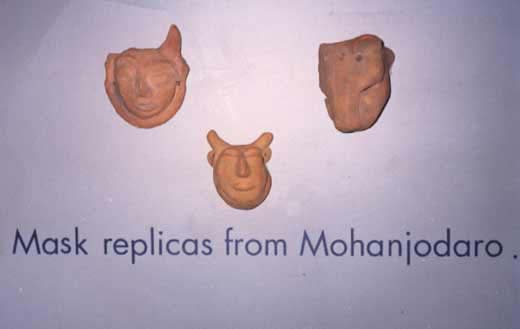
a fundamental endeavour of mankind as he created masks. Rock paintings
found in Africa, Europe or in Asia dates back to some 30000 years do
depict masks of myraid style and size. Since then to the modern man love
for mask remained an integral element of human sociology. To understand
the mask from global perspective an International Mask Festival was
organised at New Delhi which was organised by Indira Gandhi National
Centre for the Arts and others. The festival traversed through ‘mask’
stage performances through a seminar ‘Mind, Man and Mask’ to a real global
mask exposition which exhibited some 400 masks from all over the globe.
Though today ‘Mask’ remains in the periphery of
theatrical levels, but its origin rests in folk religion. For Indonesian
through ‘mask’they enact the Hindu spiritual tradition of South East Asia,
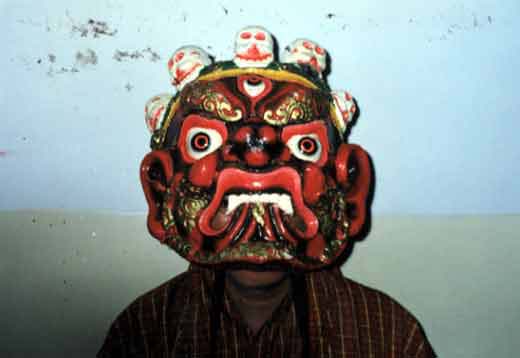
in the Himalayan Tibet, Bhutan or in Nepal the ‘buddhist’ traditions play
within those ferocious masks to fight out ‘evil’. Same goes in India,
where mask is very powerful communication within ‘sacred’corridor of
tribal people. In Africa, for example Zimbabwe, Mask plays the role of
‘family spirit’ who is guide and philosopher for its progenies. Its true,
those ‘spirit masks’ are symbolically dispeller of darkness and a link
between ‘seen’ and ‘unseen’ . Lucky Mayo explained that " this is no mere
belief system but a matter of ‘experience’ even amongst modern man". But,
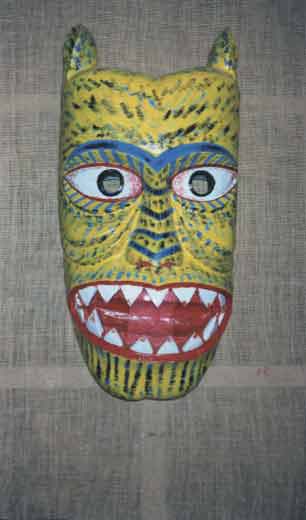
one Sri Lankan mask known as ‘,pehaps surpasses all. It is a mask
depicting various kinds of diseases some say 16,or 18 or more and ‘masker’
plays the role of ‘healer’. "This mask, though part of a very old folk
tradition is still in vogue in remote areas of Sri Lanka," said Prof. M.S.
Goonatilake .