The Relocation Program

United States Department of the Interior
For sale by the Superintendent of Documents
J.A. Krug, Secretary
War Relocation Authority
D.S. Myer, Director
U.S. Government Printing Office, Washington 25, D.C.
Price 35 cents
On December 7, 1941, approximately 113,000 persons of Japanese ancestry, two-thirds of them American citizens, were living in freedom in California, Washington and Oregon. A few months later their freedom was largely restricted and within less than a year all of them were gone from these States. Events Leading to Establishment of the War Relocation Authority
This report deals briefly with the movement of the people from their homes, under conditions of Government control, to assembly and relocation centers, and at greater length with their eventual movement from these centers back into the normal stream of American life.
Immediately after the attack on Pearl Harbor, the Department of Justice apprehended and took into custody all persons suspected of loyalties inimical to the interests of the United States. In this group there were many persons of Japanese1 ancestry. Within 2 months after the outbreak of war considerable pressure developed to move the entire Japanese population from the west coast. In February, things began to move rapidly in that direction.
On February 13, 1942, the west coast congressional delegation formally recommended to the President that all persons of Japanese descent be evacuated from the Pacific Coast States. The next day, the Attorney General designated a strip of the California coast 500 miles in length and from 30 to 150 miles in width as Restricted Area No. 1 with a 9:00 p.m. to 6:00 a.m. curfew for all enemy nationalities, and restricted all their movements to within 5 miles of their homes, effective February 24.
Five days later, on February 19, 1942, the President signed Executive Order No. 9066 empowering the Army to designate areas from which "any or all persons may be excluded." On March 2, General
Note: This report prepared by staff members of the Relocation Division.
John L. DeWitt issued Public Proclamation No. 1 designating Military Area No. 1, consisting of the western half of Washington, Oregon, and California, and the southern portion of Arizona. Later, Military Area No. 2 was established as the remainder of these four States. The proclamation stated further,"Any Japanese, German or Italian alien or any person of Japanese ancestry now resident in Military Area No. 1 who changes his place of habitual residence is hereby required to obtain and execute a 'change of residence' notice at any United States Post Office. Nothing contained herein shall be construed to affect the existing regulations of the United States Attorneys which require aliens of enemy nationalities to obtain travel permits from the United States Attorney General and to notify the Federal Bureau of Investigation and the Commissioner of Immigration of any change in permanent address."
To the press, General DeWitt said that enemy aliens would be excluded from Military Area No. 1 in the near future. He also promised that American citizens of Japanese ancestry would be excluded and that Japanese would be the first to go. He advised persons in these categories to move out their families voluntarily and thus save themselves even greater troubles in the future, emphasizing to them that it was their patriotic duty to make this move voluntarily and with a minimum of inconvenience to the Government. The Western Defense Command was in effect telling aliens and one certain group of citizens to take their children and leave the coastal region, but was not suggesting where they might go or how they might get there. As a result of these pleas, however, a good many thousands of Japanese started moving from Military Area No. 1. From all of the neighboring States began to come violent protests against receiving a population that California, Washington, Oregon and the Army had discredited. Apparently nobody wanted these refugees. The Japanese people were alarmed by rumors of plans to separate husbands and wives in concentration camps and to separate children from their parents.
In February, Representative John Tolan, chairman of the House Committee on National Defense Migration which was at that time investigating evacuation, wired a recommendation to Washington for the appointment of an Alien Property Custodian for the Pacific coast region and stressed the need of making specific arrangements for giving assistance to the evacuees. Before such arrangements could be made about 8,000 Japanese had been obliged to leave prohibited "spot" areas on very brief notice or had hastily accepted General DeWitt's recommendations. Many of these people had been victimized by land sharks and racketeering second-hand dealers and had no money or place to go. The testimony before the Tolan Committee on February 23 in San Francisco reveals an utter confusion of ideas and the lack of any practical system for handling the problems of the dislocated people.
By March 2, when General DeWitt issued Public Proclamation No. 1, it was becoming apparent to the Western Defense Command that voluntary evacuation would not dispose of the entire west coast Japanese population in an orderly fashion or within a reasonable time. Problems of property disposal, finance, employment and public acceptance in other areas were constituting blocks to this voluntary movement. The minor evacuation movements of Japanese aliens in February from prohibited "spots" designated by the Department of Justice had resulted in many bewildered and impoverished families moving in with relatives or friends in already crowded quarters or camping in their back yards in other sections of the same town or city. Some had moved as far as the interior valleys of the West Coast States to the dismay of some of the citizenry of these regions. Very few had been able or willing to migrate east of the State lines. It gradually became clear that controlled evacuation would have to be arranged for those people who could not plan or finance their movements, and that provisions would have to be made for the maintenance of a part of the Japanese population for an indefinite period until more normal resettlement could be effected.Up to this time, the Army's sole concern in the matter had been with physical evacuation, with clearing the designated military areas of Japanese. It was not considered feasible or proper that the Military should assume responsibility for the thousands of families involved or that it should administer an extensive resettlement program. Such a task appeared more proper for a civilian agency. Discussions were held between representatives of the Department of Justice, the War Department and the Bureau of the Budget,and a decision was made to create a special war agency to assume responsibility for the evacuated population.
On March 18, 1942, the War Relocation Authority was officially created.
Never before in the history of the United States had military decision dictated the exclusion of a largely citizen minority from a section of the country. No previous Government agency had faced the same problems as now faced the War Relocation Authority and no precedent or guideposts were available for devising its policy and program. In the past 125 years, this Government had not even in wartime seriously interfered with the freedom of enemy aliens except insofar as they were individually suspected. The fact that in this instance two-thirds of the people to be evacuated were American citizens by birth enormously complicated the problem. It was agreed that the Executive order creating this war agency should be broad and general. There was neither time nor precedent for initial preparation of a program in detail. How and where the resettlement was to take place were questions that time and experience alone
could answer. At this stage it was believed that other nationalities beside the Japanese might be evacuated.2On March 7, 1942, Milton S. Eisenhower, Land Use Coordinator of the Department of Agriculture, went to San Francisco to look into the Japanese situation. He returned on March 15, and 3 days later, the President signed Executive Order No. 9102 establishing the War Relocation Authority in the Office for Emergency Management. At the same time, Mr. Eisenhower was officially appointed by the President to head the agency.
The Director of the War Relocation Authority was "authorized and directed to formulate and effectuate a program for the removal, from the areas designated from time to time by the Secretary of War or appropriate Military Commander under the authority of Executive Order No. 9066 of February 19, 1942, of all the persons or classes of persons designated under such Executive order, and for their relocation, maintenance and supervision."
The first actions of the Director were to establish a regional office in San Francisco, to recruit staff, to confer with west coast representatives of other Federal agencies and to devise a tentative program. Offices were established in the Whitcomb Hotel in San Francisco, where the Wartime Civil Control Administration was already located.3 Fist Plans of the War Relocation Authority
The first plans formulated by the Director provided that the War Relocation Authority would have three principal functions:
- It would provide financial aid for Japanese required to move out of the military area but unable to do so because of lack of funds;
- It would establish a great many small work camps similar to Civilian Conservation Corps camps and scattered through the States west of the Mississippi River with the employable population living in camp and working chiefly on farms in the surrounding neighborhood;
- It would establish a group of waystations, possibly as many as 50 holding from 1,000 to 1,500 people to serve as dispersion points from which evacuees could relocate to jobs in urban centers or on farms.
The War Relocation Authority began immediately to make a canvass of existing housing which could be utilized by evacuees, investigating particularly the CCC camps, many of which had already been vacated by the Civilian Conservation Corps.
As soon as the San Francisco office was opened, calls began to come in great numbers from sheriffs and other public officials of inland communities protesting the number of Japanese passing through or settling in their jurisdiction. Calls also came from Japanese informing the War Relocation Authority that they were stranded in neighboring States because no one would sell them gasoline or necessary services. There were also frequent calls from the press in areas through which voluntary evacuees were moving. At Klamath Falls, Oregon, several Japanese were arrested to avoid violence. At Yerrington, Nevada, eight were met by hostile citizens and had to return to California. At Swink, Colorado, local residents demanded the recall of evacuees.
By late March, it had become apparent that the resentment of the interior States toward continued voluntary evacuation was based upon a complete misunderstanding of the status of the evacuees as well as upon war=bred fears and prejudices. Sheriffs from these States frequently reported that "California Japanese were escaping" from the military areas. Officials and residents of the interior regions were not aware that the military authorities were urging the evacuees to leave the West Coast States and establish themselves in inland areas. There was also widespread opinion that California, Washington and Oregon were "dumping undesirables."
It was obvious that voluntary evacuation could not continue without widespread disorders and possible risk of physical violence being directed against the Japanese. The War Relocation Authority's first general act was to recommend to General DeWitt that he prohibit further uncontrolled evacuation. The result was Public Proclamation No. 4, issued March 27, 1942, requiring all Japanese to remain within Military Area No. 1 without change of residence after midnight of March 29l. In the 2-day period before the proclamation was issued and before the "freeze" became effective, several thousand persons left Military Area No. 1. Proclamation No. 3, issued March 24 had
established a curfew affecting all persons of Japanese ancestry in Military Area No. 1, effective between 8:00 p.m. and 6:00 a.m., during which hours Japanese were obliged to be either in their place of business or in their homes, and could not pass between those places. During the day, they were not permitted to travel more than 5 miles from home.The Wartime Civil Control Administration, with the growing recognition that a vast majority of the evacuated population could be relocated only gradually and over a considerable period of time, set about establishing assembly centers to receive the evacuees temporarily until more permanent camps could be constructed and the population transferred to the jurisdiction of the War Relocation Authority. Sixteen assembly centers, most of which were set up in former race tracks or fairgrounds, were occupied by the evacuees under the Wartime Civil Control Administration.
Because of the general misunderstanding of evacuation and the status of the evacuees in Western States, and in order to explore more fully the possibilities of a widespread resettlement program,. a meeting was called at Salt Lake City on April 7,1942, to explain the situation to the officials of the States in which the Authority might be operating. The conference was attended by governors or their representatives, attorneys general or their representatives, State extension service directors, State agricultural war board chairmen, and State Farm Security Administration directors from 10 of the Western States. Conference With Governors at Salt Lake City
The meeting was conducted jointly by Colonel Karl R. Bendetsen, Assistant Chief of Staff in Charge of Civil Affairs, Western Defense Command and Fourth Army; Tom C. Clark, Chief of the Civilian Staff, Wartime Civil Control Administration; and M.S. Eisenhower, Director of the War Relocation Authority.
Mr. Eisenhower described the tentative plans which the War Relocation Authority had devised for assisting evacuated persons to resettle in other parts of the country. He explained in considerable detail the situation and status of the evacuees and requested the cooperation of the people and officials in facilitating their resumption of normal living, pointing out that one untoward incident directed toward evacuees would bring reprisals on Americans who had been interned by the Japanese Government.
Mr. Eisenhower gave assurance that the War Relocation Authority would conduct its program in a manner which would not cause long-time social, economic and political problems for the communities in which resettlement might take place.Most of the governors and attorneys general, however, were not sympathetic to the program as outlined. Some expressed complete and bitter animosities toward settlement or purchase of land by an Japanese in their States. Some indicated definite suspicion or conviction that California was using interior States as dumping grounds for an old problem. Some refused to recognize that Japanese, even though United States citizens, had any rights. Some indicated that the temper of the people in their States could not be controlled unless Japanese who had already entered the States were brought under guard. Some opposed Japanese entering private business. Some demanded that the Federal Government guarantee to remove any and all Japanese remaining at the end of the war. Some indicated that the States could operate the program if Federal funds were made available to them. The official conception by State officers of the type of program best suited to the situation was one of concentration camps with workers being farmed out to work under armed guards. Some representatives advocated out and out detention camps for all Japanese.
The governors and attorneys general utilized most of the conference time and, unfortunately, did so to a degree which gave the farm elements present little opportunity to express their need of workers from the evacuated population.l The elements representing the farmers at the meeting did indicate that evacuees were needed for seasonal and other labor, and stressed the acute labor shortage, particularly in the beet fields.
Colonel Bendetsen pointed out the distinction between internment and evacuation, explaining that under the evacuation program, the military commander of an area could determine who would be permitted to remain in the area and under what conditions, who should be removed from the area, or who might enter the area. Outside of designated military areas, citizens of the United States, he explained, were free to come and go. The Army's control over such persons applied only in these designated military areas.
He advised that the guarding by the Army of small camps, such as might be provided by former CCC camps, would be impractical from a military standpoint, and that the Army would not undertake to guard centers housing less than 5,000 persons.
The Salt Lake City conference was extremely disappointing to those who had hoped that favorable reception for the evacuees could be obtained by informing State officials of the exact nature of the
evacuees' situation. Mr. Eisenhower, in closing the meeting, said that, in view of the attitudes and conditions specified by the governors and attorneys general of the States, immediate requests for evacuee workers would have to be denied.The Salt Lake City conference was fundamental in setting the character of relocation centers as they finally evolved.
In planning the establishment of relocation centers, every possible attempt was made to make them approximate the American small town. Even in the planning stage, it was realized that this degree of approximation could not be close, and once the centers came into being, it was obvious that they could never bear more than superficial resemblance to normal free communities. Perhaps the most noticeable of the deviations from normal living was the absence of cooking facilities in the family unit. Community cooking, community eating, community bathing and toilet facilities which were common to all relocation centers are not common to American living, and they tended to lessen the effectiveness of family relationships. Equally conspicuous and out of the normal pattern was the barbed wire fence patrolled by military police which surrounded each relocation center. This not only limited the movement of residents, but was also psychologically bad. Factors Changing Relocation Plans
It was quickly realized that: (1) loyalty would not flourish in an atmosphere of restriction and discriminatory segregation; (2) it was recognized that such wide and enforced deviation from normal cultural patterns of living might have lasting and unfavorable effects on the individuals exposed to them, particularly children and young people; and, (3) that there was an obligation on the part of the War Relocation Authority both to the evacuated people and to the people of the United States to restore all loyal citizens and law abiding aliens to normal useful American life with all possible speed.
The War Relocation Authority had no sooner announced its decision to send all evacuees to large relocation centers following the Salt Lake City conference, than agricultural interests in the Inter-Mountain States began requesting the release of evacuees directly to communities in these States for work in sugar beet fields Seasonal Leave
and other types of agriculture. These requests which were advanced with great force were in direct conflict with the governors' and public officials' thinking in these States as expressed at the conference. These requests began to be received about mid-April, and by May, were very insistent.The Authority recognized that its position would be untenable with a large reserve of workers idle in relocation centers. Executive Order No. 9102 had provided that workers volunteer for the duration of the war and would be placed in private or public employment under the direct supervision of the War Relocation Authority. It had been expected that evacuees would greet the work corps with favor and that most able-bodied young people would wish to join it. The first official attempt to gain recruits for the work corps was in the Portland Assembly Center about mid-May. Workers joining there were to be sent to beet fields in eastern Oregon to help in meeting a severe spring labor shortage. Four men were sent from the San Francisco regional office to the Portland Assembly Center to start the enlistment. They found the evacuees wary of the work corps idea and full of questions for which no answers were ready. The enlistment form impressed the evacuees as bearing too much resemblance to a blank check presented for their signature. No workers were recruited at Portland, and upon the recommendation of the recruitment team, the work corps plan for recruiting seasonal workers was abandoned.
The demand for seasonal workers in the Inter-Mountain States continued to grow. The very governors who had been opposed to the presence of any evacuees in their areas, except under armed guard, were now in the position of demanding that the War Department release evacuees from assembly centers to assist their farmers in the spring work. Finally, at the insistence of several large beet companies and farm organizations, most governors and other public officials were forced to reverse their stand.
IN order to protect the interest of both the evacuees and the general public, the Director of the War Relocation Authority and the head of the Wartime Civil Control Administration, drew up a plan whereby evacuees could be released from assembly centers for seasonal agricultural work. This agreement provided that the State governors and the local law enforcement officials, including the sheriff, county judge, county prosecuting attorney and a county commissioner would sign a pledge that evacuee labor was needed,and that, if released to the county and State, the above officials would guarantee the safety of the workers.This agreement also provided that the employer would provide transportation to and from the assembly center or relocation center, that they would pay prevailing wages, that
there would be no displacement of local labor and finally that the United States Employment Service in the county would guarantee that adequate housing would be provided, without cost to the evacuee, in the area of employment.At this time, the great majority of evacuees were in assembly centers under the jurisdiction of the Army, and before the Army would release any evacuee,it was necessary for the War Relocation Authority to accept the responsibility for administering the program. It was also necessary, before any workers were released, for the WRA to forward documentary proof to the commanding general of the Western Defense Command that the State and community had met all of the above conditions. Upon receipt of this proof, the general issued a public proclamation permitting certain evacuees to work in a specific county only. These proclamations were posted in the county in question and prohibited the evacuees from moving from that county without his permission. The first county which complied with these regulations was Malheur County in the State of Oregon. Recruiters from the Amalgamated Sugar Company went into the Portland and Puyallup Assembly Centers with the officials of the United States Employment Service. They at first had very little success in recruiting the number of workers desired. Evacuees were very reluctant to venture into the outside areas where they were still being criticized by many public officials and by the population as a whole. They were also dubious about working conditions, and were afraid that they might be getting into something from which they could not withdraw.
However, on or about May 20, a small party of about a dozen evacuees left the Portland Assembly Center for Nyssa, Oregon. After a few days of exploring the living and working conditions in the area, they reported back favorably to the Portland Assembly Center, and immediately, additional workers were recruited. Numerous counties in Idaho, Utah, and Montana then made application for workers. In most counties and in most States, however, some of the public officials whose names were required on the seasonal work agreement objected to the use of evacuee laborers,or wanted to put special conditions on their use. A great deal of pressure was applied on the Army and the War Relocation Authority to modify the conditions under which the workers would be released to these areas. However, the Authority refused, and eventually most of the Western States and a good share of the counties where seasonal labor was needed,signed standard agreements for the use of evacuee labor. By the end of June, approximately 1,500 workers had been recruited. Attempts had been made to recruit many times this number, and there was a great deal of criticism against the evacuees and against the War Relocation Authority because so few evacuees had volunteered for seasonal work. Farmers and other employers who were desperately in need of getting labor could not understand the fears of evacuees; neither could they
understand that, out of 113,000 people, only a small proportion were able and qualified to do the work in question.Many public officials were worried about the treatment evacuees might receive in inland areas. Elements in some of the communities to which evacuees were going were bitterly opposed to their coming. Some threats were made against the evacuees. However, on the whole, there were few incidents and none of these were serious. Word was gotten around in the communities that these newcomers were Federal charges and that anyone acting against them would be answerable to Federal officials. There were instances of fist fights and other minor difficulties, but the speed with which these incidents were dealt with and the fact that inquiries were made by Federal officials discouraged repetition. On several occasions, WRA threatened to withdraw workers from individual communities, and, as a result of these threats, employers saw to it that reception was immediately improved. Public officials who had signed statements offering protection to the evacuees know that they were no the spot, and were generally diligent in quieting opposition. Evacuees won for themselves many friends, which tended to ease tensions. Most employers were high in their praise of the evacuees in comparison to other seasonal laborers. This last fact, coupled with the careful, conscientious job done by most of the evacuees, raised another problem, however, leading to a great deal of bidding among employers for their services. The initial employers had gone to unusual expense to recruit evacuees and pay their transportation. Other employers in the community would then try to lure away these workers by offering better wages and better housing. The public relations program resulting from this labor pirating made it necessary eventually to work out a specific contract which bound both the employer and employee as long as contract conditions were met.
After the urgent need for spring labor lessened, there was in most areas, a slack period, and the problem of keeping the evacuees employed became a major one. Frequently, evacuees after only a day or two of unemployment requested immediate return to the assembly center, leading to dissatisfaction on the party of the employer who had hoped to keep the evacuees in the field during the entire season.
Up to the middle of July, there was only one person in the San Francisco office assigned to the administration of the entire seasonal leave program. Everyone, including law enforcement officers, had come to regard evacuees as being quite special cases. The San Francisco office was flooded with questions. In some instances,local law enforcement officers were reluctant to arrest an evacuee who broke local laws and ordinances, and called the San Francisco office for advice on this and other minor problems. In July 1942, one additional employee was placed on the staff and sent to the field
to work on local problems. However,during all of the summer months, these two individuals assigned to the seasonal leave program had more work to do than they could properly accomplish.In early September, the sugar beet companies from the inter-mountain country sent representatives to San Francisco to attempt to work out a larger seasonal leave program for the fall harvest. Six or eight large companies were represented, covering States as far east as Nebraska and North and South Dakota. Most of the evacuees were still in assembly centers and the Army was represented at the meeting. The process of transferring from assembly centers to relocation centers, however, was in full swing and decisions in administrative planning at this meeting rested with the War Relocation Authority. A general work contract was agreed upon and the ground work was laid for a large recruitment program in all assembly centers and in the relocation centers that were already opened. The Authority started recruiting additional personnel to handle the expected large movement of workers and by the middle of October had established offices in Boise and Idaho Falls, Idaho; Helena and Havre,Mont.; and in Salt Lake City,Utah. These offices were to be administered by the San Francisco regional office. Each was staffed with one employment investigator and one secretary. The Denver region employed two relocation officers to work in Wyoming and Colorado.
Shortly following the seasonal work conference in San Francisco, which was to coordinate all recruiting activities, the San Francisco office received applications for tens of thousands of seasonal workers. In addition to the sugar companies, many individual farmers, agricultural companies and industrial concerns applied for evacuee labor. Each of them expected to get labor within a few days' time, and chagrin was expressed over delays and disappointments in regard to employers' requests. By the middle of October, however, approximately 10,00 evacuees were scattered through the Western States helping in harvest work. They made a major contribution in saving agricultural crops in the inter-mountain area during the fall of 1942.
While the seasonal leave program was getting started during the spring, thousands of persons in assembly centers or still "frozen" in their homes, were clamoring to be permitted to leave. Voluntary evacuation under certain conditions was still permitted by the Army even after the order of March 29 was issued which forbade free movement of Japanese out of designated military areas. Subsequent to that date, a relatively few Japanese were permitted by the Military to leave on the basis of "rather thorough investigation." Most of these were the families of persons who had previously found jobs outside the restricted area. Although more than 10,000 persons served formal notices of intention to leave Military Area No. 1 during the period when they might leave on any basis at all, only
4,889 actually established themselves in free territory during the entire period. Colorado received 1,963, Utah, 1,519, Idaho, 305, eastern Washington, 208, eastern Oregon, 115, with the remainder scattered throughout other States.About 4,000 persons migrated from Military Area No. 1 to Military Area No. 2 from March 12 to June 30, 1942, when such moves were recorded. About 90 percent of this migration was to Military Area No. 2 in California, which was later evacuated. People who had moved into eastern California voluntarily, and frequently with considerable hardship, in compliance with the requests of General DeWitt that they evacuate from Military Area No. 1, were most bitter when, without further warning, they were involuntarily evacuated from their new homes. While no commitment had been made by General DeWitt to the effect that eastern California might lot later be evacuated, it had generally been assumed by this group that in complying with the general's request they would avoid the hardships of detention,, whereas in fact,they suffered the inconveniences and difficulties of voluntary evacuation plus all of the hardships which would have been their lot had they originally remained in their homes.
In addition to such leaves as the Army permitted for the purposes of seasonal work or for individuals under special circumstances to join relatives east of the restricted area, some young people were permitted to leave the coastal area for the purpose of continuing college and university studies. Almost from the beginning of evacuation, a number of nongovernmental organizations, notably the American Friends Service Committee, had begun work on this problem with the formation of the National Student Relocation Council. In the latter part of May 1942, the efforts of these groups were united and brought into sharper focus. The council, established with the express approval of the War Relocation Authority and the War Department and composed of a number of college presidents and other prominent educators, rounded out its final organization in a meeting held at Chicago on May 29. President John W. Mason of Swarthmore College was elected chairman, and national headquarters were established in Philadelphia. During June, the activities of the council were carried forward by two coordinate groups. The west coast subcommittee operated under the leadership of Joseph Conard, and concentrated its efforts on students interested in transfer and on investigation of their academic fitness and financial status. The eastern group, with President Robbins W. Barstow of Hartford (Conn.) Theological Seminary as executive secretary, meanwhile directed its efforts toward determining which colleges or universities outside the evacuated area would accept evacuee students and how many evacuees might thus be transferred. Clearance of colleges with the War and Navy Departments was handled by the War Relocation Authority.
At the same time the Authority was exploring with a number of college officials the possibility of extension or correspondence courses in relocation centers so as to provide for the needs of students unwilling or unable to transfer to outside institutions.Looking to the opening of the fall term at colleges and universities, the War Relocation Authority and the National Student Relocation Council intensified their efforts throughout the summer of 1942 to arrange for the attendance of properly qualified evacuee students at institutions outside the evacuated area.By September 30, a total of 143 colleges, universities and junior colleges had been approved for student relocation by both the War and Navy Departments. In general, these Departments excluded, on the basis of military security, those colleges having Army or Navy contracts. However, those approved included such liberal arts colleges as Swarthmore, such State universities as Nebraska and Texas, such women's colleges as Smith and Radcliff, such Catholic institutions as Gonzaga, such teachers' colleges as Colorado State College of Education, such technical institutions as the Milwaukee College of Engineering, and such specialized schools as the Northern College of Optometry and the Oberlin Conservatory of Music.
Under a tentative leave policy adopted on July 20, a total of 250 students were granted educational leaves from assembly centers and relocation centers prior to September 30. Some of these students left during late July and August to attend summer sessions at various institutions, but the majority went on leave in September and resumed their educations with the opening of the fall academic term.
During the first months of WRA's existence, a small staff was busy meeting the urgent, pressing problems--problems of getting the first relocation centers into operation; of feeding and housing; and meeting the other minimum needs of the thousands of people arriving in the centers; establishing policies for work in the centers and of assigning evacuees to work; of handling the thousands of requests from western farmers for evacuee labor and of getting the labor out to the farmers; of handling arrangements for individual hardship cases--usually people having families already on the outside--to leave the centers. At this period there became evident what appears to be a complete reversal of national policy in regard to the disposition of the evacuated people. Initially, the Army, in ordering the evacuation, had apparently anticipated that the west coast Japanese would be able, without Government aid, to move to unrestricted areas of the country and continue normal self-support. The adverse Early Relocation Policies
experiences of voluntary evacuees and the unfavorable community attitudes shown in many, if not most, sections of the country to which they had gone, the bewilderment of the uprooted people and the fears which many of them so plainly showed toward resettlement, had caused most concerned people to be of the opinion that relocation centers would need to be maintained as havens of refuge for the duration of the war for the majority of the evacuees. It was not forgotten, however, that regulations had to be established under which those evacuees who wanted to leave the centers for seasonal work or for other purposes could be permitted to do so. The establishment of these regulations presented a problem of conflicting needs. The legality and desirability of detaining evacuees, particularly the American citizens among them, was questionable. However, the hostility, doubts and fears of the public at large, engendered by the evacuation towards this group of people, had to be recognized as did the fears and doubts of the evacuees themselves. Consequently, WRA decided that it would have to work out a program of controlled relocation which would permit the relocation of a majority of the population as fast as the fears of the public could be allayed.The primary concern of the War Relocation Authority at this time was the meeting of minimum physical needs of people arriving in the relocation centers. Little time was available to plan and work out any kind of relocation program. However, because of extreme pressures, by the early summer of 1942, a general policy had been established for seasonal agricultural leave. The first general leave regulations for permanent relocation issued by the War Relocation Authority were contained in a tentative leave policy dated July 20, 1942. Only American-born evacuees who had never lived or studied in Japan were permitted to apply for leave under these regulations, and leave was granted only to applicants who had definite offers of employment outside the area under jurisdiction of the Western Defense Command. It must be remembered that, at this time, the majority of evacuees were still under Army jurisdiction in assembly centers and that many remained under the Army's control until November 1942. It was consequently necessary to get Army permits for these individuals to leave. The Army was generally extremely reluctant to release individuals. Many permits requested by the War Relocation Authority were turned down by the Army. Early Procedures
Caution in planning these first leave regulations was also inspired by instances of violence and threats against the Japanese which occurred during the voluntary evacuation period and by statements which were still being received from many parts of the country
that the evacuees were not wanted. Ignorance of the program and lack of previous contact with Japanese had led to individual evacuees being molested, and communities in which they had arrived, unannounced, being upset. The first leave regulations were consequently cautious ones and were aimed to release only individuals who could be expected to adjust most readily to early resettlement conditions.Even as these restricted regulations were being initiated, more liberal ones were being worked out, and considerably more comprehensive set of regulations which would permit leave for broader sections of the population became effective October 1. By this time, most of the evacuees had been transferred to relocation centers and were under the sole jurisdiction of the War Relocation Authority. Also, the outstanding success of the seasonal leave program, distinguished by an almost complete lack of major disturbances and the acceptance of evacuees by residents of communities which had been originally hostile, indicated that relocation and private employment in other parts of the country might be feasible. The Chief of the Employment Division made several trips through the Middle West during the fall to canvass relocation possibilities in that part of the country. While there had been some instances of protest from midwestern communities, he became convinced that if the program were judiciously handled resettlement of evacuees in this part of the country was practical.
Under these new regulations, any evacuee, citizens or alien, could apply for leave to visit or reside in any locality outside the evacuated area. Three types of leave from relocation centers were provided for in the regulations.
1. Short-term leave was intended for the evacuee who wished to leave the center for a period of not more than a few weeks in order to consult a medical specialist, negotiate a property arrangement, or transact other personal business. It was granted by the project director for a definite period after careful investigation of the applicant. If the project director denied an application for short-term leave, appeal could be made to the National Director whose decision was final.
2. Work-group leave (laster called seasonal leave) was designed for evacuees who wished to leave the center for seasonal agricultural work. Like short-term leave, it was granted by the project director for a definite period (which could be extended) and was subject to investigation at the center. Wherever possible, a record check was made with FBI and the intelligence services on applicants for this type of leave. However, the project director had the power to grant such leave without this check if he felt that circumstances warranted.
3. Indefinite leave was granted to evacuees only by the National Director and only if four specific requirements were met: (a) the applicant for such leave had to have a definite offer of a job or some other means of support; (b) there must be no evidence in the applicant's record either at the relocation center or with the several Federal intelligence services indicating that he would endanger the national security; (c) there had to be reasonable evidence that the applicant's presence would not be unacceptable in the community in which he planned to live; and (d) the applicant had to agree to keep WRA informed of any change of address.The first of the four requirements for leave was to reassure communities to which evacuees might be going that they would not become public charges and had reasonable assurance of self-support. The second was to reassure the receiving community of the newcomers' loyalty. The third requirement was made in order to give reasonable assurance to the evacuee regarding the reception which he might expect in the new community. It was also intended to give the WRA time to prepare the community for his reception. THe need for such preparation was clearly evidenced by the unfortunate experiences of voluntary evacuees going into communities which did not understand their situation. Once an unfortunate incident occurred, it was extremely difficult, if not impossible, to get that community to accept other evacuees. The fourth requirement in regard to notice of address change was to enable the War Relocation Authority to serve the evacuee.
Within the centers, during the first few months of their operation, facilities were not well developed for assisting the evacuee in his plans to relocate. Staff was frequently inadequate in numbers, and inexperienced in its new job. The handling of leave applications and of advice to evacuees in regard to relocation plans was originally made a part of the functions of the employment division in the center which, at that time, had as its most immediate function the assignment of workers to job within the project itself and the recruitment of workers for essential project jobs. Commonly, the same appointed staff member in the center was in the position of having to choose between advising an evacuee engineer, for example, who services were badly needed on the project, to take this project job at the same time that openings might exist for the same individual in communities outside the center. The employment division staff was also responsible for the assignment of housing in the center. During the summer of 1942, this was a critical assignment, and frequently precluded much time being spent on relocation.
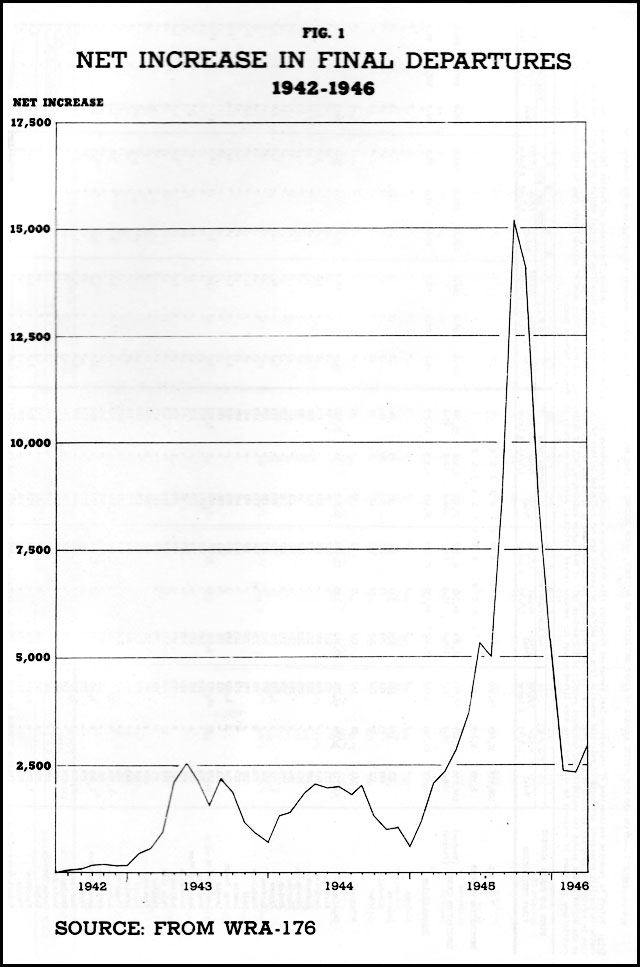
The movement of evacuees out of the centers and back into life in outside communities began very slowly. Prior to October 1, 1942, fewer than 273evacuees (including students) had gone out of the relocation centers on indefinite leave under the policy of July 20. By the end of the year, 2,200 applications for advance clearance had been file,d but only 250 applications for indefinite leave had been granted and only 866 evacuees had actually left the centers. It should be pointed out,however, that, in addition to the 193 persons who left relocation centers on indefinite leave, approximately 750 persons who left assembly and relocation centers on seasonal leave did not return to a center. Early Relocation Progress
The slow progress of the relocation program was due to many factors. The procedures governing leave clearance were cumbersome and time consuming. Applications had to be assembled at the centers and forwarded to Washington.In Washington they had to be sent to the intelligence agencies to be checked against their files; then they had to be reviewed and returned to the centers.
In addition to the procedural difficulties, there were adverse psychological factors. Many evacuees were reluctant to leave the sanctuary of the centers and face a public which might be hostile. Others were bitter because of evacuations and decided they would not leave until they could return to their own homes with all of their civil rights restored. An unmeasurable but important factor was the amount of misinformation circulated at the centers. Some of these rumors, most of them without any foundation in truth and some of them calculated to arouse extreme fear, were deliberately concocted by trouble-makers. Some influence against relocation was also exerted by individuals who had acquired prestige in the new communities and were anxious to retain not only their leadership but the continued presence of the people they were leading.
Stories were whispered to the effect that relocating people would be used as slave laborers, would be underpaid and uncared for. There were occasional tales of individuals and even groups having been murdered. Minor incidents and unpleasantnesses experienced by a few of the early resettlers were exaggerated or misunderstood and grew into fanciful tales of extreme hardship. In the atmosphere of distrust and confusion existing at the centers, each of these rumors was likely to assume grotesque proportions. In addition, a number of the Caucasian appointed staff were innocently or otherwise guilty of opposing plans for relocation, and of contributing to the mass of misinformation. A small percentage of the Caucasian staff members were
was designed to speed the procedures of leave clearance, collecting in one operation personal data on all evacuee residents over 16 years of age.The third step was the adoption in mid-March of a policy providing for limited cash grants to needy evacuees going out of the centers.
The fourth step was the decentralization of the leave clearance machinery so that in the majority of cases indefinite leave could be granted at the relocation centers without referral to Washington.
To administer the seasonal work program, seven field offices had been opened in the Inter-Mountain States. While these offices were established because of the seasonal leave program, as early as November 1942, they began to devote a good share of their time to promoting permanent relocation among seasonal workers, and were successful in helping many seasonal workers to remain outside the centers at the end of their work contract. In December, plans were made to open field offices in the Middle West and East to effect permanent resettlement. The Opening of Field Offices
Even before relocation offices were formally opened, resettlement committees had been established in many midwestern cities. Groups of concerned individuals representing many interests in the community, particularly the churches, had formed resettlement committees in Chicago, Minneapolis, Madison (Wis.), Cleveland and other cities, as a result of visits by the Chief of the Employment Division during the fall of 1942, and through the efforts of the Federal Council of Churches. At first, these committees had chiefly concerned themselves with assisting voluntary evacuees who had come into their cities. Later some of the committees began correspondence with center residents with a view to assisting individuals to relocate.
The first midwestern relocation office was opened in Chicago on January 4, 1943. In rapid succession similar offices were set up in Cleveland, Minneapolis, Des Moines, Milwaukee, New York, and numerous other key cities throughout the Middle West and East. By the close of the fiscal year 1943, there were 42of these offices scattered from Spokane, Wash., to Boston, Mass. For the next 2 years, offices showed only a slight increase, but there was substantial shifting in the location as the general trend of relocation moved eastward. Thus offices in the inter-mountain region
distrustful of the Japanese population in the centers, regarded them as "the enemy," and regarded themselves as jailers. This small group naturally opposed relocation planning both from a policy standpoint and in their contacts with evacuee workers. A second small group of Caucasian employees were overly sympathetic to evacuees and honestly shared with them their fears of unpleasantnesses to be faced outside the comparative safety of the centers. Because of the obvious genuineness of persons in this second group and the friendships which they were able to build up with evacuees and the consequent influence they exercised, their effect on relocation planning was probably the greatest deterrent effected by appointed staff members. A third and smaller group of Caucasian staff members were chiefly interested in maintaining their jobs and saw in relocation planning the eventual loss of employment. In general, the influence of the first and third groups ceased to be effective among most evacuees as the basis of their opposition became apparent. Many members of these two groups were weeded out as the program progressed.Other factors, too, tended to hold back evacuees. They were seriously hampered by remoteness from places where there were jobs. Unable to make direct contact with potential employers some residents had no effective way of knowing where jobs were, what types were available, or how to apply for them. Also, having lived for a few months in the centers without earnings, many evacuees lacked the cash necessary to establish themselves in new communities.
With all of the centers operating and the physical needs of the residents met, a heightened awareness developed of the need to promote relocation actively. The destructive effects of center life on the evacuees' morale was considerably more obvious after a few months of center living. Pressure for manpower throughout the country also compelled recognition of the large untapped manpower resources in the centers and of the excellent opportunities available to evacuees in most communities. The successful use of 10,000 seasonal workers in the fall of 1942 proved that large scale relocation was possible.
In the early months of 1943, the War Relocation Authority took action in a number of ways to accelerate outward movement. The first step was the establishment of field offices in a number of key cities throughout the Middle West and East to facilitate contact between private employers and evacuees at the centers and to develop widespread community acceptance for evacuees.
A second step was a large scale registration program carried out at the centers in February and March of 1943. This registration
closed or were consolidated while new offices appeared in such cities as Grand Rapids, Mich., and Buffalo, N.Y.Relocation offices were of two kinds, area offices and district offices. Each of the eight area offices was headed by a relocation supervisor and was generally responsible for relocation work of a rather broad geographical area. District offices, on the other hand, functioned under the general guidance of the relocation supervisor and in the immediate vicinity of the cities in which they were located. Area offices were maintained in Chicago, Cleveland, Denver, Salt Lake City, Kansas City, Little Rock, New York and Boston.
Both types of offices were assigned essentially the same basic functions. They served to provide the public in local areas with information about evacuees and the War Relocation Authority program. They solicited job offers, analyzed them and forwarded satisfactory ones to the relocation centers. They provided the War Relocation Authority with important information on public attitudes toward Japanese Americans in communities where relocation was contemplated. They fostered the establishment of new resettlement committees and collaborated with those already in existence to help resettling evacuees in a wide variety of ways to become satisfactorily established.
In the early months of their existence, the relocation offices were primarily concerned with creating favorable community acceptance and with finding suitable jobs that evacuees might fill. As a means of affecting community attitudes, relocation officers gave talks to business, professional, social, civic, church and fraternal groups; met with employers individually and in groups, enlisted the aid of unions when possible, and spoke to employees in plants where employment of Japanese was contemplated. Newspapers were provided with information in regard to the program. This public relations program was sufficiently successful so that in most communities opposition did not crystallize or become an organized movement. In those few communities in which opposition did organize, sufficient support for the program had been developed that, almost without exception, relocation continued to be possible and satisfactory. As a result of these efforts, job offers quickly piled up in relocation offices in greater quantities than they could be filled. As an example, the Chicago office by July 1, 1943, had offers which would have required more than 10,000 individuals to fill. These offers represented a wide although not all inclusive range of occupation. War plants and employers seeking domestic help were the most numerous and they were the most insistent upon getting the help which they had requested.
The early excess of job offers over takers from the centers led to a rather serious public relations problem, particularly in small communities and rural sections. Many employers had counted definitely on securing the help which they had requested and some of them had gone to considerable lengths to prepare for the advent of Japanese workers. Failing in most cases to get the requested help, employers' attitudes ranged from simple disappointment to unreasonable anger and in some cases, particularly in rural sections, to a condemnation of the Japanese group for its failure to leave what was regarded by some as a life of ease in the relocation centers and to accept wartime employment. While bitterness of this sort was most common among domestic employers, it was more serious when coming from essential war plants and agriculture.Sending job descriptions to the centers in volume was not very satisfactory. Evacuees who accepted employment on the basis of these usually scanty job descriptions and without a real knowledge of the job or personal contact with employers often found themselves unsatisfactorily place and there was a tendency to change jobs as soon as better opened up. Similarly, employers were sometimes disappointed in the individuals hired by correspondence or through the relocation officer as intermediary. In many instance, employers had advanced funds to evacuees for their relocation. This made the problem more serious.
The War Relocation Authority registration program and the program of recruiting for military service by the Army were carried out simultaneously at all relocation centers in February and March 1943. These programs were hastened by Secretary of War Stimson's announcement of January 28, 1943, that the War Department would create an all-Nisei combat team composed of volunteers from relocation centers in the United States and from Hawaii. When the War Relocation Authority was informed that the Army was planning a recruitment program in the centers, it was already developing plans for a mass registration of all adults to speed up the leave clearance procedures. The Army and the War Relocation Authority needed much the same type of background information about the people in the centers, and consequently the decision was made to combine Army recruitment and leave clearance registration in one large-scale operation to be carried out jointly by the Army and the War Relocation Authority. Leave Clearance Registration and Army Recruitment Program
It was believed that residents would welcome news of the formation of a Nisei combat team as an initial step toward the
restoration of citizenship rights. It was consequently expected that registration would proceed smoothly. However, the initial reaction of many Nisei in every center was one of resentment, because the proposed combat team was to be a segregated unit. The saw in the Army's program another instance of discrimination rather than one of restoration of rights.In each center, the registration program produced high emotional tension, and in some centers a crisis situation. It raised issues of major importance in the lives of evacuees--equality of citizenship, the obligation of military service, and Issei status. In addition the objection of many Nisei to the segregated nature of the proposed military service, many felt that they were being forced to volunteer for military service, whereas other Americans normally were waiting to be drafted. This belief that they were being forced to volunteer for military service was at least partially due to a misunderstanding of the wording of one of the questions on the registration form which required male Nisei of military age to state whether or not they were willing to serve in the armed forces.While it was the intention of this question simply to ask whether or not the individual was willing to serve if required to do so by Selective Service, it was not so interpreted by most Nisei. Some of the appointed staff were also not sure of the meaning of this question. To add to the confusion, it was at the same time that the Army's recruiting sergeants were bringing pressure to bear on the Nisei to enlist for the combat team. There is no question but what many of the negative answers and qualified answers to this question were the result of failure to understand it. Many Nisei also faced a not unnatural parental resistance to volunteering for service in advance of the normal action of Selective Service.
Prospective volunteers were concerned about what might happen to their Issei parents if they were killed in battle. They knew that their parents could not inherit real estate under the laws of the States in the evacuated area. They wondered if their enemy alien parents would be eligible for GI allotments. They knew that their elders, especially where they were non-English speaking or becoming infirm because of age, would face more than average difficulty if they were eventually forced out of the centers and into unfamiliar parts of the United States without their grown children to help them. One question on the registration form which Issei were required to answer was interpreted as, in effect, causing them to renounce Japan and embrace the United States, which country's laws prohibited them from securing citizenship status. Answering this question in the affirmative, in the understanding of it, would have left them men without a country.
The registration and recruitment programs are told in greater detail in reports of other divisions of the agency. As far as relocation is concerned, it had this positive result. The War Relocation Authority now had accumulated an extensive background of information on virtually every adult resident in the centers. For the first time, data required in connection with leave clearance was readily available on practically anyone who might apply for indefinite leave. The ground work had been laid for faster processing of leave applications, decentralization of leave procedure, and segregation of those whose loyalties seemed to lie with Japan.While registration clarified leave for most of the evacuees, it also complicated leave for many others. Under circumstances of confusion, misunderstanding, bad advice, and parental pressures, many answered loyalty questions with qualifications. Others, under duress and distress, expressed a lack of loyalty to the United States which they did not really feel. Persons falling into these last two groups, when time came for them to apply for leave clearance, found themselves at least temporarily and sometimes indefinitely blocked by elaborate procedures and repeated hearings with resultant delays. These people in turn tended to delay the relocation of family members and friends.
During the early months of 1943, as the relocation field offices began functioning and the old indefinite leave program began gaining tempo and broader scope, it became necessary for the War Relocation Authority to make a number of changes in its basic leave regulations. These changes were made primarily to speed up and simplify leave procedures by transferring to field offices and relocation centers several functions which had been previously exercised in Washington. Under the basic leave regulations which became effective on October 1, 1942, two actions were of central importance: (1) the application for leave clearance, and (2) the application for an indefinite leave permit. The first of these applications was submitted on a form somewhat similar to the questionnaire used during registration. Its purpose was to provide personal background data that could be used in determining eligibility for indefinite leave from a standpoint of national security. The application for an indefinite leave permit was made at the time the applicant was actually preparing to leave the center. It called for the specific destination of the individual, a description of the arrangements which had been made for employment or support outside the relocation center, and an agreement to keep the War Relocation Authority notified of changes in address. Changes in Leave Procedures
Until March 1943, each of these applications, whether made simultaneously or separately, was submitted to the Washington office for final action. In processing applications for clearance, a careful examination was made of information collected about the applicant at the relocation center, and a check was made against the files of Federal intelligence agencies. If there was no evidence from either source that the applicant might endanger the national security or interfere with the war effort, clearance was granted. Processing of applications for indefinite leave involved ascertaining that the applicant had a definite destination and means of support, usually a job, and checking as to whether or not public attitudes in the community to which he was going were such as to insure his safety. Prior to establishment of the field relocation offices, the check on public attitudes was usually made by writing to key officials and leading citizens in the community to which the evacuee was going. This check by correspondence was almost invariably unsatisfactory since,until public relations work was done in most communities, reaction of public officials was commonly negative.The first really important change in these procedures was made in tentative form on March 3, and clarified in greater detail on March 20. As finally worked out, the new procedure provided for decentralization of the handling of applications for indefinite leave.The purely mechanical function of issuing leave permits in cases where clearance had been granted was transferred to the relocation center. The important function of checking community attitudes was made the responsibility of the relocation field offices. The net effect was to accelerate handling of indefinite leave applications, to give field offices some control over the timing of the movement of resettlers into their districts, and to give them time to set in motion favorable public opinion.
The second significant change was adopted on March 24, 1943. It set up a system of providing financial assistance for evacuees leaving the centers on indefinite leave. Such assistance was limited to cases of actual need and was provided only to evacuees who were leaving the centers for the purpose of taking a job. It was not provided to those going out on student leave or those with independent means. The scale of grants was established at $50 for evacuees leaving the center without dependents, $75 for those leaving with one dependent, and a maximum of $100 for those leaving with two or more dependents. It was necessary to limit the size and number of such grants quite strictly since the Authority had at that time no money in its budget allocated specifically for this purpose. Later modifications adopted in April and May provided that grants might be made to the families of men in the armed services regardless of the purpose for which they were leaving the centers, and that evacuees going out to live temporarily in hostels for the
purpose of seeking employment after arrival would also be eligible. Later in the year, a further change in schedule of leave assistance grants was made to stimulate family relocation. The ceiling per family unit of $100 had proved an obstacle to the relocation of larger families. The new ruling reduced the grant for the individual going out alone to $25,but allowed $25 per capita to family groups regardless of size. Coach fare and $3 per diem while en route to destination were provided in addition to the fixed cash grant.A third major modification of the leave procedures and regulations was made on April 2, 1943. Once registration was completed and all dockets processed through the intelligence agencies, the War Relocation Authority was in a position to speed up clearance as a separate step in the leave procedures. The amendment of April 2 authorized project directors to grant indefinite leave permits without referral to the Washington office and in advance of leave clearance, provided certain basic requirements were met. The most important of these requirements were: (1) the applicant must have answered loyalty questions during registration with an unqualified affirmative, and 92) the project director must be satisfied, on the basis of evidence available at the relocation center, that the applicant would not endanger national security or interfere with the war effort. Issuance of permits in advance of leave clearance, however, was specifically prohibited in the case of (a) those who had applied for repatriation or expatriation to Japan, (b) those whose application for leave clearance had previously been denied, (c) Shinto priests, (d) aliens released on parole from internment camps by the Department of Justice, and (e) those who were planning to relocate in one of the eastern seaboard States in the Eastern Defense Command.
The Japanese American Joint Board established by War Department order dated January 20, 1943, was composed of one representative each from the War Relocation Authority, Office of Naval Intelligence, Army Intelligence and the Provost Marshal General's Office. The board was created specifically to assist in determining the loyalty of American citizens of Japanese ancestry, and to determine their eligibility for war plant employment. Early in 1943, the Joint Board agreed to consider the cases of all evacuee citizens 17 years of age and over, and to make recommendations to the War Relocation Authority on the granting of indefinite leave. Japanese American Joint Board
Recommendations of the Joint Board, according to terms of the agreement, were not binding on the War Relocation Authority. However,
the War Relocation Authority was guided by these recommendation to the extent of making further investigations in all the cases where the Joint Board had failed to recommend the granting of indefinite leave. The War Relocation Authority, at the request of the Army, agreed for a period not to issue indefinite leave for relocation within the Eastern Defense Command and the coastal areas of the Southern Defense Command to any individual whose case the Joint Board disapproved. Up to December 14, 1943, the War Relocation Authority kept this agreement. However, the length of time consumed by Joint Board clearance had in many instances cost eligible evacuees to lose desirable job offers in the Eastern States. After the last movement to Tule Lake of those evacuees whose loyalty did not seem to lie with America, the War Relocation Authority withdrew from this agreement.Early in 1944, the Joint Board dissolved, returning to the War Relocation Authority about 1,000 cases upon which it had taken no action. From them on, clearance for war plant employment was handled by the Provost Marshal General's Office. The Joint Board had functioned more as a deterrent to relocation than as an aid as had been hoped. The following are statistics of the board's operations after it had operated for 1 year and shortly before it was dissolved:
Total number of cases referred by the War Relocation Authority 37,425 Approved for Eastern Defense Command but not investigated for war plant employment 21,167 Approved for Eastern Defense Command and war plant employment. 491 Approved for Eastern Defense Command but referred to Western Defense Command 2,485 Disapproved 11,728 No action taken 489 In the case of those few persons who were cleared for war plant work, the long delays before clearance forced most of them into less essential employment. The actions of the Joint Board, in the minds of the evacuees, furnished one more case of discrimination. The psychological block thus formed proved one of the greatest deterrents to relocation.
As a result of Joint Board actions and adverse intelligence information on specific individuals, approximately 12,000 cases were returned to the centers for further investigation before July 1, 1944. The purpose of such investigation was to develop by individual hearing Leave Clearance Investigations
factual information concerning the evacuee's attitude and loyalty in order to resolve to a reasonable degree any questionable factors regarding the issuance or denial of leave clearance. Leave clearance was never denied except on the basis of individual hearings at the center, and was denied only by the National Director of the War Relocation Authority. Most of those who were denied leave clearance were transferred to the segregation center at Tule Lake.In order to establish a procedure which would operate uniformly, it was necessary to promulgate an appropriate administrative instruction to the relocation centers and field offices. The project director at each center established a hearing board, and in September 1943, the Director set up a review committee in Washington with the Head of the Leave Section as chairman. The function of this committee was to review objectively the project hearings and to make independent recommendations for or against leave clearance to the Director. About 20 staff members recruited from various divisions of the Authority served in either full time or part time capacity on the committee.
At the time the Joint Board returned the cases upon which its action had been unfavorable, the Leave Section prepared transmittal letters and assembled material essential for project hearings on each of them> Evacuees whose cases had been unfavorably reported were placed on a "stop" list and could not be granted leave by the project director until a hearing was held and leave clearance approved by the Director.
In many months of association with the evacuee population, the War Relocation Authority accumulated a large amount of information about each evacuee 17 years of age or older. The Leave Section files contained information on such topics as the individual's education, employment record, relative sin Japan, knowledge of the Japanese language, investments in Japan, organization and religious affiliations, and special aptitudes and hobbies. Reference letters were enlightening as to th evacuee's history and his social and economic environment. Intelligence reports disclosed contributions made to pro-Japanese organizations, or affiliations with organizations considered inimical to the interests of the United States.
After the hearing at the center, the case was returned with a transcript, the project director's recommendation and any additional relevant information. The docket was then prepared for the review committee by the Leave Section.
The Leave Section's individual files on evacuees classed as adults (past 16 years of age) were continuously used for administrative [purposes and were available to authorized representatives of the Federal Bureau of Investigation, the Provost Marshal General's Office, the Civil Service Commission and other Federal agencies.
On June 30, 1944, after 10 months of functioning, the project hearing boards had held hearings on 9,177 individual cases and the review committee had acted upon them in the following ways: 7,187 were approved for the granting of indefinite leave, 1,524 were denied leave clearance, and the individuals were listed for transfer to Tule Lake, 50 cases were deferred, and 436 were returned to the project for rehearings. Progress of Review Committee Action
As of December 31, 1943, the Federal Bureau of Investigation had completed and returned a total of 77,037 record checks made since it began checking records for the War Relocation Authority, leaving 2,101 pending. This balance was cleared up early in 1944.
The extensive and intensive leave clearance programs may in retrospect seem to have been excessive in that aliens of other enemy nationalities and citizens of other enemy-nation extraction were not generally so carefully screened. There were, however, many pressures making thorough check of this particular group of persons necessary and desirable. Some of these reasons were entirely aside from any special suspicion of this group as compared with others which were categorically similar. The Army required the setting up of the Joint Board. The Civil Service Commission place in force special discriminatory regulations limiting the employment of Nisei by the Government. A small but violent section of the press had created particular suspicion of this group in the public mind. It was therefore necessary for the War Relocation Authority to "clear" as individuals persons condemned as a group by a portion of the public and by some Government agencies. Special clearances were also necessary in order to safeguard the relocating evacuees by giving positive assurance to the general public that each one of them had been individually and thoroughly checked. These assurances proved of particular value in effecting war plant placement. The thoroughness of checking was extremely valuable in creating favorable public relations in communities where resettlement was to take place in that it gave ammunition to answer and effectively block the numerically small but vocally loud voices of rabble rousers attempting to make capital of the resettlement program.
The stigma placed on these people by evacuation made absolutely necessary, from the standpoint of present and future public acceptance, that they be cleared individually and collectively. Not until relocation had actually been accomplished on a broad scale, and an excellent record thoroughly established by Japanese as good Americans in civilian as well as in military life, was it possible to say that the suspicions attached to the group originally were largely erased from the
public's mind. The elaborate and sometimes onerous checking system was a necessary preliminary to the reeducation of the American people in regard to this particular minority.By early summer 1943, the flow of evacuees from the centers was gaining momentum. It was steadily draining the centers of the young and unattached but was leaving almost intact the substantial group of older people with family responsibilities. It was recognized that reevaluation and redefinition of the War Relocation Authority's relocation objectives were in order, and in the first week of July, the key relocation people from the field and centers met in the Washington office to discuss the problems they faced in carrying out the relocation program. The conference clarified and unified thinking on the entire subject of relocation, and it produced practical definite recommendations, implementation of which had by the end of the year carried the relocation program to a point where it was reaching a more complete cross-section of the population of the centers. Reevaluation of the Relocation Program
Previously, the slow-moving machinery for establishing leave clearance had retarded the advance of relocation, but as of July 1, 1943, the large majority of evacuees had been processed and were eligible for indefinite leave. Allowing for the segregation of those ineligible for leave clearance and their dependents, it was apparent that the War Relocation Authority would be left with approximately 85,000 people still in the centers. Thus far, the relocation program had resulted in the resettlement of fewer than 10,000 people. A great majority of the relocated persons were in their early 20's and were either single or young couples without family responsibilities. Few families were actually leaving the centers. It was necessary to determine what was holding families back and then to remove such deterrents, whether the obstructions were actual and material, or whether they existed only in the minds of the evacuees. The overcoming of obstacles to relocation would require,it was realized, a revitalized education program directed at the evacuee in the centers. It was agreed that greater evacuee participation in relocation planning was essential to the future success of the program.
During the summer, surveys were made at several centers to find out what was preventing the families from relocating. The most complete of these surveys was made at Granada where the questionnaire submitted produced 2,587 replies. Evacuees were asked when they wanted to relocate and what their reasons were for hesitancy about resettlement. Only 5.9 percent were interested in leaving the centers
within a few months, 27.1 percent said they were willing to leave only after the end of the war, 33.2 percent were undecided as to whether or not they should attempt relocation. The principal reason for hesitation was "uncertainty of public sentiment"; other prevailing reasons were lack of funds against an emergency, lack, of information about conditions outside the center, fear of being unable to support dependents, and fear of being unable to find proper living quarters.One principal deterrent which was difficult to classify was that many people had become institutionalized, their wants were taken care of, they knew where the next meal would come from and that they would be looked after in an emergency. Many of the older men who had worked hard all their lives could now sit and play cards all day. The women, whose social life had been limited by tradition and who had labored hard most of the lives, had found pleasure in the meetings and leisure to which center life had introduced them. Even though living conditions at the centers were not too satisfactory, they were comfortable and were better than the majority of evacuees had had before evacuation.
With the termination of the harvest work in 1942, most of the seasonal workers returned to relocation venters. However, there was a substantial number who did not wish to return and were permitted to apply for indefinite leave and stay in the area in which they had been working. An arrangement was made between one major sugar company and transcontinental railway in northern Montana for the railroad to take over as many seasonal employees as would stay for winter employment. Several hundred workers accepted this plan. In all areas some farmers retained evacuees for year-round work. Warehouses employed some of the evacuees, who had been working in the fields, for winter warehouse workers during the winter months. It is estimated that approximately 500 workers out of the 10,000 remained out on permanent relocation. These workers were processed under the indefinite leave procedures that were by then established.
The War Relocation Authority had no sooner terminated its 1942 fall seasonal leave program than it started to get inquiries from agriculturists concerning its 1943 seasonal program. During the 1942 season, a great deal of confusion had existed in many areas because of overlapping of the War Relocation Authority seasonal leave program and the Department of Agriculture's farm labor program. Consequently, the War Relocation Authority suggested to the department of Agriculture in January 1943, that the seasonal leave program for evacuees be handled by the Department of Agriculture. The Department of Agriculture officials were sympathetic, but their program for 1943 was still in the planning stage, and they could offer nothing concrete in the way of a program for evacuee workers. The Authority delayed its seasonal work program
as long as possible. However, by March 1943, the pressure had become so great that it was necessary to announce a seasonal leave program separate from the Department of Agriculture's program. Seasonal leave was handled in 1943 much the same as it had been in 1942. The Authority had a field organization, however, in 1943, and spent a great deal more time trying to work out seasonal leave arrangements which might develop into permanent relocation.During this season, there was increased competition between communities for evacuee services, and it was necessary to retain the county travel restrictions simply to keep peace between communities which were trying to steal each other's workers. Communities near relocation centers insisted on letting workers live in relocation centers and commute daily to and from the work fields. In fairness to more distant communities, and in order to run an orderly center, it was necessary to abolish this practice of commuting. This caused a great deal of resentment on the part of evacuees as well as on the part of nearby communities, and the Authority was besieged with protests.
As the 1943 seasonal leave program progressed, it became apparent that while the seasonal leave program was a major factor in promoting relocation, it also had its retarding effect. Many able-bodied evacuees found it very convenient to leave all their dependents in a relocation center where they would be cared for at Government expense while they were on seasonal leave at high wages. They could then return to relocation centers, securing free maintenance for themselves during slack seasons of employment. This worked out to the apparent advantage of the evacuees, and appeared to be a better paying proposition than permanent relocation. In order to meet this situation, it became necessary to insist that evacuees going out on seasonal leave remain for the entire period of their leave, rather than commuting back and forth, as many of them had done.
By December 1943, approximately 3,900 persons had relocated in the Salt Lake area, and 3,000 persons in the Denver area, as against 11,000 persons in all of the rest of the country. It was thought that the seasonal leave program plus the proximity of the centers were chiefly responsible for this overemphasis of settlement in the Denver and Salt Lake districts as compared to other parts of the country which seemed to offer better prospects for permanent relocation.
There were other factors contributing to a lag in general relocation. One factor suggested by the evacuees was that the Authority refused to readmit relocated evacuees for permanent residence in relocation centers until its appeared to be to the evacuee's best interest. It was necessary for the Authority to place such restrictions
because early experience showed that many of the relocates became discouraged or homesick immediately after arrival and in many cases went back to the center before giving relocation a fair trial.A prime retarding factor and an outgrowth of the segregation plan was the establishment of the leave clearance "stop" list. The removal of a name from the "stop" list could be accomplished only on the basis of painstaking hearings. At the close of 1943, there were still some hundreds of cases on which a final decision as to eligibility for leave clearance had not been reached. Some of the evacuees affected were not only eager to relocate, but also were heads of family groups, with the result that upon their own relocation was contingent the relocation of the entire family. These persons also frequently encouraged friends and relatives to delay their relocation until they themselves were released.
Consistently discouraging throughout the program of relocation were the hindrances thrown in the way of evacuees by other Government agencies, such as certain divisions of the Army, the Navy and the Civil Service Commission.
There were a number of developments favorable to relocation in the fall of 1943 and early in 1944. By August 1943, public relations work had been so effective in many communities that it was no longer necessary to give advance approval to a relocation plan. Project directors were told to encourage relocation on the basis of a community invitation in these communities. This saved a great deal of time and gave assurance to the evacuee of community welcome. Hostels operated by church groups in Chicago, Cleveland, Cincinnati and Des Moines, at that time, offered living accommodations to evacuees at a reasonable price. These hostels, the first of which was established in Chicago in January 1943, were designed to be waystations in which the newcomer to a community could make prior arrangements for temporary housing and usually meals during a brief period on arrival in the new community. This afforded his initial security and an opportunity for orientation. Under the community invitation plan, the hostel provided a base for seeking employment as well as housing.
In November 1943, relocation supervisors and officers were advised to reduce the number of job offers being sent to the centers as the number of these offers had become more bewildering than enlightening. It was recognized that a different kind of information was needed by center residents, most of whom knew little about any part of the United States east of the Rocky Mountains.
During the summer of 1943, reports officers were employed in several of the area offices chiefly to meet this need for information
existing among evacuees. Selected on the basis of newspaper and writing experience, these information specialists were primarily concerned with providing the centers with factual information in regard to their areas. Information provided included pamphlets describing the geography and economy of different States and districts, newsletters, booklets on farming characteristics of various agricultural sections, and first hand accounts of what earlier Japanese residents had accomplished. Later, pamphlets dealt with welfare services available to evacuees, tips on starting a small business, opportunities for Issei, etc. Reports officers also kept the War Relocation Authority personnel posted on newspaper story possibilities. They contacted newspapers and radio stations to secure the cooperation of these media in promoting community acceptance. By then, however, reception was generally favorable enough in the Middle West and East so that the chief emphasis was on convincing the evacuee that it was desirable for him to relocate.In March 1944, a new leave procedure authorized a trial ;period of indefinite leave. A rider on the indefinite leave permit of the person desiring a trial period permitted him to return to the center at the end of 4 months or at any time between the beginning of the fifth and end of the sixth month. The evacuee on this type of leave was to remain in a specific area and was expected to remain with the employer from whom he first accepted employment. This restriction was necessary because of the acute public relations problem which had been caused by so many evacuees jumping jobs contrary to the existing War Manpower job freeze regulations. Changes could be approved where the evacuee was not making a satisfactory adjustment. Any infringement of the War Manpower job freeze regulations placed the evacuee on indefinite leave and in the same status as any other worker. Under trial indefinite leave, the evacuee paid his own transportation costs except that, any time he decided to give up his trial status and accept regular indefinite leave, he could be reimbursed for travel and receive an assistance grant or other privileges usually granted only to persons originally leaving on regular indefinite leave. Trial leave was introduced because center residents had requested some such arrangement which would enable them to try out relocation before severing all ties with the center. It was not too successful since in practice most of the center residents who had been unwilling to relocate in indefinite leave proved also unwilling to make a bona fide attempt under the trial leave program.
Early 1944 also brought changes in the seasonal leave program. In February, it was decided to grant seasonal leave for periods up to 7 months with the privilege of a 2-months' extension, and to prohibit the seasonal worker's return to the center for the duration of his contract. Only two seasonal leave periods yearly were allowed. These provisions made seasonal leave less attractive to the worker, as they
eliminated frequent visits to the center. It was hoped that these changes would encourage some of the seasonal workers to take their families with them on indefinite leave.In January 1944, the Authority again tried to tie in the seasonal leave program with the Department of Agriculture farm labor program. This time, the effort was successful and the Office of Labor of the Department of Agriculture agreed to treat all evacuees as interstate labor and handle them on standard interstate contracts. The Office of Labor agreed to handle all details in connection with the actual employment while the War Relocation Authority agreed to handle public relation factors. In February, the seasonal leave program was modified to provide for the issuance of seasonal leave only to persons recruited for agricultural work through the Office of Labor, and employment was authorized only in counties approved by relocation officers.
These new regulations providing better controls over the seasonal leave program removed direct pressure on the Authority from farm employers, and facilitated the systematic granting of leaves to meet the more critical manpower shortages. It was possible this year, as in previous years, to supply only a small fraction of the demand for seasonal workers.
Upon the dissolution of the Joint Board, responsibility for war plant clearance passed on to the Provost Marshal General's Office. Before discussing the method of PMGO procedure, it may be well to examine the attitude of the evacuees toward war work. Many thought such work would prove their loyalty and clear then of the stigma attached to them by evacuation. Other evacuees, hearing of the high wage rates being paid for war work, were interested because of this factor. Still others used the restrictions limiting employment of Japanese in war plants as a reason for not leaving the centers for this or any other purpose. Federal Agency Rulings Limiting Employment
The PMGO procedure called for a system of preclearance before an evacuee could start work in a war plant. It also originally called for the removal from war plants of those who had been hired before it assumed jurisdiction of such hiring. This last requirement led to vigorous protests both from the evacuees working in war plants and from their employers. Because of these protests, the PMGO removed this requirement and allowed current employees to remain pending clearance. However, many who had rendered months of faithful service were removed after the PMGO investigation and this was taken by the evacuee group
as an indication that they did not have a chance for successful relocation.PMGO investigations took so long to complete that it was not successful in enabling a great many evacuees to secure war plant employment. In August 1944, the Cleveland area office made a tabulation of applications for war plant clearance then outstanding in the Detroit district. There were 172. Of that number, 146 had been pending 2 months and some as long as 9 months.
Not only were evacuees discouraged and disheartened by these delays, but employers who filed the long and cumbersome forms could not hold jobs open for as long as was required. The whole procedure discouraged many if not most employers from even attempting to hire Japanese Americans.
Another complicated aspect of the PMGO procedure was in the lack of uniformity in which different military districts interpreted the plants which were to be restricted. In one district, a food producing plant would be permitted to hire evacuees in advance of clearance, and in others, a similar company would not. The same disparities existed in connection with various war manufacturing or supplying operations; for example, a railroad in one command would be permitted to hire track workers without any clearance, but the same railroad in another command would not. The WRA protested these inequities frequently but the problem was never satisfactorily resolved.
Another example of Government interference resulted in the prejudicial treatment of east coast merchant seamen by the Navy and State Departments. They decided to restrict persons of Japanese ancestry from sailing in the Atlantic without a passport in advance of signifying an intention to get a passport. This ruling barred the Nisei seamen from the Atlantic. An ironic situation arose when Japanese seamen were removed from ships as they returned from war zones, many of them victims of torpedoing and all of them having risked their lives to hep deliver goods to our allies. After a great deal of negotiation, the restriction was finally modified before the end of the war in Europe, and most of the Nisei seamen were permitted to resume their sailing.
Still another example of governmental obstruction came on June 23, 1943, when the Civil Service Commission prior to appointment of American citizens of Japanese ancestry to positions in Federal agencies. This was the only group for which such investigation was required prior to hiring. Many Nisei were rejected for Federal employment, and many
more were discouraged and did not apply; some were given third degree investigations and kept in suspense for months thereafter. Some of those already on the payroll remained on their jobs pending completion of an investigation and others were immediately removed.By the latter half of 1943, field offices had established that satisfactory relocation plans could be made for almost any individual or family group, regardless of any special problems the individual or the family might present. The relocation centers, however, had continued to work primarily with those individuals obviously best able to relocate, and even among this group they had worked chiefly with those strongly desiring to leave the centers. It was necessary, consequently, to change the emphasis in the centers and to interest families less sure of themselves or more lacking in knowledge of outside communities. Evacuee Participation
Throughout the last half of 1943, increasing emphasis was placed on evacuee participation in relocation planning. As early as July, several of the centers had relocation committees composed of residents. These were now strengthened, in some cases, by being brought within the authority of th evacuee community council, or by being given a definite relationship to appointed staff committees on relocation. By the end of the year, two centers had functioning combined evacuee-staff relocation committees, while at all other centers the evacuees had formed their own relocation planning commissions which maintained relations with responsible members of the appointed staff. Issei were well represented in these groups. The committees took their responsibilities seriously, assembling the questions which needed to be answered before the greater relocation movement could get under way, and formulating recommendations.
About 43 percent of the evacuated people were farmers, and it was expected that they would want to continue in agricultural work. Having sustained heavy financial losses in the course of the evacuation, many families did not have money enough to start farming in a new region. Pooling of resources of several families might partially overcome this difficulty. However, many who did have sufficient money or who could arrange for financing were unwilling to risk their small capital in new fields. Good land available for lease or sharecropping was not easy to find, and farm machinery as difficult to secure under Group Relocation
wartime conditions. A great many people believed that some of the difficulties of reestablishing farmers could be overcome by securing opportunities for groups of families to leave the centers and brave the hazards of unfamiliar soil and climate together. In relation to group farming ventures, it was considered imperative that responsible representatives of the group be allowed to go out and investigate the opportunity before they committed themselves.In November 1943, the following suggestions were sent to all projects to assist group relocation: stimulation of credit unions to provide resettlement loans; aid to evacuees in securing loans from Federal and private financing agencies; exploration of group relocation opportunities by relocation officers, with particular regard to agricultural possibilities; and arrangements for evacuees representing bona fide groups to make exploratory visits.
Like trial indefinite leave, this program did not result in any considerable relocation. Only a few scattered families attempted rural relocation outside the inter-Mountain States where farming methods were similar to those on the west coast. Considerable numbers of the seasonal workers who had gone into the Inter-Mountain States did succeed in establishing themselves as independent farmers. Seabrook Farms in New Jersey attracted a large number of evacuees for labor work, and the Becker Farms in Michigan also stimulated the relocation of agricultural workers considerably.
Surveys made during the summer showed that greater emphasis had to be placed on individual and family counseling if families were to be relocated. It was realized that to accomplish the relocation of families who were hesitant about relocating, It was decided to establish a separate welfare counseling unit at each center with a view both to breaking down the rationalizations of reluctant families and to gathering information which would enable WRA to plan realistically its future program. Welfare Counseling
An agreement with the Social Security Board by which relocated evacuees were eligible for service and assistance under the program for aliens and other persons affected by restrictive governmental action became operative in this period in all States except Colorado. This Social Security Agreement
program gave assurance to evacuees that emergencies would be adequately met in communities to which they might be planning to go. Most States have residence laws relating to welfare assistance, requiring from 1 to 3 years' residence before public welfare assistance can be given, and assistance given through the Social Security Board lent assurance that assistance would be available during the period in which evacuees would be nonresidents. While the number of evacuee applicants for such service was not large, the designated State agencies cooperating with the Social Security Board did provide assistance in a number of areas of emergencies, illness, and other contingencies, and assumed responsibility in a smaller number of instances of continuing need.During the summer of 1943, an agreement was concluded with the National Housing Agency designed to assist relocation officers in one of their most critical problems. By the terms of this agreement, the relocation supervisor of a specific area was to advise the NHA regional representative of current and anticipated in-migration trends. In return, the NHA would "assist WRA in determining the acceptablilty of evacuees for housing in the locality," and also "be prepared to suggest the names of localities where the opportunities for housing evacuees were most promising." This did not work out very well since, where housing was easily secured, other relocation factors such as employment were not favorable. The agreement was not specific a=enough in practice to be of direct value, but did encourage many local units to cooperate. However, not until 1944 did many war housing projects accept evacuees, and even then many experienced difficulty in meeting war housing requirements which commonly included a rather low income ceiling and the requirement that the occupants be engaged in war work. National Housing Agency Agreement
In recognition of the fact that the movements of evacuees out of the centers was im a sense dependent on a steady flow into the centers of accurate information concerning job opportunities and living conditions on the outside, two techniques for accomplishing that end were stressed toward the end of 1943. Specific information from the area offices, including listing of job offers and personalized accounts of actual relocation experiences were sent directly to the centers. Personal experiences of resettlers were sometimes submitted in letter form and sometimes in informal reports or in the publications issued by area offices for center distribution. The second plan provided for sending to the centers individuals or teams of individuals Dissemination of Relocation Information
thoroughly conversant with conditions in specific localities in order to give interested evacuees personal contact with people able to answer their questions. At first, these visits were made largely by individual relocation officers, but in November, arrangements were made for an experimental relocation team, consisting of two relocation supervisors, a member of the Washington relocation staff, and a member of the Washington Reports Division, to visit Rohwer Relocation Center. Considerable preparation was made by not only the members of this tea, but by the entire relocation field staff to make sure that the team would be provided with every available informational tool. Relocation kits were prepared in some communities, bringing together every form of informational printed matter that could be prepared or secured describing the district or area. Dozens of movies descriptive of occupations and districts were viewed and some of them selected for the team's use. District offices prepared for the team full descriptions of their more attractive relocation opportunities. The team members addressed large general meetings and smaller meetings of specific project groups, and in addition, conducted numerous interviews with individual evacuees seeking gurther information. The effect of this team's visit resulted in plans to continue the practice of sending relocation officers, especially specialists in specific fields such as agriculture. It was also decided to continue to have relocation tams make a tour of all the centers during the early part of 1944.In addition to the efforts being made by the War Relocation Authority itself to inform evacuees of resettlement opportunities and conditions, another group of center visitors at this time was serving much the same purpose and with even more obvious immediate results. Employers planning to hire large numbers of evacuees sent recruiters sometimes to one center and sometimes to all of them. The recruiter, when he was an able man, frequently achieved excellent results since he had the advantage over representatives of the Authority of being able to concentrate on one job and one community which he knew extremely well. By this means, the confusion could be avoided which sometimes developed in the evacuees' minds when presented with not one, but hundreds of communities and jobs. Recruiters were employed successfully by a wide variety of employers and from many sections of the country. They ranged from wealthy individuals visiting a center to attempt to hire one or several domestic servants to large industrial employers, such as the International Harvester Company, seeking to employ hundreds of factory workers. Hotels were among the more successful and persistent recruiting organizations, the Stevens Hotel in Chicago, for instance, having hired several hundred evacuees by this process. The largest scale recruitment by a private concern was done by Seabrook Farms in New Jersey, which offered not only large scale group employment, but also group living which proved particularly attractive to Issei. Railroads recruited for track laborers, frequently offering family housing as well as employment. Government agencies
also participated in the recruiting of workers in the centers. The Office of Strategic Service, the Army Map Service, and Army and Navy intelligence schools carried on vigorous recruiting programs in all of the relocation centers. They recruited hundreds of workers. The Ordnance Department of the Army, beginning in the late summer of 1944, also recruited several hundred evacuees for arsenal work. These arsenal jobs effected considerable family relocation since they offered family housing. The War Hemp Administration recruited more than a hundred men for middle western jobs in Government operated plants processing hemp. While the numbers recruited by these Federal agencies were small in comparison with the total number of people to be relocated, these recruitments provided a great impetus to the relocation program. The utilization of evacuees in essential war employment by these agencies provided good public relations material to stimulate the use of evacuees by other essential employers. These recruiting campaigns also served to reduce the psychological barriers which were being built up in the minds of many evacuees.Particular stress was laid in the field at this time on securing and bringing to the attention of the centers jobs which offered housing together with employment for one or more families. Large private estates and public and private institutions proved particularly able to provide this type of job and housing combination.
From the beginning of the relocation program, many church groups and other interested agencies had been active in creating local interest in the WRA program, and in many communities they provided the relocation officer with local sponsors to whom he could turn for advice and assistance. as the program broadened and more persons relocated, it became evident that a broader cross-section of community cooperation was essential, not only to assist WRA in matters of employment, housing and public relations, but also to provide in the community a solid foundation for the acceptance of evacuees on the same basis as other residents. There was need to implement locally national agreements worked out by WRA and other public and private agencies, and to coordinate the efforts of other groups so that the resources they possessed might be available for the use of evacuees. in recognition of this need for more far-reaching planning in community adjustment, persons on the staff of the area offices were designated to specialize in the organization of community resources. Planning for Community Adjustment
There were two main objectives in this painstaking work with local committees and agencies; (1) to east the transition of the evacuee from the isolated and socially artificially centers to life in a normal community by meeting the resettler with an understanding of
his situation; (2) to encourage relocate evacuees in assisting their family members and friends to relocate. The youth and inexperience of these very young people who had gone out from the centers, usually alone, to adjust to life and work in a completely strange environment, pointed more and more to the need of having their families join them. During the fall of 1943, there was evidence that young people in Chicago, New York, and certain other localities were beginning to bring their parents out of the centers. Where this happened, the infusion of the older generation made for a more stable and better integrated social situation among the newcomers.A significant development during the latter half of 1943 was the growing conviction that the relocation program was a cooperative one to which all divisions of the Authority had a contribution to make. Originally, the handling of the relocation program, both in the national office and at the centers, was the function of the Employment Division. It was not long before the conflict between project employment and relocation was apparent. As relocation progressed, the dual obligation of this division to maintain center operations and at the same time to urge all the efficient workers to leave center employment for relocation kept the division in constant conflict within itself and with other center operations. It was understood that project employment must be subordinated to relocation. The fact remained that the Employment Division was being called upon to build up a community with one hand and tear it down with the other. Relocation committees, consisting of representatives of the employment, reports, and community management divisions, finally were set up in the Washington office and at the centers. The work of these committees in some measure relieved the Employment Division, but there was increasing awareness that relocation interests could best be served by a special division created to devote all its energies to relocation. On the basis of discussions held in the Washington office and of suggestions received form the field, the Relocation Division was organized in November 1943. The new division was assigned all functions previously performed by the Employment Division, except that at the project level, project employment and housing was made a function of personnel management, and in the national office, leave clearance was made the responsibility of the Administrative Management Divisions. The new division also took over the functions of the Relocation Assistance Division except those involving evacuee property, which were assigned to the Administrative Management Division. Administrative Reorganization for Relocation
With this reorganization, a greatly increased staff in Washington, the field, and at the projects was assigned to relocation. By the
close of 1943, the division of responsibility between the various divisions of the Authority had been clearly established, and the Relocation Division was working toward closer relationships with other Federal agencies and private organizations at the national level. The strengthening of the relocation staff at the centers and expansion of the field program gave added emphasis to adjustment or evacuees in communities of relocation, and to exploring increased opportunities for family and group relocation.From the Washington office, arrangements were made with the Travelers' Aid Society and the Family Welfare Association of America to provide the cooperation of their branch offices and affiliated agencies in virtually all large communities where relocation activities were in progress. Other relationships, previously established with public and private agencies, were reviewed and modified, where necessary, to tie them more closely into the relocation program.
There had been repeated requests by organization of center residents and by some individuals for information in regard to the availability of loans for the establishment of small businesses and the resumption of farming. During this period, the Authority made various attempts to secure agreements with such Federal agencies as the Reconstruction Finance Corporation, the Farm Security Administration, and the Federal Land Bank to finance evacuees who wished to reestablish business or farming operations. Token assurances of cooperation were forthcoming, but few, if any, loans were ever actually negotiated by evacuees from these sources. One of the difficulties was that of getting an evacuee with reasonable prospects for a loan to go through the process of actually applying for one. Most evacuees were unwilling to leave the center and work out a business plan as was required by loaning agencies unless they could receive definite assurances that they would get such a loan. In many instance,s it appeared that evacuees were using their demands for easy loans as a rationalization for not leaving the enters. The Reconstruction Finance Corporation's regulations were not clear as to aliens' eligibility for loans and no Issei would apply. It was found that the Farm Security Administration had more pending applications than funds available for loaning purposes. Some evacuees were able to establish a basis for securing loans and did secure them generally through normal private banking organizations. There were also a few instances in which loans for the establishment of businesses were made by private welfare organizations, and in at least one instance, through a fund established by a resettlement committee.
At the relocation centers, the program of relocation counseling, which was to have been the responsibility of the welfare section, was revitalized and was divided between that section and the relocation division. Welfare counselors were assigned to interview families with
welfare problems already known to that divisions. the relocation division assumed responsibility for all remaining families. This counseling program which was completed during 1944 gave a wealth of information concerning the problems and the thinking of evacuees in regard to relocation.The greatest difficulties in relocation planning arose with families which presented dependency problems or serious social maladjustments. In such cases careful planning with outside social agencies was indicated. It was also necessary to make special plans for the relocation of unattached children as well as to assume the guidance of youths of 17 and 18 in their new communities by church groups, social agencies, or responsible relatives.
For those families and minors definitely planning relocation, but obviously requiring continuing financial assistance or social guidance, a plan was worked out under which definite responsibilities were assumed by local social agencies prior to movement of the family or individual from the center. Detailed family summaries were prepared in the relocation center and submitted to the area office having jurisdiction over the community in which the individual or family planned to relocate. The area supervisor or area adjustment officer then presented these summaries to the appropriate local welfare agency, securing either an acceptance of the case or a refusal of the case, with reasons for such refusal. This plan not only served to reassure the persons relocating under it, but also provided the social agency with a wealth of background material enabling them to be of greater assistance to the resettler.
WHile the need for more effective evacuee participation had been recognized previously, it had been extremely difficult to get responsible evacuees to take active part as relocation was not too popular at the centers. By June 194,4 however, relocation planning commissions, composed of evacuee representatives, had been organized at most of the centers. They were calculated to exercise an important influence not only in the day-to-day planning of relocation activities, but also in graining acceptance for the program among the evacuee residents. These evacuee commissions were sometimes helpful in disseminating information about specific relocation opportunities and interpreting WRA policies. At several centers they sponsored the interviewing program and recommended several important changes in policy to stimulate wider interest in resettlement. At other centers, the commissions proved ineffective because of differences of opinion between groups and leaders in regard to the desirability of relocation.
To encourage the relocation of families, several significant modifications were made in the leave assistance program. The limitation was removed on the weight of personal property which relocating
families could have shipped at Government expense. Shipment, not previously available at Government expense, was authorized for the equipment, tools and fixtures essential to an evacuee's trade, business or professions (not to exceed 5,000 pounds), when replacing them in the area of relocation was not feasible because of wartime shortages. Pullman accommodations were made available for the sick and the infirm relocating with their families, and coach fares were authorized for the representatives of evacuees selected for the purpose of making a final investigation fo relocation opportunities, when such trips were approved by the relocation officers concerned.In the relocation field offices, as well as in the Washington office and at the centers, special efforts were made to get more families and older people to relocate. Evacuees already relocated were encouraged to plan with counselors from social agencies and the WRA field representatives for resettlement of their families and friends.
During the first half of 1944, 10 district offices were closed and 4 new offices were opened. Most of the offices closed were in the Inter-Mountain Area, where the assumption of responsibility for seasonal workers by the Department of Agriculture eliminated the need for these WRA offices. Two of the new offices were established in Savannah and New Orleans to pioneer the development of relocation opportunities in the South.
With the opening of offices in the South, relocation was being offered in all parts of the country, excepting in the evacuated area. Without bringing undue pressure on individuals as to selection of their destination, the Authority did encourage as broad a distribution of Japanese as possible and was proving reasonably successful in securing their dispersal throughout a great many sections of the country.
The total project population had been sufficiently reduced by relocation that the Director decided to eliminate one of the relocation centers and to transfer remaining residents to available quarters in other centers. It was realized that some step had to be taken to affect the complacency which was making many individuals and groups in the centers resistant to relocation. It was hoped that closing one center and indicating that other centers would gradually be closed would have this desired effect. Announcement was made on February 22, 1944, that the Jerome Relocation Center, in Drew and Chico Counties, Arkansas, would be closed on June 30. Jerome was small at the time, having only 6,600 residents. It was close to Rohwer, making transfer of many of the residents easier. The center was closed on schedule. While the center and all field offices made great effort to relocate its residents, the immediate effect on relocation either form Jerome itself or from the other centers was not as great as had been hoped for.
The closing of relocation centers on an individual basis was not continued, since before further center closures became practical, it began to appear that the exclusion order might be lifted in the near future and that it would lead to the general dissolution of all relocation centers.During the first half of 1944, despite the increased attempts to stimulate relocation, only about 10,000 people relocated as compared to approximately 8,000 in the previous 6 months. The surprisingly small increase was disappointing since this had been the first period in which field and center relocation staffs had been adequate to handle a much greater number of people. One favorable aspect was that a greater percentage of the people relocating were Issei. Relocation Progress
Up to December 1944, relocation progress was continuing in much the same pattern as it had in earlier months, except that during the last half of 1944 about 2,000 less people relocated than during the first half. Field offices had, in general, completed their job of creating favorable acceptance in most communities. Jobs were available in a tremendous range of occupations, and earnings were high in many communities. Cities such as Chicago, Minneapolis, Cleveland and New York not only had a great surplus of all ordinary types of jobs, but could give reasonable assurance to an evacuee with even the most out-of-the-way skill or profession that employment in his own or a related field could be obtained. Many communities in which employment was readily obtainable could also give assurances that adequate housing was available.
The job, however, in the relocation centers was becoming more and more difficult, since for the most part the adventuresome, unattached young people and the more confident and self-reliant families were gone. Many with large families were fearful as to their ability to support their dependents on the outside as well as they were being supported by the Government in the centers. No amount of successful relocation by families with similar problems seemed to convince them that they should do likewise. Center living was being accepted as a normal way of life by many people, and complacency in regard to it was apparent that continued center living was not only demoralizing, but was tending to disintegrate the fiber of a people who had, previous to evacuation, been 8nusually self-reliant, sturdy, and independent.
Children were being especially affected by th segregated nature of camp life; by lack of contact with other Americans. It was also apparent that the majority of the people remaining in the centers could neither continue living in them without great personal and social loss to themselves and to the Nation, nor could they be induced by voluntary methods to relocate. It was believed that most of the people would leave voluntarily if they could return to their former west coast homes. The War Relocation Authority repeatedly brought these facts to the attention of the Army and urged the earliest possible rescinding of the general exclusion order.On December 17, 1944, the Western Defense Command revoked the west coast general exclusion order for persons of Japanese ancestry which had been in effect since March 1942. The lifting of the order was effective January 3, 1945. It was the most significant event since evacuation, both in the life of the evacuated people and in the program of the War Relocation Authority. To the great majority of evacuees, it meant full restoration of freedom of movement; to the War Relocation Authority it signified the beginning of the final phase of its program. The relocation program was for the first time on a completely nation-wide basis. Rescinding of the General Exclusion Order and the Effect on Relocation
The reopening of the evacuated area and the broadening of the relocation program came at a fortunate time for the evacuated people. Jobs were plentiful and there was excellent demand for workers in war plants, in civilian goods production, in service occupations, and on farms. Throughout its program, the War Relocation Authority had repeatedly advised evacuees to relocate during the period while wartime prosperity was at its height. After the lifting of the exclusion order, many were able to reestablish themselves before the war's end. Those who returned to the west coast after August 1945, when war plants were beginning to close and there was beginning to be some local unemployment, had a less wide choice of jobs than would have been available had they left earlier. For these people and for the War Relocation Authority, the final relocation job would have been easier had the exclusion order been lifted earlier.
Coincident with the lifting of the exclusion order, WRA announced plans for its ow liquidation. All relocation centers were to be closed within a period of 6 months to 1 year after the relocation of the exclusion order. However, no center was to be closed without
3 months' advance notice to the residents. Other policy changes covered in the liquidation announcement were:
- Leave permits were no longer to be required of evacuees leaving the centers for purposes of relocation. Seasonal leave was abolished since the emphasis had to be on permanent resettlement. Many evacuees protested this decision to discontinue seasonal leave. The Authority also received a great many protests form agricultural groups. However, the Authority agreed to encourage all evacuees who wanted to leave centers permanently to go out on so-called seasonal jobs and relocate from there, but refused to allow persons leaving on seasonal jobs to return to the centers. All departures from the centers henceforth were to be terminal departures or short-term leave for investigation purposes or emergencies.
- Reinduction for residence at centers was no longer permitted for evacuees who had left the centers for purposes of relocation.
- Approval of relocation officers in the field was required for all visits to the centers, and such visits were limited to those which would contribute to the relocation of family members in the centers or to emergencies, with exceptions in the case of members of the armed forces or the Enlisted Reserve Corps. Center visits were initially limited because it was feared that many of the 35,000 persons already relocated might return to relocation centers with a view to reestablishing themselves as center residents so that they might better, as they thought, be able to take advantage of such assistance as the Authority might offer for reestablishment on the west coast. It was also feared that many of the 35,000 persons already relocated might return to relocation centers with a view to reestablishing themselves as center residents so that they might better, as they thought, be able to take advantage of such assistance as the Authority might offer for reestablishment on the west coast. It was also feared that any large influx of visitors at first might complicate center administration and the application of new, stepped-up relocation procedures. As a wartime measure, the Authority also did not feel justified in encouraging excessive use of rail transportation at a time when war needs required that as few people use trains as possible. Within a short time, the Authority was able to get adequate information to resettlers, and the need for visiting limitations ceased to exist. At that time, restrictions were lifted.
- Less essential services st the centers were to be sharply curtailed. Schools were to be continued only through the spring term.
- Field offices were to be set up in the evacuated area to facilitate the return of evacuees, and, simultaneously, increased stress was placed on the relocation advantages of other areas of the country as well.
--48--
- Only those evacuees whose relocation plans were approved by WRA would be eligible for relocation assistance. This was done solely to enable the Authority to control any stampede which many people outside the Authority feared might develop toward any one community or area. In practice, no such mass movement developed and this regulation did not limit individuals from moving where and when they wished.
- Evacuees who had already relocated elsewhere, but who had an approved plan for resettling in the evacuated area, were to be entitled to the relocation transportation assistance for themselves and property on the same basis as those who were leaving the centers for the first time.
The Director announced these reasons for adopting the liquidation policy:
- Center living was bad for the evacuees. It did not provide an atmosphere in which children could develop in the normal American pattern. It was generally destructive of good work habits, of the sense of responsibility on the part of family heads, and did not provide normal family living conditions. For their own welfare, the evacuees needed to get back into the life of the usual American community This could be accomplished only by closing the centers.
- The country, still at war, needed the skills and the manpower represented by the center population.
- The Congress would undoubtedly question the necessity of appropriating funds to continue centers. (Some Congressmen later questioned the necessity of maintaining centers for even the period which WRA considered essential to orderly liquidation.)
- As long as this segment of the population remained concentrated in the centers, they were more vulnerable to campaigns directed against them by their enemies. The very fact that they were set apart tended to heighten the impression that their loyalty was in question.
- If centers were to be liquidated, it should be done during the wartime period of high employment when relocation opportunities were favorable.
Early in the year, WRA endeavored to anticipate the needs of a Nation-wide relocation program made possible by revocation of the exclusion order. Since the great majority fo evacuees could now go back
--49--
home, machinery was set up in th evacuated area similar to that already operating in other sections of the country. Three area relocation offices were established: (1) southern California and Arizona, with headquarters in los Angeles; (2) northern California, located in San Francisco; and (3) Washington and Oregon, with main offices in Seattle. Relocation supervisors were placed in charge of each area, while 18 district offices were established at principal localities within each of the areas.Administration of this new west coast relocation organization was originally placed under the assistant director in the western field office. It was presumed that the relocation problems of individuals returning to the evacuated area would be different and would require a different approach than that used in the relocation organization elsewhere. It was anticipated that there might be a wholesale rush of evacuees back to their homes immediately following the lifting of the exclusion order, and the west coast organization was geared to slow down this expected rush and to conduct the return in as orderly a fashion as possible. There was some apprehension as to how the returning people would be received and most of the early effort on the Pacific Coast following the lifting of the exclusion order was devoted to public relations.
However, a survey of the situation in April 1945 indicated that most evacuees still residing in th centers were in no hurry to return to the evacuated area. This made necessary the application of a vigorous program to stimulate resettlement to the West Coast States, similar to that which had been necessary to induce relocation eastward. It had been learned, also, that the relocation job locally on the west coast was essentially the same as in other parts of the country--that it consisted of finding jobs and housing for resettlers as well as securing favorable community acceptance.
It was true that there was more discrimination and that more people were rabidly anti-Japanese within the evacuated area, but by and large it was the same two-way selling job that the Relocation Division had experienced elsewhere--selling the residents of a given area on accepting the evacuees, and selling the evacuees on leaving the false security which the centers represented to them. Consequently, the west coast administrative setup was reorganized. The entire relocation program was placed directly under the Relocation Division in Washington and with the same working arrangement as had been developed in other relocation offices. Evacuee property controls at all levels were also placed under the Relocation Division at Washington. With the west coast area reopened, and with plans made for all residents to leave the centers, property matters had for the first time become directly related to relocation.
--50--
Coincident with the reopening of the evacuated area and the assumption by the War Department of responsibility for determining who among the evacuees should be subject to individual exclusion from the west coast, or subject to other control, the WRA abolished the leave clearance (national security) provisions of its leave regulations. It had been contemplated originally that the provisions of the leave regulations relating to the issuance of indefinite leave (i.e., those relating to community acceptance, means of support outside the center, etc.) would be retained until January 20, 1945. The immediate elimination of the indefinite leave requirements was prompted by the action of the Supreme Court in the Endo decision of December 18, 1944. The Court found that WRA had no authority to detain within a center any concededly loyal citizen pending application for and issuance of leave. After December 20, 1944, WRA acted only as agent for the War Department and the Department of Justice in holding in centers individuals placed in restrictive categories. Abandonment of Leave Clearance
To assure that the return to the west coast would be orderly, WRA relocation assistance (travel expense and further assistance where necessary) was provided originally only where the evacuee had a WRA-approved relocation plan. These regulations were established as a safeguard against the possibility that too large a number of evacuees might return too rapidly to any one community. An agreement between WRA and the Department of Justice was effected whereby aliens would not be allowed travel permits to communities where, in WRA's opinion, returnees were arriving at a rate inconsistent with the public welfare. It soon became apparent that these safeguards were unnecessary, and they were eliminated.
At first there was a general attitude of disbelief among center residents regarding the WRA statement that all centers would close within a year. A small element of resentment appeared but there was no organized resistance to the policy. Resistance took the form of a widespread tendency to grasp every indication which could be taken to mean that the centers--one or more of them--might remain open. Evacuee Attitudes Toward Relocation
In order to emphasize the inevitability of liquidation and center closing, the Authority stated its policy as frequently as possible and under many circumstance. The National Director visited each of the
--51--
centers for that specific purpose, and while many people were spurred into action, a considerable number remained content to let things drift. Rumors gained credence in the centers that the Department of Justice was opposing the plan to close all centers, and hopes grew that that Department might be expected to continue two or three centers, at least, under its own administration. Many center residents were honestly convinced that the task the Authority had set itself to do was actually impossible the job of stimulating relocation and neither voiced nor showed any reservations toward the final relocation and liquidation plans. A smaller percentage of the appointed staff, however, continued to oppose relocation openly or indirectly because of their own selfish desires to remain in employment or because of excessive fears for the safety and well-being of evacuees.Relocation offices in the field and at the centers stepped up their efforts in suggesting practical solutions to individual problems. Information regarding specific localities was translated into Japanese and abundantly distributed. Letters from successfully relocated individuals were reproduced and circulated at the centers.
Community government, which had attained a varying degree of stability, prestige and influence at the centers, faced in 1945 the important problems posed by the liquidation announcement. The community government organizations continued their usually helpful role in assisting with center administration, but the major part of their concern was the fact that total relocation had to be attained within the year.
In February, an all-center evacuee conference was held to discuss the liquidation policy. Suggestion for the conference came from Topaz, when that center's community council sent invitations to the councils of all the relocation centers to attend a meeting at Salt Lake City, Utah, on February 16, 1945. Thirty representatives from seven centers (Manzanar and Tule Lake did not participate) attended a week-long conference in which a searching study was made of the problems facing center residents.
The period between the revocation announcement and the time of the conference was marked by increased activity of the various community councils. Extra sessions were called to discuss policies; committees appointed to work out details; surveys conducted in efforts to determine the thoughts of the residents; individual block meetings contributed their thinking to center-wide opinions. As a result of this council-sponsored activity, most of the representatives went to Salt Lake City with the opinion that center residents would require more assistance in relocation than WRA was making available.
--52--
Conference sentiment fell into three groups. One group sought to enlist the support of various public and private agencies, arguing that if they could secure a sufficiently wide audience on the outside they could obtain increased Government assistance. Another group agitated for a vigorous demand for full restitution of evacuation losses before relocation. The third group favored resettlement, but saw insurmountable difficultiesThe first group gained control and were able to exert a constructive influence on the conference. They argued for increased relocation assistance rather than a strongly-worded protest against center closing. They contended that evacuees who insisted they would not, or could not, leave the center were the responsibility fo WRA and not of the evacuee groups.
Out of this meeting came a "statement of facts" as the evacuees saw them, and a list of 21 recommendations. The importance of this summation lay in the fact that it was considered by evacuee leadership to be a restrained and generous statement of the minimum requirements for resettlement. It was designed for consumption by center residents by the public, and by WRA, which to them represented the United States Government.
The "statement of facts," which formed a preamble to the recommendations, was as follows:
- Mental suffering has been caused by the forced mass evacuation.
- There has been an almost complete destruction of financial foundations built during over a half century.
- Especially for the duration, the war has created fears of prejudices, persecution, etc., also fears of physical violence and fears of damage to property.
- Many Issei (average age is between 60 and 65) were depending upon their sons for assistance and support, but these sons are serving in the United States armed forces. Now these Issei are reluctant to consider relocation.
- Residents feel insecure and apprehensive towards the many changes and modifications of WRA policies.
--53--
- The residents have prepared to remain for the duration because of many statements made by the WRA that relocation centers will be maintained for the duration of the war.
- Many residents were forced to dispose of their personal and real properties, business and agricultural equipment, etc., at a mere trifle of their cost; also they drew leases for the "duration," hence have nothing to return to.
- Practically every Buddhist priest is now excluded from the west coast. Buddhism has a substantial following, and the members obviously prefer to remain where the religion centers.
- There is an acute shortage of housing, which is obviously a basic need in resettlement. The residents fear that adequate housing is not available.
- Many persons of Japanese ancestry have difficulty in obtaining insurance coverage on life, against fire, on automobiles, on property, etc.
* * * * * * * * * * * * * * * * * * * *
The Washington office gave each of the 21 recommendations made by the conference careful consideration, checking its liquidation policy against the suggestions of the conference. The result was a document entitled "WRA Comments on Recommendations of the All Center Conference." It was adequately distributed in English and later in Japanese at all centers.
--54--
In general, this document stated that solutions to atypical situations and problems would have to be worked out on an individual basis and could be met only as examples came to the attention of the Authority. It explained how some of the suggestions were not feasible, while others were already an established part of WRA policy, sometimes in a form more generous than that requested. It pointed to plans already implemented for cooperation with existing Government and civic bodies, summarizing the definite progress which had been made in reintegrating evacuees into American communities. This document answers at length so many of the questions existing at this time in the minds of center residents that it is given in full below:Recommendation No. 1: That special governmental agencies or units be established solely for providing assistance to evacuees who might require funds in reestablishing themselves.
- Resettlement aid (grants).
- Loans.
Comment: We recognize that many of the evacuees now residing in the centers will not be able to provide completely for their own support on the outside and that others will need loans to reestablish themselves in business or farming enterprises. It should be realized, however, that the practical problem of securing legislation and funds for a special agency is a very real one and, even if desirable, would require much time to accomplish. It seems highly unlikely that Congressional approval could be secured for such a proposal, or that a special agency is actually needed. As far as grants are concerned, both public and private welfare agencies throughout the country now have the lowest number of clients they have had in years and are in excellent position to furnish help for relocating evacuees who need public assistance. Moreover, the WRA has made special arrangements to transfer funds as needed to the Social Security Board for the Resettlement Assistance program which is designed specifically to meet the needs of people (such as evacuees) who have been affected by restrictive governmental action. Aid under this program is available to both citizen and alien evacuees in all parts of the country regardless of previous residence. WRA will make every possible effort, through its field offices and in other ways, to see that adequate assistance is promptly provided for handicapped resettlers who need grants or other special kinds of help. Fuller comment on loans is provided under No. 3 below.
Recommendation No. 2: That the present relocation grant be increased. It should be given to every relocatee. The penalty clause on the present form should be deleted.
--55--
We further recommend that federal aid be granted according to every individual's particular needs until such time as he is reestablished.Comment: Relocation grants are now made available on the basis of need and will continue to be. To provide each resettler with a grant regardless of his cash resources would be an unwarranted use of the taxpayer's money. The grants should be regarded not as a compensation or reward for relocating, but as a form of assistance for those who temporarily lack sufficient cash resources to reestablish themselves in private life.
The so-called "penalty clause" is included on the form merely for the information of evacuees and is standard on all government forms of this type. It is intended to warn the applicant against giving false information on the application. The penalties for providing false information will apply whether the clause is included on the form or not. In view of the recommendation of the conferees, however, the WRA has decided to delete this clause from all future printings of the form.
In cases where the relocation grant provided by the WRA is not sufficient to cover an individual's needs until such time as he reestablishes himself, supplementary assistance should be sought under the Resettlement Assistance Program from the appropriate local welfare agency. In view of the increased tempo of relocation, Congress has been asked to increase the amount which may be transferred to the Social Security Board for the Resettlement Assistance Program between now and June 30, 1945, and is being asked to appropriate additional funds for this program to cover the period through June 30, 1946.
Recommendation No. 3: That long term loans at a low rate of interest be made available, without security, to aid the residents in reestablishing themselves as near as possible to their former status in private enterprises, such as business, agriculture, fisheries, etc.
Comment: WRA is now exploring every potential source of loans--both governmental and private--for relocating evacuees. Because of the current inflation of values, we believe that evacuees would be ill advised to secure long-term loans for land purchase at this particular time. Comparatively short-tem loans for the restocking of business enterprises, the purchase of agricultural equipment and supplies, or other similar purposes, however, are definitely needed by many evacuee businessmen and farmers. WRA will bend every effort to see that such loans are made available
--56--
from some source to those wishing to reestablish themselves in their pre-evacuation line of endeavor. Evacuees at the centers will be advised as further progress is made in locating potential credit sources.Recommendation No. 4: That the WRA use their good offices so that consideration may be given on priority by OPA. Because of evacuation, residents were forced to dispose of their equipment, trucks, cars and so forth, many of which at present require the approval of an OPA Board. These equipments are essential to many residents in order to reestablish themselves in former enterprises.
Comment: WRA will render every possible assistance through the field relocation offices to evacuees who need help in obtaining agricultural equipment. Since priorities are no longer necessary for such equipment (except for crawler-type tractors), the field offices will be concerned primarily with locating dealers or individuals who have equipment and who will sell to evacuee operators. Evacuees, however, should not expect preferential treatment or the granting of priorities which are not available to other persons.
Recommendation No. 5: That the WRA make every effort to obtain a return of properties for evacuees who, due to evacuation and consequent inability to maintain installment payments, have lost the same; further, in order to prevent loss of property, to obtain some definite arrangement for the granting of governmental aid, as may be necessary, to evacuees unable, as a result of evacuation, to maintain installment payments.
Comment: There are undoubtedly a considerable number of evacuees who have lost their properties ort who are on the verge of losing them because of inability to maintain installment payments. Although WRA is not in position to take any direct action in such cases, it will assist evacuees, through its field offices, in trying to secure necessary refinancing from public or private lending institutions.
Recommendation No 6: That the WRA give financial aid to residents with definite plans, for the purposes of defraying the expenses of investigating specific relocation possibilities.
Comment: Assistance of this type is now available to evacuee representatives designated by the Relocation Planning Commission for the exploration of group relocation opportunities anywhere outside the West Coast area. This gives evacuees at the centers an opportunity to acquire first-hand information from their own
--57--
representatives about sections of the country with which they are not familiar and provides a factual basis for evaluating relocation prospects.On the West Coast, however, there is not the same need for exploratory trips of this type that there is in other sections of the country. The evacuees, after all, have a first-hand knowledge of the coastal region--its agriculture, climate, and economic opportunities. We believe that any investigative trips center residents may wish to make in that region should be at their own expense.
Recommendation No. 7: That the WRA establish adequately staffed offices in important areas and employ persons of Japanese ancestry since they understand Japanese psychology; and also establish in these field offices, legal advisory and employment departments.
Comment: Area relocation offices have now been established covering the entire United States. In the Pacific Coast section, there are three area offices--San Francisco, Los Angeles, Seattle--and 12 district relocation offices in active operation. Other offices are being established so that we shall soon have a field office in each section of the West Coast states where there was an important concentration of Japanese people before evacuation.
A number of Nisei are already employed at several of the field offices both on the West Coast and elsewhere. In view of the problem suggested by the conferees however, we are also planning in the near future to add one Issei to the staff at a number of the principal field offices. These persons will be chosen because of their knowledge of the Japanese language as well as their general ability as interviewers and negotiators.
At each of the area relocation offices on the West Coast--San Francisco, Los Angeles, and Seattle--WRA plans to have an attorney on the staff who will render legal advice and counsel to the returning evacuees. WRA is not in position to represent evacuee clients in court cases, but will help evacuees to obtain necessary private counsel through the legal aid program which is already in operation.
Assistance in securing employment is available to the evacuees through the United States Employment Service and the various private groups which are cooperating in the relocation program. WRA field offices are supplementing this service, wherever necessary, and will continue to do so.
--58--
Recommendation No. 8: That the WRA continue the operation of evacuee property offices for the duration, to fulfill the needs of relocatees.Comment: WRA plans to continue operation of the evacuee property offices on the West Coast until April 2, 1946--or virtually up until the time when the agency itself will go out of existence. All relocating or returning evacuees are given a 60-day period (after leaving the center) within which to remove their property from WRA warehouses. In emergency cases, application may be made to the appropriate field office for extension of this time limit, but in no case beyond April 2, 1946.
Recommendation No. 9: That the WRA accept for reinduction into centers those who relocate and who find themselves unable to make satisfactory adjustments.
Comment: The policy governing visits to the relocation centers has now been modified in such a way that all relocated evacuees are permitted two visits to the centers, totaling a maximum of not more than 30 days, without the necessity of securing advance approval. We believe this new policy will largely alleviate the problem suggested by the conferees. We are not prepared, however, to reinduct as regular center residents those persons who have left the centers on indefinite leave or terminal departure. The Resettlement Assistance Program is organized and has funds to relive the problems of those who meet adverse circumstances. Through one means or another, we believe that reasonably satisfactory adjustments can be worked out in all cases, and that reinduction to the center would only postpone rather than solve the adjustment problem which eventually must be faced.
Recommendation No. 10: That the WRA arrange for the establishment of hostels and other facilities in various areas; and furthermore, build new housing through the FHA, with WRA assistance.
Comment: WRA is encouraging church groups and other private organizations to establish evacuee hostels wherever needed and wherever appropriate facilities can be located. Hostels are now operating in Cleveland, Detroit, Minneapolis, Brooklyn, Cincinnati, Ded Moines, Philadelphia, Washington, Lo Angeles, Oakland, and San Jose. Every effort is being made to encourage the establishment of additional hostels in all the major cities of the West Coast area. As part of this effort, we have recently completed arrangements under which equipment such as cots, mattresses and kitchen utensils surplus to the needs of relocation centers can be made available on a loan basis to approved hostels in the West Coast states. One loan has already been made.
--59--
In addition, WRA is constantly working on the housing problem from a number of other angles.Recommendation No. 11: That the WRA provide transportation of evacuee property door to door.
Comment: Careful consideration has been given to the feasibility of providing this type of service. However, because of the large number of deliveries that would be involved and the limited number of WRA personnel available to work on property transportation, it was feared that provision of door-to-door transportation might become a serious bottleneck in the relocation program and an inconvenience to evacuee resettlers. We believe that the whole program will move more rapidly and satisfactorily if evacuees make their own arrangements for picking up property at the nearest railhead and having it delivered to their homes. In cases where an evacuee needs money to pay for the trucking service, application should be made to the appropriate welfare agency for a special grant to cover this item.
Recommendation No. 12: That the WRA negotiate for the establishment of old people's homes exclusively for persons of Japanese ancestry.
Comment: The WRA is now exploring with a number of public and private agencies the problem of providing adequate care for the older evacuees who have no means of support. We believe that it will be possible, through old age assistance and other types of public assistance, to work this problem out without the necessity for establishing an old people's home exclusively for those of Japanese descent.
Recommendation No. 13: That the WRA make negotiations to arrange (1) so that evacuees formerly civil service employees will be reinstated and (2) so that persons of Japanese ancestry will be able to secure business licenses as formerly.
Comment: Evacuees who are seeking reinstatement on former State or local civil service jobs in the evacuated area and those who wish to obtain business licenses should simply apply to the appropriate State or local agency. If any undue difficulties are experienced, the case should be reported in detail to the nearest WRA field office, which will make every effort to work out a satisfactory solution.
Recommendation No. 14: That short term leave regulations be changed to permit an absence of two months with one month extension privileges. Also, that the evacuee investigating relocation possibilities be permitted to become employed, without change of status.
--60--
Comment: This, of course, would be tantamount to reinstituting the seasonal leave program under another name. Our experience with seasonal leave have convinced us that it would not be feasible at this late stage in the WRA program. Adjustment of evacuees to private life will be far easier if the wage earners in the group start turning their thoughts away form the centers and begin making arrangements as soon as possible to bring their dependents out to normal communities.It is our policy to grant an additional 30-day short term leave in cases where it has been established that more time is needed. it should also be understood that if an individual on short-term leave wishes to take employment while on short-term leave, he may do so without losing any of the financial or other assistance which WRA provides for him or his family. If employment is taken, the individual would of course automatically enter the status of terminal departure.
Recommendation No. 15: That when an evacuee relocates or returns to his former business or home, WRA should make every effort to release frozen assets (blocked accounts), both in cases of individuals or organizations.
Comment: Those evacuees who have been cleared by the War Department for return to their former homes stand an excellent chance of regaining their frozen assets or blocked accounts. WRA has already been negotiating with the Treasury Department on this problem and will soon announce procedures for presenting applications to the proper officials for consideration. It is suggested that the Community Councils inform those whose funds are frozen or blocked to take their problems to the Project Attorney and secure his assistance in preparing applications for clearance and his advice on clearance and licensing procedures.
Recommendation No. 16: That the WRA negotiate for the concluding of arrangements whereunder alien parents may be able to operate or manage properties with powers of attorney issued by their children, particularly by sons in the United States Armed Forces.
Comment: We are investigating this matter and will provide further information at a later date.
Recommendation No. 17: That the WRA arrange to secure outright releases for parolees who relocate.
Comment: Parolees who have relocated and desire to be released form parole restrictions should apply to the Enemy Alien Control Unit
--61--
of the Department of Justice. Persons making such application should submit any factual information they may have bearing upon their loyalty to the United States and their willingness to cooperate in the war effort. This would include: (a) names and designations of any sons and daughters who are serving in the armed forces with their approval, (b) statements from friends, acquaintances or colleagues, and (c) any additional information they may have bearing on the continuation of their parolee status. WRA will be glad, upon the request of an individual parolee, to submit any information it may have regarding his character and loyalty, to the Department of Justice.Recommendation No. 18: That the WRA obtain the establishment of some avenue of governmental indemnities for relocatees who may become victims of anti-Japanese violence in terms of personal injuries of property damage.
Comment: The law-enforcement agencies of the West Coast States and the United States Department of Justice have given every possible assurance that returning evacuees will be protected, and these agencies have taken positive and rapid action in the isolated cases that have thus far arisen. It is our considered opinion that the opposition to the return of evacuees now being voiced on the West Coast by certain small cliques is largely bluffing. While there have been several cases of attempted violence, every effort has been made to bring the culprits to justice, and this procedure will be continued.
If evacuees should suffer any damage or injury, they have the same rights as any other person to seek compensation in the courts from the persons causing the loss. If the evacuees need additional money protection, there is insurance to cover almost any kind of risk. WRA will assist center residents upon request in obtaining insurance for themselves and for their property to cover any risks of damage that they think might occur after relocation. We are entirely confident that coverage can be obtained.
Federal legislation would be necessary to provide indemnities of the sort suggested by Recommendation No. 18. We know of no similar Federal legislation that has been passed by Congress. In view of the fact that no similar special consideration has been given to other persons or groups, the presumed adequacy of local law-enforcement agencies to handle any problem, and the other avenues available to evacuees to seek
--62--
compensation or protect themselves in advance, it seems extremely doubtful that Congress would give favorable consideration to the proposal.Recommendation No. 19: That the WRA arrange fore adequate government compensation against losses to evacuee property by fire, theft, etc. while in government or private storage or while in transit.
Comment: WRA has not been given authority by Congress to pay claims of this sort. In one type of case--where property has been lost, destroyed, or damaged as a result of the negligence of government employees--claims can be filed against the government up to $1,000 under the Small Claims At of 1922. Through well-established channels WRA may submit such claims to the Congress for consideration. The evacuee Property officers and the Project Attorneys at the relocation centers can give evacuees complete information with respect to the filing of claims under this law.
Where property has been damaged while in transit, claims can and should be filed in every case against the transportation company. The accountability of railroads and other carriers for property which they transport is very strict and most claims involving damage to evacuee property while in transit would likely be paid by the carriers involved.
We realize, of course, that these two remedies cover only part of the problem. In the case of acts of vandalism against evacuee property in private storage it has not been possible in most cases to identify the vandals, despite the thorough investigation that is required by WRA procedures. It must be pointed out, however, that all evacuees were given the option of storing their property with the government free of charge where it would be appropriately guarded. Since the evacuees had this option, Congress might well regard any loss to be a risk that the evacuees knowingly assumed. There may also be other types of cases in which loss has been sustained through no fault of the evacuee which may not be recoverable either as a legal or practical matter. WRA is now issuing instructions requiring all field offices to make full investigations and reports on cases involving damage or loss to evacuee property so that the fats will be of record in government files.
--63--
Recommendation No. 20: That the WRA arrange to provide students of Japanese ancestry with adequate protection in case of need, and opportunities equal to those enjoyed by Caucasian students.Comment: Since the school systems at all centers (except Tule Lake) are fully accredited in the States where the centers are located, we anticipate no difficulty concerning credits in connection with the transfer of evacuee students to be the ordinary public schools outside the centers. In the West Coast area, special efforts have been made to see that the transition of evacuee students back to the public schools in a smooth and satisfactory one. The Superintendents of Public Instruction in all three of the Pacific Coast States have assured us that they will do everything possible to assist in satisfactory adjustment of the returning evacuee students. Information kits, explaining fully the school program at relocation centers and the status of returning evacuees, have been placed in the hands of all local school superintendents in California and will probably be distributed in the near future to similar officials in Washington and Oregon. Should any returning evacuee students experience undue difficulties, the WRA field offices will render every possible assistance in working out a satisfactory adjustment.
Recommendation No. 21: That the WRA make every effort to secure work opportunities for returnees and relocatees on equal basis with Caucasian citizens, particularly in reference to admittance into labor unions.
Comment: We have already been working on this problem through the field offices and will intensify our efforts. of course, the best argument we have in convincing employers or union officials that equal treatment should be accorded the evacuees is the general attitude and work record of the evacuees themselves. No preferential treatment should be expected, but equal treatment will be the goal of all our negotiations.
* * * * * * * * * * --64--
Early west coast reaction to the liquidation policy--more specifically the fact that evacuees were going to return to their homes--presented what many believed to be a more serious problem than the initial refusal at the centers to accept, at face value, the fact that the centers were going to be closed. Public Attitudes on the West Coast
A foretaste of opposition to the forthcoming return occurred dramatically in November 1944 at Hood River, Oreg., where the local chapter of the American Legion caused the names of 16 Nisei to be erased from the memorial bearing the names of all servicemen from the community. Hood River is the center of a prosperous agricultural community which had a prewar Japanese segment equalling about 12 percent of its population. Opposition within the evacuated area against the people of Japanese descent had become organized and vocal following the evacuation. But removal of the names, although the act simply reflected a phase of that sentiment, was particularly ill-timed for the purposes of the opposition. It came at a time when there was a growing knowledge in this country of the fighting record being made by Nisei troops in Italy. Stories of their exploits had been recorded in War Department dispatches and published in newspapers everywhere. Because of the dramatic injustice and flagrantly racial basis of the local Legion action, it was possible to stimulate the interest of the press in general. For 3 months, columnists, editorial writers, and radio speakers across the country condemned the Hood River Legion post. In the glare of this national spotlight, and after considerable pushing by national Legion headquarters, the Hood River post restored the names.
The incident gave news value of national importance to a situation which threatened to spread up and down the coast. The names were back on the memorial but Hood River remained as determined as ever express purpose. Full page anti-evacuee advertisements signed by Hood River citizens were run in local papers. Meetings were called where speakers repeated many of the old myths regarding people of Japanese ancestry. The economic boycott was in full swing. Evacuees were advised to sell their land. They were bluntly told that they were not wanted back; that they would not be able to operate their orchards profitably because they would be unable to purchase equipment, supplies and the necessities of life.
But friends of the Japanese Americans also were active. A handful of Hood River citizens who believed in fair play and individual rights, and who dared to express their convictions, began to be heard. They formed a Hood River Citizens' League which printed its own
--65--
advertisements, telling the evacuees that they could legally come back and that they would receive the protection afforded by law. They actively campaigned for the support of the merchants of the valley in counteracting the damage done to the area by race prejudice. Growing in numbers and strength, and backed by national press interest in the valley and the fact that people had begun to talk about a national boycott against their famous Hood River apples, this group started a move to break the anti-evacuee economic boycott which was beginning to spread to other coast cities.This economic boycott was strongest around Portland and Seattle although it extended to certain rural areas in California. For example, one evacuee and his family returned to their farm near Maryhill, Wash., where prior to the war he had operated one of the largest fruit and produce farms in the mid-Columbia area. according to the Portland Oregon Journal of March 7:
"Although his truck was loaded with vegetables which are now fairly scarce, R. Taubota, the first [returned] Japanese grower and marketer to take his produce to the East Side Farmer's wholesale market * * * took his truck home Monday with between half and two thirds of the vegetables still in it * * * .
"He had 100 crates of parsnips and took 40 back. From his 30 crates of turnips he sold seven. He returned with 20 of his 80 crates of young onions All three vegetable are hard top find now * * * ."
Investigation showed that anti-Japanese groups had brought pressure to bear on the buyers, threatening a boycott if they purchased from Japanese.
Similar treatment was experienced by other evacuees, and WRA assigned a marketing specialist to help meet the problem. Through the help of the Portland Citizen's Committee and WRA, private outlets were secured for Japanese-grown produce. By the end of June 1945, marketing difficulties in Portland were pretty well smoothed out.
Beginning shortly after revocation, a wave of terroristic incidents broke out in California. They were concentrated in the agricultural valleys, but extended to coastal communities. About 30 serious incidents involving arson, shooting attempts, and threatening visits had occurred by June 30, 1945, with numerous minor demonstrations such as rock throwing, threats, or intimidations.
WRA met these incidents aggressively. Each separate case was reported in full not only to the national press, but to the office of
--66--
the State attorney general. The theory was that the American public is essentially fair-minded and would demand that justice be done according to established principles of fair play.As time passed and the evacuees were backed by national public opinion, and as a generally more sympathetic attitude developed on the part of local law enforcement officials, terroristic efforts to stop the return gradually subsided. Terrorism almost completely disappeared within a few weeks after Secretary Ickes issued a press release on May 14 concerning the incidents, which at that time numbered 15 shooting attacks, 1 dynamiting attempt, 3 cases of arson and 5 threatening visits. Commenting in forceful language on the pattern of terrorism, the Secretary stated:
"The shameful spectacle of these incidents of terrorism taking place at the back door of the San Francisco Conference, now in session to develop means by which men of all races can live together in peace, must be ended once and for all I believe that an aroused national opinion, rooted in the indignation of fair-minded Americans throughout the country, will be a powerful aid to West Coast state and local officials charged with bringing the vigilante criminals to justice."
Early in the relocation program, it had been realized that there were residents at all centers whose resettlement would require public assistance in one form or another, in some instances temporary, in others continuing. This problem had been partially met in advance by development of a procedure under which certain funds were supplied to the Social Security Board for use in providing needy evacuees with assistance which was not available from regular sources. This procedure, known as the Resettlement Assistance Program, was utilized very infrequently during 1943 and 1944, primarily because the people who relocated during that period were, in general, people who did not need that kind of assistance. Welfare Problems
Most of the evacuees who might be expected to require public assistance were still in the centers at the beginning of 1945. Due to th immigration pattern, the Japanese segment of the population showed an unusually heavy concentration in the age groups above 40 and below 30, with a small representation within the 30- to 4-year bracket. Prior to revocation, and to a considerable extent during the subsequent 6 months, it was preponderantly the young vigorous Nisei who relocated.
--67--
For them the problem of public assistance was likely to arise only in cases of sudden illness or accident which could impair their earning power.Prior to the evacuation, this country's Japanese population had been traditionally self-supporting. Prewar records show a negligible number who had applied for public assistance. But the evacuation and 3 years in the centers had produced a drastic change in the economic picture. Real and personal property, and farm and business equipment had often been sold at a considerable loss. Fire and vandalism accounted for loss of a great deal of tangible property which had been privately stored. And, in many instances, savings had been completely dissipated during 3 years in a center.
Many of the older center residents were bachelors who had been tenant farmers, share croppers or migrant workers. Some of these men had established a measure of economic security before the war, but many would undoubtedly have become dependent on public assistance even had the evacuation not taken place. Loss of employer contacts, depletion of savings, and 3 more years in age reduced most of this group of unattached old men to a point from which they could not be expected to reestablish themselves. In addition to these and other aged persons and groups without resources, other types of continuing dependency were found among the center residents, just as they would be in any other considerable group of people. The chronically ill, unattached children, the physically and mentally handicapped, and persons in similar categories were likely to require continuing aid. The WRA presumed that State and county of legal residence would assume responsibility. In general, the public welfare organizations of California, Washington, Oregon, and Arizona did assume these responsibilities without question. The few exceptions were a small number of inland counties in California, which placed what difficulties they could in the way of returning dependency cases. Even in these counties, with the assistance of the State welfare department, the Authority was successful in securing adequate local public assistance for returning residents.
Because relocation of welfare cases would require more administrative time and effort than would be required for the average evacuee family, a large part of WRA's attention throughout the period was given to assisting persons in this classification. The centers were combed early in the year in an effort to determine the exact nature and number of welfare cases. Then began a continuing process of describing the needs of the evacuees to local welfare agencies, and making known to the evacuees the various types of aid that were available. Dependent persons were ordinarily expected to return to their place of legal residence. In exceptional instances where there ere sound social or
--68--
family reasons for resettlement elsewhere, every assistance possible was given, and strong efforts were made to secure acceptance for these persons in the community of their choice, despite lack of legal residence for welfare purposes. Resettlement assistance under the Social Security Board was available to meet the welfare needs of these immigrants into communities in which they would not be eligible for local welfare assistance. Most communities were found willing to accept a limited number of such cases.Complete case histories of individual dependent families were prepared in the centers and sent to the WRA area office in the locality in which the family indicated the greatest relocation interest.
One of the chief delays encountered was in verification of individual residence in California, where a 3-year county residence was required before aid could be given from county funds. Occasionally it was not possible to verify county residence for the 3 years immediately preceding the war. Many Issei bachelors, in following their migratory work, had lived in several counties. Many could recall living in a certain town during a particular period, but could not recall the exact street address. The consequent searching for residence data caused delay in relocation. Because of the delays, by September 14, the centers were advised to return evacuees to the community from which they were evacuated in instance where they had been unable to verify county residence. In such cases, Social Security resettlement assistance funds could be used while verifying residence.
Shortly after the lifting of the exclusion order, it became apparent that there existed a considerable need for temporary aid in procuring essential household goods, in meeting the first month's rent, and for such other initial expenses as transportation of household and personal effects from railhead to residence. These expenses could not be met from the $25 per person relocation assistance grant, but could be paid for through the Social Security resettlement assistance program. This did not work out too well because of the extreme variation in standards in the use of resettlement assistance funds by local welfare agencies. Because WRA had complete records on individuals and could establish a uniform standard, the resettlement assistance program was modified, effective June 1, 1945. Under this modified plan, WRA began making grants directly, rather than through the Social Security Board and local agencies, to relocating families at the centers who needed temporary aid in reestablishing households during the initial adjustment period. The Social Security Board, through the State and local welfare agencies, continued to provide for all other types of emergencies or continuing assistance that might be needed by resettlers. An advantage of the new system was that families needing temporary assistance during
--69--
the adjustment period could know before leaving the center just how much they would receive and make their plans accordingly. It definitely gave extra assurance to those families most in need of such assistance.Perhaps the most difficult single problem posed by the liquidation process was that of housing for returnees. Housing was a difficulty problem in all parts of the country, but it was particularly difficult on the west coast at the time evacuees were returning. Throughout the war there had been tremendous influx of new workers into that part of the country. In the first half of 1945 there had occurred a shifting of war activities to the west coast as the European war neared its end, and war efforts were increasingly directed toward the Pacific. Most of the comparatively few center residents who had owned their own homes on the west coast had retained title to them, but quite often it was difficult to obtain possession. Where these homes were rented, it was necessary to follow CPA eviction proceedings, and some evacuees were hesitant to evict for fear such evictions might have adverse public relations effect .Others found their property had been vandalized, and encountered difficulty and delay in effecting repairs. The large majority of returnees simply required some sot of shelter which they could rent. Slums, which had housed may in "Little Tokyos," were now occupied by others; flimsy shacks, formerly occupied by farm workers, were beyond repair or were already in use. Housing
Immediately after the lifting of the exclusion order, extraordinary efforts were put forth by friendly groups in California to establish hostels to provide temporary housing for returnees. The hostel movement had started early in the relocation program but was vastly expanded during this period. The War Relocation Authority assigned part of its staff to stimulate and assist local clubs, church groups, and sometimes individual evacuees, to operate these refugees, which were planned as nonprofit rooming houses In order to serve the greatest number, some hostels placed a limit on the length of time individuals could remain. Increase in rates after a specific period was another effective method of controlling this time factor. As liquidation progressed, the west coast hostels became an integral part of the program. Many of the most successful operators were returned ministers of various denominations who secured churches, schools, or other buildings and established hostels. To further encourage this movement, the Authority initiated in April a policy of lending necessary equipment. Loans included such needed items as chairs, beds, mattresses, china, and cooking utensils. The Authority stipulated that hostels
--70--
using this equipment should be open to all evacuees. By June 30, some 50 hostels were operating in 25 cities over the country, nearly all of them in the area which had been evacuated. By the end of the year, there were 110 hostels in operation in California alone. While some of these hostels could be classed as little more than shelters and offered only a temporary solution to the housing of returnees, they made it possible for them to return to their home communities to seek employment and permanent housing.West coast field offices also concentrated on finding employment opportunities which would include housing. Perhaps the outstanding achievement of this type was accomplished in the San Jose district, where a large influential growers' association purchased considerable demountable housing which was transported to farms of association members and set up there to house returning evacuees.
Efforts were also made by church and other friendly groups to canvass in many localities and neighborhoods for individual families. While some housing was found in this manner, the result compared with the effort was disappointing. Individual evacuees were sometimes able to find housing for friends and relatives, and there was evidence of great responsibility being shown within the group toward mutual aid in housing. In many instances returnee evacuees took other evacuee families into their homes. Efforts to secure housing in advance of the arrival of the returnee to the community were generally fruitless, although various attempts were made to accomplish this.
During this period, closer liaison was established with the National Housing Agency and two of its constituent agencies, the Federal Public Housing Authority and the Federal housing Administration both in Washington and in their regional and district offices.
Discussions were held with the head of the National Housing Agency shortly before the lifting of the exclusion order, and inquiry was made as to whether or not it would be possible to set up a special program for the housing of evacuees returning to the west coast. The authority's representatives were advised that the National Housing Agency was having a difficult time providing the housing needs for war workers and the armed forces, and it would be opposed to any type of special program which called for the use of special funds to provide housing for evacuees. As housing was one of the limiting factors in the west coast war effort, the head of the National Housing Agency stated that he believed that there was absolutely no chance for obtaining the legislation needed for special evacuee housing. The cooperation of Federal housing agencies was promised, however, within the framework of the regular housing pattern existing on the west coast.
--71--
Although the NHA and the FPHA expressed their willingness to help, they were limited in their ability to be of assistance because of provisions in the Lanham Act, stating that only war workers were eligible to occupy war housing. Early in July, however, the Congress passed an amendment to the Lanham Act which put families of servicemen and veterans on a parity with war workers for eligibility for war housing. Because of the large number of Nisei soldiers and veterans, it was anticipated that this amendment would be of some help in housing resettlers.V-J Day on August 14 brought immediate cancellation of war contracts and suspension of war production, and the National Housing Agency on August 29 issued new instructions concerning eligibility to occupy war housing. These provided that "distressed facsimiles without housing who have been dislocated or displaced as a result of the war or its orderly demobilization may also be admitted as an aid to the orderly demobilization of the war effort." Evacuees were made eligible by this order, and the west coast regional housing authorities agreed to do everything in their power to assist evacuees to take advantage of these new regulations. In Washington and Oregon, the National Housing Administration actually assumed responsibility for housing returned and succeeded in providing housing for large numbers of them. This solved the major problems in these two States.
As early as June, it had become apparent that the Authority would have to take some extraordinary measures to meet the housing crisis in a few of the California districts. Consequently, the Chief of the Relocation division went to the west coast the first of July to explore all possibilities for housing. Renewed emphasis was placed on the acquisition of suitable hostels. A general survey was made of all Army, Navy, and Coast Guard installations with the hope of obtaining sufficient temporary barracks to solve the problem in the more crucial areas. It was found that the Fourth Air Force was starting to give up a number of small installations all up and down the west coast, properties which had been used for the housing of antiaircraft and air defense squadrons. Surveys were made of these installations and requests submitted to the War Department for their acquisition either on a permit to use or by outright purchase. The Western Defense Command installations, as well as the Ninth Service Command installations, were also surveyed as possibilities. By late July, sufficient installations had been located in the San Francisco Bay area and in the Los Angeles area to meet the most immediate needs. However, the Authority experienced considerable difficulty in negotiating the acquisition of these installations. In some instances, the owners of the property on which the installations were located had been trying for months to recover their property and objected strenuously to its use by another Government agency, especially one which proposed to
--72--
house returning evacuees. In other instances, communities in which the installations were located opposed the use of the installations for housing evacuees. Finally, the Western Defense Command turned over to the War Relocation Authority the first big block of temporary housing. This as located at South Fort Funston, a part of the San Francisco Harbor defense system. Sufficient barracks were turned over to the Authority there to house approximately 500 persons. Shortly thereafter, the Lomita Air Strip in Los Angeles COunty was turned over to the Authority on a permit to use. This installation was capable of housing approximately 500 persons. Soon thereafter, five other installations, located in Los Angeles County, were purchased form the Army Engineers. These installations had a total capacity of approximately 700 persons. The Santa Ana Air Base in Orange County provided, on a permit to use, sufficient barracks to house more than the number of residents returning to Orange County. The Army Air Transport Command in Sacramento turned over sufficient barracks at Camp Kohler to house returnees needing housing in Sacramento.At the same time these barracks were being acquired, the Authority negotiated an agreement with the Federal Public Housing Authority in San Francisco to take 100 veterans or service-connected families into public housing in San Francisco, 100 families in the Los Angeles area, and 25 families in the San Diego area. At the same time, the Federal Public Housing Authority agreed to make available dormitories at Hunters Point in San Francisco sufficient to house 800 persons, and in Marin County, just across the bay, sufficient dormitories to take care of 1,000 persons. The FPHA entered into an agreement to manage, on a reimbursable basis for WRA, all the temporary housing which it had acquired. This agency also agreed to convert the barracks into temporary family living quarters at WRA expense.
In general, these steps went a long way toward solving the immediate housing crisis. Although the situation remained very acute in Los Angeles County, the FPHA finally agreed to loan more than 450 unused trailers to be used to supplement housing at five of the existing Army installations. With the acquisition of these trailers, sufficient housing was in sight to meet the temporary needs of all residents returning to the county who did not have other housing resources.
Planning for the housing needs for the evacuees was complicated considerably by the fact that many evacuees used the housing crisis as an excuse for not relocating. In a survey made of San Francisco Bay residents who wished to return, over 2,100 stated that they could not return unless housing was furnished. Consequently, arrangements were made at Fort Funston, Hunters Point, and Marin City dormitories to house approximately 2,100 people. When relocation to that area was completed,
--73--
only 800 had moved into the housing provided. In the San Diego area, out of 110 families indicating that they needed emergency housing, only about 15 moved into the housing provided. It was apparent that many evacuees had housing in sight prior to the survey of housing requirements, but had hopes of obtaining better or cheaper housing. When it was found that the Federal housing was not better ort cheaper, the evacuees turned to their own resources. An attempt was made to find Army housing in other cities along the coast and in inland communities. Many installations were located and could have been used, but were not needed. There were a few rural areas where no housing resources could be found, and in these instances many evacuees requested the loan of tents. The Authority borrowed 250 tents from the Army and loaned most of these in rural communities, pending the time the evacuated could erect or find their own housing.By the time the last relocation center was closed on November 30, approximately 250 veterans or service-connected families had moved into public housing; approximately 100 persons were in Camp Kohler, Sacramento 100 in Fort Funston, San Francisco; 100 in the Santa Ana Air Base; 2,000 in the six temporary installations in Los Angeles County; and in addition to this, approximately 4,000 were in hostels.
Because of the generally critical transportation situation, careful and detailed plans were formulated for transporting the evacuees from the centers to their destinations. In conference with the Office of Defense Transportation and the American Association of Railroads, plans were made for the use of special cars along regularly scheduled runs, as well as special trains to definite points on the west coast. In mid-July, 417 people left Rohwer on a special train that had been chartered by the center to take evacuees back to various points in California. This was the first special train movement, and the first mass movement of returnees to the evacuated area. It was anxiously watched by both WRA personnel and evacuees, particularly in regard to its effect on public relations and community sentiment on the west coast. Many persons, both within and outside of the Authority, had advised against such large scale arrivals, fearing that they might occasion large scale public opposition. The train left Rohwer amid a great deal of excitement both among the travelers and among those whom they were leaving behind. During a stop-over in St. Louis, the local resettlers committee and representative evacuees now living in St. Louis met the train and provided sightseeing trips and entertainment for the travelers. Reception committees also welcomed the evacuees at their destinations and provided transportation for them to Transportation
--74--
hostels or to their homes. There was no disturbance or incident anywhere along the way, and this first special train movement was adopted as a pattern for many similar mass movements in the months to come. Group movements were thereafter encouraged by the Authority, especially as it was discovered that many evacuees were actually afraid to make the return trip alone, but lost this fear when travelling and arriving at their destinations in groups. The chartering of such special trains and coaches in addition to making the completion of the relocation program a physical possibility gave a tremendous psychological impetus to relocation. The railroads gave complete cooperation to the Authority by providing the needed equipment for group movements. With the shift of the war effort to the Pacific, the demands on the western railroads had reached unprecedented heights. Only their efficiency and cooperation enabled the Authority to carry out its program on schedule.Up to June 1945, the relocation movement had continued to be predominately to the East and Middle West, but by the end of June, the movement to the west coast began to equal that toward the east. It soon became evident that large number, if not the majority of the people remaining in the centers, had definite plans to return to the west coast, but were hesitant to be among the first to return. At the same time, there was evidence from the evacuated area that many of the former employers of the evacuees were eager to employ them, but that they, too, hesitated to be the first to act. This log jam had to be broken. WRA could not afford to have everyone wait until the last to relocate. Transportation facilities would not be adequate for such a large movement within so short a time, and the wRA staff would not be able to handle all the required details if the movements were not spaced out. Progress of Relocation
At the beginning of 1945, when the mass exclusion order was lifted, there were still 79,770 people living in relocation centers. It had been expected that the movement out of the centers for relocation would be relatively slow up to May or June because it was believed that many families with children would wish to remain until the end of the spring school term. It was also anticipated that after June there would be large numbers of people relocating steadily throughout the summer. part of these expectations were borne out. Following the liquidation announcement, the number of people leaving the centers rose steadily from approximately 200 to about 700 a week. During the second week in June, this number rose to 1,30 a week, but in the weeks following, the movement dropped back to 800 people a week. In the first 6 months of the year, 17,485 people had relocated, leaving 62,668 still living in the
--75--
centers. Of this number, about 18,000 were considered "unrelocatable" because of Department of Justice or Army detention orders affecting them or their families. This left over 44,000 to relocate before the centers were to close.One reason for the reduction in movement from the centers in June was that it had become known among center residents that certain individual in the Department of Justice were advocating continuance of at last a few centers. This knowledge of a difference of opinion within the Government in regard to the Authority's plans to liquidate relocation centers led many residents to defer making plans to leave in hope that they would not have to do so.
It was evident that most people still remaining in the centers were planning to stay until the last possible moment. It was also recognized that there were much smaller numbers of persons presenting real problems in regard to their relocation. Scheduling Departures
In order to prevent a final residue as well as to adjust to transportation and housing problems, WRA initiated a series of steps calculated to effect terminal departure of all residents.
Announcement was made on June 22 that Units II and III at Colorado River (Poston) Relocation Center and the Canal Camp at Gila River were to be closed in September, and that the residents were not to be moved to another center or to the remaining camps at Poston and Gila River, but must relocate.
An interviewing program was initiated to secure definite information on three questions which were addressed to all residents: Where do you plan to go? When do you plan to go? What assistance will you need? With this information, administrative plans could be made both within the centers and at point of relocation.
On July 13, closing dates for all relocation centers were announced. Granada Relocation Center was to close on October 15; Minidoka and Central Utah, November 1; Gila River and Heart Mountain, November 15, Colorado River and Manzanar, December 1; and Rohwer Relocation Center, December 15.
An additional step emphasizing the finality of center closure plans was curtailment of operations and services. Since conditions varied considerably among the eight centers, authority to determine
--76--
which services or operations should be curtailed or eliminated, and when, was largely left to project directors. Standards on which decisions were to be based were outlined as follows:1. Service or operations that interfere with the relocation of the residents, or that postpone such relocation, shall be curtailed or eliminate as soon as possible. Services or operations that advance such relocation may be continued as long as they are necessary.
2. Services or operations that have oi appreciable effect on relocation shall be curtailed or eliminated as the declining population of the centers no longer warrants their continuance, make their administration difficult, or increases administrative costs.
At the same time, the Authority announced the scheduling of dependency cases for departure from the center. The objectives were set forth as follows:
Dependent families who have been accepted by public welfare agencies, with assistance and housing assured, will be required to set date for departures. If housing is not assured the district offices will attempt to secure it.
Dependent families who refuse to indicate choice of location, or to discuss relocation, will have to make their relocation plans by a certain date or plans will be made for them. No transportation or other financial assistance shall be provided to dependent persons who depart for States in which they have no legal residence, without assumption of responsibility for their support by other members of the family and without approval of public welfare agencies in the community of destination.
This was followed by an administrative notice, dated August 1, which provided for scheduling the departure of all remaining center residents during the last 6 weeks of the centers' existence. In effect, this plan was a practical device for arranging an even flow of evacuees to the outside during the losing period. It was adopted only after careful consideration and weighing of many factors.
Unquestionably, it would have been desirable if all evacuees could have left the centers at their own rate of speed, with WRA acting merely as adviser and assistant. Many reasons prevented this, not the least of which was that 3 years of life in the centers where food,
--77--
clothing, and other necessities were provided, had gradually sapped individual initiative. Many evacuees were willing to let things drift until they were ordered to leave, as they had been ordered to evacuate.Parts of the scheduling notice which explain its need follows:
The National Director wrote to each project director, explaining the quote method, and offering several suggestions for its application, some of which are as follows:In order to perform effectively the administrative task of closing the relocation centers on the dates established, it will be necessary for the project director of each center to prescribe, in advance, quotas for terminal departures during the last few weeks. The importance of giving individual attention to the assistance needed by center residents in completing their relocation plans, and the need for scheduling the use of transportation facilities, make it unwise to permit large groups of evacuees to postpone their departure until the last few days.
* * * Not later than 6 weeks before the date on which the center is to be closed, the project director shall adjust the schedule of terminal departures to the population still resident in the center and shall then assign weekly and daily quotas for the departure of the remaining residents.
* * * If any resident shall refuse to arrange for packing of personal effects, arrangements for the packing to insure his leaving according to schedule shall be made for him. If the resident shall have refused to select a destination for relocation, transportation shall be arranged to his place of legal residence which will, in nearly every case, be the place from which he was evacuated. If such persons wish to adjust their plans and leave at an earlier date, they shall be given assistance in completing arrangements. The attitude of such persons shall not effect their eligibility for relocation assistance grants, temporary assistance, travel grants, and other assistance provided by WRA.
We should be careful not to schedule people for departure * * * into districts where temporary housing is not available.
--78--
* * * we should not lose sight of the reason for scheduling terminal departures during the last weeks. This is in no sense a punitive measure. It is intended merely to enable us to do a good administrative job. We need a relatively even flow during the last few weeks so that we may continue to give individual assistance to center residents in completing their relocation plans and so that we may schedule the use of transportation facilities in such manner as to avoid last minute hardships.Issuance of these instructions dispelled all ideas in the centers that there was a possibility of their not being entirely closed. Practically all residents now began making definite plans to leave, including even those who had previously indicated that they would make no plans. By September 1, the number of persons leaving the centers rose to an average of 3,000 persons weekly.
At this time, the Western Defense Command issued Public Proclamation No. 24, removing restrictions on the return to the evacuated area for individual excludees, and the last barrier to relocation vanished. During September, most restrictions by the Government were removed in regard to the hiring of citizens of Japanese ancestry, both in war plants and in Federal service. During this month, more than 15,000 people relocated.
Nearly every center closed before the scheduled date. Units II and II at Poston, each at one time housing more than 4,000 evacuees, closed on September 28 and 29, a day or two ahead of schedule. In both camps, a few individuals were transferred temporarily to Poston I because of transportation or unresolved welfare problems. Granada and Central Utah closed exactly on schedule; Minidoka, 2 days early. Both Hart Mountain and Gila River, 5 days early; Colorado River, 2 days early, and Manzanar, 9 days early. Rohwer closed on November 30, 15 days ahead of schedule.
Center closings were a Herculean task for the appointed staff and were not effected without confusion and some discomfort on the part of evacuees. For some of the aged and for a small percentage of weaker individuals, the closing days were periods of real mental distress. However, for the greater majority of the people, the end of a long period of indecision came as a welcome relief, and most of those departing looked forward with interest and curiosity, and in general, with considerable assurance to returning home.
--79--
Throughout the program, relocation was hampered by the uncertain status of persons who were detained because some question had been raised concerning their loyalty. The number of persons actually detained delayed the relocation of a far greater number because of family ties and friendly relationships. At the time the WRA liquidation program was worked out, negotiations were held with the Department of Justice and it was agreed that before the WRA went out of business, persons detained in Tule Lake and in other centers would be transferred to the jurisdiction of the Justice Department. Tule Lake
Throughout the year 1945 there remained in the other relocation centers a number of persons who were being detained by the Department of Justice or the War Department. These persons were a source of continual difficulty to the relocation program as they influenced other persons eligible for relocation. With the end of the war, the majority of these persons were freed form detention orders and were eventually relocated. Throughout 1945, the WRA carried on a relocation program in Tule Lake for the persons who were not detained. However, in view of the fact that the majority of the families in Tule Lake had at least one family member under some type of detention order, it was extremely difficult to carry out a satisfactory relocation plan for most families. From January 1, until December 1, 1945, approximately 6,000 persons relocated form Tule Lake. On December 10, 1495, the Department of Justice indicated that it was going to review the detention cases individually. The Authority then reenforced its relocation staff at Tule Lake and prepared to handle, in the space of a few weeks' time, as many people as the Department of Justice decided to release. Interviews were held for all families and the relocation problems of each ascertained. However, until the final day of center closure, WRA never knew from one day to the next which individuals would be eligible for relocation and which might be transferred to the Department of Justice. Neither was it able to tell the evacuees that were free to relocate whether the Department of Justice would maintain a shelter for dependent family members of detained heads of families. Little by little, however, the majority of the persons in Tule Lake were released by the Department of Justice and were subsequently relocated. The center was closed on March 20, 1946, when the Department of Justice transferred to internment camps the remaining 447 evacuees who were being detained. Because of the reputation which Tule Lake had acquired in the public mind, many persons were fearful of the public reaction on the west coast in relocating Tuleans as they were released by the Department of Justice. Very little difficulty was evidenced in this regard. The relocation from Tule Lake of over 8,000 persons from December 1 until March 20
--80--
occupied a great deal of the field relocation officers' time which had been planned for the working out of the final adjustment program of the entire evacuee population.With the closing of the relocation centers, the first phase of the relocation program was completed. There remained the jobs of assisting the last thousands who had left the centers to secure initial settlement in the communities to which they had gone, and of making certain that communities were adequately prepared to give much continuing services as might be needed after the War Relocation Authority closed its offices. Completion of the Relocation Program
The Authority continued to give travel assistance to those evacuees who had left relocation centers for eastern points prior to the lifting of the exclusion order and who now wished to return to their former homes on the west coast. Transportation continued to be available both for the individuals and for their household goods, up to February 28, 1946. Between the closing of the last relocation center and the last date on which such travel assistance could be given, there was a considerable increase in the number of persons availing themselves of this service, but the majority of the resettlers did not do so, choosing to remain in the communities in which they had relocated.
The Director and the Chief of the Relocation Division spent the first 3 weeks in December 1945 visiting the larger relocation areas on the west coast to determine what major problems remained. In general, conditions were found to be satisfactory. Community acceptance had improved greatly. The majority of the evacuees were happy to be back home and were making a good adjustment. Employment was readily available, although within a restricted range of occupations. Housing remained the most difficult problem but was available for all returnees on at least a temporary basis. It was decided to keep most district offices on the west coast open until May 1, and the area offices open until May 15, 1946. These were the latest dates that could be considered since the Authority's entire program was to be liquidated by June 30. District officers were instructed to conduct intensive interviewing programs among the evacuees to determine their remaining problems. This interviewing program was intended to include every evacuee insofar as possible and was to ascertain housing nee, employment problems, medical and social problems, and any instances of racial discrimination. It was recognized that some hardship cases were not known to the Authority, and this interviewing program was intended to find and assist these families. Area offices were given authorization to recommend special grants for furniture and household equipment as needs were found to be genuine and urgent.
--81--
This program was carried through with considerable success in the San Francisco and Seattle areas. In the San Francisco area alone, families representing approximatlety 30,000 people were interviewed and their problems worked out by relocation officers. In the Los Angeles area the acute housing problem occupied the full time of most staff members and only known hardship cases were interviewed. In the Seattle area the majority of families were interviewed.In addition to assisting families to find adequate shelter, the Authority's housing job included also the disposal of temporary housing installations it had obtained in California through joint arrangement with the War Department and the Federal Public Housing Authority. By the 1st of December, the FPHA was operating temporary housing for the WRA at Camp Kohler, Sacramento; Hunters Point and Camp Funston, San Francisco; the Army Air Base at Santa na; and six former Army installations in Los Angeles County. Los Angeles installations included Winona and Magnolia sites in Burbank, one site in Santa Monica, one in El Segundo, one in Hawthorne, and one at Lomita. While the Director and the Chief of the Relocation Division were on the west coast in early December, a program for the liquidation of these sites was agreed upon. WRA personnel in districts where the housing problem was most acute were given the specific responsibility of locating housing for specified families. Relocation officers with agricultural backgrounds were assigned farm families, and specialists in urban and domestic employment, to take care of the others. In general, the plan was to find employment for the workers in these families which would provide or include housing for the family unit. Between December 1945 and March 1, 1946, the staff worked hard at carrying out this plan, and with considerable success in some districts. Fort Funston was completely emptied by the first week in December, and Camp Kohler by March 15. However, at Hunters Point and other installations in southern California, some difficulties were encountered. At Hunters Point the housing provided only community cooking and bathing facilities, but was superior to that occupied by many other evacuees in the San Francisco area. Evacuees living there were naturally reluctant to move. Adequate apartments in the FPHA project t Richmond were found for all families living at Hunters Point, but while these apartments were better, evacuees were still reluctant to move, since Richmond was across the bay and was less convenient to their jobs At the time the San Francisco office was closed on May 15, approximately 117 families still remained in these dormitories. The War Relocation Authority transferred sufficient funds to the FPHA to convert these dormitories into family units.
In southern California, efforts to move families into individual units met with less success. While a great many job and housing opportunities were found, especially in domestic and agricultural work, a large percentage of the evacuees preferred to remain in the housing
--82--
installations despite their inadequacy. Many families were receiving full support from the local welfare department and expressed the belief that they could live better on relief than they could on the wages offered by domestic and farm jobs which provided housing. Some families were reluctant to give up the group living to which they had become accustomed after 4 years of institutional life in relocation centers. Arguments advanced by the Authority's staff that it would be to the advantage both of the individual families and of the entire group for them to leave these installations, fell on deaf ears. Little success was had up to March 1, in moving out many of these families, Evacuees frequently told relocation officers that they would continue in these installations until the latter were closed at which time they would attempt to find something else.The Authority was faced with a difficult situation. It had to dispose of these installations before going out of existence on June 30. The families resident in them refused to move. The Authority at this time asked the War Assets Administration if the barracks it owned could be turned over to FPHA or to the county of Los Angeles or a private welfare organization for the continued housing of evacuees. The Authority was advised that such procedure was impossible, and that the only means of disposing of these installations was to declare them surplus to the War Assets Administration. The War Assets Administration would then have to dispose of them through regular channels and no assurance could be given that any particular purchaser, no matter how willing to continue with the evacuees as tenants, would secure them. The Chief of the Relocation Division went to the west coast to try to work out a definite program for providing other housing for people remaining in the installations. Negotiations were entered into with the FPHA and the county of Los Angeles. The county of Los Angeles finally agreed to take care of 250 persons needing domiciliary or other institutional care, out of the 2,100 persons then living in the six temporary installations. FPHA agreed to house the 367 persons in veteran or service-connected families by moving them into more permanent public housing projects The FPHA also agreed that if the War Relocation Authority would provide funds for tearing down the barracks at Winona site in Burbank, and would assemble at the Winona site 300 of the FPHA trailers then scattered among the six installations, the FPHA would take this trailer project over and operate it as a standard FPHA trailer camp. The Authority was also to provide the funds to the FPHA to bring these trailers up to standard. FPHA further agreed that if the WRA would find individual placements for 150 trailers, FPHA would rent these trailers to employers or other persons willing to provide housing for evacuee families.
Under these arrangements, at least 1,000 persons could be housed at the new trailer camp in Burbank. These, plus the 250 the county was
--83--
to assume responsibility for, and 367 persons in veteran or service-connected families, made a total of 1,617 persons of the total of 2,100 persons residing in the Authority's installations in Los Angeles County. The remaining 482 persons could be accommodated in the 150 trailers to be placed out on rental, or by moving to alternative housing which some of them had.FPHA, the County of Los Angeles, and the Authority were pleased with this arrangement and were sure that it was the best that could be done considering the extreme stringency in regard to housing existing in the locality. Each of the types of housing to be furnished would be far superior to that existing in the temporary installations. However, the program was no sooner announced than the Authority began to receive complaints form the evacuees living in the installations and from some other persons friendly to the evacuees, charging that these additional moves were unnecessary and that the evacuees were being pushed around. Some ill-advised well-wishers advised the evacuees to sit tight in the temporary installations and refuse to move. It was necessary to complete the Winona project with a great deal of speed and move the service-connected persons and those needing domiciliary care in a very short time in order to meet the deadline for closing of WRA operations on the west coast. During April and continuing into May, the Los Angeles WRA staff devoted almost full time to the problems involved in assisting the people to move In spite of the opposition and the difficulties involved, by May 15 all installations except the Lomita Air Strip had been closed. There remained at Lomita approximately 130 persons who were scheduled to move to two private trailer camps. These camps were habitable but not complete. WRA suggested that the residents move so that WRA could assist before closing its office. However, the Bureau of Public Assistance advised the evacuees not to move until all facilities at the trailer camps were complete. The WRA, therefore, closed its office and left the evacuees in Lomita under the sponsorship of Los Angeles County.
In planning the closing of field offices throughout the country, sufficient time was allowed to assist in completing initial readjustment of the last resettlers to leave the centers and to complete plans for continued services to resettlers after these offices were closed. It was decided that area offices would close on May 15, 1946, with the exception of the New Orleans office, which was to close on April 1. District offices were to close on a staggered schedule based on the number of resettlers in the district and the time that the office had had to prepare for their continued social adjustment. By April 14, all district offices outside of the evacuated area were closed. The major district offices on the west coast remained in operation until May 1, with the Los Angeles district office remaining open until May 15.
--84--
The first indications earlier in 1945 that the WRA was planning to end its field services and complete all its operations by mid-1946 brought protests form some sources that the Japanese population would require continuing Federal assistance after that date. The Director took the position that such continuing service as might be needed for this one segment of the population, were not a function of the Federal Government and particularly not of a temporary wartime agency. He believed that these problems could be handled by established agencies and volunteer individuals already familiar with the evacuee and his problems and willing and able to continue to assist him.To assure such continuing assistance in local communities, a Relocation Division memorandum was issued in September 1945 instructing relocation officers to make community organizations for continued aid to evacuees a major function of their liquidation program. This memorandum suggested that in each community where a substantial number of evacuees had resettled, the district relocation officer should arrange for a meeting of interested community agencies, organizations, and concerned individuals including representation from the resettlers themselves. The purpose of these meetings was to have the community analyze the immediate and long-term needs of the resettlers and to develop the machinery necessary to meet these needs.
As a result of final community organization work undertaken by the Authority's field staff, there was at the closing of the Authority's program an effective local organization carrying on many of its services to resettlers in almost every community having any sizable number of Japanese living in it. In those few instances in which communities did not actually develop an organization primarily concerned with the local Japanese population, organizations of broader scope agreed to include the problems of the Japanese in their long-range programs and concerned individuals had agreed to continue to assist resettlers in meeting any difficulties which might arise. In larger cities, strong organizations were functioning with assistance to the evacuees as their primary concern. In some localities, these organizations were made up largely of resettlers, with other local people agreeing to assist in their specialized fields. In other cities, committees were made up largely of representatives of churches, welfare agencies, and professional and businessmen, with only a small resettler representation.
It may be presumed that, in general, such committees will continue to exist and function as long as there is need for them, but, in many communities, by the spring of 1946, such groups were finding almost no calls being made upon them for service, and some committees believed that there would be no need for their continuing beyond the end of the year.
--85--
From the start of the relocation program, the WRA faced widely different circumstances in various sections of the country in regard to the acceptance of evacuees. These sectional differences had a material effect on the eventual distribution of the evacuee population and on their adjustment in communities of resettlement. Resumé of Evacuee Acceptance and Adjustment Outside the Evacuated Area
The dispersion of the evacuees throughout the country was accepted as a desirable objective early in the program. The Chief of the Employment Division recorded that "by the middle of June [1942] it was pretty clear that WRA could count on a program for seasonal work outside the camps in western agriculture, but this did not seem to us to be enough. * * * As we saw the problem, a program which would permit permanent relocation was equally as important as the maintenance of camps. The resettlement of the evacuees throughout the country would contribute useful manpower to the country It would salvage the Japanese as Americans and would bolster the morale of the relocation centers. Beyond these immediate advantages of relocation it was hoped that this awareness of approval might even go a long way toward solving the problem of the Japanese minority in the United States through an elimination of the pressure that had been generated by excessive concentration on the west coast."
It was decided to start relocation in the Inter-Mountain States and in the Middle West, since the early war hysteria particularly in regard to the possibility of coastal invasions was less strong there than along the eastern coast. The War Department had asked the Authority not to issue leave for relocation in the Eastern Defense Command and Gulf Coast areas without special War Department clearance of each individual case.
The Chief of the Employment Division made a trip through Michigan and Illinois to appraise employment possibilities there. This trip convinced him that a considerable number of evacuees, especially the Nissei, could find new homes in the Middle West.
Time has verified his prediction. By the end of 1945, there were some 18,000 Japanese resettled in the north central area, which included the States of Indiana, Illinois, Wisconsin, Minnesota and eastern North Dakota, Missouri, Kansas, Iowa, the eastern halves of Nebraska and South Dakota, and the northern peninsula of Michigan. About 12,000 of these resettlers were in the city of Chicago. For the most part, they are not self-employed, but are employed by thousands of companies and individuals representing a normal cross-section of employment. Almost every type of occupation is represented in the group. In communities which have
--86--
attracted any number of resettlers, their presence is no longer a novelty or occasion for comment. In Chicago, for instance, they are housed in every type of neighborhood and in almost every neighborhood. The quality of housing ranges from poor to good, with the bulk of it in fair neighborhoods. In all other cities in the area, housing ranges from fair to excellent, with the bulk of the Japanese living in good neighborhoods. Special acceptance is limited chiefly by the hesitancy of the group to participate fully in the social life of the community rather than by unwillingness of the community to welcome such participation. It is questionable whether the hesitancy of the group is greater than is normal for first and second generation residents in a new country.To a great extent a fair reception was apparently ready and waiting for Japanese in many communities in the Chicago area. One of the relocation officers, who had been in placement work in Chicago, particularly with minority groups for some years before coming to the WRA, relates that on coming to work in this agency he anticipated the most difficult placement work he had ever attempted. In his first day's contacts with Chicago employers, he called on two companies, one a large candy manufacturing concern and the other a small plant doing essential war work, a manufacturer of marine valves for the Navy. The candy company saw no basis for concern over the national origin of the Japanese it was proposing to hire, and suggested that 15 or 20 might be tried as a starter, although it saw possibilities for the employment of hundreds of resettlers. The war plant owner scoffed at the idea that there would be any objection to the employment of resettlers in his organization, and offered employment to skilled machinists and also particularly asked for a girl to serve as receptionist for the front office--by all odds the most conspicuous job in the organization. The girl who was placed in this job in March 1943 was still employed in the same position when the field office closed.
Commercial amusements and social activities, such as are offered by theaters, public dancing places, taverns, cocktail bars, bowling alleys, skating rinks, and restaurants, have been freely patronized by resettlers. The only known instance of specific discrimination against resettlers in commercial places of amusement was in the two largest public dance halls in Chicago to which, after initially welcoming resettlers, for a time did not admit them. Efforts of the CHicago district office to regain acceptance were not immediately successful, but both of these dance halls later changed their policies and again admitted Japanese.
The instances in which public acceptance in the Middle West was not good were phenomenally few in number, and, where these represented in any sense an action of the community, they were in rural or small
--87--
town districts. Major incidents can almost be counted on the fingers of one hand, including three farm difficulties occurring at Cosad, Neb., Hamburg, Iowa, and Marengo, Ill., and some difficulty with the Illinois Central Railroad in Chicago. In Nebraska several families left a farm under pressure from the community, and in Iowa the purchase of a farm was blocked by community attitudes. At Marengo, there was some small but local objection to evacuee farmers coming into the community, but this opposition was overridden, and Marengo has proved a satisfactory resettlement point throughout the program. The Illinois Central Railroad situation in no sense represented an attitude on the part of Chicago, and probably did not represent an attitude on the part of very many Chicago railroad workers. The employment of a considerable number of resettler railroad workers was blocked by a threat of strike from the national office of the track workers union (AFL) located in Detroit. The probabilities are that the union used the employment of these resettlers as a basis for leverage in a union-management argument over wages and the employment of Mexican nationals.Public acceptance for resettlers in the Middle West was undoubtedly greatly increased by the work of the WRA staff and by the public relations work done by interested groups and individuals in the community, but basically public acceptance was fundamentally good to start with in most communities.
Although large numbers of evacuees resettled in the north central area, they located almost entirely in the cities. Outside of northern Illinois, Missouri and Nebraska, there are only a few evacuee farm families in the area. It is estimated that only about 2 percent of the resettlers living in the entire north central area are engaged in farming. This fact is not due to any lack of effort on the part of WRA nor to any lack of opportunities for rural resettlement in this area. An agricultural specialist was employed on the area staff, and he and the district relocation officers developed many attractive farm offers for evacuees. There were many reasons for the lack fo interest on the part of evacuees, but the principal one was the dissimilarity of midwestern farming from the type of agriculture with which the evacuees were familiar on the west coast.
Like the north central area, the Great Lakes area, including the States of Michigan (excluding upper peninsula), Ohio, Kentucky, West Virginia, the western part of Pennsylvania and the western part of New York, offered excellent opportunities for resettlement of Japanese Americans. Employment offers were plentiful and community acceptance was present from the beginning.
Instances of discrimination and prejudice were few in number and not important, and in no case did they represent the attitude of any
--88--
appreciable segment of the community. In one case, in Pittsburgh in June 1945, a controversy was touched off by a press announcement that a vacant orphanage had been donated as temporary quarters for a hostel. A small group of residents of the neighborhood held a protest meeting, circulated a petition, and tried to get an injunction to prevent use of the orphanage as a hostel. The case was dismissed with the ruling that "common pleas court had no jurisdiction in the matter." During the summer, while court action was pending, the hostel was used without incident. It had also been learned that only 36 residents of the ward had signed the original petition, although the population of the ward was 24,982.For almost a year and a half, the Western Reserve University had refused to admit Nisei students, and gave as its reason that "Government agencies with which the university had contracts for carrying on confidential war research indicate that they do not wish us to enroll students of Japanese origin for the present." This statement was not true, since PMGO clearance had bee obtained for this school. When the story appeared in the newspapers, the president of the university reversed his ruling and six Nisei were immediately enrolled.
The city of Cleveland, Ohio, which attracted some 2,400 resettlers was the favorite place for resettlement in the Great Lakes area. Aside from the extremely favorable employment situation there, the fact that the WRA office was opened early in the program (January 1943) and that community interest was already awakened were important factors in the popularity of Cleveland. The groundwork for relocation in Cleveland was done by a committee composed of many influential and highly respected local citizens to pave the way for the resettlement of evacuees. It was organized in November 1942, and remained a positive force in the program in Cleveland, complementing and supplementing the work of the WRA office and exerting a marked degree of leadership in the community. Awareness of the committee's activities quickly spread among the evacuees and had a good effect on their morale.
The eat coast area, comprising the States of Maine, New Hampshire, Vermont, Massachusetts, Connecticut, Rhode Island, New York, New Jersey, Pennsylvania, Delaware, Maryland, North Carolina, Virginia, and the District of Columbia, was also a popular region for relocation, although the full potentialities of this area were not adequately exploited. This was primarily because of earlier limitations on granting leave to the east coast and the resultant relatively late date at which WRA began to operate field offices in this area. The east coast area was not able to function on an equal basis with midwestern areas until 1945, and by that time many of the families in the enters had already set their resettlement destinations elsewhere.
--89--
The east coast area presented favorable possibilities for resettlement. Evacuees were readily introduced into various communities, and public acceptance generally was good. There were a few incidents of prejudice, none of which were especially significant except as they may have been exaggerated in the relocation centers. In one case, known as the "Great Meadows incident," several Issei farmers were forced to leave Rehobeth, Del, as the result of protests and threats by neighboring farmers. In New York City, May La Guardia publicly expressed opposition to an influx of Japanese Americans, stating it might complicate the city's already serious racial and minority problems. Later, some property owners protested the establishment of a hostel in Brooklyn. These protests brought forth the active support of many influential individuals and organizations in the city, and in the end probably helped rather than hindered the relocation program. The employment of an Issei physicist by Smith College in Northhampton Mass., drew national attention in the newspapers and radio for a time, but the situation resolved itself when the evacuee was inducted into the Army. In the spring of 1944, a Nisei was obliged to quit his job as chemist in East Providence, R.I., because of the objections of fellow workers. Newspapers in Lowell and Lawrence, Mass., were antagonistic on one occasion. Most of these incidents, however, were sporadic short-lived flare-ups of prejudice based on misinformation or selfish interest, and did not reflect widespread public attitudes.New York City, which had a prewar Japanese population of about 2,000, attracted about that same number of resettlers. Many new evacuee-owned businesses were established, and virtually all types of employment and professional opportunities were open to the resettlers in accordance with their skills.
Seabrook Farms, located near Bridgeton, M.J., was the only rural place outside the intermountain States and the west coast to attract any substantial number of evacuees. By December 1945, 1,769 evacuees had resettled at Seabrook, 1,024 of whom were employed in the processing plant and on specialized jobs. Seabrook Farms, which is made up of 16 companies and corporations, operates a huge truck farming enterprise and freezing plant. In November 1943, when the WRA representative first called upon Seabrook Farms regarding employment possibilities for evacuees, immediate recruitment of 200 people, preferably in family groups, was requested. If these were able to adjust satisfactorily, Seabrook indicated it would wish to employ a substantial number of additional evacuees. recruiters went into the centers to describe working conditions and to sign workers. At the same time, various difficulties arising from requirements of the War Manpower commission and the Army's Second Service Command, which required individual investigation of recruits because of the Army's contracts with Seabrook, were gradually being overcome by persistent WRA and Seabrook effort.
--90--
Except for Seabrook Farms, which is a community in itself, acceptance for evacuees was better in urban than in rural communities in the east coast area, and most of the resetttlers are in cities.The southern area, comprising the States of Louisiana, Mississippi, Alabama, Florida, Georgia, South Carolina, Oklahoma, Arkansas, Tennessee and Texas, presented somewhat different relocation problems. It was hoped that the South, Florida and Texas particularly, would attract evacuee farmers because of the similarity of climate and types of farming to those in California. Actually, however, only about 800 evacuees resettled in the entire southern area.
The South got off to a late start--as did the east coast--partly because of earlier reluctance of the Army to permit resettlement along the eastern seaboard and the gulf coast. Also the establishment of two relocation centers (Jerome and Rohwer) in Arkansas touched off a great deal of resentment and prejudice in that state which spread into the surrounding states.
By the fall of 1943, the Authority decided that relocation in the South was possible. The evacuees had proved at the Jerome and Rohwer centers that vegetable culture on a large scale was feasible. The Authority saw the South as offering an opportunity to successfully relocate a large number of its farm families It also thought that the South would introduce a valuable new industry which would greatly benefit the area. However, few evacuees accepted the opportunities offered them. A factor which made the South unpopular among evacuees was their concern about the Negro situation there, and their fears that persons of Japanese ancestry might be subject to the same discrimination and Jim-Crowism as was practiced against the Negro. At Camp Shelby, Miss., where some Nisei soldiers were in training, their children were at first required to attend Negro schools because of a State law requiring segregation of Caucasian children form those of other racial origins. Except for this instance, there is no pointe indication that the South would have placed the Japanese in the same status as the Negro. However, this fear was present in the minds of the evacuees. The tolerance of the South toward Japanese was not fully tested since evacuees did not resettle in this area in significantly large numbers.
Except for the Camp Shelby situation and in Arkansas, there were very few instances of overt discrimination against evacuees in the southern States. One incident occurred near New Orleans, when a group of evacuees form the centers went there to investigate agricultural opportunities. Two parishes (Planquermine and St. Bernard) passed ordinances to prevent evacuees from settling there.
--91--
Unlike other districts of the southern area, the relocation program in the Little Rock district met with considerable opposition in its earliest stages. The Governor of Arkansas was vocal in his opposition to relocation of evacuees in the State of Arkansas; the State legislature passed acts directed against persons of Japanese ancestry; evacuee parents were denied birth certificates for their children born in the relocation centers in Arkansas. A citizen of Jerome, Ark., shot at, but missed, a Japanese American soldier on leave from Camp Robinson near Little Rock; a farmer returning from a "squirrel shoot" shot at three evacuees in a woods near McGehee, Ark., wounding two and missing the third. There were in Arkansas a far greater number of people, however, who were just as active in championing the rights of the evacuees. The Wilson Plantation, located in northeast Arkansas, offered one of the best resettlement opportunities for evacuees. This farm contains 63,000 acres. It was a cotton farm, but planned a change to more diversified row-crop production. It sought a number of evacuees to pioneer in this work. There are 77 different industries built around this giant farm. Schools are superior to the average for the State. School buses serve the entire plantation Houses are far above the average tenant houses. Various types of contracts were available to the evacuees--cash rent, share crop, and wage work. Wilson Plantation offered opportunities for 1,000 evacuee families, but only 17 evacuee families comprising 87 people chose to resettle there.While few evacuees settled in the South, those that did are making an excellent adjustment both socially and economically. Because of the financial success of those few farmers that settled there, it is entirely possible that more Japanese will eventually relocate there.
The intermountain area included western Washington, eastern Oregon, Idaho, Montana, Utah, Nevada and Wyoming. The Great Plains area included the States of Colorado, southeastern Montana, western North Dakota, Wyoming, western South Dakota, western Nebraska, New Mexico and southwestern Texas. These two areas were much alike in regard to acceptance of resettlers and the evacuees' adjustment to their new communities. Despite the continuous progress of relocation in both of these areas, intolerance and prejudice against persons of Japanese ancestry were generally present in one form or another. The meeting of the western governors, discussed earlier in this report, started off the resettlement program in these areas under a serious handicap. Only one western governor (Carr of Colorado) showed any graciousness about allowing the evacuated people to come to his State. This antagonistic attitude never entirely disappeared form the "official" picture, but few officials openly fought relocation once it got under way, because of the economic pressures from employers to bring in more evacuees.
--92--
Adverse feelings sometimes took the form of violence. On one occasion in 1944, shots were fired through windows of evacuee homes near Bringham City, Utah, and on another into the labor camp at Provo. While there were a number of such instances, there were also many cases of communities backing an individual Nisei or an evacuee family. For example, there was the instance of civic leaders of Walla Walla aiding one evacuee family in finding a home so that they would have a place to which their wounded veteran son could return from the Army's McCaw General Hospital.Relocation to the intermountain and Great Plain areas was mainly to places which had fairly large prewar Japanese populations. Except for some concentration in cities such as Denver, Pueblo, Greeley, Salt Lake City, Ogden, Boise and Spokane, the majority of the resettlers worked on farms. Apparently, the presence of prewar Japanese in these areas and familiarity with the prevailing type of agriculture were the two principal attractions of these areas for relocation.
In the cities in this area, resettlers have opened up many small business ventures, most of them designed entirely to serve evacuees and their needs. Entering business in these cities, however, was not without its difficulties. Most businesses were limited in location by concentration of the population which they planned to serve, but a more serious handicap was the difficulty many of them encountered in obtaining business licenses in some of these cities. In Denver for example, the city administration was willing to issue licenses to Japanese, either citizen or alien, for operating businesses only in the old section of the city .Some did obtain licenses for other neighborhoods, but authorities used every excuse, valid or otherwise, to avoid issuing them.
Because such large number of evacuees were relocating in the intermountain and western plains areas, by mid-1943 communities began to fear the establishment of heavily concentrated areas of Japanese similar to the "Little Tokyos" that had existed on the west coast prior to the war. Opponents of the evacuees, who had originally fought the resettlement of any Japanese in these areas, began to make capital of their fears in a revived campaign against the resettlers. Worse still, many of the people who had befriended the Japanese and aided in their relocation began to express fears about these concentrations. Recognizing these fears and the more favorable opportunities that existed for evacuees in other parts of the country, WRA in 1943 closed these areas to relocation for a time in the hope of diverting a greater relocation movement to the East and Middle West. The "closing" of these areas consisted of not approving leave for persons planning to relocate there. An exception to this was those persons who had family members relocated in these areas. In such cases, family
--93--
members, especially parents, were urged to come out and reestablish the family group, thus stabilizing a bad situation which existed because of the relocation of large numbers of irresponsible youth. The plan was only partially effective, since some evacuees relocated originally to other districts only to enter these areas later. Subsequently, WRA returned to the policy of upholding the right of evacuees to live where they chose.Hostility toward persons of Japanese ancestry had, historically, been greatest on the west coast, particularly in California. In other sections of the country the "incidents" for the most part were isolated verbal protests, petitions, an occasional refusal to employ Japanese Americans or to admit them to universities as students, and similar brief, unspectacular occurrences. On the west coast, however, shots were fired, economic boycotts organized, homes burned, churches storing evacuee property vandalized, and in one case a cemetery was desecrated. The West Coast
Race prejudice, instigated by greed, emerges form any serious study of west coast social, economic and political history as the dominant factor behind hostile attitudes toward the Japanese. Antagonism was fostered by certain groups almost from the beginning of the Japanese migration to this country in the late nineteenth century. Real estate restrictions in the large west coast cities forced the Japanese into segregated districts. Occupational discrimination kept many members of the younger generation from finding work in the professional fields for which they ha trained; qualified doctors, lawyers, clergymen, scientists and teachers were generally limited to service within the Little Tokyos--with the alternative of abandoning their professions. Young Nisei trained in American schools and taught the theories of democracy, frequently found the ranks of teachers, scientists and engineers closed to applicants with Japanese names and faces. The California Alien Land Law of 1913 prohibited aliens ineligible to citizenship from purchasing agricultural land and from leasing it for a period longer than three years. The revised land law of 1920 prevented such aliens form leasing agricultural land or working on it except on a wage basis. West coast prejudice was largely responsible for the passage of the "exclusion act of 1024." Prejudice against persons of Japanese ancestry was nurtured and abetted by several powerful organizations such as the Native Sons of the Golden West and by newspapers such as those owned by Hearst ane McClatchy. When the exclusion orders were finally lifted in December 1944 these groups, having failed in their effort to force the Government to keep
--94--
the evacuees from returning, intensified their efforts to intimidate the evacuees themselves, hoping by so doing to make them afraid to return.In the face of discrimination and animosity that existed or was developed on the west coast, and the incidents of violence that met some of the first evacuees who returned, it is interesting to note that 50,140, or 62 percent of the evacuees still in the centers in January 1945, and 5,541 people who had already relocated elsewhere, returned to the west coast up to March 30. 1946.
There was a variety of individual reasons which led evacuees top return to the west coast. Some of them owned property, homes and businesses to which they could return. others, the aged and the sick, had to return to their place of legal residence in order to be eligible for public assistance. Some were afraid to go to new and strange communities. Some had many good friends among the Caucasians, and the neighborliness and good will they had experienced in California before the war far outweighed the instances of discrimination. Others were just homesick for California.
Added to these reasons, moreover, was awareness of the fact that something new had been added to the western scene. Whereas before the war only the racist anti-Japanese groups had been well organized and vocal, now new organizations had grown up which were dedicated to the principles of fair play for minority groups. These groups--such as the Pacific Coast Committee on American Principles and Fair Play, and the Councils for Civic Unity--were composed of fair-minded, energetic and influential people, and they demanded protection and opportunity for the returning evacuees.
At the time the field offices were closed on May 15, conditions were found to be generally satisfactory in Washington State. As a result of the excellent cooperation of the National Housing Agency in the Northwest, housing had not been the serious problem that it was in California. A substantial number of evacuee businessmen had successfully reestablished their businesses. In Seattle, a large number of hotels and small stores were being operated by evacuees. Greenhouse operators had successfully reinstated themselves and expected no further problems in marketing their goofs or in obtaining supplies. Evacuees were getting back into many labor unions and were obtaining services even from those who had previously opposed their return. The principal remaining difficulty was in finding white-collar clerical positions for Issei who had worked in Japanese establishments prior to evacuation. The welfare department of the State of Washington had cooperated wholeheartedly, and it appeared that all needy families were being adequately cared for.
--95--
In Portland Oreg., the situation was similar to that in Washington. The only real obstacle that had not been overcome was the city council's refusal to issue licenses to Issei to operate businesses. Many influential people in Portland were working on this problem, however, and it seemed likely that the legality of the city council's action might soon be challenged in court.At Hood River, where a great deal of hostility had been exhibited, all but one of the evacuee growers who had returned had been taken back into the apple grower's association, and they were being given excellent service in the fall harvesting season. In fact, some evacuees had less trouble getting their crops harvested than the other growers, because many friendly groups turned out to assist them. Some stores in Hood River, however, were continuing to refuse to sell to the evacuees. Because of this boycott, the evacuees were going to The Dalles to do their shopping, and Hood River merchants were beginning to worry about all the money leaving their community. There were indications that responsible merchants would soon take steps to stamp out all boycotts against the evacuees.
In northern California, housing continued to be the biggest problem, but this was a general situation affecting others besides the evacuees. The immediate needs of the evacuees had been met.
A number of evacuee businessmen had returned to their businesses in San Francisco. They were getting along well. Most of them were doing as much if not more business than they had done before evacuation. Some of the larger merchants who had had big stores in Chinatown had not returned. Many of these had reestablished themselves in Chicago and New York. Those who reestablished businesses in San Francisco were, for the most part, serving a mixed clientele rather than a strictly Japanese one as most of them did before the war.
While job placement had become more difficult in the East Bay area after the war, there still seemed to be ample opportunities for evacuees. However, white-collar Issei again presented a problem in placement. In the Central Valley and other rural areas in northern California, the demand for evacuee agricultural workers far exceeded the number of evacuees who wished such employment. Many groups which resisted the evacuees' return were now clamoring for their services. While land was scarce, many of the Nisei were obtaining parcels of ground and were reestablishing themselves as farm operators in this area. The Issei were, of course, unable to reestablish themselves as operators because of the alien land law.
The Southern Pacific Railroad was carrying on an intensive campaign to hire railroad workers, and they were offering jobs, plus
--96--
housing accommodations, for approximately 8,000 evacuee families. Several hundred evacuees were recruited for this work.All counties in California had accepted responsibility for evacuee welfare cases.
In southern California, housing too was the most serious remaining problem, but here also the immediate needs had been met. Jobs were plentiful, except for white-collar openings. The most attractive offers were for domestic service. Many wealthy people were offering high wages for evacuee families and ere providing excellent living quarters. A number of Hollywood celebrities had taken evacuee families into their homes and the demand for such families far exceeded the supply.
The "Little Tokyo" section of Los Angeles had largely been reoccupied by the Japanese, but on a much smaller scale. Many of the Los Angeles businessmen who had not relocated elsewhere were again in business. Greenhouse operators throughout the area were reestablishing themselves successfully. The boycott which had been organized against the evacuees had apparently broken down since the evacuees were having no special difficulty in obtaining supplies or in marketing their produce. In San Diego, Santa Barbara and other sections of southern California to which evacuees had returned, they were making a satisfactory adjustment.
At the time the Authority ended its field activities, approximately half of the Japanese relocated in this country had returned to the west coast; the other half were widely distributed throughout the rest of the country. Reviewing the Relocation Program
While the evacuation caused some evacuees great financial loss and mental suffering, it was not without compensation for some evacuees. In the process of resettlement, certain advantages accrued to the group especially to the Nisei in other sections of the country and even on the west coast. They found a wider variety of occupations open to them than had been available prior to evacuation. Most fo them escaped from segregation in housing and were otherwise able to merge into the general social life of new communities to a greater degree than they had previously been able to do. In general, the anti-Japanese groups on the west coast were discredited and had lost the support of the public.
--97--
While half of the whole group returned to their former homes, considerably less than half of the Nisei (42 percent) returned westward; conversely, more than half (65 percent) of the Issei chose to go back West. Some of the relocated evacuees who returned to the west coast are known to have gone back East again after looking over conditions in their former homes. Most of those who returned East were Nisei.In its relocation program, the Authority sought and received the support of a great number of agencies--Federal, State and local, public and private. While a few such agencies opposed the program through ignorance or bigotry, the overwhelming majority were intelligently understanding and helpful. Similarly, the american people as a whole proved overwhelmingly willing to accept Japanese on a fair basis as soon as they could be informed regarding them. The heroic services of the Japanese American soldiers provided an incontestable and overwhelming factor in the education of the public. The good citizenship and courage of the resettlers themselves were major factors in securing acceptance for them by the general public. The Authority acknowledges a debt to the newspapers and radio commentators (only a few chose not to treat evacuees fairly) and to the national magazines (many of which carried strong supporting articles and none of which opposed resettlers).
While most organizations and individuals favoring fair treatment for the evacuees generally accepted and went along with the Authority's relocation program, some well-wishers became emotionally involved in their concern for the evacuees and strongly advocated changes in the Authority's program to which the Authority neither at the time nor in retrospect could agree. For instance, there was considerable opposition expressed by friendly groups to the Authority's decision to close relocation centers. Aside form the practical impossibility of indefinitely continuing to support large numbers of people at public expense without valid reason, the Authority was and is convinced that while some hardships were attendant upon center closing, the ill effects of continuing center life on the residents would have caused much greater hardship had any number of residents been permitted to continue in them. Some criticism of the Authority's policies and program were, no doubt, justified but many of the policies which seemed to delay the free return of evacuees to other communities were necessitated by factors which were apparent to the Authority but may not have been fully recognized by its critics. Public attitudes and delaying pressures from the Army had to be carefully weighed by the Authority before it could proceed too vigorously. One of the criticisms leveled against the Authority in its carrying out of center closing and the consequent rapid movement of considerable numbers of people to the west coast was that the housing situation there was so stringent as to make relocation there an unreasonable hardship. The Authority did take the housing situation on the west coast into account in planning center
--98--
closure, but it as the Authority's opinion based on careful studies that the housing situation, even where it was most difficult as in Los Angeles, was not impossible. This belief proved to be correct. The Authority would have liked to see all returnees provided with modern housing and dully reestablished economically. However, this was no more practical for this group than it was for millions of returning veterans. Some impractical well-wishers failed to realize that while a number of individuals were occupying housing less adequate than that which they had had before the war, great numbers of persons who had formerly lived in the slums of Little Tokyo or in what were generally known in California as "labor shacks" on tenant farms were occupying better housing than they had left at the time of evacuation.While some of the evacuees will never recover from the bitter experiences of the evacuation, the Authority is convinced that because of the industry and integrity of the Japanese Americans, they will quickly build for themselves a better social and economic pattern than they had before the war.
--99--
Fig. 1: Net Increase in Final Departures, 1942-1946--101--
Table 1.--State and Post Office Adresses of First Destination by Nativity,
Prior January 1, 1945 and January 1, 1945 and Later:
Evacuees Relocating from WRA Centers, 194-1946Note: Refers to reported destinations of evacuees on last permanent departure from WRA Centers excluding departure to U.S. Armed Forces, institutions, Department of Justice Internment Camps, to Japan, and deaths in centers; subsequent movements of relocated evacuees from one address to another are not reflected in this table. All destinations are classified by postal address with result that rural-farm population in surrounding area are included with each post office address; only those postal addresses to which 200 or more evacuees relocated directly from centers are listed. Prior to January 3, 1945, all parts of the United Stat6es except the excluded area (composed roughly of the wester hgalf of Washington and Oregon, all of California, and the southern part of Arizona) were open to relocating evacuees; on January 3, restrictions on return of evacuees to excluded area were lifted except for persons served individual exclusion orders by the Western Defense Command.
State and Postal Address of First Destination Number Percent Total American Born Foreign Born Total American Born Foreign Born Total Prior 1/1/45 1/1/45 & later Total Prior 1/1/45 1/1/45 & later Total Prior 1/1/45 1/1/45 & later Total Prior 1/1/45 1/1/45 & later Total Prior 1/1/45 1/1/45 & later Total Prior 1/1/45 1/1/45 & later TOTAL 106,925 31,625 75,300 Not Available DESTINATION UNKNOWN 2,355 1,808 547 Not available DESTINATION KNOWN (Number) 104,570 29,817 74,753 66,219 24,861 41,358 38,351 4,956 33,395 100.0 100.0 100.0 100.0 100.0 100.0 100.0 100.0 100.0 DESTINATION KNOWN (Percent) 100.0 28.5 71.5 100.0 37.6 62.4 100.0 12.9 87.1 United States 103,609 29,793 73,816 65,460 24,837 40,623 38,149 4,956 33,193 99.1 99.9 98.7 98.9 99.9 98.2 99.5 100.0 99.4 Alabama 4 2 2 2 2 - 2 - 2 * * * * * - * - * Arizona 818 152 666 503 127 376 315 25 290 .8 .5 .9 .8 .5 .9 .9 .5 .9 Glendale 487 73 414 274 53 221 213 20 193 .5 .2 .6 .5 .2 .5 .6 .4 .6 Other 331 79 252 229 74 155 102 5 97 .3 .3 .3 .3 .3 .4 .3 .1 .3 Arkansas 161 21 140 116 21 95 45 - 45 .2 .1 .2 .2 .1 .2 .1 - .1 California 43,775 1194 43,581 22,963 170 22,793 20,812 24 20,788 41.9 .7 58.2 34.8 .7 58.2 54.3 .5 62.3 Alameda 211 - 211 117 - 117 94 - 94 .2 - .3 .2 - .3 .2 - .3 Berkeley 844 - 844 430 - 430 414 - 414 .8 - 1.1 .6 - 1.0 1.1 - 1.2 Burbank 228 - 228 112 - 112 116 - 116 .2 - .3 .2 - .3 .3 - .3 Dinuba 201 - 201 102 - 102 99 - 99 .2 - .3 .2 - .3 .3 - .3 Florin 294 - 294 183 - 183 111 - 111 .3 - .4 .3 - .4 .3 - .3 Fowler 329 4 325 174 4 170 155 - 155 .3 * .4 .3 * .4 .4 - .5 Fresno 1,532 - 1,532 760 - 760 772 - 772 1.5 - 2.0 1.1 - 1.8 2.0 - 2.3 Gardena 368 - 368 212 - 212 156 - 156 .4 - .5 .3 - .5 .4 - .5 Guadalupe 286 2 284 134 2 132 152 - 152 .3 * .4 .2 * .3 .4 - .5 Lodi 779 - 779 338 - 338 441 - 441 .9 - 1.0 .5 - .8 1.1 - 1.3 Lomita 218 - 218 113 - 113 105 - 105 .2 - .3 .2 - .3 .3 - .3 Long Beach 1,014 5 1,009 559 5 554 455 - 455 1.0 * 1.4 .8 * 1.3 1.2 - 1.4 Loomis 211 - 211 101 - 101 110 - 110 .2 - .3 .2 - .2 .3 - .3 Los Angeles 10,129 52 10,077 5,127 43 5,084 5,002 9 4,993 9.8 .2 13.5 7.7 .2 12.4 13.0 .2 15.0 Monterey 313 - 313 140 - 140 173 - 173 .3 - .4 .2 - .3 .5 - .5 Mountain View 291 - 291 154 - 154 137 - 137 .3 - .4 .2 - .4 .4 - .4 Newcastle 226 - 226 128 - 128 98 - 98 .2 - .3 .2 - .3 .3 - .3 Oakland 777 4 773 407 3 404 370 1 369 .7 * 1.0 .6 * 1.0 1.0 * 1.1 Palo Alto 245 15 230 133 15 118 112 - 112 .2 .1 .3 .2 .1 .3 .3 - .3 Parlier 391 - 391 200 - 200 191 - 191 .4 - .5 .3 - .5 .5 - .6 Pasadena 589 2 587 321 2 319 268 - 268 .6 * .8 .5 * .8 .7 - .8 Penryn 424 - 424 236 - 236 188 - 188 .4 - .6 .4 - .6 .5 - .6 Reedley 443 - 443 211 - 211 232 - 232 .4 - .6 .3 - .5 .6 - .7 Richmond 261 - 261 134 - 134 127 - 127 .2 - .3 .2 - .3 .3 - .4 Sacramento 2,769 4 2,765 1,500 3 1,497 1,269 1 1,268 2.6 * 3.7 2.3 * 3.7 3.3 * 3.8 San Diego 501 - 501 260 - 260 241 - 241 .5 - .7 .4 - .6 .6 - .7 San Francisco 2,845 4 2,841 1,343 2 1,341 1,502 2 1,500 2.7 * 3.8 2.0 * 3.3 3.9 * 4.5 Sanger 352 - 352 179 - 179 173 - 173 .3 - .5 .3 - .4 .5 - .5 San Jose 1,712 4 1,708 1,064 4 1,060 648 - 648 1.6 * 2.3 1.6 * 2.4 1.7 - 1.9 San Mateo 334 - 334 162 - 162 172 - 172 .3 - .4 .2 - .4 .4 - 5 Santa Ana 247 1 246 130 1 129 117 - 117 .2 * .3 .2 * .3 .3 - .4 Santa Barbara 260 - 260 133 - 133 127 - 127 .2 - .3 .2 - .3 .3 - .4 Selma 319 4 315 166 4 162 153 - 153 .3 * .4 .3 * .4 .4 - .5 Stockton 1,574 - 1,574 756 - 756 818 - 818 1.5 - 2.1 1.1 - 1.8 2.1 - 2.4 Venice 223 - 223 122 - 122 101 - 101 .2 - .3 .2 - .3 .3 - .3 Walnut Grove 592 - 592 308 - 308 284 - 284 .6 - .8 .5 - .7 .7 - .9 --102--
Table 1.--State and Post Office Adresses of First Destination by Nativity,
Prior January 1, 1945 and January 1, 1945 and Later:
Evacuees Relocating from WRA Centers, 194-1946
(Continued)
State and Postal Address of First Destination Number Percent Total American Born Foreign Born Total American Born Foreign Born Total Prior 1/1/45 1/1/45 & later Total Prior 1/1/45 1/1/45 & later Total Prior 1/1/45 1/1/45 & later Total Prior 1/1/45 1/1/45 & later Total Prior 1/1/45 1/1/45 & later Total Prior 1/1/45 1/1/45 & later Watson-
ville378 - 378 237 - 237 141 - 141 .4 - .5 .4 - .6 .4 - .4 Other 11,065 93 10,972 6,077 82 5,995 4,988 11 4,977 10.7 .4 14.7 9.2 .4 14.6 13.0 .3 14.9 Colorado 6,108 3,135 2,973 4,324 2,482 1,842 1,784 653 1,131 5.8 10.5 4.0 6.6 10.0 4.5 4.7 13.2 3.4 Boulder 239 161 78 181 138 43 58 23 35 .2 .5 .1 .3 .6 .1 .2 .5 .1 Denver 3,124 1,299 1,825 2,203 1,045 1,158 921 254 667 3.0 4.4 2.4 3.4 4.2 2.8 2.4 5.1 2.0 Grand Junction 202 156 46 144 119 25 58 37 21 .2 .5 .1 .2 .5 .1 .2 .7 .1 Other 2,543 1,519 1,024 1,796 1,180 616 747 339 408 2.4 5.1 1.4 2.7 4.7 1.5 1.9 6.9 1.2 Connecticut 186 71 115 125 57 68 61 14 47 .2 .2 .2 .2 .2 .2 .2 .3 .1 Delaware 7 1 6 4 - 4 3 1 2 * * * * - * * * * District of Columbia 319 192 127 243 170 73 76 22 54 .3 .6 .2 .4 .7 .2 .2 .4 .2 Florida 37 8 29 20 6 14 17 2 15 * * * * * * * * * Georgia 10 8 2 6 5 1 4 3 1 * * * * * * * * * Idaho 3,932 2,084 1,848 2,782 1,704 1,078 1,150 380 770 3.8 7.0 2.5 4.2 6.9 2.6 3.0 7.8 2.3 Boise 289 210 79 218 175 43 71 35 36 .3 .7 .1 .3 .7 .1 .2 .7 .1 Caldwell 457 215 242 328 187 141 129 28 101 .4 .7 .3 .5 .8 .3 .3 .6 .3 Fayette 373 148 225 244 119 125 129 29 100 .4 .5 .3 .4 .5 .3 .3 .6 .3 Twin Falls 338 212 126 261 174 87 77 38 39 .3 .7 .2 .4 .7 .2 .2 .8 .1 Weiser 307 162 145 216 134 82 91 28 63 .3 .5 .2 .3 .5 .2 .2 .6 .2 Other 2,168 1,137 1,031 1,515 915 600 653 222 431 2.1 3.9 1.4 2.3 3.7 1.5 1.8 4.5 1.3 Illinois 12,776 7,652 5,124 9,692 6,457 3,235 3,084 1,195 1,889 12.2 25.7 6.9 14.7 26.0 7.9 8.0 24.1 5.7 Chicago 11,309 6,599 4,710 8,627 5,562 3,065 2,682 1,037 1,645 10.8 22.2 6.3 13.1 22.4 7.5 7.0 20.9 5.0 Other 1,467 1,053 414 1,065 895 170 402 158 244 1.4 3.5 .6 1.6 3.6 .4 1.0 3.2 .7 Indiana 254 188 66 202 155 47 52 33 19 .2 .6 .1 .3 .6 .1 .1 .7 .1 Iowa 641 503 138 560 453 107 81 50 31 .7 1.7 .2 .8 1.8 .3 .3 1.0 .1 Des Moines 378 285 93 320 249 71 58 36 22 .4 1.0 .1 .4 1.0 .2 .2 .7 .1 Other 263 218 45 240 204 36 23 14 9 .3 .7 .1 .4 .8 .1 .1 .3 * Kansas 103 96 7 92 86 6 11 10 1 .1 .3 * .1 .3 * * .2 * Kentucky 22 20 2 20 19 1 2 1 1 * .1 * * .1 * * * * Louisiana 100 8 92 68 7 61 32 1 31 .1 * .1 .1 * .1 .1 * .1 Maine 7 3 4 7 3 4 - - - * * * * * * - - .1 Maryland 123 66 57 91 52 39 32 14 18 .1 .2 .1 .1 .2 .1 .1 .3 .1 Massachusetts 203 132 71 156 113 43 47 19 28 .2 .4 .1 .2 .5 .1 .1 .4 .1 Michigan 3,047 1,990 1,057 2,480 1,766 714 567 224 343 2.9 6.7 1.4 3.7 7.1 1.4 1.5 4.6 1.0 Ann Arbor 534 437 97 455 393 62 79 44 35 .5 1.5 .1 .7 1.6 .1 .2 .9 .1 Detroit 1,649 1,007 642 1,355 899 456 294 108 186 1.6 3.4 .9 2.0 3.6 1.1 .8 2.2 .5 Other 864 546 318 670 474 196 194 72 122 .8 1.8 .4 1.0 1.9 .5 .5 1.5 .4 Minnesota 2,046 1,292 754 1,659 1,164 495 387 128 259 2.0 4.4 1.0 2.5 4.7 1.2 1.0 2.6 .8 Minnea-
polis1,354 763 591 1,076 685 391 278 78 200 1.3 2.6 .8 1.6 2.8 .9 .7 1.6 .7 St. Paul 282 170 112 218 153 65 64 17 47 .3 .6 .1 .3 .6 .2 .2 .3 .1 Other 410 359 51 365 326 39 45 33 12 .4 1.2 .1 .6 1.3 .1 .1 .7 * Mississippi 52 42 10 51 41 10 1 1 - * .1 * .1 .2 * * * - --103--
Table 1.--State and Post Office Adresses of First Destination by Nativity,
Prior January 1, 1945 and January 1, 1945 and Later:
Evacuees Relocating from WRA Centers, 194-1946
(Continued)
State and Postal Address of First Destination Number Percent Total American Born Foreign Born Total American Born Foreign Born Total Prior 1/1/45 1/1/45 & later Total Prior 1/1/45 1/1/45 & later Total Prior 1/1/45 1/1/45 & later Total Prior 1/1/45 1/1/45 & later Total Prior 1/1/45 1/1/45 & later Total Prior 1/1/45 1/1/45 & later Missouri 1,108 666 442 901 592 309 207 74 133 1.1 2.3 .6 1.4 2.4 .7 .5 1.5 .4 Kansas City 346 215 131 287 191 96 59 24 35 .3 .7 .2 .4 .8 .2 .1 .5 .1 St. Louis 469 285 184 381 251 130 88 34 54 .5 1.0 .2 .6 1.0 .3 .2 .7 .2 Other 293 166 127 233 150 83 60 16 44 .3 .6 .2 .4 .6 .2 .2 .3 .1 Montana 780 511 269 467 366 101 313 145 168 .7 1.7 .4 .7 1.5 .2 .8 2.9 .5 Nebraska 919 620 299 745 536 209 174 84 90 .9 2.1 .4 1.2 2.2 .5 .5 1.7 .3 Omaha 221 154 67 171 125 46 50 29 21 .2 .5 .1 .3 .5 .1 .1 .6 .1 Other 698 466 232 574 411 163 124 55 69 .7 1.6 .3 .9 1.7 .4 .4 1.1 .2 Nevada 305 155 150 196 118 78 109 37 72 .3 .5 .2 .3 .5 .2 .3 .7 .2 New Hampshire 9 2 7 7 1 6 2 1 1 * * * * * * * * * New Jersey 2,240 679 1,561 1,379 459 920 861 220 641 2.1 2.3 2.1 2.1 2.8 2.2 2.2 4.4 1.9 Bridgeton 1,970 623 1,347 1,207 430 777 763 193 570 1.8 2.1 1.8 1.8 1.7 1.9 2.0 3.9 1.7 Other 270 56 214 172 29 143 98 27 71 .3 .2 .3 .3 .1 .3 .2 .5 .2 New Mexico 185 70 115 121 48 73 64 22 42 .2 .2 .2 .2 .2 .2 .2 .4 .1 New York 2,651 1,131 1,520 1,805 900 905 846 231 615 2.5 3.8 2.0 2.7 3.6 2.2 2.2 4.7 1.8 New York City 2,036 874 1,162 1,387 696 691 649 178 471 1.9 2.9 1.5 2.1 2.8 1.7 1.7 3.6 1.4 Other 615 257 358 418 204 214 197 53 144 .6 .9 .5 .6 .8 .5 .5 1.1 .4 North Carolina 8 7 1 8 7 1 - - - * * * * * * - - - North Dakota 20 7 13 9 5 4 11 2 9 * * * * * * * * * Ohio 4,422 2,854 1,568 3,582 2,516 1,066 840 338 502 4.3 9.6 2.1 5.4 10.1 2.6 2.2 6.9 1.5 Cincin-
nati616 491 125 467 388 79 149 103 46 .6 1.6 .2 .7 1.6 .2 .4 2.1 .1 Cleve-
land3,089 1,820 1,269 2,527 1,649 878 562 171 391 3.0 6.2 1.7 3.8 6.6 2.1 1.5 3.5 1.2 Other 717 543 174 588 479 109 129 64 65 .7 1.8 .2 .9 1.9 .3 .3 1.3 .2 Oklahoma 121 36 85 94 34 60 27 2 25 .1 .1 .1 .1 .1 .1 .1 * .1 Oregon 2,612 2524 2,088 1,498 421 1,077 1,114 103 1,011 2.5 1.8 2.7 2.3 1.8 2.7 2.9 2.1 3.0 Nyssa 319 92 227 206 75 131 113 17 96 .3 .3 .3 .3 .3 .3 .3 .3 .3 Ontario 566 187 379 377 146 231 189 41 148 .5 .7 .5 .6 .6 .6 .5 .9 .4 Portland 859 33 826 396 21 375 463 12 451 .9 .1 1.1 .6 .1 .9 1.2 .2 1.4 Vale 206 97 109 153 88 65 53 9 44 .2 .3 .1 .2 .4 .2 .1 .2 .1 Other 662 115 547 366 91 275 296 24 272 .6 .4 .7 .6 .4 .7 .8 .5 .8 Pennsylvania 1,008 385 623 737 341 396 271 44 227 1.0 1.3 .8 1.1 1.4 1.0 .7 .9 .7 Philadel-
phia740 285 455 523 250 273 217 35 182 .7 1.0 .6 .8 1.0 .7 .6 .7 .6 Other 268 100 168 214 91 123 54 9 45 .3 .3 .2 .3 .4 .3 .1 .2 .1 Rhode Island 7 7 - 6 6 - 1 1 - * * * * * - * * - South Carolina - - - - - - - - - - - - - - - - - - South Dakota 50 49 1 37 37 - 12 12 1 * .2 * .1 .1 - * .2 * Tennessee 29 24 5 29 24 5 - - - * .1 * * .1 * - - - Texas 274 130 144 222 124 98 52 6 46 .3 .4 .2 .3 .5 .2 .1 .1 .1 Utah 5,641 2,427 3,214 3,790 1,921 1,869 1,851 506 1,345 5.4 8.1 4.3 5.7 7.7 4.5 4.9 10.3 4.0 Brigham City 351 71 280 207 51 156 144 20 124 .3 .2 .4 .3 .2 .4 .4 .4 .4 Clearfield 278 60 209 170 55 115 108 14 94 .3 .2 .3 .3 .2 .3 .3 .3 .3 --104--
Table 1.--State and Post Office Adresses of First Destination by Nativity, Prior January 1, 1945 and January 1, 1945 and Later:
Evacuees Relocating from WRA Centers, 194-1946
(Continued)
State and Postal Address of First Destination Number Percent Total American Born Foreign Born Total American Born Foreign Born Total Prior 1/1/45 1/1/45 & later Total Prior 1/1/45 1/1/45 & later Total Prior 1/1/45 1/1/45 & later Total Prior 1/1/45 1/1/45 & later Total Prior 1/1/45 1/1/45 & later Total Prior 1/1/45 1/1/45 & later Ogden 900 301 599 569 233 336 331 68 263 .9 1.0 .8 .9 .9 .8 .9 1.4 .8 Salt Lake City 2,002 1,007 995 1,353 811 542 649 196 453 1.9 3.4 1.3 2.0 3.3 1.3 1.7 4.0 1.3 Tooele 241 89 152 210 86 124 31 3 28 .2 .3 .2 .3 .3 .3 .1 .1 .1 Vermont 6 6 - 5 5 - 1 1 - * * * * * - * * - Virginia 22 7 15 15 6 9 7 1 6 * * * * * * * * * Washington 5,323 2852 4,471 2,742 621 2,121 2,581 231 2,350 5.1 2.9 6.0 4.2 2.5 5.2 6.7 4.7 7.0 Seattle 2,760 13 2,747 1,242 12 1,230 1,518 1 1,517 2.7 * 3.7 1.9 * 3.0 3.9 * 4.4 Spokane 1,294 516 778 796 373 423 498 143 355 1.2 1.8 1.0 1.2 1.6 1.0 1.3 2.9 1.1 Tacoma 229 1 228 109 1 108 120 - 120 .2 * .3 .2 * .3 .3 - .4 Other 1,040 322 718 595 235 360 445 87 358 1.0 1.1 1.0 .9 .9 .9 1.2 1.8 1.1 West Virgina 1 1 - 1 1 - - - - * * - * * - - - - Wisconsin 769 493 276 608 440 168 161 53 108 .7 1.7 .4 .9 1.8 .4 .4 1.1 .3 Milwaukee 422 291 131 345 260 85 77 31 46 .4 1.0 .2 .5 1.1 .2 .2 .7 .1 Other 347 202 145 263 180 83 84 22 62 .3 .7 .2 .4 .7 .2 .2 .4 .2 Wyoming 368 290 78 290 248 42 78 42 36 .4 1.0 .1 .4 1.0 .1 .2 .8 .1 Hawaii 912 24 888 724 24 702 186 - 186 .9 .1 1.2 1.1 .1 1.7 .5 - .6 Alaska 49 - 49 33 - 33 16 - 16 * - .1 * - .1 * - * * Less than 0.05 percent.
1. Departure to California prior to 1/1/45 refer to evacuees granted permits by Western Defense Command to return to California.
2. Departure to Washington and Oregon prior 1/145 refer, for most part, to evaulees relocating to eastern half of state which was never evacuated; in some cases, evacuees were granted permits by Western Defense Command to return to evacuted portion of state.
Source: Form ERA-177, -178, and -222.
--105--
Footnotes
1. The term Japanese is used in this report to mean all persons of Japanese ancestry including the American-born citizens, or Nisei, and the foreign-born aliens, or Issei.
2. No general evacuation of persons of ancestry other than Japanese was ordered. Individuals of various nationalities were excluded from particular sections of the country by individual exclusion orders. The War Relocation Authority assumed certain responsibilities for resettlement of these individuals, but they were so few in number and needed so little assistance that no further mention of them appears in this report.
3. The Wartime Civil Control Administration had been established on March 11 by the Western Defense Command as a civilian agency of the War Department to provide for the evacuation of all persons of Japanese ancestry from Military Area No. 1 and the California portion of Military Area No. 2.