
Occupation
It is considered appropriate, at the time of the release to the American public of the following directive setting forth United States policy with reference to the military government of Germany, to preface the directive with a short statement of the circumstances surrounding the issuance of the directive to General Eisenhower. Directive to Commander in Chief of United States Forces of Occupation
Regarding the Military Government of Germany
April 1945(Released October 17, 1945)
The directive was issued originally in April 1945, and was intended to serve two purposes. It was to guide General Eisenhower in the military government of that portion of Germany occupied by United States forces. At the same time he was directed to urge the Control Council to adopt these policies for enforcement throughout Germany.
Before this directive was discussed in the Control Council, President Truman, Prime Minister Atlee, and Generalissimo Stalin met at Potsdam and issued a communiqué setting forth agreed policies for the control of Germany. This communiqué was made public on August 2, 1945. The directive, therefore, should be read in the light of the policies enumerated at Potsdam. In particular, its provisions regarding disarmament, economic and financial matters, and reparations should be read together with the similar provisions set out in the Potsdam agreement on the treatment of Germany in the initial control period and in the agreement on reparations contained in the Potsdam
communiqué. Many of the policy statements contained in the directive have been in substance adopted by the Potsdam agreement. Some policy statements in the Potsdam agreement differ from the policy statements on the same subjects in the directive. In such cases, the policies of the Potsdam agreement are controlling. Where the Potsdam agreement is silent on matters of policy dealt with in the directive, the latter continues to guide General Eisenhower in his administration of the United States Zone in Germany.
Directive to Commander-in-Chief of United States Forces of Occupation
Regarding the Military Government of Germany1. The Purpose and Scope of this Directive:
This directive is issued to you as Commanding General of the United States forces of occupation in Germany. As such you will serve as United States member of the Control Council and will also be responsible for the administration of military government in the zone or zones assigned to the United States for purposes of occupation and administration. It outlines the basic policies which will guide you in those two capacities after the termination of the combined command of the Supreme Commander, Allied Expeditionary Force.
This directive sets forth policies relating to Germany in the initial post-defeat period. As such it is not intended to be an ultimate statement of policies of this Government concerning the treatment of Germany in the post-war world. It is therefore essential that, during the period covered by this directive, you assure that surveys are constantly maintained of economic, industrial financial, social and political conditions within your zone and that the results of such surveys and such other surveys as may be made in other zones are made available to your Government, through the Joint Chiefs of Staff. These surveys should be developed in such manner as to serve as a basis for determining changes in the measures of control set forth herein as well as for the progressive formulation and development of policies to promote the basic objectives of the United States. Supplemental directives will be issued to you by the Joint Chiefs of Staff as may be required.
As a member of the Control Council you will urge the adoption by the other occupying powers of the principles and policies set forth in this directive and, pending Control Council agreement, you will follow them in your zone. It is anticipated that substantially similar directives will be issued to the Commanders in Chief of the U.K., U.S.S.R. and French forces of occupation.
PART I
General and Political2. The Basis of Military Government:
a. The rights, power and status of the military government in Germany are based upon the unconditional surrender or total defeat of Germany.
b. Subject to the provisions of paragraph 3 below, you are, by virtue of your position, clothed with supreme legislative, executive, and judicial authority in the areas occupied by forces under your command. This authority will be broadly construed and includes authority to take all measures deemed by you necessary, appropriate or desirable in relation to military exigencies and the objectives of a firm military government.
c. You will issue a proclamation continuing in force such proclamations, orders and instructions as may have heretofore been issued by Allied Commanders in your zone, subject to such changes as you may determine. Authorizations of action by the Supreme Commander, Allied Expeditionary Force, may be considered as applicable to you unless inconsistent with this or later directives.
3. The Control Council and Zones of Occupation:
a. The four Commanders-in-Chief, acting jointly, will constitute the Control Council in Germany which will be the supreme organ of control over Germany in accordance with the agreement on Control Machinery in Germany. For purposes of administration of military government, Germany has been divided into four zones of occupation.
b. The authority of the Control Council to formulate policy and procedures and administrative relationships with respect to matters affecting Germany as a whole will be paramount throughout Germany. You will carry out and support in your zone the policies agreed upon in the Control Council. In the absence of such agreed policies you- will act in accordance with this and other directives of the Joint Chiefs of Staff.
c. The administration of affairs in Germany shall be directed towards the decentralization of the political and administrative structure and the development of local responsibility. To this end you will encourage autonomy in regional, local and municipal agencies of German administration. The German economic structure shall also be decentralized. The Control Council may, however, to the minimum extent required for the fulfillment of purposes set forth herein, permit centralized administration or establish central control of (a) essential national public services such as railroads, communications and power, (b) finance and foreign affairs, and (c) production and distribution of essential commodities.
d. The Control Council should adopt procedures to effectuate, and you will facilitate in your zone, the equitable distribution of essential commodities between the zones. In the absence of a conflicting policy of the Control Council, you may deal directly with one or more zone commanders on matters of special concern to such zones.e. Pending the formulation in the Control Council of uniform policies and procedures with respect to inter-zonal travel and movement of civilians, no civilians shall be permitted to leave or enter your zone without your authority, and no Germans within your zone shall be permitted to leave Germany except for specific purposes approved by you.
f. The military government personnel in each zone, including those dealing with regional and local branches of the departments of any central German administrative machinery, shall be selected by authority of the Commander of that zone except that liaison officers may be furnished by the Commanders of the other three zones. The respective Commanders-in-Chief shall have exclusive jurisdiction throughout the whole of Germany over the members of the armed forces under their command and over the civilians who accompany them.
g. The Control Council should be responsible for facilitating the severance of all governmental and administrative connections between Austria and Germany and the elimination of German economic influences in Austria. Every assistance should be given to the Allied Administration in Austria in its efforts to effectuate these purposes.
4. Basic Objectives of Military Government in Germany:
a. It should be brought home to the Germans that Germany's ruthless warfare and the fanatical Nazi resistance have destroyed the German economy and made chaos and suffering inevitable and that the Germans cannot escape responsibility for what they have brought upon themselves.
b. Germany will not be occupied for the purpose of liberation but as a defeated enemy nation. Your aim is not oppression but to occupy Germany for the purpose of realizing certain important Allied objectives. In the conduct of your occupation and administration you should be just but firm and aloof. You will strongly discourage fraternization with the German officials and population.
c. The principal Allied objective is to prevent Germany from ever again becoming a threat to the peace of the world. Essential steps in the accomplishment of this objective are the elimination of Nazism an militarism in all their forms, the immediate apprehension of war criminals for punishment, the industrial disarmament and demilitarization of Germany, with continuing control
over Germany's capacity to make war, and the preparation for an eventual reconstruction of German political life on a democratic basis.d. Other Allied objectives are to enforce the program of reparations and restitution, to provide relief for the benefit of countries devastated by Nazi aggression, and to ensure that prisoners of war and displaced persons of the United Nations are cared for and repatriated.
5. Economic Controls:
a. As a member of the Control Council and as zone commander, you will be guided by the principle that controls upon the German economy may be imposed to the extent that such controls may be necessary to achieve the objectives enumerated in paragraph 4 above and also as they may be essential to protect the safety and meet the needs of the occupying forces and assure the production and maintenance of goods and services required to prevent starvation or such disease and unrest as would endanger these forces. No action will be taken in execution of the reparations program or otherwise which would tend to support basic living conditions in Germany or in your zone on a higher level than that existing in any one of the neighboring United Nations.
b. In the imposition and maintenance of such controls as may be prescribed by you or the Control Council, German authorities will to the fullest extent practicable be ordered to proclaim and assume administration of such controls. Thus it should be brought home to the German people that the responsibility for the administration of such controls and for any break-downs in those controls will rest with themselves and German authorities.
6. Denazification:
a. A Proclamation dissolving the Nazi Party, its formations, affiliated associations and supervised organizations, and all Nazi public institutions which were set up as instruments of Party domination, and prohibiting their revival in any form, should be promulgated by the Control Council. You will assure the prompt effectuation of that policy in your zone and will make every effort to prevent the reconstitution of any such organization in underground, disguised or secret form. Responsibility for continuing desirable non-political social services of dissolved Party organizations may be transferred by the Control Council to appropriate central agencies and by you to appropriate local agencies.
b. The laws purporting to establish the political structure of National Socialism and the basis of the Hitler regime and all laws, decrees and regulations which establish discriminations on grounds of race,
nationality, creed or political opinions should be abrogated by the Control Council. You will render them inoperative in your zone.c. All members of the Nazi party who have been more than nominal participants in its activities, all active supporters of Nazism or militarism and all other persons hostile to Allied purposes will be removed and excluded from public office and from positions of importance in quasi-public and private enterprises such as (1) civic, economic and labor organizations, (2) corporations and other organizations in which the German government or subdivisions have a major financial interest, (3) industry, commerce, agriculture, and finance, (4) education, and (5) the press, publishing houses and other agencies disseminating news and propaganda. Persons are to be treated as more than nominal participants in Party activities and as active supporters of Nazism or militarism when they have (1) held office or otherwise been active at any level from local to national in the party and its subordinate organizations, or in organizations which further militaristic doctrines, (2) authorized or participated affirmatively in any Nazi crimes, racial persecutions or discriminations, (3) been avowed believers in Nazism or racial and militaristic creeds, or (4) voluntarily given substantial moral or material support or political assistance of any kind to the Nazi Party or Nazi officials and leaders. No such persons shall be retained in any of the categories of employment listed above because of administrative necessity, convenience or expediency.
d. Property, real and personal, owned or controlled by the Nazi party, its formations, affiliated associations and supervised organizations, and by all persons subject to arrest under the provisions of paragraph 8, and found within your zone, will be taken under your control pending a decision by the Control Council or higher authority as to its eventual disposition.
e. All archives, monuments and museums of Nazi inception, or which are devoted to the perpetuation of German militarism, will be taken under your control and their properties held pending decision as to their disposition by the Control Council.
f. You will make special efforts to preserve from destruction and take under your control records, plans, books, documents, papers, files, and scientific, industrial and other information and data belonging to or controlled by the following:
(1) The Central German Government and its subdivisions, German military organizations, organizations engaged in military research, and such other governmental agencies as may be deemed advisable;
(2) The Nazi Party, its formations, affiliated associations and supervised organizations;
(3) All police organizations, including security and political police;
(4) Important economic organizations and industrial establishments including those controlled by the Nazi Party or its personnel;(5) Institutes and special bureaus devoting themselves to racial, political, militaristic or similar research or propaganda.
7. Demilitarization:
a. In your zone you will assure that all units of the German armed forces, including pare-military organizations, are dissolved as such, and that their personnel are promptly disarmed and controlled. Prior to their final disposition, you will arrest and hold all military personnel who are included under the provisions of paragraph 8.
b. The Control Council should proclaim, and in your zone you will effectuate, the total dissolution of all military and pare-military organizations, including the General Staff, the German Officers Corps, the Reserve Corps and military academies, together with all associations which might serve to keep alive the military tradition in Germany.
c. You will seize or destroy all arms, ammunition and implements of war and stop the production thereof.
d. You will take proper steps to destroy the German war potential, as set forth elsewhere in this directive.
8. Suspected War Criminals and Security Arrests:
a. You will search out, arrest, and hold, pending receipt by you of further instructions as to their disposition, Adolf Hitler, his chief Nazi associates, other war criminals and all persons who have participated in planning or carrying out Nazi enterprises involving or resulting in atrocities or war crimes.
b. All persons who, if permitted to remain at large would endanger the accomplishment of your objectives will also be arrested and held in custody until trial by an appropriate semi-judicial body to be established by you. The following is a partial list of the categories of persons to be arrested in order to carry out this policy:
[NOTE: There follows at this point in the directive a detailed list of categories of Nazi war criminals and others who are to be arrested. Some of these have not yet been found. It is considered that to publish the categories at this time would put the individuals concerned on notice and would interfere with their apprehension and punishment, where appropriate. The list of categories is, therefore, withheld from publication for the present.]
If in the light of conditions which you encounter in Germany, you believe that it is not immediately feasible to subject certain persons within these categories to this treatment, you should report your reasons and recommendations to your government through the Joint Chiefs of Staff. If you believe it desirable, you may postpone the
arrest of those whose cases you have reported, pending a decision communicated to you by the J.C.S. In no event shall any differentiation be made between or special consideration be accorded to persons arrested, either as to manner of arrest or conditions of detention, upon the basis of wealth or political, industrial, or other rank or position. In your discretion you may make such exceptions as you deem advisable for intelligence or other military reasons.9. Political Activities:
a. No political activities of any kind shall be countenanced unless authorized by you. You will assure that your military government does not become committed to any political group.
b. You will prohibit the propagation in any form of Nazi, militaristic or pan-German doctrines.
c. No German parades, military or political, civilian or sports, shall be permitted by you.
d. To the extent that military interests are not prejudiced and subject to the provisions of the three preceding subparagraphs and of paragraph 10, freedom of speech, press and religious worship will be permitted. Consistent with military necessity, all religious institutions will be respected.
10. Public Relations and Control of Public Information:
As a member of the Control Council, you will endeavor to obtain agreement for uniform or coordinated policies with respect to (a) control of public information media in Germany, (b) accrediting of foreign correspondents, (c) press censorship, and (d) issuance of official news communiqués dealing with Control Council matters. United States policies in these matters will be sent to you separately and you will be guided by these in your negotiations on the Control Council.
11. German Courts:
a. All extraordinary courts, including the Volksgerichtshof (People's Court) and the Sondergerichte (Special Courts), and all courts and tribunals of the Nazi Party and of its formations, affiliated associations and supervised organizations will be abolished immediately.
b. All ordinary criminal, civil and administrative courts, except those previously re-established by order of the military government, will be closed. After the elimination of all Nazi features and personnel you will permit those which are to exercise jurisdiction within the boundaries of your zone to resume operations under such regulations, supervision and control as you may consider appropriate. Courts which are to exercise jurisdiction over territory extending beyond the boundaries of your zone will be reopened only with the express
authorization of the Control Council and under its regulation, supervision and control. The power to review and veto decisions of German courts shall be included within the power of supervision and control.12. Police:
With the exception of the Reichshriminalpolizei (Criminal Police) all elements of the Sicherheitspolizei (Security Police), e.g., Geheimestaatspolizei (Gestapo), and the Sicherheitsdienst der S.S. will be abolished. Criminal and ordinary police will be purged of Nazi personnel and utilized under the control and supervision of the military government.
13. Political Prisoners:
Subject to military security and the interests of the individuals concerned, you will release all persons found within your zone who have been detained or placed in custody on grounds of race, nationality, creed or political opinions and treat them as displaced persons. You should make provision for the review of convictions of alleged criminal offenses about which there may be substantial suspicion of racial, religious or political persecution, and in which sentences of imprisonment have not been fully served by persons imprisoned within your zone.
14. Education:
a. All educational institutions within your zone except those previously re-established by Allied authority will be closed. The closure of Nazi educational institutions such as Adolf Hitler Schulen, Napolas and Ordensburgen and of Nazi organizations within other educational institutions will be permanent.
b. A coordinated system of control over German education and an affirmative program of reorientation will be established designed completely to eliminate Nazi and militaristic doctrines and to encourage the development of democratic ideas.
c. You will permit the reopening of elementary (Volksschulen), middle (Mittelschulen) and vocational (Berufsschulen) schools at the earliest possible date after Nazi personnel has been eliminated. Textbooks and curricula which are not free of Nazi and militaristic doctrine shall not be used The Control Council should devise programs looking toward the reopening of secondary schools, universities and other institutions of higher learning. After Nazi features and personnel have been eliminated and pending the formulation of such programs by the Control Council, you may formulate and put into effect an interim program within your zone and in any case may permit the reopening of such institutions and departments which offer
training which you consider immediately essential or useful in the administration of military government and the purposes of the occupation.d. It is not intended that the military government will intervene in questions concerning denominational control of German schools, or in religious instruction in German schools, except insofar as may be necessary to insure that religious instruction and administration of such schools conform to such Allied regulations as are or may be established pertaining to purging of personnel and curricula.
15. Arts and Archives:
Subject to the provisions of paragraph 6 above, you will make all reasonable efforts to preserve historical archives, museums, libraries and works of art.
PART II
EconomicGeneral Objectives and Methods of Control
16. You will assure that the German economy is administered and controlled in such a way as to accomplish the basic objectives set forth in paragraphs 4 and 5 of this Directive. Economic controls will be imposed only to the extent necessary to accomplish these objectives, provided that you will impose controls to the full extent necessary to achieve the industrial disarmament of Germany. Except as may be necessary to carry out these objectives, you will take no steps (a) looking toward the economic rehabilitation of Germany, or (b) designed to maintain or strengthen the German economy.
17. To the maximum extent possible without jeopardizing the successful execution of measures required to implement the objectives outlined in paragraphs 4 and 5 of this directive you will use German authorities and agencies and subject them to such supervision and punishment for non-compliance as is necessary to ensure that they carry out their tasks.
For this purpose you will give appropriate authority to any German agencies and administrative services you consider essential; provided, however, that you will at all times adhere strictly to the provisions of this directive regarding denazification and dissolution or elimination of Nazi organizations, institutions, principles, features, and practices.
To the extent necessary you will establish administrative machinery, not dependent upon German authorities and agencies, to execute or assure the execution of the provisions of paragraphs 19, 20, 30, 31, 32, 39 and 40 and any other measures necessary to an accomplishment of your industrial disarmament objectives.
18. In order to decentralize the structure and administration of the German economy to the maximum possible extent, you willa. ensure that the action required to maintain or restore essential public utilities and industrial and agricultural activities is taken as far as possible on a local and regional basis;
b. on no account propose or approve in the Control Council the establishment of centralized administration of controls over the German economy except where such centralization of administration is clearly essential to the fulfillment of the objectives listed in paragraphs 4 and 5 of this directive. Decentralization in administration should not be permitted to interfere with attainment of the largest practicable measure of agreement on economic policies in the Control Council
19. You will institute or assure the maintenance of such statistical records and reports as may be necessary in carrying out the objectives listed in paragraphs 4 and 5 of this directive.
20. You will initiate appropriate surveys which may assist you in achieving the objectives of the occupation. In particular you will promptly undertake surveys of supplies, equipment and resources in your zone. You will endeavor to obtain prompt agreement in the Control Council to the making of similar surveys in the other zones of occupation, and you will urge appropriate steps to coordinate the methods and results of these and other future surveys conducted in the various zones. You will keep the Control Council, United States Representative on the Reparation Commission and other appropriate authorities, currently apprised of the information obtained by means of intermediate reports or otherwise.
German Standard of Living
21. You will estimate requirements of supplies necessary to prevent starvation or widespread disease or such civil unrest as would endanger the occupying forces. Such estimates will be based upon a program whereby the Germans are made responsible for providing for themselves, out of their own work and resources. You will take all practicable economic and police measures to assure that German resources are fully utilized and consumption held to the minimum in order that imports may be strictly limited and that surpluses may be made available for the occupying forces and displaced persons and United Nations prisoners of war, and for reparation. You will take no action that would tend to support basic living standards in Germany on a higher level than that existing in any one of the neighboring United Nations and you will take appropriate measures to ensure that basic living standards of the German people are not higher than those existing in any one of the neighboring United Nations when such measures will contribute to raising the standards of any such nation.
22. You will urge upon the Control Council that uniform ration scales be applied throughout Germany, that essential items be distributed
equitably among the zones, that net surpluses be made available for export to Allied countries, and that imports be limited to the net deficits of Germany as a whole.Labor, Health, and Social Insurance
23. You will permit the self-organization of employees along democratic lines, subject to such safeguards as may be necessary to prevent the perpetuation of Nazi or militarist influence under any guise or the continuation of any group hostile to the objectives and operations of the occupying forces.
24. You will permit free collective bargaining between employees and employers regarding wage, hour and working conditions and the establishment of machinery for the settlement of industrial disputes. Collective bargaining shall be subject to such wage, hour and other controls, if any, as may be instituted or revived by your direction.
25. Subject to the provisions of paragraph 48 of this directive you are authorized to direct German authorities to maintain or reestablish nondiscriminatory systems of social insurance and poor relief.
26. You are authorized to direct the German authorities to maintain or re-establish such health services and facilities as may be available to them.
Agriculture, Industry and Internal Commerce
27. You will require the Germans to use all means at their disposal to maximize agricultural output and to establish as rapidly as possible effective machinery for the collection and distribution of agricultural output.
28. You will direct the German authorities to utilize large-landed estates and public lands in a manner which will facilitate the accommodation and settlement of Germans and others or increase agricultural output.
29. You will protect from destruction by the Germans, and maintain for such disposition as is determined by this and other directives or by the Control Council, all plants, equipment, patents and other property, and all books and records of large German industrial companies and trade and research associations that have been essential to the German war effort or the German economy. You will pay particular attention to research and experimental establishments of such concerns.
30. In order to disarm Germany, the Control Council should
a. prevent the production, acquisition by importation or otherwise, and development of all arms, ammunition and implements of war, as well as all types of aircraft, and all parts, components and ingredients specially designed or produced for incorporation therein;
b. prevent the production of merchant ships, synthetic rubber and oil, aluminum and magnesium and any other products and equipment on which you will subsequently receive instructions;
c. seize and safeguard all facilities used in the production of any of the items mentioned in this paragraph and dispose of them as follows:(1) remove all those required for reparation;
(2) destroy all those not transferred for reparation if they are especially adapted to the production of the items specified in this paragraph and are not of a type generally used in industries permitted to the Germans (cases of doubt to be resolved in favor of destruction);
(3) hold the balance for disposal in accordance with instructions which will be sent to you.
Pending agreement in the Control Council you will take these measures in your own zone. You will not postpone enforcement of the prohibitions contained in subparagraphs a and b and the instructions in subparagraph c without specific approval of your government through the Joint Chiefs of Staff except that, in your discretion, you may permit the production of synthetic rubber and oil, aluminum and magnesium, to the minimum extent necessary to meet the purposes stated in paragraphs 4 and 5 of the directive pending action by the Joint Chiefs of Staff upon such recommendation for postponement as you may make.
31. As an additional measure of disarmament, the Control Council should
a. prohibit initially all research activities and close all laboratories, research institutions and similar technical organizations except those considered necessary to the protection of public health;
b. abolish all those laboratories and related institutions whose work has been connected with the building of the German war machine, safeguard initially such laboratories and detain such personnel as are of interest to your technological investigations, and thereafter remove or destroy their equipment;
c. permit the resumption of scientific research in specific cases, only after careful investigation has established that the contemplated research will in no way contribute to Germany's future war potential and only under appropriate regulations which (1) define the specific types of research permitted, (2) exclude from further research activity any persons who previously held key positions in German war research, (3) provide for frequent inspection, (4) require free disclosure of the results of the research and (5) impose severe penalties, including permanent closing of the offending institution, whenever the regulations are violated.
Pending agreement in the Control Council you will adopt such measures in your own zone.
32. Pending final Allied agreements on reparation and on control or elimination of German industries that can be utilized for war production, the Control Council shoulda. prohibit and prevent production of iron and steel, chemicals, non-ferrous metals (excluding aluminum and magnesium), machine tools, radio and electrical equipment, automotive vehicles, heavy machinery and important parts thereof, except for the purposes stated in paragraphs 4 and 5 of this directive
b. prohibit and prevent rehabilitation of plant and equipment in such industries except for the purposes stated in paragraphs 4 and 5 of this directive; and
c. safeguard plant and equipment in such industries for transfer on reparation account.
Pending agreement in the Control Council, you will put such measures into effect in your own zone as soon as you have had an opportunity to review and determine production necessary for the purposes stated in paragraphs 4 and 5 of this directive.
33. The Control Council should adopt a policy permitting the conversion of facilities other than those mentioned in paragraphs 30 and 32 to the production of light consumer goods, provided that such conversion does not prejudice the subsequent removal of plant and equipment on reparation account and does not require any imports beyond those necessary for the purposes specified in paragraphs 4 and 5 of this directive. Pending agreement in the Control Council, you may permit such conversion in your zone.
34. Subject to the provisions of paragraphs 30 and 32, the Control Council should assure that all feasible measures are taken to facilitate, to the minimum extent necessary for the purposes outlined in paragraphs 4 and 5 of this directive.
a. repairs to and restoration of essential transportation services and public utilities;
b. emergency repair and construction of the minimum shelter required for the civilian population;
c. production of coal and any other goods and services (excluding goods specified in paragraphs 30 and 32 unless measures to facilitate production are specifically approved by this Government through the Joint Chiefs of Staff) required for the purposes outlined in paragraphs 4 and 5 of this directive.
You will assure that such measures are taken in your own zone pending agreement in the Control Council.
35. In your capacity as zone commander and as member of the Control Council you will take steps to provide for the equitable interzonal
distribution and the movement of goods and services essential to the purposes set forth in paragraphs 4 and 5 of this directive.36. You will prohibit all cartels or other private business arrangements and cartel-like organizations, including those of a public or quasi-public character such as the Wirtschaftsgruppen providing for the regulation of marketing conditions, including production, prices, exclusive exchange of technical information and processes, and allocation of sales territories. Such necessary public functions as have been discharged by these organizations shall be absorbed as rapidly as possible by approved public agencies.
37. It is the policy of your government to effect a dispersion of the ownership and control of German industry. To assist in carrying out this policy you will make a survey of combines and pools, mergers, holding companies and interlocking directorates and communicate the results, together with recommendations, to your government through the Joint Chiefs of Staff. You will endeavor to obtain agreement in the Control Council to the making of this survey in the other zones of occupation and you will urge the coordination of the methods and results of this survey in the various zones.
38. With due regard to paragraph 4a, the Control Council should adopt such policies as are clearly necessary to prevent or restrain inflation of a character or dimension which would definitely endanger accomplishment of the objectives of the occupation. The Control Council, in particular, should direct and empower German authorities to maintain or establish controls over prices and wages and to take the fiscal and financial measures necessary to this end. Pending agreement in the Control Council you will assure that such measures as you consider necessary are taken in your own zone. Prevention or restraint of inflation shall not constitute an additional ground for the importation of supplies, nor shall it constitute an additional ground for limiting removal, destruction or curtailment of productive facilities in fulfillment of the program for reparation, demilitarization and industrial disarmament.
Power, Transportation, and Communications
39. Both as member of the Control Council and zone commander you will take appropriate steps to ensure that
a. power, transportation and communications facilities are directed in such a way as to carry out the objectives outlined in paragraphs 4 and 5 of this directive;
b. Germans ale prohibited and prevented from producing, maintaining or operating all types of aircraft.
You will determine the degree to which centralized control and administration of power, transportation and communications is clearly necessary for the objectives stated in paragraphs 4 and 5 and urge the
establishment of this degree of centralized control and administration by the Control Council.Foreign Trade and Reparation
40. The Control Council should establish centralized control over all trade in goods and services with foreign countries. Pending agreement in the Control Council you will impose appropriate controls in your own zone.
41. Both as member of the Control Council and as zone commander you will take appropriate steps to ensure that
a. the foreign trade controls are designed to carry out the objectives stated in paragraphs 4 and 5 of this directive;
b. imports which are permitted and furnished to Germany are confined to those unavoidably necessary to the objectives stated in paragraphs 4 and 5;
c. exports to countries other than the United Nations are prohibited unless specifically authorized by the Allied governments.
42. Both as member of the Control Council and as zone commander you will adopt a policy which would forbid German firms to participate in international cartels or other restrictive contracts and arrangements and order the prompt termination of all existing German participations in such cartels, contracts and arrangements.
43. You will carry out in your zone such programs of reparation and restitution as are embodied in Allied agreements and you will seek agreement in the Control Council on any policies and measures which it may be necessary to apply throughout Germany in order to ensure the execution of such programs.
PART III
Financial44. You will make full application in the financial field of the principles stated elsewhere in this directive and you will endeavor to have the Control Council adopt uniform financial policies necessary to carry out the purposes stated in paragraphs 4 and 5 of this directive. You will take no steps designed to maintain, strengthen or operate the German financial structure except in so far as may be necessary for the purposes specified in this directive.
45. The Control Council should regulate and control to the extent required for the purposes set forth in paragraphs 4 and 5 the issue and volume of currency and the extension of credit in Germany and in accordance with the following principles:
a. United States forces and other Allied forces will use Allied Military marks and Reichsmark currency or coins in their possession. Allied Military marks and Reichsmark currency and coin now in circulation
in Germany will be legal tender without distinction and will be interchangeable at the rate of one Allied Military mark for one Reichsmark. Reichskreditkassenscheine and other German military currency will not be legal tender in Germany.b. The Reichsbank, the Rentenbank or any other bank or agency may be permitted or required to issue bank notes and currency which will be legal tender; without such authorization no German governmental or private bank or agency will be permitted to issue bank notes or currency.
c. The German authorities may be required to make available Reichsmark currency or credits free of cost and in amounts sufficient to meet all the expenses of the forces of occupation, including the cost of Allied Military Government and including to the extent that compensation is made therefor, the cost of such private property as may be requisitioned, seized, or otherwise acquired, by Allied authorities for reparations or restitution purposes
Pending agreement in the Control Council you will follow these policies in your own zone.
You will receive separate instructions relative to the currency which you will use in the event that for any reason adequate supplies of Allied Military marks and Reichsmarks are not available, or if the use of such currency is found undesirable.
You will not announce or establish in your zone, until receipt of further instructions, any general rate of exchange between the Reichsmark on the one hand and the U.S. dollar and other currencies on the other. However, a rate of exchange to be used exclusively for pay of troops and military accounting purposes in your zone will be communicated separately to you.
46. Subject to any agreed policies of the Control Council, you are authorized to take the following steps and to put into effect such further financial measures as you may deem necessary to accomplish the purposes of your occupation:
a. To prohibit, or to prescribe regulations regarding transfer or other dealings in private or public securities or real estate or other property.
b. To close banks, but only for a period long enough for you to introduce satisfactory control, to remove Nazi and other undesirable personnel, and to issue instructions for the determination of accounts to be blocked under subparagraph 48e below.
c. To close stock exchanges, insurance companies, and similar financial institutions for such periods as you deem appropriate.
d. To establish a general or limited moratorium or moratoria only to the extent clearly necessary to carry out the objectives stated in paragraphs 4 and 5 of this directive.
47. Resumption of partial or complete service on the internal public debt at the earliest feasible date is deemed desirable. The Control Council should decide the time and manner of such resumption.48. Subject to any agreed policies of the Control Council,
a. You will prohibit:
(1) the payment of all military pensions, or emoluments or benefits, except compensation for physical disability limiting the recipient's ability to work, at rates which are no higher than the lowest of those for comparable physical disability arising from non-military causes.
(2) the payment of all public or private pensions or other emoluments or benefits granted or conferred:
(a) by reason of membership in or services to the former Nazi party, its formations, affiliated associations or supervised organizations,
(b) to any person who has been removed from an office or position in accordance with paragraph 6, and
(c) to any person arrested and detained in accordance with paragraph 8 during the term of his arrest, or permanently, in case of his subsequent conviction.
b. You will take such action as may be necessary to insure that all laws and practices relating to taxation or other fields of finance, which discriminate for or against any persons because of race, nationality, creed or political opinion, will be amended, suspended, or abrogated to the extent necessary to eliminate such discrimination.
c. You will hold the German authorities responsible for taking such measures in the field of taxation and other fields of public finance, including restoration of the tax system and maintenance of tax revenues, as will further the accomplishment of the objectives stated in paragraphs 4 and 5.
d. You will exercise general supervision over German public expenditures in order to ensure that they are consistent with the objectives stated in paragraphs 4 and 5.
e. You will impound or block all gold, silver, currencies, securities, accounts in financial institutions, credits, valuable papers, and all other assets falling within the following categories:
(1) Property owned or controlled directly or indirectly, in whole or in part, by any of the following:
(a) The German Reich, or any of the Länder, Gaue or provinces, any Kreis, Municipality or other similar local subdivision; or any agency or instrumentality of any of them including all utilities, undertakings, public corporations or monopolies under the control of any of the above;
(b) Governments, nationals or residents of other nations, including those of territories occupied by them, at war with any of the United Nations at any time since 1 September 1939;
(c) The Nazi Party, its formations, affiliated associations and supervised organizations, its officials, leading members and supporters;
(d) All organizations, clubs or other associations prohibited or dissolved by military government;
(e) Absentee owners, of non-German nationality including United Nations and neutral governments and Germans outside of Germany;
(f) Any institution dedicated to public worship, charity, education or the arts and sciences which has been used by the Nazi Party to further its interests or to cloak its activities;
(g) Persons subject to arrest under provisions of paragraph 8, and all other persons specified by military government by inclusion in lists or otherwise.
(2) Property which has been the subject of transfer under duress or wrongful acts of confiscation, disposition or spoliation, whether pursuant to legislation or by procedure purporting to follow forms of law or otherwise.
(3) Works of art or cultural material of value or importance, regardless of the ownership thereof.
You will take such action as will insure that any impounded or blocked assets will be dealt with only as permitted under licenses or other instructions which you may issue. In the case particularly of property blocked under (1) (a) above, you will proceed to adopt licensing measures which while maintaining such property under surveillance would permit its use in consonance with this directive. In the case of property blocked under (2) above, you will institute measures for prompt restitution, in conformity with the objectives stated in paragraphs 4 and 5 and subject to appropriate safeguards to prevent the cloaking of Nazi and militaristic influence.
49. All foreign exchange transactions, including those arising out of exports and imports, shall be controlled with the aim of preventing Germany from developing a war potential and of achieving the other objectives set forth in this directive. To effectuate these purposes the Control Council should
a. Seek out and reduce to the possession and control of a special agency all German (public and private) foreign exchange and external assets of every kind and description located within or outside Germany.
b. Prohibit, except as authorized by regulation or license, all dealings in gold, silver, foreign exchange, and all foreign exchange transactions of any kind. Make available any foreign exchange proceeds of exports for payment of imports directly necessary to the accomplishment of the objectives stated in paragraphs 4 and 5 of this directive, and authorize no other outlay of foreign exchange assets except for purposes approved by the Control Council or other appropriate authority.c. Establish effective controls with respect to all foreign exchange transactions, including:
(1) Transactions as to property between persons inside Germany and persons outside Germany;
(2) Transactions involving obligations owed by or to become due from any person in Germany to any person outside Germany; and
(3) Transactions involving the importation into or exportation from Germany of any foreign exchange asset or other form of property.
Pending agreement in the Control Council, you will take in your zone the action indicated in subparagraphs a, b and c above. Accordingly, you will in your zone reduce to the possession and control of a special agency established by you, within your Command, all German foreign exchange and external assets as provided in subparagraph a. You will endeavor to have similar agencies for the same purpose established in the other zones of occupation and to have them merged as soon as practicable in one agency for the entire occupied territory. In addition you will provide full reports to your government with respect to all German foreign exchange and external assets.
50. No extension of credit to Germany or Germans by any foreign person or Government shall be permitted except that the Control Council may in special emergencies grant permission for such extensions of credit.
51. It is not anticipated that you will make credits available to the Reichsbank or any other bank or to any public or private institution. If, in your opinion, such action becomes essential, you may take such emergency actions as you may deem proper, but in any event, you will report the facts to the Control Council.
52. You will main such accounts and records as may be necessary to reflect the financial operations of the military government in your zone and you will provide the Control Council with such information as it may require, including information in connection with the use of currency by your forces, any governmental settlements, occupation costs, and other expenditures arising out of operations or activities involving participation of your forces.
American organizational plans for the military government of Germany were disclosed today by Henry L. Stimson, Secretary of War. American Organizational Plans for Military Government of Germany
Released May 11, 1945
For many months the United States Army, Navy, and Air Forces have been perfecting plans for the occupation of Germany and have been working with their British, Russian, and French Allies in putting together a coordinated program to impose a stern military government over all of Germany and to carry out the policies agreed upon at Yalta.
As was announced in the Yalta declaration, Germany will be governed through a Control Council on which each of the four powers will be represented. General Eisenhower will be the representative of the United States on the Control Council for Germany. Each power will administer a zone of Germany under the control of a military commander. The United States zone will be controlled by General Eisenhower as Command in Chief of the United States forces in Germany.
Lieutenant General Lucius Clay, United States Army, will serve as deputy to General Eisenhower, and as such will participate in the formulation of decisions affecting Germany as a whole. General Clay, as Deputy Military Governor for Germany, will also act as General Eisenhower's deputy in carrying out the administration of military government in the United States zone.
General Clay, 48-year-old West Point graduate, was deputy director for war programs of the Office of War Mobilization and Reconversion before he went to Europe in April to join General Eisenhower. Prior to joining War Mobilizer Byrnes, Clay was the Director of Matériel for Army Service Forces. He has been described as a tough-minded soldier with thorough understanding and experience in the balance between military necessity and civilian requirements. He was hand-picked by President Roosevelt for the direction of the occupation of Germany.
In planning its part of the Control Machinery for Germany, the United States has formed a group Control Council which will be fitted into the Control Council for Germany. The United States group has been divided into 12 major divisions, roughly corresponding to the ministries of the German central government.
The heads of these divisions, in addition to acting for the United States in Control Council matters affecting Germany as a whole, will
also, under General Clay's supervision, carry out policies in the United States zone.Names of the 12 divisions in the United States group and a description of their functions follow:
Three military divisions--Army (ground), Naval, and Air--will deal with the demobilization of the German armed forces and the disarmament of Germany.
The Transport Division will regulate traffic movements, supervise railway, road, and inland water-transportation system, and, with the Naval Division, handle port and coastal operations.
The Political Division will deal with all foreign affairs, handle domestic political matters, protect American interests in Germany, and advise other sections dealing with control of public-information services in Germany, reporting of political intelligence, and public relations.
Tremendous tasks lie ahead of the Economic Division, which will deal with such problems as food, agriculture and forestry, fuel and mining, price control and rationing, public works and utilities, internal and foreign trade, industry, conversion and liquidation, and requirements and allocations. This division will see to it that the Germans are forced to exert all efforts to feed themselves, and also insure that the liberated United Nations are given first consideration on essential commodities.
The Finance Division will control public finance, and deal with financial institutions, foreign exchange, currency, and accounts and audits.
The Reparation, Deliveries and Restitution Division will supervise, so far as the United States zone is concerned, the execution of the policies agreed upon in the Control Council, dealing with the vital activities suggested by its title, as well as handle property control and the supervision of monuments, fine arts, and archives.
A most important division will be the Internal Affairs and Communications Division. This division will supervise public safety, including control of civil police forces, public health and welfare, post, telephone, and telegraph, military communications, civil service and local government, education, and religious affairs. The division will concern itself with elimination of the dreaded Secret Police.
The Legal Division will give legal advice to the Commander and other divisions, will have jurisdiction over prosecution of war criminals, and will exercise proper controls over Allied military courts, German ordinary and military courts, and prisons.
One of the most difficult tasks will be faced by the Prisoners of War and Displaced Persons Division. Millions of citizens of the United Nations have been held prisoner in Germany, either as military hostages
or as slave laborers, and these must all be cared for and repatriated as speedily as possible.The Manpower Division will deal with problems of labor relations and allocations, wages and labor policies, housing and labor information. this division will be charged with dissolving the notorious Nazi labor front, and laying the ground work for the normal growth of democratic labor organizations and practices.
The all-important task of purging all public agencies and important German industries of Nazis will be shared by every division, each supervising this work in its own field. However, an over-all intelligence section, answerable directly to General Clay, will maintain general supervision over the entire denazification program. This intelligence section will also maintain surveillance over all German agencies and provide assurance that activities by Nazi underground, "Werewolves", and the like will be ruthlessly suppressed.
Also answerable directly to General Clay are the two sections dealing with control of public information and public relations. The former section will control all forms of public expression in Germany, including newspapers, radio,magazines and other publications, and motion pictures. it will deal with the dissolution of the propaganda ministry of the notorious Goebbels and the establishment of an unbiased and truthful press and radio system.
The public relations section will deal with the issuance of press communiqués, general relations with the world press, including the accreditation of correspondents, press censorship, and press communications. Censorship in the United States zone will be solely on the basis of military security.
The German armed forces on land, at sea and in the air have been completely defeated and have surrendered unconditionally and Germany, which bears responsibility for the war, is no longer capable of resisting the will of the victorious Powers. The unconditional surrender of Germany has thereby been effected, and Germany has become subject to such requirements as may now or hereafter be imposed upon her. Declaration Regarding Defeat of Germany and Assumption of Supreme Authority by Allied Powers
June 5, 1945
There is no central Government or authority in Germany capable of accepting responsibility for the maintenance of order, the administration
of the country and compliance with the requirements of the victorious Powers.It is in these circumstances necessary, without prejudice to any subsequent decisions that may be taken respecting Germany, to make provision for the cessation of any further hostilities on the part of the German armed forces, for the maintenance of order in Germany and for the administration of the country, and to announce the immediate requirements with which Germany must comply.
The Representatives of the Supreme Commands of the United States of America, the Union of Soviet Socialist Republics, the United Kingdom and the French Republic, hereinafter called the "Allied Representatives," acting by authority of their respective Governments and in the interests of the United Nations, accordingly make the following Declaration:--
The Governments of the United States of America, the Union of Soviet Socialist Republics and the United Kingdom, and the Provisional Government of the French Republic, hereby assume supreme authority with respect to Germany, including all the powers possessed by the German Government, the High Command and any state, municipal, or local government or authority. The assumption, for the purposes stated above, of the said authority and powers does not affect the annexation of Germany.
The Governments of the United States of America, the Union of Soviet Socialist Republics and the United Kingdom, and the Provisional Government of the French Republic, will hereafter determine the boundaries of Germany or any part thereof and the status of Germany or of any area at present being part of German territory.
In virtue of the supreme authority and powers thus assumed by the four Governments, the Allied Representatives announce the following requirements arising from the complete defeat and unconditional surrender of Germany with which Germany must comply:--
Article 1. Germany, and all German military, naval and air authorities and all forces under German control shall immediately cease hostilities in all theatres of war against the forces of the United Nations on land, at sea and in the air.
Article 2. (a) All armed forces of Germany or under German control, wherever they may be situated, including land, air, anti-aircraft and naval forces, the S.S., S.A. and Gestapo, and all other forces of auxiliary organisations equipped with weapons, shall be completely disarmed, handing over their weapons and equipment to local Allied Commanders or to officers designated by the Allied Representatives.
(b) The personnel of the formations and units of all the forces referred to in paragraph (a) above shall, at the discretion of the Commander-in-Chief of the Armed Forces of the Allied State concerned, be declared to be prisoners of war, pending further decisions, and shall be subject to such conditions and directions as may be prescribed by the respective Allied Representatives.(c) All forces referred to in paragraph (a) above, wherever they may be, will remain in their present positions pending instructions from the Allied Representatives.
Statement on Zones of Occupation in Germany1 1. Germany, within her frontiers as they were on 31st December, 1937, will, for the purposes of occupation, be divided into four zones, one to be allotted to each Power as follows:
an eastern zone to the Union of Soviet Socialist Republics;
a north-western zone to the United Kingdom;
a south-western zone to the United States of America;
a western zone to France.The occupying forces in each zone will be under a Commander-in-Chief designated by the responsible Power, Each of the four Powers may, at its discretion, include among the forces assigned to occupation duties under the command of its Commander-in-Chief, auxiliary contingents from the forces of any other Allied Power which has actively participated in military operations against Germany.
2. The area of "Greater Berlin" will be occupied by forces of each of the four Powers. An Inter-Allied Governing Authority (in Russian, Komendatura) consisting of four Commandants, appointed by their respective Commanders-in-Chief, will be established to direct jointly its administration.
(d) Evacuation by the said forces of all territories outside the frontiers of Germany as they existed on the 31st December, 1937, will proceed according to instructions to be given by the Allied Representatives.
(e) Detachments of civil police to be armed with small arms only, for the maintenance of order and for guard duties, will be designated by the Allied Representatives.
Article 3. (a) All aircraft of any kind or nationality in Germany or German-occupied or controlled territories or waters, military, naval or civil,
other than aircraft in the service of the Allies, will remain on the ground, on the water or aboard ships pending further instructions.(b) All German or German-controlled aircraft in or over territories or waters not occupied or controlled by Germany will proceed to Germany or to such other place or places as may be specified by the Allied Representatives.
Article 4. (a) All German or German-controlled naval vessels, surface and submarine, auxiliary naval craft, and merchant and other shipping, wherever such vessels may be at the time of this Declaration, and all other merchant ships of whatever nationality in German ports, will remain in or proceed immediately to ports and bases as specified by the Allied Representatives. The crews of such vessels will remain on board pending further instructions.
(b) All ships and vessels of the United Nations, whether or not title has been transferred as the result of prize court or other proceedings, which are at the disposal of Germany or under German control at the time of this Declaration, will proceed at the dates and to the ports or bases specified by the Allied Representatives.
Article 5. (a) All or any of the following articles in the possession of the German armed forces or under German control or at German disposal will be held intact and in good condition at the disposal of the Allied Representatives, for such purposes and at such times and places as they may prescribe:--
- all arms, ammunition, explosives, military equipment, stores and supplies and other implements of war of all kinds and all other war materials;
- all naval vessels of all classes, both surface and submarine, auxiliary naval craft and all merchant shipping, whether afloat, under repair or construction, built or building;
- all aircraft of all kinds, aviation and anti-aircraft equipment and devices;
- all transportation and communications facilities and equipment, by land, water or air;
- all military installations and establishments, including airfields, seaplane bases, ports and naval bases, storage depots, permanent and temporary land and coast fortifications, fortresses and other fortified areas, together with plans and drawings of all such fortifications, installations and establishments;
- all factories, plants, shops, research institutions, laboratories, testing stations, technical data, patents, plans, drawings and inventions, designed or intended to produce or to facilitate the production or use of the articles, materials, and facilities referred to in sub-paragraphs (i), (ii), (iii), (iv) and (v) above or otherwise to further the conduct of war.
(b) At the demand of the Allied Representatives the following will be furnished:
- the labour, services and plant required for the maintenance or operation of any of the six categories mentioned in paragraph (a) above; and
- any information or records that may be required by the Allied Representatives in connection with the same.
Statement on Consultation With Governments of Other Nations2 By the declaration made at Berlin on 5th June the Governments of the United States, United Kingdom and Union of Soviet Socialist Republics and the Provisional Government of the French Republic have assumed supreme authority with respect to Germany. The Governments of the four Powers hereby announce that it is their intention to consult with the Governments of other United Nations in connection with the exercise of this authority.
(c) At the demand of the Allied Representatives all facilities will be provided for the movement of Allied troops and agencies, their equipment and supplies, on the railways, roads and other land communications or by sea, river or air. All means of transportation will be maintained in good order and repair, and the labour, services and plant necessary therefor will be furnished.
Article 6. (a) The German authorities will release to the Allied Representatives, in accordance with the procedure to be laid down by them, all prisoners of war at present in their power, belonging to the forces of the United Nations, and will furnish full lists of these persons, indicating the places of their detention in Germany or territory occupied by Germany. Pending the release of such prisoners of war, the German authorities and people will protect them in their persons and property
and provide them with adequate food, clothing, shelter, medical attention and money in accordance with their rank or official position.(b) The German authorities and people will in like manner provide for and release all other nationals of the United Nations who are confined, interned or otherwise under restraint, and all other persons who may be confined, interned or otherwise under restraint for political reasons or as a result of any Nazi action, law or regulation which discriminates on the ground of race, colour, creed or political belief.
(c) The German authorities will, at the demand of the Allied Representatives, hand over control of places of detention to such officers as may be designated for the purpose by the Allied Representatives.
Article 7. The German authorities concerned will furnish to the Allied Representatives:
(a) full information regarding the forces referred to in Article 2 (a), and, in particular, will furnish forthwith all information which the Allied Representatives may require concerning the numbers, locations and dispositions of such forces, whether located inside or outside Germany;
(b) complete and detailed information concerning mines, minefields and other obstacles to movement by land, sea or air, and the safety lanes in connection therewith. All such safety lanes will be kept open and clearly marked; all mines, minefields and other dangerous obstacles will as far as possible be rendered safe, and all aids to navigation will be reinstated. Unarmed German military and civilian personnel with the necessary equipment will be made available and utilized for the above purposes and for the removal of mines, minefields and other obstacles as directed by the Allied Representatives.
Article 8. There shall be no destruction, removal, concealment, transfer or scuttling of, or damage to, any military, naval, air, shipping, port, industrial and other like property and facilities and all records and archives, wherever they may be situated, except as may be directed by the Allied Representatives.
Article 9. Pending the institution of control by the Allied Representatives over all means of communication, all radio and telecommunication installations and other forms of wire or wireless communications, whether ashore or afloat, under German control, will cease transmission except as directed by the Allied Representatives.
Statement on Control Machinery in Germany3 1. In the period when Germany is carrying out the basic requirements of unconditional surrender, supreme authority in Germany will be exercised, on instructions from their Governments, by the Soviet, British, United States, and French Commanders-in-Chief, each in his own zone of occupation, and also jointly, in matters affecting Germany as a whole. The four Commanders-in-Chief will together constitute the Control Council. Each Commander-in-Chief will be assisted by a political adviser.
2. The Control Council, whose decisions shall be unanimous, will ensure appropriate uniformity of action by the Commanders-in-Chief in their respective zones of occupation and will reach agreed decisions on the chief questions affecting Germany as a whole.
3. Under the Control Council, there will be a permanent Co-ordinating Committee composed of one representative of each of the four Commanders-in-Chief and a Control Staff organized in the following Divisions (which are subject to adjustment in the light of experience):
Military; Naval; Air; Transport; Political; Economic; Finance; Reparation, Deliveries and Restitution; Internal Affairs and Communications; Legal; Prisoners of War and Displaced Persons; Man-power.
There will be four heads of each Division, one designated by each Power. The staffs of the Divisions may include civilian as well as military personnel, and may also in special cases include nationals of other United Nations appointed in a personal capacity.
4. The functions of the Co-ordinating Committee and of the Control Staff will be to advise the Control Council,l to carry out the Council's decisions and to transmit them to appropriate German organs, and to supervise and control the day-to-day activities of the latter.
5. Liaison with the other United Nations Governments chiefly interested will be established through the appointment by such Governments of military missions (which may include civilian members) to the Control Council. These missions will have access through the appropriate channels to the organs of control.
6. United Nations organisations will, if admitted by the Control Council to operate in Germany, be subordinate to the Allied control machinery and answerable to it.
7. The administration of the "Greater Berlin" area will be directed by an Inter-Allied Governing Authority, which will operate under the general direction of the Control Council, and will consist of four Commandants, each of whom will serve in rotation as Chief Commandant. They will be assisted by a technical staff which will supervise and control the activities of the local German organs.
8. The arrangements outlined above will operate during the period of occupation following German surrender, when Germany is carrying out the basic requirements of unconditional surrender. Arrangements for the subsequent period will be the subject of a separate agreement.
Article 10. The forces, ships, aircraft, military equipment, and other property in Germany or in German control or service or at German disposal, of any other country at war with any of the Allies, will be subject to the provisions of this Declaration and of any proclamations, orders, ordinances or instructions issued thereunder.
Article 11. (a) The principal Nazi leaders as specified by the Allied Representatives, and all persons from time to time named or designated by rank, office or employment by the Allied Representatives as being suspected of having committed, ordered or abetted war crimes or analogous offences, will be apprehended and surrendered to the Allied Representatives.
(b) The same will apply in the case of any national of any of the United Nations who is alleged to have committed an offence against his national law, and who may at any time be named or designated by rank, office or employment by the Allied Representatives.
(c) The German authorities and people will comply with any instructions given by the Allied Representatives for the apprehension and surrender of such persons.
Article 12. The Allied Representatives will station forces and civil agencies in any or all parts of Germany as they may determine.
Article 13. (a) In the exercise of the supreme authority with respect to Germany assumed by the Governments of the United States of America, the Union of Soviet Socialist Republics and the United Kingdom, and the Provisional Government of the French Republic, the four Allied Governments will take such steps, including the complete disarmament and demilitarization of Germany, as they deem requisite for future peace and security.
(b) The Allied Representatives will impose on Germany additional political, administrative, economic, financial, military and other requirements arising from the complete defeat of Germany. The Allied Representatives, or persons or agencies duly designated to act on their authority, will issue proclamations, orders, ordinances and instructions for the purpose of laying down such additional requirements, and of giving effect to the other provisions of this Declaration. All German authorities and the German people shall carry out unconditionally
the requirements of the Allied Representatives, and shall fully comply with all such proclamations, orders, ordinances and instructions.
Article 14. This Declaration enters into force and effect at the date and hour set forth below. In the event of failure on the part of the German authorities or people promptly and completely to fulfill their obligations hereby or hereafter imposed, the Allied Representatives will take whatever action may be deemed by them to be appropriate under the circumstances.
Article 15. This Declaration is drawn up in the English, Russian, French and German languages. The English, Russian and French are the only authentic texts.
BERLIN, GERMANY
June 5, 19454
Germany: Zones of Occupation
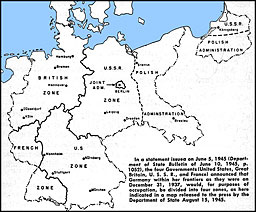
AGREEMENT BETWEEN GOVERNMENTS OF THE UNITED KINGDOM, UNITES STATES OF AMERICA, AND UNION OF SOVIET SOCIALIST REPUBLICS, AND THE PROVISIONAL GOVERNMENT OF THE FRENCH REPUBLIC ON CERTAIN ADDITIONAL REQUIREMENTS TO BE IMPOSED ON GERMANY4 Arrangements for Control of Germany by Allied Representatives
September 20, 1945
The Governments of the U.K., U.S.A., and U.S.S.R. and Provisional Government of French Republic have reached the following agreement regarding instructions to be issued by the Allied representatives in Germany:
We, the Allied Representatives, Commanders-in-Chief of the forces of occupation of the United Kingdom, the United States of America, the Union of Soviet Socialist Republics and the French Republic, pursuant to the Declaration regarding the defeat of Germany, signed at Berlin on 5th June, 1945, hereby announce certain additional requirements arising from the complete defeat and unconditional surrender of Germany with which Germany must comply, as follows:--
Section I 1. All German land, naval and air forces, the S.S., S.A., S.D. and Gestapo, with all their organizations, staffs and institutions, including the General Staff, the Officers' Corps, Reserve Corps, military schools, war veterans' organizations and all other military and quasi-military organizations, together with all clubs and associations which serve to keep alive the military tradition in Germany, shall be completely and finally abolished in accordance with methods and procedures to be laid down by the Allied Representatives.
2. All forms of military training, military propaganda and military activities of whatever nature, on the part of the German people, are prohibited, as well as the formation of any organization initiated to further any aspect of military training and the formation of war veterans' organizations or other groups which might develop military characteristics or which are designed to carry on the German military tradition, whether such organizations or groups purport to be political, educational, religious, social, athletic or recreational or of any other nature.
Section II 3. (a) German authorities and officials in all territories outside the frontiers of Germany as they existed on 31st December, 1937, and in any areas within those frontiers indicated at any time by the Allied Representatives, will comply with such instructions as to withdrawing therefrom as they may receive from the Allied Representatives.
(b) The German authorities will issue the necessary instructions and will make the necessary arrangements for the reception and maintenance in Germany of all German civilian inhabitants of the territories or areas concerned, whose evacuation may be ordered by the Allied Representatives.
(c) Withdrawals and evacuations under subparagraphs (a) and (b) above will take lace at such times and under such conditions as the Allied Representatives may direct.
4. In the territories and areas referred to in paragraph 3 above, there shall immediately be, on the part of all forces under German command and of German authorities and civilians, a complete cessation of all measures of coercion or forced labor and of all measures involving injury to life or limb. There shall similarly cease all measures of requisitioning, seizure, removal, concealment or destruction of property. In particular, the withdrawals and evacuations mentioned in paragraph 3 above will be carried out without damage to or removal of persons or property not affected by the orders of the Allied Representatives. The Allied Representatives will determine what personal property and effects may be taken by persons evacuated under paragraph 3 above.
Section III 5. The Allied Representatives will regulate all matters affecting Germany's relations with other countries. No foreign obligations, undertakings or commitments of any kind will be assumed or entered into by or on behalf of German authorities or nationals without the sanction of the Allied Representatives.
6. The Allied Representatives will give directions concerning the abrogation, bringing into force, revival or application of any treaty, convention or other international agreement, or any part or provision thereof, to which Germany is or has been a party.
7. (a) In virtue of the unconditional surrender of Germany, and as of the date of such surrender, the diplomatic, consular, commercial and other relations of the German State with other States have ceased to exist.
(b) Diplomatic, consular, commercial and other officials and members of service missions in Germany of countries at war with any of the four Powers will be dealt with as the Allied Representatives may prescribe. The Allied Representatives may require the withdrawal
from Germany of neutral diplomatic, consular, commercial and other officials and members of neutral service missions.(c) All German diplomatic, consular, commercial and other officials and members of German service missions abroad are hereby recalled. The control and disposal of the buildings, property and archives of all German diplomatic and other agencies abroad will be prescribed by the Allied Representatives.
8. (a) German nationals will, pending further instructions, be prevented from leaving German territory except as authorized or directed by the Allied Representatives.
(b) German authorities and nationals will comply with any directions issued by the Allied Representatives for the recall of German nationals resident abroad, and for the reception in Germany of any persons whom the Allied Representatives may designate.
9. The German authorities and people will take all appropriate steps to ensure the safety, maintenance and welfare of persons not of German nationality and of their property and the property of foreign States.
Section IV 10. The German authorities will place at the disposal of the Allied Representatives the whole of the German inter-communication system (including all military and civilian postal and telecommunication systems and facilities and connected matters), and will comply with any instructions given by the Allied Representatives for placing such inter-communication systems under the complete control of the Allied Representatives. The German authorities will comply with any instructions given by the Allied Representatives with a view to the establishment by the Allied Representatives of such censorship and control of postal and telecommunication and of documents and other articles carried by persons or otherwise conveyed and of all other forms of inter-communication as the Allied Representatives may think fit.
11. The German authorities will comply with all directions which the Allied Representatives may give regarding the use, control and censorship of all media for influencing expression and opinions, including broadcasting, press and publications, advertising, films and public performances, entertainments, and exhibitions of all kinds.
Section V 12. The Allied Representatives will exercise such control as they deem necessary over all or any part or aspect of German finance, agriculture (including forestry) production and mining, public utilities, industry, trade, distribution and economy generally, internal and external, and over all related or ancillary matters, including the direction
or prohibition of the manufacture, production, construction, treatment, use and disposal of any buildings, establishments, installations, public or private works, plant, equipment, products, materials, stocks, or resources. Detailed statements of the subjects to which the present provision applies, together with the requirements of the Allied Representatives in regard thereto, will from time to time be communicated to the German authorities.13. (a) The manufacture, production and construction, and the acquisition from outside Germany, of war material and of such other products, used in connection with such manufacture, production or construction, as the Allied Representatives may specify, and the import, export and transit thereof, are prohibited, except as directed by the Allied Representatives.
(b) The German authorities will immediately place at the disposal of the Allied Representatives all research, experiment, development and design directly or indirectly relating to war or the production of war material, whether in government or private establishments, factories, technological institutions or elsewhere.
14. (a) The property, assets, rights, titles and interests (whether situated inside or outside Germany) of the German State, its political subdivisions, the German Central Bank, State or semi-State, provincial, municipal or local authorities or Nazi organizations, and those situated outside Germany of any person resident or carrying on business in Germany, will not be disposed of in any way whatever without the sanction of the Allied Representatives. The property, assets, rights, titles and interests (whether situated inside or outside Germany), of such private companies, corporations, trusts, cartels, firms, partnerships and associations as may be designated by the Allied Representatives will not be disposed of in any way whatever without the sanction of the Allied Representatives.
(b) The German authorities will furnish full information about the property, assets, rights, titles and interests referred to in sub-paragraph (a) above, and will comply with such directions as the Allied Representatives may give as to their transfer and disposal. Without prejudice to any further demands which may be made in this connection, the German authorities will hold at the disposal of the Allied Representatives for delivery to them at such times and places as they may direct all securities; certificates, deeds or other documents of title held by any of the institutions or bodies mentioned in subparagraph (a) above or by any person subject to German law, and relating to property, assets, rights, titles and interests situated in the territories of the United Nations, including any shares, stocks, debentures or other obligations of any company incorporated in accordance with the laws of any of the United Nations.
(c) Property, assets, rights, titles and interests situated inside Germany will not be removed outside Germany or be transferred or disposed of to any person resident or carrying on business outside Germany without the sanction of the Allied Representatives.(d) Nothing in sub-paragraphs (a) and (b) above shall, as regards property, assets, rights, titles and interests situated inside Germany, be deemed to prevent sales or transfers to persons resident in Germany for the purpose of maintaining or carrying on the day-to-day national life, economy and administration, subject to the provisions of sub-paragraph 19 (b) and (c) below and to the provisions of the Declaration or of any proclamations, orders, ordinances or instructions issued thereunder.
15. (a) The German authorities and all persons in Germany will hand over to the Allied Representatives all gold and silver, in coin or bullion forms, and all platinum in bullion form, situated in Germany, and all such coin and bullion situated outside Germany as is possessed by or held on behalf of any of the institutions or bodies mentioned in sub-paragraph 14 (a) above or any person resident or carrying on business in Germany.
(b) The German authorities and all persons in Germany will hand over in full to the Allied Representatives all foreign notes and coins in the possession of any German authority, or of any corporation, association or individual resident or carrying on business in Germany, and all monetary tokens issued or prepared for issue by Germany in the territories formerly occupied by her or elsewhere.
16. (a) All property, assets, rights, titles and interests in Germany held for or belonging to any country against which any of the United Nations is carrying on hostilities, or held for or belonging to the nationals of any such country, or of any persons resident or carrying on business therein, will be taken under control and will be preserved pending further instructions.
(b) All property, assets, rights, titles and interests in Germany held for or belonging to private individuals, private enterprises and companies of those countries, other than Germany and the countries referred to in sub-paragraph (a) above, which have at any time since the 1st September, 1939, been at war with any of the United Nations, will be taken under control and will be preserved pending further instructions.
(c) The German authorities will take all necessary steps to ensure the execution of the provisions of sub-paragraphs (a) and (b) above, will comply with any instructions given by the Allied Representatives for that purpose, and will afford all necessary information and facilities in connection therewith.
17. (a) There shall, on the part of the German authorities and people, be no concealment, destruction, scuttling, or dismantling of,
removal or transfer of, nor damage to, ships, transport, ports or harbours, nor to any form of building, establishment, installation, device, means of production, supply, distribution or communication, plant, equipment, currency, stocks or resources, or, in general, public or private works, utilities or facilities of any kind, wherever situated.(b) There shall be no destruction, removal, concealment, suppression or alteration of any documents, records, patents, drawings, specifications, plans or information, of any nature, affected by the provisions of this document. They shall be kept intact in their present locations until further directions are given. The German authorities will afford all information and facilities as required by the Allied Representatives in connection therewith.
(c) Any measures already ordered, undertaken or begun contrary to the provisions of sub-paragraphs (a) and (b) above will be immediately countermanded or discontinued. All stocks, equipment, plant, records, patents, documents, drawings, specifications, plans or other material already concealed within or outside Germany will forthwith be declared and will be dealt with as the Allied Representatives may direct.
(d) Subject to the provisions of the Declaration or any proclamations, orders, ordinances, or instructions issued thereunder, the German authorities and people will be responsible for the preservation, safeguarding and upkeep of all forms of property and materials affected by any of the said provisions.
(d) Subject to the provisions of the Declaration or any proclamations, orders, ordinances, or instructions issued thereunder, the German authorities and people will be responsible for the preservation, safeguarding and upkeep of all forms of property and materials affected by any of the said provisions.
(e) All transport material, stores, equipment, plant, establishments, installations, devices and property generally, which are liable to be surrendered or delivered under the Declaration or any proclamations, orders, ordinances or instructions issued thereunder, will be handed over intact and in good condition, or subject only to ordinary wear and tear and to any damage caused during the continuance of hostilities which it has proved impossible to make good.
18. There shall be no financial, commercial or other intercourse with, or dealings with or for the benefit of, countries at war with any of the United Nations, or territories occupied by such countries, or with any other country or person specified by the Allied Representatives.
Section VI 19. (a) The German authorities will carry out, for the benefit of the United Nations, such measures of restitution, reinstatement, restoration, reparation, reconstruction, relief and rehabilitation as the Allied Representatives may prescribe. For these purposes the German authorities will effect or procure the surrender or transfer of such property, assets, rights, titles and interests, effect such deliveries and carry out such repair, building and construction work, whether
in Germany or elsewhere, and will provide such transport plant equipment andmaterials of all kinds, labour, personnel and specialist and other services, for use in Germany or elsewhere, as the Allied Representatives may direct.
(b) The German authorities will also comply with all such directions as the Allied Representatives may give relating to property, assets, rights, titles and interests located in Germany belonging to any one of the United Nations or its nationals or having so belonged at, or at any time since, the outbreak of war between Germany and that Nation, or since the occupation of any part of its territories by Germany. The German authorities will be responsible for safeguarding, maintaining, and preventing the dissipation of, all such property, assets, rights, titles and interests, and for handing them over intact at the demand of the Allied Representatives. For these purposes the German authorities will afford all information and facilities required for tracing any property, assets, rights, titles or interests.
(c) All persons in Germany in whose possession such property, assets, rights, titles and interests may be, shall be personally responsible for reporting them and for safeguarding them until they are handed over in such manner as may be prescribed.
20. The German authorities will supply free of cost such German currency as the Allied Representatives may require, and will withdraw and redeem in German currency, within such time limits and on such terms as the Allied Representatives may specify, all holdings in German territory of currencies issued by the Allied Representatives during military operations or occupation, and will hand over the currencies so withdrawn free of cost to the Allied Representatives.
21. The German authorities will comply with all such directions as may be issued by the Allied Representatives for defraying the costs of the provisioning, maintenance, pay, accommodation and transport of the forces and agencies stationed in Germany by authority of the Allied Representatives, the costs of executing the requirements of unconditional surrender, and payment for any relief in whatever form it may be provided by the United Nations.
22. The Allied Representatives will take and make unrestricted use (whether inside or outside Germany) of any article referred to in paragraph 12 above, which the Allied Representatives may require in connection with the conduct of hostilities against any country with which any of their respective Governments is at war.
Section VII 28. (a) No merchant ship, including fishing or other craft, shall put to sea from any German port except as may be sanctioned or directed by the Allied Representatives. German ships in ports outside
Germany shall remain in port and those at sea shall proceed to the nearest German or United Nations port and there remain, pending instructions from the Allied Representatives.(b) All German merchant shipping, including tonnage under construction or repair, will be made available to the Allied Representatives for such use and on such terms as they may prescribe.
(c) Foreign merchant shipping in German service or under German control will likewise be made available to the Allied Representatives for such use and on such terms as they may prescribe. In the case of such foreign merchant vessels which are of neutral registration, the German authorities will take all such steps as may be required by the Allied Representatives to transfer or cause to be transferred to the Allied Representatives all rights relative thereto.
(d) All transfer to any other flag, service or control, of the vessels covered by sub-paragraphs (b) and (c) above, is prohibited, except as may be directed by the Allied Representatives.
24. Any existing options to repurchase or re-acquire or to resume control of vessels sold or otherwise transferred or chartered by Germany during the war will be exercised as directed by the Allied Representatives. Such vessels will be made available for use by the Allied Representatives in the same manner as the vessels covered by sub-paragraphs 23 (b) and (c) above.
25. (a) The crews of all German merchant vessels or merchant vessels in German service or under German control will remain on board and will be maintained by the German authorities pending further instructions from the Allied Representatives regarding their future employment.
(b) Cargoes on board any such vessels will be disposed of in accordance with instructions given to the German authorities by the Allied Representatives.
26. (a) Merchant ships, including fishing and other craft of the United Nations (or of any country which has broken off diplomatic relations with Germany) which are in German hands, wherever such ships may be, will be surrendered to the Allied Representatives regardless of whether title has been transferred as the result of prize court proceedings or otherwise. All such ships will be surrendered in good repair and in seaworthy condition in ports and at times to be specified by the Allied Representatives, for disposal as directed by them.
(b) The German authorities will take all such steps as may be directed by the Allied Representatives to effect or complete transfers of title to such ships regardless of whether the title has been transferred as the result of prize court proceedings or otherwise. They will secure the discontinuance of any arrests of, or proceedings against, such ships in neutral ports.
27. The German authorities will comply with any instructions given by the Allied Representatives for the destruction, dispersal, salvaging, reclamation or raising of wrecked, stranded, derelict or sunken vessels, wherever they may be situated. Such vessels salvaged, reclaimed or raised shall be dealt with as the Allied Representatives direct.
Section VIII 29. The German authorities will place at the unrestricted disposal of the Allied Representatives the whole of the German inland transport system (road, rail, air and waterways) and all connected material, plant and equipment, and all repair, construction, labour, servicing and running facilities, in accordance with the instructions issued by the Allied Representatives.
30. The production in Germany and the possession, maintenance or operation by Germans of any aircraft of any kind or any parts thereof, are prohibited.
31. All German rights in international transport bodies or organizations and in relation to the use of transport and the movement of traffic in other countries and the use in Germany of the transport of other countries, will be exercised in accordance with the directions of the Allied Representatives.
32. All facilities for the generation, transmission and distribution of power including establishments for the manufacture and repair of such facilities, will be placed under the complete control of the Allied Representatives, to be used for such purposes as they may designate.
Section IX 33. The German authorities will comply with all such directions as the Allied Representatives may give for the regulation of movements of population and for controlling travel or removal on the part of persons in Germany.
34. No person may leave or enter Germany without a permit issued b the Allied Representatives or on their authority.
35. The German authorities will comply with all such directions as the Allied Representatives may give for the repatriation of persons not of German nationality in or passing through Germany, their
property and effects and for facilitating the movements of refugees and displaced persons.
Section X 36. The German authorities will furnish any information and documents and will secure the attendance of any witnesses, required by the Allied Representatives for the trial of(a) the principal Nazi leaders as specified by the Allied Representatives and all persons from time to time named or designated by rank, office or employment by the Allied Representatives as being suspected of having committed, ordered or abetted war crimes or analogous offences;
(b) any national of any of the United Nations who is alleged to have committed an offence against his national law and who may at any time be named or designated by rank, office or employment by the Allied Representatives; and will give all other aid and assistance for these purposes.
37. The German authorities will comply with any directions given by the Allied Representatives in regard to the property of any person referred to in sub-paragraphs 36 (a) and (b) above, such as its seizure, custody or surrender.
Section XI 38. The National Socialist German Workers' Party (NDSAP) is completely and finally abolished and declared to be illegal.
39. The German authorities will comply promptly with such directions as the Allied Representatives may issue for the abolition of the National Socialist Party and of its subordinate organizations, affiliated associations and supervised organizations, and of all Nazi public institutions created as instruments of Nazi domination, and of such other organizations as may be regarded as a threat to the security of the Allied forces or to international peace, and for prohibiting their revival in any form; for the dismissal and internment of Nazi personnel; for the control or seizure of Nazi property and funds; and for the suppression of Nazi ideology and teaching.
40. The German authorities and German nationals will not allow the existence of any secret organizations.
41. The German authorities will comply with such directions as the Allied Representatives may issue for the repeal of Nazi legislation and for the reform of German law and of the German legal, judicial, administrative, police and educational systems, including the replacement of their personnel.
42. (a) The German authorities will comply with such directions as the Allied Representatives may issue for the rescinding of German legislation involving discrimination on grounds of race, colour, creed,
language or political opinions and for the cancellation of all legal or other disabilities resulting therefrom.(b) The German authorities will comply with such directions as the Allied Representatives may issue regarding the property, assets, rights, titles and interests of persons affected by legislation involving discrimination on grounds of race, colour, creed, language or political opinions.
43. No person shall be prosecuted or molested by the German authorities or by German nations on grounds of race, colour, creed, language or political opinions, or on account of any dealings or sympathies with the United Nations, including the performance of any action calculated to facilitate the execution of the Declaration or of any proclamations, orders, ordinances or instructions issued thereunder.
44. In any proceedings before any German Court or authority judicial notice shall be taken of the provisions of the Declaration and of all proclamations, orders, ordinances and instructions issued thereunder, which shall override any provisions of German law inconsistent therewith.
Section XII 45. Without prejudice to any specific obligations contained in the provisions of the Declaration or any proclamations, orders, ordinances or instructions issued thereunder, the German authorities and any other person in a position to do so will furnish or cause to be furnished all such information and documents of every kind, public and private, as the Allied Representatives may require.
46. The German authorities will likewise produce for interrogation and employment by the Allied Representatives upon demand any and all persons whose knowledge and experience would be useful to the Allied Representatives.
47. The Allied Representatives will have access at all times to any building, installation, establishment, property or area, and any of the contents thereof, for the purposes of the Declaration or any proclamations, orders ordinances or instructions issued thereunder, and in particular for the purposes of safeguarding, inspecting, copying or obtaining any of the desired documents and information. The German authorities will give all necessary facilities and assistance for this purpose, including the service of all specialist staff, including archivists.
Section XIII 48. In the event of any doubt as to the meaning or interpretation of any term or expression in the Declaration and in any proclamations, orders, ordinances and instructions issued thereunder, the decision of the Allied Representatives shall be final.
Military Government in Germany
Employment of Nazis in U.S. ZoneSeptember 26, 1945
According to Law Number Eight which comes into force today former Nazis can only be employed as ordinary workers. If new firms are founded, documentary proof must be given regarding observation of this ruling. The new law also lays down punishments which would be imposed and right to appeal. The law is headed "Prohibition of Employment of National Socialist German Workers' Party (NSDAP) Members in Enterprises Except in Subordinate Positions."
In order further to eliminate influence of Nazism in Germany it is hereby ordered that:
(1) It shall be illegal for any business enterprise to employ any member [of the] Nazi Party or of its affiliated organizations in any supervisory or managing capacity or in any capacity other than that of ordinary worker with exception [of] employment authorized by Military Government under provisions of Paragraph Five.
(2) If any business enterprise not now in operation desires [to] start up its principal official shall as condition to his being permitted to open or operate certify that it is employing no one contrary to provisions [in] Paragraph One hereof.
(3) Any business enterprise now open or operating with any person employed in violation [of] Paragraph One of this law shall immediately discharge such person failing which it shall be immediately close by [the] Military Government.
(4) Any person violating any of [the] provisions [of] this law shall upon conviction of [a] Military Government court be liable to any lawful punishment as such court may determine.
(5) Any person discharged or refused employment under this law who claims he was not actively engaged in any of [the] activities of [the] Nazi Party or its affiliated organizations may appeal to [the] local office of [the] Military Government.
(6) This law become effective on September 26th 1945.
BY ORDER [OF THE] MILITARY GOVERNMENT
DWIGHT D EISENHOWER
Allied armies, in the course of the past two months, have uncovered an estimated 2,500,000 displaced persons in Germany. More than 80 percent are in the area of the Twelfth Army Group, and the remainder in the Sixth and Twenty-first Army Group areas. Russians constitute by far the largest nationality--more than 40 percent of the total uncovered; French represent 28 percent; Poles, 14percent; Italians, 9 percent; Belgians, 5 percent; Dutch, 5 percent; and the remainder, Yugoslavs, Czechs, Greeks, Luxembourgers, and other European nationalities. It is significant that the total uncovered is still well below all estimates used during the past year in planning for the displaced-persons operation--it is not yet possible to determine whether the original estimate of 4,400,000 persons in the SHAEF area of operations, or whether large numbers of displaced persons have not yet made themselves known, particularly those who have been working on German farms. Displaced Persons in Germany
Present OperationsReleased May 25, 1945
All Army commanders have emphasized the seriousness with which the displaced-persons problem in Germany is regarded. In almost all areas it has been treated entirely as a command responsibility, and, where consistent with military operations, combat units have been utilized to care for and control displaced persons. In Sixth Army Group area, 80 teams, consisting of 2 to 3 officers, 1 medical officer,and 4 to 6 enlisted men, have been drawn from combat units and trained in readiness for any eventuality. In the Ruhr, XVI Corps of the Ninth U.S. Army utilized four infantry divisions in controlling and caring for displaced persons. In Fifteenth Army, the commanders of XXII and XXIII Corps have assigned two artillery groups (one for each Corps) to direct displaced-persons operations in the area. Camps are being operated in this area by military government detachment, supplemented to a large extent by special combat teams.
In the initial stages of occupation some looting and pillaging and other disorders have taken place. This was the result not only of the natural exuberance of liberation among the displaced persons themselves but of the necessity of not delaying military operations by utilizing vitally needed combat forces to establish immediate control over foreign workers and displaced persons. These initial disorders, however, have diminished.Army group report that in less than a week displaced persons are brought under control, except for a few isolated instances of disorder.
In rear areas, as soon as conditions have stabilized, few displaced persons are found trekking along main roads, although frequently movements of German civilians and evacuees are mistaken for those of displaced persons.About half the displaced persons uncovered have already been bought into the more than 200 camps and centers established by the armies in Germany. Thus, in the Twelfth Army Group alone, 900,000 displaced persons were in such installations at the end of April. The process of bringing displaced persons together into established camps is necessarily a slow one. Prisoners of war have broken away from prison camps; foreign workers have quickly left factories in which they worked; political and racial prisoners in the initial confusion have gotten out of concentration camps; farm workers are found in virtually every city and town in Germany. Some time must elapse before military authorities are able to bring them together into proper centers.
In most areas displaced-persons camps and installations are under the control of military-government detachments who, although seriously overworked, have generally been successful in bringing about comparatively orderly conditions. In other cases, where combat troops could be spared, the care of these people was directly charged to subordinate commanders. More than 140 UNRRA teams, each consisting of 8 trained specialists, are already in the field working in camps under the direction of local military-government detachments. It is expected that the figure will increase to 150 by next week, and to 225 by the first of June. Personnel of voluntary welfare agencies, under the supervision of UNRRA, is being called forward to aid in the problem. In addition, almost 600 Allied liaison officers, selected by 11 governments, are in the field assisting military authorities in the control, care, and repatriation of displaced persons. in many camps, the displaced persons themselves are performing most of the administrative and other functions.
In general, the health situation of most of the foreign workers is better than was anticipated, while conditions among some groups of prisoners of war and concentrations of foreign workers in larger cities are poor. Every effort is made to see that all displaced persons are dusted with antityphus DDT. At the present time, most of the food used in displaced-persons camps is being obtained from local enemy sources and from captured enemy stocks. But,since indications are that the supply situation in Germany will deteriorate, every effort is being made to repatriate, displaced persons as quickly as possible. Already more than 450,000 French, Belgians, Dutch, and Luxembourgers have returned home.Of these, 350,000 are French, and of that number 50,000 have been moved by air in returning transport planes which brought supplies to the armies. Prospects of increasing
repatriation by air, through the use of additional planes, are at the moment good.Arrangements have been made to drop newspapers, magazines, and other material to displaced-persons camps. Allied commanders have been instructed to requisition from German authorities welfare items for the camps, and it is expected that such supplies may be supplemented by UNRRA.
The worst conditions of all have, of course, been found in concentration camps, where the Germans held political prisoners and racial prisoners. Before the camps were uncovered, army commanders took special steps to move out quantities of medical and special feeding supplies, as well as specialist personnel, ready for emergency use as soon as the camps were uncovered. Every resource available to armies is being utilized to care for the persons interned there. At Belsen, a large hospital has been established and arrangements have been made to fly 100 British medical students into the camp to assist in the care of the inmates, many of whom are suffering from severe malnutrition, typhus, typhoid, tuberculosis, etc. At Dachau, three days after it was liberated, two evacuation hospitals and part of a field hospital were set up, and two military-government detachments were directing camp operations.
Whenever possible, important political and other personages have been flown immediately out of those camps to France and Belgium. Special flights have carried large number of French and Belgian political and racial prisoners o their homes. Simultaneously, arrangements have been made to obtain detailed lists of persons found at the camps, and scores of requests regarding individuals who may have been found in camps are being handled daily. Nevertheless, the situation of large numbers of these political and racial prisoners is grave in the extreme.Many are critically ill, suffering from starvation and other diseases resulting from lowered resistance. While Allied authorities are doing everything possible to save as many people as they can, many are quite beyond help.
Early in 1944 SHAEF developed plans, in coordination with Allied governments and UNRRA, for dealing with the displaced-persons problem.Instructions were issued to Army Group commanders on 4 June 1944 relating to the control, care, relief, and repatriation of displaced persons. These were supplemented by detailed instructions issued on 18 November 1944.
Under these instructions displaced persons uncovered by military forces are assembled in collecting points and directed back to transit points or areas where they are given food, temporary shelter, and first aid.From there they are directed to assembly centers, where they are cared for until they can be repatriated. When uncovered in areas of rapid military advance, they are directed to stand fast
until arrangements can be made to collect them in assembly centers. As soon as conditions permit, United Nations displaced persons are returned to reception centers in their own countries, where their governments assume full responsibility for them. In liberated countries the care of displaced persons is the responsibility of the Allied governments concerned, assisted and advised by Supreme Headquarters, AEF, Missions. In enemy territory, United Nations displaced persons are a direct responsibility of the Allied forces, whereas enemy and ex-enemy displaced persons are made the responsibility of enemy authorities supervised by military government.Arrangements were made with European Allied governments to make available liaison officers for repatriation, to be employed by military commanders to assist in the control, identification, care, and repatriation of their nationals.
Arrangements were made with UNRRA to make available assembly-center teams to be employed by military commanders in administering United Nations assembly centers in Germany. A substantial program of recruiting, equipping, and training personnel for these teams was carried out under the plans of the displaced persons branch of SHAEF.
Arrangements were also made for the assignment and training of a limited number of military-government detachments for special work in dealing with the displaced-persons problem.
Military commanders have added to their personnel resources for dealing with the displaced-person problem by the assignment of combat and service officers and men to deal with the initial peak problem of controlling and administering displaced persons.
Arrangements were made with the Governments of France, Belgium, Netherlands, and Luxembourg for the establishment of adequate reception facilities to which their displaced nationals could be sent by the military authorities.
Mission to Europe to inquire into the conditions and needs of those among the displaced persons in the liberated countries of Western Europe and in the SHAEF area of Germany--with particular reference to the Jewish refugees--who may possibly be stateless or non-repatriable. Report of Earl G. Harrison
Released September 29, 1945
LONDON, ENGLAND
THE PRESIDENT,
The White House, Washington.M DEAR MR. PRESIDENT:
Pursuant to your letter of June 22, 1945, I have the honor to present to you a partial report upon my recent mission to Europe to inquire
into (1) the conditions under which displaced persons and particularly those who may be stateless or non-repatriable are at present living, especially in Germany and Austria, (2) the needs of such persons, (3) how those needs are being met at present by the military authorities, the governments of residence and international and private relief bodies, and (4) the views of the possibly non-repatriable persons as to their future destinations.My instructions were to give particular attention to the problems, needs and views of the Jewish refugees among the displaced people, especially in Germany and Austria. The report, particularly this partial report, accordingly deals in the main with that group.
On numerous occasions appreciation was expressed by the victims of Nazi persecution for the interest of the United States Government in them. As my report shows they are in need of attention and help. Up to this point they have been "liberated" more in a military sense than actually. For reasons explained in the report, their particular problems, to this time, have not been given attention to any appreciable extent; consequently they feel that they, who were in so many ways the first and worst victims of Nazism, are being neglected by their liberators.
Upon my request, the Department of State authorized Dr. Joseph J. Schwartz to join me in the mission. Dr. Schwartz, European Director of the American Joint Distribution Committee, was granted a leave of absence from that organization for the purpose of accompanying me. His long and varied experience in refugee problems as well as his familiarity with the Continent and the people made Dr. Schwartz a most valuable associate; this report represents our joint views, conclusions and recommendations.
During various portions of the trip I had, also, the assistance of Mr. Patrick M. Malin, Vice Director of the Intergovernmental Committee on Refugees and Mr. Herbert Katzski of the War Refugee Board. These gentlemen, likewise, have had considerable experience in refugee matters. Their assistance and cooperation were most helpful in the course of the survey.
I.
GERMANY AND AUSTRIAConditions
(1) Generally speaking, three months after V-E Day and even longer after the liberation of individual groups, many Jewish displaced persons and other possibly non-repatriables are living under guard behind barbed-wire fences, in camps of several descriptions (built by the Germans for slave-laborers and Jews), including some of the most notorious of the concentration camps, amidst crowded, frequently unsanitary
and generally grim conditions, in complete idleness, with no opportunity, except surreptitiously, to communicate with the outside world, waiting, hoping for some word of encouragement and action in their behalf.(2) While there has been marked improvement in the health of survivors of the Nazi starvation and persecution program, there are many pathetic malnutrition cases both among the hospitalized and in the general population of the camps. The death rate has been high since liberation, as was to be expected. One Army Chaplain, a Rabbi, personally attended, since liberation 23,000 burials (90 per cent Jews) at Bergen Belsen alone, one of the largest and most vicious of the concentration camps, where, incidentally, despite persistent reports to the contrary, fourteen thousand displaced persons are still living, including over seven thousand Jews. At many of the camps and centers including those where serious starvation cases are, there is a marked and serious lack of needed medical supplies.
(3) Although some Camp Commandants have managed, in spite of the many obvious difficulties, to find clothing of one kind or another for their charges, many of the Jewish displaced persons, late in July, had no clothing other than their concentration camp garb--a rather hideous striped pajama effect--while others, to their chagrin, were obliged to wear German S.S. uniforms. It is questionable which clothing they hate the more.
(4) With a few notable exceptions, nothing in the way of a program of activity or organized effort toward rehabilitation has been inaugurated and the internees, for they are literally such, have little to do except to dwell upon their plight, the uncertainty of their future and, what is more unfortunate, to draw comparisons between their treatment "under the Germans" and "in liberation." Beyond knowing that they are no longer in danger of the gas chambers, torture, and other forms of violent death, they see--and there is--little change. The morale of those who are either stateless or who do not wish to return to their countries of nationality is very low. They have witnessed great activity and efficiency in returning people to their homes but they hear or see nothing in the way of plans for them and consequently they wonder and frequently ask what "liberation" means. This situation is considerably accentuated where, as in so many cases, they are able to look from their crowded and bare quarters and see the German civilian population, particularly in the rural areas, to all appearances living normal lives in their own homes.
(5) The most absorbing worry of these Nazi and war victims concerns relatives--wives, husbands, parents, children. Most of them have been separated for three, four or five years and they cannot understand why the liberators should not have undertaken immediately the organized effort to re-unite family groups. Most of the very
little which has been done in this direction has been informal action by the displaced persons themselves with the aid of devoted Army Chaplains, frequently Rabbis, and the American Joint Distribution Committee. Broadcasts of names and locations by the Psychological Warfare Division at Luxembourg have been helpful, although the lack of receiving sets has handicapped the effectiveness of the program. Even where, as has been happening, information has been received as to relatives living in other camps in Germany, it depends on the personal attitude and disposition of the Camp Commandant whether permission can be obtained or assistance received to follow up on the information. Some Camp Commandants are quite rigid in this particular, while others lend every effort to join family groups.(6) It is difficult to evaluate the food situation fairly because one must be mindful of the fact that quite generally food is scarce and is likely to be more so during the winter ahead. On the other hand, in presenting the factual situation, one must raise the question as to how much longer many of these people, particularly those who have over such a long period felt persecution and near starvation, can survive on a diet composed principally of bread and coffee, irrespective of the caloric content. In many camps, the 2,000 calories included 1,250 calories of a black, wet and extremely unappetizing bread. I received the distinct impression and considerable substantiating information that large numbers of the German population--again principally in the rural areas--have a more varied and palatable diet than is the case with the displaced persons. The Camp Commandants put in their requisitions with the German burgomeister and many seemed to accept whatever he turned over as being the best that was available.
(7) Many of the buildings in which displaced persons are housed are clearly unfit for winter use and everywhere there is great concern about the prospect of a complete lack of fuel. There is every likelihood that close to a million displaced persons will be in Germany and Austria when winter sets in. The outlook in many areas so far as shelter, food and fuel are concerned is anything but bright.
II.
Needs of the JewsWhile it is impossible to state accurately the number of Jews now in that part of Germany not under Russian occupation, all indications point to the fact that the number is small, with one hundred thousand probably the top figure; some informed persons contend the number is considerably smaller. The principal nationality groups are Poles, Hungarians, Rumanians, Germans and Austrians.
The first and plainest need of these people is a recognition of their actual status and by this I mean their status as Jews. Most of them
have spent years in the worst of the concentration camps. In many cases, although the full extent is not yet known, they are the sole survivors of their families and many have been through the agony of witnessing the destruction of their loved ones. Understandably, therefore, their present condition, physical and mental, is far worse than that of other groups.While SHAEF (now Combined Displaced Persons Executive) policy directives have recognized formerly persecuted persons, including enemy and ex-enemy nationals, as one of the special categories of displaced persons, the general practice thus far has been to follow only nationality lines. While admittedly it is not normally desirable to set aside particular racial or religious groups from their nationality categories, the plain truth is that this was done for so long by the Nazis that a group has been created which has special needs. Jews as Jews (not as members of their nationality groups) have been more severely victimized than the non-Jewish members of the same or other nationalities.
When they are now considered only as members of nationality groups, the result is that special attention cannot be given to their admittedly greater needs because, it is contended, doing so would constitute preferential treatment and lead to trouble with the non-Jewish portion of the particular nationality group.
Thus there is a distinctly unrealistic approach to the problem. Refusal to recognize the Jews as such has the effect, in this situation, of closing one's eyes to their former and more barbaric persecution, which has already made them a separate group with greater needs.
Their second great need can be presented only by discussing what I found to be their [sic]
Wishes as to Future Destinations (1) For reasons that are obvious and need not be labored, most Jews want to leave Germany and Austria as soon as possible. That is their first and great expressed wish and while this report necessarily deals with other needs present in the situation, many of the people themselves fear other suggestions or plans for their benefit because of the possibility that attention might thereby be diverted from the all-important matter of evacuation from Germany. Their desire to leave Germany is an urgent one. The life which they have led for the past ten years, a life of fear and wandering and physical torture, has made them impatient of delay. They want to be evacuated to Palestine now, just as other national groups are being repatriated to their homes. They do not look kindly on the idea of waiting around in idleness and
in discomfort in a German camp for many months until a leisurely solution is found for them.(2) Some wish to return to their countries of nationality but as to this there is considerable nationality variation. Very few Polish or Baltic Jews wish to return to their countries; higher percentages of the Hungarian and Rumanian groups want to return although some hasten to add that it may be only temporarily in order to look for relatives. Some of the German Jews, especially those who have intermarried, prefer to stay in Germany.
(3) With respect to possible places of resettlement for those who may be stateless or who do not wish to return to their homes, Palestine is definitely and pre-eminently the first choice. Many now have relatives there, while others, having experienced intolerance and persecution in their homelands for years, feel that only in Palestine will they be welcomed and find peace and quiet and be given an opportunity to live and work. In the case of the Polish and the Baltic Jews, the desire to go to Palestine is based in a great majority of the cases on a love for the country and devotion to the Zionist ideal. It is also true however, that there are many who wish to go to Palestine because they realize that their opportunity to be admitted into the United States or into other countries in the Western hemisphere is limited, if not impossible. Whatever the motive which causes them to turn to Palestine, it is undoubtedly true that the great majority of the Jews now in Germany do not wish to return to those countries from which they came.
(4) Palestine, while clearly the choice of most, is not the only named place of possible emigration. Some, but the number is not large, wish to emigrate to the United States where they have relatives, others to England, the British Dominions, or to South America.
Thus the second great need is the prompt development of a plan to get out of Germany and Austria as many as possible of those who wish it.
Otherwise the needs and wishes of the Jewish groups among the displaced persons can be simply stated: among their physical needs are clothing and shoes (most sorely needed), more varied and palatable diet, medicines, beds and mattresses, reading materials. The clothing for the camps too is requisitioned from the German population, and whether there is not sufficient quantity to be had or the German population has not been willing or has not been compelled to give up sufficient quantity, the internees feel particularly bitter about the state of their clothing when they see how well the German population is still dressed. The German population today is still the best dressed population in all of Europe.
III.
MANNER IN WHICH NEEDS ARE BEING METAside from having brought relief from the fear of extermination, hospitalization for the serious starvation cases and some general improvement in conditions under which the remaining displaced persons are compelled to live, relatively little beyond the planning stage has been done, during the period of mass repatriation, to meet the special needs of the formerly persecuted groups.
UNRRA, being neither sufficiently organized or equipped nor authorized to operate displaced persons camps or centers on any large scale, has not been in position to make any substantial contribution to the situation. Regrettably there has been a disinclination on the part of many Camp Commandants to utilize UNRRA personnel even to the extent available, though it must be admitted that in many situations this resulted from unfortunate experiences Army officers had with UNRRA personnel who were unqualified and inadequate for the responsibility involved. Then, too, in the American and British zones, it too frequently occurred that UNRRA personnel did not include English-speaking members and this hampered proper working relationships.
Under these circumstances, UNRRA, to which has been assigned the responsibility for co-ordinating activities of private social welfare agencies, has been in an awkward position when it came to considering and acting upon proposals of one kind or another submitted by well qualified agencies which would aid and supplement military and UNRRA responsibilities. The result has been that, up to this point, very few private social agencies are working with displaced persons, including the Jews, although the situation cries out for their services in many different ways.
It must be said, too, that because of their pre-occupation with mass repatriation and because of housing, personnel and transport difficulties, the military authorities have shown considerable resistance to the entrance of voluntary agency representatives, no matter how qualified they might be to help meet existing needs of displaced persons.
IV.
CONCLUSIONS AND RECOMMENDATIONS1. Now that the worst of the pressure of mass repatriation is over, it is not unreasonable to suggest that in the next and perhaps more difficult period those who have suffered most and longest be given first and not last attention.
Specifically, in the days immediately ahead, the Jews in Germany and Austria should have the first claim upon the conscience of the
people of the United States and Great Britain and the military and other personnel who represent them in work being done in Germany and Austria.2. Evacuation from Germany should be the emphasized theme, policy and practice.
(a) Recognizing that repatriation is most desirable from the standpoint of all concerned, the Jews who wish to return to their own countries should be aided to do so without further delay. Whatever special action is needed to accomplish this with respect to countries of reception or consent of military or other authorities should be undertaken with energy and determination. Unless this and other action, about to be suggested, is taken, substantial unofficial and unauthorized movements of people must be expected, and these will require considerable force to prevent, for the patience of many of the persons involved is, and in my opinion with justification, nearing the breaking point. It cannot be overemphasized that many of these people are now desperate, that they have become accustomed under German rule to employ every possible means to reach their end, and that the fear of death does not restrain them.
(b) With respect to those who do not, for good reason, wish to return to their homes, prompt planning should likewise be undertaken. In this connection, the issue of Palestine must be faced. Now that such large numbers are no longer involved and if there is any genuine sympathy for what these survivors have endured, some reasonable extension or modification of the British White Paper of 1939 ought to be possible without too serious repercussions. For some of the European Jews, there is no acceptable or even decent solution for their future other than Palestine. This is said on a purely humanitarian basis with no reference to ideological or political considerations so far as Palestine is concerned.
It is my understanding, based upon reliable information, that certificates for immigration to Palestine will be practically exhausted by the end of the current month (August 1945). What is the future to be? To anyone who has visited the concentration camps and who has talked with the despairing survivors, it is nothing short of calamitous to contemplate that the gates of Palestine should be soon closed.
The Jewish Agency of Palestine has submitted to the British Government a petition that one hundred thousand additional immigration certificates be made available. A memorandum accompanying the petition makes a persuasive showing with respect to the immediate absorptive capacity of Palestine and the current, actual man-power shortages there.
While there may be room for difference of opinion as to the precise number of such certificates which might under the circumstances be considered reasonable, there is no question but that the request
thus made would, if granted, contribute much to the sound solution for the future of Jews still in Germany and Austria and even other displaced Jews, who do not wish either to remain there or to return to their countries of nationality.No other single matter is, therefore, so important from the viewpoint of Jews in Germany and Austria and those elsewhere who have known the horrors of the concentration camps as is the disposition of the Palestine question.
Dr. Hugh Dalton, a prominent member of the new British Government, is reported as having said at the Labour Party Conference in May 1945:
"This Party has laid it down and repeated it so recently as last April ... that this time, having regard to the unspeakable horrors that have been perpetrated upon the Jews of Germany and other occupied countries in Europe, it is morally wrong and politically indefensible to impose obstacles to the entry into Palestine now of any Jews who desire to go there....
"We also have stated clearly that this is not a matter which should be regarded as one for which the British Government alone should take responsibility; but as it comes, as do many others, in the international field, it is indispensable that there should be close agreement and co-operation among the British, American and Soviet Governments, particularly if we are going to get a sure settlement in Palestine and the surrounding countries...."
If this can be said to represent the viewpoint of the new Government in Great Britain, it certainly would not be inappropriate for the United States Government to express its interest in and support of some equitable solution of the question which would make it possible for some reasonable number of Europe's persecuted Jews, now homeless under any fair view, to resettle in Palestine. That is their wish and it is rendered desirable by the generally accepted policy of permitting family groups to unite or reunite.
(c) The United States should, under existing immigration laws, permit reasonable numbers of such persons to come here, again particularly those who have family ties in this country. As indicated earlier, the number who desire emigration to the United States is not large.
If Great Britain and the United States were to take the actions recited, it might the more readily be that other countries would likewise be willing to keep their doors reasonably open for such humanitarian considerations and to demonstrate in a practical manner their disapproval of Nazi policy which unfortunately has poisoned so much of Europe.
3. To the extent that such emigration from Germany and Austria is delayed, some immediate temporary solution must be found. In any
event there will be a substantial number of the persecuted persons who are not physically fit or otherwise presently prepared for emigration.Here I feel strongly that greater and more extensive efforts should be made to get them out of camps for they are sick of living in camps. In the first place, there is real need for such specialized places as (a) tuberculosis sanitaria and (b) rest homes for those who are mentally ill or who need a period of readjustment before living again in the world at large-anywhere. Some will require at least short periods of training or retraining before they can be really useful citizens.
But speaking more broadly, there is an opportunity here to give some real meaning to the policy agreed upon at Potsdam. If it be true, as seems to be widely conceded, that the German people at large do not have any sense of guilt with respect to the war and its causes and results, and if the policy is to be "To convince the German people that they have suffered a total military defeat and that they cannot escape responsibility for what they have brought upon themselves," then it is difficult to understand why so many displaced persons, particularly those who have so long been persecuted and whose repatriation or resettlement is likely to be delayed, should be compelled to live in crude, over-crowded camps while the German people, in rural areas, continue undisturbed in their homes.
As matters now stand, we appear to be treating the Jews as the Nazis treated them except that we do not exterminate them. They are in concentration camps in large numbers under our military guard instead of S.S. troops. One is led to wonder whether the German people, seeing this, are not supposing that we are following or at least condoning Nazi policy.
It seems much more equitable and as it should be to witness the very few places where fearless and uncompromising military officers have either requisitioned an entire village for the benefit of displaced persons, compelling the German population to find housing where they can, or have required the local population to billet a reasonable number of them. Thus the displaced persons, including the persecuted, live more like normal people and less like prisoners or criminals or herded sheep. They are in Germany, most of them and certainly the Jews, through no fault or wish of their own. This fact is in this fashion being brought home to the German people but it is being done on too small a scale.
At many places, however, the military government officers manifest the utmost reluctance or indisposition, if not timidity, about inconveniencing the German population. They even say that their job is to get communities working properly and soundly again, that they must "live with the Germans while the DPs (displaced persons) are a more temporary problem." Thus (and I am ready
to cite the example) if a group of Jews are ordered to vacate their temporary quarters, needed for military purposes, and there are two possible sites, one a block of flats (modest apartments) with conveniences and the other a series of shabby buildings with outside toilet and washing facilities the burgomeister readily succeeds in persuading the Town Major to allot the latter to the displaced persons and to save the former for returning German civilians.This tendency reflects itself in other ways, namely, in the employment of German civilians in the offices of military government officers when equally qualified personnel could easily be found among the displaced persons whose repatriation is not imminent. Actually there have been situations where displaced persons, especially Jews, have found it difficult to obtain audiences with military government authorities because ironically they have been obliged to go through German employees who have not facilitated matters.
Quite generally, insufficient use is made of the services of displaced persons. Many of them are able and eager to work but apparently they are not considered in this regard. While appreciating that language difficulties are sometimes involved, I am convinced that, both within and outside camps, greater use could be made of the personal services of those displaced persons who in all likelihood will be on hand for some time. Happily in some camps every effort is made to utilize the services of the displaced persons and these are apt to be the best camps in all respects.
4. To the extent that (a) evacuation from Germany and Austria is not immediately possible and (b) the formerly persecuted groups cannot be housed in villages or billeted with the German population, I recommend urgently that separate camps be set up for Jews or at least for those who wish, in the absence of a better solution, to be in such camps. There are several reasons for this: (1) a great majority want it; (2) it is the only way in which administratively their special needs and problems can be met without charges of preferential treatment or (oddly enough) charges of "discrimination" with respect to Jewish agencies now prepared and ready to give them assistance.
In this connection, I wish to emphasize that it is not a case of singling out a particular group for special privileges. It is a matter of raising to a more normal level the position of a group which has been depressed to the lowest depths conceivable by years of organized and inhuman oppression. The measures necessary for their restitution do not come within any reasonable interpretation of privileged treatment and are required by considerations of justice and humanity.
There has been some tendency at spots in the direction of separate camps for those who might be found to be stateless or non-repatriable or whose repatriation is likely to be deferred some time. Actually, too,
this was announced some time ago as SHAEF policy but in practice it has not been taken to mean much for there is (understandably if not carried too far) a refusal to contemplate possible statelessness and an insistence, in the interests of the large repatriation program, to consider all as repatriable. This results in a resistance to anything in the way of special planning for the "hard core," although all admit it is there and will inevitably appear. While speaking of camps, this should be pointed out: While it may be that conditions in Germany and Austria are still such that certain control measures are required, there seems little justification for the continuance of barbed-wire fences, armed guards, and prohibition against leaving the camp except by passes, which at some places are illiberally granted. Prevention of looting is given as the reason for these stern measures but it is interesting that in portions of the Seventh Army area where greater liberty of movement in and out of camps is given there is actually much less plundering than in other areas where people, wishing to leave camp temporarily, must do so by stealth.5. As quickly as possible, the actual operation of such camps should be turned over to a civilian agency-UNRRA. That organization is aware of weaknesses in its present structure and is pressing to remedy them. In that connection, it is believed that greater assistance could be given by the military authorities, upon whom any civilian agency in Germany and Austria today is necessarily dependent so far as housing, transport and other items are concerned. While it is true the military have been urging UNRRA to get ready to assume responsibility, it is also the fact that insufficient cooperation of an active nature has been given to accomplish the desired end.
6. Since, in any event, the military authorities must necessarily continue to participate in the program for all displaced persons, especially with respect to housing, transport, security, and certain supplies, it is recommended that there be a review of the military personnel selected for Camp Commandant positions. Some serving at present, while perhaps adequate for the mass repatriation job, are manifestly unsuited for the longer-term job of working in a camp composed of people whose repatriation or resettlement is likely to be delayed. Officers who have had some background or experience in social welfare work are to be preferred and it is believed there are some who are available. It is most important that the officers selected be sympathetic with the program and that they be temperamentally able to work and to co-operate with UNRRA and other relief and welfare agencies.
7. Pending the assumption of responsibility for operations by UNRRA, it would be desirable if a more extensive plan of field visitation by appropriate Army Group Headquarters be instituted. It is believed that many of the conditions now existing in the camps would
not be tolerated if more intimately known by supervisory officers through inspection tours.8. It is urgently recommended that plans for tracing services, now under consideration, be accelerated to the fullest extent possible and that, in this same direction, communication services, if on open postal cards only, be made available to displaced persons within Germany and Austria as soon as possible. The difficulties are appreciated but it is believed that if the anxiety of the people, so long abused and harassed, were fully understood, ways and means could be found within the near future to make such communication and tracing of relatives possible. I believe also that some of the private agencies could be helpful in this direction if given an opportunity to function.
V.
OTHER COMMENTSWhile I was instructed to report conditions as I found them, the following should be added to make the picture complete:
(1) A gigantic task confronted the occupying armies in Germany and Austria in getting back to their homes as many as possible of the more than six million displaced persons found in those countries. Less than three months after V-E Day, more than four million of such persons have been repatriated-a phenomenal performance. One's first impression, in surveying the situation, is that of complete admiration for what has been accomplished by the military authorities in so materially reducing the time as predicted to be required for this stupendous task. Praise of the highest order is due all military units with respect to this phase of the post-fighting job. In directing attention to existing conditions which unquestionably require remedy, there is no intention or wish to detract one particle from the preceding statements.
(2) While I did not actually see conditions as they existed immediately after liberation I had them described in detail sufficient to make entirely clear that there has been, during the intervening period, some improvement in the conditions under which most of the remaining displaced persons are living. Reports which have come out of Germany informally from refugees themselves and from persons interested in refugee groups indicate something of a tendency not to take into account the full scope of the overwhelming task and responsibilities facing the military authorities. While it is understandable that those who have been persecuted and otherwise mistreated over such a long period should be impatient at what appears to them to be undue delay in meeting their special needs, fairness
dictates that, in evaluating the progress made, the entire problem and all of its ramifications be kept in mind. My effort has been, therefore, to weigh quite carefully the many complaints made to me in the course of my survey, both by displaced persons themselves and in their behalf, in the light of the many responsibilities which confronted the military authorities.(3) While for the sake of brevity this report necessarily consisted largely of general statements, it should be recognized that exceptions exist with respect to practically all of such generalizations. One high ranking military authority predicted, in advance of my trip through Germany and Austria, that I would find, with respect to camps containing displaced persons, "some that are quite good, some that are very bad, with the average something-under satisfactory." My subsequent trip confirmed that prediction in all respects.
In order to file this report promptly so that possibly some remedial steps might be considered at as early a date as possible, I have not taken time to analyze all of the notes made in the course of the trip or to comment on the situation in France, Belgium, Holland or Switzerland, also visited. Accordingly, I respectfully request that this report be considered as partial in nature. The problems present in Germany and Austria are much more serious and difficult than in any of the other countries named and this fact, too, seemed to make desirable the filing of a partial report immediately upon completion of the mission.
In conclusion, I wish to repeat that the main solution, in many ways the only real solution, of the problem lies in the quick evacuation of all non-repatriable Jews in Germany and Austria, who wish it, to Palestine. In order to be effective, this plan must not be long delayed. The urgency of the situation should be recognized. It is inhuman to ask people to continue to live for any length of time under their present conditions. The evacuation of the Jews of Germany and Austria to Palestine will solve the problem of the individuals involved and will also remove a problem from the military authorities who have had to deal with it. The army's ability to move millions of people quickly and efficiently has been amply demonstrated. The evacuation of a relatively small number of Jews from Germany and Austria will present no great problem to the military. With the end of the Japanese war, the shipping situation should also become sufficiently improved to make such a move feasible. The civilized world owes it to this handful of survivors to provide them with a home where they can again settle down and begin to live as human beings.
Respectfully,
EARL G. HARRISON
The President has received the following letter from General of the Army Eisenhower in reply to the President's letter of August 31, transmitting to General Eisenhower the report of Earl G. Harrison, U.S. Representative on the Intergovernmental Committee on Refugees: General Eisenhower's Reply
October 8, 1945
HEADQUARTERS
U.S. FORCES, EUROPEAN THEATER
Office of the Commanding General8 October 1945.M
DEAR MR. PRESIDENT:
This is my full report on matters pertaining to the care and welfare of the Jewish victims of Nazi persecution within the United States Zone of Germany. it deals with conditions reported by Mr. Earl G. Harrison, U.S. Representative of Inter-Governmental Committee on Refugees, which was forwarded to me under cover of your letter of 31 August 1945.
Since Mr. Harrison's visit in July many changes have taken place with respect to the condition of Jewish and other displaced persons. Except for temporarily crowded conditions, the result of shifts between established centers and an influx of persons into centers as winter approaches, housing is on a reasonable bases. nevertheless, efforts to improve their condition continue unabated.Subordinate commanders are under orders to requisition German houses, grounds, and other facilities without hesitation for this purpose.
The housing problem must be seen in full perspective. This winter the villages and towns in the U.S. Zone of Germany will be required to house more than twice their normal population. One million and a half German air raid refugees who were evacuated into Southwestern Germany, together with some 600,000 Germans, Volksdeutsche and Sudetens who fled form Poland, New Poland, Czechoslovakia and Yugoslavia before the advancing Red Armies have created a condition of congestion of the U.S.Zone which forces the most careful conservation of housing space. At this moment the U.S. Zone is under orders to absorb 152,000 more Germans from Austria. Added to this influx of population, there is the loss of housing on bombed-out cities, averaging well over 50 percent; the necessity for billeting large numbers of our troops; and the accommodation required for prisoners of war. The resulting housing shortage is not merely acute, but desperate. Notwithstanding this situation, in my recent inspections and those made by my staff of Jewish centers, although crowded conditions
were found, in nearly every instance more than the 30 square feet per person of floor space required for our soldiers was available.Displaced persons have absolute preference over Germans for housing, but the requirements of the distribution of supplies, the provision of medical care,and the need for welfare activities make it desirable that displaced persons be sufficiently concentrated so that these services may be performed efficiently by the limited supervisory personnel and transport at our disposal. Thus, considerable use has been made of large installations such as brick barracks, apartment blocks and other public buildings in preference to scattered individual billets.
Special centers have been established for Jewish displaced persons. in the latter part of June, the Armies were directed to collect into special assembly centers displaced persons who did not wish to or who could not be repatriated.On 25 July 1945, Dr. Rabbi Israel Goldstein, President of the United Jewish Appeal, recommended that non-repatriable Jews be separated form other stateless people, and placed in exclusively Jewish centers. As a result, the American Joint Distribution Committee was called upon to supervise the establishment of these centers. This policy was reiterated and expanded on 22 August. Special Jewish centers were established for "those Jews who are without nationality or those not Soviet citizens who do not desire to return to their country of origin."
At the time of Mr. Harrison's report there were perhaps 1,000 Jews still in their former concentration camps. These were too sick to be moved at that time.No Jewish or other displaced persons have been housed in these places longer than was absolutely necessary for medical quarantine and recovery from acute illness. It has always been our practice, not just our policy, to remove these victims with the utmost speed from concentration camps.
The assertion that our military guards are now substituting for SS troops is definitely misleading. One reason for limiting the umbers permitted to leave our assembly centers was depredation and banditry by displaced persons themselves. Despite all precautions, more than 2,000 of them died form drinking methylated alcohol and other types of poisonous liquor. Many others died by violence or were injured while circulating outside our assembly centers. Perhaps then we were over-zealous in our surveillance. However, my present policy is expressed in a letter to subordinate commanders wherein I said:
Necessary guarding should be done by displaced persons themselves on the volunteer system and without arms. Military supervisors may be employed, but will not be used as sentries except in emergency. Everything should be done to encourage
displaced persons to understand that they have been freed from tyranny, and that the supervision exercised over them is merely that necessary for their own protection and well-being, and to facilitate essential maintenance.I feel that we have problems of shelter and surveillance in hand. Of equal importance is the provision of sufficient and appetizing food. In the past, a 2,000-calorie minimum diet was prescribed for all displaced persons in approved centers. Our field inspections have shown that in many places this scale was consistently exceeded, but there have also been sporadic instances where it was not met. Three or four thousand persons of the persecuted categories, including German Jews, in the American Zone have returned to their home communities. Many are there making a genuine effort to re-establish themselves. Until recently, there has been no clear-cut system of assuring adequate food for this group, although in most cases they have been given double rations.
I have recently raised the daily caloric food value per person for ordinary displaced persons in approved centers to 2,300, and for racial, religious and political persecutees to a minimum, of 2,500. Feeding standards have also been prescribed and sufficient Red Cross food parcels and imported Civil Affairs/Military Government foodstuffs are on hand to supplement indigenous supplies and meet requisitions to maintain these standards. We are now issuing a directive that those Jews and other persecuted persons who choose and are able to return to their communities will receive a minimum ration of 2,500 calories per day, as well as clothing and shoes, the same as those in centers.
CLothing and shoes are available in adequate amounts and of suitable types. Uniformly excellent medical attention is available to all Jewish people in our centers where they have generally adequate sanitary facilities. UNRRA and AJDC staffs, which are administering an increasing number of our centers, are becoming efficient, and are making it possible for these people to enjoy spiritually uplifting religious programs as well as schooling for children.
It is freely admitted that there is need for improvement. The schools need more books; leisure-time and welfare activities must be further developed; paid employment outside the centers needs to be fostered; additional quantities of furniture, bedding and fuel must be obtained. We have made progress in re-uniting families, but postal communications between displaced persons and their relatives and friends cannot yet be inaugurated; roads and walks must be improved in anticipation of continuing wet weather. We are conscious of these problems, we are working on them, and we have expert advice of UNRRA, of Jewish Agencies, and of our chaplains.
In certain instances we have fallen below standard, but I should like to point out that a whole army has been faced with the intricate problems of readjusting from combat to mass repatriation, and then to the present static phase with its unique welfare problems. Anticipating this phase, I have fostered since before D-Day the development of UNRRA so that persons of professional competence in that organization might take over greater responsibilities, and release our combat men and officers from this most difficult work.You can expect our continued activity to meet the needs of persecuted people. Perfection never will be attained, Mr.President, but real and honest efforts are being made to provide suitable living conditions for these persecuted people until they can be permanently resettled in other areas.
Mr Harrison's report gives little regard to the problems faced, the real success attained in saving the lives of thousands of Jewish and other concentration camp victims and repatriating those who could and wished to be repatriated, and the progress made in two months to bring these unfortunates who remained under our jurisdiction from the depths of physical degeneration to a condition of health and essential comfort. I have personally been witness to the expressed gratitude of many of these people for these things.
Respectfully,
DWIGHT D. EISENHOWER
Edwin W. Pauley, Personal Representative of President Truman and head of the American Delegation to the Allied Commission on Reparations which met in Moscow, issued the following statement on his return to the United States: German Reparations
Statement by Edwin W. PauleyReleased August 30, 1945
In the agreement on German reparations, terms of which were approved at the "Big Three" conference and announced in the Berlin communique of August 2, we believe a sound base has been laid for the accomplishment of three major American aims. These are:
1. In the interest of world security, to take out of Germany through the reparations program that part of her industry which would enable her again to make war. This we have regarded throughout the negotiations as of prime importance to the American people.
2. To agree, first among the three great powers and then with their other allies, on a fair division of removable industrial equipment and
other German assets, so as to compensate as far as possible for the losses suffered by all nations on the basis of damage sustained and contribution to victory over the aggressor.3. To assess a just and proper burden of reparation which the German nation can pay without depriving the German people of the means of subsistence at an agreed level; in other words, to spare our own or any other country the necessity of becoming a permanent contributor to the support of the German people.
Among the objectives of the United States, these three were uppermost before the conference at Moscow began. In the program agreed upon with the United Kingdom and the Soviet Union, they are now adopted as basic policies.
While we return with a feeling of keen satisfaction in the fact that the shaping of the whole program of reparations is in accord with the will of the American people, we recognize a problem of such magnitude is never wholly solved, nor can a program of such far-reaching economic consequences ever be guaranteed in all its details at the time of its formulation.
We believe we have avoided the errors that rendered the settlement after World War I a failure. We are not going to rebuild a strong Germany in order to pay reparations. We are giving out no blank checks without knowing what is in the bank. We are dealing in things which we have at hand or which we know we shall have. Where we have steel mills, we are dealing in existing steel capacity, not in hypothetical or unearned dollar values.
I wish to emphasize that the reparations plan is thoroughly workable and as agreed at the Tripartite Conference it embraces all the basic policies required for active administration. For this administration the responsibility rests solely with the occupying authorities. I have complete confidence that the military authorities know and will perform that responsibility.
Final settlement should be speeded by the feature of the plan which places the program for removal of industrial equipment on a zonal basis, instead of lumping the removals from all of Germany and then attempting to divide them equitably.
The system that we have adopted takes into account the same solid realities that were recognized in dividing Germany into zones of armed occupation, rather than setting up some scheme of over-all occupation, with a pooling of the several armed forces.
Under the plan as adopted the actual payment of reparations will be handled by "the Government of Germany", that is by the occupying powers.
Each power will be responsible for its own zone, on reparations removals, as it is on everything else, and the Zone Commanders will work together through the Control Council to maintain uniform
reparation removal policies for Germany as a whole, as provided in the Berlin Agreement.Thus, under the reparation plan as adopted at Berlin, the Control Council determines what and how much is unnecessary for a peace economy in Germany and can therefore be taken out as reparations in accordance with "common policies in regard to reparation and removal of war potential," to quote the language of Article III, paragraph 14 (f) of the Berlin Agreement.
The method of paying reparations, that is the method of Administration, rests equally on the zones because the occupation government is set up by zones and it is this occupation which must manage the German economy and manage to pay the required reparation levies.
The primary problem left for negotiation in the reparation program is the determination of the percentage shares of claimant nations other than the Soviet Union and Poland. The machinery for doing this job has been agreed upon and is now in motion. Claimant nations other than the Soviet Union and Poland have been invited to file their claims for reparations. At an early date to be fixed, probably in October, it is hoped that a meeting of representatives of the several claimant nations will be convened at some convenient place in Western Europe, the purpose of which will be to arrive at the percentage shares of all the allied nations other than the USSR and Poland, the shares of which have been determined already. In the meantime, there is no reason why deliveries of German industrial equipment and goods and commodities urgently needed by our European allies for rehabilitation and relief purposes cannot be made by the Zone Commanders.
To the Soviet Union, which in turn undertakes to settle the claim of Poland, an apportionment has already been made, both through the agreement under which each of the occupying powers takes out industrial equipment properly determined to be removable from its own zone of occupation, and by the allotment to the Soviet Union of ten per cent of such removables from the western zones and an additional fifteen per cent to be compensated by the return to the occupying powers of the western zones of equivalent values in coal, food and other commodities.
This leaves seventy-five per cent of the removable industrial equipment in the western zones--the industrial heart of Germany--available for reparations to the United States, United Kingdom, and their other allies.
With respect to the amount of, and time limit on, annual recurring reparations--reparations extracted in the form of current production from year to year--no decision can be made until the character and amount of removals of industrial capital equipment have been determined
by the Allied Control Council and the future economy of Germany is more clearly defined. There is also under consideration the creation of a permanent reparations agency, the primary function of which would be the allocation, among the claimant nations, of reparations determined to be available by the Allied Control Council. It is contemplated that on this body each of the claimant nations would have a representative.
JAPAN
United States Proposal for Establishment of Far Eastern Advisory Commission6
August 21, 1945
(Released October 10, 1945)
- Establishment
The Governments of the __________ hereby establish a Far Eastern Advisory Commission composed of representatives of the Participating Powers.
- Functions
- The Far Eastern Advisory Commission shall be responsible for making recommendations to the participating Governments:
- On the formulation of policies, principles and standards by which the fulfillment by Japan of its obligations under the instrument of surrender may be determined;
- On the steps necessary and on the machinery required to ensure the strict compliance by Japan with the provisions of the instrument of surrender;
- On such other matters as may be assigned to it by agreement of the participating Governments.
- The Commission shall not make recommendations with regard to the conduct of military operations nor with regard to territorial adjustments.
- Other Methods of Consultation
The establishment of the Commission shall not preclude the use of other methods of consultation on Far Eastern issues by the participating Governments.
- Composition
The Far Eastern Advisory Commission shall consist of one representative of each of the states party to this agreement. The membership of the Commission may be increased,as conditions warrant,by the addition of representatives of other United Nations in the Far East or having territories therein. Such United Nations as are not members of the Commission shall be invited to sit with the Commission when matters deemed by the Commission primarily to affect the interests of such nations are under consideration. In addition, the Commission shall provide for full and adequate consultations, as occasion may require, with representatives of the United Nations not members of the Commission, in regard to matters before the Commission which are of particular concern to such nations.
- Location and Organization
The Far Eastern Advisory Commission shall have its headquarters in Washington. It may meet at other places as the occasion requires.
Each representative of the Commission may be accompanied by an appropriate staff comprising both civilian and military representation.
The Commission shall organize its secretariat, appoint such committees as may be deemed advisable, and otherwise perfect its organization and procedure.
- Termination
The Far Eastern Advisory Commission shall cease to function upon notification by one of the Four Allied Powers, the United States, the United Kingdom, China and the Soviet Union, of its desire to terminate the agreement creating the Commission. Prior to such termination, the Commission shall transfer to any interim or permanent security organization of which the participating Governments are members, those functions which may appropriately be transferred.
U.S. Initial Post-Surrender Policy for Japan7
[August 29, 1945]
Purpose of this DocumentThis document is a statement of general initial policy relating to Japan after surrender. It has been approved by the President and distributed to the Supreme Commander for the Allied Powers and to
appropriate U.S. departments and agencies for their guidance. It does not deal with all matters relating to the occupation of Japan requiring policy determinations. Such matters as are not included or are not fully covered herein have been or will be dealt with separately.
Part I--Ultimate Objectives The ultimate objectives of the United States in regard to Japan, to which policies in the initial period must conform are:
(a) To insure that Japan will not again become a menace to the United States or to the peace and security of the world.
(b) To bring about the eventual establishment of a peaceful and responsible government which will respect the rights of other states and will support the objectives of the United States as reflected in the ideals and principles of the Charter of the United Nations. The United States desires that this government should conform as closely as may be to principles of democratic self-government but it is not the responsibility of the Allied Powers to impose upon Japan any form of government not supported by the freely expressed will of the people.
These objectives will be achieved by the following principal means:
(a) Japan's sovereignty will be limited to the islands of Honshu, Hokkaido, Kyushu, Shikoku and such minor outlying islands as may be determined, in accordance with the Cairo Declaration and other agreements to which the United States is or may be a party.
(b) Japan will be completely disarmed and demilitarized. The authority of the militarists and the influence of militarism will be totally eliminated from her political, economic and social life. Institutions expressive of the spirit of militarism and aggression will be vigorously suppressed.
(c) The Japanese people shall be encouraged to develop a desire for individual liberties and respect for fundamental human rights, particularly the freedoms of religion, assembly, speech, and the press. They shall also be encouraged to form democratic and representative organizations.
(d) The Japanese people shall be afforded opportunity to develop for themselves an economy which will permit the peacetime requirements of the population to be met.
Part II--Allied Authority 1. Military Occupation
There will be a military occupation of the Japanese home islands to carry into effect the surrender terms and further the achievement of the ultimate objectives stated above. The occupation shall have the character of an operation in behalf of the principal allied powers
acting in the interests of the United Nations at war with Japan. For that reason, participation of the forces of other nations that have taken a leading part in the war against Japan will be welcomed and expected. The occupation forces will be under the command of a Supreme Commander designated by the United States.Although every effort will be made, by consultation and by constitution of appropriate advisory bodies, to establish policies for the conduct of the occupation and the control of Japan which will satisfy the principal Allied powers, in the event of any differences of opinion among then, the policies of the United States will govern.
2. Relationship to Japanese Government
The authority of the Emperor and the Japanese Government will be subject to the Supreme Commander, who will possess all powers necessary to effectuate the surrender terms and to carry out the policies established for the conduct of the occupation and the control of Japan.
In view of the present character of Japanese society and the desire of the United States to attain its objectives with a minimum commitment of its forces and resources, the Supreme Commander will exercise his authority through Japanese governmental machinery and agencies, including the Emperor, to the extent that this satisfactorily furthers United States objectives. The Japanese Government will be permitted, under his instructions, to exercise the normal powers of government in matters of domestic administration. This policy, however, will be subject to the right and duty of the Supreme Commander to require changes in governmental machinery or personnel or to act directly if the Emperor or other Japanese authority does not satisfactorily meet the requirements of the Supreme Commander in effectuating the surrender terms. This policy, moreover, does not commit the Supreme Commander to support the Emperor or any other Japanese governmental authority in opposition to evolutionary changes looking toward the attainment of the United States objectives. The policy is to use the existing form of Government in Japan, not to support it. Changes in the form of Government initiated by the Japanese people or government in the direction of modifying its feudal and authoritarian tendencies are to be permitted and favored. In the event that the effectuation of such changes involves the use of force by the Japanese people or government against persons opposed thereto, the Supreme Commander should intervene only where necessary to ensure the security of his forces and the attainment of all other objectives of the occupation.
3. Publicity as to Policies
The Japanese people, and the world at large, shall be kept fully informed of the objectives and policies of the occupation, and of progress made in their fulfillment.
Part III--Political 1. Disarmament and Demilitarization
Disarmament and demilitarization are the primary tasks of the military occupation and shall be carried out promptly and with determination. Every effort shall be made to bring home to the Japanese people the part played by the military and naval leaders, and those who collaborated with them, in bringing about the existing and future distress of the people.
Japan is not to have an army, navy, air force, secret police organization, or any civil aviation. Japan's ground, air and naval forces shall be disarmed and disbanded and the Japanese Imperial General Headquarters, the General Staff and all secret police organizations shall be dissolved. Military and naval material, military and naval vessels and military and naval installations, and military, naval and civilian aircraft shall be surrendered and shall be disposed of as required by the Supreme Commander.
High officials of the Japanese Imperial General Headquarters, and General Staff, other high military and naval officials of the Japanese Government, leaders of ultra-nationalist and militarist organizations and other important exponents of militarism and aggression will be taken into custody and held for future disposition. Persons who have been active exponents of militarism and aggression will be taken into custody and held for future disposition. Persons who have been active exponents of militarism and militant nationalism will be removed and excluded from public office and from any other position of public or substantial private responsibility. Ultra-nationalistic or militaristic social, political, professional and commercial societies and institutions will be dissolved and prohibited.
Militarism and ultra-nationalism, in doctrine and practice, including para-military training, shall be eliminated from the educational system. Former career military and naval officers, both commissioned and non-commissioned, and all other exponents of militarism and ultra-nationalism shall be excluded from supervisory and teaching positions.
2. War Criminals
Persons charged by the Supreme Commander or appropriate United Nations Agencies with being war criminals, including those charged with having visited cruelties upon United Nations prisoners or other nationals, shall be arrested, tried and, if convicted, punished. Those wanted by another of the United Nations for offenses against its nationals, shall, if not wanted for trial or as witnesses or otherwise by the Supreme Commander, be turned over to the custody of such other nation.
3. Encouragement of Desire for Individual Liberties and Democratic Processes
Freedom of religious worship shall be proclaimed promptly on occupation. At the same time it should be made plain to the Japanese
that ultra-nationalistic and militaristic organizations and movements will not be permitted to hide behind the cloak of religion.The Japanese people shall be afforded opportunity and encourage to become familiar with the history, institutions, culture, and the accomplishments of the United States and the other democracies. Association of personnel of the occupation forces with the Japanese population should be controlled, only to the extent necessary, to further the policies and objectives of the occupation.
Democratic political parties, with rights of assembly and public discussion, shall be encouraged, subject to the necessity for maintaining the security of the occupying forces.
Laws, decrees and regulations which establish discriminations on grounds of race, nationality, creed or political opinion shall be abrogated; those which conflict with the objectives and policies outlined in this document shall be repealed, suspended or amended as required; and agencies charged specifically with their enforcement shall be abolished or appropriately modified. Persons unjustly confined by Japanese authority on political grounds shall be released. The judicial, legal and police systems shall be reformed as soon as practicable to conform to the policies set forth in Articles 1 and 3 of this Part III and thereafter shall be progressively influenced, to protect individual liberties and civil rights.
Part IV--Economic 1. Economic Demilitarization
The existing economic basis of Japanese military strength must be destroyed and not be permitted to revive.
Therefore, a program will be enforced containing the following elements, among others; the immediate cessation and future prohibition of production of all goods designed for the equipment, maintenance, or use of any military force or establishment; the imposition of a ban upon any specialized facilities for the production or repair of implements of war, including naval vessels and all forms of aircraft; the institution of a system of inspection and control over selected elements in Japanese economic activity to prevent concealed or disguised military preparation; the elimination in Japan of those selected industries or branches of production whose chief value to Japan is in preparing for war; the prohibition of specialized research and instruction directed to the development of war-making power; and the limitation of the size and character of Japan's heavy industries to its future peaceful requirements, and restriction of Japanese merchant shipping to the extent required to accomplish the objectives of demilitarization.
The eventual disposition of those existing production facilities within Japan which are to be eliminated in accord with this program,
as between conversion to other uses, transfer abroad, and scrapping will be determined after inventory. Pending decision, facilities readily convertible for civilian production should not be destroyed, except in emergency situations.2. Promotion of Democratic Forces
Encouragement shall be given and favor shown to the development of organizations in labor, industry, and agriculture, organized on a democratic basis. Policies shall be favored which permit a wide distribution of income and of the ownership of the means of production and trade.
Those forms of economic activity, organization and leadership shall be favored that are deemed likely to strengthen the peaceful disposition of the Japanese people, and to make it difficult to command or direct economic activity in support of military ends.
To this end it shall be the policy of the Supreme Commander:
(a) To prohibit the retention in or selection for places of importance in the economic field of individuals who do not direct future Japanese economic effort solely towards peaceful ends; and
(b) To favor a program for the dissolution of the large industrial and banking combinations which have exercised control of a great part of Japan's trade and industry.
3. Resumption of Peaceful Economic Activity
The policies of Japan have brought down upon the people great economic destruction and confronted them with the prospect of economic difficulty and suffering. The plight of Japan is the direct outcome of its own behavior, and the Allies will not undertake the burden of repairing the damage. It can be repaired only if the Japanese people renounce all military aims and apply themselves diligently and with single purpose to the ways of peaceful living. It will be necessary for them to undertake physical reconstruction, deeply to reform the nature and direction of their economic activities and institutions, and to find useful employment for their people along lines adapted to and devoted to peace. The Allies have no intention of imposing conditions which would prevent the accomplishment of these tasks in due time.
Japan will be expected to provide goods and services to meet the needs of the occupying forces to the extent that this can be effected without causing starvation, widespread disease and acute physical distress.
The Japanese authorities will be expected, and if necessary directed, to maintain, develop and enforce programs that serve the following purposes:
(a) To avoid acute economic distress.
(b) To assure just and impartial distribution of available supplies.
(c) To meet the requirements for reparations deliveries agreed upon by the Allied Governments.(d) To facilitate the restoration of Japanese economy so that the reasonable peaceful requirements of the population can be satisfied.
In this connection, the Japanese authorities on their own responsibility shall be permitted to establish and administer controls over economic activities, including essential national public services, finance, banking, and production and distribution of essential commodities, subject to the approval and review of the Supreme Commander in order to assure their conformity with the objectives of the occupation.
4. Reparations and Restitution
REPARATIONS
Reparations for Japanese aggression shall be made:
(a) Through the transfer--as may be determined by the appropriate Allied authorities--of Japanese property located outside of the territories to be retained by Japan.
(b) Through the transfer of such goods or existing capital equipment and facilities as are not necessary for a peaceful Japanese economy or the supplying of the occupying forces. Exports other than those directed to be shipped on reparation account or as restitution may be made only to those recipients who agree to provide necessary imports in exchange or agree to pay for such exports in foreign exchange. No form of reparation shall be exacted which will interfere with or prejudice the program for Japan's demilitarization.
RESTITUTION
Full and prompt restitution will be required of all identifiable looted property.
5. Fiscal, Monetary, and Banking Policies
The Japanese authorities will remain responsible for the management and direction of the domestic fiscal, monetary, and credit policies subject to the approval and review of the Supreme Commander.
6. International Trade and Financial Relations
Japan shall be permitted eventually to resume normal trade relations with the rest of the world. During occupation and under suitable controls, Japan will be permitted to purchase from foreign countries raw materials and other goods that it may need for peaceful purposes, and to export goods to pay for approved imports.
Control is to be maintained over all imports and exports of goods, and foreign exchange and financial transactions. Both the policies followed in the exercise of these controls and their actual administration shall be subject to the approval and supervision of the Supreme Commander in order to make sure that they are not contrary to the policies of the occupying authorities, and in particular that all foreign purchasing
power that Japan may acquire is utilized only for essential needs.7. Japanese Property Located Abroad
Existing Japanese external assets and existing Japanese assets located in territories detached from Japan under the terms of surrender, including assets owned in whole or part by the Imperial Household and Government, shall be revealed to the occupying authorities and held for disposition according to the decision of the Allied authorities.
8. Equality of Opportunity for Foreign Enterprise within Japan
The Japanese authorities shall not give, or permit any Japanese business organization to give, exclusive or preferential opportunity or terms to the enterprise of any foreign country, or cede to such enterprise control of any important branch of economic activity.
9. Imperial Household Property
Imperial Household property shall not be exempted from any action necessary to carry out the objectives of the occupation.
The text of a message transmitted on September 6 through the Joint Chiefs of Staff to General MacArthur follows. It was prepared jointly by the Department of State, the War Department, and the Navy Department and approved by the President on September 6. The message is a statement clarifying the authority which General MacArthur is to exercise in his position as Supreme Commander for the Allied powers. Authority of General MacArthur as Supreme Commander of the Allied Powers
September 6,1945
"1. The authority of the Emperor and the Japanese Government to rule the State is subordinate to you as Supreme Commander for the Allied powers. You will exercise your authority as you deem proper to carry out your mission. Our relations with Japan do not rest on a contractual basis, but on an unconditional surrender. Since your authority is supreme, you will not entertain any question no the part of the Japanese as to its scope.
"2. Control of Japan shall be exercised through the Japanese Government to the extent that such an arrangement produces satisfactory results. This does not prejudice your right to act directly if required. You may enforce the orders issued by you by the employment of such measures as you deem necessary, including the use of force.
"3. The statement of intentions contained in the Potsdam Declaration will be given full effect.It will not be given effect, however, because we consider ourselves bound in a contractual relationship with Japan as a result of that document. It will be respected and given effect because the Potsdam Declaration forms a part of our policy stated in good faith with relation to Japan and with relation to peace and security in the Far East."
Directive of General MacArthur to the Japanese Government
October 4, 1945
- In order to remove restrictions on political, civil and religious liberties and discrimination on grounds of race, nationality, creed or political opinion, the Imperial Japanese Government will:
- Abrogate and immediately suspend the operation of all provisions of all laws, decrees, orders, ordinances and regulations which:
- Establish or maintain restrictions on freedom of thought, of religion, of assembly and of speech, including the unrestricted discussion of the Emperor, the Imperial Institution and the Imperial Japanese Government.
- Establish or maintain restrictions on the collection and dissemination of information.
- By their terms or their application, operate unequally in favor of or against any person by reason of race, nationality, creed or political opinion.
- The enactments covered in Paragraph a, above, shall include, but shall not be limited to, the following:
- The peace preservation law (Chian Iji Ho, law number 54 of 1941, promulgated on or about 10 March 1941).
- The protection and surveillance law for thought offense (Shiso Han Hogo Kansatsu Ho, law number 29 of 1936, promulgated on or about 29 May 1936).
- Regulations relative to application for protection and surveillance law for thought offense (Shiso Han Hogo Kansoku Ho Shiko Rei, Imperial ordinance number 401 of 1936, issued on or about 14 November 1936).
- Ordinance establishing protection and surveillance stations, (Hogo Kansoku-Jo Kaneica Imperial ordinance number 403 of 1936, issued on or about 14 November 1936).
- The precautionary detention procedure. (Ministry of Justice order, Shihosho Rei, number 50, issued on or about 14 May 1941).
- The national defense and peace preservation law (Kikubo Hoan Ho, law number 49 of 1941, promulgated on or about 7 March 1941).
- National defense and peace preservation law enforcement order (Kokubo Hoan Ho Shiko Rei, Imperial ordinance number 542 of 1941, issued on or about 7 May 1941).
- Regulations for appointment of lawyers under peace preservation laws (Bengoshi Shitei Kitei, Ministry of Justice order Shihosho Rei, number 47 of 1941, issued on or about 9 May 1941).
- Law for safeguarding secrets of military material resources (Gunyo Shigen Himitsu Hogo Ho, law number 25 of 1939, promulgated on or about 25 March 1939).
- Ordinance for the enforcement of the law for safeguarding secrets of military material resources (Gunyo Shigen Himitsu Hogo Ho Shiko Tei, Imperial Ordinance number 413 of 1939, issued on or about 24 June 1939).
- Regulations for the enforcement of the law of safeguarding secrets of military material resources (Gunyo Shigen Himitsu Hogo Ho Shiko, Kisaku Ministries of War and Navy ordinance number 3 of 1939, promulgated on or about 26 June 1939).
- Law for the protection of military secrets (Gunki Hogo Ho, law number 72 of 1937, promulgated on or about 17 August 1937, revised by law number 58 of 1941).
- Regulations for the enforcement of the law for the protection of military secrets (Gunki Hogo Ho Shiko Kisku, Ministry of War ordinance number 59, issued on or about 12 December 1939 and revised by Ministry of War ordinance numbers 6, 12 and 58 of 1941).
- The religious body law (Shukyo Dentai Ho, law number 77 of 1939, promulgated on or about 8 April 1939).
- All laws,decrees,orders, ordinances and regulations amending, supplementing or implementing the foregoing enactments).
- Release immediately all persons how detained, imprisoned, under "protection or surveillance", or whose freedom is restricted in any other manner who have been placed in that state of detention, imprisonment, protection and surveillance", or restriction of freedom:
- Under the enactments referred to in Para 1 a and b above.
- Without charge.
- By charging them technically with a minor offense, when, in reality, the reason for detention, imprisonment, "Protection and Surveillance", or restriction of freedom, was because of their thought, speech, religion, political beliefs, or assembly. The release of all such persons will be accomplished by 10 October 1945.
- Abolish all organizations or agencies created to carry out the provisions of the enactments referred to in Para 1 a and b above and that part of, or functions of, other offices or subdivisions of other civil
departments or organs which supplement or assist them in the execution of such provisions. These include, but are not limited to:
- All secret police organs.
- Those departments in the Ministry of Home Affairs, such as the Bureau of Police,charged with supervision of publications, supervision of public meetings and organizations, censorship of motion pictures, and such other departments concerned with the control of thought, speech, religion or assembly.
- Those departments, such as the special higher police (Tokubetsu, Koto, Keisatsu Bu), in the Tokyo Metropolitan Police, the Osaka metropolitan Police, and other Metropolitan Police, the Police of the Territorial Administration of Hokkaido and the various prefectural police charged with supervision of publications, supervision of public meetings and organizations, censorship of motion pictures, and other such departments concerned with the control of thought, speech, religion or assembly.
- Those departments, such as the Protection and Surveillance Commission, and all Protection and Surveillance Stations responsible thereto, under the Ministry of Justice charged with protection and surveillance and control of thought, speech, religion, or assembly.
- Remove from office and employment the Minister of Home Affairs, the Chief of the Bureau of Police of the Ministry of Home Affairs, the Chief of the Tokyo Metropolitan Police Board, the Chief of Osaka Metropolitan Police Board, the Chief of any other Metropolitan Police, the Chief of Police of the Territorial Administration of Hokkaido, the Chiefs of each prefectural police department, the entire personnel of the special higher police of all metropolitan, territorial and prefectural police departments, the guiding and protecting officials and all other personnel of the Protection and Surveillance Commission and of the Protection and Surveillance Stations. none of the above persons will be reappointed to any position under the Ministry of Home Affairs, the Ministry of Justice or any police organ in Japan. Any of the above persons whose assistance is required to accomplish the provisions of this directive will be retained until the directive is accomplished and then dismissed.
- Prohibit any further activity of police officials, members of police forces, and other government, national or local, officials or employees which is related to the enactments referred to in Para 1 a and b above, and to the organs and functions abolished by Para 1 d above.
- Prohibit the physical punishment and mistreatment of all persons detained, imprisoned, or under protection and surveillance under any and all Japanese enactments, laws, decrees, orders, ordinances and regulations. All such persons will receive at all times ample sustenance.
- Ensure the security and preservation of all records and any and
all other materials of the organs abolished in Para 1 d. These records may be used to accomplish the provisions of this directive, but will not be destroyed, removed, or tampered with in any way.
- Submit a comprehensive report to this Headquarters not later than 15 October 1945 describing in detail all action taken to comply with all provisions of this directive. This report will contain the following specific information prepared in the form of separate supplementary reports:
- Information concerning persons released in accordance with Para 1 c above. (To be grouped by prison or institution in which held or from which released or by office controlling their protection and surveillance).
- Name of person released from detention or imprisonment or person released from protection and surveillance, his age, nationality, race and occupation.
- Specification of criminal charges against each person released from detention or imprisonment or reason for which each person was placed under protection and surveillance.
- Date of release and contemplated address of each person released from detention or imprisonment or form protection and surveillance.
- Information concerning organizations abolished under the provision of this directive:
- Name of organization.
Name, address, the title of position of persons dismissed in accordance with Para 1 e. - Description by type and location of all files, records, reports, and any and all other materials.
- Information concerning the prison system and prison personnel.
- Organization chart of the prison system.
- Names and location of all prisons, detention centers and jails.
- Names, rank and title of all prison officials (governors and assistant governors, chief and assistant chief wardens, wardens and prison doctors).
- Copies of all orders issued by the Japanese Government including those issued by the governors of prisons and prefectural officials in effectuating the provisions of this directive.
- All officials and subordinates of the Japanese Government affected by the terms of this directive will be held personally responsible and strictly accountable for compliance with and adherence to the spirit and letter of this directive.
Table of Contents
Previous Section (Surrender)
Footnotes
1. Made on June 5, 1945 by the Governments of the United States, the Union of Soviet Socialist Republics, the United Kingdom, and the Provisional Government of the French Republic.
2. Made on June 5, 1945 by the Governments of the United States, the Union of Soviet Socialist Republics, the United Kingdom, and the Provisional Government of the French Republic.
3. Made on June 5, 1945 by the Governments of the United States, the Union of Soviet Socialist Republics, the United Kingdom, and the Provisional Government of the French Republic.
4. Signed at 1800 hours, Berlin time, by Dwight D.Eisenhower, General of the Army, USA; Zhukov, Marshal of the Soviet Union; B.L.Montgomery, Field Marshal, Great Britain; De Lattre de Tassigny, Général d'Armée, French Provisional Government.
5. Made in Berlin Sept. 20, 1945.
6. Transmitted by the Government of the United States on Aug. 21 to the Governments of China, Great Britain, and the Union of Soviet Socialist Republics.
7. Prepared jointly by the Department of State, the War Department, and the Navy Department and approved by the President on Sept. 6. The document in substance was sent to General MacArthur by radio on Aug. 29, and, after approval by the President, by messenger on Sept. 6.
