Biennial Reports
of the Chief of Staff of the
United States Army
July 1, 1941, to June 30, 1943 to the
Secretary of War
NOTE: This presentation of the Biennial Reports is transcribed from the Center of Military History publication of 1996 [CMH Pub 70-57], which combines the original 3 reports. The Table of Contents has been reworked, and the text, maps, and charts have been renumbered consecutively to eliminate duplication or confusion. Within the text, obvious typographical errors have been corrected, but the punctuation, capitalization, grammar, and usage are those found in the original editions.
Since this edition will be used where citations in the HTML versions of the various official histories that make up the HyperWar site reference the Biennial Reports, I have attempted to reconstruct the original page numbering ([##]) in the individual reports, along with the CMH consecutive page numbers. However, lacking copies of the originals, this is a "best effort" reconstruction. -- HyperWar
This report summarizes the important events affecting the United States Army between July 1, 1941, and June 30, 1943. It is a record of what was done and why it was done, and is submitted while America is at war to permit a better understanding of the great offensive operations now in progress.Formal reports of operations in the Philippines, North Africa, and the Southwest Pacific have not yet been received. This report is based on messages, current reports, and official records of the War Department which are sufficiently complete to form an accurate picture.
Dear Mr. Secretary:With the Nation at war I submit a biennial report covering the period from July 1, 1941, to June 30, 1943.
In my first report, which covered the period between July 1, 1939, to June 30, 1941, the events were treated in two phases. The first phase included the fall of France and covered the period of national uncertainty as to the influence of the war upon the United States. The second phase, commencing with the Battle of Britain and terminating with the German declaration of war against Russia, was conspicuous for a growing national appreciation of the seriousness of the international situation and was marked by a limited peacetime mobilization of the citizen army, large appropriations by Congress of funds to develop the Military Establishment, and the orientation of industry to speed up the peacetime production rate of munitions of war.
The initial period covered by this report constitutes a third phase which was brought to an abrupt conclusion by the Japanese attacks of December 7, 1941. With war upon us we entered a fourth phase which covered the complete mobilization of the power of the United States and its coordination with that of our allies.
During the fourth phase the United States and the United Nations were forced to assume a defensive role while mobilizing their strength for a global fight to the finish. Efforts during this period were devoted to the rapid deployment of men and resources to check the momentum of the Axis assaults, while establishing protected lines of communication around the world, and at the same time initiating a vast expansion of our MIlitary and Naval Establishments (chart 10).
Democratic government devote their resources primarily to improving the standard of living of their people. Therefore, when attacked by nations which have concentrated on preparations for a war of conquest, the initial successes inevitably will go to the aggressors. This was the case with the democracies of Western Europe and later on was found true in the case of the United States. Approximately 8 months were required by this country, acting in collaboration with its allies, to accumulate the munitions, train the initial forces, and then to transport them to theaters of operations where they could be employed in offensive action against the enemy. This phase of the great emergency ended in August 1942 with the successful assault on the Japanese positions at Guadalcanal and Tulagi in the Solomon Islands (map 1).
The fifth phase, in which we are now engaged, involves the launching of Allied military power against our enemies in a series of constantly increasing offensive blows until they are beaten into complete submission.
On July 1, 1941, the international situation was extremely critical. The full power of the German Army, overwhelmingly successful in all its previous conquests, had just been loosed against Russia, and the momentum of its first drive had overrun vast areas of Russian territory. Sizable concentrations of German troops remained deployed along the English Channel, a constant menace to the security of Great Britain; and German activities in both the North and South Atlantic threatened the security of the Western Hemisphere.* Strong Italian forces meanwhile were massing in Africa. In the Pacific the menacing preparations of Japan were regarded as a possible preface to attacks upon British and Dutch possessions in the Far East and upon the Philippines, Malaysia, Hawaii, and the Panama Canal. Aggression in Indo-China gave unmistakable evidence of Japan's plan to enlarge her empire at the expense of weaker countries. THE THIRD PHASE
In this grave situation in the summer of 1941 the War Department was faced with the disintegration of the Army, which had reached a strength of more than 1,500,000 men, unless legislative action intervened to save the situation. Under the terms of the Selective Training and Service Act, selectees could only be retained in the service for a period of 1 year unless a national emergency existed. Also, National Guard units and Reserve officers must be returned to an inactive status after 1 year of service. The critical international situation demanded the retention of Extension of Service
* In August 1940, following the fall of France and the critical situation resulting with regard to the security of the British Isles, the United States and Canada had formed a Permanent Joint Board on Defense. This Board consists of 6 members from each country. Mayor F.H. LaGuardia, of New York City, is presently the chairman of the American section of the Board. Vice Admiral A.W. Johnson is the senior United States Navy member and Maj. Gen. Guy V. Henry, the senior Army member.
Chart 10: Deployment of American Troops with Arrival Date of First Contingent
Map 1: Solomon Islands Area
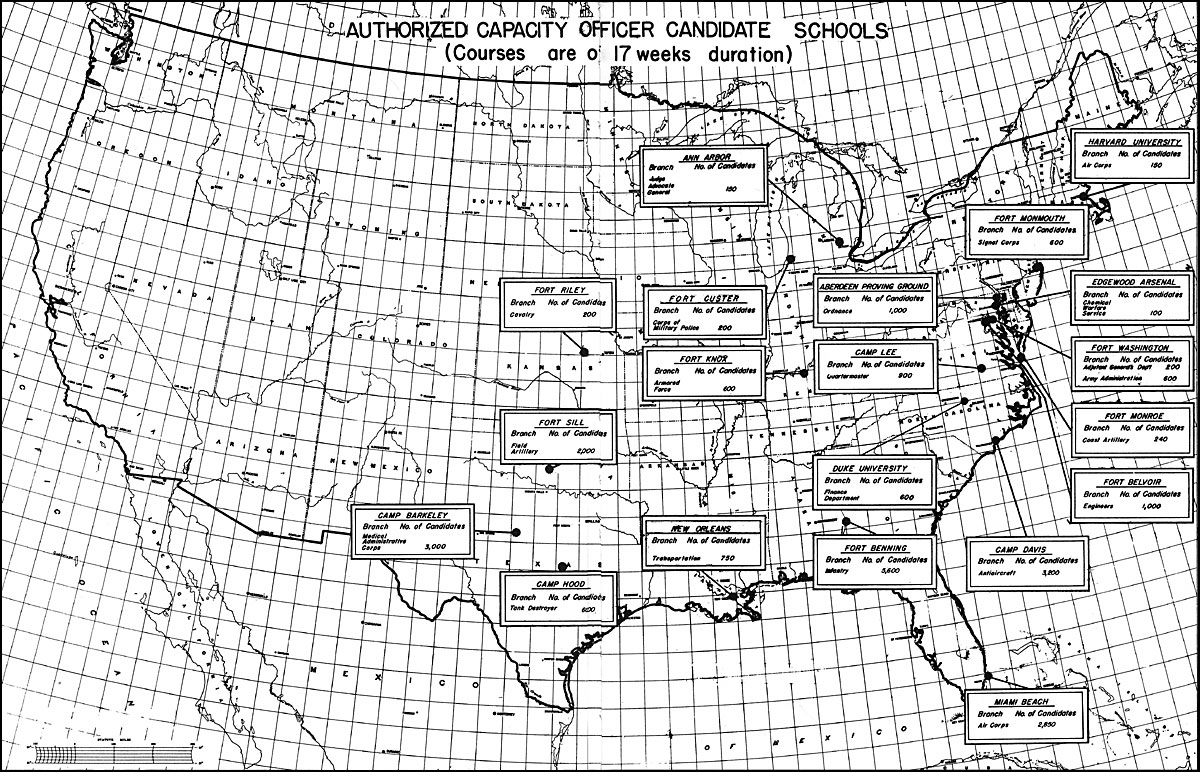
these men and organization if security of the Western Hemisphere was to be assured, and such a recommendation was made to the Congress by the President early in July. Th Selective Service Extension Act of 1941 was approved the latter part of August, 4 months before the attack on Pearl Harbor.At this time the Army of the United States consisted of a partially equipped force of 28 Infantry divisions, a newly created armored force of four divisions, two Cavalry divisions, the harbor defenses of the United States, and an air force of 209 incomplete squadrons. There was in existence a number of establishments such as induction stations, replacement training centers, and officer candidate and specialists schools, which provided the necessary basis and experience for a rapid expansion of the Army in the event of war (chart 11). Development of the Army
During the summer of 1941, large battle rehearsals continued which included maneuvers in August, September, and November of some 900,000 troops.1 The organization and training of the necessary nondivisional units (heavy artillery, engineers, etc.) to support our divisions were expedited, while special attention was directed to the development and training of the armored force and antiaircraft organizations which were faced with the prospect of enormous expansions. Selected units were given specialized training in mountain and jungle warfare and amphibious operations, and a Tank Destroyer Center was created. Supply and administrative units and installations were activated and trained to meet the greatly increased logistical demands of combat forces, but we were never able to provide them in sufficient numbers to meet service requirements for the active employment of the tactical units. During this period, port installations were expanded to support possible overseas operations.2
Chart 11: Expansion of the Army, 1941-43Lack of modern matériel, especially in airplanes and antiaircraft guns, as well as lack of trained units embarrassed the War Department during this period both in the training of troops (including air units) and in the preparation of our overseas establishments to meet possible attacks in both oceans. Since 1935 the Hawaiian Islands, having been given first priority, had been provided with more complete troop garrisons and munitions than any other overseas garrison. It now became imperative that the defenses of the Panama Canal and Alaska be given immediate priority. Also, the uncertainty of the European situation involving the peril of the British Isles* and the British Fleet made it urgently necessary for us to secure the defenses of the Western Hemisphere by establishing air bases and defensive garrisons throughout the Caribbean and in Newfoundland. With our limited means the situation developed into a problem of priorities in attempting to meet these requirements, and it was not until February 1941 that additional aircraft, antiaircraft, and other items of modern equipment could be shipped to the Hawaiian Islands. A little later Reinforcements for Overseas Garrisons
* (The substance of the following paragraph for secrecy reasons could not be included in my biennial report of June 30, 1941.)Immediately after Dunkirk in 1940, the British Isles were in effect defenseless so far as organized and equipped ground forces were concerned. Practically all their field army equipment had been lost and an immediate invasion was threatened. In this situation, Lee Enfield rifles, Browning automatic rifles and machine guns, 75 mm. artillery, with limited ammunition and TNT of the World War stock were hurriedly released to the British in return for immediate contracts to be let in the United States for modern matériel of the types mentioned sufficient to equip 1,800,000 men, with quantity production to be underway in time to meet additional troop requirements. Incidentally, at this time great lend-lease shipments to Great Britain, Russia, China, and our other allies were unforeseen.
the first shipments of modern aircraft were made to the Philippines and the Philippine Scout organization was doubled in strength, drawing the necessary personnel from the trained cadres of the new Philippines Army. The fighter planes secured for these purposes were largely obtained by stripping the limited number of squadrons then in training in the United States.In July 1941 the development of quantity production made it possible for the first time to assign modern matériel in sizable lots to the Philippines. On August 28 the first flights of Flying Fortresses were started across the Pacific via Midway and Wake Islands and thence south through Rabaul, Port Moresby, or Port Darwin, and north to the Philippines. By the first week in November some 35 Fortresses had completed this trip. A gap in airplane deliveries from the factory combined with adverse winds between San Francisco and Hawaii prevented the ferrying of an additional 48 Fortresses prior to the attack on Pearl Harbor.
In view of the potentialities of the situation in the Philippines, orders were issued in February 1941 to evacuate the dependents of Army personnel stationed there. The decision was also taken to retain in the islands most of the Regular Army personnel beyond the 2-year tour of service.
July 26, Gen. Douglas MacArthur was recalled from duty with the Philippines Commonwealth, placed on active duty, and designated as commander of United States Army Forces in the Far East. Intimately familiar with the situation in the Philippines, he at once proceeded to expedite preparations for defense within the limits of the available munitions and trained manpower.
(During the late summer of 1941, arrangements were made for the improvement of the landing strips at Rabaul, Port Moresby, and Port Darwin,3 and the commanding general of the Philippines was directed to deliver gasoline and bombs to these points and to Balikpapan in Borneo and Singapore in Malaysia. Deliveries to all but the last two points had been completed when the Japanese took the offensive, December 7.)
National Guard antiaircraft and tank units which had progressed sufficiently in training and for which the necessary modern equipment could be provided were dispatched to the Philippines during this period of preparation. Some 100 light tanks and the first 50 self-propelled artillery weapons delivered by our arsenals were shipped to the Philippines and arrived prior to the outbreak of war.
In August, President Roosevelt issued a proclamation mobilizing the Philippines National Army and steps were taken to furnish these partially trained forces with whatever equipment could be made available from the United States,, in addition to that held in reserve in the Philippines. Referring to this mobilization of the Philippine forces ands the shipments from the ed States of troops, planes, and other munitions already effected or in progress, General MacArthur in a letter to the Chief of Staff on August 30 made the following comment:
I wish to express my personal appreciation for the splendid support that you and the entire War Department have given me along every line since the formation of this command. With such backing the development of a completely adequate defense force will be rapid.In early September the War Department recommended to Congress that the Philippine Independence Act of 1934 be amended so as to authorize the expenditure of certain sugar excise tax funds and currency devaluation funds accruing in the Treasury of the United States for defensive purposes in the islands. These funds amounting to approximately $52,000,000 were wanted primarily for the extension of airfields. While awaiting legislative acton the War Department obtained $10,000,000 from the emergency fund for the President to be utilized for Philippine defenses. This, plus another $10,000,000 from Army Air Forces funds, was quickly exhausted and an additional $5,000,000 was obtained from the emergency fund for the President while the debate was in progress in Congress. Still later when the sugar excise tax legislation did not receive favorable action the War Department included in the Third Supplemental national Defense Appropriation Act, 1942, $269,000,000 for the Army of the philippines, but this did not become available until the act was approved on December 17, 1941.
By October 1941 it had been found possible to assemble 500,000 tons of supplies and 20,000 fully equipped and fairly well-trained troops as reinforcements for the Philippine Islands. Few troop transports were available, but with hasty conversion of passenger ships to troop carriers, 11 troop ships were scheduled to sail between November 21 and January 6. Six of the troop ships and nine cargo vessels were at sea when word of the Pearl Harbor attack was received. Orders were flashed to all of these vessels to proceed to the nearest friendly port and to observe radio silence. Four of the troop ships returned to San Francisco. The other two, which were well out from Honolulu with 4,500 troops aboard, made Brisbane, Australia, after 15 days of silence and uncertainty. All but one of the cargo vessels reached friendly ports. The exception was presumed captured after having reported on January 1 from 600 miles south of Tahiti that an unidentified airplane had ordered her to halt but that she was proceeding to New Zealand. Another vessel whose cargo included P-40 fighters, motor vehicles, rifles, ammunition, and gasoline, was at Christmas Island at the time the Japanese struck. It
immediately put to sea and no word was heard from it until the 23d of December when it sailed into Los Angeles harbor with its cargo intact.Further deliveries to the Far Eastern area were hampered by the loss of Wake Island which necessitated the immediate development of an alternate trans-Pacific route via Christmas Island, Canton Island, Fiji, and New Caledonia. The new route was opened to traffic during January 1942. In the interim all heavy bomber air movements were immediately undertaken from Miami, Fla., via Brazil, equatorial Africa, and India through Sumatra to Java and Australia. The loss of Sumatra in February terminated deliveries by this route. While this sudden reversal of a movement half way around the earth demonstrated the mobility of the airplane, it also demonstrated the lack of mobility of air forces until a lengthy process of building up ground service forces and supplies (mechanics, ordnance and radio technicians, signal personnel, radar warning detachments, antiaircraft, medical, and quartermaster units, as well as the troops to capture air fields and dnd them against land attack, and the accumulation of repair machinery, gasoline, bombs, and ammunition) had been laboriously completed by transport plane, passenger and cargo ship--the last two largely being slow-moving means of transportation. The planes flew to Australia in 10 days. The ground units matériel to service the planes and keep them flying required approximately 21/2 months or longer for the transfer.
Our greatest problem during this period was the recognized urgency of the situation as opposed by the fact that we were just in the process of obtaining ammunition, arms, and equipment as a result of appropriations made from a year to 2 years previously and of having available only partially trained troops as a result of the recent mobilization and expansion to war strength of the National Guard and the few Regular Army units, and the passage of the Selective Service Act the previous fall. Our first obligation had been to see that the troops assembled in this country possessed enough equipment (about 30 to 50 percent per division)4 to permit them to be trained for employment wherever the defenses of the Western Hemisphere might require, and to make certain that we had in the Panama Canal Zone, Hawaii, and Alaska sufficient garrisons and armament to prevent a hostile landing. All this took time, and time was what we lacked. Time Factor
Deficiencies in arms and equipment especially in ammunition and airplanes required for the immediate defense of the Western Hemisphere,* the Panama Canal Zone, Alaska, and for the Regular Army and National Guard with supporting troops, were so serious that adequate reinforcements for the Philippines at this time would have left the United Sates in a position of great peril should there be a break in the defenses of Great Britain. It was not until new troops had been trained and equipped and Flying Fortresses, fighter planes, tanks, guns, and small-arms ammunition began to come off assembly lines on a partial quantity production basis in the late summer of 1941 that reinforcements for our most distant outpost could be provided without jeopardy to continental United States.
As an example of the degree of our shortages, the necessity for disapproving the requests of the Government of the Netherlands East Indies is cited. After urgent requests through the various channels the representatives of that Government finally called on me personally in the latter part of August 1941 and made a moving appeal for, among other things, an initial allotment of 25,000,000 rounds of small-arms caliber .30 ammunition. They stated that they feared the disintegration of their ground forces unless at least a small amount of ammunition was promptly issued. We had an extremely critical situation here in the United States but the dilemma of these fine people was so tragic in the face of the Japanese threat that it was finally decided to accept the hazard of reducing the ammunition reserve for the troops in movement ot Iceland to an extent which would permit 7,000,000 rounds being turned over to the Dutch. Four million of these rounds were to be made quickly available by shipment from Manila, replacement shipments being started from San Francisco immediately. (Incidentally, 7,000,000 rounds was to be the daily delivery of a plant which was due to get into production in early October, but that was to be too late for the gathering storm in the Far East.)
On all the fighting fronts the Allies were in a desperate situation due to lack of adequate matériel while facing an enemy who possessed an abundance of the most modern equipment conceived at that time. The trying problem of the War Department was to meet the urgent necessities of critical fronts without
* Vitally important in the strategic defense of the United States is Brazil which offers the nearest point of approach to this continent from the east. It is also vital to the security of the Panama Canal that the various avenues of approach through Brazilian territory be in friendly hands and adequately guarded. The traditional friendship between Brazil and the United States and complete agreement between the two peoples on matters of interest to the Western Hemisphere have had an important bearing on our defense preparations. Close cooperation between the United States and Brazil was crystallized through the formation of a Joint Brazil-United States Defense Commission in May 1942. This Commission has since been working on mutual defense plans and matters related to our common war effort.
jeopardy to the security of continental United States. Money in large appropriations had been made available but not available was the time in which to convert this money into munitions ready for issue.The Lend-Lease Act was passed in March 1941, but it was not until the latter part of that year that it began to be effective in its results. An agreement for aid to Russia in cooperation with the British was implemented in October and was just becoming effective when we entered the war as a belligerent. in spite of our situation, it was vital that we help both Russia and the United Kingdom for our own security. This matter was considered to so important that lend-lease aid continued throughout the crisis of our entrance into the war without notable interruptions except in the case of a few critical items.5
In connection with the foregoing and with what follows, it is difficult to keep in mind the constant changes in the international situation and in the development of trained troops and munitions which dictated the succession of decisions and actions. For example, in the light of the situation today, the summer of 1943, we are not justified in maintaining large air and ground installations in the Caribbean from Trinidad north to Cuba and even in the Panama Canal Zone itself so far as mobile ground forces are concerned. The original program was undertaken in view of the possibility that a great tragedy suddenly might befall the United Kingdom with the consequent complete reversal of the naval situation in the North and South Atlantic. Then as well as much later our military developments in the Caribbean had to be measured by the constant threat of a German occupation of Morocco and Dakar and fifth column activities throughout Latin America.* As these possibilities, at times seeming probabilities, were wiped from the slate, the requirements in the Caribbean were altered materially and construction of installations was cad and large portions of the garrisons withdrawn. Changing Situation
Our deployments were made in the light of limited resources in troops and equipment at the time and a continuing lack of sufficient ocean tonnage or landing craft, or both, and were influenced also by the length of turn-around required of ocean shipping and the limited docking facilities at many ports. As these conditions changed our strategical approach to the war was altered accordingly. The recent opening of the mediterranean to convoys, for instance, has profoundly affected the logistical possibilities in this world-wide war.6
The Japanese attack on Pearl Harbor on December 7, 1941, galvanized the entire military organization of our Nation into the immediate tasks of protecting the United States, Alaska, and the a Canal Zone against surprise attack and sabotage. it also precipitated the movement of additional men and matériel to guard our extended naval and air lines of communications from the United States to active and prospective theaters of operations, and to replace losses in Hawaii. Plans which had been formulated in preparation for a possible state of war were put into effect according to the demands of the actual situation. THE FOURTH PHASE
War Is Declared
Since the Japanese attacks on the Pacific Fleet in Hawaii had uncovered the entire west coast of North American, the reinforcement of garrisons along the west coast, Panama, Hawaii, and in Alaska wa given first priority. The movement of air forces and antiaircraft units was initiated immediately by flight and fast freight specials. The movement of an army corps of two Infantry divisions and corps troops to the west coast started on December 14, 1941, and was completed a few days later. By December 17 the critical areas on both the Pacific and Atlantic coats had been provided with a reasonable degree of protection against air and sea attack.§ Additional antiaircraft units were sent by sea, and air reinforcements were flown to the Panama Canal. In the first 5 weeks of the war these deployments in conjunction with the forces en route to Hawaii, Alaska, and other bases involved a rail movement of approximately 600,000 troops with their vehicular transportation, guns, and equipment. The railroads of the Nation handled this sudden and tremendous volume of traffic in personnel and matériel in an extremely efficient manner, thanks in part to the previous elaborate organization in depth of coastal ports of embarkation with their intermediate storage depots and regulating stations
* In March 1942 the Inter-American Defense Board was created composed of military and naval technicians appointed by the governments concerned to consider measures necessary for the defense of the continent. Lt. Gen. Stanley D. Embick is presently Chairman of the Board and is senior United States member. All of the Latin American countries are represented. The charter of this board is contained in the resolutions of the Third Conference of Foreign Ministers held at Rio de Janeiro in January 1932.§ In February 1942, the Joint mexican-United States Defense Commission was established to consider problems relating to the common defense of the United States and Mexico. The cooperation between the two Governments in these matters has been complete.
extending as far inland as Phoenix, Ariz., Ogden, Utah, and Harrisburg, Pa.*A first necessity was to make good the damage in Hawaii and to strengthen its defenses and those at Midway, to establish a succession of island bases to guard the Pacific lines of communication with Australia and New Zealand and to permit the transport of bombers and transport planes and the servicing of naval aircraft and shipping. Ships in the Pacific coast harbors were immediately requisitioned, reloaded, and sent westward with combat and service personnel, aircraft equipment, and other matériel. Two fast convoys were organized, loaded and left San Francisco for Hawaii during the first 10 days of the war. A convoy en route to the Philippines was diverted to Australia.
Troops were sent to relive the Marines and British forces in Iceland and, at the same time, the first echelon of troops was sent overseas to Northern Ireland to assist in the protection of the British Isles and to pave the way for future American activities in Europe.
The outposts of the Panama Canal defenses were rapidly extended by the establishment of air bases in South and Central America7 and by the provision of small coast artillery detachments with 155-mm. guns to defend the critical points along the South American coast as far as Chile.
To meet the situation in the United States the areas contiguous to the east and west coasts were organized into the Eastern and Western Defense Commands respectively and placed under the command of Lt. Gen. Hugh A. Drum and Lt. Gen. John L. DeWitt. Integrated into this command set-up was the operational control of interceptor aircraft assigned to protect our coast lines. In addition, general DeWitt retained control over the Alaskan Defense Command and General Drum over the United States troops in Newfoundland and Bermuda (chart 12).
Work on the Alaska Military Highway was accelerated and the road was opened to traffic on October 29, 1942, despite the difficulties of weather and terrain.8
On December 23, 1941, Winston Churchill, Prime Minister of Great Britain, accompanied by the British Chiefs of Staff, arrived in Washington to confer with the President and the American Chiefs of Staff. Out of the serf discussions which then followed resulted an agreement, not only regarding the immediate strategy for our combined conduct of the war, but also for the organization of a method for the strategical command and control of British and American military resources. Probably no other Allied action, in the field or otherwise, has exerted as powerful an effect on the conduct of this war as the prompt establishment of a prescribed procedure for achieving unity of effort through the medium of the combined Chiefs of Staff acting under the direction of the leaders of their respective governments. There has been a gradual expansion of the system to include most of the activities involved in the war effort and we have been able to solve our problems and settle our differences in an orderly and effective manner. The control of military intelligence, of secrecy, the requirements in manpower, troop types and munitions, the allocation of organizations, matériel and shipping, the coordination of communications, the intricate civil administration to be established under the military government of newly occupied or captured regions, all these and other factors involved in the conduct of a global war have been resolved through the orderly channels of the adopted system.9 Strategy and Control
During this first meeting between the British and American military authorities, which terminated January 14, 1942, steps were taken to insure unified direction of the war effort in the Far East to meet the rapidly spreading attacks of the Japanese in that area. Gen. Sir Archibald Wavell, commander in chief in India, who was in Chungking, China, at the time with Maj. Gen. (now Lt. Gen.) George H. Brett, of the United States Army, was designated supreme commander for American, British,Dutch, and Australian forces, with General Brett as his deputy, and although the strong, carefully prepared tide of the Japanese advance overran the Philippines, the Netherlands East Indies, the Malay Peninsula, and Burma, the cooperative results obtained in this desperate emergency by the creation of a united command established a firm basis for future combined operations.
The attack by Japan and the declaration of war by Germany and Italy immediately involved the United States and Great Britain in a war of global proportions unique in the history of the world. It was not merely war non two fronts but in several theaters, with lines of communication encircling the earth and extending over 56,000 miles (chart 13). Global War
For both Great Britain and the United States, military operations in the Pacific area and the Far East created unprecedented logistical problems with respect to shipping. Time and space factors dictated our strategy to a considerable degree. To land and maintain American forces in Australia required more than twice the ship tonnage necessary for similar American forces in Europe or North Africa. In this critical period, however, it was necessary to establish without delay large supply bases in Australia both for air and ground troops and especially for the purpose of giving logistical support to our forces in the Philippines.
* The rail tonnage concentrated on the Brooklyn Army Base in the fall of 1941 exceeded that of 1918 on the port of New York.
Chart 12: Tactical Organization Within the United States
Chart 13: Time and Space Chart--Air and Water Logistics
By June 1942, 150,000 Army troops as well as Marine and Navy ground echelons had been established in the South and Southwest Pacific areas.* The peculiar topography and character of the Australian continent made the task there one of extreme difficulty. Australian distances are tremendous, the communications--road, rail, and electric wire--were limited and complicated by the absence of standardization, and the frontier for 4,500 miles was exposed to possible Japanese landings.Japan struck at Hawaii, the Philippines, Malaya, and strategic islands in the central pacific. With the advantage of a long period of preparation, including numerous initial moves in China and IndoChina to establish advance air and other bases, and capitalizing upon surprise action, the Japanese launched their thrust to prevent the concentration or reinforcement of Allied forces to halt the drive south toward Australia and Burma.10
The left wing of the southward advance of the Japanese was concentrated on the reduction of the Philippines. Our strength in the islands at that time consisted of 19,000 United States Army troops, 12,000 Philippine Scouts, and approximately 100,000 men of the newly mobilized and but partially trained and equipped Philippine Army. Included in these forces were some 8,000 Army Air Forces personnel equipped with some 250 aircraft, of which 35 were Flying Fortresses and 107 were P-40 fighters. Struggle for the Philippines
The enemy led off with systematic bombing of airfields and key points in Luzon which resulted in the destruction of a large number of our planes due to limited dispersal fields and lack of sufficient radar warning equipment, antiaircraft guns, and other matériel.
On December 10 and 22, Japanese landings were made in northwestern Luzon. Outnumbered and incompletely equipped, lacking air support, and utilizing troops but recently mobilized and organized for the first time into regimental groups, General MacArthur was left no alternative but that of a delaying action. His action was further complicated by another Japanese landing, in force, on the eastern coast of Luzon. Under great difficulties an orderly withdrawal was effected into the Bataan Peninsula for a final defensive stand, protected and supported by the fortress of Corregidor. The remaining bombing planes were sent to Mindanao (later to Australia) with the mission of securing bases from which to support the operations on Bataan. The enemy rapidly concentrated his forces ashore and launched heavy attacks against the Bataan garrison, which heroically contested every foot of ground.
(By the end of January, Japanese troops had seized the important oil center of Tarakan on the northeast coast of Borneo, captured Rabaul and Kavieng in the Bismarck Archipelago and Kieta on Bougainville Island in the Solomons, were rapidly approaching Singapore§ from the north, and controlled the sea and air routes to the Philippines. They stood along a 4,000-mile frontier of the Dutch East Indies and the Melanesian Barrier with their forces in position to threaten the remaining Dutch possessions, Australia, and the islands to its north and east.)
The difficulties of the supply situation on Bataan, under the Japanese blockade, were greatly aggravated by the fact that thousands of civilians accompanied the army into the Bataan Peninsula. The number of people to be supplied quickly forced a reduction of the entire command to half rations. Efforts were immediately initiated to organize blockade running from the Netherlands East indies and Australia and to carry medicines, special fuses, and other critical munitions by submarine. The blockade running, financed from the funds placed at the disposal of the Chief of Staff by Congress, involved many difficulties; for example, it was found that the small shipowners and crew members approached in Java, Timor, and New Guinea would not accept checks on our Federal funds deposited in Melbourne, but demanded cash. Therefore the actual money had to be flown across Africa and india by plane for delivery in Java. A complete report of these perilous operations has never been received. Of seven ships dispatched from Australia only three arrived at Cebu. Attempts to transship these supplies from Cebu to Corregidor failed because of the rigid enemy blockade. At least 15 of these blockade runners, totaling 40,000 tons, were sunk or captured by the enemy while attempting to get supplies through to Bataan. Several over-age destroyers were also fitted out as blockade runners but none of these succeeded in reaching the Philippines prior to the fall of Corregidor. Deliveries of supplies and the evacuation of certain personnel by submarine continued at intervals throughout the siege.
The difficulty of penetrating the Japanese blockade and getting supplies to Corregidor and Bataan caused the military situation to deteriorate. The half rations issued since January 11, 1942, had been further reduced by the end of March, and horses and mules were being slaughtered for food.
* American units were also landed in New Zealand. The Government of New Zealand and the local municipal governments have cooperated in every practicable manner to provide facilities, services, and buildings required by our forces. New Zealand troops now are operating with American forces in complete cooperation in carrying out assigned missions.§ Singapore fell to the Japanese on February 15, 1942.
In view of the enemy's capabilities throughout the Pacific and our untenable position in the Philippines, the major efforts of the United States were directed toward a rapid concentration of defense forces along our route to Australia, the creation of an effective striking force on that continent, and the dispatch of material aid to the forces of our allies in the East Indies.11 Accordingly, Hawaii was strengthened, additional islands along the South Pacific air-ferry route were garrisoned, and a large force was provided for the defense of New Caledonia. The components of a balanced air force were shipped to Australia, the heavy bombers being flown in via Hawaii or India. Shipping limitations precluded the early dispatch of large bodies of ground troops.In February 1942 General MacArthur was instructed by the War Department to proceed to Australia to assume command of the newly designated Southwest Pacific area. His directive from the Combined Chiefs of Staff included the missions of holding Australia, checking the enemy's advance along the Melanesian Barriers, protecting land, sea, and air communications with the Southwest Pacific and maintaining our position in the Philippines. Lt. Gen. Jonathan m. Wainwright, succeeding General MacArthur as commander of the forces in the Philippine Islands, continued the gallant defense which has become an epic in American history.
On March 31 the Japanese initiated the anticipated general assault on the Bataan position, an attack relentlessly maintained during the next 7 days. As our lines were finally penetrated and field hospitals were shelled by Japanese artillery, it became apparent that the courageous but exhausted defenders could no longer avoid disaster.
On April 9 the following radio was received from General Wainwright on Corregidor:
Shortly after flag of truce passed through the front line this morning hostilities ceased for the most part in Bataan. At about 10 o'clock this morning General king was sent for, to confer with the Japanese commander. he has not returned, as of 7 o'clock p.m., nor has result of conference been disclosed. Since the fall of Bataan the hostile air force has renewed its attack on Corregidor. This island was heavily bombed this afternoon but has suffered no damage of military consequence.Despite Bataan's loss, Corregidor, Fort Drum, and Forth Hughes (all island fortifications) continued to resist enemy attacks with counterbattery and antiaircraft fire for nearly a month. On April 13 and 14 a squadron of American bombers from the south successfully attacked Japanese installations and shipping in the Philippine area.
On May 5, after a week of intensive bombardment which buried many of the shore defenses under landslides, the enemy made a landing on North Point of Corregidor. The shattered defenses were unable to dam the Japanese tide. The following day the exhausted and depleted forces were overwhelmed and finally surrendered.
The final spirit of General Wainwright's heroic command is indicated by the extract from a letter written by him just before Corregidor fell:
As I write this we are subjected to terrific air and artillery bombardment and it is unreasonable to expect that we can hold out for long. We have done our best, both here and on Bataan, and although beaten we are still unashamed.Concurrently with the campaign to reduce the Philippines, the enemy had exploited his successes on the Malayan Peninsula to bring the entire Netherlands East Indies under his domination. Concentration of Japanese forces there and in the Bismarck Archipelago and Solomon Islands constituted a direct threat to our lines of communication in the Pacific and to the north coast of Australia.
These initial Japanese successes were due to Allied lack of military means, especially in aircraft and its supporting warning and maintenance services, to oppose an adversary whose preliminary strategic deployments permitted successive concentrations of overwhelming superiority in land, sea, and air forces on selected objectives.
The effects of the desperate resistance offered by the Philippine Army and United States forces on Bataan, holding as they did a size portion of Japanese strength, were now being felt. During the delay thus gained men and materials were dispatched to Australia, New Caledonia, and other Pacific islands. The growth of power of the United Nations in the southwest Pacific wa presaged by our air forces which were now performing long-range bombing missions against Japan's newly acquired bases in the Bismarcks and New Guinea, and were also making Japanese attempts to bomb Port Morseby and northern Australia increasingly costly. The bombing of Japan by our planes commanded by Lt. Col. (now Maj. Gen.) James H. Doolittle was a heartening event in a generally somber picture. Despite heavy losses in men and materials sustained by the Allies in Malaya, the Netherlands East Indies, and the Philippines, the military balance was approaching an equilibrium. The initiative was no longer completely in enemy hands.
That Japan intended to exploit her victories to the limit was indicated by preparations for an offensive toward Australia based on the Bismarcks and the upper Solomons. On May 4, 1942, this new adventure was signalized by the seizure of the port ot Tulagi in the central Solomons (see map 1). Between May 7 and 11, however, a heavy column of enemy naval vessels and transports moving southward in the Coral Coral Sea--High Tide of Aggression
Sea was decisively defeated by Allied naval and air forces off the Louisiade Archipelago. Suffering heavy losses the enemy retired toward bases in the Mandated Islands. Army aircraft supported this action by repeated attacks on Japanese bases at Lae, Salamaua, Rabaul, Kieta, and the Shortland areas in southern Bougainville, where concentrations of enemy shipping provided lucrative targets (map 2).The Coral Sea action marked the high tide of Japanese conquest in the southwest Pacific. The possibility that the enemy would shift his strength northward to attack Midway or hawaii prompted a regrouping of our naval units and a further reinforcement of the air and ground units at hawaii, Midway, and other island outposts. Midway-based long-range bombing and patrol aircraft were assigned offensive reconnaissance missions over extensive ocean areas. On the morning of June 3 a naval plane sighted an enemy force with transports some 470 miles to the westward. Next day, when another force with a heavy carrier concentration was located about 180 miles to the north of Midway, it became evident that the largest concentration of enemy naval strength yet assembled for Pacific operations was headed eastward with the capture of Midway as it preliminary objective. All available Navy carrier and land-based Army and Navy air forces were concentrated against the enemy. In the historic 2-day battle which followed, heavy losses in ships and airplanes were inflicted on the Japanese who retired at once.
The battles of the Coral Sea and Midway restored the balance of sea power in the Pacific to the United States and lessened a grave threat to our Pacific possessions. midway climaxed our first half year of war and marked the opening of a new phase of operations in the Pacific. The enemy offensive had definitely been checked; the United Nations firmly held chains of island bases extending from the United States to Australia; our forces had begun to deliver staggering blow; and our commanders were now free to prepare for offensive operations.
Map 2: New Guinea-Bismarcks Area
The operation against Guadalcanal inaugurated a series of offensive moves in the Pacific which have continued to the present date. The enemy occupation of the Solomon Islands permitted him the use of advance air and naval bases from which to attack our long Pacific supply line and the north coast of Australia. On August 7, 1942, therefore, United States Navy and Marine forces seized beachheads on Guadalcanal and Florida Island and occupied Tulagi. The highly prized airfield on Guadalcanal was held by the Marines against a long series of heavy air, sea, and ground assaults by the enemy. The resolute defense of these Marines under Maj. Gen. (now Lt. Gen.) Alexander A. Vandegrift and the desperate gallantry of our naval task forces marked the turning point in the Pacific. THE FIFTH PHASE
The Solomons
Army ground units commenced reinforcements of the Marines on October 13. On December 9, command in the Guadalcanal-Tulagi area passed to the Army under Maj. Gen. Alexander M. Patch. Early in 1943, a series of well-executed and vigorous operations by Army divisions and one Marine regiment in conjunction with air offensive, defensive, and support operations compressed and then destroyed all enemy resistance on the island.
While strongly contesting our offensive in the Solomons during the summer and fall of 1942, the enemy's determination to exploit previous gains was indicated by persistent reports of activities in the Bismarcks, upper Solomons, and New Guinea. These proved to be preparations for an overland push from Buna through the Owen Stanley Mountains with Port Moresby, our advance base on the south coast of New Guinea, as the immediate objective. Papua
By September 12, the Japanese had forced Allied ground force back to within 30 miles of Port Moresby in an advance which demonstrated great skill in jungle and mountain fighting; however, reinforcement of Allied ground troops coupled with effective air support finally turned back this threat. By the end of November, converging attacks by American and Australian troops had confined the enemy to pockets along the northeast coast. In the final stages of the Allied drive, the Army Air Forces under Lt. Gen. George C. Kenney, while destroying the enemy shipping employed in attempts to supply his troops, flew a complete striking force--troops, equipment, and flood--from Port Moresby over the Owen Stanley Range to the Buna area, utilizing bombers as well as transport planes.12
Our air offensive ultimately forced the now desperate Japanese to use parachutes and submarines to supply their forces which were resisting our ground pressure with fanatical ten. Early in 1943, the northeast coast of New Guinea was finally cleared of the enemy by American and Australian troops under the command of Lt. Gen. Robert L. Eichelberger, as far north as Buna, but only after he had been systematically rooted out of his fox-holes along the beaches and destroyed by the determined assaults of our men. Success in this campaign is all the more remarkable in view of the fact that throughout General MacArthur's operations he was handicapped by a serious lack of small vessels, transport planes, and special jungle equipment in a climate deleterious to white races.
The United Nations in the Pacific theater now possessed more secure positions from which to counter Japanese offensive ventures; also, commanders and troops had secured valuable experience in battle. Unified command arrangements were welding sea, air, and ground forces into efficient fighting teams. Air superiority was demonstrated by a loss ration of four to one in our favor (chart 14); and a more complete control of the sea wa made possible by the "skip-bombing" tactics perfected in the southwest Pacific by General Kenney's airmen. In a single instance, a convoy proceeding through Vitiaz Strait into Huon Gulf was completely destroyed by this type of attack. In this Battle of the Bismarck Sea, Allied losses were 1 bomber and 3 pursuit planes, with a casualty list of 13 men, compared to a known Japanese loss of 61 planes and 22 ships, and an estimated loss of an entire division of 15,000 men.
Rapidly increasing military resources in the Pacific now afford us considerable freedom of action. The characteristics of the theater, predominantly oceanic, demand precise and efficient teamwork on the part of our naval, air, and ground forces. There are no shortcuts in the accomplishment of the arduous task. Successes thus far in piercing the enemy's protective screen of island citadels prove the soundness of combining surface and submarine attacks on hostile sea routes of communication, strategic employment of our long-range bombers against the enemy's staging and supply bases, and coordinated assault by all elements upon successive objectives.13
Prior to our entry into the war, the United States, through lend-lease operations, had supported British war economy and had included measures to insure safe delivery of these supplies and materials. When we were precipitated into active participation in the European Theater
Chart 14: Comparison of U.S. and Enemy Plane Losses in Southwest Pacific and North African Theaters
struggle, the necessity for the protection and control of the trans-Atlantic sea routes became both urgent and vital. Initial preparatory measures on our part therefore included the strenghtening of both sea and air communication routes and this in turn involved the further development of bases in Newfoundland, Greenland, Iceland, and the United Kingdom.When we entered the war, Germany, although committed on the eastern front, had sufficient divisions in northwestern Europe to threaten a cross-Channel invasion or a possible thrust to seize Iceland on the flank of the sea lanes from the United States to the United Kingdom and Russia. American forces, in sufficient strength to discourage such a venture, previously has been dispatched to augment the British garrison in Iceland. The latter was relieved in its entirety by the summer of 1942.
Despite the fact that the initiative at this time lay wholly in the hands of the Axis our preliminary movements were based on future aggressive action. The time factor now became increasingly important, time in which to train the new armies, to procure the shipping and munitions, and to organize the long lines of communications, while holding the enemy at Detailed planning for specific future offensive operations was already under way in line with the basic strategy which had been previously determined. United States Troops Move to United Kingdom
Upon our entry into the war it became urgently desirable to move United States troops into the United Kingdom as early as possible to bolster the defenses there which had been seriously weakened by the dispatch of troops to the Middle and the Far East, and for the psychological effect on the British people. At that moment, however, the threat to Australia was so serious that most of the shipping immediately available in the Atlantic in January had to be hurriedly employed for the movement of 25,000 troops to the southwest Pacific, largely to garrison New Caledonia. It therefore was not possible to send more than a single division to Ireland until the following summer.
Steps were immediately taken to build up in the United Kingdom a strong American air force, notably precision bombers. These units would afford additional protection to the British Isles against any invasion attempt.
The movement of United States troops to the United Kingdom utilized our shortest line of communications overseas and effected a concentration of British, Canadian, and American forces which, with the support of the powerful metropolitan Royal Air Force, forced the enemy to employ additional troops in northwestern France, thereby reducing the strength he could employ elsewhere.
In the latter part of January 1942, the first convoy of our troops arrived in Northern Ireland. The complicated transportation, construction, and administrative problems were solved with the close cooperation of all the British agencies concerned. ,p. By June the gathering strength of United States force in the United Kingdom made it necessary to establish a headquarters and organization for a European theater of operations, and Maj. Gen. (now Gen.) Dwight D. Eisenhower was placed in command.
The United States Army Air Forces assault on the continent of Europe was launched on July 4, 1942, when six American aircraft and crews participated in a Royal Air Force attack on targets in Holland. The combined American=-British bomber offensive against the continent of Europe today gives promise of being a decisive factor in the ultimate destruction of the German citadel. It has for its objectives the reduction of German air combat strength to a virtual impotence; the disruption of vital elements of the enemy's lines of communications; the progressive destruction and dislocation of the German military, industrial, and economic system; and by the resultant psychological impact on the German people, the undermining of their morale and their willingness to continue to support the war effort. Thus the objective of the combined bomber offensive is the elimination of both the German ability and will to continue to wage war.
The British heavy bomber command was developed for the purpose of carrying out night missions, while the American Flying Fortresses and Liberators were developed for daylight operations. In the British planes, speed and armament were limited in favor of long range and heavy bomb loads. This type plane is especially effective for night operations over industrial areas where a high degree of precision in bombing is not vitally necessary. On the other hand the American bomber design tends toward a fast, very heavily armed and armored high-altitude plane. Its more limited bomb capacity is compensated for by the perfection of the precision bombsight which permits small specific targets to be singled out for destruction. The violence of the German fighter plane reaction to our daylight attacks is convincing evidence of the deadly effect of precision bombing. The enemy just find a counter to this technique or accept the emasculation of his industries and his fighter command. Aerial Assault on Fortress Europe
Allied operations to cope with German submarine activities furnish an excellent example of British and American cooperation, coordinated to achieve maximum results. There are three possible types of offensive action against submarines; that is, to sink them at
sea, to destroy the factories which build and equip them, and to attack the bases from which they operate. Factories and bases may be rendered inoperative either by a night mass attack to effect general destruction on the area or by daylight precision attacks against vital utilities such as power plants, fuel supply installations, or special repair facilities.Reports during the past months have mentioned with increasing frequency air attacks against Lorient, St. Nazaire, Brest, and La Pallice, all U-boat bases on the west coast of France. The prevision attacks have been aimed against critical points, the destruction of which render the general installations ineffective, a particularly important procedure where the docks and other vital installations have been protected by heavy concrete overhead cover. The night bombing attacks carried out by the British have involved loads of over 1,000 tons dropped in a single operation with the effect of devastating general service facilities and of shattering the morale and working efficiency of the personnel operating the submarine bases. At the same time heavy attacks have been made day and night against the submarine shipyards at Vegesack (near Bremen) and Wilhelmshaven, and against the Essen, Dusseldorf, Mannheim, Karlsruhe, and other industrial areas producing component parts for submarines.
These bombing operations, together with the action of the AntiSubmarine Command and Allied destroyers and escort vessels, appear to be in process of driving the submarine from the seas.
Experience over the European continent has demonstrated the soundness of the tactical doctrines of our air forces and of the basic design of their aircraft. Notable early examples were raids against Vegesack and Wilhelmshaven during March 1943, in which 180 of our heavy bombers destroyed over 80 German fighters with a loss of but 5 of our own planes. These raids effectively put out of action for a period of many months the Vegesack plant and administered crippling damage to the naval installations at Wilhelmshaven.
Our air assaults on Germany and northwestern Europe have grown heavier and heavier with the constantly increasing strength of the Eighth Air Force operating our of the United Kingdom. More recently it has been possible to coordinate these attacks closely with operations using bases in North Africa. The enforced concentration of the Germans' most experienced fighter pilots in northwestern Europe had an important bearing on air operations during the final battle of Tunisia and on the situation in Russia.14
The build-up of depots, airfields, and administrative services for our operations in the United Kingdom has involved a tremendous program of shipping, construction, and the organization of an extensive service command. These vital factors in modern war are time-consuming in preparation and impose a heavy burden on our air and ocean transportation facilities, but they provide the solid foundation which is an imperative requirement in conducting the specialized and technical warfare of the present day.15
On May 19, 1943, following the unfortunate airplane accident which resulted in the death of Lt. Gen. Frank M. Andrews, command of the European theater of operations was assumed by Lt. Gen. Jacob L. Devers.
In January 1942, when the Prime Minister and his chiefs of staff were in Washington, operations in northwest Africa, in Morocco and Algiers, were discussed in detail. Our limited means at the time made it impracticable to mount such an expedition. There were further discussions at the time of the Prime Minister's visit to Washington the following June and the final decision was taken in July to launch an expedition into northwest Africa in conjunction with the preparations for the advance westward of the British Eighth Army then reorganizing on the El Alamein line. The opening of the Mediterranean would facilitate Allied global operations, and the removal of the constant threat of German activities in western Morocco and at Dakar would add immeasurably to the security of the Allied position while gathering strength to administer the final punishing blows. Furthermore, if our occupation of North Africa could be carried out without fatally embittering the French troops and authorities in that region it would provide a setting for the reconstitution of the French Army in preparation for its return in force to the homeland. The psychological effect of the conquest of North Africa would be tremendous. North African Theater
The adopted plans provided that task forces from both the United Kingdom and the United States should strike simultaneously at Algiers, Oran, and Casablanca (map 3). It was urgently desired to make initial landings on the east of Algiers at Bone, Philippeville, and possibly Tunis, but the lack of shipping and of landing boats and aircraft carriers at the time made this procedure impracticable. It was desired to carry out the operation early in the fall but it was necessary ot delay until November in order to receive a large number of craft from the shipyards and provide and train the crews for the operation of these vessels. Some of the larger vessels did not become available until a week before the convoys sailed.
The success of the operation depended on the efficient handling of a mass of details as well as on the training and fighting qualities of the troops, and
Map 3: French Northwest Africa
above all, upon the secrecy with which this vast undertaking had to be prepared.General Eisenhower, who was designated to command the Allied forces involved, organized combined staff in London and directed the planning. Three task forces were formed: one entirely American sailed directly from the United States and carried out the landings along the west coast of Morocco, another of American troops escorted by the British Navy sailed from Great Britain and landed in the vicinity of Oran, the third, a combined British-American ground force escorted by the British Navy, sailed from the British Isles and landed at Algiers. There were naval covering forces, both British and American. The combined air forces, other than carrier-borne and a few transports and heavy bombers, had to be funneled through the single restricted field at Gibraltar which could have been put out of action in less than an hour. There was no choice but to accept this hazard.
The problem of how to avoid fighting with the French forces in Africa was difficult to approach. In the first place, and most important of all, the hazard to the secrecy with which the operation must be prepared and launched presented an extremely delicate balance in the choice of methods to be followed. Should an approach be made to a single Frenchman who proved unsympathetic to our purpose we risked the slaughter of soldiers on the beaches of North Africa as well as decisive losses in shipping. psychological impact from such a defeat, at that particular moment in the war would have been little short of catastrophic in its possible consequences. To a certain gree, however, this risk had to be accepted. Even so, the discussions regarding such an expedition had to be conducted on a more or less indefinite basis as to timing. Not until 4 days before the convoys would deploy off the beaches at Algiers, Oran, and Casablanca, were the few Frenchmen we had contacted informed of the actual date for the operation. This of course made it extremely difficult, in cases impossible, for these French officials to take all the steps necessary to facilitate our landings. The consequences of disclosure of our purpose to the enemy, however, involved too great a peril to justify earlier notification.
The singular relationship existing between the Vichy government and Berlin, and with the French provinces in North Africa, together with the differences of religion and race and the deep-rooted hatreds of the heterogeneous populations of Algiers and Morocco, imposed a political problem of maximum complexity on General Eisenhower. At the moment his energies and direction had to be concentrated on the successful penetration of an 800-mile coastline and a vast hinterland by a force of but 107,000 men. To further complicate the situation he must be on guard against the possibility of an Axis stroke through Spain to sever our communications through the Straits of Gibraltar and interrupt by aerial bombardment the single railroad line from Casablanca through Fez to Oran.
Concurrently with the preparation in the United Kingdom of two task forces, one of Americans to land at Oran and the other a mixed force to land at Algiers, a third task force composed of the 3rd Infantry and 2nd Armored Divisions, the major part of the 9th Infantry Division, and reinforced with supporting arms and services, was organized in the United States under Maj. Gen. (now Lt. Gen.) George S. Patton, Jr. His headquarters were temporarily established in the Operations Division of the General Staff in Washington which became the coordinating medium between General Eisenhower and General Patton. Rear Admiral (now Vice Admiral) H.K. Hewitt, who commanded the expedition until its disembarkation in Africa, assembled the force at sea on October 24 and sailed for Casablanca. This task force was to effect a junction with the force under Maj. Gen. (now Lt. Gen.) Lloyd Fredendall which was to land in the vicinity of Oran.
General Fredendall's troops consisted of the 1st Infantry Division and one-half of the 1st Armored Division, reinforced by corps troops. In addition to seizing Oran and the adjacent airfields and making contact with General Patton's force in the vicinity of Fez, this expedition was also charged with the mission of effecting a juncture with the Eastern Task Force which had the mission of capturing Algiers. The latter force under Lt. Gen. K.A.N. Anderson of the British Army, consisted of British commando and infantry units together with two United States regimental combat teams, one from the 9th and one from the 34th Infantry Divisions, and a Ranger battalion. The first landing was to be effected under the direction of Maj. Gen. Charles W. Ryder of the American Army. General Anderson took over command after the American troops had been established ashore.
The two task forces sailed from the British Isles on October 25 under British naval escort. All three task forces were provided the protection of three naval covering forces, one American.
To facilitate the capture of the airfields near Oran a 1,500-mile flight was undertaken by our troop-carrier command with United States parachute troops.
November 8 was designated as D-day no which the three task forces were to strike simultaneously. Three days previously General Eisenhower opened his command post at Gibraltar, and apropos of Allied unity of purpose in this war it is interesting to report that for the time being he commanded the fortress of Gibraltar. Just prior to his departure from London, General Eisenhower radioed me the following message:
I cannot leave the United Kingdom without expressing to you once more, and to all of your assistants in the War Department my lasting appreciation for the perfect assistance and support you have provided us. If you deem it appropriate, and a convenient occasion will occur, I should like you to pay my respects to the President and the Secretary of War and to say to them that all of us are determined to make this operation a real success.Despite the negotiations which had been carried on with a few French officials the amount of resistance which the landing forces would encounter remained problematical. General Eisenhower broadcast a proclamation of our friendly intentions toward French North Africa and instructed the French forces to display certain signals to indicate their nonresistance. However, each task force proceeded on the assumption that determined resistance must be expected. They were under orders not to fire until fire upon. A code signal, "Play ball," was to be broadcast to the entire force at the first hostile act on the part of the French in any sector, as a warning to initiate vigorous offensive action. The Landings
At the moment of the landings in Algeria began, a 1 o'clock on the morning of November 8, President Roosevelt assured the French people by short-wave radio that the Allies sought no territory and asked for French cooperation. The Spanish Government was also informed at this time that the occupation was in no way directed against Spanish Morocco or other Spanish possession in Africa.
The landings were carried out in accordance with plans and with a boldness and efficiency which secured the initial objectives, the major airfields and port in North Africa, within a period of 48 hours.
These military operations were staged against a background of diplomatic negotiations through which speedy cessations of French resistance was sought. Both Gen. Charles de Gaulle, leader of the Fighting French, and Gen. Henri Giraud, who had escaped from Germany to France and then from France to Gibraltar, broadcast pleas for French cooperation when our operations started. Diplomatic Negotiations
General Eisenhower had announced that General Giraud would be responsible for civil and military affairs in North Africa, but the French military officials on the ground were found to be loyal to Marshal Petain's government. President Roosevelt's note to the French Chief of State had assured Marshal Petain of our desire for a liberated France but the Vichy answer was disappointing. Our ambassador was handed his passports on November 9 and orders were dispatched from Vichy to French African units to resist our forces which by then had already accomplished their missions except on the Casablanca front.
Unexpectedly, Admiral Jean Darlan, Petain's designated successor, and commander in chief of all French forces, was found to be in Algiers visiting a sick son when our forces landed. He was taken into protective custody and when it was found that the French leaders stood loyal to the Vichy government, a series of conferences immediately followed with the purpose of calling halt to the French resistance against General Patton's task force in the vicinity of Casablanca. When, on the morning of November 11, the Germans invaded unoccupied France, Darlan rejected the pseudo-independent Vichy government, assumed authority in North Africa in the name of Marshal Petain, and promulgated an order to all French commanders in North Africa to cease hostilities. This order reached Casablanca a few minutes before the assault on that city was to be launched on the early morning of November 11.
The North African government was reoriented and ht into close collaboration with the United Nations under a provisional government headed by Admiral Darlan with General Giraud as commander in chief of the French ground and air units. Subsequently French West Africa under Gov.-Gen. Pierre Boisson announced it adherence to the Darlan regime, bringing to the Allied cause additional naval power and trained ground units and making immediately possible a short air route from the United States to the North African battle fronts. Cordial relations were quickly established with the Sultan of Morocco. Later it was possible to convince General Orgaz, High Commissioner of Spanish Morocco, that the American forces contemplated no action against Spanish territory.
Upon the cessation of hostilities General Eisenhower's forces were faced with numerous and pressing problems. Harbors had to be cleared of sunken ships, wharfs and docks repaired, neglected and slender lines of rail communication had to be developed to carry heavy traffic, antisubmarine patrols organized to protect our sea routes in the Mediterranean, the civil population had to be provided for and its economy started on the road to reconstruction,16 French troops in North Africa had to be equipped,17 our forces had to be disposed to prevent a successful Axis thrust through Spain, and finally, and most important of all, our forces had to close with the enemy in Tunisia to effect his destruction in North Africa.
The rapid extension of the offensive eastward was facilitated by the expeditious landing at Algiers resulting from French cooperation. Our forces had suffered Race for Tunisia
comparatively few casualties in this particular landing and as quickly as logistical support could be prepared they were headed toward Tunisia.it was apparent that a strategical surprise had been effected. Tunisia was lightly garrisoned by the French. Far to the east the German Afrika Korps and the accompanying Italian forces had been hurled back from the El Alamein position by Gen. Sir Bernard Montgomery's Eighth Army a few days prior to the landings.
Despite the manifest difficulties of supply, the immediate occupation of Tunisia appeared mandatory. As soon as French collaboration was assured, the leading elements of the British First Army, including a few of the American units which had landed at Algiers, reembarked for movement eastward to Bougie where they landed on November 11. An overland march immediately followed and Bone was occupied the following day by two companies of British parachutists and a commando unit which arrived by sea. On November 15 orders were issued for the movement of French troops then at Algiers and Constantine to protect the southern flank of the American and British units which were now advancing into Tunisia along the coastal corridors crossing the frontier. The French units were reinforced with American troops, including tank destroyer units, and one of their assigned missions was the protection of advance airfields in the Tebessa-Gafsa area. Meanwhile, our air units had moved into eastern Algeria and were rendering support to our columns from inadequate or improvised airfields despite shortages in gasoline and the great difficultly of supply.
Immediately following the landings in North Africa, Axis forces were rushed into Tunisia by sea and air. As early as November 16 our advancing troops encountered German patrols 60 miles west of Tunis. The leading units of the British First Army, with American reinforcements, reached Medjez-el-Bab, 30 miles southwest of Tunis, on November 25 and took possession of the airfields at Djedeida on November 28. Farther to the south, Allied units reached Pont du Fahs and American parachute troops were operating in the Sbeitla-Gafsa area. Axis resistance steadily increased, with intensified mechanized and artillery activity. Our advance on the Station de Jefna, 32 miles southwest of Bizerte, was repulsed on November 30. Strong Axis counterattacks with tanks forced Allied withdrawals from Tebourba, but similar enemy aggressive action directed against Medjez-el-Bab was successfully resisted. The short and easily maintained air and sea lines of communication between Sicily and Tunisia permitted the rapid build-up of the Axis forces. The nearest ports of Allied entry at Bone and Philippeville were of very limited capacity. The enemy's greatest advantage, however, lay in the possession of all-weather airfields, as the development of the rainy season for a time rendered fighter-plane support of our advance troops impossible. Difficulties of supply became so serious that active operations were practically suspended in early December. Meanwhile the enemy rapidly reinforced his position which assumed the character of a bridgehead protecting the Bizerte-Tunis area and extending southward to cover the bases into the coastal plain leading to Sousse, Sfax, and Gabes. Medjez-el-Bab remained the key point of the Allied position.
in the midst of this campaign, the assassination of Admiral Darlan created a political crisis which was met by the action of the French North African governors in designating General Giraud as Darlan's successor.
The new year opened with the opponents in Tunisia testing each other's strength along the partially stabilized line and matching each other's bids for air supremacy, both forces concentrating against ports and lines of communication. Fall of Tunisia
In Libya, Rommel's Afrika Korps with its complement of Italians abandoned a succession of defensive positions, withdrawing finally into Tripolitania. By February his troops were established on the Mareth Line in southeast Tunisia.
Meanwhile, General Eisenhower's troops were being regrouped on the Tunisian front preparatory to renewing the offensive against the Axis positions. The troops were under the operational command of General Anderson, commanding the British First Army. So far as was practicable, American units were concentrated and the French units organized into a combat corps. German thrusts at weakly held French positions, however, necessitated a further intermingling of Allied units.18
Throughout the African operation up to this time, General Eisenhower had retained control of the United States Army forces in the British Isles, ground and air. This arrangement had been continued in order to afford him a free hand in drawing on such resources as we had established in the United Kingdom. Plans had been made before the launching of the African enterprise to effect a separation in February, and this was actually carried out on February 4, when General Andrews, a highly specialized air officer who had been sent to the Middle East for experience in combat and in contacts with our allies, was appointed commander of the United States forces in the European theater of operations with headquarters in London. This order was paralleled by the creation of a North African theater of operations, under General Eisenhower.
Upon the arrival of the British Eighth Army on the Mareth Line, it came under the direction of General
Eisenhower. General Sir Harold Alexander, of the British Army, was appointed his deputy and given direct command of the Eighteenth Army Group, which consisted of the British First Army, the British Eighth Army, the United States II Corps, and the French units on the TUnisian front. North African air units were organized into the Mediterranean Air Command under Air Chief marshal Sir Arthur Tedder, with Maj. Gen. (now Lt. Gen.) Carl Spaatz, of the United States Army, as commander of the Northwest African Air Force. All heavy bombers, together with fighter support, were organized by General Spaatz into the Strategic Air Force under General Doolittle. Action was initiated at this time by General Spaatz to unify command of light and medium bombers and fighter support into a force known as the Tactical Air Force to lend close support to land and naval operations. Admiral of the fleet, Sir Andrew Cunningham, became naval commander in chief in the mediterranean under General Eisenhower's direction. These Allied command arrangements led directly to the victories which soon followed (Battle of Tunisia and conquest of Sicily).The junction of the veteran Afrika Korps with Von Arnim's command in Tunisia permitted the enemy to launch offensive strokes against the lightly held portions of the long Allied line. On February 14, hostile armored units reinforced by artillery and infantry and supported by dive bombers struck westward from Faid and broke through the Kasserine Pass (map 4). By the afternoon of February 21 the Axis forces had advanced a three-pronged armored thrust 21 miles beyond the pass, threatening the Allied position in central Tunisia. Of this operation General Eisenhower radioed the following comments:
Our present tactical difficulties resulted from my attempt to do possibly too much, coupled with the deterioration of resistance in the central mountainous area which began about January 17. That deterioration ha absorbed the bulk of the United States 1st and 34th Divisions which formations had originally been pushed forward to provide general reserves and to permit us to attack from the line which we were then holding.You would have been impressed could you have seen the magnificent display everywhere by the American enlisted men. I assure you that the troops that come out of this campaign are going to be battlewise and tactically efficient.
There were considerable tosses on both sides. The enemy was able to maintain himself in this forward position for only 2 days before he recoiled under a concentrated attack by our ground forces powerfully assisted by the entire Allied air force in North Africa. Even the heavy bombers were used against their retreating columns. During this withdrawal, the enemy endeavored to capitalize upon possible Allied reinforcing moves to the south, delivering heavy attacks in the Medjez-el-Bab area, but these were held or checked after small gains. These thrusts were the last offensive efforts of the enemy in Tunisia. The rains had ceased, the roads had been improved; the railroad had been vitalized with American methods, and matériel, and more than 10 gasoline pipe lines, the two most important being from Bone to Ferriana and from Philippeville to Ouled Bamoun, had been built. These increased facilities permitted the movement into Tunisia of additional American troops. The time had come for a coordinated Allied effort which would free the African continent of Axis forces. The development of the plan is succinctly stated in the following paragraph of a radio from General Eisenhower on March 11th:
Our own plans contemplate a rising scale of offensive operations and it will be the role of the II Corps to draw all possible strength (enemy) from the south so as to help General Montgomery's Eighth Army through the Mareth Gap. Once we have the Eighth Army through that bottleneck, this campaign in going to assume rapidly a very definite form with constant pressure and drive kept up against the enemy throughout the region.The last phase of the Battle of Tunisia opened on the evening of March 20 when the Western Desert Air Force in rear of the British Eighth Army (including the Ninth United States Air Force under General Brereton) launched an air offensive with continuous 24-hour bombing of the Axis positions and installations in the Mareth area, surpassing the intensity of any previous preparations since the capture of the El Alamein position. The Eighth Army attacked and secured a bridgehead through the minefields in the north, while the New Zealand Corps flanked the Mareth Line to the south. Coordinated pressure by the British First Army, the French, and the American II Corps under General Patton against the Axis bridgehead served to divert the enemy effort from the south. His position gradually crumpled and finally on April 7 patrols of the 9th Division, advancing southeast from Gafsa, made contact with units of the Eighth Army 20 miles inland from the coast.
Sfax was captured on April 10 by General Montgomery's forces. Rommel's columns were unable to make a stand at Sousse because of an Allied breakthrough at Fondouk, with the resulting capture of Kairouan and Pichon. He therefore fell back to a prepared and final position through Enfidaville.
The air attacks f this period provided a classic example of strategic and tactical use of air power. Allied air forces over a long period of time had studied every aspect of the enemy air transport activity across the Sicilian Straits. They awaited the moment to catch a maximum concentration of transport aircraft on the Tunisian or Sicilian fields and to strike when the enemy was in greatest need of this air transport service. on April 5 the opportunity developed and air attacks of consistent intensity were Enemy Air Power Shattered
Map 4: Battle of Tunisia, January 12-April 23, 1943
launched on the airdromes of Sicily and Tunisia, resulting in the destruction of over 150 enemy airplanes on the ground and 50 more shot down in the air; Axis ports and shipping were also heavily attacked. in all, during the period of 14 days, 147 transport planes and 31 vessels, large and small, were damaged or destroyed. The suddenness of this complete and violent rupture of Axis communications with their Tunisian forces undoubtedly came as a surprise, upset their plans for delaying actions and the defense of the Cape Bon Peninsula, and precipitated the collapse of the German and Italian forces.The advance of the British Eighth Army up the coast pinched out the II Corps which was withdrawn and started on an extremely difficult movement across the rear of the British First Army to reappear on the left flank of the Allied forces. General Patton, who had commanded the corps during the operation concerned with the breaking of the Mareth Line, was withdrawn i order to go ahead with the plans for the expedition to Sicily, and Maj. Gen. (now Lt. Gen.) Omar N. Bradley, who had been his deputy, assumed command.
Recognizing the weakness of the broad river valleys within the bridgehead, Von Arnim heavily mined all possible avenues of mechanized approach. By the 20th of April the II Corps was attacking across the mountainous terrain north of Medjez-el-Bab, clearing the way for an armored thrust into the Tine River Valley which resulted in the fracture of the Axis position. On May 3 the 1st Armored Division broke through in a powerful thrust that carried it into Mateur, only 20 miles in an air line from Bizerte. The time was ripe for the final blow.
General Eisenhower on May 5 reported:
Tomorrow morning we start the big drive which we hope and believe will see us in Tunis in a day or so. I believe we can clear up the Bizerte angle very quickly but the Bon Peninsula may be a difficult matter.British armored units hd concentrated between Medjez-el-Bab and Pont ahs in preparation for the drive down the Medjerda Corridor. After 2 days of bitter infantry fighting this armored force on May 7 under cover of an unprecedented concentration of air units, struck through the gaps secured by the British infantry and artillery and drove without check into the outskirts of Tunis (map 5). Once cracked, the Axis defense ring collapsed. The II Corps exploited its initial gains, advancing north into Bizerte on May 7 and surrounding the Axis forces north of Garaet-Achkel and De Bizerte. Troops of the corps then turned east to block the threat to the north of the Axis lines on the Medjerda plain.
Meanwhile British forces poured through their initial gap, widening the split between the Axis forces defending the Cape Bon Peninsula and those trapped between Tunis and Bizerte. The latter force surrendered on May 9. Other hostile troops to the south had been withdrawn to the dangerous refuge of Cape Bon under heavy pressure from the British Eighth Army, and the French XIX Corps under Gen. Louis Marie Koeltz. Two British armored division brushed aside the remnants of Axis armor south of Tunis and drove directly against the base of the Cape Bon Peninsula on May 10, shattering the last resistance of the enemy.
During this period the naval action under Admiral Cunningham, and the complete destruction of German air transport approaches to Tunisia, had isolated the enemy, cut off his supplies, and made impossible the escape of even the enemy high command. Directly connected with the Allied domination of the air had been the punishing defeats of German fighter forces administered by our precision bombers in their daylight attacks on northwestern Europe. The enemy had found it impossible to concentrate on the African front either enough aircraft or enough skilled pilots to dent the overwhelming surge of British and American planes.
Some 252,415 German and Italian troops and a large amount of equipment were surrendered (chart 15). This completed the conquest of the African continent and placed the United Nations in a position to launch more direct attacks on the southern face of the European fortress.* But this was only one result of the victory. The Mediterranean was again open to Allied shipping which, by shortening the turn-around of vessels, in effect meant an immediate increase of shipping equivalent to some 240 vessels. A French Army had been reborn, celebrating its birthday by the capture of 48,719 prisoners following a deep penetration of the enemy's position. American troops had demonstrated their battle efficiency and had gained a wealth of experience which could be disseminated throughout the Army. Allied air forces had successfully demonstrated a technique involving effective coordination with ground forces and the strategic application of air power. Unity of Allied effort, command, and staff, had been demonstrated to the world in a most convincing manner, as evidence of the growing concentration of power which will sweep the enemy out of control of the European continent.19
Under the lend-lease program large quantities of American equipment were being sent to the Middle East in the month immediately preceding the Pearl Harbor attack. Technical personnel, largely civilian, for servicing American planes, trucks, and tanks, was provided Middle East
* The decision to capture Sicily was made at the Casablanca conference in January 1943.
Map 5: Final Breakthrough to Tunis and Bizerte
by us to assist the British in maintaining the efficiency of the American equipment in their hands.20 American missions were established in Egypt and in Iran to coordinate and supervise lend-lease activities and to establish the necessary air-ferry routes over which American aircraft could be dispatched to the Middle East, to Russia, to India, and to China.Upon our entry into war, the missions previously referred to, composed largely of civilian technicians, were gradually transferred to military control. In june 1942 it became necessary to designate a commander for the United States Army forces in the Middle East with responsibility not only for the North African and Iranian missions but also for military personnel in the area.21 At the same time a similar command was formed for the control of United States Army forces across equatorial Africa, which unified air transport command activities along the trans-African air routes.
The crisis which developed in june 1942 with the withdrawal of the British Eighth Army to the El Alamein line threatened not only the Suez Canal but also our air transport routes to Russia and to Asia. Therefore, such aircraft as could be spared from other operations were concentrated in the Middle East to operate against the communications of the Afrika Korps in Libya and across the Mediterranean. medium tanks and 105 mm. guns on self-propelled mounts were rushed by train and ship to the British Eighth Army and every possible measure consistent with the military situation in other parts of the world was taken to assist the Eighth Army in maintaining its position while it was refitted and prepared for its triumphant march westward through Libya.
In subsequent months our heavy bombers extended their operations over the Mediterranean in attacks against Axis ports along the southern European coast. Such heavy shipping losses were inflicted on the enemy that he was compelled to provide a heavy escort for his convoys, thereby considerably reducing the volume of cargo which he could move. American medium bombers for the Middle East were ferried across Africa from the United States and fighter air craft in large numbers were delivered in Cairo, some by "flyaway" from aircraft carriers shuttling across the Atlantic and others, delivered in crates to Takoradi on the West Coast of Africa, were assembled there and flow to their destinations.
By October, General Montgomery's improved situation in troops, equipment, and logistical arrangements enabled him to crash through the El Alamein line and pursue the enemy 1,500 miles into TUnisia. Our aircraft, heavy and medium bombers and fighters, organized into the Ninth Air Force under General Brereton, participated in the preparation that preceded the attack on the enemy's positions at El Alamein and made important contributions to the subsequent pursuit. Planes from this air force struck heavy blows against German transport flights across the Sicilian Straits in the last phases of the Battle of Tunisia. Thereafter, the Ninth Air Force was occupied in the bombing operations against Axis Mediterranean positions including Pantelleria and Sicily, and in destructive raids against Naples, Messina, Reggio, and other points in Italy, all of which provided an important contribution to the shattering of Italian morale.*
In January 1941, the Curtiss plant, completing a British contract for the manufacture of P-40 fighter planes, announced that if an order could be placed within 10 days it would be possible to produce 300 additional P-40's by June of that year. Under the British contract the United States Army controlled the allotments of additional planes. The Chinese were in grave distress for lack of fighter aircraft. I proposed, therefore, that if the British would immediately turn over 50 P-40's to the Chinese government from their existing contracts followed by 25 in February and 25 in March, the United States Government would permit the allocation of the 300 planes, referred to above, for delivery in June to the British. This arrangement was accepted and the 100 planes reached China in the early summer of 1941, providing the equipment for the famous "Flying Tigers" organization piloted by volunteers under the leadership of Col. (now Maj. Gen.) Chennault, a former United States Army officer, then in the service of the Chinese Government. Asiatic Theater
Through the medium of lend-lease, material of various types and character had been reaching China by way of the Burma Road (map 6). With Japan's entry into the war China's position grew increasingly critical because of the possibility that Chinese airfields might become bases for bombing operations against Japan proper. In view of the gravity of the situation in that region, Maj. Gen. (now Lt. Gen.) Joseph W. Stilwell was selected to represent the United States in the manifold activities relating to our military interests as to pilots, planes, air transport service, matériel for Chinese ground forces and their technical and tactical instruction.
By January 1942, Japan's drive into Malaysia had spread into southern Burma. With the fall of Singapore in February the Japanese were able to launch a successful offensive against the British
* On August 1 the heavy bombers of the Eighth and Ninth Air Forces struck a devastating blow at the lubricating oil and gasoline resources of the Germans by destroying in a single raid possibly 75 percent of the Ploesti refineries in Rumania. The length of flight, the astonishing accuracy of the bombing, and the daring of the enterprise present a conspicuous example of the quality of the American flyers and their planes.
Chart 15: Prisoner of War Camps
Map 6: Southeast Asia
and the reinforcing Chinese troops in Burma, a success which was rapidly followed up by the capture of Lashio, the western terminus of the Burma Road. In this unsuccessful Allied operation General Stilwell commanded two small Chinese armies whose willingness to fight was greatly hampered by an almost complete lack of air, artillery, and adequate logistic support.Following the cutting of the Burma Road, General Stilwell immediately initiated plans for an air-ferry service route over the Himalayas, utilizing army personnel and equipment, together with a small combat air force. The nucleus of the latter was provided by bombardment and pursuit planes and service units sent from Australia to India late in February.
The development of American air power in India to meed the hostile challenge across the Bay of Bengal permitted offensive bombing operations to be initiated on April 2 against enemy fleet units in the Andaman Islands. The first flight of the Air Ferry Command into China over the Himalayas was completed 6 days later. Moving personnel, equipment, gasoline, and other supplies over the mountains into China following its transportation by sea and air halfway around the globe, imposed an unparalleled logistical problem. The operations of our air forces in India, Burma, and in China held in that region Japanese airplanes which might have been employed elsewhere; losses were inflicted on the enemy's air force, depots, and communications; and, most important of all, Chinese morale was greatly stimulated by this evidence of America's intention to support China in every way possible.
There have gradually developed since the summer of 1942 increasingly destructive bomber attacks over Burma and out of China with targets from Hopei to French Indo-China, including Hainan Island.* The enemy's retaliatory attacks usually have been repulsed with astonishingly heavy losses to his flyers. Day by day the power of our air offensive in these regions is growing and forcing a dispersion of Japanese means along their southern front, extending from Burma, 5,500 miles to the Solomon Islands, to meet our attacks which are involving them in losses so destructive as to threaten the maintenance of their air power and the efficiency of their sea forces.22
By the summer of 1942 a large amount of equipment had accumulated in India which could not be transported into China under the limiting conditions of air traffic. It was therefore decided to move the Chinese troops to the equipment rather than follow the usual procedure of delivering equipment to the troops. A considerable Chinese force had retired into India on withdrawing from Burma and this was the nucleus around which General Stilwell developed a highly modern training center for infantry, artillery, and the supporting arms and services. This project has developed with most gratifying results, providing complete tactical units thoroughly indoctrinated as to technique and tactics in the use of weapons with which they are equipped, and furnishing cadres for the training of Chinese divisions beyond the mountains in China proper.
A somewhat similar project has been carried out for the training of Chinese air cadets in the United States and with our Tenth Air Force in India.
The threat to the security of our Pacific Coast region reached its peak in June 1942 when the large Japanese task force approached Midway and another force approached the Aleutians. Both were turned back after suffering punishing losses. Dutch Harbor in the Aleutians appeared to be the immediate objective of the Japanese. Hostile reconnaissance planes had appeared over the western Aleutians, submarines had been reported in the vicinity of Umnak and Unalaska, and our Intelligence had reported the presence of a naval task force proceeding toward Alaskan waters. Operations in Alaska
On June 4, following an enemy bomber attack on Dutch Harbor the preceding day, our Army and Navy flyers located an enemy fleet consisting of at least two carriers, two cruisers, and eight destroyers, 165 miles to the southwest. Despite fog, rain, and most unfavorable weather, our aircraft, attacking repeatedly, sank one enemy cruiser, damaged another and forced the enemy to withdraw. Ten days later a hostile task force of cruisers and transports was discovered at Kiska Island, suggesting the probability that the enemy, having retired out of range of our aircraft, had occupied Kiska with troops initially destined for an assault on Dutch Harbor. Attu Island and Agattu Island were also discovered to have been occupied by the enemy.
Strategically the occupation of these barren islands was of comparatively small importance except for the possibility of infiltrations along the island chain which might eventually permit the enemy to operate against our sea routes along the southwestern coast of Alaska. Psychologically this hostile occupation was productive of serious repercussions in our Pacific Northwest. It was decided, however, in view of our almost fatal limitations in ships, planes, and trained troops at this time to maintain
* The fortitude of the Chinese people under the leadership of Generalissimo Chiang Kai-shek has been an inspiration to the United Nations. For 6 years these brave people have resisted the assaults of the enemy despite the lack of arms and equipment and without protection against the enemy's fighters and bombing planes.
the situation in the central, south, and southwest Pacific, no immediate action would be undertaken to recapture Kiska and Attu. Measures were taken, however, to bring these islands within effective air range of our combat craft. Advanced airfields were developed by troops landed on Adak August 31, 1942, from which the first mass raid against Kiska was launched on September 14. The Japanese air forces in the Kiska region were soon destroyed and his attempts to reinforce the garrison were rendered relatively ineffective by the destruction of his shipping en route to Kiska.Bases still farther west were required to strengthen our air position in the Aleutians. Consequently in January 1943, an American task force landed unopposed on Amchitka, 69 miles east of Kiska. In less than a month the fighter strip had been developed and our aircraft was operating from this advanced base against Kiska and Attu.
In the late spring shipping and matériel, though limited, at last became available to launch a formal challenge to the enemy's occupation of the Aleutians. A task force composed of a portion of the 7th Infantry Division, reinforced, landed on Attu Island, the outermost island of the Aleutian chain, on the morning of May 11, heavily supported by its naval escort. Heavy fogs limited air action. Despite the mountainous character of the country, deep snow, and the absence of roads, the troops, strongly supported by our Navy and by the air forces so far as the weather permitted, fought their way across the island to encircle the Japanese troops defending Chichagof Harbor. There on May 31, the operation was successfully terminated after a loss of 512 American soldiers against the annihilation of 2,350 Japanese.
The capture of Attu evidently came as a complete surprise to the enemy who had anticipated an assault on Kiska which now lay trapped by our planes and naval craft operating from Amchitka and from Attu, a fighter strip having been completed in 12 days on the latter island.*
Reviewing briefly the military situation as we find it on July 1, 1943, it will be remembered that our entry into war was marked by a succession of serious reverses, at Pearl Harbor, in the Philippines, and through the Malaysian Archipelago. it was a time for calm courage and stout resolution on the part of the people of the United States. With our Pacific fleet crippled and the Philippines overwhelmed at the outset, we were forced to watch the enemy progressively engulf our resistance to his advances. on year ago the German offensive in Russia was sweeping through the Donetz Basin, jeopardizing the whole of south Russia and the Caucasus and ominously menacing the Allied positions in the Middle East, particularly the oil supply at Abadan on which the naval forces in the eastern Mediterranean, the Indian Ocean, and Australia depended, in addition to the air and ground motor requirements in those theaters. Rommel's Afrika Korps with selected Italian troops had the British with their backs to Cairo, threatening the lifeline of the British Empire. Our successes in the Coral Sea and at Midway and the repulse of the Japanese forces in the Aleutians had not prevented the Japanese from carving out a vast empire from which they threatened India, Australia, and our position in the Pacific. Just a year ago also the ability of the United States to transport its power in supplies, munitions, and troops across the Atlantic was being challenged by submarines which in a single month had sunk 700,000 gross tons of shipping. SUMMARY
July 1, 1943, finds the United States Army and Navy united against the Axis powers in purpose and in operation, a unity shared when the occasion demands by the British Commonwealth of Nations, the Chinese, Dutch, French, and other fighting elements among our friends and supporters. Across the Atlantic the enemy has been driven from North Africa, and Europe has been encircled by a constantly growing military power. The Russian Army, engaging two-thirds of the German ground forces and one-third of the German air fleet in deadly and exhausting combat, has dispelled the legend of the invincibility of the German Panzer divisions.23
The British Isles are stronger than ever before and a new France is arising from the ashes of 1940. Strategically the enemy in Europe has been reduced to the defensive and the blockade is complete. In the Pacific the Japanese are being steadily ejected or rather eliminated from their conquered territory. The Aleutians are about to be cleared of all tracks and traces of the enemy. In the south and southwest Pacific two facts are plainly evident to the Japanese command as well as to the world at large: Our progress may seem slow but it is steady and determined, and it has been accompanied by a terrific destruction of enemy planes and surface vessels. This attrition must present an appalling problem for the enemy high command. Whatever satisfaction they may draw from the fanatical sacrifice of their soldiers with whom our forces come in contact, the destruction of their air power and shipping continues on an increasing and truly remarkable scale.
In brief, the strength of the enemy is steadily declining while the combined power of the United Nations in rapidly increasing, more rapidly with each
* With the occupation of Attu by our forces, the enemy position on Kiska became untenable. On August 15 a landing force was put ashore at Quisling Cove on the western coast of Kiska, which met no opposition, the enemy having evacuated the garrison to avoid further losses.
succeeding month. There can be but one result and every resource we possess is being employed to hasten the hour of victory without undue sacrifice of the lives of our men.During the past 2 years the enlisted strength of the Army has been increased by 5,000,000 men;24 the officer corps has grown from 93,000 to 521,00025 (chart 16). Included in these figures is the development of an air force of 182,000 officers and 1,906,000 men. Expansion as to time and numbers, having in mind the technical requirements of modern warfare, has been without precedent.For example, the expansion of the service units for the Army Air Forces has been approximately 12,000 percent, and that of the air forces proper about 3,500 percent. The Corps of Engineers has been increased by 4,000 percent.26 CONCLUSION
Organization
This tremendous expansion required a fundamental reorientation of the conduct of the War Department and its methods of doing business;27 it required that the various services and supply agencies be integrated into a command organization which would not only insure the efficient assembling of the means of war within the United States, but also would provide for their transportation and distribution to combat units overseas; it required that the air arm be granted the fullest exercise of initiative in developing and producing modern types of combat aircraft and in creating the most powerful air force in the world; it required that the training installations of the ground forces of the Army be centralized into one authority which would provide orderly processes in building a huge citizen army and would insure maximum effectiveness of our troops on their first entry into battle.
Early in 1942, after a period of exhaustive study extending over a year, and paralleled by a number of preliminary moves or readjustments, a committee headed by Maj. Gen. (now Lt. Gen.) Joseph T. McNarney completed the plan which established three great commands under the direct supervision of the Chief of Staff--the Army Air Forces, the Army Ground Forces, and the Services of Supply (later designated as the Army Service Forces) (chart 17). The proposed reorganization was approved by the President and the Secretary of War and made effective March 9, 1942. Later, on his appointment as Deputy Chief of Staff, it fell to General McNarney to supervise the procedure of reorganization and integration. Decentralization of authority was an imperative requirement for the tremendous war expansion, which could not otherwise have been achieved without confusion, inefficiency and the delays inherent in the transformation from a small peacetime army to the present vast organization. The fact that this complete reorganization of the machinery of the War Department and the Army at large was quietly carried out during the most perplexing period of our war effort, without confusion and with the best of good will by those concerned, was a tribute to the singleness of purpose of the senior officers and also to the manner in which the plans were developed and launched.
The Army Service Forces are charged primarily with logistical matters which include the supply, equipping, and movement of troops at home and overseas; food, clothing, equipment, ammunition, medical service;28 motor, rail, and ship transportation; records of personnel, and mail service. Under the present War Department organization many matters pertaining to morale, such as movies, educational programs, and newspapers, are also included within the supervision of this command.29 In addition, the coordination of production requirements for military munitions in the United States, the actual issue of weapons and equipment, considerations pertaining to efficient maintenance of this equipment, and the provision of a steady stream of supplies practically on an automatic basis to the various theaters of war, are functions concerned with logistical requirements (chart 18). Global war has introduced lines of communication encircling the earth (a rough check indicates that present protected supply lines extend over 56,000 miles). It has made necessary harbor improvements with depots and railroad management, as in the Persian Gulf for the transportation of supplies to Russia, and in the region of the Suez Canal and the Red Sea. It has required construction of bases in Australia and throughout the Pacific and bases a Karachi and Calcutta on the west and east coasts of India; pipe lines and pumping plants to facilitate movement of gasoline, and a multiplicity of requirements to support our fighting forces and permit them to devote their undivided attention to the enemy. All these matters are involved in the logistical problem for the Army in this war. The continual flow of trained replacements, mf them specialists, must be maintained (chart ). Each new venture usually involves new convoy routes with the additional naval escorts required. It imposes a continuing burden of supply of men and matériel which must be taken into account when new operations are considered which inevitably impose additional and continuing supply burdens. Logistics
Along with this goes the problem of providing munitions and other supplies to our Allies, and in most cases transporting them overseas to points of
Chart 16: Officer Strength, United States Army
Chart 17: Organization of the Army
Chart 18: Organization of the Army Service Forces
Chart 19: Activation of Army Service Forces Units
delivery. We are equipping the Chinese troops and French troops, we have been providing equipment for the British, the Australians, the New Zealanders, and the Canadians, we have furnished supplies to Latin American republics--we have been truly an arsenal of democracy. All this demands the maintenance of an elaborate system for allocation, distribution, and transportation, to be coordinated with our daily normal problem of meeting the demands of our own forces.The requirements of logistics are seldom understood. The burdens they impose on the responsible military authorities are rarely appreciated. The conflicting demands of our theater commanders, of Allied sovereign powers, and of the home front, pose difficulties never before approximated in war. The necessity for a high degree of efficiency in management is evident and it has been found in the coordination of all the various supplies and administrative departments of the Army, under the command and leadership of Lt. Gen. Brehon B. Somervell.
The vital importance of adequate training in the technical warfare of today is evident. Such training involves not only the basic elements of military science, but their coordination into teamwork involving the platoon, company, battalion, and regiment, and later, combined training of the various arms into divisions and army corps capable of a sustained and coordinated effort on the battlefield. The organization of training centers, expansion of our school system,30 the activation of new units, the development of training doctrines, and the conduct of maneuvers, have been the primary responsibility of the Army Ground Forces (chart 20) which under the command of Lt. Gen. Lesley J. McNair, has achieved remarkable results that today are paying heavy dividends on the battlefield.31 Training
While meeting this expansion, we were faced with the problem of so training our units that they would be able to compete successfully in their first battle experience with veteran organizations of the enemy. Until 1943, urgent demands of crisis in various parts of the world forced us to organize special units and ship them abroad without the desired degree of preparation. Fortunately, the development of the training program, the adequacy of ammunition, and the influence of officers who have been returned to the United States after participation in combat have given us for the first time a reserve of trained units ready for dispatch to the various theaters as rapidly as shipping becomes available.
Another factor is now operating to our advantage. We are reaching the end of the expansion; already it has been possible to reduce many training installations to a purely maintenance basis to furnish replacements for the present strength of the Army. it also has been practicable, and it is highly desirable, to lengthen the basic training period for soldiers and to extend the period of training for officer candidates; and most important of all, it is no longer necessary to drain units of their best officers and men to furnish trained cadres for new organizations or students of the officer candidate and technical schools. In other words, General McNair and his people are now free for the first time to concentrate their attention on polishing up the existing military machines and developing them to the highest degree of efficiency in preparation for the great battles to come.
The problems and accomplishments of the Army Air Forces (chart 21) during this emergency are so colossal in scope that they story can be properly told only by their chief, Gen. H.H. Arnold. The outstanding feature to date of America's war effort has been the manner in which our air forces have carried the war, in its most devastating form, to the enemy. limited by appropriations prior to the emergency, they have, in a remarkably short time, been able to produce combat airplanes which have matched or surpassed those of other nations. The high degree of technical proficiency necessary to operate military airplanes in combat has been secured by a complex but remarkably efficient training program. Air Forces
The Army Air Forces are now attacking the enemy on 10 different fronts through the world. Their victories wherever they come in contact with the enemy testify to the gallantry and skill of pilots and crews, to the mechanical efficiency of planes, and to the leadership of General Arnold and the fighting commanders of the Air Forces in the field, Kenney in new Guinea, Twining in the Solomons, Hale in Hawaii, Spaatz, Brereton, and Doolittle in Africa, Eaker in England, Butler in Alaska, Bissell in India, and Chennault with his unique contribution in China.
The orderly step-by-step development which the Army has undergone could not have been managed without the background of careful planning over a period of years. The framework for our Army today and its development through the growing pains in the early part of the emergency were laid during the period preceding Pearl Harbor. In matters of personnel, military intelligence, training, supply, and preparation of war plans sound principles and policies had been established in preparation for just such an Planning
Chart 20: Organization of the Army Ground Forces
emergency as arose. When the War Department was reorganized, an increased proportion of air force officers were assigned to the General Staff and at the same time it was divorced from operating activities except in the case of the War Plans Division. The latter group became the Operations Division of the General Staff, charged with the preparation of strategic plans and the coordination of operations throughout the world. For the Army it prepares the proposals and the detailed plans for the Joint and the Combined Chiefs of Staff. Its divisions are in direct contact with every theater of war. Its members are continually traveling by air to secure first-hand knowledge of local conditions and requirements. Their participation in bombing raids, in landing operations, and in the fighting has resulted in a growing casualty list reflecting the intimate contacts they maintain with conditions in the field. The practice has been established whereby members of the Operations Division serve a period of duty in each theater, in exchange with representatives of the staff of theater commanders who serve a corresponding tour of duty in War Department Operations Division. Under the direction of Maj. Gen. T.T. Handy and his predecessor, Maj. Gen. L.T. Gerow and General Eisenhower, the Operations Division of the War Department General Staff has been a tower of strength to the undersigned in the direction and coordination of our military effort.An outstanding feature of operations in the present war has been their amphibious character which requires close coordination with the Navy not only in the protection furnished to the transports en route to landing beaches but in actual air, antiaircraft, and gunfire support of landing parties after the troops leave the ships. In transporting more than 2,000,000 men of the Army overseas through submarine-infested waters, the Navy has lived up to its traditional record.
The development of the powerful war army of today was made possible by the determined leadership of the Constitutional Commander in Chief, and the wisdom and firm integrity of purpose of the Secretary of War. It has been dependent upon vast appropriations and the strong support of the Congress, and the cooperation of numerous Government agencies. Individuals, civilian organization--patriotic and commercial--all have given strong support to the Army program. outstanding has been the courageous acceptance of sacrifice by the families of those men who have already fallen in the struggle.
The end is not yet clearly in sight but victory is certain. In every emergency the courage, initiative, and spirit of our soldiers and their young leaders and of our pilots and their crews have been an inspiration at the moment, and a complete assurance of the final victory to come.
G.C. Marshall,
Chief of Staff.Washington, D.C., July 1, 1943.
Chart 21: Organization of the Army Air Forces
[1] Battle maneuvers realistic. NOTES
These maneuvers are conducted under the supervision of the Army Ground Forces, the divisions in training being organized into army corps and armies. Realism is emphasized and wherever possible they are conducted on a two-sided basis. Under Lt. Gen. Hugh A. Drum, commanding the First Army; Lt. Gen. Ben Lear, commanding the Second Army; Lt. Gen. Walter M. Krueger, later Lt. Gen. Courtney Hodges, commanding the Third Army; and Lt. Gen. John L. DeWitt, commanding the Fourth Army, extremely valuable experience has been gained in preparing our troops for battle.[2] Organization geared to requirements.
A number of organizational changes have been made in tactical units to meet the requirements of the war as it developed. The World War types square Infantry division has been replaced by the hard-hitting triangular division. Rapid moving tank destroyer units have been developed, equipped with towed and self-propelled weapons capable of knocking out enemy tanks. Armored divisions have been reorganized to provide two combat teams, to improve mobility of supporting artillery, and to combine service functions. Motorized divisions have been eliminated, the transportation formerly a part of these divisions to be held in pools to meet a special situation. Horse and Mechanized Cavalry regiments have been eliminated by substituting mechanized separate squadrons. Air-borne divisions of glider and parachute troops have been established. Also there have been provided many new types of units for service functions such as port battalions to facilitate landing operations and the rapid development of new ports, petroleum distribution units, air ferrying organizations, etc. Nondivisional units except Infantry, horse Cavalry, and armored elements are being organized in battalions or smaller formations with command groups capable of directing the operations of from two to eight such units. This permits rapid assembly of exactly the type units required for any type operation and is the basis for organizing supporting troops for task forces.[3] American-Australian cooperation.
The support and cooperation furnished the United States by the Australian Government and the people have been a vital factor in the conduct of the war in the Far East. All possible assistance was offered to the American commanders in that area in building up the air and supply bases and facilitating the establishment of troop units.Previously the Australian Government had assisted us in the development of the air route from the United States to the Philippine Islands. These airdromes were of great value in the fight to stop the tidal wave of Japanese advancement. Much of Australia's resources, including aircraft factories, hospitals, warehouses, and even manpower, were assigned directly for the support of American forces in Australia.
[4] Overseas units fully equipped.
In general, it has been the policy to furnish 100-percent equipment, with reserves and maintenance for units scheduled to be sent overseas within 3 months. When it became apparent that units in training could not be supplied with complete allowances of numerous critical items of equipment, the War Department established a policy of providing half of the allowances. Even this goal could not be reached as the expansion of the Army rapidly exceeded increases in arms production. Munitions were assigned to various theaters of war according to a priority based upon strategic plans.[5] Reverse lend-lease.
A feature of lend-lease is the so-called "reverse led-lease," the term applied to the furnishing by other nations of supplies, equipment, services, facilities and patent rights to the armed forces of the United States without cost. The most important single contribution of reverse lend-lease in the war effort has been its saving in shipping requirements. Reverse lend-lease also reduced demands on United States raw materials, productive facilities, and manpower. It further contributed to the more efficient utilization of all the productive resources of the United Nations. Overseas commanders of American forces have been directed to utilize all available sources of local supply on a reverse lend-lease basis. Procurement organizations have been established in the principal theaters of operations to obtain supplies locally for American forces and to assist in the development of local resources. Within the United Kingdom in the fiscal year 1943, 1,500,000 ship-tons of matériel were provided the United States forces stationed there in addition to a large quantity of construction materials. Had all these supplies been
shipped overseas in American vessels it would have required more than 500 fully loaded ships. In Australia and New Zealand, American forces have obtained almost all their food requirements locally. In the Middle Eastern theater the British have provided for United States forces in the area all maintenance requirements, including food supply, clothing, and equipment.[6] Volume of shipping required.
The tremendous amount of shipping required for a modern army is not generally understood. For instance, in computing initial shipping requirements an average of 6 measurement tons of cargo space per man is required. Maintenance requirements average one measurement ton per month. Also involved is the creating of a balance between shipping available for personnel and that for cargo. At the beginning of the war an acute shortage in troop-carrying capacity was met by conversions of all existing passenger ships and certain selected cargo ships. Also, additional capacity was obtained by arranging for the use of several of the larger British liners and troops ships. Late in 1942 it was found that despite the foregoing steps, cargo-carrying capabilities were agin in excess of troop-carrying capacity and an extensive program of conversion of fast cargo ships was undertaken in order to maintain the proper balance.[7] Close cooperation by Brazil.
Oral permission wa obtained from Brazil in march 1942 for the establishment of air facilities in Belem, Natal, and Recife, permitting the unlimited transit of military aircraft and the stationing of United States Air Forces technicians in Brazil. The agreement was later formalized with permission to construct additional facilities and station United States personnel in northeast Brazil. The close cooperation of Brazil in this matter has been of inestimable value in building up our air forces in Europe and North Africa.[8] Alaska Military Highway.
A project which will result in a permanent improvement in the transportation system of North American has been the construction of the Alaska Military Highway through the vaguely mapped virgin wilderness of Western Canada. The project, authorized by a joint agreement between Canada and the United States, was carried out under the direction of the Chief of Engineers. The highway was built to function as an important military supply route connecting the railway and highway system of the United States and Southern Canada with routes to several military airfields in Canada which previously had depended upon air transport for supplies.On February 14, 1942, the Office of the Chief of Engineers was instructed to prepare plans for the building of the highway. Early in March 1942, Quartermaster and Engineer troops had arrived at the end of the railroad at Dawson Creek in Canada. Engineer units working on the highway from each end and in both directions from the half-way point had completed 9 miles of the road by April; by the end of October the last gap was closed on the 14,80-miles pioneer road, which had engaged approximately 10,000 Engineer troops in construction.
Improvements currently under way provide for a 26-foot roadbed width, with surfacing placed to a width of from 20 to 22 feet. Local materials, including gravel and crushed stone, will be utilized in this surfacing. It is estimated that the cost of constructing the pioneer road, together with improving it to present proposed standards, will be $115,000,000, which figure includes the replacement of a considerable number of temporary structures destroyed during the recent spring thaw. Current improvements are scheduled for completion by December 31, 1943, and are going ahead largely by contract labor forces under the immediate supervision of the Public Roads Administration and the general jurisdiction of our Northwest Service Command and division engineer of the Northwest Division.
[9] Unity of command.
Under the direction of the President, the Joint CHiefs of Staff, composed of the Chief of Staff to the Commander in Chief of the United States Army and Navy, the CHief of Staff of the United States Army, the Commander in Chief of United States Fleet and Chief of Naval Operations, and the Commanding General, Army Air Forces, are responsible for coordination between the Army and Navy, and in operations for which the United States has sole or primary responsibility, they are charged with the strategic conduct of the war. The Combined Chiefs of Staff, composed of the above United States members and four representatives of the British Chiefs of Staff insure complete coordination of the war effort of Great Britain and the United States. A development of the Joint Chiefs of Staff and Combined Chiefs of Staff organizations is the unity of command principle which places the responsibility and authority for a contemplated operation under one commander directly responsible to the Joint Chiefs of Staff or the Combined Chiefs of Staff. When a joint or combined force commander has been designated and the units composing his force are assigned, his command responsibilities are the same as if the forces involved were all of one service or one nation. He exercises his command through the commanders of forces which have been assigned to him, and normally in operations this will consist of the assignment of their respective missions. In carrying out its mission the tactics and technique of the force concerned are the responsibility of the commander of the subordinate force.
Allied to the principles of unified command is the mechanism of operational planning on a joint and combined level. The command function of the President as Commander in Chief of the United States forces is exercised through the United States Chiefs of Staff. The British Chiefs of Staff function in a similar manner under the Prime Minister and his War Cabinet. The United States Chiefs of Staff have organized planning and supporting agencies consisting of representatives from the Army and Navy and, where applicable, from other interested governmental agencies. These United States supporting agencies assist and advise the Joint Chiefs of Staff in matters of strategy, operational and administrative planning, psychological warfare, intelligence, transportation, the assignment of materials of war, communications, meteorology, weapons, petroleum, civil affairs, and other matters. most of the supporting agencies of the Joint Chiefs of Staff organization have a British counterpart with which they work, thus forming combined agencies to advise and assist the COmbined Chiefs of Staff. An outstanding example of the success of this system is the complete harmony of action of the American and British forces in the Mediterranean area under the command of General Eisenhower.[10] Japanese miscalculations.
major miscalculation of the Japanese was the apparent expectation that the Russian Army would collapse under the German grand assault then under way against Moscow which ended in the first winter fiasco. Also unanticipated was the prolonged defense of the Philippine Islands which upset their timetable for other offensive operations in the southwest Pacific, including Australia.[11] Nuclei of Pacific air force.
The air forces in the Pacific were built up piecemeal on the skeleton of the Eleventh Bombardment Group (Heavy) in Hawaii and the Nineteenth Bombardment Group (Heavy), which moved into Australia from the Philippines.[12] Airborne movement of troops.
The most noteworthy feature of this project was the fact that only hastily prepared landing strips of the most primitive character could be made available. An unusual amount of skill and daring made possible its achievement.[13] Moves against Japan planned.
Initially our operations in New Guinea and the Solomons were handicapped by limited resources. To determine the best use of our growing strength in resources, certain commanders and staff officers of the Central, South, and Southwest Pacific areas were assembled in Washington in March of 1943. Here the latest combat intelligence was integrated and supplemented with strategic and logistical intelligence available in War and Navy Department agencies to develop a clear picture of the enemy situation and capabilities in the areas concerned. At the same time the plans proposed by the theater commanders were coordinated with those developed in the War and Navy Departments and brought into consonance with the over-all strategical concept for the prosecution of the war. Based on these considerations a plan which set forth the objectives, allotted the available means, and prescribed command arrangements was developed and subsequently approved by the Joint CHiefs of Staff. This planning including the clearing of the Japanese from Rendova Island and New Georgia.[14] Bomber attacks effective.
Large-scale daylight raids require unlimited ceilings for precise aiming from high altitudes. Days of unlimited ceilings are rare in Europe, particularly in the winter, and, in order to avoid a waste of good days, the development of accurate weather forecasting became a matter of extreme importance. It has been desirable to build up bombing missions of 300 planes or mor because of the strength of the German fighter force and the antiaircraft defenses on the western front. By July 1, 1943, over 1,000 heavy bombers were based in the United Kingdom. During the last week f July, 6 American missions, averaging almost 30 heavy bombers each, were flown, all but 1 against Germany. Perhaps the greatest tribute to the heavy bomber effort was the enemy's recognition of its importance. These attacks caused him to increase his production of fighter aircraft at the expense of bombers, to allocate new production largely to the western front, to withdraw experienced single-engine fighter pilots from the Russian and Mediterranean fronts for the defense of Germany and later to withdraw fighter aircraft from Russia. The net result was that the Germans were unable to conduct any sustained offensives this summer in Russia or build up sufficient strength in the central Mediterranean to oppose the Allied offensive.[15] American-British conferences.
In April 1942 I visited London for a series of conferences with the Prime Minister, the War Cabinet, and the British Chiefs of Staff, regarding future operations. Plans agreed to at that time were later modified as a result of another visit to London in July, in company with Admiral King, to permit the launching of the campaign in North Africa the following November.Between these two visits there was interpolated a conference in Washington of the President, the Prime Minister, and Gen. Sir Alan F. Brooke, Chief of the Imperial General Staff. It was during this conference that the British forces in the Middle East were forced to retire to the El Alamein line. The attention of the conference
thereafter was largely devoted to measures to meet the desperate situation which had developed in Egypt, supplemented by a German threat through the Caucasus toward the Abadan oil refineries in the Persian Gulf region. In this emergency 307 medium tanks and 90 self-propelled 105 mm. guns were rushed to the Middle East from New York. One transport loaded with 51 tanks and 28 105's was torpedoed and in order to replace this loss a corresponding number was taken without explanation from the American armored divisions then engaged in maneuvers. The arrival of these tanks and guns proved to be an important factor in the decisive victory of the British Eighth Army on the El Alamein line in October.[16] Government of occupied areas.
Throughout military operations in foreign territory orderly civil administration must be maintained. In anticipation of this function the War Department established in May 1942 a School of Military Government at Charlottesville, Va., designed to train Army officers for these important functions. Also, in order to establish policies and plan for the coordination of civilian activities in occupied territories a War Department Civil Affairs Division was established on March 1, 1943. This Division, acting in collaboration with other Government agencies involved, coordinates civil affairs in areas occupied by the United Nations in combined operations. In general, established policies contemplate the preservation of lines of communication and channels of supply, the prevention and control of epidemics, the restoration of war production and whatever steps are possible to transform liberated peoples into effective fighting allies.Plans for military operations also anticipate the furnishing of relief and supplies for the populations of the areas occupied. For example, Army stock piles were accumulated in North Africa in anticipation of the occupation of Sicily. These supplies included four, sugar, milk, olive oil, meat, medicine, and soap. Plans were made for public health experts, sanitary engineers, supply and agricultural experts to accompany the invasion forces into Sicily. DUring the initial period of military occupation civilian supplies were distributed under the direction of the Civilian Relief Division.
The Combined Chiefs of Staff have established a Combined Civil Affairs Committee composed of the Army, Navy, and civilian representatives of the United States and the United Kingdom. This committee is charged with the responsibility of determining policies for the planning, coordination, and administration of civil affairs in areas occupied as a result of combined military operations. THe Assistant Secretary of War is the chairman of this committee.
[17] Arms supplied to French.
At the Casablanca conference held in january 1943 it was agreed that the United States would equip the French divisions which could be formed from units then in North Africa. Arrangements were made to expedite the shipment of this equipment. The primary difficulty has been lack of transportation due to the urgency of requirements for American troops fighting in the theater. Excellent progress has been made in this matter and the French divisions are becoming an effective reinforcement as rapidly as they are equipped and trained in the technique of the new weapons. French air and naval units are included in the program.[18] Casablanca conference.
In January 1943 a 10-day conference was arranged between the President, the Prime Minister, and the COmbined Chiefs of Staff, together with a number of subordinate officials. While the decisions arrived at at that time cannot now be disclosed, it is permissible to state that an agreement for the operation against Sicily was reached and the logistical arrangements were immediately started. The plans for air and other operations in northwestern Europe were reviewed and confirmed. An understanding was reached regarding increased supplies for China and a series of operations in the Pacific commencing with the capture of Attu Island at the westernmost tip of the Aleutians (successfully completed on May 31, to be followed by simultaneous operations in the South and Southwest Pacific (now under way). The conference covered strategic plans throughout the world, a careful break-down of ship tonnage allotments, convoy movements, naval dispositions, etc.[19] Washington conference.
A conference of the President, the Prime Minister, and the Combined Chiefs of Staff and supporting agencies took place in Washington from May 12 to May 25, 1943. The decisions reached at this conference cannot be disclosed at this time. The even the preceding 4 months since the Casablanca conference were reviewed in the light of the victories in Tunisia and the Aleutians, the increase in shipping resulting from the success of the antisubmarine campaign, the developments or lack of developments on the Russian front, conditions in China, and the situation in the South and Southwest Pacific. At the close of this conference, I accompanied Mr.Churchill to Algiers and Tunisia for a closer survey of the situation in the Mediterranean. Incidentally, at this time decisions were taken regarding the bombing or rail communications through Rome and the destruction of the Rumanian oil refineries at Ploesti.
[20] Civilians aid fighting units.
In addition to lend-lease activities, a number of civilian experts have been furnished by private industrial organizations as observers to accompany d forces overseas. These experts, most of them engineers of high standing, went to such places as Cairo, Australia, Hawaii, England, the Southwest Pacific, North Africa, and elsewhere. They were given a status similar to officers and accompanied the troops in actual combat to assist in operation of equipment and to observe its performance. Reports received from them have been of great value to troops in the field and to the Army Service Forces.In addition several thousand civilian technicians have been employed within the United States in an advisory or supervisory capacity for the repair and reclamation of Army equipment. These technicians are also used for the instruction of mechanics of all types and as advisers to Army officers on maintenance activities. Through their assistance standards of preventative maintenance were raised, training of maintenance troops expedited, and damaged equipment speedily repaired and returned to the troops. The employment of qualified automotive and maintenance men from American industry has permitted the knowledge gained by years of experience in automotive maintenance to be passed on to the Army.
[21] Middle East construction curtailed.
Construction of large ordnance and aircraft depots was undertaken in the Nile Delta area, in Eritrea, and in the Levant States at a time when the enemy's success in Libya and Egypt indicated a long campaign of recovery on the part of the United Nations in the Middle East with the possible withdrawal to bases in Eritrea or the Levant. In the fall of 1942 after it appeared that the Libyan campaign coupled with the North African landings would eliminate the enemy from Africa, American support of the above depots was almost completely withdrawn, with the result that United States troops involved were then employed primarily in support of our Army (mostly air force) operations in the area and further construction was canceled. Most of the above depot activities were taken over and operated by the British.[22] Pacific operations planned.
Lieutenant General Stilwell and Major General Chennault were ordered to Washington in April 1943 to present first-hand information on the situation in China to the President, the Prime Minister, and the Combined Chiefs of Staff. Similarly, Field Marshal Wavell described the situation in Burma and India, and the military and economic problems of China were described by Dr. T.V. Soong. Plans prepared by these theater commanders were supplemented by and coordinated with those of the Combined Staff Planners resulting in the development of a logistical program and plans for effective military operations which were approved by the Combined Chiefs of Staff.[23] Aid to Russia.
The following assistance has been rendered to Russia by the United States in the form of military equipment: Over 3,000 airplanes, 2,400 tanks, 109,000submachine guns, 16,000 Jeeps, 80,000 trucks, 7,000 motorcycles, 130,000 field telephones, and 75,000 tons of explosives, which have actually arrived in Russia, with a great many other items of munitions as well as foodstuffs and raw materials.[24] Women's Army Auxiliary Corps.
On May 14, 1942, the President signed the bill establishing the Women's Army Auxiliary Corps. The basic purpose of this organization was to utilize the services of women wherever possible and thus release a corresponding number of soldiers for combat duty. Although the immediate authorized strength was established by the President as 25,000, by November the WAAC had justified its purpose to such an extent that the strength of 150,000 was authorized and an intensive recruiting campaign was undertaken.The first WAAC training center was opened at Fort Des Moines, Iowa, on July 20 1942, and within 4 weeks a basic training course for auxiliaries and a 6 weeks' course for officer candidates established. Since that time training centers have been established at Daytona Beach, Fla.; Fort Oglethorpe, Ga.; and Fort Devens, Mass. (chart 22).
The training which the women receive in these camps prepares them to take their place in Army life. The 4 weeks' basic training course is designed to inculcate the principles of Army discipline, customs, and courtesies, as well as to tech the members methods of caring for Government property. Following the basic course, WAAC's may immediately go into the field, or where special talents are indicated they may be sent to specialist schools to receive additional training.For example, women assigned to the administrative specialist schools are trained in Army administrative procedure, a matter which can be handled as efficiently by a woman as by a man. The schools for bakers and cooks teach WAAC's the fundamentals of Army cooking and efficient methods of preparation of foods for large groups as well as the principles of dietetics and balanced menus. Those assigned to motor-transport duties are not only taught the basic principles of operating Army vehicles but also elementary repair and maintenance work. Women whose tests indicate they have aptitudes may be assigned to schools for radio operators and repairmen, or given instruction in photographic techniques and developing and printing pictures and camera use and repair. Those who manifest qualities of leadership are selected for officer candidate
Chart 22: Women's Army Auxiliary Corps Training Centers and Schools
school and there they receive more intensive training in military procedure and discipline and receive further instruction in Army administration and command responsibilities.There is a growing demand for WAAC's services throughout the Army. Enlistees represent the highest type of American womanhood and as a whole the women have maintained the highest standards in every respect. They have fulfilled their duties in an efficient and businesslike manner and have been a definite asset to the Army. Each women enrolled in the WAAC has postponed the induction of a man, since they are counted as a man in computing the ultimate manpower requirements of the Army.
A little over a year after the corps was established, more than 65,000 women were members and are serving in more than 240 posts, camps, and stations in the United States and abroad. In the 155 specialists jobs they have taken over they have fulfilled their primary purpose of releasing able-bodied men for active duty on the fighting front. In addition, a number have been shipped to overseas stations and are performing valuable functions in activities as chauffeurs, and in administrative capacities at the various headquarters. Plans for the increase of the Army during the calendar year of 1943 provide for approximately 150,000 WAAC's, and equivalent in size to almost 10 divisions of soldiers released for combat duty.
On July 1, 1943, the President signed a bill changing the status of the corps from an auxiliary service with the Army to a component of the Army and giving the members the right to Army ratings, grades, privileges, responsibilities, and benefits.
[25] Officer program.
A factor of vital importance in the development of the Army has been the insistence that high standards of leadership be maintained throughout all echelons. The basis of the structure was a nucleus of 14,000 Regular Army officers augmented by 21,000 National Guard and 110,000 Reserve officers, the great proportion of whom were not on active duty. At the outset it was apparent that the limited number of Regular Army officers would be spread extremely thin and the orderly development during the early stages of the emergency could not have proceeded without utilizing the reservoir of Reserve officers who were brought to active duty in increasing numbers as the expansion proceeded. National Guard officers came in with their own units, and as a rule were not available for the new units organized incidental to the passage of the Selective Service Act.In anticipation of the even greater expansion to come there was established during the summer of 1941 a number of officer candidate schools designed to give special training to enlisted men who had displayed outstanding qualities of leadership (chart 23). Selections for attendance at officer candidate schools were based on the democratic theory that the schools were available to any man who demonstrated outstanding capabilities of leadership, who possessed the intellect as distinguished from education which would permit him to perform the functions of an officer, and who indicated that he was morally and physically qualified to train troops and lead them in combat. By June 30, 1943, officer candidate schools had given the Army more than 206,000 officers, serving in grades from second lieutenant to lieutenant colonel.
In order to meet a demand for officers who were specialists in various technical professions and who would not be involved in direct command of troops, approximately 47,000 officers were appointed from civil life, thus releasing experienced military personnel for other duties. This figure is in addition to chaplains,doctors, and former officers. These commissions were granted chiefly for duty in highly specialized positions in the Judge Advocate General's Department, Corps of Engineers, Ordnance Department, Signal Corps, and Army Air Forces. Early in 1943 when the officer shortage in the Army had been overcome, procurement from civil life restricted to professional and technical specialists not otherwise obtainable, and a gradual reduction in the capacity and output of the officer candidate schools was initiated to keep step with the decline in the expansion rate of the Army. General officers.-- Success or failure of military campaigns and the welfare of innumerable lives are dependent upon decisions made by general officers. Our generals, therefore, are selected from men who have measured up to the highest standards of military skill, who have demonstrated a comprehensive understanding of modern methods of warfare, and who possess the physical stamina, moral courage, strength of character, and the flexibility of mind necessary to carry the burdens which modern combat conditions impose.
We had on June 30, 1943, 1,065 general offs to command and staff the Army. This represented a net increase of 722 during the past 2 years, as shown in the following table:
Rank July 1, 1941 June 30, 1943 Net increase General 1 5 4 Lieutenant general 8 25 17 Major general 89 271 182 Brigadier general 245 764 519 Total 343 1,065 722 This increase, however, did not keep pace with the expansion of the Army, for on July 1, 1941, there was
1 general officer for every group of 4,241 officers and enlisted men, while on June 30, 1943, there was 1 to 6,460.Of these 1,065 generals, 18 were officers of the Reserve Corps, 80 from the National Guard, and 9 were promoted to brigadier general after being commissioned in lower grades directly from civil life. Of those holding commissions in the Regular Army, 476 were retired officers on active duty.
Generals Lieutenant generals Major generals Brigadier generals Total Regular Army: Active 3 22 238 647 910 Retired 2 2 19 24 47 Subtotal 5 24 257 671 957 Reserve 2 16 18 National Guard 12 68 80 Army of the United States 1 9 10 Total 5 25 271 764 1,065 Of the 910 active list Regular Army generals, 865 were temporary appointments only in general-officer grades, while 45 held permanent rank in those grades. Although only about 3.7 percent of the Army's commissioned strength was made up of National Guardsmen, somewhat over 7 percent of the Army's general officers had come from the National Guard.
[26] Construction program.
The war construction program, begun under the Quartermaster Corps and transferred to the Corps of Engineers on December 16, 1941, presented a prodigious engineering problem (chart 24). By March 31, 1943, the total cost of the entire program amounted to $9,226,464,000, of which $2,588,000,000 was for Ground and Service Forces facilities, $2,823,510,000 went for industrial facilities, and $2,503,096,000 was devoted to construction for the Air Forces. The balance represented such items as the Civil Aeronautics Administration program, storage and shipping facilities, and passive protection.In the accomplishment of this program, 18,139,098 acres of land were acquired at a cost of $249,039,132. At the peak of employment, in July 1942, more than 1,000,000 persons were involved in some phase of the program, which figure, by March 1943, had fallen to somewhat over 350,000. At that time about 75.8 percent of the authorized projects had been completed, an additional 6.4 percent were ready for use and 17.5 percent were under construction and only 0.3 percent of the total authorized had not been started.
Housing for 4,919,617 men was provided--3,507,552 for the ground units, 1,412,065 for the Air Forces and for civilian workers. A total of 222,154,054 square feet of depot storage space was made available; 230,235 hospital beds were provided, representing 76.2 percent of the authorized number.
The cost of Air Forces projects to March 31, 1943, amounted to $2,500,000,000. Plants for the manufacture and storage of munitions and ware chemicals obligated approximately $3,000,000,000. Repair and upkeep of installations by the Chief of Engineers are provided for by an authorization of about $400,000,000 for the current fiscal year ending June 30, 1943. A program for camouflage and other passive protective measures to vital war factories and installations is being provided at a cost of about $40,000,000. All of this work is under the supervision of 5t1 Engineer Districts within the continental limits of the United States and nine extra-continental district engineer offices.
Various types of military training facilities and camps and cantonments have been built--ranging from parachute training towers to rifle ranges.
Since the health of the soldier is a vital responsibility of the Army, many health facilities, in addition to hospitals and housing, have been built. These include proper provision for food storage and cooking, incinerator plants providing for the prompt disposal of garbage and refuse, ample laundry facilities and proper heating.
Recreation centers operated by the U.S.O. have also been constructed by the Army. Attractive, modern buildings, containing club rooms and lounges, a social hall with a stage and dressing rooms, study and reading rooms, as well as a refreshment lounge and soda bar, were included in the program.
To further the high purpose of religious worship plans called for the construction of 478 chapels. In appearance, the chapels resemble the typical small church of the average American community--the slant-roofed frame building with steeple at the front. Each chapel has an electric organ and a seating capacity for about 400 soldiers and is so designed and equipped that services of any denomination can be conducted.
In January 1941 work was started n the Atlantic bases leased from Great Britain--a huge program, involving construction of permanent housing, temporary housing, airfields, fortifications, and miscellaneous technical facilities. With the approach of war, this program was accelerated and expanded to include additional bases in the Caribbean area, while in July 1941 work was started on the construction of facilities in Greenland.
Late in 1941 efforts were directed toward construction of supply routes to our own overseas possessions
Chart 23: Authorized Capacity, Officer Candidate Schools
Chart 24: Major War Construction--Corps of Engineers
and to those of the Allied Nations. The first of these provided a chain of airfields for delivery of airplanes to some of our Pacific Island outpost, Australia, and the South pacific area. Attention was also given to air routes over the North and South Atlantic; air facilities in the northeast portion of South American were expanded and work was started in the Red Sea rea, Iran and Iraq to develop ports and rail and highway transportation facilities.Construction problems of almost every variety have been encountered; some ferry-route airfields have merely been graded and permitted to freeze; others were paved with steel mats, while still others have been overlaid with concrete. Housing has varied from simple wooden structures used in theaters of operations to brick and tile buildings in South America. Housing in areas adjacent to the Arctic Circle is of special design, with plenty of insulation, vestibules, and storm windows.
[27] Public relations.
The War Department Bureau of Public Relations was established on February 11, 1941. During the war the guiding principle of the conduct of Army public relations has been to release all information consistent with safeguarding military security. Also by the establishment of a code of wartime practices for the press and radio, a genuine cooperation has been attained by these great news-disseminating agencies.The global character of the war and the early dispatch of American troops to widely separated area necessitate a world-wide organization for the prompt dissemination of news. Public relations offices in the headquarters of each theater of operations provide continuous access to important announcements by commanding generals overseas. Commanders of units in the field are instructed to assist the correspondents accredited to their organizations, and to provide them with quarters, subsistence, transportation within the area, and with the means of communication which assure that their dispatches and pictures will be carried promptly from battle zone to the home front.
As a method of providing news free from hint of propaganda, the principle has been accepted that civilian correspondents rather than public relations officers should prepare the news for the public. Within the Bureau an accrediting service considers and processes applications for the dispatch of civilian representatives both to posts in this country and to overseas theaters. Some 500 writers, photographers, and radio commentators, representing press feature services, individual newspapers, picture syndicates, and radio networks have thus far been accredited by the Bureau to theaters of operations.
The difficulties of making a full pictorial record under conditions of active warfare have been the object of special arrangement. A photographers' pool, both for still and motion pictures, operates in every theater. Under its regulations, still pictures and newsreel footage taken by one representative are made available to all. Early in 1943 facilities were set up for the dispatch by radio of still pictures from North Africa. By this means, photographs appear in the American press within a matter of hours from the time they are taken.
The News Division, subdivided in terms of the media it serves, has separate branches for press, magazine, and book publishers, radio and pictorial services, assisting them to obtain such news of the Army as they desire. Through the Press Branch all news emanating from the War Department is distributed to the public. The Pictorial Branch provides pictorial news through still pictures, newsreels, and other films and maintains liaison with the film industry through the War Activities Committee, Motion Picture Industry. The Radio Branch, in addition to serving as War Department contact with the broadcasting industry, produces each week an hour's program, The Army Hour, presenting reports from the war zones, a summary of news, and developments of our training establishment. Through its Continental Liaison Branch, the News Division maintains close liaison with all public relations officers within the continental limits of the United States.
The War Intelligence Division prepares such communiques as are issued by the War Department, maintains Bureau contact with theaters of operations and its principal officers are available at all times to provide guidance on war news. This division is charged with the accrediting of all war correspondents and photographers. Lists of casualties and prisoners of war are announced to the public by this division, which also safeguards military security through the review of manuscripts intended for release to the public. The Industrial Services Division is charged with a continuous study of morale in manufacturing plants engaged in the production of war maté;riel.
The Bureau maintains direct contact with the arms and services through Offices of Technical Information established in all branches of the Army. In addition to news of special activities, these offices provide answers to many of the inquiries addressed to the War Department from publicity media, other organizations, and individuals.
The expansion of activity in combat zones has developed in increasing demand for the interpretation of events and for news from the battle areas. First-hand accounts of life on the battle fronts reach the public constantly from officers returned from the combat zones.
[28] Health in the Army.
The expansion of the Army was accompanied by a rapid development in the knowledge and application of medical science as it pertained to the Army. Of outstanding
importance were the measures taken to prevent such diseases as could be prevented by inoculation and vaccination. Our soldiers have been vaccinated with an improved variety of typhoid and paratyphoid, and all have been immunized against tetanus. Also, where necessary, troops have been vaccinated against typhus, bubonic plague, cholera and yellow fever.The necessity for giving prompt and effective care to battlefield casualties has resulted in the development of special types of equipment, including mobile X-ray units and mobile field operating units which can give immediate treatment to serious battlefield casualties. Of all developments in the present war, however, perhaps the most outstanding are the application of sulpha drugs to wounds and the use of dry human blood plasma for transfusions.
Despite the continuous expansion since 1940 th health record of the Army as a whole has made a constant improvement. For instance, the record for the fiscal year 1943 was better than that for 1942 and both represented peak attainments. The number of cases requiring medical treatment was lower during 1942 and 1943 (825 per thousand) than in the preceding two years (1.071 per thousand). Although the percentage of illness in the Army during the past 2 years was greater than during peacetime, the death rate fo all causes in the United States was lower than any during the history of our Army. Equally interesting figures are available with respect to casualty rates within the Army Air Forces during this period of tremendous expansion. Despite the phenomenal rise in the total hours of flying time during the last 2 years, the rate of increase in fatalities has shown but slight rise and was actually decreasing during the first quarter of the fiscal year 1943.
Another interesting development of the present war has been the evacuation of sick and wounded by air. During the campaign in Guadalcanal and the recent campaign in New Guinea evacuation was conducted entirely by air. In cases where transportation by mule pack train through mosquito-infested jungles would have meant 14 to 21 days of difficult travel, it was accomplished in less than an hour by airplane. In New Guinea the largest number of air evacuations in a single day was 592. In April of this year during the Tunisian campaign evacuation by air was continuous, 400 men being the top figure for 1 day; the distance of transport was from 280 to 350 miles. This rapid and safe method of transporting casualties has resulted in greatly decreased mortality rates (chart 25).
[29] Organized leisure time activities.
Prior to the beginning of the war a Morale Branch was established in the War Department primarily for the purpose of providing entertainment and organizing the soldiers' leisure time with a view to preventing homesickness and providing wholesome recreation while off duty. Later the Morale Branch was replaced by the Special Service Division with a greatly extended scope of activities.The Special Service Division has coordinated the contributions of the entertainment industry in cooperation with the United Service Organizations, camp shows, and the Army. Within the Zone of the Interior more than 100 entertainment units have circulated throughout 950 Army stations in the past 6 months. In addition, a large number of screen, concert, and radio starts; band and radio shows; and a total of 65 entertainment troupes have toured all theaters of operations overseas.
Of benefit to enlisted men are the service clubs, guest houses where visiting relatives may stay overnight, motion-picture theaters, and recreation halls which have been provided at various Army stations. These facilities are operated by the service commands under policies developed by the Special Service Division.
In the past year the number of theaters of the Army Motion Picture Service operating under the Special Service Division has been doubled over the previous year. The average daily attendance i 1943, was 573,756, as compared with 260,000 in 1942. Each week at least 3 Hollywood feature pictures, the gift of the American motion picture industry, are distributed among overseas stations, these pictures being released simultaneously with the release of similar programs in the United States. To keep the soldier overseas informed of what is going on in the United States 16 short-wave stations broadcast from the United States to every overseas area.
For reading material the Army Library Service has sent overseas approximately 94,000 units sets of all current magazines together with nearly 3,000,000 books. The Army weekly newspaper Yank, published by the Special Service Division, has attained a world-wide circulation of over 400,000 and local Army newspapers, which now total over 900 are assisted by regular provision of special copy and pictorial features. A weekly news map giving brief but clear picture of the war situation throughout the world circulates over 66,000 copies to camps, posts, and stations, while an additional 15,000 is sent to the Navy, Coast Guard, and Marine Corps; the Canadian Army; and war plants in the United States. A smaller "overseas edition" is distributed to theaters of operations and to hospitals in this country.
Four to seven feature films in the series, Why We Fight, have been completed. These motion pictures give a graphical and historical portrayal of the causes and of a depiction of the war itself and are shown to all military personnel. In addition a daily news summary is distributed daily by radio to points in all theaters.
Chart 25: U.S. Army Battle Casualties, 7 December 1941 Through 30 June 1943
To assist soldiers moving overseas in adjusting themselves to new environments a series of Pocket Guides to foreign areas has been produced. These small volumes acquaint the soldier with the area in which he will serve. more than 2,000,000 copies have been distributed. In addition, phonograph records and instruction manuals have been produced to give instruction in 30 languages. Phrase books and dictionaries are now being produced in 20 languages.To provide correspondence courses for off-duty use of troops, the Special Service Division, in cooperation with 81 colleges and universities, has established a series of correspondence courses whereby the solider, at a limited financial cost, can continue his education while in the Service. On April 1, 1943, Army enrollment exceeded 20,000 persons, 50 percent of whom were soldiers overseas.
The War Department has given considerable attention to delivery of soldiers' mail as a means of maintaining morale, particularly in the active theaters. During the past year so-called V-mail service has been instituted by which letters are microfilmed and transmitted by air and reproduced at their destinations. Since the operation of V-mail service commenced 14 months ago, 110,000,000 pieces of V-mail have been processed and delivered. When in microfilm form the saving in weight is 99 percent.
[30] Educational system expanded.
In order to increase the output of the United States Military Academy and to provide its graduates with actual combat experience, the course of instruction there was reduced to 3 years. Of special significance was the addition of air instruction and the commissioning of many graduates directly into the Air Corps.The Command and General Staff School at Fort Leavenworth, Kans., was tremendously expanded during the past biennium in keeping with the need for qualified general and special staff officers. Also a course was added for the training of officers in operations of the Army Service Forces.
In April 1943 an Army-Navy Staff College was established as an agency of the Joint Chiefs of Staff organization to provide for training of senior officers of the Army, Navy, and Marine Corps with special training in all phases of joint or coordinated operations of air, land, and sea forces.
[31] Training.
Ground Forces training.-- The technical warfare of today requires that all troops be highly trained in a variety of complicated subjects. This training involves not only physical conditioning to permit men to effectively operate in climates ranging from the sub-Arctic to the Tropics, but it also requires that troops be prepared to conduct difficult amphibious operations, be qualified in jungle, mountain, and desert warfare, and also be capable of fighting as a coordinated unit in large-scale mobile operations.Before they can undertake advanced training, all soldiers must be indoctrinated with certain basic principles, such as discipline, personal sanitation, first aid, guard duty, the use and care of weapons, etc. Accordingly, branch replacement training centers were established throughout the United States to which selectees were assigned upon their induction for a period of 13 weeks, following which they were assigned to tactical units for their advanced training (chart 26). At the beginning of the war, training centers were expanded to a capacity of 316,000 but still could not accommodate the large numbers being inducted at that time. It was consequently necessary for certain divisions which were being activated to organize their own basic training centers and give this primary training to the soldier upon his assignment to the division.
Between July 1, 1941, and July 1, 1943, 50 divisions were activated within the Army. This expansion imposed a difficult problem. To organize a division, a nucleus of trained personnel had to be available around which the division could be built. This requirement resulted in the establishment of a cadre system whereby the cadre, or nucleus, of a new division was drawn from divisions then in existence. The situation was not entirely satisfactory because divisions were being activated at such a rapid rate that a parent division, for instance, might be called upon to furnish two or more cadres while itself in the primary stages of training and development. Also, the requirement that the cadre consist of hight-type personnel imposed unfortunate and practically a continuous drain on the keymen of the parent division.
Activating and transforming an infantry division into a competent fighting team of 15,000 men is a long and complicated job (chart 27). A unit of this size demands not only many of the skills and special services necessary for a civilian community of comparable size, but it must also be prepared to move with all its equipment and sustain itself in the field under combat conditions. For instance, within a typical infantry division the transportation of men, equipment, and supplies requires more than 1,500 men. The preparation of food requires more than 650 men. The administrative duties in connection with food and supplies require more than 700 men; medical, 600; communications, 1,500; repair and maintenance of equipment, 450 soldiers; while a variety of other specialized services accounts for 1,600 additional men. All of these soldiers receive not only intensive training in their specialties but also combat training to support effectively the 8,000 men in the division whose principal job is at the fighting front. (All figures are approximate.)
To meet the urgency the War Department evolved a system to insure that when the approximately 15,000 selectees arrived at their division training area there would be a minimum of lost motion and waste
of time in immediately instituting the training program. For instance, the key officer personnel of a division were designated and assigned approximately 3 months before a division was to be activated. These officers were then given a course of instruction at a school pertinent to their activities, following which they arrived at the division activation area approximately 43 days before the activation date. The remainder of the officers and enlisted cadre, which was to furnish the noncommissioned officers and certain specialists, such as cooks and technicians, arrived at the division activation area approximately 38 days before the activation date with the result that when the selectees themselves arrived on D-day the division program could be launched without further delay. Normally the enlisted personnel are not assigned to a division until they have undergone a period of 13 weeks' basic training in a replacement training center and are versed in the fundamentals of being a soldier.Following assignment ot a division 13 additional weeks are spent in learning the tactics and techniques of his particular arm moving progressively through the platoon, company, battalion, and regimental training. At the end of the 26 weeks the various components of the division--the infantry regiment, field artillery battalion, and service regiment--are trained and are capable of working as a team within themselves. The following 13 weeks are devoted to divisional training. The division itself learns to operate as a team of the combined arms and services. During this period the Infantry, Field Artillery, division reconnaissance troops, Engineer battalions, Quartermaster company, Ordnance company, Medical battalion and Signal company all have been integrated to one smooth running machine--the division. The final 13 weeks are devoted to maneuvers and field exercises during which the division polishes its field training and learns to work as part of a higher unit.
To meet the need for specialized training of certain units selected for specific operations the Desert Training Center was established in March 1942, the Amphibious Training Center in May 1942, and the Mountain Training Center at Camp Hale, Calif., in September of 1942. The 30,000 square miles of the Desert TraIning Center terrain have been a major asset to the training facilities of the ground forces. In addition to providing experience in desert operations, the absence of restrictions on the use of land permits complete freedom of action in large-scale maneuvers. The area is organized as a theater of operations to provide training under realistic conditions and maneuvers are conducted with the accompanying problems of supply, maintenance, field bivouacs, etc., prevalent in actual combat and under the nearest permissible approach to actual combat conditions. In addition, large maneuver areas have been established in Tennessee, Oregon, and Louisiana, where units of all the arms and services, comprising forces approximately the size of army corps, are sent at the conclusion of the division training phases for 8 weeks of intensive practical field training.
A practical aspect of the training given to ground units has been the establishment of "battle indoctrination" courses which are intended to simulate, as far as is practical, actual conditions existent on the field of battle. Exercises requiring the breaching of barbed-wire entanglements, crossing other obstacles which may be encountered in combat, such as streams, woods, towns, mined and fortified areas, all while under a screen of live ammunition fire, has been an important factor in producing units competent to enter combat against experienced and seasoned enemies.
Air Forces training.-- In a general way the training schedule of an air force combat group is characteristic of any other military team (chart 28). The group, however, generally does not assemble until the completion of a period of technical training of various key individuals. This training is given in technical schools where the pilots, navigators, bombardiers, radio operators, aerial gunners, and others become expert as individuals in their specialties. This individually trained group is then assembled and undergoes a period of progressive team training in operational training units similar, with obvious modifications pertinent to the Air Forces, to Ground Forces units.
The expansion of the Army necessitated a carefully planned program to insure that the standards which had been established during peacetime were not lowered. The extent of the expansion is indicated by the fact that in the 19 years prior to 1941, the total number of pilots trained was less than 7,000. Today the rate of pilot production is about 75,000 per year not including glider, liaison, observation, and women pilots. In addition there has been incorporated a substantial training program for British, Dutch, Canadian, and Chinese pilots. The program for the training of the Chinese has had an important bearing on operations against the Japanese and is continuously expanding.
In addition to the combat flying crews who, although individual specialists, must attain a high degree of cooperative effort, the air forces have been faced with a problem of training competent ground crews--soldiers who, regardless of the weather or the hour, service planes, do rush repair jobs, keep vitally important instruments in precise order, and carry out other maintenance activities. The size of the ground crews necessarily varies with the situation but in general comprises a substantially larger number than the flying crews themselves. The expansion in the number of ground technicians trained is indicated by the fact that in the 20-year period prior to July 1, 1941, there were less than 15,000 graduates
Chart 26: Replacement Training Centers
Chart 27: Building an Infantry Division
Chart 28: Training a Combat Group (Heavy Bombardment)
from the Air Corps technical training schools. During the succeeding 21 months over 503,000 men completed prescribed courses which, incidentally, had increased from 30 to 90 specialties. The total number of graduates for the period covered by this report approximates 625,000.The welding together of the ground and air components into a coordinated team is accomplished in the operational training units which function under the four Air Forces located in the United States. During this period a bomber group, for instance, is developed into a coordinated team and then moves as a unit to combat theaters. In addition, the four Air Forces furnish operational training to replacement crews, both ground and air, which are then sent to combat theaters to replace the attrition inevitable in the aerial warfare of today.
In addition, the Army Air Forces have established a sort of postgraduate system of training in the School of Applied Tactics at Orlando, Fla. At this school officers and enlisted men participate in specialized training in all branches of air defense, bombardment, air support, and air service. In addition, the school conducts operational research, develops and tests tactical aircraft and equipment in field operations, and actually engages in every phase of aerial warfare under conditions simulating reality. Selected members of tactical groups undergo a period of training here before their unit training. As part of its component the School of Applied Tactics possesses a model task force complete with fighter, bomber, air support, and air service commands with all their respective elements, equipment, and problems.
Following completion of operational training in the United States, units are then dispatched overseas--multiengine types, flying as units wherever practicable. In the theater a further period of operational training is required to prepare the units for the particular type of targets and operating conditions which will be encountered in that particular theater. For instance, the problems of a fighter group in the Solomons are entirely different from those operating out of the United Kingdom. Similarly a different situation exists in the air units operating in Burma, India, and China.
Table of Contents ** Previous Chapter (1 Jul 41 - 30 Jun 43) * Next Chapter (1 Jul 43 - 30 Jun 45)