Assignment of a Mission
The story of Marine Aviation in the Luzon campaign is a story of close air support for ground troops. It is a story about some good flyers, an obsolete airplane, and the development of techniques to carry out a concept as old as Marine Aviation itself.
By mid-September 1944, the 1st Marine Aircraft Wing, roosting fretfully in the Northern Solomons, had literally "missed the boat" twice in the planning stages of two Philippine assault operations. Prior to the 15 September decision to by-pass Mindanao and strike Leyte, the Marine wing had expected assignment of shore-based air command at Sarangani Bay, proposed focal point for southern Mindanao landings. The short cut to Leyte also by-passed Major General Ralph J. Mitchell's 1st Wing. In actuality, the wing had already lost its originally promised assignment at Mindanao even before this change took place. In the face of an anticipated shipping shortage, the Solomons, then the location of the wing, were considered to be too far from the target area; a paucity of shipping had also excluded Marine air units from the forces allocated to the Leyte assault, for the same reason. (See Chapter I for more complete discussion of early planning and changes thereto.) Until just one month before the Leyte landings took place, it appeared that General Mitchell's Marine command had only an indefinite hope of eventual participation in the Philippine campaigns.
General Mitchell, having been informed in Brisbane on 26 August that the prospective assignment for the 1st Wing was called off, took leave to the U.S. during September. His deputy commander, Brigadier General Claude A. Larkin, had charge of the 1st MAW and Aircraft Northern Solomons in his absence, when, on or about 20 September, an air officer from General Kenney's Far East Air Forces arrived on Bougainville. This officer informed General Larkin that all of the dive-bombing squadrons attached to the 1st Wing would be used in a campaign against Luzon, an operation scheduled to take place after seizure of Leyte and Mindoro. The emissary of the U.S. Army air command in the Southwest Pacific Area seemed surprised that the Marines had no information about the movement.1
The oral order contained too little detailed information for Larkin to begin full-scale preparations, but he quietly initiated a reorganization of subordinate units that included seven dive bomber squadrons (known as Marine Scout Bombing Squadrons; brief designation, VMSB) scattered through three
of the wing's five air groups.2 Closest group at hand that could be converted into an all dive bomber unit was MAG-24, based at Piva North Airfield on Bougainville. As of 1 October, MAG-24 shed two fighter squadrons and received two dive bombing squadrons in return. This gave the group a strength of four dive bombing squadrons, consisting of VMSB's 133 and 236 on Bougainville, 241 on Munda, and 341 on Green Island. Of the wing's three remaining VMSB units, two (142 and 243) continued under control of MAG-12 on Emirau, and the last one (244) under MAG-14 on Green Island.3 (See Map 3, Chapter I.). An additional organization at group level would be required for administration and servicing of these last three squadrons.
In spite of the reshuffle, operations went on much as usual in the Northern Solomons; the news of forthcoming combat in a new zone, for at least a segment of the wing, had not spread.
It was 10 October before additional information concerning a move to the Philippines reached Bougainville. General Mitchell had returned from leave on the 3d, but remained with his command for only a week; then he departed to observe the Leyte landings, which were set for 20 October. Only a few hours after General Mitchell's departure, a group of FEAF staff officers arrived from Hollandia. In a conference with General Larkin, they confirmed the assignment of Marine flyers to the Luzon operation. They also transmitted an order for the acting Marine commander to request ships for the movement of two air groups, additional evidence that the assignment was firm. Through oral instructions issued by the FEAF officers, the mission of the Marine dive bombers was divulged at last: close air support of Army ground troops.4
General Larkin immediately called in Colonel Lyle H. Meyer, commanding officer of Marine Aircraft Group 24, broke the news of the assignment to him, and ordered an intensified training program initiated at once to prepare all dive bomber personnel for their coming specialized role.
At the same time, the 1st Wing sent a request to the Commanding General, Aircraft, Fleet Marine Force, Pacific at Pearl Harbor, asking for immediate assignment of an additional group headquaters to the wing. As a result, 3d Marine Aircraft Wing's MAG-32, then operating in the Hawaiian area, received orders on 14 October, transferring its Headquarters and Service Squadrons to the 1st Wing. All tactical squadrons of the group were detached directly to the 3d Wing on oral orders. Within three days, Lieutenant Colonel John L. Smith, Guadalcanal ace and acting commanding officer of MAG-32, had loaded some 50 officers and 600 enlisted men aboard four LST's. As a parent echelon for VMSB's 142, 243 and 244, they headed for Emirau Island to take over a new brood.5
On 12 October came the first published orders for the Luzon campagn. Operations Instructions Number 73, General Headquarters, Southwest Pacific Area, without specifically mentioning air units to be used in the operation, stated, in part, that Sixth U.S. Army was to "establish air facilities in the LINGAYEN area in the following priority: Target Date entire installation S+15. 2 PBY squadrons (tender based), 2 fighter groups, 1 night fighter squadron, 2 tactical reconnaissance squadrons, 1 photo squadron, 1 liaison squadron, 1 dive-bomb group (7 squadrons), 1 medium bomb group."
Briefly stated, Sixth Army's missions were: (1) to land in the Lingayen-Damortis-San Fernando (La Union) areas of Luzon; (2) to establish a base of operations, including facilities
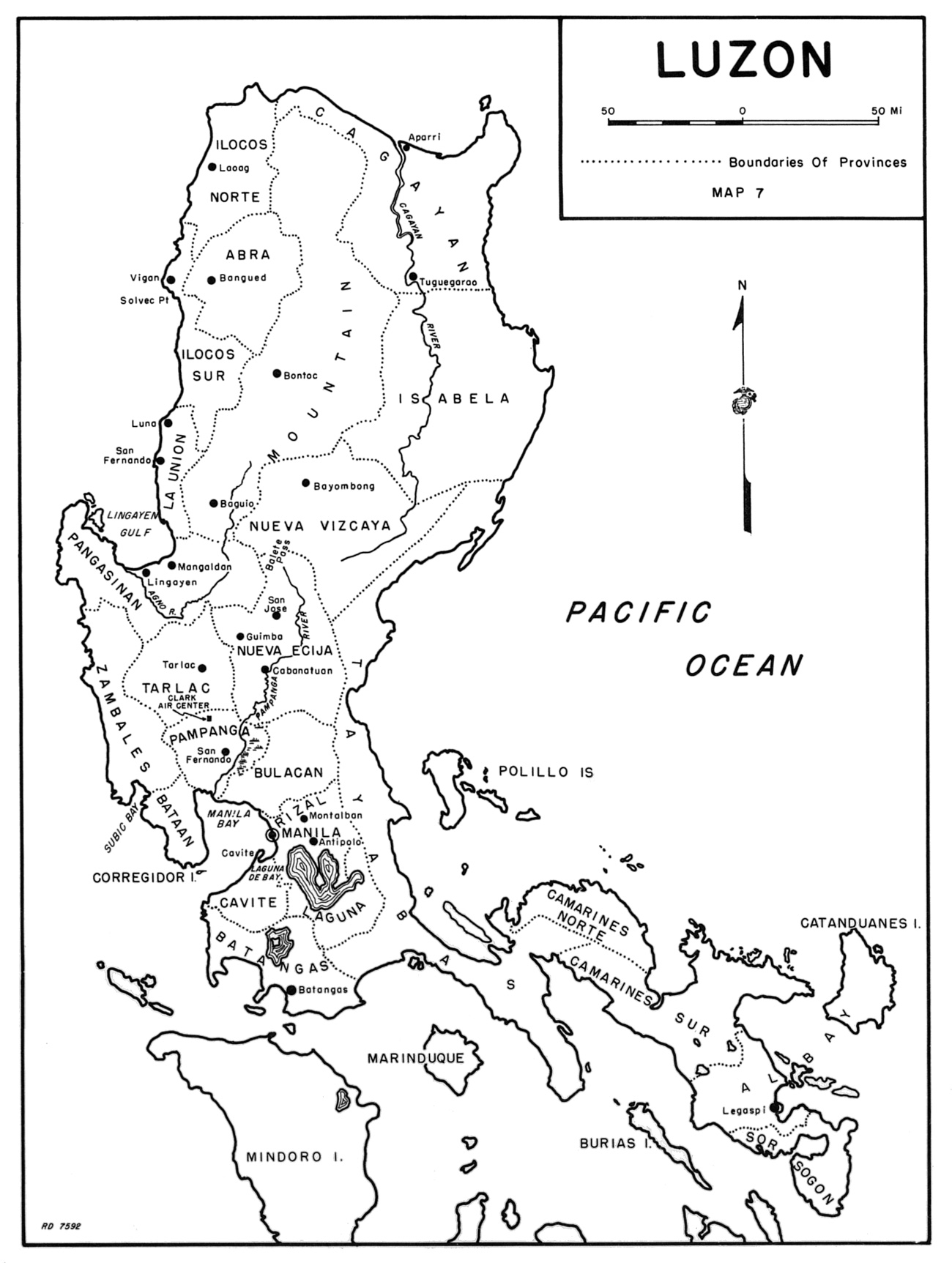
for uninterrupted naval and air operations; (3) to advance southward and seize the Central Plain-Manila area; and (4) by subsequent operations, as directed by General Headquarters, Southwest Pacific Area, to establish control over the remainder of Luzon.6 (See Map 7.)
Five days later, orders from Kenney's Allied Air Forces, SWPA, based on MacArthur's 12 October orders, gave more detailed instructions, naming actual units. MacArthur's orders had simply specified "1 dive-bomb group (7 squadrons)." Kenney's orders of 17 October specified the seven dive bomber squadrons of the 1st Marine Aircraft Wing.
The Marine air units were to be attached to the Fifth Air Force, as part of the air assault force. Target date for Lingayen landing: 20 December 1944.7
These same orders offered promise of an eventual share in Philippine operations for the remainder of the wing. Mitchell, directed to continue control over all Army, Navy, New Zealand and Marine aircraft in the Solomons-Bismarck Archipelago as Commander, AirNorSols, was, at the same time, to "prepare for forward movement in future operations and for transfer of responsibility for control of air operations in the Solomons to the Royal New Zealand Air Task Force."8
On 7 November, Colonel Clayton C. Jerome, AirNorSols' Chief of Staff, was selected by General Mitchell as the commanding officer of MAG-32. By virtue of seniority, Colonel Jerome also would become over-all commander of both groups (MAG's 32 and 24) during their combined operations.
On the same date, Commander Aircraft, Northern Solomon Islands, issued Operations Instructions Number 24-44. These orders stipulated, in part, that all dive bombing squadrons of the 1st Marine Aircraft Wing, Headquarters and Service Squadrons MAG-24 and Headquarters and Service Squadrons MAG-32 were assigned to the Fifth Air Force for operational control and as reinforcement to the Fifth Air Force.
Fifth Air Force, in turn, was part of Allied Air Forces, which were charged to "support the operations of the Sixth U.S. Army in the occupation of the Lingayen Gulf-Central Luzon Plains area by: intensified air activities against hostile installations; destruction of enemy air and surface forces Celebes Sea area, and assigned areas in the Philippines Archipelago; air defenses of existing bases and forces in transit."9
Squadrons (VMSB) 133, 142, 236, 241, 243, 244, and 341 (all units of the 1st MAW) were directed by the same order to prepare for " . . . occupation of target areas immediately following the assault and by S-plus 15." These units were also to "provide direct support for ground operations in the Lingayen area and Central Luzon at the earliest practicable date after arrival on target."
Headquarters and Service Squadrons MAG's 24 and 32 were ordered to take station in the Lingayen area at the same time and establish, at the earliest practicable date, base and servicing facilities for accommodating VMSB squadrons.
The commanding officer, 308th Bombardment Wing (H), as Task Force Commander for Fifth Air Force, was to assume direct operational control of Marine air units subsequent to their arrival in the target area and until relieved by Fifth Air Force headquarters.10
On 12 November MAG-32 disembarked at Emirau Island. The following day this organization took over Marine Scout Bombing Squadrons 142, 243, and 244, and on 14 November Colonel Jerome took command of the newly augmented group.

Map 7
LuzonA Study of Close Air Support
Since 10 October, when General Larkin had received the oral orders from FEAF officers that the 1st MAW would receive a change in combat mission, the unexpected news had caused one question to loom large before the MAG-24 planning staff: what techniques must be employed for aircraft to render direct and effective support to the infantry, and at the same time insure maximum safety to friendly troops? The first step in the preparation of the group for its assignment was to make an analysis on the subject of close air support.
The making of such an analysis was complicated by a number of factors. Close air support was by no means a new concept--it had, in fact, been developing piecemeal since World War I. It had always possessed something of an improvised quality, varying according to service viewpoint, the circumstances and the tactical needs of the moment.11 In the different branches of service, and in different theaters of operation, close air support had grown to have almost as many definitions as there were units which had made use of it.
In World War II, for example, the first really close air support by American planes took place at Guadalcanal, in planes flown by both Marine and Army pilots. The situation was unusual in the fact that the pilots were stationed so close to the front lines that, prior to flying a support mission, they frequently walked up far enough to take a look at their targets. All briefing for the missions took place on the ground, and radio communication was not called upon for too important a role. But as the island-hopping continued, to Bougainville and Peleliu, coordination continued to improve.
With the U.S. Navy, air support was taking yet another turn. Extensive shipboard radio networks had been designed especially for air support control, and they functioned successfully at Tarawa and continued with improved effectiveness in subsequent amphibious operations. At Tarawa 650 close-support sorties were flown with what was generally described as "excellent results."12 But Navy facilities and control organization were geared for carrier-based air support, not for a mobile, land-mass campaign.
In late 1943 specially trained air liaison parties (ALP's) were organized to foster closer coordination of air-ground operations. Thirteen of these parties were to be attached to each Marine division (and later, Army divisions), as the air liaison section of the newly designated joint assault signal company (JASCO). Each ALP originally was made up of one aviation intelligence officer and three to seven aviation communication technicians.
These air liaison parties were organized and trained to transmit requests for aerial support with the greatest possible speed, to direct strikes or to assist a support air controller (SAC) in briefing and directing an air attack on a desired objective.13
The officer specialist on each team knew aviation capabilities, and could evaluate requirements for air support missions; he could also advise ground commanders concerning the use of such support. With the rest of his team and the much improved communications gear with which they were equipped, he was able to make close liaison a fact rather than a hope.
Close air support was progressing rapidly in 1944, but there was still no unified approach to the problem. There existed in the various doctrines many differences of procedure and nomenclature. Still more important, however, were the differences inherent to the variety of operations and situations for which they had been devised. Army and Navy doctrines steadfastly maintained centralized radio control of attacking aircraft from a support air controller well behind front lines14 or on shipboard. (The support air controller and his

EARLY FORERUNNER OF THE RADIO JEEP was this 1925 Navy cargo truck, which Marines of Observation Squadron One (at Naval Air Station, North Island, San Diego, California) fitted with radio equipment to produce the first air-ground communications vehicle. Motive power for the system's electrical generator was furnished by a jacked-up right rear wheel and a belt drive.
assistants comprised the support air party--SAP.)
Marine planners on Bougainville, and other airmen thinking concurrently along the same lines, persisted in a firm belief that on many occasions front-line ALPmen could and should talk planes onto a target by direct communication; this, they felt, was far more efficient than relaying the information through intervening echelons and a far distant controller.15
At Guam, in July 1944, Colonel Frank C. Croft, air officer for General Geiger's III Amphibious Corps, persuaded the Navy to allow his well-trained ALP's to assume direct control from shore positions for many close air support missions that were being flown by carrier-based naval aircraft.
All these operations and many more were studied and evaluated by the planners of MAG-24.16 Then, under the supervision of Lieutenant Colonel Keith B. McCutcheon, group operations officer, a detailed doctrine for air support organization was drawn up, making use of all these evaluations. Additional considerations were: types of communications equipment that would be available, and operational requirements to be expected in the Philippines.17
The doctrine decreed this basic premise:
Close Air Support is an additional weapon to be employed only at the discretion of the ground commander. He may employ it against targets that cannot be reached by other weapons or in conjunction with the ground weapons in a coordinated attack. It should be immediately available and should be carried out with deliberation and accuracy and in coordination with other assigned units.18
Training for the Mission
At Bougainville on 13 October, just three days after the first given word of the new assignment, pilots, crewmen, communicators, air combat intelligence officers (ACI) and operations officers began attending classroom lectures. During the next two months they received an intensive basic course of 37 lectures that presented a diversified curriculum covering every conceivable phase of close air support. Ground study included such subjects as organization and tactics of U.S. and Japanese infantry units, map reading, communications, artillery spotting, and target identification, all presented in the greatest detail possible. There was also specialized instruction about the Philippines, with the range of subjects including a study of the people of the islands, geography, and weather.
Instruction was under the direction of Lieutenant Colonel McCutcheon, assisted by a staff of instructors with a wide and varied background of experience. It included several wing and group intelligence officers who had participated with Marine divisions in the Marianas as air liaison officers;19 specialists from Seventh Fleet Intelligence Section and the Army's 37th and Americal Divisions. (These divisions were also in the Northern Solomons preparing for the Philippine campaign.)
During the next two months there existed between the islands a veritable revolving schoolhouse--ACI officers and other representatives of VMSB squadrons on outlying islands attended Bougainville classes as students, then went back and became teachers at Emirau, Green and Munda. In all, some 500 pilots and gunners received the course and were examined on their acquired knowledge.
Shortly after the school for airmen began, various conferences were held with representatives of the Fifth Air Force to discuss plans for the impending operation. In these conferences, according to Lieutenant Colonel McCutcheon, one important difference in concept of air strike control was brought out:
. . . the Fifth Air Force would furnish the Support Air Parties, but they were not contemplating using direct communication between the Air Liaison Parties and the planes in the direction of the mission. The Navy concurred with the Air Force in this respect. It seemed to . . . [MAG-24 that front-line control] was the only logical way to conduct close support so further emphasis was placed on training its own Air Liaison Parties. These parties were actually a combination of the Air Liaison Party and the Support Air Party. . .20
In order to carry out this Marine concept of a dual-purpose ALP (to be used both as a requesting agency for air strikes and a direct controller of those strikes), teams of officers and enlisted men were selected for specialized training. All personnel who would be involved in elements of the air-ground radio networks underwent exhaustive drill to perfect coordination of procedure. Indoor training initiated the program and parties were dispersed to simulate a regiment in assault with two battalions in advance. Colored cardboards indicative of the various radio nets involved were given to the appropriate unit. Typical requests for air support were sent back through the proper channels and then mock strikes were orally directed to fulfill the requests. As the parties became more experienced in these oral drills, more complicated problems were set up. When a satisfactory degree of proficiency was attained the class moved outdoors and did the same thing using radio equipment, including

GUNNER'S VIEW of bomb blast, taken as Marine SBD zooms up from dive bombing run against enemy position in Central Luzon.
seven radio jeeps and two radio vans (SCR-299).21 In the final stages of training, the teams directed planes to the vicinity of the jeeps and controlled them, first on dummy runs, later on live ones.
Air liaison parties would be attached to infantry units down to and including battalions, and from front-line positions would function much like forward observers. Outfitted with their radio jeeps, ALP's could keep pace with advancing command posts yet remain a continuing element of the liaison system. In situations requiring the air liaison officer to take position away from the jeep, he kept uninterrupted contact with the planes through a hand-carried radio.22
The Marines obtained some of their most practical training experience through a working arrangement with the 37th Division, then on Bougainville. Pilots observed from the ground various infantry maneuvers of this organization, and then, with a much keener concept of the doughboys' problems, took to the air to join them in realistic assaults on mock enemy positions. Marine ALP's accompanied division troops and directed planes in dummy runs over requested targets while the groundmen's fire blazed away beneath them. Squadrons from Green and Munda Islands flew in for several of these exercises; to spread participation as far as possible, extra pilots sometimes replaced gunners in rear seats during the practice flights.
One of the most important outgrowths of the joint training was the development of a solid foundation of mutual confidence between the ground and air units involved; the Marines would join forces with the 37th Division again when the chips were down at Luzon, and a full acceptance of close air support by these former partners-in-training would not be hindered by unfamiliarity and distrust.
Luzon Landings to be Delayed
The first move toward assemblage of scout-bomber units began on 22-23 November when, by air ferry and four LSI's VMSB-241 moved from Munda to Bougainville.
In the meantime the Leyte campaign was underway, but difficulties being encountered there (Chapter II) would necessitate a 10-day delay in Mindoro landings (from 5 December to 15 December). Therefore, because most of the same shipping would be required for the assault of Luzon, the original target date for the latter (20 December) would not be met. On 30 November23 General MacArthur ordered the Commanding General, Sixth Army, by dispatch to effect Luzon landings on 9 January. On the following day the dive bombing squadrons secured from combat flying, so that all their aircraft could be maintained in operational readiness for duty in the Philippines. Until then, along with their close support and embarkation preparations, all tactical units of MAG's 24 and 32 had continued the monotonous chore of blasting, with daily regularity, the by-passed islands in the 1st Wing's area of responsibility. (See Map 3, Chapter I.)
Movement to Lingayen Gulf
Departure of the various ground echelons began on 12 December from Bougainville, 16 December from Green and 19 December from Emirau. In all, six transport vessels were employed for the long and devious journey to Lingayen Gulf.24 Personnel, equipment and supplies of the two groups were scattered through the six transports which themselves were widely spread over Southwest Pacific waters. Christmas Day, for example, found two ships anchored and troops disembarked at

AIR STRIP AT EMIRAU in the Bismarck Archipelago is shown under construction in April 1944. Eight months later 173 SBD's of Marine Aircraft Groups 24 and 32 left this field on a 2,500 mile flight via Momote, Owi, Peleliu and Leyte to Mangaldan Airdrome, P. I. The long flight was made without loss of a plane or injury to personnel.
Milne Bay, on the eastern tip of New Guinea; one, a cripple,25 was in dry dock at Manus Island; still another was weighing anchor at Emirau; the remainder were on the high seas.
Meanwhile, all squadron flight echelons gathered at Emirau by mid-December for a month of final preparations, and to await call into Philippine action. Instruction continued, planes were given final touches of maintenance and, on 19 December, 108 SBD's from the combined squadrons participated in a bombing raid on Kavieng, New Ireland;26 the
two groups had mated into a single team. (See Map 3.)
Confident that his flyers were primed for decisive action, Colonel Jerome took leave of his planes and men and Emirau on 26 December, and boarded a transport plane for Leyte, springboard for the Luzon invasion fleet. It was his task to continue close liaison with Army forces to be supported and to integrate plans with immediate AAF superiors.27 While Marine surface echelons plowed slowly toward the rear of the Lingayen assault convoy, and air echelons awaited a base from which to operate, Colonel Jerome would accompany forward Army elements to establish a "beachhead" for his command.
With the colonel was his advance party, Lieutenant Colonel Keith B. McCutcheon, MAG-24 operations officer, and Corporal Ladislaus J. Blasko, the colonel's driver. Upon arrival at Tanauan airstrip, the three men drove in their jeep to Tacloban, where 308th Wing was loading equipment on LST's. Corporal Blasko was instructed to get himself, the jeep and sundry stores aboard one of these vessels somehow. The trio separated further when Colonel Jerome went aboard the USS New Mexico and Lieutenant Colonel McCutcheon the USS Mississippi.
Lingayen Landings and Development of an Airbase
On 9 January 1945, Sixth Army units made unopposed landings on a two-corps front, and by nightfall positions were secured three to five miles inland along approximately 15 miles of southern Lingayen Gulf shoreline. (See Map 8.)
First Marine to hit Lingayen beach was Corporal Blasko, when, the day after initial assault, USS LST-1025 nosed ashore to disgorge its load. Colonel McCutcheon also disembarked that day, but Colonel Jerome was ordered aboard the USS Wasatch from the

COLONEL CLAYTON C. JEROME, commander of MAGSDAGUPAN (and later of MAGSZAMBOANGA) and his driver, Corporal Ladislaus J. Blasko, first Marine ashore on Luzon, 9 January 1945.
New Mexico for a day of conferences and did not reach shore until 11 January.28 There, stranded without baggage amid the turmoil of a supply-strewn beach, the senior Marine of the invasion joined 308th Bombardment Wing's encampment where McCutcheon soon found him. With welcome surprise, the two officers saw driver Blasko, jeep and all, bounce across cluttered sands toward them to consolidate forces.
The camp site chosen for the wing was three miles east of the town of Lingayen. Between this site and gulf-side Lingayen lay a pre-war airstrip, 3,900 feet long, which Army engineers began to scrape, lengthen and surface with steel matting. As it turned out it was 17 January before this strip became operational;29 even at the outset, activity already
begun convinced Colonel Jerome that there would be no room for Marines there. With a potential need of operating 500 Army and Marine aircraft of all types, one strip would not suffice.
Word came that Fifth Air Force's Brigadier General Paul B. Wurtsmith (who then headed the V Fighter Command, but who would soon be given command of the Thirteenth Air Force by General Kenney) had selected an undeveloped site for a second airfield on the shoreline some 15 miles east of Lingayen. After one night in the AAF camp, the three men piled into the jeep; if a new strip was to be in the making, they intended to be on the spot to oversee ground work for Marine accommodations. They drove eastward behind XIV Corps lines, across Dagupan River by barge into I Corps area and continued through already-captured Dagupan town. Then, coming upon a small river over which the road bridge had been destroyed, they solved a seeming impasse by driving across a railroad trestle. Their route continued eastward across the path of a tremendous inland movement of men and supplies keeping pace with the south-driving front, until, at their destination, they had crossed almost the entire breadth of S-Day's landing zone. (See Map 8.)
The proposed airstrip locale, being adjacent to a beach west of San Fabian (see Map 8), offered minimum trouble for unloading supplies from ship to base, and inland foliage supplied fair concealment for camp sites. But the terrain available for a landing strip was extremely narrow, and the ground promised little assurance of holding up in wet weather. Nonetheless, Jerome set up a temporary headquarters in a bombed-out schoolhouse and began staking out areas for camps, shops and aircraft dispersal.30
In the meantime, Colonel Meyer, who had directed the ground echelon's movement, arrived in Lingayen Gulf on 11 January aboard USS President Polk with 14 MAG-24 squadron pilots, 278 enlisted men and five corpsmen. While engaged in unloading their equipment and awaiting call to their own base, the Marines aided the shorthanded Sixth Army Engineers in unloading and laying steel matting on the Lingayen strip, a task concerning which Sixth Army's Lieutenant General Walter Krueger, on 20 January, wrote the following to Colonel Meyer:
Upon the successful completion of the construction of the Lingayen air strip, I desire to express my personal appreciation and official commendation of the 24th Marine Air Group for the outstanding manner in which it performed its part in that important task.
The rapid completion of this strip was mandatory. When a critical manpower shortage developed that jeopardized the construction program, the 24th Marine Air Group responded magnificently in the emergency by providing excellent working parties to assist in the unloading and laying of landing mat. Although having no previous experience in work of this nature, the men performed their duties enthusiastically and efficiently. Their efforts represented a valuable contribution to the speedy completion of the Lingayen air strip and reflect great credit upon the officers and men.
On 14 January, Meyer and his men, loaded on borrowed Army vehicles, moved to the chosen site just in time to find that heavy grading equipment had dug too deeply into the thin crust of top soil and lost all chance for a solid undersurface. There was compensation, however, for this seemingly unfortunate delay--a more suitable site was selected between Dagupan and Mangaldan. (See Map 8.) Along both sides of a road connecting the two towns stretched a broad expanse of rice fields, a site not outwardly fit for launching and landing hundreds of high-powered military aircraft.
But in the wide open space afforded, Jerome vouchsafed that such terrain could be converted successfully into an airbase. From experience gained during Philippine duty in 1927, he knew that a paddy field,31 properly graded and packed, made a good surface with a solid foundation--at least during the comparatively dry season, and monsoon downpours were not due for another three months--plenty of time for the job at hand.
Men and equipment backtracked about six miles southwestward and work began afresh at this new site; Mangaldan Airdrome was in the making with a 6,500-foot east-west runway

THIS IS THE LINGAYEN GULF SHORELINE where Sixth Army landed on 9 January 1945. Ten miles to the east, across the rice fields and the Dagupan River, is Mangaldan Airdrome, home base of the Marine dive bombers on Luzon.
emerging north of the road and a camp area south of it. In this second effort by Army engineers to prepare a strip, light bulldozers were employed and extreme care was exercised to knock off only the crusty paddy ridges which left a flat surface with foot-deep rice roots as a firm foundation.32
During days following, other ground echelons arrived and unloaded men and supplies at San Fabian, five miles north of Mangaldan. All hands pitched in on camp construction and organization of facilities that everything might be in readiness for full-scale operations just as soon as the strip stood ready for its brood of planes.
While this base was building, official combining of command for the two groups came about through a 308th Bombardment Wing directive designating Colonel Jerome as Commander, Air Base, Mangaldan, and Commander, Marine Aircraft Groups, Dagupan.33
Colonel Jerome, in turn, directed Colonel Meyer to assume duties as Deputy Commander of both posts. Lieutenant Colonel John L. Smith34 and Lieutenant Colonel McCutcheon became executive officer and operations officer, respectively, of MAGSDAGUPAN, and Major Sherman A. Smith35 took over the duties of "Strip Commander." In like manner, officers of both 24 and 32 would be pooled to perform all operations, intelligence and other functions relevant to coordinated tactical operations.
To the infantry and the combat correspondents, flyers of this combined enterprise came to be known as "The Diving Devildogs of Luzon." The seven squadrons operated under colorful nicknames: Flying Eggbeaters (VMSB-133), Wild Hares (VMSB-142), Sons of Satan (VMSB-241), Black Panthers (VMSB-236), Flying Goldbricks (VMSB-243), Bombing Banshees (VMSB-244), and the Torrid Turtles (VMSB-341).36
All seven of the Marine squadrons were equipped with a type of plane that had been declared obsolete by this stage of the war. The SBD, or Douglas Dauntless, had already compiled a brilliant war record and was ready for retirement, but still another chapter of history was destined to be written about the sturdy little plane.
At the entry of the U.S. into World War II in late 1941, the SBD was the only American dive bomber in current production, and it was, therefore, the best plane of its type in early action. By June 1944, however, only two of the seven Navy carriers operating with dive bombers were still flying the SBD, and on 21 July the last of the SBD's (No. 5,936) rolled off the Douglas Aircraft Company's assembly line.37 The faster and more heavily armed Curtiss SB2C was replacing the Dauntless.
Marines used the SBD for the first time in combat in June 1942 at Midway. Later it gave valiant service with Marine air units of the 1st Wing all the way from Guadalcanal up the Solomons chain to Bougainville. The plane had many characteristics that made it extremely desirable as a dive bomber--the accuracy with which SBD pilots pin-pointed targets on Bougainville had been likened to threading a needle--but the SBD was not an unmixed blessing. It had plenty of limitations, too.
The strafing power of the plane is limited to two guns, the speed is slow [normal cruising speed approximately 140 knots with 1,000 lb. bomb load], and they require fighter cover in enemy contested air.38
The Fifth Air Force had abandoned the dive bomber, which they considered an uneconomical weapon, in favor of using the fighter bomber.39 General Kenney, former commander of the Fifth Air Force, says:
Back in 1942 we did have one squadron of A-24 [Army designation for the SBD] dive bombers which had insufficient range for our work in New Guinea. Moreover they were too slow to argue with the Zeros at that time, so I quit using them and asked the Air Force to send me B-25s and A-20s which were much better for the skip-bombing technique which we were finding much more effective against shipping than dive-bombing and which also did excellent support work for the Australian and American ground troops . . .40
The combat radius of the Dauntless was only about 450 miles, a figure based upon fuel consumed during engine warm-up, take-off,

Map 8
Lingayen Gulf Landing
9 January 1945rendezvous, flight to target, 20 minutes over the target and the return flight to base. The maximum cruising range of the plane was not overly long either, even with the most economical power settings: approximately 1230 statute miles at 142 m.p.h.
Bomb loadings varied with the targets assigned. The usual load per plane was one 500-lb. bomb plus either two 250-lb. or two 100-lb. bombs. When a 1,000-pounder was carried, it usually constituted the sole bomb load, but on occasion, two 100-lb. bombs were also carried.41
Arrival of Flight Echelons at Mangaldan
In spite of starting from scratch a full six days after S-Day (9 January), progress on and about the strip indicated that requirements set forth in original plans back in October (to be on station by S-plus 15) would be met on schedule. On 19-20 January, two of MAG-24's dive bomber squadrons, VMSB's 133 and 241, moved up from Emirau, by way of Momote and Owi, to Peleliu and awaited there a further green light.42 The signal came on 25 January. Led by Major Lee A. Christoffersen (commanding VMSB-133) and Major Benjamin B. Manchester III (commanding VMSB-241), and escorted by R4D's for navigational purposes and PBY's for air-sea rescue.43 46 SBD's completed a one-day, one-stop-at-Leyte, flight from Peleliu to Mangaldan without serious incident.44
Within three days, VMSB-142 (commanded by Major Hoyle R. Barr), VMSB-236 (Major Fred J. Frazer), VMSB-243 (Major Joseph W. Kean, Jr.), and VMSB-341 (Major Christopher F. Irwin, Jr.) had started on the long flight to Lingayen. Last of the seven squadrons, VMSB-244 (Major Vance H. Hudgins), left Emirau on 28 January, and by month's end, assemblage at Mangaldan was complete.45 One hundred and sixty-eight SBD's, 472 officers and 3,047 men gathered on the ex-rice field.46
But the Marines were not to be alone at Mangaldan Airdrome. One day prior to the first SBD arrivals, a squadron of Army P-47's had flown over from the Lingayen strip to base there. Shortly afterward, between 200 and 250 AAF planes came to operate from the field. They, as well as the Marines, were under the operational control of 308th Bomb Wing, but local base operations and combined camp facilities were the responsibility of Colonel Jerome.
Mangaldan's airstrip soon became a busy one. Its two flanking, oiled parking strips were jammed with aircraft, as was the entire perimeter surrounding the landing strip and taxi-ways. The assortment of planes ranged from single-engine fighters and dive bombers
to four-engine heavy bombers. In addition to the SBD's there were: P-47's, P-51's, A-20's, C-47's, a few transient B-24's, and even some PBY-5A's (amphibian model of the Catalina patrol plane) for air-sea rescue.47
Combat Operations Begin
After one day for aircraft maintenance, the two first-arrived dive bombing squadrons were ready for combat assignment. The pilots, too, were ready and eager to give the type of close air support for which they had prepared. In the beginning, however, missions were not what the Marines had expected. Targets assigned to them were far beyond the front lines. No attempt was made to establish liaison from the ground during strikes except that each flight reported by radio its departure for an objective to a support air party of the 308th Wing. It became apparent immediately that these AAF and infantry units were not accustomed to air support really close to the troops. Furthermore, it was not Allied Air Force doctrine to control aircraft strikes directly from a front-line observation post.48 The Marines had to await an opportunity to put their own liaison teams into forward areas with the troops.
As MAGSDAGUPAN operations began, all request for air strikes first were processed through the chain of command within the Sixth Army. When approved all the way up the line, these requests then were passed along to the 308th Wing whose operations officer designated the subordinate air units to carry out the various assignments. As a result of this processing, one day's requests were set up that evening for action on the following day. The MAGSDAGUPAN operations office usually received its daily assignments during the early morning hours. For each mission delegated to the Marines, the number of

DOUGLAS DAUNTLESSES are directed back to the "line" after flying a mission: in close support of Sixth United States Army ground troops on Luzon.
planes, and time to be on target was specified, but type of ammunition to be used, and selection of the squadron or squadrons to participate was their own. Obviously targets assigned in this delayed manner only infrequently would be close to the front lines, for not often could an infantry commander afford to wait a full day for air support on an objective at close range.49
There were two other procedures, however, that would soon come into use to decrease the time required between request for, and execution of air support. The first of these was known as a "ground alert" during which planes and pilots stood by at the airbase ready to be in the air on 30-minute call. Requests then channeled back over a support air request net, and mission assignment and target briefing took place in rapid order prior to take-off. This method was, of course, much faster than the one previously mentioned. Even faster than the "ground alert," however, was another method which became increasingly popular--the "air alert," which provided for planes to be continuously on station in the air orbiting a designated stand-by point, and ready to be ordered to whatever target the liaison men on the ground might designate for them. This elimination of the middlemen,50 coupled with the fact that planes could be directed onto targets immediately when such targets presented themselves, made close air support a much more versatile weapon.
At 0900, 27 January, 18 VMSB-241 SBD's took off on what the squadron recorded as MAGSDAGUPAN Mission No. 1.51 The flight received fighter cover from four P-47's of 35th Fighter Group over a 35-mile route to target, the town of San Fernando, La Union province. (See Map 7.) Assigned to attack heavy and medium gun positions, bivouac areas, oil dumps and selected buildings, pilots released 36 100-lb. and 18 500-lb. bombs while gunners strafed on low flying runs. The bivouac area was razed, all designated buildings heavily damaged, and Second Lieutenant Edward M. Fleming made a confirmed, direct hit on an oil dump. Smoke resulting from this strike rose some 3,000 feet and could still be seen by returning pilots in the landing circle over Mangaldan, 35 miles away.
An afternoon flight of 18 VMSB-133 planes struck in the opposite direction at much-attacked Clark Field Air Center, 50 miles north of Manila (see Map 9), and with equally successful results blasted supply dumps and scattered debris over a wide area. This first day's action gave the Japanese a liberal sample of precision bombing that troops from the Land of the Rising Sun would learn to know and fear in days to come.
The pattern for flying these dive bombing raids had been firmed into a generally uniform system or standing operating procedure; tactics employed were quite different from those of other types of bombing groups. When going on a mission, the Marine flyers usually took off from the Mangaldan strip in sections of three planes.52 Once air-borne, the entire flight joined up in a very tight formation for mutual protection. Once joined, and while still climbing to an altitude of approximately 15,000 feet, the flight proceeded toward its target.
The planes approached the objective area at an altitude normally about 10,000 to 11,000 feet above the target. The flight would then extend its formation so that each pilot could locate the target; once they had made positive identification, the attack began. The lead pilot

TOWN OF SAN JOSE Nueva Ecija province, important road and railway junction at the entrance to Balete Pass. Marine and Army aircraft bombed and strafed this key objective preliminary to its seizure by the 6th Infantry Division against little opposition in early February 1945. Japanese units cut off to the south were thereby denied an escape route through the Pass to Cagayan Valley.
pointed the nose of his plane down, followed by the rest of his flight, one plane at a time. Dive flaps were opened to keep the planes from gaining too much air speed while in dives approaching 70 degrees,53 and to give the SBD stability in its near-vertical flight. While going down to the target pilots had to allow for windage and a slight amount of ship's yawing.
With the target held in the sights, bombs were released at an elevation of about 2,000 feet,54 after which the nose of the plane was pulled toward the horizon and the dive-flaps closed quickly for added speed. By this time the bombers would be about 1,000 feet above the ground, in a slightly nosed down position.55 The planes continued losing altitude quickly
until they were at treetop level, using their accumulated air-speed for violent evasive maneuvers to avoid enemy fire. Thereafter the planes continued to a rendezvous point for another bombing attack, or perhaps several strafing runs before the final rendezvous for the return flight to the base.
First strike of the Black Panthers (VMSB-236) and Torrid Turtles (VMSB-341), on 30 January, combined 36 of their aircraft to render a devastating blow on a far northern town of Tuguegarao, Cagayan province. (See Map 7.) Seven large craters, by visible count, were left in the airstrip there which had been used as a receiving base for Japanese replacement aircraft flown in from Formosa. Eight enemy fighter planes in two revetments along a bamboo-lined road received a thorough strafing treatment. Supply areas were left ablaze, 10 barracks buildings demolished, and three direct hits found their mark in a large school building that guerilla sources had reported as an enemy headquarters. The flyers left below them a scene of mottled disarray; the sting of the obsolescent Dauntless was still a potent one.
Between 25-31 January, five Marine squadrons participated in a total of 17 missions (255 individual combat flights), dropped 207,800 pounds of bombs and expended 25,895 rounds of machine gun ammunition. Targets of the period extended in an 180 degree arc from north through east to south, ranged up to 150 miles distant from Mangaldan and included 10 towns in five different Luzon provinces.57
One assignment on 29 January, although lacking anticipated doctrinal procedure, did amount to close support of ground troops; it was executed without direct control after a thorough ground briefing of the target area. Doughboys, meeting dogged defensive action a bare 20 miles northeast of the Marine base, requested aerial assistance. XIV Corps and the right flank of I Corps had pushed steadily southward down the Central Plains, but I Corps, while continuing southeast, was committed to attack eastward into the mountainous regions along a north-south front to protect an elongated Sixth Army flank. On the corps' pivotal left, or northern, flank the 158th Regimental Combat Team (RCT) had fought slowly inland from Lingayen Gulf past Rosario against enemy forces which resisted tenaciously from dug-in positions. On the west bank of the Bued River, a few miles east of Rosario (see Map 8), the 158th RCT was halted and called for assistance through air support; 29 Dauntlesses (from VMSB-241 and 133) responded by dropping 55 bombs into an east bank area of 2,300 by 3,500 feet, and, although pilots saw no activity in the objective area, Sixth Army later reported the division was well pleased with results.
During January operations, all flights continued to be escorted by from four to six Army fighters (P-40's, P-47's, P-51's or P-38's), but no enemy air opposition was encountered, and after the first part of February such escort was generally discontinued. However, Marine attackers were subjected often to AA fire that, on the second day of operations, accounted for the first MAGSDAGUPAN fatalities. During a combined strike of several squadrons in the Clark Field vicinity, a 20mm shell hit the engine of a plane carrying First Lieutenant Gordon R. Lewis and Corporal Samuel P. Melish (VMSB-133) just after its bombs were dropped; the SBD never pulled out of its dive.
The Final Drive to Manila
By 1 February (S-plus 23), Lingayen Gulf beachhead was considered secure; the main ground effort turned to concentrate upon the next phase of the campaign, capture of Manila.
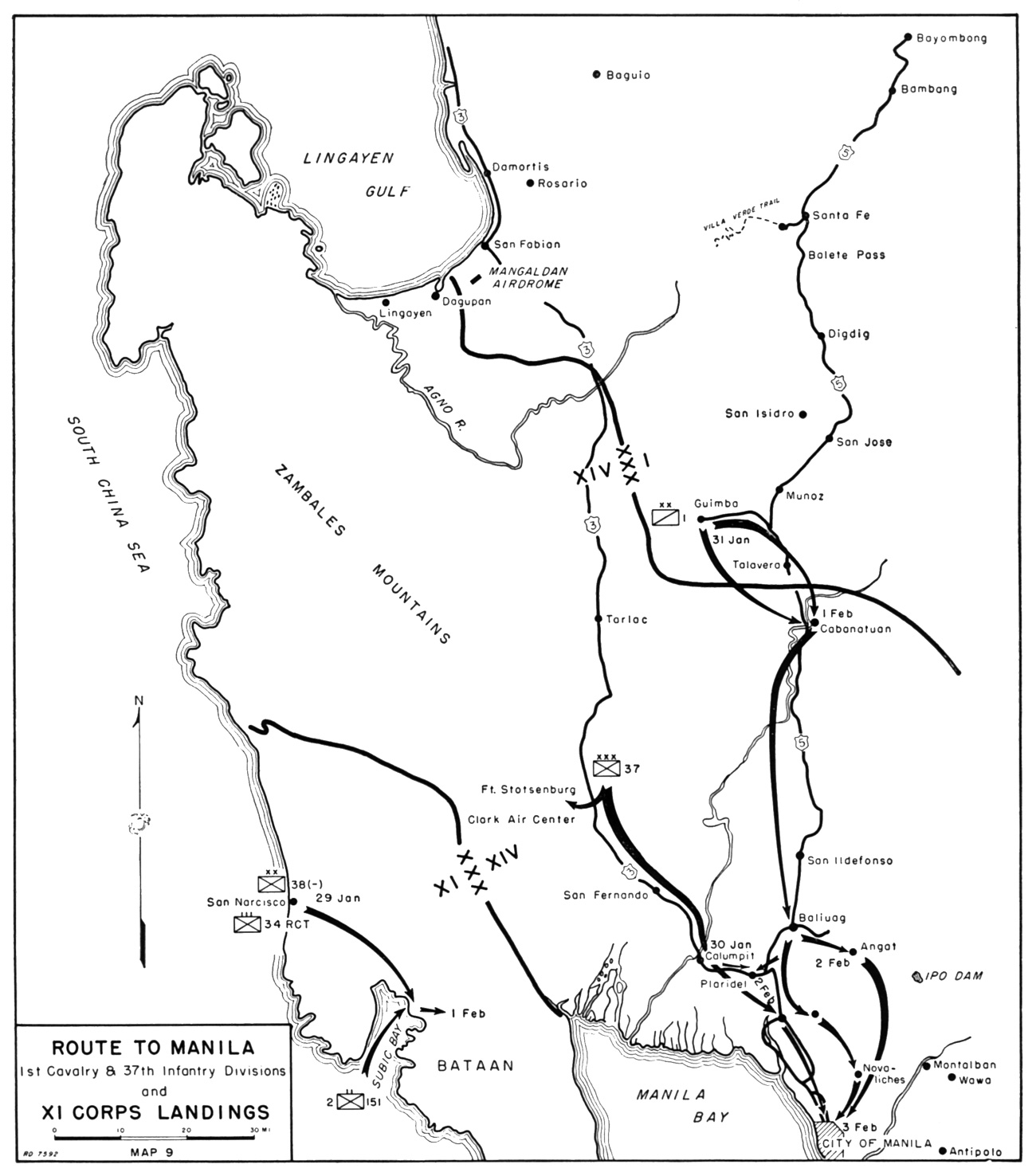
I Corps' left flank had battered stubborn enemy resistance in the Rosario area far enough eastward to dissipate threat of long-range artillery on the landing beaches; its right flank had driven 50 miles southeast of the gulf to Talevera, and the corps front was swinging east to seal off enemy forces in the
mountains north and northeast of Central Luzon Plain. (See Map 9.)
XIV Corps units had captured Clark Field Air Center and Fort Stotsenburg, and were pushing westward into the Zambales Mountain all along its right flank from Lingayen. The Marines' old Bougainville friends, the 37th Division, had reached the most southerly point of advance, Calumpit, site of the highway and railroad bridges destroyed earlier by MAG-12's Corsairs. Manila: 25 miles away.
Moreover, two additional assault landings had been successfully completed in the last days of January, both by units of Eighth Army. In the first, XI Corps came ashore at San Narcisco, a few miles northwest of Subic Bay, in a move designed to cut off Bataan Peninsula and open Subic Bay to Allied shipping. By 1 February, XI Corps forces, having passed to the control of Sixth Army, completed the opening of Subic Bay and were driving eastward to join XIV Corps along the shores of Manila Bay. Meanwhile, on 31 January, 15 miles south of the entrance to Manila Bay, the 11th Airborne Division hit the beach in ship-to-shore landings to open a drive toward Manila from the southwest under the leadership of Eighth Army's commander, Lieutenant General Robert L. Eichelberger (USA). Three days later, the division's parachute regiment made a bold air-borne landing on Tagaytay Ridge, and the southwestern foothold on Luzon became secure.58
Still another newcomer to the Luzon fray was Major General Verne D. Mudge's 1st Cavalry Division, which landed at San Fabian, Lingayen Gulf, on 27 January and by 31 January concentrated its forces 40 miles inland at Guimba (see Map 9) where General MacArthur personally bade General Mudge: "Go to Manila. Go around the Nips, bounce off the Nips, but go to Manila. Free the internees at Santo Tomas. Take Malacahan Palace and the Legislative Building."59
To assist this dramatic effort, flyers of MAGSDAGUPAN stood ready on 1 February, with all seven squadrons then available for assignment, to begin a new phase of their recently begun Luzon operations; they were about to get their first real chance to prove the worth of close air support. From the 308th Bombardment Wing came these orders: provide an "air alert" of nine planes from dawn to dusk over the 1st Cavalry Division.
Assignment to a continuing "air alert" status was just what the Marines needed to prove a basic element of their doctrine: aviation as an immediately available, additional weapon at the hands of an infantry commander, able to function with the highest degree of coordination and accuracy under on-the-spot direction of a front-line observer. "Air-trained" liaison teams, in personal contact with forward ground commanders, could call into instant action their air-borne weapons, already in the vicinity. By a variety of means (radio, panels, pyrotechnics, flashing lights, smoke, etc.), ALP's would provide ground-to-air briefing of targets and indicate friendly troop disposition. The ALP's then would make certain, by observing a dummy run by the flight leader, correctness of the pilot's intended target, and during the attack, alter instantaneously any errors in subsequent runs. The "air alert" system was ideal for support of fast moving forces, and the 1st Cavalry Division was to be such a force. Here, then, was an opportunity for the Marines to win the confidence so sorely needed for support aviation.
One minute after midnight on 1 February, 1st Cavalry Division's motorized units, spearheaded by a "flying column" under Brigadier General William C. Chase, moved out from Guimba to begin its historic dash to the Philippine capital city.60 (See Map 9.) At dawn they approached Cabanatuan (capital of Nueva Ecija province), their first major objective; with them were two radio jeeps and

1st CAVALRY DIVISION'S COMMANDING GENERAL Verne D. Mudge, confers with Brigadier General William C. Chase who led the "flying column" into Manila on the night of 3 February 1945. Accompanying these first Americans to return to the Philippine capital were two Marine air liaison parties.
a radio truck, manned by Marines of groups 24 and 32.61 These were the first MAGSDAGUPAN air liaison parties to do front-line duty with the infantry on Luzon.62 In the radio jeeps were Captains Francis R. B. Godolphin and Samuel H. McAloney, each with one enlisted man.63 In the radio truck (used to maintain coordination between the jeeps and Mangaldan) was Captain John A. Titcomb, MAG-24's communications officer, assisted by two enlisted men.64
From the first they were given excellent cooperation by the division's support air party, which did everything in its power to make it easy for the Marine liaison unit to direct missions. Captain McAloney and his jeep driver worked closely with General Chase, staying always near at hand. The general frequently rode in Captain McAloney's jeep. Captain Godolphin (a former professor of Greek and Latin at Princeton University) directed many a strike during the 38 days he was in the front lines as an air liaison officer.
Working under the direction of these men, there were always nine SBD's droning overhead in a lazy circle, ready to pounce downward

1st CAVALRY DIVISION troops advance toward Manila amid the cheers of Filipinos who line both sides of the Angst River, at a point 25 miles from Manila. Marine flyers blasted points of enemy concentrations and stood aerial guard over the division's entire left flank during the cavalrymen's 100-mile dash to Manila between 1-3 February.
to stop any threat to the on-rushing mechanized cavalrymen.
For three days the Marine divebombers stood aerial guard over the exposed left flank of the "flying column," searched an area 30 miles ahead and 20 miles behind advance ground patrols and reported enemy troop or motor movement that might threaten interference or attempt to cut the division's swiftly extending lines of communications.
While intelligence garnered by the aerial informants indicated a general eastward fleeing of motley enemy forces away from the line of advance, it also provided information as to areas from which opposition might be anticipated and accordingly afforded a basis for employment of rear security forces. Presence of our aircraft, cruising menacingly above the network of roadways available to Japanese transport, tended to keep enemy movement at a minimum during daylight hours.65
Thus aided, cavalrymen in trucks and jeeps and tanks forged rapidly southward, actually in three separate columns, down Luzon's Route 5 highway or over more primitive roads and even across paddy fields. Whenever possible, they swept around places of isolated enemy concentrations and faced their most time-consuming impediment at points where bridges lay demolished. Advance scouting by air of the many rivers which had to be crossed would disclose condition of bridges prior to arrival of the column and thereby often eliminate devious rerouting.
Pointing specifically to this type of assistance, the 1st Cavalry Division's historian later proclaimed in generous tribute:
Much of the success of the entire movement is credited to the superb air cover, flank protection, and reconnaissance provided by the Marine Air Groups 24 and 32. The 1st Cavalry's drive down through Central Luzon was the longest such operation ever made in the Southwest Pacific Area using only air cover for flank protection.66
During the first three days of supporting the 1st Cavalry Division, Marine close air support disciples displayed a convincing combat performance which mixed all ingredients of air-ground coordination, and did everything except drop bombs in the immediate front of our troops. That they could strike close-range targets with a reasonable degree of safety was perceived and acknowledged by groundmen whose occupation of target areas followed so closely that no doubt was left as to precision obtained. These visually evaluated results indicated the aerial marksmen could repeatedly confine hits within a small target zone.

Map 9
Route to Manila
1st Cavalry & 37th Infantry Divisions
and
XI Corps Landings
Lending official expression to such conclusions was a statement made by the "flying column's" General Chase: "I have never seen such able, close and accurate air support as the Marine flyers are giving us."67
Moreover, these groundmen became accustomed to aircraft availability; they found air-ground liaison simple and thorough, for mission requests were fulfilled promptly and target identification made in a dependable manner; they found, too, that positive control of planes from the ground need not be the questionable factor of bygone days. Indeed, MAGSDAGUPAN'S performance on the road to Manila was a major step forward toward establishing a confidence in their close support wares on the part of the ground troops.
Certainly Japanese failure to launch a major counter-offensive on the Central Plain abetted the division's swift progress, yet straggling enemy forces there were capable of serious harassment. Because General MacArthur had ordered the 1st Cavalry to reach Manila as soon as possible, it followed that all effort was made to avoid large-scale battle enroute. To this end, the several requested SBD strikes helped dissipate resistance before the motorcade reached it.
On the first day of "air alert" operations, while the horseless troopers busied themselves at Cabanatuan, two separate nine-plane flights were sent ahead to attack Angat, another struck San Jose del Monte; both towns contained concentrations of enemy troops. Each mission thoroughly blasted designated objectives in the towns. On 2 February, 45 planes of VMSB's 133, 142 and 241, after taking-off on a prearranged assignment, were diverted by division-level ground control (SAP) to bomb and strafe San Isidro, a town within sight of the "flying column." (Three planes of the "air alert," then on station, received SAP permission to join the San Isidro attack.) All bombs fell within a specified area, only 200 by 300 yards in size, and Army observers reported "target left in shambles."68
Later that day, division troops pushed further south, made contact with elements of 37th Division near Plaridel, and after fording the Angat River met their strongest enemy resistance of the day. Between Plaridel and Santa Maria, the 2d Squadron, 8th Cavalry Regiment, came upon a well-entrenched Japanese battalion "in a position capable of withstanding an entire division."69
ALPman Godolphin, in company with the unit's commander, had an idea to offer. Through radio contact with SAP, he cleared a request for immediate use of the patrolling SBD flight. Soon they were on station and had received a briefing in the air. Then they "struck" in a novel, yet effective, manner. Of this action, 1st Cavalry records have this to say:
Here the dive bombers of MAG 32 made several strafing passes at the Japs without firing a shot, due to the proximity of friendly troops, and enabled the squadron to slug its way into the defensive position and rout the occupants.70
Assistance was not all one-sided. A VMSB-236 patrol, on 3 February, carried out a reconnaissance mission for one Marine ground liaison team at Baliuag. It followed up with a similar task for the other ALP near Santa Maria, and finally was directed in search of a reported antiaircraft position. Flight leader, Captain Glen H. Schluckebier, who had previously turned over the lead to another plane when his radio failed, tagged along in silence. But while enroute to carry out the last request, his ignition system failed completely (apparently inoperative from an enemy bullet), the engine stopped and a crash landing became inevitable. With but little altitude to maneuver, Schluckebier jettisoned a 1,000-lb. bomb, picked out a rice field and landed, wheels up, without injury to himself or his gunner, Sergeant Donald M. Morris. Cavalry troopers reached the downed airmen, at a point one mile southeast of Baliuag, almost before they had extracted themselves from the crashed aircraft. A division Piper Cub soon picked up the Marines and took them to Guimba, where
they remained overnight. They returned to Mangaldan next day by truck.71
By nightfall of 3 February, just 66 hours after rolling forth from Guimba, leading cavalry elements crossed Manila city limits, and that very night their tanks stormed the gates of Santo Tomas University to free over 3500 emaciated Allied prisoners interned there.72
The Philippine story, of course, was not complete, nor did entry into the capital entirely conclude one of its long-planned chapters, for many days of bitter street fighting ensued before a "secure" sign could be posted. But upon reaching Manila, a statement from the cavalry commander, Major General Verne D. Mudge, gave sweeping testimony of the high regard he held for Marine air support during the historic dash:
The Marine dive bomber pilots on Luzon are well qualified for the job they are doing, and I have the greatest confidence in their ability. On our drive to Manila, I depended solely on the Marines to protect my left flank from the air against possible Japanese counterattack. The job they turned in speaks for itself. We are here.
I can say without reservation that the Marine dive bomber outfits are among the most flexible I have seen in this war. They will try anything, and from my experience with them I have found that anything they try usually pans out. The dive bombers of the First Marine Air Wing have kept the enemy on the run. They have kept him underground and enabled troops to move up with fewer casualties and with greater speed. I cannot say enough in praise of these dive bomber pilots and their gunners and I am commending them through proper channels for the job they have done in giving my men close ground support in this operation.73
MAGSDAGUPAN activity had not been limited exclusively to support of the cavalry division. Each "air alert" flight, prior to takeoff, had customarily received briefing on a secondary target assignment. In case their bombs were not expended before relief by the succeeding flight, the nine Dauntlesses would proceed to the preselected objective area, check in with its controlling support air party and deliver their bomb load at targets then considered vital by Sixth Army. During the three days of air cover over the cavalrymen, 15 separate flights took part in the rotating assignment, five per day; of these 10 hit alternate targets before completing their missions.
It was not necessary for pilots simply to await their turn on the "air alert" schedule, for, in addition, other operational commitments continued during the three-day period. Seven combined-squadron missions were carried out with from 26 to 45 aircraft participating.
As during initial Mangaldan operations, many missions were against strong points in the rugged terrain of tightly defended La Union province. More prominent, from a direct support standpoint, were several highly destructive assaults on San Jose, Nueva Ecija province. This town was of strategic importance as the gateway to Balete Pass, escape route of Japanese forces to northern Luzon and Cagayan Valley. Seizure of San Jose also would deny to enemy forces in the north access to the Central Plain and would remove the last remaining threat of large scale counterattack against the Sixth Army left flank. By 1 February elements of 6th Infantry Division had quelled resistance in Munoz, seven miles southwest of San Jose.74 (See Map 9.)
Upon the division's request a VMSB-133 flight strafed along the road connecting the two towns, knocked out a well-camouflaged pillbox that fired on them, left burning an abandoned bus, and finally, dropped bombs on a total of 16 buildings still standing in San Jose.75 On 4 February, 6th Division troops entered the well-leveled town and met but slight opposition.76
Completion of flight operations on 3 February was coincident with the entry into Manila. In circumstance, if not in fact, this date marked the end of one operational phase for MAGSDAGUPAN--if any such differentiation could be made during the campaign.
Rain came down in torrents during the night; stiff winds slapped the camp area, and planes were put under double tie-downs to withstand the heavy blow. Water left the strip a quagmire, and on the 4th and 5th, flight operations were impossible.
This breather gave all hands time to improve their living conditions. After order was restored from the windstorm, personnel pitched in on building projects and shower installations. Also, for the first time, enough equipment was in place to serve three hot meals a day.
Plans Are Made to Use Marines on Mindanao
By this time success of the Luzon campaign was assured. But fierce fighting yet remained ahead, and its conclusion was a matter of methodically driving the stubborn enemy back into areas of ever-decreasing size. It would be five months longer before Sixth Army considered the entire island under its control and passed responsibility to Eighth Army for final annihilation of some 25,000 trapped Japanese remnants.77
Widespread action on Luzon, concurrent with the seizure of Manila, called for an increase in American forces, both ground and air. The 309th Bombardment Wing (H) arrived from Leyte to begin operations from the Clark Air Center area on 4 February, while 310th Bombardment Wing (M) continued supplementary support from Mindoro.78 The 33d Infantry Division made a scheduled appearance at Lingayen on 10 February, thus bringing to nine the total of U.S. Army divisions.79
However, the offensive was going well on Luzon, and plans were taking final shape for the concluding phase of the entire Philippine campaign. General MacArthur, by using Lieutenant General Robert E. Eichelberger's remaining Eighth Army forces, soon would be ready to set in motion scheduled operations against by-passed Central Visayas and Mindanao. (VICTOR Operations)
Even though his squadrons were just beginning to win recognition for their close support capabilities, Colonel Jerome foresaw a sharp decline in Luzon aerial operations within a month or so. He was eager for his dive bombermen to be in on any shift of scene that might offer continuing use of their talents. Opportunity came in the form of a request that he attend a planning conference of air organizations called by General Kenney at Leyte for 11 February.80
Advance notice of the meeting was short; Colonel Jerome had to leave for Leyte within 24 hours after hearing of it. The colonel felt unable to commit his units to further engagement without approval of General Mitchell, so he immediately dispatched to Bougainville an urgent request for instructions. The next day, he delayed his departure from Mangaldan Airdrome as long as possible; still no reply from the 1st Wing commander was forthcoming. At Leyte, the reply came from General Mitchell himself who had been enroute and landed at Tacloban the same day.81
Even then, Mitchell's Chief of Staff, Colonel Verne J. McCaul, was on Mindoro Island scouting a location for a 1st Marine Aircraft Wing base of operations. But a once-promising expectation of the wing's departing from the Northern Solomons grew increasingly remote. Fifth Air Force Headquarters soon would move to Luzon from Leyte, and the Thirteenth Air Force would assume responsibility for all of the Philippines south of Luzon.82
Yet it did not have to be all or nothing for the Marine general; he continued to seek real combat for more of his units. Amphibious assault by Eighth Army's 41st Division against Zamboanga, western peninsula of Mindanao Island, was set for 10 March. Before the conference ended, Marine airmen
were slated for a major role in that campaign, for several of the decisions reached by 13 February affected the Marine wing units then in the Philippines and also included plans for a few newcomers from the Bougainville command.
In spite of Sixth Army reluctance to lose any of its air support on Luzon, MAG-32 was released by General Kenney in order for it to support the Eighth Army on Mindanao. Ground echelons of Jerome's group would begin immediate preparations for an initial move to Mindoro Island for final staging, but its tactical squadrons were to continue, supported by MAG-24, full-scale Luzon operations until Zamboanga facilities were readied.
MAG-12 would leave Leyte and, like MAG-32, move to Mindanao Island. MAG-12's Corsairs would cover Zamboanga troop landings from Dipolog, Mindanao, a guerilla-held base. Headquarters and Service Squadrons 12, never yet united with Leyte-based squadrons,83 would be joined by ground echelons of MAG-12's tactical squadrons for staging at Mindoro with MAG-32.
MAG-24, to be left at Mangaldan to complete its commitment to Sixth Army, would eventually join its sister units on Mindanao. But to round out the proposed SBD-Corsair team, Mitchell was heartened by a Philippine assignment for at least a few 1st Wing newcomers. One medium-bomber squadron, VMB-611 (PBJ's), and two air warning squadrons, AWS-3 and 4, were to move up from the Solomons.
After these plans were settled, General Mitchell remained in the Philippines for almost a month. He visited each of his unit commanders on Leyte, Samar and Luzon. He observed from front lines on Luzon the style of Marine close air support being rendered there, and he also oversaw Zamboanga invasion preparations at Mindoro. Toward the end of the month, illness of MAG-12's Colonel Willis prompted the general to hasten Colonel McCaul (still at Mindoro) to Leyte to take command of the fighter group.84 Mitchell departed from Leyte for his Bougainville duties on 4 March, confident that his airmen, flight crews and all ground personnel were performing in a satisfactory manner. The general was by now unhappily aware that the original plan of displacing wing headquarters to the Philippines had been shelved, that his responsibilities as Commander AirNorSols bound him to Bougainville and permitted only occasional visits to his forward units.
Close Air Support Takes Hold
Meanwhile, resumption of flight operations at Mangaldan on 6 February marked the beginning of a period which not only brought SBD close air support closer, but which found more and more Army ground commanders appreciating the capabilities of such support. That appreciation, and the close support missions it brought, was won by a campaign of salesmanship firmly backed by performance.
Colonel Jerome, when not engaged in directing his own groups, coordinating (as Commander, Mangaldan) a base crowded with numerous and varied types of air units, or maintaining liaison among Army Air Force organizations, visited top commanders within Sixth Army to urge maximum use of the CAS (close air support) weapon. His talks with I Corps' Major General Innis P. Swift, USA, and XIV Corps' Major General Oscar W. Griswold, USA, cleared the way for direct approach to division generals, the commanders who had to be convinced that close support could help the infantrymen.85
MAG-32's executive officer, Lieutenant Colonel Smith, made the rounds of all infantry divisions being supported by 308th Bomb Wing and told them of the Marine liaison organization available for their use. After explaining the way front-line control of air support worked, Smith made arrangements to have division operations or intelligence officers ride along in the rear seats of planes


MANGALDAN AIRDROME. From this ex-rice field over 300 Marine and Army planes operated in combat missions against the Japanese on Luzon.
on actual missions to see the results for themselves.86 Evidence that such contacts paid off came by month's end; seven radio jeeps, and a like number of Marine forward air control teams, were in service with various divisions.87
Continuance of direct contact after supporting operations began proved a fruitful link in providing excellent coordination. Marine intelligence officers and air coordinators drove forward to learn the area's tactical situation at division command posts, looked the terrain over from the ground and then returned to brief pilots. Ofttimes, squadron pilots themselves made similar forward excursions, a practice encouraged within the groups. Army infantrymen never ceased to profess amazement in discovering "fly-boys" right beside them in forward outposts. The arrangement was advantageous in two ways: the pilot's concept of his mission improved, and his very appearance there demonstrated obvious interest that in itself made the groundmen more confident in accepting close support from these flyers.88
One of Colonel Smith's early trips, however, did not meet with the hoped-for success. Jeeping to a point midway between Munoz and San Jose, Smith gained a near-front-line interview with Major General Edwin D. Patrick, USA, commanding the 6th Division. Accompanying the colonel was Captain James L. McConaughy, Jr., one of the assistant MAG-32 intelligence officers and a would-be air liaison officer. Of the ensuing talk, McConaughy has this to say:
Smith put on a good sales talk, offered to rear seat any of the general's operations or intelligence officers who might want a look. He [the general] was scared of airplanes; that is, scared of their accuracy and lack of ground control. He was polite but absolutely firm.89
Yet the idea had been planted with the skeptical General Patrick. It bore fruit a couple of weeks later when his division was shifted from I to XIV Corps to fight in an area east of Manila alongside the 1st Cavalry Division.90 The latter organization's bountiful enthusiasm for CAS trickled over, bolstering Smith's claim of adequate control mechanism; General Patrick decided to have a cautious try.
Given the assignment, McConaughy left the ranks of unemployed air liaison officers. He reports the success of trial offerings:
I got the job of running strikes for the 20th Infantry Regiment, and everything went to perfection. Targets initially were 1000 yards and more away, gradually we worked into 500 yards and sometimes a bit under. We worked all the tricks, like dummy runs while infantry advanced under them. When the Japs caught on to this, we'd bring in the first section and have them drop, then infantry would advance while the second and third section (usually nine plane flights) dove on the target but did not drop.91
The 20th Regiment liked what it saw of close air support, and day by day increased the number of requests for it, although other regiments of the division, 1st and 63d, did not immediately fall into line with such complete endorsement. However, that success of SBD air support had caught division fancy is indicated by an order directed to all subordinate units on 25 February. It pointed out that air units granted strikes on a basis of profitability of targets and affirmative results of previous strikes. Then, in ordering all units to submit "every scrap of information" on strikes in the division's zone, Patrick promised that if his headquarters could provide accurate evaluation, "the air forces will continue to give this command an increasing number of support aircraft throughout the present operation."92
Immediately, reports began to filter in; thereafter, a daily message emanated from General Patrick to General Griswold, commanding the XIV Corps, summarizing air activities. Typical of these summaries is one of the first, written on 27 February, which records the almost-incessant, though largely unspectacular, Marine aerial effort against the enemy in a rugged mountainous area.
Nine SBD's made two strafing runs and dropped bombs at 0900 on caves, foxholes and road along Mariquina River.
Nine SBD's strafed and dropped bombs at 0800 in Wawa area. Targets were dump areas and gun positions.
Eight SBD's strafed and dropped bombs at 1420 on troop concentration. Target was a clearing on a knoll and the area was well covered . . . estimate 100 Japs in target area . . . many killed.
Nine SBD's . . . at 1540 . . . numerous caves SE of Wawa. All bombs in target area.
Nine SBD's . . . at 1600 . . . gun positions and bivouac at road junction.
Nine SBD's . . . at 0900 . . . caves and supply dump.
Nine SBD's . . . at 1000 . . . huts and supply dump. All bombs on target, destroying at least five buildings. Direct hit on what is believed enemy CP.
Seven SBD's . . . troop concentration from 1300 to 1450 with good results.
Six SBD's hit gun emplacements marked by smoke. Ground observers report 4 direct hits.
Weather was extremely bad throughout the day. Visibility was poor in all target areas. No B-24 strike on Metropolitan Road this date due to weather.
Total sorties: Seventy-five.93
This pick-and-shovel activity, in the same region, accounted for more than half of the Marine missions during this period in support of both 6th and 1st Cavalry Divisions.
Successful example continued to bring about an increase in the number of Army ground commanders requesting Marine air support. 1st Regiment's Colonel James E. Rees, USA, had had sincere reason to shun the tactic in proximity to his troops. Three weeks earlier, on 4 February, soldiers of the 1st Regiment had entered San Jose. Ground control of an Army Air Force flight above the village was from division headquarters some miles to the rear. Resultant confusion led to misdirected strafing of his troops, "causing some casualties and lowered morale and combat efficiency."94
Nonetheless, Colonel Rees was given reason to revise his opinion on 28 February. A message from regiment to division, that date, describes a situation that led up to a spectacular display of bombing precision:
During the night a small group of 15 or 20 men began withdrawing from high ground and fell or tumbled into a 40 foot ravine. At the time they were carrying Lt. Stock on a litter. There are about 12 men and Lt. Stock in the ravine, and they refuse to leave until [he] dies or they can get him out . . . At the present time the ravine is covered by enemy fire. No plans for advance until men have been cleared out. . .95
ALPman McConaughy, already nearby with the 20th Regiment, was summoned hastily to move his team and radio equipment within sight of the trapped men--actually almost a mile away, but "terrain visibility was superb." In McConaughy's own words, the action of the drama:
There were Japs a couple hundred yards away [from the stranded patrol] . . . After a very thorough briefing, all by radio, the regimental commander (after one dummy run by the flight leader was right on) said the lead plane could drop one wing bomb. It was beautiful to watch. We were on a high cliff on one side of the valley and it was a clear day. The first drop was dead on. The colonel was impressed and allowed that we could let the lead plane come in again and drop his belly and other wing bomb. It took the SBD 20 minutes to climb up again and we could watch the whole show as if it were the movies. His second dive was fantastically accurate, too, and the colonel said he was convinced, so the other eight planes followed the squadron leader down. The bombing was fantastically successful--the farthest one of 27 bombs being 30 (honest, only thirty) yards off target. They got the party out thanks to this discouragement to the Nips and from then on the colonel couldn't get enough planes for his regiment--literally, he asked for nine flights (9 planes each) as a standing, daily order.96
General Patrick personally witnessed the performance; in his air summary for 28 February, he described the feat as "superb."97

CLOSE AIR SUPPORT STRIKE, MARINE STYLE, for ground troops in Central Luzon. Douglas Dauntless dive bombers come down on a target marked with white phosphorous shells as strike is directed from front-line position on the ground.
Except for the special significance that this mission had to the observers on the ground, and the fact that all results were clearly witnessed and recorded, it would probably have slipped by as a routine bombing, as did so many others of perhaps comparable success. The "fantastically accurate" pilots who participated were unaware of their good deed; perhaps they still are.98 Back at Mangaldan, 115 air-miles away, squadron action reports for the day were of an oft-repeated nature--Results of damage: "Unobserved."
In the meantime, the SBD's had been striking in all directions. Only during the first two days of Manila street fighting was the "air alert" not on station in support of the 1st Cavalry Division: the bad weather of 4-5 February had halted operations at Mangaldan. Thereafter the Marines stood ready for any request to blast special targets within the Philippine capital, although most frequent use of "on station" planes was made with an eye to the division's future operations.
Less than five miles east of the city, across the Mariquina River, was strongly held Japanese territory. Along a broad front (Antipolo-Montalban-Ipo) were entrenched an estimated 20,000 enemy troops.99 (See Map 9.) In that ruggedly mountainous region, made more imposing by the long-prepared Shimbu Defense Line established therein,100 a bitter hand-to-hand infantry struggle was inevitable following Manila's capture.
Consequently, for the most part, the division support air party (and our own liaison teams) held sway on the eastern rim of American holdings. When not specifically needed for Manila objectives, Marine flights were directed across the Mariquina River. The flyers would come to know the topography of this region intimately for there they would fly the great majority of their forthcoming missions.
Although La Union province continued to receive heavy pounding and the Balete Pass area also felt the sting of frequent bombings, strikes east of Manila rapidly multiplied in number. In addition to SAP-originated assignments, there began a concentrated strategic air assault to soften these defenses.
Between 6-10 February alone, SBD pilots struck 15 different towns in Bulacan and Rizal provinces. (See Map 7.) They found targets, too, on roads, along river banks, in valleys and on mountain tops. They blasted buildings, supply and ammunition dumps, caves, and gun emplacements; they strafed and demolished dozens of enemy vehicles of all types, destroyed three river boats and rained machine-gun bullets down upon troop concentrations. Important, also, was the reconnaissance information supplied by the flyers which materially aided current Army intelligence.
Strikes grew ever larger, too, in the number of SBD's participating in single missions--36, 46, 48, 50, 63--and on 10 February, 81 planes from five VSMB squadrons combined to carry out their biggest strike of the campaign. This force hit the Wawa-Montalban area with a greater total might than usual, and while considerable destruction was wrought, the attempt to use so many planes in a concentrated target space proved unwieldy.101 Subsequent large strikes were dispatched in column with an interval between smaller flight units.102
In and around the Manila area, the Marines, when called upon, delivered support to speed the collapse of isolated Japanese resistance.
Initially, the 1st and 37 Divisions were alone in fighting their way through the city from the north. However, by 8 February the 11th Airborne Division approached from the southwest to within range of Japanese artillery from Nichols Airfield, located on the southern outskirts of Manila. The light 75mm pack howitzers of the division had proven largely ineffective against the concrete pillboxes surrounding the airfield.103 To combat the impasse, aerial assistance became necessary. The call for help went out, and a Marine flight, already in the air over another locale, was dispatched to the scene.
This instance was a typical example of aviation's flexibility, once endowed with good ground-air liaison, in rendering support on short call wherever and whenever needed. Thirty-six planes of VMSB's 133 and 341 had taken off, proceeded to a designated area northeast of Mangaldan, but when unable to contact the Army SAP in that sector, the flight headed for Wawa, 125 miles south. Reporting there to the zone's controlling liaison team, the SBD pilots were then directed to check in with still another support air party, south of Manila, which had a mission for them. Without delay, the means to fit an immediate need was delivered.
In minimum time, while circling Nichols Field, the Marines were thoroughly briefed to coordinate their attack with 11th Airborne troops. Then, in a five-minute onslaught through an intense antiaircraft barrage, the 36 Dauntlesses hurtled downward in 70-degree
dives from 9,000 feet to loose their 1,000-pounders upon Nichols Field objectives. And as it so often turned out, two hours after takeoff a mission was successfully completed in exactly the opposite direction from pre-flight anticipation.
At the end of the attack the ground controller reported the results "excellent." A small ammunition dump blew up with a violent explosion; some 15 buildings and an unassessed number of pillboxes received heavy damage. But the losses were not completely one-sided. Second Lieutenant Edward E. Fryer and radio-gunner, Sergeant John H. King, were shot down by enemy ground fire and were seen to crash in flames in Manila Bay. Pilot Fryer was recovered alive only to die later of severe burns.104
On other mid-February days MAGSDAGUPAN flyers again worked with the 11th Division near Nichols Field. The Philippine Racing Club and Paco Railroad Station were among the prominent landmarks to fall prey to Marine bombing. Also on several occasions Marine flyers were pressed into action against targets within Japanese-held Fort William McKinley, then under attack from 1st Cavalry troopers.105
Two assignments over this latter objective illustrate the variation in devices attempted. One flight was specially called upon merely to orbit above the fort in order to worry enemy artillery into inaction. It did just that. Another twist from normal routine came about through a highly successful experiment with air-borne strike control. Major Jack L. Brushert, executive office of VMSB-241, had flown

SANTO TOMAS UNIVERSITY, where 3500 Allied internees were freed by the 1st Cavalry's "flying column" which stormed the gates within a few hours after entering Manila's city limits on 3 February 1945.

CORREGIDOR
to Quezon strip and landed for a few days of ground control observation. On 14 February Brushert took to the air with the 1st Cavalry's Marine ALPman, Captain Godolphin, in the rear seat of his plane. They preceded a dive bomber flight over Fort McKinley, and while the pilot orbited the plane near the target area, the usually grounded control officer directed the other airmen by radio in an attack on Japanese artillery positions within the fort.106
Meanwhile, "the most concentrated bombardment" staged in the Pacific Theater had been leveled upon the historic island fortress lying in the entrance of Manila Bay--Corregidor. (See Map 7.) On 16 February, 2,065 troops of the 503d Parachute Regiment landed on it from the air, and 1,000 more soldiers crossed the channel to hit the beaches against negligible opposition.107 But for 10 days prior to the landings Fifth and Thirteenth Air Forces' medium and heavy bombers had struck with all-out effort against the tiny parcel of land on which American forces had so heroically withstood Japanese assault until 6 May 1942.
MAGSDAGUPAN flyers had but one small opportunity to avenge directly the Marines who died or were captured on the Rock three years earlier. On 9 February 1945, 18 young men in nine SBD's of VMSB-341 bombed docks and buildings on Corregidor, starting several fires with their nine tons of bombs.108 And though they knew this was only an infinitesimal share of the total bombings, the pilots and their enlisted gunners came away satisfied that they had left their mark in memory of the old-timers who had gone before.
On 19 February (while brother Marines were initiating their assault on Iwo Jima) a 48-plane strike was launched on derelict ships inside the Manila Harbor breakwater to assist their old Bougainville friends, the 37th Division.
The division was slowly penetrating enemy strong points in the city's waterfront sector, known as Intramuros. From three battered Japanese vessels standing offshore had come harassing medium-caliber fire. For over a half hour the Marines bombed and then strafed the hulks, to put out of commission once and for all the floating gun platforms. Direct hits were confirmed on each of the half-sunken freighters, and as the flyers set their course north to Mangaldan, a towering column of black smoke reached skyward.
One bomb was laid directly on its mark by Colonel Meyet who had tagged along as an observer, as he often did. The MAG-24 commander, unable to resist the temptation, had become an active participant.109
As planned in the training period at Bougainville, pilots were to serve as ALP's. From every squadron a few flyers came forward to rotate as members of the various teams as they worked in, and then east of, Manila. What the pilots learned doing ALP work was reflected later in their own air discipline and close support flying.
A conclusion of one squadron commander, Major Fred J. Frazer (VMSB-236), regarding the use of pilots as air-ground liaison officers, indicates both advantage and drawback in their use on Luzon. Frazer, himself a frequent front-liner, points out (in comparing them with the intelligence officers who were "ground" Marines) that the flyers were better acquainted with the capabilities and limitations of the aircraft and the tactical ability of their flying mates. Use of pilots as close support controllers led to more effective support in many respects. In one respect, however, they were deficient--most junior pilots lacked an adequate knowledge of ground tactics.110 Nevertheless, when the two types of officers worked together, as they usually did, a well-balanced team resulted.
The only logical means for Mangaldan pilots to get to the front--Mangaldan is 110 air-miles from Manila--was to fly. Within three days after American entry into Manila, the 1st Cavalry Brigade had established itself in the vicinity of Quezon City, a suburb in the eastern outskirts of Manila. A widened Quezon boulevard, turned into a makeshift airstrip, became a familiar roosting spot for SBD's. Especially did it facilitate pilot forays to front lines for ground liaison duty or observation. A MAGSDAGUPAN skeleton crew later was maintained at the "strip" to service Marine planes landing there, and two jeeps were kept on hand for transportation forward.
But on a great number of occasions, Quezon served still another purpose. Within a 20-mile radius of Quezon City were flown almost all of the many missions in support of the 6th, 37th, 1st Cavalry and 11th Airborne Divisions during the rest of February. The boulevard-strip, as an emergency landing field during these operations, had something more than incidental utility. For a time, an average of one SBD per day had reason to seek refuge there because of damage from antiaircraft fire, mechanical difficulties or fuel shortage.
About the middle of February the 1st Cavalry Division was relieved from the heavy fighting in Manila, and on the 20th the push to the east began in earnest. In the Mariquina Watershed area where Shimbu defenses caused slow and tedious ground progress, daily air support was provided with increasing weight and intensity. By the division's own words much credit for breaking resistance at this point was given to the concentrated air support rendered.111
An indication of the effect the air attacks had, regardless of observed damage, is seen in two excerpts from a Japanese diary captured by the 1st Cavalry:
15 February 1945: Since dawn enemy airplanes have been coming over and we were unable to move.
16 February 1945: Due to the fact that an enemy plane has been flying around since morning the unit has been unable to move.112

MANILA, once known as the "Pearl of the Orient," as it appeared after the February-March battle for the city. In the foreground is Intramuros, the ancient walled city.
In addition to the immobility imposed upon the Japanese by the mere presence of U.S. aircraft, real damage was often assessed to the credit of aviators in after-action evaluation by groundmen. In the words of MAG-32 War Diary:
. . . a patrol from the 7th REGIMENT of the 1st CAVALRY picked up 11 unmanned heavy machine guns after a bombing and strafing attack near the water filters ¾ miles south of NOVALICHES LAKE on about the 9th of February. These guns represent about ¾ of the chief defensive fire power of a full battalion.113
While dive bomber devastations continued in all directions, flyers and ground liaison teams persistently endeavored to improve their procedures and coordination. After initial trials on 19 February,114 further experimentation in the use of an air-borne coordinator proved so successful that it became standard doctrine for many missions, particularly those involving a large number of planes.
On "ground alert" assignments, a single plane, piloted by the air coordinator, reported to the SAP and ALP prior to arrival on target of the strike flight. Ground radio tendered him all target and friendly troop identification and, when the flight came upon the scene, he would be ready to make a marking run on the objective for their benefit. Full-fledged attack could begin immediately.
Even on "air alerts" improvement of coordination was apparent. The method saved time and did not necessitate a flight leader to absent himself from the rest of his planes
for a separate dummy run. It also eliminated prolonged subjection of the entire flight to enemy ground-fire; the main force of SBD's could stay clear of a dangerous area until the air coordinator was positive of correct target and had again gained altitude for the final identifying run.
About this time a serious kink in the very life line of good close air support came into sharp focus. With greater U.S. air traffic than ever operating on Luzon, and all aircraft communication being handled on four VHF (very high frequency) radio channels, the confusion caused by so many planes on the same frequency was often a hazard to positive control at critical moments.
Fortunately, radio facilities incorporated in the SBD permitted a workable solution to the problem although a heterogeneous situation already existed with regard to aircraft radios within the two different models of the Douglas dive bomber then assigned to MAGSDAGUPAN. The SBD-6 was equipped with a four-channel VHF radio and a two-channel MHF (medium frequency) set. But SBD-5's had only the MHF. Under these conditions it had been necessary for each flight of -5's to attach themselves to a flight of -6's to work inside the forward bomb lines. When working alone, in the early stages, these less-adaptable planes were usually assigned longer range targets. Wisely, the earlier model Dauntlesses were not intermingled throughout the squadrons, but were assigned exclusively to VMSB-243 and VMSB-244.116
After finding the VHF channels too crowded, all MAGSDAGUPAN squadrons and their radio jeeps switched to medium frequencies for air-ground liaison.117 The -6's were still able to monitor one VHF channel simultaneously with lower range transmissions, and the -5's thus became able to perform support of the closest type.
Constantly there was a search for improved efficiency. Along with the experiments and changes in communications, there were experiments in tactics and in weapons, always with the hope of doing it better. Sometimes, of course, these experiments did not succeed.
One of the most effective implements of aerial-delivered destruction employed on Luzon was the napalm bomb. This weapon, which consisted of napalm jelly mixed with gasoline and released like a bomb in droppable fuel tanks, came to be used in great quantity by Army air units. The fire-spreading bombs, ignited on impact by the detonation of an armed fuze, were very successful in burning off wide areas of lush vegetation in many Luzon sectors. Interrogated prisoners revealed that enemy troops had a great fear of the "fire bomb."118 Napalm attacks were particularly useful in following up normal bombing raids that had reduced many debris-strewn towns to veritable tinderboxes, easy prey to the fireprovoking bomb.
Army air units dropped 6,555 tons of napalm on Luzon, a figure representing roughly one sixth of the total explosive tonnage released over the island.119 Marines had almost no part in its use. Altogether, only some 583 gallons fell from the bombracks of SBD's. This very small quantity was loosed during two experimental missions, both of which were extremely unsuccessful. The effort was given up entirely, not without good reason.
A short supply of SBD auxiliary fuel tanks made it impossible to expend any of them for releasing napalm. By 15 March, however, MAGSDAGUPAN had come into possession of some captured 53-gallon Japanese belly tanks. Two of these were filled with jelly and gasoline for experimental bomb use. The tank fittings were not the proper size for easy suspension on the Dauntless' bomb shackle, but with considerable effort, the misfits were rigged. One plane, so loaded with napalm, accompanied a flight against targets east of San
Fernando. Observers in an accompanying plane watched the first air release, and saw the Japanese fuel tank tumble end over end in a very erratic flight path.
A second trial took place on 20 March, with nine SBD's loaded with the makeshift bombs. Of the nine tanks released, only one landed near the intended target; the rest dropped anywhere from 2,000 to 5,000 yards short. Further experimentation was abandoned.120
There were other difficulties at Mangaldan, too. The lack of adequate maps was a serious handicap to pilots. Only through the familiarity gained by repeated flights over the various areas was the problem minimized, and it was never overcome completely. A great duplication in the names of towns was particularly confusing; it was necessary always to specify the province as well as the name of the town in designating a target.
The Philippines had been in the sphere of American influence for nearly 50 years, yet, of the 42,000-odd square miles of Luzon, only about 5,000 square miles had been adequately mapped, and these were mainly in the Central Plains-Manila area.121 None of the maps were of a scale suitable for cockpit manipulation and still fit for the needs of close air support work. Aerial photographs and guerilla sketches, when available, were useful only for general

HALF-SUNKEN JAPANESE FREIGHTER in the foreground is one of the derelicts in Manila harbor from which stranded enemy seamen continued to harass U.S. troops in the city with machine gun fire. On 19 February, 48 Marine Dauntlesses bombed and strafed three of these hulks to silence them once and for all.
orientation, rather than identification of specific objectives. Oral briefing by the ALP's, who had direct observation of the target, supplied the necessary precision.122
Departure of MAG-32 Ground Echelons from Luzon
Even as the Marine squadrons were working out their operational problems and flying a full schedule of combat missions, there were other matters of immediate concern at Mangaldan Airdrome.
When it had been decided at Leyte (between 10-13 February) that MAG-32 would be used in the Mindanao campaign, it was planned that the group's ground echelon would move into Zamboanga with Army assault forces on 10 March. With these landings less than 30 days away, immediate preparations for the movement were necessary.
But before Colonel Jerome left the Leyte conferences, on 14 February, to initiate these preparations at Mangaldan, he received approval from General Mitchell to make certain changes in the organization of his departing air group. With MAGSDAGUPAN operating as a composite tactical unit, attachment of squadrons to either of the groups had been definitive for administrative purposes only. But impending separation dictated reshuffling the squadrons for two reasons.
First, anticipated requirements for Zamboanga operations indicated that MAG-32 should embark upon the new campaign with four of the tactical squadrons. Until this time it had been composed of only three--VMSB's 142, 243 and 244.
There was still another consideration, however, in reassigning the units. The problem of personnel rotation to the United States was acute at the moment. Because transportation required to effect the relief of personnel was more available to and from Luzon, it was decided to retain at Mangaldan, in MAG-24, those squadrons which had the greatest number of men due for immediate return to the States.123 Other swaps of individual short timers were made from the less affected departing units.
From Leyte, General Mitchell alerted his headquarters in Bougainville of the contemplated organization changes, and on 15 February a wing dispatch officially transferred dive bomber squadrons 236 and 341 from MAG-24 to its sister group; VMSB-244 was shifted from 32 to 24.124
While there was no break in hammering at the enemy by flight echelons, Headquarters and Service Squadrons-32 and the ground echelons of VMSB's 142, 236, 243 and 341 immediately began to pull up their camp stakes. The stay at Mangaldan had been so short for the last surface arrivals at Lingayen that the order to repack came on the very day the remnants of gear were finally broken out. The men dubbed themselves "Stevedores Union, Local 32."125
The surface echelon included the executive officers of each squadron, most of the attached ground officers, an average of 10 pilots from each squadron, Navy doctors, the Protestant chaplain and one civilian, the Red Cross representative. All enlisted men were taken except a skeleton maintenance crew. In all there were 90 officers, 1251 enlisted Marines and 41 corpsmen comprising MAG-32's ground echelon.126 This contingent, by 20 February, had moved with all their gear to WHITE Beach near San Fabian, ready to board 10 LST's.
While the Marines were closely grouped on the beach, a lone Japanese plane made a sudden and unexpected appearance from the east across the nearby hills. The enemy craft streaked over the loading area, dropped a single bomb and was gone. Luckily the bomb fell some distance away from the main concentrations of personnel, wounding only two men. Directly hit, however, was a large stack of oil drums, which burst into flames, threatening large quantities of precious supplies. Nearest the scene was Mr. Arnold F. Mitchell, the Red Cross representative, who courageously took the lead in extinguishing the fire by commandeering
a bulldozer and its driver, Staff Sergeant Junior F. Hill. Both men rode the vehicle back and forth into the blaze and pushed sand on the fire until it came under control.127
Lieutenant Colonel Smith, by now a seasoned LST troop commander, took charge of the Lingayen Gulf to Mangarin Bay (Mindoro Island) movement. Loading was completed in one day, but the open-mouthed vessels remained in the gulf for three days before final departure, 23 February. Fifteen days later their occupants would take part in J-Day assaults in the VICTOR IV Operation, Zamboanga, Mindanao, P. I.
Some of the MAG-32 staff remained temporarily, taking leave of Mangaldan between 26-28 February by air transport. Colonel Jerome, since the conclusion of the Leyte conference, had been kept on a continual round of air junkets between Mangaldan, Mindoro and Leyte. In order to give his undivided attention to movement and staging of MAG-32, Jerome ceased to direct Marine operations on Luzon on 19 February. The following day Colonel Meyer became officially designated as Commander, Marine Air Groups, Dagupan and Commander, Air Base, Mangaldan.128
Enemy Air Raids on Mangaldan
During the entire course of MAGSDAGUPAN aerial operations, there was no instance of enemy aerial opposition to confront the SBD's. As previously noted, enemy air power had been decisively humbled. Yet a few Japanese planes had eluded destruction. They continued to escape detection by careful camouflaging at strips deep in enemy-held territory. Once in a while they were wheeled out, usually at night, to strike quickly at selected American targets and dash back to protective cover.
From the first days of camp construction at Mangaldan, "red alert" signals were piped to the airfield through the Army air warning system whenever approach of enemy aicraft was suspected. The first actual raid, and only one of two altogether at Mangaldan, came at 0210 on 29 January when one enemy plane, believed to be a TONY, droned overhead. It dropped four small bombs along the runway and departed as suddenly as it had come. The bomb holes were easily and quickly covered; no greater damage had resulted.
In the early morning hours of 1 February, an alert was followed by sounds of a plane and of bombs exploding harmlessly somewhere to the east. That was the last night intruder heard for a whole month although personnel were alerted on 2, 6, 7, 19, 20 and 22 February.
Following these false alarms all hands were considerably more at ease when raid signals were circulated. But following a "red alert" early on 2 March, a very real attack was launched at 0200 when a BETTY (twin-engine bomber), flying very high, was picked up by the searchlights. Every AA gun in the area fired at it, filling the sky with tracers. Almost everyone stood up in his foxhole to watch the show. Then two more BETTY's came over the camp area at an altitude of 300 feet or less, on a course 90 degrees from that of the first plane. They dropped approximately 260 anti-personnel bombs in the Marine camp area. The distraction caused by the high flying plane made the low-level attack a complete and costly surprise.
Seventy-eight Marine officers129 and men sustained injuries; four were dead as a result of the crucial blow struck at Mangaldan. Many tents were damaged, the roof of one mess hall caught fire, direct hits were scored on a quartermaster stockpile and debris was well scattered throughout the area.
Across the road, 11 500-lb. bombs struck the west end of the airdrome and runway, burrowed deeply into the ground but did not explode. A fragmentation bomb, however, directly hit one SBD to write it off as a complete loss. Another SBD was holed, but a wing change remedied the damage.
Camp facilities were quickly restored from physical effects of the bombing. Morale remained

MARINE SBD PULLS AWAY after bombing an enemy position in the mountains west of Bambam, Luzon, just before U.S. Infantry advance to take it.
high. Air operations were not disrupted. The enemy's earnest effort to knock out the strength and operational efficiency at Mangaldan was completely fruitless. The next day the Marines took off over the bomb craters, flew a total of 149 sorties, and dropped 72½ tons of bombs on targets ranging from Manila to San Fernando.130
After MAG-32's ground echelon departed, air operations continued in much the same vein although each day's added experience increased the ease with which support activities functioned. The doctrine and its mechanical techniques were proving simple, thorough, effective and highly adaptable through many variations of combat application. Time and practice influenced considerably the smoothness of coordination and brought about adjustment of small details that led to safer execution of assault missions. Division and section leaders learned to attack along lines of approach which provided the safest direction of pull-out. Pilots acquired a skill for comparable accuracy on shallow glide-bombing runs when low-cloud cover precluded the use of the normal steep dive. Experience also taught them to string out their attack to permit the ground controller to lead each plane onto the target.131
Greater and greater became the demand for Marines and SBD's. By March their ability to pin-point targets in the recesses of barbarous terrain had become well known to all the Army divisions on Luzon. The call for this special talent did not recognize a geographical restriction such as was set up early in that month among the major Fifth Air Force units. By joint agreement between Sixth Army and
Fifth Air Force the three bomb wings were each given the mission of supporting a corps. The 308th Bomb Wing (and the Marines) continued operations under the 308th was to work with the I Corps, the 309th with XI Corps and 310th with XIV Corps.132 Adherence to these limits was not rigid, however; consistent with the principle of economy of force, available aircraft were often employed in a zone other than that to which they were regularly assigned. The Marine dive bombers, in particular, were frequently shifted from one corps' zone to another to accommodate the needs of the ever-changing situation.
Throughout February they had been called upon frequently to strike at enemy cave positions west of Fort Stotsenburg in support of the 40th Division; then in XIV Corps' zone. (See Map 9.) High-altitude and glide-bombing attacks had been found of dubious value against the caves. Skip and dive bombing tactics proved the most successful,133 hence, assignment of the SBD regardless of proposed zones for air action. In early March penetration into this region of the Zambales Mountains was undertaken by the 43d Division until it, in turn, was relieved by the 38th Division on 15 March. Under each successive command the Marines were found no less useful, and in delivering strikes for the 38th Division MAGSDAGUPAN airmen had rendered support to some extent to each of the nine U.S. Army divisions then fighting on Luzon.134
That area east of Manila, where close air support was most thoroughly exploited, lay entirely in XIV Corps' domain until 15 March, and no slackening of SBD assignment resulted from the zoning arrangement. Nor were Marine missions fewer after 15 March when XI Corps assumed control of operations east and northeast of Manila with the 6th and 43d Divisions.135 The 1st Cavalry was given a much-needed rest for a week before pressing south of Manila with the XIV Corps.136 The Shimbu Line in the Antipolo area had begun to crumble, but heavy air attacks by Marine and Army flyers against the high ground north and south of Antipolo continued unabated.
After mid-February in the I Corps zone (or roughly the northern half of Luzon), close-support missions gave way to longer-range assaults against the enemy's lines of communication, especially along Highway 5 north of San Jose through the Balete Pass, the Villa Verde Trail and up the Bued River Valley. (See Map 9.) Although it was known that only partial blocking of Balete Pass was possible, it was found that continued strikes greatly hampered Japanese ability to reinforce and resupply his front lines. Marine and Army daytime attacks so successfully halted motor transport in the mountains that the Japanese resorted to torch-lit night movement. Even this effort by the enemy was doomed to almost complete curtailment by flights of Army night fighters and bombers.
VMSB pilot reports often related the belief that their bombs hit ammunition dumps, and occasionally they spotted and knocked out artillery positions. Credence is given to these beliefs by Sixth Army reports which indicated

AIR LIAISON PARTY jeep of Marine Aircraft Group 24, surrounded by guerillas in northern Luzon where Marine ALP's directed close air support for the Filipino fighting forces.
a noticeable decrease in enemy artillery fire following aerial assaults.137
A veritable backyard fight still existed east of Lingayen Gulf after a month and a half of Luzon hostilities. One sample of close-to-home fighting occurred on 23 February when a VMSB-133 flight was credited with destruction of an active enemy 75mm gun a bare 15 miles from Mangaldan.138
First priority, however, was given to targets in Baguio, summer capital for the Philippine Islands and gold-mining center of Luzon.139 Lucrative targets were known to exist in almost every important building of this mountain city, and with united effort American airmen systematically destroyed these objectives.140
Many other places in the environs of the summer capital also felt the sting of SBD bombing and strafing: Trinidad, Acop's Place, Santo Tomas Rest Camp, Ambuclao, Itogon, Bokod and Birac. (See Map 8.) Still other flights struck much farther northeast into the Cagayen Valley. A supply dump, said by Army ground patrols to be the largest in Mountain province, was destroyed at Rizal. Bombs were dropped on and near a house reported to be a Japanese general's quarters in Isabela province. The target was demolished and enemy troops running for cover were strafed.
So went the Marine Corps' aerial war in support of the United States Sixth Army. But in the MAGSDAGUPAN story is recorded still another chapter of close air support: in behalf of the Filipinos who, pathetically ill-equipped and decisively out-numbered, fought stubbornly, and with very little assistance, a cat-and-mouse war to rid their homeland of the Japanese intruders. For the Marines this phase, which ran through a full gamut of doctrinal evolution, is all the more remarkable in that, for once, very close support by air was accepted eagerly from the first. This acceptance came in spite of unavailable refinements of coordinating technique in the early stages.
Four American Army officers who had been hiding out since Bataan had whipped together a group of guerilla Filipinos in northern Luzon before the U.S. forces returned to the Philippines. Heading this band, and directing its harassing and intelligence activities, was Lieutenant Colonel Russell W. Volckmann, USA.141 After the Lingayen landings Colonel Volckmann established liaison with the Sixth Army, and received some supplies and equipment for his men, but his guerillas continued to fight alone along the west coast of Luzon, well north of U.S. ground penetrations. These combatants gained organizational status under the title USAFIP, North Luzon--or United States Armed Forces in the Philippines.142
These troops had no artillery, no tanks, not even 37mm antitank guns. Rifles, automatic rifles, a few machine guns and a few mortars were all that they had. With no supporting weapons to assist them, the guerillas were hard put to conquer a strong enemy. That did not stop them from trying.
For several months the only substantial, active support received by Volckmann's USAFIP came from Marine and Army airmen, but until late February liaison between ground and air was circuitous and coordination haphazard.143
Intelligence garnered by the Filipinos, however, served as a basis for many missions on mountain towns, Japanese troop concentrations and hostile gun positions in La Union and Ilocos Sur provinces. The first MAGSDAGUPAN mission, on 27 January, was against San Fernando, a La Union port city under the watchful surveillance of USAFIP. Thereafter, hardly a day went by during which VMSB strikes did not register pinpoint assaults within the guerilla area, either as primary or secondary target assignments. Throughout the Marines' Mangaldan operations it was almost standard procedure for flights to proceed to USAFIP zones when weathered out from southern targets.
Of a certainty, results had telling effects on enemy dispositions there, but the strength of Filipino forces was inadequate to push back the numerically superior Japanese from any sizeable area. Besides, even the well-equipped U.S. divisions could measure their gains only in terms of yards in similar rugged terrain 30 miles to the south.
The only radio contact with Americans was from Volckmann's headquarters; strikes to support guerilla operations were ground-briefed at the Lingayen airfields, and thereafter contact, if any at all, between air-borne flights and guerillas fell back upon visual aids such as panels or mortar-laid smoke signals. In spite of sole reliance upon these basic devices, many closely knit support missions were run off without infliction of casualty to the native infantrymen.144
In time, reports made by Filipino units of specific air strikes filtered back to the Marines via Army channels. Many such messages were recorded in MAGSDAGUPAN unit diaries, and while sometimes they perhaps contain an overly generous estimate of enemy casualties, they do make clear the high regard USAFIPmen had for the help they were getting from Allied aviation.
Interesting, too, is the Filipino attempt to Americanize the wording of their reports. Typical is this sample that reported results of 18 VMSB-244 planes that "swooped down along the river from Bokod to Ambulac" on 12 February:
At Bokod Central the schoolhouse was directly hit and was reduced to ashes. According to information the Japs were out from the school building when the building was bombed, however, there were unknown Jap casualties at Fidmin's and Bisaya's house, where the Japs were exactly staying. Those that failed to scram out of the house were believed to have been burned to death. The sentry at his post was directly hit by firing from the planes.
A Gurel, KP 49, three bombs were dropped along the 14 houses fully occupied by around 200 Japs. These houses were instantly reduced to ashes. When these houses were in flames loud explosions of different volumes of sound were heard by our men and civilians. Believed a large amount of Jap ammunition and property were reduced to ashes. The number of Japs killed could not be definitely ascertained . . .
More about this same action came in the words of the commanding officer of "M" Company USAFIP, North Luzon:
The Allied planes made an excellent job in bombing Bokod and civilian houses . . . Before the planes started strafing the Japs, many more Japs came to reinforce their companions. The planes machine-gunned them. They scrambled to the bushes. Our men who were ready to attack the Japs, waited until the strafing stopped. Immediately after this our two platoons went down to Bokod to do their job, causing Rosio Delmas to be wounded. Our men had benn [sic] engaging the Japs until it was dark after which they withdrew up into the mountains. The Japs along the river were machine-gunned from Bokod to Ambuclao. Japs stationed at Gusaran, Ambuclao, were also given a lot of hell. The house where they were staying received the right dope . . .145

TYPICAL PINPOINT TARGET the Marine dive bombers were called upon to strike is this small bridge over a mountain river in the wild country of central Luzon. Strikes on such targets interdicted enemy supply lines and impeded enemy movement.
Even with such generally successful results, there was need for closer and more direct liaison. Increased effectiveness, according to MAGSDAGUPAN concepts, demanded that plane control be on the ground near the focal point of attack.
On 21 February, Captain Samuel H. McAloney (who had previously flown to 308th Hq. to obtain permission to work out plans for better guerilla support), Captain James I. Best, and Captain John A. Titcomb flew in a TBF with Major Ernest E. Pegau, MAG-32's assistant operations officer, to Luna airfield.146 (See Map 7.) This prewar emergency landing field in La Union province, 30 miles north of the closest American lines along Lingayen Gulf, lay only a few yards from the surf. There the Marine officers conferred at guerilla headquarters with Colonel Volckmann, and arrangements
were worked out for a special Marine air liaison party to join the guerilla forces.
Within a week a radio jeep, radio truck, six enlisted technicians, Captains McAloney and Titcomb and Second Lieutenant Sydney H. Taylor had been transported up the coast by LCT and put ashore near Luna. They were ready to direct close air support, Marine style. Later, Captain Best joined the team.
Communications with Mangaldan and Lingayan commands were established over the radio truck's facilities and by L-5 aircraft.147 The newly landed personnel were not long in getting into the thick of battle. With native help, the Marine crew worked miracles in driving and dragging and pushing the jeep into the most inaccessible spots imaginable. And the guerillas began to move ever-deeper into enemy strongholds. They hacked their way forward behind aerial blastings integrated with all manner of dummy-run tricks. Yard by yard, through valleys and over mountains, they dislodged and routed dug-in Japanese.
Mostly, air support came from dive bombers, but occasionally Army A-20's and Mustang's (P-51's) were brought down to hit just in front of the ever-present white panels that outlined the farthest guerilla advance. In many planned ground pushes, coordination with air was so well executed that, as an example, SBD's would pin-point their bomb drops, A-20's would follow closely on a strafing run and P-51's would set the debris ablaze with an immediate napalm attack. That kind of versatility paved the way for guerillas to overun positions that they found deserted except for the enemy dead and their abandoned equipment.
Yet, frequently the Filipinos did not have the means to hold their gains. Sometimes they were pushed back, but on another day the whole air-ground process of dislodging the Japanese would be repeated until USAFIP eventually forged ahead with appreciable conquest to their credit.
Such was the pattern for guerilla siege and capture of the vital town of San Fernando before a division-sized U.S. landing could be launched. By 25 February USAFIP units were ready to seize a foothold on Bacsil Ridge, a dominating bit of terrain, strongly implanted with the enemy, just north and east of the port town. This proposed point of battle was less than 20 miles south of Luna. Radio truck, jeep and liaison party moved to the front. The truck was put in operation in a field only a few miles behind the ridge, to keep in touch with both Luna and airbase headquarters. Then by cover of night, Filipinos cut a rough trail and manhandled the jeep to a good vantage position up the ridge's northern end. Panels were laid, and all was in readiness for a big air strike and ground assault on the 26th.
First planes to arrive were A-20's. In turn, the flight of 12 planes reported to the truck, were vectored to the ridge and then were turned over to the jeep director for final instructions and strike control. From aerial photos, previously marked with pertinent features by the guerillas, and by careful radio cross-checking, the flight acknowledged its identification of friendly positions.
After a go-ahead order, down came the Army planes in sections of three. At minimum altitude they streaked over the length of the ridge and dropped 100-pound parafrags at close interval, starting at a point hardly 100 yards in front of the guerillas. Three strafing runs quickly followed. Then, by prearranged signal to the troops--three mortar shots fired in rapid succession--and by voice call to the planes, a realistic dummy-run was launched. As the planes came over, the native soldiers charged ahead 1,000 yards to their first objective--without a casualty.
Soon, after reentrenching themselves and bringing the jeep forward, the USAFIP witnessed an aerial encore. This time the attack was pressed by 18 VMSB-142 and -243 planes which pounded the next section of the ridge with 500-pound GP bombs and assisted in strafing clear a path for another advance. Thus, in one day, the forceful little groundmen
were enabled to take and hold positions beyond the strategic crest of the ridge.148
McAloney, coach-by-radio of the day's air team, had this to say:
At the end of this day, there was no doubt in anyone's mind as to the accuracy and effectiveness of planes in air support when there was good communication between the planes and someone close to the front lines who could direct the planes and who could coordinate planes and troops.149
Back at Mangaldan pilots stated that "our SAP'S must be made of iron . . . their radio jeep was out in the open right up to the guerilla front lines."150
This tribute had its ironical side; three days later, on 1 March, Captain Titcomb, while directing a close support mission, was killed by a sniper's bullet. Records indicate that he was coordinating a strike with the 1st Battalion, 121st Infantry, USAFIP, at the point of deepest penetration along the same Bacsil Ridge.151
The guerilla surge did not halt for the moment, nor in the days to come. Air and ground teamwork continued unabated to capture Bacsil Ridge, then Reservoir Hill, and finally the Japanese were pushed out of San Fernando altogether.152 True close air support was the key to this conquest.
For the period 5-31 March, 186 separate missions were flown in northern Luzon to support the guerillas. Sixty missions in the San Fernando area represented the largest concentration of strikes. Thirty-two missions were flown against the Solvec Point area, 50 miles north of Luna. Seventeen strikes hit the San Quintin area northeast of Solvec Point, and 13 more in and around Bangued. (See Map 7.) In addition, there were approximately 20 other scattered missions flown in guerilla territory during March.153
MAG-32 Airmen Leave for Zamboanga
Meanwhile, although landings had been made at Zamboanga on 10 March (see Chapter IV), departure from Luzon of the four MAG-32 squadrons had been stayed awaiting complete readiness of facilities at the southern island. Moreover, delay was further extended because Sixth Army appealed for the dive bombers to continue Luzon support for as long as possible. Consequently, the Corsairs of MAG-12 were on station at Zamboanga over a week before release of VMSB squadrons from Luzon was ordered.154
At 1700, 23 March 1945, after a full day's assortment of missions from Mangaldan, word was passed to prepare for movement of squadrons in relays beginning the next day. Flight echelons of VMSB-236 and VMSB-142 initiated the 650-mile redisposition on the 24th in 42 SBD's;155 VMSB-341 followed on the 25th with all 24 of its Dauntlesses; and VMSB-243 took up the rear with the last of the group's planes on 26 March. Over the three-day period, three R4D's from Marine Aircraft Group 25 shuttled back and forth to carry all extra personnel, squadron equipment, and personal gear. Displacement of the group from Luzon to Mindanao was complete and was successfully accomplished except for the loss of one plane and two men.156

ADVANCING GROUND TROOPS AFTER AN AIR STRIKE. Members of the 145th Infantry Regiment, 37th Division, move up Highway #5 after a dive bombing attack on enemy positions just ahead in the hills.
So ended MAG-32's 56-day participation in the campaign to retake Luzon Island from the Japanese. Of their services in this campaign, General Walter Krueger, Commanding Sixth Army, wrote later to the Commanding General of the 1st Marine Air Wing:
During the period 28 January to 23 February [actually 23 March] the 32d Marine Air Group of the 1st Marine Air Wing supported the operations of the ground forces under my command in the crucial stages of the Luzon Campaign. This support was of such high order that I personally take great pleasure in expressing to every officer and enlisted man in that group my appreciation and official commendation for their splendid work.
Commanders have repeatedly expressed their admiration for the pin-point precision, the willingness and enthusiastic desire of pilots to fly missions from dawn to dusk and extremely close liaison with the ground forces which characterized the operations of the Marine fighter groups. By constant visits of commanders and pilots to front line units in order to observe targets and to gain an understanding of the ground soldier's problems, by the care which squadron commanders and pilots took to insure the maximum hits, and by the continuous, devoted work of the ground crews in maintaining an unusually high average of operational aircraft, the 32d Marine Air Group exemplified outstanding leadership, initiative, aggressiveness and high courage in keeping with the finest traditions of the Marine Corps.
As we approach the last ramparts of Japan, I and every soldier under my command would be pleased to

BALETE PASS served as one of the few overland passageways between the Central Plain and Cagayan Valley of northern Luzon. Japanese forces strongly defended this pass. Marine Corps airmen flew several hundred sorties against the enemy's motor transport, artillery positions and his entrenched troops along this winding mountain arterial.
have the 32d Marine Air Group of the 1st Marine Air Wing serve with us again.157
On the morning of 24 March, the once-crowded parking area on the west end of Mangaldan airstrip seemed comparatively deserted; only three dive bombing squadrons (MAG-24's squadrons 133, 241, and 244) now remained on Luzon. But while the four squadrons of MAG-32 were enroute to a new assignment in Mindanao, the Marine squadrons left behind continued to pound the enemy. For the next ten days, bombing missions were carried out with unabated pressure on targets to the north and east--no more missions were needed in the direction of Manila.
Though there were far fewer SBD's than before, the requests for Marine air support took no corresponding drop. Nine and 18-plane flights continued to be sent on most strikes, but in order to fulfill more of the requests that kept on pouring in, MAG-24 began to send out frequent three-plane sections to stand "air alerts."
Air support targets were centered mainly in three specific areas of enemy resistance: in the guerilla zone of Ilocos Sur province, in and around Baguio, and in the Santa Fe-Balete Pass sector. During a 10-day period, MAG24's three squadrons flew 122 separate missions,
38 of them being ground-directed attacks near Solvec Bay on the northwest coast, 35 in Balete Pass, and 14 in the vicinity of Baguio.
An end came to these operations, at least temporarily, on 2 April 1945, when Marine Aircraft Group 24 issued orders to the squadrons to halt combat operations after the last flight on that day and make ready to follow MAG-32 to Mindanao. The squadrons immediately began breaking camp, and in a very few days had started moving gear to WHITE Beach at San Fabian.
Packing and moving chores were greatly hampered by heavy rains and the sticky mud of the Philippines that can bog down even a bulldozer. In spite of these difficulties, however, by 7 April most of the ground personnel were either already on shipboard, or just getting ready to board.
On this same day came a change in orders which indicated that, for flight personnel and a skeleton ground crew, at least, the Luzon campaign was not yet over. Air operations were to be resumed by special request of the Sixth Army. The orders had been channeled down through Fifth Air Force and the 308th Bomb Wing before being received by MAG-24.
Unfortunately, however, because of the rainy weather and the extremely muddy condition of the airstrip, planes were inoperational until 10 April. Meanwhile, when VMSB-241 struck camp, their flight personnel moved to VMSB-133 area, joining the mechanics and pilots from that outfit who had remained to service and fly the planes.
Ships carrying ground personnel of VMSB-133, 241, and 244 formed into a convoy on 10 April and were underway for Mindoro at 1500. The convoy consisted of the USS Wasatch and USS LST's 463, 470, 473, and 806, five cargo ships, one destroyer, and two destroyer escorts.
Colonel Meyer had decided that in order to facilitate arrangements in Mindanao, it would be expedient for him and the commanders of the three squadrons158 to precede their flight echelons and travel with the convoy, in order that everything would be in readiness for the squadrons when the airplanes were flown to Malabang, Mindanao Island, later in the month. The flight echelon was left in the command of Major Manchester (now group operations officer), with each squadron being commanded by its executive officer.
The convoy dropped anchor in San Jose harbor, Mindoro, on 12 April and two days later departed for Mindanao.
Back on Luzon the last air action of MAG-24's units was taking place on 14 April, mostly in the Balete Pass area, which had been struck heavily every day since the 10th in direct support of the 37th Division.159 Mangaldan operations were being brought to an end because there was every indication that rain and mud would soon make the strip completely inoperative.160 Since personnel and equipment were already prepared for an air lift to the south, the entire Marine flight echelon flew in relays to the concrete, all-weather runways at Clark Air Center. This movement was completed on 16 and 17 April. No combat missions were flown by Marine flyers after the arrival at Clark Field; all time was spent in maintenance and checks prior to the over-water flight from Clark Field to Malabang, a flight scheduled to be made as soon as the latter field had been readied.
On 20 April, 24 VMSB-241 planes left Clark for Malabang; the next day the flight echelon of VMSB-133 followed suit, and on 22 April, 22 SBD's of VMSB-244 and two of Service Squadron-24's planes, plus three R4D's loaded with gear left Luzon and landed safely in Malabang. With this landing in Mindanao,
Marine flyers had written "Finis" to their portion of the fighting in Luzon.161
Summary of Marines' Luzon Operations
No other air organization on Luzon had carried on the fight against the Japanese with greater perseverance than MAGSDAGUPAN. They had maintained a consistently high operational schedule--for 45 consecutive days (after the rains of 4-5 February and until the departure of four squadrons) the average number of sorties flown was 159 per day, or 1,113 per week.162 These figures take on deeper meaning if they are considered in conjunction with a comparative analysis of statistics embracing the entire Fifth Air Force.
A table prepared by the Fifth Air Force, and contained in the Sixth Army's Report of the Luzon Campaign, lists a total of 68 varied-type squadrons which "operated under the Fifth Air Force and furnished close air support for the Sixth Army during the Luzon Campaign." These units comprised a grand total of 1,294 aircraft.163 The seven Marine squadrons, therefore, represented 10 per cent of all participating squadrons, and all of the SBD's (average number attached to MAGSDAGUPAN-177) represented less than 13 per cent of the total aircraft.
During the entire Luzon campaign, Fifth Air Force flew 57,663 support sorties, total for a period of approximately six months. Over a 76-day period (27 January to 14 April), Marine dive bombers flew 8,556 support sorites (four of the squadrons contributed to this total for 56 days only). Therefore, although operating for less than half the period of the campaign, MAGSDAGUPAN accounted for almost 15 per cent of the six-month campaign totals. Comparative figures on a weekly basis are even more revealing: Fifth Air Force averaged 2,240 sorties per week; as previously stated, the seven VMSB squadrons alone averaged 1,113 sorties per week. With 13 per cent of the Luzon-operated aircraft, the SBD's flew 49.7 per cent of the individual sorties.164
Several factors contributed to this high percentage of operational performance. The Marines had no other mission than to support ground troops, and in carrying out that mission they maintained almost continuous air alerts, a reason in itself for a busy flight schedule. Many of the AAF targets were long-range, as for example raids on Formosa, while SBD missions were always comparatively close to base and of fairly short duration. One cannot overlook, however, the proficient MAGSDAGUPAN maintenance crews which kept an average of 81 per cent of the SBD's in combat readiness and made it possible for individual aircraft to be flown frequently up to nine hours per day.
The aerial operations of the final phase of the Luzon campaign did not differ greatly from the earlier stages except in one respect--the Marine system of close air support control was by now widely accepted throughout the Sixth Army. By the end of March, all Marine close support missions were directed from the front lines, regardless of whether the ground controllers were Army or Marine personnel. In both cases, there was but one common objective--to direct planes onto enemy targets with maximum speed and efficiency. Just how well this objective was accomplished may be shown best in a summary report from Sixth Army--it reads:
Joint air-ground operations in the Luzon Campaign reached a state of perfection never attained heretofore in the Southwest Pacific Theater. The earnest desire of the air and ground components to employ their forces as a team in order to exert their combined maximum power against the enemy, the establishment of an efficient air-ground liaison system and the application of proven tactical principles and procedures, were the outstanding features of the close air support operations. These operations disrupted the enemy's lines of communication, destroyed many of his ammunition and supply dumps, much of his motor transportation, and inflicted thousands of casualties upon him.165
Footnotes
1. Larkin letter. Source further commented: "We almost invariably got oral preparatory orders from FEAF Staff Officers for any operation movement; this was routine, usually it was confirmed in writing at a later date." Available 1st MAW records do not reveal identity of FEAF officer nor the exact date of his arrival.
2. In Sep44 the 1st MAW, in addition to its headquarters organization, was composed of MAG's 12 (Emirau), 14 (Green), 24 (Bougainville), 25 (Bougainville), and 61 (Emirau). MAG's 12, 14 and 24 contained varied-type squadrons--fighter, dive bomber, and observation. MAG-25 had two transport squadrons and MAG-61 was made up of medium bomber squadrons. War Diary, Hq 1-MAW, 1-31Oct44.
3. War Diaries, MAG's 12 and 14, Oct44.
4. Larkin letter. Conference was held in Bougainville headquaters of MajGen O. W. Griswold, USA, U.S. Army XIV Corps commander. The XIV Corps was also slated for Luzon.
5. War Diary, MAG-32, Oct44.
6. Luzon, Sixth Army, Vol I, 1.
7. Operations Instructions, No. 73, Hq Allied Air Forces, SWPA, dated 17Oct44. These orders based upon MacArthur's GHQ, SWPA, Operations Instructions, No. 73, dated 12Oct44, which did not designate specific air units of air assault force.
8. Ibid.
9. ComAirNorSols Operations Instructions 24-44, dated 7Nov44, based upon Operations Instructions No. 73, Hq., Allied Air Forces, SWPA, dated 17Oct44, and upon Operations Instructions, No. 7, Hq., 5th Air Force, dated 26Oct44.
10. Ibid. By the time this order was published, Fifth AF had assumed responsibility for all land-based aerial operations in the Philippines (27Oct), and its Hq. was established at Leyte.
11. A discussion of the differing U.S. concepts concerning employment of air power may be found in "Unification and Integration," Commodore Dudley W. Knox, USN (Ret), Infantry Journal, Feb 1950, 8-11.
12. Sherrod, Philippines II, 4.
13. Interview with Maj Lyford Hutchins, 2May51.
14. Usually located with divisions and higher units.
15. Interview with LtCol K. B. McCutcheon, 13Apr51.
16. Bibliography of MAG-24 doctrine contained reference to 23 sources.
17. LtCol K. B. McCutcheon, "Close Support Aviation," report in CMC files; hereinafter cited as McCutcheon.
18. Ibid., 3-4.
19. In mid-September 1944, six air combat intelligence officers were assigned to the 1st MAW from the Hawaiian Islands. These were Captains John Pratt, Stanley Ford, Franklin McCarthy, Francis R. B. Godolphin and Samuel H. McAloney. Three of these men had been trained at the Naval Air Intelligence School, Quonset Point, R. I., and three at the Army Air Force Intelligence School, Harrisburg, Pa.--all had been trained further at the Air Liaison School at Camp Bradford, Virginia. They had then been attached to the 4th Marine Division and had participated in the assault landings and campaigns of Roi Namur, Saipan and Tinian as air liaison officers with the 4th Division. Memo from McAloney to author 15Dec50.
20. McCutcheon, 9. An official AAF Standing Operating Procedure (Headquarters, Allied Air Forces, Southwest Pacific Area, APO 925, Standing Operating Procedure Instructions Number 12/2, dtd 1Oct44, COOPERATIVE ACTION OF LAND-BASED AND CARRIER-BASED AIRCRAFT IN SUPPORT OF LANDING OPERATIONS, based on SOP Instructions No. 16/2, GHQ, SWPA, dtd 26Sep44) contains the following definitions: ". . . SUPPORT AIRCRAFT CONTROLLER (COMMANDER SUPPORT AIRCRAFT)--An air officer who exercises control over all aircraft in the objective area, and who, assisted by the Fighter Director and Fighter Controller, insures coordination between Air Support, Naval Gunfire, Ground Artillery fire, and Fighter Aircraft activities. SUPPORT AIRCRAFT PARTY (SUPPORT AIRCRAFT CONTROL PARTY)--An Air Force party consisting of Support Aircraft Controller, necessary officer and enlisted assistants, and equipment designed to transmit and receive requests for air support between supported force commanders and supporting air commanders and to control air support missions. AIR LIAISON PARTY--A small communications team which transmits requests for air support to Support Aircraft Controller (or Support Aircraft Controller Ashore) and keeps him informed of positions of front line troops, results of close support missions, and location of remunerative targets." Under "Procedures," this SOP states further: ". . . Air Liaison Parties, attached to infantry battalions and such higher headquarters as may be necessary, will assist the commander of the unit to which attached in requesting air support missions." There is no mention of Air Liaison Parties directing strikes.
21. Each jeep was fitted with both VHF (Very High Frequency) and MHF (Medium High Frequency) transmitters and receivers, used for short range work; the vans used similar equipment capable of much longer range.
22. Sometimes the ALP used a field telephone to keep in touch with the jeep's radio operator, who in turn relayed messages to the planes.
23. It was on this date, too, that dispatch orders alerted MAG-12's Corsairmen for immediate action on Leyte. See Chapter II.
24. MAG-24 units were aboard the SS John T. McMillan, SS Wm. S. Stewart, SS Julian W. Mack, and USS President Polk. MAG-32 embarked in SS Joe C. S. Blackburn and SS James B. Francis at Emirau; it's Green-based VMSB-244 was transported aboard the SS Julian W. Mack with MAG-24 personnel. Sqd War Diaries, Dec44.
25. On 8 December, while being loaded at Emirau, the SS Joe C. S. Blackburn broke from her moorings in a strong wind and wound up rolling on the rock and coral beach. By 19 December it was refloated, loaded and forced to accept a tow to Manus because of a broken rudder. Misfortune continued to hound her, for while trying to enter dry dock at Manus the Blackburn rammed another ship, took until 5 January to complete repairs, and arrived at Lingayen 16 days after the first Marine-carrying transport.
26. Raid was originally planned for Rabaul; bad weather prevented hitting the primary target. Kavieng was an unplanned secondary, and had not been previously mentioned or briefed.
27. In early December Maj J. F. Larimer, USA, reported for duty on Col Jerome's staff as air liaison officer from 308th Bombardment Wing, and on 11 December Jerome and Larimer flew to Leyte for a two-day conference with 5th AF concerning preparatory details of the operation.
28. Muster rolls, Hq. Sgds., MAG's 24 and 32, Jan 45.
29. "History of the 308th Bombardment Wing (H), Luzon Campaign," 1-7. On this date the Lingayen Defense Force was dissolved and eight CVE's departed for Ulithi to prepare for the Okinawa invasion while six others left for Mindoro to stage for Subic Bay landings on 29 January. Air responsibility was turned over to Commanding General, Allied Air Forces by Commander, Allied Naval Forces on 17 Jan.
30. Interview with BrigGen C. C. Jerome, 9Feb50.
31. From, the Malay word "padi," literally, rice, whether growing or cut.
32. Interview with BrigGen C. C. Jerome, 9Feb50. The water table in this area was about 2½ to 4 feet. There was a 12 to 18 inch surface of dried mud with rice roots. Once the top crusty layer was broken through to the ooze below, it was very difficult to patch the soft spot. Therefore the bulldozers (actually a lighter vehicle called a "motor patrol" was used here) made very shallow cuts, and the surface was compacted with rubber tired "wobble dollies."
33. Sherrod, in Philippines III, 5, (preliminary draft), explains: "Mangaldan is halfway between San Fabian and Dagupan. Since the latter word makes a better combination the Marines chose MAGSDAGUPAN as their designation, rather than MAGSMANGALDAN or 'First Provisional Marine Air Wing,' which is what one of their earliest close support clients, the Sixth Division, labeled them." At any rate, it was the name of MAGSDAGUPAN, born of local exigency, and not the official unit name or names, which gained wide recognition throughout the area.
34. Interview with BrigGen C. C. Jerome, 9Feb50. "Smith was Exec of MAG-32 but he actually ran the group. I was too involved in handling the overall picture."
35. Ibid. "As strip commander, Major Sherman Smith had the job of coordinating operations for all the various Army and Marine units operating from the strip, responsibility for all field facilities, repair, tower operations, and a great many other housekeeping tasks. He did an excellent job."
36. John A. DeChant, Devilbirds, 182.
37. "War Record of the SBD," BuPers Info Bulletin, Sep44, 32-33.
38. McCutcheon, 11.
39. USSBS, Military Analysis Division, The Fifth Air Force in the War Against Japan, 76. Hereinafter cited as USSBS Fifth AF.
40. Ltr from Gen George C. Kenney, USAF, to author, 27Oct50.
41. "Marine Dive Bombers in the Philippines," an analysis and summary of the operations of VMSB Squadrons based on Luzon, P. I., for the month of February, 1945--made from War Diaries and ACA-1 reports; prepared by Intelligence Section, Division of Aviation, Hqs, USMC, 5May45, 5. Hereinafter cited as Dive Bombers in the Philippines.
42. At the time of departure from Emirau, orders were for planes to go all the way to Lingayen. However, the movement was halted at Peleliu when word was received of the relocation of the airstrip from which the planes were to operate.
43. Each squadron was split into two twelve plane flights, each with an R4D type aircraft (supplied by MAG-25 at Bougainville) for navigational purposes. LtCol John P. Coursey was senior R4D pilot. Each squadron also had a PBY (Dumbo) for air-sea rescue; however, these planes were so slow that they departed about one half hour ahead of each SBD squadron and arrived behind them at each destination.
44. One plane (1stLt L. M. Carlson, VMSB-133) remained at Peleliu with engine trouble, but arrived at Mangaldan two days later. 2dLt S. L. Hammond's SBD (VMSB-241) developed a rough engine after Leyte take-off, and over Manila Bay his engine quit while at 10,000 feet; pilot and gunner jettisoned wing tanks and gear; at 500 feet engine again started, and Lt Hammond made an emergency landing at Lingayen field. Sqn War Diaries, VMSB's 133 and 241, Jan45.
45. Not a single SBD was lost on the 2,500-mile flight over water from Bougainville to Luzon. Partly for his role in this operation, LtCol Wallace T. Scott, operations officer of MAG-32, later received the Legion of Merit. Citation reads, in part: ". . . Lieutenant Colonel Scott was responsible for planning, briefing and executing the flight of 168 dive bombers and their escorting planes from Emirau . . . to Mangaldan Airstrip . . . an operation so excellently prepared that no plane was lost and no personnel injured . . ."
46. Compilation of figures from War Diaries of all units; includes Navy medical personnel.
47. "Black Cats" from ComAirSeventh Fleet.
48. AAF policy, as set forth in their SOP, was to maintain control of aircraft strikes at a considerably higher echelon than was used by the Marines. However, there are individual cases on record in which AAF Air Liaison Parties did exercise front-line control of aircraft strikes, as early as 29Feb44, in the invasion of the Admiralties, according to information furnished by the Air University Library, Maxwell AFB, Ala.
49. MS. COMMENT, Air University Library: ". . . The target assignments implied in this paragraph were usually not ground support requests but air force orders based on information supplied by guerrillas, reconnaissance, or photographs and as such, of course, were usually behind the front lines."
50. Higher echelons monitored requests (open channels) and they could voice immediate disapproval of any mission called for by front-line units. Silence by high air and ground echelons denoted approval. MS. COMMENT, Air University Library, adds: ". . . If there were other more important strikes, the 308th Bomb Wing or division or corps SAP would cut in."
51. Maj B. B. Manchester, III, won the honor of leading the first strike by the toss of a coin with Maj L. A. Christoffersen, according to Combat Correspondent Wallace R. McLain.
52. Occasionally six planes took off simultaneously, with one three-plane section rolling directly behind the other. In at least one instance a nine-plane take-off was made.
53. Indicated air speed in a dive while using flaps was about 250 knots.
54. Reflector sights were bore-sighted for 2,000 feet (release altitude) above target.
55. With instantaneous fuze settings, pull out was usually completed at 1,000 feet, in order to avoid bomb blast. On some missions, however, a delayed fuze setting of 2/10 second was used, which allowed planes to pull out at treetop height and still be ahead of the explosign zone of the bomb. Less plane damage resulted from shrapnel using this type of fuze setting, and also allowed for closing dive flaps while the plane was still vertical, before the pull out maneuver took place.
56. War Diary, MAG-24, 30Jan45.
57. Compilations taken from Aircraft Action Reports, VMSB's 133, 142, 236, 241 and 341, Jan45.
58. Luzon, Sixth Army, Vol I, 29-32.
59. Maj B. C. Wright, The 1st Cavalry Division in World War II, 126. Hereinafter cited as 1stCavDiv in WWII.
60. Ibid., 126. General Chase was temporarily relieved of his command responsibility of the 1st Cavalry Brigade to lead the "flying column," a highly mobile task force composed of three "serials;" including Reconnaissance, Anti-Tank, Medical, Field Artillery, Tank, Engineer, Machine Gun and Engineer units, brought together in a balanced striking force.
61. McCutcheon, 10.
62. They reported, on verbal orders, on 31 January.
63. T/Sgt R. B. Holland with Captain Godolphin; PFC P. E. Armstrong with Capt McAloney.
64. S/Sgts A. A. Byers and P. J. Miller.
65. Dive Bombers in the Philippines, 3.
66. 1st CavDiv in WWII, 127.
67. War Diary, MAG-24, Feb44.
68. Sqd War Diaries, 1 and 2Feb45.
69. 1st CavDiv in WWII, 128.
70. Ibid., 128.
71. War Diary, VMSB-236, 3Feb45.
72. Capt McAloney and his crew went with Gen Chase and the advance column that broke through to Santo Tomas the night of 3Feb45. McAloney to author, 15Dec50.
73. War Diary, MAG-32, 10Feb45.
74. Luzon, Sixth Army, Vol I, 33-35.
75. War Diary, VMSB-133, 1Feb45.
76. Luzon, Sixth Army, Vol I, 33-35.
77. Luzon, Sixth Army, Vol I, 97-98. Command of Luzon operations passed to Eighth Army 1Jul45.
78. Ibid., Air Support Annex 99.
79. Ibid., Vol II, from diagrams showing disposition of friendly forces.
80. Interview with BrigGen C. C. Jerome, 9Feb50.
81. Ibid. Date of gathering at Leyte confirmed in muster rolls, 1st MAW, Feb45.
82. General Kenney Reports, 521.
83. USS Jack London, with part of HqSq and ServSq personnel, dropped anchor off San Jose, Mindoro, 11Feb. USS Nathaniel Macon, with the remainder, arrived Leyte Gulf 12Feb and sailed for Mindoro the next day. War Diary, Feb45, HqSqd and SMS-12.
84. Col McCaul assumed command of MAG-12 on 26Feb45. WD, MAG-12, Feb45.
85. Interview with BrigGen Jerome, 9Feb50.
86. Letter from James L. McConaughy, Jr., to Robert Sherrod, 13May48. (Copy in Marine Corps Historical Division.) Hereinafter cited as McConaughy.
87. McCutcheon, 11.
88. McConaughy.
89. Ibid.
90. Assignment of 6th Div to XIV Corps effective 17Feb45.
91. McConaughy.
92. G-3 Journal, 6th Div, 25-28Feb45.
93. Ibid.
94. 1st Infantry Regiment, History of the Luzon Campaign, Action Reports, 4Feb45.
95. G-3 Journal, 6th Div, 25-28 Feb.
96. McConaughy. The writer states, "Patrick finally, in effect, ordered" the strike.
97. G-3 Journal, 6th Div, 25-28 Feb. On 14 March, in the Wawa-Antipolo sector, a sudden burst of Japanese machine gun fire directed at the 1st Regiment's forward OP instantly killed Col Rees and mortally wounded Gen Patrick. First Infantry, History of the Luzon Campaign, 47.
98. By study of the Aircraft Action Reports as to time, location, and bomb load, plus cross-references to ground unit documents, the writer believes the following members of a VMSB-244 flight took part: Major John L. Dexter (flight leader and squadron executive officer); Captain "H" L. Jacobi; First Lieutenants Howard W. Hambleton, Frederick D. Martin (later KIA on Mindanao), Morris E. Mayo, Vance H. Fallon, and Joseph F. Marty; Second Lieutenants Lewis B. Van Allen and Raymond C. McKinister.
99. Luzon, Sixth Army, Vol 1, 39.
100. The Shimbu Line consisted of a network of cunningly constructed pillboxes, strong points, caves and gun emplacements assiduously camouflaged. The enemy had stored vast quantities of food, medical supplies, ammunition, fuel and motor parts in this region.
101. Also, bomb smoke from so many planes made accuracy progressively more difficult.
102. McCutcheon, 10.
103. Luzon, Sixth Army, Vol 1, 38.
104. War Diaries, VMSB's 133 and 341, Aircraft Action Reports, 8Feb45.
105. War Diary, MAG-32, Feb45.
106. Daily Intelligence Summary, MAGSDAGUPAN, 14Feb45.
107. General Kenney Reports, 520. "About 3,000 tons of bombs per square mile" were dropped on Corregidor in the 10-day period.
108. War Diary, VMSB-341, 9Feb45.
109. War Diary, MAG-24, Aircraft Action Report, 19Feb45. 2dLt Donald E. Johnson (VMSB-133) was shot down on this mission. Later listed as "Killed in Action."
110. "Close Air Support in the Luzon Campaign," LtCol F. J. Frazer. Unpublished monograph, AWS-SC, MCS Quantico, 1950, 22. Hereinafter cited as Frazer.
111. Action Report, 1stCavDiv, 27Jan-30Jun45.
112. Quoted from MAG-32 War Diary, 21Feb45.
113. Quoted in War Diary, MAG-32, 21Feb45, from a 1st CavDiv report to the group.
114. Two air alert flights of VMSB-241 were first to use air coordinator. Missions were flown in Antipolo area. The first was directed by Major Brushert; second, by Major Manchester--ExO and CO of the squadron. War Diary, VMSB-241, 19Feb45.
115. "The Employment of Marine Dive Bombers in Support of the Sixth Army on Luzon." LtCol L. A. Christoffersen. Unpublished monograph, AWS-SC, MCS, Quantico, 1950.
116. These two squadrons employed one plane, equipped with both types of radio, to receive ground instructions on VHF and relay information to the rest of the flight on MHF.
117. McCutcheon, 11.
118. Luzon, Sixth Army, Vol 1, 106.
119. USSBS, Employment, 55.
120. War Diary, MAG-32, 15 and 20 March 45.
121. Luzon, Sixth Army, Vol IV, 11.
122. Memo to author from LtCol K. B. McCutcheon, dtd 10Dec50.
123. Interview with LtCol J. L. Smith, 20Apr50.
124. 1st MAW Special Order No. 13-45.
125. MAG-32 unit history, 1945, 2.
126. Figures compiled from unit muster rolls, Feb45.
127. MAG-32 unit history, 1945, 3. The men wounded in this action were Cpl George F. Wegner and PFC Jack R. Broome.
128. Muster rolls, MAG's 24 and 32, Feb45.
129. Col Meyer and LtCol W. T. Scott, MAG-32 operations officer, were among the officers wounded.
130. WD's MAG's 24 and 32, 2Mar45.
131. Squadron History VMSB-241, 1Jan-1Aug45.
132. Luzon, Sixth Army, Vol I, 105.
133. Ibid, 104. One of the most successful strikes against cave positions west of Ft. Stotsenberg took place on 23Feb45, according to an account by 1stLt W. E. Dickey, Jr., who took part in the mission. "18 VMSB-142 planes were called in to bomb some Japs dug in on the brink of a hill that neither artillery or mortar had been able to faze. The air-ground jeep called for Capt Austin Wiggins to dive singly at a given target, marked by white phosphorous mortar shells. He went down and thereafter we went in, one plane at a time, each plane having personal control by the jeep on the ground. He would tell us--'Now the next plane drop your bomb 50 feet west of the last one--or 100 feet south, etc,' until all 18,000 pounds of bombs had been placed exactly where he wanted them. The Army then moved forward with no opposition. All the time we were in the attack the jeep was very elated and would tell us after each bomb hit--'Man, that was right in their laps.' . . . I never before or later . . . heard of . . . success to equal this particular strike in close support."
134. Although this statement is not contained in any document consulted, its accuracy has been established from a cross-check and comparison of infantry division zones of action and Marine air targets on given dates.
135. Luzon, Sixth Army, Vol I, 72.
136. 1st Cav Div in WWII, 144.
137. Luzon, Sixth Army, Vol I, 104.
138. War Diary, MAG-24, Feb45.
139. Baguio, although located on top of a mountain, was actually in the center of what appeared to be an extinct volcano, often described by the pilots as being in the shape of a deep saucer.
140. One very successful strike took place on 9Feb45, according to Capt E. R. Ciampa, Jr., ". . . VMSB-243 made one of the first strikes against Baguio. One target was one particular wing of a Jap Hospital. We were told by intelligence that this wing was used to store ammo and quarter troops. We were to leave the other hospital buildings alone. That one wing was hit and an explosion resulted; the reminder of the hospital was left intact."
141. Wayne Parrish, "On the Beam," Liberty Magazine, 23June45, 13. The other U.S. officers were: LtCol George M. Barnett, USA; LtCol Parker Calvert, USA; and LtCol Arthur Murphy, USA.
142. Guerilla forces were also referred to as USFIP, or United States Forces in the Philippines.
143. "Marine Close Air Support in the Philippines," a paper by Capt Samuel H. McAloney, on file at Marine Corps Historical Division, 8.
144. Ibid., 9-10.
145. Guerilla excerpts from "Supplement to War Diary," VMSB-244, Feb45.
146. War Diary, MAG-32, 20Feb45. Besides SBD's, there were two TBF-1's (torpedo bombers) and one R4D attached to the Marine groups.
147. A light liaison plane most frequently used for artillery spotting.
148. Events above were taken from "Is Air Support Affective?", by Capt S. H. McAloney, Marine Corps Gazette, Nov45, 38-39, and from squadron war diaries, 26Feb45.
149. "Is Air Support Effective?", McAloney, Marine Corps Gazette, Nov45, 39.
150. War Diary, MAG-32, 26Feb45.
151. War Diary, HqSqd, and muster rolls, MAG-24, 1Mar45.
152. Exact date of San Fernando's fall does not appear in documents consulted.
153. Luzon, Sixth Army, Vol I, 107. As mountain-going as was the jeep, often it met its match in some of the terrain. At such times Marine air liaison officers took to the air in L-5 liaison aircraft to spot and mark targets, hover near the scene and direct attack planes in destroying objectives.
154. Interview with BrigGen C. C. Jerome, 2Dec49.
155. Five additional SBD's failed to get off the first day because of mechanical difficulties, but all proceeded safely to their destination with the later-leaving squadrons.
156. On the flight from Mangaldan to Zamboanga on 24March, 2dLt Charles T. Rue (VMSB-142) encountered engine trouble off Panay Island. One of the escorting transport planes accompanied Rue's SBD to a point over a small strip at San Jose on the SW coast of Panay. This strip had been labelled as friendly according to intelligence reports prior to take-off. Rue executed a safe landing, and he and his gunner, SSgt Robert R. Stanton, were seen to wave by the pilots in the transport before it continued on to Zamboanga. (The strip was too short for the heavily-laden transport to attempt an evacuation of the men.) As it turned out the strip was actually in enemy hands, and both Marines were taken prisoner. Later, when San Jose came under U.S. control, it was established that Rue and Stanton had been killed by the Japanese and buried near the airstrip.
157. Ltr from Gen Walter Krueger, Commanding Sixth Army, to Commanding Officer, 1st Marine Air Wing, dated 16 May 1945. MAG-24 received a similar letter from Krueger covering the period of its participation.
158. Majors Cummings, Hudgins and Brushert. LtCol J. H. Earle, Group ExecO also accompanied the surface echelon.
159. LtCol Manchester now reports that from 10-14 April the 308th Bomb Wing released MAG-24 from all other duties to support the 37th Division in Balete Pass. The division sent a radio-truck and operators to Mangaldan. Control of close support strikes was exercised over the radio by the division G-3 who followed the Marine doctrine of having the controller in position to observe the target. MS. COMMENT: LtCol B. B. Manchester, 111.
160. Col Jerome had been correct, when selecting the site for Mangaldan Airdrome, in his estimate that the strip's surface would hold up for three months.
161. See Appendix VIII for Navy Unit Commendations awarded MAG's 24 and 32.
162. These averages derived from Daily Intelligence Summaries, MAGSDAGUPAN, 7Feb-22Mar45. While the number of individual flights remained almost constant, the mission totals, of course, fluctuated with the varying size of flights. Often recorded, however, were as many as 13 separate "air alert" flights on a single day, along with perhaps seven to ten special ground-assigned missions.
163. Luzon, Sixth Army, Vol I, 100-101.
164. Statistics covering Fifth Air Force are from USSBS, Employment, 55.
165. Luzon, Sixth Army, Vol I, 108.
Transcribed and formatted for HTML by Jerry Holden for the HyperWar Foundation