COMINCH P-013
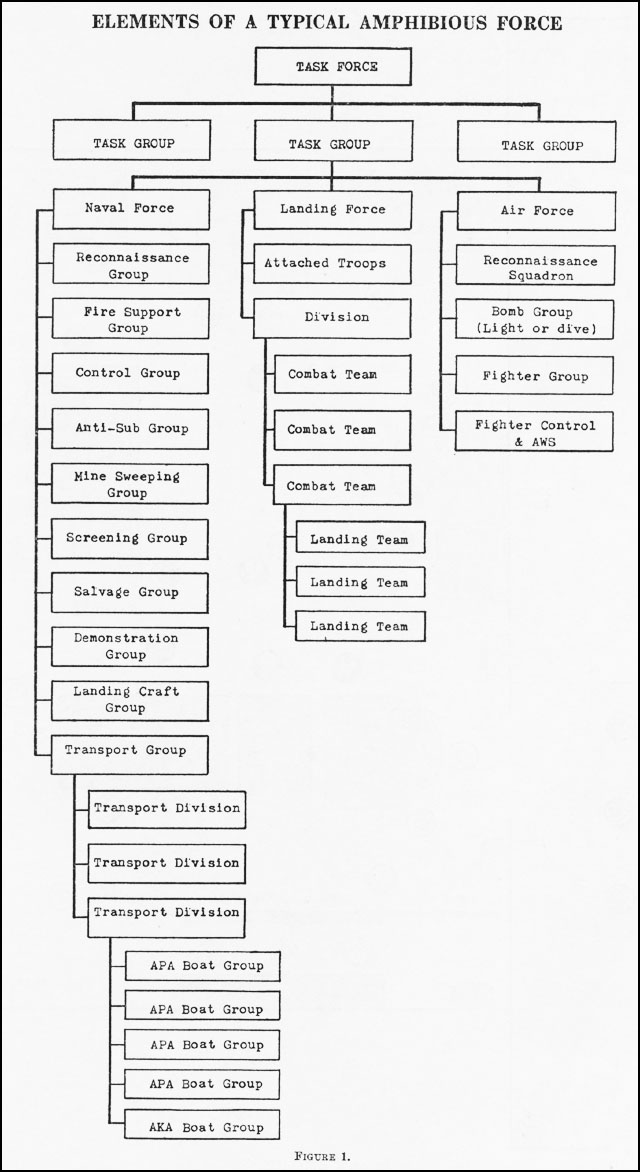
Figure 1.
COMINCH P-013 RADAR BULLETIN NO. 6 (RADSIX) CIC MANUAL UNITED STATES FLEET
HEADQUARTERS OF THE COMMANDER IN CHIEF5000. Part V. TYPE ORGANIZATIONS
The following chapters discuss the organizations of a combat information center for specific classes or types of ships. For uniformity the material will be considered in its relation to parts I through IV. Where details are discussed in earlier sections they will be referred to only in the manner (if any) in which they differ from the general details of the earlier sections. Definitions will conform to part I. Each type organization will be discussed under the following headings:
Introduction:
Basic functions of the command on the type of ship being considered:
Functions, duties, and responsibilities of CIC.General functions with reference to parts II, III, and IV of RAD SIX.
Communications of CIC:
Special duties and responsibilities in type of ship being considered, which are not covered by earlier sections.
Administrative organization of CIC, (Pending decision).
Diagram of CIC (and auxiliary CIC, where applicable) (Showing equipment, design, and stations of personnel involved).Diagram of S/P communications and other intraship communications (MCs, voice tubes, etc.)
Operational organization of CIC:
Equipment used for intership radio communications.Diagram of battle bills and condition watches.
Detailed duties.The watch bills are necessarily presented as a composite of the types and are furnished only as a guide.
Communication diagrams show circuit outlets, authorized for the CIC of the type.
COMINCH P-013
- The CIC in an Amphibious Command Headquarters Ship (AGC).
- The AGC type of ship has been designed for serving as the flagship of the amphibious force commander. An amphibious operation may involve hundreds of ships and landing craft of all types. The elements of a typical amphibious force are shown in the accompanying diagram (fig. 1).
- Functions, duties, and responsibilities of CIC.
- The combat information center in an AGC shall be organized to perform the general functions listed in parts II, III, and IV of this publication.
- Essentially the duties and responsibilities of CIC in an AGC are similar to those of any other ship. However, all data must be evaluated and processed in terms of the whole force in addition to data in terms of the single ship because of the presence of a flag aboard. It frequently is the responsibility of CIC on an AGC to coordinate the functioning of other CICs in the force. Aboard an AGC, the personnel in joint operations room, flag plot, and the staff duty officer rely on CIC for much information.
- Administrative organization of CIC. (Pending decision.)
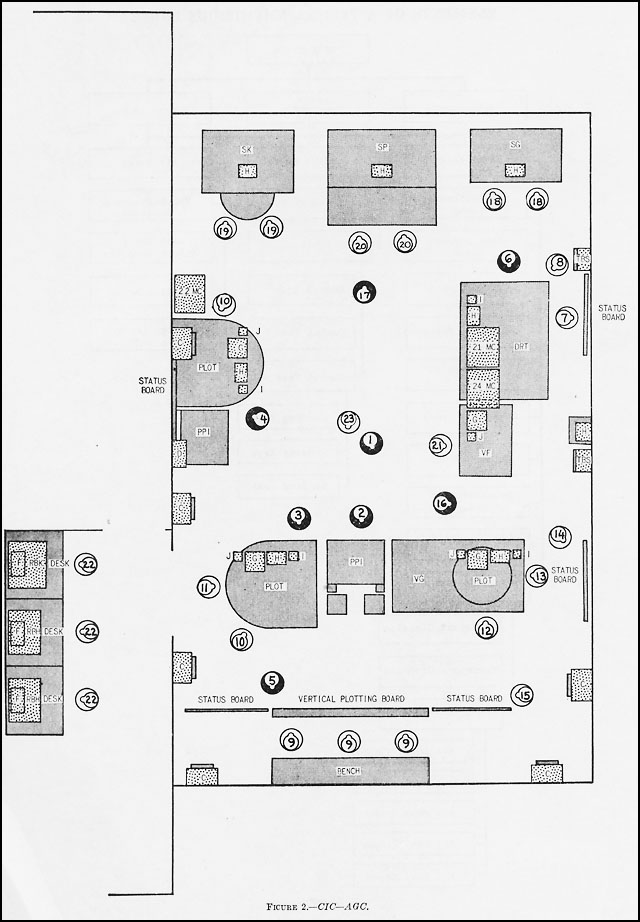
- Diagram of CIC (fig. 2).
- Communications in CIC.
- Diagram of sound power and other intraship communications (table 1). The purpose of the accompanying diagram is to show those circuits which, are commonly used by each individual, not the number available.
TABLE 1.--AGC--Communication Diagram
JA 1,2,
3,4,
6,
JFJL
JC1JP 1JS 21JS 22JS 23JS 24JS 81JS 1JV 1,
4JWJX 49JY X6J 21, 22,
24MCVHF
&
UHFEvaluator CIC officer Fighter director Assistant fighter director Radar control officer Geographic plot officer Assistant geographic plotter Geographic recorder Summary plotters Intercept plotters DR plotter Surface plotter Assistant surface plotter Surface status board keeper Air status board keeper Gunnery liaison officer Radar supervisor SG operator and stand-by SK operator and stand-by SP operator and stand-bys Precision PPI operator Radio recorders1 JA talker JL talker JF talker Flag liaison officer 1. Additional radio recorders supplied as the occasion demands.
COMINCH P-013
ELEMENTS OF A TYPICAL AMPHIBIOUS FORCE
Figure 1.
COMINCH P-013
Figure 2.--CIC--AGC.
COMINCH P-013
CIC--AGC
PERSONNEL LEGEND EQUIPMENT LEGEND 1.
2.
3.
4.
5.
6.
7.
8.
9.
10.
11.
12.
13.
14.
15.
16.
17.
18.
19.
20.
21.
22.
23.
24.Evaluator.
CIC officer.
Fighter director.
Assistant fighter director.
Radar control officer.
Geographic plot officer.
Assistant geographic plotter.
Geographic recorder.
Summary plotters.
Intercept plotters.
DR plotters.
Surface plotter.
Assistant surface plotter.
Surface status board keeper.
Air status board keeper.
Gunnery liaison officer.
Radar supervisor.
SG operator and standby.
SK operator and standby.
SP operators and standbys.
Precision PPI operator.
Radio recorders.
JA talker.
JL talker.C.
D.
F.
G.
H.
I.
J.Radiophone unit and speaker amplifier.
Wind direction and velocity indicator.
Speaker.
Radiophone selector switch
Sound-powered selector switch
Sound-powered handset
Radiophone handset.
COMINCH P-013
- Equipment used for intership radio communications. The allowance of radio equipment changes often, and the installation at times varies from the allowance. A specific list of radio equipment would therefore be misleading. The VHF channels available will indicate in a general manner the extent and type of radio equipment provided. Remote radio phone units and speaker amplifiers provide CIC with a flexible means for transmitting and receiving on multitudinous channels.
Equipment Frequency Examples of use 2 remote control transmitters and speakers. VHF Maneuvering and emergency warning. 4 transmitters and receivers. VHF Fighter net, inter-CIC and support aircraft direction. 4 10-channel transmitters with 2 10-channel receivers. VHF Aircraft control force (group) CIC circuit. 2 radio telephone units (R, P, U.) (transmit and receive). VHF, HF Fighter net, CIC circuit and local air warning. 3 radio receivers. HF, VHF General purpose.
- Operational organization of CIC. Officers and men having their battle stations in CIC or assigned as watch officers should be carefully trained at a CIC training center.
- Diagram of battle bill and condition watches (table 2).
- Duties and Stations of CIC Personnel.
- Evaluator:
- The evaluator should be an experienced officer charged with the general responsibility for operation of the CIC at general quarters. This normally requires that the executive officer or navigator act as evaluator and have the CIC as his battle station.
COMINCH P-013
TABLE 2.--AGC-CIC Watch Bill
Station Condition I Condition I A Officers Men Officers Men Officers Men Evaluator 1 1 CIC officer 1 1 Fighter director 1 1 Assistant fighter director 1 1 Radar control officer 1 1 1 Geographic plot officer 1 1 1 Assistant geographic plotter 1 Geographic recorder 1 Summary plotters 3 3 3 Intercept plotters 2 1 1 DR plotter 1 1 1 Surface plotter 1 1 1 Assistant surface plotter 1 Surface status board keeper 1 1 1 Air status board keeper 1 1 1 Gunnery liaison officer1 1 1 1 Radar supervisor 1 SG operator and standby2 2 2 2 SK operator and standby 2 2 2 SP operators and standbys 4 4 4 Precision PPI operator 1 1 1 Radio recorders3 3 3 3 JA talker 1 1 1 JL talker 1 1 1 JF talker (if flag embarked) 1 1 1 Flag liaison officer (if flag embarked) 1 1 1
Station Condition II and III Officers Men CIC watch officer 1 Radar control officer 1 Geographic plotter 1 Surface plotter 1 Summary plotters 2 Intercept plotter 1 SG operator and standby2 2 SK operator and standby 2 SP operator and standby 4 JA talker 1
1 Officers supplied by other divisions if necessary.
2 Omit in those vessels with SG indicators installed outside of CIC. Target designation switchboard manned by one of the talkers.
3 Additional radio recorders supplied as the occasion demands. During condition III, duties of personnel should be combined as complement requires.
COMINCH P-013
- The evaluator's station should have a selector switch to the principal sound power circuits with call-up buttons to local air (joint ops), staff watch officer's shelter, pilot house, intelligence office, joint operations control, and war command room.
- CIC officer:
- The CIC officer should be an experienced officer, qualified in all phases of CIC work. He is responsible for the training and administration of the combat information center. He should be qualified to take over the evaluator's position at general quarters when that officer is required elsewhere.
- The CIC officer's station should have a selector switch to the same sound power circuits as the evaluator. In addition, his station should have a voice radio selector switch connected with the principal transceivers and transmitters. The MC circuits and ship's service telephone should be convenient for his use.
- The CIC officer normally should not stand condition watches but will be on call at any time.
- Fighter director officer:
- The fighter director will be directed by the evaluator or CIC officer to take over the responsibility for interception of a specific raid threatening our forces. He should alternate with the CIC officer during extended general quarters (Condition I A) and act as evaluator during the absence of both the CIC officer and the evaluator.
- The fighter director station should have a voice distribution system utilizing all VHF channels used for aircraft control and inter-CIC reporting.
- The fighter director normally should not stand condition watches but will be on call at any time in event enemy aircraft threaten our forces.
- Assistant fighter director officer:
- The assistant fighter director should be an officer qualified to conduct the interception of enemy aircraft. He should supervise the intercept plot and handle visual fighter direction if the necessity arises.
- Summary plotters and the radar control officer:
- The summary plotters will man the vertical plotting board. The men will plot radar, radio, and lookout information on the back of the transparent plot, and the radar control officer may filter this information when necessary. The radar control officer should see that all air information is available and assist the evaluator.
- Sound-powered radar circuits are available to the summary plotters. The radar control officer should have a radio phone selector switch and the necessary sound powered outlets available.
- Geographic plotters:
- The geographic plot officer is a CIC watch officer who supervises the plotting on the DRT and the surface plot as well as the solution of surface tactical problems. He should see
COMINCH P-013
that all information is readily available and assist the evaluator in every way possible. An enlisted man assists him.
- Gunnery liaison officer:
- The gunnery liaison officer should be an officer from the gunnery department who should stand watch in CIC at general quarters. He should be responsible for passing to gunnery control all information required. The lookout talker may assist the gunnery liaison officer.
- The gunnery liaison officer's station should include sound-powered telephone selector switch with radar, gunnery, and command circuits.
- Surface plotter:
- The surface plotter may be an enlisted man who keeps the surface plot up-to-date under the direction of the geographic plot officer.
- Intercept plotters and DR plotters:
- The intercept plotters should be enlisted men who will plot the track of enemy raids and DR plotters should dead reckon friendly fighters sent to intercept. The are under the supervision of the assistant fighter director.
- Status board keepers:
- The status board keepers will be enlisted men who will handle the surface and air status boards respectively. The geographic plot officer should supervise recording on the surface status boards and the assistant fighter director should supervise the keeping of the air status boards.
- The surface status board keeper should have the low angle search radar circuits available. The air status board keeper should have an outlet from the VHF equipment used for the fighter net.
- Lookout talker:
- The lookout talker should man the JL (or JC) sound power circuit and relay lookout and gunnery reports to CIC. He may plot air and surface contacts on the summary plot.
- Radar operators:
- The two radar operators are desirable at each radar during general quarters permitting continuous operation with one man on the set for 30 minutes and then resting 30 minutes while the other takes over. During condition watches the radar operators should rotate duty with the enlisted talkers and plotters.
- During condition II and III watches there should be two officers stationed in the CIC. The CIC watch officer in charge should act as evaluator and coordinate the functions of the CIC. The assistant CIC watch officer will aid him in all respects, act as radar control officer when necessary, supervise plotting, and provide the solution of tactical problems.
- Joint operations room.
A thorough knowledge of facilities and operation of the joint operations room is necessary for CIC personnel, if they are to be of maximum value.
- This room is usually located on the main deck, amidships, forward of the ship's wardroom and just aft of the CIC. Here the staff officers of the Army (Marines), Navy and air forces of either service coordinate the employment.
COMINCH P-013
in detail of the forces participating and maintain and evaluate the complete picture of the battle situation.
- The CIC in a Relief Headquarters Command Ship (RAGC).
- A RAGC is a vessel designed for serving as the relief flagship of the amphibious force commander. It will usually be an APA with modifications to accommodate a flag.
- Functions, duties and responsibilities of CIC.
- The general functions of CIC are the same as those listed in parts II, III, and IV of this publication.
- The duties and responsibilities of CIC on a RAGC are similar to those of any other ship. When a flag is aboard, the work in CIC should be closely coordinated with the work of the staff which will depend upon CIC for much information.
- Administrative organization of CIC. (Pending decision.)
- Diagram of CIC (omitted).
- Communications in CIC.
- Diagram of sound power and other intraship communications (omitted).
- Equipment used for intership communications in or adjacent to CIC. The allowance of radio equipment changes often, and the installation at times varies from the allowance. A specific list of radio equipment would therefore be misleading. The VHF channels available will indicate in a general manner the extent and type of radio equipment provided. Remote radio phone units and speaker amplifiers provide CIC with a flexible means for transmitting and receiving on multitudinous channels.
Equipment Frequency Examples of use 2 remote control transmitters and speakers. VHF Maneuvering and emergency warning. 2 transmitters and receivers, VHF Inter-CIC and aircraft control. 1 10-channel transmitter with 2 10-channel receivers. VHF Aircraft control, force (group) CIC circuit. 2 radio telephone units (RPU) (transmit and receive). HF Aircraft control, secondary CIC circuit and local air warning. 3 radio receivers. HF, VHF General purpose.
- Operational organization of CIC.
- Battle bill and condition watches (table 3).
- Duties and stations of CIC personnel: Similar to those of personnel on a AGC (see par. 5152).
- During condition II and III watches there should be one officer stationed in CIC who should act as evaluator and coordinate the functions of CIC He will supervise the work of the enlisted men on watch.
COMINCH P-013
TABLE 3.--RAGC-CIC Watch Bill
Station Condition I Condition I A Officers Men Officers Men Officers Men Evaluator 1 1 CIC officer 1 1 Fighter director 1 1 Assistant fighter director 1 1 Radar control officer 1 1 1 Geographic plotter 1 1 1 Geographic recorder 1 Summary plotters 3 2 2 Intercept plotters 2 1 1 DR plotter 1 1 1 Surface plotter 1 Status board keeper 1 Gunnery liaison officer1 1 1 1 SG operator and standby 2 1 1 SK operator and standby 2 1 1 Radio recorders2 3 2 2 JA talker 1 1 1 JL talker 1 1 1 JF talker (if flag embarked) 1 1 1 Flag liaison officer (if flag embarked) 1 1 1
Station Condition II and III Officers Men CIC watch officer 1 Geographic plotter 1 Summary plotters 2 Intercept plotter 1 SG operator and standby 1 SK operator and standby 1 JA talker 1 JL talker 1
1 Officers supplied by other divisions if necessary.
2 Additional radio recorders supplied as the occasion demands. During condition III, duties of personnel should be combined as complement requires. Target designation switchboard manned by one of the talkers.
COMINCH P-013
- The CIC in an Attack Transport, Attack Cargo Ship and Destroyer Transport (APA, AKA, APD).
- These vessels are designed as troop transports and cargo ships to be used during amphibious operations.
- Functions, duties, and responsibilities of CIC.
- The combat information centers on an APA, AKA, or APD should be organized to perform the functions listed in parts II, III, and IV of this publication.
- Special duties and responsibilities:
- Essentially the duties and responsibilities of CIC on these vessels are similar to those of any other type of ship. If the vessel acts as a group or division flagship the staff will rely on CIC for much information, and the work in CIC should be closely coordinated with that of the staff.
- Boat wave tracking:
The function of boat wave tracking is performed by these types of vessels. In an amphibious operation the waves of assault boats must be carefully tracked by the parent ship and all interested stations kept informed of their progress toward the beach. It is possible to obtain from a good plot:
- Course of boats to the beach or line of departure; whether they will reach the correct location.
- Speed of waves; whether they will arrive at destination on time.
- Position of marker, control, and support vessels.
- The administrative organization of CIC. (Pending decision.)
- Diagram of CIC (fig. 3).
- Communications of CIC.
- Diagram of sound power and other intraship communications (table 4).
TABLE 4.--APA, AKA--Communication Diagram
JA1 JL1 1, 2JP 21JS 22JS 51JS2 1JV 1JW JX X6J 21MC VHF
&
HFEvaluator CIC officer Geographic plotter Air plotter Surface (or summary) plotters Air search radar operator Surface search radar operator Radio recorder/operator JA talker JL talker1 1 Combined on some vessels, in which event No. JL talker necessary.
2 IF radio direction finder fitted.
- Equipment used for intership radio communications. The allowance of radio equipment changes often, and the installation at times varies from the allowance. A specific list of radio equipment would therefore be misleading. The VHF channels available will indicate in a general manner the extent and type of radio equipment provided. Remote radio phone units and speaker
COMINCH P-013
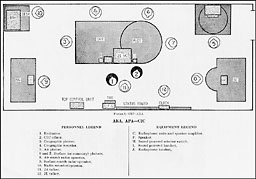
Figure 3. CIC--AKA, APA, APD
COMINCH P-013
amplifiers provide CIC with a flexible means for transmitting and receiving on multitudinous channels.
Equipment Frequency Examples of use APA AKA APD Remote control transmitter and speaker. VHF Maneuvering and emergency warning. 1 1 1 Remote control transmitter and speaker. VHF Aircraft control. 1 1 1 10-channel transmitters with 2 10-channel receivers. VHF Boat wave control. 1 1 1 Radio receiver. HF General. 1 1 1
- Operational organization of CIC.
- Battle bill and condition watches (TABLE 5).
- Duties and stations of CIC personnel similar to those on AGC and RAGC.
TABLE 5.--APA-AKA-APD: Watch Bill
Station Condition I Condition I A Officers Men Officers Men Officers Men Evaluator 1 1 CIC officer 1 1 Geographic plotter 1 1 1 Geographic recorder 1 Air plotter 1 1 1 Surface (or summary) plotters 2 1 1 Air search radar operator 1 1 1 Surface search radar operator 1 1 1 Radio recorder/operator1 1 JA talker 1 JL talker 1 1 1
Station Condition II and III Officers Men CIC watch officer 1 Geographic plotter 1 Air plotter 1 Surface search radar operator 1 Air search radar operator 1 1 Additional radio recorders supplied as the occasion demands. During Condition III, duties of personnel should be combined as complement requires.
COMINCH P-013
- The CIC on a Battleship and Cruiser (BB, CB, CA, CL).
- The functions of battleships and cruisers are essentially similar. Their main batteries of heavy, long-range guns are their chief reasons for being. These types of ships will be used mainly in surface actions and bombardments. They have also proved useful as an antiaircraft screen for carrier units.
- Functions, duties, and responsibilities of CIC. The CIC is an agency for the collections of combat and tactical information by every possible means. Collected information is plotted, recorded, kept on file to facilitate its evaluation and dissemination to interested stations. Parts II, III, and IV of this publication deal with these general functions of CIC in detail.
- Special duties and responsibilities:
The following functions will be performed by CIC. The order of importance is dependent upon the tactical situation.
- Air search and warning.
- Surface search and warning.
- Recognition and identification.
- Target indication.
- Tracking.
- Plotting.
- Navigation.
- Control of aircraft.
- Administrative organization of CIC. (Pending decision.)
- Communications in CIC. The sound power phones are CIC's primary system of interior communication. Outlets for a large number of circuits have been placed in CIC. To give flexibility to this system, many of the circuits have outlets through one of two types of switches--the selector switch or a panel of toggle switches. The advantage of each is also its disadvantage. With a panel of toggle switches, circuits can be crossed. This is sometimes desirable. It leads, however, to unintentional crossing, which may seriously impede communications. Selector switches permit being on only one circuit at a time. The single, double, or quadruple sound-powered jack-box outlets are also installed in CIC. Many circuits have outlets in CIC which are seldom used. These have been installed for the unusual situations. CIC's today have most of the sound-powered outlets in CIC wired through panel of 10 or 20 toggle switches.This means that a majority of the circuits leading to CIC are available to a large number of the personnel in CIC. Operationally this is misleading, because with a few exceptions each person in CIC has only one or a very limited number of circuits which he uses. The purposes of the accompanying diagram are not to show circuits which are AVAILABLE to each person but circuits which are COMMONLY USED by each individual.
- Diagram of S/P Communications and other intraship communications. (See table 6.)
COMINCH P-013
FIGURE 4.--CIC-CLSee legend on page 61.
COMINCH P-013
CIC--CL PERSONNEL LEGEND EQUIPMENT LEGEND 1.
2.
3.
4.
5.
6.
7.
8.
9.
10.
11.
12.
13.
14.
15.
16.
17.
18.
19.
20.
21.
22.
23.
24.
25.
26.
27.Evaluator.
CIC officer.
Fighter director.
DR plotter.
Intercept plotter.
Geographic plot officer.
Geographic plotter.
Geographic recorder.
Air plotter.
Assistant air plotter.
Surface plot officer.
Surface plotter.
Surface status board keeper.
Air status board keeper.
MB gunnery liaison officer.
AA gunnery liaison officer.
Radar supervisor.
Surface search operation and standby.
Air search radar and standby.
SP operators.
Precision PPI operator.
Communication officer.
Radio recorder/operator.
JS talker.
JA talker.
JL talker.
JW talker.C.
D.
E.
F.
G.
H.
M.Radiophone unit and speaker amplifier.
Wind direction and velocity indicator.
Pitometer.
Speaker.
Radiophone selector switch.
Sound powered selector switch.
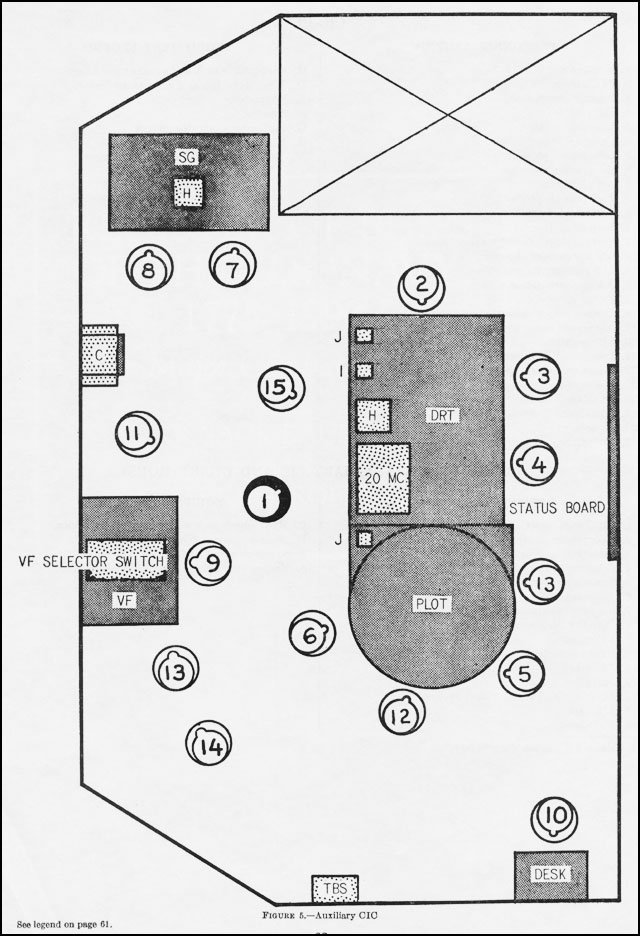
Remote range and bearing indicator.BB, CA, CB, CL--AUXILIARY CIC AND CHART HOUSE PERSONNEL LEGEND EQUIPMENT LEGEND 1.
2.
3.
4.
5.
6.
7.
8.
9.
10.
11.
12.
13.
14.
15.OinC auxiliary CIC.
Geographic plotter.
Assistant geographic plotter.
Geographic recorder.
Surface plotter.
Assistant surface plotter.
SG radar operator.
Standby SG operator.
VF operator.
Radio recorder.1
JA talker.
JL talker.
JC talker and status board keeper.
5JP talker.
JS talker.C.
H.
I.
J.Radiophone unit and speaker. Amplifier.
Sound powered selector switch.
Sound powered handset.
Radiotelephone handset.
1 Mans JX circuit if necessary.
COMINCH P-013
FIGURE 5.--Auxiliary CICSee legend on page 61.
COMINCH P-013
FIGURE 6.--CHART HOUSE
COMINCH P-013
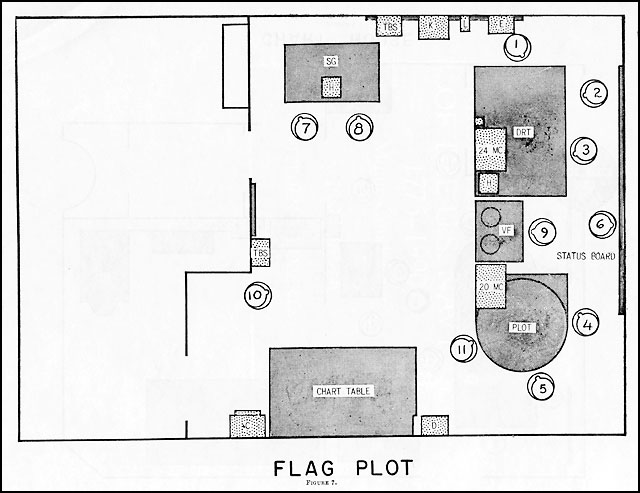
FIGURE 7.--FLAG PLOT
COMINCH P-013
BB, CB, CA, CL--FLAG PLOT PERSONNEL LEGEND EQUIPMENT LEGEND 1.
2.
3.
4.
5.
6.
7.
8.
9.
10.
11.Geographic plotter.
Assistant geographic plotter.
Geographic recorder.
Surface (or summary) plotter.
Assistant surface (or summary) plotter.
Status board keeper.
Surface search radar operator.
Standby surface search radar operator.
Precision PPI operator.
JF talker.
JS talker.C.
D.
E.
H.
I.
K.
L.Radiophone unit and speaker amplifier.
Wind direction and velocity indicator.
Pitometer.
Sound-powered selector switch.
Sound-powered handset.
Remote bearing indicator.
Remote range indicator.
COMINCH P-013
TABLE 6--BB, CB, CA, CL-Communication Diagram 1 BB only.
JA 1,
2,
JBJC JF JL 1,
2,
3,1
4,1
5,
JP1
JS21
JS22
JS23
JS24
JS25
JS31
JS,
32
JS41
JS,
42,
43,1
44171
JS81
JS1,
5JV1,
2,
3,
4,
5,
6,
7,1
8,1
JWJX 49
JY
(4)2JZ XJA X1JV X1JW
X2JW,
X5JW,
X6JW,
X7JW,1 X8JW1XJX X6J 20,
21,
22,
24
MCVHF
&
HFEvaluator CIC officer Fighter director Intercept plotter DR plotter Geographic plot officer Assistant geographic plotter Geographic recorder Air plotter Assistant air plotter Surface (or summary) plotter Assistant surface (or summary) plotter Surface status board keeper Air status board keeper MB gunnery liaison officer1 AA battery gunner liaison officer1 Radar supervisor SG operator and stand-by SK operator and stand-by SP operators and stand-bys Precision PPI operator Radar switchboard operator Communications officer1 Radio recorders/operators JS talker JA talker JL talker JV talker JW talker JF talker (if flag embarked) Flag liaison officer (if flag embarked)
COMINCH P-013
- Equipment used for intership radio communications. The allowance of radio equipment changes often, and the installation at times varies from the allowance. A specific list of radio equipment therefore would be misleading. The VHF channels available will indicate in a general manner the extent and type of radio equipment provided. Remote Radio Phone units and speaker amplifiers provide CIC with a flexible means for transmitting and receiving multitudinous channels.
1 (3 for BB, 2 for CA, CL)
Radio Frequency Examples of use 2 remote control transmitter-receiver units. VHF Primary warning and maneuvering. 2 transmitter and receiver units. VHF Aircraft control, Inter CIC circuit. 3 10-channel transmitter-receiver sets.1 VHF Aircraft control, Force (Group) CIC circuit. 4 radio telephone units (R/P.U.) transmit and receive. VHF, HF Aircraft control, CIC circuit and local air warning, spotting circuit. 3 radio receivers. VHF, HF General purpose.
- Operational organization of CIC. The standard organization of battleship and cruiser CIC's should provide for manning stations at general quarters and during condition watches. Due to currently existing differences in the arrangements of CIC equipment in ships of the fleet even of the same type, variations from the standard bill may be found.
TABLE 7.--BB, CB, CA, CL--Watch Bill 1 BB only.
Station Condition I Officers Men Evaluator 1 CIC officer 1 Fighter director 1 Intercept plotter 1 D.R. plotter 1 Geographic plot officer 1 Assistant geographic plotter 1 Geographic recorder 1 Air plotter 1 Assistant air plotter 1 Surface (or summary) plotter 1 Assistant surface (or summary) plotter 1 Surface status board keeper 1 Air status board keeper 1 MB gunnery liaison officer3 1 AA battery gunnery liaison officer3 1 Radar supervisor 1 S.G. operator and standby2 2 SK operator and standby 2 SP operators and standbys 4 Precision PPI operator 1 Radar switchboard operator4 1 Communications officer3 1 Radio recorders/operators5 2 JS talker 1 JA talker 1 JL talker 1 JV talker 1 JW talker 1 JF talker (if flag embarked) 1 Flag liaison officer (if flag embarked) 1 Condition II and III Officers Men CIC watch officer 1 CIC watch officer 1 Geographic plotter 1 Geographic recorder 11 Surface (or summary) plotter 1 Assistant surface (or summary) plotter 11 Air plotter 1 Assistant air plotter 11 SG operator and standby2 2 SK operator and standby 2 SP operator and standby 4 Precision PPI operator 1 Radar switchboard operator4 1 Radio recorder5 11 JS talker 1 JL talker 1 2 Omit in those vessels with SG indicators installed only in Auxiliary CIC. Target designation switchboard manned by one of the talkers.
3 Officers supplied by other divisions if necessary.
4 Usually located outside of CIC.
5 Additional radio recorders supplied as the occasion demands. During condition III, duties of personnel should be combined as complement requires.
TABLE 8.--BB, CB, CA, CL: Auxiliary CIC (Chart House) Watch Bill Auxiliary CIC will not normally be manned during condition III except, in those vessels where the SP radar has replaced 1 of the 2 authorized SGs and the indicator of the remaining SG is located in auxiliary CIC.
Station Condition I Officers Men OinC auxiliary CIC 1 Geographic plotter 1 Assistant geographic plotter 1 Geographic recorder 1 Surface plotter 1 Assistant surface plotter 1 SG radar operator 1 Stand-by SG radar operator 1 VF operator 1 Radio recorder 1 JA talker 1 JL talker 1 JC talker and status board keeper 1 5JP Talker 1 JS Talker 1 Condition II and III Officers Men Surface plotter 1 SG radar operator 1 Stand-by SG radar operator 1 JS talker 1
COMINCH P-013
TABLE 9.--BB, CB, CA, CL: Flag Plot Watch Bill 1 Officers as assigned by Flag.
Station Condition I Officers1 Men Geographic plotter 1 Assistant geographic plotter 1 Geographic recorder 1 Surface (or summary) plotter 1 Assistant surface (or summary) plotter 1 Status board keeper 1 Surface search radar operator 1 Stand-by surface search radar operator 1 Precision PPI operator 1 JF talker 1 JS talker 1 Conditions II & III Officers1 Men Surface (or summary) plotter 1 Surface search radar operator 1 Stand-by surface search radar operator 1 JF talker 1 JS talker 1
- Detailed duties.
- Evaluator:
- Require that immediate reports be made to him of pertinent information received from all sources, including radar, radio, internal communications systems, lookouts, and visual signals.
- Require that CIC personnel coordinate their efforts to display and filter this information.
- Furnish timely, properly evaluated, accurate information to the command and control stations, and be prepared to recommend a course of action based on evaluated information.
- Consult directly with command via sound-power hand sets, MC circuits, or voice tubes.
- Be thoroughly familiar with the capabilities and limitations of all radar and RCM equipment.
- Assist command in conning the ship with regard to avoiding collision or grounding.
- CIC officer:
- Be thoroughly familiar with the duties and responsibilities of the evaluator, and be prepared to assume these duties in the absence of the evaluator.
COMINCH P-013
- Maintain a check on operating methods to insure maximum effective search consistent with the prescribed condition of radar silence.
- Keep operators informed of expected sectors of contact with friendly or enemy units.
- Receive and correlate information from lookouts, radio and flag signals.
- Check on radar contacts reported as side lobes, ionized clouds, land, double echoes, interference, and countermeasures.
- Insure that main and secondary battery fire control radars, directors, and automatic weapons are coached on to designated targets.
- Insure that all personnel concerned are informed of the designations give to the various raids.
- Insure rapid dissemination of information to control stations.
- Select surface contacts to be tracked, with particular attention to those nearest or most dangerous.
- Keep command and the control stations informed of the progress of interception problems.
- Assist the navigator when operating near land by selecting suitable landmarks for radar fixes.
- Assist the evaluator in the performance of control functions delegated to CIC.
- Utilize the VF (precision PPI) for analyzing radar contacts.
- Be ready to render assistance in furnishing maneuvering and tactical data.
- Fighter director:
- Protect his ship or force against air attacks by effective use of the fighters assigned to his control.
- Control communications with combat air patrol, and if necessary, the inter FD channel with force (group) CIC officer and ship's CIC officer of other units.
- Control the operation of the air search radar.
- Be prepared to direct planes engaged in antisubmarine patrol, and perform that function when ordered.
- Know the responsibilities of force (group, unit) and ship C.I.C. as laid down in USF 10.
- When not handling fighter direction, coordinate air plotting and the dissemination of air information as directed by the evaluator.
- Intercept plotter:
- Maintain close communications with the air search radar.
- Plot contacts with neatness, accuracy, and speed, in accordance with standard plotting procedure.
- Enter amplifying information along track of target.
- Keep plotting board clear of unnecessary detail.
- Supervise other air plotters.
- Record number of friendly planes in the air with their search sectors.
- DR plotter:
- Keep a DR plot of own fighters.
- Wear headset connected to fighter net channel.
COMINCH P-013
- Know thoroughly the technique of DR as prescribed in the Air Plotting Manual. (RADFOUR)
- Geographic plotter:
- Maintain a continuous plot on the DRT of own and enemy ships to determine their course and speed and any changes therein.
- Check scale setting of DRT frequently.
- Supply bearings and ranges course and speed for initial rangekeeper solution to gunnery liaison officer if requested.
- Provide ranges and time interval to initial firing point when requested.
- Correct DRT bug during bombardment for set and drift determined by navigational fixes.
- Keep the evaluator informed of all important data.
- Assistant geographic plotter:
- Works with the geographic plotter as a teammate to speed the plotting.
- Label plots, determine courses and speeds, etc.
- May be designated to operate the teleplotter. However, an additional man may be necessary for this.
- Air plotter:
- Plot all air contacts with proper labels including raid designations, courses and speeds, composition, angels, etc.
- Provide such information as possible of sun, force and direction of wind, etc.
- Keep a plot of the tactical air situation, including sector of probable enemy approach, bearing and distance of own and enemy bases, and own planes in the air.
- Keep the evaluator and AA gunnery liaison officer informed of all important data or change occurring in the plot.
- Check with surface search radar for spotting low flying aircraft.
- Assistant air plotter:
The assistant air plotter should assist the air plotter in maintaining a continuous plot of all air targets reported by the air search radar, lookouts, or radio.- The surface (or summary) plotter:
It is often desirable that he be an officer. He will be the surface plotter if a surface plot display is being kept on the plotting board he is manning, (i.e. all surface and air units, friendly and enemy). He should:
- Keep a continuous track of all surface contacts (or all surface and air contacts), to keep the cognizant personnel in CIC informed of the identity of any surface radar contact (if summary plotter, any surface or air contact) in question.
- Aid the gunnery liaison officers in preventing the fire of own ship from endangering friendly ships.
- Maintain a relative plot of own disposition.
- Indicate location and disposition of friendly ships, pickets, and stragglers.
COMINCH P-013
- Maintain maneuvering board plot of own ship's course and speed, and be prepared to furnish tactical data.
- Provide ranges and bearings of sound contacts by escorts, in relation to self and to fleet center.
- Plot such data as rain clouds, land, wind speed, and direction.
- Plot reports from radar operators and lookouts.
- Coordinate lookout information, radio information, and radar information for identification and composition.
- Assistant surface (or summary) plotter:
- Assists the surface (or summary) plotter in the execution of his duties as outlined above.
- Recorders--geographic: surface (or summary). The geographic and surface (or summary) recorders should keep an accurate record of radar ranges and bearings. use of VG (projection PPI) with tracking paper may obviate the necessity of having recorders. If proper plotting procedure is used, the tracing paper on the VG will preserve the record. This together with equipment for photographing the PPI will aid in keeping a record of the action.
Tracing paper on the DRT may give sufficient information to reconstruct an action; however, the geographic plotter is often in need of a reference if he misses a range or bearing. If the raid time, bearing and radar range data is presented conveniently for all concerned on the surface status board, it will not be necessary to have a surface recorder as such. When this, due to the physical limitations of CIC's, is not applicable, it is necessary to provide a recorder for either the geographic plotter or both geographic plotter and surface (or summary) plotter.
- Surface status board keeper. The surface status board keeper should be under the supervision of either the surface (summary) plot officer or the geographic plot officer. He should:
- Maintain an up-to-date record of the tactical data on the board.
- Record data on surface raids, if board is designed to include such data.
- Air status board keeper. The air status board keeper should be under the supervision of the fighter director officer. He should:
- Maintain an up-to-date record of all intercept information.
- Keep posted such information as condition of weather, clouds, states of sea, time of sun and moon rise and set, current, drift, force of wind, etc.
- Record information on physical condition of fighter planes, ranges and bearings of enemy planes and force, losses, status of own carriers and patrols.
- M.B. (main battery) gunnery liaison officer. M.B. gunnery liaison officer shall by observation of the surface search radars, the geographic plot, the VF, the surface or summary plot:
- Keep the evaluator and gun control stations informed of the surface gunnery situation.
- Analyze all contacts by checking IFF indications, lookouts reports, and the known location of own ships and land masses.
- Inform the AA liaison officer of any air targets appearing on surface radar scope.
COMINCH P-013
- Check CIC's computation of courses and speeds of targets being tracked against M.B. plot computer-solution.
- Coach directors on target as ordered.
- Check director train and range indicators to insure they are on designated targets.
- Warn evaluator and gun control stations when own ships are in danger of own firing.
- During shore bombardment (indirect fire), give advanced range, bearing, and elevation of the target.
- Antiaircraft (secondary battery) gunnery liaison officer.
- Keep the evaluator and air defense officer informed of the developments in the air situation.
- Make every effort to determine the character of contacts by checking for IFF, approach bearings, altitudes, course, speed, identification by lookouts, and location of own air patrols.
- Coach AA fire control directors on to designated targets employing target designators or the appropriate telephone circuits.
- Insure that directors are on designated targets by checking target range and bearing indicators located in CIC.
- During low visibility torpedo attacks insure that AA guns do not fire on bearings which endanger other ships of the screen.
- Follow the same procedure for the secondary as MB gunnery liaison officer does for the main battery when the secondary battery is firing on surface targets.
- Surface and air search operators:
- Maintain an alert search on the prescribed range scale, with the antenna rotating at the prescribed rate.
- Report all contacts, amplifying initial reports as additional information becomes available.
- Report all unusual or doubtful indications, and be able to recognize double echoes, side lobes, ionized clouds, second trip echoes, wake signals, interference jamming, window, land echoes, aircraft, and surface craft.
- Check all contacts for IFF, when ordered, and identify the code.
- Know disposition of ships in company.
- Communications officer:
- Supervise the watch on all radio circuits and inform the evaluator of all pertinent incoming messages.
- Encodes and transmits messages as directed by evaluator (e.g., contact and amplifying reports).
- Decodes messages received, notifying personnel concerned.
- Be familiar with and have access to standard tactical instructions and the current operations and communications plans.
- Radio recorders:
- Should be proficient in keeping receivers tuned.
- When desirable, they will be used for recording designated radio circuits which CIC is monitoring. If mechanical recorders are provided, they will operate these.
COMINCH P-013
- If C/W is in use, radiomen shall be provided to record and send.
- Telephone talkers. Talkers must be carefully trained in proper S/P maintenance and procedure, in accordance "CominCh's Telephone Talkers Manual."
- Flag liaison officer. The flag liaison officer, if assigned, should observe all scopes, plots, and status boards, and consult with the evaluator, and provide the flag officer with all evaluated information needed.
- Officer in charge of auxiliary CIC. The officer in charge of CIC should be a qualified CIC watch officer and preferably a radar officer. He should:
- Supervise the operation and maintenance of radars and plots in auxiliary CIC.
- Provide assistance to CIC when needed.
- Be prepared to assume the most urgent functions of CIC in the event of damage to the main installations.
- Recognition officers. The recognition officer is an officer who has specialized in recognition training. He should be qualified in the operation of CIC and the mechanics of aircraft control and fighter direction. He should:
- Supervise the performance of the battle lookouts.
- Perform visual fighter direction when ordered.
- Condition watch organization. (See 5451).
- During condition of readiness watches, CIC shall be prepared to perform the same functions as during General Quarters, but with reduced personnel.
- The CIC watch officer shall perform the duties of the evaluator during condition watches. In addition he should:
- Perform the duties of CIC communications officer.
- Qualify as a radar operator.
- Conduct systematic training of condition watches personnel to perfect radar operation, and plotting techniques, as well as team training in the performance of all functions of CIC.
- Brief the relieving watch before relinquishing the watch.
COMINCH P-013
- The CIC on a Carrier (CV, CVB, CVL, CVE).
- The aircraft carrier (CV, CVB, CVL, CVE) is designed for use as an operating base for aircraft which may be controlled offensively, and/or defensively by own carrier or by other control stations.
- Functions, duties, and responsibilities of CIC.
- The combat information center should be organized to perform the following functions. (Their order of importance is not determined by the order of listing, but varies with the tactical situation.)
- Air search and warning.
- Surface search and warning.
- Aircraft control.
- Recognition and identification.
- Plotting and tracking.
- Gunnery.
- Navigation.
These functions have been discussed in detail in parts II, III, and IV of this publication.
- In addition to the above general functions, the combat information center on carrier type ships, should be so designed as to perform the following special functions:
- Maintenance of complete records of all friendly air-borne aircraft (including mission, time of departure, and return of all strike groups).
- Communication with all air-borne aircraft.
- Control and coordination of all defensive fighter planes of a task group or task force.
- Control of, and assisting, all pilot-rescue planes or ships.
- Administrative organization of CIC. (Pending decision)
- Communications in CIC.
- Intraship communications (table 10).
TABLE 10--CV, CIC, and Air Pilot Communication Diagram
JA JF 1JG 2JC X1
JGJL 1,
2,
5
JP1JS 21
JS22
JS23
JS24
JS25
JS41
JS,
42,
JS71
JS81
JS1,
5JVJX 49
JYXJA X1
JVXJX 19,
20,
21,
22,
24
MCVHF
&
HFEvaluator CIC officer Fighter director Assistant fighter director Radar control officer Geographic plotter Geographic recorder Summary plotters Intercept plotters DR plotter Surface plotter Assistant surface plotter Status board keeper Gunnery liaison officer Ship's information officer Radar supervisor Maintenance man SG operator and standby SK operator and standby SP/S.M. operators and standbys Precision PPI operator Radar switchboard operator Radio recorder/operator JA talker JL talker JX talker JF talker (if flag embarked) Flag liaison officer (if flag embarked)
- Intership communications. The allowance of radio equipment changes often, and the installation at times varies from the allowance. A specific list of radio equipment would therefore be misleading. The VHF channels available will indicate in a general manner the extent and type of radio equipment provided. Remote radio phone units and speaker amplifiers provide CIC with a flexible means for transmitting and receiving on multitudinous H.F. channels.
1 2 for CVL, CVE.
Equipment Frequency Examples of use 2 remote control transmitter-receivers VHF Maneuvering and emergency warning. 4 transmitters and receivers VHF Inter CIC, force (group) CIC circuit. 4 10-channel transmitter receivers1 VHF Fighter net, aircraft control, force (group) CIC circuit. 8 radio telephone units (RPU) transmit and receive2 VHF, HF Search and attack local air warning. 3 receivers VHF, HF General purpose. 2 6 for CVL, CVE
COMINCH P-013
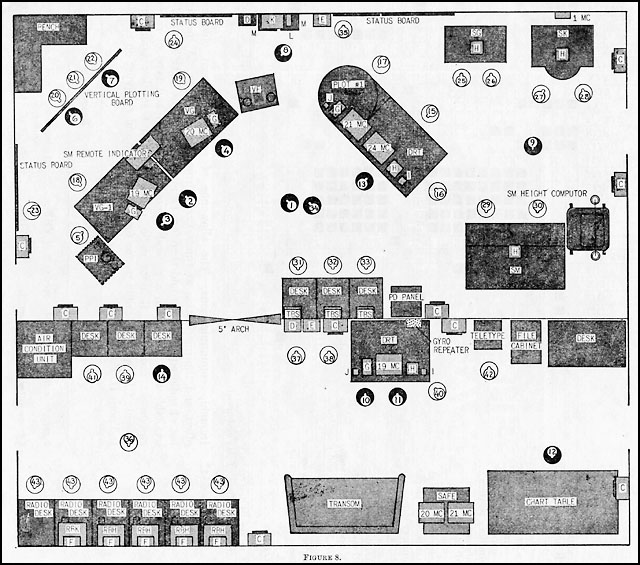
Figure 8.
COMINCH P-013
CV CIC PERSONNEL LEGEND EQUIPMENT LEGEND 1. Evaluator. A. Radiophone unit. 2. CIC officer. B. Speaker amplifier. 3. Fighter director. C. Radiophone unit and speaker amplifier. 4. Assistant fighter director. D. Wind direction and velocity indicator. 5. D.R. plotter. E. Pitometer. 6. Ship's information officer. F. Speaker. 7. Radar control officer. G. Radiophone selector switch. 8. Gunnery liaison officer. H. Sound-powered selector switch. 9. Radar supervisor. I. Sound-powered handset. 10. Air operations officer (air plot officer). J. Radiophone handset. 11. Assistant air operations officer (assistant air plot officer). K. Remote bearing indicator. 12. Assistant air operations officer (assistant air plot officer). L. Remote range indicator. 13. Geographic plot officer. M. Remote range and bearing indicator. 14. ACI officer. 15. Geographic plotter. 16. Surface recorder. 17. Surface plotter. 18. Intercept plotter (at VG). 19. Intercept plotter or surface plotter (at VG). 20. Summary plotter. 21. Summary plotter. 22. Summary plotter. 23. Status board keepers. 24. Status board keeper. 25. SG operator. 26. SG operator. 27. SK operator. 28. SK operator. 29. SM/SP operator. 30. SM/SP operator. 31. Radio operator/recorder. 32. Radio operator/recorder. 33. Radio operator/recorder. 34. JA talker. 35. JL talker. 36. JX talker. 37. 1JG talker. 38. 2JG talker. 39. Yeoman. 40. Messenger. 41. Aerology. 42. Teletype operator. 43. Radio operator/recorder.
COMINCH P-013
Figure 9.--CIC and AIR PLOT--CVE (105 Class)
COMINCH P-013
CVE CIC PERSONNEL LEGEND EQUIPMENT LEGEND 1. Evaluator. C. Radiophone unit and speaker amplifier. 2. CIC officer. D. Wind. 3. Fighter director. E. Pitometer. 4. Assistant fighter director (and ships information officer). G. Radiophone selector switch. 5. DR plotter. H. Sound-powered selector switch. 6. Radar control officer. I. Sound-powered handset. 7. Gunnery liaison officer. J. Radiophone handset. 8. Radar supervisor. 9. Air operations officer (air plot officer). 10. Assistant air operations officer (assistant air plot officer). 11. Geographic plotter. 12. Assistant geographic plotter. 13. Geographic recorder. 14. Surface plotter. 15. Intercept plotter. 16. Intercept plotter. 17. Status board keeper. 18. Summary plotter. 19. Summary plotter. 20. SG operator. 21. SG operator. 22. SP operator. 23. SP operator. 24. SK operator. 25. SK operator. 26. Radio operator recorder. 27. Radio operator recorder. 28. JA talker. 29. JL talker. 30. 1JG talker. 31. 2JG talker. 32. Yeoman. 33. Radio operator recorder.
COMINCH P-013
Figure 10.--CIC-CVL and AIR PLOT
COMINCH P-013
PERSONNEL LEGEND 1. Evaluator. 17. Summary plotter. 2. CIC officer. 18. Summary plotter. 3. Fighter director. 19. Status board keeper. 4. Assistant fighter director (ships information officer). 20. SG operator. 5. DR plotter. 21. SG operator. 6. Radar control officer. 22. SK operator. 7. Ships information officer. 23. SK operator. 8. Gunnery liaison officer. 24. SM/SP operator. 9. Radar supervisor. 25. SM/SP operator. 10. Air operations officer (air plot officer). 26. Radio operator/recorders. 11. Assistant air operations officer (assistant air plot officer). 27. JA talker. 12. Geographic plot officer. 28. JL talker. 13. Geographic plotter. 29. JX talker. 14. Geographic recorder. 30. 1JG talker. 15. Intercept plotter. 31. 2JG talker. 16. Intercept plotter or surface plotter (at VG). 32. Yeoman. 17. Summary plotter. 18. Summary plotter.
COMINCH P-013
- Operational organization of CIC.
- Diagram of battle bill and condition watches (Table 11).
TABLE 11.--CV: Watch Bill
Station Condition I Condition IA Officers Men Officers Men Officers Men Evaluator 1 CIC officer 1 1 Fighter director 1 1 Assistant fighter director 1 1 1 Radar control officer 1 1 1 Geographic plot officer Geographic plotter 1 1 1 Geographic recorder 1 Summary plotters 3 3 3 Intercept plotters 2 1 1 DR plotter 1 1 1 Surface plotter 1 1 1 Assistant surface plotter 1 Status board keepers 2 1 1 Gunnery liaison officer1 1 1 1 Ship's information officer 1 Radar supervisor 1 1 1 Maintenance man 1 1 1 SG operator and standby3 2 2 2 SK operator and standby 2 2 2 SP/SM operators and standbys 4 4 4 Precision PPI operator 1 1 1 Radar switchboard operator4 1 1 1 Radio recorder/operator2 3 2 2 JA talker 1 JL talker 1 1 1 JX talker JF talker (if flag embarked) 1 Flag liaison officer (if flag embarked) 1 Station Condition II and III Officers Men CIC watch officer 1 Fighter director 1 Geographic plotter 1 Summary plotters 2 Surface plotter 1 Status board keeper 1 SG operator and standby 2 SK operator and standby 2 SP/SM operator and standby 4 Radar switchboard operator 1 Radio recorder operator 1 JL talker 1 1 Officers supplied by other divisions if necessary.
2 Additional Radio recorders supplied as the occasion demands. During condition III, duties of personnel should be combined as complement requires.
3 Omit in those vessels with SG indicators installed in auxiliary CIC. Target designation switchboard manned by one of the talkers.
4 Usually located outside of CIC.
COMINCH P-013
- Stations and detailed duties of CIC personnel.
Station Duties Evaluator May be executive officer, air officer, assistant air officer, or suitably experienced officer delegated by air officer. Exercises control and supervision over all stations. Evaluates and digests information for presentation to captain and flag. Recommends courses of action based on radar information and intelligence. CIC officer He is charged with the administration, training and organization of the CIC; he is the division officer. At General Quarters he assists the evaluator as directed. He carries out the duties prescribe in USF 10A. He exercises tactical control of CAP subject to orders of the OTC. He is responsible for providing an organization which furnishes the flag, captain, and control stations with all the tactical information, air or surface, which is essential to the respective stations. Fighter director Assists CIC officer. Maintains information of VF status in own ships, and other air-borne aircraft. Conducts interceptions as directed. Assistant fighter director Under the direction of the CIC officer he conducts interceptions of designated raids. When not so engaged, a surface plot can be kept on his projection PPI or polar plotting board. DR plotter Plots radar reports. Dead reckons aircraft. No. 1 intercept plotter Plots reports from designated air search radars. No. 2 intercept plotter Same; in addition, maintains a surface plot when the plotting board or VG is not in use as an intercept plot. No. 2 DR plotter Plots reports from fighter direction radar, dead reckons as required. He may act as extra geographic plotter, instead of above. Ship's information officer Mans ship's information circuit. Disseminates information available in CIC to all control stations. Gunnery liaison officer Furnishes gunnery officer and gunnery stations with information and coaches gun directors to targets. Directs transfer of targets from search to fire control radar via the target designation system. Status board keepers Maintain information and status boards. Status of CAP including fuel, vector calls, altitude, time out and in, searches A/S patrols, weather, disposition of VF, etc. Radar control officer Controls radar of own ship and force under direction force (Group, Force) CIC officer or ship's CIC officer in accordance with air search doctrine. Supervises vertical summary plot. Filters plots as necessary. Plots warning net reports. Initiates warning net reports as directed. Geographic plot officer and assistant geographic surface recorder Plot SG/SM-SP reports on DRT; record SG-SM-SP reports with bearing, distance, and time. Talker (JA) Talker. Talker (JX) Talker. Messenger Messenger. Visual fighter directors Conducts visually directed intercepts as designated by ship's CIC officer. Plotter plots radar information relayed from CIC. Radio recorder Record TBS No. 1. Radio recorder Record TBS No. 2. Radio recorder Record VHF 1 thru 10 (as required). Radio recorder Record HF warning net. Radio recorder Record search and attack frequencies. Radio recorder Record HF fighter net (as required).
COMINCH P-013
Station Duties SK radar operator Operates SK radar. SK radar Talker as required or second scope operator. SG radar Same as for SK. SM/SP radar Operator PPI scope. SM/SP radar Operator "A" and "R" scopes. SM/SP radar Talker (sometimes required).. Radar supervisor Roving watch. Supervision of SM/SP, SK, SG radar operation and maintenance. Check identification, composition, and altitude of contacts.
COMINCH P-013
- The CIC of a Destroyer (DD).
- The destroyer is a general utility ship and has many missions to perform. It may be used in surface actions, air actions or against subsurface craft. Its primary weapon of attack is the torpedo, but it has a potent secondary weapon of dual purpose guns. Escort work for combatant or noncombatant ships is also a destroyer's duty.
- Function, duties and responsibilities of CIC.
- The CIC of a destroyer performs the same general functions as outlined in Parts II, III and IV of Rad SIX. The CIC of a destroyer should provide for the efficient handling of simultaneous enemy attacks of all types.
- In addition to the general functions, a destroyer's CIC has the following added responsibilities:
- Torpedo fire.
- Anti submarine warfare.
- Escort work.
- Administrative organization of CIC. (Pending decision)
COMINCH P-013
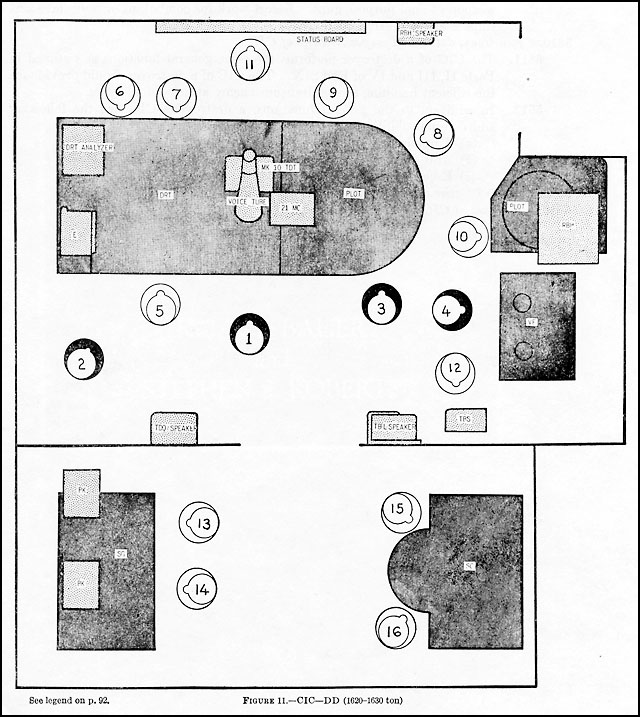
Figure 11.--CIC--DD (1620-1630 ton)(See legend on page 92.)
COMINCH P-013
Figure 12.--CIC--DD (1,850 ton)(See legend on page 92.)
COMINCH P-013
Figure 13.--CIC--DD (2,100 ton)(See legend on page 92.)
COMINCH P-013
Figure 14.--CIC--DD (2,200 ton)(See legend on next page.)
COMINCH P-013
DD (1620-1630, 1850, 2100, 2200 TON CLASS) CIC PERSONNEL LEGEND EQUIPMENT LEGEND 1.
2.
3.
4.
5.
6.
7.
8.
9.
10.
11.
12.
13.
14.
15.
16.Evaluator.
CIC officer.
Fighter director.
Gunnery liaison officer.
Geographic plotter.
Assistant geographic plotter.
Geographic recorder.
Air plotter.
Assistant air plotter.
Surface plotter.
JA talker.
Radio recorder.
SG operator.
Standby SG operator.
SC operator.
Standby SC operator.C.
E.
F.
H.
K.
L.
M.Radio phone unit and speaker amplifier.
Pitometer.
Speaker.
Sound-powered selector switch.
Remote bearing indicator.
Remote range indicator.
Remote range and bearing indicator.
COMINCH P-013
- Communications in CIC.
- Diagram of S/P communications and other intraship communications. (See table 12.)
TABLE 12.--DD: Communication Diagram
JA 1JP 21
JS22
JS41
JS81
JSJU 1JV 1
or
5
JWJX 49
JY
(4)X6J 21
MCVHF
&
HFEvaluator CIC officer Fighter director Gunnery liaison officer Geographic plotter Assistant geographic plotter Geographic recorder Surface plotter Air plotter Assistant air plotter SG operator and standby SC operator and standby Radio recorder JA talker
- Equipment used for intership radio communications. The allowance of radio equipment changes often, and the installation at times varies from the allowance. A specific list of radio equipment would therefore be misleading. The VHF channels available will indicate in a general manner the extent and type of radio equipment provided. Remote radio phone units and speaker amplifiers provide CIC with a flexible means for transmitting and receiving on multitudinous H.F. channels.
DD(445-692)
1 3 for picket DD, 1 for DM-DMS, DE and other DD.
Equipment Frequency Use 2 remote control transmitter-receivers VHF Maneuvering and emergency warning. 1 transmitter and receiver VHF Inter CIC, support aircraft direction. 2 10-channel transmitters receivers1 VHF Aircraft control, force (group) CIC circuit, fighter net. 2 radio telephone units (RPU) transmit and receive VHF, HF Fighter net, CIC circuit, local air warning. 2 radio receivers HF General purpose.
COMINCH P-013
- Operational Organization of CIC.
- Battle bill and condition watches (table 13).
TABLE 13.--DD: CIC Watch Bill
Station Condition I Officers Men Evaluator 1 CIC officer 1 Fighter director 1 Gunnery liaison officer 1 Geographic plotter 1 Assistant geographic plotter 1 Geographic recorder 1 Surface plotter 1 Air plotter 1 Assistant air plotter 1 SG operator and standby 2 SC operator and standby 2 Radio recorder 1 JA talker 1 Condition III Officers Men CIC watch officer 1 Geographic plotter 1 Surface plotter and VF operator 1 Air plotter 1 SG operator 1 SC operator 1 Precision PPI operated by surface plotter or gunnery liaison officer during condition I. A precision PPI operator may be desirable, in addition, during condition I.
- Detailed duties--battle bill.
- The evaluator should:
- Supervise all activities in CIC during General Quarters.
- Furnish timely, properly evaluated, accurate information to the captain, the unit commander embarked and the control officers as necessary.
- Train CIC teams so that specific orders are not necessary.
- Supervise exterior and interior communications used by CIC. Require that immediate reports be made to him of all pertinent information received from all sources, including radio, internal communications systems, lookout, and visual signals.
- Coordinate the plotting and tracking of all air and surface contacts.
- Use fire control radars to check doubtful contacts.
- Make initial reports to command on all contacts and see that necessary contact report is sent out on warning net.
COMINCH P-013
- Make necessary amplifying reports to command and warning net.
- Designate targets as ordered by the commanding officer. Coach main battery and torpedo directors and automatic weapons on to invisible targets.
- Inform the radar operators of all facts that might aid them in radar interpretation, such as presence of all land echoes, masses, squalls, expected friendly contacts, second sweep echoes.
- Use all facilities to insure safe navigation of the ship.
- Have DRT and other equipment checked for accuracy at frequent intervals. Gyro repeaters should be checked every 15 minutes.
- Report enemy countermeasures immediately to command.
- Be thoroughly familiar with the capabilities and limitations of all radar and identification equipment.
- The CIC officer should:
- Be thoroughly familiar with the responsibilities of the evaluator, and in his absence assume those responsibilities.
- Coordinate and supervise the tracking of targets, supervise the upkeep of the surface plot insuring that standard plotting procedures are followed.
- Solve all problems involving the use of the maneuvering board, own and enemy torpedo effective range devices and the CIC equipment.
- Be thoroughly familiar with destroyer tactical, torpedo, gunnery, and associated doctrines, including the force plans.
- When in contact with unidentified surface units, solve torpedo effective range problems and advise the evaluator of his findings.
- Furnish necessary information on invisible targets to the torpedo director for the solution of torpedo control problems.
- Understand and control the use of IFF.
- Perform other duties as directed by the evaluator.
- The fighter director should:
- Know the responsibilities of the force (group, unit) and ship CIC in connection with the control of aircraft as laid down in current tactical publications and the operations plans.
- Control communications with the combat air patrol, and, when necessary, with the force (group, unit) CIC officer and CIC officers of the other units.
- Control the use of the air search radar when actually engaged in the direction of fighter aircraft.
- Relinquish his control of the air search radar to the officer performing gunnery liaison duties when air attack is imminent.
- Keep the evaluator informed of the air situation.
- Have an accurate log of radio transmission kept.
- When not engaged in directing fighter aircraft, supervise maintenance of air or summary plot.
- Be prepared to direct aircraft engaged in antisubmarine patrol, and perform that function when ordered.
- Notify the evaluator at once of the bearing and range of emergency IFF.
COMINCH P-013
- The gunnery liaison officer should:
- Coordinate and supervise the operation of search radars, following standard operational procedures.
- Interpret all radar contacts and be proficient in that function.
- Keep himself and all radar operators informed of expected contacts.
- Coach main battery director on invisible targets designated by the evaluator, using all available facilities such as precision PPI.
- Furnish radar spots to the gunnery control officer as requested.
- Visual fighter director (applies to specially designated fighter director ships) should:
- Take over direction of aircraft by visual means when the situation dictates this necessity.
- Assist the fighter director in CIC by coordinating all visual information and relaying to CIC.
- This officer may be the recognition officer or other officer appropriately trained.
- Geographic plotter, assistant geographic plotter and the geographic recorder should:
- Work as a team, tracking all unidentified or designated targets on the DRT accurately and rapidly.
- Give particular attention to targets designated by the evaluator when plotting several targets simultaneously. A rough plot should be kept of the location of all unidentified units.
- Include in the plot up-to-date minute data on course, speed, number, and composition of targets, in accordance with standard surface plotting procedures.
- The surface recorder should keep a record of time, target range, bearing and identity of all targets being tracked, and give the time "marks" for such tracking.
- Check the DRT and supplementary equipment for proper scale settings, alignment and accuracy.
- Aid in low visibility navigation and shore bombardment.
- The air plotter, assistant air plotter should:
- Work as a team, plotting all air targets rapidly and accurately in accordance with standard air plotting procedure, and in accordance with standard air plotting procedure, determine their altitude, identity, course, speed, and composition. When plotting several targets, particular attention should be given those targets designated by the fighter director or, if attack is imminent, by the evaluator or his assistant.
- Maintain an up-to-date air status board.
- Advise the fighter director and air search radar operator of all targets which fail to track with a normal air speed.
- Dead reckon friendly planes when they are being vectored for interception if no fixes are reported by radar.
- Keep reference points plotted and convert contacts for contact and amplifying reports.
- Check with surface search radar for spotting low flying aircraft.
COMINCH P-013
- The surface (or summary) plotter should:
- By keeping a continuous track of all surface contacts (or all surface and air contacts); keep the cognizant personnel in CIC informed of the identity of any surface radar contact (if summary plotter, any surface or air contact) in question.
- He must aid the gunnery liaison officer in preventing the fire of own ship from endangering friendly ships.
- Maintain a relative plot of own disposition.
- Indicate location and disposition of friendly ships, pickets, and stragglers.
- Maintain maneuvering board plot of own ship's course and speed and be prepared to furnish tactical data.
- Provide ranges and bearings of sound contacts by escorts, in relation to self and to fleet center.
- Plot such data as rain clouds, land, wind speed, and direction.
- Plot reports from radar operators and lookouts.
- Surface search radar operator should:
- Operate the surface search radar in accordance with standard operating procedures.
- Report all new targets as soon as detected, and obtain acknowledgment.
- Report ranges and bearings of targets in accordance with standard procedure.
- Report any abnormal performance of the surface search radar, and obtain acknowledgment.
- Report the suspected use of radar countermeasures.
- Report presence of IFF on all targets.
- Be alert to pick up low flying aircraft and report them to the air search radar operator and geographic plotter.
- Assistant surface search radar operator should:
- Assist the surface search radar operator with his duties.
- Alternate with the surface search radar operator in operating the radar.
- Report ranges and bearings to surface (or summary) plotter if desired.
- Air search radar operator should:
- Operate the air search radar in accordance with procedure set forth in paragraph (i) above.
- Assistant air search radar operator should:
- Assist the air search radar operator with his duties.
- Alternate with the air search radar operator in operating the radar.
- JA talker should:
- Report to the evaluator all transmissions in this circuit.
- Serve as the evaluator's talker.
- Detailed duties--condition watches.
- CIC watch officer should:
- Perform the duties assigned during General Quarters to the evaluator, CIC officer, and gunnery liaison officer.
- Conduct sufficient drills and training exercises when practicable to train condition watch CIC team.
COMINCH P-013
- The geographic plotter should:
- Perform the duties assigned to the geographic plotting team during General Quarters.
- Maintain the surface (or summary) plot.
- Alternate with a search radar operator at frequent intervals (about every 30 minutes).
- The air plotter should:
- Perform the duties of the air plotting team during General Quarters.
- Maintain a record of all voice transmissions.
- Alternate with a search radar operator at frequent intervals.
- The surface search radar operator should:
- Perform the duties assigned to the surface search operators during General Quarters.
- Alternate with one of the plotters at frequent intervals.
COMINCH P-013
- The CIC in a Destroyer Escort, Patrol Frigate or Coast Guard Cutter (DE, PF, CGC).
- These ships are designed as escorts and antisubmarine ships. They have highly developed antisubmarine equipment, but little surface or air armament. These types of ships are particularly important for the protection of merchant ships without radar.
- Functions, duties and responsibilities of CIC.
- The normal functions and responsibilities of a combatant ship's CIC as indicated in parts II, III, and IV apply to these ships including fighter direction, surface tracking and efficient radar search for both air and surface targets.
- See section on CIC and antisubmarine warfare in part IV. These ships, as antisubmarine ships, should have a CIC that is prepared to handle information from the sonar equipment in an efficient manner. CIC should be cognizant of latest doctrines in antisubmarine warfare, particularly concerning:
- Regaining contact procedures.
- Use of retiring search plans.
- Current doctrine in coordinated attacks, including creeping attacks.
- Control of planes for aerial antisubmarine operations.
- Launching, monitoring, and recovering effective sonobuoy patterns.
Torpedo control by radar on destroyer escorts may be the function of CIC at night or during low visibility. With no torpedo director, CIC should be prepared to control torpedo fire by giving orders directly to tubes.
- Administrative organization of CIC. (Pending decision)
- Diagram of CIC. (See fig. 15.)
- Communications in CIC.
- Diagram of S/P communications and other intraship communications. (See table 14).
TABLE 14.--DE: Communication Diagram
JA 1
JP51
JS21
JS22
JS81
JSJU 1
JVJX 21
MCVHF
&
HFEvaluator CIC officer Geographic plotter Geographic recorder Surface plotter Air plotter Assistant air plotter Surface search radar operator Air search radar operator Assistant air search radar operator Radio recorder JA talker/status board keeper
COMINCH P-013
Figure 14(See legend on facing page.)
COMINCH P-013
1 Small polar plot located where convenient.
CIC DE (3") PERSONNEL LEGEND EQUIPMENT LEGEND 1.
2.
3.
4.
5.
6.
7.
8.
9.
10.
11.
12.
13.Evaluator.
CIC officer.
Geographic plotter.
Assistant geographic plotter.
Geographic recorder.
Air plotter.
Assistant air plotter (optional).
Surface plotter.1
Status board keeper.
Surface search radar operator.
Air search radar operator.
Radio recorder.
JA talker (if necessary).A.
B.
F.
E.
H.
I.Radiophone unit.
Speaker amplifier.
Speaker.
Pitometer.
Sound-powered selector switch.
Sound-powered hand set.
COMINCH P-013
- Equipment used for intership radio communications. The allowance of radio equipment changes often, and the installation at times varies from the allowance. A specific list of radio equipment would therefore be misleading. The VHF channels available will indicate in a general manner the extent and type of radio equipment provided. Remote radio phone units and speaker amplifiers provide CIC with a flexible means for transmitting and receiving on multitudinous H.F. channels.
Radio Frequency Examples of use 1 Remote control transmitter-receiver unit. VHF Primary warning and maneuvering. 2 10-channel transmitter-receiver sets VHF Aircraft control, Inter CIC circuit. 2 radio telephone units (RPU) transmit and receive VHF, HF Spotting circuit, inter-CIC circuit, local air warning. 2 receivers HF General purpose. - Operational organization of CIC.
- Battle bill and condition watches. (See table 15.)
TABLE 15.--DE: CIC Watch Bill
Station Condition I Officers Men Evaluator 1 CIC officer 1 Gunnery liaison officer 1 Geographic plotter 1 Geographic recorder 1 Surface plotter 1 Air plotter 1 Assistant air plotter 1 Surface search radar operator 1 Air search radar operator 1 Assistant air search radar operator 1 Radio recorder 1 JA talker/status board keeper 1 Condition II and III Officers Men CIC watch officer 1 Geographic plotter 1 Air plotter 1 Air search radar operator 1 Surface search radar operator 1
COMINCH P-013
- Detailed duties.
- Evaluator (executive officer) should:
- Exercise general supervision over the collection of all combat and tactical information by CIC.
- Evaluate this information.
- Disseminate the evaluated information.
- Recommend courses of action to the commanding officer.
- Assist in the execution of chosen courses of action.
- Execute any specific control functions which command may delegate to CIC, such as target designation, torpedo firing control, and the monitoring of voice circuits.
- Maintain an hourly plot of ship's position on the strategic chart.
- CIC Officer (division officer) should:
- Execute direct supervision over the collection of all information by CIC and its presentation to the evaluator.
- Assist in evaluation.
- Prepare contact and all amplifying contacts.
- Use CIC aids, such as the maneuvering board and MK 7 angle solver in the solution of tactical problems.
- Be prepared to serve as evaluator.
- Be prepared to serve as fighter direction officer should an emergency warrant detailing limited fighter direction to the ship.
- Geographic plotter, assistant geographic plotter, surface recorder, should:
- Track unidentified and designated targets on the DRT.
- Note on the plot all amplifying data, such as identification, course, speed, number of targets, in group, wind direction, firing of and track of torpedoes, and opening of gunfire.
- Maintain an orderly record of time, range, and bearing of all plots.
Be able to track 2 targets simultaneously, plotting each once a minute.
- Be able to track 2 targets simultaneously, plotting each 1 a minute, while at the same time maintaining an approximate multiple plot on at least 10 other targets.
Procedure:
- Destroyer escort and frigate IFF should be considered non-directional. Apparent IFF bearings should not be used in checking identification of targets. With two targets at the same range, analysis should be made by the CIC officer before noting, friendly indication for either target. The plotters should not make this deduction themselves.
- In tracking targets at long range where the radar pip may fade, the radar operator should give the time mark. Where radar conditions permit, the recorder should give the time mark, preferably at regular intervals.
- To avoid confusion in sonar target tracking, only the time mark, center bearing, and range should be furnished the plotting team. Such information should be furnished by the sonar-hut over sound-powered phones. Other sonar
COMINCH P-013
information required by the evaluator should be collected over other phone circuits. Use of the 21 MC should be avoided.
- Whenever possible standard scale settings of 2,000 yards per inch should be used on the DRT for plotting surface targets, and 200 or 500 yards per inch for sonar targets.
- Air plotter and assistant air plotter should:
- Maintain an air plot of all air radar contacts for identification and defensive gunnery purposes. This primary function should not be sacrificed for the tracking of specific targets.
- Track only those air targets designated by the evaluator.
- Dead reckon friendly planes.
- Note all possible amplifying data on unidentified and enemy targets, such as course, speed, altitude, size, and number.
- Be able to maintain a plot on at least 10 different air targets.
- Keep air information on data board.
Procedure:
- Apparent IFF bearings should not be used in checking identification of air targets. With two targets at the same range, the air plotters should make a careful analysis before noting which is showing IFF.
- Surface plotter should:
- Maintain a plot of the relative location and identity of all surface targets within radar or visual range. When disposition or size of force makes this impossible with all targets, emphasis should be centered on the following:
- New or enemy targets.
- The guide.
- Adjacent ships.
- Major radar land marks.
- Screening ships.
- Column leaders.
- Stragglers.
- Major ships in company.
- Other friendly units.
- Be able to identify each pip on the surface search radar scope at all times.
- Maintain the relative movement line of each target, paying particular attention to adjacent ships.
- Keep posted on the data board the disposition, formation, course, speed, and axis, patrol speed, and details of zigzag plans.
Procedure:
- Man JA circuit to receive lookout reports.
- Obtain radar information by reading surface search radar scope directly, without interfering with the operation.
- Label identified targets with the TBS calls, or with raid designations as directed by the CIC officer.
- Surface search radar operator should:
- Search for new targets, using normal operating procedure.
- Maintain this search effectively at all times, even when providing data on targets.
COMINCH P-013
- Reports new targets immediately to evaluator and obtains his acknowledgment.
- Check unidentified targets for IFF, first requesting permission from the evaluator, and report results to surface plot.
- Furnish ranges and bearings to surface plot as requested.
- Furnish ranges and bearings of guide to the OOD or evaluator upon request to assist in station keeping.
- Make immediate and forceful reports to the evaluator of any target closing the ship within one thousand yards and obtain his acknowledgment.
- Check the alignment of azimuth on scope each half hour against ship's head by magnetic compass if using SL radar.
- Report any casualty or erratic performance of the radar to the evaluator.
- Air search radar and assistant operator should:
- Search for air targets, using normal operating procedure.
- Maintain this search effectively at all times, even when providing data on targets.
- Report new targets to evaluator immediately and obtain his acknowledgment. Indicate as soon as possible the size of contact, altitude, and number of aircraft in group.
- Check unidentified targets for IFF< first requesting permission from the evvaluator, and report results to air plot.
- Furnish ranges and bearings to air plot to assist in tracking.
- Report any casualty or erratic performance of the radar to the evaluator.
- Report any indications of radar countermeasures to the evaluator.
- Radio recorder should:
- Maintain a log of all exterior voice traffic heard in CIC, both incoming and outgoing.
- Keep the volume of all speakers at the minimum required for proper reception.
- Make sure the evaluator has heard all important messages.
- Report any circuit failure to the evaluator.
- Inform the CIC officer when unable to keep up with traffic volume.
- Assist in decoding and encoding voice messages as traffic permits.
- JA talker should:
- Serve as the evaluator's talker, unless the evaluator himself wears the phones, in which case the talker is not necessary.
- Report to the evaluator all transmission on this circuit.
- Report routine information to the bridge when directed by the evaluator.
- The following stations should be manned in CIC during war cruising conditions:
- CIC watch officer: Assists plotting on surface plot where necessary.
- Geographic plotter: Plots on geographic plot. Rotates with surface search radar operator.
- Air plotter: Also handles radio recording.
- Surface search radar operator.
COMINCH P-013
- Air search radar operator: Alternates with surface search radar operator if air search radar is not being used.
During war cruising condition, the CIC watch officer assumes the combined duties of evaluator and CIC officer. The CIC watch officer must be properly relieved before leaving his station in CIC. He is responsible for (a) the proper functioning of CIC and (b) furnishing the OOD with all possible information and assistance.
Table of Contents * Previous Section (Procedures and Operations) * Next Section (Appendix)