Battle Experience: Battle of Leyte Gulf
This account is based on many and extensive sources. Necessarily there are conflicts in accounts as to the details of time and nature of events. All times indicated are zone minus nine. Every effort has been made to present the essential features of the Second battle of the PHILIPPINES Sea accurately with the information at hand. Preface
Allied invasion of the PHILIPPINES forced the hand of the Japanese High Command. It was evidently decided to make an all-out effort to drive U.S. forces from the PHILIPPINES, even at the risk of a major action. The enemy's audacity was probably bolstered by exaggerated damage claims of Japanese aviators who managed to reach home from strikes on U.S. FORCES engaged in aerial attacks on OKINAWA, FORMOSA and LUZON (10-19 October 1944). The Japanese aviators reported an amazing victory, and Tokyo was quick to claim -- for the fifth or sixth time -- that the naval strength of the United States had been rendered puny. The Japanese may have been sincere in their belief, as it is often difficult if not impossible accurately to estimate damage to distant ships. For example, during the action off FORMOSA, a false impression was made on one of our Task Group Commanders who had seen a Japanese plane fall and make an apparent cloud cover of smoke on one of his distant ships, which caused him to inquire concerning the extent of the ship's damage and possible speed. The reply came back that this was a near miss, the ship had no damage, and could make full power.
These neutralization air attacks by Task Force 38 on Japanese airfields, and strikes against aircraft, surface craft and military installations commenced at dawn on 10 October 1944 on OKINAWA. This Task Force caught the Japanese completely off guard. No serious opposition was encountered and at dawn on 12 October the attack on FORMOSA was commenced. (See Photographic Section I). On October 12 and 13, successful strikes were carried out. Day and night fighters and own ships' anti-aircraft fire succeeded in preventing serious damage to our surface forces until the evening of October 13. The enemy's offensive effort attained respectable proportions on this evening in the form of air attacks on the task groups. Task Group 38.2, being on the northern flank, absorbed most of the effort and the USS Canberra was torpedoed, resulting in the flooding of both engine rooms. During the following evening, Houston was damaged by a similar attack. On 16 October, while under tow, the Houston received a second aircraft torpedo hit, but both ships reached ULITHI.
A series of naval engagements and, in terms of victory, ones which may turn out to be among the decisive battles of modern times, were won by our forces against a three-pronged attack by the Japanese in an attempt to land reinforcements on LEYTE Island and wipe out our covering forces. The various factors and steps in our success were brought about. Behind each there was a reason. It is particularly gratifying to see in these actions how each arm of our naval force -- the submarine, aircraft carrier, battleship, cruiser, destroyer, destroyer escort on down to the PT boats -- was coordinated and contributed magnificently in the defeat of the enemy. In these engagements our surface ships slugged it out with the enemy and our carrier-borne aircraft both intercepted and pursued enemy ships with conspicuous success. Our submarines detected, reported, and effectively attacked approaching and retreating enemy warships.
When Allied troops went ashore at LEYTE ("A" Day, 20 October 1944), reports now indicate that most Japanese heavy surface units were in the Southwest area, and that the carrier fleet was in the Empire. The enemy apparently had decided to join these forces in the Central PHILIPPINES at the earliest practicable moment. Maximum use was to be made of shore-based air.
the over-all picture is now fairly clear from sightings, photographs and information at hand. the entire group of Japanese heavy surface units arrived BRUNEI Bay (NW BORNEO) 21 October 1944 and fueled. Upon departing BRUNEI Bay, this combined force separated into two forces; namely, one force heading northeast detected west of PALAWAN Island, hereinafter called the Central Force, and the other force heading east detected in the SULU Sea, hereinafter called the Southern Force. The Central Force was composed of 5 BBs, 10 CA, 2 CLs
and 11-12 DDs. This is the Force, minus casualties, which transited SAN BERNARDINO Strait on the night of 24-25 October and attacked our CVEs east of SAMAR.The Southern Force was composed of 2 BBs, 2 CAs, 7 DDs and 2 possible CLs. This is the force which was engaged by Seventh Fleet units, covering force, in SURIGAO Strait in the very early morning of the 25th.
Evidently at approximately the same time as the Central and Southern Forces departed from BRUNEI Bay, a Northern Force (Carrier Force) sortied southward from the Empire. This force, in two groups, probably consisted of 1 CV, 3 CVLs, 2 XCV-BBs, 5 CAs-CLs, and 10 DDs. This is the force which was spotted for the first time on the evening of the 24th by planes of the Third Fleet, Supporting Force. The Central and Southern Forces had been under heavy aerial attacks by planes of TASK FORCE 38 and indications were that both Forces were heavily damaged, but this new Northern Force contact by two different reports constituted a fresh threat of undetermined strength. The Northern Force was engaged by planes, cruisers and destroyers of the Third fleet on the morning of the 25th.
Two track charts follow: (1) "Japanese Fleet Approaches, 22-24 October 1944", indicates that the ensuing engagements were to be timely, closely-coordinated attacks (page 4); (2) "Three-Pronged Battle of Philippines Sea, 25-26 October 1944:, shows general locations of the Battles of SURIGAO Strait, East of SAMAR (with retiring enemy units under air attack), and East of LUZON (page 5).
Composition of Forces
A. (Battle of Surigao Strait)
OWN FORCES T.G. 77.2 (R. Ad. Oldendorf, OTC, in Louisville Battle Line (R. Ad. Weyler in Mississippi) (a) T.U. 77.2.1 (R. Ad. Weyler) Mississippi (F) (OBB) Maryland (OBB) (b) T.U. 77.2.2 Tennessee (OBB) California (OBB) Pennsylvania (OBB) DesDiv Xray (6 DDs) Left Flank Force (R. Ad. Oldendorf) Louisville (F) (CA) Portland (CA) Minneapolis (CA) Denver (CL) Columbia (CL) DesRon 56 (9 DDs) Right Flank Force (R. Ad. BERKEY) Phoenix (F) (CL) Boise (CL) HMAS Shropshire (CA) DesDiv 47 plus
HMAS Arunta(6 DDs)
ENEMY FORCES
(Probable)Southern Force (V. Ad. Shapi Nishimura) First Group: BatDiv 2 Fuso (BB) Yamashiro (BB) Mogami (CA-XCV) DesDiv 4 Michishio ? (DD) Yamagumo ? (DD) Asagumo ? (DD) Shigure ? (DD) 4 miles astern of above: Second Group: Ashigara ? (CA) Kiso ? (CL) Kinu or Isuzu ? (CL) Unidentified (3-6 DDs)
Japanese Fleet Approaches--October 22-24, 1944
Three-Prong Battle of Philippines Sea
October 25-26, 1944
Composition of Forces (Cont'd)
B. (Battle East of Samar)
OWN FORCES T.G. 77.4 (R. Ad. T.L. Sprague) Northernmost Station CarGrp (R. Ad. C.A.F. Sprague) T.U. 77.4.3 T.U. 77.4.31 (R. Ad. C.A.F. Sprague) Fanshaw Bay (F) (CVE) St. Lo (CVE) Kalinin Bay (CVE) White Plains (CVE) T.U. 77.4.32 (R. Ad. Ofstie) Kitkun Bay (F) (CVE) Gambier Bay (CVE) T.U. 77.4.33 (Screen) 3 DDs 4 DEs Central Station CarGrp (R. Ad. T.L. Sprague) T.U. 77.4.1 T.U. 77.4.11 (R. Ad. T.L. Sprague) Sangamon (F) (CVE) Suwannee (CVE) Chenango (CVE) Santee (CVE) T.U. 77.4.12 (R. Ad. G.R. Henderson) Saginaw Bay (F) (CVE) Petrof Bay (CVE) T.U. 77.4.13 (Screen) 3 DDs 5 DEs Southernmost Station CarGrp (R. Ad. Stump) T.U. 77.4.2 T.U. 77.4.21 (R. Ad. Stump) Natoma Bay (F) (CVE) Manila Bay (CVE) T.U. 77.4.22 (R. Ad. Sample) Marcus Island (F) (CVE) Kadashan Bay (CVE) Savo Island (CVE) Ommaney Bay (CVE) T.U. 77.4.23 (Screen) 3 DDs 5 DEs
ENEMY FORCES
(Probable)Central Force (CinC Second Fleet)
(Succeeded in passing SAN BERNARDINO STRAIT)BatDiv 1 Yamato (BB) Nagato (BB) BatDiv 3 Haruna (BB) Kongo (BB) CruDiv 5 Myoko (CA) Haguro (CA) CruDiv 7 Suzuya (CA) Chikuma (CA) Tone (CA) Noshiro or Yahagi (CL) DesRons 2 and 10 Unidentified (11 DDs) Planes of TG 38.1 arrived over the retreating enemy at about 1330I/25 and delivered their first attack about 1400I/25.
Composition of Forces (Cont'd)
C. (Battle East of Luzon)
OWN FORCES ComTHIRD Fleet -- Ad. W.F. Halsey, Jr. T.F. 38 (V. Ad. M.A. Mitscher in Lexington T.G. 38.2 -- R. Ad. Bogan Intrepid (F) (CV) Cabot (CVL) Independence (CVL) Iowa (BB) New Jersey (FFF) (BB) Biloxi (CL) Vincennes (CL) Miami (CL) 16 DDs 25 Oct: Iowa, New Jersey, Biloxi, Vincennes, Miami, DesRon 52 (less 1) detached at 0240 I. 25 Oct: Iowa, New Jersey, Washington, Alabama, Massachusetts, South Dakota, Biloxi, Miami, Vincennes, DesRon 52 (less 1) joined 1055 I. 25 Oct: Iowa, New Jersey, Biloxi, Miami, Vincennes, DesRon 52 (less 1) detached 1600 I. TG 38.3 -- R. Ad. Sherman Essex (F) (CV) Lexington (FF) (CV) Langley (CVL) Massachusetts (BB) South Dakota (BB) Santa Fe (CL) Mobile (CL) Reno (CL) 10 DDs 25 Oct: Massachusetts, South Dakota, Santa Fe, Mobile, 4 DDs detached 0240 I.
Santa Fe, Mobile, 8 DDs joined 1055 I.T.G. 38.4 -- R. Ad. Davison Franklin (F) (CV) Enterprise (CV) San Jacinto (CVL) Belleau Wood (CVL) Washington (BB) Alabama (BB) New Orleans (CA) Wichita (CA) 25 Oct: Washington, Alabama, Wichita, New Orleans, 6 DDs detached 0240 I.
Wichita, New Orleans, 2 DDs joined 1055 I.TF. 34 -- V. Ad. Lee 25 Oct: Formed at 0240 I. Washington (BB) Iowa (BB) New Jersey (BB) Massachusetts (BB) South Dakota (BB) Alabama (BB) Wichita (CA) New Orleans (CA) Santa Fe (CL) Mobile (CL) Biloxi (CL) Vincennes (CL) Miami (CL) 18 DDs 25 Oct: Dissolved at 1055 I. T.G. 34.5 -- R. Ad. Badger Iowa (BB) New Jersey (BB) Biloxi (CL) Vincennes (CL) Miami (CL) 8 DDs (Dissolved at 0700 I, 27 Oct.)
ENEMY FORCES
(Probable)Northern Force Zuikaku (CV) Cardiv 3 Chitose (CVL) Chiyoda (CVL) Zuiho (CVL) CarDiv 4 Ise (XCV-BB) Hyuga (XCV-BB) Nachi ? (CA) Tama (CL) Kiso (CL) Abukuma (CL) Oyodo ? (CL) 6-10 DDs
Results of Battle
OWN FORCES ENEMY FORCES Surigao Strait Sunk Damaged Sunk Damaged None 1 DD - A.W. Grant 2 BBs -
1 CA -
5 DDs -
Fuso
YamashiroMogami (XCVS)
Michishio
Shigure
(or Nowake)
Yamagumo
Asagumo
(Unidentified)1 CA - 1 CL -
2 DDs -
Ashigara Kinu (or Isuzu)
(Unidentified)
East of Samar Sunk Damaged Sunk Damaged 2 CVEs -
2 DDs -
1 DE -
Gambier Bay
St. LoHoel
JohnstonRoberts
6 CVEs -
1 DD -
1 DE -
Kalinin Bay
Fanshaw Bay
White Plains
Sangamon
Suwannee SanteeHeermann
Dennis
3 CAs -
3 CAs
(by SS)
1 CL -
1 DD -
Suzuya
Chikuma
KumanoAtago
Maya 10/23
Haguro 10/24
(or Myoko)Noshiro 10/26
(or Yahagi)Unidentified
4 BBs -
4 CAs -
1 CL -
6 DDs -
Yamato
Musashi (sunk?)
Kongo
NagatoTakao
Chokai
Tone
AobaUnidentified
Unidentified
East of Luzon Sunk Damaged Sunk Damaged None 1 CV - 1 CVL -
Franklin Belleau Wood
1 CV - 3 CVLs -
1 CL -
2 DDs -
Zuikaku Chitose
Chiyoda
ZuihoNagara (by SS)
Unidentified
2 BBs -
1 CA -
3 CLs -
3 DDs -
Ise
(or Hyuga (XCV)
Unidentified (XCV)Unidentified
Oyodo Unidentified (sunk?)
Unidentified (sunk?)Unidentified
* Ships of the class are known to have been sunk, but the identification of the units is subject to question. Box Score
Japanese ships from all forces estimated sunk in the PHILIPPINES action 23-27 October 1944.
Ship Action BB Fuso Sunk 10/25 in SURIGAO STS. BB Yamashiro Sunk 10/25 in SURIGAO STS. CV Zuikaku Sunk 10/25 east of LUZON CVL Chitose Sunk 10/25 east of LUZON CVL Chiyoda Sunk 10/25 east of LUZON CVL Zuiho Sunk 10/25 east of LUZON CA Atago Sunk 10/23 by Sub CA Maya Sunk 10/23 by Sub CA Haguro Sunk 10/24 in SIBUYAN SEA CA Mogami Sunk 10/25 in SURIGAO STS. CA Suzuya Sunk 10/25 east of SAMAR CA Chikuma Sunk 10/25 east of SAMAR *CL Noshiro Sunk 10/26 in SIBUYAN SEA *CL Nagara Sunk 10/25 by Sub DD Michishio Sunk 10/25 in SURIGAO STS. DD Shigure or Nowake Sunk 10/25 in SURIGAO STS. DD Yamagumo Sunk 10/25 in SURIGAO STS. DD Asagumo Sunk 10/25 in SURIGAO STS. Time Table
23-27 October 1944
23 October
(Between 0630-0730)
- Enemy Central Force attacked by submarines off PALAWAN.
(CAs Atago,: Maya sunk; Takao turned back.)
24 October
- Enemy Central Force, minus 3 CAs, entered SIBUYAN Sea, attacked by 3rd Fleet carrier-based aircraft.
(Musashi (BB) damaged; Haguro (CA) sunk.)- Heavy Enemy land-based air attack on 3rd Fleet.
(USS Princeton (CVL) sunk.)
25 October
(Morning)
- At 0500 Enemy Southern Force met by 7th Fleet in SURIGAO STRAIT.
(Eight enemy ships sunk.)- At 0700 Enemy Central Force met by Light Forces of 7th Fleet, East of SAMAR ISLAND.
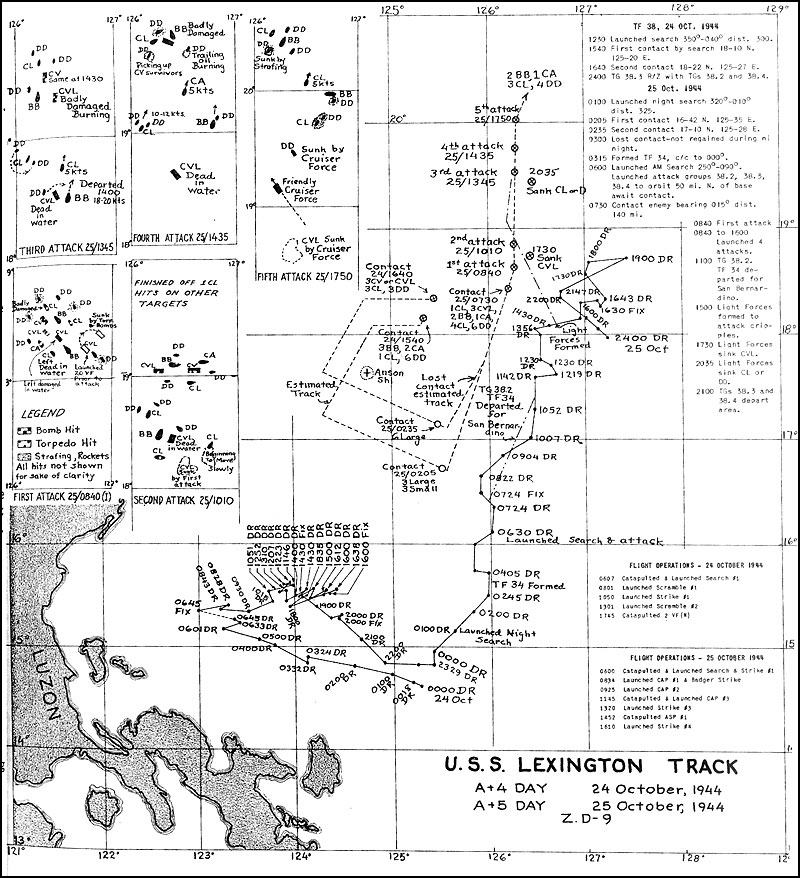
(Two Enemy CAs sunk plus other damage. Our losses: 2 CVEs -- Gambier Bay and Saint Lo; 2 DDs -- Hoel, Johnston; 1 DE -- Roberts)- Enemy Carrier Force (Northern Force) met by units of 3rd Fleet East of Luzon.
(All enemy carriers (4) destroyed.)
25 October
(Afternoon and Evening)
- At 1300 Enemy Central Force under attack by 3rd Fleet aircraft East of SAMAR.
(2 Enemy CAs sunk.)Late that night 3rd Fleet surface force sank crippled CL or DD in SAN BERNARDINO STRAIT.
- Late on 25th one of our subs sank a Natori Class Cruiser (possibly the Nagaro) of the Enemy Carrier Force (Northern Force) retiring towards empire.
26 and 27 October
- Retiring Enemy (Central Force) under air attack by 3rd Fleet aircraft, after passing through SAN BERNARDINO STRAIT and scattering. (Believed Noshiro (CL) and probably one CA destroyed.)
Commander Task Force 77 (Covering Force) Reports: Preliminary Events
1. Some discussion of conditions preliminary to the joining in action of major naval forces is deemed necessary in order that the action may be viewed in proper perspective. During the month of September, carrier-based aircraft of the Third Fleet had made extensive raids on main enemy airbases throughout the PHILIPPINE ISLANDS, with the attacks concentrated on the group of airfields in the vicinity of MANILA, SAN FERNANDO, and LAOAG. These raids by the Third Fleet, under the command of Admiral HALSEY, were most effective in destroying large numbers of enemy aircraft. Starting about 10 October, and continuing through about 20 October, Third Fleet carrier forces delivered destructive and extensive raids on enemy airbases and shipping in the NORTHERN LUZON, FORMOSA, and LOOCHOO ISLAND [Ryukyu Islands] area. These Third Fleet raids, in addition to destroying large amounts of shipping, were effective in destroying large numbers of enemy aircraft and in drawing effective enemy aircraft strength away from the PHILIPPINE area and toward the FORMOSA area.
2. In the meantime, the Third and Seventh Amphibious Forces, covered by surface forces and carrier-based aircraft of the Seventh Fleet, moved north from NEW GUINEA bases to effect a landing on the island of LEYTE. The landing operations were initiated on 17 October when the outpost islands of SULUAN and HOMONHON were seized by a light amphibious group under the command of Rear Admiral STRUBLE, supported by a part of the CVEs and by battleships, cruisers, and destroyers of Task Group 77.2. Minesweeping was commenced immediately to clear the mine barrier thought to exist between DINAGAT ISLAND and HOMONHON ISLAND. The following day a landing was effected on DINAGAT ISLAND and the eastern entrance to LEYTE GULF was effectively secured. Minesweeping was continued and beach reconnaissance completed by underwater demolition teams by 19 October.
3. Early in the morning of 20 October, the amphibious forces moved through the swept channel between HOMONHON and DINAGAT ISLANDS and landed U.S. Army troops of the Tenth and twenty-fourth Corps in two beach areas -- one near TACLOBAN and one near DULAG -- under cover of heavy fire from our surface ships and air bombardment by aircraft from the CVEs of Task Group 77.4. The landings were made exactly on schedule at 1000 Item, 20 October, and progress ashore was satisfactory. Army troops ashore continued to advance for the next three days under strong air and surface ship support, making satisfactory progress against Japanese positions. By 20 October, the third Fleet, under Admiral HALSEY, had moved into supporting positions and his carrier Task Groups continued to bomb and strafe enemy bases in CENTRAL and SOUTHERN LUZON and the VISAYAS. There was no immediate enemy reaction, other than relatively light air attack, to our landing on the island of LEYTE. The enemy air attack, however, gradually increased in intensity despite continued bombardment of his air bases by our air forces.
4. In order that early warning might be had of the approach of any hostile naval forces, submarines had been stationed to guard BRUNEI BAY, BALABAC STRAIT, MINDORO STRAIT, VERDE ISLAND PASSAGE, and to the westward of LUZON off MANILA and northward thereof. Air search from MOROTAI ISLAND, extending from BALABAC STRAIT to VERDE ISLAND PASSAGE, were extended to a radius of 1000 miles, while carrier Task Forces of the Third Fleet and air searches by Central Pacific forces from PALAU and SAIPAN were depended upon to give early information of the approach of enemy forces east of the PHILIPPINES.
5. At 0200, I/23, a submarine reported a radar contact on three battleships southwestward of PALAWAN ISLAND on position latitude 08-20N, longitude 116-20E, course 040 degrees, speed 15 knots. At 0300, I/23, a submarine reported a force of 11 combat ships in position latitude 08-47N, longitude 116-37E on course 039, at speed of 15 knots. At 0340, I/23, the submarine Bream reported a force of at least two heavy cruisers and several destroyers in position latitude 14-05N, longitude 119-43E, speed 10 knots and on a course directed for the VERDE ISLAND PASSAGE, and reported one hit on an Aoba class heavy cruiser. At 0630, I/23, the submarine Darter in position latitude 09-24N, longitude 117-11E, reported 3 battleships, 4 CAs, and three other vessels, and also reported obtaining four torpedo hits in one Atago CA and damaging another Atago class CA. At 0700, I/23, the submarine Dace, in position latitude 9-29N, longitude 117-20E, reported a total of 11 ships, including 3 BB, 2 CA, one CV and many unidentified CA, CL, DD, and reported getting four hits in a Kongo class BB. It was later determined that the attack of these two submarines resulted in the sinking of the heavy cruisers Atago and Maya, and the damaging of the heavy cruiser Takao. The U.S.S. Darter, in the heat of pursuit, subsequently grounded on BOMBAY shoal and had to be abandoned.
6. From the foregoing reports it was realized that large Japanese naval forces were on the move and it was estimated that the Northern Force could arrive at CORON BAY about 2000, I/23, and the large force moving northeast through the PALAWAN PASSAGE could arrive at CORON BAY about 0100, I/24. It was believed that the Japanese might refuel in the vicinity of CORON BAY, and it was now felt fairly certain that they would attempt an attack on our naval forces off LEYTE, probably through SOUTHERN SURIGAO STRAIT. At 2130, I/23, the submarine Angler in position latitude 13-00N, longitude 119-30E, reported 15 to 20 ships, including three probable battleships, on an easterly course at a speed of 18 knots.7. Presumably based on these excellent submarine reports, Commander third Fleet directed three reinforced air searches to be made by his fast carrier groups on the early morning of the 24th; one to cover the MANILA, VERDE ISLAND PASSAGE, and SIBUYAN SEA areas; one to cover SOUTHERN VISAYAS and CENTRAL SULU SEA area. these searches were successful in locating large enemy forces, and at 0840, I/24, an enemy force reported to consist of 4 BB, 8 CA, and 13 DD was reported just south of MINDORO ISLAND, moving northeastward into the TABLAS STRAIT. At 0904, I/24, aircraft reported a force consisting of 2 BB, 1 CA, and 4 DD in position latitude 08-55N, longitude 121-50E, course northeast, speed 15 knots, and claimed four bomb hits on each of the battleships and rocket hits on the DDs. These two enemy forces will henceforth be referred to as the Central Force and the Southern Force.
8. The Southern Force was again reported by aircraft and attacked at 1000, I/24, in approximately the same position and on the same course as before (See Photographic Section II.) At 1155, I/24, a MOROTAI search plane in position latitude 09-30N, longitude 120-30E, reported 3 CA, 4 DD on course southeast, at speed 10 knots. The morning attacks on the enemy Southern Force had been delivered by the reinforced search group of aircraft of Task Group 38.4, which shortly after 1000, I/24, stated it was moving north to effect concentration with the remainder of Task Force 38, northeast of SAN BERNARDINO STRAIT, and would be out of range of the Southern Force.
9. As reported by Third Fleet aircraft, the enemy's Central Force continued to move northeastward through TABLAS STRAIT and at 1200, I/24, a total of 25-27 combatant ships of this force were reported north to TABLAS ISLAND moving on a general easterly course. Aircraft from Task Force 38 struck at this enemy force between 1430 and 1500I in a position in the SIBUYAN SEA about 30 miles north of SIBUYAN ISLAND. (See Photographic Section III.) The force was reported to consist of a total of 4 BB, 8 to 9 CA, 2 CL, and 12 or 13 DD. Aircraft reports indicated that the enemy force had been severely damaged and was badly disorganized. Nevertheless, aircraft at 1925, I/24, reported substantially this same force moving on a course of 120 degrees towards the northern tip of MASBATE ISLAND and again at 2030, I/24, aircraft reported the same enemy force just north of MASBATE ISLAND on an easterly course, evidently bound for SAN BERNARDINO STRAIT.
10. Commencing with first light and throughout the day of the 24th, enemy aircraft attacked our naval forces off LEYTE at steadily increasing intensity. By morning of the 24th, it was evident that we were faced with two large Japanese naval forces. One, the Central Force, moving eastward towards SAN BERNARDINO STRAIT, and the other, the Southern Force, moving northeastward towards the MINDANAO SEA, while a third force, henceforth referred to as the Northern Force, consisting of 2 CV, 1 CVL, 1 BB-XCVS, 3 BB-CA, 5 CA-CL, and 6 DD, was reported by aircraft at 1640, I/24, in position 18-10N, 125-30E, course southwest, speed 15 knots.
11. By early afternoon of the 24th, it was felt definitely that the enemy intended to attack our naval forces covering the landing at LEYTE ISLAND, and disposition were made accordingly. Thirty PT boats in ten groups of three each were stationed as reconnaissance and attack groups as follows: three groups between SOUTHEAST BOHOL and CAMIGUIN ISLAND, and SIPACA POINT on MINDANAO. The remainder covered the southern entrance to SURIGAO STRAIT and JINATUAN PASSAGE, and the passage between MINDANAO and SOUTHERN DINAGAT ISLAND, with orders to remain south of latitude 10-10N and to report and attack enemy forces sighted. Task Group 77.2, under Rear Admiral OLDENDORF, consisting of 6 OBB, 4 CA, 4 CL, and 24 DD, took up initial station in latitude 10-34N, longitude 125-19E, in a position to guard both the southern and eastern entrances of LEYTE GULF, with orders to attack and destroy any enemy forces attempting to enter the gulf. The carriers of Task Group 77.4 with their escorts were disposed about fifty miles to the eastward of HOMONHON ISLAND in three Task Units within mutually supporting distance and from north to south as follows: 77.4.3; 77.4.1; 77.4.2.
12. In addition to these forces, destroyer pickets were stationed in the southern and eastern entrances to SURIGAO STRAITS to give early warning of enemy approaches. A late afternoon air search to the westward in the MINDANAO SEA to a
distance of about 100 miles from the southern entrance of SURIGAO STRAIT failed to disclose the presence of enemy forces. Searches by night Catalina over the MINDANAO SEA were not productive of reports of enemy sightings. Commander Task Group 73.7 (the Black Cats) was also ordered to conduct a night search to the northward of LEYTE GULF and eastward of SAMAR. Commander Task Group 77.4 was directed to run a search at daybreak for enemy surface ships to the northward covering sector 340 degrees to 030 degrees for distance of 135 miles, point of origin SULUAN ISLAND.
Commander THIRD Fleet (Supporting Force) reports in part:
1. On 23 October 1944, from the multiplicity of sighting reports it was evident that the landings on LEYTE had provoked a violent reaction, and that the enemy was preparing to make a major stand of some sort in the PHILIPPINES. The enemy intent was not clear, but his reported naval movements on the 23rd definitely constituted an immediate threat. Commander Third Fleet decided to initiate carrier searches to obtain earliest information of any enemy movement toward LEYTE.
2. After nearly two weeks of intensive operations against OKINAWA, FORMOSA and LUZON, all of the carrier groups needed re-arming except for torpedoes and for the AP and SAP bombs habitually reserved for use against combatant ships. One group, Task Group 38.1, had been started toward ULITHI on 23 October; task groups 38.2, 38.3 and 38.4 were immediately available.
3. On the night of 23-24 October, Task Groups 38.2, 38.3 and 38.4 were moved in close to the PHILIPPINE coast preliminary to launching searches. Task Group 38.3 was placed east of POLILLLO ISLAND to cover the west coast of LUZON; Task Group 38.2 was placed close to SAN BERNARDINO STRAITS; and Task Group 38.4 was sent to the vicinity of SURIGAO STRAITS.
4. At dawn 24 October, search teams each consisting of Hellcats and Helldivers, were launched to cover the west coast of LUZON and the SULU SEA and its approaches. The weather was favorable for search and strike operations. At 0846 (24th) Task Group 38.1 was ordered to put about and proceed toward a fueling rendezvous with Task Units 30.8.4 and 30.8.8 in latitude 15N, longitude 130E at 0700 (25th).
5. At 0810 (24th), search planes from Task Group 38.2 sighted the Center Force in latitude 12-14N, longitude 121-32E on course 015, speed 18. This force was in 2 groups. The composition of the first group was reported as 2 BBs, 3 or 4 CAs or CLs, and 6 DDs. The second group was reported to contain 2 BBs, 3 or 4 CAs or CLs and 7 DDs. The Commander Third Fleet intercepted the search plane report on VHF search frequency, and at 0822 originated an urgent despatch to CTF 38, CTG 38.3 and CTF 38.4 and the usual information addressees, giving the contact, composition, course and speed. This was followed at 0827 by urgent despatch instructing Task Group 38.3 and Task Group 38.4 to concentrate toward Task Group 38.2 at best speed and to strike this force.
6. At 0905 (24th), the Task Group 38.4 search intercepted and attacked a force of 2 BBs, 1 CA, 4 DDs at latitude 08-55N, longitude 121-50E, southwest of NEGROS. The search team reported two bomb hits in each BB, rocket hits on CA and 2 DDs, and heavy strafing of 2 other DDs. It was decided to adhere to the decision to have Task Group 38.4 close Task Group 38.2 and to shift target to the Center Force on the assumption that SEVENTH Fleet forces could take care of the smaller Southern Force.
7. Analysis subsequent to the operation indicates that the Center Force contained 5 BBs, 7 CAs, 1 CL and 13 DDs. Reports of 2 to 3 additional CLs cannot be reconciled.
8. The enemy reacted by launching a vicious air attack against Task Group 38.3. Prior to the enemy attack, our forces shot down 40 planes. About 100 planes were shot down around task group 38.3, but the Princeton was hit hard. Task Group 38.3 was delayed in complying with the order to concentrate by recovery of search and attack groups and by efforts to assist the Princeton. Birmingham, Morrison, and Irwin, while assisting Princeton, were badly damaged when the Princeton's after magazines blew up. Later in the day, in order to be free to move toward the enemy Northern Force, Princeton was sunk (See Photographic Section IV.), and Birmingham, Morrison, Gatling and Irwin were sent to ULITHI for repairs and for hospitalization of the wounded.
9. At this time it was evident that the Japanese navy was making a major effort, whether for direct attack or transporting troops, or both, was not apparent. If this was to be an all-out attack by the Japanese fleet, there was one piece missing in the puzzle--the carriers. They were believed to have been in the Empire; and there had been sightings which indicated that replenishment measures might have been taken for some important movement from Empire waters. Although our submarines stationed in Empire waters had not reported a carrier force, it was felt that they were sure to be employed in some manner in any operation as great as that revealed on the morning of the 24th. Consequently, a search to the north by our carrier planes was ordered, and at 1640 (Item) a search plane from Task Group 38.3 reported a force at latitude 18-10N, longitude 125-30E, course 210, speed 15, (the Northern Force).
10. Amplifying reports of this Northern force varied. CTF 38 listed the force as 3 CVs, 3 to 4 CA and 6 DDs at latitude 18-10N longitude 125-20E, course 210, speed 15, and stated that one of the enemy carriers was an Ise class. Later CTF 38 reported that pilots who had had a good look reported 2 Shokaku CVs, 1 CVL, 3 CLs and 3 DDs on course 270, speed 15 at latitude 18-25N, longitude 125-28E at 1640 Item, while at latitude 18-10N, longitude 125-30E were 4 BBs or CAs, 5 cruisers, 6 DDs on course 210, speed 15 at 1540 (Item). One of the BBs was reported to have a flight deck aft. At 1600 (Item) 2 DDs were reported by a carrier search plane at latitude 19-40N, longitude 123-00E, course 240, speed 12. Commander Third Fleet concluded that the Northern Force was disposed in two groups, estimated to contain a total of at least 17 ships and possibly as many as 24 ships.11. A curious point was apparent from the contact reports of the three forces: They were all proceeding at deliberate speed and it was inferred that there was a pre-determined focus of geographical location and time. The movements indicated that a carefully worked-out coordinated Japanese plan was in motion, with 25 October as the earliest date of concerted action.
12. Throughout the day (24th) carrier strikes had been launched against the Center Force and all reports indicated that the Center Force was being effective and heavily damaged. (See Photographic Section III.) In the face of these continued strikes the Center Force kept coming with a determination that commanded respect. By dusk the following damage had been reported: at least 4 and probably 5 DDs torpedoed and bombed, 1 probably sunk; a minimum of 3 CAs torpedoed, and other bombed; 1 CL sunk; 1 DD sunk; 1 DD probably sunk, and 4 damaged.
13. Task Group 38.2 made a total of 146 sorties, dropped 23 tons of bombs and 23 torpedoes, reporting the BB Yamato damaged by 3 torpedo hits; another Yamato BB (possibly same one) damaged by 1 torpedo hit and 2 bombs; 1 Nagato BB hit by torpedo and 1 bomb; 1 Kongo BB hit by 2 torpedoes and 6 bombs; 1 CA, Mogami, possibly sunk by torpedo hit; 1 CA, Nachi, hit by 1 torpedo; 1 CA, Tone, hit by 1 torpedo. Task Group 38.3 reported 1 BB badly hit, 2 others damaged, and 4 CAs and [?] CLs damaged in the Center Force. Task Group 38.4 reported 1 BB (Musashi ?) hit by torpedo, on fire, down at the bow and probably sunk; 1 Yamato BB, 1 to 3 torpedoes, 2 bomb hits; 1 Kongo BB, 1 bomb hit; 1 cruiser damaged; 1 CL sunk; 1 DD sunk; 1 DD probably sunk; 4 DDs damaged. Some details of the foregoing information were not available at dusk but flash reports indicated beyond a doubt, that the Center Force had been badly mauled with all of its BBs and most of its CAs tremendously reduced in fighting power and life.
14. Although the Center Force continued to move forward, the Commander THIRD Fleet decided that this enemy force must be blindly obeying an Imperial command to do or die, but with battle efficiency greatly impaired by torpedo hits, bomb hits, topside damage, fires, and casualties. From long experience with the Japanese, their blind adherence to plan, and their inability to readjust disturbed plans, the Commander THIRD Fleet had long ago adopted a policy of attacking first. The Southern and Center Forces had been under heavy and persistent air attacks while proceeding through inland waters in daylight. Japanese doggedness was admitted, and Commander THIRD Fleet recognized the possibility that the Center Force might plod through SAN BERNARDINO STRAITS and on to attack LEYTE forces a la GUADALCANAL. The Commander THIRD Fleet was convinced that the Center Force was so heavily damaged that it could not win a decision, while the possible maximum strength of the Northern Force, as reported by CTF 38, constituted a fresh and powerful threat. It was decided that earliest possible attack on the powerful Northern (Carrier) Force was essential for breaking up the enemy plan and retaining the initiative.
15. The alternatives were to:
- Divide the forces, leaving TF 34 to block SAN BERNARDINO STRAITS while the carriers, with light screens, attacked the Northern Force;
- Maintain integrity of our own entire striking strength concentrated off SAN BERNARDINO STRAITS;
- Strike the Northern Force with all of our own striking strength concentrated.
(a) was rejected; the potential strength of the undamaged Northern Force was too great to leave unmolested, and requiring TF 34 to engage the Center Force while at the same time exposed to attack by land-based and possibly carrier-based air attack was not sound. This alternative spread our strength and risked unprofitable damage in detail.
(b) was rejected because it permitted the Northern Force to function as planned unmolested, and because destruction of Japanese carrier forces would mean much to future operations.
(c) was adopted; it maintained the integrity of the BLUE striking fleet; it afforded best possibility of surprise and destruction of enemy carrier force. It was particularly sound and necessary if the strength of the Northern Force proved to be the maximum reported. It was recognized that the Center Force might sortie and inflict some damage, but its fighting power was considered too seriously impaired to win a decision. Finally, it was calculated that THIRD Fleet forces could return in time to reverse any advantage that the Center Force might gain and Commander third Fleet was firmly convinced that (c) would contribute most to the over-all PHILIPPINES campaign even if a temporarily tight situation existed at LEYTE.16. It was a hard decision to make, and having made it, Commander THIRD Fleet was gravely concerned until he received word that the Center Force had given up in the face of the valiant efforts of the SEVENTH Fleet CVE Groups.
17. At 2022 (24th) Task Groups 38.2, 38.3 and 38.4 were given orders to assemble and make night run toward Northern Force preparatory to dawn attack. The Japanese know how to shuttle from carrier-to-target-to-airfield and all of Commander THIRD Fleet plans had for weeks been predicated on denying the enemy that advantage by closing promptly.
18. At 2030 and 2145 (24th) the Center Force was snooped by an Independence VF(N) north of MASBATE on various course and trailing much oil.
19. During the run north care was taken not to over-run the daylight circle of the Northern Force, as to do so would place the Northern Force between Task Force 38 and LEYTE. By daylight, Task Force 34 was formed up ahead of the carrier groups to provide for coordinated air and surface attack on the Northern Force.
20. Dawn searches were launched and strike groups put in the air ready to hit as soon as contact was made. The Northern Force was located in latitude 18-37N, longitude 126-45E at 0730 (Item) on course 180, speed 20, and the first strikes proceeded at once.
BATTLE OF SURIGAO STRAIT Plans
CTG 77.2 comments:
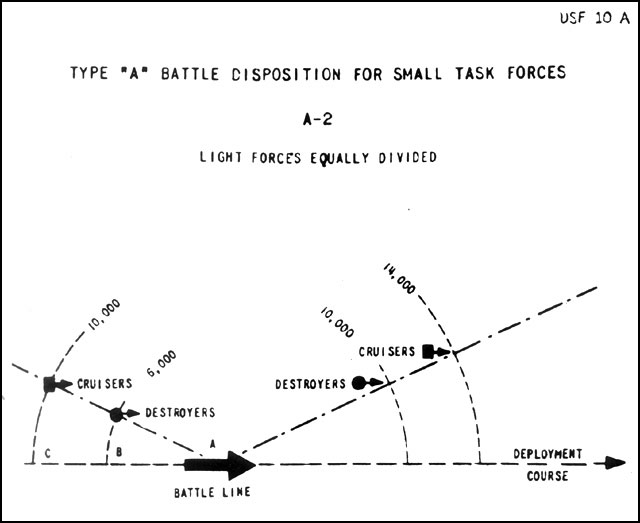
For a number of days prior to the SURIGAO STRAIT action many reports had been received concerning the movements of Japanese surface forces. It was understood that the Japanese were putting into effect a plan for the relief of the PHILIPPINES and that enemy surface forces were probably about to attack our forces in LEYTE GULF. Mindful of the Japanese activities in the VISAYAN AREA, Commander Task Group 77.2 had decided on 24 October that it would be wise to take precautionary dispositions in the vicinity of LEYTE GULF with particular emphasis on SURIGAO STRAIT, south, and had issued a directive to his forces directing them to take stations with light forces initially located on an east-west line four miles east of TAYTAY POINT, on course east, speed 5 knots, and with heavy forces plus destroyer screen located to the northwestward in Area DRUM south of latitude 10°-46'N. This was equivalent to a battle disposition of the A-1 type (see USF-10A). The directive for Task Group 77.2 to remain in area south of latitude 10°-46'N. Had come originally from Commander Task Force SEVENTY-SEVEN, who had evidently clearly visualized the enemy capabilities.
Large enemy forces had been reported and bombed in the SIBUYAN SEA by THIRD Fleet on 24 October in late afternoon, and large enemy forces had been reported and bombed by Task Group 38.4 in the SULU SEA southwest of NEGROS the same day. It was apparent that either of these forces could, if it so desired, reach LEYTE GULF by early the next morning.
At 1513 on 24 October, Commander Task Group 77.2 received the following orders from Commander Task Force SEVENTY-SEVEN:
BE READY FOR NIGHT BATTLE. JAP FORCE ESTIMATED 2 BB, 4 CA, 4 CL, 10 DD REPORTED TO BE UNDER ATTACK IN EASTERN SULU SEA BY OUR CARRIER PLANES ON 24 OCT. JAPS ABLE TO ARRIVE LEYTE GULF TONIGHT. MAKE ALL READY FOR NIGHT BATTLE. CTG 77.2 REINFORCE BY TG 77.3. PTs IN MAXIMUM NUMBER FROM CTG 70.1 TO BE STATIONED LOWER SURIGAO STRAIT AND STAY SOUTH OF 10-10 NORTH DURING DARKNESS.These orders were supplemented by a later message:
PRIOR TO DARKNESS PLACE BOATS IN SECTIONS OF 2 or 3 BOATS EACH AS FOLLOWS: PANAON - SW TIP. SOUTH OF MADILAO POINT. SOUTH OF LIMASAWA ISLAND. 2 OF THE SECTIONS WILL PATROL BETWEEN AGIO POINT BOHOL PAST CAMIGUIN ISLAND TO SEPAO POINT MINDANAO. IT IS IMPORTANT THAT EACH SECTION LEADER REPORTS CONTACTS. Wachapreague AND OTHER SECTION LEADERS MUST RELAY THESE REPORTS TO CODLIVER. FROM OYSTER BAY, 21 BOATS PLACED AS FOLLOWS: PANAON ISLAND - SE TIP. BELAA POINT MINDANAO. 6 SECTIONS IN SURIGAO STRAIT. ONE SECTION OFF SUMINON ISLAND. ONE MEDCHART OFF KANHATIC POINT DINAGAT ISLAND. 2
OFF KANIHAAN ISLAND. ONE SE AMAGUSAN POINT. Wachapreague WILL INFORM LCI-S LAST STATION. AFTER MAKING REPORT OF CONTACT, SECTIONS WILL ATTACK INDEPENDENTLY.When the above message was received, the concept of the Battle Plan had already been formulated by CTG 77.2, and it was therefore speedily drawn up and issued as follows:
General Situation. Jap air and surface forces appear to be gathering westward in VISAYAS for offensive strike on area of LEYTE. Air attacks have been made all day on our surface forces in LEYTE GULF. Enemy striking group of at least 2 BB, 4 CA, 4 CL, 10 DD may attack tonight after 1900.General Plan. Our force will attack by torpedo and destroy by gunfire at moderate ranges Japan surface forces trying to enter LEYTE GULF thru SURIGAO STRAIT East or South.
Battleline. Rear Adm. WEYLER Bat Div 3 less New Mexico, Idaho 4 less Colorado, 2 plus DDs as named repel or destroy Jap battleline by gunfire, fast closing to moderate range of from 17,000-20,000 yards. CruDivs 4 less Indianapolis plus Minneapolis, 12 less Cleveland and Montpelier plus DDs as named -- left flank forces -- defend left flank of own battleline. Strike battleline of enemy, Rear Adm. BERKEY CruDiv 15 less Nashville, Shropshire (R.N. Cruiser), DesDiv 47 -- Right Flank Force -- defend right flank of own battleline. Attack battleline of enemy. X-ray battle disposition used like A-2 in USG-10A. (See page 78-16). BBs in first station Lat 30-35 (E. of HUNTUNGAN POINT) Longitude 125-16E and steaming at 5 knots in easterly direction. BBs should turn at Longitude 125-27E and, unless otherwise directed, operate within these limits of longitude with DD screen as needed. Stations on battleline will be kept by flank forces. Before battleline engagement, torpedoes may be fired.
Be on the lookout for enemy torpedoes, remembering possibility of going thru Jap torpedo waters before attack. Primary voice designated channel A to be used -- 3845 kilocycles. As secondary voice designated channel B use 3980 kilocycles. For CW communications use 575 kilocycles. Use -9 time. CTG 77.2 with left flank force in Louisville.
It will be noted that this plan covered possible entrance not only to SURIGAO STRAIT, south, but also to SURIGAO STRAIT, east. This was because it was felt by Commander Task Group 77.2 that the latter was almost as probable as the former and that if the enemy was willing to hazard his forces in action in SURIGAO STRAIT, south, he would be just as willing to hazard his forces in SURIGAO STRAIT, East. How accurate this forecast was has been proven by events!
So soon as his plan had been formulated, Commander Task Group 77.2 called a conference of the Commander of the Right Flank Forces, Rear Admiral R.S. BERKEY, U.S. Navy, and the Commander of the Battleline, Rear Admiral G.L. WEYLER, U.S. Navy, to discuss the plan in detail.
THERE IS NO SUBSTITUTE FOR PERSONAL
CONFERENCES AND FREE DISCUSSIONS.It was pointed out that the amount of A.P. ammunition in all battleships was low and that there was likewise a shortage of ammunition of all types throughout the force. It was therefore essential that the battleships fire at ranges where their percentage of hits and their fire effect would both be high. This was settled on as between 17,000 and 20,000 yards. Likewise, it was pointed out that it appeared as if a wonderful opportunity for using the torpedoes in the offensive role for which they had been designed would be presented, and it was emphasized that each such opportunity would be immediately acted upon. The necessity for the destroyers keeping to the sides of the straits in attacking and in retiring was stressed because it was thought that the enemy radar would probably be ineffective against the land, and because it was feared that any of our destroyer units retiring towards own battleline might be fired on by our own forces. This in fact occurred. Both Admirals were very enthusiastic about the plans and were thoroughly indoctrinated as to the Commander's policies. There can be no doubt but that such conferences are often vital to the success of any operation and should be held before any important action whenever practicable.
BATTLE EAST OF SAMAR
Commander Task Group 74.4 (was also CTU 74.4.3) comments:
1. When the enemy attack by his southern force through SURIGAO STRAITS developed, the question of the whereabouts of the enemy northern component (Center Force) became even larger and more formidable. This unit had never been assigned
Type "A" Battle Disposition for Small Task Forces
A-2
Light Forces Equally Divided
Figure 8.
any responsibility for covering the exit of SAN BERNARDINO STRAITS, either by reconnaissance or by force, and in the absence of any information that this exit was no longer blocked, it was logical to assume that our northern flank could not be exposed without ample warning.2. Had this T.U. had any reason to suspect that an enemy sortie could be made through SAN BERNARDINO Straits undetected by other U.S. forces, a search to the northwest would have been launched from a more easterly position, and it is probable that a direct surface action could have been avoided.
BATTLE EAST OF LUZON.
Under PRELIMINARY EVENTS it was pointed out that Commander THIRD Fleet had decided to adopt the third alternative, (c); namely, "Strike the Northern Force with all of our own striking strength concentrated." Also, repeating, this PLAN or alternative was adopted because it maintained the integrity of the BLUE striking fleet, and it offered best possibility of surprise and destruction of enemy carrier force. it was particularly sound and necessary if the strength of the Northern Force proved to be the maximum reported. It was recognized that the Center Force might sortie and inflict some damage, but its fighting power was considered too seriously impaired to win a decision. Finally, it was calculated that the THIRD Fleet Forces could return in time to reverse any advantage that the Center Force might gain and Commander THIRD Fleet was firmly convinced that (c) would contribute most to the overall PHILIPPINES campaign even if a temporarily tight situation existed at LEYTE.
it was a hard decision to make, and having made it, Commander THIRD Fleet was gravely concerned until he received word that the Center Force had given up in the face of the valiant efforts of the SEVENTH Fleet CVE groups.
At 2022 Task Groups 38.2, 38.3 and 38.4 were given orders to assemble and make night run toward Northern Force preparatory to dawn attack. The Jap knows how to shuttle from carrier-to-target-to-airfield and all of Commander THIRD Fleet plans had for weeks been predicated on denying the enemy that advantage by closing promptly.
Commander Task Force 77 summarizes briefly: Narrative
Battle of Surigao Strait
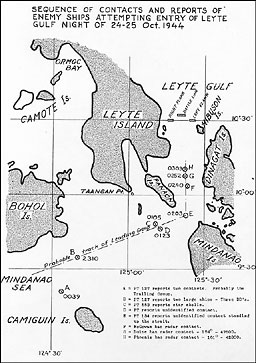
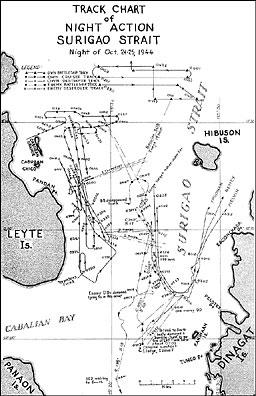
1. About 0030I/25 PT boats between BOHOL and CAMIGUIN sighted, reported, and delivered an attack against a fast approaching enemy force on a course for SURIGAO STRAIT. At 0123I/25 PT boats at the southern entrance to SURIGAO STRAIT reported strong enemy forces moving north at high speed in two groups (see page 78-18), the first group consisting of 6 to 8 ships including several heavy units, and a second group about four miles astern of the first group and composed of about 8 ships. As the enemy moved north, PTs drove into the attack, but, so far as can be determined, without effecting any material damage. Our Surface forces closed the enemy to form a semi-circle around the northern end of the strait -- battleships in the center, cruisers and destroyers equally divided on each flank.
2. The action was opened at 0305I/25 by a destroyer torpedo attack delivered by picket destroyers, and torpedo attacks from both east and west against the enemy heavy ships by our destroyer attack groups. This was an excellently executed night torpedo attack by sections of three destroyers each. The torpedoes were seen to hit, the enemy column was slowed and many explosions noted. The destroyer attack was completed about 0400I/25 and at 0405I/25 our PT's and cruisers on easterly courses opened fire simultaneously at range of sixteen to seventeen thousand yards. By 0445I/25 the remaining enemy had turned away and was in flight, hotly pursued by our surface forces. A few of his units were successful in escaping westward through southern SURIGAO STRAIT. (See page 78-19).
3. from the best information presently available, it is believed that the enemy's southern force which moved into SURIGAO STRAIT, commanded by Vice Admiral Shapi Nishimura, was organized as follows:
First Group -- Batdiv 2 Fuso, Yamashiro
Mogami2 BB
1 CA-XCVSDesdiv 4 Michishio, Yamagumo
Asagumo, Shigure4 DD About four miles astern of the above:
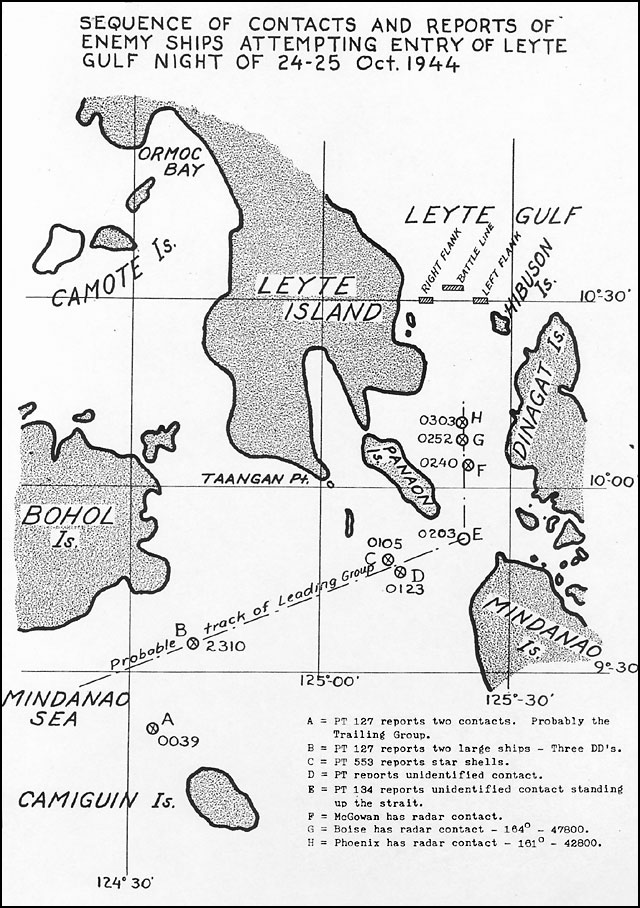
SEQUENCE OF CONTACTS AND REPORTS OF
ENEMY SHIPS ATTEMPTING ENTRY OF LEYTE
GULF NIGHT OF 24-25 Oct. 1944
TRACK CHART
of
NIGHT ACTION
SURIGAO STRAIT
Night of Oct. 24-25, 1944
Second Group - Ashigara
Kiso, Kinu or Isuzu
Unidentified1 CA
2 CL
6 DD4. Of the first group, only the damaged Mogami is thought to have escaped the early morning action. In this action also the Ashigara (CA) and two DDs of the second group were damaged, and the damaged Ashigara was probably sunk by aircraft of Task Unit 77.4.2 south of PANAON Island about 0857I/25, while between 0750 and 0841 the damaged Mogami and several destroyers were further damaged by air attack at the entrance to SOGOD Bay.
As experienced by Cruiser of Left Flank (CO Denver reports):
1. A Japanese force, believed composed of 2 BB's, 2 CA's, 2 CL's and 10 DD's, was engaged and decisively defeated in SURIGAO STRAIT in the early morning of 25 October by a Task Group under the tactical command of Rear Admiral J.B. Oldendorf, U.S. Navy, this ship being a unit under Rear Admiral R.W. Hayler in the left flank forces of the above Task Group. Vice Admiral T. C. Kincaid commanded the force.
2. Submarine and plane sightings throughout the 23rd and 24th showed the enemy to be concentrating in the MINDORO area for what could only mean an attempt in strength to destroy our fleet units protecting LEYTE Gulf and thus cut off and annihilate our land forces on LEYTE and nearby islands.
3. Soon after 0100 on the 25th, contacts from PT boats stationed at the southern entrance reported sightings of several ships entering the straits from the southwest between CAMIGUIN and BOHOL Islands.
4. As the enemy ships, disposed in two columns, one leading the other by about 4 miles, proceeded north, attacks were made by our PT boats and picket destroyers with several torpedo hits claimed. Many amplifying reports were made by these ships to the O.T.C. During the three hours which intervened between their first contact and the time of commencing gunfire by Admiral Oldendorf's forces deployed at the north end of the strait.
5. Tactically the situation could hardly have been more unfavorable for the enemy. He ran a gauntlet of our PT boats and destroyers in order to arrive at the northern end, to find on first contact his "T" capped by a superior force already deployed. It must be assumed that from his plane observations during the previous days he had accurate knowledge of the composition of the forces opposing him.
6. Almost from the time of commence firing at 0350 the enemy ships appeared to observers in this ship to be a continual mass of flame and explosions, with the exception of two which appeared to CIC to countermarch and escape at high speed to the southward.
7. After daylight, the forces of the left flank made a sweep down the channel to polish off the cripples and sank what appeared to be a Katori class cruiser with her bow missing. observed also were four other ships sinking which could not be identified because of the heavy oil smoke and flames surrounding them. (See Photographic Section V.) This sweep was discontinued when word was received that an enemy force of 4 BB's, 8 CA's, and several DD's had been sighted off Samar, attacking our CVE's. If this second force had entered SURIGAO Strait east at the same time that force one was coming up the southern strait the battle might have taken a disastrous turn since all our ships were low on ammunition, this ship having entered the action with only 1200 rounds of A.P. Such may have been the enemy's intent, changed by the fight put up by the CVE's. But regardless of his intent, the desperate effort to destroy our naval forces in LEYTE Gulf was frustrated and his fleet was dealt a crushing blow.
As experienced by Cruiser of Right Flank (CO Boise reports):
1. Earlier in the day (24th), about 30 PT boats of Task Group 70.1 were ordered south and deployed so as to observe the southern approaches to SURIGAO Strait, with orders to report and attack with torpedoes if the enemy appeared. These units were on station by early evening. At 2310 PT 127 made contact with and reported an enemy force 10 miles off the southeast tip of BOHOL Island. Later, at 0040 25 October, this same boat reported two contacts bearing 310°T, distance 10 miles from CAMIGUIN Island. A third PT contact at 0123 reported by Wachapreague placed the enemy bearing 140°T, distance 18 miles from TAANOAN Point. These contacts indicated that an enemy force was approaching SURIGAO Strait. This was made certain when a fourth report, this time by PT 13 at 0202, placed the enemy off the southern end of PANAON Island and standing up the strait. The enemy force appeared to be composed of at least two very large targets and several smaller ones.
2. Boise's first radar contact with the enemy was made at 0252, bearing 164°T, range 47,900 yards. A track was immediately established and the plot from 0252 on is shown on page 21B. At 0254 a second contact was made with a force astern of the initial contact about 4000 yards. From the radar screen there appeared to be two columns of three or four ships each, with a large ship in the lead of each column. (The ships astern of column leaders did not separate on the screen until several minutes later). Prior to contact, own forces deployed for battle had patrolled on an east-west line at the northern exit of SURIGAO Strait. After contact, destroyers headed down channel to attack with torpedoes. Their attacks commenced at about 0300 and continued intermittently until about 0400. Several hits were reported.3. The gunnery phase of the battle was fought in the classic style of the formal battleline engagement. By 0350 the enemy van was well within range and OTC ordered commence firing, the battleline opening up at about 0350. Boise opened fire on order from Commander Right flank forces (CTG 77.3) at 0351 with main battery to starboard on the largest target in the van, range 18,100 yards, bearing 053°T. A steady rate of fire was maintained and many hits were observed on the target. The enemy continued to advance up the Strait at first, but by 0400 all units appeared to be veering off to the west and south; the enemy was being heavily hit. At about 0401, shell splashes were observed near HMAS Shropshire. The splashes were all short initially, then all overs. A few moments later, several salvos were heard passing directly over Boise. Boise ceased firing on order at 0410 with target bearing 154°T, range 12,800 yards, having expended 439 rounds of 6"/47 calibre armor-piercing projectiles. Shortly after commence firing, fires were seen to break out on several of the targets, some of an apparently serious magnitude. At 0420 orders were received from Commander Task Group 77.2 to resume fire. However, no suitable targets were within effective gun range of Right Flank cruisers. The target (battleship) which had been the object of our fire was by this time apparently retiring down the Strait and rapidly drawing out of range. All other enemy units also appeared to be in full retreat down the Strait.
As experienced by Destroyer of Right flank (CO Daly reports):
1. Shortly after sunset our own forces formed battle disposition A-2, U.S.F. 10A, with light forces on both bows in the van of the battleline axis 135 (T), deployment course 225 (T). Task Group 77.3 occupied the van position to starboard of the fleet axis, with cruisers on the 14,000-yard circle. DesDiv 47 occupied a position 8,000 yards ahead of the cruisers. This group of destroyers was divided into two attack groups: Section I -- Hutchins, Daly, Bache. Section II -- HMAS Arunta, Killen, Beale.
2. The entire force maneuvered at slow speeds, fleet center in vicinity of Latitude 10°34'N., Longitude 125°19'E. The entrance from the strait to LEYTE GULF was completely blocked. Thirty PT boats were stationed in ten groups of three each at the southern entrance of SURIGAO STRAIT, operating south of Latitude 10°17'N.
3. The weather during the early part of the night was far too beautiful to serve our purpose. The moon shone brightly with visibility to at least 8,000 yards; light breezes were blowing, and the sea was calm. Fortunately, before the enemy arrived the moon had set. Local squalls visited the area, bringing low overcast clouds and a dark black night. Zero visibility was interrupted only by intermittent vivid flashes of lightning which transpired around us.
4. Commencing at 0920, when they reported an enemy force ten miles southeast of BOHOL ISLAND, contact reports were received regularly from the PT boats. At 0132 they reported the enemy force nine miles southwest of PANAON ISLAND, and at about 0240 five miles west of KANIHAAN ISLAND steaming north at twenty knots. Numerous star shells and occasional sweeping searchlight beams could be seen over the southern horizon from this vessel, indicating that the PT boats were harassing the enemy.
5. Ships of DesRon 54 started south, down SURIGAO STRAIT, about 0230. Remey, McGowan, and Melvin steamed down the eastern shore. Monssen and McDermut steamed down the western shore, passing near ships of DesDiv 47 which were at that time three miles due east of HUNUNDAYAN. The eastern group executed the first torpedo attack of the battle, followed by the two ships west about 0310, and commenced retirement to the north at high speed. A large explosion was seen to the southeastward by Daly personnel at 0316; this explosion was probably a result of the torpedo attack by DesRon 54.
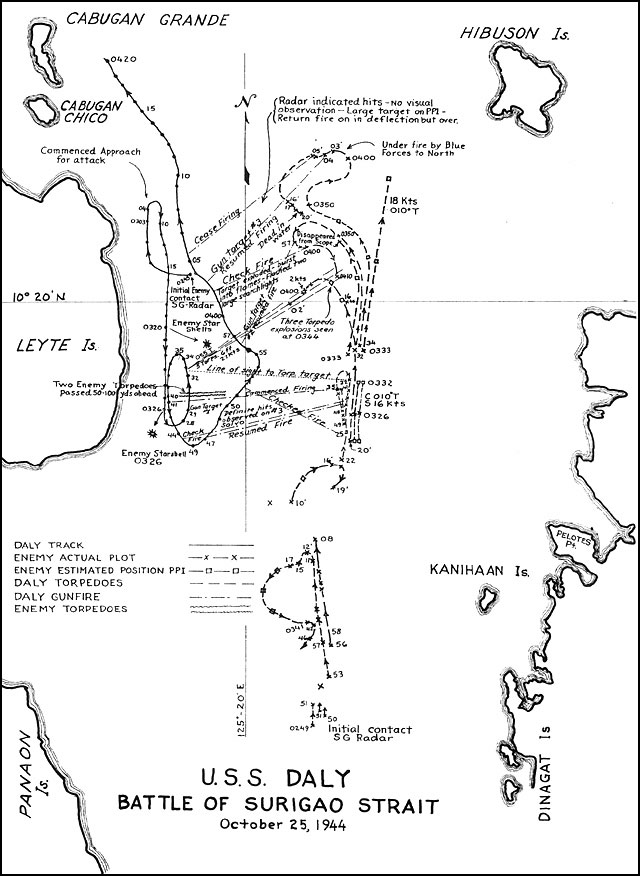
6. Daly made radar contact on the enemy force at 0248 from a position two miles east of HINUMDAYA. (See page 78-22). At time of first plots, Daly's position was Latitude 10°21.3'N., Longitude 125°16'47"E. Enemy bearing was 164 (T), range 30,400 yards, with several targets on a
U.S.S. Daly
Battle of Surigao Strait
October 25, 1944
northerly course at 17 knots. Contact was reported to CTG 77.3 on the task group common circuit, 2748 KCs.7. DesDiv 47 turned and started south in column at 0307, speed 15 knots. HMAS Arunta was directed to lead her group eastward to attack, and at 0314 Arunta, Killen and Beale commenced approach for torpedo attack on course 140 (T) at 25 knots, laying funnel smoke during approach. The Arunta's attack unit fired torpedoes at 0327 from a position about 7,000 yards on the port bow of the enemy formation and then reversed course, retiring to the northwest.
8. At 0321 Hutchins, Daly and Bache increased speed to 25 knots on course 180 (T) and commenced approach for torpedo attack, laying funnel smoke. We passed Monssen and McDermut close aboard to starboard as they retired to northwest at high speed.
9. Leading enemy ships were bearing 115 (T) at 13,000 yards. Only the van units could be seen on the short range PPI scope at this time. There appeared to be four large ships in an approximate line of bearing normal to their course, 010 (T). The enemy was attempting to illuminate this attack unit with starshells, but all stars burst short until 0326 when one bright greenish star burst a thousand yards broad on Daly's starboard bow. Hutchins turned left to 050 (T). Daly and Bache followed in her wake, all three ships standing by to fire a half salvo of torpedoes to starboard.
10. Seen on the SG radar PPI, the enemy disposition consisted of two groups of ships: Four large ships abreast, interval about 500 yards, were out ahead. Two thousand yards astern was a second group of three large ships (the largest pips on the radar scope), formed on a line of bearing normal to the course, 010 (T), interval about 500 yards. One (or more) smaller targets was a few hundred yards west of these ships. Evaluator's original estimate of the enemy force was nine ships in this northern group.
11. At 0329 Hutchins altered course left to 000 (T) and fired five torpedoes to starboard. Daly followed in her wake. At 0330 two torpedoes crossed Daly's bow, the closest not more than 50 yards ahead, from starboard to port, on approximately course 280 (T). The wakes of these torpedoes could be seen forming as they approached. Bubbles were just rising as Daly's bridge crossed torpedo track number two with the water still sizzling. A light trail of smoke could be seen rising from the bubbles. Bubbles from torpedo track number one were rising just forward of the stem at the same moment. Both of these torpedoes were first detected by underwater sound equipment. They were too close, however, to permit evasive maneuvers.
12. Hutchins reversed course to the left after firing torpedoes. Daly held course and at 0332 fired five torpedoes to starboard, using as target an enemy ship of the second group (largest pip visible on SG radar), bearing 099 (T), 10,700 yards, course 010 (T), speed 16 knots; torpedo course 055 (T), speed 27 knots, depth six feet. After firing, reversed course to left, Bache fired five torpedoes to starboard at 0335 and followed in Daly's wake. Stopped funnel smoke at 0338.
13. Main battery trained on enemy vessel in vicinity of second enemy group, a relatively small pip. Commenced firing to port at 0341 on this target, bearing 025 (T), range 11,000 yards. Target appeared to have reversed course, making 16 knots. Small bursts could be seen at the target as salvos landed. FD and SG radars indicated salvos were hitting. Checked fire at 0344 as Hutchins turned left to cross our bows.
14. At 0344 three large explosions, unmistakably torpedo hits, in quick succession were observed by all bridge personnel and repair parties bearing about 045 (T). Each explosion was a round ball or dull orange flame which subsided and disappeared almost immediately. The ship which was hit by these torpedoes immediately opened fire with major and minor calibre guns, frantically throwing steel through 360°, and initiating general gun action between both forces.
15. It is certain that these three torpedo hits were made by Daly's torpedoes fired at 0332, twelve minutes before, for the following reasons:
- radar plot shows a large target in Daly's torpedo water at a range of 10,800 yards from point of firing, the exact distance a 27-knot torpedo will travel in twelve minutes. Subsequent plots reveal that this target decelerated and was making only 2 knots at 0400.
- Hutchins' torpedo course was 120 (T). She fired at a different target to southeastward three minutes prior to launching of our torpedoes.
Bache apparently fired at same target as Daly but three minutes later, so that her torpedoes could not have arrived at point of contact at 0344. It is entirely possible that she also registered hits.
- DesRon 54 conducted first attack with "torpedoes away" prior to 0320, since the last destroyers of that group to attack (Monssen and McDermut) passed Daly to westward on retirement course at that time. From PPI tracing their firing range was close to 7,000 yards, so that their torpedoes hit long before 0344.
- Section III (Arunta, Beale, Killen) launched torpedoes at 0327 at a range of 6500-7000 yards. Their torpedoes reached their marks within the maximum time of 9 minutes or prior to 0336.
- Torpedoes fired by DesRon 56 were fired after 0350. In addition, these ships were on the eastern flank and there would be little chance of seeing torpedo hits on the other sides of large enemy ships from our western position. Our TBS log shows that these ships were ordered to fire a half salvo at 0348 with "standby to fire" at 0354.
16. Daly resumed gunfire to starboard on first gun target at 0347 after turning left in Hutchins' wake to 050 (T). Further hits were observed on radar scopes but no further visual results noted other than small flashes at target, apparently caused by projectile impact. Resumed laying funnel smoke.
17. At 0352 checked fire and changed course left to 310 (T). Cruisers of TG 77.3 opened fire on enemy, firing north to south. Daly shifted to new target bearing 032 (T), 7,500 yards, and commenced firing at 0355. Target was hit on the first salvo. Tracers could be followed into the hull of this vessel. On the third salvo this target exploded and burst into flames. Bache also took this target under fire and the continued salvos of both destroyers continually hitting in rapid succession brought results which were gratifying to see. The light from the fires and explosions positively identified this ship as a heavy cruiser. Our fire forced the enemy to turn away. Target angle on opening fire was 045 (T), changing slowly to 160 (T). After the first explosion, target flashed two large searchlights and fired a red very star. It continued to be hit repeatedly by Daly and Bache. Debris flew into the air as each salvo hit. After it burst into flames, this target was taken under fire by BLUE heavy units to the north, and it is certain that it never escaped. Through descriptions of this target by bridge and director personnel, particularly through description given by rangefinder operator, it has been established that this target was a Furutaka class heavy cruiser. Since we were clearing the area in order not to foul the range of our battleships and cruisers, it was necessary to cease firing on this cruiser and shift to a target farther north.
18. At 0402 picked up a large enemy ship bearing 043 (T), 11,000 yards, our third and last gunfire target, and commenced firing at 0403. Changed course right to 330 (T) and increased speed to 30 knots. This ship had apparently been firing at our group for some time with its secondary battery. In the lightning flashes at least three salvos, which were only from 50-100 yards over in range, were seen to land midway between Hutchins and Daly. Some salvos were also heard by director crews and after 40 MM and 20 MM battery crews, passing overhead. No "shorts" were observed.
19. Immediately after we opened fire on this ship, a salvo with one tracer was fired at us. It was definitely on in deflection for it gave the sensation of standing in center-field waiting for a fly-ball which will land in one's glove. Fortunately this salvo passed overhead, landing from 200-300 yards over.
20. This enemy vessel was a heavy cruiser or battleship for it was firing major calibre guns at our heavy units to the northward and was under heavy fire from our ships. It is certain that its escape was impossible.
21. It is possible, from the fact that three or more successive salvos landed midway between Hutchins and Daly, that the enemy has some type of fire control radar and that he experienced a bleeding or convergence of pips from our two ships.
22. At 0405 ceased firing and proceeded on northerly course past BLUE forces which were advancing southward toward the disintegrating enemy. At 0425 slowed to 20 knots and at 0431 slowed to 15 knots, operating several miles north of CABUGAY GRANDE ISLAND. Enemy ships which were still afloat and retreating in a damaged condition were sunk one after another by our battleships, cruisers and destroyers. This job was completed shortly after daylight.
23. At 0509 formed anti-aircraft disposition with Task Group 77.3 and steamed southward toward KANIHAAN ISLAND. At daylight seven heavy pillars of billowing black smoke could be seen on the horizon ahead. One by one these pillars of smoke disappeared as the ships from which they originated sank under the gunfire of our ships. (See Photographic Section V.) Hundreds of survivors were reported in the water, almost all of whom refused to be rescued and were left to their fate.
24. No enemy ships remaining by 0730. Task Group 77.3 reversed course to northward, retiring from SURIGAO STRAIT. Increased speed to 27 knots.25. At 0744 enemy aircraft were reported approaching, and at 0811 fifteen Japanese dive-bombers (VALS attacked the force five miles east of HIBUSON ISLAND. The planes were driven away by gunfire after at least four had been shot down. Daly expended 33 rounds of 5"/38 AAC ammunition but the planes were at all times at maximum range and results were negative.
26. Task Groups replenished fuel and ammunition in LEYTE GULF during the day in preparation for an anticipated enemy surface attack on LEYTE GULF on the night of 25 October. This threat, presented by strong enemy surface force operating east of SAMAR ISLAND, did not materialize.
Commander Task Force 77 summarizes briefly: Battle East of Samar
1. At 063I/25 [sic] aircraft anti-submarine patrol of Task Unit 77.4.3 (Northern CVE Group) reported many enemy battleships, cruisers, and destroyers on a southerly course about 15 miles north and westward of the Task Unit. The first news of this enemy force was received on board the flagship about 0724I/25 when Commander Task Unit 77.4.3 reported that he was under gunfire attack by four battleships, eight CAs and many destroyers, at a range of about 30,000 yards. This was the first indication that the enemy's Central Force had succeeded in passing through SAN BERNARDINO Straits. Up to this time, from information available to Commander SEVENTH Fleet, it was assumed that THIRD Fleet forces were guarding the SAN BERNARDINO Straits in position to intercept and destroy any enemy forces attempting to come through. To confirm this assumption, Commander SEVENTH Fleet had sent a despatch to the Commander THIRD Fleet asking if he was guarding the SAN BERNARDINO Straits. Reply was not received until after the enemy surface forces were attacking our Northern CVE Group.
2. At this point, the situation appeared very critical. Our surface combatant forces were deep in the southern part of SURIGAO Strait after the battle of the early morning, and after five days of almost continuous bombardment of shore objectives and fighting a naval action, they were exceedingly short of ammunition and fuel. Moreover, the destroyers had expended almost all their torpedoes. Nevertheless, all of our available surface forces were ordered to concentrate at eastern entrance LEYTE Gulf, preparatory to moving to the support of the retiring CVEs, and an urgent call for assistance was sent to Commander THIRD Fleet. All aircraft were recalled from support missions and were directed against the enemy's Central Force attacking our CVEs. Task Units 77.4.1 and 77.4.2 moved northward to support of Task Unit 77.4.3 and the enemy was hit with every conceivable form of plane attack, including dummy torpedo runs by planes without torpedoes.
3. At about 0730, in response to orders to cover a retirement of the northern carrier task Unit, two destroyers -- Hoel and Johnston -- and the Roberts (DE) reversed and delivered a daylight half-salvo torpedo attack against the enemy battleships at a range under 10,000 yards, then turned and delivered the other half salvo against enemy heavy cruisers at a range of about 7,000 yards. After one of the most gallant and heroic acts of the war, all three ships were sunk, although the Hoel continued to withstand concentrated enemy fire for about one hour before finally sinking. As a result of continuing air action by our CVEs and the destroyer attack, the enemy momentarily turned away and several of his ships were seen to be hit and in trouble.
4. The enemy, however, resumed the action and about 0900I/25 the Gambier Bay was badly hit, dropped astern, and later blew up and sank as a result of enemy shell fire. (See Photographic Section VI.) The Saint Lo was sunk about 1050I/25 as a result of an enemy dive bomber crashing into the flight deck and starting a tremendous fire. This fire caused several violent explosions on the ship and the Saint Lo sank without further enemy action. (See Photographic Section VII.) At 1255I/25 the enemy force turned away and commenced retirement towards SAN BERNARDINO Strait on a course of 105 and speeds of 15 to 20 knots, leaving several damaged ships behind. Throughout the morning and continuing into the afternoon, our CVEs were the primary target of incessant and strong enemy air attack. As a result of these attacks and of enemy surface gunfire, many of our CVEs were severely damaged and were unable to land or service their planes. In this extremity, the partially completed TACLOBAN airfield was put into use and CVE planes were skillfully landed on that partially completed airfield, serviced, and returned to the attack, thus saving many planes and pilots who would otherwise have been lost due to water landings. it is remarkable that in these landings on an unknown and ill-kept field no serious injuries were sustained by our air personnel, which speaks very highly for their skill.
5. Planes of Task Group 38.1 arrived over the retreating enemy at about 1330I/25 and delivered their first attack about 1400I/25. As
the enemy continued to retreat northward, they were continually attacked and harassed by the planes of 38.1 and by the planes of the CVE Force. The enemy's remaining forces consisting of about 14 ships, including his four battleships, were last reported entering SAN BERNARDINO Straits at 2200I/25, leaving several cripples far to the rear. These were finished off the next day by the forces of Task Force 38. Except for the pursuit phase, this ended the Battle of LEYTE Gulf in which the enemy's major fleet was decisively defeated with heavy loss.
CTU 77.4.3 (Unit of Northernmost Station CarGrp) reports:
1. On the morning of 25 October TU 77.4.3 was operating off the east coast of SAMAR providing routine support for the LEYTE Landing forces, when it was surprised and attacked by a major part of the Japanese Fleet.
WAR INSTRUCTIONS, (F.T.P. 143(A)), PAR. 233 (f), STATES IN PART, "A FORCE SURPRISED IS AT LEAST PARTIALLY DISORGANIZED AND DEMORALIZED AND HAS DIFFICULTY IN REGAINING THE INITIATIVE AND COORDINATING AND CONCENTRATING ITS PHYSICAL STRENGTH. IT FOLLOWS NATURALLY THAT OUR OWN COMMANDERS MUST NOT BE SURPRISED."In the running fight which followed, this unit, while escaping what seemed certain annihilation, lost two of its six CVEs and three of its seven screening vessels. No vessel of this Task Unit escaped undamaged.
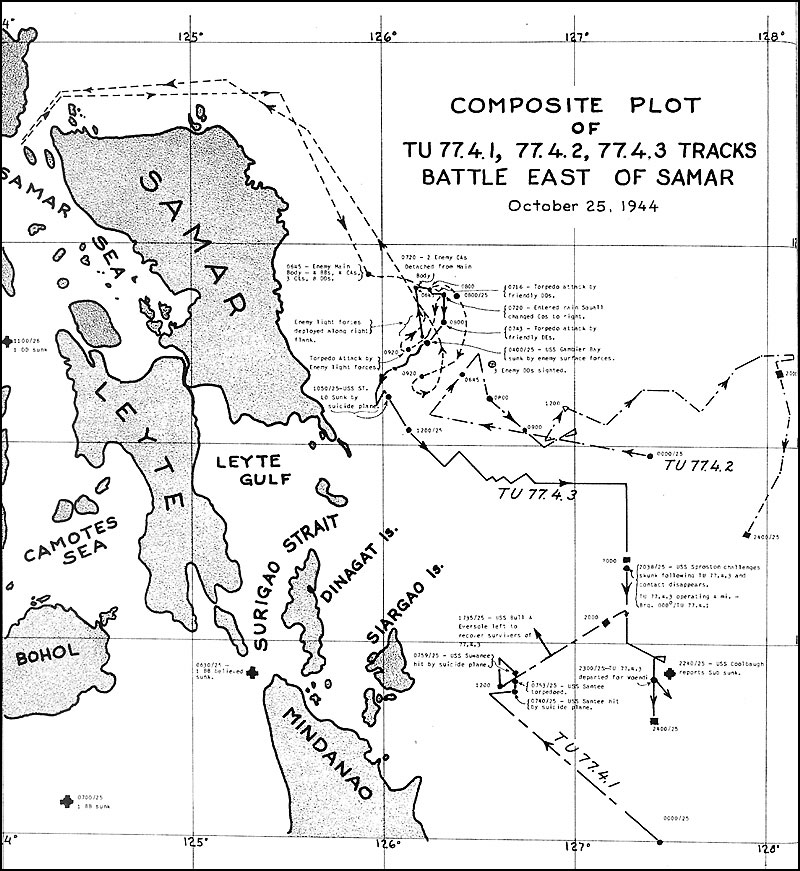
2. For about two and one half hours this group was under constant attack, endeavoring to outrun an enemy vastly superior in speed and armament and to avoid a constant and increasing threat of encirclement by the enemy's heavy cruisers on the left, his destroyers on the right, and his main body astern. (See pages 78-27, 28) In this effort some benefit of concealment was derived from the scattered showers that prevailed during the morning, and more from the use of smoke. Nevertheless, until the moment when the enemy broke off and retired to the north there appeared only one possible outcome of the encounter -- complete annihilation.
3. The first indication of untoward events was the report at 0646 of automatic AA fire, bearing 300°, distance about 15 miles. Seven minutes later a large enemy fleet, believed at the time to have consisted of 4 BB, 8 CA-CL, and at least 8 DD, was sighted, bearing 298°, distance about 17 miles. No report of radar contact was made prior to the visual sighting.
4. Almost immediately after being sighted the enemy opened fire. The first shells fell close about the S.B. Roberts and in a short time the CVEs were under fire. At 0655 carriers were ordered to launch all available planes and the unit took launching course eastward into the wind. Launching completed, the disposition continued to the east and southeast at maximum speed, making smoke for concealment. At 0701 the screen was ordered to lay a smoke screen astern of the carriers.
5. At 0705 CTU 77.4.3 broadcast a contact report and requested assistance.
6. From the time of the first fall of shot throughout the launching of planes and for the next two hours and one half the unit was steadily under fire from the main batteries of Japanese BB, CA and DD. To avoid the effects of the smoke, the enemy advanced two heavy cruisers up the port quarter of the disposition, and under continuous pressure from these ships this unit was slowly forced around from its original easterly course until it was heading for LEYTE Gulf. On this course the relative wind was such that the smoke lay in an east-west line. With all CVEs making heavy black smoke and with the escorts making both funnel and chemical smoke on the starboard quarter of the disposition, vision of both forces was largely obscured. This fact, with the failure of the Japanese to close the range more rapidly, was largely responsible for saving the Task Unit from complete destruction.
7. Prior to 0800 the Task Unit was under fire from BB astern and CA on the port quarter. As the course was altered slowly to westward, most of the firing was from the cruisers coming up to port, with infrequent salvos from the heavy ships astern and from DD's who for a time were advanced on our starboard quarter.
By 0740 the CAs bearing 300°T had closed the range to 24,000 yards, and the screen commander was ordered to launch a torpedo attack. As a consequence of this attack one DD and one DE were not seen again and another DD was so damaged that it was later sunk by the enemy while slowing to repair damage. Due to the heavy smoke the course of this attack and the results obtained could not be observed.
9. As the enemy ships advanced to within effective range, the CVEs and the screen took them under 5-inch fire. Such of our splashes as could
T.U. 77.4.3 Track Chart
Battle East of Samar
25 October 1944
Composite Plot of
TU 77.4.1, 77.4.2, 77.4.3 Tracks
Battle East of Samar
25 October 1944
be observed were directed at the heavy cruisers to port, and this, considering the circumstances, seemed remarkable both in rate of fire and accuracy, being well on in deflection and good although tending to be slightly under in range.10. As the Japanese cruisers gained on the port flank the Task Unit was forced continually to veer to the right toward the shoreline. In this process, and consequent to individual maneuvers and differences of speed, the disposition became scattered out along the southwesterly course line with White Plains, Kitkun Bay and Fanshaw Bay in the lead. As a result, the heaviest fire was directed on the other CVEs and the screen and many near misses and straddles were observed.
11. At 0754 a vessel of the screen reported torpedoes approaching the carriers from the starboard quarter.
TIMELY WARNING OF APPROACHING TORPEDOES HAS SAVED SHIPS.12. At 0756 three destroyers of the Fletcher Class were sighted on the horizon to southward. Informed by searchlight that we were under surface attack, these DD's first stood to the eastward toward the enemy, then turned and disappeared on a southerly course. They did not enter the affray.
13. Throughout this period the planes of this Task Group attacked the enemy ships and additional fighters were catapulted to aid by strafing. From about 0900 planes from TU 77.4.1 and TU 77.4.2, which had returned from their support missions, assisted planes of this group. Considerable damage was inflicted on the enemy by these attacks.
14. At 0759 a bomb or shell hit followed by flames was seen on the bridge structure of one of the heavy cruisers, but the fire was shortlived and the enemy did not appear seriously hurt.
15. Shortly after 0800 the leading cruiser to port commenced a turn away from the CVE formation. Any hopes of respite that were raised by this maneuver were quickly dispelled as she continued the turn through 360° and fell in astern of her consort. The fire of these ships continued undiminished in intensity and as they continued to gain they shifted their aim to the leading ships. From this time on, Kitkun Bay and Fanshaw Bay were under heavy surface fire and were repeatedly straddled. Salvos with red and blue dye were used by these cruisers to stop their splashes.
DYE-LOADED SHELLS ARE FREQUENTLY USED BY JAPANESE.16. About 0805 there was a submarine alarm cumulating in a supposed sighting. No torpedoes were observed and it is not believed that there was a submarine present.
17. At 0820 Gambier Bay reported that she had been hard hit and was proceeding on one engine. Under continuous fire she dropped steadily astern and disappeared in the smoke. Pilots later reported seeing her being shelled at point blank range, and first reports from survivors indicate that she sank at 0900 as a result of many 8-inch hits from six CAs which closed a final range of 2,000 yards.
18. The two cruisers to port had by now forged ahead clear of the drift of the smoke from the CVEs, and at 0826 two DEs were ordered to cross from right to left and lay their smoke on the port bow of the disposition.
SMOKE SCREENS ARE EFFECTIVE AGAINST OPTICALLY-CONTROLLED GUNFIRE.19. At 0902 Dennis (DE-405) reported being hit below the waterline and main battery out of commission.
20. About this time, in the hope of disrupting the enemy fire and of slowing down the cruisers who were now threatening to turn the CVEs back to the northward toward main enemy disposition, ComCardiv 26 ordered the TBMs who had expended their bombs to make dummy torpedo runs on the enemy ships. The effectiveness of this ruse is not known.
THE GRAVENESS OF THE SITUATION IS EMPHASIZED BY THESE HEROIC ACTS.21. At 0924 the enemy cruisers, now at a range of only 10,500 yards, ceased fire, countermarched in column to the left and retired to the northeast. This Task Unit immediately slowed to 15 knots.
22. One minute later the alarm was broadcast by the OTC over TBS of many torpedoes approaching astern. Field of vision in this direction was limited to about 1000 yards by smoke from one of our DEs but no wakes were seen from Kitkun Bay and air observers reported that torpedoes were stopping short of the disposition. CAs to port had obviously fired this torpedo salvo.
23. The surviving CVEs and four escorts continued on a southwesterly course and made preparations for launching further air attacks on the retiring enemy.24. No further attack by surface units was experienced, but reports of bogies over the next half hour culminated in scattered but determined attack by enemy dive bombers. (See Photographic Section VII.) At 1050 Kitkun Bay suffered minor damages and a small gasoline fire when a TONY Made a suicide dive through the catwalk on the port side forward. About five minutes later St. Lo (ex-Midway) was dive bombed by a plane which, hit by AA, flamed as it passed across the deck and splashed on her port beam. A burst of fire was seen on board St. Lo, caused either by the bomb explosion or by parts from the burning plane; it died down rapidly but was followed in the next few minutes by a series of extremely heavy explosions which threw smoke and debris high into the air and by violent flames showing from the hangar deck. When last seen, personnel were abandoning ship over the starboard side forward. At 1114 the surviving ships of the screen were ordered to stand by St. Lo to pick up survivors and from this time the CVEs proceeded without a screen.
25. Kitkun Bay was subject to a further attack at 1120 when a JUDY carrying a heavy bomb dove into the water just off the bow, throwing tons of water and considerable shrapnel over the bridge and the forward part of the ship.
26. Shortly after this attack, the Kitkun Bay launched 4 TBM with the torpedoes remaining on board to strike the retiring Japanese Fleet. A little later radio contact was established with the first fast carrier striking group who were vectored toward the enemy.
27. What remained of task unit 77.4.3 -- Fanshaw Bay, White Plains, Kalinin Bay and Kitkun Bay -- retired south and southeast throughout the afternoon, recovering aircraft as practicable, and headed for an evening rendezvous that had been arranged with TU 77.4.1. This latter unit was within TBS range when at 1938 a single skunk was observed closing the formation from the quarter. Identification proving impossible, request was made to CTU 77.4.1 for screening ships to investigate the contact. At 2050 three destroyers assigned to this task were closely approaching the contact when it disappeared. One DD reported sighting a conning tower and attacking with depth charges, after which contact was not again made.
28. Enemy snoopers were overhead during the early part of the night and one was shot down by the destroyers investigating the previously mentioned contact. No attack on this unit developed, however, and without further incident the four CVEs accompanied by a "borrowed" screen departed LEYTE Area.
CTU 77.4.2 (Southernmost Station CarGrp) reports:
At 0814 TU 77.4.3 reported his position as 11° 34' N, 126° 25' E and changing course to 205°T. Also "We have been straddled for last half hour"; "We have not been hit yet, their shooting is very bad". TU 77.4.2 at 0800 was at 11° 13' N, 126° 49' E (11° 13.5' N, 126° 32.5' E) on course 160°T, speed 17 knots except when into wind launching aircraft which required a heading to the northeast. The enemy force was between the two Task Units, at a position estimated to be abaft the port beam of TU 77.4.3 and on the starboard quarter of TU 77.4.2. ComDesDiv 94 (Captain Reynolds) in Haggard, with the Hailey and Franks took position about 3 miles astern of the carriers to intercept any light forces in the van of the enemy's main force attempting to attack. When shell fire fell near our DDs, CTU 77.4.2 ordered them to close the formation. The five DEs took station ahead of carriers for screening. The enemy was estimated to be about 20 to 25 miles astern, closing at the rate of 1000 yards every ten minutes, speed 30 knots. Enemy shell fire was reported falling short of the destroyers at 0817.
2. At 0833 changed course to 037°T to launch Strike No. 2 and land 6 VT from TU 77.4.3. The launching and landing was completed by 0844 when course was changed to 140° T. Strike No. 2 consisted of 8 VF and 16 VT, the latter loaded with torpedoes. At 0834 a pilot observing in the air reported that TU 77.4.3 on southerly course was on bearing about 300°T distance 17 to 19 miles from this unit, that cruisers were firing off TU 77.4.3's port quarter, and that a battleship and two heavy cruisers were astern of TU 77.4.2 about 20 miles with another battleship 30 miles astern. At 0841 this Task Unit was again taken under shell fire by heavy enemy ships astern. This fact and the Task Unit position, 11° 13' N, 126° 52' E. were reported to CTG 77.4 and CTG 77. CTU 77.4.2 estimated the shells to be 8-inch. Shells straddled the destroyers astern the formation with no hits. An enemy plane was reported to the west. A VT from this unit attacked a submarine NW of and 20 miles distance from TU 77.4.3.
3. At 0855 Strike No. 1 initiated its attack on the enemy. Part of this flight attacked 2 heavy cruisers and 1 light cruiser, which had TU 77.4.3 under close fire, and successfully scored two torpedo hits, one on each of the heavy cruisers. The balance of Strike No. 1 supported by Strike No. 2 attacked the two heavy cruisers and one battleship directly astern of Task Unit 77.4.2, obtaining two torpedo hits on one of the heavy cruisers.4. The main weight of this attack struck the enemy between 0910 and 0930. At 0924 the nearest ship had closed to sixteen miles, shell fire was coming closer to the CVEs (a salvo falling about 1700 yards astern), and enemy masts were observed on the horizon. Unprecedented valor was displayed by the pilots in executing attacks against these heavy combatant ships. FMs were the only support for the VT as they persistently attacked. Evaluated reports and photos indicate that two torpedo hits on a heavy cruiser (Tone Class) and one torpedo hit on a battleship (Kongo) were scored in these important first two strikes. The effect of the attacks caused the enemy to circle immediately and discontinue gunfire on this Task Unit. CTU 77.4.3 states in a subsequent dispatch that the enemy at about this time turned away from bombarding his unit for no apparent reason. It is believed these attacks were responsible to a great extent for the enemy turning away and discontinuing fire at least temporarily.
5. The enemy ships at this time were too close for this unit to risk turning into the wind, which was from 049°T, 7 knots. Consequently, a decision was reached by CTU 77.4.2 to launch the third strike of 12 VT, one of which carried o torpedo, the balance 4 - 500# SAP bombs each, and 8 VF on course 120°T. As the CVE catapult tables call for 22 knots of apparent wind down the catapult for launching a heavily loaded VT, such a decision was somewhat risky but the launch went off without casualty at 0935 with 20 knots of apparent wind 20° on the port bow. The radar screen showed that this Task Unit was opening the range from the enemy ships which evidently were taking evasive action during the attacks of Strikes 1 and 2. Strike No. 3 immediately threw its weight against the enemy and the resultant three bomb hits on the previously twice torpedoed heavy cruisers are believed to have forced upon the enemy unit commander the decision to discontinue further attacks on TU 77.4.2. One heavy cruiser was subsequently observed by pilots to retire to the west and the battleship to the north at extremely slow speed, with a badly damaged destroyer close by.
6. In the meantime, while the Third strike was attacking, the Task Unit changed course at 0945 to 050°T into the wind to land Strike No. 1. For the next hour bogeys were picked up on the radar and two BETTYS were reported sighted 12 miles to the northwest. Interception was not accomplished. However, at 1045 one JILL carrying a bomb or torpedo was shot down 20 miles to the southwest. The Combat Air Patrol during this period pursued numerous reported bogeys, evidently snoopers covering the Jap fleet.
7. At 1051 CTU 77.4.3 reported that he was under heavy air attacks and also that elements of the Jap fleet were closing again. The attacking Jap planes were reported by CTU 77.4.3 to have hit three of his CVEs. No further report was received at the time as to whether the elements of the fleet closed TU 77.4.3. Subsequent radio interceptions at 1325 and later dispatches indicated that the fleet did not close again.
8. At 1115 Strike No. 4 was launched, consisting of 19 VF and 37 VT of which 11 carried torpedoes and the balance SAP and GP bombs. This large strike effectively hit the main Jap force which was about 45 to 55 miles on bearing 305°T from this Task Unit. Pilots reported the position of the enemy's main force as 11° 43' N, 126° 13' E with a crippled battleship and heavy cruiser 20 to 30 miles to the east of the main force. This information and positions were immediately sent to CTG 77.4 and CTF 77. Pilots further reported the enemy to be on course 225°, which indicates he might have started to run back against our forces prior to this large strike arriving. On the other hand it is highly possible he was engaged in evasive maneuvers and his base course was confusing to the pilots. In either case, after being attacked by this strike any indication that the enemy considered returning to the south was eliminated and there was no doubt as to his heading, which was north, at top speed. The damage inflicted during this attack is estimated to have included several bomb hits on a heavy cruiser, a bomb hit and a torpedo hit on a battleship, and continued effective strafing attacks on the escorting destroyers.
9. At 1200 TU 7.4.2 was at 11° 12' N, 127° 02' E (11° 11.3' N, 126° 57' E) on course 120°T. A reported was received from pilots at 1230 that several hundred survivors, evidently from a ship of TU 77.4.3 were in the water in the vicinity of 11° 12' N, 126° 30' E. This information was immediately sent to CTF 77 and subsequently a rescue unit was dispatched from LEYTE Gulf. At the same time radar picked up a large group of
friendly planes approaching this disposition from the northeast and subsequently voice communications were established over VHF with these planes which were from CVs of Task Group 38.1. The flight leader requested latest position of the Jap fleet. CIC on the flagship Natoma Bay gave these planes a vector commencing at 1255 and continued to direct this appreciated support until the flight leader "tallyhoed" the main enemy force at 1302. The result of their attack is not known.10. By this time Strike No. 5 was ready to be launched by TU 77.4.2. Up to this time a total of 80 VT and 55 VF had been launched against the enemy's force by this Task Unit and all available SAP bombs and torpedoes expended. By 1331 Strike No. 5 consisting of 11 VT armed with GP bombs and rockets and 8 VF was airborne and after the fleeing enemy. CSA for CTF 77 sent the following voice transmission to CTG 77.4 at this time: "Appears Jap force seriously weakened. Keep striking". Pilots of the Task Unit reported 1 heavy cruiser dead in water and sinking, 1 battleship dead in water, with 1 destroyer in comparable condition at about 11° 25' N, 126° 33' E. This was reported to CTF 77 and CTG 77.4 at 1458. During this period base course of the Task Unit was 120°T but when conducting air operations course was to the northeast, resulting in a mean almost dead easterly track. This heading was maintained to reduce danger of enemy air attacks interfering with our operations against the enemy.
11. The last strike for the day was launched commencing at 1508 and consisting of 26 VT and 24 VF. The VF carried 250-lb. GP bombs and the VT 500-lb. GP bombs and rockets with instructions to attack the light units of the Jap force. Upon completion of launching, several bombers (SB2Cs) from TG 38.1 were landed along with the Task Unit's returning flights, including Strike No. 5. Pilots reported that the Jap main force was at 12° 05' N, 125° 45' E on a northerly course at 1420 when they executed their attack. One cruiser was reported lagging behind damaged. The results of Strike No. 5 are unknown but it is felt that it must have been primarily harassing due to the loadings which were all that were available and the small number of planes. The position of the enemy and composition, which was reported to be three battleships, three heavy cruisers and seven destroyers, was forwarded immediately to the higher echelons (at 1538). (See page 78-33.) At this time a second attack group from TG 38.1 was picked up on the radar and reported four enemy ships, one a battleship or heavy cruiser dead in the water in the vicinity of the previously reported cripples, thereby confirming the effectiveness of the CVE strikes. Part of this attack group attacked the cripples at 1550 and the balance, on being given the position of the retiring main enemy force, proceeded after them. The results of their attacks are not known.
12. CTU 77.4.2 decided to alter course to the west at this time in order to render aid in recovery of personnel in the water and, if practicable, send the three destroyers on a night attack to finish off the cripples. At 1549 course was 290°T and subsequently changed to 250°T at 1617. However, at 1632 the appearance of a large group of bogeys on the radar screen bearing 310° distance 70 miles on course 130 necessitated a reevaluation of the immediate situation. At this time a pilot reported the main enemy force at 12° 30' N, 125° 25' E course 310° speed 18. This position was passed to CTF 77 and CTG 77.4. Upon receipt of further information confirming CIC's report that the bogey consisted of 30 or more enemy planes, CTU 77.4.2 ordered the Task Unit to change course into the wind and launch VF. The current airborne CAP were already on vector toward the incoming raid. By 1650 28 VF had been launched, subsequently followed by 12 more. It was not too late to launch any more strikes and no better use for the VF could be foreseen. At 1705 the Task Unit turned from 050°T out of the wind to course 120°T and formed disposition 5V for defense against air attack. With Fighter Director Control in CIC on the flagship, interception of an estimated 25 to 35 enemy fighter bombers stacked at altitudes from 17,000 feet down to 1,000 feet was successfully accomplished with the initial "tallyho" occurring at exactly 1700, distance 35 miles from the formation. In the ensuing aerial engagement 16 enemy planes were confirmed as shot down, an estimated ten additional planes damaged, and the attack completely and adroitly broken up by the excellent combination of teamwork and skill between the VF pilots and CIC personnel. No enemy planes came within 17 miles of the formation. The value of this successful interception is the more significant as reports from the other Task Units indicated the enemy air force was executing suicidal air attacks where possible.
13. At 1734 CTU 77.4.2 sent his last contact report on the enemy for the day: "Our last strike hit Jap force at 1723, position 12° 35' N, 125° 32' E, course 300, speed 10 knots. Results still unknown." This position placed the Jap force off northeast coast of SAMAR heading for SAN BERNARDINO Straits. Subsequently pilots landing from this strike at 1825 stated that the force appeared to consist of four battleships, 3 heavy cruisers, two light cruisers and seven destroyers, with two battleships trailing oil and seemingly in trouble, three destroyers and one light cruiser lagging behind and one heavy cruiser apparently damaged.
Probable Formation of Jap Fleet
East of Samar
25 Oct. 1944 - 1500 ITEM
14. Recovery of Strike No. 6 and the CAP was commenced at 1808 on course 080°. The last plane was landed aboard by 1831, including the dusk CAP, and course was set at 210°T, speed 15 knots, zig-zagging using Plan #6. Upon receipt of information that a special surface rescue group had sortied from LEYTE Gulf to pick up the previously mentioned survivors, and in view of the information that the heavy surface units of TF 38 were enroute south to intercept any cripples, CTU 77.4.2 abandoned his previous intentions of heading to the west and set course to the southwest to close CTG 77.4.
As experienced by CVE of Northern-most Station CarGrp -- CO Kalinin Bay reports:
1. A plane on anti-submarine patrol from U.S.S. Kitkun Bay reported to the OTC a task force composed of four enemy battleships, six cruisers, and numerous destroyers bearing 270° (T), a distance 20 miles from this formation at 0654. The pilot of the plane definitely identified the task force as enemy. This information was conveyed to this ship over the Inter-fighter Director Net (37.6 mcs.). Immediately after this report excited Japanese voices were heard over the IFD Net. A frequency test was made and it was found that the Japanese were directly on 37.6. mcs. On orders from the OTC, General Quarters was sounded at 0658 and speed increased to flank.
2. Acting in pursuance to orders all available aircraft were launched, the pilots having been instructed to attack the Japanese task force and proceed to the TACLOBAN airstrip, LEYTE, to re-arm and re-gas. By 0725 we had launched three TBM-1C's loaded with 500-lb. GP bombs and 8-5" rockets, six TBM-1C's loaded with 10 100-lb. GP bombs and 8-5" rockets, one TBM-1C loaded only with service load ammunition, and ten FM-2's with full service load ammunition, all planes having been previously loaded in accordance with the scheduled missions. Two TBM-1C's temporarily out of commission on the hangar deck were made ready loaded with torpedoes. The damage to the catapult prevented the launching of these planes. At about 0750 launched three additional FM-2's. During the entire launching operations this ship was under incessant fire from the heavy enemy surface units. Only one FM-2 returned aboard this ship at 1745; the other planes landed at TACLOBAN airfield, on other ships of the formation, and some of them are unaccounted for.
3. At 0705 three heavy Japanese cruisers were sighted bearing 270° (T), distance 34,500 yds. Salvos were fired by the cruisers at this force, many shells exploding close aboard. Destroyers and carriers were ordered to make smoke screen. Several hits were observed on the Gambier Bay, who at the time was off the port bow. Many salvos had been fired since 0705 and when U.S.S. Gambier Bay had been severely hit, the enemy cruisers increased their fire on this vessel and began to close the range and deploy off the port quarter. This ship was, for a considerable time during the shelling, the ship in the formation nearest to the enemy--"Tailend Charlie", which probably accounted for such intense fire being directed at this ship by the enemy. Used various evasive courses so as to present a smaller target to the enemy units.
4. At about 0750 received a direct hit on the starboard side just aft of the forward elevator on the hangar deck; several near misses at the same time. No units were visible off the starboard side at this time; this hit may have come from the Japanese battleships observed to be firing on us by a fighter pilot of U.S.S. Kalinin Bay who was attacking the enemy units. Fragments of a large calibre shell were found on the hangar deck.
5. The three heavy cruisers on our port quarter were definitely identified by the Recognition Officers and other officers of the ship to be one heavy cruiser of the Nachi Class and two heavy cruisers of the Tone Class. When the enemy cruisers closed the range to 18,000 yds. at about 0800, the 5"/38 cal. gun of this ship was ordered to open fire. The cruisers intensified their fire on this ship immediately and two direct hits were received forward and many salvos exploded close aboard. Received a hit from 8" shell on water line at Frame 78 port side. The shell went down through the first platform deck, through the GSK storeroom and into the Aviation Lube-Oil Tank where it exploded. A fuel oil tank and the forward bulkhead of the forward engine room were ruptured and the evaporator system was disabled. The shell missed going through the bottom of the ship by a narrow margin.
6. The cruisers closed to 17,300 yds. Fire was continued from the 5"/38 cal. gun on the Japanese cruisers. At about 0825, at a range of approximately 16,000 yds. a direct hit was scored on the No. 2 turret of the Nachi Class heavy cruiser by this vessel. The five-inch gun commenced rapid fire after observing this hit, and another hit was made on the same cruiser just below the previous one. After the first hit the No. 2 turret was observed to be slowly enveloping in flames and the second hit caused a quick burst of flames which completely obscured the turret. The cruiser then turned hard to port and withdrew from the formation temporarily.
7. At about 0830 five destroyers were sighted
on the starboard quarter--"head-on-view"--approaching in column formation. Their identity was not known, and at first they were thought to be friendly units coming to assist. It was not until they opened fire on our formation from a range of approximately 14,500 yds. That they were known to be hostile. At this time the heavy cruisers attacking from the port quarter were obscured from view by a smoke screen laid down by friendly escorts. The fire of the five-inch gun was immediately shifted to the Japanese destroyers attacking us and closing from the starboard quarter. Fire was continued and the Japanese destroyers closed the range to 10,500 yds., at which time they were definitely recognized to be of the Terutsuki Class, with high bow and two gun mounts forward and a heavy tripod foremast and mainmast. Many salvos from the destroyers attacking us exploded close aboard. A number of the shells passed directly overhead. This ship continued to fire on the attacking destroyers with the five-inch gun.8. The enemy cruisers continued their attack from the port quarter, and due to the fact that the destroyers were shelling from the starboard quarter, evasive courses were not used. Several more hits and many near misses were made on this ship by the enemy cruisers. Since the attacking destroyers were rapidly closing the range, fire was continued on them and never again during the battle shifted to the cruisers. Several of the escorts of this formation closed the cruisers and the range on them began to open.
9. At about 0930 a direct hit amidships was scored on one of the Japanese destroyers, and it immediately was enveloped in white smoke. The enemy destroyers made radical maneuvers and began to withdraw, but continued their fire on this vessel and other ships of the force. A friendly destroyer crossed our stern at about 500 yds. and made smoke, and closed the Jap destroyers as she approached. firing of the five-inch gun was ceased because of the presence of this friendly destroyer and because the enemy destroyers were no longer visible through the smoke screen. The time of cease firing was about 0935.
10. A TBM aircraft, believed to be from U.S.S. St. Lo, that had been circling the formation made a steep glide astern of the ship and strafed in the wake of the ship about 100 yds. astern, exploding two torpedoes which had been fired from the enemy destroyers.
TORPEDO WAKES HAVE BEEN PREVIOUSLY MARKED BY AVIATORS BUT THIS MARKSMANSHIP IS OUTSTANDING.The explosion of the torpedoes was only a short while after the enemy had ceased surface shelling of the force. This was the first warning of a torpedo attack being launched against this ship. Immediately after these torpedoes were exploded, another torpedo was sighted directly astern in the wake of the ship. It appeared to be broaching. The five-inch gun on the fantail opened fire at a depressed elevation of 2° and a shell exploded approximately ten feet ahead of the approaching torpedo; it was next observed veering to port.
A SUFFICIENT JAR TO UPSET THE GYRO IS INDICATED.At least twelve other torpedo wakes were sighted on parallel course on both sides of the ship.
COMBING THE WAKES PROVES SUCCESSFUL.After the torpedo attack the entire enemy surface force retired to the northward.
11. There was a slight lull in the battle before a concentrated enemy air attack began at about 1050. Destroyer escorts on the starboard bow and beam commenced anti-aircraft fire and three ZEKES were sighted over the U.S.S. White Plains. One of the ZEKES crashed off the starboard bow of this ship. Automatic weapons opened fire on the attacking aircraft. More ZEKES began to dive on the formation from astern. The leading one was hit by anti-aircraft from this vessel and was smoking when it made a suicide crash dive on the port side of the flight deck, disintegrating and causing numerous fires which were extinguished in less that five minutes.
AN OUTSTANDING PERFORMANCE OF THE FIRE FIGHTING PARTY.Gun crews of No. 4 20MM to No. 14 20MM were flash-burned. Another ZEKE, which had been fired by anti-aircraft from this ship while approaching in steep glide from the starboard quarter, crashed amidships on the port side into the after port stack. The third ZEKE that attempted to crash dive this ship went into the sea close aboard on the port beam, having been subjected to intense fire from the automatic weapons. When the air attack ceased, about 1130, a DINAH was observed passing overhead at 10,000 feet.
IN COMMENTING ON DAMAGE CONTROL THE COMMANDING OFFICER STATES THAT DAMAGE CONTROL WAS SUPERB, WHICH IS HEARTILY CONCURRED IN. HE ALSO STATES THAT THE USE OF WOODEN PLUGS TO STOP UP WATER-LINE HOLES SAVED THE SHIP.
As experienced by CVE of Northern-most Station CarGrp -- CO Fanshaw Bay reports:
1. U.S.S. Fanshaw Bay, while operating 50 miles east of SAMAR Island (Zone minus 9 time) in the central Philippines in company with TU 77.4.3 consisting of 6 CVEs, 3 DDs and 4 DEs, furnishing air support for landing operations on LEYTE, encountered the major body of the Japanese surface fleet during morning dawn alert on 25 October 1944. Despatches previously received on the night of 24 October had indicated that one enemy force consisting of 4 battleships, 8 cruisers and 13 destroyers had been sighted in the SIBUYAN Sea, possibly headed for SAN BERNARDINO Straits; a second enemy force had been reported in the SULU Sea apparently headed for the MINDANAO Sea and possibly SURIGAO Strait. At about 0645, 25 October 1944, some 15 minutes before the enemy fleet was visually sighted, voice transmissions in the Japanese language were intercepted, strength 5, modulation 5, over the inter-fighter director net, frequency 37.6 mcs, an unidentified surface contact was reported on the SG radar bearing 292°, distant 181/2 miles, and a pilot on anti-submarine patrol reported the presence of a large group of ships about 15 miles west. The Japanese force opened fire on planes of our anti-submarine patrol at 0647 and were then sighted by our ship's lookouts.
2. At 0658 enemy cruisers opened fire on ships of this task unit from extreme range of 29,200 yards bearing 284°. Order were given to launch all planes remaining on board. An 8-plane local Combat Air Patrol, 7 VF special strike group, and one torpedo plane with air observer had been launched prior to contact with enemy; 1 remaining fighter and 11 torpedo planes were launched and proceeded to strafe and bomb the enemy fleet which was closing rapidly.
3. Fanshaw Bay with other ships of this unit retired at best speed (17 knots), making smoke. Enemy cruisers closed to 25,000 yards firing 3 gun salvos. While retiring eastward into the wind in order to launch aircraft and await favorable opportunity for a turn towards LEYTE Gulf, this unit entered a heavy rain squall and, taking advantage of this reduced visibility, changed course to the southward towards own heavy ships at LEYTE and opened slightly on the enemy. Upon emerging from the squall, the enemy body consisting of battleships and cruisers continued to advance directly astern while their light force of cruisers and destroyers deployed and split into two units and commenced advancing, one on our port and one on our starboard flank.
4. Our own seven destroyers and destroyer escorts were ordered to launch a torpedo attack which they did immediately at 0740. Fanshaw Bay opened fire with 5-inch stern gun at 0757, getting 3 hits on cruiser on port quarter. Fire bombs on hangar decks were jettisoned at 0808 and gasoline pump room flooded with CO2 gas at 0920.
5. Salvos from enemy cruisers were close straddles apparently from 6-inch and 8-inch batteries. At 0750 Fanshaw Bay received first hit on the bow from an 8-inch shell, damaging our catapult. Eight minutes later an 8-inch shell struck forward, destroying anchor windlass. Fanshaw Bay planes succeeded in damaging one enemy cruisers. Enemy cruisers closed to within 14,000 yards while main body of the enemy fleet closed to 19,500 yards. U.S.S. Gambier Bay was hit by shell fire, crippled, and fell behind, later being sunk by point blank enemy destroyer gunfire. Two of own destroyers and one destroyer escort were lost in launching torpedo attack on main body of enemy fleet. At 0855 Fanshaw Bay received another 8-inch shell hit on forward end of flight deck, again damaging catapult.
6. Enemy launched torpedo attack from extreme range and, having been subjected to continuous heavy air attack from our own planes, changed course to retire at 0925, the three enemy groups then bearing 021° distant 21,000 yards, 152° distant 18,700 yards, and 088° distant 19,500 yards. Torpedoes expended themselves astern with no hits. At 0952 Japanese fleet faded from radar screen, retiring to the north. Enemy force was composed of 4 BB's, 8 CA's, 2 CL's and 12 DD's.
7. At 1051 ship's AA shot down Japanese fighter in suicide attack on us, 35 feet off our starboard quarter. 1056 St. Lo sinking from damages received. All our DDs and DEs ordered to remain and rescue survivors. 11081/2 assisted Kitkun Bay in shooting down enemy fighter in suicide dive on Kitkun Bay. 1115 Retiring to the south to join task group 77.4.1 1948 Being trailed by surfaced submarine. 2020 Joined forces with Task Unit 77.4.1. 2100 Unidentified aircraft circled our formation but did not attack. 2136 Screening destroyer of Task Unit 77.4.1 attacked and probably hit submarine. 2200 Task Unit 77.4.1 screening destroyer fired on and destroyed one unidentified aircraft. Task Unit 77.4.3 departed for MANUS.
As experienced by screen Destroyer of Northern-most station CarGrp -- CO Raymond reports:1. At 0730 we commenced systematic firing on an enemy cruiser bearing 310° (T), range 14,000 yards, closing. At this time there was a moderate and intermittent heavy rain with heavy clouds settling low overhead. This, and the fact that all ships were making smoke, reduced our visibility considerably. Between 0735 and 0740 a torpedo wake was observed to be approaching and passed this vessel approximately 20 yards to port. No torpedoes were observed to have hit any of the ships in the formation. We continued to make smoke using both F.M. generators and funnel smoke.
2. At 0743 CTU 77.4.3 ordered the destroyer escorts to make torpedo attack on enemy cruiser. We immediately checked fire on our 5" battery and came to course 000° (T) to close range on enemy cruiser. This target was then dead ahead and we commenced firing with our forward 5" gun, while the range decreased rapidly to 10,000 yards or less. At this time the enemy launched a major torpedo attack at a range of approximately 14,000 yards from this vessel. The enemy employed eight or nine destroyers in this attack. Torpedo wakes were observed coming toward this vessel, one wake was observed to have passed close to port and another passed under this vessel heading for the CVE group. None of these torpedoes were observed to have hit any of our vessels.
3. At 0756 we fired a spread of three torpedoes at an enemy cruiser at a range of 10,000 yards and closing fast. The target at this particular time was making an effort to close the formation, also to outflank the formation on the port side. The DRT tracing of this action indicates that after we fired our torpedoes evasive action was taken by the enemy cruiser. This evasive action succeeded in closing the range at least 1,000 additional yards and made conditions more favorable for our torpedo attack. Several observers stated that we hit this cruiser however, visibility was so reduced that there is uncertainty as to who may have hit the cruiser.
4. On the run in for this torpedo attack we were under fire from the enemy cruiser and numerous straddles were obtained by them on us. Just after we fired our torpedoes and before we changed course and returned to the formation, the commanding officer observed a destroyer escort, which appeared to be the "[Samuel B.] Roberts, on our starboard beam under heavy fire from the enemy. The Roberts was firing rapid fire from her 5" guns and she appeared to be taking direct hits from the enemy. A curtain of flashes was observed surrounding this vessel and when we changed course to return to formation we could no longer locate the Roberts.
5. Returned to formation at speed of 24 knots. We opened fire on enemy cruiser bearing 058° (T) at 0814 (ITEM), initial range 11,000 yards. The 5" guns were in automatic director (Mk. 51) control. Radar ranges were used and Mk. 6 computer solution was applied to the gun order corrector. Target was observed to be crossed four times and five direct hits were obtained.
6. At 0828 CTU 77.4.3 ordered this vessel to intercept enemy cruiser approaching the formation on the port quarter. This target appeared to be the one we were firing at all of this time and we immediately changed course to intercept cruiser. At this time the last of the FM smoke supply was exhausted and we had no torpedoes left. At the start of the run the commanding officer is of the considered opinion that changing course toward the cruiser saved this vessel because most of their salvos at that time were overs rather than shorts; however, they did manage to straddle us at least once on the way in. The bearing of the cruiser at this time was 113° (T), initial range 12,600 yards by radar, which decreased rapidly to 5,700 yards. The method of fire was still automatic director (Mk. 51) control; target speed was about 24 knots. After the range decreased to 5,700 yards, the target changed course to port and the range increased rapidly. A casualty occurred to the Mk. 6 computer when the range was 16,000 yards, at which time the guns were ordered to shift to local power control and the spotting, as heretofore, was all done by the gunnery officer. Ranges continued to be obtained by radar and spots were applied to them. The firing was continued until the range exceeded 18,000 yards at 0950. The enemy cruiser, which was definitely identified as the Nachi class, and a battleship retired on course 070° (T) at 25 knots. Numerous observers and the gunnery officer reported that the enemy cruiser was crossed a minimum of five times and at least fifteen hits were obtained. During the interception period, enemy cruiser shifted fire from carriers to this vessel.
7. The enemy fire was not too accurate. The commanding officer was impressed with the following facts:
- The salvos landed with what appeared to be no dispersion and a beautiful pattern was obtained by the enemy.
- The colored dye-loaded projectiles used in almost all instances observed were brilliant. The following colors were seen: yellow, red and purple. The pattern consisted of five rounds each.
- The commanding officer was impressed by the fact that the enemy cruisers either did not open up rapid fire or were not capable of maintaining rapid fire.
- The enemy cruiser did not maintain a continuous barrage against this vessel, but shifted fire from time to time to other vessels and shifted back to us apparently only when they were bothered by our fire.
- The enemy ships did not take advantage of the several opportunities to close the range and finish us with their superior fire power.
- Our smoke screen was very effective.
8. No damage was sustained by this vessel during this action; although one salvo, in particular, which landed short, close aboard on our port bow, raised the sound dome, turning it around 360°. After the action the sound dome was again lowered and no damage was observed as the sound beam appeared to be normal. In several instances, this vessel was about to maneuver successfully to avoid very systematic ranging salvos on the part of the enemy cruisers.
9. At the conclusion of the action and while this ship was still at general quarters, enemy planes, identified as VALS, approached the formation at 1050 (ITEM) and five planes were observed to make suicide dives on our carriers. Unfortunately, this happened so suddenly that this vessel was unable to take a position where our anti-aircraft fire could be effective. Two planes were observed to miss the carriers and plunge into the sea. Only one plane of the group was within range of our 40mm and 5" guns and fire was opened on this plane which may have deflected it. One plane was successful in diving through the after elevator on the main deck of the USS St. Lo (ex-Midway) which caused a violent explosion. After five internal explosions the St. Lo broke in two and sank. Another carrier was hit by an enemy suicide plane; damage was not ascertained by observers. At 1105 enemy planes concentrated on USS Fanshaw Bay, attempting suicide dive attacks. We were ordered by CTU 77.4.3. To assist in rescuing survivors from USS St. Lo (ex-Midway). Carriers left the area on southeasterly course.
Commander Task Force 38 comments: Battle East of Luzon
1. About 0030(I) 25 October the Independence launched a night search to the north 320 to 010. About 0205 a radar contact was made by one of our search planes at Lat. 16-42 N., Long. 125-32 E. (See page 78-39.) This contact reported 3 large and 3 small ships on course 110, speed 15 knots. At 0235 the same search plane made contact with a second group of six large ships at Lat. 17-10 N., Long. 125-31 E. This put the closest enemy group almost due north, an estimated 80 miles distance. About 0255 TF 34 was formed, course changed to 000 and speed 25. At 0300 night tracking plane had to return to base because of engine trouble. Radar contact was never regained during darkness due to difficulties with radar equipment in relief search plane.
2. Prior to dawn all TG's armed planes and at 0555(I) a search 350-090 was launched, followed immediately by attack groups from all three task groups. The attack groups were stationed 50 miles ahead of the TF on bearing true north to await a contact. At 0730 the enemy carrier task force composed of 1 CV, 3 CVL, 2 XCV/bb, 1 CA, 4 CL and 6 DD, was sighted on a true bearing 015, distance about 130 miles from TF 38. Obviously the enemy had changed course to about 010 and proceeded at high speed after the radar search plane had contacted him.
3. At 0840 the first attack groups struck the enemy forces. At 1115(I), TG 38.2 and TF 34 left the battle and headed for SAN BERNARDINO STRAITS. At 1500 CTF 38 formed a striking group composed of cruisers and destroyers available in TG's 38.3 and 38.4. This force was ordered to close enemy cripples. This they did, finishing off a CVL damaged in the first air attack at 1730. At 2035 the same force sank a large DD or CL. The last air attack struck about 1750. The results of the day's action were 1 CV, 3 CVL's, 1 CL, and 1 DD definitely sunk. All other ships were heavily damaged and it is believed that at least one DD and one CL probably sank. The enemy BB's received several torpedo and bomb hits but were not too greatly affected by them. At 2200 our forces reversed course and departed for a fueling rendezvous at Lat. 16 N., Long. 129-30 E.
CTG 38.3 reports:
1. At 0205 the Independence night searches reported the enemy forces in two groups, one at Lat. 16-42 N., Long. 125-36 E., and the other 26 miles due north of that position. Both groups were reported on course 110° -- speed 15 and the nearest was 85 miles, bearing 352° from our formation. At 0253 TF 34 units withdrew from the carrier Task Groups and took station 10 miles North of Task Group 38.3. Course was set at 000°, speed was reduced to 10 knots to allow heavy ships and their escorts to clear ahead. Massachusetts, South Dakota, Santa Fe, Mobile,
U.S.S. Lexington Track
A+4 Day 24 October, 1944 A+5 Day 25 October 1944
C.K. Bronson, Cotten, Dortch and Healy were detached from this group to join TF 34.2. At 0220, in accordance with instructions previously received from ComTaskFor 38, Lexington was ordered to send out dawn searches on bearings from 290° to 330° to a distance of 350 miles. Essex was ordered to furnish two communication relay units of 2 VF(N) each stationed at 100 and 200 miles from the launching point. Similar missions were to be carried out in sectors 330° to 360° by Task Group 38.4, and 190° to 220° and 250° to 290° by Task Group 38.2.
3. It was considered certain that regardless of whether the enemy continued his southeasterly course or headed north in an attempt to escape he would be within easy range of air attack at dawn. With this in mind, orders were sent out at 0340 to arm the first deckload strike immediately and launch the CAP, searches, and first attack at earliest dawn. Plane availability, after taking into account necessary patrols and searches, was such that only one well balanced strike group could be mustered. At 0543 ComTask Force 38 advised that there was no recent information of the enemy's position and therefore ordered initial strike planes to take station 50 miles to the north, where they were to await target data and further instructions.
4. Fortunately, the weather was excellent -- clear with only a few clouds on the horizon and wind from 050° at 16 knots. There was sufficient light to commence launching at 0555, and soon afterward search planes took departure from Lat. 16-06 N., Long. 125-55 E. Since it appeared likely that the enemy might be east of assigned search sectors, one division of Essex CAP was vectored out on orders of CTF 38 to conduct a high speed search to the northeast. The decision paid rich dividends, for it was those pilots who first sighted the Jap task force at 0710 in Lat. 18-37 N., Long. 126-45 E., bearing 020°, 135 miles from our formation, on a northeasterly course. Although forced to climb steadily to avoid intercepting fighters, our CAP performed a magnificent reconnaissance job. For a full fifty minutes they circled over the enemy ships, reporting their position, composition and maneuvers. The force consisted of seventeen ships:
1 Zuikaku class CV
2 Chitose class CVL
1 Zuiho class CVL
2 Ise class XCV (battleships with flight deck aft)
1 unidentified CA
1 Oyodo or Agano class CL
2 Natori class CL's
1 unidentified CL
6 DD5. At time of original contact, strike #1 planes were already orbiting fifty miles north of our formation and thus were only some 85 miles from the enemy. Half an hour later they had the Jap ships in sight and at 0800 their attack was in progress. About fifteen enemy fighters attempted interception but they were quickly eliminated. As a result it was possible to keep a target coordinator over the ships almost continuously throughout the entire day, directing each attack, assigning targets and reporting results.
6. Task Group 38.3 sent five air strikes against the enemy forces -- three full-scale attacks launched at 0555, 1145 and 1615, and two small groups of remaining available planes which took off at 0835 and 1315 and joined Task Group 38.4 strikes. (See Photographic Section VIII.) Also in midafternoon 4 cruisers and 12 destroyers were sent to find and destroy any cripples within practicable range. Detailed evidence of sinking and damage is contained in individual ships' reports. A brief narrative of the day's events follows:
7. Reports of Essex CAP, target coordinator, and pilots of strike #1 confirmed the original enemy composition as stated in paragraph 5. As the first strike approached, one Chitose class CVL pulled out of formation, apparently attempting to launched planes by the Japanese version of "method Baker". This carrier received at least three torpedoes and several direct 1000# bomb hits from Task Group 38.3 planes. Many violent explosions occurred and the ship was left dead in the water, burning furiously. The other Chitose class CVL was also left dead in the water from several direct bomb hits. One torpedo was put into an Ise class XCV and another into one of the Natori CL's. Damage was also reported on two DDs. Nine enemy fighters were shot down.
8. At 0925 the returning Essex strike leader was heard reporting best available targets to pilots of Strike #2. He said that when he left there were four carriers still afloat, two of them badly damaged. However, by the time the second strike arrived over the Jap force about 1015 only three carriers could be found -- Zuikaku, Zuiho and one badly damaged Chitose class CVL. In the interval between attacks the other Chitose class CVL, left burning and exploding by Strike #1, is estimated to have sunk. Lexington and Langley planes, which had joined with Strike #2 from Task Group 38.4, reported making two torpedo hits on the Zuikaku and one on an Ise class XCV. Fires were started on one Natori class cruiser by strafing.
9. Meanwhile, urgent requests for assistance had been intercepted from Task Force 77 CVEs which were under attack by Japanese surface forces to the east of SAMAR Island. At 1100 ComTHIRDFlt ordered Task Group 38.2 plus all the battleships, Vincennes, Miami, Biloxi and DesRon 52 (units of TF 34) to reverse course at 1115 and proceed south. TG 38.3 and CTG 38.4 were directed to continue strikes against the enemy carrier forces.10. Shortly after strike #3 took off at 1145, Belleau Wood target coordinator reported that the enemy ships were then in two groups. One to the south, thereafter known as "The Cripples", was composed of an Ise class XCV, one CL and 2 DD's, all circling the second Chitose class CVL which was still dead in the water and burning as a result of the first attack. The other group was some 20-30 miles northwest of the cripples. It consisted of Zuikaku, Zuiho, the other Ise XCV, 3 cruisers and 2 or 3 destroyers. The enemy ships were approximately 102 miles, bearing 351°, from our formation and TG 38.3 planes were ordered to strike the northern group, which was apparently still heading 000° at 15-20 knots. Their attack at about 1310 put finishing touches on Zuikaku with nine direct 1000# and 2000# bomb hits. In addition, one torpedo was put into the northern Ise class XCV. Planes from TG 38.4 were soon to make several good hits on Zuiho, which was also left dead in the water burning badly. At about 1400 Lexington target coordinator watched Zuikaku go under -- a very gratifying sight. The "cripple group" was not attacked by Strike #3, but at about 1410 a division of Lexington CAP, which had been ordered to keep an eye on those ships, reported the XCV, CL and 2 DD's were abandoning the damaged CVL and heading north to join the main group.
11. Remaining available planes from Lexington and Langley (designated Strike #4) were again launched at 1315 to join a TG 38.4 attack. Their assigned target was the northern Ise class XCV and three torpedo hits were obtained in a well coordinated attack. The ruggedness of this enemy ship is shown by the fact that she stopped dead in the water for only about 10 minutes and then got underway again. Pilots reported that they observed Zuiho listing heavily and burned almost the water level. Langley target coordinator saw her sink at 1520.
12. The final attack of the day -- full deckloads from Essex, Lexington and Langley -- took departure at 1615, with the enemy ships bearing 327°, 92 miles. Pilot reports, substantiated by photos, indicate that only ten vessels were still afloat -- 2 Ise XCV's, 1 unidentified CA, 1 Oyodo or Agano CL, 1 Natori CL, 1 unidentified single stack CL and 3 DD's all underway -- plus the crippled Chitose class CVL dead in the water and abandoned by the other ships. As a result of well coordinated attacks, two torpedoes and six direct bomb hits were obtained on the XCV's. One of them slowed to 8 knots temporarily, but later was reported still heading north at 20 knots. A destroyer was confirmed sunk and one 250# bomb hit was obtained on the stern of a CA.
13. In the course of the day's strikes it rapidly became evident that there might be several Jap cripples which could best be finished off by ship's gunfire or torpedo attacks after dark. At 1340 CTG 38.3 requested permission from CTG 38 to organize a cruiser and destroyer attack against enemy cripples after dark. At 1342 he directed me to prepare for such attack but stated he expected with 1 BB in each group it might be a little tough and he desired to take the force out without towing damaged ships. On this information I directed ComCruDiv 13 and Comdr. Screen to prepare for this attack, leaving Reno and 4 destroyers to remain with carriers and Essex to furnish 2 night fighters for snooping. I felt that the tactical situation warranted this reduction in the carrier screen. We ruled the sea in our vicinity, there were no enemy aircraft in the air to bother us, the enemy was in full retreat, and the only remaining objective was to prevent his cripples from getting away. However, ComCruDiv 13 returning from TF 34, although close to the disposition, never reported to me for duty. At 1412, CTG 38 directed him to proceed north with cruisers and DD's. I did not issue him any further orders although I sent ComDesRon 55 in Porterfield with Callaghan at 1454 to join him and just before dusk had the Essex send two night fighters to report to him to the north.
14. This cruiser-destroyer group consisted of the Santa Fe, Mobile, Wichita, New Orleans, and DD's Porterfield, C.K. Bronson, Cotten, Dortch, Healy, Cogswell, Caperton, Ingersoll, Knapp, Callaghan, Bagley and Patterson. At 1615, ComCruDiv 13 reported he had in sight the final enemy CVL, still dead in the water and listing badly. Our ships opened fire at long range. There was some ineffective return fire from the carrier but at 1700 it turned turtle and sank in Lat. 19-08 N., Long, 126-32 E. Further north at 1840 radar contact was established with three enemy ships which had been spotted and kept under observation by Essex VF(N). They were estimated to be 2 DD and 1 CL dead in the water, probably picking up survivors. As soon as our ships opened fire the two enemy destroyers fled north at high speed. Neither the VF(N) or our ships were able to regain contact with these vessels, but the Jap CL put up stubborn resistance and maneuvered at speeds up to 26 knots. Finally, after receiving many hits from our gunfire, she was seen to explode
and sink at 2055 in Lat. 20-14 N., Long. 126-11 E. By then our VF(N) had contacted the remainder of the enemy force (reported as 5-6 ships) some 45 miles further north on course 000° speed 20. ComCruDiv 13 considered it impracticable to close and withdrew. He reported enthusiastically on the performance of Essex VF(N).15. From the tactical point of view of this Task Group Commander, the situation during the day had been ideal. We had wiped out the enemy air on the day before and we had him within striking range of our aircraft. We were proceeding towards him at 25 knots, he could not get away, and a good fresh breeze for air operations was only 45° on my starboard bow. It was a happy situation. The enemy was between 80 and 100 miles away, an ideal distance for aircraft strikes. We pounded him from dawn till dark with everything we had. The only untoward incident was at 1328 when I received orders from CTF 38 to proceed no further northward. At that time I felt we almost had the enemy cripples in sight. In accordance with these orders I headed 270°, which, with operations into an easterly wind, kept me in the same general locality. However at 1417 I requested permission from CTF 38 to proceed to northward again to insure getting in my last strike of the day before dark. Upon receiving affirmative from this transmission, we headed north again.
16. At 1800 the Task Group turned southeast toward assigned fueling rendezvous and at 0915 the following day our cruisers and destroyers rejoined from their cripple hunt. The action of 25 October had been gratifying to say the least -- the Japanese Navy had been dealt blows from which it is safe to say they will probably never recover. Our losses for the day of 6 planes, 3 pilots and 4 crewmen had been very minor compared to the total effort employed.
As experienced by a Cruiser -- CO Mobile reports:
1. At about 0300, 25 October the Heavy Surface Striking Force (Task Force 34, Vice Admiral W.A. Lee, Jr., Commander Battleships, Pacific) was formed from units of Task Force 38 present and stationed ten miles due north of Task Group 38.3. At the same time, the fleet course was changed to north to close the enemy. By 0430, Task Force 34 was formed up in Cruising Disposition Four-NAN. The six fast battleships were in three columns with the guide in Massachusetts in the formation center, and with order from the right: Battleship Divisions 7 (Iowa and New Jersey), 8 (Massachusetts and Alabama), and 9 (South Dakota and Washington). Cruisers were stationed with Cruiser division 13 (Santa Fe and Mobile) as the Left Flank, Cruiser division 6 (Wichita and New Orleans) and the Center, and Cruiser division 14 (Vincennes, Biloxi, and Miami) as the Right Flank. The eighteen destroyers of the task force formed an anti-submarine screen ahead.
2. The three Carrier Task Groups launched searches and strikes on the enemy carrier force to the northward as early as light conditions permitted, the planes passing over TF 34 while en route to and from the target. The Heavy Surface Striking force continued on ahead, first forming Cruising Disposition Four-SUGAR, in which the cruisers were spaced in the forward semi-circle on circle 6 and the battleships on circle 2, then forming the anti-aircraft disposition, Cruising Disposition Four-VICTOR. Massachusetts remained as guide in the formation center; the remaining battleships and the cruisers were evenly spaced on circle 6. The destroyers remained as an anti-submarine screen on circle 13, then somewhat later formed as sections. The task force course was modified only slightly throughout the morning; speed was increased to 20 and finally to 25 knots.
3. There were no enemy air contacts in the vicinity during the morning, and TF 34 did not remain organized long enough to make surface contact. At 1115, new orders were received from Commander THIRD Fleet, based on information of the enemy action off SAMAR Island during the morning, particularly on the sortie of enemy battleships and cruisers by way of SAN BERNARDINO Strait. TF 34 was reduced to include only the fast battleships, Cruiser Division 14, and Destroyer Squadron 52; all other units, on detachment from TF 34, were directed to rejoin their assigned Carrier Task Groups. TF 34 and TG 38.2 reversed course to the southward; TGs 38.3 and 38.4 were directed to continue strikes on the enemy carrier force. Mobile formed column on Santa Fe and, screened by Destroyer Squadron 50 (less Gatling), Cruiser Division 13 set a course to rejoin TG 38.3. Cruiser Division 6 (Wichita and New Orleans), screened by Bagley and Patterson, took a parallel course to rejoin TG 38.4. At about 1300 when within super-frequency radio range of the Carrier Task Groups, CTF 38 directed the two cruiser-destroyer groups to join and take station north of TG 38.3; TG 38.4 was to the southward. Wichita and New Orleans then formed a column astern of Mobile, and the destroyers formed a ten-station screen.
4. The weather throughout the 25th had scattered lower broken clouds, with light scattered showers. Visibility was 20 to 30 miles; the surface wind was northeasterly at 14 to 18 knots. The sea was light to moderate. Moonset (first quarter) was at 0055, 26 October 1944.
5. At 1415, CTF 38 directed ComCruDiv 13 to "Take your cruisers and destroyers on a northerly course to the crippled group, and we will give you information as further data is received from target observers over the target." Complete information was not available, but it was believed that the carrier air strikes conducted since early morning had been successful in sinking three of the four enemy carriers and in damaging the fourth carrier and several other ships of the enemy force. The cruiser-destroyer group immediately set course 000°T., at 25 knots, to close the reported position of enemy cripples. At about 1515, the cruisers launched planes for search and for possible rescue missions. TG 38.3 provided fighter cover during daylight, and two night fighter-snoopers beginning at sunset.6. At 1612 a surface contact was picked up by radar, bearing 028°T., distant 31,000 yards; at about the same time, the destroyers formed attack groups astern of the cruisers. At 1615, a Japanese CVL (Zuiho or Chitose class) was sighted dead in the water; a check, both visual and by the cruiser planes, failed to reveal the presence of other enemy ships in the immediate vicinity. The heavy cruisers opened fire at 1625; Mobile commenced firing at 1634. Many hits were observed immediately, and firing was ceased at 1641. Destroyers were sent in toward the target to finish it off, but it sank, unaided, at 1700. The Mobile aviator, airborne over the area, reported an estimated 200-250 men were seen abandoning the CVL just before it sank.
7. Aircraft were recovered between 1730 and 1745; at about this time, Commander Destroyer Squadron 55 in Porterfield, with Callaghan, reported for duty and the twelve destroyers present were then stationed in four attack groups of three destroyers each, two attack groups on each quarter of the cruiser column. Night fighters reported the presence of enemy ships to the northward, and by sunset (1805), the cruiser-destroyer group was proceeding at 25 knots, on course 345°T., to close the reported position.
8. At 1835 radar contacts were picked up bearing 352°T., distant 14 miles, and, after a short period of tracking, the enemy ships were identified as three in number, one of which, the largest, was continuing on a course to the northward while the two others, medium-size pips, were closing our disposition, presumably for a torpedo attack. The light cruisers opened fire on the near targets and the heavy cruisers on the far targets, when in range; Mobile opened fire at 1852 on the nearest target, bearing 330°T., distant 18,870 yards. After about ten minutes, however, it became evident that only one enemy "cripple", accelerating to 34 knots, was planning to remain in the vicinity; the other one reversed course and joined the larger ship, retiring to the northward.
THE JAPANESE ABILITY TO QUICKLY EFFECT TEMPORARY REPAIRS AND DEVELOP HIGH SPEED ON THEIR "CRIPPLES" HAS BEEN DEMONSTRATED BEFORE AND IS CONSIDERED OUTSTANDING.Both of the retiring ships had disappeared from the radar screen by 1920.
9. There was considerable firing by all four cruisers, with some hits observed at long ranges, during the first hour and a half of the engagement. The enemy ship maneuvered considerably and effectively, avoiding gunfire and maintaining some return fire, maneuverability, and speed. the target was slowed down once or twice, and on one of these occasions a destroyer attack group closed and fired torpedoes, but the enemy ship seemed able to increase speed soon thereafter. Smoke was used by the enemy, both to prevent observation and, apparently, to simulate damage.
THIS RUSE HAS BEEN REPORTED BEFORE AS LIKELY.Finally, when the range was closed, some of the hits scored on the enemy ship appeared to take effect; when the range was in to about 10,000 yards, the engagement neared its conclusion. After 2036, when the range was closing from 10,000 to 7,500 yards, many decisive hits were scored, particularly by Wichita, and at 2040, Santa Fe commenced illuminating with starshells. The target immediately came into view, and after more hits had been scored at point blank range, the ship, identified as either an Agano or Oyodo class light cruiser, exploded and sank at 2056.
The enemy plan of action was apparently for the Northern Force (Carrier Force) to supply air General Recapitulation
support for the Central Force (Main body of the Japanese Fleet) when it sortied out of SAN BERNARDINO Strait on the morning of the 25th. It will be noted from the track chart that this Central Force was somewhat delayed in making the transit through the MINDORO Strait where, on the afternoon of the 24th, it was attacked by carrier aircraft of the THIRD Fleet whose reports indicated that this Central Force was being effectively and heavily damaged, causing ships to temporarily turn west. After leaving SAN BERNARDINO Strait, the Central Force (Main Body) was to engage our covering force, while the Southern Force (Troop-laden reinforcement) emerged from SURIGAO Strait to clear out LEYTE GULF and land reinforcements on the flank of our beach-head.As it happened, the Central force (Main body) was detected, reported, and attacked by BLUE submarine stationed for that purpose by Commander Submarines SEVENTH Fleet and Commander Submarines PACIFIC Fleet. At this time, the CAs Atago and Maya were sunk. The Takao, heavily damaged, turned back. Short three heavy cruisers, this force continued on through MINDORO Strait, entering the SIBUYAN Sea on the morning of 24 October. Here this force underwent attack by THIRD Fleet carrier-based aircraft. A Yamato Class BB was damaged and not again seen in subsequent photographs of this force. Photos show one CA -- possibly the Haguro -- sinking during this action of the 24th. Commander THIRD Fleet reports that in the face of these continued strikes the Central Force kept coming with a determination that commanded respect. By dusk the following damage had been reported to him: At least 4 and probably 5 BBs torpedoed and bombed, one probably sunk; a minimum of 3 CAs torpedoed and another bombed; 1 CL sunk; 1 DD sunk; 1 DD probably sunk and 4 damaged. Some details of the foregoing information were not available at dusk, but flash reports indicated beyond doubt that the Central Force had been badly mauled with all its BBs and most of its CAs tremendously reduced in fighting power and life. Although the Central Force continued to move forward, Commander THIRD Fleet decided that this enemy force must be blindly obeying an Imperial command to do or die, but with battle efficiency greatly impaired by torpedo hits, bomb hits, topside damage, fires and casualties. Commander THIRD Fleet was convinced that the Central Force was so heavily damaged that it could not win a decision, while the possible maximum strength of the Northern Force, as reported by Commander Task Force 38, constituted a fresh and powerful threat. It was decided by Commander THIRD Fleet that earliest possible attack on the powerful Northern Force (Carrier Force) was essential for breaking up the enemy plan and retaining the initiative.
In spite of damage, the Central Force continued on and transited SAN BERNARDINO Strait early on the morning of 25 October. Turning south toward the LEYTE beachhead, contact was made with light units of the SEVENTH Fleet east of SAMAR. Later, aircraft of the THIRD Fleet joined this engagement. The CA Zuzuya sank at 1330 (I) when fire aboard got out of control and exploded her own torpedoes. Later in the afternoon, the CA Chikuma is also known to have been sunk. While retiring through SAN BERNARDINO Strait late that night, THIRD Fleet surface forces caught a damaged straggler identified as a CL or DD and sank it.
On 26 and 27 October, the retiring force was under attack by THIRD Fleet aircraft. Damage inflicted is still obscure, but it is believed that the CL Noshiro and probably one CA were destroyed. Remaining ships scattered and fled. Two CAs, one CL and four DDs were visually sighted in MANILA on 29 October. One damaged Tone Class CA was sighted on 3 November in BACUIT Bay (PALAWAN).
The Southern Force (Troop-laden LEYTE reinforcement force) was attacked and damaged by search groups from TG 38.4 off the west coast of MINDANAO in the morning of the 24th. After undergoing this air attack this force continued east through the SULU Sea under attacks by planes from the CVEs of the SEVENTH Fleet. Although sightings are somewhat at variance, it would appear that this force consisted of 2 BBs (Yamashiro and Fuso, comprising Batdiv 2), 1 CA (Mogami), possible 1 or 2 CLs and 7 DDs. Toward midnight, PTs sighted this force south of BOHOL Island, trailed, reported and attacked with torpedoes, claiming two hits. Enemy entered SURIGAO Strait about 1230 (I) in two columns, heavy ships leading each column, second column 4 miles astern of the first.
In an action with SEVENTH Fleet units in SURIGAO Strait, at pre-dawn on the 25th, the three heaviest units are known to have been sunk. Reports indicated that the destroyers, Asagumo, Yamagumo, Michishio, Shigure and possible the Nowake were sunk. Reports do not account for other units present, but attacks in the MINDANAO Sea on the following morning (26 October) indicate that additional unidentified units were present and escaped.
The Northern Force (Carrier Force) apparently departed the Empire on about 20 October with only a small proportion of its planes. The other planes were probably flown to northern LUZON and expected to land aboard the carriers on the morning of the 25th. On the morning of the 24th, THIRD Fleet units were under heavy air attack by shore-based planes; an estimated 150 Japanese planes were shot down and the USS Princeton was lost. About 1540 T.G. 38.3 search planes contact an enemy force reported to be 3 BBs, 4-6 CAs and 6 DDs at Lat. 18°-10'N., Long. 123°-30'E., on course 210°, speed
15. At 1640 a second contact was made by a search plane and reported to consist of 2 CVs, 1 CVL, 3 CLs and 3 DDs, course, 270°, speed 15, position Lat. 18°-25'N., Long. 125°-28'E. Commander THIRD Fleet reports that amplifying reports of this Northern Force varied. He concluded that this force was disposed in 2 groups, estimated to contain a total of at least 17 ships and possibly 24 ships.The reports at hand now indicate that this Northern Force was composed of 1 CV (Zuikaku), 3 CVLs (Chitose, Chiyoda, Zuiho) 2 XCV-BBs (Ise, Hyuga) 3-4 cruisers and approximately 10 DDs. A cruiser of hitherto unknown design was reported in this force and may have been the new CA Ibuki. This force was engaged by THIRD Fleet units during the early morning of 25 October east of LUZON. All carriers were sunk and at least 1 XCV-BB was damaged. During retirement late on the 25th, a BLUE submarine sank an Natori Class cruiser (possibly the Nagaro).
A recapitulation of the information at hand indicates that the heavy cruiser Mogami, badly damaged at MIDWAY and subsequently virtually rebuilt in the Empire, had her after turrets removed and an aircraft handling deck constructed aft. The Mogami was believed sunk in the SURIGAO Straits action. Captured documents have described a projected eight-plane complement for Japanese CAs. It is possible that the new Oyodo and Ibuki were both built with a staging deck, paralleling the known conversion of the battleships Ise and Hyuga to XCV-BBs. Highlights of Philippines Fleet Action
A document captured on LEYTE from a crashed plane included an oporder dated 18 October, directing planes to rendezvous with the carriers Zuikaku, Chitose, Chiyoda, and Zuiho at an undisclosed locality on 20 October. In addition to air groups believed regularly assigned to these carriers, land-based units not normally employed on carriers were apparently to be used in the action, a further indication of the enemy's severe shortage of trained carrier pilots. Since the carriers started from the Empire about 20 October, the above order suggests that a fairly full plane complement was aboard, and that the heavy air strike on BLUE units East of LUZON on 24 October may have been (at least in part) a long-range attack from carrier units which then continued to MANILA, planning to return the following morning. This tactic, practiced by the Japanese in the Fist Battle of the PHILIPPINES Sea, would also explain the scanty carrier-plane opposition met by our forces on the early morning of 25 October.
In an early summary of battle experiences in encounters off SAMAR and in the SURIGAO Straits, Seventh Fleet reports: (1) Anti-radar shells, having the effect of window; (2) Smoke and flame-throwers possibly used by Japanese ships to simulate damage; (3) Dye-loaded shells, making yellow, red, blue, pink and green splashes; (4) Three Jap BBs, one a Yamato Class, making 27 knots for 20 minutes; and (5) Japanese battleships opening fire at 33,000 yards, suggesting maximum range.
It is no known that the Fuso and Yamashiro were organized into a division, BatDiv 2, and were apparently with the Japanese Second Fleet. The enemy was apparently forced to put these overaged units -- previously considered too slow and oil-consuming to be used in combat -- back on Fleet duty.
Table of Contents ** Next Section