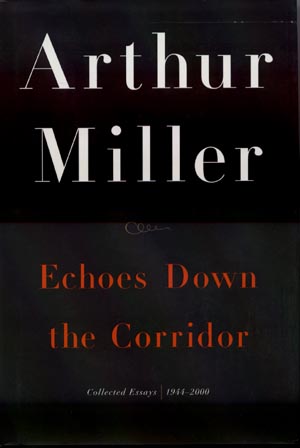
Steven R. Centola, ed. Arthur Miller. Echoes Down the Corridor. New York: Viking, 2000.
Review by Ana Lúcia Moura Nouvais, UniSant' Ann
Book Reviews
From: Vol. 3 May 2001 p. 6-7
Steven R. Centola, ed. Arthur Miller. Echoes Down
the Corridor. New York: Viking, 2000.
Review by Ana Lúcia Moura Nouvais, UniSant' Ann
In his preface to Echoes Down the Corridor: Collected
Essays,
1944-2000, edited by Steve Centola, Arthur Miller emphasizes in
the
first paragraphs his astonishment about his involvement with the
political
life expressed in his past essays. Although it seems a surprising
factor
for him, it does not surprise the reader of the audience who is
familiar
with Miller's works.
Beforehand, we should take into consideration the
title of this book, a reference taken from the epilogue of The
Crucible,
one of his most famous plays, deeply connected to the intent to express
a political point of view against the predominant hysteria in two
historical
events: the witch-hunt in Salem, Massachusetts, in 1692 and the
witch-hunt
stimulated by the Senator Joseph McCarthy in the 1950s.
Taking an overview in Miller's works, it is possible
to detect a set of themes evoked and reelaborated in his fiction,
critical
essays and drama, all of which reveals the author’s concern about
incorporating
in his creation process a discussion that implies the consciousness of
social and political structures. Miller’s autobiography, Timebends,
published
for the first time in 1987, reveals the procedure adopted by the author
in recollecting his own past, exposing memories and reflections about
his
career, interwoven with historical events. This procedure shows that,
for
Miller, his own life is highly associated with his own work experience.
A similar structure can be noticed in Echoes
Down the Corridor. The first essays "A Boy Grew in Brooklyn" and
"University
of Michigan" focus on aspects about Miller´s childhood and
his impressions about the University of Michigan, when he studied
there.
These personal impressions were set on a larger
dimension: how he experienced his interaction with foreign people in
Brooklyn
when he was a child and mainly how he had been introduced at that time
to the Depression Age, a recurrent historical episode presented in Death
of a Salesman, another well-known play by Arthur Miller.
The way Miller thinks about his time as a student
at the University of Michigan indicates another level of discussion:
the
profile and perspectives of the students of his generation compared
with
University of Michigan's students today.
The description of some past events and their effect
on current days can be understood as a kind of "echo" that extends
itself
through time. One of the "echoes" that hasn't faded in the air,
according
to Miller's point of view, is the impact of World War II, of Nazism on
mankind, as a legacy of an unsolved sense of guilt. The essays "The
Nazi Trials and the German Heart,"
"Guilt and Incident at Vichy,"
and "The Face in the Mirror: Anti-Semitism
Then and Now" express the author’s criticism toward the overwhelming
terror
spread by Nazism. The second and third of these essays are related to
the
play Incident at Vichy, written by Arthur Miller in 1965 and
the
novel Focus published in 1945. These essays trace
considerations
about the questions that underlie the structure of those works. They
share
a kind of growing need of getting conscious of the injustice often
manifested
in reality. In these two works by Miller, the protagonists move through
transformations in their attitudes as they develop their consciousness
about the unfair events which occurred during World War II.
This process of getting conscious of the historical
events, of the continuous injustice, inequality, and disaster
predominant
in almost every society through time, is asserted throughout the book
as
a vital need.
Although the essays collected in this book present
a variety of themes and were written from 1944 to 2000, many of them
deal
with a comparison between the context of a specific event in the past
and
its meaning today. This can be especially noticed in the essays
dedicated
to his plays — "Salesman at Fifty" and "The Crucible in
History."
These essays have in common the author's emphasis on the impact of the
past upon the present that has not dissolved, but somehow kept its
trace
and mark on present times. The essay regarding the fifty-year
anniversary
of the play Death of a Salesman contains details of the process
of creation of the play and the author's observations on the Chinese
production
in 1983. "The Crucible in History" reinforces and fulfills the
main
intent of Arthur Miller to expose and defend his own point of view in
an
open and passionate way, not only presenting arguments but also
appealing
to the reader to be aware of the seriousness of such discussion. "The
Crucible in History" recovers and clears up all the discontentment
of Miller before the episode of McCarthyism, through his experience in
researching the Salem trials and being interrogated by the Un-American
Activities Committee. In this essay, the author also establishes
connections
between his play and its impact when put on stage abroad in places like
China, Russia, South Africa, and South America--countries that share
the
experience of endured dictatorships and a terrifying process of
persecution.
These essays in Echoes Down the Corridor contain
many other relevant aspects in addition to the few selected for this
review.
Throughout, Arthur Miller states his ideas and positions
about
his own experience or about an historical event which denotes a flow of
consciousness, a deep reflection about past and present times
juxtaposed
to reveal some of their resembling features. The present events that
contain
something that originated from a prolonging effect of the past carry
out
the "echo" of that past, and as an "echo" one cannot clearly understand
what it is being said; one can only have the certitude that it is in
fact
an "echo."
From: Vol. 3 May 2001 p. 12
Stefani Koorey. Arthur Miller's Life and Literature: An
Annotated
and Comprehensive Guide. Boston: Scarecrow Press, 2000.
Review by Peter Hays, University of California, Davis.
Koorey's book is invaluable. As its title indicates, it is an
exhaustive,
annotated bibliographic guide to research printed in English on Arthur
Miller. Its table of contents indicates its thoroughness: after a
chronology,
Koorey, for primary works, lists all stage plays, screenplays,
teleplays
and smaller dramatic works, then radio plays and unpublished works,
fiction,
and poetry; under nonfiction, she separately catalogs books, forewords
and introductions, essays, speeches, letters, statements (brief
comments
in others’ works), and even blurbs for others' books. She also catalogs
interviews in print and in electronic media, as well as in
manuscripts,
correspondence, recordings, photographic and miscellaneous collections.
For secondary works, her book lists other,
prior bibliographies and checklists, dissertations, and biographical
articles,
essays, and profiles (arranged chronologically, but also indexed). Then
it catalogs critical works that deal with Miller in general: books,
essays
in books, essays in journals and magazines, essays in newspapers; and
brief
mentions. Next it lists each play, followed by the same breakdown of
critical
studies: books, essays, reviews (Broadway, London, and regional), as
well
as commentary on film, radio, and television plays, fiction and
non-fiction,
and even unpublished conference papers on Miller. (One omission here:
the
Prince William Sound Community College Fourth Annual Theatre Conference
in August 1996, which celebrated Miller, and which he attended). Next,
Koorey provides an list of media sources: a filmography of Miller's
film
and television plays (when produced, starring whom), documentaries and
tributes, sound recordings, and internet and CD-ROM sources. What is
most
amazing is that the annotations prove that she has seen most of
these
items noted in her book and summarizes their contents, a monumental
task
(as her introduction indicates). And finally, Koorey includes an
appendix
of premieres (US and London), dates, theaters, actors and directors, as
well as the list of sources she has consulted, followed by two indices,
one of names, one of titles and subjects.
Every college library and every researcher of the
works of Arthur Miller should have this book. It's an incredible
compendium
and an extremely valuable resource.
From: Vol. 3 May 2001 p. 12
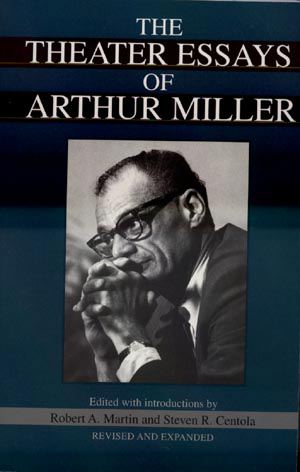
Robert A. Martin and Steven R. Centola, eds. The Theater Essays
of Arthur Miller, Revised and expanded.
New York: Da Capo Press, 1996.
Review by Frank Bergmann, Utica College of Syracuse University.
Reading the revised and expanded edition of Theater Essays is
rather like meeting an old friend after many years: he looks a little
different
and is a little more portly--by nearly fifty percent, we are told--but
is still the same good guy. Would a slimmer New Theater Essays
have
been preferable? Though there is some really good stuff among the
new pieces, the new edition's chief virtue seems to me to lie in making
the older gems readily available again, the likes of "Tragedy and the
Common
Man," "On Social Plays," "The Family in Modern Drama," and the
unforgettable
"The Shadows of the Gods."
The additions to this new edition include an
expanded
and updated literary chronology. There are two new essay sections, with
seven and eleven selections; thirteen additions to the cast lists; and
the bibliography is carried forward to 1996 from 1977 but also fills
out
the earlier years and adds useful bits of information, including TV,
videos,
and CD-Roms. Steven Centola's "Introduction to the Expanded Edition"
crisply
analyzes each new essay selection, but I am a little unhappy with his
Lomanesque
conclusion regarding "the tremendous talents of this outstanding
American
playwright": to my mind, Miller is not in need of being hawked.
So has our old friend changed except getting
older?
In 1972, Miller writes about the French Crucible movie: "I
don't
think it is a good idea as a general rule to try to make movies of
plays
because the play is based primarily on what words can make true, while
the movie is our most directly dream-based art and dreams are mostly
mute"
(365). Yet he writes the screenplay for the 1996 Hytner/Day-Lewis/Ryder
Crucible! Early misgivings about Broadway have turned to
full-fledged
lamentations by the time of the 1985 Roudané interview, and even
though New York has generally treated Miller with respect, Salesman
simply isn't The Lion King, and so it doesn't really matter
that
there were fifty-two German productions of Miller plays in one recent
year
(just where did I read that Hitler’s Germans might not have proved
quite
so villainous had they had some Disney with their Goethe and
Schiller?).
Miller has not stopped writing since 1996, which
is why some new theater essays have found their way into Centola’s
edition
of Miller's Echoes Down the Corridor: Collected Essays 1944-2000
(New York: Viking, 2000), though Centola might have pointed out that
"Notes
on Realism" in Echoes is a close rewrite of "About Theater
Language"
from the revised Theater Essays. Miller himself writes that the
focus of Echoes is politics, but since, for him, politics and
theater
are inseparable, we may look forward to having, some day, all his
essays
in one great big volume.
What stays with me after all the wisdom and the
heartache and the chuckles is admiration for Miller's sense of the
ending.
The man who closes the 1959 "On Adaptations" by: "The integrity of a
masterpiece
is at least equal to that of a can of beans" (217), and in 1993 calls
Broadway
theater "a cripple looking for a crutch" (525). Also a little
change
in Hamlet: the 1958 "the rest is silence" (194) becomes
the
1990 "The rest is gossip" (513).
Truly, Arthur Miller has a way with words, and
therefore
his way with us.
From: Vol. 3 May 2001 p. 13
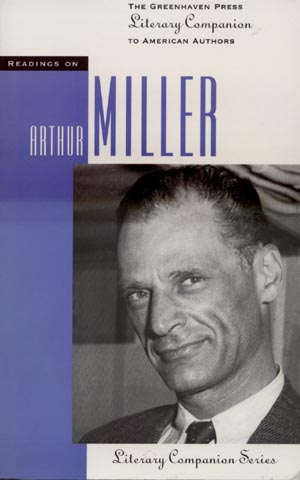
Thomas Siebold, ed. Readings on Arthur Miller.
San Diego: The Greenhaven Press, 1997.
Review by Harry Harder, University of Wisconsin at Eau Claire
The Literary Companion Series of the Greenhaven Press is
designed
for young adults with the goal of "provid[ing] an engaging and
comprehensive
introduction to literary analysis and criticism." While the
items included in this particular companion are certainly engaging and
would serve in a general way to introduce the uninitiated reader to a
study
of Arthur Miller, they are not, in my opinion,
"comprehensive."
For example, fourteen of the twenty-one items are from the 1950s and
60s,
and four of the five articles on Death of a Salesman
are from the 1960s. It would be important for anyone using this
collection
to either point out or become familiar with the historical setting of
not
only the plays but the material written about them and Miller. It
is also noteworthy that none of the items focuses primarily on the
major
theatrical and cinematic productions of Miller's plays, but deals
primarily
with themes, characterizations, style, and dramatic techniques.
With that said, this collection could, in a number
of ways, be a valuable tool in a course on Miller or major American
playwrights.
First, the brief but very informative biography at the beginning
of the book, and the chronology and list of Miller's works that end it
give any reader an excellent factual basis for starting research on
Miller.
The biography, however, goes only to 1993, leaving a gap that the
reader
or teacher needs to fill in. Chapters in the book cover the
background
to Miller's plays, including literary influences and the playwright's
run-in
with the House Un-American Activities Committee; themes in the plays;
extensive
criticism and analysis of Death of a Salesman and The
Crucible,
and, finally discussions of several non-dramatic works. An
interview
with Miller from 1990, an article (from 1959) by a close friend on
Miller's
creative process, and a speech by Miller on literary influences on his
work follow the biography and give the reader a real sense of
hearing
Miller's voice and beginning to understand what has driven him as a
dramatist.
In the speech, given in 1958, Miller asserts his belief "that you could
[not] tell about a man without telling about the world he was living
in,
what he did for a living, what he was like not only at home or in bed
but
on the job." And Miller makes it clear that Ibsen’s "problem
plays"
opened him to an understanding of what he saw as the true reason for
writing:
"because other people needed news of the inner world," and if they did
not get that news, "they would go mad with the chaos of their lives."
The chapters dealing with the two major plays
include
both positive and negative comments and evaluations, a good mix for
students
beginning the study of a major writer. And the essays are quite
varied
in style and level of difficulty. For example, Harold Clurman's
article
on Willy Loman, although brief, is challenging in its language and
provocative
in some of its ideas--a good article to use for class discussion on the
role of the critic in literary studies. Some of the other items
on
the play are more straight-forwardly informative and less
argumentative,
again a good mix. Since this collection is meant to be used
to introduce Miller, the emphasis on what most critics would consider
his
two major plays is understandable, and, of course, anyone using this
text
could easily supplement it with material or comments on, for example, After
the Fall and The Price.
Two features of this collection deserve special
mention. Each item in all the chapters is headed with a brief
summary
of that item so that the reader may determine which articles to read in
pursuit of his or her interest. Second, most of the
articles
include an insert, put there by the editor, that illuminates or
illustrates
some point made in the article. For example, in an article on
Miller's
writing process, the editor has inserted a comment by Miller about what
he thinks of the critics: "If I had listened to the critics I'd
have
died a drunk in the gutter." It's our good fortune that
Miller
did not listen to the critics, but it is also helpful to have a
collection
like this (including articles by a number of critics) to help us, as
both
students and teachers, to think about and discuss Arthur Miller's very
significant contributions to the American theater.
From: Vol. 3 May 2001 p. 14
Thomas Siebold, ed. Readings on "Death of a Salesman."
San Diego: Greenhaven Press, 1998.
Review by Carlos Campo, Community College of Southern Nevada
Even before the Table of Contents in The Greenhaven Press's recent Readings
on "Death of a Salesman," we have an entire page dedicated to the
following
quote by Miller: "Salesman is absurdly simple! It's about
a salesman and it's his last day on earth." Obviously, this quote
serves as an ironic preface to the 150 pages that follow, pages that
illustrate
the complexity of a play that is often called simple, but rarely
simplistic.
The text's Foreword sets forth the mission of the
Literary Series: "To present literary criticism in a compelling and
accessible
format" (10). While the Salesman edition is less than
compelling
at times, it is accessible throughout and provides students with a good
tool for research and personal study. The text contains a short
introduction
and a solid biographical section, followed by sixteen essays, a
chronology,
and selective bibliography. The essays are neatly divided into
three
"Chapters," which focus on "Themes," "Willy Loman," and "Relationships
in Death of a Salesman."
Editor Thomas Siebold has included work from most
of the authors that are synonymous with Miller criticism: Dennis
Welland,
Sheila Huftel, Neil Carson, Bernard Dukore, Edward Murray and Ronald
Hayman.
Chapter 1: "Themes" is the most in depth and strongest of the three,
blending
diverse perspectives of the play that include Miller’s own musings,
Expressionism,
Marxism, Consumerism, and Oedipal themes, among others.
There
are several fine pieces here, including the excerpt from Murray, who
deftly
debunks criticism that attacks Miller's perceived attempt to "answer
the
unanswerable." As Murray notes, "Critics who assault Salesman
rarely reveal where they stand; they seem to suggest that the answer
has
been found--perhaps they themselves have the answer--but that Miller,
through
sheer stupidity or perversity, has not provided the answer" (37).
Welland's comments are insightful as well; he not only refutes Eric
Bentley
and Eleanor Clark's insistence on the Marxist aim of the play, but also
provides an interesting evaluation of Willy and Charley's
relationship.
Brian Parker's focus on Expressionism in the play is quite trenchant,
especially
his comments on staging elements, including Jo Mielziner's set.
Parker's
note that Willy's father's flute playing has "degenerated" in the
modern
world to Willy and Biff's "unbusinesslike habit of whistling in
elevators"
(69), and even Howard and his children whistling on the tape recorder
is
fascinating.
Siebold has the confidence--or audacity--to include
Daniel Schneider's comments regarding the "Oedipal Theme" in the play,
an essay that Miller has alluded to several times in seeming disdain
for
the mention of the theft of Bill Oliver's fountain pen representing a
phallic
symbol. While that single assertion of Schneider's is rather
notorious
as a "critical stretch," the essay is quite strong overall, despite the
fact that he is at times given to hyperbole. Solid work from
Jacobsen,
Wilson, and Spindler round out the chapter.
Chapter 2: "Willy Loman" is an uneven section,
featuring
some of the collection's best and weakest essays. Neil Carson's
comments
on the "Father/Son Relationships in the Play" are excellent, as he
drives
home the point that "The quintessential boy-man, Willy is the eternal
adolescent
arrested at an early stage of development and because of it unable to
help
his own son to a healthy maturity" (89). Thomas Porter's
discussion
of "Willy Loman and the American Dream" clearly describes that Salesman
is "an anti-myth, the rags-to-riches formula in reverse so that it
becomes
the story of a failure in terms of success, or better, the story of the
failure of the success myth" (109). Nada Zeineddine tries to
point
out "Willy Loman’s Illusions," but her essay lacks a clear focus and is
often reduced to summary. John Shockey's essay, "A Comparison of
Ronald Reagan and Willy Loman" is a thinly-veiled political criticism
of
Reagan, which adds little to our understanding of Mr. Reagan or the
play.
Chapter 3: "Relationships" includes four essays,
with Kay Stanton's "Women in Death of a Salesman" the standout.
Any discussion that does not focus solely on the men in the play is
refreshing,
yet Stanton understands a crucial element of the play when she writes,
"Careful analysis reveals that the American Dream as presented in Death
of a Salesman is male-oriented, but it requires
unacknowledged
dependence upon women as well as women's subjugation and exploitation"
(131). Sheila Huftel's excerpt is quite fine; she elucidates the
visceral qualities of the play, concluding that "As far as possible in
Miller the intangible must be made tangible" (143). The selection
from Dukore is a bit superficial, though perhaps useful to a first-time
reader. Siebold's extract from Hayman is simply too short, but
includes
a first-rate observation of Willy's failure in the infamous scene from
Boston: "Willy has hidden The Woman in the bathroom and he has every
chance
of getting rid of Biff before he comes out, but characteristically,
after
telling him to go and wait downstairs, in his giggling admiration of
the
boy, he encourages him to repeat an imitation he has done of a
schoolmaster"
(127).
Siebold adds a nice touch by including excerpts
from Miller's autobiography Timebends, a choice that he could
have
exploited to further advantage. Siebold should expand the "For
Further
Research" section; it is clearly limited, even for an introductory
text.
Are there voices missing here? Surely, but one never knows the
restraints
faced by the editing team; there were many, undoubtedly. What
emerges
is a highly readable, well edited text, which will serve introductory
students
well. It seems that the editorial team's overall hope, "that
young
adult readers will find these anthologies to be true companions in
their
study of literature" is realized in this text.
From: Vol. 7 June 2003 p. 13-14
“Arthur Miller” in the Dictionary of Literary Biography
(Vol.
226).
Review by Carlos Campo, Community College of Southern Nevada
The latest volume of the Dictionary of Literary Biography (DLB
266) is entitled Twentieth-Century American Dramatists, and is
the
fourth in a series that began in 1981 with volume seven.
Christopher
J. Wheatley edits this edition, as he has the three previous in the
series,
in 2000 (volume 228), and in 2002 (volume 248). The DLB Advisory
Board describes their purpose as "to make literature and its creators
better
understood and more accessible to students and the reading public,
while
satisfying the needs of teachers and researchers." The entries
are
summed up as "career biographies, tracing the development of the
author's
canon and the evolution of his [sic?] reputation" (xiii).
The subject that dominates Wheatley's introduction
is the literary "canon," which he defines as "works that are typically
regarded as representing the enduring examples of aesthetic and
cultural
achievement" (xv). Wheatley relates that the first series editor, John
MacNicholas, implied that only O'Neill, Wilder, Williams and Albee
should
be considered canonical American dramatists. He further comments
that "If you asked an Irish or Polish scholar of American literature in
the early twenty-first century who the canonical American playwrights
are,
he or she would probably respond O'Neill, Arthur Miller, Williams,
probably
Albee, and maybe Wilder" (xvi). Wheatley makes an important point
about "shifting critical reputations" affecting what is available to
teach,
and furthermore, that what is taught, of course, is considered
canonical.
Wheatley recounts a recent review of Albee's Tiny Alice which
deemed
the play "pretentious," and he comments that "An unknown playwright
judged
to be pretentious would not be produced" (xviii).
Wheatley concludes his introduction by emphasizing
how difficult it is to fully delineate an "official" American literary
canon: "Although there are no formal characteristics that sum up the
American
canon, there are continuities. Most of the best plays tend to be
examples of domestic realism: O'Neill's Long Day's Journey into
Night,
Miller's The Crucible, Williams's A Streetcar Named Desire,
and Albee's Who’s Afraid of Virginia Woolf? are some examples"
(xix).
It is impossible to miss the fact that Wheatley gives Miller short
shrift
in his introduction; by replacing Death of a Salesman (surely
the
most canonized American play of all) with The Crucible, he
reinforces
his iconoclastic view of Miller and his plays. Miller was not
included
in the second or third series, either, appearing for the first time in
this volume.
The volume features twenty-nine (!) playwrights,
from Edward Albee to Elizabeth Wong. Albee and Miller are clearly
the "most likely to be canonized" here, with Albee's twenty-four pages
of text surpassed only slightly by Miller's twenty-five. Albee's
biographer, Lincoln Konkle, enters the canonical fray with:
"Scholars
have made the case that Albee, having sustained a career in the
American
theater for more than six decades, has joined Williams as a serious
challenger
to O'Neill's status as the great American playwright. Comprising
more than twenty-five plays, his body of work is as extensive as
Williams's,
as varied in subject and form as O'Neill's, as experimental as
Wilder's,
and as reflective on American society as Miller's” (5). Konkle
later
comments that Albee's plays are "almost certainly the most intellectual
of those by the major American playwrights" (26).
Steven Marino was given the daunting task of writing
Arthur Miller's entry, and he begins with a terse sentence which sums
up
his view of Miller's reputation: "Arthur Miller is one of the major
dramatists
of the twentieth century." Marino's opening line is emblematic of
his work here overall; he allows the reader's opinion of Miller's
literary
contribution to grow out of the body of writing rather than impose his
perspective on the reader. In addition, Marino never seems to
overwrite,
shunning hyperbole over carefully chosen prose that fits his task like
a favorite sweater: comfortable, familiar, classic. Marino closes
his opening paragraph with, "Miller clearly ranks with the other truly
great figures of American drama such as Eugene O'Neill, Tennessee
Williams,
and Edward Albee" (188).
Marino then moves on to trace Miller's life and
literature, inextricably bound as they are, commenting only once more
on
Miller's literary stature in his closing phrase: "Arthur Miller is
continuing
the pace that has made him one of the major figures in American
theater"
(206). The constraints of DLB's format and the prolific
nature
of Miller's career make Marino's assignment difficult indeed, as he is
forced to cover a wide range of plays and the events that fueled
them.
As one might expect, Marino calls Death of a Salesman Miller's
"masterpiece,"
and then goes on to discuss the play in the subsequent thirteen
paragraphs
(The Crucible gets seven, Broken Glass six). While
the play's critical reception and major themes are thoroughly
discussed,
Marino also takes time to nicely cover many of the play’s other
elements,
including Elia Kazan's contribution and Jo Mielziner's stunning
set.
Marino moves from life to "lit." seamlessly, recounting Miller's
writing
of the play in his ten-by-twelve cabin as he conjures the name Loman
and
the play's first two lines, "'Willy' and 'It's alright. I came back.'"
There is a quiet, but unmistakable confidence in
Marino's writing, a sure-handedness that undoubtedly springs from a
lifetime
of interest in Miller and diligent background study. He covers The
Price with the same aplomb as The American Clock and The
Last Yankee; plays that even some Miller aficionados might find
puzzling.
Miller's penchant for all things political is a prominent feature of
the
entry, as Marino details Miller's active political life and its clear
affect
on his drama. Marino concludes the piece by relating Miller's
relentless
artistic activity, from the publication of Echoes Down the Corridor,
a collection of non-theater essays to the August 2002 premiere of his
latest
play, Resurrection Blues.
Miller's section also includes eight photos and
Playbills for View and The Price. DLB's
illustration
policy reflects its concern with "the iconography of literature," and
icons
such as Marilyn Monroe, Lee J. Cobb, and Miller himself grace the pages
here. The Price's Playbill is especially reflective of
its
time, as a terrific photo of the actors engaged in a scene is flanked
by
a prominent ad for Kentucky bourbon: "Old Grand-Dad is waiting for you
in the bar." A massive list of further readings concludes the
entry,
with exhaustive sections entitled "Interviews," "Bibliographies,"
"References,"
and "Papers," respectively.
Steve Marino's work here clearly indicates that
he was a fine choice to author this important reference work, which
provides
a reliable and comprehensive overview of Miller's life and work.
While one would expect to see Miller in a subsequent volume in this
series,
Marino's yeoman effort will surely stand as a worthy testament of
Miller's
unmistakable contribution to American letters.
From: Vol. 7 June 2003 p. 7
Words at War: World War II Era Radio Drama and the Postwar
Broadcasting
Inductry Blacklist by
Howard Blue. New York: Scarecrow Press, 2002.
Blue's book discusses the role of Arthur Miller's radio dramas,
alongside
sixteen other progressive radio dramatists, and a number of the actors
involved during this period of assistance towards the World War
II
effort. The book also discusses the coalition of right-wing
forces
that attacked Miller and his colleagues and drove many of them from
radio.
Radio dramatist Norman Corwin calls the book, ". . . masterly . . . .
Blue
stands with Barnouw and Dunning, and it is high rank indeed."
Paul
Buhle of Brown University (author of books including Popular
Culture
in America) states, "This may well be the best book on American
radio
ever written." Check <www.howardblue.com> for
more
details. For further information including how to purchase a copy
at the author’s discounted price, contact Howard Blue via the internet
at: <Khovard@Juno.com>. Or mail: Howard Blue, 1951
Valentines
Road, Westbury NY 11590.
From: Vol. 8 December 2003 p. 10-11
Arthur Miller--His Life and Work by Martin
Gottfried.
Da Capo Press, 2003. 446 pp.
Review by Will Smith, Drew University.
Author of the most comprehensive Miller biography to date, Martin
Gottfried
is remarkably candid in his introduction about the immediate weakness
of
his work. "Arthur Miller decided not to cooperate with the
writing
of this biography when he realized that it would deal with not only his
work but his life" (x). Circumventing the uncooperative primary
source
with whom he had worked amicably before, Gottfried sought to validate
his
conviction that "There are…more than theatrical reasons for telling
this
life story" (x). Certainly plenty has been written about Miller's
work, much of it by Miller himself. Gottfried labels Miller's
1987
autobiography Timebends "calculated," "selective," and
"sometimes
misleading" (x) and challenges its accuracy and honesty throughout this
book. But according to Gottfried, "Arthur Miller's notion of a
biography
was a book about his plays" (ix). Over the course of his 446
pages,
Gottfried rather successfully finds the man beneath the plays by
attempting
to find the man in the plays, ironically validating Miller's perception
that an analysis of his work is a biography of him.
Miller's reluctance to reveal himself to Gottfried
scars the work, repeatedly drawing attention to Gottfried's frustration
with his subject. Actor Jason Robard's quip, "It's real difficult
to get close to Arthur. He's always remote" (365), captures the Miller
Gottfried chooses to present. Throughout, Gottfried labels Miller
self-absorbed, self-analyzing, remote, moralistic, and emotionless--a
man
who approximates a smile only by tightening his cheek muscles.
Gottfried
offers some explanation for Miller's emotional distance, not the least
of which is a dramatic fall from grace after the emasculation suffered
by marrying and divorcing the most fantasized-about woman in America.
Perhaps playing to his audience, Gottfried devotes
nearly 100 pages of his work to the unhappy life of Miller and Marilyn
Monroe. At times sounding infatuated by the starlet himself,
Gottfried
writes at length about Monroe's life and career during her courtship
and
marriage with Miller, too frequently editorializing about her
awe-inspiring
beauty. Although Marilyn's inclusion in the work is essential,
Gottfried's
treatment of her and other subjects at times borders on the
salacious.
He reports when Marilyn learned she was pregnant with Miller's child
(she
would later miscarry) that she was "fearful that her many abortions had
made it impossible for her to carry to term" (313). Additionally,
he rather weakly suggests that when writing A View from the Bridge,
Miller became aware of "incestuous impulses in his relationship with
this
beloved daughter [Jane]" (260), only to discount what he'd written a
paragraph
later, "The subject probably says more about Miller's relationship with
himself than with his daughter" (260). He also needlessly repeats
an account of Arthur's teenage experience with a prostitute.
Finally,
and perhaps most revealingly, Gottfried notes that Miller's first child
with his third wife, photographer Inge Morath, a son Daniel, was a Down
Syndrome baby whom the couple sent to an institution where he would
later
die, never spoken of, or visited by, his father.
The pedagogical nature of Gottfried’s approach overrides any
sensationalism
that escapes the individual chapters. At times sounding like a Cliff's
Notes companion to the body of Miller's work, he offers long plot
summaries
of each play and infuses them with relevant elements from Miller's
biography.
Most of these explorations are forgettable with a few notable
exceptions.
Gottfried does a particularly good job with All My Sons, The
Crucible,
Death of a Salesman, and After the Fall, expertly tracing
character,
script, and theme in each. He shows evidence of thorough research
into early drafts of the major works, offering a variety of extricated
lines for our consideration. The Salesman chapters are so
strongly told that we root for Miller's success with the play as he
overcomes
difficulties with production, titling, and actor selection, and awaits
the early newspaper reviews from opening night.
Another highlight from the work is Gottfried's
sensitive
and perceptive reading of Miller’s complex relationship with director
Elia
Kazan. Gottfried melds a host of sources to piece together the
extraordinary
successes of the pair and detail their subsequent parting following
Kazan's
appearance in front of the HUAC. In particular, Gottfried makes a
convincing quid pro quo case tying Miller's silence about Kazan
directing
On
the Waterfront (a work strikingly similar to Miller's The Hook
which he and Kazan had pitched to Hollywood only years before) to
Kazan's
withholding of Miller's name at his testimony in front of the HUAC.
Gottfried's book is exceptionally well-timed.
Miller has just celebrated his eighty-eighth birthday (though the book
awkwardly presents him in past tense), Kazan was recently given an
Academy
Award and died only months ago, and PBS has been running specials on
the
McCarthy Era almost regularly for months. Gottfried's conclusion
supports the case that American interest in Arthur Miller may be at its
highest since the 1950s. Though Gottfried does not provide the
American
who knows Miller only as the author of The Crucible and the
husband
of Marilyn Monroe any new reasons to celebrate his life, seeing the
playwright's
works splayed across the page, one cannot help but acknowledge his
unparalleled
longevity in American drama.
Gottfried remarks that Miller, at 45, was considered
an "American theatrical anachronism, with his . . . most produced and
best-respected
work--generally considered behind him" (308). Poignantly,
Gottfried
relays an account from 1968's Democratic National Convention where
Miller
looked out at the audience and remarked, "There was the American people
. . . That’s the audience I wish I had. They're not in my
theater.
And if they ever got into the theater, you would have something!
You would have fever!" (384). Given that Miller so aptly
captures
the economic and social realities that Americans struggle under every
day,
there exists a painful irony in the fact that his best audiences reside
overseas.
Gottfried presents Miller as a man looking to
capture
the human condition and in the process capture and understand
himself.
Reviewers of his later plays pilloried Miller for belaboring his
biography
in a way that they did not attack O'Neill and Williams. Gottfried
identifies a complex group of factors that contributed to Miller's fall
from American stardom including his emphasis on morality, adherence to
theatrical realism when modernism came into fashion, and association
with
America's beauty, Marilyn Monroe. However, it is as likely that
American
audiences--the figurative sons and daughters of the HUAC that attempted
to end Miller’s career in the 1950s---have a limited appetite for
introspection,
self-flagellation, and brazen challenges to the American ideals so many
of them unquestioningly hold so dear--the very elements that make
Miller's
life his work.
From: Vol. 9 June 2004 p. 17
Arthur Miller: Genius! The Artist and the Process by Bruce
Glassman. Englewood Cliffs, NJ: Silver Burdett, 1990. 117pp.
Review by Susan C. W. Abbotson, Rhode Island College.
Considering the frequency with which both Death of a Salesman
and The Crucible are taught in High Schools, it is only
surprising
that it took so long for someone to write a biography of Arthur Miller
explicitly aimed at "juveniles." This is very readable, and written in
a jaunty style that engages the reader, but there are troubling aspects
which make me wonder if our juveniles might not deserve something
better.
In eleven brief chapters, Bruce Glassman takes us
from Miller’s "Harlem Days," through to Danger Memory! offering
an overview of Miller's life and career over this period. Clearly
feeling a need to keep his younger audience interested, there are times
when events become over-sensationalized, and Miller's life is presented
as a series of coincidences and lucky chances much like that of David
Beeves
(for instance, do we really need to know that critic John Anderson died
three weeks after advising Miller not to give up playwrighting?).
Also, some of the potentially titillating aspects of Miller's life
(such
as his aborted singing career and, of course, Marilyn) are dwelt on too
long.
More problematic are a series of misleading
assertions;
Miller's uncle, Manny Newman, becomes an unrelated neighbor from
whom Miller once borrowed a hammer, misreading an aside from Timebends,
working titles for Death of a Salesman become Death Comes
to
the Archbishop and Death and the Maiden (The Inside of
his
Head isn't even mentioned), Creation of the World and Other
Business
rather than "Some Kind of Love Story" is the play we are told which was
inspired by the Reilly case, and there is an unnecessary implication
that
Miller only married Inge Morath because he got her pregnant! Such
remarks color the veracity of the book as a whole. Glassman
includes
a number of quotes from Miller for which he offers no citation, so
where
these come from (and indeed other information on offer here), be it
archival
material, personal interview(s), or something else, is never indicated.
Miller's formative years are described as
"unremarkable"
(9), rather than the stereotypical artist's period of struggle and
pain.
Glassman strongly encourages his reader to view Miller's immediate
family
as the raw material for most of his characters, and declares that
Miller's
discovery of Marxism was to "greatly influence the rest of his life"
(16),
and The Crucible made Miller "a spokesman for the leftist
cause"
(65. Similarly blown out of proportion is Glassman's continuous
insistence
on Miller's perennial "uncertainty" as a writer; after Death of a
Salesman,
"[Miller] was struck with a sinking feeling that he would never find
another
thing about which to write. It was a feeling that would come and
go in him for the rest of his life" (20). Telling us that "Miller
was never able to walk away from the guilt he felt about his success"
(41),
further likens him to David Beeves, but comes across as facile.
The descriptions of the plays are potted, mostly
a brief summary and broad strokes as to Miller's creative process, and
the intended examination of common themes, usually a couple of
sentences
summing up a central overiding theme for each play—all get increasingly
sketchy as we get into the 1970s and beyond. A bibliography of only six
books, and not ones that have been carefully chosen is sadly
inadequate,
and the chronology, which offers social context by including major
world
events, is also sketchy regarding the production of later plays, making
Miller's work look less produced than in fact it has been.
One positive to the book is the array of photographs
included. There are plenty of pictures in each chapter to
illustrate
both Miller's work in the theater, changing family situation, and the
general
historical period under discussion (indeed the ratio of space devoted
to
photographs vs. text is around 3:5). There is also a splendid
color
picture portfolio in the center of the book with scenes from plays,
posters/playbills,
and candid shots of Miller I had not seen before. Although
clearly
more interested in Miller's ethical/political/psychological development
than artistic (the book's title is also misleading), Glassman does
include
reference to most of Miller's work, even the Michigan plays, and some
of
his aborted efforts in the 1960s (despite the radio plays being
dismissed
in two words as "patriotic plays" without even naming any titles), so
this
study will at least expand its uninformed reader's knowledge a little,
but it remains uncertain as to whether its advantages outweigh its
faults.
The way Glassman makes such a big deal of Miller
being unable to give a clear answer as to how he wrote such a good play
as Death of a Salesman seems to purposefully set him up for a
fall,
suggesting that "genius can be just as arbitrary as failure"
(53).
We soon get the sense that Glassman views Miller's political
involvement
as more important in his later years than anything he has
written.
While outwardly objecting to what he considers the unjust unpopularity
of Miller's work, Glassman seems to tacitly agree the work is unworthy
of attention as he summarizes American Clock as
"unconventional"
(102), Playing for Time as "hard-minded" (106), Archbishop's
Ceiling as "highly intellectual" and "too sophisticated" (106), and
the earlier one-acts as "hard to understand, with hidden meanings and
vague
allusions to seemingly unrelated events" (107). Of the later
plays,
only "Clara" seems to meet with approval. For all Glassman opines
about Miller's future, his conclusion implies that he sees Miller's
career
in the theater as long dead.
From: Vol. 9 June 2004 p. 17-18
The Facts on File Companion to American Drama by Jackson
R.
Bryer and Mary C. Hartig Eds. New York: Facts on File,
2004.
xiv; 562pp.
Review by Susan C. W. Abbotson, Rhode Island College.
Tired of going to the library to spend hours browsing the reference
shelves or plowing through mostly irrelevant sites on the internet to
find
the salient details on American dramatists and their plays? Want
an accurate, detailed reference guide to answer all those niggling
questions
and dates about who did what, when, where and why? Wait no more,
as husband and wife team, Jackson Bryer and Mary Hartig have put
considerable
time and effort into providing us with just the guide we need.
Covering
American drama from its humble beginnings through to the twenty-first
century
there are entries here on all of the major playwrights, movements, and
individual plays you’ve ever heard of (and some which may just be
new).
Great efforts have been made to reflect both the entire span of
American
drama as well as its sheer diversity.
Bryer and Hartig allow us to realize that American
drama did not just spring to life with O'Neill, but has been developing
since the eighteenth century. They outline this truth succinctly
and with clarity in their introduction, and then embellish it with
numerous
entries on key plays and playwrights from the early years (from Thomas
Godfrey and Royall Tyler through to Augustin Daly and James
Herne).
As they explain, "While some of these earlier plays may be of uncertain
literary and theatrical value," they remain, "stepping stones to the
undeniably
greater works that came after them" (vi).
Quoting several misguided critics, who have long
ignored the vibrancy of American drama, and commenting on the irony
that
these same plays and dramatists have often enjoyed a better reputation
in Europe than on their own native soil, Bryer and Hartig point
out
that "American drama has often been regarded as the poor stepchild in
the
family of American literature" (v); this whole book is testament to the
obtuseness of such a belief. Bryer and Hartig clearly feel
American
drama has been and continues to be an exciting arena of ethical inquiry
and innovation, as well as cultural, social and political
interest.
It is supported by a magnitude of theaters across America (more than
one
hundred professional and semi-professional producing companies in New
York
City alone, and at least fifty each in cities like Chicago and
Washington
DC), which collectively belie the insignificance of American drama, and
assure its continued growth in the future.
Obviously, Arthur Miller is well represented, with
a succinct two page bibliography and entries on seven of his major
plays
(about the same amount given to contemporaries such as Edward Albee,
Sam
Shepard and August Wilson). Only Eugene O'Neill and Tennessee
Williams
take up more space, but the lengthy three page entry on Death of a
Salesman
balances that out, as most entries on plays only take up a page or
less.
Miller's entry covers his life and works from his Depression era
beginnings
through to Resurrection Blues. My only complaint would be
the surprising omission from the bibliography of Stephani Koorey's
invaluable
annotated bibliography Arthur Miller's Life and Literature
(2002),
a far more detailed and up-to-date guide than John Ferres's Arthur
Miller:
A Reference Guide from 1979, and no mention of Terry Otten's The
Temptation of Innocence in the Dramas of Arthur Miller (2002), or
Stephen
Marino's A Language Study of Arthur Miller's Plays (2002),
both
excellent studies that, again, cover far more than some of those early
studies from the 1960s and 1970s which are included.
While many of the entries have been written by the
book's editors, a number have also been provided by an array of
evidently
knowlegable scholars (87 in all). The book also contains useful
appendixes
listing the winners of various major drama prizes, and a general
bibliography
for American drama which supplements the bibliographies on individual
plays
and playwrights throughout the book.
From: Vol. 11 June 2005 p. 14-15
Arthur Miller: A Critical Study by Christopher
Bigsby.
Cambridge: Cambridge University Press, 2005. x; 514pp.
Reviewed by June Schlueter, Lafayette College.
Arthur Miller: A Critical Study may not be a Festschrift
for the playwright, but the coincidence of its publication and Miller's
death is fortuitous. Indeed, Miller might not have appreciated
essays
by diverse hands so much as this volume, which pulls together the many
strands of Miller's life and career to present what will surely be the
definitive tribute to America's foremost playwright.
Nor is anyone better positioned to have written
this critical study than Christopher Bigsby, who teaches at the
University
of East Anglia, home of the Arthur Miller Centre; who was responsible
for
the BBC radio broadcast of The Golden Years in 1987; who brokered the
love
affair that Britain had with Miller in his later years, including a
part
of the gala eightieth birthday celebration in 1995; who knew Miller
personally
and interviewed him frequently; and who publishes widely and
perceptively
on American and British theater.
Bigsby has published on Miller before--most notably
File
on Miller (Methuen, 1988), (ed.) Arthur Miller and Company
(Methuen,
1990), (ed.) The Portable Arthur Miller (Penguin, 1995), and
(ed.)
The
Cambridge Companion to Arthur Miller (Cambridge University Press,
1977).
But none of his projects, nor those of any other scholar, has been this
extensive. Arthur Miller: A Critical Study is a
compendium
of information, drawn from a range of resources, and a seasoned
sequence
of judgments on the plays and the man. It follows the work
chronologically,
from the Michigan plays of the 1930s through
Finishing the Picture
(2004), documenting and assessing a 68-year career that was still in
motion
when Miller died in 2005. In interspersed chapters, Bigsby
engages
larger issues--"Arthur Miller: Time-Traveller," "Tragedy," "The
Shearing
Point," "Fiction," and "Arthur Miller as a Jewish Writer"--and in brief
narratives that serve as postscripts to his discussions, he provides
information
on production.
Even Bigsby's brief introduction reveals his depth
of understanding of Miller both as a person and a playwright.
Indeed,
his examination of materials in the Harry Ransom Humanities Research
Center
at the University of Texas at Austin, the University of Michigan, and
the
Billy Rose Theatre Collection at the Library of the Performing Arts,
Lincoln
Center; of typescripts provided by Miller; and of rehearsal materials
have
yielded discoveries and insights. In his discussion of the
Michigan
plays, for example, Bigsby takes us through three versions of Miller's
variously titled first effort, which won him the University’s Hopwood
Award,
and he identifies another wartime play, Boro Hall Nocturne
(1942),
previously unknown. Bigsby is as conversant with the never
produced
Half-Bridge
(written 1940-43 and "over-stuffed with plots" [34]) as he is with the
widely known Death of a Salesman (1949); he offers a fine
chapter
on the radio plays and insightful analyses of the late 20th- and early
21st-century writings, including Finishing the Picture, which
Miller
had begun in 1977-78 and returned to in 2003-04. Even in chapters
on the much analyzed plays--All My Sons, Death of a Salesman, The
Crucible,
and A View from the Bridge--he offers perceptive close
readings,
refreshed by notes on early drafts, some discarded, and revelations
secured
in conversations and interviews.
It is clear from his nearly 500 pages of commentary
that Bigsby recognizes the coherence of the Miller canon, seeing in it
the relentless reflection of a mind aware of unfolding events in the
world
and deeply concerned. Hence the imperative of individual action,
the interplay of responsibility and guilt, and the constraints of
contingency
and destiny appear and reappear, mapping an individual quest for
correspondence
between his own moral positions and the world's. Marxism,
Communism,
Judaism all figure in what Bigsby styles "the corridors of Miller’s
work,"
which he aligns with care.
Bigsby explores Miller's preoccupations, with
family,
for example, particularly father/son, and with America. With Death
of a Salesman, he sifts through the many interpretations Miller
himself
offered and settles on the Beijing notebook statement that "Death of a
Salesman, really, is a love story between a man and his son, and in a
crazy
way between both of them and America" (102). Indeed, even at an
advanced
age, Miller did not stop exploring that relationship: in The
Ride
Down Mt. Morgan (1991), a play that Bigsby calls "a response to
Reagan’s
America" (366), Lyman Felt undergoes (or undertakes) a crisis when he
reaches
the age at which his father died. Nor did Miller ever abandon the
motif of the American dream. As Bigsby puts it in his discussion
of Mt. Morgan, "Loman, the loser salesman of Death of a
Salesman,
has become Lyman, the salesman who believes he has found a way to win"
(368-69). In numerous plays, right up through Resurrection
Blues
and Finishing the Picture, Miller's wish for an unconflicted,
reconstructed,
fair-minded America is plain. As he moves through each successive
chapter, Bigsby braids the instant work with the ones before it,
creating
a critical frame within which the synchronicity of Miller's work
becomes
both visible and clear.
I have two quibbles with Bigsby's book, neither
of them serious. One is that Bigsby only infrequently
acknowledges
the critical work of other scholars. Though in the privileged
position
of a retrospective on Miller's entire career, and though abundantly
equipped
with primary material, Bigsby seldom touches base with the considerable
body of secondary literature on Miller, which could well have enhanced
his own analyses. The second is that Bigsby might have included
more
of his own experience with Miller's plays in performance.
Although
the interstices of chapters collectively form a production record and
he
does speak of performance within the chapters, one wishes that a
scholar
who has been so engaged with theater had more frequently dipped into
his
own recollections of how individual productions responded to the text
and
how audiences, himself included, responded to the plays. Indeed,
the newly established production archive at the Museum of Television
and
Radio in New York and Los Angeles about which Susan C. W. Abbotson
writes
in the June 2004 Newsletter promises a bright future for
performance
scholarship on Miller. Whatever its records yield, however, will
only embellish Bigsby's study, which is, in its own right, a
substantial
piece of scholarship and an immense achievement.
Reviews by society members of the following (and more) coming soon:




Play Reviews:
From: Vol. 3 May 2001 p. 8
"A View from the Bridge as Opera"
Review by Paul Schlueter and June Schlueter, Lafayette College
New operas, even those with scores by noted composers and librettos
based on distinguished literary works, rarely seem to become part of
the
standard operatic repertoire. Doris Lessing's two works set as operas
in
collaboration with Philip Glass, for example, seem doomed to be
curiosities
that receive an initial production or two, then are never heard from
again,
as seems also to be the case with André Previn's setting of
Tennessee
Williams' A Streetcar Named Desire.
This does not, however, seem to be the fate that
will occur with William Bolcom's distinguished operatic setting of
Arthur
Miller's A View from the Bridge, which received its premiere
performances
in October 1999 at the Lyric Opera of Chicago, the company that
commissioned
the work. To be sure, this production received far more advance
publicity--as
well as enthusiastic reviews--than has been true with many other
contemporary
works, but, in this case, the hype was completely justified. In all
respects,
View
is an artistic success.
We were fortunate in being able to attend the first
of View's nine over-subscribed performances at the 3,500-seat
Civic
Opera House, as well as an invitation-only press conference in which
the
principals--Miller included--discussed the work's genesis and
production
with an audience of critics from around the world. Though over the
years
we've attended many operatic events of both standard and new works,
this
was one of the more exciting productions we have experienced. Wholly
aside
from the book and score, the technical touches, using the talents of
some
of the theatre world's most celebrated talents, made this a remarkable
event. Lyric, long one of America's more imaginative opera companies,
had
previously commissioned Bolcom's setting of Frank Norris' McTeague
and Anthony Davis' Amistead, and though both were acclaimed,
neither
has had as major an impact as View.
Bolcom (b. 1938), who was awarded the Pulitzer Prize
for Music in 1988 as well as Guggenheim, Rockefeller, and NEA grants,
has
written a number of other operas, including one based on the writings
of
William Blake, Songs of Innocence and Experience, and composed
cycles
for performers as varied as mezzo Marilyn Horne, cellist Yo-Yo Ma, and
flutist James Galway. He is possibly best known for his ragtime
performances
and other theatrical settings; but as a student of such distinguished
composers
as Darius Milhaud and Olivier Messiaen, among others, he is surely
conscious
of the divergent directions modern music can take. Rather than taking
the
"minimalist" paths of Glass, John Adams, and others, however, Bolcom
prefers
an eclectic synthesis of American popular musical forms and traditions
with major international influences. View, for example,
includes
such popular touches as doo-wop, blues, tango, and a slightly rockish
version
of the old standard tune "Paper Doll" as well as grandly orchestrated,
dramatically accessible scenes.
Opera necessarily requires some leveling of
characters
and relationships because of the sheer necessity of communicating all
experiences
and emotions through music. Bolcom and his longtime collaborator,
playwright-librettist
Arnold Weinstein, focused on longshoreman Eddie Carbone and his family
and friends but not at the cost of making them types, ethnic or
otherwise;
these individuals become subtly-shaded characters whose lives and
feelings
are richly moving. Noted soprano Catherine Malfitano as Beatrice, for
example,
is perfectly cast, as is resonant baritone Kim Josephson as Eddie and
tenor
Gregory Turay as illegal-alien Rodolpho. (Turay's high-tessitura
singing
of a lyrical "New York Lights" seems destined to become a standard by
itself,
and Marco's "I Sailed Away" by bass-baritone Mark McCrory is
dramatically
powerful.) Baritone Timothy Nolen is effective as lawyer Alfieri, and
soprano
Juliana Rambaldi is suitably vulnerable as Catherine.
Frank Galati is a remarkable stage director, as
his extensive work with such theatre companies as Goodman and
Steppenwolf,
as well as Lyric, have long demonstrated. Dennis Russell Davies is a
highly-regarded
young conductor. Santo Loquasto, familiar as Woody Allen's favorite
production
designer for his films, is costume and set designer, and evocatively
re-creates
the Red Hook setting with angular, expressionistic touches of girders,
including the brooding Brooklyn Bridge overseeing all that occurs on
stage.
Duane Schuler's lighting has won acclaim at the Met as well as in
Europe,
and in View he is subtly able to adapt lights and Wendall K.
Harrington's
grainy photographic projections to create changing emotional
relationships
among the characters. Donald Palumbo's excellent chorus serves nicely
as
a touch that Miller enthusiastically endorsed, as a Greek chorus
commenting
on the action.
In short, nothing in this production, which was
four years in the planning, has been left to chance, and the
result
is a wholly satisfying artistic effort. Thematically, it becomes a
modern
musical version of the "force of destiny" that Verdi dramatized so
memorably
in the nineteenth century. It will be a force many others will be able
to experience when New York's Metropolitan Opera tackles it in 2002.
From: Vol. 3 May 2001 p. 9
"The Crucible at Muhlenberg College: A Review"
Review by Paul Schlueter
It would be difficult to find a professional production of Arthur
Miller’s
The
Crucible, much less a college staging, more flawlessly produced
than
Muhlenberg College's short run that ends this afternoon. Indeed, if
there
were anything that would enhance this production, it would be
additional
performances that would enable reviews and word-of-mouth to bring in
the
audiences it deserves.
The play is set in the Salem witch trials but written
during, and clearly about, the infamous Joseph McCarthy-HUAC madness a
half century ago. It remains eerily prophetic as civil liberties and
individual
conscience continue to be eroded for ideological orthodoxy and presumed
national defense. Miller's protagonist in The Crucible, John
Proctor, is the epitome of the playwright's ordinary but morally
courageous
hero in that he is willing to lay down his life, if need be, to
preserve
his integrity and name.
Proctor's personal honor transcends mere expediency,
and as played by Matt Kelley he is flawed yet morally superior to those
determining his fate.
Nor is his wife Elizabeth, played with quiet power
by Kelly Howe, any less impressive in maintaining her dignity in the
light
of maliciously slanderous accusations by the promiscuous Abigail
Williams,
played superbly by Emily C. Abruzzi. Among Abigail's companions in
their
false accusations of witchcraft are Lisa Daly, Abby Mahone, and Candace
Raio. Bit parts are equally strong, as with Nicole Shamice Lomax as the
slave Tituba, Aileen Chumad as Rebecca Nurse, and J. Michael DeAngelis
as Giles Corey.
The ambitious judges (Robbie Saenz de Viteri and Gabriel L. Nathan)
are more interested in procedures that prove guilt than in truth, just
as is Parris, an arrogant clergyman (Jarad Mitchell Benn) who values
greed
and ambition, and all are played persuasively. Tyler Ryan Ault is
powerful
as the Rev. John Hale, summoned to investigate charges in the parish.
Hale
ultimately sees the injustice in the witch-hunt, but he is powerless to
alter the momentum of accusations leading to the deaths of innocent
people.
Francine Roussel, who was involved in the 1996 film
version of the play, directs with unusually fine attention to ensemble
movement and blocking, as well as to uniformly excellent delivery by
her
large cast. Indeed, about the only directorial reservation one can
register
is her gratuitous gallows shot at play's end, which somewhat dilutes
Elizabeth
Proctor's final lines.
Technical details are also fine, notably Mildred
Greene's accurate costumes and Dennis Parichy's lighting. Michael
Schweikardt's
set makes effective use of simple plank walls with doors and panels to
create a bedroom, kitchen or courtroom. Paul E. Theisen, Jr., designed
the sound, and Edgar A. DuPont served as technical director.
[This review ran Sunday, Feb. 25 2001 in THE EXPRESS-TIMES
(Easton,
PA) (reprinted by permission of the author)]
From: Vol. 7 June 2003 p. 9
"The Crucible at Syracuse Stage"
Review by Frank Bergmann, Utica College
Affiliated with Syracuse University, Syracuse Stage is the only
equity
theater in upstate New York; it has provided that region with--in the
words
of its anniversary slogan--"30 years of fabulousness." As part of the
promotion
for its February 19-March 22, 2003 run of The Crucible, the Stage
distributed an interview with director Timothy Douglas in which he
explains
why the cast, except for a few parts, is African American like himself:
"The primary thing is that The Crucible is a play about
persecution
and the response to that persecution. It is also a quintessentially
American
play, and I think that a response to persecution cannot come with any
more
authenticity than through the descendants of African slaves."
Now it could be argued that The Crucible is first
of all a play about a man's integrity, and that in America no one can
speak
more authentically about persecution than the survivors of the
Holocaust
or their descendants or the descendants of the millions who were
killed.
The one overt connection with the issue of race in The Crucible
is Tituba, and her response to it, so it seems to me, Miller has
rendered
clearly and empathically. Douglas promises the listeners (viewers?)
that
"[n]o matter how well they may think they know this play, they’re going
to hear new things."
I was hoping to be enlightened in regard to "the
single error" of John Proctor's life: as John Winthrop reports in his Journal,
James Britton and Mary Latham "were condemned to die for adultery" and
executed. If even just faint echoes of that early Puritan rigor could
still
be heard in 1691, then Elizabeth's urging John to go and denounce
Abigail
takes on a whole other meaning, as does John's "I'll think on it." Let
us remember that Danforth wants to know from Elizabeth: "To your own
knowledge,
has John Proctor ever committed the crime [my italics] of lechery?" A
related
problem for me has been John's responsibility--or more properly lack
thereof--toward
Abigail. Marcel Aymé put it this way: "Pursued by remorse for
having
committed adultery, he shows no regrets regarding his gravest
shortcoming,
that of having led astray a little soul who had been entrusted to him."
Of course Miller adduces extenuating circumstances for John's betrayal
of Elizabeth, namely the dynamic which Elizabeth eventually describes
as
"[i]t needs a cold wife to prompt lechery." However, Miller
dismisses
Abigail's case as "a whore's vengeance": the abused girl discredits
herself
by incredible overreaching, unleashing a public storm to right a
private
wrong.
But to the performance (March 21). Hale, Corey, and the
Nurses were white actors. Abigail, Elizabeth, and Parris were
light-skinned
African Americans; John, Mary Warren, Putnam, and Danforth (yes!) were
darker. Given this cast, I set aside Douglas's announced intentions in
order not to get lost trying to figure out his racial calculus; I
decided
to consider the actors as characters in the play only rather than also
as director's messengers. Judge Hathorne, Marshal Herrick, and Hopkins
were dropped, with a new character with an authentic name, Willard,
taking
Herrick's place. Parris took over Hathorne's "Can you faint now?"
shtik.
I am not sure what the reasons for the changes were (I do not care
about
Hopkins, who makes the tiniest of cameo appearances in Miller's text),
but I began to understand why Miller has so often inserted himself in
casting
and other aspects of production.
The rabbit stew scene which opens Act 2 was omitted. At
the end of the play, the set did not provide a window whose bars
Elizabeth
is supposed to grip for support (and, in my opinion, restraint). The
most
severe change occurred with Hale, who was made into an old man.
Conversely,
Rebecca's bathetic "breakfast" line was kept. The set was spare and
suitably
uninviting, with clever lighting from below as well as from above. The
costumes, especially those of the girls, were more colorful than the
sumptuary
laws would have permitted. There was some fine acting (Cynthia
Addai-Robinson
as Abigail, Rachel Leslie as Elizabeth, Tyrone Mitchell Henderson as
Parris,
Larry John Meyers as Hale, Jane Welch as Rebecca Nurse, and Malcolm
Ingram
as Giles Corey). Kim Sullivan (Danforth), however, inspired no fear,
and
Tamara E. Johnson's (Mary Warren) voice was thick, as was Ray Anthony
Thomas's
(John Proctor), the latter becoming nearly unintelligible in the
emotional
scenes.
I came away once again deeply moved by the play's power,
but I did not hear new things and found no answers to my questions.
From: Vol. 7 June 2003 p. 9
"A View From the Bridge Has New York Debut at Metropolitan
Opera House"
by Stephen Marino, St. Francis College
The incredible run of revivals of Arthur Miller's work that have
appeared
on the New York stage in the last seven years continued this season as
the Metropolitan Opera presented the New York debut of the operatic
version
of A View From the Bridge for eight performances in December
2002.
The opera, which premiered at the Lyric Opera of
Chicago in 1999, is composed by William Bolcom, with a libretto by
Arnold
Weinstein and Arthur Miller. Bolcom made some changes for the New
York version, most notably adding two new arias, one each for the
characters
of Eddie and Beatrice. The production opened on December 5 and
received
strong reviews. Howard Kissel of the New York Daily News judged
that
"it is one of those rare times when opera is great theater."
Anthony
Tommasini of the New York Times called it an "involving and significant
work."
I attended the final performance on December 28
which was broadcast live over the Chevron Texaco Metropolitan Opera
International
Radio Network to more than 360 stations in the United States and 40
countries
in the Americas, Europe, East Asia, and Pacific Rim. Admittedly,
no opera buff, my interest in this work, mainly lies in how Miller's
masterpiece
would translate into operatic form. I knew that Miller had
explained
that when he first heard in his Brooklyn neighborhood the story upon
which
he based the original one act version, he thought he had heard it
before
as "some re-enactment of a Greek myth." Consequently, Miller
designed
both the one act and two act plays with the grand structure and themes
of tragedy; thus, the play seemed to me, as the composer has said, a
"natural"
for opera. The gestation for the opera version of View
actually
began with co-librettist Weinstein, who had taught the play in his
classes
at Columbia. After the composer Bolcom contributed the music for
Miller's play Broken Glass in 1994, Weinstein, with Miller's
approval,
encouraged Bolcom to make View his next operatic work.
The December 28 matinee featured three particularly
strong performances: Kim Josephson's robust portrayal of Eddie strongly
conveyed his tragic descent; Catherine Malfitano's vocal range was
particularly
effective in capturing Beatrice's conflict between her niece and her
husband;
Isabel Bayrakdarian, in her Met debut, convincingly expressed
Catherine's
growth from girl to woman. The standout performance belonged to
Gregory
Turay as Rodolpho whose tenor voice frequently moved the audience to
applause.
His performance of "New York Lights" in the first act is one of the
more
dramatic moments in the opera when Rodolpho sings a paean about his
love
for New York City. The song has been receiving particular notice
from music critics as having a melody that could be attractive to
popular
music listeners. Composer Bolcom explains that he conceived the
song
to deliberately fuse Broadway-type melody with an early 20th century
Neapolitan
one. The song's lyrics also are notable for mixing images from
locations
in Sicily and New York. Turay's tenor voice sustains notes for so
long that the effect is haunting.
The massive set, designed by Santo Loquasto, befits the grandness of
both play and opera. The set merges interior and exterior settings
without
clear delineation. Steel girders and platforms evoke both the docks
where
Eddie plied his trade as a longshoreman and the Brooklyn Bridge, which
has literal and figurative importance in the work. Brick and wood
suggest the tenement buildings of the Red Hook neighborhood where the
Carbone
apartment is located. Scrims and projection screens also cast
images
of Sicily, Brooklyn, Manhattan, and the Red Hook docks on the back
walls.
The set also provides necessary space for the production's large
chorus.
The chorus, fits Miller’s scheme to place Eddie among his neighbors
because
his passion for Catherine begins the violation of the social codes in
which
the Sicilian-American community operates. The operatic chorus was
as powerful as in any stage version of View I have seen.
My academic interest in how the play would translate
into operatic form was completely satisfied from the opening minutes of
Act 1. When I heard Alfieri sing his first lines, I immediately
recognized
them as belonging to the original 1955 act version of View,
which
Miller wrote in an intriguing mixture of blank verse and prose.
In
fact, in composing the piece, Bolcom has incorporated a significant
amount
of this prose poetry. Miller’s lyrical dialogue effectively
adapted
to the dialogue of operatic music.
View is now touring major U.S. cities and
is expected to become a regular part of the American operatic
repertoire.
From: Vol. 9 June 2004 p. 16-17
"Review of Broken Glass"
By Francis Beckett, Garden Suburb Theater, in Highgate, London
In November 1938, a Jewish New York woman tries to go out and
suddenly
finds she cannot move her legs. The doctor cannot find anything
physically
wrong with her. So what's on Sylvia Gellburg's mind? Each day she
reads of Jews being persecuted in faraway Germany. Old men are being
forced
to scrub Berlin pavements with toothbrushes, and the Jews around her do
not seem to care. Her husband, who regards his Jewishness as something
to live down, thinks German Jews may have brought their troubles on
themselves.
(A lot of people said that in the thirties, in then UK as well as in
America.)
Her doctor, who is also Jewish, says it is a passing fad and is bound
to
end soon, because Germans are cultivated people with fine literature.
Her
sister, when Sylvia talks about the Nazis, simply says: "Oh, that!"
Of course, Arthur Miller is far too good a
playwright
to rely on ideas alone. Sylvia's husband made her give up work, and he
has not been able to make love to her for years. She lusts after her
doctor,
who was something of a sexual predator when young and probably still
is.
But at its heart, Broken Glass is a play
about Jewishness, and Mandy Ribekow-Evans as Sylvia never lets you
forget
it. Hers is a delightful, sensitive performance, all the more powerful
for being a little understated. She lies in her bed, or sits on her
wheelchair,
dominates the theatre with the intensity of her reactions, and never
once
resorts to histrionics, for she does not need them.
Sylvia's husband Phillip is in many ways the central
character. He's made his career in a firm which employs no other
Jews--he's
"buried himself in the goyim" as another character puts it. The
challenge
for an actor is that he's in many ways an unattractive character, but
the
play will not work unless the audience cares what happens to him. It's
a challenge to which Andy Wilson rises magnificently.
From the first moment we meet him, when he is rudely berating the
doctor's
wife for calling him "Goldberg," we care. Wilson can speak, or sit and
listen, but he never stops being Phillip Gellberg, puzzled husband of a
woman who is much brighter than him, the over-eager servant of a louche
and greedy WASP. We feel we know him well enough to shake him and try
to
make him look clearly at the world. It's a truly remarkable
performance.
Rusty Ashman is completely convincing as the doctor,
a sexual sophisticate, and integrated Jew who has "married out." "What
Jew rides a horse?--says one of the other characters when he appears,
magnificently,
in riding clothes. The contrast, as they sit together, between him and
the crumpled, black-suited, unhappy Gellberg is heart-wrenching. Ashley
Collins makes the very most of her chance with the doctor's wife, still
in love, still sexually jealous of him, still suspicious (and with
cause,
we suspect) of his relationship with his female patients.
Roger Rose plays Gellburg's employer with all the
casual arrogance of great wealth. He's assured, relaxed, a little
patronising.
Little as we see of him, Rose enables us to get to know him. Sylvia's
sister
is played by Pauline Rosenthal, and according to the programme notes,
it's
the first time she has ever acted, anywhere. If so, it's a remarkable
debut.
She got right into the skin of this rather silly and superficial woman.
We quickly knew her well enough to be frustrated at her inability to
see
anything beyond the enfolding walls of her own home. Bernard Smith's
direction was thoughtful and understated,
the work of someone who is taking care with a play he loves. American
accents
were not overdone, simply indicative--enough so you would know it was
American,
not so much that an English cast would start labouring over them.
Everything was done with care. When Sylvia's scenes
ended with a blackout, she did not get up and walk out under cover of
darkness;
a stagehand was sent to carry her. And in the intervals between scenes,
a curtain opened and a lone cellis--Alexis Ashman--caught and maximised
the mood of that part of the play. She was, in many ways, the
best
thing about the evening. Lighting (David and Debbie Lane) and
stage
management (Andrew Craze) reflected the careful, thoughtful,
understated
mood.
It was performed in Upstairs at the Gatehouse, Highgate’s theatre pub,
a delightful theatre space which, to me, throws into sharp relief the
drawbacks
of the bare, institutional hall in the Suburb. I saw the show on
the Thursday, which was certain to have the lowest attendance of the
run,
and it was almost full. What's more, most of the people there were not
GST members. We'd achieved that rare thing, an audience that doesn't
depend
on the presence of all Rabbit's friends and relations.
I suspect there's more of a potential audience in
Highgate than in the Suburb, and that a pub theatre is a more
attractive
place to spend an evening than a school hall. I suspect too that if we
choose plays with one eye on the people who live hereabouts, we have a
better chance of getting them to come and see us.
With Broken Glass we had a play which stood
a good chance of getting an audience in a Jewish part of London. And
slightly
higher prices won't stop people coming if we are giving them what they
want, where they want to: they will not then worry too much about
£8
for non members, and £3 for members. And if you can offer a
production
of this quality, no one is going to feel cheated afterwards.
From: Vol. 10 June 2004 p. 4-7

"Finishing the Picture at the Goodman"
Review by Paula Langteau, University of Wisconsin-Marinette
In the same month as the playwright celebrated his 89th
birthday--October
2004--Arthur Miller's newest play, Finishing the Picture, had
its
world premiere at the Goodman Theatre in Chicago. And it goes to
show that even at age 89, Miller is still at the top of his game.
Finishing the Picture is about the making
of a film--or perhaps, more specifically, about attempts to finish
making
it, given that the lead actress, Kitty, spends virtually the entire
play
in bed, debilitated by depression and drug abuse. Through the
course
of the play, the rest of the cast work to coax her out of bed, to get
her
to finish the picture. Artfully directed by Robert Falls, the
play
features Stephen Lang and Linda Lavin as acting coaches Jerome and
Flora
Fassinger; Frances Fisher as Kitty's personal assistant, Edna Meyers;
Stacy
Keach as film producer Phillip Ochsner; Harris Yulin as film director
Derek
Clemson; Matthew Modine as Kitty's husband, Paul; Heather Prete as
Kitty;
and Scott Glenn as cinematographer Terry Case.
Not so loosely based on Miller's relationship with
Marilyn Monroe and the finishing of the screenplay, The Misfits,
the (auto)biographical connections can be identified readily in
Miller's
memoirs, Timebends. Yet, despite the obvious biographical
links, Miller wants the audience to get beyond the notion of Kitty as
Marilyn,
insisting, as Modine described in the talk-back session following the
October
7 performance, that Kitty not speak and that she not have blonde
hair.
In fact, in the Goodman's production, the audience catches a glimpse of
Kitty's face only briefly in the course of the entire play and she
speaks
lucidly only once, in the opening scene, and then only to call out for
Flora, her acting coach.
Quite frankly, the technique works. While
so much of the play can be seen as clearly biographical, the potency of
the play comes in its much larger message, provided first by the script
and then given powerful visual dimension by its skillful direction in
the
hands of Robert Falls. What becomes evidently more important than
Kitty, her identity or her appearance is the impact these have on
others
around her. So, while the actors focus on Kitty, the play
ultimately
is more about them and their reaction to her than about her, and, thus,
serves as a critique of the expectations and dependence of the creators
and consumers of film and film culture.
Through the use of superimposed film and landscape
images--as well as character close-ups--onto three stage scrims, Miller
and/or Falls (without the script it becomes difficult to determine
which
choices originated with whom), reflect the filmmaking process through
the
projection of images onto a two-dimensional surface. As the play
opens, the scrims reflect filmmaking images, such as the trademark
motion
picture number countdown to a film’s beginning, the typing of a
typewriter,
and the closure of a clapboard signifying "takes." The audience
also
sees film images of Kitty at a window, pairs of feet dancing on the
beach,
a speedometer racing to 100 miles per hour, a leopard, and a
sandscape.
These images set the stage for a story of the two-dimensionalizing of
experience
through the creation of film, the distancing of the actress from
reality,
its effect on personal relationships, the out-of-control acceleration
of
the damage, the predatory nature of the business and the ultimate
integration
of the experience into the landscape of our culture. Following
intermission,
the scrims are again employed, this time to reflect a mountain scene
that
slowly metamorphosizes into Kitty's body and finally into an inferno,
reflecting
simultaneously the California forest fires gaining ground just outside
the window of the penthouse where most of the play’s action takes place
and the metaphorical fire threatening to overtake Kitty. Thus,
the
actress is subsumed into the landscape and, ultimately, consumed by
it.
These images simultaneously forecast and summarize the story played out
on the stage boards.
The scrims serve their most powerful function,
however,
when they effectively cast the audience in Kitty's role by reflecting
her
vision, presenting the view from her physical perspective. This
happens
in a confessional-like scene in Act Two, when the audience sees
simultaneously
both the full scene on the stage and a close-up image of each
respective
character in the play, through Kitty's eyes (in live video on the
semi-transparent
scrims), as they take turns coming to her room to sit by her bedside to
share their stories. These scenes reveal more about each of the
characters--their
desires, fears and needs--than about Kitty. Kitty becomes their mirror,
the screen projecting each of their deepest issues, needs and longings.
As the characters come to confess, in the process they come to their
own
revelations. Edna credits Kitty for this, saying, "You see
through
everything." Thus, like a silent priest hearing the confessions,
she becomes almost Godot-esque, a savior-like figure, not unlike
Ralph/Charlie
in Miller's Resurrection Blues. Like Ralph/Charlie, who
she
is is less important than who she is to others. As Modine says in the
talk-back,
"She doesn't have to exist in the bed. She represents our salvation."
Of course, Kitty's own burden is heavy, what Derek
refers to as "100 pound weights on her ankles" and "the ghosts sitting
on her chest." And her destruction is inevitable. This is
reflected
most vividly in her unhealthy dependence upon her acting coaches,
Jerome
and Flora Fassinger (the Lee and Paula Strasberg figures). From
her
bed, Kitty demands to see Jerome Fassinger, presumably to help her
return
to the set. Clearly neither psychologist nor psychiatrist, and
quite
visibly eccentric on stage, the character Jerome (as played by Stephen
Lang) and his wife Flora (played by Linda Lavin) are redeemably
endearing
to the audience with their ridiculous attire, quirky mannerisms and
laughable
self-importance. (At one point, Jerome credit himself with having
"forged the link between who [Kitty is] and the entire cultural history
of art.") Yet, while in the play his ludicrous pronouncements are
hysterical and his costuming, humorously absurd (and, incidently,
directly
out of the pages of Miller's autobiographical recollection of Lee
Strasberg's
appearance), Miller’s recounting of the dangers of the Strasbergs'
Method
Acting training in Timebends is anything but funny:
Applied to Marilyn, Paula's 'method'--and Lee's--was beginning to seem sinister, a dangerously closed circle of reasoning; if you had not studied with Strasberg and were not one of his adepts, you were not in a position to criticize . . . . I was in this category, . . . barred from applying experience and common sense to a steadily degenerating situation whose arcane depths were by definition beyond us. If Paula could not help her, no one must be allowed to. To add another complication, Marilyn's trust in Paula was by no means complete: she regarded her merely as Lee's stand-in who was indeed capable, however unintentionally, of misleading her. (Timebends 420)In the play, Miller further explores the continuum of Kitty's loss of identity and the seeming co-existence of her simultaneous powerlessness and sense of power. On the one hand, Kitty's identity has been swallowed up in the image she portrays in film. Or, as Miller describes it for Marilyn in Timebends, "The simple fact, terrible and lethal, was that no space whatever existed between herself and this star. She was 'Marilyn Monroe,' and that was what was killing her. And it could not be otherwise for her; she lived on film and with that glory foresworn would in some real sense vanish . . . . Since her teens she had been creating a relationship with the public, first imaginary and then real, and it could not be torn from her without tearing flesh . . .. . One thing only was sure; she must finish the picture. To fail would confirm her worst terror of losing control of her life . . . " (483).
Work Cited
Miller, Arthur. Timebends: A Life. New York:
Grove
Press, 1987.
From: Vol. 10 June 2004 p. 7-8
"Arthur Miller's Finishing the Picture at the Goodman
Theatre
in Chicago, IL. 10 October 2004"
Review by Kate Egerton, Indiana University South Bend
The Goodman Theatre's production of Arthur Miller's new play, Finishing
the Picture, begins with overlapping silver screens in front of an
opaque curtain. After an old black and white countdown sequence,
the screens show a film montage of a dreamland desert and fragments of
a woman's body. The camera lingers over slices of her face, her
back,
her shapely derriere, her legs, and eventually she is shown meandering
through the desert with a man. Both are filmed only from the
waist
down, the woman taking off her shoes the better to walk in the sand.
While Miller clearly based Finishing the Picture
on the filming of The Misfits, focusing exclusively on the
Marilyn
Monroe character, and her ability--or inability--to work, he has taken
occasional pains to distance the audience from that specific
event.
The film's story is never mentioned, and there are no indications that
any other cast members remain on the set. While the Goodman
Theatre's
publicity materials show fragments of Heather Prete's blonde head, on
stage,
Kitty wears dark brown hair.
The performances of this very accomplished cast
are all quite distinct, so much so that they don't all quite seem to
belong
in the same play. The Fassingers--Kitty's acting coaches, played
by Linda Lavin and Stephen Lang--are of a piece and wickedly sharp
caricatures
of Lee and Paula Strasberg. After Flora Fassinger has set the
pattern
by moaning on endlessly about her shoddy and penurious treatment on the
set while lounging around the producer's balcony in a voluminous black
caftan that frequently threatens to engulf the petite Lavin, Jerome
Fassinger
comes on the scene in act two in a bizarre red and black cowboy suit,
which
he eventually completes with both hat and boots. The duds,
combined
with his glasses and chin beard, make Lang look like Lenin after a trip
to a flashy western outfitter. Matthew Modine's Paul, the screenwriter
who is also Kitty's husband, comes off an earnest nerd who tries and
fails
to talk about love. Derek (Harris Yulin) and Terry (Scott Glenn),
the filmmakers, are shown calmly plying their trade, trying to keep the
film up and running despite the perpetual absence--literal or
metaphorical--of
Kitty (Heather Prete), the leading lady. She, in turn, is propped
up--both literally and metaphorically--by Edna (Frances Fisher), her
mousy
but resourceful secretary and handler. Phillip Oschner (Stacy
Keach),
the trucking magnate turned neophyte producer, fills the role of the
outsider
to whom all must be explained. While Modine is clearly an
idealized
stand-in for the young Miller, Robert Falls has spoken about Oschner as
"sort of the romantic hero of the play, which I think is kind of
wonderful--and
perverse. But within him, we're also seeing a portrait of Arthur now"
(Kuchwara).
The only character who does not map onto the story of The Misfits,
Oschner plays a central role in the play's tenuous resolution of
Kitty's
story, becoming the vehicle through which Miller can craft what new
perspective
Finishing
the Picture offers.
We learn about the film's troubled history when
Oschner arrives at the hotel to figure out why production has stalled
and
to determine whether to shut the film down. In addition to the
short-term
losses, the characters all make clear that this decision would destroy
Kitty's career. He has begun his efforts by seducing Edna, who
seems
pleased if enormously self-conscious to find herself the focus of any
man's
attention. In the early morning, as the play opens, he looks out
from the hotel balcony and sees the signs of a wildfire approaching
from
the west. He soon finds that there's a wildfire in the hotel,
which
soon appears in the form of a starlet, both nude and stoned,
practically
falling into his room.
Kitty, for all that she has absolutely no dialogue
and practically no costume, holds all of the power in this play in the
rawest fashion imaginable. Usually nude, mute but for mewling,
kittenish
cries that recall Charlie Brown's teachers on helium, her internal life
is as withheld from the audience as her body is exposed. Kitty is
oddly desexualized despite appearing naked. Flora may lie on her
bed, and Edna constantly rubs her head and her back, but the
men--especially
Paul--keep their distance except for a chaste peck or the offer of a
supportive
arm. Following the pattern established in the opening montage, the
audience
never gets an unobstructed view of her face for all that we see of the
rest of her. When the play opens, the film crew is waiting, as
they
wait every day, to see if Kitty is fit to work. Terry, the
cinematographer,
measures this fitness by examining her eyes and deciding whether or not
the camera will pick up her drugged state. The audience never has
a chance to check; in the only scene where Kitty stands face forward,
she
hides behind an enormous pair of sunglasses. Paul, Kitty's
husband,
is obviously disgusted by her condition and her behavior.
Although
he tries to look out for Kitty in a particularly perfunctory fashion,
it
is clear that he feels thoroughly rejected and he knows that in every
way
that matters, Kitty is utterly lost.
After the interval, the screens from the prologue
display a similar film, but now Kitty's prone and naked body morphs
into
and out of the mountains themselves. She is the desert, the body
of the land, larger than any human presence and as impervious to human
desire. The last image before the third act is the horizon
filling
with flame--reflections of the wildfire, coming her way.
During the third act, the largest translucent movie screen from the
opening montages moves back over the set. As the cast parades in
one by one to talk to Kitty, by now huddling under a sheet in Phillip
Oschner's
bedroom, each face and voice is projected in closeup as the actor mimes
the scene beyond the screen. The giant close-ups, filmed from
below,
attempt to put the audience in Kitty's position, but they also makes
the
rest of the cast look better; in this format, even the ridiculous
Jerome
Fassinger is allowed to be moving.
All of the movie people have other interests, more
real and pressing interests, than this picture: Derek seems to be
smuggling
drugs on the side, Terry spends the film waiting to hear about an oil
fortune
that may be coming his way, the Fassingers obsess over their studio and
the cash flow that keeps them afloat, and Ochsner clearly considers
this
whole project, no matter how emotionally engrossing, a small diversion
from the serious business of interstate commerce. While the
audience
believes that he genuinely feels for Kitty--he ends up with a better
attempt
to communicate with her in the third act than anyone else
manages--given
a choice between Kitty and Edna, Oschner has already chosen Edna.
We have no idea what Paul will do next, but he'll be doing it alone.
As for Kitty? Well, everyone already knows
what happened to her.
Work Cited
Kuchwara, Michael. "The Joy of working with Arthur Miller in
the Creation of a New Work." The Associated Press State &
Local Wire 20 Oct. 2004.
From: Vol. 10 June 2004 p. 8-12

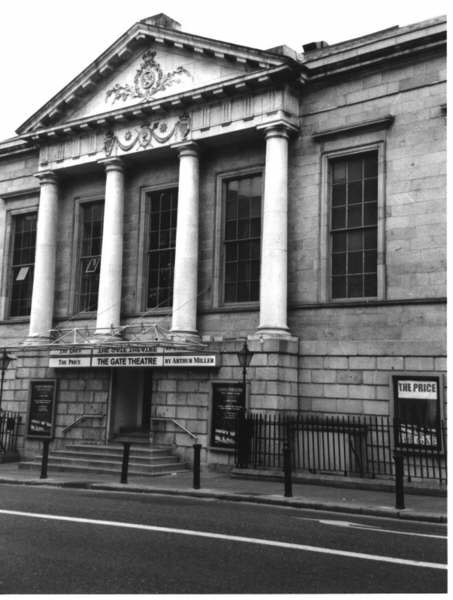
"A Dark and Riven World: Review of The Price at
Dublin's
Gate Theatre, June 8, 2004"
Review by Lew Livesay, Saint Peter’s College
Dublin's Gate Theatre provided the ideal venue for this version of The
Price that dramatized a fierce refusal to allow intimacy to take
hold.
This controlled performance, at the outset, very quiet with low voices
and moments of silence, made the mounting revelations of the second act
all the more potent. The theatre itself, and the audience, helped
in capturing so much of the nuance in this play. The classic Gate
building, located a kilometer north of the Liffey, atop O'Connell
Street,
has been home to theatre for over two centuries. The main hall
only
seats 371 people. Every seat is close to the stage, and the
acoustics
carry precisely to each corner. So intimacy is built into the
theatre's
setting, as it is into the attention span of the people in the
seats.
Last year, I remember distinctly the laser precision of realizing that
a Gate crowd is unparalleled after I had sat through Declan Conlon’s
one
man performance of John Banville’s The Book of Evidence,
adapted
by Alan Gilsenan. The play ran over two hours without
intermission,
and not once during the entire piece did one cough or distraction issue
from the assembled mass. It was a stunning immersion in
concentration,
virtually matching the tour de force upon the stage. In Timebends,
Miller observes that "the English were probably the best audience in
the
world" (430). I'll only add that they have apt competition across
the Irish Sea.
Directed by Mark Brokaw whose credits take in all
periods and many major theatres throughout the states, this Dublin
production
foregrounded the revelations in the marriage of Victor and
Esther.
Ger Ryan played Esther with intensity reminiscent of Elizabeth Franz in
the O'Neill Theater production of Salesman back in 1999.
Once
again, Ryan, like Franz, revealed the depth of another female character
in the Miller oeuvre. This Esther was every bit as neurotic as
her
husband, but she also had moments that broke through her habituated
tedium
to envision a world of possibilities undreamt of in her husband’s
self-imposed
imprisonment as self-convicted family martyr. Her pain became all
the more vivid for her moments of seeing that what could be, will never
be.
The acting throughout was superb. Lorcan
Cranitch
played Victor as a man, especially in the second act, who is searching
deep within himself to find and get out the next word, much like
Malkovich
played Biff in the 1984 production of Salesman. Nick
Dunning
came on stage as Walter, looking very much like a charming Jay Gatsby,
with the slicked back blond hair, the effortlessly wide smile, and the
elegant camel hair coat. This Walter's confidence gained
throughout
Act 2, as his brother's confidence waned. In this production, the
"two seemingly different roads out of the same trap" emphasize the
differences
over the original sameness (The Price 110; emphasis mine).
What made sense to me during this viewing was the line from Schleuter
and
Flanagan that "neither of the two brothers changes his commitment"
(109).
This family stands riven with no hope of crossing the chasm, much as
Esther
hopes to do. Her despair has two roots: one is economic and the
other
is emotional. She is willing to trust Walter just to better her
economic
plight, but in the end, she is as paralyzed as the two brothers.
She has settled into her drinking and substitution of the dog for a
human
mate. And yet Ger Ryan played Esther with such awakened ferocity
that, at two moments in the second act, it felt as if she had already
left
her husband. It left me wondering for a moment if the play had
actually
been revised.
In this staging, Esther stands alone as the one
who can see what neither of the brothers have any hope of ever
seeing.
A.C. Bradley once wrote that if Hamlet had been in Othello’s shoes, he
would have readily unveiled the conniving of Iago quite promptly, and
if
Othello had been in Hamlet’s shoes, he would have taken action without
such paralyzing delay. If either of the brothers in Brokaw’s
rendering
of The Price would have listened to the words or cared about
the
suffering of Esther, their worlds might have evolved toward
happiness.
With Ryan's performance, the character of Esther provides a momentary
glimpse
at hopeful solutions to the stalemate between the brothers. In
many
readings of the play, this function is attributed to Solomon. In
one of our foremost readings to date, Chris Bigsby centers the play in
the relationship of the two brothers and reads their conflict as a
"tension
between determinism and freedom" (20/165/225). Both Alice Griffin
and Terry Otten, as does the interpretation from Schleuter and
Flanagan,
also develop readings out of foregrounding the brothers.
The Dublin production of The Price was
starkly
darker than any of the others that I have seen or read about. In
fact, in looking over the interpretations of the best Miller critics, I
was surprised to see how inclined Bigsby, Schleuter and Flanagan, and
Roudané
are to urge optimistic readings of the conclusion. Their readings
generally
find Gregory Solomon's final laughter to be a redemptive note
suggesting
that missed connections need not be the norm if one adopts a philosophy
of flexibility and continues to fare forward in life as Solomon has
always
done, ready to remake oneself as changing conditions demand. This
roll-with-the-punches outlook has tremendous appeal, and no doubt a
production
can even foreground Solomon, presenting his vitality as a variation to
characters trapped in their own solipsism.
Miller actually avoided a question one time from
Bigsby who was suggesting that Solomon has a stereotypical nature by
insisting
simply, "I enjoy that character more than anybody I ever wrote" (Arthur
Miller and Company 148). Roudané runs with this idea
as
far as anyone: "Solomon, the most humorously and humanely drawn
character
in Miller's repertoire, functions as a kind of modified raisonneur, his
benevolent wisdom offering a healthy counterbalance to the animosities
within the Franz family" (200). The Dublin production, however,
did
not go that route; it emphasized corrosion, rather than
salvation.
In "The Salesman Has a Birthday," Miller talks about how he has
witnessed "a terribly lonely people, cut off from each other by such
massive
pretense of self-sufficiency, machined down so fine we hardly touch any
more. We are trying to save ourselves separately, and that is
immoral,
that is the corrosive among us" (13). This passage conveys the
felt
experience of Brokaw's The Price. The brothers each exist
apart in his own "self-sufficiency," never giving an inch to the other
in stubbornly refusing to see the world from the other's
perspective.
Only the woman sees how hopelessly divided they are. Even Solomon
remains ensnared in his own revitalized attempts at survival so that
the
laughter at the end of this production comes across with a slightly
sinister
sense that he has come out on top in this financial give-and-take in
trying
to get the long end of the stick, with the laughing record thrown in as
absurd surplus to his unexpected financial windfall. Here he is,
reborn at his age, in having bested a cop and a surgeon. Solomon
is always coming out of retirement, whether it is Her Majesty's navy or
the appraiser's industry, which he made "ethical" (61) --a line that
elicits
the strongest laughs from the other three. In this play,
laughter,
like claims to ethics, usually occurs at someone else’s expense.
In this cynical laughter, the verbalization which came to mind was
George
Bernard Shaw's question in Major Barbara--"What price salvation
now?"
My feeling from viewing this play in Dublin was
that "The two brothers participate in a moral fencing match that scores
no palpable hits and ends where it began" (Schleuter and Flanagan
110).
If the play is intended, as Miller tells us in "Behind The Price,"
to mirror the irreconcilable splits in America during the Vietnam War,
then the stasis at the end of the Dublin production was an objective
correlative
of America at the time the play was first produced in 1968
(60/297).
At this point I am reminded of Raymond Williams' reading of After
the
Fall, a play which he did not get; nevertheless, he shrewdly
perceives
that the play "has the weight and disturbance of a culture behind it"
(276/16).
In this same essay, Williams perceives how the culture has moved beyond
the moral position of Ibsen in that "the social reality is more than a
mechanism of honesty and right dealing" (269/9). This thinking is
supported by Miller's own claim in his conversation with Bigsby that
both
brothers are needed in the current world (Arthur Miller and Company
148)--a
point that is reinforced with the observation in the Stage Notes to the
play: "As the world now operates, the qualities of both brothers are
necessary
to it (117). The direction in which Williams points us involves
reading
Miller in relation to the culture and the ideologies that are prevalent
at the times of the play. One of the important tasks that faces
all
of us in the Miller Society is to be thinking more and more about how
Miller's
plays can help us to understand the significance of the twentieth
century,
with its sequence of nightmares that must be interpreted.
Shortly after returning from Ireland, a colleague
of mine in the English department at Saint Peter's College, Bill Luhr,
alerted me to an interesting book on cultural history by Lary
May.
Luhr said that a few passing references to Miller in May’s book had
made
an impression on him about how painful the HUAC experience must have
been.
With that prompt, I picked up a copy of The Big Tomorrow, a
work
that basically examines how the American film industry has been a
shaping
force in defining our culture. Following the depression, the
studios
all contributed to reinforcing an implicit ideology that would present
images and plot lines implying that in America disparate people readily
blended into one homogenous accord. Similarly, in Timebends,
Miller describes how, after the depression and during the war years,
people
simply relinquished their sense of individual identity to become part
of
something larger, but lacking in any sense of "transcendence."
Miller
goes on to say that ". . . conformity became the new style of the hour"
(262). For May, much of twentieth century Hollywood can be
understood
as operating with a conservative impetus toward promoting an
Anglo-Saxon
temperament of stoic manhood as the quintessential American character.
The telling point in May's story is how the original philosophy behind
the Republican party, projected most fervently in the thinking of
Lincoln,
with its aversion to racial and class intolerance, has one last hurrah
in the Will Rogers persona before ultimately sacrificing a social
vision
in favor of an economic vision of monopoly masquerading as
capitalism.
The argument maintains that the Depression, World War II, and the Cold
War created conditions that suppressed class consciousness in favor of
rallying the nation around a leadership that could establish its
elitist
superiority at the center of American life. National submission
to
conservatism, in order to survive three staggering traumas, is what
ultimately
empowered Republican hegemony. Questioning this norm at a time
when
the nation was at risk could easily be depicted as an act of
unpatriotic
malice. Through such a filter the American dream of freedom and
open
space coalesces into the image of the rich and powerful leader cloaked
in the red, white, and blue. What allows for unheard of
accumulations
of wealth to accrue to a select few is an underlying belief in social
Darwinism.
From Teddy Roosevelt's rugged individualist to John Foster Dulles's
discovery
of Edmund Burke, the Republican party came to promote the conqueror as
an aristocratic heir apparent--rising above the herd of average,
unmotivated
masses--thereby creating an entitlement platform built on the notion
that
"To the victor go the spoils."
Lary May aptly describes the polarization that
resulted
in obeisance to this Republican ideal of American might: "The rise of a
structured corporate order [during the war years] . . . generated
severe
class and racial conflict. Because the populace failed to unite
across
racial and cultural barriers, the corporate order gained power.
Both
in films and in reality, the rise of the new economy undercut control
over
work and public life, creating a deep sense of anxiety" (127).
During
the war years, the State Department effectively supervised film
production
so that stars like Cagney, Bogart, and Wayne were all part of the
propaganda
machine aimed at forging a unity to win WW II. After the war,
according
to May, the void left by the loss of individual freedom was filled by a
drive toward conspicuous consumption, which subsumed the Lincoln ideal
of equality for people who should be controlling their own work.
Certainly, in Miller’s The Price, we have a depiction of two
brothers
who do not enjoy their work. Class consciousness is a large part
of the reason why. The one brother simply wants to rise above
others,
and the other brother is married to a woman who does not want to go out
with him while he is in his uniform. Each one is oppressed in a
different
way by a hierarchy that dictates values to them.
The story that May recounts about politics in
forties'
Hollywood represents a microcosm of the nation in the decades after the
war. May identifies one Eric Johnston as the strategic planner
for
how Hollywood helped to establish American ideals committed to class
harmony,
private property, centralization of corporate power with an eye toward
globalization, and control over film imagery as the future of
communication.
Johnston saw the attack on Pearl Harbor as the definitive opportunity
to
assert his leading idea demanding "class consensus." Johnston
then
continued this rhetoric after the war: "His anticommunism was different
from earlier varieties in that it was not a negative but a positive
doctrine.
It helped explain labor discord as the act of foreign agents and
promised
that a campaign to end discord and defend the free world from communism
would provide a new purpose and identity for the nation--that is,
Johnston
identified anticommunism with a renewal of the nation's manifest
destiny"
(191).
A sense of divinely bestowed "manifest destiny"
has always been the positive spin put on blind allegiance to Darwinian
competition. The then president of the Screen Actors Guild
absorbed
how this vision of American empire depended on advancing a mythology
built
on positive symbols of family values, private homes, and religious
fundamentalism,
standing in staunch opposition to impending evil projected outward onto
communism. The threatening other becomes the ultimate scapegoat
that
justifies the paranoia of isolation politics. This singular
villain
is constantly metamorphosing from Hitler, to Stalin, to Castro, to Ho
Chi
Minh, to Gorbachev, and more recently to the likes of Saddam Hussein,
Osama
bin Laden, and even Jacques Chirac. This list suggests a sense of
the arbitrary nature of the actual scapegoat. The critical point,
however, depends on understanding that identity formation demands the
demonization
of some other. In many ideologies, the scapegoat function is
central
so that identity can be constructed in reactionary opposition to a
symbolic
outcast who, along with the people connected to him by association,
must
be kept at arm's length and excluded. Miller points out, in the
stage
notes to The Crucible, that "all organization is and must be
grounded
on the idea of exclusion and prohibition" (6).
In a hierarchical society, in which echelon must
be disguised and downplayed, the privileged group defines itself not in
terms of an inherent ideal of goodness, but rather by unifying the
hierarchy
as one substantive unit in opposition to a pollution that it
collectively
detests. If the scapegoat function is removed, the hierarchy
would
be dis-covered in all its imbalances and injustices. The
scapegoat
function works for the powerful to maintain power unchallenged
internally,
because as Freud explained with his main insight in Beyond the
Pleasure
Principle, Thanatos is far more powerful in mobilizing the human
psyche
than Eros. The prime impulse that supports elitist philosophy
needs
to instill fear in the social group. As Walter says, "the whole
thing
comes down to fear" (82). The dominant ideology behind elitism
has
always been committed to the notion, in May's words, that "class unity
against an external enemy provided the bonds for a new consensus"
(192).
The postwar president of the Guild who became the enduring disciple of
Eric Johnston’s legacy was a former B--film actor who had been
thoroughly
indoctrinated into plot lines in which conflicts take a simplistically
manichean form of pure good against a diabolically fearful evil.
This actor, turned political convert to Johnston's weltanschauung,
was none other than Ronald Reagan.
May identifies Miller as one of the artists who
did not see the economic solution advanced by Johnston and Reagan as
the
solution to anxiety over identity in the period following "the atomic
bomb,
fascist genocide, and a bloody war" (217). Nevertheless, in
Johnston's
rhetoric, we can discern the seeds of the eventual theory that leads
the
Reagan administration into unprecedented spending in the defense
industry,
supply side economic theory to encourage unlimited production on the
premise
that a global market would emulate America's insatiable drive toward
consumption,
and the binding of traditional family values to the sacrosanct image of
the private home. This homogenous elitism, with its inherently
patriarchal
and puritanical ideology, relentlessly secures its strength by seeing
freedom
as perpetually threatened by cultural difference. Such
developments
should remind us of Benjamin Franklin's warning that "Those who are
willing
to sacrifice essential freedom for security deserve neither."
Miller's The Price can be read as the
entr'acte
between the Cold War of the fifties and the Reagan obsession with
bringing
down the Berlin Wall. This play is an attempt, on Miller's part,
to resist what he calls "respectable conformity" (Timebends
313).
We can see social Darwinism built into an unwitting Walter Franz and
blind
commitment to remembered family values built into Victor Franz.
In
the end, never the twain shall meet. That is much of what I now
see
coming out of this play, and the Dublin production gave me a very
strong
sense of how hopelessly steeped the two brothers are in their opposing
points of view built on a will to resist the other. Given his
money
and his mobility after his divorce, Walter will of course come to
dominate
on the social landscape. Being what Miller calls "an idealist of
sorts," Victor will have to simply live out his choice within his
marriage
(Arthur Miller and Company 148). There is little hope of
reconciling
the two brothers. For theatregoers who expect resolution, the
play
can remain frustrating. But a cultural reading can argue that the
play, as a reflection of its time, offers a somber portrait of an
America
divided against itself.
In 1968, Richard Nixon, with his corporate vision
of a future America, defeated Hubert Humphrey, who was forever
committed
to small companies spread across an American landscape comprised of Mom
and Pop stores from sea to sea. Republican economic determinism
must
be acknowledged as having won out at the millennial turn. If
indeed,
as Bigsby has alerted us in a number of places, Miller was undergoing
uncertainties
from the mid-fifties into the sixties about his art and his connection
to theatre, then we need to take more seriously the sense of stasis in
After
the Fall and The Price and read this condition as a mirror
of
the moral paralysis of the time. In this regard, Miller's plays
from
the sixties have gotten exactly right the condition of a culture whose
idealism had no chance of offering a viable alternative to the economic
machinery that has come to dominate the latter decades of American
history
in the twentieth century. Perhaps we really do need to be
thinking
more and more about exploring historical and cultural dimensions in
Arthur
Miller's work.
Works Cited
Bigsby, C.W.E. "What Price Arthur Miller--An Analysis of The
Price." Twentieth Century Literature 16 (1970):
16-25;
rpt. Critical Essays on Arthur Miller. Ed. James J.
Martine. New York: G.K. Hall, 1979. 161-71; rpt. in rev.
form.
A
Critical Introduction to Twentieth-Century American Drama, Volume
2.
Cambridge: Cambridge UP, 1984. 220-29.
Griffin, Alice. "The Price." Understanding Arthur Miller.
Columbia: U of South Carolina P, 1996. 138-56.
May, Lary. The Big Tomorrow: Hollywood and the Politics of
the American Way. Chicago: U of Chicago P, 2000.
Miller, Arthur. "Behind The Price." The
Crucible
in History and Other Essays. London: Methuen, 2000; rpt. as "The
Price--The Power of the Past. Echoes Down the Corridor:
Collected
Essays--1944-2000. Ed. Steven R. Centola. New York:
Viking,
2000. 296-99.
---. The Crucible. 1953. New York: Penguin,
2003.
---. "On The Price." Arthur Miller and Company:
Arthur Miller Talks about his Work in the Company of Actors, Designers,
Directors, Reviewers, and Writers. Ed. Christopher
Bigsby.
London: Methuen, 1980.
---. The Price. 1968. New York: Penguin,
1985.
---. “The Salesman Has a Birthday.” The Theater
Essays of Arthur Miller. Ed. Robert A. Martin and Steven R.
Centola.
New York: DaCapo, 1996. 12-15.
---. Timebends: A Life. New York: Grove, 1987.
Otten, Terry. "The Price." The Temptation of Innocence
in the Dramas of Arthur Miller. Columbia: U of Missouri P,
2002.
145?58.
Roudané, Matthew. "Talk is Not Cheap: The Price."
American
Drama since 1960: A Critical History. Twayne’s Critical
History
of American Drama Series. New York: Twayne, 1996. 200?02.
Schleuter, June, and James K. Flanagan. "The Price." Arthur
Miller. New York: Ungar, 1987. 109-18.
Williams, Raymond. "Arthur Miller." Drama: From Ibsen
to Brecht. 1952. New York: Oxford UP, 1969.
267-76;
rpt. as "Arthur Miller: An Overview." Arthur Miller:
Modern
Critical Views. Ed. Harold Bloom. Philadelphia:
Chelsea,
1987. 7-16.
From: Vol. 10 June 2004 p. 13
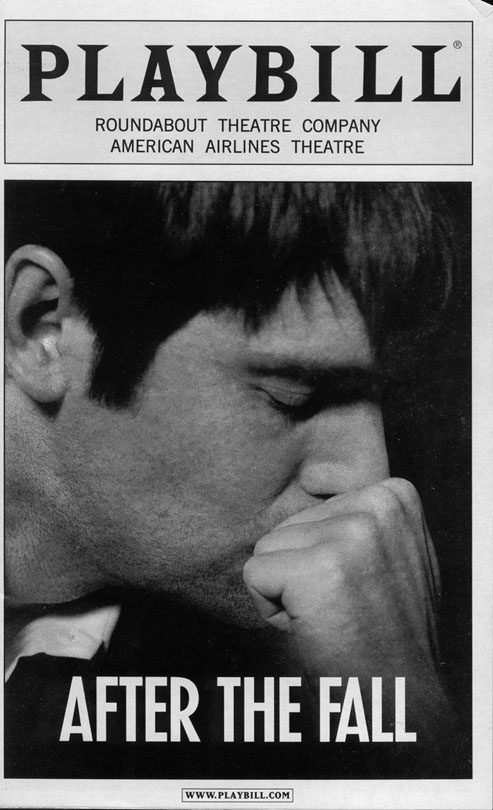
"After the Fall Revived on Broadway After Forty Years"
Review by Stephen Marino, St. Francis College
In the summer 2004, New York's Roundabout Theatre Company staged the
first Broadway revival of Arthur Miller's controversial 1964 play, After
the Fall, at the company's American Airlines Theatre on 42nd
St.
This long-awaited production completed a string of New York revivals
since
the mid-1990's of most major Miller plays. After the Fall
had not been performed in a Broadway house since the original Lincoln
Center
Repertory production starring Barbara Loden and Jason Robards, a
production
for which many critics excoriated Miller in taking unfair advantage of
the death of Marilyn Monroe on whom the character Maggie is
based.
A 1984 revival, with Frank Langella and Diane Wiest, ran
off-Broadway.
The 2004 production was widely anticipated because its two stars, Peter
Krause and Carla Gugino, are better known as television
performers:
Krause as funeral director Nate Fisher in HBO's Six Feet Under and
Gugino as the title character of the cancelled ABC dramatic series, Karen
Sisco. Also, Michael Mayer brought stellar directorial
credits
to this production having previously directed the Tony award winning
revival
of Miller's A View From the Bridge.
In After the Fall Miller wanted to
dramatize
how individuals and nations confront guilt, denial, and
responsibility.
He has said that the dramatic structure of the play is based on
psychoanalysis.
The main character, the lawyer, Quentin speaks to an unidentified
Listener--a
friend, perhaps, or an analyst--someone he is going to tell about a
decision
he must make, which is the plot of the play. In this fashion he
examines
his entire life: his guilt and responsibility in his relationship with
his parents, his two failed marriages to Louise and Maggie, and his
doubts
about marrying a third time to Holga. But Miller moves the play beyond
Quentin's personal story and shows how guilt and responsibility also
operate
in history, particularly in the Holocaust and McCarthyism. Similarly,
Quentin
confronts the guilt of betrayal when one of his friends, Mickey,
modeled
after the director Elia Kazan, is subpoenaed to testify before HUAC and
tempted to betray his friends and colleagues. Many critics of the
original production focused on the personal elements and mostly ignored
the larger theme and implications of the play--the reason why it is so
infrequently revived thus obscuring its place as a major drama in
Miller's
canon,
In After the Fall Miller returned to the
expressionistic dramatic structure he had used in Death of a
Salesman.
He writes in the liner notes that the action occurs entirely in the
"mind,
thought, and memory" of the protagonist, Quentin. He, therefore,
structured
the scenes and the characters, who remain on the stage, to appear as
almost
free associations popping into Quentin's head. The original
Lincoln Center set, designed by Jo Mileziner (who had also created the
famous Salesman stage), conveyed the intended non-realistic
psychological
effect with a series of grayish platforms, steps, and ramps. The
tower of a concentration camp dominated the back of the stage--a
crucial
metaphor which indicates the guilt of the survivor. Other notable
productions of the play have offered successful variations of the
non-realistic
set. Franco Zeffirelli's 1966 Rome production employed a stage of
steel frames so actors could appear and disappear at any place on the
stage;
a 1990 British production used a flight of steps descending into a
cave-like
vortex.
Unfortunately, the 2004 Roundabout Theatre Company
version did little to rescue the play's production reputation.
Although
most critics focused on what they saw as a seriously miscast Peter
Krause
and uneven acting by Carla Gugino, their performances were not the
cause
for the failure of this production. (In fact, at the evening
performance
I attended, Gugino gave a powerful depiction of Maggie's descent into
psychological
despair and Krause seemed to grow into his role. In the final
confrontation
scene between Maggie and Quentin in Act 2, both actors fed off each
other’s
performances.) Rather, their depictions of Maggie and Quentin are the
result
of a seriously misconceived production from the outset. Michael
Mayer
has done some "creative editing" of Miller's original play by
eliminating
characters and reshuffling scenes to make the play more
"accessible."
The effect of this editing created for me a mere "version" of After
the Fall. The sophistication and strength of the play is that
the seemingly random appearances of characters and scenes are actually
highly structured and carefully choreographed by Miller in order to
build
to Quentin's acceptance of Holga's love at the climax of the
play.
This production ineffectively removed some of Maggie's crucial dialogue
with Quentin and moved the appearances of Quentin's mother, his first
wife
Louise, and Holga.
Another major misconception was in Richard Hoove's
set. Designed to resemble the famous TWA terminal at New York's
JFK
airport, this set countered Miller's notion of the play taking place in
the "mind, thought, and memory" of Quentin. Rather than reinforce
the non-realistic, psychological space vital to Quentin's monologues,
the
set rather blatantly enforced a defined place and time. The
sounds
of planes flying overhead and the announcements of arrivals and
departure
had the effect of creating a too-obvious and unnecessary metaphor for
the
arrival and departures of characters. The occasional image of the
concentration camp tower--a dominant symbol in the original set--seemed
out of place.
After forty years, After the Fall remains
an enigmatic Miller play. This disappointing production did
little
to contribute to our understanding.
From: Vol. 10 June 2004 p. 14-16
"After the Fall: Is the Knowing All?"
Review by Dr. Stefani Koorey, Valencia Community College
Just over a year following Arthur Miller and Marilyn Monroe's
divorce
in 1961, and less than seven months before Marilyn's death, Arthur
Miller,
46, married Ingeborg Morath, 38, on February 17, 1962.
Arthur Miller's marriage to Marilyn Monroe had not
been easy. What had begun as the hopeful union of two wounded lovers
ended
unhappily after a series of betrayals and regret-filled attempts to
balance
their private marriage with their public careers. Instead of providing
Monroe with some much-needed confidence and emotional stability, her
third
and final marriage proved to be a contributing factor to her undoing.
Monroe was terribly upset over the news of Clark
Gable's death, before the birth of his only child, and later devastated
by gossip and innuendo that she was in some way responsible for his
heart
attack through her erratic behavior and shooting delays during the
filming
of The Misfits. Famous now for her unprofessional work ethic,
her
uncooperative attitude, and her self-involved personality, whatever
little
reputation Marilyn had built for herself as a serious actress
disappeared
forever. On her thirty-sixth birthday, she was fired from her next
film,
Something's
Got to Give, for numerous production delays caused by her severe
emotional
illness. No longer able to complete a film project, and already
teetering
on the brink of a complete psychological collapse, Marilyn Monroe's
mental
state rapidly declined.
Marilyn Monroe died alone at the age of 36, sometime
in the early morning hours of Sunday, August 5, 1962, in her new home
in
the Brentwood section of Los Angeles. The official coroner's report
listed
her cause of death as "acute barbituate poisoning--ingestion of
overdose,"
and a "probable suicide."
According to W.J. Weatherby and others, it was his
new wife Inge who had persuaded Miller to write the semi-confessional After
the Fall to lay the ghost of Marilyn to rest, work through his
deep
guilt, and allow their own marriage a chance to grow. In fact, Miller
dedicated
the play to her: "For My Wife, Ingeborg Morath." As a playwright
primarily concerned with the conflict between personal and public
responsibility,
After
the Fall reads as Miller's attempt to dramatically explore various
issues regarding his disillusion with marriage ("the death of love"),
Monroe's
suicide, and his own culpability in their breakup. After the Fall
is mainly concerned with Quentin's suffering, not Maggie's, during and
after their marriage.
After the Fall premiered on January 24, 1964,
at the new Lincoln Center Repertory Theatre in New York City.
Construction
of the theatre at Lincoln Center for the Performing Arts was not
completed
in time for Miller's opening so the play was produced in the
repertory's
temporary home at the ANTA Washington Square Theatre. It had been nine
years since Miller had "faced the monster" and presented a new
full-length
play on the New York stage. The anticipation surrounding the play's
arrival
was significant enough to sell out the entire run well in advance of
its
opening. Reported Nathan Cohen in the National Review, "Very
few
plays have been awaited with as much expectation as Arthur Miller's After
the Fall. 1
By almost all accounts, After the Fall became
known as Arthur Miller's public confession, an exploitive exposé
of his marriage to Marilyn Monroe, and a kind of summation of his life
thus far. Critics and scholars alike seemed to agree that Miller's new
play was a serious breach of good taste: Richard Corliss of Time
called it "a 2 1/2 hour act of flagellation in which Arthur Miller's
whips
sear his own flesh and that of anyone he touched or who touched him";
John
O’Connor, in 1974 in the New York Times, angrily wrote that
"the
play for all its painful sincerity, is an egotistical abomination";
Susan
Sontag commented that "Miller's self-exposure is mere self-indulgence";
Richard Gilman noted that the play was "an endless sophomoric revelry
without
meaning"; Nathan Cohen jabbed, "Seldom has there been such a chasm
between
conception and execution, between arrogance of aim and pettiness and
insufficiency
of achievement"; Leslie Hanscome called the play, "undoubtedly the most
nakedly autobiographical drama ever put on public view"; and Robert
Brustein,
in a review entitled, "Arthur Miller's Mea Culpa," decried: "After
the Fall is a three-and-one-half-hour breach of taste, a
confessional
autobiography of embarrassing explicitness, during which the author
does
not stop talking about himself for an instant while making only the
most
perfunctory gestures toward concealing his identity." 2
Two weeks after the play opened, Miller answered
his critics with an article in Life magazine entitled, "With
Respect
For Her Agony--But With Love." In this essay, written as a
rebuttal
to a review in the same issue by Tom Prideaux entitled "Marilyn's Ghost
Takes the Stage," Miller wrote, "The character of Maggie . . . is not
in
fact Marilyn Monroe." He continued his counter-attack by
lambasting
those who would dare to see his play as anything other than a work of
art:
"Certainly one of the more diverting, if minor, pastimes of literary
life
is the game of Find the Author . . . Once the author's identity is
'discovered'
a certain counterfeit of knowingness spreads through the reader's soul,
quite as though he had managed to see through an attempt to trick him
into
believing that the work at hand was art rather than a disguised
biography."
3
Later in the year, Miller insisted that the public
outcry against After the Fall came as a complete surprise. "It
honestly
never occurred to me," Miller wrote, "that anyone was trying for a
literal
resemblance, or that the audience would see one, because I didn't see
one."
In October of 1965, Miller reiterated his innocence: "As for the
obsession
on the part of the public that the character of Maggie in After the
Fall is Marilyn Monroe, I insist it is not. What the character did
portray was a kind of suffering which Marilyn had. . . . If it were
Marilyn
in After the Fall, it would be a tribute to the depth and
reality
of her suffering. And that," said Miller, "is the last I have to say
about
it." 4
The genesis of this play in Miller's literary
timeline
appears to date from the mid 1950s, before his marriage to Monroe. In
July
1959, in an interview with Kenneth Allsop for Encounter, Miller
spoke of being immersed in a project, begun several years previously,
which
sounds similar in theme and form to After the Fall. "It is
about
the present day," Miller revealed, "about people who lived through the
events of the 'thirties and 'forties, and are now face to face with
their
lives in a world they never made. I am trying to define what a human
being
should be, how he can survive in today’s society without having to
appear
to be a different person from what he basically is." 5
It is likewise apparent that three climactic events in the playwright's
life heavily influenced the final script of After the Fall: the
death of his mother, Augusta; his marriage to Inge Morath; and the
death
of Marilyn Monroe--for all three persons figure prominently in the
narrative.
The plot of After the Fall is
unquestionably
autobiographical. It involves the working out of the psychic dilemma of
Quentin, a successful New York lawyer racked by self-doubt--after two
broken
marriages, he wonders whether he has the right to take on the burden of
a third. In trying to make his decision, Quentin recalls memories of
family,
friends, women, and former wives, who expressionistically appear and
disappear
as Quentin's stream of consciousness unfolds. His first marriage to
Louise
turned sour because, she says, he treated her as if she "didn't exist."
His second wife, Maggie, a famous pop singer, turns shrewish and
self-destructive.
His current love, Holga, an intelligent European girl who is a survivor
of Nazi Germany, represents the possibility of survival and hope in a
cruel
and violent world. The play ends on a complex and inexact note, with
its
hero, Quentin, still questioning his existence as he begins his life
anew
with Holga.
The similarities between events and circumstances
in Miller's personal and professional life, including the lives of
those
in his immediate circle of family and friends, and in those of his
characters,
are almost too numerous to list. The most outstanding warrant our
attention--not
only for their sheer inescapable presence, but also for their striking
and conspicuous nature as referents to events and persons that exist
outside
the text of the play.
Both the play's author and his main character were
born around the same time--Quentin and Miller were in their forties in
1964. During the Depression, each had a foreign-born father who lost a
sizable business. Miller and Quentin's fathers both were illiterate, a
fact only known by their wives after they married and a source of great
shame to them both. Both Quentin and Miller left home, against the
wishes
of their fathers, to make their own way. Both have older brothers who
stayed
behind to help their fathers in business. Like Miller, Quentin found in
socialism a "brotherhood opposed to all the world's injustice," became
disillusioned with leftist causes, appeared before HUAC, and parted
company
with a close friend who named names. Additionally, both Rose and
Augusta
died before their husbands.
Miller's marital history also parallels Quentin's.
Quentin and Miller met their first wives when they were college
students.
Both also told their first wives about their interest in other women,
and
both women reacted similarly to the news. Both Mary Grace Slattery
(Miller's
first wife) and Louise entered psychoanalysis towards the end of their
marriages. Both marriages ended in divorce after each husband found
solace
with another woman who would end up as wife number two.
The similarities between Maggie and Marilyn Monroe
are even more profound. Both Monroe and Maggie experienced the same
unpleasant
childhoods: they were illegitimate; their fathers deserted their
families;
and their mothers were unstable. Both tried unsuccessfully to locate
their
fathers and both of their mothers had tried to smother them as
toddlers.
Neither Maggie nor Marilyn graduated from high school, but each somehow
incredibly rose to the highest rank in popular entertainment. Each had
an arresting combination of sexual attractiveness and girlish charm and
were idolized and desired by millions of fans worldwide. Both had
loveless
affairs with their older male mentors, and were forbidden by these
men's
families to visit them on their deathbeds. Both were in psychoanalysis,
and worked on their chosen craft with a renowned teacher. Impressed
upon
meeting Quentin-Miller, Maggie-Marilyn likewise kept his picture in her
bedroom. Both found a journal, soon after their weddings, in which
their
husbands detailed their dissatisfaction with the marriage. Both
divorced
after several years of marriage. Each woman was vain, neurotic,
infantile,
difficult to work with, brooded about people taking her as a joke,
broke
contracts, and finally ended her life with an overdose of sleeping
pills.
Act One consists of a series of vignettes that
episodically
provides us with important background information on Quentin. This, in
turn, enables the audience to understand the significance of the
failure
of his second marriage to Maggie, presented in Act Two. The second act
mostly abandons the expressionistic structure set up in Act One. It
operates,
almost completely, as a straight cause and effect narrative. Only in a
few instances does the past interject itself, mainly to juxtapose
emotionally
similar moments from Quentin's past. Act Two's plot is almost entirely
devoted to Quentin's marriage to Maggie, including her emotional
disintegration
and attempted suicide, ending with Quentin reuniting with Holga.
Quentin's recollections predominantly revolve around
the women in his life--past, present, and future. More like motifs than
representations of actual persons, Quentin's women appear and disappear
around and above him as he remembers his life and decides his future.
Time
also moves in different directions, forward and backward, colliding and
overlapping, as Quentin exposes his pain. Like an advanced version of
the
expressionistic movement in Death of a Salesman, Miller
situates
past events and immediate thoughts as concurrent to show the complex
inner
workings of Quentin's mind. From Quentin's very first speech we learn
that,
in the present time of the drama, Quentin's second wife, Maggie,
committed
suicide fourteen months ago; a few weeks following her death Quentin
quit
his lucrative law practice because "It just got to where I couldn't
concentrate
on a case any more; not the way I used to. I felt I was merely in the
service
of my own success. It all lost any point"; his mother, Rose, had died
some
four to five months ago of a heart attack; and Quentin had most
recently,
while in Germany, met a woman named Holga who is an
archaeologist.
Miller then builds on this information by showing us scenes enacting
each
event.
Peter Krause's performance as Quentin in the recent
NY revival was deeply introspective. He exuded a boyish charm that was
outgunned by his continuously morose demeanor. While an excellent
choice
for the role, considering he brings to the part the audience's
preconceived
notion of him as troubled and thoughtful from his years on Six Feet
Under, Krause's inability to shake the sorrow that engulfed him
made
for a long evening. The ups and downs that Quentin experiences in this
play were played by Krause as only slight shifts of mood.
The casting of a blonde Holga and a redhead Maggie
was deliberate, I think, in order to distance us from the
autobiographical
nature of the play. However, this effect was obliterated when Quentin
meets
Maggie for the first time and we see her costumed in an exact copy of
Marilyn's
cherried dress from The Misfits.
Miller is trying to do something very sophisticated
with this drama. He is attempting to literally, and literarily, bend
time
and space by presenting a character who is realizing himself as he
reveals
himself. While the events he remembers are from all manner of time
frames,
Quentin is himself telling his story in real time--it takes as long as
it takes to come to his conclusions regarding his choice of future
action.
Miller remarked in an interview "the play is a continuous stream of
meaning.
It’s not built on what happens next in terms of the usual continuity of
a tale--but upon what naked meaning grows out of the one before. And
the
movement expands from meaning to meaning, openly, without any bulling
around.
The way a mind would go in quest of a meaning, the way a new river cuts
its bed, seeking the path to contain its force." 6
Contrary to critical opinion, I do not find the
drama overtly confessional, but, rather, explorative. While the answer
to his initial dilemma seems obvious to us as audience members, Quentin
seems innocently uncertain at the beginning of his quest as to where or
when it will end or how he will find his way. The audience is thus
being
asked to serve as witness, not jury or judge, to Quentin's revelations,
as he determines, for the first time, the meaning of his life. Opposing
those critics who assert that there is an uncomfortable imbalance
within
Miller’s dramatization of his first person structure, I find a
consistent
balance evident, existing between Miller's dramatic form and his
content.
Miller's central character repeatedly steps out of the action of the
play
to address the audience directly on matters relating to his memories.
Likewise,
Miller himself, as the play's progenitor, purposely steps out of his
fictional
frame and moves into the realm of his real-life private world. In doing
so, he succeeds in drawing his thickest lines yet connecting himself to
his art.
For all his psychic suffering, it is very hard to
like Quentin or appreciate his pain. His incessant blaming of the women
in his life for his turmoil is thematically uninteresting and reeks of
self-aggrandizement. Quentin's messianic questioning of guilt
throughout
the play reflects his deep desire to return to a time when he was
innocent
and without blame. Miller wishes us to understand that beyond the
personal
guilt that Quentin finds in his life and in the lives of those about
him,
there exists a larger universal guilt of mankind’s culpability in the
atrocities
of Nazi Germany. Quentin's "wish to kill" Maggie, and his Mother, is
made
analogous to the violence that led to the horrors of Nazism. In
Quentin's
final speech of the play, he attempts to make sense of himself and
establish
a reason to continue his life after the Fall.
Notes
1 Nathan Cohen, "Hollow Heart of a
Hollow
Drama,"
National Review 7 April 1964: 289.
2 Corliss, "Wounds That Will Not
Heal":
113; John O'Connor, "TV: Miller's After the Fall on NBC," New
York Times 10 Dec. 1974: 91; Susan Sontag, "Going to Theatre,
Etc.," Against Interpretation and Other Essays (New York: Dell,
1966): 147; Richard Gilman, "Still Falling," Commonweal 14 Feb.
1964: 601; Nathan Cohen, "Hollow Heart of a Hollow Drama": 289;
Leslie
Hanscome, "After the Fall:
Arthur Miller's Return," Newsweek
3 Feb. 1964: 50; Robert Brustein, "Arthur Miller's Mea Culpa,"
New
Republic 8 Feb. 1964: 26.
3 Arthur Miller, "With Respect For Her
Agony--But With Love," Life 7 Feb. 1964: 66.
4 Barbara Gelb, "Question: 'Am I My
Brother's
Keeper?'"
New York Times 29 Nov. 1964, rpt. in Roudane, ed., Conversations
With Arthur Miller: 79.
5 Kenneth Allsop, "A Conversation With
Arthur Miller," Encounter 13 (1959): 58-60, rpt. in Roudane,
ed.,
Conversations
With Arthur Miller: 52-55.
6 "Arthur Miller Ad-Libs on Elia Kazan,"
Show
Jan. 1964: 55-56, 97-98, rpt. in Roudane, ed., Conversations With
Arthur
Miller: 69.
Reviews by society members of the following productions and more coming soon:
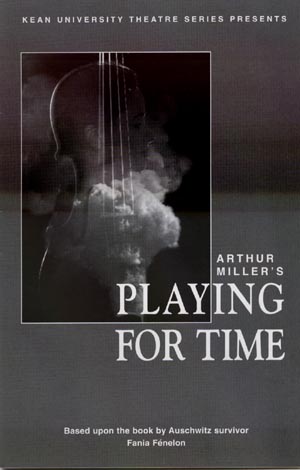

Updated 24 May 2008