21
PART II
More Direct
Involvement in the WSCF, 1952-1961
Federation
First-hand
It was in all these
varied and mostly indirect ways that I became involved in the WSCF. It was not,
however, until 1952 when I had already been General Secretary of the ASCM for
three years that I first experienced the Federation at firsthand.
India 1952-1953
In December of that
year, the third World Conference of Christian Youth was held at Kottayam in
south-west India. The WSCF was one
of the five international sponsoring organizations, which had called the
conference. Overlapping with it in time, a WSCF student conference was held at
Tambaram, Madras, and after it, the
General Committee met at Nasrapur in January 1953. The main responsibility for
the Tambaram conference was Harry Daniel's; but it was felt that he should be
at Kottayam, so the WSCF asked me to take over the local organization of
Tambaram. I had already written the Bible study for it. The Growth of a
Christian, and had agreed to be the Chaplain of the Conference. I arrived
at Madras Christian College at the beginning
of December and spent the month arranging, bedding, catering, public relations
and so on, and then participating in the leadership of the conference. This
gave me a wonderful opportunity to get to know the Indian and expatriate staff
of the Allege, members of the Indian SCM and to meet WSCF leaders as passed
through en route to Kottayam - Philippe Maury, Harry Daniel and Paul Abrecht. Madras Christian College had been founded
about 100 years before by the Church of Scotland and was an affiliated college
of the University of Madras. At that time,
there were still four Scots on the teaching staff, all able men and devoted
college. I stayed with one who was the Principal, A.J. Boyd.
22
Very soon, I made
the acquaintance of Chandran Devanesan who was Chairman of the SCM of India, Burma and Ceylon and who taught
History. He and his equally delightful and beautiful wife, Savithri, made me
very welcome, and so began a life-long friendship. (In 1970, they came to Australia for the Conference
on Action for World Development held jointly by the Australian Council of
Churches and the Australian Episcopal Conference of the Roman Catholic Church,
along with Malcolm Adeseshiah who in his student days had been a member of the
SCM at Madras and was
Director-General of UNESCO. Chandran succeeded Dr. Boyd as Principal, and later
on became the first Vice-Chancellor of the North-East Hill University at Shillong.)
Just when I was beginning
to despair of having the accommodation ready in time, Marie Jeanne de Haller
of Switzerland, a WSCF Secretary,
arrived from Geneva together with
Helen Logan of Scotland, one of the office
staff at 13 rue Calvin. Instantly, we were a smoothly working team along with
our Indian SCM colleagues, and all was in readiness when the conference began.
The majorities were members of the Indian SCM, but there was a good
representation of the other SCMs from Asia, Europe, North and South America. For me it was a
very exiting experience to be, at last, in such a company and to experience at
first hand, our unity together in Christ. It was also exiting to experience the
differences in outlook and custom -the theological seriousness of some of the
Germans, the Indonesian absorption with building a nation recently freed from
colonialism, and the Indian custom of entering the Chapel with bare feet - and
the shock, after a few days, of seeing an American preaching in socks and
shoes'. Three of the addresses were printed in The Student World, Second
Quarter, 1953: 'Evangelism - the Gospel to the Whole Man' by Peter Kreyssig of Germany; 'The Christian in
the University' by Philip Lee-Woolf of Great Britain, and 'Church and Mission' by Valdo Galland
of Uruguay. See also Appendix I, the article by John Gault in The Australian
Intercollegian, March 1953, 'The Growth of a Christian: WSCF Conference at
Tambaram'.
23
Nasrapur
At 4 a.m. on the morning after the conference finished, those of us going to
General Committee had to rise in order to catch a train which took us long on a
journey northwest across India to Poona. There we were welcomed at the Hindu
Medical College, and then traveled by road to Nasrapur, an isolated Christian
retreat center where the General Committee met in a marquee, worshipped in a
simple chapel of low walls, open to the air and views of the distant hills,
beneath a spreading roof, and lived in adequate but plain accommodation. The
General Committee was a great experience for here were former, present and
future leaders of the Federation meeting together to review and plan the work
of the Federation, to engage in Bible study together, to hear addresses on
relevant topics, and to learn of the problems being faced by SCMs in several
very different situations and parts of the world – rural Asia, newly –
independent countries of Asia, colonial Africa, communist – dominated countries
– China, the impact of military life in NATO, and French Universities. And
there was the detailed work in small groups preparing the budget, planning for
literature and other activities, followed by decisions in plenary sessions.
Here came on a
visit Reinhold von Thadden, former German SCM leader and founder of the
Kirchentag in post-war Germany, a legendary and impressive figure who felt very
much at home in the WSCF context. Here also came Visser't Hooft, General
Secretary of the WCC after the WCC Central Committee meeting in Lucknow. And this was
Robert Mackie's last meeting as chairman. How fortunate I was to experience
the friendliness, humor, firmness and acute perceptions of his chairmanship.
His closing address remains a memorable memory. He stood before us in the
marquee with a Greek New Testament in his hand. He said, 'This testament was
given to me by George Ravanis during a visit to the Greek SCM'. George had had
the misfortune, one very dark night, to fall into a recently excavated trench
on his way to the marquee and was in a hospital in Poona. Looking back over
fifteen years as an officer 01 the Federation, he quoted a sentence from the
General Committee Minutes of 1949 at Whitby in Canada:
Within the SCM, we
have recognized a more than human fellowship across confessional boundaries, to
which we are bound to bear witness as a fact and as a gift of the Holy Spirit.
24
Then, opening the
Greek testament to St. Paul's letter to the
Philippians he began to speak of 'Our More Than Human Fellowship' by leading
us in a study of the meaning of the New Testament word for fellowship, Koinonia.
He highlighted a number of phrases by which Paul described the nature of this
fellowship: its members share partnership in the Gospel, they are partakers
with me of grace, they participate in the spirit, they share
Christ's sufferings, and they are in partnership in giving and
receiving. Each of these he related briefly and tellingly to the Federation and
its member SCMs, to the agreements and disagreements, to the tensions and
triumphs of the General Committee's discussions over the previous two weeks. It
was simple, direct and moving - and, on me, it made a lasting impression
expanding my understanding of the essence of the Federation and of the
Christian Church. To read, once again, the summary of his address in The
Student World for the Second Quarter of 1953 is not only to have a precious
memory re- kindled but also to be reminded of the reality of the fellowship
that characterized that General Committee meeting and the whole life of the
Federation then and later. In an account of the meeting, which I wrote for The
Australian Intercollegian, March
1953, I said that Nasrapur’ was one of my most thrilling experiences’, and went
on to say:
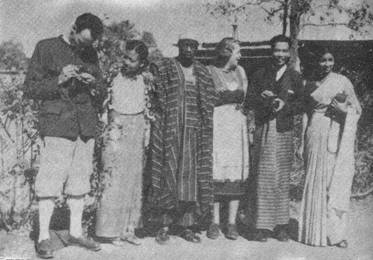
A world Christian
community: some delegates at the 1953 Nasrapur General Committee. Kyaw Than,
another former Federation Secretary is second from right.
25
I had heard often
of the wonder of such fellowship within the world community of the Federation. I
was also aware that it was not something which happened automatically or
according to a set pattern. It was therefore exciting and thrilling to find
oneself one of a company of people who were part of the family of the
Federation, and who were yet, at the same time, becoming a living, responsible
fellowship of persons out of many nations and races learning to understand each
other and work together. (See Appendix II)
The dominant note
at both Tambaram and Nasrapur was evangelism, but not in any pietistic or
traditional sense. In both places, there was a serious attempt to re-think what
Christian mission meant in terms of our citizenship in the world, our life in
the universities, and in the varied circumstances of private and professional
life. In the words of Patricia McGrath (The Australian Intercollegian,
June 1953, "Bound up With the World"),
Underlying all the
work of Nasrapur... was the conviction that Christians, singly and in
communities, are called to live in the world, to make their witness in
the very midst of the beauty and terror, the boredom and the mystery of the
day-to-day life of men and women. (See Appendix III)
The addresses at
both places (perhaps especially Peter Kreyssig's), the encounter with the
village social work of Madras College, and the work of the Commissions at
Nasrapur all contributed to an important piece of re-thinking and of fresh
commitment within the WSCF.
A particularly
notable change was that, for the first time in WSCF history, an Asian was
elected to the chair - D.T. Niles of Ceylon / Sri Lanka. Not only that.
The election was between two Asians - D.T. and M.M. Thomas of India. M.M. had been a
vice-chairman since Whitby 1949, and a very
effective WSCF secretary, bringing a clear Asian voice not only to the WSCF
Political and University Commissions but also to the World Council of Churches
in its formative years. From 1968 to 1975, he was Moderator of the WCC Central
Committee, where he continued to make a very significant intellectual and
spiritual contribution. D.T. gave strong leadership, stimulated commitment to
ecumenical mission/ and won the affection of many from 1953 to 1960. Then the
non-European, non-American trend continued with the election of Philip Potter
of West Indies.
26
Federation Visitor
to the Republic of Korea,
November 1953
Towards the end of
1953, I became involved in the WSCF in a new and unexpected way. Without
warning, I received a letter from Geneva asking me to be a
Federation Visitor to Korea in November. The
reason for this was that Harry Daniel had been refused a visa by the South
Korean government because he was an Indian.
The background was
that, after the truce of July 1953, a Neutral Nations Repatriation Commission
had been set up to repatriate prisoners-of-war from each side. It consisted of
representatives from Czechoslovakia, Poland, Sweden and Switzerland with an Indian
chairman, Lt. Gen. Thimayya, and an Indian Army Custodian Force to control the
prisoners-of-war and to effect the transfers. Inevitably, political tensions
were high during this operation in September. The South Korean government, with
its strong anti-communist convictions, clashed with Thimayya, accusing him and
India, of bias.
Confronted by this
barrier, the Federation looked for an alternative means by which it might
minister to a member movement emerging from the three-year Korean War. Someone
(Leila Giles or Harry?) remembered that I had been born in Korea, and so I was
approached. The category of 'Federation Visitor' had been used on a number of
occasions to supplement staff visits. I was, of course, greatly thrilled by
this honor and by the undreamt possibility of re-visiting the land of my birth
and boyhood. My first seven years were spent in what is now referred to as South Korea, and the second
seven in the North. Korea was, in those
days, one country, as it had been for centuries. However, in 1910, it had
ceased to be independent, being annexed by Japan. In 1945, the
Allied Powers partitioned it at the 38th parallel.
During the Korean
War, the country had been greatly devastated, large numbers of people had been
killed, and there had been large migrations – refugees from the North to the
South, and the temporary removal of Southerners from Seoul and other parts to
the small area in the Southeast, which was never conquered by the North. Whole
universities had become refugee institutions in Pusan.
27
When a truce was
made in July 1953, people, universities and government departments returned to Seoul although about 85
percent of it had been destroyed. There was a beginning of a new day. In this
situation, the Federation wished to give a tangible sign of its fellowship with
Korean students, and its concern for them and their future. It also wished of
ways in which it might assist them, regrettably, it had to accept the fact that
it could only relate to the South, as the 38th parallel had been
turned into a heavily – guarded and impenetrable barrier between North and
South, as it has remained ever since, until August 1986 when the first limited
contacts between families were permitted briefly for a few days only, and not
repeated.
I had to begin my
visit by spending a few days in Tokyo in order to obtain
the necessary document for entry into Korea by personal
appearance at the headquarters of the Supreme Command of the United Nations
Forces. This gave me a memorable opportunity for contact with leaders of the
Japanese Student YMCA and Student YWCA, in Tokyo. (That city had
been rebuilt to a remarkable extent after the huge devastation of the ghastly firebombing
of the Second World War.) As a result of these contacts, I departed bearing a
message of reconciliation to Korean students (see Appendix IV), as I was to do
again in 1959-1960.
Following my visit
to both countries, I wrote a Travel Diary for the Student World, which
was published in the Second Quarter 1954. (See Appendix V)
The main purpose of
my visit was to be a Federation presence, to be a visible sign of the
Federation's concern, a reminder that they were not alone or forgotten, and an
assurance of the international interest and support of their fellow-members
throughout the world. A secondary purpose was to discover ways in which
practical expression might be given to that concern and interest. Consequently,
in the latter part of my visit, I consulted with graduate and undergraduate leaders
as to the kind of help they might welcome. As a result, I was able to send a
detailed list to Geneva of needs, and of ways,
they might be met. This
was acted upon.
28
Tutzing General
Committee
My next direct
contact with the WSCF was in 1956 in relation to the Tutzing General Committee
in Germany. As was usual, an
international student conference was held immediately before the General
Committee meeting. This was in Mannheim, a city that had
suffered much both before and during the Second World War. Virtually the Nazis,
and a very large proportion of the houses, public buildings, had eliminated
the whole of its Jewish population and the bombing raids of the Allied Air
Forces had destroyed factories of this industrial city. It was a sad and
distressing experience to see the signs of destruction, to come upon a simple
but eloquent memorial to the Jewish dead, and to hear of these things from some
of the inhabitants. At the same time, it was impressive and moving to witness
the progress in re-building. The college in which the conference met was a new
structure with modem facilities. The church in which we met for worship and
addresses was a newly finished replica of its predecessor, complete with a
beautiful and colorful mural of a Tiepolo painting. And there was the lively
and exhilarating symbol of the modern style fountain in a city square. It and
its surrounding garden was another declaration that even amidst the dire
demands of physical restoration of roads, businesses and dwellings, life is
something to be enjoyed and celebrated. To these things was added, especially
for foreign delegates, the experience of being received and welcomed warmly and
happily by German students and seniors. And so by train to Tutzing, near Munich, where the General
Committee was to meet in the Evangelical Academy on the shores of a
large lake.
After my return to Australia, I wrote the
following description of the opening and a summary of some of the main features
of the meeting:
On the still,
summer afternoon of Sunday, August 15, the bell of the little white Lutheran Church rang out over the
green slopes of the dreamy holiday town of Tutzing in Upper Bavaria. As the sound
drifted out over the lake,
29
representatives
from 56 countries stirred themselves from siesta or unpacking, and strolled up
the hill, past the houses gay with window – boxes of red geraniums, to the
opening service led by D.T. Niles, of Ceylon, and Roger
Blanchard, of USA.
The Church was
white inside also; light and well cared for by those who loved it, and a place
of worship. We sat before an almost life-size crucifix carved with beauty and
realism in a countryside noted for its woodwork. The familiar figure on the
Cross had the strangely unfamiliar face of a Bavarian and was strong of body.
It was this
combination of the familiar and commonly shared Christ and the unfamiliarity of
one another that were the recurring notes of the strange, exciting, bewildering
and exhausting fortnight of General Committee. Out of every continent and
from every race we had come: members of one fellowship yet strangers to one
another; bound by one purpose, yet differing in our ways of working out that
purpose; seeking to work together, yet finding that others were accustomed to
different methods. In part General Committee was the experience of learning to
live and work together in love and honesty as one family in Christ; learning to
come with our own preconceptions, traditions, contributions and inhibitions
and yet coming to a lively encounter in which one's revered methods of
procedure might not be used or even appreciated and in which the contribution
of a person or a delegation was not always so much something which had been
brought to be 'given', as the capacity to meet and respond and strive together
to learn God's will through encounter and even disagreement; having learnt, to
work it out together in harmony.
In the opening service,
we assembled very much as members of national delegations. In the closing
service, two weeks later, we worshipped together as members of General
Committee, of one of the working fellowships within Christ's Universal Church. Some found the
process of change harder than others did. A few found it difficult. Perhaps
even some never quite realized what was going on, or resisted it at times. Yet
in spite of our blindness unwillingness, and in spite of our failure to pray as
we ought
31
or to be filled
with the Holy Spirit as we might be, and in spite of tiredness and mental
saturation or the stubborn realities of world politics, Christ did work his
reconciling work amongst us, as the Federation, taking on the flesh of a
General Committee, sought to learn again the meaning of being a minister of
reconciliation.
The Theme and the
Business
The General
Committee met to do the business of the Federation I but it did so in the
context of the theme, 'Jesus Christ the Reconciler'. Dr. W.A. Visser’t Hooft
dealt with this in a series of addresses and notably in two: one by a young
French philosopher who is not a Christian, Francois Jeanson, and the other.
(These may, and should, be read in The Student World, First Quarter
1957, along with the addresses by Rena Karefa-Smart of Africa on race problems;
Bishop K.H. Ting of China on the Church in China today; that of Father Kaolin,
a Swiss Dominican, and the sermon of D.T. Niles.)
But the theme was
also dealt with in terms of the tension existing between the Koreans and
Chinese and, within the Koreans, between loyalty to their nation and to the
universal nature of Christ's kingdom. It was dealt with, in business, in terms
of the relationship between students of communist countries and those who are
not, between the International Union of Students and the World University
Service, between the WSCF and the IVF, between men and women, between racial
and other groups in conflict. In each case, it was learnt that even Christians
(!) do not achieve reconciliation… in the twinkling of an eye by a magical
formula or by quoting words from the New Testament. We had to face some of the
blunt, seemingly intractable factors of life - of life in the Church as well as
in the world - which are the continuing challenge to Christ's workers for
reconciliation. Yet, in each case, it was possible to do something, which would
bring the time of complete reconciliation nearer, to open new channels by which
God's grace might flow more freely in the arid or tense areas of human life
bringing potentialities and peace to light.
31
Attendance
This was the most
representative committee yet. There were some 130 representatives from 57
countries. Particularly notable were the large delegations from Latin America and Africa and the presence
of a delegation from China.
For the remainder
of my report on Tutzing in The Australian Intercollegian, March and May
1957, see Appendix VI. With it is an account from the December 1956 number
written by two other Australian delegates, Margaret Bearlin and Jean Stock, as
both convey something of the impression Tutzing made on three of the delegates.
(Appendix VII)
To those accounts,
I would now add something of my personal involvement in the meeting. A major
factor was the presence of a delegation from China for the first time
since the Chinese Revolution of 1949. It consisted of two men, Huang Pei-yung
of the YMCA in Shanghai and Chao Fu San of the teaching staff of Tsinghua
University, near Peking (as the university and the city were then known), and
one woman, Su May Ting. Her husband, K.H. Ting, former WSCF Secretary and now
head of the Nanking Theological Seminary, was present as one of the speakers
at the meeting. To have these four present was a great and very welcome
experience for almost every member of the Committee. It was good to have the
renewal of contact and to hear of developments in China and of the
activities of the YMCA, as well as of the Church. I had heard K.H. Ting speak
to the Central Committee meeting of the World Council of Churches, two or three
weeks earlier, in Hungary, and I was struck by the fact that at Tutzing he was
not so sharp in his criticisms of foreign missions in China before the
Revolution as he had been at Galyateto. There he had just arrived from China and he was
speaking to an audience, which included leaders of large churches and mission
boards of the West, some of whose members were still engaging in hostile
criticism of China. At Tutzing, he
was speaking within the family of the Federation to members of the family,
sharing with them what he and his fellow Chinese Christians had been
discovering as 'God made issues clear and simple to us, thanks to the
revolution'. This did not mean that he withdrew or lightened is criticism, but
that his primary emphasis was on lessons learnt and on a new understanding of
the nature of Christianity and evangelism. For example, Christianity is not 'a
means to get certain benefits, certain results, certain advantages'.
32
We seek God, not
because of any benefit, but because God is what He is. We love God, not because
of any benefit, but because He is lovable. We trust in God because He is
trustworthy... We should not first see the Gospel in its
"usefulness", but in all its "unrootingness". Christ is not
the answer to our questions, for He questions the very foundations of our questions...
In the past, when we preached a pragmatic Christianity, although we brought
many people into the churches, we were only converting disobedient
non-Christians into disobedient Christians. And that we cannot really consider
as evangelism.
He added that, as
Chinese churches have been relieved of foreign financial and political backing
and the protection of unequal treaties, 'the simple words of Pascal become
real to us: "It is a truly blessed state of the Church to be dependent on God
alone".
Looking again at
his address, as printed in The Student World, First Quarter, 1957,1 am
struck both by the number of sentences I marked when I first read it, and by
what it still says to us about the nature, task and relationships of the
Church. Perhaps, in the West, we are now more ready to recognize its relevance
to our very different situation and to learn from it. Thirty years ago, even
some in the WSCF were somewhat defensive of the role of Western missions in China, on the one hand,
and, on the other, were overconfident about the place and role of the churches
in the West.
Be that as it may,
the critical issue in the General Committee as a result of the Chinese
presence, was their impact on the Korean delegation. They were from South Korea. China had come in on the
North Korean side in the Korean War of 1950-1953. So, for them, China was still an enemy
country, especially as the war had only been suspended by a truce rather than
ended by a treaty. I was asked to chair a sub-committee to bring the Chinese
and Koreans into conversation with each other. We met on several evenings,
after the evening session, well into the night. The discussion began abruptly
with the assertion by the Koreans that there was no Christian Church in China. That is, we
started well behind scratch. It took a lot of time and talking by Huang
Pei-yung and Chao Fu San to
33
persuade them that,
there were (at that time) one million Protestants, let alone Roman Catholics,
and that there were Christian students and SCM activities. It took time,
patience and restraint on the part of all. I had known Kim Hyun Ja from Korea, since Nasrapur;
but the other Koreans were unknown. Now, I not only got to know them, but also
I came to realize that she was a strong supporter of her Government’s position,
as she has remained all her life. What the Korean government might say or do
was a major concern. Nor could the Chinese ignore the fact that they too had to
return to their own country and possibly be answerable for any position they
took or agreement they made.
So, in spite of the
informality and friendliness of our talking, it was not possible to ignore the
invisible political authorities and atmospheres 'back home' in whose presence
we were to some extent talking, in spite of their physical remoteness.
Nevertheless, a real conversation developed out of which grew mutual
acceptance, understanding and sympathetic appreciation of each other. My own
most vivid memory is of Chao Fu San, on about the third night at 1.00 a.m., making a brief response to the Koreans, which was a
simple, warm expression of Christian concern, regard and understanding. To me,
it indicated how far we had come and how much we had grown in knowledge of each
other, of the two backgrounds and of the meaning of reconciliation.
Nevertheless, it
proved impossible for the Koreans to ignore what might happen to them as
individuals on their return to Korea if they remained
in a meeting in which the Chinese were received as full members. On the other
hand, it was not possible for the General Committee to classify the representatives
of one of its oldest movements as 'Observers', even when that request came from
an equally old movement. The General Committee meeting had begun on August 12
and continued till August 25. Normally, the Credentials Committee would have
tabled the list of official delegates and persons present at an early session.
But, in view of the Korean – Chinese situation, the report of that committee
was delayed to allow negotiations conducted by my sub-committee. In the end,
the Koreans decided they must withdraw from the Tutzing meeting before the
report of Credentials Committee on August 17. They made this known by writing
to D.T. Niles, the Chairman on August 14, stating that if the Chinese were
'officially seated', they would
34
find it necessary
to leave the meeting. We do this only after great searching of heart,
and it is in no sense a denial of the Christian brotherhood that we feel and
desire with Christian students in China, and of the
world-wide fellowship in Christ within the World's Student Christian
Federation, which we deeply treasure.
The letter made
clear their surprise at finding Chinese representatives at Tutzing, and also
the difficulty ('impossibility') they had, in view of their experience of
Communism in Korea, of understanding 'how a genuine, organized Christian
movement of students can exist under a Communist regime'. But they added: 'We
do not mean to imply that there are no honest, convinced, and genuine
Christians living there. With them, we have sympathy and understanding... We welcome
the opportunity, suddenly and unexpectedly made possible at Tutzing, for us to
meet and talk with Student Movement representatives from Peking.'
After the
presentation of the letter to the Committee, the Chairman read a statement in
which he made it clear that the Korean delegation was leaving 'because of the
circumstances of the Student Christian Movement in their country' and 'in order
to make it easier for the Korean SCM to remain within the Federation'. The
statement continued:
There has been clear
mutual understanding between our Korean friends and those who have been
conferring with them, a growing appreciation of the nature of our fellowship
within the Federation, and a willingness to share one another's burdens. It is
a joy to know, and I rejoice to say it, that the many conversations about this problem,
which have taken place in the last few days, have been marked by great openness
of spirit and Christian consideration and a sense of fellowship in one Lord.
We assure the Korean
delegation of our full appreciation of the difficulties in which they find
themselves and of our continual prayer for them within the fellowship of the
Federation. (Tutzing Minutes, pp.17-18)
35
So, with sadness on
all sides, the Koreans departed; but, at least, they had been able to stay for
six days. During that time, they had not only made clear their situation and
the impact, which the encounter with Communism had made on individuals,
groups, churches and political parties in the South. They had also had to face
the fact of the unbelievable - that Christianity and Christians continued to
exist under Communism in China; and to see their
national experience within the context of their membership in the Federation.
For all of us in the General Committee, it was a testing and learning
experience. A testing of our ability to put loyalty to Christ above all things;
and a learning to be rid of glibness in our affirmations about unity in Christ,
about reconciliation, and about working out how to act as Christians in the
face of the harsh realities of political and international conflict.
After the reading
of the Korean letter and the official WSCF statement, 'the Chairman called the
General Committee to prayer, and led the delegates in a prayer of intercession
and thanksgiving'. We bade the Koreans farewell, and only then was the report
of the Credentials Committee received and adopted. It listed both the Chinese
and Koreans as official delegates of Affiliated Movements.
It was the Tutzing
General Committee, which launched the Federation's study program on 'The Life
and Mission of the Church'
which received a substantial response in national movements and which
culminated in the Strasbourg World Conference of 1960. It was also a meeting
in which important business was done and policies decided.
Amongst the
business matters was that of the revision of the WSCF's Constitution. No change
was proposed in the first sentence: ‘The name shall be: "The World's
Student Christian Federation".' I surprised myself and the Committee by
moving that the apostrophe‘s’ be deleted from 'World's'. I was even more
surprised when the committee agreed! For some time I had thought that, it made
the English version of the name unnecessarily difficult. For John R. Mott, back
in 1895, it had had significance to say that the Federation was the World's,
but in a day of many world organizations, of greater internationalism, it
seemed pointless to have one body, which insisted on the apostrophe s. It meant
little more than extra vigilance for a proofreader. If one wished to press the
point with theological argument, it could be asked whether, in fact, the Federation
was the World's or Christ’s. However, at Tutzing, there was no argument.
Feeling somewhat cheeky, I simply moved the deletion on such grounds as that
'World's' was unnecessary and clumsy; and it was agreed without much comment,
apart from Philippe Maury pointing out that it made no difference to the French
or German versions which were without apostrophes. However, the Constitution
provided that due notice be given to all national movements, so the matter was
not decided formally until the next General Committee at Thessaloniki in 1960.
Back to Table of Contents
Main Page