3
PART I
Antipodean Experience of the Federation
The Contribution of Dr. T.Z. Koo
I first became
aware of the World Student Christian Federation at the beginning of my second
year as an undergraduate of the University of Melbourne when Dr. T.Z. Koo
made the first of three visits to Australia as a Secretary of
the WSCF. Like other members of the large student, and public, audiences who
heard him speak; I was fascinated by this expressive, eloquent and charming
Chinese speaker, as by his grasp and understanding of Chinese culture and-modem
political changes, of international affairs, and of the essence of Christian
faith and practice. In my first year, I had had virtually no contact with the
Student Christian Movement (or Christian Union, as it was then called), although,
in the latter half of the year, I had begun to take some part in the activities
of the Foreign Service Group (successor to the Student Volunteer Mission
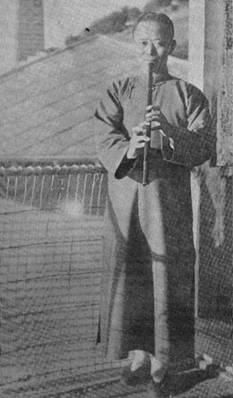
Union). Now I began to be drawn in, as I listened to this young man in his long
Chinese gown, sharing information and insight about the old and' new China of
his day, about students of many nations, and about Christianity from both a
Chinese and an international perspective. He did so in fluent and telling
English with graceful and expressive gestures of his hands, captivating his
audiences by the directness and apparent simplicity of his speech and by the
use of illuminating illustrations drawn from his Chinese background.
At less formal
meetings than the large public ones, he took out his Chinese bamboo flute and
played Chinese folk music. He also spoke about the old folk songs, and even
taught us to sing some of them. Some were about nature, others about love, and
one was a Buddhist Temple tune. This he had
set to the words of the Christian hymn "Let us with a gladsome mind;
Praise the Lord, for he is kind".
4
It was this, which was the immediate cause of my closer contact with the
Australian SCM; for Margaret Holmes, the national executive officer who was
also a vice-chairman of the WSCF, gathered a few students to form a choir to
sing this hymn at a church service in which TZ ('Tee-Zee') as he was commonly
called, was to speak. Friends persuaded me to accompany them to the national
office, where Miss Holmes (as we respectfully called her for many years,
although we referred to here as "M.H.", and eventually graduated to
the select company of those who were invited to call her 'Margaret'!) rehearsed
us in this and other hymns with the aid of a very small, old harmonium, a
portable, pedal-operated organ. That was in April 1931.
In March-April 1937, T.Z. returned to Australia. By this time, I
was a Traveling Secretary of the ASCM, and was closely involved in his visit to
Adelaide, the capital of South Australia. There we received
enthusiastic messages from Perth, Western Australia, where he had
begun his Australian tour. A telegram read:
Koo has done
wonderfully well in Perth. Every meeting has
overflowed. Over 1000 at University Hall. Solid stuff. You are safe in planning
on biggest scale. Suggest early flute broadcasts...
This was followed
by letters in a similar exuberant vein. For example, the Adelaide Advertiser
reported on 20 March 1937:
Few visitors in
recent years can have stirred as much public interest in Perth as Dr. T.Z. Koo,
the distinguished Chinese scholar and internationalist... Charm is difficult to
define, but that of Dr. Koo arises from his ability to combine in his own
serene and humorous personality the best of the old China and the new, and
of the East and the West. In his addresses, he has shown an alert appreciation
of modem movements in Europe, together with affection
for the ancient classics and music of his people.
Both The
Advertiser and The News, the evening paper, gave considerable
coverage to his visit, both before and after he arrived.
5
VISIT of Dr. T. Z.
KOO
Secretary, World's Student Christian Federation
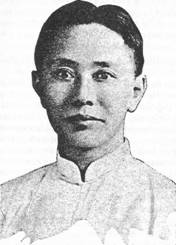 March 13
to April 30 1937
March 13
to April 30 1937
Perth March 13-19
Adelaide March 22-28
Tasmania March 30-April 3
Sydney April 5-12
Brisbane April
13-18
Melbourne April 20-27
Canberra April 28-29
Sydney April 30 (to sail or New Zealand)
A
press cutting announcing the program of Dr. Koo
6
On 24 March, The
Advertiser gave some eleven-column inches to a report of his public address
on 'The International Situation in the Far East and its Effect on
World Peace' to a gathering of 1200 in the University's Bonython Hall. It added
a further two inches to announce details of the rest of his program, including
the statement that 'in view of the excellent attendance. Dr. Koo would give a
second public lecture at 8.00 p.m. tomorrow on a
subject to be announced'.
His subject at that
meeting was 'Christ and the Modem Age'. On other occasions, the subjects were,
'The Reconstruction of China', 'World Affairs through Chinese Eyes', and 'The
Relations between God and Man'. He spoke to university students, to a large
meeting of boys and girls from secondary schools, to 'the annual
"freshers' social" at the University', to the congregation of the main
Methodist Church on Easter Sunday, and broadcast an address on the national
network. Over Easter, he led a conference of the State Council of the ASCM in
which leaders and members had the stimulating, enlightening and challenging
experience of hearing him talk simply and tellingly of God, of the Kingdom of
God, of Christian love, of disciplined Christian discipleship and of living
together in fellowship. My scribbled notes of his talks contain such
statements, thoughts and suggestions as these:
Christian Faith is in God as the
universal Father of all mankind. This is a simple faith, but in the modern
world (of 1937) we are called to raise this belief as a Gibraltar against the
beliefs which deify the nation state and the Aryan race, exalting the national
and tribal gods.
The Kingdom of God has often been
thought of as a distant goal. It is, in fact, an important and relevant reality
if we see it in relation to nationalism. We (as human beings) are not bound together
by our nationalities. Those of one nationality have little in common with those
of another nationality. But, on the spiritual plane, as citizens of the
Kingdom of God, we stand united. By birth you are citizens of Australia, but by
adoption you are citizens of the Kingdom of God. Internationalism is not
enough, rather (we must work for) a world community (in which) national
loyalty is drawn up into a higher entity. The Kingdom of God is that condition
of life when man accepts God and his rule.
7
The Kingdom is
already here because God is. But for us it is in the future until we accept
God. Then, when we are in the Kingdom, we are conditioning the future.
Love. Chinese use the word 'benevolence'
rather than 'love'. 'Be good to your friends and just to your enemies' say the
Chinese classics. This is a summary of benevolence. Contrast that with Christ's
'Love your enemies'. We need an outpouring of the concept of Christian love to
make treaties... The human spirit is at so low an ebb that, while we don't want
armaments, we don't want to trust to love. We must re-establish the spiritual,
the creative power of love in life.
God. For many people. God is a patch of
vagueness. We can help youth to overcome the patch of vagueness, by:
a)
Pointing to the person of Christ. Because I am Chinese, I
always tended to think of Christ as Teacher. This resulted in a wish that he
had been more explicit on practical social problems. But the great purpose of
his life was 'when you see me, you see the Father'. It was far more important
that he should point man to God rather than give a few details about living.
b)
Nurturing the spiritual faculty. Youth need not only the
scientific mind, but also the development of the spiritual mind - not only
analysis, comparison and so on, but also contemplation, meditation, silence,
e.g., one can analyze a picture, but one must also become conscious of its
beauty. So we should forget analysis at times and let the soul drink in the
whole.
c)
Being courageous, that is, not afraid to demand of youth a
decision for life. We must have courage to challenge students to have faith. We
ourselves need faith to take that step and also knowledge to know when a person
is ready for that step.
Fellowship. This is a form of
nurture. (An individual is not left to solitary discipleship or to
participation in a highly organized, 'busy' program of activities) but becomes
part of a group held together by a common loyalty to Christ, centered on
worship, and expressing itself in practical service for others - like-minded
people brought together and devoted to inward fellowship and outward service.
The strength of the SCM depends not on an individual's strength but on how far
we are bound together as a real fellowship which shares thought, work and life
together.
8
He spoke at the
Easter Conference of these and many things central to the Christian faith and
life. However, three words struck me particularly at the time and have remained
with me throughout the fifty years since: mulling it over. I can still
see and hear the way he rolled that word ‘mulling’ around his mouth. He was
speaking about the importance of daily Bible reading for the Christian. He went
on to recommend that the reader pick out a word or a phrase from the reading,
storing it in the mind and, during the day, ‘mulling it over’, so that its
significance and meaning was gradually realized and digested.
Another vivid and
enduring memory is of his illumination of the Parable of the Prodigal Son.
He was speaking to a university audience on ‘Christ Speaks to Modem Man about
God’. He began by referring to three Chinese ways of speaking of God: as a
state of equilibrium; as divine power behind the universe; as illumination, the
one who sees and knows all and illuminates man through wisdom. He continued: ‘All
Chinese ideas are abstractions. In Christianity we see the abstract clothed
with personality. We see that in Christ who said, “When you see me, you see the
father”’. So he moved on to the parable and the startling impact it had made on
him as a Chinese. He pointed out that the parable is really a picture of God in
the person of the father, and this is a very striking picture to the Chinese of
T.Z.’s generation for whom a father was the symbol of family discipline – ‘the
great stem one’. But ‘the parable pictures the father overcoming his sense of
dignity as father, and rushing out and embracing his son. Chinese never embrace’.
He went on to say: ‘In the Orient, God (resides) in dignity and man crawls
through sin, sorrow and suffering. But in Christianity, God is coming to man
also and is yearning for man’. God is love.
Dr. Koo was
the WSCF for successive student 'generations' in Australia and New Zealand. He visited both
countries in 1931, 1937 and 1941. On each occasion, he embodied the
internationalism and the inter-racial nature of the Federation in his own
person and experience. In his addresses, he presented and expounded the shared
Christian convictions and loyalty at the heart of the WSCF.
9
In Adelaide, in
1937, he had made a similar point when talking of 'the practice of silence to
cope with the increasing tension of modem life'. On that occasion he had been
speaking of 'the process of becoming'. He said:
The real genius of
the SCM is in being, as well as in doing. We are becoming something.
If we don't help and nurture the process of becoming we won't become. We won't
get far with a wish unless we discipline ourselves. Some necessary things I
have found useful are:
a)
The discipline of vigilance: unless we watch ourselves, we
can slip into un-Christian ways of thought;
b)
The discipline of study, i.e., study in the particular sense
of Bible study. If you have not much time, read a few verses, then recall them,
mull them over. This can result in sudden flashes of insight.
c)
The practice of silence (as stated above).
d)
The necessity constantly to re-identify oneself with Christ.
The continual pressures of life dull us. We need to re- identify ourselves. The
gift of Christianity, and its genius, is that it gives the person, Jesus
Christ; not a code as does Confucianism. A living interest comes from
identification with the person of Christ.
The text of several
of Dr. Koo's addresses were printed in various numbers of The Australian
Intercollegian in 1931, 1937 and 1941. With them are numerous, enthusiastic
comments in appreciation of his contribution in making Christ and the World
Christian community of the Federation real to Australian students. (See, for
example, the editorial. May 1937, his 'Building the World Christian Community'
in the same number, and student reports of his Melbourne and Sydney visits, pp.58-59.)
12
A World Christian Community
This was the
conception of the WSCF which emerged in the early 1930s, and which caught the
imagination of students like me. Suddenly we realized that as Christian
students we were not just members of an organization or federation of
organizations, but a world Christian community in which we became "deeply
conscious of the precedence of our Christian loyalty over all earthly loyalties",
(Report of the World's Student Christian Federation, 1935-1938, p.60).
This major change in the WSCF's understanding of itself was due to Francis P.
Miller, an American layman who succeeded John R. Mott as chairman about 1928.
He was particularly interested in international affairs and was involved in an
organization in the United States which was concerned with the discussion of
foreign policy issues. In 1928 Visser't Hooft began as half-time Secretary of
the WSCF. In his Memoirs, he recorded that, as early as 1921, he had:
been impressed by
his (Miller's) passionate convictions about the urgency of bringing into being
a world Christian community with a truly catholic outlook. The task of the
Federation was in his view to pioneer for the church universal. Now that he had
become chairman he felt that the first thing to do was to try to arrive at a
deeper spiritual unity among the various parts of the Federation. He felt, as I
did, that we lived in a time of spiritual and intellectual chaos. We were not helping
students to find a clear sense of direction, (p.38)
Out of this grew
the appointment of the Message Commission consisting of six outstanding leaders
from America, England, China, India, France, and a Russian Orthodox émigré’
theologian. They launched a Message study which resulted in a series of
international discussions, in careful study of the Message paper by a great
majority of national movements, and an extensive correspondence between them
and Geneva. After a year, Visser't Hooft could write: 'As one looks back over
the last twelve months one is struck by the fact that the message study has
become a powerful element of unification in the Federation's life' (The
Student World, Second Quarter, 1931, p.102). In the Report of the WSCF,
1935-1938, there is, in the paragraph-bidding farewell to Francis Miller, a
comment on both the result and the origin of this study:'...
13
it should be
recorded that the work on the common message of the Federation which has done
so much to make us into a more united and more aggressive Movement, was started
by him...'. In regard to his vision of a World Christian community, it is
stated: 'What was at first so little understood has now in fact become part of
the very fabric of the Federation's life.'
Certainly it was
these three words - World Christian Community which leapt out at me from the
Message paper in the 1930s and it was this concept which captured my attention
and loyalty and became a major molding idea for my life and thought as a Christian.
Meeting and listening to T.Z. Koo gave it substance, as did visits by other
international visitors during the 1930s such as Stanley Jones, the renowned
American missionary in India, Toyohiko Ka-gawa of Japan, and Walter Marshall
Horton of Oberlin College, USA, all of whom spoke at ASCM meetings or
conferences. After the Second World War, there came John Coleman, a Canadian
mathematician who as a WSCF secretary, revived the direct links with the
Federation.
The Australian SCM and the WSCF
The ASCM itself
took its membership of the WSCF very seriously and enthusiastically. The annual
observances of the Day of Prayer for Students in each university centre were
well-attended gatherings of undergraduate and graduate members of the Movement
which regularly brought to the fore the interests, concerns and needs of
students around the world and linked Australian students into the fellowship of
the Federation. Similarly, the Federation Service at the annual National
Conferences conveyed the reality of membership in a world community through
worship and addresses. They also were occasions when Australians returning from
participation in conferences of the WSCF or of other national movements shared
their experiences and insights. Amongst memories of many impressive moments,
several particularly vivid ones stand out - Charles McLaren, medical
missionary, on furlough from Korea in 1955, presenting the challenge to
Christian commitment and to missionary service; Ron Sussex, fresh from study at
the Sorbonne, telling us in January 1939 of the fears and despairs of French
students as they faced the likelihood of war and how they were finding a new
relevance in the 'apocalyptic' thirteenth chapter of St. Mark with its
references to wars and rumors of war and the end of an age;
14
the Anglican bishop
of Singapore sharing in 1946, something of his discoveries of what it meant to
be a Christian in a Japanese prison and learn about loving one's enemies as
well as one's fellow prisoners; Jack Lewis, in 1956, talking about the
significance of the Christian Faith and Life Community which he had founded in
relation to the University of Texas; and the presence of delegates from Indonesia
and Ceylon at the same conference.
Even more directly
related to the WSCF were the occasions when Australians participated in
regional conferences of the Federation with delegates going and returning as a
group, as happened with the Java Conference of 1933 on 'Christ and the Students
of the East', the Pacific Area Conference at Mills College, San Francisco, in
1936; the Asian Leadership Training Conferences of Kandy 1949 and Indonesia
1951; and the Tambaram Conference of 1952. And then there came the occasion in
January 1956 when the Federation actually came to Australia for the first time
by holding one of its 'Study Chalets' at Castlereagh in New South Wales. This
was an international three-week study course attended by delegates from
Pakistan, India, Ceylon, Burma, Indonesia, U.S.A. and New Zealand and by ten
Australians. (See the report by Frances Parsons, Australian Intercollegian,
May 1956,) It was led by Peter and Leila Bailey. (Leila, as Leila Giles, had
been on the staff of the Federation for over two years from July 1953, and
Peter had been an Australian Rhodes Scholar at Oxford. They had recently returned
to Australia and been married.) The theme was 'The Christian Community' which
was explored in relation to the University, Politics and the Church itself, by
means of addresses, discussions, reading, and a study of the book of Jonah. Dr.
Visser't Hooft and Philip Potter (at that time in charge of the Youth
Department of WCC) visited the Chalet as they were in Australia for a meeting
of the WCC Executive Committee. It was a highly successful event which 'did not
end on the 4th of February when we left Castlereagh, because all this time, our
own life as a community grew... We were, and we became, one,' as Frances
Parsons wrote.
15
Other events and
influences which strengthened the relation of the ASCM to the Federation during
the 1930s were the Bievres General Committee, the Chinese Student Relief
appeal, the exchange of periodicals with other national movements, and the
first World Christian Youth Conference at Amsterdam in 1939 on the eve of the
Second World War.
The General
Committee met at Bievres, in 1938, very conscious of the war between China and
Japan, of the rising tension in Germany between Nazis, Christians and Jews,
and of the possibility of world war. As Visser't Hooft wrote in his Travel
Diary (Student World, Fourth Quarter, 1938, p.359);
It was a sober
meeting... and still it was not a gloomy meeting. For we were able to rejoice
in the fact that precisely in the face of these threats of the world it had
been shown that true faith remains unshaken and that the community of Christ
remains unbroken. And so the main note of our meeting was a determination to
go on without counting the cost and to do our job more thoroughly. The
"Three-Year Plan" which we drew up together is based on a recognition
that we must all work at the foundations, and that we must do this together.
For one who was not
at Bievres and who was an SCM staff member working with students on the other
side of the world, the Three- Year Plan came as a green light (its cover was in
fact, green) signaling the way forward. It came as a sign and as guidance from
the WSCF. It was a concrete sign of the world Christian community of students
and it gave reality and substance to that concept and conviction. It had grown
out of the recent years of working together and it described 'a movement of
students who try to live in obedience to their Master, and which because of
that obedience and not in spite of it desires to be open to all seeking
students, to be truly oecumenical, and to learn obedience in all realms of
life.' It was a three-year plan for the Student Christian Movements and the
World's Student Christian Federation.
While the Chinese
Student Relief appeal was a fund-raising effort of the International Student
Service (later World University Service), the WSCF was an active partner in
that, and in Australia the appeal was run by the SCM. It was not simply a
financial appeal, but was also an occasion for close identification of
Australian students with the tribulations and struggle for survival of the
Chinese universities during the Japanese invasion of China. Consequently, it
was a means by which numbers of Australians became involved in a partnership of
caring.
16
The Australian
Intercollegian regularly gave space and prominence to WSCF news and to
articles by international Christian leaders. In addition, the Australian SCM
encouraged subscriptions to the British SCM's magazine. The Student
Movement. The ASCM staff also had access to exchange copies of the American
Intercollegian and Far Horizons and the magazine of the SCM of India, Burma
and Ceylon and those of other national SCMs. All of these helped to create a
sense of shared ideas and interests, and to introduce views and impressions
from other perspectives. They supplemented the basic material provided by The
Student World.
The WSCF was a
partner with the World's YMCA and YWCA in organizing the Amsterdam Youth
Conference. This was designed to bring together Christian students and youth
from around the world into an experience of Christian unity and international
understanding. Its theme was 'Christus Victor'. It made a great impact in
Australia, particularly through meetings organized to farewell and then to
welcome back the delegates. The outbreak of the Second World War one month
after the end of the conference appeared to shatter its hopes. Yet, in fact,
'Amsterdam 1939' meant for a large body of young people that they had
experienced personally what it was to be part of an international Christian
community. They were plunged abruptly into a war which threatened that unity,
and which postponed further development of it. Darkness, division and despair
became the daily realities of life, in varying degrees. Yet for these young
people there was the new fact of unity in Christ and the compulsion to live in
the light of that experience. No longer for them could there be capitulation to
the hysteria and propaganda of war. They could not forget or deny that on 'the
other side' there were friends whom they knew and who like them dreamt and
yearned for a world of justice and peace. In 1947, the next 'generation' of
youth met at Oslo in the second world conference under the theme 'Jesus Christ
is Lord', and began the task of binding up the wounds and laying the
foundations of new international cooperation.
17
Throughout the
1930s, particularly Margaret Holmes fostered the keen awareness in the
Australian SCM of the WSCF. She herself had been one of the Australian
delegates to the Mysore General Committee meeting in 1928. She returned as an
even more ardent and devoted member and supporter of the Federation, and also
as a life-long lover of India. When I became a traveling secretary, she
conveyed to me her enthusiasm for India and especially its Nationalist
movement, as well as the delight and inspiration she had received from her
first direct experience of the WSCF. So I heard for the first time of Visser't
Hooft, Hromadka of Czechoslovakia, Max Yurgan of South Africa, and many others,
and became enthused by her enthusiasm. It was she who organized the annual Day
of Prayer observances and carefully planned the WSCF services at National
Conferences.
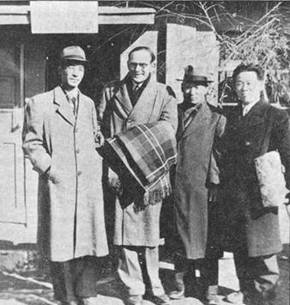
Frank Engel, second from left, with leaders
of the Korean Student Christian federation
18
It was she who,
later, was instrumental in me being invited by the New Zealand SCM to become
their General Secretary when George Falloon was called up to be an Army
Chaplain. In that position, of course, I became more closely related to the
WSCF as I corresponded with Robert Mackie who had succeeded Visser't Hooft as
General Secretary of the Federation. After the German invasion of France, the
WSCF headquarters had been moved from Geneva to Toronto in Canada in order to
ensure and facilitate communication. It was from there that he edited 'WSCF
News' which continued to keep us in touch with student thought and action
around the world. I recall vividly being at an SCM conference at Pounawea,
which is on the east coast of the South Island of New Zealand. Looking out to
sea on one occasion, I became aware suddenly that Robert Mackie was at that
same time visiting Chile in South America. Amid all the separation, isolation,
and silences of the war, there came an acute realization of being linked with
him in a common task and of students there and around me being part of the same
fellowship and enterprise. The South Pacific Ocean seemed to shrink, and the
reality of our unity in the Federation was sharpened as that evening we prayed
for him and the students he was visiting and the work of the Federation.
During this time in
New Zealand, I shared with him my uneasiness as to whether I should continue
as General Secretary when the war was making great demands on the Church and
society, when army chaplains and YMCA staff were needed. He wrote back putting
very firmly the need of students and the SCM for leadership at such a time. We
had never met. In fact, we did not meet for another ten years or more. But
because we shared an SCM background (his Scottish and British; mine, Australian
and New Zealand), and were involved together in the WSCF, there was a closeness
between us with a common understanding of basic things, resulting in mutual
trust. Later, I learnt that Robert for all his experience and reputation as an
administrator in Britain, the WSCF, and the
World Council of Churches, was above all things a caring pastor.
Back to Table of Contents
Main Page