8
Korea: Liberation and Self-Determination
Crisis Watch
Commentary
By John Feffer
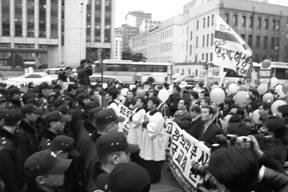
Fifty-six years ago, Korea was liberated from Japan. Note the
passive construction. Koreans did not, by and large, liberate themselves at the
end of World War II. The United
States liberated the South; the Soviet army
liberated the North. The division of the peninsula continues to this day. It
remains the chief obstacle to Korean self-determination. And self-determination
is a key organizing principle for Koreans on both halves of the peninsula.
After flirting with both
Soviet and Chinese styles of communism, North Korea built a new system around Juche
or self-determination. The principle of Juche encompasses political independence
from other countries, economic self-sufficiency, and self-defense (the
mellifluous Korean triplet of chaju, charip, chawi). This independent,
nonaligned vision proved quite compelling for several third world countries
during the cold war. True, at the height of its powers, North Korea depended on other
countries (Chinese energy supplies, Russian armaments, European technology).
But relatively speaking, North
Korea was a passionately independent country
that determined its own course in the world. Relative to South Korea, that is.
South Korea has remained, even after the
democratization struggles of the 1980s and 1990s, dependent on the U.S. military.
There are 37,000 U.S. troops stationed in South Korea.
The U.S. supplies South Korea
with over 70% of its armaments. The U.S.
also sets the parameters within which South Korea makes its defense
policy. There is a considerable civic movement in South
Korea that opposes U.S.
bases as well as larger U.S.
strategic initiatives (including missile defense). Korean nationalism "the
right of Koreans to determine their own national priorities" animates this
movement.
Self-determination is
not, of course, simply a matter of government prerogative. Since the 1980s,
Korean civic movements have been expanding the space for citizens to
participate in public policy. For instance, in the wake of the Asian financial
crisis, civic movements have campaigned against "fire sales" and
foreign control of domestic financial institutions, trying to preserve the
economic self-determination that produced the "miracle on the Han."
Even though South Korea's
national sovereignty remains constrained by U.S. military and economic
influence, South Korean civil society is one of the most vibrant in the world.
This transformation in
popular sovereignty, perhaps more so than the relative differences in the two
governments' ideologies, marks the divergence in North and South Korean
realities. Twenty-five years ago, the two Koreas were structurally similar,
if ideologically different. In neither country did ordinary citizens exercise
popular sovereignty (in the formal democratic sense of the word). At that time,
unification as a fusion of two vertically structured societies seemed easier to
imagine.
Today, with the citizens
of North and South operating according to entirely different conceptions of
what it means to be a citizen, unification seems a
9
more
difficult undertaking.
Still, overcoming the
division of the Korean peninsula remains the national aspiration of the Korean
people (which may differ from what any given Korean individual might want: many
South Korean twenty-somethings, for instance, could care less about
unification). There is no doubt that diluting U.S.
power over South Korea
is a necessary precondition. Such a dilution would include the transformation
of U.S. troops into a transitional peacekeeping role, a compromise that North
Korea has indicated, sotto voce, that it would accept, largely because it
prefers U.S. troops to revived Japanese militarism. It would also require the
U.S. to step back from its theater missile defense plans, which threaten to
further divide North from South (the North vigorously opposes the plan; the
South is under pressure from the U.S. to support the plan).
Several presidents have
supported reducing the U.S.
"footprint" in Korea
(Nixon, Carter, Bush Sr.). In the 1990s, however, the presence of U.S. troops
in South Korea has attained the status of a sacred cow, with several top
officials insisting that U.S. troops will remain on the peninsula even after
unification (i.e.: after the disappearance of any North Korean
"threat"). And the Bush Jr. administration has aggressively pushed
missile defense rather than seriously pursuing the threat reduction package
that the Clinton administration was on the verge
of negotiating with North
Korea.
Korean unification, a
difficult task even at the best of times, is not made any easier by the forces
of globalization and U.S.
military policy. To help create an atmosphere in which Koreans can determine
the fate of the peninsula largely by themselves, the U.S. government should stop
thinking of its own short-term interests and consider the long-term interests
of the region.
(John Feffer <Johnfeffer@aol.com>
writes frequently about East Asia. He is a
member of FPIF's Advisory Committee.)
Sources
for More Information
Roy Richard Grinker,
Korea and Its Futures (1998).
Chalmers Johnson, Blowback: The Costs and
Consequences of American Empire (2000).
Samuel Kim, ed., Korea's Globalization (2000).
Marcus Noland, Avoiding the Apocalypse:
The Future of the Two Koreas
(2000).
People's Solidarity for Participatory
Democracy (PSPD)
(South Korean civic movement pushing for
greater popular sovereignty) 3F Anguk Bldg 175-3 Anguk-Dong Chongno-Gu Seoul
110-240, Korea Tel: 82-2-723-4250
Fax: 82-2-723-5055 Email: pspdint@pspd.org
Web: http://www.pspd.org/
10
What is SOFA?
United States-U.S. Military Bases- ROK-US Status of Forces Agreement
(SOFA)
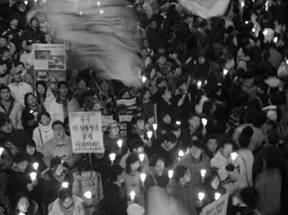
Currently there are
37,000 U.S. servicemen
stationed in 96 different places in the Republic
of Korea (ROK or Korea in short). Since the U.S.
Army landed in Inchon
Port in Sept. 9, 1945,
the U.S. Armed Forces have never left ROK and have had great influence over it.
In short Korea
is a heaven for the U.S. Armed Forces. There are
several countries occupied by the U.S. Armed Forces in the world, but none
enjoy such privileges with absolute strategic command as in Korea.
The Status of Forces
Agreement (SOFA) is an agreement that determines the lawful status of the U.S.
Armed Forces in ROK. According to international law, foreign armed forces
generally abide by the law of the stationed country. An exception is made when
the foreign armed forces have to perform a special duty in a country under a mutual
agreement between two countries within the law. However, SOFA between ROK and U.S. goes far beyond making simple
accommodations to the U.S. Army - it is practically forfeiture of the
sovereignty of Korea.
During the period of the U.S. military
government, ROK had no sovereignty. After an establishment of an independent
administration, the new administration and the U.S. agreed upon the status of the
U.S. Armed Forces. The content of the agreement consisted of surrendering all
rights on the part of ROK and allowing the U.S. Armed Forces' exclusive rights
to the military bases and facilities with one condition that the U.S. Army
withdraw in 1949. Because of a request made by the U.S. Army during the turmoil
of the Korean War in June, 1950, however, the U.S. Army took away all the
jurisdiction of the Korean government. It took thirteen years to go from a
complete surrender of jurisdiction to an establishment of SOFA between ROK and
the U.S.
in 1967, which is considered a most unequal law by international legal
standards.
The U.S. administration further demanded a
humiliating agreement between Korea
and Japan and a dispatch of
Korean troops to Vietnam.
Even after partial revisions were made to SOFA in 1991, most items limiting the
rights of ROK remain unchanged. In exchange for the revisions, the U.S.
demanded that ROK pay an enormous share of the cost of stationing US troops
there. Agreeing to make further revisions of ROK-US SOFA in November 1995, the
Korean administration promised to raise their share of the defense fund. (The
share of ROK in 1995 was $ 30 million, which amounts to 78% of the stationing
expenses, with an annual increase of 10 %) Due to a unilateral announcement of
a negotiation rupture
by the U.S.,
however, the agreement has been deferred until now. Only when local civil
organizations launched strong campaign against it, the U.S. Pentagon - being
concerned about anti-U.S. sentiment - made an announcement last November that
it will hold working-level meetings within this year.
However, what will the U.S. request and Korea surrender in exchange this
year? Will ROK purchase a massive amount of the U.S. made weapons? Or will the U.S.
demand a further increase of the financial contribution by ROK?
Unfair
ROK-U.S. SOFA
Because of SOFA:
·
ROK is permanently leasing U.S. military
bases for free.
·
The criminal jurisdiction of the U.S. servicemen committing crimes against
Koreans falls under the U.S.
armed forces.
·
In reality it is difficult to compensate for
civilians' damages inflicted by the U.S. troops.
·
Korean laborers working in U.S. military
bases do not have the protection of the major labor rights protected under
Korean law.
11
·
Korean custom-clearance officers do not have an
access to U.S.
military goods.
·
ROK cannot place a restriction on environmental
problems in the U.S.
military bases.
·
ROK cannot protect an invasion of private
property that is occupied by U.S.
military.
·
ROK does not have an access to information
regarding weapons brought in by the U.S. Army to Korea.
·
Other issues include women living in military
camp-side towns and noise disturbance resulting from military planes.
As can be seen from the
above problems, SOFA supports indulgences of all crimes committed by the U.S.
servicemen.
SOFA, Encouraging Crimes
Committed by the U.S.
Servicemen
The U.S. government and its military do not
acknowledge the criminal jurisdiction of the Korean Administration of Justice;
and precisely because of that, the crimes committed by the U.S. soldiers,
averaging 2,000 cases a year, are not punished properly. The Korean government
is supposed to hand its jurisdiction over the U.S.
servicemen and their families to the U.S. Army if the U.S. requests. Since the
establishment of SOFA in 1967, the cases in which ROK claimed jurisdiction over
the U.S.
servicemen remain only 2%. Although the U.S. soldiers commit hideous crimes
including murder, robbery, and rape, Koreans cannot even arrest them for
investigation unless the crime is a flagrant offense. Crimes committed by the U.S.
servicemen are increasing in number, and they are getting crueler.
The U.S. uses any
land in Korea
for free.
The land can be used
indefinitely; a lease period is not specified. Considering that most countries
establish a lease contract with a lease period, which are
often extended through an agreement, the rent-free usage of the U.S. military bases in Korea is unreasonable. Because Item
6, ROK-US Mutual Defense Treaty, which is the basis of SOFA, states that this
treaty is valid indefinitely, it is as if the ownership of the U.S. military bases belongs to the U.S.
When leasing a base, one needs to inspect and monitor if the property is being
used according to its original purpose. As such, the Korean administration
needs to have the right to govern what is going on in the U.S. military bases, but that is
not the case. Furthermore, the purpose of facilities and military zones may not
necessarily be related to the security of the Korean peninsula since the
purpose of the U.S.
military occupancy is not stated at all. Given that the military strategic
command belongs to the U.S. Armed Forces, this can be very dangerous.
Irreclaimable Environmental and Noise Pollution
Environmental pollution
produced by the U.S.
military bases is very serious. The U.S. military bases are discharging
polluted water and oil into rivers and ocean illegally. The environmental
damages include soil pollution by heavy metals such as PCB, lead, and cadmium;
and hearing damage, insomnia, the birth of deformed infants and animals as well
as miscarriages because of shooting, bombing, and landing and taking-off of
fighter jets. Item 1, Article 4, of SOFA states that the U.S. Armed Forces do
not have an obligation to restore the base and facilities formerly used by the U.S.
army back to the original state. This lack of obligation creates an ironical
situation in which an army dispatched to defend a country destroys its very
territory. The case of the Philippines
has proven that the U.S. Army destroys the occupied land for good after its
withdrawal. Providing the land for free and indefinitely, however, we are not
even given a right to conduct surveillance.
An
institutionalized system known as SOFA legalizes inequality between countries.
ROK-U.S. Status of Forces
Agreement must be completely revised!
12
All agreed upon articles in ROK-US SOFA
must be corrected:
·
Complete guaranteeing of Korean government's
jurisdiction and rights to criminal investigation and to carrying out
sentences.
·
Establishing claim for damage incurred by the U.S.
servicemen.
·
Contracting a lease between ROK and the U.S. and
collecting fees for using military bases.
·
Establishing human rights and labor rights of
Korean laborers working in the U.S.
military bases.
·
Providing preventive measures against smuggling
and illegal outflow of the U.S.
military post exchange (or PX).
A revised law must
include other measures abolishing special privileges of the U.S. Armed Forces.
These are the minimal needs and demands for reclaiming our nation's sovereignty.
In the 50 years of the U.S. occupancy in Korea,
the U.S. has seriously
violated Korea's
sovereignty and human rights. The U.S. supported military dictators'
regimes and have oppressed Korean Minjung (an indigenous Korean word referring
to people resisting oppression) trying to change an unfair ROK-US relationship.
The U.S government has also dismissed the demands of Koreans calling for an
equal relationship between the two countries. Despite opposition expressed by
Northeast Asian
Minjung, the U.S.
forced unfair agreements and treaties upon Korea,
Taiwan, Japan, Philippines,
and so on in order to hold strong military hegemony over Northeast
Asia.
Foreign military forces
must withdraw from every country. The U.S. Armed Forces Korea are no exception. We do not know of any foreign army
altruistically sacrificing their lives and bearing all costs, except in a very
few and temporary cases perhaps. We only know of inequality and looting
committed by foreign forces. Therefore, the U.S. Armed Forces stationed in Korea
must withdraw from this land unless they agree to revise SOFA completely.
Solidarity in South Korean Civil Movement against the U.S. Forces:
The case of the death of two schoolgirls in June 2002
Naoko Murakami (Summer
Internship Student)
August 22, 2002
1.
Introduction
The civil movement
against the U.S. Forces in Korea (USFK) has brought about two revisions of the
Status Of Forces Agreement (SOFA) between South Korea and the U.S. Despite the revisions, however, the
persistency of USFK legal treachery and the intrinsically unjust nature of SOFA
was yet again exposed in the recent case of the
negligent homicide of two middle school girls by US servicemen in Yangju, Kyonggi Province. The resulting civil protest exerted a
significant influence on the legal resolution of the incident, and demonstrated
strong solidarity among citizens in South Korea.
This paper is
specifically concerned with the civil movement against the USFK and its
handling of the Yangju incident. The paper follows the civil movement up until
the USFK announcement of its decision not to waive criminal jurisdiction over
the incident. This paper also visits, through footnote, a crime committed in
2001 by a U.S. soldier in Okinawa, Japan.
Because the fight for criminal jurisdiction is at the heart of both cases,
comparison of the two help the understanding of civil movements in each
respective country. It will be
helpful for readers to understand the characteristics of Korean civil movements
against U.S. crimes, and
further the study of civil movements against U.S. armed forces across the world.
2. The Incident and its development
On 13 June 2002, in
Yangju, Kyonggi Province, two middle school girls walking to a friend’s
birthday party were killed by a U.S. armored truck, which was participating in
a field exercise called
13
ATT Training. About 10 tanks participated in the
training of that day, and they were heading to a training area at regular
intervals. A 54-ton truck in the
third line hit the two girls when it turned aside to clear the way for the tank
approaching from the opposite direction.
The driver and the track commander, Sgt. Mark Walker and Fernando Nino
from the U.S. 2nd Infantry
Division, were handed over to U.S.
military police for investigation.
Immediately, the USFK expressed regret over the incident through a
statement issued in the name of the commander of the Eighth U.S. Army, Lt. Gen
Daniel R. Zanini. It also clarified
the USFK’s intention to thoroughly carry out a South Korea-U.S. joint
investigation. Thomas A. Hubbard,
U.S. Ambassador to South
Korea, also expressed his condolences over
the deaths of the two girls later in the afternoon. The next day, the assistant chief of the
Second U.S. Army, the assistant chief of civil affairs, and the assistant chief
judicial affairs visited the mortuary and gave 1,000,000-Won consolation money
to the parents. This was an exceptionally quick and sympathetic response by the
USFK.
Other actions taken by
the USFK, however, were predictably in favor of hindering rather that helping
justice. South Korean police, who
arrived at the accident scene, were not permitted to do anything more than
basic investigation, such as collection of evidential sources, because the USFK
had already finished arranging the scene.
The Korean police were not even permitted to interview the soldiers and
witnesses.
The Status of Forces
Agreement (SOFA), which is based on the Korea-U.S. Mutual Defense Treaty in
July 1966, defines the legal status of the U.S. Forces in Korea. Under
the terms of the third paragraph of Article 22 of SOFA, it is the U.S. who has the first criminal jurisdiction
over the crimes that are committed by U.S. servicemen while on duty. South Korea does not have a right
to get involved from investigation to trial. Unlike the Status of Forces
Agreement between Japan and U.S., SOFA between South Korea and U.S. provides
the U.S. a conclusive right to decide whether the incident occurred while on
duty or not. All that the South Korean government can do is to request that the
U.S.
waive its jurisdiction. According
to the statistics of the Justice Ministry, the National Campaign for
Eradication of Crime by U.S. Troops in Korea,
South Korean courts passed judgment only in 23 cases (7.3%) out of 311 crimes
involving U.S.
soldiers in 2000 and 26 cases (6.9%) out of 376 crimes in 2002.
South Korea is able to request that the U.S. waive its jurisdiction on the crimes
committed by U.S.
soldiers in liberty. After the
first revision of SOFA in 1991, the items that the U.S.
gives “sympathetic consideration” to South Korea’s request was
added. However, South Korea still did not, and still does not,
have a legal right to obtain jurisdiction, because the U.S. could reject South Korea’s request.
Regarding the death of
the two school girls in Yangju, the Ministry of Justice filed an official
request with USFK, on July 10, to give up its primary criminal
jurisdiction. This was the first
time the South Korean government exercised its right to request the U.S to
waive jurisdiction over a crime committed by U.S. soldiers. Under the terms of Article 4 of the
Korea-U.S. Mutual Defense Treaty, the Ministry of Justice has to file an
official request with the USFK to waive primary criminal jurisdiction within 21
days after an incident. Therefore,
the Ministry of Justice had to file an official request with the USFK before
July 5. But because the
USFK’s consignment of the warrants for the incident was unpunctual, this
deadline was extended to July 11.
The reasons for the
Ministry of Justice’s unprecedented decision to request U.S. waiver of
jurisdiction are as follows: the South Korean prosecutor could not interview
the two U.S. soldiers until July 9, the death of the two junior high school
students was serious affair, the victims did not have any fault, and they were
considering the feelings of the bereaved family. In response to a Korean
request of waiver, the U.S.
must, under the terms of SOFA, reply within 28 days.
Shortly after the
Ministry of Justice’s request, it was speculated that the U.S. was
unlikely to waive jurisdiction because it had never previously waived
jurisdiction over crimes committed by servicemen while on the duty. On the day
after the Ministry of Justice’s request, Culture Daily reported that the
USFK was unwilling to create a precedent where a crime committed while on duty
was prosecuted in a South Korean court. The USFK’s lack of a quick
response to the Culture Daily report led civic groups and citizens to actually
infer this statement as true.
The bereaved families and
civic groups sued the six U.S.
commanders under suspicion of negligent homicide and requested to have them
prevented from leaving South
Korea.
One of them, the 2nd division commander, who promised the bereaved
families to build a memorial monument for two girls, finished his term and
departed from South Korea.
Based on independent investigation implemented in July, the Korean prosecutor
announced that they could not find negligence for criminal liability among the
commanders who were sued, except for the drivers and truck commander. Although South Korean prosecutors also
summoned the suspects, they reportedly refused to answer specific questions
about the incident. According to the Ministry of Justice, on August 7, the USFK
submitted an official document stating that the USFK would not waive jurisdiction
because there hadn’t been any precedent in which the USFK waived its
jurisdiction over an incident committed while on duty, and furthermore, that
the persons concerned had already been prosecuted under their jurisdiction.
3. South Korean Civil Movement against the USFK
3.1 History of civil movements against the USFK, and SOFA
The two revisions of SOFA
were the direct results of civil movements against the SOFA and the USFK. The
existence of U.S. forces in Korea was
of course a result of Cold War doctrine.
Protest against the USFK was forbidden under former authoritarian
regimes and the National Security Law. A rationale was created and
propagandized to justify the continued presence of USFK; the notion that the prevention
of a North Korean attack was only possible through the continued existence of
USFK was fixed indelibly within the psyche of a generation of South Koreans.
Thus, although U.S.
soldiers committed a great number of crimes in the era passed, the victims and
their bereaved families were compelled to accept them. Protest against the USFK
was recognized as an act serving the interests of the enemy.
Today, crimes of U.S. soldiers
against prostitutes around the military bases tend not to be brought to light. It is not only because the victims are
unwilling to come forth, but also because the South Korean people pay little
attention to them. There is deeply
rooted prejudice against prostitutes serving U.S. soldiers. Calling them by the demeaning term, “Yangsaeksi
[prostitution for the U.S.
soldiers, (literal translation: Western hostess)],” South Korean people
want to deny even their existence. South Korean people did not recognize the
crimes by the U.S.
soldiers against prostitutes as problems for the whole of South Korean
society. They believed that the
USFK was only an issue for “non-nationalistic” people, or for
prostitutes. Accordingly, numerous
criminal cases, not to mention crimes that went unreported, were covered up
without attracting anyone’s attention.
However, as
anti-Americanism spread in the 1980s among the civics in the wake of the
Kwangju Incident, the crimes of U.S.
soldiers became a concern for South Korean citizens. At the same time, increasing momentum
toward democratization brought active discussion over a revision of SOFA. SOFA was revised for the first time in
25 years on February 1991. Yet, the
revised version of SOFA still maintained unequal clauses. Although the clauses stating South
Korea’s automatic waiver of criminal jurisdiction over U.S. soldiers was
deleted and the scope of crimes over which South Korea can exercise first
jurisdiction was
15
expanded, some
clauses are still effective enough to impose restrictions on South
Korea’s exercise of jurisdiction.
The second revision was
also the result of a public outcry against crimes involving U.S.
soldiers. Crimes committed by U.S.
servicemen, such as the bizarre murder of Yun Gumi in 1992 again gave rise to
much controversy over the overall revision of SOFA. Particularly, the case of Yun Gumi
brought the crimes of the U.S.
army into public debate. Consequently, the first civic group that specializes
in crimes involving the USFK, the National Campaign for Eradication of Crime by
U.S. Troops in Korea,
was established. Negotiations with
the U.S.
for the revision of SOFA started in 1995. However, these negotiations were
suspended due to disagreements on criminal jurisdiction. The U.S. then unilaterally broke off
the negotiations in 1997. As crimes
involving the USFK became infamies, (crimes including murder, damage to the
quality of life of residents in the vicinity of target practice areas, and
unsanctioned discharge of toxic substances into the Han
River), protests against the USFK rose sharply in 1999 and could
not be ignored. As a result, the
negotiations between South Korea
and the U.S.
resumed. 127 civil groups for the
revision of SOFA merged in solidarity to become the People’s Action for
Reform of Unjust ROK US SOFA Agreement.
Monthly rallies in front of the U.S. embassy also began, and still
continue to take place after 35 rallies. In January 2001, through 11
negotiations, a proposal for the revision of SOFA was concluded. During the
process of its ratification in South
Korea, civics and civil groups sharply
reacted against ratification because it was a change for the worse in
actuality. The public debate regarding SOFA among the South Korean citizenry
has directly aided the movement for democratization and development of civil
society in South Korea.
3.2 The Civil Movement regarding the death of the two schoolgirls
The civil movement
against the USFK’s indifferent response to the death of the two girls did
not immediately gain momentum. The FIFA World Cup, which South Korea was hosting at the
time, was drawing much of the public’s attention away from the
incident. As major media did not
report the incident, many citizens were even unaware of the incident. However,
as noted above, it was unusual for the USFK to express regret over the incident
so quickly. The public did not
forget the incident. After the
World Cup, South Korean citizens’ concern about the incident grew because
of movements by civic groups, including reports on Internet web sites and
street demonstrations. One month
later, rallies were simultaneously held in big cities throughout the country.
What the civil movement
required of the USFK was mainly divided into four items: waiver of jurisdiction
over the incident, President Bush’s apology, prompt payment of
compensation, and the revision of SOFA.
The call for criminal jurisdiction over the incident came as the result
of the USFK’s inability to give a convincing explanation on the cause of
the incident. The public was
growing suspicious, but as long as the USFK had jurisdiction, South Korean
prosecutors could not even interview the soldiers responsible for the
16
deaths. It is highly likely that the U.S.
conceals the truth to avoid liability. The request for President Bush’s
apology results from a precedent set by former president Bill Clinton while
visiting Okinawa for a summit in 2000, when he officially apologized for an
incident committed by a U.S.
soldier there. This incident demonstrates the inherently biased nature of SOFA
between Korea and the US, with regards to such issues as the
jurisdiction over crimes committed by a U.S. soldier while on the duty.
However, citizens also
recognize that the South Korean government is also at fault in its handling of
the Yangju incident. Although the
national coalition worked on the government again and again, the reaction of
the government was languid. It was
at the last possible moment when the Ministry of Justice unwillingly filed an
official request with the U.S.
for waiver of jurisdiction. The government seemed only concerned with its
relationship with the United
States.
On July 22, the Defense Ministry spokesman doubted that the U.S.
military would give up jurisdiction over the soldiers. This definitively inflamed the
citizens’ discontent with the government because the government seemed on
the side of the United
States. The reason the Defense Ministry
cited is the same reason that the USFK had raised from the beginning and that
the USFK consequently raised when it announced its decision not to waive
jurisdiction on August 7, 2002. To
make matters worse, the Defense Ministry retracted its proposal to have an
interview with the national coalition group. Two days after the announcement, the
national coalition held a press conference in front of the building of the Defense
Ministry and denounced the Defense Ministry by using such words as
“betrayal,” “humiliating,” and
“thoughtless”.
Moreover, when the people
heard that the Kyonggi
Province office was to
honor a commander of the Second U.S. Army for his achievements, in light of the
upcoming departure from his post, citizens reacted sharply against it. They argued that this would show the
Kyonggi government as being ignorant of the current citizen’s movement
against the USFK and unpatriotic.
Kim P’ant’ae,
director of the People’s Action for Reform of Unjust ROK US SOFA
Agreement, insisted that though the South Korean government had been pushed to
request the waiver of jurisdiction to the U.S., it did not seem to have strong
will to pursue a thorough investigation. Mun Jonghyon, regular representative
of the national coalition, also argued that one of the obstacles preventing the
demise of the USFK was none other than the South Korean government and what was
required was an active involvement of the South Korean government towards the
resolution of the incident, as the Okinawa administration and Japanese
government had done. Through the
incident, the South Korean citizens learned that an active civil movement
enables them to steer the government, which did little for the people’s
rights by itself.
The current upsurge of
the protests against the USFK reminded citizens of other incidents involving
the USFK. The incident of the two
school girls came a week after a 52-year-old worker, Chon Dongrok, died
following his electrocution by power lines set up by a U.S. military base near the
inter-Korean border. In rallies for
the two girls, there were pictures of Chon Dongrok and boards, which accused
the USFK of his death. In the 5th
national coalition rally for a full accounting of the death of the two
schoolgirls and punishment of those responsible for it, a regular
representative of a national coalition mentioned the incident of Chon Dongrok
when he called for closing of the military unit responsible for the
incident. Also, the unsolved
homicide committed by a U.S. serviceman in March 2000 received a great deal of
public attention and roused the movement for its reinvestigation, although when
it happened, it was ignored because the victim was an aged prostitute for U.S.
soldiers. The National Campaign for
Eradication of Crime by U.S. Troops in Korea explains that the case of the
schoolgirls exposed the USFK’s uncooperative and unreasonable stance on
crimes committed by its soldiers.
17
SOFA and Sovereignty Over Korea
By Ahn Sung-Ho
Two Korean middle school
girls were run over and killed by a U.S.
armored vehicle at around 10:45, June 13, in Yangju, Kyonggi
Province, 30
km north of Seoul.
The girls were identified as Shin Hyo-soon and Shim Mi-sun on their way to a
friend's birthday party. On the other hand, the two soldiers who operated the
54-ton armored bridge carrier were identified as Sgt. Fernando Nino and Sgt.
Mark Walker from the U.S.
2nd Infantry Division. They were immediately handed over to U.S. military police for
investigation by local law enforcement officials in conformity to the Status of
Forces Agreement (SOFA). The investigation was done virtually by the U.S.
military army alone and was alleged to reveal that it was an accident. The families and friends of the girls
and NGOs have been demanding that the investigation be re-done systematically
by the Korean police, and that the United States Forces Korea (or USFK) give up
its rights to try the soldiers in a U.S. court. On July 10, the
Ministry of Justice of Korea
filed an official request for the United States Forces Korea to waive its
primary criminal jurisdiction over the alleged accident that crushed the two
students to death. Further, the major political parties, the Grand National
Party and the Millennium Democratic Party, also supported the Korean Government's
action.
This means that the ROK
as a nation has requested the U.S.
for jurisdiction over the incident. The USFK, however, declined the ROK
request. One argument is that there is no precedent of U.S. soldiers being tried in Korean
courts concerning on-duty crimes. The National Campaign for Eradication of
Crimes by U.S. Troops, a local civic NGO however, has rebutted this argument
saying that although not in Korea
the U.S. did waive its
jurisdiction once: in June 1957 the U.S. government declared it would
give up its primary criminal jurisdiction over the death of a 46-year-old
Japanese woman. This precedent virtually nullifies the power of the first
argument.
There is no reason why it
cannot occur in Korea
if one occurred in another country. The other argument is that the two U.S.
soldiers already face a court-martial for negligent homicide. This isn't
persuasive because the court process can always be stopped.
These are not isolated
incidents, but just a tip of the iceberg. The National Campaign reports the
Korean government's official statistics that 56,904 U.S. soldiers and civilian
employees were involved in 50,082 criminal acts between the years of 1967 and
1998. And less than 5% of the criminals involved were taken to Korean courts.
On the basis of the
statistics, experts estimate that more than 100,000 crimes were committed since
U.S.
troops began to station in this nation on September 8, 1945. Right now, we have
37,000 U.S. troops in 96
bases in the territory of the Republic
of Korea. They have been
killing our women, they have been raping or sexually abusing our children, they
have been despising and beating our brothers, but rarely being reasonably
punished. What do they sound like? Do they sound like troops of one of our
allies? No, they sound more like those of a conqueror. They are arrogant, don't care about the safety and security of our
people.
They are just concerned
about themselves, their regulations, their customs, and their ideas. We know
that U.S.
troops have good-natured soldiers. But as a system, they are evil. Where do
those absurdities come from? First, people almost unanimously blame them on the
SOFA between the Republic of Korea and the United States.
This Agreement, which was
drafted when Korea
was so poor and desperate, confers such a ridiculously exceptional status to
American soldiers and their families and their relatives and their visitors. We
know the Agreement was signed by the Korean government and was ratified by the
National
18
Assembly, and so that it
has a great binding force. Since it damnifies the sovereignty of this
nation and constantly threatens the safety and security of the citizens,
however, the SOFA must be interpreted and applied to the restoration of Korea's
sovereignty.
For the specific case in
question, the U.S.
government must re-consider their decline to the Korean government and waive
the jurisdiction in question. They must recall that Korean citizens also have
rights to life, happiness, and safety if U.S. citizens do. The SOFA must be
revised and the evil unfairness of the ROK-U.S. relationship must be fixed
immediately. Second, the Korean
government and law enforcement officers should be reminded that their duty is
to protect or care for their own people. A brief review of the USFK-involved
crimes shows that Korean police are not aggressive enough in protecting the
safety, life, property, and human rights of Koreans. If our guards and officers
do not care, who would care? Most of all, lastly, all the people must realize
the seriousness of the unfairness in the SOFA and deploy a new millennium
movement of independence from the USFK. We must spend more money on our
national defense. We cannot live in this state of indigence drunk with some
physical comfort when in a shadowy corner of this land our brothers, sisters,
and children are despised, abused, and killed away. This absurdity cannot be
ignored any more.
The Hanyang Journal
All Rights Reserved
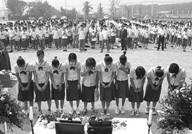 Students holding ceremony in memory of Hyo-Soon
and Mi-Sun
Students holding ceremony in memory of Hyo-Soon
and Mi-Sun
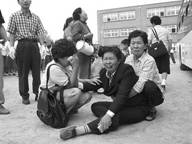
One of the victim’s mother
in grief