Celebrating North Carolina Native- American heritage
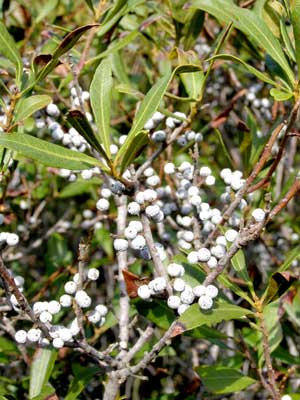
PHOTO BY KEN MOORE. Wax myrtle berries are a component of bayberry candles.
By Ken Moore
Flora Columnist
Two plants I mentioned last week when leading into the coral honeysuckle story are wax myrtle and yaupon holly. Both are major components in stabilizing our coastal sand dunes. Though very tolerant of wind and sea spray, when they are positioned near the dunes at the leading edge of the wind and wave action they hunker down in prone positions close to the ground. Further back from these harsh conditions, they occur as large shrubs or small trees. Both are beautiful evergreen plants with engaging fruit and are often used in residential and urban landscapes. In addition, they have a rich heritage of use by Native Americans.
You’ll find dried specimens of both of these important plants in Raleigh this Saturday at the N.C. Museum of History’s 15th American Indian Heritage Celebration. From 11 a.m. to 4 p.m., the state’s eight recognized tribes will be celebrating their rich heritage through colorful ceremonial dancing and singing, storytelling, fluting and demonstrations, including the “burning into shape†of a dugout canoe and hands-on activities with Native-American crafts. A full schedule of events/activities is available at ncmuseumofhistory.org
Mary Locklear, Lumbee wildcrafter and herbalist, will be there to show and describe plant uses. I enjoy learning of the early uses of our native plants and the great stories associated with them.
I make frequent reverence to Herbal Remedies of the Lumbee Indians by Arvis Locklear Boughman and Loretta O. Oxendine, in addition to Daniel Moerman’s definitive Native American Ethnobotany.
The wax myrtle, Myrica cerifera, is often called southern bayberry, associated with popular bayberry candles. The waxy-coated, silver-gray berry-like fruits are the source for the scent of those candles. The Houma Indians of the Louisiana territories are described as boiling the wax from the berries of our southern species for candle making. These days, I suspect the northern bayberry, Myrica pensylvanica, with larger fruit, restricted in our state to Dare and Currituck counties, is most likely the plant used.
Numerous descriptions include decoctions of leaves, stems and roots for all manner of medicinal use, from headaches to stomachaches. I particularly enjoy reflecting on a wax myrtle use attributed to the Seminoles. They are reported to have used the plant as a tobacco substitute. With strong-scented glands on both sides of the leaves, that must have provided a mighty memorable smoke, indeed!
Ms. Lucy Mae Hammonds Locklear, a Lumbee elder, boiled the leaves from this tree, which she called the Merker tree, into a tea to treat whooping cough.
The beautiful red-berried yaupon holly, Ilex vomitoria, is the source of the “black drink.†Fresh and dried leaves of this native holly do make a drinkable green tea, but the strong drink decocted by Native Americans throughout the Southeast was definitely an effective emetic and thus became a legendary seasonal ceremonial drink.
Osceola, a great chief of the Seminoles, was named after this ceremonial drink. His name meant “black drink singer.†Closer to our region, the Cherokees are reported to have traveled from the west to trade flint and other objects with the eastern Lumbees for the “black drink.â€
Enjoy this and more at the celebration this Saturday.
Email Ken Moore at flora@carrborocitizen.com.
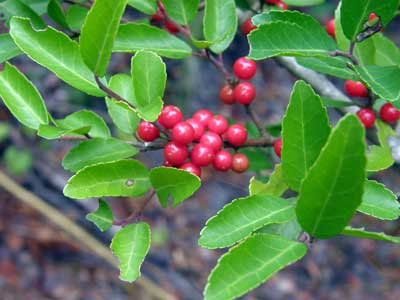
PHOTO BY DAVE OTTO. Yaupon holly leaves make the ‘black drink.’
Botanical surprises on the beach dunes
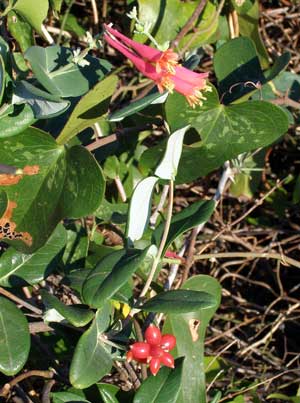
PHOTO BY KEN MOORE. Coral honeysuckle flower buds poised to open in winter’s sun.
Ken Moore
Flora Columnist
Thankfully, when my surf fishing is not successful, I can fall back on the pleasures of taking a closer look at the variety of plants holding the sandy dunes in place. Though late in the season, I was surprised to find – hunkered down with the dune-stabilizing wax myrtles, yaupon hollies and coastal red cedars – lingering flowers of members of the composite plant family: asters, seaside goldenrods, gaillardias and dune camphorweeds.
The biggest surprise, however, was native coral honeysuckle, Lonicera sempervirens, with red flowers and red berries sprawling over mats of dune-clinging evergreen catbriers. I usually see it in forests and along woodland edges, where it flowers sparingly when not in full sunlight. I stopped mid-stride and simply stood there gawking in wonderment, my thoughts reflecting on the coral honeysuckle still in flower on my trellis back home in Carrboro. I remembered with nostalgia the story of how I came to have that special long-flowering coral honeysuckle growing on the edge of my deck.
Back in the late 1980s, keen Raleigh gardeners Pat and Charles Wheeler were driving along Salter Path Road on Emerald Isle. Charles was surprised when Pat came to an abrupt stop and turned the car around to take a closer look at a high sand dune construction site where she, being the wildflower nut she still is, had spied a mound of red flowers.
The time was May and the plant was a giant mound of coral honeysuckle flowers very much in harm’s way. Pat, with Charles’ assistance, succeeded in rescuing that specimen to flourish in their Raleigh garden, where it surprised her with continuous flowering even into the cold Christmas holidays.
During that period, Charles was president of the Botanical Garden Foundation, and on one of her frequent visits to the N.C. Botanical Garden, Pat shared some cuttings of her special red honeysuckle with garden staff, who in turn were mightily impressed and shared it with Niche Gardens. Under the guidance of UNC Herbarium curator Jimmy Massey (of Holly Hill Daylily fame), Niche Gardens and the Botanical Garden jointly introduced Lonicera sempervirens “Major Wheeler†to the gardening public.
In this manner, Pat was pleased to honor her husband, who was not only an avid gardener but, as a vice president of the UNC General Administration, had assisted the Botanical Garden with grant writing, as he provided assistance in so many ways to deserving organizations and populations throughout the state.
Plants with stories are a treasured part of one’s garden. Everyone needs a “Major Wheeler†coral honeysuckle to festoon their gardens with mounds of hummingbird-attracting flowers throughout the growing season and, especially, to provide cheer during the winter months. The Botanical Garden sold out during their big fall sale, but they’ll have more in the spring. But now’s a great time to plant, and I know that Niche Gardens has some. I realize now that my single specimen is not enough!
Email Ken Moore at flora@carrborocitizen.com.
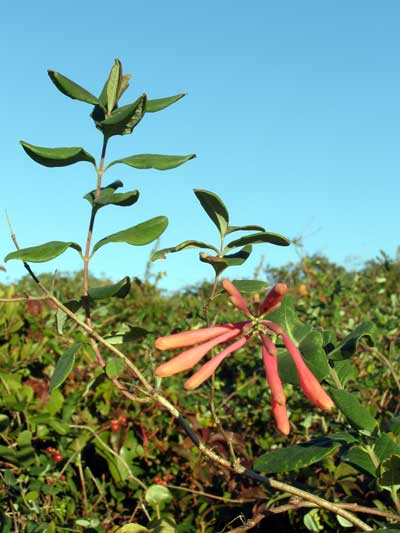
PHOTO BY KEN MOORE. Coral honeysuckle, flowers and berries, mingle with catbriers on sand dunes.
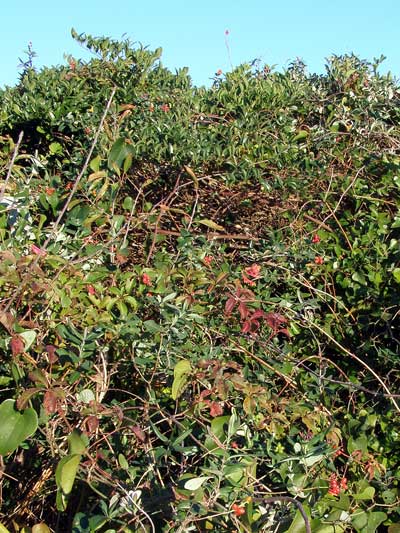
PHOTO BY KEN MOORE. Dense mat of coral honeysuckle and catbrier secure coastal dunes.

The Nature Observation Trail is just for walkers. Photo by Ken Moore
By Ken Moore
Flora Columnist
Three cheers for the guys who manage UNC Carolina North’s 20-plus miles of trails! There is now a footpath reserved exclusively for walkers. Believe it or not, the markers at the trailheads state that the trail is for “walking only, no dogs, no runners, and no bikes.â€
Unbelievable. Thank you, thank you, thank you!
I walked it recently and, though near residential areas of hundreds of homes, I experienced peace and quiet akin to being in a far-away wilderness. Mind you, it was in the middle of the week, so even heavily traveled trails elsewhere in the forest would not be too crowded. But I had this particular trail, the Nature Observation Trail, completely to myself for a leisurely hour of walking, contemplation and standing quietly in awe of big pines, oaks and tulip poplars.
One stand of towering tulip poplars made me think of the virgin Joyce Kilmer Memorial Forest in the far-western end of our state. Well now, the trees aren’t really that big, but big enough to make me think of Joyce Kilmer. The opportunity for uninterrupted, quiet contemplation and nature observation is really special.
The trail is narrow and intimate. At times, one has the sensation of walking along on a deer path. We walkers and quiet nature observers are fortunate to have such a trail; hopefully, the rules of this single pathway will be honored by all the other enthusiastic travelers along more heavily used trails.
However, this and many Carolina North trails are under siege.
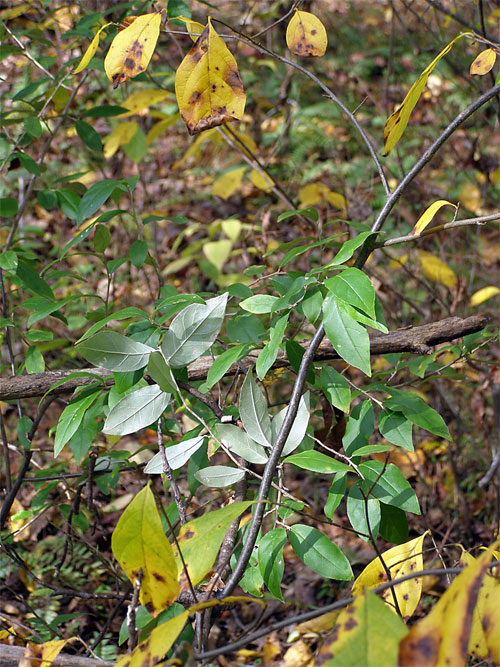
Invasive eleagnus (silver-green leaves) out competes native spicebush (leaves turning yellow). Photo by Ken Moore
Exotic invasive plants already have a frightening foothold. Much of the understory shrub layer bordering the creek and beaver swamp is a thicket of one particular exotic invasive, Eleagnus umbellata, silverberry, or autumn, olive. This exotic from China and Japan has literally consumed hundreds of acres of forests. One heavily infested area along the Nature Observation Trail right now offers a dramatic contrast.
Spicebush,Lindera benzoin, the host plant of spicebush swallowtail butterflies, is in its yellow fall phase. In contrast is the silver-green foliage of eleagnus, which is visibly poised to outcompete and eradicate the spicebush within the next several years.
Now enter the Carolina North management team of Greg Kopsch and Jerry McGovern. To combat this invader, they supervise an active program that provides opportunities for community volunteers to take part in assisting with the eradication efforts. Coming up on Nov. 13, they will host another volunteer workday to extract more of this noxious, shrubby weed from the native spicebush habitat. Contact them at forestmanager@fac.unc.edu for more information. Better yet, visit their informative website (fac.unc.edu/CarolinaNorth.com) for trail maps, scheduled special events, regular updates about what’s going on in the “forest†and other activities available for volunteers.
And all you walkers out there, now’s a good time to discover for yourself the trail that’s reserved just for you!
Email Ken Mooreat flora@carrborocitizen.com.
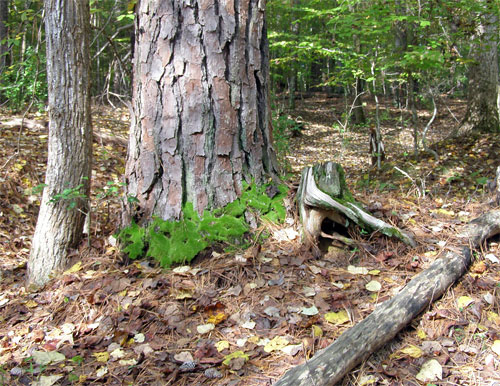
Many spots along the trail are worth a closer look. Photo by Ken Moore
Flora and fauna on Cane Creek Reservoir

PHOTO BY MARGARETTA YARBOROUGH. A great blue heron takes refuge in foliage of pine and tulip poplar on the edge of Cane Creek Reservoir.
By Ken Moore
Flora Columnist
I thank UNC librarian and Flora reader Margaretta Yarborough for sharing stories and pictures of her frequent Cane Creek Reservoir paddling adventures. As a kayak-birder, she manages to capture some engaging images from her kayak. Those images influenced me to go paddling on the lake this past Saturday.
When I arrived at the lake office to check in, pay the modest fee for boat rental and get suggestions from the helpful lake wardens, I encountered Lucretia Kinney, another Flora reader and an avid birder. She had already enjoyed a morning of birding. Unlike Margaretta, Lucretia birds on foot, and I see her frequently at Mason Farm Biological Reserve beyond Finley Golf Course. She posts her bird sightings on eBird.com, where I learned that OWASA’s Cane Creek Reservoir (ccreek@owasa.org) is one of North Carolina’s birding “hotspots.â€
Lucretia’s description of Saturday morning is noteworthy: “I had an excellent birding morning, with 33 species identified – very exciting. One thing that makes the reservoir special is the habitat diversity, including pines at the entrance, mixed hardwoods along the nature trail along the creek, the agricultural fields, the well-kept lawn and the lake. No wonder it’s a ‘hotspot’ birding area.â€
Though I didn’t match Margaretta’s spring wood duck sighting, the bald eagle that launched into flight from its perch high above my canoe definitely made my day!
In spite of other paddlers and a number of fishermen, the lake was so quiet and peaceful that I felt that I had it all to myself. Everyone out there, engaged in different interests, seemed to be sharing a special moment in time “at nature’s pace.â€
My own attention moved back and forth from bird movements and sounds to wishing I had brought my fishing pole. But, for me, the true adventure was that wide-open vista, from water to sky, of the beginning of what some folks like to call “peak†fall color. Lake warden Eric Barnhardt, who grew up in the Carolina mountains, describes the color around the lake as being as beautiful as any in the state.
It’s just beginning, folks, and you have three more Saturdays before the lake closes for the winter season to get out there and experience a paddler’s view of fall color.
You may enjoy challenging yourself by trying to identify trees by their colors. Those bright yellows are most likely tulip poplars; golden yellows are probably hickories; burgundy reds are dogwoods or sourwoods; and brilliant, shiny reds, blackgum. Sweetgum can present a palette of colors, and sassafras is just too beautiful to describe. You’ll have to paddle nearer to make certain. A really useful guide is Fall Color and Woodland Harvests by Anne Lindsey and Ritchie Bell.
If you visit the lake, make certain you check in with the lake wardens. In addition to providing lots of friendly assistance, Eric, Allen Smith and Ben Nichols will want to show you the buckeye collection. Ask for some stories from “Buckeye†Ben.
Email Ken Moore at flora@carrborocitizen.com.

PHOTO BY KEN MOORE. Paddlers have great views of fall color.
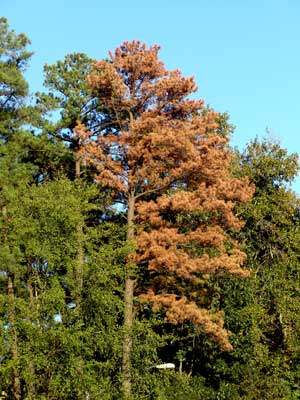
PHOTO BY KEN MOORE. Dead pines are easily spotted in our community.
By Ken Moore
Flora Columnist
Dead pines throughout our community are easy to spot. Isolated single specimens or groups of two or three pines lend a copper-brown color to the green tree canopy.
The deaths of isolated small groups of trees are most likely the result of Ips engraver beetles. There are three species, the small Ips, the medium Ips and the one we most likely have, the large Ips.
Fortunately, the Ips beetle is not a large-scale killer of pines, unlike the southern pine beetle, which is notorious for destroying entire stands of pines.
Longtime residents may recollect the large-scale infestation of southern pine beetles back in the mid 1970s. Loss of valuable timber and removal of stands of pines from residential properties was a great expense to many folks back then.
A fifth pine beetle common in the South is the turpentine beetle, which generally doesn’t kill trees, but certainly makes them more vulnerable to the other beetles.
Life cycles of all the beetles are similar.
The most destructive southern pine beetle is a little one-eighth-inch-long black beetle that usually attacks a tree stressed by drought or other environmental causes and/or construction-caused tree-trunk injury and root compaction. Unlike the smaller populations of other beetles, southern pine beetle populations may be in the thousands.
Beetles bore through the outer bark into the living inner bark, where they deposit eggs. Eggs quickly hatch into ravenous little larvae eating their way throughout the inner bark, cambium, until they pass through a resting, pupa, stage before emerging as the next generation of adults to begin the cycle again, all within as little time as four weeks.
The trees die because movement of water and other nutrients within the inner bark is halted by the girdling effect of the eating chambers of countless larvae. Blue-stain fungus pathogens often accompany the adult beetles boring into the bark, resulting in additional disruption of nutrient transport within the inner bark.
Beetle entries are easily identified by the presence of a “pitch tube,†appearing as a small popcorn-size ball of sap, resin, exuding from the tree. Healthy trees exude sap quickly enough to trap attacking beetles. Stressed trees don’t have that vigor. Attacked trees are generally not detected until their crowns have turned red, by which time much of the next generation of beetles has exited. Exit holes appear as pinhead-sized holes scattered on the outer bark.
The common practice in controlling southern pine beetle infestations is to cut and remove adjoining living green pines within a radius of 40 to70 feet around the dead stand, which also is removed.
Such drastic measures are not required for infestations of Ips engraver beetles. There is no necessity to remove uninfested nearby living trees. If a tree or a few trees killed by Ips beetles do not pose danger of injury or physical damage where they will eventually fall to earth, the dead tree(s) left standing serve as “snag†trees, hosting secondary invading insects and serving as havens of food and nesting sites for woodpeckers and other birds.
If you have a dead pine or suspected beetle-infested tree on your property, contact the N.C. Forest Service’s Hillsborough office (732-8152) and request an assessment of your particular situation. You may save significant expense and make some woodpeckers very happy.
Email Ken Moore at flora@carrborocitizen.com.

PHOTO BY KEN MOORE. Telltale pitch-tube entry hole (lower right) and exit hole (upper left) of adult pine beetles.
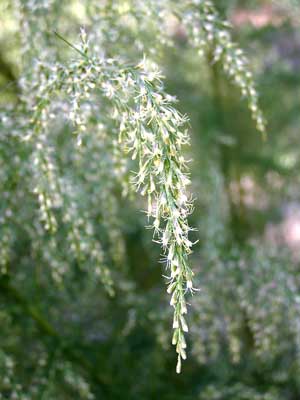
PHOTO BY KEN MOORE. Heads of tiny disc flowers hide in the cascading tops of dog fennel.
By Ken Moore
Flora Columnist
Beautiful, elegant Eupatorium capillifolium. Now that sounds a lot nicer than “beautiful, elegant dog fennel,†doesn’t it? The name dog fennel sounds a bit disreputable, and I suspect the plant was given such an unkind name because it is so very common, and unwanted, in fields and pastures, where it quickly establishes itself, occupying space that could be used by the preferred pasture grasses, feed for cattle and horses.
The leaves of dog fennel are thin and threadlike, closely resembling the lacy foliage of the popular herb fennel. The species epithet, capillifolium, from the Latin, refers to hair-like leaves. As has been described in an earlier Flora story on boneset, the genus name, Eupatorium, is from the Greek, honoring Mithridates Eupator, King of ancient Pontus. This king of long ago is credited with discovering that one of the species of Eupatorium was an antidote against poison, something those ancient politicos apparently needed to have close at hand at mealtimes.
Delving into the meanings of official scientific plant names can lead one off into all sorts of time-consuming and interesting contemplative adventures.
Dog fennel is one of our many native Eupatoriums, that genus in the composite plant family, Asteraceae, characterized by countless heads of tiny disc flowers, arranged in dome-shaped configurations like the easily recognized Joe-pye weed and, more commonly, flat-top configurations like the pretty blue ageratum and the distinctive white-flowered boneset and the several species of thoroughworts that are commonly noticed on roadsides these days.
In contrast, dog fennel grows taller and taller along roadsides and in fields throughout the growing season, looking like wavy-haired green weeds and carefully avoided by any and all grazing animals, wild or domesticated.
Spread across the larger landscape, dog fennel is not appreciated for the elegantly beautiful plant it is. When seen out of its normal context as a single specimen or as a few scattered here and there, one is more inclined to pause and take a closer look. Such an experience is easy and enjoyable these days around the emerging landscape of the N.C. Botanical Garden’s new Visitor Education Center.
The beauty of the tall stems, standing still or swaying in the breeze, changes as sunlight streams through the hair-like foliage, changing colors with each hour. Taking time to study individual plants, you will discover that some of the plants bear stems of burgundy red, nicely contrasting with the green-stemmed specimens nearby.
For flower arrangers, stems of the lacey foliage provide a lovely foil for any selection of flowers and grasses, and the resulting arrangements are not available from florists.
This plant has a wonderfully described herbal heritage. A tea of the roots was a common treatment for fevers. More interesting is the practice by some herbal “conjurers†or “rootworkers†of using drops of a concoction of boiled stems and leaves to make an unsuspecting person obey their every command. There are other unbelievable herbal attributes, which I’ll leave you to discover in a local library.
Email Ken Moore at flora@carrborocitizen.com.
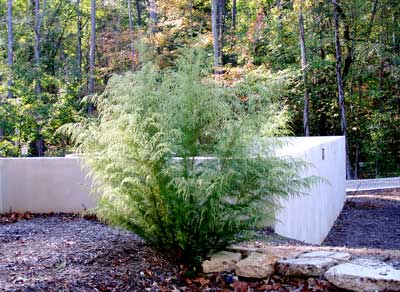
PHOTO BY KEN MOORE. A graceful specimen, dog fennel stands out at the N.C. Botanical Garden.
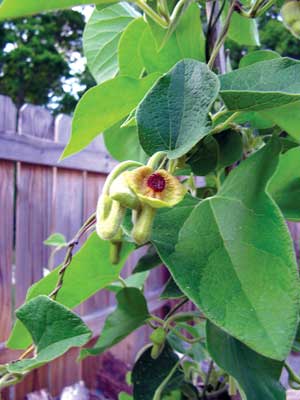
PHOTO BY MAGGIE ROOS-COPDSI. Pipevine (Dutchman’s pipe flowers) hide beneath lush heart-shaped foliage.
By Ken Moore
Flora Columnist
Recently, I received the following account from Flora reader Nancy Walker:
“Thanks to the North Carolina Botanical Garden, we (my gardening partner Maggie Roos-Codsi and I) planted three pipevines at Maggie’s house in Bahama two years ago. Little by little, the story of how this plant participates in the ‘big picture’ was revealed to us. The caterpillars that eat the pipevine leaves become poison feed to unwary predators of the ensuing pipevine swallowtail butterfly. As the predators ‘learn’ about that protection … they grant many species of ‘dark’ butterflies the same ‘immunity’ from attack, rather than risk the poison.â€
So we have here an example of mimicry, one of nature’s mysterious wonders.
In this case, through countless years of adaptation, some butterfly species have somehow developed color patterns similar to a species succeeding in becoming undesirable as a meal for predators.
Well now, the pipevine, or Dutchman’s pipe, Aristolochia macrophylla, is a luxuriantly growing vine of mountain-cove forests. Apparently, it will tolerate our harsh lowland Piedmont growing conditions. I’m always amazed when plants, by nature, restricted to the environmental conditions of the mountains, manage to survive here in our hot and dry Piedmont. The Botanical Garden has had one climbing around in a pawpaw tree for several years.
In late spring, flowers of pipevine are most engaging (see photo above) and do evoke an image of the Sherlock Holmes’ Dutchman’s smoking pipe. If any pipevine swallowtail butterflies are around, you can count on those spiny-looking, orange-pimpled, black larvae (caterpillars) devouring the entire vine. Don’t get out the spray can. The vines will recover soon after those ravenous caterpillars have moved on to their quiet resting stage before emerging as beautiful black-and-blue adults.
In addition to the pipevine swallowtails in the garden, Nancy and Maggie were able to capture, in photos from some distance away, the red-spotted purple butterfly, so similar in appearance that it is unlikely to become a meal for numerous potential predators.
You can observe nature’s mimicry in your garden by growing pipevines of your own. Unfortunately, the Botanical Garden has no more pipevine plants available this year. However, Niche Gardens has plants of a closely related species, the wooly Dutchman’s pipe, Aristolochia tomentosa, which naturally occurs in South Carolina and is successfully cultivated here in our area. It also is a preferred food plant of larvae of the pipevine swallowtail. Larvae of the mimic red-spotted purple feed on wild willow and black cherry, two tree species very common in our area.
In addition to enjoying the flowers of your Dutchman’s pipevines, you can develop skills distinguishing the two butterfly species.
Many thanks to Nancy and Maggie for sharing their pipevine story.
Email Ken Moore at flora@carrborocitizen.com.

PHOTO BY MAGGIE ROOS-COPDSI. Orange-pimpled, fleshy spiked larvae of pipevine swallowtails are distinctive.

PHOTO BY MAGGIE ROOS-COPDSI. Pipevine swallowtails lack the red-orange spots on the forewings, characteristic of the red-spotted purple.
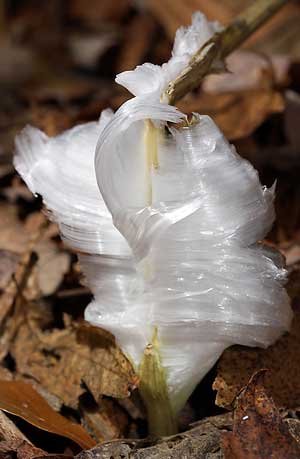
PHOTO BY PATRICK COIN . Ice flowers form at the base of only a few plants.
By Ken Moore
Flora Columnist
Thankfully, that near-100 degree first day of fall has been followed by needed rain and cooler temperatures. I’m relishing thinking of those dreadful freezing mornings in January. For folks crazy enough to be out walking just as the sun is beginning to rise on frigid winter mornings, you may spy the rather common, but rarely seen, ice flowers (described in Flora, 1/14/10).
Some of you may recollect that you have to be out before the sun has been up long enough to melt the flowers. Mysteriously found at the base of only a few species of plants, they are apparently formed from freezing moisture inside, splitting the stems and forming ribbons of ice at the stem base.
Wild oregano, Cunila origanoides, (Flora, 8/14/09) is one plant that hosts ice flowers. This smallish, somewhat woody native perennial is fairly common low on the ground beneath canopies of upland oak forests. You can find it scattered along the upper trails of UNC’s Carolina North and on the upper trails of the N.C. Botanical Garden. The easiest place to find it, with an identification label, is in the garden’s plant-families display. That’s where I viewed my first ice flowers last January.
A much commoner host plant is wingstem, or crownbeard, Verbesina occidentalis. It is another of those fall composites, members of the aster plant family. You may observe it standing six or more feet tall in large patches or entire fields along roadsides now.
The flower heads of wingstem have only a few ray flowers emerging erratically here and there among multiple disc or tubular flowers. (see photo) The result is that fields of wingstem are not as showy as fields of some of the other composites, such as bur-marigolds or goldenrods. Some folks taking a closer look describe the flower heads as messy; others find them rather engaging.
A noticeable characteristic of wingstem is the nature of its stem, which is lined with four winged edges (thus the common name), making the stem appear to be square (see photo).
A few years ago, some wingstems volunteered along the edge of my front steps. I’m hoping to have my very own ice flowers at the base of my plant stems during some frigid January mornings this coming winter. I will be very grateful that I won’t have to walk very far in hopes of seeing them.
To improve your chances of seeing ice flowers this winter, get out soon and locate a couple of populations of wingstem. Come next January, you’ll know where to take your early-morning walks for a chance to catch ice flowers before they melt. Good luck.
Email Ken Moore at flora@carrborocitizen.com.
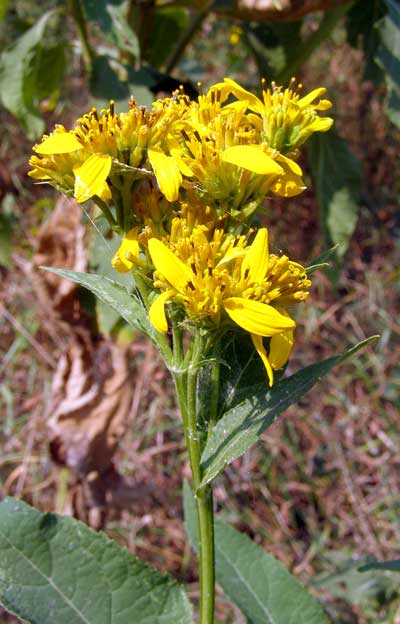
PHOTO BY KEN MOORE. Ray flowers of wingstem are erratically scattered among the disc flowers.
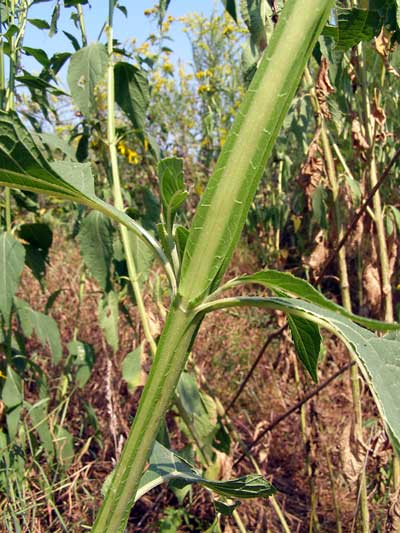
PHOTO BY KEN MOORE. Wingstem gets its name from the “wings†along the edges of the stem.

PHOTO BY KEN MOORE. Note the hourglass shaped leaves of wild poinsettia.
By Ken Moore
Flora Columnist
Several weeks ago, Raleigh friend Margaret Schucker emailed to me a plant image with this inquiry: “What is this? I found it growing out of a crack in the sidewalk and came home and threw it into the ground. It looks sort of like a poinsettia, but obviously not on steroids. If it’s not some kind of horrible, invasive thing, I will leave it there. It’s great to have anything that blooms in this heat. Plus I didn’t have to do anything to help it along. Good quality in a plant!â€
For several weeks, I’ve been enjoying wild poinsettia, Euphorbia cyathophora, formerly E. heterophylla, beneath my seashore mallows. I had considered describing this unusual waif of a plant to Flora readers, but other plants kept pushing it aside.
Having one make its way to Margaret’s yard was enough to bring it forth for this week.
This smallish, native annual is also called fire-on-the-mountain and painted leaf, definitely descriptive names.
My original plants came from the members’ plant sharing at an N.C. Native Plant Society annual picnic several years ago. Keen plantsman Pete Schubert brought seedlings from his Durham garden, where they had proliferated from ones he dug from the garden of exceptional plantswoman Edith Eddleman. I treasure such pass-along plants because they all come with stories shared by special friends.
In past years, I’ve delighted in spotting these dwarf poinsettias scattered sparingly about the yard. This year, I have a patch making quite a statement because I have been watering them during the drought. Those little waifs are standing 3 feet tall, making a commanding mass below the mallows. Others scattered about elsewhere are barely a foot tall, but are still showing cheerful red-tinged leaves in spite of no watering.
In North Carolina, this plant is scattered in the Piedmont and coastal plain; its original range is obscure. It’s considered native to the lower South down into tropical America. In some distant countries like Brazil and India, it is a “horrible invasive†in agricultural crops.
Alerted by descriptions of its invasive nature, I checked with my friend and invasives guru Johnny Randall at the Botanical Garden. His response, “For all practical purposes, this subtropical weed is a ‘waif’ for us in the Piedmont and has little chance of posing a threat to natural area ecology,†made me relax.
If you happen to spot this little poinsettia in your garden or while walking out and about, take a “closer look.†You will discover that, like the showy-specimen poinsettias of the holidays, those red petals are really leaves, modified to mimic petals. The true flowers are those little bud-like structures in the middle, out of which you may see heart-shaped balls that are the developing fruit extending out from within the cup-like flowers, all of which are characteristics of the Euphorbia plant family.
I hope you are fortunate to spot this little cousin of the Christmas poinsettia. You can imagine yourself having to grab for a sweater before you walk outdoors.
Email Ken Moore at flora@carrborocitizen.com.

PHOTO BY KEN MOORE. Red-tinged leafy bracts surround the tiny flowers of wild poinsettia.

PHOTO BY BETSY GREEN MOYER. Red berries and shiny evergreen leaves of partridge berry catch your eye in fall and winter.
By Ken Moore, Flora Columnist
Looking down on the ground last week along trails in Umstead State Park between Raleigh and Durham, I spotted numerous patches of partridge berry, Mitchella repens. Scientific names are always thought provoking. Many times their meanings are obscure. In this case, the names are logical. The genus name, Mitchella, honors colonial Virginia botanist Dr. John Mitchell, who corresponded with Carl Linnaeus, the Swedish botanist responsible for developing the worldwide system for plant classification.
Most likely, Mitchell sent specimens of partridge berry to Linnaeus, who scrutinized them and placed them in his botanical naming scheme. Often times, Linnaeus, as do other botanical authorities, named new plants in honor of the discoverer. The species epithet, repens, refers to the trailing or creeping habit of the plant. And, indeed, partridge berry does trail along the ground, or when clinging to lichen and moss-covered rocky surfaces, like along Bolin Creek below Carrboro’s Adams Tract, presents itself as a vertical cascading mat of evergreen, opposite-leaved stems.
These mats, whether horizontal or vertical, are a joy to discover now through winter, with bright-red berries scattered along the creeping stems. Betsy Green Moyer’s image (photo above) from Paul Green’s Plant Book visually describes such a discovery. If you take a really close look at those little berries, you will find two tiny depressions, positioned as if two eyes are peering back at you. Those two eye depressions mark where two four-petal, tubular flowers sat upon their joined ovaries. Following successful pollination, those two flowers produced a double drupe that looks like a single berry.
OK, that’s enough botany.
In the late spring, around Mother’s Day, look for flowers on this prostrate little ground cover. Frequently there will be a berry or two lingering when flowers appear. Practice “belly botany†and get down low enough to see the paired, frilly, double-white flowers. The flowers are fragrant, so while on the ground you may as well give them a sniff. Thanks to Anne Lindsey for the unusual springtime image (above) of flowers and berry from Wild Flowers of North Carolina.
Partridge berry has an herbal heritage of medicinal use to ease the pain of childbirth and help with women’s ailments.
Paul Green’s description is especially engaging. “Partridge berry, Turkleberry or turkeyberry, sometimes called love-in-winter, pipsissewa, wintergreen, etc., is a shy little ground creeper which grows in the moist deep woods. It has delicate fragrant flowers which develop into single red berries that look like little drops of coral among the greenery. The deer especially like these berries and sometimes it is called deer-berry. The berries are good for all kinds of diseases, especially for diarrhea and rheumatism, so say the herb doctors.â€
Other common names are running-box and two-eye-berry. It’s really simpler to remember just the official scientific name, Mitchella repens!!
Though it commonly grows in all kinds of forests, if you go looking for it you’ll probably not find it. Fortunately, it’s easy to identify, so you’ll be pleasantly surprised when you “happen upon it.â€.
Email Ken Moore at flora@carrborocitizen.com.

PHOTO BY WILLIAM S. JUSTICE. Paired flowers of partridge berry produce a two-eyed red berry-like fruit.

PHOTO BY DAVE OTTO. You must practice ‘belly botany’ to see the hairs of partridge berry flowers.