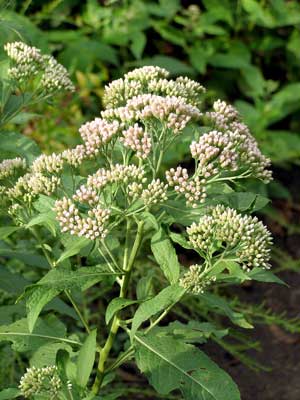
PHOTO BY KEN MOORE. Wild camphorweed makes a nice deer-resistant garden plant.
Flora Columnist
“After Joe-Pye weed comes Pluchea.â€
That was the declaration from gardening friend Sally several weeks ago when Joe-Pye weed flowering heads of purple gave way to seed heads of shades of brown.
Joe-Pye, commonly seen standing tall in wet meadows and roadside ditches, is familiar to many of us, but not so with the shorter flowering stems of marsh fleabane, Pluchea camphorata. In fact, unless it is accidentally touched, creating an unforgettable smelling experience, one most likely will never have acknowledged it.
I know this plant by the common name, camphorweed. And because of the distinctive aroma of crushed flower heads, that’s the name I prefer. Upon my first encounter smelling the plant, I was impressed, but not favorably. However, like a number of so-called “connoisseur†things – vintage cigars, Scottish single malts and some of the sophisticated teas – camphorweed is something for which you could eventually acquire an affinity.
Now whenever I find camphorweed in wet ditches or along riverbanks, I reach over to crush some of the flower heads and look forward to getting a whiff of its tell-tale odor. Neophytes will undoubtedly describe it as pungent and unpleasant. However you respond, you won’t forget the experience.
Though common throughout the coastal plain and the Piedmont, the delicate pink flower heads don’t jump out at you. Camphorweed generally stands no higher than accompanying goldenrods and Eupatoriums and other common companions, and is easily missed when viewing the general mix of plants in ditches and along streams.
Sally’s declaration about Pluchea results from her experience of growing it in a garden setting, where single plants become attractive specimens, such as the ones she tends in the Garden of Flowering Plant Families behind the Totten Center of the N.C. Botanical Garden. That’s probably the only garden in which you will find distinguished camphorweed.
It is capable of getting around via those delicate flying seeds, characteristic of most members of the composite or aster family. If you pause and observe the several ditches and swales near the Botanical Garden’s new visitor center, you will find some handsome specimens of camphorweed in the assemblage there of other interesting moisture-loving plants, including boneset, several engaging sedges and even cattails. All those plants “planted†themselves from specimens elsewhere in the gardens. It’s always interesting to appreciate how nature designs gardens in available spaces.
Take a closer look at those tubular (disc) flowers of camphorweed. Do you recognize those star-shaped disc flower openings? You’ve seen similar ones in recent Flora stories of other composite family flowers.
I am surprised that camphorweed, with such a pungent aroma, does not have an impressive heritage of medicinal or other practical uses. The common name, marsh fleabane, suggests that some folks may have used crushed plants as a natural insect repellent.
A significant attribute pointed out by Sally is that deer don’t like it, so it is desirable as a garden plant. Make note that Sally has potted up some seedlings for the garden’s special fall plant sale, Saturday, Sept. 25. That may be your only opportunity to add this deer-resistant plant to your garden.
At least go by and pay it a visit, and don’t hesitate to gently crush the plant for that special odiferous experience.
Email Ken Moore at flora@carrborocitizen.com.
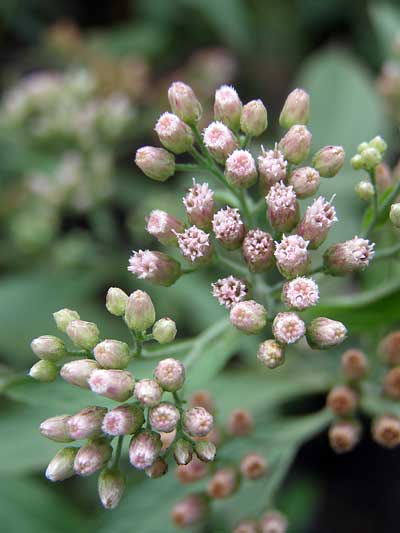
PHOTO BY KEN MOORE. Tiny camphorweed heads of disc flowers pack a powerful odor.
Discover Occoneechee’s fern glade on Labor Day
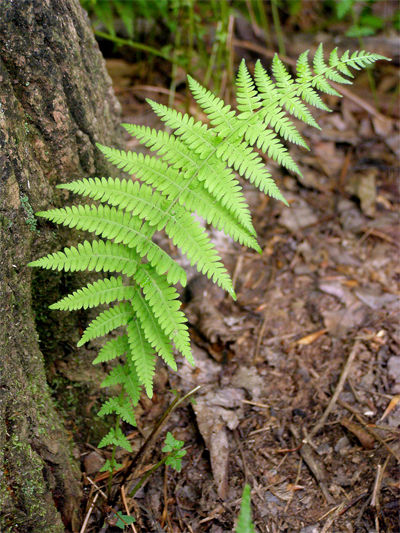
New York fern frond tapers at top and bottom. Photo by Ken Moore
Those of you who remain home-based during the Labor Day weekend can enjoy a half-day mountain adventure finding the fern glade at the base of Occoneechee Mountain just west of Hillsborough.
I visited the mountain on Sunday to see if the fern glade is surviving the heat and drought. That glade of New York ferns, Thelypteris noveboracensis, is still impressive.
As the above photo illustrates, the pale-green fern frond tapers at top and bottom. I remember a mountain lady years ago describing an easy way to remember this fern. “If you think of New Yorkers ‘burning their candles at both ends’ you’ll never forget New York fern!†That notion remains with me, though now I believe we all tend to move too quickly to take time to notice ferns.
My preferred walk to the fern glade is following the Mountain Loop trail clockwise beginning beneath the giant white oaks at the visitor parking area. Trail maps are in the opposite direction near the ranger’s residence. My recommended clockwise trail meanders leisurely along contours up and down around the 867-foot mountain.
Early on, you’ll notice the forest floor carpeted green with thousands of seedlings of rock chestnut oak, Quercus montana. Take time to contemplate how many of those little trees will manage to become a specimen like the parent trees above. Last season’s acorn crop was unbelievable. This year’s will most likely be sparse, but later in the fall you may spot some chestnut oak acorns, which are the size of pecans.
As you move along, it’s fun to “read the landscape,†imagining what occurred in this forest in decades past. Take a closer look at all those chestnut oaks that dominate the several ridges you cross as you proceed around the mountaintop. Most of those deeply grooved tree trunks occur as multi-trunked specimens, probably stump sprouts from a long-ago fire. Occoneechee has a history of fire; parts of the mountain show evidence of fire within the past decade.
My favorite tree is a mighty old specimen that spreads upward from a hollowed central base of five trunks. Can you think of other disturbances for such a tree response?
Continuing down to the north side of the mountain, you walk through an understory of mountain laurel, which you will want to see early next May when they are in flower. Just beyond your intersection with the Eno riverside trail, you will find yourself approaching the fern glade. Sit on one of the huge tree trunks along the trail to soak in that sweep of ferns. It’s not unlike being in the Carolina mountains. Return here in April to find a sea of mayapples and Jack-in-the-pulpits.
Your climb back to the parking area takes you along a power line cut, where “power-line botany†is fun. Most notable in flower now are clumps of licorice goldenrod, Solidago odora. Crunch and smell a leaf. It makes a refreshing herbal tea, and this goldenrod is available at native plant nurseries as a fine garden plant.
You’ll make more discoveries before finishing your walk.
Exploring Occoneechee Mountain is worth doing each month of the year.
Email Ken Moore at flora@carrborocitizen.com

PHOTO BY KEN MOORE. Seashore mallow produces a sea of pink hibiscus-like flowers.
By Ken Moore
Flora Columnist
Driving through the center of campus on Cameron Avenue last week, I noticed hundreds of flowers of seashore mallow, Kosteletzkya virginica, stretching up over the stone wall next to Coker Arboretum’s arbor. The vivid pink of those flowers caused me to slow down for a brief closer look.
Here in the Piedmont, you will see this beautiful wildflower only in gardens. In the wild, it occurs in ditches and edges of brackish marshes and rivers along the coast from New York all the way down and around to coastal Texas.
Years ago, in the late 1970s, I was approaching the White Oak River bridge at the coastal town of Swansboro when I spied a ditch filled with a tall wildflower unknown to me. Using my trusty old Flora of the Carolina’s botanical key, I was excited to zoom in on seashore mallow.
Seeds collected from that ditch a month or so later were subsequently sown at the N.C. Botanical Garden. Resulting plants were observed for the next several years in the garden’s wildflowers beds. Surprisingly, seashore mallow, expected to require constant moist conditions, as in the wild, proved to be a vigorous, drought-tolerant perennial. So impressed were garden staff that they designated it the Wildflower of the Year in 1990. Since then, as a result of the garden’s seed distribution and plant sales, it has become a common garden plant in the area.
If you take a really close look at the pink flower, you will discover a central tube or cylinder of numerous stamens with pollen-covered anthers. Emerging from the center of the stamen tube is the stem, the style of the female pistil, which at the end splits into five globular stigmas eager to capture pollen from unsuspecting pollinating insects. This particular configuration of flower parts is characteristic of plants in the Malvaceae, the mallow or hibiscus family.
Plants along the arbor at Coker Arboretum are now past peak flowering, though the couple of plants below my deck are just now beginning to peak. It’s interesting that years ago seashore mallow flowered later. I remember flowering beginning after Labor Day and continuing right up to frost time. Perhaps this is another of those alterations in nature resulting from changes in our weather patterns.
The flowers have a habit of opening early in the morning and closing by midday on hot sunny days. They remain open into late afternoon on cloudy days and even on sunny days if the temperature is coolish.
If you’re traveling to the coast in the morning within the next week or two, look for seashore mallow along wet edges. And visit your favorite garden center to search it out for planting in your garden. I know there are some available at the Botanical Garden, where they will be a popular item at the big fall plant sale on Sept. 25.
Give your plant lots of room to grow. A single specimen can attain a height and spread of 6 feet. In addition to those beautiful flowers, you’ll enjoy all the butterflies and bees flitting about.
Email Ken Moore at flora@carrborocitizen.com.

PHOTO BY KEN MOORE. The stigmas extending from the flower pollen tube get pollen from the pollen-covered bee brushing by.

PHOTO BY CHRISTIAN FISHER. Swallowtails converge on Chatham County devil’s walking stick.
By Ken Moore
Flora Columnist
For weeks now, I’ve wanted to describe the lovely fern glade at the base of the mountain at Occoneechee Mountain State Natural Area. The 2-mile trail encircling that mountain is one of the premier hikes in our area. In spite of this summer’s heat and drought, that fern glade is still lime-green fresh looking.
But all the butterflies and other interesting critters moving about on the summer wildflowers keep sidetracking me. So this past week, as I was once again beginning to focus on that fern glade, I received an enthusiastic description from Chatham County reader Christian Fisher about all the butterflies on devil’s walking stick, Aralia spinosa, in the community’s woods. The note was accompanied by a wonderful image of yet another native plant “butterfly magnet.†That image was so engaging that I thought, “Well now, devil’s walking stick is a plant worthy of attention; I should focus on that sometime.â€
The very next day, Ron Flora, gardener and staff member of the Carrboro branch of the State Employees’ Credit Union, and I engaged in a short over-the-counter plant conversation. He was curious about a plant he saw stretching out from entangling kudzu along the woodland trail at the N.C. Museum of Art. It was covered with all sorts of butterflies. After hearing a few more of his keen observations, I responded that it must be a devil’s walking stick he had seen. So, that sealed it. This week, the spotlight is on Aralia spinosa.
This small tree is fairly common along streams and in low moist areas scattered throughout our state. It’s seldom noticed until large clusters of small cream-colored flowers or dark purple-black berries show up along forested roadsides. The 2-to-4-foot-wide double-compound leaves are unforgettable.
If you discover the plant during a leisurely walking excursion, you will notice menacing thorns armoring the stems. Since devil’s walking stick commonly suckers, you’ll most likely find a grove or thicket of those spiny stems. You dare not grab hold, for obvious reasons. Only the Devil, himself, would dare do that.
It’s interesting that devil’s walking stick shares close kinship with two quite different plants: ubiquitous English ivy, Hedera helix, and the much-revered magical herb, ginseng, Panax quinquefolium. All three bear tiny flowers in globe-shaped clusters characteristic of the plant family, Araliaceae.
For easy viewing, there is a thicket at the edge of the big magnolia grove in the Coker Arboretum. And there is a smaller thicket along the edge of the sand hill habitat just inside the cattail gate at the N.C. Botanical Garden. Regular commuters up and down South Columbia Street may notice the thicket along the woodland edge near the Ambulatory Care Center. Keep your eyes open for other Aralia spottings.
And about that Occoneechee Mountain fern glade, don’t wait for my description; enjoy discovering it yourself.
Email Ken Moore at flora@carrborocitizen.com.

PHOTO BY KEN MOORE. Touch softly devil’s walking stick’s armored stem.
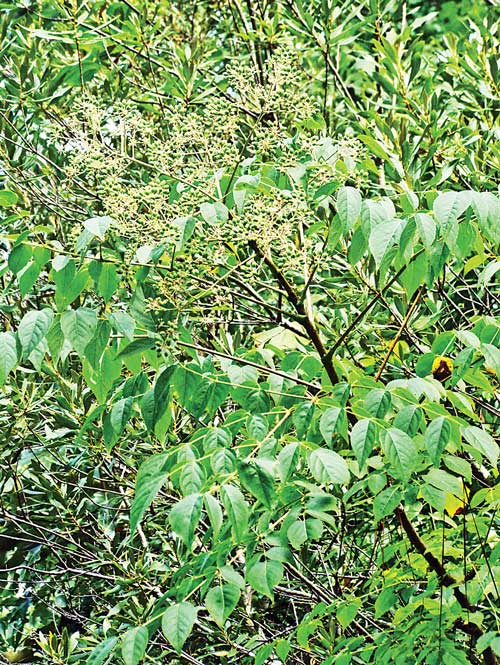
PHOTO BY KEN MOORE. Once discovered, you’ll never forget devil’s walking stick.

PHOTO BY KEN MOORE. Sneaky praying mantis finds the flower and berry clusters of devil’s walking stick a great dining hall.

PHOTO BY KEN MOORE. Silver spotted skipper is one of several butterflies attracted to swamp milkweed.
By Ken Moore
Flora Columnist
Four weeks ago (Flora, 7/8), I featured swamp milkweed, Asclepias incarnata, because of the pair of milkweed leaf beetles that hung around for weeks and weeks. My milkweeds have completed flowering for this year, and those two beetles, who did finally get together, are now gone.
On a recent visit to the N.C. Botanical Garden, I was delighted to find dozens of swamp milkweeds in pots still flowering in the sales area. Adding to the beauty of those pink flowers were the numerous butterflies flitting about and feeding on flower nectar. I had not remembered butterflies much attracted to the single milkweed in my garden.
The spectacle at the Botanical Garden demonstrated that having several of these milkweeds in proximity somehow creates an irresistible attraction for butterflies, as well as other pollinators. I plan to have several plants grouped together growing in my garden next year. I visited the garden again this past weekend and those flowers are still attracting butterflies.
Another wildflower that is a magnet for various species of butterflies is ironweed, Vernonia novaboracensis. Like swamp milkweed, it’s another tall wildflower common along streams and in wet meadows. Ironweed is easily cultivated and surprisingly tolerant of drought. I planted one in a flower border a few years back and now, from self-seeding, I have several new plants growing nearby. They have grown tall during our recent dry spells and now multiple clusters of brilliant purple flower heads attract numerous swallowtails and skippers.
It’s great fun to sit in the late afternoon near those purple-topped stems with binoculars in hand to focus on the butterflies as they flit about and alight on those flower heads. A beautiful contrast is the rusty-colored hue, hence the name ironweed, of the seed heads that begin forming soon after pollinators have performed their function.
Of course, you don’t need binoculars to take a closer look at the butterflies and other pollinators on the heads of the ironweed. Those insects are so engaged in extracting nectar from the flower tubes that you can practically touch them. And with a keen eye, you can zoom in on the details of those clusters of disc flowers. You may even notice the split, curled tips of the stigmas of the pistil (female part of the flower) extending from each flower tube.
Using a 10-powered hand lens is always a big help when you take this kind of closer look.
Though both swamp milkweed and ironweed are fairly common in moist habitats throughout the state, they are surprisingly seldom noticed unless you are driving on back roads in the mountains, where in low meadows you’ll spot the brilliant purple-flowered ironweed contrasting with the yellow of goldenrods and the tall pinkish domes of Joe-Pye weed. In our vicinity, keep your eyes alert along edges of roadside drainage ways and open meadows. You’ll most likely have to rely on seeing them in gardens, or, better yet, grow your own.
Email Ken Moore at flora@carrborocitizen.com.

Eastern tiger swallowtail taking nectar from ironweed heads of tubular disc flowers.

PHOTO BY KEN MOORE. Spiraling disc flowers characterize the center of giant sunflowers.
By Ken Moore
Flora Columnist
I’ve enjoyed a couple dozen varieties of giant sunflowers, Helianthus annuus, scattered about my fenced-in veggie garden for the past month. The sunflower heads of various sizes and colors looking down from six-to-eight-foot stems are a colorful and exciting addition.
The designs of those hundreds of little tubular disc flowers spiraling around from the center of each giant flower head are unbelievable. In addition, those flower heads are in constant activity with visiting bees, wasps and butterflies. Goldfinches balancing upside down on the flower heads extracting ripened sunflower seeds provide excitement any time of day.
I’m proud of my collection of sunflowers, but none of mine are as in-your-face dramatic at those standing sentinel above the veggie and herb beds at Johnny’s on West Main Street.
Those sunflowers seem to talk to admirers, particularly the children, who peer up at them, and the speechless wonder on the faces of smaller children held up by parents is a joy to observe.
The giant sunflower is one of the very few worldwide commercial crops that originated on our American soil. Native Americans had already begun hybridizations and spread it far and wide from its southwest and northern Mexico center of origin before early explorers observed it in the late 15th century. Native Americans used it medicinally for everything from snakebite to rheumatism; it was a staple in their diets and was used as a visual element in important ceremonies.
It quickly made its way over to Europe and beyond. It was easily cultivated almost everywhere, even in faraway Russia, where in the mid-1800s its nutritional and economic importance was greatly improved. It’s fun to reflect that those beautiful Van Gogh sunflowers originated in southwestern North America.
Over at Johnny’s, though, I was more excited to find an impressive specimen of one of our commonest native perennial sunflowers. There are more than two dozen species of wild sunflowers in North Carolina. Most species of Helianthus are perennial and none of them are as large as the giant flowered annual. They are, however, quite beautiful and easily cultivated.
That impressive multi-stemmed specimen at Johnny’s seems to be Helianthus resinosus, formerly classified as H. tomentosus. While I have considered it common along roadsides, current botanists describe it as infrequent across the state. I’ll leave it to them to complete mapping out its natural distribution.
Johnny’s proprietor Brian Plaster obtained his specimen at the Raleigh Farmers’ Market. You’re got to see it to believe it. Wish I had it in my garden. I suspect, like the giant annual helianthus, it has undergone a bit of hybridization. A similar-looking helianthus is Jerusalem artichoke, H. tuberosus, frequently cultivated in gardens for its tasty tubers.
Keep a watchful eye on roadsides during the remainder of the summer. You’ll spot several species of the wild sunflowers standing tall with lots of bright-yellow composite flowers. As those seed heads ripen, you’ll also spot goldfinches flitting about.
Email Ken Moore at flora@carrborocitizen.com.

PHOTO BY KEN MOORE. Multiple flower heads characterize the many species of wild sunflowers along roadsides.

PHOTO BY KEN MOORE. Young Carrboro resident Avery Spade studies the giant sunflowers at Johnny’s.
More reflection on exotic invasives

PHOTO BY KEN MOORE. Self-seeding chaste tree, sometimes called hemp tree (see the leaves), attracts pollinating bees and wasps but has nothing else to add to the local natural ecosystem.
By Ken Moore
Flora Columnist
I’ve targeted chaste tree, Vitex agnus-castus, (above) and crape myrtle, Lagerstroemia indica, (back page) to be chopped out of my landscape. You’ll not be happy to read on for the reasoning.
Mention of one’s position on exotic invasives usually initiates heated discussions among gardeners. While many such plants cause multi-million-dollar disruption to agriculture and natural areas, others are objects of pride in private and public gardens.
It’s good to pause and recognize that no individual or organization introduced exotic plants to America intending to create the environmental/economic disasters we now have. Exotic plants date back to the pioneers’ cherished herbs and medicinals from their homelands. Thomas Jefferson and other colonial horticulturists introduced exotics of beauty and culinary appeal. Some invasive plants were accidental stowaways.
Rather than feel guilty for exotic species, we can simply appreciate where we are and how to proceed.
As described in the July 8 issue of The Citizen , our town has taken a bold step. New developments are not allowed to include plant species that appear on the Invasive Exotic Species List, Rank 1-Severe Threat, of the N.C. Native Plant Society (ncwildflower.org). Not surprisingly, that list includes plants like tree of heaven, mimosa and Chinese wisteria, already so ubiquitous that few would dare plant more, though some still plant Chinese wisteria.
I am bewildered by the absence of Bradford pear on that list. Though it’s listed on Rank 2 of the society’s list, it is allowed for new plantings in Carrboro. That is unbelievable (see past Floras featuring the Bradford pear). Observing the flowering of trees along the N.C. 54 bypass around Carrboro, I have noted that at least 50 percent of the forest edge is filled with Bradford pear, tree of heaven, princess tree and mimosa.
Federal, state and conservation organizations have compiled numerous lists of undesirable exotics. To view those lists and understand more about exotic invasives, visit the N.C. Botanical Garden website (ncbg.unc.edu). Under “conservation†is “Invasive Exotic Plants: Publications and Resources.†Among other references, you’ll discover the N.C. Department of Transportation has a sizeable publication with identification guides, historical notes and eradication recommendations. Amazingly, Bradford pear is not considered a “Threat†or “Moderate Threat.†Rather, it’s included on its “watch†list
Why do we have to wait until plants have successfully invaded hundreds and hundreds of acres of landscape before we declare them pests to avoid?
Tree of heaven was introduced to Philadelphia in 1784. It’s taken 200 years for it to reach the current level of disturbance. In contrast, the cultivar Bradford pear was introduced in the 1960s; within 40 years, it’s displacing natives from local fields and roadsides.
My chaste tree, a gift from a friend, is now seeding around like a weed in less than 10 years. During that same period, my beautiful so-called dwarf cultivar of crape myrtle, now higher than 20 feet, has been reseeding for six years. Don’t know how long I can keep it confined to my yard.
The botanical garden has a list of “Plants to Avoid in the Southeastern United States.†I recommend that as the list for folks to adopt as a guide. It’s not perfect, because it doesn’t include my chaste tree or crape myrtle, nor do any other lists.
So I am developing my own list of plants to exclude from my garden. Whatever one chooses to retain and/or introduce in a private garden is whatever one chooses. The real damage to larger landscapes is from large-scale plantings on public landscapes of exotics that eventually escape to adjoining public and private lands.
To be truly responsible, all roadways, parks and residential and commercial developments should be landscaped only with plant species indigenous to the region. Indigenous species are the natural components that thread together a healthy regional ecology (environment).
The native plant society welcomes feedback, so I hope they will bring Bradford pear up to the “Severe Threat†list soon. I hope the Town of Carrboro will take a truly bold step and require all new landscapes to reflect only the native flora of our region.
Email Ken Moore at flora@carrborocitizen.com.

PHOTO BY KEN MOORE. Inappropriate annual pruning never allows crape myrtles, approved to meet the town’s parking lot shade-tree requirement, to become shade trees.

Joe-Pye weed is a butterfly magnet. Photo by Ken Moore.
By Ken Moore
My plan to follow up on exotic invasives this week will have to wait. It’s been side-tracked by Joe-Pye. I featured Joe-Pye weed, Eupatorium fistulosum, in Flora way back on Aug. 9, 2007, so I won’t repeat here about the plant’s name, medicinal heritage and how to grow it.
Joe-Pye is definitely my favorite plant. In addition to being a magnet for butterflies, it provides me with more weeks of appeal than just about any other plant I know!
I leave the domed skeletal remains standing tall throughout the winter for architectural interest. I enjoy watching the new season’s growth emerge from the base of the plants. By mid-summer, those stems may reach a height of 12 feet. My gardening friend Sally Heiney has Joe-Pyes that are 11 and a half feet tall. This year, mine are only 9 feet, 9 inches tall, but that’s perfect, because, since they’re at the base of my deck, I can peer right into the large flowering heads.
I’ve been peering into those flower heads for a couple of weeks now, enjoying the slow progression from tiny pink flower buds to mature disc (tube) flowers.
Hundreds of little clusters of disc flowers make up that big dome configuration. As each disc flower opens, it looks like a five-pointed star from which protrude two brilliant pink threads. Those threads are the stigma tips of the pistil, the female part of the flower, waiting for some insect to deliver pollen from the stamens of another flower.
It’s been amazing to observe the progression of different kinds of insects visiting the flower heads throughout the day. Early morning brings little green sweat bees and similar species. Butterflies seem to prefer the afternoon and early evenings. Whatever the time, there’s always a hive of activity to watch.
When friends show up, I used to say, “Hey, come see my flowers!†But these days I call out, “Hey, come see my bugs!â€
Last week, my eye caught something I’ve never before encountered. It looked like an inchworm with tiny flower parts attached to its back. I couldn’t believe my eyes as that little critter stretched forward, severed one of those thread-like stigmas and twisted backwards to attach it to its body. That little inchworm had become perfectly camouflaged, hidden from predators among those clusters of flowers. Then, with confidence, the inchworm proceeded to eat the stigmas of nearby flowers.
Having no idea what I was seeing, I called my friend Sally to see if she had any on her Joe-Pyes. She had not seen any, but based on my description she suggested I check out an image of a wavy-lined emerald moth caterpillar. As usual, Sally was right. That’s what I’ve been watching this entire past week; it’s much cheaper than going to a movie.
Joe-Pye weed is noticeable now in ditches and low places along rural roadsides. We should all have Joe-Pye weeds growing somewhere in our gardens and yards. They’re available at just about any nursery or garden center that features natives. In additional to the flowers and butterflies, you’ll enjoy inviting friends over to see the bugs in your garden.
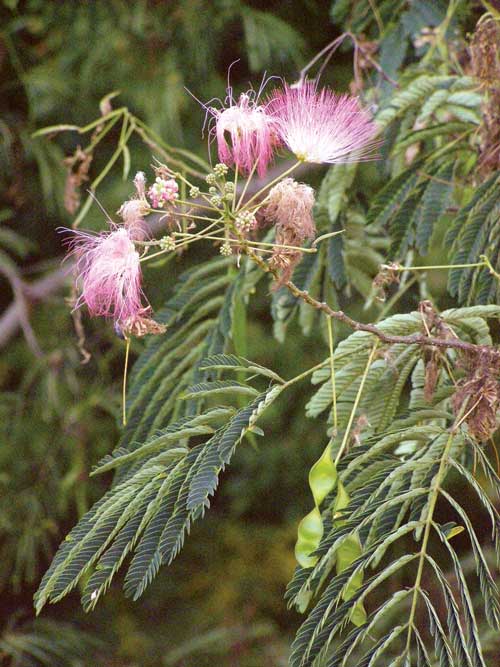
Fern-like leaves, frilly flowers and twisted bean pods characterize invasive mimosa. Photo by Ken Moore.
By Ken Moore
Last week, several Citizen readers said to me, “Ken, you should write about exotic invasives!†My response: “Well, I do occasionally write about them, but I try to focus more on the beauty of our native flora.†How appropriate then that this past week’s Citizen carried a front-page article titled, “Carrboro updates its invasive plants list.â€
At the top of Carrboro’s new Do Not Plant list are two trees featured in the July 12, 2007 Flora. Some of you may remember them.
I spent childhood days playing under a neighbor’s giant mimosa tree with fragrant silky flowers in summer and twisted bean pods in the fall. The mimosa, also called silktree, Albizia julibrissin, remains for me one of the most exotically beautiful of all trees. And exotic it is, having been introduced from Asia in the mid-1700s, though it’s now at home throughout North Carolina and the entire Southeast. I’m still trying to get rid of one I set in my yard two decades ago. The staff of the N. C. Botanical Garden has had success eradicating a formerly persistent population along the Coker Pinetum on Manning Drive.
Magnificent specimens of mimosa thrive throughout Carrboro and Chapel Hill. Though you are most likely not going to cut down a specimen, you do need to be aware that those bean pods can spread far beyond your yard. We should be concerned about the big specimen below the Morgan Creek bridge on Smith Level Road. The creek provides seed dispersal for future trees all the way down to Jordan Lake and beyond. Those magnificent specimens in the vicinity of the Courtyard on West Franklin Street pose a similar threat. Those seeds reach Jordan Lake via storm drains into that same Morgan Creek.
Another vigorous exotic, expressing itself now along field and woodland edges, as well as on paved urban sites, is Tree of Heaven, Ailanthus altissima. It was introduced in the late 1700s from Europe, to where it had earlier been imported from China for potential silkworm production. The intended silkworm industry failed in Europe and America, but that tree has succeeded all too well, now displacing native trees and shrubs. You can’t miss it along woodland edges of the Calvander approach to Carrboro and along the bypass between Jones Ferry and Smith Level roads.
You can easily spot single specimens or thickets of upright stems with compound leaves of 10 to 40 leaflets. Vigorous clusters of yellow-green winged fruit on the female trees maturing to a striking rusty red and brown in the late summer are eye catching.
Both of these trees, among others, are on Carrboro’s newly adopted list, which is “Rank 1-Severe Threat†of the North Carolina Native Plant Society Invasive Exotic Species List. You are encouraged to visit ncwildflower.org/invasives/list.htm for other categories of invasive plants.
I will most likely continue this topic next week.
In the meantime, I’ll continue my own battle with my formerly favorite mimosa and will never allow Tree of Heaven a foothold on my property. The nature of our roadsides and forests is in our hands. You will have to decide how responsible you are going to be.
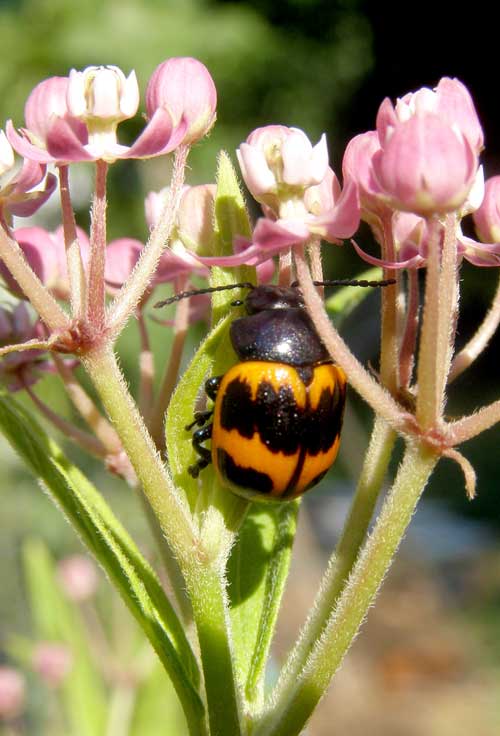
Swamp milkweed hosts milkweed leaf beetles. Photo by Ken Moore.
By Ken Moore
“Look what’s in my garden!†That email last week from friend Pete accompanied an image of a beautiful milkweed leaf beetle.
I immediately went out to my garden, where I have two pots of swamp milkweed partially immersed in a little pool tucked in front of the veggie garden, all of which is enclosed by a curiously constructed deer-, rabbit-, groundhog- and raccoon-proof fence.
And, sure enough, there were two beautiful milkweed leaf beetles, as best I could determine with my meager references, Labidomera clivicollis.
Fortunately, Pete already had led me to the likely identification of the beetle that made my investigation much easier. I am in awe of entomologists, who focus on distinguishing characteristics of the thousands and thousands of insect critters all around us. I view insect taxonomy as more complicated than plant taxonomy, but that may be because plants remain stationary. Taking closer looks at the jumping, flying, running insects is something else!
However, this orange-and-black beetle is very accommodating. It doesn’t seem to mind being handled, content to walk around on hand and fingers until placed back on its milkweed. The color and patterns of the beetle are really variable. No two are exactly alike. One of my two is bright orange and the other is yellow.
Their habit is described as feeding and mating on milkweeds. They eat both leaves and flowers, but not enough to cause any real harm. Sometimes you may notice that a leaf is partially broken. The beetles are clever in slitting a leaf vein or two to partially drain the leaf of its toxic milky sap, making the outer part of the leaf a bit tastier for ingestion. Eggs are laid on leaf undersides and larvae drop to the ground to continue their cycle. Larvae are described as sometimes staying around a while to chew on the leaves. The beetle population seems to remain low enough to be respectful of its host milkweed.
Though the beetle will visit the common milkweed, Asclepias syriaca, it prefers the swamp milkweed, Asclepias incarnata. With vivid pink flowers, swamp milkweed occurs naturally, as its name implies, in swamps, along pond edges and in boggy areas throughout the mountains and Piedmont and less commonly in the coastal plain. Its broader distribution is from New England all the way down and around to Texas.
Swamp milkweed makes a nice long-lived garden plant. Just don’t let it linger without moisture too long during droughts. If you pinch off the spent flowers, it will re-bloom several times during the growing season. In addition to the colorful beetles, it attracts butterflies and many desirable pollinators. Niche Gardens keeps it as one of their standard butterfly-attracting perennials and it is still available at the N.C. Botanical Garden.
Whether a milkweed or some other plant attracting your attention with flowers, you’ll most likely find accompanying critters, in many cases, as beautiful and engaging as the flowers.