by Ken Moore
Flora Columnist
Several days ago, I went to see Avatar, and have to say that a recent assessment of the movie by Carol Kaesuk Yoon in the New York Times resonated with me.
Rather than taking issue with possible scientific inaccuracies or questioning implausible notions,

Locked-in-ice sweet gum ball and stones.  Photo by Tim Stambaugh
Yoon appreciated the director for engaging the entire viewing world with compelling images of “kinds of wonderfully shocking similarities and dissimilarities among living things that have largely been the prerogative of biologists – especially those known as taxonomists, who order and name the living things on Earth.†She concludes: “Maybe Avatar is what we need to bring our inner taxonomist back to life, to get us to really see.â€
I moved through the day reflecting on that notion of reawakening the taxonomist in each of us “to really see.†It was in that context that local musician, songwriter and keen woods-walker Tim Stambaugh and I engaged each other over afternoon coffee at Johnny’s on West Main Street.
Referring to the recent Flora ice flowers story, Tim wanted to share his image of an ice-trapped sweet gum ball he discovered while exploring a frozen-swamp forest floor. To my inquiry, “Where did you find that?†Tim described a woods path along Price Creek that borders a small cypress swamp forest in the shallows of University Lake.
That sweet gum ball made me think of the fantastic plant images of Avatar’s other world. Viewing Avatar made me want to visit a tropical rain forest, so that I could see fantastic Avatar-like plants here on Earth.
Tim was animated in describing the changing seasonal wonders of the woods path where he discovered the locked-in-ice sweet gum ball. I asked to see more images of his woods path. Tim’s close-to-the-ground perspective of the forest floor in summer is now implanted in my head. The awesomeness of that view makes me realize that I don’t need to travel to a tropical rain forest to have Avatar-like experiences. As Yoon suggests, we merely need “to tap into our inner taxonomist to really see.â€
I challenge us all to explore our local woods with new energy, taking time to really see. Take an Avatar walk.
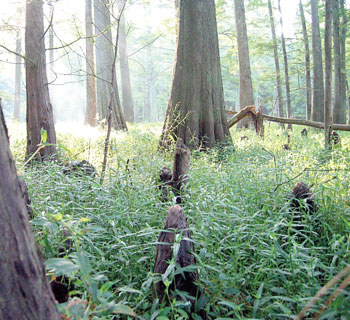
An Avatar view of a local swamp forest. Photo by Tim Stambaugh
All around, look up and down and “take in the heart-stopping wonder of really seeing the living world.â€
Email Ken Moore at flora@carrborocitizen.com.
Find previous Ken Moore Citizen columns at The Annotated Flora.
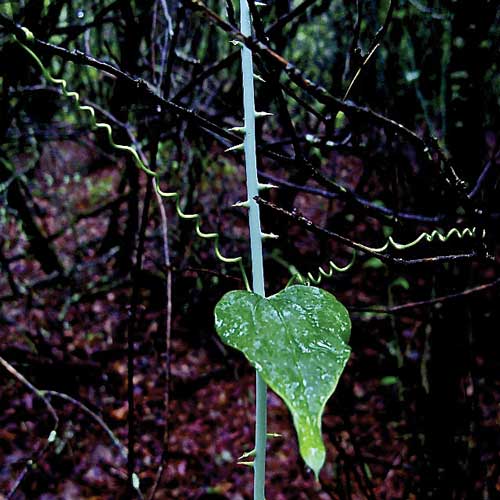
Common catbriers occasionally display remarkable colors. Photo by Giles Blunden.
By Ken Moore
Local architect Giles Blunden has a passion for photographing mushrooms. When asked to verify the identity of his mushroom images, I refer him to recently retired botany librarian and local historian Bill Burk, who really knows his mushrooms. When Giles focuses on other plants, I’m on firmer ground. Last summer, when he asked,
“Ken, what’s this?†showing me a remarkable image among his mushrooms, I recognized a common native vine.
“Where did you find that catbrier?†I asked, and he replied, “While photographing mushrooms in the mountains near Asheville.†When accused of computer enhancement, he declared that his image was exactly what he saw. And indeed, I recollect seeing that unbelievable turquoise-blue color on stems of catbriers from time to time, even here in our local area.
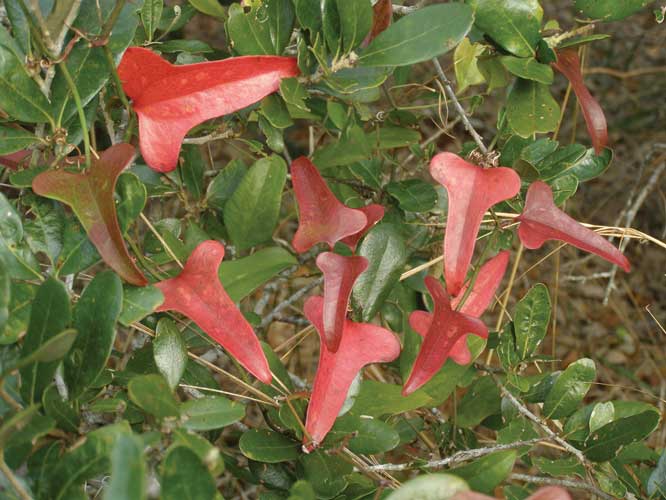
Catbriers often have a few red or burgundy cold season leaves. Photo by Ken Moore.
From mountaintops to seacoasts, the vegetation of our state seems to be heldin place by one or more of several species of catbrier, Smilax spp. Descriptive common names include sawbrier, greenbrier and bamboo-vine.
A few weeks ago, while walking the Springer’s Point Preserve on Ocracoke Island, I encountered brilliant-red leaves on some of the catbriers there. With evergreen entangling vines above and strong tuberous root systems below, catbriers are effectively securing dunes and shorelines against wind and surf action. You may remember discovering knobby, potato-like roots washing up on seashores and sound sides. Those are remnants of the tough storage roots of catbriers.
Many folks consider catbrier a thorny pest, an impenetrable natural barbed-wire fencing. Perhaps smilax was the inspiration for barbed wire. In response to those who find it a menace, I suggest simply stepping around it, acknowledging that smilax tangles provide shelter for many wild critters. And the berries, brilliant-red on two species and dark blue-black on the others, provide nourishment for birds and other wildlife.
For us humans, tender shoots, tendrils and leaves of catbriers eaten raw are treats, according to ethnobotanist James Duke. Peterson’s Edible Wild Plants offers several recipes for tasty preparations of tender plant parts.
Some catbriers are deciduous and others are evergreen. In parts of the South, evergreen catbriers are grown for shade on arbors and used for holiday greenery, like magnolia and holly. I have a black-berried, evergreen catbrier still decorating my back entrance.
Catbriers have a rich medicinal herb heritage. Leaves and roots were used for teas and poultices and even the thorns were valued as a type of acupuncture.
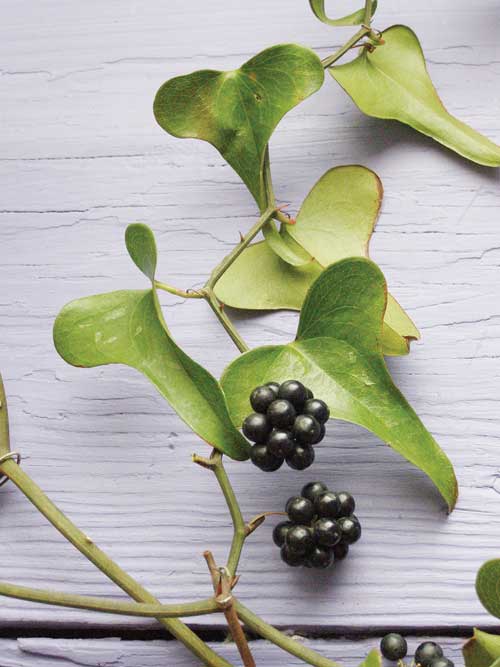
Black-berried, evergreen smilax makes long-lasting decoration. Photo by Ken Moore.
I always leave some naturally occurring smilax vines to grow freely along my back deck and yard trellises. Tiny greenish-yellow, lily-like flowers invite a closer look in mid-spring. The leathery round and heart-shaped leaves are attractive as the vines reach upward and outward in all directions. Some catbriers are not thorny and are attractive in flower arrangements.
So there you have it; with thorns, or without, catbriers are vines of value and beauty to behold.

There are many uses for Fraser firs. Photo by Ken Moore.
By Ken Moore
With ally Clay Hudson, I am in dead-heat competition with other “tree ferriers†to deliver the greatest number of orphaned Christmas trees to Diana Steele’s Willow Hill Preschool. For years, Diana has inspired energetic curbside rescuing of discarded trees, mostly native North Carolina Fraser firs, Abies fraseri.
Under Diana’s supervision, these trees eventually settle into meandering brush piles in the woodlands containing her magical gardens and preschoolers’ discovery ground.
The former magnificent North Carolina high-altitude evergreen Fraser fir forests, described as “Christmas Tree Land†by B.W. Wells in The Natural Gardens of North Carolina, are much diminished now by the exotic balsam wooly adelgid insect pest. I remember being awed back in 1967 by the solid blue-green Fraser fir ridgetops along the Blue Ridge Parkway’s highest elevations west of Asheville. Those ridgetops today are steep-sloped deserts of giant dead stems of the former magnificent firs.
Today we see Fraser firs mostly as Christmas tree farm crops in our western counties. Though helping the economy of the region, those farms don’t replace the magnificence of the former Fraser fir forests.

Rescued Fraser firs highlight Willow Hill welcome bunny. Photo by Ken Moore.
Unfortunately, much of the Christmas tree production depends upon heavy pesticide and herbicide use with resulting toxic runoff. A bright side is that some farms are now moving toward pollution-free organic operations.
Just about everyone who enjoyed an indoor tree this past holiday season had a tree cut from one of those tree farms. With the holidays past, those trees are discarded along curbsides into February. Though we are fortunate to have curbside pick-up for landfill composting, it’s sad that we don’t offer each tree a more reverent appreciation by extending its beauty and usefulness outdoors on the home turf.
I want to stop and rescue every curbside discard, take it back and stand it upright in my yard, where it will continue to remain green for many more weeks.
Sited near bird feeders, the trees become excellent shelter and approach perches for birds. Simply set upright in the ground, they provide evergreen elements all around the garden and home landscape for several more months.
After the visual landscape effects are past, the branches can be cut and applied as mulch around trees, shrubs and on garden beds. There are so many creative uses on the home grounds for these trees, there is no sense discarding them curbside, making more work for public-works crews.

Willow Hill preschoolers celebrate their Fraser fir creation. Photo by Diana Steele.
Once again, Diana Steele gets the annual “Citizens’ Award for Creative Orphaned Christmas Trees Recycling.†Not only do these trees provide instant dramatic landscape effect throughout her garden, but before dozens of them ever make the journey down to become woodland brush-pile wildlife habitats, the kids in her preschool move them around and, like budding architects, make tree fortresses, tree castles and even giant bird nests for their creative energies to explore for weeks on end.
So begin planning now on ways you will keep your Christmas tree on your home turf next year!
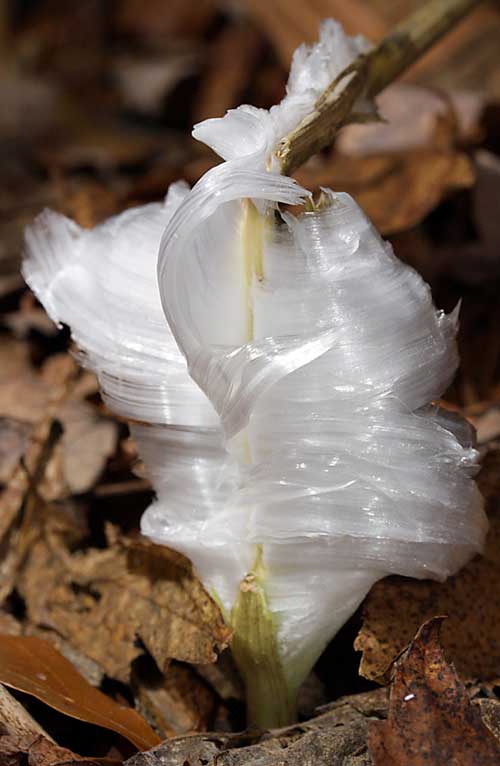
Ice flowers form at the base of only a few plants. Photo by Patrick Coin.
By Ken Moore
Last week, Botanical Garden staffer J.C. Poythress enthusiastically asked whether I had seen the ice flowers. Responding, “What’s an ice flower?†he quickly led me out to the gardens behind the Totten Center to show me several. Wow, another first-time experience. Then another staff person described an article about ice flowers in the Botanical Garden Newsletter of Nov. -Dec. 2006.
That article, “One Flower You’ll Never Find in the Herbarium,†was written by Carol Ann McCormick, assistant curator of the UNC Herbarium. Though you may never discover one of these ice flowers on your own, I hope, like me, you will be happy to at least know they exist.
With permission, I am sharing here an abbreviated version of Carol Ann’s article.
“The UNC Herbarium is a research collection of 750,000 pressed and dried plant specimens. An herbarium specimen, if a wildflower, is the entire plant, glued and sewn onto stiff, acid-free, 11 ½ x 16 ½ inch paper. If a tree, then a twig with leaves and flowers is mounted on the paper. Bulky items like pine cones or black walnuts are kept in acid-free cardboard boxes.
“Ice flowers, as you will learn, are never found in herbaria.
“I first encountered ice flowers several years ago along my driveway in Alamance County. One cold December morning, I was peeved to see Styrofoam packing peanuts scattered along a rocky east-facing bank uphill from Big Branch Creek. I got out to clean up the litter and discovered that they were not Styrofoam, but delicate whorls of ice. Even more amazing, each whorl of ice was around the base of only one kind of plant, wild oregano, Cunila origanoides. There were plenty of other plants on the rocky bank, Christmas ferns, goldenrods, and melic grass, but ice whorls only at the base of wild oregano.
“A little research revealed that I’m not the first to observe ice flowers. Ice flowers are delicate ribbons of ice that encircle the stems of certain plants when the temperature falls below freezing. According to Forrest Mims (www.sas.org/E-Bulletin/2003-12-19/mimsci/body.html), the flowers ‘are formed when liquid water inside freezes and splits the stem open. Water and water vapor inside the stem are emitted directly into the air, and transformed into delicate ribbons of ice.’
“Ice flowers do not form on just any plant. I’ve found no explanation for ice forming on some plants and not on others. The plant best-known for forming ice flowers is frostweed, Crocanthemum canadense, in the Rockrose family. Verbesina virginica, white crownbeard, and Verbesina alternifolia, wingstem, both in the Aster Family, also form ice flowers. My ice flower plant, wild oregano, is in the Mint family.
“How big are ice flowers? I mistook the smallest ones for packing peanuts, but the largest were fist-sized. When do ice flowers form? I first noted them in a cold spell in mid-December. On a walk at 8:30 p.m., I shone a flashlight beam on the rocky bank, and tiny whorls of ice were beginning to form. How long do ice flowers persist? Once the morning sun heats the forest floor, 8:30 a.m. on this particular slope, the delicate whorls melt away. Where do ice flowers form? The only place I’ve seen them form in my forest is along a 50-foot stretch of my driveway where wild oregano flourishes. I must point out that I am not typically hiking at 7 a.m. on January mornings, so perhaps they occur on other plants! At a meeting of Garden staff last January, I asked if anyone else had noted ice flowers. Most people admitted they’d never heard of, much less seen, the phenomenon.
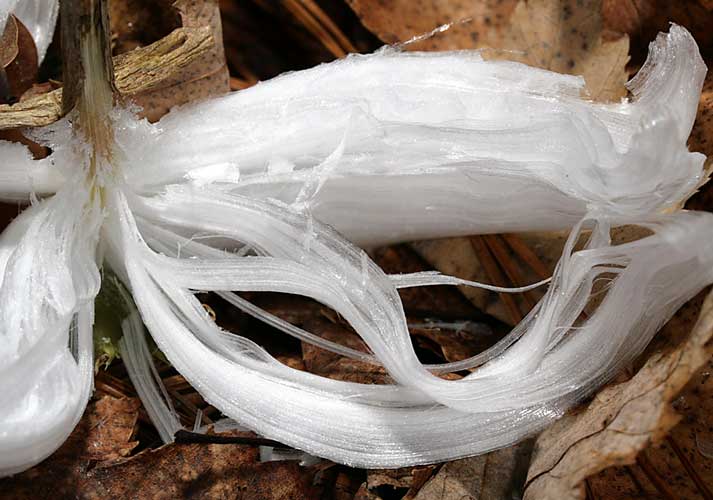
Every ice flower design is unique. Photo by Patrick Coin.
“I noted ice flowers frequently in December and early January but not afterward. I hypothesize that as winter progressed, the wild oregano stems dried out, so less water and sap was available for freezing. Clearly I have many more questions than answers about ice flowers, but I urge you to be on the lookout for these ephemeral, never to be found in herbaria, ice flowers.â€
Thank you to Carol Ann for sharing her observations of these seldom-seen phenomena and to Patrick Coin for the beautiful images.

Wayne Poole displays some of his collection of broomstraw brooms. Photo by Ken Moore.
By Ken Moore
Local storyteller Wayne Poole is passionate about brooms. I mean, he is really into showing and talking about old-timey brooms. I can listen for hours to the stories Wayne spins about wild nature and our local culture. A couple of weeks ago, I joined him on a local jaunt to find some materials to make brooms.
Now, Wayne is as opposite in disposition to me as one could imagine. I am fast-paced, easily distracted and boisterous, bordering on the obnoxious.
Wayne is quietly centered, easy-going and deliberate in his movements. We have worked very successfully together at Schoolhouse of Wonder, so I know that opposites can move to a single drummer from time to time.
So I had already determined that I was going to experience broom-making at Wayne’s speed. It was a truly memorable experience of slowing down to “smell the roses,†except the fragrances in this case were the subtle aromas of tawny-colored broomstraw.
Wayne began my introduction to sedge brooms by bringing out his collection of various-sized brooms, some a decade or two old. He explained that over the years of gathering broomstraw, or sedge, as some folks prefer, he noticed that “there’s more than one kind of broom out in those fields.†I acknowledged that, yes indeed, there are several different species, and he had a keen eye to detect their differences.
The one I believe is most commonly used for broom-making is old-field broomstraw, or broomsedge, Andropogon virginicus. We walked out into Wayne’s front yard and discovered he had two different species right there.
Wayne was disparaging of his front-yard broom because it wasn’t as tall as what was growing in an adjacent field. I guessed that he had mowed his yard midway during the summer, which he acknowledged, and that accounted for his native broom grass being shorter than the unmowed near-by field.
Broomstraw is a native grass, and native grasses generally grow actively during the warm months of the year. It is in sharp contrast to the popular lawn-turf exotic fescue, a cool-season grass, which prefers cooler growing conditions. Broomstraw begins to really express itself in the mid-summer and doesn’t become noticeable until it begins to shoot up in August and September and sports those delicate plume-like seeds in October and November. If mowed in late summer, it never quite catches up with its unmowed neighbor.
It is one of the pioneer native species to appear in an abandoned field and it can hold on for several years before other perennials and shrubs and trees begin to move in, the classic “old-field succession†of ecology texts.
Beginning in October and continuing well into the following springtime, broad sweeps of copper-reddish broomstraw across the native landscape are a beautiful sight to behold.
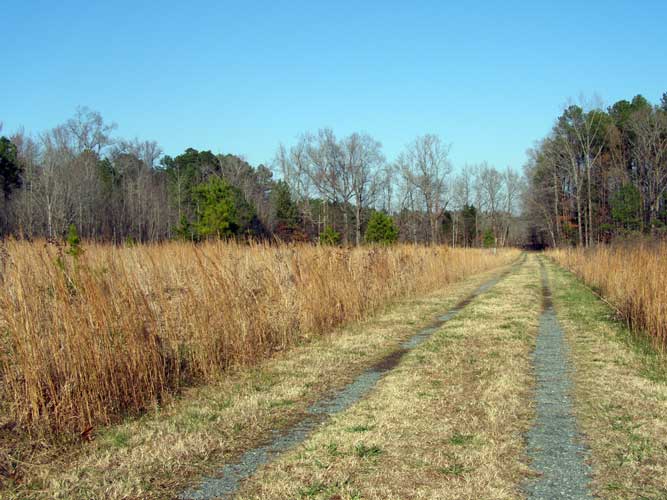
Sweeps of broomstraw color some of the fields at Mason Farm. Photo by Ken Moore.
Next time you are out walking, pause from time to time to discover subtle differences and be appreciative of the old-timers who utilized those wild grasses to keep clean their hearths and yards.
I’m very proud of the broom I made under Wayne’s tutelage, and I have it proudly displayed next to my back door.
Begin 2010 enjoying winter’s beauty

Alligator hide-like bark distinguishes old persimmon trees. Photo by Ken Moore.
By Ken Moore
How well I remember one winter walk, stopped in mid-stride by the sounds of snow falling through the bare forest canopy. That sound of snow touching the earth remains audible in my recollections.
Driving back from Raleigh on I-40 recently, my companion remarked on the beauty of the winter landscape, particularly noting the magical effect of shining copper-colored leaves on trees in the forest racing by us.
In spite of the cold, I cherish the winter fields for their remarkable colors: browns, burgundy and contrasting off-whites, and the mixture of textures of fluffy seed heads and starkly bare branches.
The forest, shorn of its green leafy canopy, is filled with low-angled light inviting the woods walker to proceed from room to room, taking in particular furnishings most often hidden by lush summer foliage.
The lay of the land is easily visible across the open forest floor, dramatic ups and downs with old erosion gullies crisscrossing everywhere. Here and there the path sometimes intersects animal trails. I can never resist taking off on one of these little trails in the hope that I’ll discover the critter at the end, but each time the animal seems to have disappeared with nary a trace. However, off the beaten path, I always find some botanical or other natural feature of interest.
In the winter, the true architectural characteristics of trees are revealed, with the dramatic skyward stretching of massive limbs. In addition, the amazing diversity of bark surfaces becomes apparent.
One of my favorite trees is the persimmon. They may be detected scattered in open fields and throughout forests by dramatic horizontal angled limbs. The bark is dark and deeply fissured into chunks that make me imagine alligator hide.
Some folks discover that trees are easier to identify when they are in the bare winter condition. For those interested in winter identification, it’s easy to begin with the pocket-sized Winter Tree Finder by May Watts. This guide focuses your eyes and attention on details that are quite obvious once you take the time for a closer look.
In addition to bark color and texture, look for alternate and opposite arrangements of twigs, and notice the shapes of the buds. A smooth light-colored bark is possibly an American beech. If you see alternately arranged copper-colored leaves still hanging on and really slender, sharp pointed buds at the branch tips, you know for certain you have an American beech tree.
If you find a light-colored, smooth-textured bark and the trunk has vertical muscle-like ridges, and you are down along a creek edge, you have an ironwood tree; it’s called blue beech in the northern states. It will not have copper-colored leaves present.

Copper-colored leaves and needle-like buds characterize American beech. Photo by Ken Moore.
But you don’t have to identify a tree to enjoy it. Just being aware of so many different kinds of trees is worthwhile. And once in awhile, you may want to hug a special tree, and thank it for making possible our life here.
Go take a walk and meet a tree on New Year’s Day. Then make a wish that you’ll do it once a week the rest of the year. Then make that wish come true!

The fragrant flower of southern magnolia defines summer in the South. Photo by Byrd Green Cornwell.
By Ken Moore
“A beautiful and popular shade tree throughout the [Cape Fear] Valley and the south. It has become a sort of cognomen for the culture, the beauty and the old-timeyness of the region.†This observation from Paul Green’s Plant Book makes me reflect on Christmastime visits to my aunt’s farm near Norlina in Warren County.
The seasonal visit included cutting the traditional red cedar tree to take back home. The cedar smelled great, but was prickly to decorate. One vivid memory of those visits is my aunt’s Christmas tree. It was a 6-to-8-foot tall loblolly pine with lights and decorations. Way back then, I thought that was a weird tree for the holidays. But, hey, my aunt had lots of them on the farm, and they were definitely not prickly like the cedars.
Another vivid memory is tailing my long-striding aunt down to the mailbox, where there was a huge evergreen magnolia with limbs reaching down to the ground all around. I helped her carry magnolia branches back to the house, where she would lay them about, mixed with pine boughs.
Now that was appealing to me, and still is now. Magnolia branches provide a special warm feeling for me during the holiday season and I always especially remember my aunt.
This irresistibly fragrant, white-flowered tree of the South, sometimes called Bull Bay, Magnolia grandifolia, is common in the maritime and low-country forests all the way around the coastal Southeastern United States. It has been planted and cherished in gardens and landscapes for so long that you sometimes see seedlings here and there, where birds and perhaps squirrels and other critters have dropped those bright red-covered seeds. The dried cone-like fruit are often added to wreaths for holiday decorations.
You can’t think Christmas in Colonial Williamsburg without all those doors adorned with magnolia-leaf arrangements. Like my aunt, those old colonials used what they had growing aplenty all about them!
Unlike so much of the other traditional evergreen foliage we bring indoors to cheer us up and protect us from evil spirits and provide shelter for good elves, magnolia remains attractive even in its drying condition.
Native Americans of the coastal regions combined bark of magnolia, dogwood and poplar for a tea to treat malaria, sinus infections and stomachaches. And sometimes, magnolia branches were substituted for red bay branches for stirring flavor into lard.

Scarlet-seeded magnolia cones adorn southern magnolia in the fall. Photo by Betsy Green Moyer.
Paul Green shared a story about a magnolia leaf. As related to him by Galley Farrington, there was a “knockout of a woman†traveling through the region “to bring joy to mankind.†Her trick, which the men were embarrassed to describe, was to take a dollar bill from each, fold it in a large magnolia leaf for them to keep in a pocket, for at least an hour, to bring them good luck. Their luck was not so good when that woman was long gone and they each discovered that nary a one of those folded leaves still held a dollar bill.
Southern magnolia brings up all kinds of memories, the best of which is bringing some indoors for this special season.
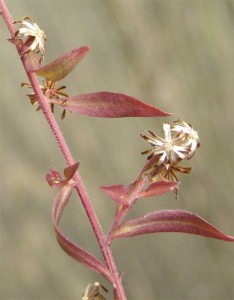
A closer look reveals beauty in a wild aster in winter phase. Photo by Ken Moore.
By Ken Moore
Last week a Citizen reader asked how I found anything to feature during winter. I responded that nature is so rich that I always had one or more subjects lined up, even in the winter. I added that I was already working on the lingering colors of sparkleberry.
That was my intent until the next day, when by the back door my eyes were captured by little white stars along burgundy limbs. Taking a closer look at a native aster in a pot destined, eventually, to go into the ground, I marveled at the coloration of remaining leaves highlighting star-like bases from which seeds had already taken flight.
At that moment, stopped in my tracks, I realized that the sparkleberry would have to wait; nature had stepped in to redirect my focus on that little aster.
However far ahead I plan, I am not really in charge of selecting what I will feature each week. Many times I am deflected from my intended focus to a more compelling one because of something that captures my eye. Perhaps my response to that Citizen reader should have been that I simply feature whatever nature thrusts my way.
I have moved that potted aster closer to my door for easier viewing each time I pass. That wildflower, in its so-called dormant phase, is now providing me as much pleasure with its bright star-shaped seed receptacles on stems strewn with burgundy colored leaves as it did last fall with its flurry of tiny purplish flowers perched on green leafy stems.
I recall how back in the fall I cautioned you to take a lighter hand as you “put your garden to bed for the winter.†I urged that clumps of tall branching plants and fluffy seed heads be left for winter interest and for food and cover for birds and other critters. I was at that time more intent on the distant landscape view of nature’s winter garden. Now I’m walking up close to discover color and textures not so obvious from a distance, definitely well worth slowing one’s pace.
The short walk to and from the mailbox is rewarded by the winter effect of dense wooly seed heads of common goldenrod along my very unkempt driveway. Recalling how I enjoyed the golden plumes of these, possibly my favorite of all wildflowers, weeks ago, I’m appreciating how the fluffy white seed heads rival the earlier bright flower heads.
In stark contrast, on rainy days those same seed heads are barely discernable, because they close tightly when wet. Well, that is logical; for why would a plant expose flight-dependant seed when it is weighted down with moisture?
The drifts of goldenrod seed heads lining the unmowed portions of the highways encircling our town these days seem to be suspended in time, as if to make certain we eventually take notice during our fast-paced travels.
Now I’m wondering what Mother Nature will offer up as alternative to my plan to feature the sparkleberry next week.
Taking a closer look with pencil and brush

Robert Johnson’s nature note page includes details surrounding a miniature landscape.
By Ken Moore
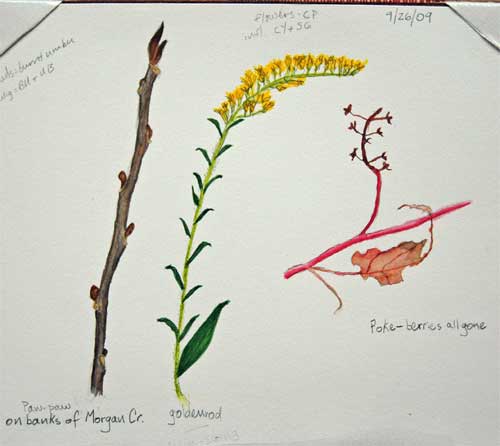
Next time you take a woods walk, carry along a pencil and a little notebook or sketch pad. Wherever you pause along the way to take a closer look, make some quick sketches and written notes of what you see and how you feel. Pay attention to details like bud shapes, round or pointed, whether a leaf is dark or light green, perhaps a colorful beetle in the path.
A simple sketch with color notes jotted on the sides guides you if you want to add color when you return home.
Some of you are thinking you’re incapable of drawing and painting. Beware, there is art in everyone. We simply need to rediscover that childhood freedom and creativity that lurks buried within. Reflect on how we drew as children. Whether a tree or bird, we drew it. Then along came the well-meaning parent or other attending grown-up with an “Oh no, that’s not how a tree looks!†and therein was the end of our artistic expression, sometimes, sadly, for the rest of our lives.
Back in late September, North Carolina nature artist Robert Johnson

Illustrations by Laura Cotterman.
led a weekend class for a number of local outdoorsy types interested in keeping nature journals. Robert is like a contemporary Mark Catesby, except Robert does not have to rely on the harsh colonial travels on horseback through virgin territory. Robert makes long hiking and camping excursions into the wilds across America and from Alaska to New Zealand. In making his “nature notes,†he likes to “hike light†to “keep it simple!†He goes equipped only with a small sketch pad and a pencil and a little color chart of his own design. Back at camp, he sets up for the evening to add watercolors to his sketch notes, sometimes redrawing several pages to make larger ones representing an entire plant and animal community.
Going a step beyond Catesby’s colored sketches of almost 300 years earlier, Robert includes miniatures of the landscapes in which he discovers the subjects of his details. I can stand and contemplate a single one of his finished journal pages for many minutes and then want to go back again and again. Many of Robert’s works describe the wild nature of North Carolina. Thirty-two of them are on exhibit at the N.C. Botanical Garden through Dec. 21, and well worth a visit.
In September, students accompanying Robert at Mason Farm Biological Reserve were happy to discover new ways of looking, and with rediscovered childlike freedom made quick sketches and color notes, returning indoors to transform their notes into colored landscapes and details. No two were alike, and all were beautiful. Some of those folks had never set pencil or brush to paper.
Illustrations by Laura Cotterman.
Simple sketching is a useful way to focus your eyes and feelings on a landscape and details found there. Even you can do it. So on your next nature walk, take along a sketch pad and pencil, take that closer look, and draw from the found inner child – and don’t be critical of your work.
Make note; Robert Johnson will return to lead field sketching classes next spring at the Botanical Garden and next fall at the Museum of Natural Sciences.
Beautyberry’s English experience

Mark Catesby’s colored illustration of the “garish purple†berries of American beautyberry.
By Ken Moore
I am grateful to a loyal reader of the Citizen for passing on to me Andrea Wulf’s The Brother Gardeners: Botany, Empire and the Birth of an Obsession, published last year. This account of the lives and passions of pioneer plant explorers and avid gardeners of the 18th and 19th centuries is engaging reading. Just a few nights ago, I was captivated by a copy of Mark Catesby’s color illustration of American beautyberry.
English plant explorer Mark Catesby is credited with introducing our native beautyberry, Callicarpa americana, to England in 1724. Wealthy English merchant Peter Collinson, with an obsession for growing plants, also received specimens of beautyberry from Philadelphia farmer John Bartram, who had made collections from his travels in South Carolina.
With Collinson’s financial help, Catesby published the colored drawings and written accounts of his American travels, Natural History of Carolina, Florida and the Bahama Islands, in a 10-part series from 1729 to 1748. His illustration of beautyberry caught the attention of English gardeners eager for new plants from America. His verbal description was equally engaging: “a highly unusual plant which wore its garish purple berries around its branches like bead bracelets.â€
Though Collinson succeeded in bringing this American shrub to fruit, the English climate did not favor it for extended periods. As Phillip Miller, another avid English gardener, whose 1731 first edition of Gardeners Dictionary became the standard botanical/horticultural reference for gardeners worldwide, noted in his 1768 edition, “they had flowered, but to the great frustration of gardeners had failed to produce the desirable bright purple berries.â€
Sadly, English gardeners today must rely on the smaller-berried oriental callicarpas, which, in my perspective, pale in contrast to our coastal North Carolina native.
Those “garish purple†berries are still holding on as we head into December, I think because we have not yet had serious killing frosts. There is a particularly spectacular planting of them over in the woodland gardens just west of building five at the Carol Woods Retirement Community.
The friendship established across the Atlantic between Collinson and Bartram was steadfastly affectionate, while at times testy, as their numerous correspondences attest. Collinson came to depend on Bartram as the most reliable source for cuttings and seeds of American plants and Bartram depended upon Collinson for financing plant explorations and providing botanical/horticultural texts not otherwise available to him.
Collinson was the center of many such collaborative friendships. Stories of worldwide plant adventures, including the travels of Captain Cook, and the subsequent successes and failures of English gardeners with new plants are enriching for wildflower enthusiasts and gardeners alike.

“Garish purple†beautyberry still showing off in Carol Woods. Photo by Ken Moore.
By mid-18th century, plants were eagerly exchanged back and forth across the Atlantic. And, early on, enthusiasm for growing exotic foreign plants was tempered a little by concern for potential dangers. When yellow toadflax, Linaria vulgaris, a much-loved flower in Britain, invaded the landscape like a weed, Bartram was worried about the havoc. So today, as we are aware of the havoc of plants like Norway maple and paper mulberry, gifts to Bartram from his English patrons, we also are appreciative of many plants shared by early gardeners that do remain well behaved within our garden gates.