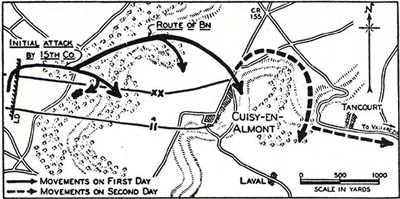
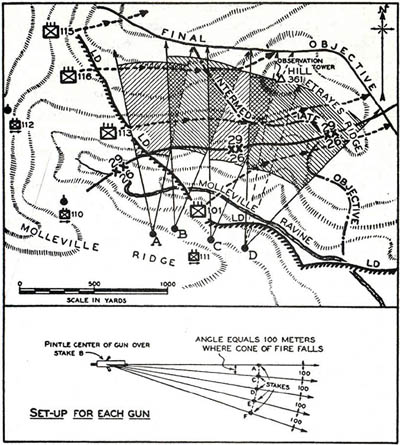
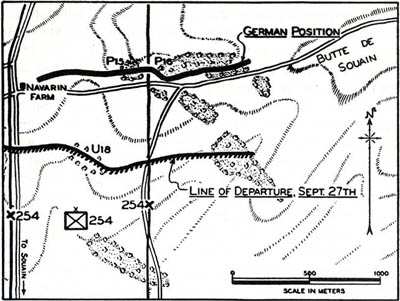
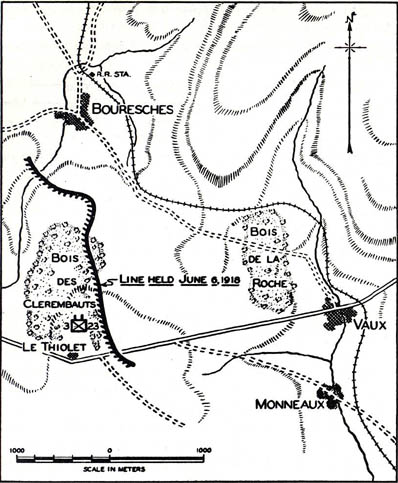
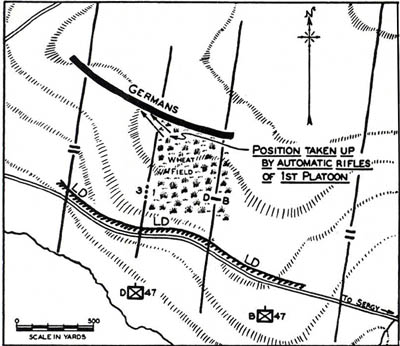
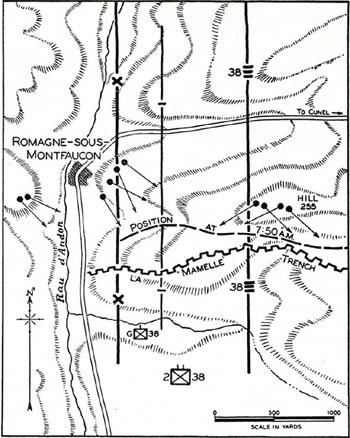
This book treats of the tactics of small units as
illustrated by examples drawn from the World War. It checks the ideas
acquired from peacetime instruction against the experience of battle.
There is much evidence to show that officers
who have received the best peacetime training available find themselves
surprised and confused by the difference between conditions as pictured
in map problems and those they encounter in campaign. This is largely
because our peacetime training in tactics tends to become increasingly
theoretical. In our schools we generally assume that organizations are
well-trained and at full strength, that subordinates are competent,
that supply arrangements function, that communications work, that
orders are carried out. In war many or all of these conditions may be
absent. The veteran knows that this is normal and his mental processes
are not paralyzed by it. He knows that he must carry on in spite of
seemingly insurmountable difficulties and regardless of the fact that
the tools with which he has to work may be imperfect and worn.
Moreover, he knows how to go about it. This volume is designed to give
the peace-trained officer something of the viewpoint of the veteran.
By the use of numerous historical examples,
the reader is acquainted with the realities of war and the extremely
difficult and highly disconcerting conditions under which tactical
problems must be solved in the face of an enemy. In so far as there was
material available, these examples pertain to American troops and have
been drawn from the personal experience monographs on file at The
Infantry School. The combat experience of other armies, however, has
been utilized to supplement that of our own.
This work does not purport to be a complete
treatise on minor tactics of infantry. The aim of its authors has been
to develop fully and emphasize a few important lessons which can be
substantiated by concrete cases rather than to produce just another
book of abstract theory.
GEORGE C. MARSHALL,
Colonel, Infantry.
May 1, 1934.
INFANTRY IN BATTLE was prepared by the Military
History and Publications Section of The Infantry School under the
direction of Colonel George C. Marshall. Major Edwin F. Harding planned
the book and supervised the preparation and edit of the manuscript.
Major Richard G. Tindall wrote the original drafts of most of the
chapters. Captain John A. Andrews, Captain Robert H. Chance, and
Lieutenant C. T. Lanham assisted in the research and the preparation of
the maps, and contributed parts of some of the chapters. Captain Russel
B. Reynolds drafted the chapter on the fire of machine guns. Lieutenant
Lanham edited and revised the manuscript in full.
The second edition of INFANTRY IN BATTLE is not a
mere reprint. The entire book has been extensively revised. Many of the
sections have been completely rewritten; much of the tactical doctrine
restated; and new maps by Technical Sergeant William H. Brown
substituted for those of the first edition. This work was performed by
Captain C. T. Lanham, in consultation with Lieutenant Colonel Edwin F.
Harding.
The art of war has no traffic with rules, for the
infinitely varied circumstances and conditions of combat never produce
exactly the same situation twice. Mission, terrain, weather,
dispositions, armament, morale, supply, and comparative strength are
variables whose mutations always combine to form anew tactical pattern.
Thus, in battle, each situation is unique and must be solved on its own
merits.
It follows, then, that the leader who would
become a competent tactician must first close his mind to the alluring
formulae that well-meaning people offer in the name of victory. To
master his difficult art he must learn to cut to the heart of a
situation, recognize its decisive elements and base his course of
action on these. The ability to do this is not God-given, nor can it be
acquired overnight; it is a process of years. He must realize that
training in solving problems of all types, long practice in making
clear, unequivocal decisions, the habit of concentrating on the
question at hand, and an elasticity of mind, are indispensable
requisites for the successful practice of the art of war.
The leader who frantically strives to remember
what someone else did in some slightly similar situation has already
set his feet on a well-traveled road to ruin.
Example 1
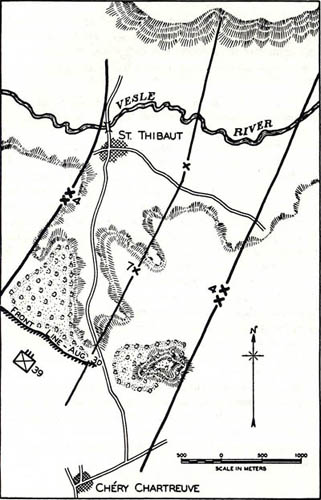
EXAMPLE 1. In the early days of August, 1918, the
Germans were retiring toward the Vesle River. On the third day of this
month the U. S. 4th Division relieved the 42d and advanced. The 39th
Infantry, part of this advancing division, moved forward in an
approach-march formation with two battalions in assault. All day the
troops struggled forward-the slowness of the advance being caused not
by hostile resistance but by the difficulty of the terrain,
particularly the dense woods that had to be negotiated.
Late in the day resistance was encountered and
overcome. The enemy fell back. Orders were now received to form a
column with an advance guard, take up the pursuit and drive across the
Vesle in order to establish a bridge-head on the slopes to the north.
The 39th Infantry (less one battalion was
designated as the advance guard of the 7th Brigade. After a march of
several hours, hostile artillery fire was encountered, whereupon the
column halted for the remainder of the night. At dawn the march was
resumed, but finding that the proposed route of advance was being
shelled by the enemy, the advance guard counter-marched to another
road. Some confusion resulted from this, the 2d and 3d Battalions
becoming intermingled. Thus, when the movement again got under way,
Company H formed the advance party, Companies F, K, and L the support,
and Companies I, M, Machine-gun Company, Companies E and G, in the
order named, the reserve.
Early on August 4 the column approached the
Vesle on the Chéry-Chartreuve-St. Thibaut Road. About 2,000 meters
south of St. Thibaut this road passes through a deep defile, 200 meters
wide and nearly perpendicular to the commanding heights north of the
river. The road runs through the full 1,000-meter length of this
defile, then emerges at the northern exit to open terrain, over which
it winds smoothly to the little village of St. Thibaut. To reach this
village, the open terrain before it has to be crossed, and this lies
under direct command of the high ground to the north.
No enemy infantry had been encountered.
Company H, in column of twos, approached St. Thibaut without being
fired on. At 8:00 a.m. it entered the town. By this time part of the
support, marching in column of squads, was well out of the defile.
Company H had cleared the town and had nearly reached the bridge over
the Vesle when suddenly the Germans on the northern heights opened with
machine guns and artillery on the advance party and the support,
causing heavy casualties and throwing the support, in particular, into
the greatest confusion.
DISCUSSION. Here is a perfect example of a command
offered up on the bloody altar of form. Let us look at that sacrifice
more closely.
Until the advance guard emerged from the
defile, the terrain had shielded it from hostile ground observation. As
it left this friendly protection it came in direct view of the
commanding heights to the north. Hostile artillery had been firing from
these heights but a short time before, but in spite of this the advance
party moved out in column of twos and the support in column of squads.
In Major Eddy's words, "It was a sight that must have made the German
artillery observers gasp in amazement, for before them lay an
artilleryman's dream."
Why was this done? Probably because their
training had established it as a custom of the service, as a law of the
Medes and the Persians, that an advance party moved in column of twos
and a support in column of squads. Their orders had directed them to
form an advance guard, they were not under fire, and therefore they
adopted one of the diagrammatic formations set forth in training
manuals.
True, this unit was entirely lacking in
open-warfare experience, having participated in only one attack and
that from a stabilized position. It is also true that the intermingling
of the 2d and 3d Battalions rendered command difficult. Nevertheless,
common sense decried such a suicidal formation in the presence of the
enemy.
Example 2
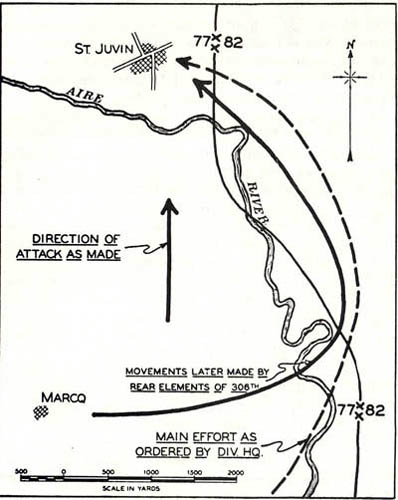
EXAMPLE 2. On October 14, 1918, the U. S. 77th Division
attacked the Germans north of the Aire River near St. Juvin. The
hostile positions in this vicinity were strong, particularly against an
attack from the south. Feeling certain that the German barrage and
defensive fires were registered south of St. Juvin and the Aire River,
the division commander planned to take the village by envelopment from
the east and southeast, while one regiment made a frontal demonstration
from the south. He decided that, under cover of darkness, troops could
cross the Aire well to the south unobserved. This operation would
require movement in the zone of the 82d Division on the right, but the
position of the 82d facilitated this maneuver. Therefore the 77th
Division order specified:
Unfortunately, this idea of maneuver was not reproduced
in the orders of the lower echelons, the troops being, sent "straight
against St. Juvin from the south," the direction that the division
commander had particularly wished to avoid for the real attack.
The 1st Battalion of the 306th Infantry,
which the division commander had expected to be directed against St.
Juvin from the east, attacked straight from the south with the
unfordable Aire between it and its objective. The hostile barrage and
murderous machine-gun fire from the slopes north of the Aire swept
through the assaulting units in a wave of destruction. The attack
stopped. At noon the situation was such that the division commander
believed a serious repulse inevitable.
At this time the commanding officer of the
306th Infantry concluded that there was no chance of success if the
attack continued along these lines. Therefore, after the failure of the
frontal effort, this regimental commander, acting on his own
initiative, directed the rear elements of his regiment to cross the
Aire east of Marcq and make a flanking movement against St. Juvin. This
maneuver was carried out, and the town, the hostile position, and 540
prisoners were captured.
DISCUSSION. General Alexander emphasizes the fact that
the attack, as launched at first, was merely frontal. It failed. Not
until the regimental commander, acting on his own initiative, ordered
troops to cross the Aire and strike the hostile position in flank, was
success achieved.
This division commander states that "evidently
the malign influence of trench-warfare doctrine, which in all cases
depended upon a barrage and a straight push behind it," still
controlled the minds of some of his subordinates.
From beginning to end, the World War is
studded with major and minor reverses that resulted from attempts to
apply methods that were successful in one situation to another
situation.
EXAMPLE 3.
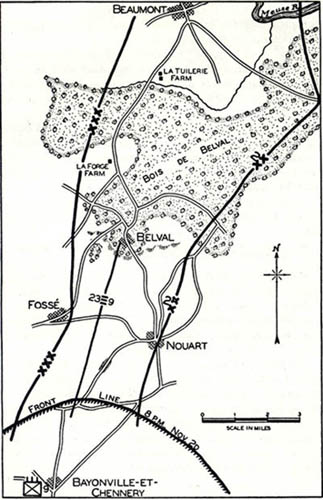
EXAMPLE 3. On November 2, 1918, the 9th Infantry, part
of the U. S. 2d Division, was in division reserve southwest of
Bayonville-et-Chennery. An American attack, launched on November 1, had
achieved considerable success, and the Germans appeared somewhat
demoralized.
On the afternoon of November 2, the 9th and
23d Infantry Regiments (3d Brigade) received orders to advance abreast,
cross the front line at 8:00 p.m., and under cover of darkness moved
forward to the heights just north of the Nouart-Fossé Road. They would
then organize this position and prepare for a vigorous pursuit.
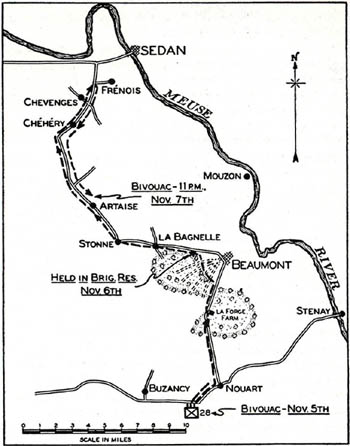
The 9th Infantry, in the order 1st, 2d, 3d
Battalions, moved out in column of twos along the
Bayonville-et-Chennery-Nouart Road to the front line then held by the
4th Brigade. As the regiment came to the outguards of the 5th Marines
it was informed that the enemy still occupied the area to the immediate
front-information which was soon found true.
The leading company (Company A) sent forward a
patrol of several selected men which preceded the column by about 100
yards. Slowly the regiment moved forward. It passed through a long cut
in the road. As the head of the column emerged from the cut, it ran
into an enemy outguard of seven or eight men. These were promptly
killed or captured and the regiment resumed its forward movement, this
time protected by a deployed platoon to the front and by small groups
from the leading company as flank guards. Heavy fire was now received
from the left. The column at once took cover while Company A deployed,
moved against the enemy and drove him off. It was now midnight and the
objective was close at hand. Accordingly, a halt was called until 5:00
a.m., at which time the regiment advanced a short distance and deployed
on the designated line, Nouart Fossé.
An attack was launched from this line and new
objectives were reached without encountering serious opposition. Here
another pause ensued.
Although German resistance was rapidly
crumbling along the entire Western Front, the 9th and 23d found that a
definite stand was being made a short distance to their front on the
crest along the south edge of the Bois de Belval. Accordingly, American
artillery fire was placed on this position and preparation made to take
it.
The brigade plan was unusual. The 9th and 23d were ordered to penetrate the German position by marching in column on the road
through the Bois de Belval and to seize and occupy the heights south of
Beaumont. The advance was to be supported by a rolling barrage
extending 200 yards on each side of the road.
The 9th Infantry began its forward movement
about 4:30 p.m. in the following order of march: 3d Battalion and
Machine-Gun Company as advance guard, followed by the 2d and 1st
Battalions, each with one company of the 5th Machine-Gun Battalion
attached. It soon became dark. As the head of the advance guard
approached the edge of the woods a few hundred yards south of Belval,
German machine guns opened fire from both sides of the road. Patrols
sent to the left and right made short work of silencing these guns. At
Belval the road was barricaded. This was cleared up and the regiment,
in column of twos, moved on in the darkness and mud. Rain began to
fall.
Frequent halts were made to intercept enemy
detachments moving along the road and to verify the route. Several
Germanspeaking soldiers were placed at the head of the advance guard to
hold the necessary brief conversation with any groups of the enemy that
might be encountered. Several of these groups were taken prisoner
without firing a shot.
Just north of la Forge Farm the leading
company of the advance guard surprised a large detachment of German
troops who were industriously preparing a position from which they
could cover a clearing in the forest. Sixty or seventy prisoners were
taken.
The column continued, surprising a train
bivouac and capturing an aid station. It arrived at the north edge of
the wood at 10:45. At la Tuilerie Farm the officers and men of a German
minenwerfer company were surprised and captured. Dispositions were then
made to hold the ground won.
According to reports of prisoners and captured
documents, the Germans had intended to hold the position near the south
edge of the Bois de Belval for two days.
DISCUSSION. Here is a remarkable action. During a
single night a regiment, in column and on roads, marched five miles
through the enemy position! This feat becomes still more remarkable
when we consider the fact that it was preceded by four years of
stabilized warfare during which such an operation would have been
classed as the height of insanity.
The plan was revolutionary. It was contrary to
all the tedious rules that had been evolved while the war stagnated in
the trenches. Perhaps that is the very reason it succeeded. Of course,
some praise this operation and others damn it as poor tactics and a
dangerous gamble. But no matter what the rule books say, one
unassailable fact remains-the American commander's estimate of the
extent of German demoralization and confusion was thoroughly upheld by
the success obtained. And we judge by results.
Example 4.
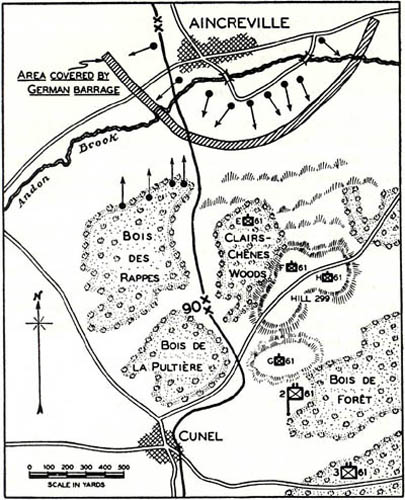
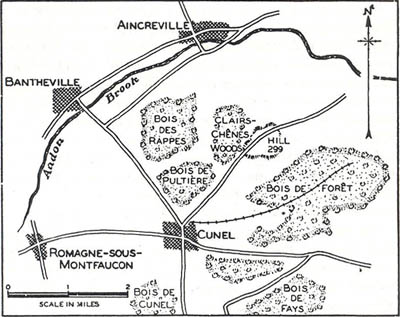
EXAMPLE 4. On October 29, 1918, the 2d Battalion of the
U. S. 61st Infantry held a position south of the Andon Brook. From the
north edge of the Clairs-Chênes Woods the grounddevoid of cover-falls
in a long gentle slope to the little brook that skirts Aincreville.
The Germans, in possession of Aincreville, had
emplaced their machine guns about 250 yards in front of the town in a
semicircular position. In addition, they had prepared an artillery
barrage to fall about 200 yards in front of their machine guns.
The Americans could hear voices and the
rumbling of wagons in Aincreville, but had no idea in what strength the
enemy held the town. Patrols could advance only a short distance before
they were driven off, for the Germans signalled for their defensive
barrage on the slightest provocation. The signal was a green-star
rocket, which brought the barrage down about two minutes later.
Expecting that be would be ordered to capture
Aincreville, the battalion commander made his estimate of the
situation. His men were very tired. After a succession of long marches,
they had taken part in operations from October 12 to 17, and, though
suffering heavy casualties, had met with only small success. Following
this they had remained under artillery fire in division reserve for
several days and then, after receiving a few partlytrained
replacements, had relieved elements of the 3d Division in the front
line on the night of October 26-27.
In view of the condition of his men, the
battalion commander believed that any cut-and-dried attack would have
small chance of success. There was no cover. An American artillery
preparation would be certain to bring down the German's barrage and
cause their machine guns to open. And he was not at all sure that his
weary men would advance through this fire over open terrain. He did
believe, however, that the Germans were equally tired and that if he
could only get close quarters with them the problem would be solved.
On the afternoon of October 29 the expected
order arrived. It directed that one officer and 100 men from this
battalion attack and seize the town following a preparatory artillery
and machine-gun barrage. The battalion commander immediately proposed
an alternative plan which was approved. Only the officer directly in
charge of the action and four or five reliable sergeants were let in on
the plan. This is how the battalion commander proposed to take
Aincreville
At 2:30 a.m., October 30, Lieutenant R. W.
Young and 100 men from Company F would capture Aincreville by surprise.
The attack would jump off without preparatory fire of any kind. The
assault would be made in two waves. The sergeants who were in on the
plan would follow the second wave to insure that all men went forward
at the crucial moment and not back. The advance would be made silently.
The battalion commander believed that these troops could reach a point
within thirty yards of the line of machine guns before being
discovered. When the hostile machine guns opened up, the attackers were
to lie down and take cover. Lieutenant Young, with a captured German
Very pistol and green-star rocket, would then fire the signal calling
for the German defensive barrage. All of the Americans knew this
signal.
As soon as Lieutenant Young felt that his men
realized the meaning of the green-star rocket, he would yell: "Beat it
for the town!" The battalion commander believed that the assaulting
troops would realize that there was no time to regain their line before
the German barrage came down in rear of them and that, therefore, their
only hope of safety lay in reaching the town.
Arriving in town, they would take cover in the
houses and cellars, wait until morning, and then mop it up.
Arrangements were made to report the capture of the town by rocket.
The unit on the left would place a machine-gun
barrage on the western exit of the town, preventing German escape and
diverting attention there. The signal for this barrage would be the
green-star rocket fired by the attacking force.
The plan worked perfectly. The Americans
advanced until halted by fire from one or two machine guns. They were
close to the guns and in a line. The rocket went up and a voice
shouted: "Beat it for the town, it's your only chance!" The men ran
over the machine guns, leaped across the stream and entered the town,
where they were assembled and directed into houses and cellars. There
were only one or two casualties.
Lieutenant Young was killed the next morning while supervising the mopping up of the town.
DISCUSSION. Certainly there is nothing stereotyped
about this plan. It is not customary to sit on a piece of ground where
the enemy places his barrage and then send up a signal calling for that
barrage. It is equally unusual to devise a deliberate surprise for your
own troops. This plan worked, however, and that is the criterion by
which an action must stand or fall.
It is possible that the town might have fallen
before a daylight assault well supported by fire. Perhaps it might have
been taken by a night attack more nearly conforming to the book. On the
other hand, it is possible that the battalion commander was entirely
correct in his estimate of the effort he could expect from his men at
this particular time. The result obtained fully justified the means
employed.
CONCLUSION. Every situation encountered in war is
likely to be exceptional. The schematic solution will seldom fit.
Leaders who think that familiarity with blind rules of thumb will win
battles are doomed to disappointment. Those who seek to fight by rote,
who memorize an assortment of standard solutions with the idea of
applying the most appropriate when confronted by actual combat, walk
with disaster. Rather, is it essential that all leaders-from subaltern
to commanding general-familiarize themselves with the art of clear,
logical thinking. It is more valuable to be able to analyze one battle
situation correctly, recognize its decisive elements and devise a
simple, workable solution for it, than to memorize all the erudition
ever written of war.
To quote General Cordonnier, a French corps commander:
IN WARFARE of movement even higher commanders will
seldom have a clear insight into the enemy situation. Detailed
information of hostile dispositions and intentions will ordinarily be
revealed only through the medium of combat. Obviously, such information
is not available in the initial stages of a battle and experience has
shown that little of it ever filters down to frontline leaders as the
fight progresses. In mobile warfare, then, small units may expect to
fight with practically no information of friend or foe. Theirs, as
Captain Liddell Hart expresses it, is the problem of how to guard, move
and hit in the dark.
In stabilized warfare more information is
usually available, but even here the smaller units will be repeatedly
confronted with obscure situations that demand immediate action.
The leader must not permit himself to be
paralyzed by this chronic obscurity. He must be prepared to take prompt
and decisive action in spite of the scarcity or total absence of
reliable information. He must learn that in war the abnormal is normal
and that uncertainty is certain. In brief, his training in peace must
be such as to render him psychologically fit to take the tremendous
mental hurdles of war without losing his stride.
Example 1
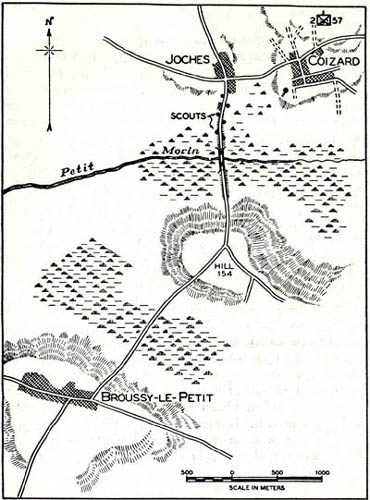
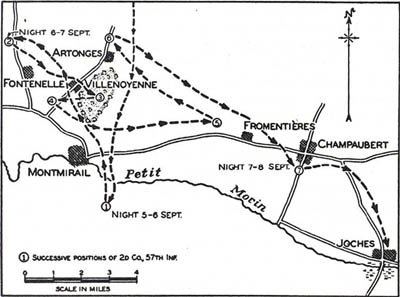
EXAMPLE 1. On September 8, 1914, the German 14th
Division, which had been in army reserve during the early stages of the
Battle of the Marne, was ordered to force a crossing of the wide swamp
south of Joches. This swamp, impassable even to foot troops, was
bridged by a single road. The French, located south of the swamp, could
fire with artillery and machine guns on both Joches and this road.
Marching from the north the 2d Company of the
57th Infantry (temporarily attached to the 53d Infantry reached the
north edge of Coizard at 8:00 a.m., and prepared for action while its
commander went forward to the southern outskirts of the village to
reconnoiter. From there he could see Joches, the formidable swamp and,
beyond the swamp, Hill 154 interlaced by hedges and dotted with sheaves
of grain. He could see that the French held this hill, for their red
pantaloons were clearly visible in the morning sun. There was no
firing; everything was quiet. Behind him he saw a few German batteries
moving up. At 9:00 a.m. he saw a group of German scouts leave Joches
and start forward to cross the swamp. The French immediately opened
fire on the village and the road with artillery, machine guns and
rifles. At this point the company commander was called to the rear
where he received the following battalion attack order:
The 2d Battalion of the 16th Infantry starts the
crossing of the Petit Morin River. The 53d Infantry will follow, with
the 2d Company of the 57th Infantry at the head. The objective is the
village of Broussy-le-Petit.
That was all.
The attacking infantry knew neither the
enemy's strength nor the location of his front line. They were not told
whether or not their attack would be supported by artillery. They had
no idea what units would be on their flanks. They only knew that they
had to attack and would meet the French somewhere beyond the swamp.
From the personal experience
monograph of Captain Adolf von Schell of the German General Staff, who
commanded the 2d Company of the 57th Infantry.
DISCUSSION. This example is typical of attack
orders that infantry companies may expect in open warfare. Leaders had
to be guided by their mission, by the ground in front and by what they
could see. Indeed, Captain von Schell emphasizes the fact that the
order quoted was the only one he received during the entire day.
In peace these highly-trained troops had been
accustomed to orders arranged in a certain set sequence and to
elaborate information of the enemy. But when war came there were only
fragmentary orders and little or no information of the enemy. To quote
Captain von Schell:
"In open warfare on the Western Front
and on the Eastern Front, in Rumania and in the Caucasus, it was always
my experience that we had the most meager information of the enemy at
the start of an attack."
Example 2-A
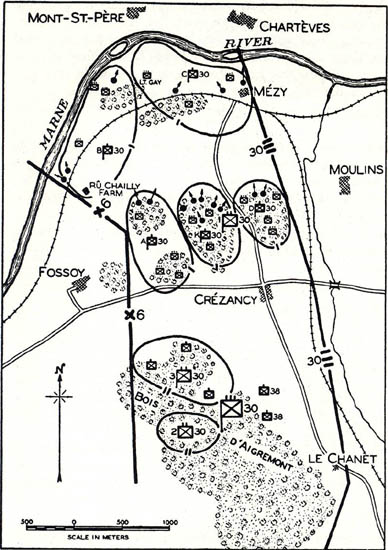
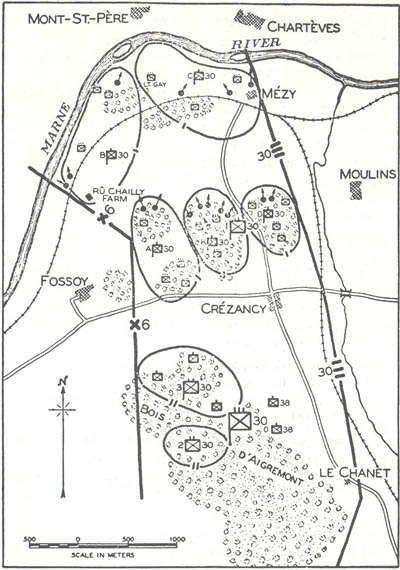
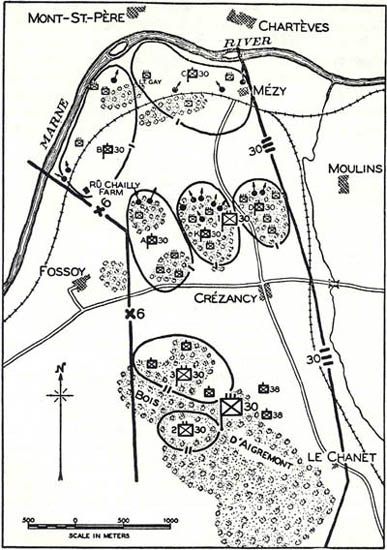
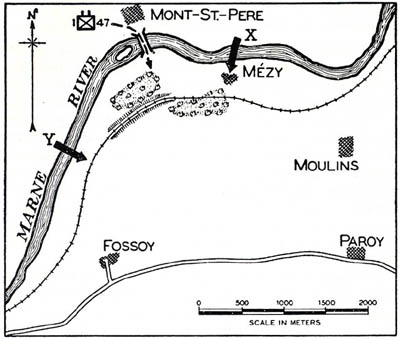
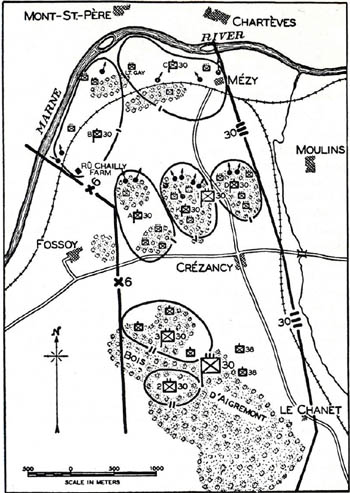
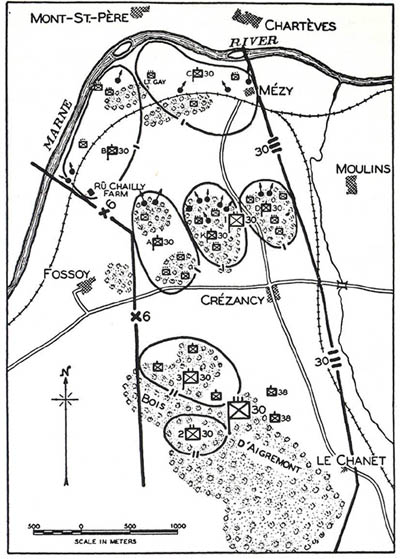
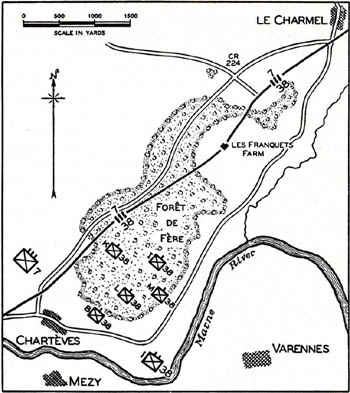
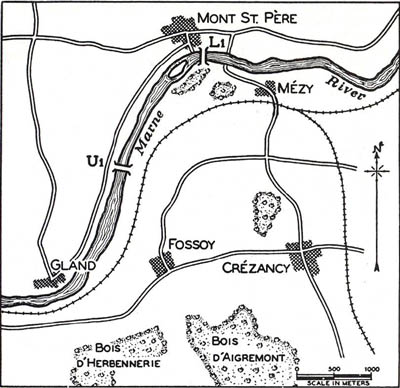
EXAMPLE 2-A. On July 14, 1918, the U. S. 30th Infantry
held a defensive sub-sector south of the Marne, with its command post
in the Bois d'Aigremont. The 1st Battalion, reinforced by an additional
rifle company (K), Stokes mortars and machine guns, defended the area
north of the Fossoy-Crézancy Road. Companies B and C outposted the
river bank from Mézy to the Rû Chailly Farm. The rest of the regiment,
with two companies of the 38th Infantry attached, had organized the
Bois d'Aigremont in depth.
Communication agencies between the 1st
Battalion and the regiment included two independent telephone lines,
one buzzer, one TPS (earth telegraphy), a projector, pigeons and
runners.
About midnight on the 14th, American
artillery opened a violent bombardment. A few minutes later German
shells began to burst in the Americas. area. The cannonade increased in
violence.
Soon after the German bombardment had gotten
under way, it was realized at headquarters of the 1st Battalion that
the longexpected German attack had at last jumped off. Signal equipment
was tested and found useless. A rocket was sent up calling for
artillery fire on the north bank of the Marne. Since it was impossible
to tell whether the American artillery was firing there or not, other
rockets were sent up from time to time. Runners were sent to Companies
A, K, and D, informing them that the expected attack was in progress
and directing them to hold their positions.
About 2:10 a.m. an excited runner from
Company C arrived at the battalion command post. He reported that at
the time he left Mêzy the Germans in the town greatly outnumbered the
Americans there. He also said that he had passed many of the enemy
between Mêzy and the battalion C.P. He appeared very calm after a time
and was positive that the information he had given was correct.
A few minutes later another runner arrived,
this time from Company B. He stated that the Germans had crossed the
river opposite the Rû Chailly Farm, had destroyed two platoons of
Company B, and that his company commander requested reinforcements. The
folly of attempting to move troops through the woods in darkness and
under intense artillery fire was realized, and accordingly no movement
to reinforce Company B was ordered.
A messenger from Company A now reported that all the officers in his company had been killed.
Runners sent out from the battalion C.P. for information never returned.
At daylight four officers' patrols were sent
out. One of these, commanded by a battalion intelligence officer,
returned shortly and reported that a hostile skirmish line was only
fifty yards in front of the woods.
In view of these alarming reports the
battalion commander decided to move his C.P. about 500 yards to the
rear in a ravine west of Crézancy. He believed that this location would
facilitate control, give a better line on the action, and be more
accessible to runners. Messengers were sent to Companies A, K, and D,
informing them of the change. The commander of Company D construed this
message to mean that the battalion was withdrawing. Accordingly he
withdrew his company to the Bois d'Aigremont via Crézancy. The
battalion commander was unaware of this movement at the time.
At this point a message was received from the
regimental commander asking for a report on the situation. From the
context it was clear that he had not received any of the messages that
had been sent back during the previous five hours.
From the personal experience monograph of Major Fred L. Walker, who com. mantled the lit Battalion of the 30th Infantry.
DISCUSSION. Although the battle had been in
progress only a few hours, the battalion commander knew neither the
location of his own front line nor that of the enemy. In fact, he did
not even know if his two forward companies were still in existence. He
was unaware of the situation of the units on his flanksif they were
holding or if they had been withdrawn. He had to judge the situation by
surmise, and part of that surmise was incorrect.
Example 2-B
EXAMPLE 2-B. Let us now consider the situation at
regimental headquarters during this same action. Hour after hour
passed, but no word came in from front, flanks, or rear; only reports
from nearby units in the Bois d'Aigremont that they were suffering
heavy casualties. All means of communication within the regiment had
failed soon after the bombardment began. Messages were sent to the rear
reporting the situation. Runners sent forward did not return.
Throughout the night the regimental commander
and his staff sat about a table in the C.P. dugout, studying a map by
the uncertain light of one dim candle. This candle was periodically
extinguished by the concussion of bursting shells. The roar of
artillery made conversation difficult.
At daylight the regimental commander made a
personal reconnaissance. Shells were falling everywhere within the area
between the Fossoy-Crézancy Road and the Bois d'Aigremont, but except
for this he saw no signs of activity.
He returned to the C.P. and there he found
that a message had come in from the front line indicating that the
Germans had crossed the Marne at two or three places. Apparently it had
taken hours to get this information back.
At 5:00 a.m. a runner from the 1st Battalion brought in the following message:
In five hours the regimental commander had learned
practically nothing of the situation. The American artillery kept
pressing him for targets, but he could designate none. He had no idea
where his own troops were or where the enemy was. All he could do was
send out more runners in an endeavor to determine the situation; and
this he did.
Shortly after 5:00 a.m. an officer came to
the C.P. with the report that one of his men had talked to a man from
Company C who said that some of his company had been driven out of
Mézy. A few minutes later an officer reported in from 1st Battalion
headquarters. He stated that the battalion commander had been unable to
get any direct news from his forward-company commanders since 2:30
a.m.; that the woods just north of the Fossoy-Crézancy Road had been
torn to pieces by shellfire, and that casualties in the headquarters
personnel were heavy. Companies A, K, and D had not been engaged. The
battalion commander was certain, from what some stragglers had said,
that the Germans had crossed the river near Mézy and the Rû Chailly
Farm, had passed the railroad and were moving south.
Some time after this the commander of the Ist
Battalion reported in person to the regimental command post. He said
that his two forward companies (B and C) were totally lost; that every
unit of his command had sustained heavy losses; that communication,
even with companies nearby, was extremely difficult; and that he had
moved his command post slightly to the rear. He then recommended that
the artillery, which had prepared defensive concentrations within the
position, place fire south of the railroad. He added that the remnants
of Companies A, K, and D should be able to hold out a while longer.
A little later another officer came in. He
had a message for the regimental commander-"a message from brigade," he
said. The colonel reached for it expectantly. Here, at last, would be
some definite news-the location of the hostile front line, the enemy's
assembly areas, the location of the German boats and bridges. Brigade
probably had it from the aviators. He opened the message and read:
From "The Keypoint of the Marne and its
Defense by the 30th Infantry," by Colonel Edmund L. Butts, who
commanded the 30th Infantry.
DISCUSSION. Here is an instance where the
regimental commander knew even less of the situation than the commander
of his front-line battalion. Not until the battalion commander went in
person to the regimental command post did the colonel have even a
glimmering of the situation, and then much vital information was
lacking and much was in error. For example, the regimental commander
was informed that the two frontline companies were "totally lost."
Actually, as we shall see, this was completely erroneous. Some elements
of these companies were still very positively in the war. In fact, at
about the time the colonel was receiving this disheartening report, two
platoons of one of his front-line companies, aided by machine guns,
were breaking a German attack by the effective expedient of practically
annihilating the battalion making it.
The incident of the message from brigade to
regiment, received at the height of battle, and seven hours en route,
is most instructive.
Example 2-C
EXAMPLE 2-C. Lieutenant James H. Gay commanded a
platoon of Company C of the U. S. 30th Infantry, posted near the river
bank opposite Mont-St.-Père. His command had not suffered a great deal
from the German bombardment, but communication had been out with all
units except one platoon located about 300 yards to his rear. "At
dawn," states Lieutenant Gay, "I knew absolutely nothing of what it was
all about or what was happening except in my own little sector."
About 4:30 a.m. some Germans approached from
the front and after a fight lasting several hours were beaten off by
Lieutenant Gay's platoon. Around 9:00 a.m. a lull ensued.
Communications were still out. Lieutenant Gay's idea of the situation
is given in his own words:
"I thought the whole action had been
merely a good-sized raid which had been repulsed. There was absolutely
no further movement in our range of vision and I did not know of the
events which were occurring elsewhere at the time."
Shortly after 9:00 a.m., Lieutenant Gay saw
Germans to his. right-rear and to his left-rear. At this point American
artillery fire carne down on his unit. He decided to move back and join
the platoon in his rear. When this was accomplished the two platoon
leaders met and, after discussing the situation, agreed to move their
combined units back toward the company C.P. En route they stumbled into
two parties of Germans and took 150 prisoners. Having so many prisoners
and finding that the company command post was occupied by the enemy,
they decided to move on to the battalion C.P. On the way they passed
another command post. It was deserted. They reached the old location of
the battalion C.P. only to find it had been movedno one knew where.
Lieutenant Gay then marched the two platoons
and his 150 prisoners directly down the Crézancy-le Chanet Road.
Although the column must have been highly visible, not a shot was fired
at it. He finally reached American troops, turned over his prisoners
and later rejoined his battalion.
Taken from a statement of Lieutenant Jame H. Gay, who commanded the 2d Platoon of Company C, 30th Infantry.
DISCUSSION. In the midst of one of the
decisive battles of the World War, Lieutenant Gay diagnosed the
situation as a good-sized raid. In a general engagement, leaders of
small units will seldom know much more than this lieutenant. Their
conception of the situation is invariably distorted.
In this action we have seen the meager
information possessed by a regimental commander, by the commander of a
forward battalion, and by the leader of a front-line platoon. What
information they did receive arrived hours after the events had
occurred, and was indefinite and often negative. A comparison of this
with the extremely definite information usually provided in map
problems is striking. Officers who expect anything approaching such
precision in actual combat are headed for a bitter surprise.
Owing to the extreme violence of the German
bombardment, communication in this battle was undoubtedly more
difficult than usual. But on the other hand, this was a defensive
action for the Americans; they were operating over familiar terrain,
and their communication agencies were installed at the start of the
fight.
Example 3
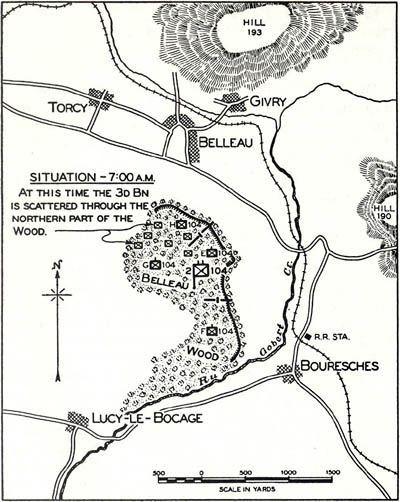
EXAMPLE 3. On July 17, 1918, the 2d Battalion of the
U. S. 104th Infantry, which was then holding a position in Belleau
Wood, received word that it would be relieved that night. Later, a
message came in directing the battalion scout officer to report to
regimental headquarters. Following this, another message arrived
ordering the captain of Company E to report to the brigade. Neither of
these officers returned. Preparations for the relief went on, but as
hour after hour passed and no reconnaissance parties arrived, the
battalion commander became concerned. At midnight he called the
regimental command post but could locate no one except the supply
officer, of whom he inquired:
"What about this Field Order No. so-and-so
{the order for the relief]? There haven't bpen any friendly visitors up
here." The reply killed any idea of an early relief.
"Well, there isn't anybody around here, but I can safely tell you that it is all off."
At 3:30 a.m. the missing scout officer
returned with word that the 3d Battalion would pass through the 2d and
attack at 4:35 a.m.
Time passed. No one appeared. At 4:15 a.m.
the 3d Battalion commander arrived alone with his hands full of charts
and orders. He was visibly agitated. After complaining about "a
horrible tie-up on the part of the higher-ups" he briefly explained the
contemplated plan. This attack, which was to be launched from the north
edge of the wood and drive toward the little town of Belleau, was
believed to be merely a local operation for the purpose of rectifying
the lines.
In due course the American barrage came down
and at 4:35 a.m. began to roll forward. Not until then did elements of
the 3d Battalion's assault companies begin to arrive. A heavy enemy
artillery concentration began to fall on Belleau Wood.
The 3d Battalion commander, seeing that his
troops had arrived late and were somewhat disorganized by hostile
artillery fire, now declared his attack off, and directed his officers
to have the men take what cover they could find in the woods. He then
sent the following message by pigeon to brigade headquarters:
Meanwhile, the 2d Battalion commander had started for
his C.P. En route he saw scattered men of the 3d Battalion frantically
digging. When he reached his C.P. he was told that the regimental
commander wished to speak to him. He heard the colonel's voice:
"The 3d Battalion has not attacked." "I know it."
"Well, you take command of it and attack at once."
"It can't be done," the stupefied major replied. "They are scattered all over the world."
"Well, it has to be done. This order comes
from higher authority. However, I'll give you a little time. What time
is it by your watch?"
"7:05 a.m."
"All right, I'll give you until 7:30 and a rolling barrage. Go to it!"
Then the wire went out and ended the conversation.
The commander of the 2d Battalion took charge.
At 8:20 a.m. he managed to launch the attack that should have started
at 4:35 a.m. Although the 7:30 barrage had passed, the attack at 8:20
a.m., in which he employed some elements of his own battalion, was
reasonably successful.
From the personal experience monograph of Major Evan E. Lewis, who commanded the 2d Battalion of the 104th Infantry.
DISCUSSION. Here we see two battalion
commanders participating in the Aisne-Marne Offensive, the attack in
which the initiative on the Western Front finally and definitely passed
to the Allies. Both officers believed it to be a local action to
rectify the line!
We see the commander of the 2d Battalion
suddenly confronted with a surprise situation-an order to take command
of another battalion, whose men were scattered, whose units were
disorganized, and to attack with it in twenty-five minutes. This
officer had not been thinking about the problem of the 3d Battalion. He
knew neither the location of its units nor the whereabouts of its
officers, and yet immediate action was mandatory.
Hundreds of examples can be given; those
cited are not isolated cases. Consider the experiences of the French
Third and Fourth Armies and the German Fourth Army. On August 22, 1914,
these huge forces clashed in a series of true meeting engagements. The
French army commanders, in particular, did not believe that any
appreciable force of the enemy was anywhere near.
On the morning of the 22d a battalion of the
French 8th Division (part of the Third Army, detailed as the support of
the advance guard, was destroyed within its own outpost lines, without higher authority knowing anything about it at the time .
Even today it is difficult to say what actually happened. Apparently it
was surprised in route column by Germans who had penetrated the French
outpost in the early morning fog.
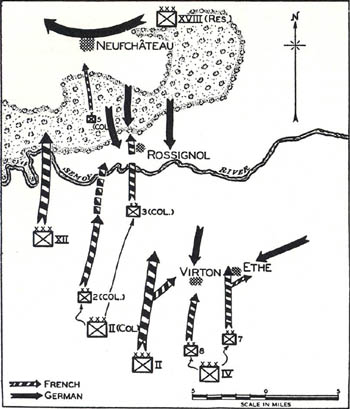
On the same day, a few miles to the west, the
French 5th Colonial Brigade, marching north, stumbled into the flank of
the German XVIII Reserve Corps, which was marching west. The battle
started with the French advance guard striking the German column at
right angles and shooting up the combat trains of part of one division.
Near St. Vincent, on this same eventful day,
the commander of the French II Colonial Corps informed one of his
division commanders, "There is nothing in front of you. You can push
right on. It's just a march today." Soon afterward he and his staff
became the private and personal target of German light artillery and
scrambled to cover. When asked for information he replied, "I haven't
the faintest idea of the situation."
In the Battle of Guise, on August 29, 1914,
initial contact on the front of the German Guard Corps seems to have
been made by the corps signal battalion which, through error, marched
into the enemy lines.
Indeed, there appears to be no limit, save
the imagination, to the astounding situations that evolve in the
darkness and confusion of war. Consider the Turkish pursuit of the
British in 1915, after the Battle of Ctesiphon. The Turkish cavalry was
sending in reports of the location and movements of the retiring
British. The Turkish infantry was pressing forward to gain contact with
the British. According to the British official history the Turkish
cavalry was actually in rear of the Turkish infantry without the
infantry, cavalry, or high commanders being aware of the fact. The
movements attributed to the British were presumably the Turkish
cavalry's observation of its own infantry.
CONCLUSION. Again it is stressed that these
examples afford a striking contrast to the detailed and precise
information that is given in map problems. In actual combat practically
nothing is known. The situation, particularly in open warfare, is
almost invariably shrouded in obscurity. Advanced units, at best, will
have but little accurate knowledge of the enemy and frequently none of
their own troops. Moreover, even the meager information they do possess
will often be false or misleading.
But this does not mean that leaders must
meekly submit to the proposition that war is likely to be a game of
Blind Man's Buff and that nothing they can do will alter this
condition. On the contrary, this realization of the dearth of reliable
information in war should serve a dual purpose. First, it should
stimulate leaders to adopt those positive and energetic measures that
are necessary if vital information is to be gained. Secondly, it should
so prepare the leader mentally that, instead of letting himself sink
into the bog of apathy when no information is forthcoming, he will
recognize the condition as normal and rise to prompt and decisive
action.
We carry out in war what we learn in peace.
In consonance with this principle the military student, after becoming
familiar with the basic tactical concepts, should be given but little
positive information of the enemy in his various terrain exercises, map
problems and map maneuvers. Thus will he become conversant in peace
with one of the most trying and difficult problems in war.
Whether we like it or not, combat means confusion,
intermingled units, loss of direction, late orders, misleading
information, unforeseen contingencies of all sorts. Troops must often
carry out their orders under conditions of extreme fatigue and hunger,
in unfavorable weather and almost always under the devastating
psychological and physical effect of the fire of modern weapons. Not to
take into account these grim realities in formulating a plan of action
is fatal.
But even when they are taken into account the
leader often faces a cruel dilemma. For instance, the situation may
call for an involved maneuver, and an involved maneuver increases the
chance of disastrous error. On the other band, a simple maneuver,
though decreasing the likelihood of serious error, may fail to meet the
situation. Therefore, it is fallacy to preach simplicity as -a battle
cure-all. But it is not fallacy to say that simplicity in plans,
methods, and orders should always be striven for and that elaborate and
complicated maneuvers should not be adopted except for the gravest
reasons.
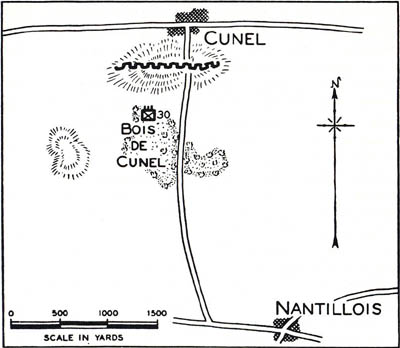
Example 1.
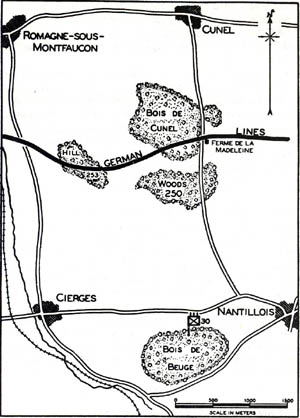
EXAMPLE 1. On the morning of October 10, 1919, the U.
S. 30th Infantry was ordered to attack to the north toward the little
town of Cunel. Following an artillery preparation, the 1st Battalion
was to attack from the north edge of the Bois de Cunel. Of the two
remaining battalions of the 30th, the 2d was in support and the 3d in
brigade reserve.
The attack jumped off at 7:00 a.m. The 1st
Battalion reached a point about 500 yards north of the wood where it
was stopped by heavy fire from the front and both flanks. The men
sought holes in the ground for cover. The hostile fire was so heavy and
covered the area so thoroughly that movement in any direction appeared
suicidal. Therefore, this battalion remained where it was until dark.
The 2d Battalion had not left the wood.
Meanwhile, an order came in from the division
commander directing that the trenches in the 30th Infantry zone, north
of the Bois de Cunel, be taken at once. To carry out this mission the
following plan was adopted:
The 1st Battalion would withdraw under cover
of darkness to the Bois de Cunel, where it would reorganize. At 7:30
p.m., after an artillery preparation had been fired on the trench, the
battalion would again attack, closely following a barrage. The 2d
Battalion would follow in support.
At dark the 1st Battalion fell back to the
wood and began to reorganize for the new attack. This proved extremely
difficult. In the darkness the withdrawing units lost direction and
became intermingled. No vestige of control remained. To crown the
battalion's difficulties, German artillery lashed the little wood with
violent and tireless energy.
H-hour approached, and the American
preliminary bombardment began, while the battalion commander still
struggled to gather the remnants of his command and to bring some
semblance of order out of the confusion that existed.
H-hour arrived and passed, but the battalion was still so disorganized that no troops moved forward at the designated time.
At 10:00 p.m. the 2d Battalion, which had not
been committed during the day and which was completely in hand, made a
surprise attack and captured the German position.
From the personal experience monograph of Major Turner M. Chambliss, who commanded the 2d Battalion of the 30th Infantry.
DISCUSSION. The plan of attack for the 7:30
p.m. operation can be explained simply and briefly. But although the
words are few, simple, and readily understood, the operation that they
dictated was far removed from simplicity.
A battalion that had been pinned down under
hostile fire all day was required to withdraw under fire, reorganize in
a wood in the darkness, and then resume the attack.
The withdrawal was difficult and had to be
made by individual movement. Movement in the dark for 500 yards, across
a shell-pitted, fire-swept zone, is not a simple operation for a
battalion, which at the start is deployed in lines of skirmishers;
neither is a night reorganization in a wood that is being shelled by
the enemy.
The simple and effective solution would have been to attack with the 2d Battalion at 7:30 p.m.
Example 2
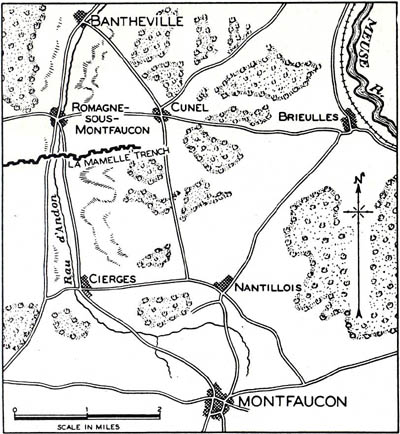
EXAMPLE 2. On October 3, 1918, the U. S. 5th Brigade,
with the 4th Infantry on the right and the 7th Infantry on the left,
occupied the zone of the 3d Division. Each regiment was disposed in
column of battalions. In the 4th Infantry the 1st Battalion held the
front line with Company B on Hill 274 and Company A along the
Cierges-Nantillois Road, with patrols in Wood 268. The remaining
companies of the battalion were located in rear of Companies A and B.
In the 7th Infantry, the 2d Battalion
occupied the northern part of the Bois de Beuge with two companies in
the front line and two in support. These companies were all partially
deployed. The 1st Battalion of the 7th Infantry, with an attached
company of the 8th Machine-Gun Battalion, was located south of the Bois
de Beuge near a stream and a narrow-gauge railroad. This unit was well
in hand and more compactly grouped than the 2d Battalion. The brigade
had occupied approximately these same positions since the afternoon of
September 30. It had been expecting to attack to the north.
Orders were finally received directing that
the attack be launched at 5:25 a.m., October 4. By this order the
boundaries of the 3d Division were moved a few hundred yards to the
west and the direction in which they ran was slightly altered. The new
right boundary of the division and of the 4th Infantry was the
Nantillois-Cunel Road while the new left boundary for the division and
the 7th Infantry was to the west of the CiergesRomagne Road. The
boundary between regiments approximately halved the zone. Therefore, in
order that the troops might face their objectives at the start of the
attack, both the 4th and 7th Infantry had to move to the west.
At 6:00 p.m., October 3, the regimental
commander of the 7th Infantry issued an oral attack order at his C.P.
located south of the Bois de Beuge near the narrow-gauge railroad. It
was nearly dark at the time. This order directed the 2d Battalion,
which was then in the front line in the Bois de Beuge, to sideslip to
the left and be prepared to lead the attack the following morning. The
1st Battalion of the 7th Infantry was also directed to move to the left
and, in the morning attack, to follow the 2d Battalion in support at
500 yards.
Although the 1st Battalion commander
suggested that it would be simpler for his unit to be employed in
assault, since its movement into the new zone would be easier, the
order was not changed. This battalion completed its movement
successfully. A road, a stream, and a narrow-gauge railroad all
provided guiding features leading from the vicinity of its former
position to the new location.
Arriving at its new position, the 1st
Battalion was unable to locate the 2d. When the hour for the attack
came the 1st Battalion moved forward with two companies leading and two
following. Near Cierges a portion of the 8th Machine-Gun Battalion was
encountered. Its commander requested information as to the location of
the 2d Battalion. About this time Company G of the missing battalion
was seen moving forward. The company commander, however, had not been
in touch with the remainder of the battalion for a long time and had no
idea where it was. He attached himself to the 1st Battalion.
The 1st Battalion commander now reported to
the regiment that he was unable to locate the 2d Battalion; that in
pushing forward in the regimental zone his unit had come under fire and
that, therefore, he was advancing it to the attack as assault
battalion. This attack moved forward from the line of departure later
than had been intended and, as a result, met with little success.
The 2d Battalion, in attempting to sideslip
to the left during the night, had become so badly scattered that, as a
unit, it was rendered ineffective on October 4.
Let us now turn to the 4th Infantry. In this
regiment the assault battalion, the 1st, was similarly ordered to
sideslip to the left in the dark. It successfully accomplished this
movement.
Part of the battalion order, issued at 11:00
p.m., October 3, which referred to the movement of Company B, then on
Hill 274, was in substance as follows:
Company B will be relieved by units
of the 80th Division. It will not wait for them but will withdraw at
once and move into Company A's present position.
The company commander returned to his unit
and issued his order about 1:00 a.m. The 1st and 2d Platoons were in
the front line and the 3d and 4th were in support. The company
commander ordered the two front-line platoons to withdraw due south
until they reached the southern slope of Hill 274 and there assemble in
columns of twos. He ordered the 4th Platoon (on the left to move to the
Nantillois-Cunel Road (near its location at the time, form in column of
twos and then move south until it reached the Nantillois-Cierges Road;
there it would wait for the company commander. He ordered the 3d
Platoon to move to the left and follow the 4th in column of twos. The
2d and 1st Platoons, in order, were directed to follow the 3d. All
platoon leaders were cautioned to have their men observe the utmost
secrecy.
After all platoons had started, the company
commander went to the head of the column. When the road junction was
reached he directed the 4th and 3d Platoons to march to the west along
the Nantillois-Cierges Road. When the last man had cleared the road
junction these two platoons were halted, deployed in squad columns and
marched to the south for 300 yards. Here they were again halted and
faced to the front. The assault platoons, the 1st and 2d, similarly
marched along the road, halted, and deployed in rear of it. Thus, by
utilization of distinct terrain features and by care in making the
movement, this company was enabled to deploy in the dark, in its proper
zone, after a flank movement along the line of departure.
About 4:00 a.m. it reported that it was in
position. Company A, the other assault company of the battalion, also
made the sideslip successfully.
However, after Company B left Hill 274 the
Germans moved forward and occupied it, thereby enfilading the attack
with machine-gun fire. Little success was obtained.
From the personal experience
monograph of Captain Fred During, who commanded Company B of the 4th
Infantry; and from a statement by Captain George S. Beatty, who was
adjutant of the lit Battalion of the 7th Infantry.
DISCUSSION. It is not a simple movement for
battalions to sideslip in the dark into positions with which they are
not familiar and then attack at daylight. The failure of the 3d
Division's attack on October 4 can be largely attributed to this
attempt to sideslip the two assault battalions.
In the 7th Infantry, the 2d Battalion became
scattered and lost, and the support battalion suddenly found itself in
the front line. It would have been far simpler to move the 1st
Battalion to the left-front and use it in assault. It was better
grouped initially; it did not have to make such an extreme movement to
the flank; and finally, there were distinct, unmistakable terrain
features that could be easily followed, even in darkness, to the new
location.
In the 4th Infantry the assault battalion
successfully completed its difficult movement by painstaking attention
to detail; but even so, the evil features inherent in that move made
themselves evident. Obviously the execution of such a complicated
maneuver required a considerable amount of time and therefore it could
not be postponed too long. This was undoubtedly the reason Company B
was directed to move at once, without waiting for the arrival of the
troops who were to relieve them. As a result, the Germans occupied Hill
274; and enfilade fire from the commanding ground played a major part
in breaking the attack on the morning of October 4.
Attempts to execute complicated maneuvers in combat have both direct and indirect evils. They almost never succeed.
Example 3
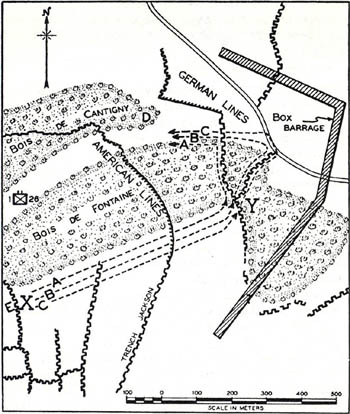
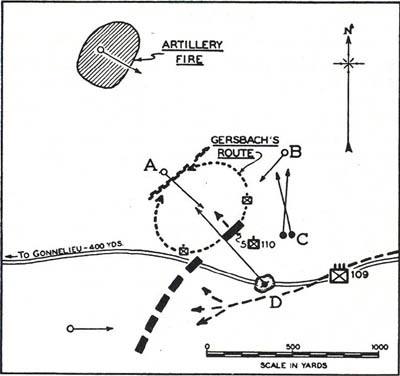
EXAMPLE 3. On June 29, 1918, Company D, U. S. 26th
Infantry, carried out a raid on German positions near Cantigny. The
hour set for the action was 3:15 a.m., at which time there was just
enough light to see. Part of the order for this raid follows:
FIELD ORDERS No. 10
INFORMATION The enemy is occupying the woods to our front with one battalion, something in the manner indicated in the attached sketch.
INTENTION On J Day at H Hour, we will raid the Wood, entering the
woods at the angle 22.8-30.4 (point Y on sketch), and kill or capture
the occupants of the trenches running north and northeast as far as the
northern edge of the woods, returning from there by the northern edge
of the BOIS DE FONTAINE.
ALLOTMENT OF UNITS The raiding party will be composed of personnel of Company D, 1st Lieutenant Wesley Freml, Jr., officer commanding raid.
(1) Lieut. Dillon -1 Sgt. -2 Cpls. -12 Pvts. -A Party
(2) Lieut. Dabney -1 Sgt. -2 Cpls. -12 Pvts. -B Party
(3) Lieut. Ridgley -1 Sgt. -2 Cpls. -12 Pvts. -C Party
(4) Lieut. Tillman -1 Sgt. -2 Cpls. -12 Pvts. -D Party
(5) Lieut. Freml (O.C.) -2 Sgts. -3 Cpls. -18 Pvts. -E Party
(2 stretchers and 4 stretcher-bearers.)
When he has assured himself that the party has withdrawn
to within our own lines, the officer commanding the raid will fire
three (3) star RED rockets-this will signify to all concerned that the
raid is completed.
On commencing artillery bombardment, A, B, C and E
Parties, preserving their general alignment, will advance as dose as
possible to the woods.
A, B and C Parties, in the order named from
left to right, will advance directly into the woods. If opposition is
encountered, B Party will hold with covering fire from the front, and A
and C Parties will advance by the flanks, outflanking the resistance.
On entering the woods, A Party will split off
to the left branch of the trench to the north edge of the wood,
capturing or killing all occupants and from that point it will return.
B and C Parties will continue down trench
running to the northeast, outflanking tactics being employed when
necessary. On reaching north edge of the woods, they will function the
same as A Party.
E Party will follow in rear. It shall be its
particular function to guard the right flank and reinforce the
assaultirg parties when necessary.
D Party will remain in observation in its
original position, ready to engage with fire any machine guns that may
open from the slope of the ridge or northeast of the woods. It will
retire on completion of the raid.
THEODORE ROOSEVELT, JR.
Major (USR), 26th Infantry
Commanding
Information and instructions as to fire support,
dress and equipment, and many other details were included. The assault
parties were directed to move forward during a ten-minute preparation
by artillery and Stokes mortars. A box barrage would then be formed,
while the infantry rushed the position. The plan called only for those
supporting fires normally available in the sector. The position and
routes followed by the assault parties are indicated on the sketch.
The raid was carried out as planned.
Thirty-three prisoners were taken, including one officer, five
noncommissioned officers, two artillery observers and two or three
machine gunners. Several sacks of papers and other intelligence data
were secured. The American casualties were one officer and one soldier
killed and four soldiers wounded.
From records of the U. S. 1st Division.
DISCUSSION. We have previously examined a plan
that was briefly and simply stated but that nevertheless was the
antithesis of simplicity when it came to execution. Here we have a plan
that appears complicated. It requires some time and thought to
understand, and yet simplicity is its underlying feature. It is
obvious, then, that simplicity in tactics is not necessarily equivalent
to simplicity in words.
Let us examine this plan. In the first place,
the order was published several days before the raid, thereby giving
all concerned ample time to digest it and to make the necessary
preparations.
The work planned for the artillery, machine
guns, and Stokes mortars was simple. They were directed to do some
shooting on a time schedule. That was all.
It is with the assault parties, however, that
we are chiefly concerned. Note that the southern edge of the Bois de
Fontaine parallels the route of advance of these parties. To maintain
direction to their objective, each group had only to follow this edge
of the wood. Arriving at the hostile position the left party turned to
the left (north) following the German front-line trench until it
reached the north edge of the Bois de Fontaine which it then followed
back to the American lines. The two right groups moved along the trench
that runs to the northeast until they, too, reached the north edge of
this wood which they followed back to their own position. All three
parties had clear-cut features to guide them and each route formed a
circuit.
Thus we see that the tasks for the individual
groups were not difficult to carry out on the ground. The chances for
possible mishaps were greatly reduced by the care taken in selecting
these guiding features for the parties to follow. Their mission was
clear and simple. The action of Party A did not hinge on that of Party
B. The plan did not depend on any delicate calculation of time and
space. It was simple and it proved effective.
Example 4
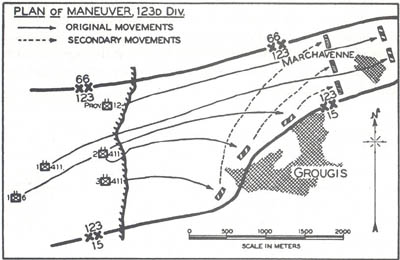
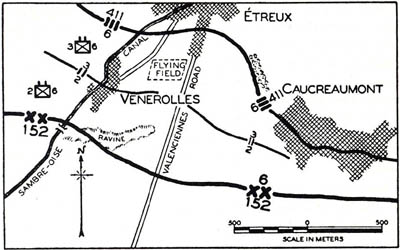
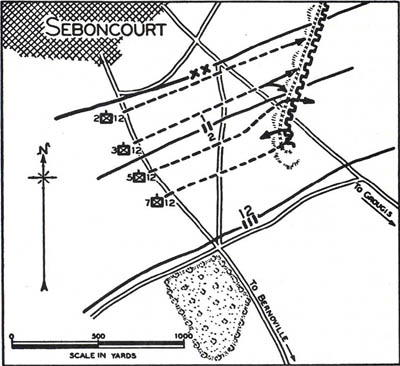
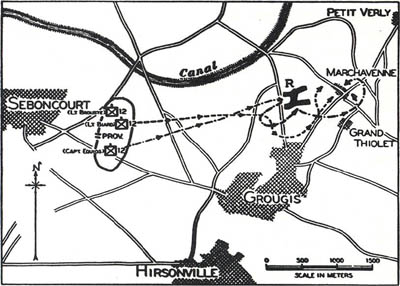
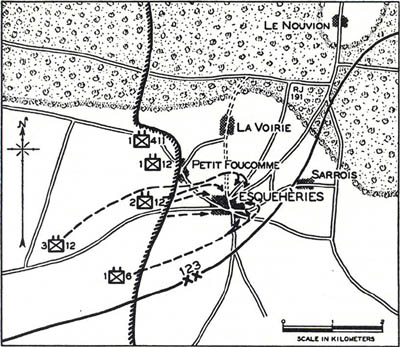
EXAMPLE 4. On October 17, 1918, the French 123d
Division attacked northeastward toward Grougis and Marchavenne. The
scheme of maneuver follows:
Three battalions were employed initially in
assault. On the left, a provisional battalion of the 12th Infantry (2d
and 3d Battalions combined because of losses had the mission of
maintaining contact with the 66th Division to the north. This was
considered particularly important. The 2d and 3d Battalions of the
411th Infantry, with a company of tanks attached, were on the right of
this provisional battalion. These two battalions were ordered to move
forward and establish themselves facing Grougis.
The 1st Battalion of the 411th, in second
line, was directed to follow behind the interval between the 12th
Infantry unit and the 2d Battalion of the 411th Infantry, and then,
after the two right assault battalions had established themselves
facing Grougis, push ahead and take Marchavenne. The 1st Battalion of
the 6th Infantry was ordered to follow the 1st Battalion of the 411th
Infantry initially and protect its right flank, finally taking position
on the left of the 2d Battalion of the 411th Infantry, facing the
northwest portion of Grougis.
The 2d and 3d Battalions of the 411th
Infantry and the 1st Battalion of the 6th Infantry, having established
themselves as a flank guard to the south, were to push forward to
Marchavenne when successively liberated by the advance of the 15th
Division on the south. Thereafter they would assist the attack of the
66th Division on the north.
The remainder of the 123d Division's
infantry, which was holding the line of departure, was ordered to
reform and become the division reserve. Artillery fires were to lift on
a carefully arranged time schedule. Marchavenne was to be taken in one
hour and thirty minutes after the jump-off by a battalion which, at the
start of the attack, was some 4,500 yards away.
Marchavenne was captured practically on time, by an attack from the south
and southeast-carried out by the provisional battalion of the 12th
Infantry which was to guard the north flank of the division . This
battalion lost contact with the 66th Division and got ahead of the
troops on the right. Its two assault companies crossed each other's
path and the bulk of the battalion, advancing rapidly, crossed the
entire divisional zone diagonally. It found cover just north of Grougis
(which was still held by the enemy and took Marchavenne by an
envelopment from the south and east about 7:45 a.m.
The battalion that had been ordered to take
the town was still more than a mile to the rear, slowly advancing. It
arrived at Marchavenne long after the town had fallen, but in time to
help hold it against a counter-attack. These two battalions in
Marchavenne held an isolated position for several hours.
The assault battalions of the 411th Infantry
and the 1st Battalion of the 6th Infantry met with some success, but
after reaching Grougis they were unable to go farther. At 5:00 p.m.
they were still there, facing southeast. On this day, after the initial
capture of Marchavenne, which could not be exploited, the division had
no success. During the early part of the attack the provisional
battalion of the 12th Infantry captured ten cannon and 300 prisoners.
From an article by Major P. Janet, French Army, in "La Revue d'Infanterie;" December, 1926.
DISCUSSION. Here is a complex plan of attack
devised by officers of long experience in the war, which was to be
carried out by veterans. The original assault battalions were to fan
out and form flank protection while a second-line battalion, advancing
through the interval, was to take the objective. The flank battalions
would then disengage successively, move on to the objective, and take
part in a renewal of the advance beyond Marchavenne. Furthermore, the
artillery support was arranged according to a carefully worked out time
schedule; it would be upset unless this delicate time-table worked with
mathematical precision.
True, the 123d Division achieved a modicum of
success in this attack, but it certainly cannot be attributed to the
plan. Nothing happened as expected. The assault battalions of the 411th
Infantry managed to make some advance, as did the 1st Battalion of the
6th Infantry, but all three became involved near Grougis and were there
the entire day. These were the troops that, according to the plan, were
to carry the attack beyond Marchavenne.
The complicated maneuver of attacking to the
front, then facing to the right, then disengaging, then pushing forward
again, was too much even for these veteran troops. It could not be
carried out at all, let alone according to the carefully prepared
time-table.
It is interesting to note that the battalion,
which had been directed merely to maintain contact on the north flank,
crossed to the south boundary of the division and took the objective by
an envelopment from the south and east. It was to the aggressiveness of
this battalion that the division owed such success as was achieved. It
appears that the inability to exploit the rapid capture of Marchavenne
was due principally to the complicated and involved plan of attack.
Example 5.
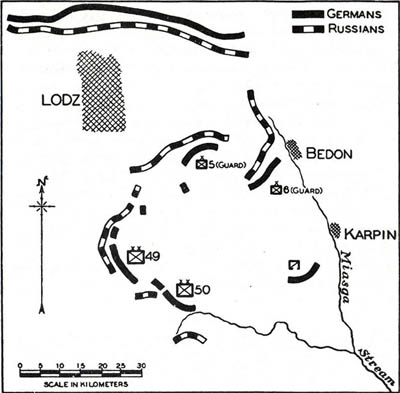
EXAMPLE 5. On the morning of November 23, 1914, a
German force, located south and east of Lodz, in Poland, finding itself
surrounded by Russians, turned about and struck to the north in an
effort to break through the enemy and escape. The Germans, who had been
fighting for days, were at the point of exhaustion. Fresh Russian
columns were converging on them from all sides. The situation was
desperate.
The 3d Guard Division, part of the
beleaguered German force, spent the 23d attacking northward toward the
little town of Brzeziny, which it had passed through shortly before in
its advance to the south. All day the Guards drove forward through a
dense wood, against strong opposition. Russians appeared to be
everywhere-on both flanks and in rear.
At 4:00 p.m. the Guards reached the railroad
that runs through the wood south of Galkow, and here they were halted
and reorganized while their sixty-five-year-old commander, General von
Litzmann, took stock of the situation.
Along the railroad stood some 1,500 men, all
that was left of seven battalions of infantry. The division artillery,
under the protection of a handful of infantrymen, was still south of
the wood. Information of other German units and of the enemy was
virtually non-existent. Earlier in the day firing had been heard to the
east, but this had gradually died away. Late in the afternoon the
Russian resistance to the German advance had perceptibly weakened. But
the Guards were in a deplorable state. All units were terribly depleted
and hopelessly intermingled. The men were so exhausted that they could
scarcely be kept awake. Such was the situation that confronted this
remnant of a division as darkness and the bitter cold of a Polish
winter night closed in on November 23.
Soon after dark a corps order arrived. In a
stable filled with Russian wounded the division commander pulled a
small candle out of his pocket, lighted it, and examined the order. It
had been delayed in reaching the Guards. The instructions it bore
pertained only to operations for November 23, but it did make clear the
fact that the corps commander wanted them to reach Brzeziny on that
day.
Therefore, at 7:25 p.m. the division commander rapidly outlined the following plan:
This division captures Brzeziny
tonight. It will advance in column, with advance guard via Galkowek and
Maiczew, in silence, and gain the road running from the southwest
toward Brzeziny. It will develop when one kilometer in front of the
town and press into it by a surprise attack.
After the storming of Brzeziny,
baggage will be brought forward. Messengers will report to receive
orders at the marketplace in the building where division headquarters
was located before.
The advance guard and the order of march were designated, and a supplementary order was sent to the artillery.
The division commander marched with the
advance guard. The maneuver was successful. Brzeziny was stormed and
the staff of the VI Siberian Corps captured. The success of this action
materially aided the remainder of the German forces in smashing through
the hostile lines. The Russians, becoming discouraged, withdrew while
the German units, taking along thousands of prisoners and much
matériel, rejoined their main army.
From the Reichsarchiv account.
DISCUSSION. The Guards were in a situation as
difficult and desperate as can be imagined. They had no information of
the location of other German troops and no knowledge of the hostile
dispositions, except that the enemy seemed to be everywhere in superior
numbers. Their men were exhausted and their units depleted and
intermingled. They were in a dense forest; it was bitter cold, and
night was falling.
Under such conditions a master effort could
be made only by superior troops, commanded by determined leaders,
working under a simple plan. The division commander took these
considerations into account. His plan was based on the three essentials
for a night operation-direction, control, surprise.
Troops become easily lost in a night march,
particularly exhausted troops who are staggering forward in a daze.
Things must be made as simple as possible for them. The route
prescribed facilitated the maintenance of direction. First, movement
along the eastern edge of the wood to the north edge. From here
Galkowek could be reached with little danger of the column getting
lost. From Galkowek the march could continue straight to the north and
be certain of intercepting the road that led directly to Brzeziny.
To insure the utmost control the division
commander ordered that the advance be made in route column. It was no
time for half-measures. The men were completely exhausted, so much so
that unless they were directly under the eyes of their leaders, they
would lie down and go to sleep. An attempt to move in several columns
or in any extended formation would have meant disintegration and
certain failure.
To achieve the third essential, surprise, the order directed that the advance be made in secrecy and silence.
Finally, as a crowning bit of psychological
bravado, came the order for establishing the command post in the
marketplace of Brzeziny. A large dose of optimism was required by
officers and men, and their commander, with the deft touch of the true
leader, gave it to them. German accounts describe the thrill that ran
through the assembled German officers on hearing the resolute words of
their leader.
Here, one of the most complex, difficult, and
desperate situations which troops have ever been called upon to face
was met and solved by a simple order. In such a dilemma only the utmost
simplicity of plan and execution stood any chances of success.
CONCLUSION. In war the simplest way is usually the
best way. Direct, simple plans, clear, concise orders, formations that
facilitate control, and routes that are unmistakably defined will
smooth the way for subordinate elements, minimize the confusion of
combat and ordinarily increase the chances of success.
In brief, simplicity is the sword with which the capable leader may cut the Gordian knot of many a baffling situation.
All means-reserves, fire support, ammunition-are
concentrated for the decisive stroke. Economy of force at nondecisive
points and greater mobility permit the concentration of superior forces
at the decisive point. To make the main effort a real knockout blow,
economy of force elsewhere may have to be extreme.
To determine the location for his principal
effort, the leader seeks to discover the enemy's weakness. The flanks
and rear of an enemy being weak points, he will strike at these when
they can be reached. Often the ground itself will be the deciding
factor. By a careful study the leader will be able to determine those
parts of the terrain where the enemy cannot employ his weapons to
advantage. At the same time he should not lose sight of the fact that
the terrain should permit his own attack to be supported by artillery,
machine guns, and tanks. Thus, strength will strike weakness.
Having made his choice, the leader's
dispositions must correspond to his scheme of maneuver. The density of
deployment is greater where the main effort is to be made. Troops must
be available to assure continuity of the effort and to permit the
leader freedom of action to deal with the incidents of battle. All
available fire support is concentrated to assist the main effort.
The scheme of maneuver of small infantry
units is simple and does not look too far in the future. It is
concerned with the enemy resistance which is close; new decisions,
based on the new situation, must be made later. For example, when
confronted with a vague situation, or unsuitable terrain, it is
possible that no definite idea will stand out. In such a case, there
will be no true main effort at the start; it will be withheld. The
scheme of maneuver will simply be an advance in order to determine what
is in front, with the unit commander retaining control and freedom of
action. His dispositions will be such that he will be able to reserve
his main effort until the situation warrants the commitment of the bulk
of his force.
Example 1
EXAMPLE 1. On September 26, 1918, the U. S. 33d
Division attacked north in the opening phase of the Meuse-Argonne
offensive with the 66th Brigade in assault and the 65th Brigade in
reserve. In front of the division lay the dense Bois de Forges which
covered one side of a formidable height. Along the right of the
division sector ran the Meuse River, but since there was to be no
attack on the east side of the river the right flank would be wide open
to fire from that direction. With these facts in mind the division
planned its attack.
"The whole theory of the attack," said the
division order, "is by echelon with the left in advance." The 131st
Infantry, the left regiment of the 66th Brigade, would advance rapidly
to open ground east and north of Gercourt and Drillancourt in order to
assist the 132d Infantry in the capture of the Bois de Forges.
Accordingly, the barrage in front of the 131st would move forward
faster than that in front of the 132d. The 132d Infantry would strike
the Bois de Forges from the southwest. As the advance progressed the
attack of the 132d would gradually swing until it was headed almost due
east. The Bois de Forges would not be attacked from the south or the
southeast.
The 131st Infantry and 132d Infantry would,
at first, attack side by side, each with two battalions in assault. The
132d, however, would make a sharper turn to the right than the 131st;
the interval thus formed would be taken care of by reserves. The zone
of the 131st would be 2,000 meters wide, but it would actually follow a
rolling barrage about 800 yards wide.
Following an intense preparation, the attack
jumped off and drove forward with the support of an artillery and
machinegun barrage. The machine-gun barrage, which was directed against
the southern edge of the Bois de Forges, was particularly helpful in
that it fostered the idea of a non-existent attack from the south.
By 10:00 a.m. the two attacking regiments had
carried their objectives and captured 1,400 prisoners, at the cost of
only 250 casualties.
In his report of the operation the brigade commander stated:
The 132d Infantry, on a front of about
two kilometers, attacked the enemy positions in front of and in the
Bois de Forges from the southwest, and making a turning movement to the
east while in the woods, using the roads in the center of the woods as
a guide and a dividing line between battalions, came out at the
objective exactly as planned in the orders of the brigade at 10:00 a.m.
This maneuver struck the enemy's
works in the flank and rear, took them entirely by surprise and also
was responsible for the few casualties inflicted upon the troops.
The history of the division has this to say:
This entire engagement was
particularly interesting because of the fact that it was an action
planned and executed by a brigade as a unit. It was entirely successful
owing, first, to the courage and dash of our splendid troops, and,
second, because the plans had been carefully worked out and studied by
all concerned, and during the action these plans were followed with
marvelous exactness.
From "History of the 33d Division."
DISCUSSION. On this day the 66th Brigade took
about five prisoners for each casualty it suffered. Its two regiments
swept through the enemy and were on their objective in a few hours.
The brigade was an interior unit making an
attack against enemy positions to its front. But that did not keep it
from striking in an unexpected direction at enemy weakness-from having
a main effort. It did not spread troops all over its zone. It did not
smash up against the Bois de Forges as the Germans expected. In parts
of the zone no troops attacked at all. Any Germans between Forges and
the Bois de Forges were in a trap if the main attack went through, and
that attack did go through.
The 33d Division was not making the main
effort of the American attack; its mission was rather one of flank
protection. Here, then, we see a main effort within an attack which
itself is not a main effort.
The main effort is usually characterized by
the assignment of comparatively narrow zones of action, and by massing
many reserves behind and much fire in front of the attacking troops. In
this case we see a regiment with two assault battalions make a main
effort on a front of approximately 800 yards.
Example 2.
EXAMPLE 2. On October 11, 1918, the 1st Battalion of
the French 412th Infantry reached the Oise River. The Germans held the
east bank in strength, but owing to the general situation, it was
thought that they would probably withdraw. Therefore, in spite of the
fact that the French battalion occupied a front of three kilometers, it
was ordered to seize the crossings of the Oise and be prepared to
pursue the Germans.
All efforts to seize the crossings on the
11th and 12th having failed, a stronger attack was organized on the
13th. For this attack the three rifle companies and 12 machine guns of
the battalion were disposed to cover the four groups of crossings. Five
additional machine guns had been picked up during the previous advance
and these, too, were emplaced to fire on the disputed passages. A
Stokes mortar and a 37-mm. gun completed the picture.
The battalion had a very good idea of what it
was up against. It knew that the enemy had posted advanced groups along
the river to cover the crossings and that these groups were tied in by
patrols. It also knew that there was a continuous line of resistance on
the east bank of the canal, and that there were reserves and supporting
artillery at Senercy Farm, Sucrérie, and along the west edge of
Séry-les-Mézières.
The terrain in front of the battalion, though
flat, was covered with a rather lush vegetation which afforded a
certain amount of cover. The river, fifteen to twenty yards wide and
seven or eight feet deep, constituted an appreciable obstacle, but the
canal was fordable. Reconnaissance revealed that the enemy had
demolished all the bridges and had emplaced machine guns to cover the
ruins. Heavy undergrowth on the far bank of the Oise provided excellent
cover for the Germans along the river.
The French attack was fruitless. The
slightest movement near the river bank provoked a storm of fire from
the well-concealed enemy. Nevertheless, the battalion struggled
throughout the afternoon to gain a foothold on the east bank. By
nightfall the casualties had mounted to alarming proportions and this
unit, which had battered at the river line for three successive days,
knew that it had again failed.
In spite of this stubborn enemy resistance,
the higher command still believed that it had nothing but a German rear
guard to deal with and continued to call on the infantry to hammer its
way through. Thus, at nightfall this battalion received still another
attack order. The entire division would renew the attack at 8:00 a.m.
the next morning and the 1st Battalion of the 412th Infantry would
again be in assault.
Shortly after dusk a patrol which had been
reconnoitering the river line made an important discovery. At X (see
sketch) it found an undamaged foot bridge so well hidden by overhanging
branches that until now it had gone undetected. The patrol leader,
followed by his men, quickly and quietly crawled across. At the far end
they surprised but failed to capture two German sentinels and in a few
minutes the bridge was blown up.
The patrol now moved to the destroyed
railroad bridge to the northeast and struck the enemy post there by
surprise. After a short fight the Germans withdrew. The patrol leader
then posted his men so as to form a small bridge-head near X, swam back
across the Oise, and reported the situation to his battalion commander.
The battalion commander at once decided to
throw troops across the Oise near X, form a larger bridge-head, and
attack in the direction: canal bend-Sucrérie. lie then sent a message
to the regiment stating that the battalion intended to handle the whole
affair by its own means, and asking that all friendly artillery fire
cease in front of the battalion, except as requested by the battalion
commander himself.
By 2:00 a.m. the bulk of the battalion had
crossed the river. At dawn it attacked to the southeast. Let us examine
that attack. The entire 3d Company, three platoons of the 2d Company
and two platoons of the 1st Company, constituted the attacking force
and advanced on a front of less than 500 yards. The other three rifle
platoons were spread out on the remaining 2,500 yards of the battalion
front, with the mission of assisting the attack by fire.
Seventeen machine guns plus one captured from
the Germans -every gun the battalion could muster-were located on the
high ground west of the stream, and supported the attack by overhead
fire. Each gun was given a mission of neutralizing a definite portion
of the zone between the river and the canal and between the
Berthênicourt-Senercy Farm Road and the railroad.
The Stokes mortar emplaced near
Mézières-sur-Oise fired on the railroad bridge over the canal. The
37-mm. gun, in position near Berthênicourt, fired on the canal bridge
on the Berthênicourt Road and on Senercy Farm.
A 75-mm. gun previously located north of the
battalion's zone, had been driven from its emplacement by German fire,
and its commander had reported late on the night of October 13 to the
1st Battalion. That same night the battalion commander ordered it to a
position on Hill 84 and assigned it the mission of enfilading that
portion of the canal in front of the attack as soon as it was light
enough to see. The fire of the 75 was to be the signal for all other
fires to open. A short time thereafter the assault would be launched on
rocket signal.
In addition to the fire support described,
the battalion commander ordered each company to form a battery of VB
grenadiers, each battery having a precise target on the canal. He also
arranged for the three platoons not in the main effort to protect the
flanks and assist the attack by fire.
The attack was launched at about 7:15 a.m.
and was a complete success. The battalion, advancing on a narrow front,
captured the hills east of the Oise. Other troops were pushed across
the river behind the successful battalion.
From Infantry Conferences at l'École Supéieure de Guerre, by Lieutenant Colonel Touchon, French Army.
DISCUSSION. The actors state that in all this
there was not the reasoned method that we are pleased to find there
today. "Because of the urgencies of the situation," said the battalion
commander, "it was necessary to move fast, to muddle through. There
were no written orders, only hasty, fragmentary, oral orders-many of
them given as one went from one place to another. The whole scene
resembled that which probably exists on the deck of a sinking ship."
Nine rifle platoons were massed in a main
effort on a front of less than 500 yards. The rest of the battalion
zone-over 2,500 yards-was held by three platoons which were charged
with flank protection and with fire assistance to the main effort.
The main effort was supported by every
available weapon18 machine guns, a 37-mm. gun, a Stokes mortar and a
75. And every weapon fired! All the fire support was concentrated on
the area in front of the main effort and on the terrain immediately to
its flanks.
The action of the leader dominated
everything. He had so familiarized himself with the terrain that when
the opportunity came, he was able to assign positions and missions to
all his machine guns and to a 75-mm. gun in the dark. And it worked!
Because of this and because he knew that a main effort should he a main
effort, his battalion scored a notable triumph.
Example 3
EXAMPLE 3. On August 20, 1918, the 4th Battalion of
the French 365th Infantry, an interior unit, attacked to the east with
the mission of taking Cuisy-en-Almont. About 900 yards in front of the
battalion's position stood a fortified work which had not been reduced
by the artillery preparation. The battalion commander believed that
machine-gun fire from here might smash his attack before the battalion
even got under way. He therefore adopted the following plan:
The 15th Company, with one platoon of machine
guns, would be the only unit of the battalion to move out at H-hour.
This company would move into the zone of the unit on the north and,
taking advantage of the cover in that locality, would swing wide past
the field work, then turn south and storm it from the rear.
As soon as the fortification fell, the rest
of the battalion would attack. The 14th Company, following the 15th,
would advance via the wooded slopes that border the northwestern
portion of the Cuisy-en-Almont plateau, and attack the town from the
north.
The 13th Company would maintain contact with the unit on the right and outflank Cuisy-en-Almont on the south.
The battalion commander with the machine-gun company would move straight toward the town (between the 13th and 14th Companies).
The attack, carried out according to plan, was
highly successful: 530 prisoners and 24 machine guns were captured. In
this connection it is interesting to learn that at the start of the
attack the companies of this battalion averaged some 60 effectives.
The next morning the battalion was just east
of Cuisy-enAlmont. The battalion commander and his command group were
making a reconnaissance near the east edge of the town. While engaged
in this work they heard a sudden roar and saw the bare plateau to their
left-front (which was held by the enemy) erupt under a heavy
bombardment. The battalion commander at once concluded that the French
units on his left were launching a powerful attack. Although he had not
been notified of any such attack, he immediately issued the following
order:
Our left has just attacked; we must keep touch with it.
The 15th Company will cling to the flank of the 127th Infantry
(unit on the left). The 13th Company will follow the 15th. The 14th
will hold Cuisy-en-Almont temporarily, Two platoons of machine guns
will support the movement.
All our movement will be made without going down into the
ravine. {Reconnaissance had revealed that the ravine was thoroughly
covered by enemy machine guns.}
Our objective is Laval, but Laval will fall of itself if we
turn the Cuisy-en-Almont ravine by the north and then swing south. We
will thus gain the spur east of the town. From there we will take
Tancourt and Vauxrezis.
We will advance by individual movement, by infiltration,
avoiding the ravines and outflanking them on the north. According to
latest information, the Germans still hold the crossroads (155).
The 15th Company will send a patrol, commanded by a very
energetic leader, to determine if the 127th Infantry has really
advanced. Our attack will start on my order.
The patrol found that the 127th was attacking and,
upon receipt of this information, the 4th Battalion began its advance.
Without loss it captured an entire German machine-gun company which
occupied the spur east of Cuisy-en-Almont. These machine guns were
sited west and southwest to cover the ravine of Cuisy and Laval.
The battalion continued its advance.
The division commander, who had gone forward, met a runner coming back with a message. He glanced at it.
12:30 p.m.
Lieutenant Gilbert (13th Company) to the Battalion Commander:
I am at Tancourt. We have gone 300 meters beyond the village.
From the sound of the firing the 5th Battalion must
be still at Laval. No liaison with the 14th and 15th Companies. I push
on toward Vauxrezis. I have met some resistance which has been reduced.
Prisoners were sent back in three groups, altogether 70 to 80 men. The
German machine guns were left on the ground.
Having no resistance in front of me, I am advancing until I get contact.
The division commander took a pencil and scribbled on the message:
My congratulations to Gilbert. That's the way to make war.
From an article by Major St. Julien, Frencb Army, in "La Revue d'Infanterie," November, 1927.
DISCUSSION. On two successive days this
battalion scored striking successes. This was a real feat for an
interior assault unit in the usual Western Front push. We do not have
to look far for the reason: the commander of the 4th Battalion was not
a copy-book soldier. He did not traffic in schematic solutions and
neatly-turned maxims. Instead, he determined the enemy's vulnerable
point and then devised a scheme of maneuver in which his main effort
would strike that point.
On the first day he moved his battalion
through wooded ravines; the second day he avoided ravines and moved
over a bare plateau. In the first instance he moved through the wooded
ravine because this route offered cover and enabled him to fall on the
flank and rear of a dangerous field work. On the second day the
situation was different. The ravine east of Cuisy-en-Almont was
thoroughly covered by enemy fire. Therefore, he elected to move his
battalion, man by man, over the open plateau. But again his scheme of
maneuver was marked by a main effort that struck the enemy at a
vulnerable point and from an unexpected direction. The success of this
leaders shrewd reasoning is attested not only by the ease with which
his command took its objectives, but by the fact that the number of
prisoners taken exceeded the battalion's effective strength by some
300%.
Of course it will not always be possible to
maneuver in the zone of a neighboring unit as this battalion did.
Frequently it will not be advisable and still more frequently it will
not be permitted. In this case it so happened that movement in the
neighboring zone was both desirable and permissible, and the battalion
commander was quick to avail himself of the opportunity.
CONCLUSION. In each case examined, the scheme of maneuver of the commander played a major part in the success achieved.
Generalship consists of being stronger at the
decisive pointof having three men there to attack one. If we attempt to
spread out so as to be uniformly strong everywhere, we shall end by
being weak everywhere. To have a real main effort-and every attack and
every attacking unit should have one-we must be prepared to risk
extreme weakness elsewhere.
Maneuvers that are possible and dispositions that
are essential are indelibly written on the ground. Badly off, indeed,
is the leader who is unable to read this writing. His lot must
inevitably be one of blunder, defeat, and disaster.
The intelligent leader knows that the terrain
is his staunchest ally, and that it virtually determines his formation
and scheme of maneuver. Therefore he constantly studies it for
indicated lines of action. For instance, there may be no evidence of
the enemy, yet the terrain may say clearly and unmistakably, "If you
come this way, beware! You may be enfiladed from the right." Or it may
say, "Right-o! This way to the hostile position." Or again, "Close your
formation here or a platoon or two will be lost."
Although small infantry units cannot choose
the terrain over which they will attack or on which they will defend,
they can make the best use of it. For example, a small infantry unit
may find portions of its assigned zone devoid of cover. It will seldom
be desirable to attack over such exposed ground. It is usually better
to fix the enemy by fire in such a locality and utilize more favorable
portions of the allotted area for the advance. On the defense a unit
may find that part of the terrain to its front is open and presents a
splendid field of fire while another part affords good cover by means
of which the enemy may be able to work up close to the position
unobserved. This covered approach fairly shouts, "Hold me strongly!
This is the danger point."
The ground is an open book. The commander who
reads and heeds what it has to say is laying a sound foundation for
tactical success.
Example 1
EXAMPLE 1. On July 15, 1918, the 1st Battalion of the
German 47th Infantry took part in an attack against the U. S. 3d
Division south of the Marne. This battalion crossed the Marne at a
bridge near Mont-St.-Père. Other units, utilizing crossings at X and Y,
had gone before with orders to clear the ground in front of the 47th.
The battalion commander had no information
whether or not this had been done. The situation was vague and his
battalion was the first unit to cross the bridge. A few hundred yards
beyond the bridge stood a small wood and beyond that a railway
embankment. Between the river bank and the woods the ground was open.
The battalion, in route column, continued its
advance toward the railway embankment. It was suddenly surprised by
heavy, close-range, rifle and machine-gun fire and virtually destroyed
as a combat unit for the day.
From the battle report at the German 471h Infantry.
EXAMPLE 2. On August 4, 1918, the advance guard of
the U. S. 7th Brigade, consisting of elements of the 39th Infantry,
approached the Vesle River. German artillery had been firing from the
north bank earlier in the day. The last 1,000 or 1,500 yards to the
Vesle offered little or no cover and was dominated by the high ground
north of the river. The situation was vague.
The advance guard moved forward on the road.
The advance party, in column of twos, followed by the support in column
of squads, had almost reached the river bank when the German artillery
suddenly opened with deadly accuracy and inflicted heavy losses-
From the personal experience
monograph of Major Manton S. Eddy, who commanded the Machine-Gun
Company of the 39th Infantry. (This action is described more fully in
Example 1 of Chapter 1: Rules.)
DISCUSSION. In both the preceding examples
the situation was obscure, but the terrain clearly decried the maneuver
that was actually carried out. In each case, failure to take the
possibilities of the terrain into account was roundly and soundly
punished.
Example 3
EXAMPLE 3. On November 4, 1918, the French 6th
Infantry, with the 152d Division on its right and the 411th Infantry on
its left, attacked across the Sambre-Oise Canal with the 2d and 3d
Battalions in assault, the 2d on the right.
By 7:30 a.m. the 3d Battalion had captured
the north portion of Venerolles, had reorganized, and stood ready to
renew the advance. The 2d Battalion was still mopping up the southern
part of the town. On the north, the 411th Infantry had advanced
rapidly, captured Étreux and pushed on. Right elements of the 411th
were approaching the long rectangular wood between Étreux and
Caucreaumont. Other units of the 411th were still farther advanced. The
attack gave every indication of a brilliant success.
East of Venerolles, in the central portion of
the 3d Battalion's zone, lay a flying field-flat and bare. Some slight
cover existed south of the field. East of the Valenciennes Road an
interlacing network of thick hedges divided the ground into many
inclosures.
Without effective artillery support, the bulk
of the 3d Battalion attempted to advance straight across the bare
aviation field. It encountered a deady machine-gun fire. With
tremendous losses and in the utmost confusion, it fled back to
Venerolles. So great was this battalion's demoralization that it was
unable to resume the attack for many hours.
The repulse of the 3d Battalion had its
effect on the 2d, constraining that unit to advance at a snail's pace.
It was 1:00 p.m. before the 6th Infantry succeeded in crossing the
Valenciennes Road.
Shortly after 9:00 a.m. leading elements of
the 411th Infantry reached the eastern edge of Caucreaumont, but the
slow progress of the 6th Infantry permitted the Germans to concentrate
their reserves against the 411th, with the result that at midnight this
regiment was 400 yards in rear of the point it had reached at 9:00 a.m.
Although the attack succeeded, the French were unable to exploit it.
From the account by Major P. Janet, in "La Revue d'Intanterie," January, 1928.
DISCUSSION. The dislocation of the 6th
Infantry's attack, which in turn compromised that of the entire
division, appears to have been caused by the brash attempt of the 3d
Battalion to cross terrain that was utterly devoid of cover without
proper artillery support.
Although the French were not aware of the
German dispositions to their front, one glance at the terrain should
have shown them the danger ahead. If the battalion moved out across the
flying field and the Germans did happen to be on the other side, that
battalion would be in a bad way.
The rapid advance of the 411th Infantry
indicates that a maneuver either to the north or south, combined with
fire action across the flying field, would have been effective. The 3d
Battalion, however, in utter disregard of the terrain, took a chance
and advanced in the open with the result described. The bulk of the
casualties in the 6th Infantry on November 4 were sustained by this one
battalion in its few disastrous minutes on the flying field.
Infantry unsupported by artillery or tanks
has practically no chance of success in a daylight advance over bare,
open terrain against machine guns.
Example 4
EXAMPLE 4. On October 10, 1918, the U. S. 29th
Division crossed the Meuse, fought its way northward, and captured
Molleville Ridge, where the attack came to a halt. The division's front
line on Molleville Ridge ran northwest and southeast, roughly parallel
to Etrayes Ridge which lay beyond the deep Molleville Ravine. The 26th
Division prolonged the 29th's line to the southeast.
When orders were received to take Etrayes Ridge, it was decided to strike to the east.
The 101st Infantry (26th Division would attack
to the northeast from the position shown on the sketch. The 1st
Battalion of the 113th Infantry (29th Division would jump off from a
position 600 meters northwest of the 101st Infantry and attack due
east. By referring to the sketch it will be seen that the lines of
attack of these two units left a large triangular section of the front
uncovered. The Germans in this sector would, of course, be cut off by
the junction of the two American units on the common objective.
The lines of advance of the 115th and 116th
Infantry and the positions of the 110th, 111th and 112th Machine-Gun
Battalions are shown.
The late Brigadier General L. S. Upton, from whose article this account is taken, says:
I saw the opportunity to employ a machine-gun barrage
from Molleville Ridge and directed Major Tydings to work out the
details of an interlocking barrage paralleling the line of advance.
Major Tydings' task was to keep his parallel
barrage 125 meters in advance of the attacking infantry. On the sketch
are four black dots-A, B, C, and D. These represent four machine-gun
batteries of four to six guns each. About 10 meters in front of each
gun he placed a number of stakes in a semicircular row. By traversing
the guns through the angles formed by these stakes, each gun gave a
beaten zone 100 meters wide and 100 meters deep. Therefore, the beaten
zone before the 113th and 116th Regiments consisted of four to six
interlocking zones.
The attacking troops dropped back from their
line of departure before H-hour to allow the artillery barrage to fall
on the German line which was close up. The machine guns took advantage
of this movement and at 5 minutes before H-hour, Battery A put down its
interlocking zone just in front of the line of departure.
At H-hour each gunner of Battery A swung his
gun so that his line of sight was directly over Stake A. This placed
his cone of fire 125 meters in advance of the line of the 113th
Infantry. Batteries B, C, and D remained silent. The artillery and
machine-gun barrages were synchronized to the rate of advance of the
infantry, 100 meters in 10 minutes. The machine gunners traversed
slowly and steadily. At the end of ten minutes they were firing over
Stake C, and their beaten zone had moved 100 meters on the ground and
was still 125 meters in advance of the infantry. Each gunner continued
to traverse: from Stake C to D in ten minutes, then to Stake E in ten
minutes more, reaching Stake F forty minutes from H-hour.
When Battery A had completed forty minutes it
ceased firing and Battery B commenced. When Battery B completed its
mission, Battery C opened up. As soon as a battery completed its
firing, it withdrew.
At their intermediate objective the troops
were halted and reorganized. There was no machine-gun firing during
this halt. It was Battery D's mission to fire if it should be
necessary. Six minutes before the jump-off from the intermediate
objective, Battery D concentrated all its fire on Hill 361 where the
German observation posts were located. At one minute before the
jump-off it switched its fire back to the zone last fired on by Battery
C and then resumed its mission of covering the advance of the infantry
to the final objective.
The 111th Machine-Gun Battalion fired
approximately 300,000 rounds of ammunition during this attack. None of
its personnel was killed and but few wounded. Casualties were kept low
by the successive withdrawal of each battery when through firing.
The 113th Infantry captured about 50 machine
guns in its zone of advance. These guns were in brush piles and were
sited down the Molleville Ravine. All were laid for short-range work.
The losses of the attacking infantry of the
29th Division were light. The effectiveness of the machine-gun barrage
drove the German gunners from their pieces and enabled the infantry to
advance with slight opposition. It was a good illustration of the
importance of fire superiority and of the ease of winning a fight when
this has been established. The flank barrage of machine guns, carefully
laid and timed, was a major factor in the success of this attack.
From "The Capture of Etrayes Ridge," by
Brigadier General L. S. Upton and Senator Millard E. Tydings, in "The
Infantry Journal," August, 1927.
DISCUSSION. The results achieved in this
attack were almost entirely due to an appreciation of the possibilities
offered by the terrain. General Upton says, "The conditions of the
attack gave a rare opportunity for a flank barrage of machine-gun fire
generally paralleling the line of advance."
It was the ground and its relation to the
front line that made this unusual and highly effective type of
machine-gun support possible. As told, it all appears simple and
obvious. The terrain was there and the relative positions of the
opposing forces offered the opportunity. In this case it was
recognized. Too often such opportunities pass unnoticed. After the
disaster has occurred or the favorable chance has gone by, someone
usually suggests what might have been done. It is too late then.
Opportunities presented by the terrain must be seen and utilized before
they are revoked by the chance and change of war.
Consider the experience of the French 3d
Colonial Division. On August 22, 1914, this unit blithely advanced
across the Semoy (a stream that was fordable in only one or two places)
and plunged into the forest north of Rossignol. To its rightfront the
ground was open and completely dominated the bridge on which the
division was crossing. The location of the enemy was unknown but some
of his cavalry had been encountered.
The terrain fairly screamed that machine guns
and artillery should be emplaced to cover the division and that every
means of rapid reconnaissance should be utilized to search the ground
commanding the defile. This mute warning was either ignored or not
seen.
The divisional artillery, once across the
Semoy and approaching the forest, found itself on a road flanked on
both sides by swampy ground, hedges and ditches. If the enemy was
encountered, the artillery could do practically nothing. The enemy was
encountered, both to the front and the right-front. The artillery,
unable to leave the road, was helpless. That part of the division which
had crossed the Semoy was cut off and captured or destroyed.
The French had had ample time to occupy the
keypoints beyond the river, but they failed to do so. They had been
afforded an opportunity to select their battlefield but had let the
opportunity slip by. They neglected the possibilities of the terrain,
and for that neglect they paid dearly.
CONCLUSION. The ability to read the writing
of the ground is essential to the infantry leader. In open warfare he
will never be able to arrive at a detailed idea of the hostile
dispositions. He can, however, see the ground. He can see where enemy
weapons are likely to be located. He can see critical points from which
a few well-emplaced machine guns can knock his attack into a cocked
hat. He can see what areas the enemy can cover effectively and what
areas are difficult for him to defend. He can pick out the mutes of
advance which permit effective fire support by his own supporting
weapons. From this study of the ground he can plan his attack, make his
dispositions and send back requests for definite artillery missions.
So it goes. If we have a clear idea of the
enemy's dispositions, which will be seldom indeed, we will attack him,
taking the terrain into consideration. If his dispositions are obscure
and the situation vague, we can still solve the problem; for by
attacking the terrain, we can effectively attack the enemy.
Incorrect estimates of the amount of time required
for the distribution of orders, for the movement of units to new
locations and for the necessary reconnaissances by subordinates,
frequently lead to tactical failure. A strict application of the
various rates of march set forth in neatly compiled tables of
logistics, without consideration of the special conditions prevailing,
may easily disrupt an operation. Obstacles will arise, mishaps will
occur, hostile activities will intervene-and without ample allowance
for these unforeseen inevitabilities, the most promising plans will, at
the very outset, be sadly disjointed.
In war, time always presses; therefore
leaders should be quick to seize upon any time-saving expedient. Where
time is the essential factor, let orders go forward by staff officer or
by wire rather than require front-line commanders to go to the rear.
Let officers be assembled beforehand when it is known that orders are
about to be received. Prescribe the necessary reconnaissance in advance
when the course of action is reasonably obvious. When practicable, make
use of operations maps, oral orders and fragmentary orders. In brief,
utilize every timesaving device that ingenuity and forethought can
devise.
Example 1
EXAMPLE 1. On August 6, 1918, the U. S. 47th Infantry
(in brigade reserve) occupied a defensive position in the northern part
of the Bois de Dôle.
The 39th Infantry, then in the front line,
had been trying to cross the Vesle and establish a line along the
Rouen-Reims road, but this regiment had suffered so heavily from
artillery fire that its relief appeared imminent. The commander of the
2d Battalion of the 47th Infantry realized this. Furthermore, he
believed that his battalion would take part in this relief and then
drive forward as an assault element. Finally, he was convinced that
orders for this operation would arrive that night.
Acting on this assumption, the battalion
commander moved forward during the afternoon and made a detailed
personal reconnaissance of the front line near St. Thibaut. There he
learned a good deal from the officers of the 39th; among other things
that the Vesle was "not very deep" and that, except for a few snipers
along the river and in Bazoches, there would be little or no resistance
between the river and the road. From this information it appeared that
a night relief of the front line and a subsequent move to the river
could be made with little difficulty.
After he had completed his reconnaissance, he
returned to the Bois de Dole, assembled his company commanders on a
wooded hill that commanded a view of the front line, and acquainted
them with the situation. Then, with the aid of a map, he issued an oral
warning order, in substance as follows:
The enemy, supported by considerable artillery, holds
the heights north of the Vesle. A few machine guns and snipers occupy
scattered positions north of the Rouen-Reims Road. The 39th Infantry
reports one of their battalions across the river. Our engineers have
been constructing foot bridges over the river. The river itself is
twenty or thirty feet wide and not very deep. In the event we are
directed to relieve the 39th Infantry, we will probably be ordered to
cross the Vesle and take up a position on the Rouen-Reims Road. If our
battalion is in the assault, the boundary lines of the present 39th
Infantry sector will be maintained. They are shown on the map and
include the town of Bazoches. The direction of advance will be due
north. Companies G and H will be in the assault echelon and Companies E
and F in support; Company H on the right supported by Company E. If the
advance from St. Thibaut is to the Rouen-Reims Road, companies will
form for the movement in the sunken road immediately east of St.
Thibaut. As your companies arrive at this point you will take up
whatever formation you believe best.
Throughout the night the rain came down in torrents.
About midnight the regimental commander received a message to report to
brigade headquarters, located at Chartreuve Farm. There he received an
oral order directing the 47th Infantry to relieve the 39th by 5:00
a.m., cross the Vesle and establish a line on the Rouen-Reims road. Two
companies of the 11th Machine-Gun Battalion were attached to the
regiment. Boundaries were the same as those of the 39th Infantry.
Bazoches would be pinched out by a combined French and American
advance.
Returning at 1:00 a.m. to his command post in
the Bois de Dole, the regimental commander assembled his unit leaders
and issued a brief oral order, which was similar to the warning order
issued by the commander of the 2d Battalion during the afternoon. The
2d Battalion was designated as the assault unit; the 3d Battalion, with
the regimental machine-gun company attached, was ordered in support;
and the 1st Battalion was held in regimental reserve. Battalions were
directed to move out at once in the order: 2d, 3d, 1st.
The regimental commander then proceeded to St. Thibaut.
Darkness and heavy rain made reconnaissance almost impossible.
The forethought of the commander of the 2d
Battalion now served its purpose. He assembled his company commanders
and explained the battalion's mission. He stated that no information,
other than that already given, was available and that the orders he had
issued during the afternoon would be carried out. He then directed his
adjutant to bring up the battalion as soon as it could be assembled,
and left for St. Thibaut.
At 2:00 a.m. on August 7 the regiment,
covered by a small advance guard, marched on St. Thibaut. No guides
were furnished. The road was a knee-deep quagmire. Dead men and animals
added to natural obstructions of the narrow way. Slowly, and with great
difficulty, the column struggled forward. The enemy continued to shell
the road, but owing to the darkness this fire was largely ineffective.
In reply, American artillery steadily shelled the heights north of the
river.
About 3:30 a.m. the 2d Battalion reached St.
Thibaut, where it was met by the battalion commander. He told his
company commanders that he had been unable to obtain any additional
information but that the situation looked worse than had been
represented to him the previous day. In fact, the only protection
against hostile machine guns and snipers lay in reaching the
Rouen-Reims road before daylight.
The 2d Battalion moved quickly to the sunken
road 200 yards east of the village, took up an approach-march formation
and at 3:45 a.m. moved out. Enemy artillery fire increased. The 3d
Battalion, followed by the 1st, moved slowly along the St. Thibaut
road, in order to allow the 2d Battalion time to clear the sunken road.
The regimental commander was extremely
anxious to have his assault battalion reach the Rouen-Reims road before
daylight; therefore he personally directed the initial stage of the
approach to the river.
The enemy evidently expected the relief, for
an artillery barrage was laid on the sunken road, the roads leading
into St. Thibaut, and on the village itself.
Dawn was breaking and a light mist hung over
the ground as the 2d Battalion crossed the narrow-gauge railroad track
north of the sunken road. Three hundred yards more brought the
battalion to the river. Foot bridges reported to have been constructed
by the engineers could not be located. The company commander of the
right company moved forward and attempted to wade the river. In so
doing he made two discoveries: first, that wire entanglements extended
from the middle of the stream to the opposite bank; second, that the
stream was too deep for wading. Nevertheless, a few officers and
noncommissioned officers managed to struggle across. Once across they
made another disheartening discovery: the north bank was wired with a
line of double apron entanglements and beyond this with a line of
spirals. The noncommissioned officers who had reached the far bank at
once began to cut gaps through the wire while the officers strove to
get the troops across as quickly as possible.
Meanwhile, enemy artillery had opened up on
the river line with mustard gas. In order to expedite the crossing,
heavy articles of equipment such as grenades, bandoliers, and
automatic-rifle clips, were thrown across. Many of these items fell in
the river and were lost. All men who could swim were then ordered to
sling their rifles and swim across. The water was soon full of
struggling soldiers. Leggins were lost, clothing slashed to ribbons,
and many men badly cut about the arms and legs by the entanglements.
Several soldiers were drowned. Men who could not swim were pulled
across on crude rafts improvised out of any buoyant material that came
to hand.
As the line moved forward through the wire
the mist lifted and immediately the assault waves came under heavy
enfilade machine-gun fire from the left flank. It was now broad
daylight.
Although sustaining severe casualties, the
two assault companies succeeded in pushing on to a line about 50 yards
short of the Rouen-Reims Road. The remainder of the regiment, however,
was cut off along the Vesle by hostile artillery fire. After several
days of fruitless effort, all units were withdrawn to the south bank.
From the personal experience monograph of Captain William A. Collier, Infantry.
DISCUSSION. This example shows some of the
reasons why time-and-space calculations taken from the book often go
awry. It also shows how time can be wasted and how it can be saved.
First, consider the situation at midnight.
Brigade headquarters wanted the 47th Infantry to move forward and reach
the Rouen -Reims Road by daylight. This meant that the 47th would have
to make a night march of at least three miles, partly across country,
in a torrential rain, and with a stream crossing included.
The regimental commander was called back to
the brigade command post to receive his orders. He did not get back to
his own command post until 1:00 a.m. It appears that time might have
been saved had the order been sent forward instead of calling the
colonel back. On his return he assembled his officers and issued his
order. Another hour went by before the regiment moved out. If the
officers had been assembled prior to the return of the colonel, time
again could have been saved and time, as usual, was vitally important.
Secondly, we see the valuable results of the
preparation made by the commander of the 2d Battalion. During the
afternoon he had made his reconnaissance. He had gone over the
situation with his subordinates. He had issued a tentative order based
on the probable course of action. When he found that the regimental
order coincided with his surmise, all he had to say was, "The orders I
gave this afternoon will be carried out."
The 47th Infantry started on its three-mile
march at 2:00 a.m. It appeared just possible for it to reach the
Rouen-Reims Road by 5:00 a.m. provided the march was continuous and no
obstades were encountered.
Unfortunately, the 47th did meet
obstacles-serious ones. Rain fell in torrents, the road was knee-deep
in mud, dead animals and men blocked the way, the enemy shelled the
road and no guides were furnished. The 2d Battalion, leading, did not
reach St. Thibaut until 3:30 a.m., did not leave the sunken road, where
it changed to combat formation, until 3:45 a.m., and did not reach the
Vesle until dawn. The foot bridges could not be found and further
advance was opposed by enemy fire.
Calculations of time and space were evidently
based on rates of march without allowances for unforeseen
contingencies. An hour, or even a half-hour, saved in launching the
movement would have been invaluable in this instance where time was a
paramount consideration.
Example 2
EXAMPLE 2. In November, 1918, the U. S. gist Division,
attached to the French Army of Belgium, took part in the Ypres-Lys
offensive.
Throughout the day of November 2, the 364th
Infantry (part of the gist Division had been held in division reserve
at Spitaals-Bosschen. During the evening the commanding officer of the
364th Infantry received oral orders for an advance that night.
Returning to his command post at 9:40 p.m., he met his unit commanders,
who had been previously assembled, and immediately issued his order.
Within twenty minutes the 364th Infantry was on the road moving toward
Wortengem. The written order for this movement reached the regiment
after midnight.
The 364th had been directed to proceed to
temporary foot bridges which had been thrown across the Scheidt River
between Eyne and Heurne (about a mile out of the gist Division's zone).
After crossing the Scheldt it was to move south and attack Fort Kezel
in conjunction with the remainder of the division which would be
located along the west bank of the river.
To accomplish this mission two things were
essential: first, the regiment would have to march nearly ten miles,
cross the river, form for attack and advance about two and a half miles
more, all under cover of darkness; second, if the enemy were to be
surprised, the troops would have to reach a position close to Fort
Kezel before daylight.
At 4:00 a.m. the 364th reached a point about
three kilometers beyond Oycke where it was met by guides. Here the
column was delayed by a message directing the colonel to proceed to the
artillery command post for a conference with the brigade and artillery
commanders relative to supporting fires.
At 4:45 a.m., a half hour before daylight,
the head of the column was still three kilometers from the foot
bridges. Enemy artillery had been interdicting the roads. Appreciating
the situation, the regimental commander ordered the battalion to march
to areas east of Oycke and dig in. The crossing was not attempted.
From the personal experience monograph of Captain Frederick W. Rote, Infantry.
DISCUSSION. This regiment received orders so
late that its task was almost impossible. The distance to the point of
crossing was a little less than ten miles. Two and a half miles more
remained from the crossing to Fort Kezel. Using the usual rate of march
by road at night (two miles per hour it would take about five hours to
reach the crossing. Following the crossing, the march would be across
country at one mile per hour. This would require two and a half hours
more. The whole movement would require seven and a half hours of steady
marching-not including the time lost in crossing.
In this case, the colonel had his unit
commanders assembled and waiting for him on his return. Due to this,
the regiment was in motion in the exceptionally good time of twenty
minutes, or at 10:00 p.m. Daylight came about 5:15 a.m., or seven and a
half hours later. Theoretically, the movement was just about possible,
but practically, it was not. No time was allowed for delays -not even
for such obvious things as enemy artillery fire, crossing the river,
issuing the attack order or taking up the attack formation.
The account does not explain the cause of the
delays in the march of this unit, but that there were delays may be
seen by the fact that at 4:45 a.m. the head of the column was still
three kilometers from the crossing.
The calculation of time-and-space factors had been too optimistic.
Example 3
EXAMPLE 3. At 4:30 p.m., October 9, 1918, the 2d
Battalion of the U. S. 38th Infantry was ordered to move from its
position at Cierges, leapfrog the 1st and 3d Battalions which were
holding la Mamelle Trench near Romagne-sous-Montfaucon, and attack
toward Bantheville. The ridge southwest of Bantheville, which was the
battalion objective, was four miles away. Darkness would fall in an
hour and a half.
The battalion, advancing over the ridges
northeast of Cierges in approach-march formation, came under heavy
artillery fire and had to break up into smaller sub-divisions. It did
not arrive in time to attack that day.
From the personal experience monograph of Captain Francis M. Rich, Infantry, who commanded Company G of the 38th Infantry.
DISCUSSION. Here we have an attack ordered in
which the objective could not possibly be reached before night, and yet
a night attack was not intended.
The comment of Captain Rich on this phase of the operation follows:
The objective was four miles off, there had been no
preliminary reconnaissance, and darkness was only one and a half hours
away. The briefest consideration of time and space would have shown
that it was impossible to execute the order. A better plan would have
been to make the approach march under cover of darkness, thus avoiding
the bombardment to which the battalion was subjected, and attack at
daylight.
EXAMPLE 4. On June G, 1918, the 23d Infantry (U.
S. 2d Division) held a position northwest of Chateau-Thierry. At 3:15
p.m. that day division issued orders for the 23d Infantry and the units
on its left to attack at 5:00 p.m. This order reached the commanding
officer of the 23d Infantry at 4:00 p.m. He ordered the 1st and 3d
Battalions, then in the front line, to attack in conjunction with
troops on the left.
It was nearly 5:00 p.m. before the battalions
got this order. Both battalion commanders assembled their company
commanders at double-time and issued their orders. Captains literally
gathered their companies on the run and started toward the enemy lines.
The 3d Battalion attacked at 5:50 p.m. Its attack was repulsed with
considerable losses.
On July 18, 1918, the 23d Infantry was attacking
eastward in the Aisne-Marne offensive. The advance had been rapid all
morning, but in the afternoon it began to slow down.
Early in the afternoon the division commander
met the commander of the 3d Brigade (9th and 23d Infantry Regiments and
ordered a resumption of the attack at 4:30 p.m. The brigade commander,
however, did not even find his two regimental commanders until after
that hour. When he finally located them he ordered them to resume the
attack at 6:00 p.m.
Fifteen French light tanks were to support
the attack. Most of the units of the 23d were badly intermingled. Both
regimental commanders were of the opinion that the attack could not be
launched by 6:00 p.m. The tank commander wanted even more time than the
colonels. The colonel of the 23d Infantry conferred with the French
captain commanding the tanks, and then, at 6:30 p.m., moved forward to
organize the attack.
At 7:00 p.m. the 23d Infantry jumped off
under the personal command of the regimental commander. The 9th
Infantry, also led by its colonel, jumped off fifteen minutes later.
From the personal experience monograph of Captain Withers A. Burress, who was Operations Officer of the 29d Infantry.
DISCUSSION. Such experiences as that of the
23d Infantry on June 6 are avoidable, yet they occurred with monotonous
frequency in the World War. There were undoubtedly many excellent
reasons why the order for a 5:00 o'clock attack did not reach the
regimental commander until 4:00 and the battalion commanders until
nearly 5:00. But in spite of reasons good or bad, the fact remains that
the order should have reached the troops at an earlier hour. The
chances are that much time would have been saved all the way down the
line, had each headquarters visualized the ultimate effect of
cumulative delay.
On July 18 the same thing happened. Battalion
and company commanders had almost no time in which to make
arrangements. The troops were good, the leadership was vigorous, but
all time estimates were profoundly in error. It took more than five
hours for the division commander to make his will felt. In this
instance there was an excuse for the delay, for the 3d Brigade had been
in full battle. The fault here is that due allowance for the
disorganization incident to combat was not made in arranging for the
resumption of the attack.
Within each of the attacking regiments the
commanding officers obtained coordination by personally conducting the
operation. The confusion of the battlefield, particularly in resuming
an attack that has been stopped, makes coordination by time extremely
difficult. For small units other methods should be considered. If the
time method is used, the allowance must be generous.
CONCLUSION. These illustrations are by no means
extreme. Accounts of the World War bristle with tactical failures that
are directly due to fallacious conceptions of time and space. Indeed,
instances abound in which attack orders were received after the hour
specified by the order for the jump-off. In many cases unpredictable
circumstances intervened-circumstances that disjointed even the most
generous time allowances. But it is equally true that many leaders
based their calculations on parade-ground logistics, completely
ignoring the inevitable obstacles that arise in war.
Commanders and their staffs must give the
most careful thought to considerations of time and space. The time
element should be computed from the specific conditions that will be
encountered, or that are likely to be encountered, and not be taken
merely from theoretical tables setting forth rates of march and time
required for distribution of orders under average conditions.
Actual application of troop-leading methods,
as taught at our service schools, will save many precious minutes.
Forethought in making reconnaissance, shrewd anticipation of the
probable course of action, tentative warning orders issued on this
hypothesis, and arrangements for the instant transmission of orders,
represent but a few of the time-saving devices the aggressive leader
will adopt.
MOBILITY includes far more than mere rapidity of
movement. From the leader it demands prompt decisions, clear, concise
orders, anticipation of the probable course of action and some sure
means for the rapid transmission of orders. From the troops it demands
promptness in getting started, the ability to make long marches under
the most adverse conditions of terrain and weather, skill in effecting
rapid deployments and abrupt changes of formation without delay or
confusion, facility in passing from the defensive to the offensive, or
the reserve, and finally, a high morale. In brief, then, mobility
implies both rapidity and flexibility.
EXAMPLE 1. In the early days of the World War the 35th Fusiliers, part of the German II Corps, made the following marches:
August 17: 13.1 miles September 1: 18.8 miles (Fight at Villers-Cotterêts)
August 18: 25.0 miles September 2: 08.8 miles
August 19: 06.2 miles (Battle of the Gette) September 3: 20.6 miles
August 20: 21.9 miles September 4: 18.8 miles (Fight at Montmirail)
August 21: 06.2 miles September 5: 15.6 miles
August 22: 07.5 miles September 6: none (Battle of the Mame)
August 23: 28.1 miles September 7: 23.1 miles (Battle of the Marne)
August 24: 10.0 miles (Battle of Mons) September 8: 20.6 miles (Battle of the Mame)
August 25: 18.7 miles September 9: none (Battle of the Marne)
August 26: 12:5 miles (Battle of le Cateau) September 10: 20.0 miles
August 27: 21.9 miles September 11: 18.1 miles
August 28: 23.8 miles September 12: 07.5 miles (Battle of the Aisne)
August 29: 05.0 miles (Fighting on the Somme)
August 30: 15.6 miles
August 31: 20.6 miles
DISCUSSION. In 27 consecutive days the 35th
Fusiliers marched 408 miles, an average of 15.1 miles a day. This
period included at least 11 battle days and no rest days. All marches
were made under full pack.
On September 7 and 8, in the movement to
attack the north flank of the French Sixth Army, this regiment marched
43.7 miles with only a three-hour halt. The entire march was made under
the most difficult traffic conditions.
From the "Militär-woehenblatt," February 25, 1932.
EXAMPLE 2. On May 30, 1918, the 7th Machine-Gun
Battalion of the U. S. 3d Division was training near la-Ferté-sur-Aube.
This battalion was motorized, but its motors were of unsuitable design
and its personnel had had comparatively little training in handling
them.
At 10:00 a.m. an unexpected order directed
the battalion to proceed at once to Condé-en-Brie, using its own
transportation. This order was occasioned by the headlong drive of the
Germans for the Marne, following their successful break-through along
the Chemin des Dames.
A warning order was promptly issued. Troops
were recalled from drill, extra trucks borrowed, and at 2:30 p.m. the
column cleared la-Ferté-sur-Aube. Within the space of a few miles the
trucks were found to be seriously overloaded. On steep hills the men
had to detruck and, in some cases, push. Tires were old and punctures
many. Delays were frequent. Motorcycles proved valuable in carrying
spare parts to broken-down trucks.
About 9:00 p.m. a short halt was made near
Sézanne in order to rest the men and refuel and overhaul the cars.
Thereafter no lights were used. At daybreak the column encountered
refugees who crowded the roads and made progress difficult. Nearer the'
front, infantry, artillery, and supply wagons appeared in the intervals
between the refugees. At 12:30 p.m., May 31, the head of the battalion
halted at Condé-en-Brie, having made 110 miles in 22 hours over
congested roads. The battalion arrived at Chateau-Thierry, went into
position in the afternoon, and at dawn engaged the Germans.
From the perronal experience monograph of Major John R. Mendenhall, who commanded Company B of the 7th Machine-Gun Battalion.
DISCUSSION. In this case mobility was obtained
through the use of motors. Although the equipment was deficient and
traffic conditions difficult, this battalion moved 110 miles and
deployed in position against the enemy within some twenty-seven hours
after receipt of its orders.
Example 3
EXAMPLE 3. On August 17, 1914, detachments of the
German I Corps were disposed on the East Prussian frontier with the
main German forces concentrated well in rear. A strong Russian advance
was in progress from the east.
The I Corps had been given a covering mission, but its commander believed in an aggressive defense.
The 4th Infantry Brigade, a squadron of
cavalry and a regiment of field artillery were located at
Tollmongkelmen. To the north, elements of the 1st Division covered a
wide front east of Stal luponen.
Early on the 17th the Tollmongkelmen
detachment was confronted with the following situation: The elements of
the 1st Division, to the north, were engaged against much stronger
Russian forces, and their situation was serious. The south flank of
this fighting was some eleven miles from Tollmongkelmen. According to
reliable information, a Russian division advancing west from Wisztyniec
was now but a few miles from Mehlkelmen.
The German commander at Tollmongkelmen at
once decided to contain this Russian division with a small force and,
with the bulk of his command, move north and strike the southern flank
of the Russians who were attacking the 1st Division elements near
Goritten.
From his command, which had already been
assembled, he sent two battalions of the 45th Infantry, a squadron of
cavalry, and a battery of field artillery against the Russian advance
from Wisztyniec, with orders to stop the Russians at Mehlkelmen at any
cost.
With the 33d Infantry, one battalion of the
45th Infantry, and five batteries of artillery, he marched to the
northeast, arriving in the vicinity of the fighting about 11:30 a.m.
This detachment promptly attacked toward Goritten directly against the
rear of the enemy- The effect was immediate- The Russians withdrew in
disorder with heavy losses, including some 3,000 captured. German
losses were slight. The delaying detachment to the south carried out
its mission, holding the Russians at Mehlkelmen the entire day-
From "Tannenberg," by General von François, German Army, and the Reichsarchiv account.
DISCUSSION. Although the Russians were vastly
superior in numbers, they were overwhelmed by their faster-thinking,
faster-moving opponents. A quick decision, a rapid march, and a sudden
attack from an unexpected quarter completely routed them.
Had the German force at Tollmongkelmen not
been moved north promptly, the result would probably have been a
successful defense east of Tollmongkelmen, and a reverse near
Stalluponen.
The German commander at Tollmongkelmen took a
chance. He risked defeat on his own front in order to put weight into
his effort to redress a critical situation on a more decisive front.
His confidence in the superior mobility of his troops and in the
ability of a weak detachment to effect the required delay near
Mehlkelmen was justified.
Example 4
EXAMPLE 4. On November 5, 1918, the 28th Infantry,
part of the U. S. 1st Division, bivouacked about three miles east of
Buzancy. The division was in corps reserve- The Germans were
withdrawing.
About 2:30 p.m., the regiment received
warning that the 1st Division would relieve the 80th Division that
night and that orders for the movement would be issued later. The
troops were given a hot meal, packs were rolled, and a tentative march
order prepared. By 4:30 p.m. all arrangements were complete; the
regiment was in readiness, waiting only for the order to move out.
About 5:00 p.m. a written message came in,
directing the command to march at once to the vicinity of Beaumont, via
Nouart and la Forge Farm. The regimental commander was instructed to
report to the brigade commander at la Forge Farm for further orders. A
few minutes after this message arrived the regiment was in motion.
The march was difficult. Nouart's narrow
streets were congested with units of the 2d and 80th Divisions. Beyond
Nouart the road meandered through thick woods and over marshy ground;
shell holes and fallen trees blocked the way; in many places the mud
reached halfway to the knee; fields and ditches, bordering the road,
were filled with water. Often the men had to march in column of twos.
Rest periods were few. But in spite of the difficulties a steady rate
of march was maintained (about one and one-third miles an hour for the
greater part of the distance).
At la Forge Farm orders were received
directing the 1st Division to attack towards Mouzon on the morning of
November 6. The 28th Infantry was ordered to occupy a position in the
woods two miles west of Beaumont.
When the leading element reached Beaumont it
found the bridge destroyed and the exits of the village under shell
fire from positions east of the Meuse. After studying the map the
regimental commander decided to move across country to the prescribed
position.
Since it was too dark to pick up landmarks,
battalion commanders were given compass bearings. Three unimproved
roads that intersected the route of march furnished a check on the
distance. When the third road was crossed, the regiment would be near
its destination.
The going was heavy. Ditches and shell holes
barred the way; fields were wet and soggy; fences had to be cut. To add
to these difficulties, the enemy steadily shelled the area through
which the column was passing, making it necessary to extend the
distance between units.
Dawn was breaking when the column reached the
third road. The terrain did not check with the map! The regiment was
halted and an officer was sent down the road toward Beaumont. He found
that there were four roads instead of three; the Germans had built one
for use in transporting supplies to the front. The command was marching
in the right direction and had only a short distance to go. The
regiment resumed its march and arrived at its designated position in
good time.
Since the attack toward Mouzon met but little
resistance, the 28th Infantry remained in brigade reserve. About 4:00
p.m. this same day, the regiment received a telephone message from the
brigade commander, in substance as follows:
The brigade is going on a long march. Move out at once
on the Beaumont-Stonne road toward Stonne. The regimental commander
will report to me in person at the crossroad at la Bagnelle for orders.
The 26th Infantry will be withdrawn and follow you in column.
In a few minutes the regiment was again en route.
Orders received at la Bagnelle directed the 1st Division to march on
Sedan in five columns, seize the hills southwest of that city, and
attack at daylight. The 28th Infantry and Company D of the 1st
Engineers were ordered to march via Stonne-Chéhéry-Frenois.
Neither the location of the enemy front line
nor that of friendly units, other than the division, was definitely
known. Therefore the brigade commander decided to move forward in route
column, preceded by an advance guard, and push through such resistance
as might be encountered with as little extension as possible.
The regimental commander was ready with his
orders when the 28th Infantry reached la Bagnelle. The regiment marched
all night. About 7:00 a.m. the advance guard was fired on from a
position near Chevenges. The regimental commander, who was with the
advance-guard commander, at once ordered an attack. The attack got away
promptly and drove past Chevenges to within two or three miles of
Sedan.
At 11:00 a.m. orders were received to halt
the advance and organize the ground for defense. Five hours later the
28th was ordered to withdraw to the vicinity of Artaise, as it was not
desired that the 1st Division enter Sedan. The last units of the
regiment arrived in Artaise about 11:00 p.m.
Prom the personal experience monograph of Major William G. Livesay, who was Plans S Training Officer of the 28th Infantry.
DISCUSSION. Between 5:00 p.m. November 5 and
11:00 p.m. November 7, the 28th Infantry covered about thirty-five
miles. During this period it made a difficult and exhausting night
march to take up a battle position, a second all-night march in
pursuit, an attack, a transition from the offensive to the defensive
and, finally, a withdrawal. For fifty-four hours this regiment marched
and fought without food and virtually without rest.
Although this outstanding performance would
have been impossible without the physical efficiency and high morale
that characterized the regiment, it would have been equally impossible
without first-rate troop leading. Instructions were anticipated and
warning orders issued. In each case, the regiment was able to move
immediately on receipt of the order. The regimental commander was
directed to put his troops in march toward a certain point, and then
told where to report for further instructions. There was no time wasted
in issuing elaborate march orders, nor was there any delay in taking
prompt, positive action when the column encountered unforeseen
difficulties.
Intelligent foresight, rapid decisions, prompt orders and high morale are factors that make for mobility.
Example 5
EXAMPLE 5. On August 19, 1914, the 30th Chasseur
Battalion, with one battery of artillery attached, was ordered to move
east from Stosswihr along the north side of the Fecht, in order to
cover the debouchment of other troops. One battalion of the 152d
Infantry was assigned a similar advance and mission south of the river.
The 30th Chasseurs consisted of six companies of well-trained,
well-conditioned troops, ready for any eventuality.
The valley of the Fecht is about a mile wide.
The valley itself is relatively flat and open, but is dominated on both
sides by steep, wooded hills. The secondary valleys entering the Fecht
from the north are pronounced depressions. Progress through the woods
by deployed units would be slow.
The battalion commander, knowing that German
covering forces were near and combat imminent, decided to move the bulk
of his command along the slopes of the north bank to envelop any
resistance met. Crests were to be used as successive objectives. Few
troops would be left in the valley. He explained his general idea
before the march started and issued his order, extracts of which
follow.
The battalion will follow the road
Stosswihr-Hohroth-Fräuenack-erkopf and then, without losing height,
will move parallel to the valley. Order of March: 4th, 5th, 6th, 2d,
3d, 1st Companies.
The 4th Company (advance guard), will deploy astride
the route followed as soon as the enemy is met; the 5th, then the 6th,
will deploy to the north.
The 2d Company will deploy to the south, maintain contact with the 4th Company and cover the valley road.
The 3d and 1st Companies will be in reserve.
The battery will move behind the 2d Company, keeping
generally near the south edge of the woods, abreast of the reserve. The
machine-gun platoon will also follow the 2d Company.
About 8:00 a.m. the 4th Company, near 661,
encountered an enemy force to its front and deployed, as did the 2d
Company. The 5th Company at once moved to the north, deployed two
platoons and advanced against resistance. The 6th Company farther
north, met no enemy and continued its advance.
Along most of the front the French deployed
more rapidly than their opponents, whom they could see fanning out
under their fire. This was particularly true on the north flank, where
the French definitely had the advantage of being the first to deploy.
Here an envelopment was made and the Germans were taken under a
converging fire. Meanwhile, the French battery and machine guns had
promptly gone into action, directing their fire against German elements
in the open valley.
In spite of the fact that the Germans had
artillery support, the French envelopment made progress. About 3:30
p.m. the 6th Company arrived on the spur northwest of Chapelle-St.Croix
and turned southward, surprising a command post and the German elements
that were located there.
A strong German attack in the valley, near
Gunsbach, failed. As a result of this repulse and the progress of the
French envelopment, the Germans withdrew in confusion. The French
pushed on and reached their assigned objective.
This battalion, assisted by fire from the
battalion of the 152d south of the Fecht, had defeated the 121st
Württemburg Reserve Regiment and some elements of the 123d and 124th.
From Infantry Conferences hy Lieutenant Colonel Touchon, French Army, at the École Supérieure de Guerre.
DISCUSSION. Here is an instance where a
battalion commander regulated his deployment in advance. His maneuver
had been carefully planned in the event the enemy was encountered-fire
in the open valley, maneuver in the covered area. He realized that the
negotiation of such steep slopes as those along the Fecht would be a
slow and fatiguing job, even for his hardy Alpine troops. Therefore he
wisely began the climb before gaining contact with the enemy, but
without deploying. Thereby he saved his men and increased his speed.
That the French were able to deploy faster
than their opponents was largely due to the almost automatic nature of
their maneuver. A few shots and the movement got under way. No time was
lost in making decisions and issuing orders.
Those cases in which a prearranged deployment
can be used will be few. Situations seldom develop in accordance with
preconceived ideas. Nevertheless, this action graphically illustrates
the tremendous advantage that may result from a previously planned
course of action.
The defeat of this larger and stronger German
force may be directly attributed to the superior mobility of the 30th
Chasseurs. This superior mobility resulted from two things: First, the
excellent performance of the troops, who were well-trained and in good
physical condition; second, the foresight of the battalion commander.
CONCLUSION. The physical marching ability of troops is
an important factor in mobility, but it is only a part. Rapid decisions
and clear, quick orders are vital. No less important are the
requirements demanded of the troops-prompt execution of orders, rapid
deployment, quick changes of formation and observance of march
discipline.
Superior mobility must be achieved if we are
to surprise our opponent, select the terrain on which we are to fight,
and gain the initiative. There is no alternative. If we are slow in
movement, awkward in maneuver, clumsy in deployment-in a word, not
mobile-we can expect to be forestalled, enveloped, or constrained to
launch costly frontal attacks against an enemy advantageously posted.
Surprise is usually decisive; therefore, much may
be sacrificed to achieve it. It should be striven for by all units,
regardless of size, and in all engagements, regardless of importance.
When the squad opens fire it should do so suddenly and simultaneously.
When an army attacks it should strike from an unexpected direction, at
an unexpected time, with unexpected violence.
When the enemy confidently expects a certain
course of action his dispositions are made with the view of meeting
that action. If, however, an unexpected plan be adopted the hostile
dispositions and arrangements must be hastily improvised, and are
therefore less effective. Concealment of the point of attack permits
the offense to mass superior forces against a critical point before its
action can be countered by a hostile concentration. Similarly,
concealment of the time of attack prevents the defense from initiating
appropriate counter-measures and, at the same time, adds tremendously
to that moral effect which is the soul of offensive action.
Surprises gained by large forces in the
World War are well known. For example, on July 18, 1918, the French and
Americans surprised the Germans. On May 27, 1918, the Germans won an
easy victory by surprising the French on the Chemin des Dames. The
British and French surprised the Germans on August 8, 1918, "the black
day of the German Army."
In all these cases the precautions taken to
insure secrecy were extreme and so were many of the chances. On the 8th
of August, for instance, all the infantry of the French 42d Division
formed for an attack in a block some 400 yards deep by 1,200 yards
wide. If the Germans had suspected this, few of their shells would have
missed. The formation was not discovered, however, and at the
prescribed hour of attack the French infantry moved forward in mass. It
completely escaped the enemy's counter-preparations and barrages,
smashed through his lines, advanced miles into his territory, and
captured 2,500 prisoners. True, this division took a chance, but it got
away with it and made one of the most successful French attacks of the
war.
The French spring offensive of 1917 failed
chiefly because it lacked surprise. Many earlier Allied offensives
failed for the same reason; they had been too well advertised by days
of artillery preparation.
Surprise is by no means a monopoly of the
larger units. It applies to the squad as well as the army, and for both
it is almost invariably decisive. Indeed, it is not too much to say
that without surprise of some kind an operation will fail, or at best
achieve but a limited success.
Example 1
EXAMPLE 1. On November 7, 1918, the U. S. 356th
Infantry reached the Meuse River, whose far bank was held in strength
by the Germans. Colonel R. H. Allen, the regimental commander, had
orders to prepare a plan for effecting the crossing.
Colonel Allen, in consultation with
engineers, selected a point for crossing. His plan was based primarily
on surprise. Six captured German pontoons (borrowed without leave from
the 2d Division were to be used. The crossing was to be made at night
just west of the mouth of Wame Creek. A covering detachment of
twenty-five men would go over first and fan out across the neck of the
river bend to stop hostile patrols.
Immediately after this the 1st Battalion
would cross and push forward in silence, with rifles unloaded. They
would pass to the north of Pouilly, cut the wire lines leading to the
town, and then seize the heights east of it. Later this battalion would
continue to the high ground on the edge of the Bois de Soiry.
The 3d Battalion would follow the 1st, pass
around Pouilly and move to the Bois de Hache. As it passed Pouilly it
would drop off one company to overcome organized resistance in the
town.
The artillery prepared concentrations on a
time schedule carefully calculated to keep ahead of the infantry. Fire
would be opened only on receipt of orders or on rocket signal from the
regimental C.P. at Wame Farm. If fire had not been opened by the time
the 1st Battalion reached the Pouilly-St. Rémy Farm Road, the artillery
would open up on signal from this battalion.Similar arrangements were
made for machine-gun supportthe machine guns to remain silent until the
artillery opened.
A demonstration was planned at Pouilly. The
river was shallow here and the enemy obviously expected an attack, for
a previous attempt had been made to build rafts near this town and
effect a crossing. The Germans had noted the preparations and had heard
pounding. At the slightest movement in this vicinity they opened fire.
Full advantage was taken of this. Lumber for rafts was piled near the
Forêt de Jaulny and imperfectly camouflaged. Each night men were
detailed to hammer on boards in a quarry near Pouilly.
For the main crossing, boats were to be
lashed together in threes thus making two rafts of the six pontoons.
These rafts were to be pulled back and forth across the river by ropes
manned by shore parties of the 314th Engineers. Hay and boards were
placed in the metal boats to deaden the sound of hobnailed shoes. No
commands were to be given. Absolute silence was to be enforced. Signals
across the river were arranged by the engineers. A light telephone wire
was attached to each end of the rafts. A vigorous jerk on the wire was
the signal for the raft to be pulled across. The pontoons were to be
hauled to Wame Creek and floated down to the Meuse.
Battalion and company commanders were given
the detailed plan on November 9, but no one else was told of the scheme
until shortly before its execution.
Certain changes were ordered by the division
but, as a result of protest by Colonel Allen, these were reduced to a
minimum. For instance, the division ordered an artillery preparation
but the regimental commander felt that this would eliminate the element
of surprise. He protested and the original plan for artillery support
was allowed to stand.
The crossing was ordered to be carried out
on the night of the 10th. The demonstration staged at Pouilly succeeded
beyond expectation. Practically all of the hostile artillery in the
vicinity placed its fire on this area and kept it there during the
entire operation.
At the real crossing, the first troops were
ferried over at about 8:20 p.m. Soon after this some German artillery
came down nearby, whereupon Colonel Allen ordered the signal rocket
fired and the American artillery and machine guns opened. In a few
minutes the enemy shifted his artillery fire to the Pouilly area and
from that time on not another shell fell near the ferry.
The crossing continued, generally according
to plan, and was entirely successful. Many prisoners were taken in
Pouilly and Autréville. At the last place an entire machine-gun company
was captured as its was falling in to move on Pouilly.
The 1st Battalion, moving through darkness
and fog, advanced to its objective by compass bearing. This battalion
and the 3d, which followed it, suffered few casualties. The enemy was
taken completely by surprise.
The experience of the 2d Battalion of this
regiment was different. It had been ordered to move to a foot-bridge
where the 2d Division was crossing. It reached the designated bridge at
9:00 p.m., but had to wait until 1:00 a.m. before it could cross. The
enemy discovered the movement. His artillery came down with deadly
accuracy on the crossing and on the 2d Battalion Most of the officers
of this battalion, including the battalion commander, were killed or
wounded, and 232 men out of the 600 who began the operation shared the
same fate.
From the personal experience monograph of Captain Arthur S. Champeny.
DISCUSSION. Colonel Allen's plan was based on surprise, and surprise succeeded as it almost always does.
The Germans expected a crossing at Pouilly
and the regimental commander took great pains to encourage them in that
belief. For several days he fostered this idea. The building of rafts
nearby, the imperfect camouflage of lumber, the previous threat of a
crossing, the nightly pounding on boards near Pouilly, all confirmed
the Germans in their belief. Further, since secrecy was the basis of
the operation, the colonel strongly opposed the division's desire for
an artillery preparation prior to the crossing. His views prevailed.
The sum total of all these precautions
resulted in the Ist and 3d Battalions attacking in an unexpected manner
from an unexpected place. The Germans were not even sure that a
crossing had been made. That the surprise was complete is clearly shown
by the fact that practically no artillery fire fell at the point of the
actual crossing, whereas the Pouilly area was pounded unmercifully
during the entire operation.
The disastrous effect of the lack of
surprise upon casualty lists is forcefully illustrated by the
experience of the 2d Battalion, which lost nearly one-half its men in
crossing the same stream.
Example 2
EXAMPLE 2. Late on July 17, 1918, the 1st Battalion
of the U. S. 39th Infantry made a trying march to the front. By the
time the battalion reached the front line, which ran along the
Faverolles-Troësnes Road, the men were tired out.
Late that night an attack order came in. The
regiment had been ordered to take the Boisson de Cresnes and the
colonel had decided to do this by attacking with the 1st and 3d
Battalions abreast, the 1st on the left. The 1st Battalion staff
hastily examined maps. Diagonally across the battalion front flowed the
Saviêres. Beyond the stream rose the densely wooded ridge of the
Boisson de Cresnes, which was believed to be strongly held by the
enemy.
The 1st Battalion did not make any
reconnaissance of the ground to the front. On the map the Saviêres
appeared too insignificant to occasion any difficulty in crossing. The
battalion attack order was issued, therefore, without reconnaissance.
Companies A and B were placed in assault, and C and D in support.
Company C of the 11th Machine-Gun Battalion was directed to follow the
right support company. The Faverolles-Troësnes Road was designated as
the line of departure.
The American attack was scheduled to jump
off at 5:30 a.m., while the French, in adjacent zones, were to attack
at 4:30 a.m., an hour earlier. The idea was to pinch out the formidable
Boisson de Cresnes by a simultaneous advance on each side of it. The
Americans would then drive forward and mop up the wood.
At 4:30 a.m. the French attacked. Coincident
with this, German artillery and trench mortars placed heavy
concentrations on the American front line. At 5:15 a.m. the 1st
Battalion was informed that the American hour of attack had been
postponed to 8:00 a.m.
At this hour the battalion moved forward.
The German bombardment had ceased. Not a sound was heard as the men
moved across the long, wheat-covered field that sloped down toward the
Saviêres. Finally, the assault companies broke through a fringe of
trees and scrambled down a bluff to the river.
Then it was discovered that the Saviêres,
which had appeared so insignificant on the map, was swollen by heavy
rains to twice its normal width and depth. The banks on each side had
become deep and difficult swamps.
Companies A and B, continuing the advance,
became intermingled and forthwith fell into the greatest confusion, not
200 yards from the hostile position. The floundering, the splashing,
and the shouting made enough noise to alarm every German in the Marne
salient, but strangely enough drew no fire.
Finally, a few patrols, armed with automatic
rifles, succeeded in crossing the swollen stream. One of these killed
or drove off the crew of an enemy machine gun that was just about to go
into action. The noise of this sudden burst of fire spurred the other
men to greater effort and the crossing was at last completed.
Once over, the battalion promptly reformed
and pushed on into the Boisson de Cresnes. It advanced rapidly, meeting
surprisingly little resistance. A captured German sergeant explained
the lack of opposition by saying that the Germans had not expected
anyone to be daring enough or foolhardy enough to attempt an attack
over the flooded and swampy Saviêres in broad daylight. Therefore the
Germans had massed their machine guns and organized the terrain on the
northern and southern approaches to the woods where the ground was firm
and the cover suitable for an attack.
From the personal experience mono
raph of Captain Walter B. Smith, who war Scout Officer of the 1st
Battalion of the 39th Infantry.
DISCUSSION. The Germans had made a
painstaking, logical estimate of the situation. They had placed their
strongest defense where an attack seemed most probable. Opposite the
1st Battalion of the 39th, where an attack appeared incredible, they
had only a handful of troops.
Thus, when the Americans blundered into the
illogical solution, the Germans were caught completely off guard. After
floundering through a marsh where a few well-placed machine guns could
have stopped a regiment, the battalion captured a strong position-a
position so formidable that it was almost undefended.
This battalion was unquestionably lucky. The
failure to reconnoiter and to ascertain the true condition of the
Savières should, by all odds, have resulted in a bloody repulse.
Instead, it resulted in a brilliant success. Why? Because the attacking
troops, by stumbling into the unexpected and the improbable, achieved
the decisive element of surprise.
Example 3
EXAMPLE 3. On July 14, 1915, the 4th Platoon of
Company A, U. S. 30th Infantry, held a small wood northeast of Fossoy.
Farther forward, scattered platoons of the 30th formed an outpost along
the Marne.
About midnight July 14-15, the Germans north
of the Marne opened a terrific artillery bombardment, but the 4th
Platoon escaped without casualties. At dawn the bombardment ceased but
rifle and machine-gun fire could still be heard. Fog and smoke obscured
the view of the river. Men coming back from other organizations said
that the Germans had crossed the Marne.
Some time later the platoon leader saw
German infantry moving toward his position in an approach-march
formation. They were near the railroad. The platoon leader did not open
fire. The German infantrymen and machine gunners came on at a slow walk
and as steadily as though on parade. An officer walked at their head
swinging a walking stick.
The American platoon leader waited "until
the Germans came as close as the British did at Bunker Hill, perhaps 30
yards." He then gave the order to fire, and the men opened up all along
the line at point-blank range. To use his own words, "The
automatic-rifle squads made their Chauchats rattle like machine guns.'
The Germans fired only a few shots. Two
Germans, who were trying to get a light machine gun into action, were
very conspicuous. They were literally riddled with bullets. Nearly
every man in the platoon claimed to have killed them. The enemy took
what cover they could find and later withdrew to the Marne. The
American platoon leader stated that approximately forty Germans were
killed (as determined by a count made later) and an undetermined number
wounded.
From a statement by Lieutenant William C. Ryan, who commanded the 4th Platoon of Company A, 30th Infantry.
DISCUSSION. Surprise can be obtained in the
defense as well as in the attack. The surprise effect was gained in
this action by withholding fire until the enemy was within thirty yards
of the position, then opening suddenly and simultaneously.
Had Lieutenant Ryan opened fire when he
first saw the Germans he might have stopped them farther from his
position, but he would undoubtedly have failed to crush the attack so
decisively. The strength of the assaulting Germans cannot be stated
definitely, but presumably they were a depleted battalion of the 398th
Infantry.
Lieutenant Kurt Hesse, adjutant of the
German 5th Grenadiers, tells of a similar experience in his description
of the fighting along the Marne on this day. His unit, committed
against troops of the U. S. 3d Division (apparently the 38th Infantry),
was similarly surprised by fire at point-blank range. He says:
I have never seen so many dead. I have never seen such a
frightful spectacle of war. On the other bank the Americans, in close
combat, had destroyed two of our companies. Lying down in the wheat,
they had allowed our troops to approach and then annihilated them at a
range of 30 to 50 yards. "The Americans kill everyone," was the cry of
fear on July 15-a cry that caused our men to tremble for a long time.
Example 4
EXAMPLE 4. The 2d Battalion of the U. S. 127th
Infantry (32d Division) relieved other troops in the Bois de Baulny on
the night of October 3-4, 1918. On the morning of the 4th it took part
in a general attack as an assault battalion. Its first objective was
the Bois de la Morine and the Bois du Chêne Sec.
Although supported by artillery and machine
guns, the attack soon broke down under heavy and accurate German
machinegun fire. Several attempts to resume the attack with the aid of
further artillery preparation, got nowhere. The battalion suffered
fairly heavy losses.
During the night, orders were received to
resume the attack at 6:00 a.m. A heavy fog covered the ground the next
morning when the battalion jumped off. When the attack reached the
Gesnes stream it encountered machine-gun fire, but this was high and
ineffective. The battalion reached a point 100 yards from the Bois de
la Morine with only a few casualties. From this point it launched a
frontal attack in combination with a flanking attack by two platoons
from the east. This attack carried the position along the forward edge
of the wood and the battalion pushed on to the north edge of the Bois
du CMne Sec, where it halted and reorganized. About 100 prisoners were
taken.
From the personal experience monograph of Major Ralph W. Dusenbury, who commanded the 2d Battalion, 127th Infantry.
DISCUSSION. Here we see a battalion carry out
a successful attack against a position it had failed to take the
previous day. On October 5 it was much weaker numerically than on the
4th, and yet it succeeded without great difficulty. The fog made the
difference. The Germans could not tell where or when the attack was
coming. Thus the movement on the second day contained the element of
surprise.
When enemy fire renders terrain impassable
by day, that same terrain may frequently be negotiated under cover of
darkness, fog, or some artificial screening agent. Leaders must,
therefore, be prepared to take prompt advantage of unusual weather
conditions that offer sudden and golden opportunities. Thus, may they
achieve surprise.
CONCLUSION. Though all leaders recognize the decisive
effect of surprise, it does not follow that all leaders are able to
achieve it. Too often are routine methods adopted with the idea that
surprise will result. Too often are schemes, that have gained surprise
several times in the past, relied upon to gain that same surprise
again. Frequently they end in failure. For instance, prior to July 15,
1918, the Germans made several successful attacks, gaining surprise
each time. But on July 15 the same methods failed. This time the French
adopted effective counter-measures against tactics that had become
stereotyped. The German tactics were the same that had succeeded
before, but they had now lost all the decisive qualities of the
unexpected. Failure resulted.
The importance of varying methods cannot be
overemphasized. Often the good, standard solution, particularly if it
be the obvious one, will not be as effective as some other solution
that has many apparent disadvantages, but has the transcending quality
of the unexpected.
Tactical surprise it usually the
reward of the daring, the imaginative, and the ingenious. It will
rarely be gained by recourse to the obvious.
DECISIONS IN WAR are difficult. More often than
not they must be made in obscure and uncertain situations. Frequently
the time at which a decision should be made presents a greater problem
than the decision itself.
Solving map problems, particularly those
which depict detailed and definite situations, is only slight
preparation for the mental ordeals of war. The map problem has an
important place in military instruction, but by itself it is
inadequate. Academic knowledge and a stored-up accumulation of facts
are not enough on the battlefield. The leader must know when to act as
well as what to do in certain well-defined situations, but above all he
must be willing to accept responsibility for positive action in blind
situations. To develop these qualities to the full, map problems should
be supplemented by exercises with troops in conditions more closely
approximating those of actual combat.
Example 1
EXAMPLE 1. On the morning of August 22, 1914, the
French 5th Colonial Brigade, with a battalion of field artillery
attached, marched north through the Ardennes Forest with the
destination of Neufchateau. Other French columns marched north on both
flanks. Although these columns were only a few miles apart, the heavy
woods virtually precluded intercommunication.
The advance guard of the 5th Brigade
consisted of a regiment of infantry, less one battalion. Orders
directed that the enemy be attacked if met. Although hostile cavalry
patrols had been encountered, no strong enemy force was believed near.
Shortly before noon the brigade neared Neufchateau. Billeting parties moved ahead of the main body to enter the town.
Suddenly the advance party darted up the hill
west of Neufchateau and began firing to the north and northwest. The
point was heard firing near Neufchateau. A company of the support,
which was then nearing the bridge west of the Bois d'Ospot, turned to
the right and moved rapidly into the wood. The rest of the support
moved up the hill west of Neufchateau. At this time the head of the
main body was near the north edge of the forest marked Ardennes on the
sketch.
It was now discovered that the first firing
had been directed at a long train of vehicles moving west on the road
from Neufchateau and on a squadron of hostile cavalry halted in close
formation near the tail of the train. An enemy force, strength
undetermined, was now seen approaching Neufchateau from the east. The
reserve of the advance guard immediately attacked to the northeast into
the Bois d'Ospot.
The brigade commander promptly directed his
main body to assemble near the north edge of the forest and ordered his
artillery into positions from which it could assist the advance guard,
cover the deployment of the main body and support the attack. This
decision was made a few minutes after contact had been gained and
before any but the vaguest information had been received.
The support of the advance guard, on the
hill west of Neufchateau, was now attacked in force from the east, the
northeast, the north and the west.
The German attack that came from the east
struck the Bois d'Ospot and, after a brief but bloody fight, drove the
reserve of the French advance guard to the southwest.
Even before all his main body cleared the
forest, the brigade commander issued an attack order. He had four
battalions. Three would attack the Bois d'Ospot from the south and
southeast. Their attack would be supported by artillery. The fourth
battalion would remain in brigade reserve.
Just as these units moved out it became
evident that the situation on the left was desperate. The force on the
hill west of Neufchateau was fighting for its life. It was being
enveloped from two sides. The brigade commander therefore diverted one
battalion to meet this menace to his left and continued his planned
attack with the other two.
The main attack encountered strong German
forces moving from the east and the French enveloping movement was
itself enveloped. The attack stopped. The two assault battalions now
found themselves in a serious situation. Much stronger forces were
holding them in front and striking them in flank. The Germans were
employing a great deal of artillery. To prevent the threatened
envelopment of his right, the French brigade commander committed his
reserve. At about 5:00 p.m. he established a position on the line of
villages south and southwest of the Bois d'Ospot and passed to the
defensive. The German attack was stopped.
From "Neufchâteau," by Colonel A. Grasset French Army.
DISCUSSION. During the period considered, the
decisions of the French advance-guard and brigade commanders met the
actual situations. Indeed, they are much like approved solutions to a
map problem in spite of the fact that they were based on little
information.
What happened was this: The French brigade
stumbled into the bulk of the German XVIII Reserve Corps which was
marching across its front from east to west. Thereafter events moved
rapidly.
The action taken by the advance guard was on
the initiative of its commander. The brigade commander acted with equal
celerity: although the situation was vague, he immediately assembled
his main body and issued a hasty order prescribing a coordinated
attack. He put in all his artillery. He gave weight to his main effort.
Just as this attack moved out, it became evident that the advance gaurd
would be routed or captured before the blow at the enemy right could
take effect. The brigadier therefore took the necessary action to cover
the left flank, even at the expense of weakening his main effort. When
the main attack was enveloped, the brigade reserve-which the commander
had hoped to employ for the decisive blow-was used to protect the right
flank. The brigade then passed to the defensive and held.
The brigade commander did not wait for the
ideal situation to develop. Instead, he met the recurring crises of the
action as they arose. Even when the situation developed unfavorably and
entirely at variance with what he had expected, his prompt and
intelligent decisions were equal to the occasion. As a result his
brigade fought the bulk of a corps to a standstill!
Example2
EXAMPLE 2. On the morning of July 15, 1918, the 1st
Battalion of the U. S. 30th Infantry held the forward area in the 30th
Infantry sector south of the Marne. Companies B and C, as outpost, were
disposed by platoons close to the river bank. The remainder of the
battalion, with Company K and some machine guns attached, held
positions in the woods north of the FossoyCrézancy Road.
A German bombardment began about midnight.
Neither the battalion commander nor the regimental commander received
any definite information for several hours. (A more detailed account of
this action is given in Examples 2-A, 2-B, and 2-C of Chapter II.)
About 5:00 a.m. the battalion commander made the following report to the regimental commander:
He then recommended that the artillery fire its SOS
barrage (prepared concentrations within the American position to the
south of the railroad line).
From the personal experience monograph of Major Fred L. Walker, who commanded the 1st Battalion of the 30th Infantry.
DISCUSSION. The regimental commander had to
make a decision here. Should he ask for this SOS barrage which could be
put down in a matter of minutes, or should he wait just a little longer
before doing anything?
If he decided not to call for the SOS, he
might miss the chance of bringing effective fire on the enemy and
breaking up the attack. On the other hand, if he did have it fired, the
barrage might be in the wrong place; it might hit American troops, or
it might waste ammunition by falling behind the Germans.
This was far from an ideal situation, but
none-the-less it was a situation that had to be met. To the regimental
commander it seemed clear that the Germans were somewhere south of the
Marne. He accepted the report that Companies B and C were a loss. He
noted the report of the battalion commander that the German barrage had
passed but that Germans were not following. Presumably they must be
somewhere near the railroad. He asked for the barrage. It was fired.
Although it did inflict casualties on at least two platoons of American
troops who were still holding out on the river bank, it is reported to
have played an important part in stopping the German attack.
Example 3
EXAMPLE 3. The 70th Infantry, part of the French
Fifth Army, had marched north to meet the German enveloping movement
through Belgium. On the afternoon of August 20, 1914, it halted a few
miles south of the Sambre.
About 5:00 p.m. the 2d Battalion was ordered
to move two or three miles forward to Arsimont "to hold the bridges at
Auvelais and Tamines." The battalion marched at once. En route the
battalion commander designated the 5th Company "to guard the bridge at
the village of Auvelais."
The 5th Company arrived at Auvelais about 8:00 p.m. It was dark. The company commander had the following surprises:
At 10:00 p.m. the captain of the 5th Company received a curt message: "You can expect to be attacked early tomorrow morning.
He got his battalion commander on the telephone and explained the situation.
"The main bridge and the bend of the river at
Auvelais are down in a hole. My company will be shot here like rats in
a trap. I request authority to move to the north bank and organize the
defense there."
"No, the order is strict not to go north of the Sambre."
"Well, then, I request authority to organize the defense on the higher ground just south of Auvelais."
"No, the order is to guard the bridges, not to abandon them."
The company commander was promised one more rifle company, and with that he had to be content.
From an article by Captain Pots, French Army, in "La Revue d'Infanterie," December, 1929.
DISCUSSION. Before seeing a German, this
company commander had several unpleasant surprises. The situation
differed completely from what he had expected. Never in all his
training had he been placed in anything even remotely resembling this
situation and told to solve it.
Everything appeared illogical. The terrain
was unfavorable and his force was too small. Even the two solutions
that did occur to him were rejected by the battalion commander, for
both violated rigid injunctions laid down by the army commander.
There was no use fighting the problem; it
had to be solved. Therefore he did what he could. He held the bulk of
his force in reserve at the principal bridge and posted small guards at
the other seven.
Skirmishing began at 8:00 a.m. the next
morning and gradually developed into an attack. The French held the
town until about 3:30 p.m.
Example 4
EXAMPLE 4. On the night of October 8-9, 1918, the U.
S. 117th Infantry held a position near Prémont, with its three
battalions disposed in depth and generally facing east. Late in the
afternoon of the 8th it had been passed through by fresh troops who
were reported to have advanced the line somewhat to the east.
Early on the morning of October 9 the
regiment received an order directing it to attack in the direction of
Busigny at 5:30 a.m. There had been no warning order and there was no
time for the regiment to issue a written attack order. To launch the
attack at the scheduled hour, the regiment decided to jump off in the
formation in which it stood-the 2d Battalion in assault, the 1st in
support, and the 3d in reserve. The order would have to be telephoned.
And then the trouble began. The line from
the regiment to the 2d Battalion had gone out. However, the 2d
Battalion was still connected with the 1st, so it was arranged that the
1st Battalion should relay the order to the 2d. But before the order to
the 1st Battalion was completed that wire also failed. The hour of
attack, the general plan, the general direction of attack, the
objective and the boundaries (in part only had been transmitted before
the line went dead. This message was received at 3:40 a.m. -one hour
and fifty minutes before H hour.
While checking map coordinates, the 1st
Battalion found that an error had been made in defining boundaries. The
line of departure was indefinite; it was believed to be some three
miles away but its exact location was unknown. Information of the enemy
was lacking and no information was at hand as to the proposed
activities of reserves and adjacent troops. The hour was growing late.
It was obvious that much time would be lost in relaying the order to
the 2d Battalion. It narrowed down to the question of whether or not
the 2d Battalion would arrive in time. The following steps were taken
in the Ist Battalion:
At the first word that an advance was to be
made, company commanders were ordered to report in person at battalion
headquarters. The sergeant-major attended to this while the message
from regiment was still coming in.
At the same time the adjutant notified the
2d Battalion by telephone that it was instructed to attack and that
details would be sent as soon as received. At this point wire
connection with the regiment went out.
The battalion intelligence officer and his
detachment were immediately sent out to locate the line of departure,
obtain as much information as possible and send back guides along the
route of approach. This officer, who had heard the telephone
conversation, had his detachment ready and moved out at once.
It was apparent that the 2d Battalion,
although closer to the front, might be late. Since the 1st Battalion
had been able to start its preparations earlier, it was decided that it
would also march to the front and, if it arrived before the 2d
Battalion, take over the assault role. In other words, both battalions
started forward, the one arriving first to be in assault, the other in
support.
Both battalions arrived at the same time;
each one had two companies available and two far to the rear.
Consequently the attack was made with battalions abreast, each
battalion initially employing one company in assault and one in
support. The barrage which had started was overtaken. The rear
companies finally got up and the attack drove forward successfully.
As the result of a lucky guess, the attack seems to have been made in the proper zone.
From the personal experience monograph of Major Charles W. Dyer, Infantry.
DISCUSSION. The situation confronting the 1st
Battalion was abnormal and illogical. The troops should have been
warned earlier. Orders should have been received sooner. At the very
least the battalion should have been given the location of its line of
departure and told what its boundaries were. The communications do not
appear to have been well handled. Obviously there are many things to
criticize.
By the terms of the order the 1st Battalion
was in support. If the attack failed to jump off in time, it would not
bear the onus. But this battalion does not appear to have spent any
time dallying with the consoling thought that it was not responsible.
The essential feature of the plan was that a battalion of the 117th
Infantry attack at 5:30 a.m. from some ill-defined location. Since it
looked as if the 2d Battalion might not be able to reach the jump-off
line in time, the commander of the 1st Battalion decided to be prepared
to pinch-hit for it if necessary. What matter if it were the 1st
Battalion or the 2d? Either one was capable of launching an attack.
Therefore, acting in harmony with the
general plan, the 1st Battalion disregarded the attack order, agreed on
a solution with the 2d Battalion, and started on its way. A decision
was taken that met the situation. Perhaps there are things in this
decision that could be criticized. If events had gone seriously wrong
the 1st Battalion commander might have been in a tough spot. If we sit
down in the peace and quiet of a map-problem room and meditate for an
hour or two, we may reach a better solution. This battalion commander
had to make a decision quickly. He did, and as a result the 117th
Infantry attacked with the right number of troops at approximately the
right place and time.
Example 5
EXAMPLE 5. On April 7, 1916, during the Verdun
offensive, the 1st Battalion of the German 22d Infantry attacked a
French strong point on a hill southeast of Haucourt.
The 1st Company was to attack straight
toward 289. The 3d Company was to attack toward 288, then wheel to the
west, taking the strong point in rear. The 156th Infantry was to attack
on the left of the 3d Company and the loth Reserve Infantry was to
attack on the right of the 1st Company.
The 3d Company overcame resistance near 288
and faced generally west as shown on the sketch. One platoon, commanded
by Ensign Bötticher, was sent to 287 with the mission of protecting the
flank of the 3d Company.
Upon arrival at 287 the following situation confronted the platoon leader:
He heard heavy firing near 289 and concluded that the 1st Company was hotly engaged.
He saw that the 3d Company was confronted by
a French force at A, and that this force seemed to be preparing for a
counter-attack.
Near 292 the loth Reserve Infantry was engaged in a fight with the French and seemed to be making no progress.
Near B he saw French troops marching toward the strong point, and near C another group resting in reserve.
The German platoon had not been seen by the French.
Bötticher decided to attack the French
reserves at C. This he did, scoring a complete surprise and capturing a
French colonel, two captains and 150 men. Reorganizing rapidly, the
platoon then attacked the French opposing the loth Reserve Infantry
near 292. The attack was successful and several hundred additional
prisoners were taken.
From an article in "Kriegskunst im Wort and Bild," 1931.
DISCUSSION. This is an example of a security
detachment that accomplished its mission and more by means of an
attack. The leader reasoned that the French moving forward near B could
be dealt with by the 1st Company, since the French direction of advance
was such that they would meet the 1st Company frontally.
He considered the advisability of aiding the
3d Company by firing on the enemy at A, but this would leave the
company still exposed to the danger of being attacked in rear by the
French reserves at C. These reserves constituted the chief threat. Once
they were disposed of the whole problem would be solved.
Ensign Bötticher's s estimate of the situation was correct, and his prompt action met with spectacular success.
CONCLUSION. Decisions will have to be made regardless
of the fact that the situation may be vague, abnormal or illogical.
Each event that occurs, each bit of information received, will cause
the leader to ask himself, "Shall I continue with my present plan and
dispositions, or is it now necessary for me to give a new order?"
Whatever the answer to this question, it involves a decision on the
part of the commander.
Even if information be lacking, the leader
must produce decisions. In most cases a poor decision will be better
than no decision at all. Negligence and hesitation are more serious
faults than errors in choice of means.
No rule can tell us how to time decisions
correctly. All we can say is that the decision must be made early
enough for action based upon it to be effective. On the other hand, it
must not be taken prematurely, lest it fail to meet a changing
situation.
How can we learn to make decisions that meet
the existing situation? Uusally our map problems state a definite
situation and then conclude, "It is now 10:00 a.m. Required: Decision
of Captain A at this time." Possibly Captain A would have made a
decision before this time. Perhaps he would wait for more information
or for a more ideal situation to develop. At any rate, one of the most
difficult elements of his decision, i.e., when to make it, has been
made for him.
Problems and exercises in which the
principal element is the time at which decisions are made should be
included in peacetime instruction. By such means the natural tendency
to temporize in obscure situations may be counteracted and leaders
trained to take timely action.
In war, situations will frequently arise
which are not covered by express orders of superiors. Perhaps the
situation will appear entirely different from that which higher
authority seemed to have in mind when it issued orders. The subordinate
may feel that literal compliance with orders received would be
disastrous. In such cases he must act in accordance with the general
plan. He must take the responsibility and make a decision.
Marshal Foch said:
There is no studying on the battlefield. It is then
simply a case of doing what is possible, to make use of what one knows
and, in order to make a little possible, one must know much.
It requires perfect performance by a leader to
insure that his unit is committed to action according to a clear,
workable plan and under favorable conditions. Indeed, it may require
extreme energy and forethought to insure that his command is engaged
according to any plan at all.
We consider it axiomatic that in war there
will always be a plan. But history is replete with instances where
organizations have drifted into battle for no particular reason and
with no particular plan. It is true that the leader's plan may, and
frequently will, change with changes in the situation, but the
motivating idea behind it must remain. "Battles of which one cannot say
why they were fought and with what purpose, are the usual resource of
ignorance," said Napoleon. And this indictment holds true for any
pointless maneuver in the presence of the enemy.
The effective coordination of the means at
hand for the accomplishment of some desired end has been a major
problem since wars began. Too frequently the problem has not been
solved and splendid fighting units have been expended in purposeless
effort or have failed to accomplish anything at all by reason of
masterly inaction.
Hundreds of similar situations are revealed
in the World War. Operations of the British at Suvla Bay in August,
1915, are particularly reminiscent of the two fiery noblemen.
It has been well said that "in war all is
simple, but it is the simple which is difficult." Misunderstandings,
misleading information, late orders, the fact that troops are not
actually where the higher commanders think they are, often result in
units being engaged aimlessly. But, on the other hand, subordinate
leaders as well as their superiors can do much to mitigate such evils
by forethought, by careful planning, and by good troop leading.
In every operation there must run from the
highest to the lowest unit the sturdy life-line of a guiding idea; from
this will be spun the intricate web that binds an army into an
invincible unit embodying a single thought and a single goal.
Example 1.
EXAMPLE 1. On July 29, 1918, the 3d Battalion of the
U. S. 47th Infantry (attached to the 168th Infantry had advanced to a
position in the valley of the Ourcq south and southwest of Sergy. The
enemy had been steadily driven back. Now he occupied positions a short
distance north of the Ourcq.
The 3d Battalion knew little of the
situation except that it had suffered heavily from German artillery and
machine-gun fire during the advance to the Ourcq. Some American troops
seemed to be on the south slopes of Hill 212.
The battalion, with units intermingled, was
extended in one long line under cover of the woods along the stream.
Most of Company L had become separated from the battalion. This is how
the situation appeared to a platoon leader of Company M:
Company M advanced some 500 yards in about two hours.
At the end of this time the company commander, seeing no other troops
near, stopped the attack and held his position. At dusk he received
orders to withdraw Company M to the sunken road near the village, which
he did. Here the survivors found that there was some conflict of
opinion as to why the 3d Battalion had attacked. Indeed, there appeared
to be considerable doubt whether it had been intended to attack at all.
From the personal experience
monograph of Captain Howard N. Merrill, who commanded a platoon of
Company M, 47th Infantry, and later, that company.
DISCUSSION. The attack of the 3d Battalion
conveys an impression of utter aimlessness. Let us grant that orders
came in late and were incomplete. Let us grant that the battalion did
not have time to assemble all of its elements; that it was in poor
condition to attack; that promised artillery support did not
materialize; that the majors of the battalion were casualties; that
enemy information was vague; that it was not known what other friendly
troops were to do. Such a state of affairs is in the very nature of
war. In this case it appears that some of the adverse factors could
have been avoided, but let us forget that for the moment.
The attack order received by the battalion
can be summed up as, "Attack at 9:00 a.m. toward Nesles with your right
on the road." What the companies of the battalion now needed to know
was "What part are we to play in this battalion attack? Where do we
deploy? What company is on our right? Who furnishes flank protection?
Who is in reserve?" In other words, a battalion attack order, no matter
how brief, was desperately needed. Instead, the battalion commander
issued what was, in effect, a march order.
The battalion moved to the north edge of
Sergy in column of squads and there came under fire. At once everyone
did what seemed best to him. There was no coordination of effort-no
plan-and the battalion promptly ceased to function as a unit. It
drifted blindly and aimlessly into battle. Company M, on its own, moved
to the left and attacked, and for the rest of the day labored under the
impression that it was fighting the war singlehanded.
A brief order regulating the deployment
before the battalion came under fire would unquestionably have made a
great difference. That the time for this was short was no excuse. An
attack should have been anticipated. The enemy was being driven back
and the battalion was close to his position. What could be expected but
an attack?
It is obvious that the battalion commander
should have made a point of getting in touch with the 168th Infantry,
to which he was attached, in order to learn the plans for the next day.
Also, much could have been done during the night toward effecting a
reorganization of the battalion. So, too, the most perfunctory
reconnaissance would have disclosed the fact that the Germans were
still close at hand; this would have averted the movement in the sunken
road.
The battalion was in its first fight. It
lost twenty-five officers and 462 men. Its courage was marked, but
courage is not a substitute for experience and training.
Example 2.
EXAMPLE 2. Late on the afternoon of July 25, 1918,
the U. S. 167th Infantry completed the relief of elements of the 26th
Division northeast of Courpoil. The 1st and 3d Battalions, each with a
machine-gun company attached, took over positions in the front line;
the 2d Battalion was held in reserve near the north end of Etang de la
Lagette.
Enemy artillery fire was heavy during the night and continued throughout the next day.
Early on the 26th, front-line battalion
commanders sent patrols forward to gain contact and locate the enemy
line. At 8:00 a.m. the patrols returned. They reported that the enemy
line was only four to five hundred yards in front of the American
position and that it bristled with machine guns. Patrols from both
battalions had suffered casualties. Since the 26th Division had stated
that the enemy was four or five kilometers away, this report was
immediately forwarded.
The same morning, the regimental and
battalion commanders inspected the front line. During this inspection
the colonel oriented his battalion and company commanders on a proposed
plan of attack. In fact, he issued what amounted to a tentative attack
order. To be put into execution it required only confirmation and
designation of H-hour.
The direction of advance, probable objective
(which the regimental commander said would undoubtedly be la Croix
Rouge Farm and the woods beyond) and the mission of each battalion were
covered. Positions from which the 37-mm. guns and the Stokes mortars
were to support the attack were specified. The aid station, the
ammunition distributing point, and the regimental command post were
located. Each company knew what it was to do.
Shortly after these arrangements had been
completed, the regimental commander was directed to report to brigade
headquarters. Expecting to receive an attack order, he ordered the
battalion commanders to assemble at the regimental command post to
await final instructions.
The brigade attack order was issued to
assembled regimental commanders at Courpoil at 4:20 p.m. The order
called for a twohour artillery preparation. H-hour was designated at
4:50 p.m. The colonel of the 167th pointed out that the artillery could
not comply unless H-hour were changed. He further stated that the
French commander on the left of the 167th said he had no orders to
attack. The brigade commander replied, "We will attack as ordered, and
be sure you jump off at 4:50 p.m."
The colonel of the 167th Infantry
immediately issued an oral attack order to his executive who was
waiting with a motorcycle and side-car to rush it to the assembled
officers at the regimental command post.
The colonel's order was simply this:
The battalion commanders received the order at 4:42
p.m. The regiment attacked on time, made a successful advance and
captured 305 prisoners and seventy-two machine guns. The 168th Infantry
on the right attacked somewhat later. The French did not attack.
From the personal experience monograph of Colonel William P. Screws, who commanded the 767th Infantry.
DISCUSSION. Owing to the foresight of its
regimental commander, the 167th Infantry was enabled to attack on time.
In anticipation of an attack he had carried his preparations to an
extreme. Fortunately, his tentative plan was in full accord with the
instructions he subsequently received.
In open warfare, anticipation to this extent
is seldom advisable. Nevertheless, if the general situation clearly
indicates the order that can be expected, a subordinate leader may well
make many preliminary provisions. Reconnaissance, the establishment of
contact with adjacent units, feeding a hot meal to the troops, issuing
extra ammunition, dropping packs, providing for the instant
transmission of orders, and the orientation of subordinates, are
matters that need not await the receipt of an attack order. Indeed,
such steps will frequently change many a laboriously logical
explanation of failure to comply with orders to the succinct and
satisfying phrase-"Attack launched on time."
Example 3.
EXAMPLE 3. On October 9, 1918, the 1st Battalion,
16th Infantry, participated in an attack by the 1st Division in the
Meuse-Argonne offensive. The first mission assigned the battalion was
the capture of Hill 272. This hill was strongly held and several
previous attacks against it had failed in the face of a well-prepared
and highly-coordinated system of protective fires.
The attack was ordered to jump off at 8:30
a.m. behind a rolling barrage. One company of the 1st Gas Regiment was
directed to fire a thermite concentration on a German machine gun nest
located near Hill 176 to the left-front of the battalion.
The plan of the battalion commander was essentially as follows:
Companies B and C in assault (B on the right, each having one-half of the battalion zone.
Companies A and D in support (A on the right,
to form just in rear of the line of departure. Both companies to be
wellclosed up to escape the German protective barrage known to be
registered on the forward slope of Hill 240.
To charge Companies A and B with the protection of the right flank.
Company C to be particularly alert for activity near Hill 176 in the zone of the unit on the left.
Aid station in a shell hole to the right front of Hill 240.
Command post between Companies A and D. The battalion commander to advance initially with Company C.
Although the attack jumped off in a thick
fog, the Germans realized that something was afoot and called for their
defensive barrage. This came down in rear of the support companies,
both of which held their position until the assault companies had
gained distance.
Soon after the attack started, Company C
came under heavy machine-gun fire from Hill 176. The left half of the
company wheeled toward the hill and vanished in the fog; the other half
continued to the north. The battalion commander immediately confirmed
this action, directing the left assault and left support platoons to
continue their efforts against Hill 176 and then to advance, protecting
the left flank of the battalion. When Company D came up he ordered it
to continue toward Hill 272, since the capture of that hill was the
battalion's main mission.
In the fog companies lost contact, but all
moved forward. Arriving at the foot of Hill 272 the battalion commander
halted Company D and checked up on his battalion. He found that all
companies had arrived at the foot of the steep slope. Company B, on the
right, had advanced straight to its proper position and Company A had
come up abreast of it on the left. Two platoons of Company C were to
the left of Company A, and Company D was some distance to the left of
these.
Having determined the disposition of his
companies, the battalion commander issued oral orders for them to move
forward and capture that part of the hill in their immediate front.
Following this they were to spread out to the flanks until contact was
complete within the battalion and all parts of the hill occupied. The
companies were told to get to the top of the hill and stay there at all
costs.
Each company gained a foothold on the hill by working small groups up the hillside between German machine-gun positions.
The footholds thus gained were then enlarged by a continuation of this infiltration. At 11:00 a.m. the hill fell.
From the personal experience monograph of Major Charles W. Ryder, who commanded the iv Battalion of the 16th Infantry.
DISCUSSION. The attack of this battalion
appears to be just another frontal push. The artillery fired and the
infantry moved forward to exploit the effect of the fire. The fog was a
bit of luck. What is there noteworthy about the affair? There is this:
the battalion was commanded. It acted according to a plan.
The plan was not merely a routine,
stereotyped announcement of which two companies would be in assault and
which two in support. It contained several ideas. First, it foresaw
where the German protective fires would be dropped and arranged to mass
the battalion well forward so that even the support companies would
escape this fire. Nothing revolutionary, perhaps, but still not the
usual thing.
Second, the battalion commander foresaw what
was going to happen on his left. Accordingly, he took action to protect
this flank by orders to Company C and by personal intervention there at
the start of the fight.
Finally, at the foot of Hill 272 we see the
battalion commander getting his units in hand. We hear him revise his
plan, bringing it up to date, thereby insuring a battalion blow instead
of a series of haphazard, disjointed efforts.
Thus, even in a frontal attack behind a
rolling barrage, one of those cut-and-dried "once more, dear friends,
into the breach" affairs, there is need for an infantry unit to have a
plan and there is room for its commander to have an idea.
CONCLUSION. We have examined a case or two where
units have drifted into battle. We have seen what happened to them.
Undoubtedly it would be going too far to say that every unit that
becomes engaged without a definite plan is slated for defeat, for
occasionally sheer valor is able to surmount passive leadership. In
such cases, we have a "soldiers' battle." But even in those rare
instances where such battles achieve a certain measure of success, they
are seldom decisive since full exploitation is impossible. Regardless
of the occasional exception, the fact remains that planless action is
an open invitation to disaster.
We have examined other situations where the
foresight of the leader enabled the unit to attack under conditions far
more favorable than would otherwise have been the case. In these,
success was achieved not by transcendent flashes of genius but merely
by having an intelligent plan.
Insuring teamwork and coordinating the
attack is the responsibility of the leader. Whatever the method
adopted, he must guard against a disjointed, piecemeal effort. He can
best accomplish this by keeping ahead of events instead o£ letting them
drag him along in their wake.
It is always well to keep in mind that one fights to gain a definite end-not simply to fight.
It is far more important that orders be written
clearly and issued promptly than that they be correct in form. With
welltrained troops, little time, and poor maps, orders will tend to be
general. Especially should details be eliminated when time is short and
changes in the situation are probable before the order can be executed.
With plenty of time, excellent maps, and troops lacking in experience, more details may be advisable.
Example 1.
EXAMPLE 1. Early in 1915 the 4th Company of the
German 256th Reserve Infantry Regiment, part of the 77th Reserve
Division, took part in an attack against the Russians.
Although the bulk of the troops had no war
experience, there were one or two men in every squad who had been in
battle. The officers were veterans.
The march to the front was long and
difficult, but the fact that General von Hindenburg was in command of
the operation instilled great confidence in all ranks. The Germans
attacked at dawn, surprised and defeated the Russians, and promptly
took up the pursuit. The battalion of which the 4th Company was a part
found virtually no enemy to its front. Occasionally it met a few
Russians who quickly took to their heels.
The battalion marched all day and all night,
first toward the east, later toward the south. The cold was intense and
the snow deep. The men who marched at the head of the column and broke
the path through the snow had to be relieved every half hour.
In spite of the exhausting march and its
attendant hardships, morale remained high. The entire command had
estimated the situation correctly: "This long march," they said, "is to
enable us to encircle the Russians. This will be another Tannenberg."
Toward morning the weary column approached the town of Eydtkuhnen. The
men were rejoicing over the fine billets they would find there, when
suddenly the column bent away from the main road and again moved east.
Some of the recruits began to growl. But the
old soldiers said, "Shut up, you dumb recruits. Do you think you are
cleverer than Hindenburg? If we old timers are satisfied, you ought to
be. We were making marches when you were still at your mothers' apron
strings."
Morning came but the troops marched on. Fog
limited visibility to 100 yards or less. Suddenly the column halted.
Company commanders were assembled and the battalion commander issued
the following oral order:
The leading companies moved out with one platoon in
assault and two in reserve. Each leading platoon sent forward two pairs
of scouts. The advance had scarcely started when one of the scouts came
running back and reported:
"The road is 300 meters in front of us. Russians are marching on it toward the east."
Upon receipt of this information the battalion commander merely ordered:
"Attack at once!"
The battalion, continuing its advance,
suddenly burst upon the highway which was jammed with trains and
artillery. A shout, a few shots, a rush, and the Germans were on the
road in the midst of the enemy's transport. The Russians were
completely surprised; all but a few who escaped in the fog were
captured, with all their guns and vehicles.
From an address delivered at The
Infantry School by Captain Adolf von Schell, German Army, who commanded
the 41h Company in this action.
DISCUSSION. The battalion commanders order
in this situation was brief, simple, and issued in time to permit
subordinates to make their dispositions. The battalion commander did
not refer to road junctions and points on the map; he spoke in terms of
the ground which the troops could see. He did not go too far into the
future, nor did he prescribe what would be done if various situations
were encountered. He was satisfied to place his troops in such a
formation that they could handle any situation that came up.
Of this order Captain von Schell says:
Please notice that the order included no information of
the enemy. We had no information of the enemy. Nevertheless as we
approached the road, a decision had to be made; not because we had met
the enemy, but because it was time to give an order. The situation
demanded it.
EXAMPLE 2. Near Cantigny on May 28, 1918, the U.
S. 1st Division launched the first American attack of the World War.
For obvious reasons it was highly important that their initial effort
be a smashing success. To this end the operation had been planned far
in advance and in the most minute detail.
The 1st Division had been holding this
sector for several weeks and this, plus the excellent maps that were
available, insured a high degree of familiarity with the terrain.
Although seasoned in a defensive sector, the troops were still
inexperienced in offensive combat.
The division order was an extremely lengthy
affair that neglected no detail. Indeed, it left practically nothing to
the initiative of subordinates. Finally, the attack itself was
conscientiously rehearsed behind the lines on terrain that approximated
the coming scene of battle. The attack succeeded.
From the personal experience monograph of Captain George E. Butler, Infantry.
DISCUSSION. The order for the Cantigny attack
is an extreme example of the extent to which minute details may be
prescribed in preliminary arrangements for combat. It illustrates the
maximum authority a commander can exercise over a subordinate who leads
a unit in combat. In war of movement, such an order would be wholly
impracticable, but it was well suited to the special conditions at
Cantigny. The troops were inexperienced; the objective was strictly
limited; there were good maps; there was plenty of time. Therefore the
higher commander, having much at stake, exercised the maximum of
authority.
Example 3.
EXAMPLE 3. On November 22, 1914, a German corps,
reinforced, had attacked westward and northwestward toward Lodz. In
conjunction with other German troops it had wheeled down from the north
as part of a wide envelopment. But the envelopment struck a snag: the
attack was checked, communication with other German forces cut, and
reports indicated superior Russian forces closing in on all sides.
The position of the German force is
approximately given on the sketch. The 3d Guard Division (5th and 6th
Guard Brigades) faced north and northwest. The 49th Reserve Division
faced generally west and the 50th Reserve Division faced south and
southwest. The troops were exhausted, and units were depleted and
intermingled. The effective strength of the divisions was not over two
or three thousand men each.
In this situation the commander of the
German enveloping force decided to withdraw to the east of Miasga
Stream, and then strike north. His written orders directed the 3d Guard
Division to remain in position until midnight, and then move east of
the Miasga between Bedon and Karpin. The order also directed the
division to send "a flank detachment to the south of Bedon
immediately." In addition to this order the Guard Division received
various oral messages, and from these it understood that its mission
was to secure the right flank of the corps.
Accordingly five battalions of the Guard
were moved south to establish protection on that flank. The division
interpreted "right flank" to mean "south flank," and the instructions
to place a "flank security detachment south of Bedon" to mean that the
Guard Division was responsible for all flank security in the region
south of Bedon. Actually the corps intended that the Guard should
furnish flank protection on the north.
The five battalions dispatched to the south
repeatedly crossed columns of the 49th Reserve Division withdrawing to
the east, and caused great confusion. The German force withdrew
successfully and escaped, but this crossing of columns and the ensuing
confusion resulted in both the Guard and the 49th Reserve Division
fighting on the following day in extremely unfavorable circumstances.
From the Reichsarchiv account and "Der Durchbruch bei Brzeziny," by Emit Eilsberger.
DISCUSSION. A force which had been advancing
west turned around and withdrew eastward. Everyone was tired and
exhausted. Things were complex enough without having to puzzle over
rules for writing orders. When the withdrawal began, it appears that
some German headquarters considered the right flank to be the north
flank, while others considered it to be the south flank. In such a
confused situation as this, or in any situation where there is even a
remote chance of misunderstanding, the words "right" and "left" should
not be used.
The construction placed on the commonplace
military expression "a flank security detachment south of" is
instructive. It forcefully illustrates the dangers that may lurk in
many a timeworn expression. If seasoned professionals can misinterpret
their own specialized vocabulary, it is certain that nonprofessionals
will fare even worse. In peace, then, special emphasis should be laid
on the language employed in orders. Leaders of all grades should be
trained to test every word, every phrase, every sentence, for ambiguity
and obscurity. If, by even the wildest stretch of the imagination, a
phrase can be tortured out of its true meaning, the chance is always
present that it will be.
Short, simple sentences of simple, commonplace words, will go far toward making an order unmistakable.
Example 4.
EXAMPLE 4. On February 24, 1916, the 5th Battalion of
the French 336th Infantry held a sector east of Verdun. Germans were
attacking the fortress from the north. After a study of the situation
the French high command decided that the troops in this sector should
be withdrawn to a position closer to Verdun. Although this movement was
planned for the night of February 24-25, the division order did not
reach the 211th Brigade until after midnight, and orders for the
front-line troops did not arrive until 4:00 a.m.
The division order went into great detail.
In addition to prescribing the line to which the division would
withdraw and boundaries between units, it directed two battalions of
the 211th Brigade to act as a covering force. Both battalions were
named in the order and their dispositions and duties minutely covered.
The 5th Battalion, for example, was ordered to hold
Hautecourt and Broville with one company,
Montricel Woods and la Malacorre with another company, and Moranville
and Blanzée with the remainder of the battalion. The order then summed
up the mission in these words:
The role of the covering detachments is to keep the
enemy in ignorance of our movement. To this end they will fight a
delaying action, employing powerful fires. For this purpose each
battalion will be assigned two platoons of machine guns. Weak outguards
will be left in the front line with the mission of holding enemy
patrols in check and covering the withdrawal.
In spite of the detail in which this order abounded,
it was silent on one point-the hour when the covering detachment would
withdraw.
The movement got under way and, from all
accounts, the withdrawal of the bulk of the division was well executed.
At 6:00 a.m., with the division safely out of the way, the 5th
Battalion believed its mission accomplished and began its own
withdrawal under cover of a snowstorm. Its movement went undiscovered.
By 10:00 a.m. the battalion had reached the
vicinity of Moulainville. The movement had been successfully completed
-or so the 5th Battalion thought. An hour later came disillusionment in
the form of an order to return at once to the positions occupied that
morning.
During the march back, the battalion ran
head-on into a German attack and never succeeded in reaching its old
position. Its withdrawal had been premature and had cost the French
several pieces of artillery.
From Infantry Conferences by Lieutenant Colonel Touchon, French Army, at l'École Supérieure de Guerre.
DISCUSSION. Here is an order that violated
two fundamentals: it was late in reaching subordinate units and it
omitted one essential fact-when the covering force would withdraw.
Though not stated in the order, the division commander intended this
force to remain in position until forced back by the enemy. The order
may have seemed clear to the man who wrote it, but it was not clear to
the man who had to execute it, and that is the all-important thing. One
of the first things the commander of a covering force wants to know is
"how long do we stay?" Upon the answer to that question depends the
entire tactical course of the action.
In war, leaders of small units are usually
no more than one or two jumps ahead of physical and mental exhaustion.
In addition, they run a never-ending race against time. In such
conditions long, highly involved orders multiply the ever-present
chance of misunderstanding, misinterpretation, and plain oversight.
Such orders also increase the chance of error on the part of higher
commanders. In seeking to work out all details for subordinate units
they may, like the division commander in this example, forget some
essential. By looking too long through a microscope, they may lose
sight of the big picture.
Perhaps in the above instance subordinates
may be criticized for not correctly interpreting the order. But even if
we concede this, the issuing authority must still shoulder the greater
blame. The order should have left no room for misinterpretation. The
elder Moltke's admonition, "Remember, gentlemen, an order that can be
misunderstood will be misunderstood," still holds.
EXAMPLE 5-A. On June 6, 1918, the 3d Battalion of
the U. S. 5th Marines was due west of Belleau Wood. Late in the
afternoon the captain of the 47th Company (part of the battalion)
assembled his platoon leaders and issued an attack order. He briefly
indicated the direction of attack, the company dispositions, and then
directed:
"Get your men into position as fast as you can. We attack at 5:00 p.m."
He pulled out his watch, glanced at it and added, "It is 5:15 p.m. now."
From the personal experience monograph of Captain Raymond E. Knapp, U. S. Marine Corps.
EXAMPLE 5-B. The U. S. 35th Division attacked on
September 26, 1918, and made a deep advance into the German lines. The
division then issued an order prescribing a resumption of the attack at
8:30 a.m. on the 27th, after a three-hour artillery preparation. Among
other things, the order provided that the 140th Infantry pass through
the 138th Infantry. Shortly after the division order had been sent out,
a corps order arrived directing the attack to be resumed all along the
front at 5:30 a.m. The 35th Division attempted to change its fast
order. However, since some units had already been notified to attack at
8:30, it was considered impracticable to advance the time to 5:30.
Therefore a compromise hour, 6:30 a.m., was decided upon.
In the midst of this confusion, the 140th
Infantry received an order at 5:05 a.m. to attack at 5:30 a.m., after a
five-minute barrage. The barrage failed to come down, but nevertheless
the 140th moved out, passed through the 138th and attacked. The
advance, unsupported by artillery, was quickly stopped with heavy
casualties. The order directing the attack at 6:30 a.m. arrived too
late.
From the personal experience monograph of Major Fred L. Lemmon, Infantry.
EXAMPLE 5-C. The 142d Infantry, part of the U. S.
36th Division, spent October 7, 1918, southeast of St. Etienne-à-Arnes,
having relieved front-line troops in that vicinity. The 2d Battalion
held the front line; the 1st Battalion was in support.
During the afternoon the commanding general
of the 71st Brigade received an oral warning order of an attack that
would jump off at 5:15 the next morning. Formal written orders, he was
told, would follow. At about 8:00 p.m. he summoned his regimental
commanders and passed on this meager information. Not until after
midnight did the brigade receive its written orders and not until 3:00
a.m. did its written order go out to the regiments.
At about 3:30 a.m. the battalion commanders
of the 142d Infantry were called to the regimental command post and
given oral orders for the attack which was scheduled to jump off in one
hour and forty-five minutes. There was little time left for the
battalion commanders to formulate and issue orders to their companies.
Five-ten (5:10) a.m. found the four company
commanders of the 1st Battalion crouched around a map spread on the
ground near the entrance to the battalion command post. They had little
idea what the attack was all about. They knew the 2d Battalion was
ahead of them and would attack in the direction indicated by the big
red arrow on the map. The names of some towns had been mentioned as
possible objectives, but none of the company commanders had heard of
them, or if they had they didn't remember them.
Companies A and B, A on the right, would
follow the assault battalion at 1,000 meters and take advantage of
whatever cover the terrain might afford. Companies C and D would follow
A and B. No boundaries had been given nor was any other information
forthcoming. Meanwhile, the American barrage had already started and
the Germans were replying with their counterpreparation.
The attack jumped off a few minutes later
and, after heavy casualties, scored a partial success. More time to
acquaint the companies with the situation and tell them what was
expected of them would undoubtedly have produced greater results at a
smaller cost.
From the personal experience
monograph of Major Ben-Hmr Chastaine, who commanded Company A of the
142d Infantry; and from the monograph "Blanc Mont," prepared by the
Historical Section of the War Department General Staff.
DISCUSSION. These examples are not rare
exceptions. In fact, almost every unit in the A.E.F. had the unpleasant
experience of receiving orders too late. The cause was usually the
same-too much time absorbed by higher echelons in preparing, issuing,
and transmitting their orders.
It should always be remembered that no
matter how perfect an order may be, it fails in its purpose if it does
not arrive in time.
Example 6.
EXAMPLE 6. In September, 1915, the German 256th
Reserve Infantry Regiment was marching eastward into Russia. Although
there had been fighting a few days before, the regiment was now meeting
little resistance. This happy state of affairs was shortlived. At about
10:00 o'clock on the morning of September 20 the commander of the 3d
Battalion, who had ridden forward, returned to his unit, assembled his
officers and told them:
"The Russians have attacked our cavalry with
strong forces and pressed it back. We are to assist it by defending a
river which lies about two kilometers to our front."
The advance continued. Wheel the battalion
reached the river they found it wide and deep. On the far bank they saw
a village. But they saw no Russians, no German cavalry, and heard no
firing. The battalion commander then issued this order:
Over there on the right about 500 yards away is a farm;
a battalion of another German unit will be there. We defend generally
along this edge of woods to the left. The 9th, loth and 11th Companies,
from right to left, will hold the front line, each with a sector 300
yards wide. The 12th Company will be in reserve behind the middle of
the battalion. Our cavalry is to our left. Send patrols across the
river. I will get in touch with the cavalry.
The 9th Company commander sent a patrol toward the
farm and then, with a few subordinates, moved forward to the river to
reconnoiter. Following his reconnaissance, he decided to place his 1st
and 2d Platoons in the front line near the river, and hold the 3d
Platoon in reserve. He then issued a complete order and platoon leaders
returned to their units.
The company commander remained near the
river looking for a boat. Looking back he saw his platoons moving
forward. Suddenly he heard a few shots off toward the right. At first
he thought his men were shooting pigs, but as the firing increased he
concluded that a Russian patrol had been discovered on the right. Then
he heard another burst of fire, this time from his right-rear. Bullets
whistled over his head. There was no mistaking the characteristic crack
of the Russian rifle.
With a command to his runners to follow him,
the company commander set off at a run for his reserve platoon. On the
way he gave this message to a particularly reliable runner:
The left platoon will retire into the wood and get ready
to follow me in an attack toward the farm. The right platoon will
defend the entire company sector. Give this order to the platoon
commanders and then report this decision to the battalion.
On reaching the reserve platoon, which had faced
toward the farm and was replying to the fire coming from that
direction, the company commander ordered:
"The whole platoon will attack in double time toward the farm."
As the platoon advanced through the wood toward the farm, a member of the patrol arrived with this message:
"The patrol is north of the farm. The Russians are at the farm. They are trying to get around us."
Upon reaching the edge of the wood where he could see the Russian position the company commander ordered:
"Lie down; range 400; commence firing!"
The German platoon opened fire and immediately drew down a heavy Russian fire in return. A few moments later a runner reported:
"The 2d Platoon is 200 yards behind us." The company commander called out:
"I am attacking with the 2d Platoon on the right. This platoon will keep up the fire and then join the attack."
The company commander ran back to the 2d
Platoon and led it forward on the right. During the movement he pointed
out the position of the platoon already engaged and gave the order:
"There are Russians on this side of the river near the farm. We are attacking."
As the platoon emerged from the wood, it
received heavy fire on its right flank. The Russians were not only much
stronger than expected, but were much farther across the river than
anyone had thought. At this moment a runner from the battalion
commander reported:
"The Russians have broken through the cavalry. The battalion commander is wounded."
Since there were no signs of the German
battalion which was supposed to be at the farm, the company commander
decided to retire. This was accomplished successfully.
From an address at the Infantry School by Captain Adolf von Schell, German Army, who commanded the 9th Company.
DISCUSSION. The more difficult the situation,
the less time there will be to issue long orders. Furthermore, men will
be excited, and only the simplest movement can be executed.
Usually the first order for the fight can be
given without hurry. It should therefore be complete. Above all, the
mission and the information at hand should be given. In this case both
the battalion and company commanders issued orders for defense which
oriented all concerned.
Once combat has started, new orders of any
length are impracticable. New situations should be met as Captain von
Schell met them-by fragmentary orders that are brief and clear. In the
foregoing example the situation was critical; had time been taken to
issue long, formal orders, the battalion would have been cut off. The
troops being veterans, an indication of what was desired was enough.
CONCLUSION. A good order must meet three minimum requirements:
Every trained soldier knows that control is
essential to success in battle, but combat records afford ample
evidence that the measures necessary to insure it are frequently
neglected in the early stages of a war. The reason is plain. Officers
without combat experience-even those who have had considerable
peace-time training-do not fully appreciate the difficulties of control
under battle conditions. There is a tendency to take it for granted; to
assume that it will be there when needed.
To maintain control in battle, the leader
must keep constantly in mind the supreme importance and great
difficulty of the problem. The control factor must be carefully weighed
in every tactical decision. This requirement is absolute; for no plan
can be carried through, no previously conceived maneuver executed, no
fleeting opportunity grasped, unless a leader has control of his unit.
If he has it, even indifferent troops may obtain decisive results. If
he does not have it, the most highly trained organizations become
partially or wholly ineffective.
During certain phases of an action, control
may be temporarily sacrificed or attenuated for other advantages-such
as a reduction of casualties. This, however, is justified only when the
leader is sure that he can regain control of his command and makes
positive arrangements to do so.
Some of the more important matters affecting
control within the unit itself are its organization, its state of
training, the capacity of its subordinate leaders, and its morale.
Every commander should bear these things in mind in evaluating his
control problem. In addition, he should remember those factors that
tend to promote good control. Among these should be listed:
Example 1.
EXAMPLE 1. On August 19, 1914, the 7th Company of the
French 153d Infantry made an approach march of some three miles in the
preliminary phase of the Battle of Morhange. The 4th Platoon of this
company numbered about fifty-five menforty of them regulars and the
rest reserves who had been called to the colors three weeks before.
These reservists had forgotten much of their former training, and
consequently lacked the dependability, confidence and aggressiveness of
the other members of the platoon.
The platoon advanced some two miles under
continuous artillery fire but, thanks to a combination of good leading
and good luck, lost only two men. The remainder of the 7th Company was
not so fortunate; it lost 33.
Late in the afternoon the platoon reached
the reverse slope of a bare hill which had to be crossed. The crest,
though out of small-arms range, was within easy range of the German
artillery. A company to the left of the platoon attempted to cross in
skirmish line and was shot to pieces. The platoon witnessed this.
The platoon leader studied the terrain
carefully. He noted a ravine at the foot of the forward slope that
offered fairly good protection. The only cover from the crest down to
this ravine was a line of grain shocks spaced at intervals of four or
five yards. The platoon leader decided to move his unit to the ravine a
man at a time, taking advantage of the cover offered by the shocks. He
led the way and directed his platoon to follow. On reaching the ravine
he took cover and waited for the platoon to rejoin him. One by one they
filed in. The enemy had not fired a single shot. Nevertheless, a check
revealed `12 men missing-all reservists. The platoon leader had not
left anyone behind to see that all men made the forward movement.
From studies on the advance of
infantry under artillery fire by Major André Laffargue, Prench Army.
Major Laffaergue commanded the 4th Platoon of the 71h Company.
DISCUSSION. The formation adopted for
crossing the crest was undoubtedly correct. It enabled the platoon to
escape the enemy's notice, and thus avoid the disaster which had
overtaken the company on its left. True enough, this formation
temporarily sacrificed control, but in this case it was justified in
order to save casualties. Furthermore, the leader made positive
arrangements to regain control at the earliest possible moment. He
prescribed the length and method of the advance and he led the way in
order to be on hand to gather up his men as they came in. He probably
had an additional motive in going first: his outfit was undoubtedly
shaken by the fate of the company on the left; by leading the way he
provided his men with a first-class sedative.
Indeed, this young officer can not be
criticized for anything he did, but, as so often happens in war, he can
be criticized for something he failed to do. In this instance he forgot
half of his command problem-the rear half. He failed to charge any of
his noncommissioned officers with the job of seeing that the entire
platoon followed him as directed. We have seen the result: when the
platoon reformed in the ravine 12 reservists-nearly one-fourth of the
command-were missing.
So far as these twelve men were concerned,
special precautions were necessary. These men were reservists; they had
but recently joined the unit; the platoon leader knew practically
nothing of their state of training or their dependability. In such
circumstances the closest supervision is necessary if control is to be
maintained. The figures speak eloquently-two men lost from physical
causes, twelve from moral causes.
Example 2
EXAMPLE 2. On September 26, 1918, the U. S. 131st
Infantry attacked to the north with the mission of gaining the high
ground beyond Gercourt. The 1st Battalion, in regimental reserve (Point
X), was to follow the assault battalions at 500 yards.
The battalion commander prescribed a
formation in line of companies in the order: A, B, C, D, from right to
left. Battalion headquarters and attached units followed in rear.
At H-hour fog and smoke limited visibility
to a few yards. After a short while contact patrols informed the
battalion commander that the left assault battalion was held up by
machinegun fire and that they had been unable to locate the right
assault battalion.
Realizing that both forward battalions were
well behind the schedule of advance, the commander of the 1st Battalion
decided, on his own initiative, to take advantage of the protection
afforded by the rolling barrage, which was now some distance ahead, and
advance in the zone of the right assault battalion.
He made no change in dispositions although
his battalion was now moving forward as an assault unit. Much
difficulty was experienced in maintaining direction owing to poor
visibility and to the deep trenches that crisscrossed the areas.
Frequent checks by compass were necessary.
About 20 minutes after the battalion moved
out, it reached the top of the hill (Point Y) on which it had been
advancing. At this moment the fog lifted from the hill and the sun
broke through. Strange things had happened during the short advance. On
the right the battalion commander saw Company B; on the left, Company
C; just in rear, the battalion headquarters group. Companies A and D
had disappeared. No other friendly troops were in sight. Visibility to
the rear was still greatly limited by the fog and smoke which clung to
the low ground over which the battalion had advanced.
From the personal experience monograph of Captain Carroll M. Gale, who commanded the 1st Battalion of the 131st Infantry.
DISCUSSION. The battalion entered the combat
as regimental reserve. During this period it should have been held in
as compact a formation as the covered approaches and the effectiveness
of hostile long-range fire permitted.
The formation of four companies abreast
spread the battalion over a wide area. This dispersion was particularly
objectionable because of the poor visibility. In general, formations in
column facilitate control; formations in line make it difficult.
Premature development or deployment surrenders, before necessary, a
portion of that full control which should be retained to the last
possible minute. In this particular situation the formation adopted by
the leader multiplied the chances for mistakes and for units getting
lost.
When the battalion commander decided to take
over an assault role, he might well have adopted the familiar "square"
formation-two companies leading, two companies following. Certainly
that disposition would have been far easier to control than four
companies in line. Moreover, with visibility what it was, intervals and
distances should have been reduced to the minimum.
The consequences of the faulty formation are
instructive: at the moment the battalion required all of its fighting
power, it found itself only fifty per cent effective.
Example 3.
EXAMPLE 3. On July 18, 1918, the U. S. 16th Infantry
attacked to the east in column of battalions. The 1st Battalion, in
assault, reached the initial objective, quickly reorganized, and pushed
on toward the second objective in the formation shown on the sketch.
Just as the battalion moved out, its leader
was struck down and the captain of the left assault company (B) assumed
command. This officer promptly delegated the responsibility of
coordinating the movement of Companies C and D and the attached
machine-gun company to the captain of Company C, while he undertook to
do the same job for the assault companies (A and B). At the same time
he continued actively in command of his own company.
After a short advance the assault companies
met resistance from the right front, veered in that direction, and
eventually found themselves on the second objective, but out of the
battalion zone of action. Meanwhile the rest of the battalion had
disappeared.
After some delay, the battalion commander
took steps to rectify the error in direction and sent patrols to locate
his other three companies. They were finally found at Point Z. The time
lost in locating the companies that got out of control gave the enemy
an opportunity to restore order and strengthen his defensive
dispositions, and compromise the battalion's chance of achieving a
striking success.
From the personal experience monograph of Major Fred Md. Logan, who commanded Company L of the 16th Infantry.
DISCUSSION. The loss of control in this
situation can be attributed primarily to faulty organization of
command. The new battalion commander assigned one officer to command
the three reserve companies while he himself commanded the two assault
companies. In so doing he failed to appreciate his new responsibility,
which was the command of the battalion as a whole. In fact, it may be
said that he inadvertently abdicated control.
When the reserve consists of more than one
unit it may be desirable from a control viewpoint to have one officer
responsible for its movements. This leaves the commander free to study
the enemy situation and fight his assault units. He controls his
command through his subordinates . In this particular case, the
battalion commander was probably correct in designating an officer to
command the three reserve companies but he erred in failing to restrict
this officer to coordinating the advance of the reserve with the
progress of the assault units. In effect, he set up two independent
commands.
In retaining active command of his company,
the new battalion commander committed his second error. He became so
engrossed in the problems of Company B that he forgot his primary
responsibility-control of the battalion. The result was all but
inevitable: communication within the battalion broke down and the
leader had no idea what had happened to the larger part of his command
or even where it was.
Control presupposes that the leader know the
location of all elements of his command at all times and can
communicate with any element at any time.
CONCLUSION. The consequences in each of the three
examples in this chapter were identical-a great reduction in the
effective strength of the unit concerned. This reduction was caused by
loss of control and not by casualties or pressure from the enemy. It is
clear that a leader cannot strike with his full power unless the
elements of his command are available when needed.
In maneuvers, with good visibility, no
casualties, no confusion incident to battle, the most perfunctory
effort is often enough to keep track of the location of subordinate
units. It is far different in war; there, the control problem assumes
giant proportions. Only those leaders who realize its difficulties and
who take positive and constant action to solve it will find their units
in hand and ready to strike at the critical moment.
The infantry leader should have a good view of
the terrain, personal observation of the enemy, and be in close touch
with his own troops. Thus will he be able to deal promptly with rapid
changes in the situation. He cannot be tied to a remote command post
and take effective action in a sudden crisis. The mere fact that
communications function well does not excuse him from intimate contact
with his subordinates or from personal observation of the action. Even
though technical means of communication fail, a commander must still be
able to exercise his influence on events.
To quote Major General J. F. C. Fuller of the British Army:
If intercommunication between events in front and ideas
behind are not maintained, then two battles will be fought-a mythical
headquarters battle and an actual front-line one, in which case the
real enemy is to be found in our own headquarters. Whatever doubt
exists as regards the lessons of the last war, this is one which cannot
be controverted.
Example 1.
EXAMPLE 1. On the night of July 18-19, 1918, the
French 365th Infantry, which had been in reserve, made a march of eight
kilometers to the front in order to effect a passage of lines and
attack at dawn.
For this attack the 4th and 6th Battalions
were to be in assault. The 4th Battalion, with its right resting on and
following the Maubeuge road, was directed to attack toward Montagne de
Paris while the 6th Battalion, on the left of the 4th, was ordered to
move against Mont-sans-Pain. The line of departure was in the vicinity
of the Carrières trench. H-hour was set at 4:45 a.m. Units were to move
out when the first shells of the rolling barrage came down.
At 4:00 a.m. the 4th Battalion reached the
locality indicated on the sketch. Here it found that the battalion zone
of action was much wider than had been expected. Liaison had not yet
been established on the right with the 1st Zouaves of the 153d Division
nor on the left with the 6th Battalion.
The battalion commander made a rapid
reconnaissance and issued his orders. Company commanders rejoined their
units. As the first shells of the barrage fell, the 6th Battalion
suddenly appeared, moving directly across the front of the 4th. It
disappeared in the dust and smoke, attacking along the right boundary
of the regiment. The 14th Company of the 4th Battalion joined the
movement and became intermingled with the 6th Battalion and the 1st
Zouaves. The barrage began to move forward.
Observing this movement, the battalion commander at once assembled his company commanders and issued the following order:
We were to attack on the right. Now we attack on the
left of the regimental zone. Our objective was Montague de Paris. Now
it is Mont-sans-Pain. The 13th Company will cover the entire battalion
front. Forward!
The attack of the battalion was fairly successful.
During the morning twenty-two messages
dealing with tactical matters were sent or received by the battalion
commander, who kept close behind the advance. All of these messages
were carried by runner ; not one was unduly delayed. This figure
does not include messages sent to the regimental commander, or those
dealing with anything but strictly tactical matters. The total number
of all messages handled, including those dealing with losses and
supply, is said to have been about seventy-five.
From an article by Major Pamponneau, French Army, in "La Revue d'Infan-terie," October, 1930.
DISCUSSION. Here we see an instance of a
battalion losing its direction in a night march and attacking in the
zone of the unit on its right. This action, coming as a complete
surprise and at the very moment of the jump-off, presented an
unexpected and confused situation to the 4th Battalion. Fortunately,
the commander of the 4th Battalion was well forward, in dose contact
with his units, and was thereby enabled to retrieve the situation. Had
he been mulling over maps or orders in some sheltered command post, his
entire battalion, instead of one company, would have become
intermingled with the 6th Battalion and there would have been no
assault in the left half of the regimental zone.
By means of personal contact with his unit
commanders, supplemented by excellent communication within the
battalion, this leader actually commanded.
In an attack, infantry commanders must be well forward.
Example 2.
EXAMPLE 2. By desperate fighting from August 6 to 8,
1918, the U. S. 112th Infantry, supported by the 1st Battalion of the
111th Infantry, had succeeded in capturing the little town of Fismes
and driving the Germans to the north bank of the Vesle. On the night of
August 8 the 111th Infantry relieved the 112th, and the 1st Battalion
of the 111th, which had been attached to the 112th, reverted to its
proper unit.
The 111th Infantry had orders to cross the
Vesle and continue the attack. The 1st Battalion, being the most
available unit, was directed to cross the river and assault Fismettes.
What little had remained of the one bridge
across the Vesle had been completely destroyed. Bridging, in the face
of the murderous accuracy of the German fire, was considered
impossible. The barbed-wire entanglements that filled the river
rendered wading or swimming out of the question.
Under cover of darkness, the men of Company
A gathered rocks and débris from nearby ruins and heaped them in the
stream until the pile formed a species of footpath close enough to the
opposite bank to be bridged by a stout plank.
Utilizing this slippery and treacherous
causeway, the men of Company A, with other troops of the battalion,
filtered across the river and took cover in the ruins along the
southern edge of Fismettes. It was 4:15 a.m. when this move was
completed.
It now developed that no one knew the plan.
The company commander had been given an oral order. He did not know the
line of departure, the time of attack or, for that matter, just where
he was.
Suddenly heavy artillery fire fell to the
front, all the American guns appearing to open simultaneously. At this
moment a runner appeared and thrust a package into the hands of a
platoon leader. A hasty examination disclosed the fact that it
contained the division's confirming order for the attack and was
intended for the brigade. From this order it was learned that the
artillery fire crashing to the front was a barrage in preparation for
the attack and was due to raise to the objective at that very moment.
The barrage was wasted as far as the 1st Battalion was concerned for
this unit was supposed to be 500 yards farther to the front, 300 yards
farther to the right, and ready to jump off at the next instant.
The battalion commander had remained in Fismes.
Daybreak found elements of the battalion
huddled in Fismettes. The commander of Company B, being senior, took
command and organized an attack to the north. The attack was broken up
by heavy fire at close range.
The Germans now gradually filtered back into
Fismettes and began firing on the battalion from the rear. Confused
houseto-house fighting followed. After a desperate struggle the
battalion, though seriously depleted, still held Fismettes.
Several messages were sent to the battalion
commander advising him of the situation and requesting reinforcements,
ammunition, rations, and help in evacuating the wounded. Runners went
back, under fire, over the foot-bridge. No word came back. No help was
received. The fighting continued.
On August 11, a vigorous German
counter-attack was repulsed. Immediately thereafter both German and
American artillery opened on the town. Frantic messages were sent back
to battalion headquarters to have the American barrage raised or
stopped. But there was no relief from the artillery and no response
from battalion headquarters. All the Very cartridges and rockets in the
battalion were fired, but to no avail. Heavy casualties piled up.
Finally an officer made his way back to the
battalion command post south of the Vesle. He stated that there were
nearly as many men around the C.P. as the battalion had in the front
lineamong them many of the runners who had carried messages back from
Fismettes.
This officer asked why the messages to raise
the American barrage had not been complied with. The reply was that the
telephone was out and that the information could not be sent to the
rear. Upon the insistence of this officer, the liaison officer started
back in person to tell the artillery to stop its fire.
The battalion commander appears to have been
equally out of touch with the regiment. Although many detailed messages
had been sent back by the troops north of the Vesle and many got
through to the battalion command post, a regimental report, dated
August 20, stated that repeated requests sent to the C.P. of the 1st
Battalion for information of the condition of the troops in Fismettes
brought no definite information up to the afternoon of August 11.
On the morning of the 14th the battalion was relieved.
From the personal experience monograph of Captain Onmann W. Freeborn, Infantry.
DISCUSSION. During the capture and occupation
of Fismettes the battalion commander remained in his command post south
of the Vesle. From such a position he was unable to deal with the many
desperate situations which his battalion had to face situations that
demanded immediate action on the spot. In a word, he failed to command.
His only possible excuse for remaining south
of the Vesle would be easier communication with the regiment and with
the artillery. But even this must be invalidated since neither of these
agencies was kept informed of the situation, although the units in
Fismettes poured vital information into the battalion command post.
Because the wire system failed, the
battalion commander assumed that he was unable to communicate with
either the artillery or higher authority. This, of course, is no
excuse. So long as anyone, including the commander, can walk, crawl, or
roll, an infantry unit is not "out of communication."
Example 3.
EXAMPLE 3. After pushing forward all day August 19,
1914, in pursuit of a retiring enemy, the French 153d Infantry reached
the heights of Signal de Marthil and Hill 321. During the day heavy
artillery fire had been received from the direction of Baronville, but
the region north of Signal de Marthil seemed free of the enemy.
Outposts were established on the north
slopes of the heights between Hill 321 and Signal de Marthil. As the
advance was to be resumed the following day, no elaborate
communications were established between the observation elements of the
outpost and the remainder of the regiment. There was no wire or radio,
and the outposts had not been provided with pyrotechnics.
At dawn on the 20th, the battalions
assembled on the south slopes of the hills, awaiting orders. Breakfast
was being prepared. Suddenly a hail of shells fell on the French
position. Men ran for the nearest cover. Since no message came from the
outpost it was assumed that the Germans were laying down a
counter-preparation to prevent a French advance. Fifteen to twenty
minutes passed and then a rumor spread: "The enemy is attacking."
The battalions received orders to deploy on
the crests to their front. Scarcely had the leading platoons climbed
the slope when they encountered a strong hostile attack. The French
left was enveloped. The Signal de Marthil fell. The undeployed
battalions, still on the southern slope, were taken in flank by heavy
fire. The French vainly strove to establish a firing line, but were so
confused that they did not even know in which direction to deploy. They
were driven back in disorder.
The French outguards had seen the Germans
debouch from the heights south and west of Destry, but messages sent to
the rear did not reach the French regimental and battalion commanders
until the Germans were almost on them.
From an article by Major Laffargue, in "La Revue d "Infanterie," April, 1927.
DISCUSSION. The German attack progressed
1,500 to 2,000 yards in full view of the French outguards and reached
the Chateau-Salins-Morhange Road before the French battalions received
word of it. The Germans appear to have covered this distance in about
twenty minutes.
The French battalions were only 400 yards or
so from the crests. The commanders were among their troops. Their
desire could be expressed simply: "Deploy on the hills to your front."
Yet the Germans got there first. Regardless of the fact that the French
appear to have been too confident to take warning from the artillery
fire, the striking thing is that the German attack progressed 2,000
yards before messages from the outpost could travel a third of that
distance and be acted upon.
In such a situation, the value of visual
means of communication must be apparent. Pyrotechnics or projectors,
using a prearranged code to express simple, important ideas such as
"enemy attacking," would have met the situation.
The disaster to this regiment must be attributed, in large part to inadequate communications.
Example 4.
EXAMPLE 4. On October 6, 1918, the 3d Battalion of
the U. S. 26th Infantry attacked Hill 272. Two companies, K in assault
and M in support, advancing from the southeast, had reached the slopes
of the hill, which was still strongly held by the Germans. Company I,
extending along the entire battalion front south of the hill, assisted
the attack by fire. Farther to the left some guns of Company A of the
3d Machine-Gun Battalion and elements of a battalion of the 28th
Infantry added their fire to the effort. Company L, with two machine
guns, covered the right flank and rear of the attack from the ravine
northeast of the Ariétal Farm. It was realized that this was a danger
point since the 1st Division, to which the 26th Infantry belonged,
appeared to be farther advanced than the troops on its right. Elements
of the 7th Field Artillery supported the attack, and a system of rocket
signals had been arranged with them in case telephone communication
should break down. The support battalion of the 26th Infantry was
located near Hill 212.
About 3:00 p.m. the commander of the assault
battalion was south of the left flank of the leading elements of
Company M. He could see Hill 272 and Companies I and K. He also had a
fair view to the northeast.
An extension of the telephone line from the
battalion command post was within 400 yards of the battalion
commander's position. Actually, he had expected to have a telephone
with him, for it was well understood in the regiment that if the
communications of any unit failed to function, that unit would soon
have a new commander. But in this case casualties among the telephone
detachments had prevented a further extension of the telephone, so an
advanced C.P. was established at the end of the line.
About this time artillery fire and some
scattered rifle fire were heard to the northeast, and men from
Companies L and M came running past the battalion commander. They
reported that hundreds of Germans were counter-attacking southwest down
the valley east of Hill 272 This would take the American attack in
flank and rear. Company K, the leading assault company, began to
withdraw. The battalion commander could now see the Germans moving down
the valley in close formation. They seemed to be in force. A forward
movement of the widely deployed Company I was not believed possible in
the face of the fire from Hill 272. Moreover, any movement by this
company would take time.
The battalion commander took the following action:
He sent an oral message by runner to Company K directing that it hold its ground and continue to face Hill 272.
He sent two runners by different routes to
the end of the telephone line with written messages to be telephoned to
the support battalion asking for machine-gun and artillery support. (It
was routine for the support battalion to pass such messages on.) The
runners were then to find the artillery liaison officer, inform him of
the situation and ask for Fire No. 9, data for which had been prepared.
The liaison officer was known to be observing artillery fire from a
tree in the woods south of Hill 272. He had a telephone line to the
artillery.
Meanwhile, with the aid of three veteran
noncommissioned officers of Company M, the battalion commander
succeeded in halting and assembling some 40 of the retreating troops.
Taking charge of these 40 men, he moved through the woods and
counter-attacked the advancing Germans on their left flank.
The runners sent with the written message
found that the officer left at the telephone extension had been killed,
but they telephoned the message properly and promptly. They then found
the liaison officer and delivered their message to him.
The German movement had also been noted by
the regimental command post. As a result of the prompt transmission of
information, the machine guns of the support battalion on Hill 212
placed accurate, indirect fire on the valley. The artillery also
brought down its fire promptly.
These fires, in conjunction with the efforts
of Companies L and M, and the fire of the two machine guns that were
covering the right flank, broke the hostile attack. The Germans
suffered heavy losses and withdrew in confusion.
From the personal experience
monograph and supplementary statements of Major Lyman S. Frasier, who
commanded the 3d Battalion o{ the 26th Infantry.
DISCUSSION. This situation, which developed
so suddenly, appeared extremely serious to the battalion commander. Men
from two companies had started to run. A third company had started to
withdraw. Intervention by the battalion commander was imperative.
Had he not been well forward where he could
see the enemy, see his own troops, and exert his personal influence, he
would have been helpless. Information would not have reached him in
time.
Thanks to excellent communications, he was
able to make his wants known to the regiment and to the artillery. The
telephones were working and he was within 400 yards of one. Moreover,
the artillery liaison officer, though not with the battalion commander,
was not far distant, and he had a telephone connected with the
artillery. The battalion commander knew just where this liaison officer
was. So did the runners. They knew where they were to go, and in a
crisis, they telephoned important messages promptly and properly.
This situation could not have been fully met
if preparations had not been made for such an eventuality. The
artillery and the machine guns were prepared to place fire in the
valley. On receipt of a short, simple message, they did so and did so
promptly.
The following passage from the monograph of
Major Frasier indicates the methods used in the 1st Division (by that
time a veteran organization) to insure communication in the
MeuseArgonne offensive:
Battalion commanders had been informed before the battle
that their chief duty was to advance but that next to this their most
important function would be to keep in touch with regimental
headquarters. If these two things were done, the ground gained would
undoubtedly be held.
It was understood that the assault battalion was
responsible for the wire line as far back as the support battalion. The
support battalion would maintain the line to the regimental C.P. The
telephone section of the regimental signal detachment would assist in
the supply and maintenance of the entire telephone system.
The wire scheme generally employed at that time was
called a ladder line. The lines were laid about ten yards apart or at
any other distance which would permit a lineman on patrol to observe
both lines for breaks. At regular intervals these wires were bridged.
The linemen detailed to bridge the wires carried
test sets. In order to keep the system working, men were detailed as
line guards and patrols. At all times, both day and night, there would
be one man patrolling every 500-yard section of wire. These guards
would meet.
During the second phase of the Meuse-Argonne
offensive it cost the 3d Battalion 74 men to maintain telephone
communication, but had we not had communication at all times, the
number of casualties that could have been charged to the lack of it
might well have been 740 instead of 74.
Runners were depended upon entirely for
communication between companies, and between companies and the
battalion command post. Runners and mounted messengers were depended
upon for communication (other than by telephone) with regimental
headquarters.
An important message would be sent by at least two
runners, one leaving some little time after the other. It was also
found advisable to place some distinguishing mark upon runners. When no
distinguishing marks were worn, it required that they carry their
messages pinned on their blouses in a conspicuous place.
CONCLUSION. In order to exercise control,
battalion commanders should be well forward. In their field training,
battalions should practice methods of maintaining communication between
the commander's forward position and his command post. Frequently an
extension of the telephone system will be the simplest solution.
As a rule, the battalion commander should
move forward along the announced axis of signal communication. If, for
any reason, he leaves this axis, a runner should be left behind who
knows where he can be located. The command-post personnel should always
be able to find the commander.
Runners must be relied upon for
communication within the battalion. Unless this messenger service is
carefully planned and its personnel is of high quality and well
trained, it will not be able to survive the tests of the battlefield.
To fight his unit efficiently, a leader must
be able to impart his decisions to his subordinates quickly and
correctly. To insure prompt, intelligent assistance from the higher
echelons, he must be able to keep them informed of the situation.
In brief, without effective communications the efforts of infantry in battle will be aimless and uncoordinated.
A superficial reading of military textbooks is
likely to convey the idea that the duties of a leader consist only of
estimating the situation, reaching a decision, and issuing an order. It
is evident, however, that unless the orders of the commander are
executed, even a perfect plan will fail. On the other hand, a poor
plan, if loyally and energetically carried out, will often succeed.
A commander, then, must not only issue his
order but must also see to its execution. It is the omission of this
final step that has caused many brilliant plans to go awry. Too often a
leader assumes that once his plan is completed and his order issued,
his responsibility for the action terminates. He seems to feel that he
has discharged his obligation and that the execution remains entirely
with his subordinates. Such an assumption is false even when dealing
with veteran troops. Where poorly trained troops are involved, the
necessity for vigilance and supervision becomes even more imperative.
Initiative must not be destroyed, but the commander must nevertheless
bear in mind that the responsibility for the result of the action rests
squarely with him. Consequently, he is not only justified in carrying
out the supervision necessary to insure proper execution, but is
seriously delinquent if he fails to do so.
Of course, a leader cannot be everywhere,
but he can and should weigh the capabilities and limitations of his
subordinates, determine the critical point or time of the action, and
lend the weight and authority of personal supervision where it is most
needed:
Example 1.
EXAMPLE 1. On the foggy morning of August 29, 1914,
the German 2d Guard Regiment, located just south of the Oise River,
faced an obscure situation. French outguards were known to be a mile to
the south, but the strength and intentions of their main force remained
problematic. Although the French had been withdrawing for several days,
this was no guarantee that the withdrawal would continue.
The 2d Guard Regiment was ordered to
advance, making a first bound to the high ground near Hill 164. The
regiment moved out with the 1st Battalion on the right as base unit,
the 3d Battalion on the left, and the 2d Battalion in the second
echelon behind the center.
Neither the regimental commander nor the 1st
Battalion commander gave the direction of march by compass bearing.
Routes of advance were not reconnoitered.
The 1st Battalion descended the slopes of
the ridge east of Romêry, and reached a wooded valley which it took for
the valley leading to Wiege. After marching for half an hour the
battalion reached the edge of the wood, but found no Wiege. Thereupon
the battalion commander ordered a halt. Maps were produced and officers
became involved in a discussion as to the location of the battalion.
The truth was soon apparent-the battalion was lost!
At this point the brigade commander, Major
General von Schacht, arrived. He showed the battalion commander that he
had followed the valley leading from Romêry to the southeast and that
if the battalion continued on its present course it would march
diagonally across the zone of the division on its left.
General von Schacht then reoriented the
entire regiment, and with this information the correct position was
soon reached. This proved of great importance, for the French had
ceased retiring and were making a stand.
From the account by Lieutenant Colonel Koeltz, French Army, in "La Revue d'Infanterie," June, 1927.
DISCUSSION. Except for the fact that the
brigade commander was well forward, supervising the execution of this
movement, the attack of the brigade, and very possibly the at tack of
the entire division, would have been launched under most unfavorable
circumstances. Had the brigade commander given orders and then remained
at a command post in rear, one of his regiments would have gone
wandering off into the zone of another division.
The brigade orders were correct; it was the
execution by the regiment which was at fault. We may well put down for
reference the fact that neither the regimental nor battalion commander
had given the direction by compass.
Fortunately, the brigade commander knew that
even with such excellent troops as the German Guards, mishaps and
mistakes can occur; and that after an order has been given, it is
necessary to see that it is properly executed.
EXAMPLE 2. On October 9, 1918, the U. S. 92d
Division took over the Marbache sector. By November 1 it had been in
line for three weeks. During this time patrols had been ordered out
nightly, and at least two raids had been made. But in spite of this
activity no prisoners had been brought in. This, coupled with the fact
that reports sent in by patrols were highly conflicting, indicated that
many patrols were not going far beyond their own wire. Consequently, a
staff officer of the 183d Brigade (92d Division) was directed to keep a
large-scale patrol map of the routes followed by all patrols as shown
in their reports, together with any detailed information submitted,
such as location of hostile wire, lanes through wire, trails, and enemy
outposts. By checking patrol reports against recent maps and aerial
photographs it was soon possible to determine which reports were
reliable.
From the personal experience monograph of Captain Roy N. Hagerty, who was aide-de-camp to the Commanding General, 1834 Brigade.
DISCUSSION. This example shows one form of
supervision that a staff may take to assure itself that orders are
being carried out. Junior officers-lieutenants and captains-had failed
to see that orders were executed. It was not practicable for the
brigade commander or his staff to go out personally with the patrols,
but they could and did deduce from the means at hand which patrols were
actually going out, and which were sending in misleading reports.
This incident illustrates the necessity for
close supervision of a partly trained command whose discipline and
morale are questionable. Here it would have been desirable to relieve
all unreliable junior officers, but this was not practicable at the
time.
EXAMPLE 3. During the period September 26-October
6, 1918, the U. S. 305th Infantry, with Company D of the 305th
Machine-Gun Battalion attached, took past in the Meuse-Argonne
Offensive. Most of the officers of the 2d Battalion of the 305th
Infantry had been recently promoted or had just joined and were new to
their jobs. A few days previously the battalion had received
replacements, many of whom had little training. These replacements
constituted about 207o of the battalion's effective strength. There
were several instances during the ensuing action when men asked
officers how to place a clip of cartridges in a rifle.
Late on the afternoon of September 30 the 2d
Battalion reached a position near the Naza Ridge where the Germans were
making a determined stand. It was too late to organize and launch an
attack, so the battalion was ordered to halt and dig in. The terrain
was broken and shell-torn. The ridges all looked more or less alike. No
two officers could agree from a study of the map as to what ridge they
were on. The battalion commander therefore disregarded the map and,
taking all company commanders with him, made a personal reconnaissance
and assigned sectors. Company commanders then led their companies into
position.
Early on the morning of October 1 the
battalion commander inspected the dispositions. He found a wide gap
between the 305th Infantry and the 28th Division on the right which had
to be closed by the battalion reserve. He also found that the two
machine guns attached to each company had been placed on the extreme
flanks of the company lines without regard for fields of fire. In one
case, the guns had been placed some 50 yards beyond the rifle company,
without a single rifleman near enough to protect them. The machine-gun
company commander had not been consulted in locating these guns.
Inspection of machine-gun emplacements
showed that two had been dug with so much consideration for the
protection of the gun crew that any firing would have to be done at an
angle of 45 degrees!
From the personal experience
monograph of Major Erskine S. Dollarbale, who commanded Company D of
the 305th Machine-Gun Battalion.
DISCUSSION. The fact that soldiers were
found in the front line who were unfamiliar with the simplest
fundamentals of their weapons must appear incredible. Yet such
conditions were not uncommon in our army during the World War and they
may occur again in a future conflict of major proportions. They serve
to emphasize the necessity for careful supervision.
We see a lack of training in map reading on
the part of company officers, making it necessary for the battalion
commander to conduct his unit commanders to their areas. Later, partly
because of the character of the terrain and partly because the troops
were unaccustomed to night movements, we see company commanders guiding
their units into position by hand. The next morning's inspection of the
dispositions disclosed that, in spite of all previous efforts, there
was a dangerous gap on the right flank. Thanks to the battalion
commander's vigilance this was discovered in time to take corrective
measures.
Finally, the necessity for checking such
details as the siting and construction of machine-gun emplacements, is
clearly demonstrated. Personal safety is likely to be uppermost in the
minds of partly-trained troops and only the most rigid supervision will
insure that units and individuals are not sacrificing battle efficiency
for an unwarranted amount of activity.
EXAMPLE 4. General Pétain, later
commander-in-chief of the French Armies, commanded a corps in the
French attack in Artois in the spring of 1915. After issuing his
orders, the General repeatedly questioned subordinates in regard to
their conception of the manner in which they would carry out those
orders. He is said to have questioned every gunner about his part in
the attack, and to have supervised the registration of every piece of
artillery.
DISCUSSION. This is an extreme example of
supervision and one that is rarely practicable. The results justified
General Pétain. His corps achieved a remarkable success: it rapidly
overran the German defenses in its front and effected a deep
penetration. It was the only corps to achieve such a signal success in
the general attack.
EXAMPLE 5. On the evening of June 1, 1918, the U.
S. 7th Machine-Gun Battalion (two companies) occupied positions on the
south bank of the Marne at Chateau-Thierry. Company B was disposed with
one platoon covering the right flank of the battalion, and two platoons
generally covering a bridge across the Marne.
French troops who had been fighting north of
the Marne began withdrawing south of the river, and a German attack
developed against the American position on the south bank. Germans were
reported to have crossed the Marne in the darkness. The battalion
commander had exercised little supervision over his companies. The
situation as it appeared to the captain of Company B is described in
the personal experience monograph of Major John R. Mendenhall, who at
the time commanded this company. He says:
To the captain of Company B the situation appeared
desperate. Runners sent to the battalion C.P. failed to return. His own
reconnaissance and the report of a lieutenant from Company A, who had
been on the north bank, convinced him that, without rifle support,
Company B could not avoid capture and was ineffective in the positions
it then occupied. Moreover, failure to gain contact with the battalion
C.P. implied that it had moved, probably to the rear, and orders had
been to cover such a withdrawal.
The captain therefore sent oral messages by runners
to his platoons, directing the 1st and 3d Platoons to withdraw to the
second-line position, and the 2d, which he hoped was still commanding
the bridge, to cover the withdrawal.
The company commander then went to the battalion
command post which he found had not been moved. There he received
orders to move his company back to its former positions. The captain,
with his headquarters personnel and four reserve guns, moved back to
the bridge. There he found the 2d Platoon had gone, as well as the
others.
In his monograph Major Mendenhall then
describes a fight in the dark between Germans, who could be recognized
by their helmets, a few French, and the crews of his reserve guns which
went into action.
The combined fire of these guns drove the remaining
Germans across the bridge. The guns were then moved to positions from
which they held the south bank until daylight when the remainder of the
company was reëstablished in its former positions.
Investigation later showed that the runners had
become confused and delivered the company commander's order to each of
the three platoons as "Withdraw at once."
Let us now see what happened to the two platoons near
the bridge. This is described by Lieutenant Luther W. Cobbey, who
commanded one of these platoons.
About 9:30 p.m. a runner came to me with an order to
retreat with all possible speed; that the Germans had crossed the river
and were on our side. Supposing that the Germans had made a crossing
without my knowing it, I followed the instructions given, which were
nothing less than to "beat it."
On the way back we passed through an enemy barrage.
We moved about four kilometers to the rear, taking up a position on a
hill overlooking the river, where the French had prepared a line of
resistance. On arriving there I found Paul (Lieutenant Paul T.
Funkhouser, commanding a platoon of Company B) with his platoon; he had
received the same order.
After putting our guns into position, we waited for
the German attack that we expected at any moment. At about 1:00 a.m.
Paul said, "Don't you think we had better go back into Chateau-Thierry
and find out whether the Germans are actually in the town?"
Paul and I took one runner and started back. We
finally reached the place we started from and to our surprise found
there were no Germans on our side of the river. We immediately went to
battalion headquarters to find out why we had been ordered to retreat.
The major denied any knowledge of our retreat, and showed no interest
in the matter. He didn't seem to give a darn what we had done or might
do.
Paul and I felt that the only thing to do was to go
back, get our men and guns, and get into action again in our old
positions, which we were finally able to do about daylight.
From the personal experience monograph of Major John R. Mendenhall, who commanded Company B of the 7th Machine-Gun Battalion.
DISCUSSION. The 7th Machine-Gun Battalion was
lucky indeed that this mishap did not result in a serious reverse. Its
predicament affords a triple illustration of the necessity for
supervision.
First, partially because of lack of
supervision and control by the battalion commander, one of his
companies began an unauthorized withdrawal contrary to his desires.
Since he had not kept in close contact with Company B and since he had
failed to supervise its operations (either personally or through a
staff officer), he must be credited with a share of the responsibility
for its withdrawal. During the operations, he gave his subordinates the
impression of inactivity and indifference.
Second, as the captain of Company B
discovered, orders-particularly oral orders sent by runner-may be
easily altered in the transmission or misconstrued. It will often be
necessary to issue oral orders in the haste and confusion of battle,
but the next step must invariably be a verification of the execution.
Finally, this example shows that when errors
are promptly discovered they may be repaired. True, the captain of
Company B discovered his error too late to keep his platoons from with-
drawing, but he was able to prevent disastrous consequences by using
his four reserve guns.
In spite of all we can do, misunderstandings
will occur in war. The leaders job, then, is to detect these errors
early and correct them quickly; this can be done only through dose
supervision. If he fails to supervise he will usually learn o£ the
blunder after the disaster has occurred.
CONCLUSION. Orders will be misunderstood by
troops, regardless of their experience or degree of training. But even
when orders are understood, fear, fatigue, or sheer inertia may result
in a failure to carry them out unless leaders exercise a continuous and
untiring supervision.
A simple, workable plan is important; a
clear, understandable order is important; but supervision to see that
the will of the commander is executed is all-important.
In an attack, one of the leader's most important
duties is maintenance of direction. Infantry Drill Regulations
(Provisional), 1919, fresh from the experience of the World War,
states: "More attacks fail from loss of direction than from any other
cause." Whether or not this statement can be fully substantiated is not
important. The important thing is that so many attacks did fail through
loss of direction that this statement was written into post-war
regulations.
Undoubtedly the best aids in maintaining
direction are clearly visible terrain features that can be seen by all
men and that cannot be mistaken. Distant direction points or such
features as roads, streams, railroads, ridges or valleys that run in
the desired direction are invaluable. It frequently happens, however,
that these natural guides either do not exist in the desired locations
or else lead only part way to the assigned objective. In such instances
reliance must be placed on the marching compass.
Even when guides are furnished, the
responsibility for getting a unit to the proper place at the proper
time is still the commander's. It will therefore pay him to check on
the guide.
Example 1.
EXAMPLE 1. On the night of July 17, 1918, the 2d
Battalion of the U. S. 28th Infantry moved forward with orders to
attack at 4:35 the following morning. Leaving its position near
Mortefontaine at 9:30 p.m., it marched via a trail and an unimproved
road to the environs of le Chauffeur. A violent rainstorm set in
shortly after the battalion got under way. A description of the march,
as given by the battalion commander, follows:
The darkness became so intense that it was impossible
for the men in ranks to see those in front of them. The trail, which
was bad at best from recent shelling, now became a quagmire. It was
necessary to close the units without distance and have the men hang on
to the equipment of the men ahead. Great difficulty was experienced in
keeping the column from being broken, as the men were constantly
sipping and falling into shell holes.
As the column approached the front, the roads and
traiis became congested with horses, cannon, motor trucks, tanks and
artillery, en route to their positions. This added to our difficulty
and it was only through the almost superhuman efforts of the officers
and the men that the battalion ever reached its destination.
The battalion commander joined the column as it
passed the regimental command post. At this point the battalion was
broken up and the individual companies, led by French guides, proceeded
toward their respective positions.
The battalion commander had the only available map.
As Company H started to descend into the
ravine near Cutry, the Germans began to scorch that area with artillery
fire. The guide, becoming excited and confused, promptly led the
company in the wrong direction. The company commander, having neither
map nor compass, did not realize this until he arrived in a town. Here
French soldiers told him that he was in Curry and that there were some
Americans to the east. Later he met the adjutant of the 26th Infantry,
the unit on the right of the 28th, and this officer gave him general
directions. The company then proceeded northeast.
At 4:15 a.m. it passed the command post of
the 2d Battalion of the 26th Infantry, whose commander pointed out the
position of Company H on the line of departure. Day was just beginning
to break. The company dared not move out of the ravine to go into
position lest it be seen by the enemy, and the benefit of surprise be
lost. Therefore the company commander continued his march up the ravine
until he reached the command post of the 2d Battalion of the 28th
Infantry. Upon reporting to his battalion commander, he was directed to
form his company near the top of the steep slopes of the ravine and be
prepared to emerge at a run at H-hour and close on the barrage.
The company had failed to get into position
for the attack on time. By a bit of good luck it did manage to get into
a position from which it could join the advance at H-hour. This it
did-quickly catching up with the barrage.
From the personal experience monograph of Major Clarence R. Huebner, who commanded the 2d Battalion of the 28th Infantry.
DISCUSSION. That the troops got into position
at all speaks highly for the energy and determination of both officers
and men. It also speaks well for the capability of the guides that most
of the companies were properly led to the line of departure.
However, the guide assigned to Company H
lost direction and took the company south instead of east. The company
commander had no compass, and did not realize the mistake. In fact, if
he had not reached a town which he knew was not in his zone of action,
where he could make some inquiries, his company would not only have
been unable to attack with its battalion, but in all probability would
have continued south into the zone of the other brigade of the 1st
Division.
Guide or no guide, a leader should have a compass and use it.
Example 2
EXAMPLE 2. On October 7, 1918, the Germans in front
of the U. S. 3d Division held a line that ran from Ferme de la
Madeleine through the south edge of the Bois de Cunel and over the
crest of Hill 253 to the Cierges-Romagne-sous-Montfaucon Road. They
seemed to be strengthening this position. Heavy fighting had been in
progress for several days.
During this time the 6th Brigade was in
reserve. On October 8, division orders directed that the attack be
resumed at 8:30 a.m., October 9, with the 6th Brigade in assault and
the 5th Brigade, which was then in the front line, in reserve.
The 30th Infantry, part of the 6th Brigade,
was located near the north edge of the Bois de Beuge. On the afternoon
of October 8, the regimental and battalion commanders made a personal
reconnaissance of the front lines in Woods 250. During the course of
this reconnaissance the regimental commander informed the battalion
commanders of his general plan. At 10:00 p.m. at his command post he
issued his formal orders which placed the 3d Battalion in assault and
the 2d Battalion in support.
The 2d Battalion was ordered to be in
position along the south edge of Woods 250 by daylight. Guides from the
3d Battalion were furnished for this movement. At 3:00 a.m. the
battalion moved from the Bois de Beuge in column of twos and advanced
across a shell-swept zone. Strict orders from higher authority
prescribed that in all troop movements 50-yards distance would be
maintained between platoons and 200-yards between companies. The
battalion commander believed that this was impracticable for troops
moving at night over a shelled area. Accordingly, he closed up the
column.
The route taken by the guide was not the one
the battalion commander had previously reconnoitered. About halfway to
Woods 250, shells began to fall near the line of march. Then and there
the guide lost the way and the column was compelled to halt.
At this point, the battalion commander took
things in his own hands and conducted the march by compass bearing. He
reached the designated location in good time, but here he discovered
that the shelling had resulted in a break in the column and that he had
with him only one and a half companies. Officer patrols were at once
sent out to locate the missing units. These were eventually rounded up,
and daybreak found the entire battalion assembled in the south edge of
Woods 250.
From the personal experience monograph of Major Turner M. Chambliss, who commanded the 2d Battalion of the 30th Infantry.
DISCUSSION. Here we have the simple problem
of moving a support battalion a short distance forward to a new
position. True, the movement had to be made by night over a shelled
area, but the occasion did not seem to call for special precautions to
prevent loss of direction. It was natural to assume that the guide
would conduct the battalion to its destination. However, as this
battalion commander discovered, implicit reliance on guides is
dangerous.
Officers responsible for the direction of
the march should use their compasses as a check on their guides. Even
the leaders of subordinate units should verify the direction of march
by compass. Otherwise, as in this case, rear elements may become
detached and lost.
EXAMPLE 3. General Wtain, later
commander-in-chief of the French armies, commanded an infantry brigade
at the Battle of Guise on August 29, 1914. His brigade attacked late in
the afternoon. General Pétain had taken particular care to insure that
his brigade would attack in the right direction, having given both
compass bearing and distant direction points that could be easily seen.
However, as twilight closed in, the
direction points became indistinguishable. Moreover, the brigade began
to receive fire from several localities not directly to its front. This
resulted in part of the command veering off from the proper direction.
As night deepened, the situation became more and more confused. The
brigade seemed to be disintegrating.
To the front a burning village was clearly
visible. Although not in the exact direction of attack, it was not many
degrees off. General Pétain sent orders to all units to converge on
this village. By this device the bulk of his brigade was brought under
control again.
Example 4.
EXAMPLE 4. After repulsing the German attack on July
15, 1918, the Americans and French crossed the Marne and advanced north
and northeast.
On July 22 the 3d Battalion of the U. S.
38th Infantry was advancing toward le Charmel in a diamond
formation--Company I in the lead, Company K on the left, Company M on
the right, and Company L following in rear. The 7th Infantry was on the
left and the 1st Battalion of the 38th Infantry on the right, but
contact had not been gained with either of these units.
The Germans seemed to be fighting a stubborn
rear-guard action. Their light artillery hammered at the American
advance; their airplanes struck at it with machine guns and bombs; and
their snipers, concealed in trees, let the leading American elements
pass and then fired into them from the rear.
Company K had two platoons leading and two
in rear. The ist Platoon, to the right front, was designated as the
base unit of the company. A compass bearing-30° magnetic-was followed.
About 8:00 a.m. the leader of the 1st
Platoon noted that Company I appeared to be cutting across the front of
his platoon. He reported this to his company commander. The latter,
after personal reconnaissance, ordered a change of direction to 20°
magnetic, the bearing on which Company I was then marching.
The company had marched about fifteen
minutes on the 20° azimuth when a corporal from the 1st Platoon, in
charge of a connecting group between Companies I and K, reported to his
platoon leader that he had lost touch with Company I. The company
commander, upon being informed of this, sent the corporal and his party
out to the east to regain contact and continued the advance-going back,
however, to the original 30° azimuth.
About thirty minutes later Company K became
involved in a heavy fight near Crossroads 224, almost due north of les
Fronquets Farm. No friendly units were near and the company, after
suffering heavy losses, finally withdrew.
At the same time the remainder of the
battalion encountered serious resistance southwest of les Franquets
Farm. They attacked but failed to dislodge the enemy.
On this day various American units lost contact. As a result little progress was made.
From the personal experience monograph of Captain John H. Hilldring, who commanded Company K of the 38th Infantry.
DISCUSSION. The loss of direction took
Company K well into the zone of the 7th Infantry, where it became
involved in a desperate fight to no purpose. In commenting on this
incident Captain Hilldring stresses the necessity for visual contact in
moving through dense woods. He says:
Company I was responsible for direction. The other
companies of the battalion should have linked themselves to Company I
at close range and should have gone where Company I went. Such a
formation has disadvantages, but in woods it is a far better scheme to
close up and accept the disadvantages and losses arising from a
too-compact formation. To make certain that the battalion went forward
as a unit, the battalion order should have read: Direction: For Company I, 30° magnetic azimuth; all other companies will conform to direction established by Company I.
It is true that the blame might be fixed upon the
leader of the 1st Platoon, which was the base unit of Company K.
However, in combat the platoon leader is a busy individual, and if he
be made responsible for contact with some unit he cannot see, he must
of necessity delegate that responsibility to another.
It will frequently be necessary for units to march on
a compass bearing. The opportunity for error and confusion will be
lessened by keeping the number of columns to a minimum as long as
possible. For example, a company should move as a company as long as it
can before breaking into platoons.
Visual contact will keep a unit together; the compass will take it in the right direction.
Example 5
EXAMPLE 5. On August 8, 1915, the British and New
Zealanders were attacking what was considered the key position on the
Gallipoli Peninsula. A footing had been gained on the dominant ridge
known as Chunuk Bair. Two battered New Zealand battalions were
intrenched on the summit. Turks and British had both suffered heavy
losses.
The British plan was to capture Hill Q
(northeast of Chunuk Bair) by an attack at dawn on August 9. A heavy
bombardment from 4:30 to 5:15 a.m. was planned, following which Hill Q
was to be attacked by one force generally from the west and by another
force from the general direction of Chunuk Bair. The latter force,
commanded by General Baldwin, consisted of four battalions from three
different brigades.
At 8:00 p.m. General Baldwin's force was
within a mile or two of its attack objective. The intervening country,
however, was extremely difficult, being traversed by high ridges and
deep ravines. The slopes of the ridges were often so steep that they
were impassable even for infantry, and the deceptive character of the
terrain made it easy for units to lose their way.
General Baldwin's force was located in the
Chailak Dere, a deep ravine. Casualties from Chunuk Bair were sent back
to The Apex and thence down Chailak Dere. From The Apex a narrow saddle
led forward to the advanced foothold of the New Zealanders on Chunuk
Bair. Except for this, the approaches to the Chunuk Bair-Hill Q range
consisted of steep ravines with corrugated, scrub-covered slopes on
which no advancing line could retain its formation for half a minute.
"How on earth can we do it?" asked one of the reconnoitering officers. The Australian official history answers:
The one possible method was obvious to most of those on
the spot. The assault could be made only if the battalions of the new
force were marched up the Chailak Dere and right to the advanced New
Zealand position, then at dawn turned to the north and straight up the
crest of the ridge.
This march would be possible, if, after a certain
hour, the Chailak Dere were kept strictly free from all down-traffic-if
no troops, even wounded, were allowed to descend it, and the new
battalions were then led up it in single file. Some of the New Zealand
brigade at The Apex explained this to Baldwin and his brigade-major and
it was undoubtedly by this route that Godley (the division commander in
charge of the attack) and his chief of staff intended the advance to be
made.
The plan decided upon, however, was to move up the
Chailak Dere, cross over Cheshire Ridge, drop down into the Aghyl Dere
and then climb the far side to Chunuk Bair and Hill Q. This route had
not been explored, but on the map it seemed to be the shortest and
straightest. Baldwin considered the other route, which had been urged
with considerable force by some officers, as unnecessarily circuitous.
Baldwin's battalions began their advance
about 5:00 p.m. Movement was slow, and guides lost their way. Baldwin
then turned the column back and guided it by an easier route into the
Aghyl Dere. Exactly what happened is uncertain, since many of the
leading participants in this famous night march are dead. The
Australian official history states, "The available records at this
point are very vague and defective, and the story cannot be told with
certainty."
The results, however, are clear. Baldwin's
force, after marching all night, was not in position to attack at the
hour set. Indeed, it was nearly as far away as when it started.
"Hours later," says the Australian official
history, "a brave, disjointed, pitiably ineffectual attack was made by
Baldwin's force." It failed with heavy losses.
From "Official History of Australia in the War of 1914-18," Volume 11, and "The Dardanelles Commission Report."
DISCUSSION. The shortest way in this case
would have been the circuitous route urged by the New Zealanders. This
route had the following advantages: it had been reconnoitered; it was
practicable, as evidenced by the fact that the New Zealanders sent back
their wounded that way; it followed clear-cut terrain features. The
Chailak Dere led up to The Apex; from The Apex a narrow saddle led
forward to Chunuk Bair; from Chunuk Bair the ridge toward Hill Q was
clearly marked.
The movement recommended by the New
Zealanders was not easy; it would take considerable time, and upon
arrival near the New Zealanders the force would have to make a somewhat
difficult deployment. However, the plan had one outstanding virtue: it
practically insured that Baldwin's force would be within striking
distance of its objective at dawn.
The shortest route proved to be the longest. The British commander-in-chief, General Sir Ian Hamilton, says in his report:
"In plain English, Baldwin, owing to the darkness and the awful country, lost his way."
The Australian official history refers to
Baldwin's decision as "a tragic mistake' and says: "The sum of its
possible consequences is beyond calculation."
Example 6.
EXAMPLE 6. On September 25, 1915, the British
launched an attack in the vicinity of Loos. Although the similarity of
such landmarks as mine-heads, buildings and oblong woods made the
directional problem extremely difficult, no provision was made to keep
direction by compass.
The British official history states that in
England, where there are many hedges and other obstructions, some
companies detailed a "navigating officer" who was responsible for
maintaining the proper direction. This excellent peace-time arrangement
seems to have been overlooked in the war training of the new divisions.
The 9th Black Watch, 8th Seaforth
Highlanders, loth Scottish Rifles, and 7th King's Own Scottish
Borderers, were the assault battalions in the 15th Division which
attacked east toward Loos. In this attack there were two towers in Loos
which initially served as excellent points of direction.
During the early stages of the advance,
direction was well maintained and the attack achieved considerable
success. The German first position and Loos were quickly captured.
The towers, well known to all ranks, now lay behind.
The 47th Division on the right o£ the 15th,
was supposed to halt and form a defensive flank after reaching the
vicinity of Loos, but this does not appear to have been clearly
understood in the 15th Division. Consequently the Black Watch, right
battalion of the 15th Division, inclined to the right to maintain
contact on that flank.
Resistance now seemed stronger to the right
front. This, coupled with the fact that the battalions on the left
flank crossed the two roads from Loos to Hulluch, which ran obliquely
to their line of advance, caused these units to veer to the southeast.
Hill 70 was captured and Germans were seen running to the south.
Leading assault elements, badly intermingled with reserve battalions
that had been pushed forward, now turned to the south. They were
promptly fired on from the front and enfiladed from the east.
The entire division attack disintegrated. Losses were extremely heavy.
The British official history says:
On reaching the top of the hill (Hill 70) a number of
officers of the 44th Brigade, unaware of the change of direction,
believed the houses they could see ahead of them to be those of Cité
St. Auguste, and that they were still advancing eastward. Reports and
sketches sent back to brigade and division headquarters during the
morning showed that this erroneous view was fairly prevalent. As a
matter of fact, the view east from Hill 70 and the view south are
extraordinarily similar.
The history further says:
In the me antime the change of direction which had
destroyed the initial cohesion and weight of the attack, and exposed
its left flank, made any continuation of the advance eastward more than
ever out of the question.
Later in the day a German counter-attack retook Hill
70. During the night the 63d Brigade of the 21st Division was moved up.
Portions of this brigade attacked at 11:00 a.m., September 26, in
conjunction with the 24th Division on its left. The men of the 63d
Brigade moved over the same ground that had been covered by the left
flank of the 15th Division the day before. Almost the identical thing
happened.
The attack was to go east. After crossing
the roads from Loos to Hulluch, fire was received from the right-front
and units veered to the southeast, thereby exposing their left flank to
enfilade fire of Germans from the Bois Hugo. In spite of this enfilade
fire at close range, the attack moved southeastward up the slopes of
Hill 70. Finally, flesh and blood could stand no more. The troops broke
and retired in disorder.
The right flank of the 24th Division
followed the example of the troops on their right. As a result, the
attack of this division dwindled to the efforts of some two and a half
battalions going in the proper direction. It failed with heavy losses.
The British official history suggests that
the roads between Loos and Hulluch, running diagonally across the line
of attack, were largely responsible for the loss of direction. It
states: "The general movement was eventually at right angles to them
(the roads towards Hill 70."
From "British Official History of the Great War: Military Operations, France and Belgium," Volume IV.
DISCUSSION. Loss of direction was the
principal thing that stopped the attacks of these three divisions. The
British official history, in commenting on Loos, says:
The number of occasions on which troops mistook their
objectives is extraordinary. It was a difficulty that had been overcome
by good staff work at maneuvers in England, even in blind country
intersected with hedgerows.
Five points stand out at Loos:
It is essential to use the compass to maintain direction.
An unmistakable direction point that can be seen by all ranks
is of great value. The Loos towers helped the assault battalions of the
15th Division maintain the proper direction as far as Loos.
It is highly desirable to know what the units on the flanks
are going to do. When the 47th Division, acting in accordance with its
orders, hatted to form a defensive flank to the right, the right
battalion of the 15th Division followed suit. This helped draw the
entire assault to the southeast.
When a road, a hedge, or a stream intersects the route of
advance there is always a strong tendency to move forward at right
angles to it. It cannot be stated definitely that the location of the
roads running from Loos to Hulluch was the only cause of the change of
direction by two divisions on two successive days. Unquestionably there
were other contributing causes. Nevertheless, it is extremely
suggestive that, in each case, immediately after crossing these roads,
the advance moved forward at right angles to them, and not in the
direction desired. When such features are encountered, running neither
parallel nor perpendicular to the desired direction of advance, the
danger signal is being waved. Enemy fire attracts attacking troops. A unit fired on tends
to face in the direction from which it thinks the fire is being
received.
CONCLUSION. Maintenance of direction is a hard job and it cannot be
solved without thought and effort. The casual manner in which we
sometimes see this matter handled in problems, indicates that as the
war recedes, many of its most vivid lessons grow dim.
We see boundaries of infantry units drawn with a ruler,
bisecting woods and occasionally passing a house or a road junction. To
be of real value a boundary should be visible on the ground. We see
directions of attack that take troops diagonally over ridges, or that
cut across main roads at an angle of 10° to 20°.
In planning attacks this matter of direction should be kept
well to the fore. If it appear that a certain plan of attack will make
maintenance of direction unusually difficult, the commander may well
consider altering the plan.
Of course, attacks cannot be planned only from the viewpoint of
ease in maintaining direction. Small units have to go where they are
told. However, since so many attacks do fail from loss of direction,
infantry commanders will be well repaid for time and thought expended
on the question: "How can I make sure that my subordinates will go in
the right direction?"
Maneuvers, over familiar terrain, in which a compass direction
is given to subordinates may do some good, but not enough. Exercises in
which the compass is actually needed will be far more valuable.
If the enemy is allowed full mastery of his
fires, any advance toward him in daylight will be penalized by heavy
losses. Therefore the attacker resorts to various eypedients to
circumvent or nullify the enemy's defensive fires. An attack screened
by darkness, fog, or smoke, is one method that may accomplish this end.
Surprise is another. A skillful utilization of covered approaches is a
third. But often the situation or the terrain precludes any one of
these methods. Then must the enemy's fire be beaten down by our fire if
we are to advance. Even when one or more of the other methods are used,
the time will inevitably come when we must resort to fire to neutralize
the enemy's defensive fires. In short, fire must be fought with fire
with more effective fire.
In modern war mere numbers cannot be used as
a substitute for fire. If the attack lacks surprise or superior fire
power, an increase in men will merely mean an increase in casualties.
Thus it becomes a vital duty of the leader to take all possible
measures to provide adequate fire support for his attacking troops. Nor
does this responsibility devolve only upon the high commandit applies
to all leaders from the highest to the lowest.
The attacker's scheme of fire is built up on
what is often termed a base of fire. For large units the base of fire
consists of supporting artillery. For the infantry battalion it is made
up of machine guns and infantry cannon. But even the rifle platoon and
squad may have a base of fire. For instance, a platoon may use its
first section to fire on the enemy while the second section maneuvers
to strike him in flank; in that case the first section is used as a
base of fire. In the squad the automatic rifle may be used as a base of
fire to cover the advance of other members of the squad.
The composition of the fire support as well
as the method of employing it will vary widely with conditions. Often
it will be found advantageous for the riflemen to approach the enemy
from one direction, while the fire support from the base of fire is
delivered from another direction. In any event the base of fire should
advance as the attack progresses.
Riflemen cannot be expected to reply
effectively to hostile machine-gun fire at long and medium ranges,
particularly if it comes from a flank. The exact location of the guns
is difficult to determine and to pop away at the countryside in the
hope of neutralizing their fire is futile. Therefore, riflemen in the
attack work their way forward under the protection of the fire of
supporting artillery, machine guns, and light mortars; seldom do they
fire at ranges greater than 400 yards.
Experience in the World War indicates that
riflemen meeting with machine-gun fire at the longer ranges will either
seek the nearest shelter and wait for the fire to cease or push forward
without replying-depending upon the effectiveness of the hostile fire.
When, however, the advancing riflemen get close enough to determine the
approximate location of the guns, their own fire becomes an important
factor in furthering their advance. It becomes of vital importance when
the supporting fire of artillery, howitzer weapons, and machine guns,
is compelled to lift. At this stage, attacking troops must cover the
final phase of their advance into the hostile position by their own
fire-or pay the price. Enemy machine guns that are still in action-and
there may be many of them-should be overcome by pushing forward a few
men to get on their flanks or in their rear under cover of the fire of
the other members of the attacking groups. To rush machine guns, even
with fire support of other riflemen, is costly; to attempt to do so
without it is suicidal.
Example 1
EXAMPLE 1. On September 27, 1915, the French 254th
Brigade struck to the north with the mission of carrying that part of
the German position which lay between the Navarin Farm and the clump of
woods marked P15 (both inclusive). The brigade sector was some 800
meters wide.
The attack order called for a deep column of
assault with waves 300 meters apart. The 19th Battalion of Chasseurs,
deployed in one dense skirmish line, would form the leading wave.
Behind it would march the 355th Infantry (two battalions only), the
171st Infantry, and the 26th Battalion of Chasseurs.
The assault column would form prior to
H-hour with each wave completely deployed in line of skirmishers. At
H-hour all waves would move forward "and not allow themselves to be
stopped either by obstacles or by enemy fire."
Thus a mass of 6,000 bayonets was to assault
a front of 800 meters. Enthusiasm ran high, for this was the third day
of a great French offensive-an offensive that would bring Germany to
her knees. The troops were confident that the hour of decisive victory
was at hand.
And so, at the appointed hour, this brigade
of 6,000 highhearted and determined men stood up and at the word of
command fixed their bayonets, shouldered their rifles, and marched
forward in quick time and in step to assault an intrenched enemy armed
with machine guns. One can only surmise the thought in the minds of
those German gunners as they saw the dense and seried waves of
skirmishers marching stolidly toward them.
As the leading wave approached the German
position the French artillery lifted and the enemy's artillery, machine
guns and rifles opened with a concerted roar. The leading wave went
down, the others surging forward were literally blown apart. In a
matter of minutes the attack had melted away. A few men reached the
wire in front of the German position, but there they were forced to
take cover in shell holes. The entire brigade, nailed to the ground by
a merciless fire, could do nothing but wait for nightfall.
During the night units were reorganized and
the higher command ordered a resumption of the attack the next day. The
new brigade commander (the previous one had been wounded) issued his
orders. Zone of action and formation were the same as for the 27th. The
attack order included the following:
The brigade commander insists particularly that it is
with rifles on shoulders, bayonets fixed, and in good order, that the
result will be achieved. Do not think of firing; just push on.
The attack was launched at 3:30 p.m., from a line
only 200 meters from the German position. The massive column of assault
rose, moved forward in step, and the events of the day before were
repeated. Pinned to the ground, the débris of the brigade waited for
night.
Under cover of darkness it managed to withdraw. Losses were more than fifty per cent and included nearly all the officers.
From an article by Lieutenant Colonel Ducornez, French Army, in "La Revue d'Infanterie," February, 1927.
DISCUSSION. The war had lasted more than a
year when this attack was launched, yet we see the French still
contemptuous of the effects of fire. No effort was made to utilize
infantry fire power-in fact, firing was forbidden. The French sought to
overwhelm the enemy by employing a massive column of assault -a
formation of a bygone day which took no account of the annihilating
power of modern weapons. The result is clear-cut. In attempting to win
by movement alone, the 254th Brigade met with a costly reverse. Six
thousand bayonets, massed on a narrow front, proved helpless against a
far smaller number of defenders.
Example 2.
EXAMPLE 2. At 3:15 p.m. June 6, 1918, the U. S. 23d
Infantry received orders directing it to launch an attack to the east
and northeast at 5:00 p.m. with two battalions in assault. It was
planned to support the attack with a machine-gun company and the
available one-pounders and Stokes mortars, but no arrangements were
made for artillery support.
The time was inadequate for the necessary
preliminary arrangements. The 3d Battalion attacked at 5:50 p.m. with
companies K and M in assault-the company commanders literally gathering
these companies together on the run and starting toward the enemy line.
The attack moved through a rolling wheat
field toward its objective. Little, if any, supporting fire was placed
on the German position as the riflemen advanced. When the battalion was
deep in the wheat field, the enemy machine gunners opened fire from the
front and flanks, inflicting heavy casualties and halting the attack.
The battalion eventually withdrew to its original position. It had lost
8 officers and 165 men, virtually all from the assault companies, K and
M.
On July 1, 1918, the same battalion again attacked,
this time from a line about 1,000 yards east of the position it
occupied on June 6. In the interim the regiment had received
replacements and had been reorganized.
In this attack every type of fire support,
including a rolling barrage, was utilized. One entire machine-gun
company, one section of Stokes mortars and one section of 37-mm. guns,
were attached to the battalion. Every detail for supporting fires had
been completed.
The attack moved off promptly at 6:00 p.m.
and advanced in perfect order. By 8:00 p.m. all units were on their
objectives and consolidating their positions. More than a hundred
prisoners and thirteen machine guns had been captured. After repulsing
a strong counter-attack, supported by artillery, a check of casualties
revealed the loss of four officers and 143 men.
From the personal experience monograph o} Captain Withers A. Burress, Operations Officer of the 23d Infantry.
DISCUSSION. In this example we see the same unit attacking twice over practically the same terrain.
The first attack, notable for its lack of
fire support, failed to attain its objective. Its only result was the
temporary elimination of two companies from further combat usefulness.
The second attack clearly illustrates the
effectiveness of adequate fire. Here, all available supporting weapons
were brought to bear in order to further the advance of the attacking
infantry. As a result, the same unit, but with less experienced
personnel, overcame strong enemy opposition, and advanced to its
objective in good order. Furthermore, it sustained fewer casualties
than in its previous abortive effort.
The second attack was a limited-objective
operation, prepared well in advance. In mobile warfare neither the time
nor the matériel will be available for any such elaborate scheme of
fire support, but by the same token the organization of the defense
will usually be less complete. But be it trench warfare or open
warfare, leaders must still bend every effort to provide their
attacking troops with some form of effective fire support.
Example 3.
EXAMPLE 3. On July 30, 1918, the 1st Battalion of the
U. S. 47th Infantry attacked to the north with companies B and D in
assault, B on the right. No supporting fires had been provided.
Company D moved forward to the attack with
the 1st and 3d Platoons in assault, the 1st Platoon on the right. After
an advance of 250 yards the company came under fire. Thereafter, by
dint of short dashes and crawling, the men succeeded in advancing the
line some fifty-yards farther, but here they were held up and here they
remained for three hours with the enemy position only a little more
than a hundred yards to their front.
The situation looked bad, particularly for
the 3d Platoon, which had been caught in the open ground in the left
half of the company zone, where it was being systematically cut to
pieces by machine-gun fire from the front and both flanks. All efforts
to advance this platoon had failed. The 1st Platoon, pinned to the
ground in a partially-cut wheat field, was not much better off.
After three hours of this a message came in
from Company B stating that machine guns in front of Company D were
holding up their advance and asking Company D to clean them up. Spurred
to renewed action by this message, the company commander directed the
1st Platoon to work two automatic rifles forward to a point just within
the northwest corner of the wheat field. They were to open fire to
their left-front whether they saw anything to fire at or not, since the
machine guns which had been holding up the 3d Platoon seemed to be
located in that general area. The 3d Platoon was ordered to be ready to
rush when the automatic rifles opened fire.
The automatic riflemen reached their
position, saw some Germans and opened fire to the left-front. At the
sound of the Chauchats the 3d Platoon rushed the hostile position,
covering the intervening distance of 125 yards at a run. The resistance
was promptly overcome, about twenty-five prisoners being taken in the
assault.
From the personal experience monograph of Captain John W. Bulger, who commanded Company D of the 47th Infantry.
DISCUSSION. In this action no fire support of
any sort had been provided for the 1st Battalion which was separated
from its regiment. The battalion pushed forward 300 yards and then was
nailed to the ground. For three hours it stayed there while its
casualties mounted. Then the captain of the left assault company
ordered a very simple maneuver. He had two automatic riflemen work
their way forward through the wheat and open fire to the left-front.
Under cover of this fire the 3d Platoon rushed and carried the
position. The effectiveness of this simple expedient probably lay in
the surprise effect of fire coming from an unexpected direction which
required a new distribution of enemy fire. In any event, this reasoned
use of fire and movement plus a seasoning of surprise resulted, as it
so often does, in success.
It is interesting to learn that Company B
employed a similar maneuver at about the same time. One automatic
rifleman and a lieutenant crawled forward on the extreme left flank
until they reached a position considerably in advance of the rest of
the company. The automatic then opened fire on the enemy to the
right-front. The fire of this well-posted automatic rifle enabled
Company B to resume its advance after it too had been held up for
several hours. The German position was then quickly overrun.
Statement of Captain Jared I. Wood, who commanded Company B of the 47th Infantry.
Example 4.
EXAMPLE 4. At 7:30 a.m., October 10, 1918, the 2d
Battalion of the U. S. 38th Infantry, with two companies in assault and
two in support, attacked northward from la Mamelle Trench. Each assault
company attacked in column of platoons.
Company G, on the left, formed for the
attack under shelter of the western nose of Hill 255 with the assault
platoon in la Mamelle Trench and the other platoons farther down the
hill. The scouts of the leading section were on the crest of the hill.
At 7:30 a.m. the scouts moved forward unmolested, followed by the
leading section in line of skirmishers. When this leading line reached
the crest of the hill, it was met by heavy machinegun fire and promptly
disappeared from view. The sections in rear continued to move forward
and piled up on those in front. Within fifteen minutes most of the
company was pinned to the ground on the crest and northern slopes of
the hill. The enemy artillery and machine-gun fire was so intense that
the company was virtually paralyzed. In twenty minutes it suffered
fifty per cent casualties.
The situation in the other companies was
much the same. Units became intermingled and the few remaining leaders
lost control. The battalion, unsupported by fire, was unable to make
effective reply to the deluge of German fire which converged upon it
from the town of Romagne-sous-Montfaucon, from the ridge west of that
town and, most disconcerting of all, from the crest of Hill 255. By
7:50 a.m.-only thirty minutes after the jump-off-it was clear that the
attack had failed. The battalion commander thereupon ordered a
withdrawal to la Mamelle Trench. This was accomplished by individuals
crawling back over the hill.
When the battalion withdrew, five or six
riflemen remained on the forward slope of the hill. A lieutenant,
commanding a machine-gun section, saw these men and ordered his guns to
be set up near them. He then opened fire on the German position on the
crest of Hill 255, from which the heaviest hostile fire was coming, and
continued firing until his ammunition was exhausted. Then, led by the
lieutenant, the riflemen and the gun crews rushed the position. Their
charge was successful. Thirtysix prisoners and six machine guns were
captured. The battalion was unaware of what had happened until the
prisoners were marched into the American lines.
From the personal experience monograph of Captain Francis M. Rich, who commanded Company G of the 38th Infantry.
DISCUSSION. Here we see a battalion met by
fire from three directions as it moved over the crest of a hill. The
men were confused, control was lost, and the advance was definitely
stopped. The reasons are clear. The battalion had no effective
artillery support and it had not established a base of fire. In
attempting to fight fire with movement alone, it merely offered itself
as a target for the enemy. A few minutes of this was enough. It
withdrew. The attack had failed.
Two machine guns and a few riflemen
thereupon proceeded to accomplish more than the entire battalion. This
small group began by placing heavy fire on the enemy on Hill 255. Here
we see effective reply being made to the German fire; the Americans no
longer had the exclusive role of targets. Then came the rush which
carried the position. Movement combined with fire had again succeeded
where movement alone had failed.
Example 5.
EXAMPLE 5. At dawn on July 18, 1918, the 1st
Battalion of the U. S. 16th Infantry attacked eastward with two
companies in assault and two in support. On the first objective,
Company D leap-frogged the assault company in its front and became the
left assault company.
At 5:50 a.m. the advance was resumed. Smoke
and the early morning mists limited visibility to a few yards. Shortly
after this second advance began Company D lost contact with units to
its left, right and rear. The advance, however, was continued. Suddenly
the mist lifted and the company emerged on a small knoll on the western
edge of the Missy-aux-Bois Ravine. Here it was stopped by concentrated
enemy machine-gun fire from the front and both flanks. No friendly
troops were in sight. The entire company was withdrawn in rear of the
knoll. Patrols were sent out on each flank but the enemy fire was so
heavy that any advance beyond the crest of the knoll was impossible.
Enemy machine guns had been placed to rake the ravine.
Shortly thereafter, and much to the surprise
of the company commander, four French tanks appeared from the rear and
moved into the position of Company D. These brought down still more
fire. The captain of Company D immediately took charge of the tanks and
pointed out to the French lieutenant in command those targets which had
been located. The tanks moved straight across the ravine under a hail
of enemy fire and then turned south down the ravine toward
Missy-aux-Bois, wreaking havoc among the enemy machine-gun nests.
When the tanks left the ravine, the company
moved forward. Only one enemy machine-gun opened fire as the line
crossed the crest of the knoll and advanced into the ravine.
From the personal experience monograph of Major Leonard R. Boyd, who commanded Company D of the 16th Infantry.
DISCUSSION. As so often happens in war, this
company suddenly found itself in an unusual and unexpected situation.
The lifting fog revealed that the company had gone astray. Contact had
been lost with all friendly troops and with all weapons that had been
supporting the advance. Such were the conditions in which this isolated
unit stumbled against the strongly held Missy-aux-Bois position and
there it was stopped in its tracks by a storm of machine-gun fire from
the front and both flanks. Further advance was impossible.
Then came the tanks-literally a deus ex
machina. Here were supporting weapons indeed; here was a base of fire-a
moving base of fire that could and did silence the murderous machine
guns. Thus did Company D gain the fire superiority that enabled it to
resume its advance.
CONCLUSION. From the time infantry becomes
exposed to the fire of hostile infantry, fire and movement become
inseparable. At the longer ranges, supporting weapons will furnish the
fire and the riflemen will furnish the movement. This fire must be
adequate and it must be effective if the infantry is to close to
assaulting distance and still have strength enough to storm the
position.
As the infantry nears the hostile position
the supporting fires are forced to lift. Then must the riflemen
themselves furnish both the fire and the movement. At this stage, fire
without movement is useless and movement without fire is suicidal. Even
with both, the last hundred yards is a touch-and-go proposition
demanding a high order of leadership, sound morale, and the will to
win.
The machine gun acts by fire alone; movement of
this weapon has no other purpose than to secure positions from which
more effective fire can be delivered. Maximum usefulness is obtained
only when every gun within range of the enemy is firing effectively
against him.
Studies of the use of machine guns on the
Western Front disclose the fact that while some machine-gun companies
performed many and varied fire missions, others performed few fire
missions, and had no effect upon the outcome. Some commanders made
great use of their machine guns; others merely had them tag along.
Leaders must know what the guns can do
before the attack starts, what they can do while the attack is in
progress, and what they can do during reorganization and consolidation.
They must learn to seek and to recognize opportunities for employing
machine guns in every phase of the action. Finally, they must have the
aggressiveness to keep everlastingly at the task of getting the guns
forward, so that when opportunity does present, they will be able to
seize it.
Example 1.
EXAMPLE 1. In the opening phase of the Meuse-Argonne
offensive the well-seasoned U. S. 28th Division was given the mission
of outflanking the Argonne Forest on the east.
Of the division's fourteen machine-gun
companies, eight were ordered to support the assault battalions. The
division machinegun officer was directed to draw up a plan for the
effective employment of the other six. These six companies were used in
the following manner:
The 108th Machine-Gun Battalion was assigned
tasks in the left half of the division zone and the 109th Machine-Gun
Battalion in the right half. The four companies of these two battalions
were to fire initially upon the enemy front line from Boureuilles to
Hill 263, inclusive, then to lift to the Fils de Fer. One company of
the 107th Machine-Gun Battalion was directed to fire initially on
Boureuilles and the other upon Hill 263, after which both were to place
an enfilade barrage along the edge of the forest.
It was all long-range fire, and much of it
had to be delivered by indirect laying. Reconnaissance for positions
was necessary and data had to be prepared, checked and rechecked.
T-bases were put in and the guns placed in position. Each company was
required to have 60,000 additional rounds of ammunition. Fire was to be
delivered at the rate of 100 rounds per gun per minute. D-day and
H-hour were announced as 5:30 a.m., September 26, 1918.
The actual occupation of positions began
late in the afternoon of September 25. Despite difficulties and the
great amount of preparation, checking and coordinating, everything was
in readiness well in advance of the hour set for the jump-off.
At 2:30 a.m. the artillery preparation
started. Shortly before H-hour, the machine-gun barrage commenced on
schedule and as planned. Fire from guns of all calibers poured into the
German position.
The advance began. During the day the left
brigade carried Hill 263 and pushed on into the edge of the forest. The
right brigade took Varennes, and then pushed up the Aire valley as far
as Montblainville. Strong resistance was met but at the end of the day
this alleged "impregnable position" had been successfully penetrated.
From the personal experience monograph of Major Stuart C. MacDonald, who was Machine- Gun Officer of the 28th Division.
DISCUSSION. This example shows that even when
in reserve, machine guns may be used to good purpose during the initial
stages of an attack.
Commanders of regiments and larger units
must seize opportunities to use all the supporting fires their
organization can furnish. Guns of reserve battalions are available for
these missions and should be so employed. If they remain silent, they
exert no influence upon the outcome of battle.
Of course, preparatory and supporting fires
cannot eliminate the enemy, but they can reduce his defensive power by
inflicting casualties, by making his fire less effective, by lowering
his morale, and by interfering with his movement and reinforcement. The
defense may thus be weakened to such an extent that the attackers can
assault the position with a reasonable chance of success and without
prohibitive losses.
Example 2.
EXAMPLE 2. This example is a continuation of the
operations of the 28th Division in the Meuse-Argonne. The next day,
September 27, an unsupported rifle battalion attempted to advance to le
Chêne Tondu but was driven back after suffering heavy casualties from
machine-gun fire. It was reforming for a second attempt when the
division machine-gun officer arrived. This officer promptly arranged
with the commander of the rifle battalion to support the attack by
machine-gun fire. He brought up the 24 guns of the division machine-gun
battalion (the 107th) and secured other guns from the 109th Machine-Gun
Battalion, which was nearby. These guns were placed in position on the
forward slopes of a commanding ridge from which the attack could be
supported by direct overhead fire.
All was now ready, but there were no
targets. There were no enemy columns, no enemy groups, no visible enemy
trenches or other works. Nevertheless, the enemy was there and the
American machine gunners knew a way to get at him.
Each pair of guns was given an initial
mission of firing upon the first wooded ridge. This fire was to start
two minutes before the battalion jumped off, and was to continue until
masked by the advance. When this occurred, all guns would lift to le
Chêne Tondu. In neither case were there any definite targets; therefore
area fire was to be used and this was to sweep again and again through
the suspected German positions. This plan, although worked out rapidly,
was carefully coordinated.
When the American machine guns opened, the
Germans attempted to silence them by fire. This failed, for the guns
were well concealed and the German fire, directed at the summit, passed
harmlessly overhead.
The attack succeeded. The assault units met no resistance whatever.
From the perronal experience monograph of Major Stuart C. MacDonald, who was Machine Gun Officer of the 28th Division.
DISCUSSION. This operation illustrates how
machine guns may be used to aid assault units when they get into
difficulties after having left the initial line of departure.
Whether this success was brought about
because the machine guns found their targets and drove the Germans out,
or because the Germans recognized this as a properly supported attack
and withdrew to a new position in accordance with a prearranged plan,
is not definitely known. But whatever the cause of the German
retirement, the facts are that the unsupported attack failed with heavy
losses, while the supported attack succeeded with no known casualties.
Two factors contributed to the success of
the second attack: the first, and most important, was the willingness
of the rifle battalion to try again; the second was the presence of a
machinegun commander who saw something his guns could do and did not
hesitate to offer them for the mission. Apparently no one had ordered
this machine-gun commander to find this particular assault battalion
and help it. He didn't wait to notify anyone or to get authority for
this use of his guns. Instead he went to another battalion and borrowed
more. He saw an opportunity to affect the outcome of battle by the use
of his guns and seized it.
The ideal target seldom occurs in battle.
Rarely will even small groups of the enemy be seen. But the absence of
definitely located targets is not a bar to firing. If the enemy is
thought to occupy an area, that area may be swept with fire to seek him
out. Generally,-the area in which he is located will be determined by
the resistance encountered in the advance and this knowledge will
afford the machine guns their opportunity. The machine gun is a
suitable weapon to employ against areas. It has the necessary volume of
fire and delivers it on a long and narrow beaten zone. It can be
traversed uniformly to cover wide areas, and raised or lowered to cover
deep ones. By searching critical areas, valuable results may be
obtained from guns that might otherwise serve no useful purpose.
Example 3.
EXAMPLE 3. On November 21, 1914, the German 49th
Reserve Division had been roughly handled by the Russians. A powerful
Russian attack had carried the three small hills north of Gospodarz,
captured the 9th Battery, and driven back the 225th, 228th, and 231st
Infantry Regiments, which had been defending the hills.
Shortly before dawn of November 22 these
three German regiments attacked to the northwest in an effort to retake
the three hills and the lost battery. The 228th Infantry, in the center
of the line, was charged with the recapture of Hill No. 2 and the 9th
Battery. The 225th Infantry, attacking on the right, struck at Hill No.
1 and the 231st Infantry, on the left, at Hill No. 3. The gruelling
campaign had reduced all three regiments to skeleton strength; not one
could muster more than a few hundred effectives.
It was still dark when the attack jumped
off. The 228th Infantry, with its left following the left branch of the
road from Rzgow, drove forward rapidly and soon recaptured the lost
battery. At this point it became apparent that the 228th had
outdistanced both the 225th and the 231st, for in addition to the heavy
frontal fire from Hill No. 2, this hard-driving regiment was now taken
under a murderous cross-fire from Hill No. I and Hill No. 3.
In an effort to escape this fire the 228th
pushed forward to the shelter afforded by the slopes of Hill No. 2.
Here it found comparative security from the Russian machine guns but it
also found something else: it found that the German artillery was
shelling Hill No. 2 and that much of this fire was falling squarely in
the ranks of the 228th. The situation was critical: the regiment could
not advance; it could not stay where it was; and if it withdrew it
would again come under machine-gun fire from three directions. The
regimental commander decided that a withdrawal was the best of three
very bad choices and accordingly ordered his command to fall back to
the battery position.
So back the regiment went while the Russian
guns swept it from flank to flank. Back in the battery position they
sheltered themselves as best they could and waited. The enemy's machine
guns continued to rake the position. No man dared lift his head.
And, then, the men of the 228th suddenly
heard German machine guns firing to their left and right. The sound and
the tempo were too characteristic and too familiar to be mistaken. As
this German fire increased in volume and intensity, the fire on the
228th steadily dwindled. Men began to lift their heads and look about.
Suddenly Lieutenant Kuhlow, the only
unwounded officer of the 228th, seized a rifle with bayonet fixed,
leapt to his feet, and shouted, "Vorwärts! Kameraden, folgt mir! Auf, marsch, marsch! "
and started for Hill No. 2. "That cry," says the German account, "held
magic." The remnant of the 228th-"there may have been a hundred men in
all"-surged after their leader. This little German group swept up the
disputed hill. "The Russians fired to the last minute," says the
account, "and then surrendered."
From "The Experiences of the 49th Reserve Division in the Campaign of Lodz, November 22, 1914."
DISCUSSION. Here are two perfect examples of
machine guns used to assist adjacent units-one by the Russians in
defense, one by the Germans in attack.
Opportunities to assist adjacent units by
fire constantly occur in battle. In the attack some units advance
faster than others; these will have enemy positions on their flanks.
Often these positions may be subjected to enfilade or reverse fires
from machine-gun units that have gone forward with the riflemen. By
taking advantage of such opportunities, adjacent units are helped
forward and, at the same time, serious threats are removed from the
flanks of the more advanced units.
On the defensive, similar opportunities to
assist adjacent units by fire will be frequent. The first penetrations
of a defensive line will be made on a limited front. By cross fires
from adjacent positions as well as by prompt counter-attack, the
penetration may be stopped and the enemy ejected.
CONCLUSION. The foregoing examples illustrate the
use of machine guns in the attack. Good illustrations of this use of
heavy machine guns by American troops in the early stages of the World
War are none too frequent. In view of the innumerable examples that are
available to show the decisive influence of this powerful weapon in
defensive operations, the shortage of good attack illustrations is
significant. It strongly indicates that the possibilities of machine
guns as an adjunct to the attack were not fully appreciated until the
war had nearly run its course. In the earlier American attacks, machine
guns were seldom assigned specific fire-supporting missions. The idea
seems to have prevailed that machine guns were fulfilling their mission
as long as they maintained their place in the formation.
The following quotation from Colonel Walter C. Short's book, The Employment of Machine Guns, bears on this point:
In the 1st Division at Soissons on July 18, 1918, the
machine-gun companies were broken up and three machine guns were
assigned to each infantry company. These guns were practically all
placed in the first wave of the company to which attached. Almost the
only order given to the machine gunners was for them to take their
places in certain waves. I talked with practically all infantry
battalion commanders and machine-gun officers of the 1st Division after
this fight, and I found no case where an order had been given for the
machine guns to support the advance of the infantry with fire. The
order had been invariably to take a certain place in the formation. The
machine gunners had generally interpreted the order literally. They
took this position in the formation and kept it. They were not
interested in finding opportunities for shooting their guns nearly so
much as they were in maintaining their position. The results were most
serious. The machine-gun companies suffered very heavy casualties and
accomplished practically nothing except during the consolidation. One
company lost 57 men without firing a shot. Another company lost 61 men
and fired only 96 rounds. This is typical of what happened to a greater
or lesser extent throughout the whole division.
Later on the Americans began to realize some of the possibilities of the machine gun. Again quoting Colonel Short:
At St. Mihiel the 90th Division made practically no use
of its machine guns. On the contrary, on November 1 it fired over
1,000,000 rounds with the machine guns, and practically all day the
infantry advanced under the protection of machine-gun fire. The 2d
Division at St. Mihiel used only 8 out of 14 companies at the beginning
of the fight. On November 1 this division not only used all of its own
guns but used 10 companies of the 42d Division. The 5th Division at St.
Mihiel used only 8 out of 14 companies at the beginning of the fight.
In the early part of November this same division was using overhead
machine-gun fire to cover the advance of its exploiting patrols. These
three divisions are typical examples of the great strides that were
made in the use of machine guns during the last few months before the
Armistice.
Although machine guns lend themselves more readily to
the defense than to the attack, this is no excuse for a failure to
exact the utmost from them in support of advancing troops. The
handicaps to their effective employment in the attack can and must be
overcome. An intelligent appreciation by battalion and regimental
commanders of their power and limitations is essential and this must be
supplemented by the determination to get the guns forward and use them.
For their part the machine-gun units must be on the alert to seize and
exploit every opportunity to assist the forward movement of the rifle
units, without waiting for specific orders to engage a particular
target or locality.
When infantry has room to maneuver, or is not
faced by strong continuous resistance, it may be able to advance with
little or no assistance from tanks and artillery. This situation may
arise when the enemy is not determined to hold, or after the rupture of
his position. On the other hand, when confronted by determined
resistance from a strong enemy who is well equipped with machine guns,
infantry requires all possible assistance from the auxiliary arms,
particularly the powerful help of the artillery, in order to have any
chance of success.
In our problems and exercises we have
adopted a liaison technique which permits infantry-artillery teamwork,
but does not insure it. Mere physical and intellectual liaison between
these two arms is not enough; there must be moral liaison as well. The
infantry must know and trust the artillery; the artillery must know and
t. rust the infantry.
Let us examine some of the many difficulties
the infantryartillery team meets in the attack. Let us assume that a
battalion has an artillery liaison officer with it, that communications
are working, and that in the initial stages of the attack the artillery
can fire its concentrations either on a time schedule or by direct
observation of the infantry's advance.
So far so good, or at any rate, not so bad.
But now what happens if the infantry goes too fast, or not fast enough,
for a time schedule of concentrations? What happens if it goes through
terrain where it and the enemy are both lost to view of artillery
observers?
Usually it will not be long before our
battalion strikes a snag. The problem of infantry-artillery liaison
then becomes acute. Pinned to the ground, platoon leaders have only a
vague impression of the sources of hostile fire, and that impression
may be in error.
Although it will seldom be true, let us
assume that all officers are provided with adequate maps. Let us
further assume that some of the enemy can actually be seen. Subordinate
leaders must now transmit this information to the rear, together with
the locations of their own units. Just how accurately will these
platoon leaders be able to locate this hostile resistance on the map?
How precisely will they indicate the positions of their own troops?
Remember, this will not be done in the academic quiet of the
map-problem room, but in the confusion and stress of battle; not on
new, unfolded maps, but on maps that are muddy, wet, and wrinkled from
a hundred folds. Under such conditions, just how legible will this
information be?
The message goes back by runner and
eventually reaches the battalion commander. This officer still has to
formulate his request and, through his liaison officer, transmit it to
the artillery. Even if we assume that this message is clear and
accurate and contains all that the artilleryman must know, there are
still other factors to be considered. The message may be long and
involved. The artillery has to receive it, may have to compute data,
and then has to get on the target. Even if everything is accomplished
with 100% efficiency and good luck, how long will it all take? In
exercises we do these things in a few minutes; in war they often take
hours. The artillery may lack ground observation. The infantry's
request may be incomplete or inaccurate. Communications may break down.
These and a thousand and one similar obstacles may arise that must be
overcome before the artillery can come to the aid of its partner.
Here are the things that artillerymen must
know: accurate location of the target; nature of the target, whether it
is an enemy machine gun, a line of foxholes, or a counter-attack; the
location of the front line of friendly troops; when the fire is to
start; and, finally, when it is to stop. Unless it has this
information, the artillery can not respond effectively to the calls
made upon it by the infantry it supports. But how often and how fast
can the infantry furnish this? Artillery observers seldom know all of
it unless they are told. They can see something, but not everything.
As a result of the lessons of the World War,
we shall probably avoid some of the more common errors we made then.
For instance, the artillery liaison officer will certainly not be
chosen for his uselessness to the artillery, as seems to have been done
in some cases.
We have a good mechanism, we prepare and
number the concentrations that are likely to be needed, and we are
well-schooled in theory. But how many infantry units frequently
participate in exercises in which artillery is represented, and
infantry-artillery liaison emphasized, when there is anything beyond
the transmission of a routine message or so? Has the infantry been
practiced under battle conditions, in transmitting requests to the
artillery quickly requests that the artillery finds adequate for fire
on unexpected targets?
Unless infantry considers the artillery in all its actions, it is headed straight for trouble!
In many instances in the World War, artillery
gave extremely effective support to the infantry. If we expect this to
be normal we must make it normal. We must be prepared to deal with the
difficult situation as well as the situation that solves itself. The
infantry-artillery team is not a fair-weather partnership. For this
reason the historical examples that follow deal largely with situations
in which infantry-artillery teamwork was not attained or was difficult
to attain,
Example 1.
EXAMPLE 1. On August 22, 1914, the French Fourth Army
advanced northward in several columns. One of these columns, composed
of elements of the XVII Corps, moved on Anloy via Jehonville. Although
the situation was vague, the enemy was believed to have strong forces
in the area Maissin-AnloyVillance.
The advance guard of the French column, a
battalion of the 14th Infantry, pushed through the woods north of
Jehonville. At the north edge it ran into a violent and well-adjusted
system of enemy fires and was unable to debouch. The other battalions
of the 14th quickly entered the line and attacked. Although the
regiment attacked again and again, it was uniformly unsuccessful. Each
effort was repulsed with heavy losses. Another regiment, the 83d, moved
to the west through the woods and attacked from that direction, but
with no better result.
Meanwhile, what was the artillery doing?
There were three battalions of artillery in the column. One battalion
passed positions from which it could act to the north of the forest,
and assembled in close formation in a dip northwest of Jehonville; the
other two waited in rout column at Jehonville for orders that never
arrived.
Of all this artillery only one battery went
into position. This was located on the northwest slopes of Hill 435
behind a clump of trees. Although there was no observation post at hand
that afforded a view north of the wood, the battery was nevertheless
firing. (At this time French wire equipment was so limited that
observation had to be close to the guns.
A staff officer of the XVII Corps rode up to the battery commander and asked, "What are you firing on?"
The indignant artilleryman replied, "I am firing on the order of the general and on nothing else."
He had no target, and he was being very careful to fire "long."
From "The Combat of Infantry," by Colonel Allèhaut, French Army.
DISCUSSION. In this example the French
infantry acted as if the artillery did not exist. The artillery for its
part, failed to solve a difficult problem but one that will be soon
encountered in any war. There are lots of wooded areas in this world.
There was not the remotest indication of any
infantry-artillery liaison here, and yet Colonel Allèhaut thinks that
perhaps the artillery did some good. He says:
Let us not forget that on this part of the battlefield
infantry was succumbing to the combined fires of German machine guns
and artillery. The voices of the cannons of this one battery were all
that bolstered this infantry's impression that it had not been
abandoned to its tragic fate. . . The morale of the infantry of this
column was rated among the best on this day. . . . [Perhaps] it was due
to the illusion of support created by this one battery firing "into the
blue."
Illusion may be better than nothing, but when it comes to artillery support of infantry what is actually needed is reality.
Example 2.
EXAMPLE 2. On July 18, 1918, Battery A of the U. S.
7th Field Artillery formed part of the artillery supporting the 28th
Infantry (1st Division). The initial artillery support was to take the
form of a rolling barrage. Telephone wires had been installed, liaison
detachments had gone to their respective headquarters, and H-hour (4:35
a.m.) found the battery in position, prepared to take its proper part
in the attack.
In this operation the artillery battalion
commander had been ordered to accompany the infantry commander whom he
was supporting; this in addition to the usual liaison officer furnished
the infantry. Since there was no executive officer provided at that
time in the artillery organization, the senior battery commander was
detailed to act in this capacity in the absence of the battalion
commander. The commander of Battery A took over this duty. The
procedure had certain disadvantages. To quote Captain Solomon F. Clark:
Messages from the infantry came through the battalion
commander. Messages, orders, fire charts, etc., from the artillery
brigade, invariably came direct to the battalion C.P. near the
batteries. This procedure practically deprived the artillery battalion
commander of the ability to control his unit, and resulted, in those
cases where it was followed to the letter, in command being assumed by
junior officers for considerable periods of time.
At 4:35 a.m. the batteries opened. No caterpillar
rockets were seen, so the artillery concluded that it was not firing
short. Liaison officers soon reported that the barrage was
satisfactory.
The attack progressed and Battery A
displaced forward. On the way, a runner from the artillery liaison
detachment met the battery. He delivered the following message:
The liaison officer with his detail of a half-dozen
men had gone over the top with one of the assault companies of the 28th
Infantry. In the fighting near the Missy-aux-Bois Ravine, the platoon
to which he had attached himself became separated from the others. Soon
the platoon commander found himself out of contact on left and right.
The lieutenant, who had never fired a rifle, became engaged in a duel
with a German sniper and was wounded in the arm. To quote Captain
Clark, "It may be easily imagined that liaison under these conditions
practically ceased to exist."
Late on the morning of the 18th the
commander of the artillery brigade visited Battery A. He stated that
the infantry had far outrun the artillery fire, that they were at that
time near Berzy-le-Sec, and that their front line was beyond the
artillery's maximum range. Reconnaissance parties were sent out and,
after some time, determined the location of the front line. It was by
no means as far advanced as Berzy-le-Sec. In fact, the infantry did not
take that town until several days later.
From the personal experience monograph of Captain Solomon F. Clark, Field Artillery.
DISCUSSION. The 1st Division had been in
training in France for more than a year and had had six month's
experience in the front line. It had participated in a limited
objective attack at Cantigny. It was accustomed to the idea of liaison
officers and was determined to solve the problem of tying in its
artillery with the infantry. Is it reasonable to expect that the
average division will be better prepared?
At the start of the attack liaison was
perfect. The form of support-a rolling barrage-facilitated this at
first. The rolling barrage, which lifts on a time schedule and moves
forward, starts with the infantry but thereafter it may be either too
slow or too fast. In one case it retards the infantry; in the other it
outruns them, failing to give support where and when support is needed.
However, "lifts" on a time schedule can solve the early part of the
problem if the infantry and artillery have been coordinated beforehand.
The real trouble develops later. For
instance, in the foregoing example, the artillery brigade commander was
completely in error as to the location of the front-line infantry. It
is obvious that unless the artillery knows the infantry's location it
is going to hesitate to fire. Yet, despite this natural reluctance, it
is only necessary to read the personal experiences of front-line
infantry leaders to realize that all too frequently artillery does fire
on its own troops. In fact, General Percin, of the French Army,
estimates that 75,000 French casualties were caused by French artillery
during the last war. American artillery frequently faced the same
indictment.
It is infantry-artillery liaison that seeks
to remedy such conditions and that strives to promote a more smoothly
functioning partnership. This should be borne in mind when the
artillery liaison officer reports to the infantry commander; an
immediate conference should follow, and not a perfunctory one either.
The infantry commander should thoroughly acquaint the liaison officer
with the situation, and in turn be thoroughly acquainted with the
artillery plan, the location of the artillery's OP's, the plan for
displacement of observation, and the terrain the artillery commands
with its observation and fires. Infantry should also have a clear
understanding of the work of the liaison detail itself. During the
World War an infantry commander often told his liaison officer, "You
stay here;" and then promptly forgot all about him.
The artillery believes today that a liaison
officer, unless definitely needed at the front to check or observe
fire, should stay with the infantry battalion commander. The artillery
liaison sergeant remains at the command post in the absence of the
battalion commander and the liaison officer. He keeps abreast of the
situation and is authorized to transmit requests for fire. If the
liaison officer is at the command post, the sergeant goes to the
observation post.
In the example we have just examined, the
artillery liaison detail displayed great gallantry. They rivalled their
infantry comrades in pushing forward against the Germans, but they did
not do the job they were sent forward to do.
The infantry-artillery liaison mechanism
existed then in much the same form it does today. The troops were
better than the average that can be expected in the opening stages of
any future war, and yet late in the morning of this attack "liaison
practically ceased to exist."
Prearranged fires, assignment of specific
artillery units to support specific infantry units, and the dispatch of
liaison officers from artillery to infantry will not by themselves
insure infantry-artillery teamwork.
Example 3.
EXAMPLE 3. On August 20, 1914, the French 59th
Division held a position near Nancy with outposts generally along the
Seille. One battalion of the 47th Field Artillery, facing north and
northeast, was located near Mt. Toulon and Mt. St. Jean. The 28th
Battery was at B-1 with its observation at O-1, 300 meters in advance.
The 27th had its observation on Mt. Toulon, and the 29th, farther east,
had its observation on the spur to its front. The terrain permitted
observation far to the front and to the east.
On the morning of August 20 the officers of
the 28th and 29th Batteries were at the observation post of the 29th
Battery with their battalion commander. To the east they heard an
uninterrupted cannonade. It was known that the French Second Army had
advanced in that direction. The 59th Division remained facing toward
Metz. Beyond this the battery officers knew nothing of the situation.
About 10:00 a.m. a single shrapnel and a
little later a salvo burst over Nomeny, where a French infantry company
was on outpost. The captain of the 28th Battery rushed back to his O.P.
The cannonade on Nomeny became more intense, then a sharp fusillade was
heard. The artillery saw nothing to shoot at. Where were the French
infantry of the 277th which was to the front? Some movement was noticed
near Manoncourt. Men moved singly from the Seille toward the high
ground to the south, then thin lines moved in the same direction,
halted, and were hidden by the wheat.
Actually one battalion of the 277th Infantry
had been strongly attacked and had fallen back and abandoned Nomeny,
which had caught fire. At 11:00 a.m. this battalion was reinforced by
another and a violent combat ensued on the front NomenyManoncourt. But
of all this the artillery was ignorant.
About noon the commander of the 28th Battery
received an order through a liaison agent to open fire "to support the
infantry toward Nomeny and Manoncourt." The order failed to state where
that infantry was located. The liaison agent went back to the battalion
O.P. at Mt. Toulon with the report that the O.P. of the 28th could not
see Nomeny, and a request that the battery be permitted to change
position. (The battery had only 500 meters of wire.)
In the meantime the battery commander had
opened fire, because it seemed to him that the French had fallen back
beyond the Manoncourt-Nomeny road; therefore in firing beyond that road
(range more than 5,000 meters) there could be little danger to his own
infantry. He chose a green field which stood out amid the yellow wheat
and by progressive fires searched a wide area from the road to the
stream. Enemy artillery fired on Mt. St. Jean and Mt. Toulon.
The rifle fire to the front died away. Soon
after a battalion of the French 325th Infantry, which had been in
reserve, moved forward on the road east of the 28th Battery. The
battery commander found some personal friends in this battalion and,
from them, learned that the 325th was to relieve the 277th and attack
toward Nomeny. By this accidental conversation, he learned what had
happened and what the infantry planned to do.
Shortly after this the 28th Battery was
ordered to accelerate its fire "to support the infantry toward Nomeny."
The battery moved to B-2. From here the captain could see Nomeny and
its environs.
About 4:00 p.m. he saw the 325th deploy one
battalion on each side of the road and advance. The artillery placed
fire in front of the 325th on the plateau which fell toward the Seille.
The infantry was enabled to advance. By dark it had nearly reached the
Seille.
From an article by Major de la Porte do Theil, French Army, in "La Revue d'Infanterie," August, 1925.
DISCUSSION. Here the striking things are the
absence of coordination between infantry and artillery, the lack of any
precise missions given to the batteries, and the ignorance in which the
artillerymen were left during the battle.
It was only through an accidental encounter
of old friends that any information reached the batteries. There was no
detachment charged with maintaining liaison. How much time would it
have taken the infantry near Manoncourt to get a request for fire back
to Mt. Toulon?
The artillery here had splendid observation;
still its targets were far from conspicuous. It was forced to search
areas where it thought the enemy might possibly be located. To a
certain extent the action of the infantry and artillery was
coordinatedbut only because personal friends had accidentally met.
Example 4.
EXAMPLE 4. Let us skip four years.
In 1918 this same artillery battalion of the
47th Field Artillery had, in the expansion of the French Army, become
the 3d Battalion of the 220th Field Artillery. On September 14, 1918,
it took part in a carefully prepared attack to the northeast.
Artillery support of the infantry was to be
in the form of a rolling barrage; artillery units were assigned in
direct support of infantry units; batteries were given precise
missions; the artillery's command posts were located near the command
posts of the infantry they supported; liaison detachments were
furnished the infantry; displacements were planned in advance; and
everything was worked out on an elaborate time schedule. Let us see
what happened.
The French 165th Infantry and a battalion of
marines were the attacking elements of the division. They advanced at
5:50 a.m. The initial stages of the attack were successful. The
artillery fired its barrage on schedule. At 8:20 a.m. the barrage
reached the second objective. In accordance with orders, the 3d
Battalion of the 220th Field Artillery displaced forward. It was not
expected to shoot again until 10:50, but was in its new position a
kilometer west of Laffaux by 10:00 a.m. There it received orders to
fire-not on targets beyond the second objective but on the Gobineau
Ravine, much closer than that objective.
The infantry had not reached the second
objective. It had been held up since 8:00 a.m. between the first and
second objectives. The barrage had rolled on. The liaison details took
more than an hour to acquaint the artillery with this situation.
Artillery fires then had to be moved back toward the rear. The location
of the French infantry still remained uncertain.
All morning, efforts were made to renew the
advance. The artillery supported these attempts by firing on areas on
the east slopes of the Gobineau Ravine. It was useless. At 6:00 p.m.
the infantry was still in the immediate vicinity of the position it
held at 8:00 a.m. Several days elapsed before the French were able to
resume their advance.
From an article by Major de la Porle du Tbeil, French Army, in "La Revue d'Infanterie," August, 1925.
DISCUSSION. This operation was minutely
prepared, but it was not possible to know in advance exactly what would
happen. All details had been worked out on a time schedule, according
to the concepts of the French command. When the rhythm was destroyed,
it was difficult to tie in the artillery with the infantry. The
infantry lacked support when it needed it most.
Despite signals, pyrotechnics, and all the
other means of communication at its disposal, the liaison detachment
took more than an hour to get word to its artillery of the existing
situation. Even then the information was incomplete. Let us quote Major
du Theil:
Only one thing was lacking: a knowledge of exactly where
to fire. The Gobineau Wood and Ravine are large. Tons of steel could be
poured into them without reaching the few machine guns that stopped the
29th Divisions infantry.
Who knew exactly where those machine guns were? Who could say? Maybe a
few infantrymen of the 165th saw them. But no one could locate them
exactly, much less direct- the fire of a battery on them effectively,
or send the necessary information to the captain, two or three
kilometers to the rear.
The liaison detachments managed to transmit the approximate location of
the lines. That was something. In an hour it was possible to bring back
the barrages. Efforts were made to move out againblind efforts. At no
moment did we have precise fires, fires that kill the adversary aimed
at, and which open the breach at the appointed place, as at the start
of the attack.
Between 1914 and 1918 we had gone far. Nevertheless the experience of
the war shows that the solution to this problem is not always effective
in its present form.
Perhaps we may never be able to turn out a perfect
solution to the problem-perfection of execution is seldom encountered
in war-but we can overcome many difficulties that handicap
infantry-artillery teamwork.
Example 5.
EXAMPLE 5. Following its defeat in the Battle of the
Frontiers, the French Fourth Army withdrew slowly, and in the closing
days of August, 1914, made a stand on the Meuse.
On August 27 the 87th Infantry Brigade,
which had been in reserve near Beaufort and Beauclair, moved forward to
take over a sector generally extending between Cesse and the Forêt de
Jaulnay. Its mission was to prevent the enemy from debouching west of
the Meuse. Limits of the sector were not precisely defined. It was
understood that French outposts held the line of the Meuse.
Fourteen batteries of field artillery under
an artillery regimental commander were attached to the 87th Brigade for
the operation.
The brigade itself consisted of the 120th
Infantry and the 9th and 18th Chasseur Battalions. The 18th Chasseurs
were directed to occupy the woods just south of the Forêt de Jaulnay;
the 9th Chasseurs were ordered into a position south of the Maison
Blanche Inn; and the 120th Infantry was held in reserve.
The forward movement to these locations was
made in a dense fog. The question of positions for the artillery was
difficult. The woods were very thick, and from their edge the ground
descended to the Meuse. It was finally decided to place all the
artillery in a clearing about 800 yards wide in the Forêt de Dieulet.
This position afforded excellent observation to the front.
As the result of previous successes in which
artillery had played a large part, the 87th Brigade commander was
strongly impressed with the necessity for artillery support of the
infantry.
About 8:00 a.m. the fog lifted. German heavy
artillery near Cervisy shelled the French position, blew up a caisson,
and caused some losses. Because of the long range, the French artillery
did not reply.
Through his field glasses the brigade
commander noted some dark uniforms to the left front and, accompanied
by the artillery colonel and a signal detail, went in that direction on
a personal reconnaissance. He thought the troops seen were his own 18th
Chasseurs. Instead he found troops of the II Colonial Corps, the unit
on his left.
He met a lieutenant whom he asked to explain the situation.
"General, we are at the place where the
Beaumont-Stenay road enters the Forêt de Jaulnay. The Maison Blanche
Inn is 500 yards from here. Two kilometers farther in the same
direction you can see some houses. That is the village of Cesse. The
Forêt de Dieulet is behind us, and to our left front is the Forêt de
Jaulnay. We have a post of Colonial infantry at Maison Blanche. A
battalion of the regiment of Colonel M, which occupies those trenches
to your right toward that hill, 19o, furnishes the post at Maison
Blanche.
"I belong to the regiment of Colonel L. We
have one battalion in the Forêt de Jaulnay which is to advance in the
woods as far as the Inor bend, while the other two battalions under the
colonel attack in the direction of Luzy, with their left flank on the
edge of the Forêt de Jaulnay. Luzy is just behind that crest you see on
the horizon."
"What information have you of the enemy?"
"Cesse, Luzy, the Inor bend of the Meuse, and
Pouilly are occupied by the enemy. Our outposts have been driven from
that crest this side of Luzy and the colonel is moving out to attack
the crest which he wants to hold. The Germans are on the military crest
now."
"Tell your colonel to hold up his attack
until my artillery can get in liaison with him and support his attack,"
directed the brigade commander.
The artillery colonel who had accompanied
the brigade commander had a telephone wire connecting him with his
batteries in the clearing. He installed a telephone at an O.P. and
began to describe the situation to his commanders.
The lieutenant reached the Colonial colonel
in time to stop the attack. The colonel rushed to join the 87th Brigade
commander, and a new plan was arranged. Two artillery battalions were
to shell the Luzy crest while a third shelled the edge of the Forêt de
Jaulnay.
The patrols of the Colonial infantry had
moved forward in a thin line. The military crest of the ridge west of
Luzy was held by a strong German firing line supported by several
machine guns. This line opened a heavy fire on the French patrols. The
French Colonial infantry waited in rear, while the French batteries
registered on the crest.
After a few minutes word came back from the
artillery that everything was ready. The artillery knew the infantry
plan and could open fire for effect at a moment's notice.
"You can go now, Colonel," the 87th Brigade commander told the Colonial.
But before the French movement could get
under way, the Germans attacked. Their firing line executed rapid fire
for two minutes and then rushed forward. Behind the crest that had
sheltered them the German supports and reserves followed. The three
German lines were about 300 yards apart. The French artillery was
silent until the German reserves had gotten well beyond the crest. Then
the French artillery opened fire for effect. Heavy losses were
inflicted and the Germans thrown into confusion. The French infantry
now attacked, completely scattering the dazed Germans. In less than
twenty minutes the French were near Luzy. Their losses were slight.
Since the Germans still held Cesse, the 87th
Brigade commander decided to attack this village with the 9th Chasseurs
and one battalion of Colonials.
"It's going to be tough," a Colonial
remarked to the brigadier. "There's a whole line of walls there near
the village. The Germans sheltered behind them will shoot us up."
The brigade commander wished to humor the
Colonials and restore their confidence. They had met with a disaster a
few days before.
"Not at all," he replied. "You will go into Cesse with your hands in your pockets, and I will go with you, my hands in mine."
The two attacking battalions formed; the
artillery was informed of the plan. The entire fourteen batteries
supported the attack by fire on Cesse and its environs. The Germans in
Cesse were taken under a powerful concentration and sustained severe
losses. To quote the French brigade commander: "We reached Cesse with
our hands in our pockets."
From "Une Brigade au Feu," by General Cordonnier, French Army.
DISCUSSION. The Germans had crossed the Meuse
on the morning of the 27th. Therefore, the French, in accordance with
their mission, attacked. The Colonial Infantry was about to go it
alone. The intervention of the 87th Brigade commander, who belonged to
another army corps, resulted in excellent infantryartillery teamwork.
The infantry brigade commander his artillery colonel rapidly
coordinated their artillery with the Colonial infantry. The brigade
commander ordered the coordination. The artilleryman acted both as an
artillery commander and as his own liaison officer.
The essential points are:
The commander on the spot was deeply impressed with the necessity for infantry-artillery teamwork.
The infantry knew the location of the Germans.
A representative of the artillery was with
the infantry and got this information from them. He was also informed
of the infantry plan.
He had instantaneous communication with the artillery, and was thereby enabled to transmit this information promptly.
Artillery observers had an excellent view
of the terrain and could identify the targets and objectives from the
description given over the phone.
As a result of the intervention of the
87th Brigade commander, the infantry and artillery were coordinated as
to time. The infantry attack was not launched until the artillery was
ready to fire for effect. Everything had been hastily improvised, but
that is often necessary. In this case it was effective.
In commenting on the combats of the 87th Brigade in August, 1914, General Cordonnier says:
The artillery with this brigade had been loaned by the
division or the army corps. Sometimes the brigade had one artillery
unit, sometimes another. Each time it was necessary to arrive at an
under. standing in advance. It was only with the Stenay battalion
(which had trained with the 87th Brigade in peace) that one could go
into action without feeling one's way and without fear of being
misunderstood. The best results are obtained only if infantrymen and
cannoneers are accustomed to working with each other.
Example 6.
EXAMPLE 6. On October 4, 1918, the U. S. 1st Division
launched its attack in the great Meuse-Argonne Offensive. By noon the
following day the 1st Battalion of the 26th Infantry had captured Hill
212 and the woods east of that hill. At this time the 3d Battalion,
which had been in reserve, was ordered to advance, pass through the 1st
Battalion, and continue the attack. At 1:15 p.m. the relieving
battalion reached the forward lines of the assault units.
Here the battalion commander was informed
that a barrage would be laid on the southwestern part of the Bois de
Moncy, which dominated the valley from Hill 212 to Hill 272. This
valley had to be crossed in the advance. The barrage was scheduled to
come down at 1:45 p.m., stand for fifteen minutes, and then roll
forward. To quote the battalion commander:
This necessitated a nerve-racking wait of forty-five
minutes under heavy artillery and machine-gun fire delivered at short
range from across the valley, and enfilade fire of all arms from the
Bois de Moncy. But it was too late to do anything about it.
The battalion advanced behind the barrage and,
against strong opposition, fought its way forward to a point south of
Hill 272. To quote the battalion commander again:
During all this time the artillery liaison officer, who
had accompanied the 3d Battalion commander, did excellent work. He
controlled the fire of two guns that were located southeast of
la-Neuville-leComte Farm. He had direct telephonic communication with
these pieces. Instead of giving targets to his guns, this unusually
compe-tent officer issued fire orders from wherever he happened to be.
He thus destroyed many machine guru and two pieces of artillery. His
fire could not only be directed on all targets to the front, but on
targets located along the Bois de Moncy as well.
Later, while the battalion was attacking Hill 272
from the east, the Germans counter-attacked toward its flank and rear.
The battalion commander, through the liaison officer, asked the
artillery to fire a numbered concentration which had been previously
prepared to cover the area over which the Germans were advancing. The
fire came down promptly and was effective.
From the personal experience monograph of Major Lyman S. Frasier, who commanded the 3d Battalion of the 26th Infantry.
DISCUSSION. We see here an example of good
infantryartillery liaison. The bulk of the supporting artillery was
used to fire a rolling barrage in accordance with the general artillery
plan. In the future we shall probably make little use of the rolling
barrage. The form of support will be different. Nevertheless, at the
start of an attack artillery will fire according to some general plan.
By October, 1918, the 1st Division was a
veteran organization. It had learned much about infantry-artillery
liaison. The effectiveness of the artillery support is all the more
notable when we learn that the 1st Division in this operation did not
have as much artillery supporting it as was usual in 1918 Western Front
attacks. The remarks of the battalion commander speak for themselves.
Some enemy machine guns, as well as two
field pieces located well forward, were not neutralized by the barrage.
Prearranged fires will never put out all hostile machine guns.
Sometimes machine guns will remain silent until the infantry has gotten
close. In this example the artillery liaison officer was with the
infantry battalion commander and in direct communication with the
artillery. He personally conducted the fire on these machine guns. His
method was a short cut which will probably be resorted to frequently.
CONCLUSION. A study of the early Franco-German
engagements in 1914 reveals the striking fact that virtually no unit
that effectively tied in its infantry and artillery suffered a severe
reverse. On the other hand, where severe reverses were suffered the
loser had invariably failed to coordinate his artillery with his
infantry. It would be an exaggeration to say that, in the early days of
1914, all a commander had to do to win was to achieve
infantry-artillery teamwork, but nevertheless such a statement would
not be very far from the truth.
The phrase "The artillery conquers; the
infantry occupies was coined when trench warfare began. It was not
true, as the officer who originated it undoubtedly realized. But it did
represent the reaction to numerous reverses that were attributed to the
artillery's failure to support their attacking infantry properly. It
focused attention on what might be called ARTILLERY-infantry teamwork.
When this was changed to the infantry-artillery team, decisive results
began to be achieved.
The importance of infantry-artillery liaison
is undeniable; the real question is: "How can the action of these two
arms be tied together on the battlefield?"
Any intervention of direct-support
artillery, which has not been foreseen and prepared for, usually
requires much time. And once infantry has asked for this fire, it must
wait until it materializes, or run the risk of being fired on by its
own artillery. Although artillery will try to comply with all requests
for fire, the supply of ammunition is by no means unlimited; it is
important to -remember this. For these reasons, infantry should try to
settle local incidents with its own weapons, leaving the artillery to
fire on larger targets in accordance with the previously arranged
scheme. On the other hand, when a real need exists for artillery fire
on some particular place, infantry should not hesitate to ask for it.
Infantry that is accustomed to working with
a definite artillery unit has the opportunity to arrange certain
conventions. Conventional signals might be arranged to insure the
immediate execution or renewal of certain fires. The duration of any
particular fire asked for by the infantry might habitually last for a
definite period of time-three minutes, for example-unless otherwise
requested. The artillery might signal the fact to the infantry that it
is about to cease certain fires by some peculiarity in its fire at the
end-greater rapidity the last minute, a long salvo, a smoke salvo, or a
high-bursting salvo. Individual infantrymen, lying down, need some such
warning-something they can see or hear. These are but a few conventions
that might be used; the number is limited only by the ingenuity and
familiarity of the units involved.
Infantry requests for fire might include a
statement limiting the duration o f the request. If at the end of a
request for fire made, say, at 9:00 a.m., the message added "Request
good until 10:00 a.m.," that would mean that the artillery would not
comply with the request at all if it had not been able to do so by
10:00 a.m. Then at 10:00 a.m. the infantry would be free to go ahead,
if the situation had changed, without being exposed to the fire of its
artillery, or it could make a new request.
If the physical distance, and sometimes
greater mental distance, that separates the infantry and the artillery
on the battlefield is to be spanned, the following considerations
should be observed:
Habitual designation of definite artillery units to support definite infantry units.
Intellectual liaison and mutual familiarity
between the arms, so that infantry will not call on artil!ery to do the
impossible, the unnecessary, or the unsuitable; while the artillery,
for its part, will be capable of appreciating the infantry's problems.
Determination by the artillery to support
the infantry when support is needed, even at some cost, and to seek
OP's that will enable artillery observers to follow the combat by
direct observation.
Use by the infantry of its own weapons
against small targets that are difficult to describe to the artillery,
thereby freeing the artillery to fire on larger targets.
Recognition by the infantry that prompt advantage must be taken of opportunities afforded by artillery fire.
Proximity of infantry and artillery leaders in combat, with command posts as close together as practicable.
Particular attention to communications.
A moral liaison, reciprocal esteem,
confidence and friendship,preferably personal friendship between the
two elements of the particular infantry-artillery team.
Previous joint training of the two specific
units of the team. Careful selection and actual training with infantry
units of artillery liaison officer.
Maximum use of prearranged fires.
As the infantry nears the enemy, it deploys and
advances, protected by part of the artillery. The German regulations
state: "At the outset the first endeavor should be to lay down the law
to the enemy, thereby securing ones own freedom of action. This is best
accomplished by the early development of the main body in the direction
in which the deci-, sion is sought, with a view to timely deployment."
Early and effective entry of the artillery is of the greatest importance. To quote the German regulations further,
The artillery of the main body first gives the necessary stability to the front which is being formed.
The alert commander does not await the clash
of leading elements before taking action. When contact is imminent he
deploys his artillery and his infantry supporting weapons in order to
protect the forward movement of infantry elements in rear. Ordinarily
he will see that his infantry (except those elements well in rear)
leaves the road and advances by bounds.
During this advance, active reconnaissance
is pushed to locate the most advanced detachments of the enemy. As the
infantry nears these it assumes a formation preparatory to combat. The
nearer it gets, the more closely this formation resembles a complete
deployment. From such a formation a coordinated attack can be launched
with great rapidity.
Clinging to the road, when contact is
imminent, invites punishment by hostile artillery, and is almost
certain to rob a command of any chance to surprise the enemy.
Furthermore, it may easily lead to a piecemeal engagement.
Example 1.
EXAMPLE 1. On September 5, 1914, the German IV
Reserve Corps (7th and 22d Reserve Divisions) echeloned to the right
rear of the German First Army, had the mission of protecting the flank
and rear of this army from the west-the dangerous direction of Paris.
The IV Reserve Corps marched south in two columns with cavalry on its
west flank.
Early on September 5, the 1st Battalion of
the 27th Reserve Regiment and the 2d Battalion of the 7th Artillery
were detached from the 7th Reserve Division and ordered to march west
to support the cavalry. Suspicious French activity from the direction
of Paris had been reported.
About noon this small force was overtaken near Gesvres-leChapitre by a messenger who brought the following order:
The French are coming from the west. The IV Reserve
Corps changes direction to the west. The 7th Reserve Division moves on
Monthyon. Turn southwest and rejoin it at Monthyon.
The artillery battalion (with the exception of one
platoon which remained with the 1st Battalion of the 27th Reserve
Regiment) immediately set off for Monthyon at an increased gait. The
infantry followed. Near Fescheux Farm the infantry battalion commander
received a second order.
Move to Cuisy by roads through the Bois des Tilliêres. The cavalry reports the French are within a few miles.
Since the terrain near Fescheux Farm afforded no
observation to the west, the infantry battalion commander and his staff
galloped forward to the hill a mile northwest of Monthyon. From there
observation was excellent-and startling! Near le-Plessisl'Evêque the
little German group saw a French force that they estimated as a
brigade. To the northwest they saw a line of French skirmishers moving
east between the Bois des Tilliêres and the village of St. Souplet.
The battalion commander at once galloped
back to his command and ordered his platoon of artillery to trot ahead
and occupy the hill he had just left. He then deployed his
three-company battalion. One company faced the skirmish line north of
the wood; one faced the wood itself; and the third remained in reserve.
The artillery platoon moved out at a trot and after climbing the steep
hill went into position at the gallop. A moment later the guns of this
platoon roared the opening octaves of the Battle of the Ourcq and the
Battle of the Marne.
Meanwhile, the artillery battalion continued
its rapid march on Monthyon. As it neared the town it was met by a
German cavalry officer who quickly explained the situation. "The
French," he said, "are just over there a short distance." In a matter
of minutes the battalion wheeled off the road, raced up the northern
slopes of Monthyon Hill, went into battery and opened with a burst of
surprise fire.
Although the French in this locality were
partially deployed, the German artillery's early entry into action
effectively covered the advance of the 7th Reserve Division, whose
units were thrown into battle as fast as they arrived. Despite the
numerical superiority of the French, the tactical laurels of this day
seem to go to the Germans. Even the threatened envelopment from the
French near St. Souplet was stopped in its tracks.
From an article by Lieutenant Colonel Koeltz, French Army, in "La Revue d'Infanterie," October, 1930.
DISCUSSION. A successful French attack
driving southeast from St. Souplet would have taken the IV Reserve
Corps in flank and might well have had far-reaching results. Had this
corps been broken on September 5, the Battle of the Marne might have
been as decisive tactically as it was strategically.
The check of the French movement near St.
Souplet may be partially attributed to the early engagement of the
German artillery. This effectively covered the deployment of the larger
German elements on the north flank.
The action of the one platoon that trotted
ahead of the German infantry, and went into position on the hill a mile
northwest of Monthyon, was the result of a definite order. It was a
bold movement and provides an extreme case. The action of the rest of
the artillery battalion was accidental. Nevertheless, it clearly
indicates the importance of the early deployment and early commitment
of artillery in a meeting engagement.
With the wire equipment of today, the
battery positions would not be so advanced. The observers-not the
guns-would occupy the hills.
Finally, the action of the infantry battalion commander adds one more bit of testimony to the value of personal reconnaissance.
Example 2.
EXAMPLE 2. On September 5, 1914, the German IV
Reserve Corps encountered the French Sixth Army, which was moving
eastward from Paris to strike the flank and rear of the German First
Army. The IV Reserve Corps was charged with the protection of this
threatened flank. However, after a heavy engagement it withdrew a short
distance under cover of darkness The next day the German II Corps,
located south of the Marne, was rushed north to the assistance of the
IV Reserve Corps, which was threatened with a double envelopment.
The German 3d Division, part of the II
Corps, marched north in one column. It had been alerted about 1:00 a.m.
At the head of the division rode the 3d Dragoons, followed immediately
by the corps commander in his automobile and the commander of the 3d
Artillery Brigade and his staff.
At 5:00 a.m., from a height near Trilport,
these officers saw five strong French columns moving eastward, north of
the Marne. Evidently the IV Reserve Corps would soon be attacked by
very superior forces.
The corps commander forthwith ordered the
artillery of the 3d Division to pass the infantry and get into action
quickly in order to assist the IV Corps and cover the crossing and
debouchment of the 3d Division beyond the Marne. The dragoons were
directed to cover the batteries.
The artillery (three battalions of light
artillery and one battalion of howitzers from the corps artillery
received this order about 6:00 a.m. and moved forward at a trot,
passing the infantry's leading elements.
The commander of the artillery brigade
preceded the column to reconnoiter. About 8:30 a.m., from Hill 114, he
saw French infantry crossing the high ground at Marcilly, Barry, and
Chambry. He saw no friendly infantry anywhere on the plateau east of
Barcy. (Actually there were a few German companies near Vareddes.) This
artilleryman immediately ordered his guns into position. Two battalions
of light artillery and the battalion of howitzers went into position
near Hill 114 and the third battalion of 77's near Germigny-l'Evêque.
By 9:00 a.m. three battalions had opened fire; the remaining battalion
was in action fifty minutes later.
At about 9.30 a.m. the fire of the German
artillery stopped the advance guard of a French brigade near Barcy and
delayed the advance of two other brigades. Thereafter it intervened
with particular effectiveness near Chambry.
About 10:00 a.m. the German 5th Infantry
Brigade crossed the Marne and went into position on the plateau just
north of Vareddes. The 6th Brigade reached the crest west of Vareddes
about noon.
The French attacks, starting about 12:45
p.m. and continuing throughout the afternoon, were repulsed. The south
flank of the IV Reserve Corps was secured.
From the article by Lieutenant
Colonel Koeltz, French Army, in "La Revue d'Infanterie," October, 1930;
and from the articles on Monthyon by Captain Michel, French Army, in
"Revue Militaire Française," 1930.
DISCUSSION. Although a few German troops
were at Vareddes on the morning of September 6, the operations of the
3d Division had all the earmarks of a meeting engagement. The French
were advancing in several columns from the west, the Germans in a
single column were moving north. Possession of the crests north and
west of Vareddes was highly important to both sides.
All the German artillery was in position and
firing effectively before their infantry had crossed the Marne. This
artillery not only delayed the French advance, but covered the approach
and deployment of the German infantry. When the French attacked in
force, they were repulsed again and again.
The decision to advance the artillery was
taken early. The movement was covered by mobile troops, the 3d
Dragoons. The failure of the French on the south flank on this day may
be attributed in large part to the early deployment of all the German
artillery.
Example 3.
EXAMPLE 3. On August 27, 1914, the French, who had
been withdrawing to the south and west, made a stand on the line of the
Meuse River. The French 87th Brigade occupied the woods west of Cesse,
with small outposts near the river bank. Fourteen batteries of
artillery supported the brigade from a position in a clearing in the
woods.
During the morning it was discovered that
some Germans had effected a crossing. The French promptly attacked near
Cesse and Luzy and drove them back. The fighting then died down.
In the afternoon a German column of infantry
was seen descending the long slope from Heurtebise Farm toward
Martincourt. It was estimated that there were some 3,000 men in the
column. French artillery had previously registered on points on this
road. The fourteen batteries divided the target, each taking a part of
the column.
As the head of the column neared Martincourt
the French batteries simultaneously opened fire. The German column
suffered heavy losses and was completely scattered.
Fifteen minutes later German artillery
appeared on the same road, following the infantry. It, too, was in
route column. The leading batteries attempted to go into action but
were prevented by the massed fire of the French artillery. The German
artillery withdrew.
From "Une Brigade au Feu," by General Cordonnier, French Army.
DISCUSSION. It appears that the commander of
the German force failed to make provision for a vigorous and searching
reconnaissance. In any event, the highly vulnerable formation he
adopted definitely indicates that he was unaware of the situation to
his front. The artillery, which should have been in position to protect
the forward movement of the infantry, actually followed fifteen minutes
behind it. The infantry had been dispersed before the artillery even
attempted to go into position.
The infantry first, and then the artillery,
made separate and successive efforts which led to disaster. For the
German infantry to have reached the Meuse, it would have been necessary
for it to get off the road, abandon such a vulnerable formation as
column of squads, and advance under the protecting fire of its own
artillery.
There are many similar examples in the
mobile operations of the World War where troops approached the enemy in
route column, on roads, and paid heavily for their temerity.
The advance guard of the U. S. 7th Brigade
approached the Vesle in this manner: its support was caught by a
devastating artillery fire while in route column. (See Example 1,
Chapter I.)
At Ethe, the artillery of the advance guard
of the French 7th Division was caught in route column on a forward
slope and on a narrow road from which it could not escape; it was
virtually destroyed by German artillery. On the same day a large part
of the French 3d Colonial Division, marching in route column on the
road near Rossignol, was surprised by German artillery fire. Half of it
was destroyed or captured.
Example 4.
EXAMPLE 4. On August 22, 1914, the French 40th
Division, echeloned to the right-rear of other French forces, marched
northeastward in two columns. This division was charged with the
protection of the right flank of the French movement north.
Farther to the right a cavalry division reconnoitered to the north and east.
The situation was obscure. Small German forces were known to be near, but nothing was known of the larger elements.
The 79th Brigade (left column) marched in the following order:
Advance Guard: 154th Infantry (less 2d Battalion)
2d Battalion of 154th Infantry
Main Body: 40th Field Artillery (3 Battalions)
155th Infantry
There was no French cavalry in front of the brigade.
The point passed Xivry-Circourt and entered
Joppecourt. Here it saw and fired on hostile cavalry. About 8:30 a.m.
the 11th Company of the 154th Infantry (the leading element) was fired
on from Hill 340 near Fillieres. The leading battalion, assisted by the
remainder of the advance guard, attacked and drove some Germans to the
north and west.
With its units somewhat intermingled, the
advance guard reached the line: Ecorcherie-Hill 374-southeastern edge
of Filliêres. The 2d Battalion of the 154th Infantry, leading eleof the
main body, was crossing the Crusnes. Suddenly, a German attack,
effectively supported by artillery, debouched from the woods east of
Filliêres.
The 2d Battalion of the 154th attacked
toward Filliêres but as it neared the southern edge of the town it was
driven back by Germans attacking from the wooded ravine in that
vicinity. The French artillery, in position near Joppecourt, attempted
to support the infantry, but its fire was ineffective
The 154th Infantry, opposed by a strong
enemy who was well supported by artillery, lost heavily. It reported
that it could not bold. It was then ordered to withdraw south of the
Crusnes toward Joppecourt. The 3d Battalion of the 155th covered the
withdrawal.
The remainder of the 155th now moved north
of the Crusnes toward Ville-au-Montois. Here it encountered advancing
Germans who drove it westward in disorder.
The remainder of the 40th Division was
equally unsuccessful. That night it was ordered to retreat some twenty
miles southwest of Joppecourt.
Let us now examine the movements of the Germans opposed to this brigade.
That morning the German 34th Division, an interior unit, had been ordered to move so as to be disposed at 7:00 a.m. as follows:
Advance guard (furnished by 86th Brigade) : On the line Errouville-Mines-Reichland.
Remainder of the 86th Brigade (which was
composed of the 30th and 173d Infantry Regiments) and the 69th Field
Artillery, in assembly positions in rear of this line. The artillery
prepared to support leading elements.
The 68th Infantry in two columns just southeast of the Ottange-Aumetz road, with its head near Aumetz.
The 70th Field Artillery on this road abreast of the 68th Infantry.
The 14th Uhlans (cavalry) reconnoitering to the front.
By 7:00 a.m. these dispositions had been
carried out. Meanwhile, a vigorous cavalry reconnaissance had brought
in positive information of the French movement and, based on this, the
division made a new bound forward at 7:30 a.m.
The 14th Uhlans were directed to march on Fillières, continuing reconnaissance.
The 86th Brigade was ordered to move to the line Serrouville -Beauvillers.
During this movement the 69th Field Artillery
was told that it would support the 173d Infantry, and the 70th Field
Artillery that it would support the 30th Infantry. Thus, all the
artillery was prepared to cover the movement of the leading brigade.
The 68th Brigade (67th and 145th Infantry
Regiments) followed the leading brigade toward Serrouville moving
across country in approach formation.
By the time this bound was completed enough definite information was at hand for the division to issue its attack order.
The 86th Brigade, supported by the bulk of
the artillery, attacked toward the line Malavillers-Mercy-le-Haut. The
68th Brigade (less two battalions in division reserve moved north of
the 86th Brigade and, supported by one battalion of artillery, drove
hard for fillières. Both attacks succeeded and the French were driven
to the west.
Further to the south, the German 33d Division employed similar measures and was equally successful.
From an article by Colonel Étienne, French Army, in "La Revue d'Infanterie," March, 1926.
DISCUSSION. The French 79th Brigade, marching
in column behind a conventional advance guard, was caught flat-footed
by an alert, aggressive, well-prepared enemy. The Germans did not
fumble their way forward in a clumsy, inelastic and vulnerable
formation. Realizing that battle was in the offing, they made a partial
deployment long prior to contact and then advanced by bounds until the
situation became clearer. As a result they were able to launch a
coordinated attack with great rapidity.
The French fought a piecemeal action,
battalion by battalion. Their artillery was late and ineffective.
Contrast this with the smashing German attack, effectively supported by
artillery from the very inception of the action.
The French 154th Infantry was crushed. Its
casualties were appalling. Every officer in its 2d Battalion was killed
or wounded. The two battalions of the 155th sent north of the Crusnes
met a similar fate.
The German attack came as a complete
surprise. The French 79th Brigade was unable to get its full power
under way at one time. Its advance guard, in attempting to explore the
situation, was decisively defeated before it could be effectively
supported, and two battalions of the main body became involved in the
debacle. Further south, the remainder of the French 40th Division was
similarly surprised. Night found it in full retreat.
Colonel Étienne contrasts the French forward
movement "made too fast and without prudence" with the method by which
the Germans gained contact and became engaged.
He says:
An examination of the orders issued in this action makes
the advance of the German 34th Division stand out. This division
advanced by successive bounds, in a formation preparatory to combat,
and with an artillery unit prepared to support each infantry unit. Before an adversary in movement, even more than
before an adversary in position, contact should be effected by
successive bounds-the advance being covered by elements seeking to
discover the hostile front and direction of march.
Advance guards should be sufficiently early in
making dispositions that approximate combat formations. Unless one
wishes to be caught deploying, dispositions must be taken at least 10
or 12 kilometers from the enemy. If both sides continue to advance it
isn't at kilometer 12 that contact will be made, but at kilometer 6. Moreover, it is essential that such dispositions be
made as will enable the artillery to intervene in the minimum time m
support of the advance elements.
CONCLUSION. In his book Development of Tactics - World War , Lieutenant General Balck, German Army, says:
Without considering long-range batteries, troops in
march column approaching the effective zone of hostile fire can expect
to be fired on when within 10 kilometers of the front. This requires
that the column formation be broken into separate elements. In this day
of long-range guns, it may easily happen that the enemy's projectiles
will arrive sooner than the first reports of the reconnoitering units;
thus the infantry will have to feel its way after it reaches the
fighting zone
In no case must troops enter the hostile zone of
fire in close order. . . . The development of the attacker must be made
under the assumption that artillery fire may start at any minute, and
that the larger his force, the sooner will the enemy open fire. The
utilization of cover, the adoption of formations calculated to lessen
the effect of fire, the timely removal of all vehicles from the column
and their movement from cover to cover, are the best means of avoiding
hostile artillery fire.
We have seen that German regulations emphasize early
development of the main body. French regulations go even further. They
prescribe deployment or partial deployment prior to contact.
It must be noted, however, that for small
units acting alone, partial deployment before contact makes it
extremely difficult to change direction. In such cases the distance
from the enemy at which partial deployment may profitably begin will be
greatly reduced. It should be remembered that the figures mentioned by
General Balck and Colonel Étienne assumed the proximity of large
forces, adequately provided with artillery.
The desirability of the early deployment of
at least a portion of the artillery was clearly brought out by many
meeting engagements in the World War. Artillery and machine guns must
go into position early if a decisive effort in the critical early
phases of a battle is to be strongly supported. Finally, repeated
disasters should teach infantry that a daylight movement in route
column on roads in the neighborhood of an alert enemy is a short cut
into action that will usually be paid for in heavy casualties.
FORMATIONS taken up in the approach march should
be flexible and should be adapted to the terrain and the situation. A
skirmish line, for instance, is not flexible; it cannot maneuver to
take advantage of cover nor can it be readily controlled. Therefore it
is an undesirable formation for an approach march. Since column
formations facilitate maneuver, control, and maintenance of direction,
they are generally preferable.
At all times the greatest care should be
taken to move along reconnoitered routes, to cover the advance with
patrols, and to avoid premature deployment.
Example 1.
EXAMPLE 1. Late on July 28, 1918, the 1st Battalion
of the U. S. 47th Infantry was ordered to march to a certain farm in
the Forêt de Fêre, where it would receive further orders from the 42d
Division, to which it had been temporarily attached. After an all-night
march the battalion reached the designated farm where it received an
order attaching it to the 167th Infantry and directing it to report to
the command post of that regiment.
Since the heavy foliage of the Forêt de Fêre
afforded perfect concealment from the air, the battalion marched north
on the main road through this wood in a column of squads. It was known
that the Germans had recently been driven out of this area, but beyond
that there was no information. The woods were alive with American
artillery and troops, apparently in some confusion.
Early on the morning of July 29 the
battalion reached the north edge of the forest. Previous to this a halt
had been called and the troops given a breakfast which consisted of a
fraction of their reserve ration. Being detached from their regiment
and unaccompanied by their kitchen section, the battalion commander had
authorized the use of a portion of the reserve ration on his own
responsibility.
The battalion, in column of twos, then moved
along the edge of the forest to the Taverne Brook where the stream and
the wooded ravine provided intermittent cover. Distances between
platoons were increased. Taking full advantage of all cover, the
battalion made its way to the grove of trees which harbored the command
post of the 167th Infantry. There the troops were placed under cover.
Although machine-gun fire had been encountered, no casualties were
incurred.
After a short delay, instructions were
received to move forward and make a daylight relief of a front-line
battalion of the 167th.
Reconnoitering parties were immediately sent
out. Two captains, accompanied by their own runners and runners from
the 167th Infantry, moved down the Taverne Brook, acquainting
themselves with the situation to the front and reconnoitering routes of
approach. They learned that assault elements of the 167th were a short
distance beyond the Ourcq, that the enemy occupied the crest of the
hill just beyond that stream, and that he had machine guns well sited
and well concealed in the waisthigh wheat on the hilltop.
The reconnoitering party also noted that
after it crossed the road south of and generally parallel to the
railroad, it was shielded from hostile observation to the north by
trees along the Ourcq and scattered cover near the railroad.
The 1st Battalion moved out that afternoon.
Company B, whose captain had been forward on reconnaissance, led the
way. The battalion, in column of twos and with increased distances
between companies, moved along the Taverne Brook where it could not be
seen.
Arriving at the point where the trees along
the Ourcq hid it from enemy observation on the north bank, the column
bore to the right, moved through the woods, and forded the river. At
this point the battalion ceased to move as a single column. Companies
now moved separately to their assigned locations, in different
formations. For instance, Company B advanced with two platoons in the
lead and the other two following at 200 yards. Each platoon was in line
of squad columns.
The forward movement of the battalion
continued to the unimproved road just north of the Ourcq which
generally marked the front:line. Here the approach march ended and the
ordered relief was made.
This battalion had moved by day into a
position close to the Germans without drawing any unusual amount of
fire. It was in position facing its objective, in good condition. Only
one or two casualties had been incurred. These resulted from artillery
fire during the halt near the command post of the 167th.
Let us now examine the experiences of the 3d
Battalion of the 47th Infantry, which made a similar movement at the
same time and on almost the same terrain. This battalion was also
detached from its regiment and ordered forward. En route the battalion
commander received word that the 168th Infantry had captured Sergy and
that the battalion would advance and mop up that town. He was further
informed that hostile artillery fire could now be expected.
The battalion continued down the road in
column of squads. As the head of the column reached the road fork about
one mile south of Sergy, the enemy's artillery opened with a sudden
fury; shells plastered the fields near the plodding column. The
battalion commander met this situation by ordering "Column right" and,
when the tail of the column had completed the turn, "Squads left." He
then ordered each company to form line of platoon columns and continue
the advance with Companies I and L leading and K and M following. Each
platoon marched in column of twos; in some cases half-platoons were
staggered. The forward movement, in general, paralleled the Ourcq.
Thus the battalion deployed suddenly and
continued its advance across country. No reconnaissance had been made.
To the right, American troops could be seen moving to the crest of Hill
212 but they appeared unable to get beyond the crest.
The hostile shelling became heavier and
heavier. Casualties mounted. Platoon and company commanders did not
know where they were supposed to go or what they were supposed to do.
A little later a village was seen through
the trees to the rightfront, and machine-gun fire from this direction
was added to the shell fire. The right assault company inclined to the
right toward the firing while the left assault company continued in its
original direction. By this time the battalion had become so
intermingled and had so lost direction that concerted action was
impossible.
Companies broke up. Small groups of men
milled around, not knowing what to do. There were two majors with the
battalion, but both had been wounded. Losses were heavy. Intermingled
units straggled into the trees along the Ourcq and there the battalion
remained all night.
From the personal experience
monographs of Captains Jared 1. Wood and Howard N. Merrill, who
commanded Companies B and M, respectively, of the 47th Infantry.
DISCUSSION. The problem of these two
battalions was very similar-to get to the Ourcq in good condition and
with minimum loss. Both organizations were ordered to make their
advance by day. Friendly troops covered their movement.
The approach march of the 1st Battalion
brought it close to and opposite its objective. The troops, sustaining
practically no casualties, reached this position in excellent physical
condition and high morale. That is certainly the aim of an approach
march.
The 1st Battalion's movement was
characterized by a thorough utilization of the terrain. It was not
seen; hence it was not shot up. It took advantage of the available
cover and it adopted formations suitable to that cover. It
reconnoitered for defiladed routes of approach prior to the advance. It
changed into a widely deployed formation at the latest minute permitted
by the situation. It had not been necessary to resort to this earlier
because the reconnoitered route of approach was sheltered and the
situation was known.
The experience of the 3d Battalion was quite
different. It made no reconnaissance. It marched in column of squads,
down an open road toward a position behind the front line, and it
continued in this formation even after it had been warned that it could
expect artillery fire. That this battalion was not severely punished
during this stage of the operation speaks highly of its luck.
Fortunately, the first salvos of the German artillery missed an
excellent target and the battalion deployed. Whether it would have been
better to deploy each company, but retain column of companies, and bear
toward the shelter of the woods along the Ourcq, cannot be determined.
The result of the actual deployment, made suddenly and without
sufficient information having been given to subordinates, was
inevitable. Units quickly lost direction and became intermingled.
Before long the battalion had disintegrated into a confused body of men
who, after heavy losses, finally scrambled into the woods along the
Ourcq.
The great difference between the experiences
of the 1st and 3d Battalions may be attributed to one thing: the 1st
Battalion moved over ground that had been reconnoitered, taking pains
to hide itself; the 3d Battalion moved in a conspicuous formation over
ground that had not been reconnoitered.
Example 2.
EXAMPLE 2. Early on the morning of August 22, 1914,
the French 7th Division marched north through a heavy fog. Shortly
after the march began, the leading elements of the division
unexpectedly stumbled into the enemy near Ethe. A bloody and confused
battle followed. During its course, the division commander ordered his
rear brigade to attack in the direction of Belmont.
The situation was obscure. A few French
troops were known to be along the north edge of the Jeune Bois, and the
Germans, presumably, were still north of the Ton, where their artillery
could be heard firing. Many German guns appeared to be in action and
their fire seemed to be placed on the north slopes of the Jeune Bois.
Since observation was lacking, it was apparent that the German
artillery was unable to fire effectively except on the hilltops south
of the Ton and on the slopes near that stream. Although these facts
were few, they were significant. Let us see how they were used in the
planned attack on Belmont.
Four battalions of the rear brigade were
ordered to move forward and jump off for Belmont from the northern edge
of the Bois des Loges and the Jeune Bois. Two battalions were to be in
assault and two in support.
The left assault battalion, commanded by
Major Signorino, arrived at Gomery in route column where it received
its attack order. Although Major Signorino knew nothing of the
situation to his front and had only a 1:200,000 road map, he at once
deployed his battalion, with two companies leading and two following.
Each company deployed its four platoons in the same way.
Thereupon the battalion struck out for the
Bois des Loges as the crow flies-straight across country. In its path
stood Hill 293, but the battalion did not swerve. Straight up the hill
it moved. When it reached the top it must have made the Germans gasp,
for there, if ever, was the artilleryman's idea of a magnificent
target. It is probable that most of the seventy-two German guns that
were in position cracked down in unison on Major Signorino's battalion.
In a matter of moments this unit was
literally blown to pieces and its bewildered suvivors were racing in
wild disorder for the friendly shelter of the Jeune Bois.
The same thing happened to the right assault battalion, which lost its bearings and also went over the top of Hill 293.
The German artillery had smashed the French attack before it even reached its line of departure.
From "Etbe," by Colonel A. Grasset, French Army.
DISCUSSION. It appears that the commander of
this French battalion was hasty to the point of foolhardiness. A moment
or two of reflection would undoubtedly have averted this costly error.
But the major didn't reflect; the moment he received his orders he
placed his battalion in the formation that French regulations approved
and set off for his objective.
Now in some cases a formation like this may
be desirable for an advance under artillery fire. If there is no cover,
for example, we will unquestionably want to spread out. But in this
instance the terrain seems to indicate a movement south of Hill 293.
Here a covered route of approach was available, a route that could be
followed in a more compact formation-probably in column of companies,
with security detachments ahead and on the flanks. Such a formation
would have insured both protection and control. The formation actually
adopted not only precluded the use of the covered route of approach but
resulted in the battalion advancing over the only part of the terrain
that the German artillery could effectively shell.
Example 3.
EXAMPLE 3. By August 29, 1914, the German 4th Guard
Regiment had crossed the Oise and its leading elements had reached RA
Marin. On this day the regiment was ordered to attack southward with
one battalion in assault. It was definitely prescribed that this
attack, which was part of a general advance by the Guard Corps, should
pass east of le Sourd.
The colonel of the 4th Guards ordered his
1st Battalion to take over the assault role. In his order, he pointed
out the east edge of Rû des Fontaines, which he mistook for le Sourd.
Not much was known of the enemy except that he had been retreating
rapidly before the German advance and that a few of his troops had been
encountered north of Rû Marin.
The attack of the 1st Battalion jumped off
at 11:45 a.m., by which time the 2d Guard Regiment, on the right, had
already captured le Sourd. However, a few French troops still remained
in RA des Fontaines.
The 1st Battalion of the 4th Guards, which
had only three companies available, deployed the 1st and 3d Companies
in assault with the 2d following behind the center. Two platoons of the
6th Company (2d Battalion) joined the 1st Battalion instead of
rejoining their own organization.
The 1st Company on the right, with all three
platoons abreast directed its advance against the eastern corner of Rû
des Fontaines. The 3d Company guided on the 1st. As the 1st Company
neared the village it was attracted by rifle fire from the southwest
and obliqued in that direction. All of the 3d Company obliqued with it,
except one platoon which pushed on toward a knoll 400 meters east of
the town where a small French detachment had been seen. A small gap was
thus created in the front of the 3d Company. The 2d Company and the two
platoons of the 6th Company immediately moved forward and filled this
gap. Thus the entire battalion was deployed in one.long skirmish line.
The 7th Company of the 2d Battalion, with a
platoon of machine guns, was south of Rû Marin. One or two wounded men
who had returned to that place reported that the French were attacking
with dense lines of skirmishers and that a terrific fight was raging.
The 7th Company and the machine gunners rushed forward at once, covered
1,500 yards without stopping and, exhausted and out of breath, mingled
with the firing line southeast of Rû des Fontaines.
The French elements evacuated their advance
position and the Germans moved forward almost without opposition until
they encountered the main French position on the high ground near and
north of les Bouleaux. In the face of heavy small-arms and artillery
fire, the battalion pushed on. It was without artillery support, had no
reserves, and all its units were intermingled. Its advance was held up
with heavy losses 500 yards from the French position.
From the article by Lieutenant Colonel Koeliz, French Army, in "La Revue d'Infanterie," June, 1927.
DISCUSSION. Here 900 to 1,000 men were
engaged to throw back a few observation elements. The German battalion
split up. The reserves hastened to the firing line. False information
reached the rear, and portions of another battalion rushed to the
rescue. Units became intermingled. Then, in these unfavorable
circumstances, the real resistance was encountered. Premature
deployment had resulted in a blow in the air.
These errors were not committed by untrained troops but by the German Guard, a corps d'élite commanded by hand-picked officers.
CONCLUSION. The formation for the approach
march should be elastic, readily lending itself to maneuver. Above all
it should reduce both the visibility and the vulnerability of the unit.
The situation and the terrain will dictate
whether or not the approach march will be made on or off roads and
trails. Generally it will be made along ravines, slopes, and low
portions of the terrain, as these avenues provide more cover than
conspicuous hilltops and ridges. In open warfare the enemy will not
have artillery and ammunition to maintain a constant interdiction of
these covered areas.
The approach march should be secured either
by advance guards or by units already engaged, and should be made over
ground that has been thoroughly reconnoitered. Its object is to place
troops close to their attack objective in good condition, with good
morale, and with minimum losses. There is no formation which of itself
can accomplish this.
The best way to avoid losses is to avoid
being seen. The terrain itself will indicate the most suitable
formation that can be employed without sacrificing control.
Reconnaissance will enable the leader to read these indications.
The attack by infiltration, or soft-spot tactics,
endeavors to push rapidly through the weak parts of the enemy position,
avoiding or temporarily masking the strong parts. The small groups that
filter through unite beyond the resistance. The strong points are then
gradually reduced by action from the front, flanks and rear.
An initial breach made in the enemy position
must be widened and deepened. This advance within the hostile lines is
most difficult. The situation will be confused. Some units will have
advanced much farther than others. Higher commanders will seldom know
just where the smaller units are; therefore, close support by the
artillery will either be impossible or largely ineffective. Such
conditions demand the utmost in aggressive leadership on the part of
the commanders of small units.
It is risky to drive through a gap without
trying to widen it. Sufficient reserves to exploit the success cannot
be pushed through a bottle neck. On the other hand, if the advance is
halted while the breach is exploited laterally, time is lost, and the
enemy is afforded an opportunity to reform on positions in rear and
limit the success. As a rule some compromise must be adopted between
lateral and forward exploitation.
Usually a rapid advance in its own zone is
the most effective assistance a unit can render its neighbor. By so
doing, it drives past the flanks of enemy groups that are still
resisting, thereby making it possible to attack these groups in flank
and rear.
If, however, a rifle company is having great
difficulty in advancing in its own zone while its neighbor is pushing
forward rapidly, it will often be advantageous to move the bulk of the
company, or at least its maneuvering elements, into the adjacent zone
and fight beside the company which has advanced. These elements then
have the option of advancing or attacking in flank the resistance which
has been impeding the assault elements of the company. Similarly, an
infantry unit may, and frequently should, fire into the zone of
adjacent units, for boundaries are intended to be a help and a
convenience, not a hindrance. On the other hand, the commander must be
certain that this fire does not endanger neighboring troops.
Captain Liddell Hart, the British writer, has termed infiltration tactics "the expanding torrent system of attack." He writes:
If we watch a torrent bearing down on each successive
bank or earthen dam in its path, we see that it first beats against the
obstacle, feeling and testing it at all points.
Eventually it finds a small crack at some point. Through this crack pour the first driblets of water and rush straight on.
The pent-up water on each side is drawn towards the
breach. It swirls through and around the flanks of the breach, wearing
away the earth on each side and so widening the gap.
Simultaneously the water behind pours straight through the breach, between the side eddies which are wearing away the flanks.
Directly it has passed through it expands to widen
once more the onrush of the torrent. Thus as the water pours through in
ever increasing volume, the onrush of the torrent swells to its
original proportions, leaving in turn each crumbling obstacle behind
it.
Captain Liddell Hart suggests that the breach must be
widened in proportion as the penetration is deepened, by progressive
steps from platoon to brigade. He propounds the following procedure:
The forward sub-unit, which finds or makes a breach
in any of the enemy's positions, should go through and push ahead so
long as it is backed up by the maneuver body of the unit.
The forward units on its flanks who are
held up should send their maneuver bodies towards and through the gap.
These will attack the enemy in flank, destroy his resistance and so
widen the gap.
Meanwhile the units in rear press through
the gap and deploy (expand) to take over the frontage and lead the
advance in place of the temporarily held-up units.
The held-up units, as soon as they have
accounted for the enemy opposing them, follow on as maneuver units to
support the new forward units.
Example 1.
EXAMPLE 1. On October 12, 1918, the French 12th
Infantry attacked to the northeast with its 1st and 2d Battalions in
assault (the 2d on the right). Diagonally across the regiment's front
ran a strongly-held and heavily-wired German trench sited along a
commanding ridge. Two lesser crests lay between the trench and the
Seboncourt-Bernoville road, but otherwise there was slight cover.
Both forward battalions placed two companies
in assault and attached two machine guns to each. Four machine guns
were moved to positions near each reserve company. Each assault company
advanced with two platoons in assault and two in support.
The 7th Company, which was closest to the
Germans, became heavily engaged before the other units. Although it
reached the German position, it was thrown out by a counter-attack and
suffered such heavy losses that it was temporarily eliminated as a
combat unit. The remaining three companies reached the last crest west
of the German trench, where they were quickly pinned to the ground by
heavy fire.
At this juncture a few men noted a threshing
machine near the point where the Seboncourt--Grougis road crossed the
trench and promptly converged on it to take advantage of the slight
cover it offered. From their dangerous position behind the thresher, a
lieutenant and a sergeant saw that the entanglement across the road was
made up of portable wire. Here was an opportunity and both men were
quick to seize it. They raced forward and succeeded in clearing away
the wire at this point before the defenders picked them off. Nearby
elements of the 5th Company saw the gap, rushed for it, broke through,
and cleared a short stretch of the German trench on each side.
This group then continued the advance,
leaving only five or six men to keep the gap open. These men were given
a French machine gun and a captured German machine gun and ordered to
fire to the north in order to assist the 1st Battalion.
Meanwhile the captain of the 3d Company, who
had noted this success, brought up his two machine guns and opened fire
with them. Since his assault platoons were pinned to the ground, he
sent a runner to the leader of his right support platoon with a message
directing him to move under cover of the crest toward the thresher,
enter the German position and attack northward along the German trench.
The runner was killed before he reached his destination.
Fortunately the platoon leader in question,
acting on his own initiative, decided to make the very movement
ordered. His platoon passed through the breach, turned north, took the
defenders of the trench in flank and rear, and captured two machine
guns and 50 prisoners. The assault platoons of the 3d Company then
advanced, and captured all of the trench in their zone. This action
allowed the 2d Company to capture the position in its front soon
afterward.
From an article by Major P. Janet, French Army, in "La Revue d'Infanterie," November, 1926.
DISCUSSION. The mechanism of infiltration
tactics finds a clear illustration here. A few men get a foothold in
the enemy position. Most of them push forward. But the gap is small, so
some men are left to keep it open, to widen it and to assist adjacent
units by fire. In this case six men were left behind with two machine
guns to neutralize the flanks of nearby enemy posts.
The assault platoons of the 3d Company were
pinned down; they couldn't move. The company commander decided to use a
support platoon-where? Not in his own zone where the attack was
failing; had he done so he would probably have done nothing more than
swell the casualty list. Instead, he ordered the platoon to move into
his neighbors zone, to the gap, to the weak point, while he used a
small base of fire to occupy the enemy and pin him down during the
movement.
It is interesting to learn that the
lieutenant did the very thing his captain desired, although the order
never reached him. He moved out of his zone, penetrated the hostile
position and exploited the success laterally. As a result of this one
small gap being widened, the entire hostile position was soon captured
on a two-battalion front.
In this case the exploitation was almost entirely lateral, which was
probably due to the virtual elimination of the 7th Company and the
extremely heavy casualties in the 5th.
Example 2.
EXAMPLE 2. The British 1st Division took part on
September 25, 1915, in the Battle of Loos. The 2d Brigade, attacking on
the right, was thrown back and failed to reach the German position. On
the left, the left elements of the 1st Brigade were successful,
captured the German front line, and pushed on.
The 2d Brigade, using fresh troops, renewed
its attack. This renewed effort also broke down with heavy losses. The
3d Brigade (British divisions contained 3 brigades each of 4
battalions) and a force of two battalions, known as Green's Force,
still remained at the disposal of the division commander. Green's Force
was ordered to make another frontal assault on the left of the 2d
Brigade, while elements of the 3d Brigade advanced north of it through
the break in the German defenses near la Haie Copse.
Green's Force, attacking with one battalion on each side of the Lone Tree, was soon brought to a halt.
The leading battalion of the 3d Brigade lost
direction, bore off to the right, joined Green's Force and was involved
in its repulse. Let us see what happened to the next unit, the 2d Welch
Battalion.
With two companies in assault and two in
support, it moved in extended order over open ground for a mile. It was
unobserved. The German front line was found to be completely deserted.
No trace of the battalion supposed to precede the Welch could be found,
so after advancing a short distance within the German position, the
battalion commander changed direction to the right front toward a point
where the exposed right flank of the 1st Brigade was believed to rest.
This movement led the battalion in rear of the enemy trenches south of
the Bois Carré, opposite which Green's Force and the 2d Brigade were
held up. A number of Germans manned the reverse side of their trench
and opened fire. The Welch kept moving forward.
Suddenly, fire from a portion of the trench
ceased and a German officer appeared with an extemporized white flag.
He was followed by 5 other officers and 160 men. This group came
forward and surrendered.
The Watch moved on and halted on the Lens-la
Bassée road southwest of Hulluch, where they were on the right flank of
the 1st Brigade. From this point one company was sent against the
remaining Germans still holding up Green's Force and the 2d Brigade.
Threatened in rear by this company, the remaining German elements
consisting of more than 400 men of the 157th Regiment surrendered.
The 2d Brigade and Green's Force were now
free to advance. By 5:20 p.m. they had reached the Lens road and had
linked up with elements of the 15th Division on the right.
From "Military Operations, France and Belgium," Volume 11, (British Official History of the Great War).
DISCUSSION. In discussing the Battle of Loos the British official history states:
An attack on an entrenched position is not merely a
matter of the commander making a good plan and getting it thoroughly
understood and rehearsed. Once released, an attack does not roll on to
its appointed end like a pageant or play. Innumerable unforeseen and
unrehearsed situations, apart from loss of the actors by casualties,
begin at once to occur. Troops must be led, and there must be leaders
in every rank, and in the latter part of 1915 these leaders were in the
making.
The leading of the 2d Welch after it had broken
through and arrived in rear of the enemy's trenches near Lone Tree,
which resulted in the surrender of Ritter's force and enabled the 2d
Brigade to advance, was an exhibition of initiative only too rare on
the 25th of September.
The achievement of this one battalion compared to
that of the four or five battalions that repeatedly dashed themselves
against the German wire, is striking. Battalion after battalion
attacked, only to prove a little more thoroughly that a frontal assault
against wire and machine guns produces nothing but casualties- and a
few medals for bravery among the survivors. All of these battalions,
except the 2d Welch, were engaged where the original attack had failed,
and in the same way. The barbed wire that stopped the first attack
stopped the later ones just as effectively.
The 2d Welch, however, were used not where
there had been failure, but where there had been success. They went
through the narrow gap that had been created in the German front, then
bore to the right, spread out and gained contact on the flank with the
troops that had made the gap. A broad front of attack was again built
up and the breach that had been created in the British line by the
failure of the 2d Brigade was covered.
This one battalion accomplished what the 2d
Brigade, assisted by three other battalions, had failed to do. The
Welch pushed where the pushing was good. Thus, three years before the
phrase and the idea became so prevalent, this battalion demonstrated
the attack by infiltration.
Example 3.
EXAMPLE 3. On August 8, 1918, "the black day of the
German Army," the French 42d Division attacked southeast. On its left
were Canadians; on its right the French 37th Division. The 42d used
three assault battalions initially. From left to right these were: the
2d Battalion of the 94th Infantry; the 3d Battalion of the 94th
Infantry; the 8th Chasseur Battalion.
The attack was launched at 4:20 a.m. The 2d
Battalion of the 94th made a rapid advance along the left boundary of
the division. In the early stages of the attack it saw no sign of the
Canadians.
On the right, both the 8th Chasseurs and the 37th Division were held up in front of the Bois de Moreuil.
The center assault battalion of the 42d
Division (the 3d Battalion of the 94th Infantry attacked with the 9th
Company on the right and the loth on the left. Both companies had
machine guns attached. The 11th Company followed the loth.
As the 9th Company neared the Bois de
Moreuil it came under fire and fell into disorder. Most of the men took
cover facing the wood. The loth Company advanced somewhat farther but
was eventually held up by fire from the front and right front. The
Germans were located in the woods and in the trench shown in the
sketch.
The battalion commander caused mortar and
machine-gun fire to be placed on the points from which the resistance
seemed to come, but still the 9th and loth Companies were unable to
advance. Meanwhile, the battalion had lost the rolling barrage and a
large gap had opened between it and the 2d Battalion on the left, which
had swept victoriously on.
At this time the captain of the 11th Company
(battalion reserve) took action on his own initiative. Taking advantage
of the rapid advance of the 2d Battalion, he moved to the left of the
loth Company, found cover on the slopes of the Andréa Ravine and
succeeded in reaching the trench to his front. There were no Germans in
that part of the trench. Thereupon he sent one platoon to the right to
attack generally along the trench. With the rest of the company he
continued the forward movement through the woods toward the Gretchen
Ravine.
The platoon that attacked laterally along
the trench was successful. Its action enabled the loth Company to
advance, and between this company and the platoon ten machine guns and
fifty prisoners were taken.
Meanwhile, the bulk of the 11th Company,
moving by small groups and individuals, had reached the Gretchen Ravine
and reformed. A Stokes mortar was pounding the northeast corner of the
Bois de Moreuil where enemy machine guns had been firing. In addition,
machine guns of the 2d Battalion were enfilading the southeast edge of
the wood in order to assist the 3d Battalion. Taking advantage of these
fires, the 11th Company attacked and captured the northeast corner of
the wood.
While this was going on, the loth Company
had moved through the wood, swerved to the southwest and now came up on
the right of the 11th Company. The 9th Company reorganized and later
arrived in rear of the loth and 11th Companies.
German resistance in the Bois de Moreuil
broke down after the 11th Company captured the northeast corner of the
wood and the 8th Chasseurs were enabled to advance and mop up.
The road running along the southeast edge of
the Bois de Moreuil had been designated as an intermediate objective
where the barrage would halt for a short time. The advance from this
objective was resumed by all assault elements of the 42d Division in
good order and on time.
On this day the 42d Division captured 2,500 German prisoners; its own losses were small.
From "Infanterie en Bataille," by Major Bouchacourt, French Army.
DISCUSSION. The operations of the 11th
Company furnish an excellent example of the "expanding torrent." The 2d
Battalion had driven a hole in the enemy position-a deep, narrow
breach. The 3d Battalion was held up but its reserve, the 11th Company,
having more freedom of movement than the assault units, executed a
maneuver.
Preferably this should have been ordered by
the battalion commander. As it turned out, his subordinate recognized
the opportunity and acted on his own initiative. By good luck there was
coordination of effort. The battalion commander had caused certain
localities to be covered by his machine guns and his Stokes mortar, and
this fire facilitated the movement of the I 1th Company.
It advanced on the left where there was
cover, and where the attack of the 2d Battalion had swept the path
clear. It reached a position abreast of the Germans who were holding up
the loth Company. No other troops being immediately available, the 11th
Company employed one platoon to widen the breach while the remainder of
the company pushed on to catch up with the 2d Battalion, thereby
extending the front of attack. The loth Company, thanks to this
assistance, was now able to advance; it pushed on and became the right
assault company instead of the left. The 9th Company was in such
confusion that it could no longer be continued in assault. Accordingly,
it was reorganized and moved forward as the battalion reserve. Thus the
battalion was enabled to resume the advance along its entire front on
time.
This action graphically demonstrates the concept of infiltration.
Example 4.
EXAMPLE 4. On October 17, 1918, the French 12th
Infantry attacked to the northeast toward Marchavenne. The attack,
supported by considerable artillery, jumped off at dawn.
The 12th Infantry formed a provisional
battalion of its depleted 2d and 3d Battalions and used this force
as.an assault unit. Its total in effectives came to about seven
officers and 250 men. These men had been attacking for days and were
close to the point of exhaustion. The battalion commander himself had
little confidence in the success of the attack. On the other hand, the
three company commanders were experienced, were dose personal friends,
and had the confidence of their men.
The battalion formed for attack with the
company of Lieutenant Biard on the north and that of Captain Equios on
the south. Lieutenant Brouste' s company was held in battalion reserve.
A heavy fog covered the ground as the attack
began. The French overran the German main line of resistance some 500
yards in front of the line of departure and pushed on. The Biard
company, advancing rapidly, veered to the right and, without realizing
it, crossed in front of Captain Equios' company.
The fog began to lift and as it did the
Biard company came under heavy fire from a German redoubt (R).
Lieutenant Biard sized the situation up, decided to envelop the redoubt
from the south, and quickly swung his company in that direction. This
movement was unnoticed by the Germans who were holding Grougis and the
company reached the north edge of that village without meeting any
resistance. To the northeast, toward Marchavenne, Lieutenant Biard
heard artillery firing. He also noted that the Brouste company had
followed his movement. He had received no word from the battalion
commander and had no idea of the location of any troops on the
battlefield except the two companies with him.
Lieutenant Biard now changed his plan. He
decided to attack Marchavenne instead of the redoubt. Half concealed by
the thinning fog, the company filtered through the orchards north of
Grougis a man at a time. When they reached the GrougisPetit-Verly road
they turned northeast and followed the roadside ditches toward
Marchavenne. The Brouste company conformed to this movement.
Lieutenant Biard sent out his scouts and, in
addition, made a personal reconnaissance. The fog was almost gone.
Grand Thiolet-a little cluster of farm buildings-loomed up 300 yards to
the right. The movement was still unobserved by the Germans. Two enemy
batteries were firing vigorously from orchards just west of
Marchavenne. Nearby were German machine guns with belts inserted; the
crews lay near the guns.
As the French companies closed up,
Lieutenant Biard issued brief orders: One platoon would rush the
batteries west of the town; one would move through Grand Thiolet and
attack Marchavenne from the east; another would circle to the east and
attack the town from the north; and another part of the force would
move along the road and attack from the southwest.
The attack proved a complete surprise. The
town was captured and four officers, 150 men, eight 77-mm. guns and
twentyfive machine guns were taken. The French did not lose a man.
Shortly afterward the Equios company came
up. This company had also stumbled into the redoubt at R and been
nailed to the ground by fire. Fortunately, French artillery fire had
opened up on the redoubt, and this enabled Captain Equios to pull back
rear elements of his company and reorganize. While engaged in this he
learned that the rest of the battalion, which he had been looking for
on his left, had pushed far ahead on his right. He therefore utilized
his reorganized elements to envelop the redoubt from the south and
southeast. The redoubt fell, its defenders fleeing to the northeast.
Captain Equios then continued the advance, rejoined his battalion, and
assisted in organizing Marchavenne for defense. Counter-attacks were
repulsed. Later, other French units arrived.
The provisional battalion's bag of prisoners during the day exceeded its effective strength. Its losses were less than 60 men.
From an article by Major P. /met, French Army, in "La Revue d'Infanterie," December, 1926.
DISCUSSION. Most of the success of this
battalion must be attributed to the surprise it gained through the use
of infiltration tactics.
The Biard company found a gap in the hostile
defense-a soft spot. It saw that reserves were following, so it pushed
through the gap. The Brouste company followed. Movement through the gap
was on a narrow front, one man at a time. The movement continued
unobserved until near Marchavenne. Here the companies spread out again
to attack. Surprise was achieved by the care taken to avoid hostile
observation and by the direction of the attack on Marchavenne.
There are things to criticize in the
operation. The battalion commander exercised no control; he had no idea
what was going on. Lieutenant Biard, after fording his gap, either did
not try to notify or did not succeed in notifying his battalion
commander of what he was about to do. Moreover, both assault companies
lost direction early in the attack and also lost contact with units on
the flanks.
Nevertheless, when all things are
considered, the attack of this battalion stands as one more example of
a master effort furnished by troops who have almost reached the limit
of moral and physical endurance.
CONCLUSION. The combat within the enemy position
gives infantry its great hour. It is then that infantry is largely on
its own; it must use its own fires to the utmost advantage while it
maneuvers. It must neutralize and turn enemy resistances, infiltrate
and inundate the enemy position. It is the hour of small assaults from
the front, the flanks, the rear.
Fire action in the direction of progression
will be difficult except for the elements of leading echelons and for
curved-trajectory weapons. But machine guns with their flat trajectory
will have excellent opportunities for lateral neutralization.
Successful maneuvers in such difficult
circumstances demand an elasticity of mind, a lively intelligence and
quick, sure decisions on the part of small-unit commanders. They also
demand infantry that has been trained to maneuver. In war, troops will
do only what they have learned in peace; at least this is true in the
early days of a war.
No rule can be laid down that will state in
what manner and to what extent a breach should be exploited. It would
seem desirable for small infantry units to devote most of their
strength to pushing forward and broadening the front of attack to its
original dimensions. Direct action by a few men from flanks and rear
against enemy resistance will often be decisive due to the moral
effect. This was the case in two of the examples noted: the 2d Welch
Battalion and the 11th Company of the French 94th Infantry. However,
each case must be solved on its merits.
By using reserves where a success has been
obtained, we oppose our strength to enemy weakness. If we employ
reserves to redeem the failure of assault units and commit them in the
same manner and in the same place as those assault units, we will
frequently strike the very part of the hostile position that has
already been proved the strongest. For instance, on August 7, 1915, at
the Dardanelles, the Australians flung their reserves into battle over
the same ground and in the same maneuver used by their terribly
defeated assault units. Of that action the Australian official history
has this to say:
For the annihilation of line after line at The Nek the
local command was chiefly responsible. Although at such crises in a
great battle firm action must be taken, sometimes regardless of cost,
there could be no valid reason for flinging away the later lines. after
the first had utterly failed.
It is doubtful if there exists in the records of the
A.I.F. [Australian Imperial Force] one instance in which, after one
attacking party had been signally defeated, a second, sent after it,
succeeded without some radical change having been effected in the plan
or the conditions.
To sum up, then, we may say that to succeed we must go fast and to go fast we must go where the going is good.
During combat, leaders always seek information
that will answer such questions as: "Does the enemy occupy those
woods?" "Where is Company B?" "Is that hill held by the enemy?" "Where
is my left assault company?" "I see hostile movement to my right
front-what does it mean?" Usually, answers to such questions will be
obtained by reconnaissancereconnaissance to determine not only the
enemy situation but the situation of our own troops as well.
The subordinate infantry commander has at
his disposal only one sure means by which he may secure timely and
vital information-infantry patrols. A well organized and properly
conducted infantry patrol may operate successfully in spite of
unfavorable weather, poor visibility, and difficult terrain.
Successful patrolling demands the highest of
soldierly virtues. Therefore, the selection of personnel for an
important patrol must not be a perfunctory affair. The men should be
carefully selected and only the intelligent, the physically fit and the
stout of heart should be considered. One careless or stupid individual
may bring about the death or capture of the entire patrol or cause it
to fail in its mission. The moron, the weakling and the timid have no
place in this hazardous and exacting duty.
In the scheme of continuous reconnaissance,
reconnaissance by the commander plays an important part. Personal
observation, coupled with accurate information from other sources,
enables him to make correct deductions from the past, prepares him to
act promptly and effectively in the present, and permits him to
anticipate the future.
Example 1.
EXAMPLE 1. For two days the U. S. 47th Infantry, in
conjunction with other troops, had made a determined effort to
establish a bridge-head across the Vesle near St. Thibaut. Actually,
the 2d Battalion had effected a crossing early on the morning of August
7, 1918, but it had been subjected to such terrific punishment that it
was no longer capable of effective offensive action. It was therefore
ordered to withdraw to the vicinity of the Ferme des Filles.
In the events that followed this withdrawal,
patrols from the 3d Battalion of the 47th Infantry played an important
part. The battalion commander tells what happened in the following
paragraphs:
During the early evening of August 9, the 2d Battalion
withdrew. This move left the 3d Battalion holding all of the 7th
Brigade front along the narrow-gauge railway embankment south of the
river. Contact was established with the 59th Infantry on the right and
the French 62d Division on the left.
Although the day of August 10 was quiet compared
with the three previous days, there was some sniping and a little
artillery fire on St. Thibaut.
About 4:00 p.m. the regimental commander informed
the battalion commander that a reliable report from the aviation
indicated that the enemy had evacuated the area to the front and was
hurriedly retreating to the Aisne River. He then directed the battalion
commander to take up an advance-guard formation and move at once in
pursuit of the enemy until contact had been gained.
The colonel was told that the battalion was now in close
contact with the enemy and that ground north of the Vesle could be
gained only by a well-organized attack. The colonel insisted upon the
reliability of the information he had received, and pointed out the
embarrassment it would entail if the enemy slipped away undetected. It
took a great deal of talking to convince him that there were yet enough
of the enemy to the front to stop an advanceguard march.
As a result of the discussion with the regimental
commander, the 3d Battalion was directed to send out patrols and to
follow them up with the battalion if the enemy was found to have
evacuated the area to the immediate front.
After conferring with the company commanders and
explaining the regimental commander's instructions, five patrols were
selected, each composed of one noncommissioned officer and one private.
These men were selected for their fitness for
reconnaissance-patrol work. They were equipped only with pistols, gas
masks, and can. teens. They were assembled before dark at points where
the area to be covered could be seen. Their instructions were to cross
the Vesle, penetrate to the high ground north of the Route Nationale,
and find out whether or not the enemy had evacuated the area to the
front. They were further instructed to report to the battalion command
post immediately after completing their reconnaissance. These patrols
were distributed along the front at five different points. The area to
be covered extended from the St. Thibaut-
Bazoches road (the route of the left patrol) to a point more than 1,000 yards east of St. Thibaut.
Company commanders were ordered to start the patrols as soon as it was dark enough to hide their movement.
In the meantime each company was told to be ready to move out, if the reported evacuation was indeed a fact.
About 10:00 p.m. two of the patrols which had tried
to cross the Vesle at and near Bazoches, reported back with information
that this town was held by the enemy. This word was transmitted
promptly to regimental headquarters.
Between 10:00 p.m. and 11:00 p.m. two other patrols
reported that they were unable to cross the river because of the enemy
on the opposite bank. The leaders of these patrols said that they had
remained on the river bank for some time observing the movements of the
enemy on the other side. The enemy, they said, appeared to be
concentrating troops just north of the river, particularly in a patch
of woods just north of the railway and about 800 yards east of
Bazoches.
About midnight one member of the patrol. from
Company M, whose route was on the extreme right, reported in. He was
very excited; in his hand he had a Luger pistol and the shoulder strap
from a German uniform. He reported that by working well into the sector
of the 59th Infantry, he and his corporal had reached a point about 300
yards south of the Route Nationale and about 1,000 yards east of la
Haute Maison. Here they stopped because of enemy traffic on the road.
He stated that while they were lying in wait, they had seen the Germans
unload some sort of weapons on small wheels and move them south toward
the river. He also stated that several small groups of enemy soldiers
came in along this road and turned south toward the river. As the
returning patrol was passing through some woods north of the river and
about 400 yards west of the left boundary of the 59th Infantry, it
encountered a large number of German soldiers. The patrol was
discovered and fired on. There was some fighting at close quarters
during which the private killed a German from whom he took the shoulder
strap and the pistol. The corporal was shot through the neck, but made
his way into the lines of the 59th Infantry where he had been left for
first-aid treatment.
From the information gained by the patrols it was
quite evident that the enemy was not retiring. Actually, it looked as
if he intended to attack.
This information was transmitted immediately to the
regimental commander by runner and telephone. Runners were also
dispatched to the 59th Infantry and to the French with messages giving
the substance of the information.
Early the next morning the enemy launched an attack against the 3rd Battalion which was easily and quickly repulsed.
From the personal experience monograph of Captain Hurley E. Fuller, who commanded the 3d Battalion of the 47th Infantry.
DISCUSSION. This example is an excellent
illustration of the effective employment of small infantry patrols in
battle reconnaissance.
The location and activities of the enemy had
to be discovered at once. Patrols were the surest and quickest agency
that could get this information. Not one patrol but five were ordered
out; this increased the chances of success and insured coverage of the
entire front. The patrols were of minimum strength and made up of
specially selected men. Each patrol had a definite mission and a
well-defined objective-the Route National which could be easily located
even at night. Each patrol was shown during daylight the area over
which it was to operate. Their equipment is also worth noting,
particularly, the substitution of pistols for rifles.
The fact that only one patrol actually
reached the objective is unimportant. All patrols brought back valuable
information. Those that were unable to cross the river brought back
conclusive evidence that the enemy was still in position in
considerable force and that no withdrawal was in progress. Moreover,
the information gained by two of these patrols, together with the
report of the one which did succeed in crossing, made it clear that,
far from contemplating a withdrawal, the enemy was about to attack.
Example 2.
EXAMPLE 2. On March 22, 1918, the German 229th
Reserve Infantry attacked to the west. After driving forward a
considerable distance, the attack was brought to a halt near Saulcourt.
Since it appeared that the British intended to stand and make a fight
here, the Germans decided to find out where the enemy would offer the
most resistance before they resumed the attack. The regimental
commander promptly dispatched a patrol to determine the location of the
enemy's new main line of resistance. This patrol consisted of a
lieutenant, an ensign as second in command, one light machine-gun squad
and one rifle squad. Machine-gun and minenwerfer fires from the
regiment were to assist the patrol.
The patrol moved forward about 11:30 a.m. As
it neared A (shown on sketch) it came under fire from a machine gun and
suffered two casualties, one being the leader. The ensign then took
charge and, not wishing to become involved in a fight, withdrew the
patrol to the rear. This action was facilitated by the covering
minenwerfer fire which was placed on the machine gun near A.
After a 500-meter detour the patrol again
crawled forward and near B surprised and captured two enemy sentries.
It then moved a short distance south to an old trench which it followed
until it came under heavy fire from the direction of C. The patrol
leader now halted the advance, got out his map, and showed his men just
where they were and where he wanted them to go. He then ordered them to
fall back, individually, some 300 meters, then move south across the
road and assemble near the road junction at D. This was done.
Meanwhile, hostile fire continued on the area that had been vacated.
From D the patrol leader saw that the
British held Saulcourt, but it did not appear that the town was
occupied in force. He noted that British outposts were stationed
directly east of the town, but did not appear to extend far to the
southeast, since he could locate no enemy near D. Having satisfied
himself on these points, he then moved his patrol to the small wood at
E, taking great pains to avoid hostile observation.
From E he saw only small British detachments
along the southeast edge of Saulcourt, but 600 yards west of the town
he saw strong hostile forces digging in. Their south flank did not
extend far beyond Saulcourt.
The patrol leader immediately led his patrol
back to the regiment. It had been gone two hours. The leader reported
that Saulcourt was held by a British outpost, that the main line of
resistance was 600 yards in rear, and that there seemed to be a gap in
the British defenses south of the town.
Based on this report, the division to which
the 229th belonged attacked without delay, making its main effort on
the south. The attack succeeded with slight losses.
From an "licit in "Kriegskunst im Wort and Bild," 1928.
DISCUSSION. The article from which this
example was taken attributes a large part of this successful attack to
the leading of this one patrol. The paragraph of the German infantry
regulations with which the article dealt says:
Reconnaissance may never be omitted during battle. No
difficulties of terrain and no exhaustion of troops or leaders should
cause it to be neglected.
Careful reconnaissance requires time, but unless the
information ac. quired reaches the commander in time to be'acted upon,
the reconnaissance is valueless.
The patrol in this example was led with vigor and
determination. When it encountered resistance it moved back and tried
elsewhere; it did this several times. It did not become involved in a
useless fight nor did it permit enemy outposts to prevent it from
accomplishing its mission.
The fact that there were no British near and
east of E, although negative information, proved of decisive
importance. Finally, the patrol leader got his information back in time
for it to be acted upon. That is a requirement that can never be
repeated too often.
Example 3.
EXAMPLE 3. On July 20, 1918, three battalions of
French Chasseurs attacked eastward toward the Bois Manuet in column of
battalions.
It soon developed that this wood was not the
lightly held objective the French had expected to take so easily. In
short order the leading battalion and the one immediately behind it
were nailed to the ground by a murderous machine-gun fire. So heavy was
this fire that even liaison between companies of the same battalion was
almost impossible. There was no question about it-the French attack had
been definitely checked.
Now just about this time the commander of
the reserve battalion moved forward to acquaint himself with the
situation. He found the commander of the leading battalion in a shell
hole on the crest northeast of Rassy. This officer had been wounded and
could give little information beyond the fact that his entire battalion
seemed to be pinned down and that the enemy resistance from the Bois
Manuet was very strong. One of his companies had gone astray.
It appeared that if any advance were to be made it would have to be made by the reserve battalion.
The commander of the reserve battalion
continued his reconnaissance. To the north he discovered a slight
depression and what appeared to be a covered approach leading toward
the Bois de Latilly. Nearby crests were swept by enemy fire but, so far
as he was able to determine, no fire reached this approach. He
therefore concluded that it was possible to advance by this route and
decided to order his battalion forward. To cover his advance and to be
sure he made no mistake, he ordered a number of small patrols to move
over the selected route. These were to be followed at a considerable
distance by half the battalion. Meanwhile he had made all necessary
arrangements for covering fire on the enemy.
The patrols reconnoitered the route and
found it protected from hostile fire. The battalion commander followed
near the head of his half-battalion which moved in single file. When
this force reached the southern edge of the Bois de Latilly, a patrol
which had been sent to the east edge of this wood reported that it had
found there the missing company of the assault battalion. The battalion
commander at once ordered this company to provide security to the east
and then sent back for the remainder of the battalion. Upon its arrival
he established a base of fire perpendicular to the enemy front, and
attacked southward.
The Bois Manuet was quickly taken from its defenders-a fresh German battalion.
While the casualties in the original assault
battalions were heavy, the reserve battalion lost only eight killed and
twentythree wounded during the entire day. The German battalion seems
to have been almost destroyed in its fight against the three French
battalions.
From Infantry Conferences at l'École Supirieure de Guerre, by Lieutenant Colonel Touchon, French Army.
DISCUSSION. This is an excellent illustration
of the value of personal reconnaissance by the commander. Going in turn
to each of the assault battalions, the commander of the reserve
battalion gained first-hand information of the situation, obtained a
good view of the terrain to the front and flanks, and was thereby
enabled to formulate a sound plan for the employment of his unit.
Having formulated a plan and selected a
tentative route of advance (which he had personally discovered), he
ordered small patrols to precede his battalion as reconnaissance and
covering groups. As a result of his own reconnaissance, he was more
than reasonably certain that the route selected was suitable for his
advance, but he took the additional precaution of sending forward
patrols.
The success of the maneuver may be directly attributed to the careful reconnaissance made by this battalion commander.
Example 4.
EXAMPLE 4. On July 15, 1918, the Germans struck
southward across the Marne at the U. S. 3d Division. The German plan of
attack called for the 47th Infantry to remain in division reserve until
the 6th Grenadiers had cleared the south bank in the vicinity of Mêzy.
The 47th would then cross.
The 1st Battalion of the 47th Infantry
reached its assembly position north of the Marne after suffering
relatively heavy losses from American artillery fire. Extracts from its
report on subsequent operations follow:
The 1st Battalion, which was to be the first unit of the
regiment to cross the Marne . . . assembled at 5:00 a.m. to march to
bridge L-1. Its effectives at this time numbered 11 officers, 49
noncommissioned officers and 244 men (these figures include the 1st
Machine-Gun Company).
The battalion staff, the 4th Company, part of the 3d
Company, and the 1st Machine-Gun Company then proceeded to the Marne
and crossed by bridge L-1. The 1st and 2d Companies and the rest of the
3d Company had been seriously delayed by heavy enemy fire and did not
follow until much later. . . .
Since the enemy's infantry did not contest the
passage of the river and since the division had ordered the 6th
Grenadier Regiment to clear the village of Mêzy and the woods south of
bridge L-1, the battalion advanced in route column. Still moving in
this formation the battalion plunged into a wheat field a short
distance south of the Marne. Its leading elements had penetrated about
200 meters into the high wheat, when they were suddenly taken under
heavy and highly effective rifle and machine-gun fire from the
direction of the Mêzy-Mont-St. Père road and from the woods south of
L-1.
It not yet being daylight and the fog still prevailing,
the position of the enemy could not be definitely determined. But in
spite of the low visibility the battalion immediately met with heavy
losses. The 4th Company, which was the foremost unit, suffered
especially. On account of the high wheat, the men were only able to
fire from the standing position; and whoever raised his head above the
wheat was almost always hit.
All six guns of the machine-gun company immediately
assumed the highest possible firing position and opened fire. But the
enemy was apparently well dug in . and the wheat too high even for the
highest firing position of the machine guns. Therefore no effect was
obtained, despite the concentrated fire and the liberal expenditure of
ammunition. Within a few minutes one man of the machine-gun company had
been killed and eight wounded. .
A further advance was useless without the support of
escort artillery and trench mortars which were not on hand. The attack
of the battalion gradually slackened and finally came to a standstill,
since the men, even when crawling, were hit by enemy riflemen posted in
trees.
In these circumstances, the machine-gun company
could no longer hold its ground. Accordingly it withdrew . . . and took
up a new position close to the southern bank of the river. But here,
too, no fire could be delivered owing to the high wheat. Since it was
absolutely essential that something be done, the company retreated to
the high ground on the north bank which permitted commanding fire. But
low visibility still prevailed, and nothing could be seen from here
either.
Meanwhile the 3d and 4th Companies suffered heavily
from rifle and machine-gun fire and finally even from rifle grenades
and shrapnel. The battalion commander, who was at the head of the
battalion, now crawled back to report to the regiment and ask for
auxiliary weapons. These weapons . . . could not be brought up. . . . Finally all men of the 3d and 4th Companies who
could crawl back did so and. took up position on the north bank of the
Marne. The adjutant having been killed and the battalion commander and
orderly officer wounded, details of the subsequent action of the
battalion can not be determined.
Elements of the 1st and 2d Companies do not seem to
have crossed the Marne. The report says the effective strength of the
battalion at this time was reduced to that of a small company.
Let us now turn to the 2d Battalion of the
47th which was dug in north of bridge L-1, and see what part it played
in this attack. Early in the morning it supported the advance of the
1st Battalion by fire from the north bank. At 9:45 a.m. it received
orders to cross the Marne by bridge U-1 (assigned to the 398th Infantry
and flank the machine-gun nests at the railway embankment and in the
woods north of the railway. Here is this battalion's account of what
followed:
Personal reconnaissance by the commander of the 2d
Battalion showed that U-1 could not be reached under cover, and that a
march to that point would probably cause inexcusable losses in view of
the well-directed fire of the French artillery. The battalion therefore
decided to cross at L-i, and obtaining permission from the regiment to
do this, assembled its units and crossed in the following order: 8th,
7th and 5th Companies, two platoons of the machinegun company, 6th
Company, one platoon of the machine-gun company. The 8th Company.
extended to the left on the southern bank and opened fire on Mézy and
the edge of the wood. The 7th Company followed and extended to the
right. Both companies attempted to advance, but at once came under
heavy rifle and machine-gun fire.
A patrol under the command of Lieutenant Hoolman now
succeeded in gaining contact with the 398th Infantry on the right and
an NCO patrol was sent out to establish liaison with the 6th Grenadiers
on the left.
The 6th Company now extended the front to the right,
overwhelmed the enemy and took possession of the foremost wooded
section (just south of L-1). The advance was made under heavy enemy
shell fire. The battalion then attacked the next wooded section. Here
it was taken under machine-gun fire at close range but . . . succeeded
in carrying the wood and dispersing the enemy. It then took the railway
embankment and the terrain immediately south of it, and connected up
with the 398th Infantry on the right. This done, it reported that it
had reached its objective and asked whether it should continue to
advance and whether it could expect support and extension to the left. Patrols were sent out to the south and to the east.
Sergeant Hentschke in command of a small patrol advanced to a point
east of Fossoy, found the terrain free from enemy troops and saw a
German skirmish line enter Herbennerie Wood. This patrol took several
prisoners, destroyed a field piece and a light machine gun, and brought
back two badly wounded grenadiers. It also found that Mézy was not
occupied by the enemy.
The battalion was now informed by the regiment that
no further support could be given. A patrol was again sent to Mézy to
protect the left flank. It was fired on. The hostile group, which was
not particularly strong, was dispersed by a platoon of the 6th Company,
but at considerable cost.
Since no contact could be gained with the 6th
Grenadiers, close liaison was maintained with the 398th Infantry, and
dispositions for the night were agreed upon.
On the morning of July 16 this battalion, acting in
accordance with orders issued during the night, withdrew to the north
bank of the Marne without suffering any loss in the movement.
The report of the commander of the 3d
Battalion of the 47th Infantry tells why the 2d Battalion commander
considered it impracticable to make the crossing at U-1 as ordered on
July 15. According to the map it appeared possible to cross at U-1. The
order from higher authority specified that the 2d Battalion, followed
by the 3d, would move under cover of the woods from its present
position to bridge U-1. The 3d Battalion report states:
The entire slope west of the Mont-St. père-Gland road
was shown on the map as wooded, while in reality it was completely bare
and could be observed at all points by the enemy. Moreover, the road
leading from Mont-St. Pire to U-1 was under heavy artillery fire.
The 3d Battalion commander also made a personal
reconnaissance, and in addition sent out an officer patrol to
investigate the situation before he acted on the order to cross at U-1.
He reached the same conclusion as the commander of the 2d Battalion.
From the battle report of the 47th Infantry.
DISCUSSION. These reports afford an
interesting comparison of the separate advance of two battalions over
the same ground on the same day.
From the account of the operations of the
1st Battalion it is apparent that little or no actual reconnaissance
was attempted on the south bank of the Marne. The battalion commander
undoubtedly assumed that the 6th Grenadier Regiment held the ground to
his front and would furnish ample protection for his crossing. The
assumption was logical but, after all, it was only an assumption and
should have been verified. As it happened, the 6th Grenadiers had been
virtually annihilated.
The subsequent actions of the 1st Battalion
furnished the realization of the machine gunner's dream-to catch troops
in route column at close range.
The ruinous losses suffered by this battalion are wholly attributable to a lack of proper reconnaissance.
By contrast, the actions of the 2d Battalion
stand out as a shining example of how it should have been done. The
personal reconnaissance of the battalion commander disclosed the folly
of an attempted movement to the U-1 crossing. The prompt deployment of
the battalion as soon as it gained the south bank, coupled with the
active employment of reconnaissance and contact patrols, minimized
losses and prepared the way for an effective attack.
EXAMPLE 5. During the Meuse-Argonne offensive the U.
S. 26th Infantry, part of the 1st Division, relieved troops of the 35th
Division along the general line indicated on the sketch. The regiment
was in contact with hostile patrols but the location of the enemy's
main defensive position was unknown.
Before daybreak on October 2, front-line
battalion commanders received an oral order to penetrate the enemy
screen to their front with strong combat patrols and locate the enemy's
defensive position. This order, which originated at corps headquarters,
was based upon a report from the French that the Germans had withdrawn.
In compliance with this order, the commander
of the right flank battalion sent forward a patrol of two officers and
70 men. Anxiety for the safety of the patrol caused him to include a
corporal and private from the signal detachment with a breast reel and
a telephone.
Of the two officers and 70 men who set out,
only one officer and twelve men returned. What happened is best
described in the personal diary of the surviving officer.
The patrol left battalion headquarters about one hour
before sunrise and advanced in double file to the line of outguards. At
the line of outguards it deployed in two waves, the first wave as
skirmishers, the second in squad columns about 50 feet in rear. The fog
was thick. The two officers marched between the skirmish line and the
line of squad columns.
When the patrol had advanced about a half-kilometer,
it was fired on by several machine guns from Montrebeau Wood.
Lieutenant X ordered the patrol to double-time to a draw just ahead of
us. We advanced at a run to the Rau de Mayache and up the crest of the
hill on the other side. Several men fell; we saw nothing to fire at. At
this point the patrol was stopped by machine-gun fire from the left,
the left-rear, and from across the Exermont Ravine. Suddenly a nest of
two guns about 40 yards in front of us opened up. Lieutenant X, the
patrol leader, was killed, so were a number of men who tried to rush
the nest. It was finally put out and two Boches killed. Fire was so
heavy that we had to dig in where we were. Men were falling on all
sides.
At this time Corporal Y cut the telephone in. I got
the battalion commander and told him what a mess we were in. He said to
hold where we were. The fire from the woods to our left-rear became so
heavy that I sent Corporal Z and six men to work their way against it.
They succeeded in putting out one light machine gun and reported the
woods heavily held.
About one hour later some 30 Boches were discovered
immediately to our rear. Part of the patrol faced about. Just then we
saw Captain A coming forward with a part of his outfit and the Boches
withdrew.
About 1:00 p.m. orders were received to withdraw to
the line of outguards. We had about 20 men left who were deployed on a
front of 200 yards. I managed to get 12 survivors back to the line of
outguards and reported my arrival to the battalion commander.
From the personal experience monograph of Major Barnwell R. Legge, who commanded a battalion of the 26th Infantry.
The losses suffered by this patrol are
appalling. Indeed, had the battalion commander not thought to include
the little signal detachment there would probably have been no
survivors left to tell the tale. In that event the patrol would have
failed in its mission and its sacrifice been useless.
All along the front, American patrols drove
through the enemy screen, took their losses and came back with vital
information. Major Legge sums up their work in this statement:
Although the cost was great, the patrols had
accomplished their mission: information was now available to lay the
barrage for the initial attack.
CONCLUSION. It is not likely that infantry leaders
will ever find an adequate substitute for the infantry patrol. Through
it and through it alone is the small unit able to find timely answers
to the myriad questions that arise in battle. The higher echelons are
primarily concerned with the larger point of view; to them the problems
that confront the battalion and the company are microscopic. But even
when they do receive information of vital interest to the smaller
front-line units, it seldom reaches those units in time to be of value.
There are no two ways about it-patrols are
the eyes of the small infantry unit. Sometimes these patrols will
discover just where the enemy is and just what he is doing. This, of
course, is information of the highest value. But more often than not,
they will bring in only negative information; they will report that the
enemy is not in such-and-such a place and is not doing this, that, or
the other thing. To the intelligent leader, information of this type is
frequently of the greatest importance and he will impress that fact on
his patrols.
As for the leader himself, he must never
lose sight of the value of patrols nor allow this important duty to
degenerate into a routine, slipshod, you-do-it-sergeant affair.
Since the success of a battalion, a
regiment, or even a division, will frequently depend on the conduct of
one small patrol, patrols must be hand-picked, carefully instructed,
and given a dear, definite mission. These three things play a vital
part in the borderland between success and failure.
When to send out patrols, their number and
their strength, are matters that must be determined by the situation.
Of course, there is such a thing as over-patrolling; sometimes a
reconnaissance enthusiast will exhaust his command through incessant,
unwise, and unnecessary patrolling. This error, though serious, is
rare. Usually it is a question of under-patrolling. In this connection,
the old saying is a good guide: "When it is apparent from the situation
that patrolling is unnecessary, send out patrols anyway."
Once made, a decision should not be changed
except for weighty reasons. Infantry commanders, however, are
constantly confronted with changes in the situation that demand new
schemes of maneuver and consequently new orders. With such
kaleidoscopic suddenness does the situation veer and shift that it is
not unusual for a subordinate unit to be ordered to intitiate a certain
line of action only to have the order countermanded before the action
has gotten under way.
When counter-orders do occur it becomes a
paramount duty of all leaders to curb irritation and the instinctive
tendency to criticize. Success in combat is certainly not rendered more
likely by the muttered criticisms of junior officers-criticisms which
rapidly and seriously affect the moral tone of a command.
Responsibility for changing a mission rests
squarely with the commander. When the march of events has invalidated
his original assignment he must of necessity take the new situation
into account. Behind every counter-order there is usually a valid
reason. If we are able to adopt the French proverb, "To understand all
is to forgive all," we shall meet changing orders with greater
equanimity.
Example 1.
EXAMPLE 1. On September 5, 1914, the 2d Company of
the 57th Infantry, part of the 14th Division, which in turn was part of
the German Second Army, made a long march to the south in pursuit of
the retiring French. The 14th Division, on the right of the army,
passed east of Montmirail.
The 2d Company crossed the Petit Morin and
spent the night in a small village south of the river. At daylight,
September 6, heavy cannonading was heard to the south. But instead of
marching toward the sound of the guns, the 14th Division turned about
and moved to the north.
Consternation spread through the ranks of
the 2d Company. The men could not find out why they were required to
march to the rear. They had never done so before. About noon word
passed that the division was in army reserve. A little later the column
halted along the main road from Chateau-Thierry to Fontenelle. Goad
spirits soon returned, for the men felt that the battle must be going
well if the reserve was allowed to rest. At dusk the sound of artillery
firing died down.
In the early morning of the following day,
September 7, these troops made a short march into a wood near Artonges.
There they encountered badly damaged supply wagons returning from the
front. The drivers told of a German retreat, of heavy casualties, of
defeat. The men again became apprehensive.
At 8:00 a.m. the 2d Company marched to
Villenoyenne and began digging in. The situation was baffling. They had
been driving the French to the south. Suddenly they had marched to the
north with ominous rumors of a German defeat. Now the whole divis ion
was digging in facing to the west. Where could the First Army be?
Leaders sensed a certain anxiety among the men.
At 11:00 a.m. orders arrived directing that
intrenchment cease and that the division start a forced march on
Fromentiêres to the east. The march was long and difficult. Again and
again the column had to cross long trains of ammunition and supply
wagons going to and from the front.
At 1:00 p.m. the column was halted, although
it had not yet reached Fromentiêres. Orders had been received to
countermarch on Artonges. These bewildering changes reacted badly on
the men. It appeared to them that the higher commanders were unable to
decide on any course of action.
Artonges was finally reached at 5:00 p.m.
Officers and men sat about discussing the events of the day, trying to
deduce their meaning. At 8:00 p.m. the command was informed that the
French had penetrated the left wing of the army and that during the
night the reserve would march to their assistance without rest and
without regard for march casualties.
It was very dark when this forced march
began. Part of the route led across country. Once more the direction of
march was east. The impression gained headway among the troops that the
battle was going badly. At 1:00 p.m. on September 8 the reserve reached
its destination near Champaubert. The men dropped to the ground in the
sleep of exhaustion. In three hours they were aroused. They had
expected to attack at daylight; instead they continued the march to the
east. No one knew why. Arriving at Joches definite orders were finally
received to attack to the south.
Now let us consider the reasons for these
movements. The German Second Army and the First Army on its right were
directed to execute a wheel to the west. The left or east wing of the
First Army was, on September 5, farther advanced to the south than the
Second Army. Therefore, if the wheel were to be made, the right or west
element of the Second Army (the VII Corps consisting of the 13th and
14th Divisions) was superfluous at the front at that time. Consequently
it was designated as army reserve and ordered to move north to
Montmirail.
On September 6 all corps marching to the
south were engaged in heavy fighting. The 14th Division remained in
army reserve. A French attack from the direction of Paris against its
right flank had caused the First Army (on the night of September 2) to
shift troops from south of the Marne to the north to meet the threat to
its flank. Thus the 14th Division heard rumors of defeat.
The gap resulting between the two armies,
being protected only by cavalry, was a weak spot. It was obvious,
therefore, that the right flank of the Second Army would have to be
refused. Only the left wing would continue the attack. In this plan the
14th Division, situated behind the right wing, was allotted the task of
securing the right flank. Accordingly we saw it digging in, facing
west.
Meanwhile a desperate battle had begun along
the entire army front. No decision was reached. Reports of the
situation in front of the gap between the First and Second Armies did
not appear critical at this time. The army commander naturally wanted
his reserve centrally located. Hence the march to Fromtierères.
In the meantime new messages reached the
army which forced it to guard its right flank. The 14th Division again
marched back to the threatened right wing.
On the evening of September 7 fresh
intelligence indicated that the French had penetrated between two corps
of the Second Army. The only available reserve had to make that
difficult night march. Later the situation cleared up and the danger to
this particular portion of the front disappeared.
On the morning of September 8 it was thought
that a weak point had been located in the hostile front. Owing to the
situation on the right flank it was imperative that a decision be
reached promptly. Hence the troops of the army reserve were awakened
after three hours' sleep, marched farther to the east and ordered to
attack.
From the personal experience monograph of Captain Adolf von Schell, who commanded the 2d Company of the 37th Infantry.
DISCUSSION. There is no question that these
apparently aimless marches affected the fighting capacity of the
troops. Undoubtedly morale suffered. Perhaps the army commander changed
his mind too often. Perhaps he jumped at conclusions too quickly as
reports filtered in. But regardless of whether or not each of the
decisions was best, each move corresponded to a definite conception of
the situation. They were not the result of a commanders whims but an
honest effort to meet the situation as understood at army headquarters.
Such counter-orders are virulent irritants,
but leaders, by precept and by example, may do much to instill calmness
and fortitude in accepting these inevitabilities of war.
EXAMPLE 2. During the early days of the
Meuse-Argonne offensive the U. S. 30th Infantry (3d Division) was held
in the Bois de Hesse in corps reserve. The men lived in shell holes
with little or no protection from the unending rains.
For two consecutive days order followed
order with weary monotony-"'be prepared to move at a moment's notice."
Finally, at 9:00 p.m. the night of September 29-30, an order was
received directing that packs be rolled and that the regiment be held
in readiness for an immediate move. After a two-hour wait in a
torrential rain, a new order arrived stating that no move would be made
that night, and that men would be permitted to pitch tents.
One hour later, at midnight, a third order
was received directing the battalions to be ready to move in thirty
minutes. The movement actually took place at 3:30 a.m.
From the personal experience monograph of Major Turner M. Chambliss, who commanded the 2d Battalion of the 30th Infantry.
DISCUSSION Frequent changes of orders
seriously affect morale. Men lose confidence in their superiors.
"Ordercounter-order-disorder" is more than a pungent expression.
Pointless vacillation, whether by the lieutenant commanding a platoon
or the general commanding an army, cannot be too vigorously condemned.
Only the exigencies of a changing or obscure situation can justify the
serious effects of the counterorder.
In this instance the apparent indecision was
probably the result of varying information concerning the situation of
the 79th Division. The 3d Division relieved the 79th on September 30, making a daylight relief ,
upon the receipt of information which indicated, or which was
interpreted to indicate, that the situation of the 79th was critical.
Example 3.
EXAMPLE 3. The 82d Reserve Regiment, part of the main
body of the German 22d Reserve Division, marched south toward the Marne
on September 5, 1914. It was part of the IV Reserve Corps which had
been assigned the mission of protecting the flank of the German First
Army from the direction of Paris.
About noon the troops were going into
bivouac in accordance with their orders when a counter-order arrived
directing the column to march west to Penchard. A short time later
firing was heard to the west.
The 7th Reserve Division, north of the 22d,
had become engaged with the French near Monthyon. The 22d was ordered
to advance in echelon on its left. Accordingly, on reaching Penchard,
the leading elements of the 22d Division turned northwest toward
Monthyon.
The French were reported in the vicinity of
Iverny and le-Plessis-l'Evêque. The 7th Reserve Division, whose units
were deployed and considerably intermingled, was near Monthyon. The 82d
Reserve Regiment was still near Penchard when a hostile advance was
noted driving from the south of Iverny toward Chateau-Gaillard. This
threatened to take in flank the 7th and 22d Divisions which were moving
on Monthyon.
The 82d Reserve Regiment had been ordered
by the division commander to attack at once in the direction of
le-Plessisl'Evêque. The regiment was deploying under cover of the
valley northwest of Penchard. Orders had been issued, plans had been
made, and officers were studying the terrain to the northwest. Then
just as the regimental commander was about to launch the northwest
attack he learned that strong hostile elements were advancing from the
west on Penchard and Hill 164. Violent firing was heard to the west and
southwest.
The regimental commander promptly abandoned
the objective and direction of attack assigned him. He caused his
entire regiment to face to the southwest and attack straight over Hill
164. The 82d reached the south and west slopes of Hill 164 as the
Moroccan brigade entered Penchard from the southwest. Some leading
elements of the Moroccans had already reached the slopes south of
Penchard and were approaching Hill 164. Others, having reached
Penchard, opened fire on the German trains that congested the road, and
caused a panic. The 82d Reserve Regiment took the Moroccans in flank
and rear, reestablished the situation and drove the enemy back.
From the account by Lieutenant Colonel Koeltz, French Army, in "La Revue d'Infanterie," October, 1930.
DISCUSSION. Here we have a case where an
infantry'commander who was ordered to do one thing, disobeyed, and did
something entirely different. He was ordered to attack to the northwest
and take a French attack in flank. Instead he attacked to the
southwest.
He took the responsibility of disobeying a
definite order because he realized that the order had been given in
ignorance of the existing situation. He felt sure that he was doing
what his superior would want him to do, and that there was no time to
ask for instructions.
The troops, of course, received numerous
counter-orders. "We are going to halt for the night." "No, we march to
the westwhy to the west?" "We are to attack to the northwest." "No, we
attack to the southwest."
The counter-order directing the turn to the
west and continuation of the march just as the troops were going into
their announced bivouacs, was the result of a decision by the corps
commander, General von Gronau, who had the mission of protecting the
right flank of the First Army from the dangerous direction of Paris.
The situation was obscure and General von Gronau ordered an attack to
clear it up. He struck the Sixth Army of General Maunoury as it moved
forward to get into position for a decisive attack on September 6.
The counter-order issued by the commander of
the 82d Reserve Regiment to attack to the south and southwest, instead
of to the northwest as the regiment was preparing to do, was based on
information received after the first attack order was issued.
Had the 82d blindly followed its original
orders the Moroccan brigade might well have secured Penchard and Hill
164, thereby taking both the 7th and 22d Reserve Divisions in flank and
rear.
In both cases counter-orders were the manifestation, not of vacillation, but of aggressive leadership of a high type.
CONCLUSION. It is an error to think that
counter-orders indicate a lack of resolution. Many of them, probably
most of them, result from the obscurity of war. In mobile warfare we
know the situation will invariably be vague. As information filters in
to the higher commanders, changes in dispositions will be required. The
information on which these changes are based will seldom reach the
lower units at the time. They will read about it in a book after the
war. Counter-orders, therefore, should be regarded as normal, accepted
cheerfully, and passed downward with an air of confidence.
SOLDIER pinned to the ground by hostile fire,
with no form of activity to divert his thought from the whistling death
about him, soon develops an overwhelming sense of inferiority. He feels
alone and deserted. He feels unable to protect himself. With nothing to
do but wait and with nothing to think about but the immediate danger
that surrounds him, his nerves rapidly reach the breaking point.
Inactivity, therefore, constitutes a most serious danger to his morale.
By diverting the attention of the soldier
through some simple mental or physical expedient, this nervous tension
may be materially reduced. The leader, by thinking objectively himself
and by causing his men to perform tasks involving thought and movement,
may successfully combat the intense mental strain of battle. So too
will simple, matter-of-fact actions by a commander tend to instill in
the men a sense of confidence and security.
EXAMPLE 1. On August 22, 1914, the 6th Company of
the French 116th Infantry attacked over open ground toward the little
town of Maissin. Although the men were in their first fight and were
obviously nervous, they drove steadily forward under a galling
machine-gun fire. Finally they reached a wheat field on the crest near
Maissin where the enemy's rifles and machine guns definitely brought
the company to a halt. The instant a man lifted his head a spray of
bullets cracked ominously through the wheat.
But where was this enemy? That was a
question that no man in the 6th Company could answer. Although they had
made their advance under a harassing fire and although they were now
nailed to the ground, they had yet to see a single enemy target. In
fact, the company could not even tell where the fire was coming from.
Bit by bit, nerves stretched toward the breaking point; the situation
on the crest grew electric.
And then the company commander saw two or
three Germans near the edge of Maissin. Immediately he ordered his
company to open fire on the outskirts of the town-each man to fire only six rounds .
The company opened up with a will. One
soldier near the captain fired his six shots with the greatest
deliberation. Then, with the empty cartridge cases in his hand, he
turned and asked: "Captain, shall we save the empties or throw them
away?"
The crisis had passed and the company was again well in hand. Their subsequent attack succeeded.
From "The Battle of Ardennes," by Major Pugens, French Army.
DISCUSSION. The captain saw that his men were
becoming dangerously tense. They were in their first fight. They had
been advancing under enemy fire and were pinned to the ground with no
good target before them.
He wanted to give them something to do,
something that would occupy their minds. He did not want them to dig in
for that might stop the attack; furthermore, such a procedure was at
variance with the French ideas of 1914. The two or three Germans seen
near Maissin did not present a target which warranted the expenditure
of much ammunition; therefore, the company commander did not permit his
men to fire at will. Instead, to settle their nerves, he ordered them
to fire by counted cartridges. This gave each man a task on which he
had to focus his attention and at the same time reasserted the control
of the leader.
The incident of the soldier and the empty
cases shows that the company commander succeeded in his aim. He had
prescribed a first-rate sedative.
EXAMPLE 2. In August, 1916, German reinforcements
were rushed to the assistance of the Austrians who had been thrown far
to the rear by General Brussilov's pile-driver offensive. Shortly after
the Germans put in their appearance several of their units were ordered
to move forward and occupy a reserve position. Austrian noncommissioned
officers were detailed as guides. One of the German companies, led by
its Austrian guide, moved forward under cover of darkness and
eventually reached a large shed. Here it was halted and the men slept
until morning.
When dawn broke the company commander found
that this shed was located about 200 meters from an Austrian battery
and therefore was very likely to suffer from Russian artillery fire. He
had just sized up this situation when he looked up and saw a Russian
observation balloon hovering to his front. In spite of the
all-too-apparent danger, he felt that the situation as a whole demanded
that the presence of the Germans remain a secret. He therefore decided
to keep his men hidden in the shed until the balloon went down.
Almost immediately the Russians began to
shell the Austrian battery. One out of every three or four rounds fell
short, striking near the shed. The company commander noticed that his
men were becoming increasingly nervous. Some of them on excuses of one
sort or another, tried to obtain permission to leave the shed. When the
captain did not allow this, the men lapsed into a sullen silence; not a
word was spoken. Minute by minute the tension grew. The company
commander saw that action of some sort was necessary. Therefore, he
called the company barber, sat down with his back to the Russian fire,
and directed the barber to cut his hair. He had the most unpleasant
haircut of his life, but the effect on the men, however, was splendid.
They felt that if their company commander could sit down quietly and
let his hair be cut the situation could not be as bad as they had
imagined. Conversation started up; soon a few jokes were cracked and
before long some of the men began to play cards. After that no one paid
any attention to the shells. Even when two men were wounded by shell
fire, the morale o£ the company was not noticeably affected.
From a lecture by Captain Adolf von Scholl, German Army, at The Infantry School.
DISCUSSION. In discussing this and other
incidents of a similar nature, Captain von Schell stresses the
importance of causing the individual soldier to do something. He says:
As soon as a soldier does something, he becomes master
of the situation. . . . When men have been on the defensive for a long
time, send out patrols even if there be no special reason for patrols.
The patrols instill a sense of self-confidence and superiority.
Inactivity and waiting undermine morale and rub nerves raw.
EXAMPLE 3. On August 22, 1914, the French 7th
Division, advancing in route column, suddenly encountered Germans near
Ethe moving south and west. The French had not expected any serious
engagement that day.
The battle opened at close range in a
pea-soup fog. In the murk and obscurity units soon became intermingled
and disorganized. Neither side knew anything of the situation. Perhaps
that should be amended, for the French did know one thing: they knew
that everywhere they went they met Germans.
The 11th Company of the French 103d Infantry
had been one of the first units to blunder into the unsuspected enemy.
It had fought hard but without any idea of what was going on. Later in
the morning, when the fog began to lift, this company could find no
other French units. But, for that matter, they were unable to locate
the enemy either.
Bullets cracked about them from several
directions, but no one had any idea where they came from. The enemy
seemed to have vanished into thin air. This company, in its first
fight, felt completely isolated.
The company commander tried to determine his
objectives and locate targets while death struck around him. His
company had already suffered appreciable losses, including several
platoon and section leaders. Finally, he noted a wood about 1,000 yards
away and decided that it might harbor some Germans. Accordingly he
ordered his company to open fire on it.
He did not expect any physical effect from
this long-range fire directed against the edge of a wood. Indeed, he
didn't even know whether or not the enemy was in the wood. He opened
fire for one reason-to quiet the nerves of his men.
A little later other French troops deployed
along a crest near the 11th Company. These men had scarcely deployed
before the ubiquitous enemy blasted their front with violent rifle and
machine-gun fire and at the same time struck them in rear with a
furious cannonade. These new arrivals lost little time in staging a
withdrawal. The crest was not healthy.
The captain of the 11th Company saw this
withdrawal, but since he had received no orders he held his company in
its position. A bit later two German battalions assaulted the abandoned
crest. Their attack broke down completely, due to the flanking fire of
the 11th Company from one side and of two stray machine guns from the
other.
The repulse of this attack probably exerted
a decisive influence on the fight, for it kept a German brigade from
taking a large part of the French 7th Division in flank and rear at a
critical moment.
From "Ethe;" by Colonel A. Grasset, French Army.
DISCUSSION. The unexpected situation in which
the men of the 11th Company suddenly found themselves was undoubtedly
nerve-wracking. The wise company commander, wishing to occupy their
minds, ordered fire against a distant wood. Colonel Grasset emphasizes
the fact that this fire was ordered primarily for its moral effect.
Although he does not specifically set forth the resulting effect on the
men, the events that followed speak eloquently.
This company, having been given a dose of
soothing syrup, remained to face and stop an attack by two German
battalions although the rest of the French had withdrawn. In so doing
it played a decisive role in the fight of the 7th Division.
EXAMPLE 4. At 4:35 a.m., July 18, 1918, Company D
of the U. S. 16th Infantry jumped off in the Aisne-Marne offensive. At
the outset it was a support company of an assault battalion. A few
minutes before the scheduled hour of attack the Germans opened a
violent bombardment which appeared to be directed at Company D. The
troops were tired; they had undergone a difficult and fatiguing march
to the front; the company commander and his men, facing this hostile
bombardment, felt that the outlook was far from encouraging. Suddenly
the American barrage opened!
This American barrage was the most inspiring incident of
five days of fighting {writes the company commander}. We who had been
depressed and who had dreaded the formation of the company under the
German barrage now jumped up and hurried to our places. It was a great
relief to have something to do-the officers to supervise the formation
and the men to get into their proper places.
Many had been killed and wounded by the enemy's barrage. Several squads
had to be reorganized while shells were still falling in the immediate
vicinity.
During the first part of the advance I was surprised to see every man
smoking a cigarette. Then I heard someone call out, "Over the top with
a cigarette!" I remembered, then, that the company had been issued a
tobacco ration the previous evening and that I had cautioned them all
to save one smoke, so each man could start "over the top with a
cigarette." This gave the men something to think about during the first
few minutes. The badinage that arose, while still under the barrage,
relative to the comparative worth of several popular brands of
cigarettes, proved that the idea was not without merit.
The advance continued. Losses in the company became in creasingly heavy from artillery and long-range machine-gum fire.
After several men of the company had been blown up by
shells, I noticed that a spirit of uneasiness became dominant. Men
stopped at the sinister whine of an approaching shell; ranks began to
sag; the threat of the shells was uppermost in the minds of the troops.
To divert their attention I decided to try some disciplinary measures
of the drill field. I moved from front to rear, and by dint of vigorous
whistle-blowing and considerable yelling, dressed up the lines.
Whenever a man strayed out of formation I called to the platoon or
section leader to dress his outfit. It was not long before each man was
paying more attention to his place in line than to machine-gun bullets
or shell fire. I noticed a good deal of talking among the men,
accompanied by puzzled glances in my direction. I overheard such
remarks as "Must think we're on the drill field," "What the hell's
eating him?" etc.
The company moved forward without faltering, even when a shell landed
squarely on a column composed of a lieutenant and his platoon
headquarters.
The attack progressed successfully and later
Company D became engaged as an assault company. On July 19 the attack
was continued. On this day, as Company D approached a slight rise
northeast of Chaudun Farm, it encountered machine-gum fire from front
and flanks. Here is what the company commander says:
The machine-gun fire seemed to be coming from the
wheatfield that crowned the rise, so I passed the word along the first
line that the leading platoons were to charge toward the top of the
hill. The orders miscarried somewhat for, as I jumped up, the entire
company advanced. The machine-gun fire did not vary in its intensity
and a few men fell. The support platoons advancing in squad columns had
the misfortune, however, to have a shell land on a column in which a
platoon leader was marching.
The charge, which had started at a run, soon slowed
down to a jog, due to the difficulty of climbing the incline over the
slippery grass. The line was walking when the crest was reached. Still
we heard the machine guns firing. They were farther to the front. We
had now come under observation, and a few bursts in our ranks convinced
me that our charge had been premature.
Now that the company was unable to advance, the
company commander found that both he and the men were becoming
intensely nervous. He thereupon directed one platoon to dig in near the
crest of the hill and took the remainder of the company about 100 yards
to the rear and ordered them to dig in there.
I found it was a great relief to be busy, so my striker
and I dug a shelter in a new shell hole. I worked until I was wet with
perspiration. The extreme nervousness which had seized me after our
capture of the hilltop then left me.
Shell fire continued on our position and casualties
were numerous, although the company was now dug in below the surface of
the ground. I found in my inspection trips, however, that the exercise
had calmed the men to such an extent that they were joking about which
platoon would receive the next enemy shell.
From the personal experience monograph of Major Leonard R. Boyd, who commanded Company D of the 16th Infantry.
DISCUSSION. The incidents described in this
example deal with measures taken by a company commander to reassure his
men and allay their tension during critical periods of an action.
In each instance the remedy consisted of
giving the men something to do and something other than their troubles
and dangers to think about. It should be noted that at the time the
company commander required his men to dress their lines in
parade-ground fashion, the company was in support and not in assault.
In this case the serious drawbacks that usually accompany rigidly
dressed lines and columns, applied only to a limited extent. The
company commander here considered that the moral effect on his men far
outweighed the disadvantages inherent in an extreme regularity of
formation. Says Major Boyd:
The mental effort of the men to maintain alignment while
under heavy fire, and their secret amusement at their leaders
idiosyncracies, made the element of personal danger a secondary matter.
Major Boyd comments on the ineffectiveness of the
rifle fire during the first few hours of the attack. Owing to
excitement many men failed to set their sights; others set their sights
and never used them; still others shut both eyes and jerked the
trigger. He noted that later in the action the rifle fire was much
steadier and far more effective.
Movement [he states] applied to individuals will
frequently afford a tense and apprehensive man a physical means of
letting off steam. If the man is required to perform heavy labor,
personal danger is readily forgotten. However, when shells are
exploding near an unoccupied soldier he is unable to push back waves of
fear. He crouches and waits; and for him the battle will probably
degenerate into an unending series of "waits."
CONCLUSION. Until recently, armies fought in
comparatively close order. Masses were held together by drill and by
discipline. The enemy was in plain view. Now we usually struggle
against an invisible enemy. We no longer fight in masses but in small
groups-often as individuals. Therefore the psychological reaction of
the individual is more important than ever before.
In war, the soldier is the instrument with
which leaders must work. They must learn to play on his emotions-his
loyalty, his courage, his vanity, his sense of humor, his esprit de
corps, his weakness, his strength, his confidence, his trust. Although
in the heat of battle there is no longer time to prepare soldiers for
the violent impressions of war, there are, however, two simple means by
which a leader may lessen tension: He can do something himself that
will give the men a feeling of security; or he can order his men to do
something that requires activity and attention.
The thousand-and-one contingencies that an attack
by night gives rise to must be foreseen and provided for. Especially
must careful provision be made for maintaining direction, for
preserving control and for insuring secrecy.
Owing to the power of modem armament, night
attacks will probably be more frequent in future conflicts. Positions
which infantry has failed to take by day may sometimes be successfully
stormed by night. Particularly will darkness aid in the passage of
areas that enemy fire denies by day.
Night attacks have their place but they are
by no means a panacea for avoiding the difficulties of modern combat.
They present many difficulties all their own. Imperfectly trained and
partially disciplined troops will seldom succeed in these operations.
Even seasoned veterans, led by experienced commanders, have often
failed to overcome the dangers of the dark.
Example 1.
EXAMPLE 1. During the opening days of the First
Battle of the Marne, the German Fifth Army suffered so heavily from
French artillery fire that its infantry was unable to close with the
enemy. In order to come to grips, the army ordered a night attack on a
twenty-kilometer front for the night o£ September 9-10. Portions of
four corps participated. One of the units engaged in this action was
the 30th Infantry of the German 34th Division.
On September 9 this regiment, which had just
received a number of replacements, was in reserve near Bulainville.
That afternoon the colonel received the division attack order. In this
order the 30th Infantry was directed to launch its attack from the
vicinity of Amblaincourt, which was believed to be occupied by the
French. The small hill about 1,800 meters southwest of Issoncourt was
assigned as the regimental objective.
Realizing that the Bunet stream would have
to be crossed, the colonel promptly dispatched an officer patrol to
reconnoiter for crossings. Before dark this patrol returned with the
necessary information.
At nightfall the regimental commander
assembled his officers and issued his order. The regiment would attack
with the 2d and 3d Battalions abreast, the 2d on the right. The 1st
Battalion would be in reserve. The 2d Battalion was to move forward
along the west edge of Chanel Wood and then turn eastward following the
south edge toward the objective. The 3d Battalion would move on the
objective by guiding on the north edge of the wood. Weapons would not
be loaded and there would be no firing. Silence was mandatory.
Necessary commands would be transmitted in whispers. First-line
battalions would advance "with units well in hand, preceded by a thick
line of skirmishers."
By midnight the 30th Infantry and adjacent
troops had reached attack positions north and west of Amblaincourt
without alarming the French. Rain was falling. The advance began. As
the leading elements neared Amblaincourt there was a sudden burst of
firing. Immediately everyone rushed toward the town. There were no
French there. In the confusion some straw piles nearby caught fire,
revealing the milling Germans to the French, who actually occupied
Chanel Wood and who promptly opened a heavy fire. The German assault
units forthwith fell into the greatest disorder, and the 30th Infantry
became intermingled with the 173d on its left.
In spite of the confusion and the heavy
fire, most of the men of the 30th and some of the 173d pushed on toward
the dark outline of the Chanel Wood. They crossed the Bunet, the water
reaching to their breasts and sometimes to their necks. Emerging from
the stream they charged the wood in one confused mass. They reached the
edge and hand-to-hand fighting followed. German accounts state that an
irregular fire came from all sides, that no one knew friend from foe.
Neighboring units had lost direction and there were even men from other
corps mingled with the troops of the 30th. About 2:30 a.m. the Germans
were in possession of Chanel Wood, but their losses had been enormous.
The history of the 30th Infantry says:
The most complete disorder reigned after the incidents
of Chanel Wood. Near Anglecourt Farm there were units of the 30th,
173d, 37th, 155th, and even Württemburgers (XIII Corps). Officers
strove to organize at least squads or half-platoons, but the smallest
group, as soon as formed, became lost in the obscurity. It was only
along the southern edge of the Chanel Wood that sufficient order was
reëstablished to continue the advance. . . .
The 8th Company managed to push on and capture
several cannon after a hand-to-hand fight with the gunners.
Unfortuately, they had to withdraw soon afterward, having come under an
intense fire from their own comrades.
At daybreak the 30th Infantry, completely
intermingled with the 173d, held the line: northeast corner of Chanel
WoodHill 309. Although ground had been gained, the attack was
considered a failure.
On September 12 a German colonel who
commanded a unit in the same division with the 30th Infantry, met the
German Crown Prince, who commanded the Fifth Army, and asked permission
to speak frankly regarding this attack. This being granted, he said,
"Imperial Highness, one more night attack like that one and the Army
will be forever demoralized."
From an article by Colonel Étienne, French Army, in "La Revue d'Infanterie," August, 1927.
DISCUSSION. The history of the 30th Infantry
refers to this night as "St. Bartholomew's Eve." In the memory of the
survivors, it was the most terrible of the entire war.
Although the incontestable bravery of the
German troops achieved miracles, the action was doomed before it began.
Subordinate commanders were not given an opportunity for daylight
reconnaissance. The infantry was not opposite its objective at the
jump-off. The objective itself was more than 6,000 meters away with the
intervening terrain unknown. As a crowning touch the regiment was
ordered to execute an abrupt change of direction-this in the dead of
night and at the height of the attack. To demand that the 30th
Infantry, in a night attack, take Amblaincourt, capture Chanel Wood,
then change direction and push on to a distant objective, meanwhile
maintaining control, was more then demanding the impossible; it was
presenting an unequivocal invitation to disaster.
By their very nature, night attacks should have limited objectives. The results may be exploited by day.
Example 2.
EXAMPLE 2. On the night of October 6-7, 1914, the
French 2d Battalion of Chasseurs moved by truck to Vrely, where it
arrived at 7:00 a.m. There it was attached to the 138th Brigade. At
2:30 p.m. it was ordered to march on Rouvroy in order to participate in
a night attack by the 138th Brigade. Another attack, coordinated with
this, was to be launched from Bouchoir toward le Quesnoy.
The 138th Brigade planned to attack with the
254th Infantry on the right, the 2d Battalion of Chasseurs on the left,
and the 251st Infantry in reserve. The dirt road between Rouvroy and
Hill 101 was designated as the boundary between the 254th Infantry and
the 2d Battalion of Chasseurs. The terrain between Rouvroy and
Parvillers was flat and presented no difficulty to movement at night.
The 2d Chasseur Battalion was an élite
organization. However, as a result of previous fighting, its effective
strength had dwindled to about 150 men per company. Most of the
battalion's six companies were commanded by noncommissioned officers.
At 5:45 p.m., with dark closing in, the
battalion moved forward through Rouvroy. Not more than an hour had been
available for reconnaissance. Information was vague. It was believed
that Parvillers was held by the Germans.
The 2d Chasseurs formed for attack as
follows: Two companies deployed in one long line of skirmishers,
preceded by patrols. Four companies followed in second line. These four
companies were abreast, each having two platoons leading and two
following. Platoons were deployed in line of skirmishers. The distances
ordered were:
150 meters from the patrol to the first line.
200 meters from the first line to the second line.
50 meters between leading elements of second-line companies and their supports.
The machine-gun platoon was placed fifty meters behind the left of the third line.
Shortly after dark the battalion advanced on
Parvillers. As the advance neared Hill 101, one of the patrols ran into
an enemy outguard which promptly opened fire. Many of the French
answered this fire without knowing what they were shooting at or why.
Soon, firing became general.
The two leading companies halted. Instantly
a cry of "Forward!" rang through the darkness and this was caught up
and echoed by hundreds of voices. Abruptly the second-line companies
rushed forward, charging pell-mell through the leading companies, one
of which followed. A terrific uproar ensued, punctuated with shouting
and cheering.
The rush reached a trench 250 meters
northwest of Parvillers. The defenders had fled, leaving weapons and
equipment, but the enemy farther in rear had been warned. Suddenly
three 77-mm. cannon, 150 meters behind the trench, opened at pointblank
range on the French. By the flashes, German artillerymen could be seen
serving the guns. The French in front of the battery stopped, but those
on the right closed in and captured the three pieces.
In great disorder the advance continued
toward the village. As the French moved forward, their left flank came
under fire of enemy machine guns located near the road junction 600
meters northeast of Parvillers. By this time all French units were
hopelessly intermingled, several company and platoon commanders had
become casualties and in many places the French, confused by the dark,
were firing on their own troops. The attack wavered and stopped.
It was 11:00 p.m. With much difficulty
noncommissioned officers rallied a few scattered groups and occupied
the conquered trench. It was realized that further concerted action by
the battalion was impossible.
Meanwhile, the right assault company, which
had not followed the general movement, was still under partial control.
The battalion commander ordered it to a central position 600 meters
northeast of the trench to cover the withdrawal of the battalion. When
the order to withdraw was given, voices, whistles and bugle calls were
heard. Firing continued during the entire movement, but eventually the
battalion managed to extricate itself and reform in rear of Rouvroy. It
had suffered in the neighborhood of 300 casualties.
The entire French attack failed.
From an article by Lieutenant Colonel Jeze, French Army, in "La Revue d'Infanterie," June, 1924.
DISCUSSION. In this engagement the French
solved the problem of direction but failed completely in the coëxisting
problems of control and surprise.
As a matter of fact, the direction phase
practically solved itself, for the roads paralleling the advance on
Parvillers made any great loss of direction virtually impossible.
Unfortunately, no kindly terrain feature could eliminate the remaining
difficulties.
It was inevitable that this widely scattered
formation should result in loss of control. At night, distances and
intervals must be diminished and formations kept compact. In this
instance, section columns or even larger groupings would unquestionably
have gone a long way toward keeping the battalion in hand. Particularly
was a compact formation mandatory here since most of the company and
platoon leaders were noncommissioned officers with little or no
experience.
The patrol that encountered the hostile
outguard on Hill 101 should have closed with the bayonet without
firing. It failed to do this, and firing soon became general. The usual
results followed: once started, the firing could not be stopped;
officers were unable to get the leading elements to continue the
advance; and the attacking units fired into their own troops.
The second-line companies, with due courage
but with undue cheering and firing, charged. The tumult, the firing and
the onrush of hundreds of men from a distance gave the Germans ample
warning. It was an attack-an assault that had started too far off. The
French lines, revealed by their cheering, were swept by machine-gun
fire. In the utmost confusion the assault wavered to a halt.
Loss of control through a vicious formation, and loss of surprise through yelling and firing, had wrecked one more night attack.
Example 3.
EXAMPLE 3. On January 12, 1915, the French were
attacking northward near Soissons. At 7:00 a.m. the 1st Battalion of
the French 60th Infantry, which was in reserve, marched from Villeblain
to Maast-et-Violaine where it arrived at 10:45 a.m. There it received
an order to move back to Courmelles which it reached at 8:00 o'clock
that night.
At Courmelles the battalion commander was
told that his battalion and a battalion of the 44th Infantry would
immediately move forward and retake Hill 132 which had just been
captured by the Germans.
No large-scale maps were available and no
one in the battalion knew the terrain or the exact location of the
hostile positions. The order received by the battalion commander more
than met the requirement of brevity: "Attack when you get close to Hill
132." The information he received was equally helpful: "The enemy is on
Hill 132. He will shoot at you." Someone, however, was thoughtful
enough to provide a guide to conduct the battalion to the French front
line.
The two battalions cleared Courmelles at
8:30 p.m. and two hours later reached the Vauxrot Glass Works where
they dropped packs. They now marched along the road in single file.
Soon the guide turned off into a communication trench that was kneedeep
in mud and blocked in several places by fallen trees. At these blocks
the column was broken and the companies became disorganized. In
consequence, considerable time had to be spent in reorganizing platoons
when the front line was reached. It was 3:30 a.m. before the attack
formation could be taken.
The 1st Battalion of the 60th Infantry was
directed to form with two companies in assault and two in support, each
company in column of platoons, and each platoon deployed in line of
skirmishers. When the company commanders attempted to form up they
found that entire platoons were missing and that those on hand were
badly intermingled and completely out of control. Voices were raised,
commands shouted, and questions yelled back and forth in the darkness.
Here and there matches were lit to check compasses. German flares
became increasingly frequent.
At 4:00 a.m. the attack jumped off-but in
places only. Firing began almost at once. The troops were poorly
oriented. They did not know where to go or where to stop. There was no
liaison. One assault company lost direction. The company behind it
pushed on and the two became hopelessly intermingled. German artillery
and machine guns opened a withering fire on the disorganized units,
forcing them to halt, take cover, and wait for daylight.
At daybreak it was learned that the
battalion of the 44th had jumped off at a slightly later hour. The
attack of both battalions failed. The losses in the 1st Battalion of
the 60th Infantry were exceptionally heavy.
From an article by Lieutenant Colonel Jeze, French Army, in "La Revue d'Infanterie," June, 1924.
DISCUSSION. This attack is a conspicuous
tragedy of error. A deliberate effort at failure could not have been
more thorough. The troops, having spent the day in marching and
countermarching, were exhausted when the attack was launched. The
precipitation with which the battalion was engaged precluded proper
preparation, particularly reconnaissance. Indeed, the troops were in
the dark figuratively as well as literally, not even knowing the exact
location of the hostile position. Add to this the lack of control at
the jump-off, the unsuitable formation, the lighting of matches, the
shouting and firing, and we have a situation that not even a Bonaparte
could retrieve. Direction, control, and surprise were simply
non-existent.
As Colonel Jeze concludes:
In doing exactly the opposite of what was done, they
would not have been far from realizing the most favorable condition for
the success of the operation.
Example 4.
EXAMPLE 4. On October 10, 1918, the 2d Battalion of
the U. S. 30th Infantry was in reserve in the Bois de Cunel. On the
previous day, as an assault unit, it had reached the north edge of the
wood and was therefore somewhat familiar with the terrain beyond.
Early on the loth the Ist Battalion of the
30th Infantry had attacked to the north, but after advancing a short
distance had been pinned to the ground in front of a German trench
located north of the Bois de Cunel. It was ordered to withdraw to the
woods, reorganize and resume the attack at 7:30 p.m., assisted by a new
artillery preparation. The withdrawal began shortly after dark, but in
the process the battalion became so disorganized that it was unable to
launch the attack at the designated hour.
Now since the division commander had ordered
that the trench 800 yards north of the Bois de Cunel be taken on the
loth and since the 1st Battalion had failed to do this and was unable
to make a second effort in time, the 2d Battalion of the 30th Infantry
and one company of the 7th Infantry were directed to attack the hostile
position at 10:00 p.m. The northwestern edge of the wood was designated
as the line of departure for the 2d Battalion and the northeastern edge
for the company. There would be no artillery support.
After all units were in place the battalion
commander assembled his company commanders and explained the attack
plan in detail. The battalion would attack with three companies in
assault and one in reserve. Since the frontage was large and since all
organizations had been depleted some forty per cent in previous
fighting, each company would employ three platoons in assault and one
in reserve. The assault platoons would deploy as skirmishers with
intervals of two to five yards. The reserve company, formed in line of
squad columns, would follow the center assault company at 100 yards.
The machine-gun company attached to the battalion would remain in place
until the enemy had been driven from the trench, then move forward and
assist in the organization of the captured position.
The attack was launched on time. Exactly two
and a half hours had elapsed since the Germans had been subjected to a
heavy artillery preparation; following which the attack of the 1st
Battalion had failed to materialize. When no attack followed this 7:30
p.m. bombardment, the Germans apparently concluded that the Americans
would make no further effort that night.
The advance of the 2d Battalion was slow and
cautious. Secrecy had been stressed. German flares went up frequently.
Each time one began to illuminate an area, all men remained motionless,
resuming their movement only when the flare died out. This method of
advance was continued until the assault units were close to the hostile
position. Finally the movement was discovered and machine-gun and rifle
fire ripped into the assaulting units from front and flanks. But the
Americans were now too close to be stopped. In a swift charge they
closed with the enemy, overcame a determined resistance and captured
part of the disputed trench. The Germans, however, still held portions
of the trench on the flanks.
By this time every vestige of organization
had disappeared. Many company, platoon and section leaders were
casualties. The reserve company was completely intermingled with the
assault companies. All was confusion. Immediate steps were taken to
reorganize the battalion, while a message requesting reinforcements was
sent to the regimental commander.
At 2:30 a.m. the battalion commander
reported to the regimental command post. He informed the colonel that
the 2d Battalion was now occupying the trench in the zone of the 30th
Infantry and had established contact with the company from the 7th
Infantry on the right, but that reinforcements were necessary on the
left, where the enemy still held the trench in considerable force. One
company was promptly dispatched to this dangerous flank and after
severe fighting drove the enemy from his position.
At 6:00 a.m. the strength reports of the units that had made this attack showed the following effectives:
Company E, 30th Infantry: 1 officer, 30 men.
Company F, 30th Infantry: 40 men.
Company G, 30th Infantry: 1 officer, 20 men.
Company H, 30th Infantry: 1 officer, 27 men.
Company G, 7th Infantry: 1 officer, 10 men.
Not all of the missing were casualties. Many men who could not be accounted for had merely lost their way in the darkness.
From the personal experience monograph of Major Turner M. Chamblisi, who commanded the 2d Battalion of the 30th Infantry.
DISCUSSION. Here most of the conditions essential to the success of a night operation are evident:
The battalion knew the terrain.
It was close to its clearly defined line of departure. It was placed opposite its objective.
The objective was limited and was unmistakable even in the dark.
The troops had not been engaged during the day and were therefore comparatively fresh.
Details of the attack were carefully explained by the battalion commander.
The movement was made in silence, great care being taken to avoid alarming the enemy.
The attack was made at a time when the Germans had concluded that no further effort would be made that night.
All of these factors made for success.
On the other hand, the extended formation
contributed to the loss of control; and the subsequent confusion and
intermingling of the reserve company with the assault units
necessitated a call for help to clear up the situation on the left
flank.
The figures giving the effective strength of
units indicate the disorder which may attend even a successful night
attack. True, the companies were depleted at the start but, even so,
the small effective strcngth at the conclusion of the operation is
striking.
Example 5.
EXAMPLE 5. Late in the afternoon of November 5, 1918,
the French 123d Division, which had been attacking to the east, was
stopped west of Esquehêries. The troops were on the verge of
exhaustion, but despite this, the 12th Infantry, with the 1st Battalion
of the 6th Infantry attached, was directed to prepare an attack to take
Esquehêries without delay.
The colonel of the 12th Infantry issued
orders for an attack at dark. The 2d Battalion was directed to attack
the town from the west, encircle it on the north and seize the exits
toward Petit Foucomme and la Voirie. The 3d Battalion was ordered to
pass north of the 2d Battalion and hold the exits leading toward RJ 191
and le Nouvion. The 1st Battalion was told to push forward to the le
Nouvion road and occupy a position where this road entered the forest.
The 1st Battalion of the 6th Infantry was directed to seize the
southern exits of Esquehèries and those leading toward Sarrois. After
securing these exits the attacking battalions were then to strike
toward the center of the town.
The commander of the 1st Battalion received
this order at 8:00 p.m. and immediately sent for his company
commanders. At 9:00 p.m. none of them had yet reached the battalion
command post. In the interim the battalion commander learned that the
1st Battalion of the 411th Infantry, on his left, had received no order
to attack. The night was pitch dark and rain was falling in sheets.
There was no road or trail to guide him to his objective; he would have
to advance three kilometers across country over terrain that bristled
with thick hedges. Considering his men incapable of such an effort, he
requested authority to remain in position until daybreak. This was
granted.
The 2d Battalion also received this order
about 8:00 p.m. Its commander at once endeavored to get in touch with
adjacent battalions to arrange details. He was finally informed that
the 1st Battalion had received authority to delay its advance until
daylight. He was unable to get in touch with any other unit.
Undeterred by this, the battalion commander
issued his order. The 5th Company was directed to move forward until it
reached the Petit Foucomme-Esquehêries Road, which it would follow to
the town. The 6th Company was ordered to advance until it reached the
dirt road leading from la Voirie to Esquehêries, then follow that road
to the town. The 7th Company, which had been in reserve, was directed
to send one platoon down the road that entered Esquehêries from the
west. This platoon would attack and capture the western part of the
town. The rest of the 7th Company was directed to remain in reserve.
The company commanders protested that their
men were extremely fatigued, the rain heavy, the night dark, and the
terrain unknown. The battalion commander was obdurate. He stated that
the operation would be carried out according to his order and that the
movement would start as soon as the 3d Battalion arrived.
At 11:00 p.m. the 10th Company of the 3d
Battalion put in its appearance. Its commander stated that at the start
of the movement it had been the rear company in the 3d Battalion
column, but that now he had no idea where the remainder of the
battalion was. After a further fruitless delay the commander of the 2d
Battalion directed his companies to move to the attack without waiting
for the 3d Battalion.
Shortly after the attack jumped off the
remaining units of the 3d Battalion arrived. The men were exhausted,
the companies disorganized and the officers unoriented. The battalion
commander thereupon decided to remain in position until dawn.
Meanwhile, the 2d Battalion had moved out at
1:00 a.m., much later than had been expected. Darkness and the heavy
rain made the forward movement slow and difficult. The 5th and 6th
Companies did not reach the north edge of the town until daylight. The
1st Battalion of the 6th Infantry encountered similar difficulties and
did not reach the southern exits until 5:00 a.m. However, the one
platoon of the 7th Company which had been ordered to attack from the
west and which had a road to guide on, advanced rapidly and captured
the western part of Esquehèries. When this happened the Germans
evacuated the entire town, leaving this one platoon in undisputed
possession.
From an article by Major P. Janet, French Army, in "La Revue d'Infanterie," April, 1928.
DISCUSSION. The failure of the attempted
encirclement of Esquehèries is instructive. Four battalions were
ordered to participate in the operation. So great were the difficulties
that two did not even make a start, while the other two, with the
exception of one platoon, did not arrive within striking distance of
the objective until daylight.
This one platoon had a positive means by
which it was enabled to maintain direction, namely, the road that ran
past its initial position straight into the town. Other units, lacking
points on their routes that could be readily identified, spent the
greater part of the night in a disheartening game of Blind Man's Buff.
Again it is pointed out that of four
battalions ordered to the attack only one platoon closed with the
enemy. And yet this single platoon captured the objective.
This operation graphically demonstrates the
following facts: troops who are to take part in a night attack should
be familiar with the terrain; the ground should not present too many
obstacles to movement; the troops should be close to and opposite their
objective; the axis of advance should be clearly marked and
unmistakable; and finally, the troops involved should be in good
physical condition and imbued with a high morale.
Example 6.
EXAMPLE 6. On November 11, 1914, the French 121st
Infantry was entrucked and moved to the north where a great battle was
in progress along the Yser River.
In three months of war the 121st Infantry
had been both lucky and successful. Morale was excellent. As an added
touch, many officers and noncommissioned officers, wounded in earlier
fights, had recently returned to the regiment.
About noon the 121st arrived at Oostvleteren. Here it was directed to march to Reninghe where further orders would be issued.
At Reninghe at 4:00 p.m. a division commander informed the colonel:
Your regiment is attached to my division. The Germans
have crossed the Yser Canal between the Drie Grachten bridge and a
point 800 meters south of it. There is nothing in front of Noordschote
to prevent their rapid progress toward Reninghe.
At 1:00 a.m. tonight the 121st will attack and drive the enemy over the Yser
The XX Corps will be on your right and a regiment of
Zouaves on your left. There is a gap between them. Their flanks are
near the canal.
You will find the colonel of Zouaves at Noordschote. Carry on without further orders.
The regimental commander designated the 2d Battalion, supported by a machine-gun platoon, to make the attack.
Noting from his map that the terrain between
the Yser and Yperlee Canals appeared extremely difficult, the battalion
commander determined to make a personal reconnaissance. Saddle horses
having just arrived, he mounted all his company commanders and moved
rapidly toward Noordschote. Finding no one there, the party climbed to
the second story of a house and studied the terrain. Although dusk was
closing in, enough light remained to show that the problem of reaching
the Yser with troops at night would present grave difficulties. The
intervening terrain was a quagmire, interlaced with small canals and
large ditches, which would obviously make the maintenance of direction
and control extremely difficult. No French units could be seen.
Apparently there were some Germans near the Yser Canal.
Following the reconnaissance, the battalion
commander issued an oral order for the attack. He directed the
battalion to move forward without delay to Noordschote and to form by
11:30 p.m. along the Yperlee Canal with three companies abreast, their
right 400 meters south of the Noordschote bridge, and their left just
north of the Yperlee bend. Patrols would be sent out to seek liaison
with units on the flanks. Reconnaissance of the canals directly to the
front was limited to 200 meters in order not to alarm the enemy. Two
companies were directed to search Noordschote for light material such
as ladders and planks which could help them across canals.
At 12:15 a.m. the 8th Company would move out
along the ditch 400 meters southeast of and parallel to the
NoordschoteDrie Grachten Road and follow this ditch to the Yser.
The 6th Company, starting at 12:30 a.m.,
would at first follow the ditch just south of the road, then incline to
the right and march on the junction of the Yser and the Martie Vaart.
The 5th Company, at 12:40 a.m., would follow the road, or the ditch just north of the road, and attack the Drie Grachten bridge.
The 7th Company and the machine guns were to remain east of Noordschote in reserve.
The battalion commander further directed that
there be no firing, that leading elements wear a white brassard, and
that particular attention be paid to control-each company moving in a
single column, preceded by an officer patrol.
About 6:30 p.m. the battalion started its
march on Noordschote. In the meantime the battalion commander had
reported the results of his reconnaissance and his plan for the attack
to the regimental commander, who approved his dispositions but informed
him that he was going to try to have the attack postponed twenty-four
hours.
At 8:00 p.m. the battalion commander met the
colonel of the Zouave regiment at Noordschote, which still appeared
entirely deserted. The Zouave commander stated that he knew
reinforcements were coming but not that a night attack was
contemplated. He added that he could not furnish any guides who knew
the terrain in question. There was no evidence of the XX Corps to the
south.
The battalion reached Noordschote at 8:30
p.m. Efforts to find the commander of the front-line battalion of
Zouaves on the left failed. However, the few Zouaves in the vicinity
were notified of the proposed action of the 121st and told not to fire.
A few tired soldiers of another unit were found just north of the
Noordschote-Drie Grachten road, and their commander, a noncommissioned
officer, was informed of the plan to attack. To questioning, he replied
that he knew nothing of the terrain south of the road but believed that
the water in the ditches would be about a meter deep. At 11:00 p.m.
patrols reported that water in these ditches was breast high.
Just at this time an order was received
countermanding the attack and directing the battalion merely to hold
its ground. All companies were immediately notified.
At 11:10 p.m. a patrol reported that it had
gained contact with the XX Corps to the south and found it in a state
of complete confusion; no one there knew where any units were.
At 12:30 a.m. came a new counter-order
directing the attack to be launched at 3:00 a.m. The battalion
maintained all its previous arrangements with the exception of the
times at which companies were to move.
The 8th Company moved forward at 2:15 a.m.
At 2:30 a.m. the captain of this company reported that it was almost
impossible to cross the canals. Several men had fallen in and were
unable to climb out of the sticky mud. He added that in such conditions
movement to the Yser would require several hours, that many men would
be lost en route and that there would be no surprise. Having implicit
confidence in this company commander and feeling that he would not
exaggerate difficulties, the battalion commander immediately ordered:
The 8th Company will follow the 6th and on reaching the Yser, move south to its objective.
The 6th Company moved out on the Noordschote-Drie
Grachten Road and followed it almost to the Yser before turning south.
A few minutes later the 8th Company followed the 6th. The 5th Company
then moved by the same route to the Drie Grachten bridge.
The attacks of all three companies succeeded.
The Germans, completely surprised, were
thrown back over the Yser without more than a shot or two being fired.
The battalion captured 25 prisoners and suffered no losses.
From an article by Lieutenant Colonel Baranger, French Army, in "La Revue d'Infanterie," April, 1929.
DISCUSSION. This attack succeeded despite
conditions which might easily have led to failure, such as fatigue of
the troops, the almost impassable state of the ground, the confused
situation of adjacent units, and the fact that the troops arrived on
the scene after dark.
Why did it succeed? Direction! Control! Surprise!
The column formation in which the advance was
made facilitated control. Each company was preceded by an officer
patrol; thus, when contact was first made, it was made by a group under
a responsible leader.
The road and the Yser guided the troops to
their desination. In the original order these companies were to advance
abreast, each in a column and each following a specified ditch. When
this was found to be impracticable, all used the road.
Extreme precautions were taken to obtain
surprise. Despite the obvious desirability of ascertaining the state of
the terrain, the battalion commander limited reconnaissance to 200
meters to the front in order to avoid alarming the enemy. In the
advance he insisted on silence and prohibited firing.
Finally, the battalion consisted of good
troops and determined leaders, and as a result of success in three
months of war, a feeling of mutual trust and confidence had been
established.
"The symphony in black was not known to this battalion," says Colonel Baranger.
CONCLUSION. Night attacks can not be improvised; to
have even a reasonable chance of success they must be planned and
prepared down to the last foreseeable detail. Among the many things the
leader must take into consideration in planning a night operation, the
following are particularly important:
Night attacks should preferably be undertaken
by fresh, well-trained troops in good physical condition. The troops
must be under control at the start.
The objective should be well defined and easily recognized in the dark.
The units making the attack should be able to form opposite the objective and at no great distance from it.
Generally speaking, there can be no maneuver.
Each attacking column must drive through to its objective without
regard to the progress of adjacent units.
Routes of approach should be clearly defined and unmistakable in the dark.
Subordinate leaders should be given adequate opportunity for daylight reconnaissance.
The formation should facilitate the
maintenance of direction and control. This means a column formation in
the early stages and, as the enemy is approached, a line of small
columns preceded by patrols. The skirmish line is undesirable.
A strong leader with a few determined men
should head each column. A reliable officer or non-commissioned officer
should bring up the rear.
Orders must be explicit. Every subordinate
leader should know the objective; the compass direction of attack; the
formations that are to be taken up; the exact mission of his unit; the
signal for the assault; action in case the enemy is not surprised;
locations of rallying points in the event the attack is repulsed;
action upon carrying the enemy position; and the means of identifying
friendly troops. Subordinate leaders should pass this information on to
their men.
Secrecy and silence are essential. There must
be no firing, no yelling, no smoking, no striking of matches. Absolute
silence should be maintained until the attack erupts in the enemy
works.
Night attacks are difficult operations. They are
frequently the expression of a vigorous leadership which, regardless of
difficulties, is determined to carry through to a successful
conclusion. But despite the vigor of the leadership, these attacks will
usually fail unless extreme attention be accorded that military trinity
of the night: direction, control, and surprise.
Time and again, numbers have been overcome by
courage and resolution. Sudden changes in a situation, so startling as
to appear miraculous, have frequently been brought about by the action
of small parties. There is an excellent reason for this.
The trials of battle are severe; troops are
strained to the breaking point. At the crisis, any small incident may
prove enough to turn the tide one way or the other. The enemy
invariably has difficulties of which we are ignorant; to us, his
situation may appear favorable while to him it may seem desperate. Only
a slight extra effort on our part may be decisive.
Armies are not composed of map-problem
units, but of human beings with all the hopes and fears that flesh is
heir to. Some are natural leaders who can be relied upon to the limit.
Some will become conveniently lost in battle. A large proportion will
go with the majority, wherever the majority happens to be going,
whether it be to the front or to the rear. Men in battle respond
readily to any external stimulus-strong leadership or demoralizing
influences.
Thus we sometimes see companies of 170 or
180 men reduced to fifty or sixty a few minutes after battle has begun.
Such a company has not been reduced two-thirds by casualties; it has
suffered, perhaps, but not in such heroic proportions. Every army
contains men who will straggle at the first chance and at the first
alarm flee to the rear, sowing disorder, and sometimes panic, in their
wake. They tell harrowing tales of being the only survivors of actions
in which they were not present, of lacking ammunition when they have
not squeezed a trigger, and of having had no food for days.
A unit can be seriously weakened by the loss
of a few strong characters. Such a unit, worn down by the ordeals of
battle, is often not a match for a smaller but more determined force.
We then have a battlefield miracle.
It is not the physical loss inflicted by the
smaller force, although this may be appreciable, but the moral effect,
which is decisive.
The familiar exploits of Sergeant York and
Lieutenant Woodfill afford striking examples of what one or two
individuals can accomplish in combat when resolute action is
accompanied by tactical efficiency.
Example 1.
EXAMPLE 1. On March 6, 1916, the German 38th Reserve
Regiment attacked to the south. The 1st Battalion of the 38th Regiment
was ordered to take the high ground south of the Forges Brook while the
2d Battalion of the 51st Reserve Regiment (on its left) took Forges.
The 4th Company, the left assault company of
the 1st Battalion, reached the Forges Brook where it was held up by
machine-gun fire from the village of Forges on its left flank. The 2d
Battalion of the 51st was still engaged in a hard fight to the
left-rear against the defenders of the village.
Sergeant Glodecks, with three men, was on
the left flank and somewhat separated from the 4th Company. A few fruit
trees afforded him concealment from the direction of Forges. By careful
observation Glodecks discovered that the principal fire holding up the
4th Company came from a house southwest of Forges.
He briefly told the men with him what he had
learned. He then told them that he had decided to infiltrate forward
and take this house from the rear. At his command the men made a quick
rush to the Forges Brook. They waded the icy, breast-deep stream,
crawled forward past the house, turned to the left and prepared to
attack. Their movement apparently had not been discovered.
At Glodecks' command the four threw
grenades, then rushed the house from the east. They surprised and
captured twenty Frenchmen. This allowed the 4th Company to advance.
Glodecks and his three men advanced
northeast through Forges taking their prisoners with them. A party of
eighteen Frenchmen was surprised and captured as a result of the
unexpected direction of this small group's advance. Continuing through
Forges, Glodecks' party took 130 more prisoners. This permitted the 2d
Battalion of the 51st to capture the town.
From an article in "Kriegskunst im Wort und Bild," 1929.
DISCUSSION. The moral effect of a sudden
attack from the rear caused the French to give in at a time when they
were offering stubborn resistance to an attack from the front. They had
undergone hours of bombardment. They had faced a violent attack.
Perhaps some of their natural leaders had become casualties. At any
rate, their will to resist suddenly broke.
Why didn't the French laugh at the Germans
and disarm them? There were enough Frenchmen, even unarmed, to have
overpowered their German captors. Physically there was nothing to
prevent it; morally there was much.
Evidently the German sergeant was a
determined man. The account says he had the confidence of all the men
in the company, and was known as a clear-thinking soldier. His three
comrades were either men of the same caliber or, as is often the case,
the determination of the sergeant had been contagious.
Example 2.
EXAMPLE 2. On the afternoon of August 22, 1914, the
situation of the French 7th Division appeared desperate. Its leading
brigade (the 14th in Ethe, was almost surrounded. Units were
intermingled, casualties were heavy and the town was on fire. The
French 13th Brigade was south of the Jenne Bois with Germans on three
sides. German artillery on the heights north of Ethe ruled the
battlefield and had cut communication between the two French brigades.
A German force, estimated as a brigade, was assembled at Bleid, after
having annihilated a flank-guard battalion of the French 13th Brigade.
French artillery support had been ineffective.
Captain Bertin and his company of some
eighty men were in the Bois de St. Leger where they had been cut off
from the rest of the French. He decided to make a detour to rejoin his
own troops. About 2:00 p.m. he reached the edge of the woods as shown
on the sketch.
In front of him, at close range, he saw
German batteries firing to the south. German local reserves were
scattered over the terrain. Groups of German officers were observing
the action in and around Ethe. The French company had not been seen.
Bertin knew almost nothing of the general situation.
Captain Bertin and his company attacked.
They captured two batteries, shot down horses and gunners, and pushed
on toward the west-almost to the command post of the German loth
Division. Here a counter-attack by hastily gathered runners, engineers
and infantry, led by the German artillery-brigade commander, finally
dispersed the French company. Most of the French were killed or
captured. Only a few managed to escape.
Let us now note what followed. The commander
of the German loth Division became worried about his left flank. The
German 53d Brigade at Bleid belonged to another corps and there had
been no communication between these troops and the loth Division.
Actually, the 14th Brigade in Ethe was almost at the mercy of the
German loth Division and the French 13th Brigade was about to begin a
withdrawal to escape a threatened double envelopment.
Fortunately for the French, the commander of
the German loth Division did not realize this. He had received
pessimistic reports concerning the unit on his right and now his left
seemed to be threatened. For all he knew, the attack of Bertin's
company might be the forerunner of a powerful French effort against his
left flank. Late in the afternoon he ordered a withdrawal of the entire
division to the woods north of Ethe. The French division escaped.
From "Ethe," by Colonel A. Grasset, French Army.
DISCUSSION. The commander of the German loth
Division did not realize the death-grip he had on the French.
Pessimistic reports from corps, the death of the chief of staff at his
side, heavy losses, and the failure of communication with the unit on
his left contributed to his gloomy impression.
The psychological effect of Bertin's attack
coming at this time undoubtedly played a great part in the German
commander's decision to withdraw. Emerging from the forest, shooting
down gunners and horses, pushing right up to the divisional command
post, this company destroyed itself, but in so doing it probably saved
the French 7th Division.
In this case the French captain could not
realize how farreaching his decision might be. He did not know the
desperate situation of the French or the strength of the Germans. He
was alone and unsupported. He knew that the chances were against the
ultimate escape of his company. Yet fortune offered him an opportunity
to do a great deal of damage to the enemy and he did not hesitate to
seize it.
EXAMPLE 3. On July 31, 1918, the 1st Battalion of
the U. S. 47th Infantry attacked northward near Sergy, with Company B
on the right. During the attack, the unit to the right of the 1st
Battalion was temporarily held up; this left the battalion's right
flank exposed. At once this flank came under a murderous enfilade
machine-gun fire and at the same time the enemy smashed at it with
artillery fire from the right-front. The battalion was stopped in its
tracks and casualties began to pile up. In the right platoon of Company
B the platoon leader was killed and all the noncommissioned officers
killed or wounded.
Private Walter Detrow saw the situation and
immediately assumed command on the right of the company. Forthwith he
led that part of the line forward in the face of heavy machine-gun
fire. The company slowly fought its way forward, destroying machine-gun
nests and their crews. By noon it had reached the road leading from
Nesles to Fère-en-Tardenois.
From the personal experience monograph of Captain Jared 1. Wood, Infantry, who commanded Company B, 47th Infantry.
DISCUSSION. The successful advance of Company
B may be directly attributed to the leadership of Private Detrow. While
he did not achieve a spectacular personal triumph, his action
nevertheless multiplied the real strength of the Americans with him
many times. His spirit and determination so inspired the rank and file
that an officerless unit which had been shot to pieces under the deadly
enfilade fire of machine guns, drove forward and destroyed those guns
and their crews.
If an organization loses its commissioned
and noncommissioned personnel it usually ceases to function as an
effective combat unit. And yet, in this instance, the action of one
private gatvanized a moribund command and swept it forward to victory.
Detrow, promoted to sergeant, was killed in action in October, 1918.
Example 4.
EXAMPLE 4. The Germans attacked the British at
Cambrai on November 30, 1917. The 2d Battalion of the 109th Infantry
drove deep into the British position but was finally stopped a short
distance east of Gonnelieu by British machine guns.
Brave attempts to push on failed. Squad and
platoon leaders reported that the support of accompanying weapons and
artillery was necessary if further progress was to be made. The
regimental commander tried to get artillery fire but the British and
Germans were too intermingled. Accordingly he arranged to resume the
attack with the support of heavy machine guns and minenwerfers.
The 5th Company of the 110th Infantry, which
had been following in reserve, was now pushed forward into the front
line with orders to attack a machine-gun nest at A. The following
arrangements had been made:
Two German heavy machine guns from positions
near C sought to neutralize the British machine-gun nest at B.
Artillery fired on another machine-gun nest located about 800 yards
northwest of A. A minenwerfer in a shell hole at D fired on the nest at
A.
Under cover of this fire the 5th Company
attacked. Some elements went straight forward, while small groups tried
to work around the flanks of the nest at A.
Sergeant Gersbach of the 5th Company led a
squad on the right. Each time a minenwerfer burst on the British nest,
Gersbach and his group made a short rush forward. Meanwhile, the German
machine guns beat down the fire of the enemy nest at B and eventually
silenced it. Gersbach and his group progressed slowly. Several men were
hit, but the others, encouraged by the example of their leader,
continued on. Meanwhile, a similar group was working around the left
flank.
Gersbach finally reached a trench leading to
the nest at A. With two or three men he turned to the left, attacked
the nest with hand grenades, and captured it. The breach thus opened in
the British defenses was widened, and the 109th Infantry continued its
attack successfully. The fight for the nest at A lasted two hours.
From an article in "Kriegskunst im Wort and Bild," 1928, dealing with the historical basis of the German regulations.
DISCUSSION. The German article from which
this example is taken deals with the continuation of the attack within
a hostile position. In his discussion the author says: "The squad
leader, supported by the fire of heavy infantry weapons and acting in
conjunction with neighboring rifle and machine-gun squads, continues
the attack from nest to nest, seeking always to strike the enemy
resistance from the flank."
The article states that in the heat of
battle the troops themselves discovered the suitable methods of
carrying forward the attack within the hostile position. It emphasizes
the necessity for coordination of effort, the support of minenwerfer
and heavy machine guns to neutralize enemy nests, and then adds,
"Success, however, was always brought about through the flanking action
of courageous small groups."
This minor incident in a great battle
illustrates four things. First, the difficulty of getting artillery
support on the nearest enemy once the hostile position has been
penetrated. Second, the action of the leader in coordinating his
supporting weapons with his attacking riflemen. Third, the use of
machine guns to neutralize the enemy on the flank and the use of
curved-trajectory weapons to fire on the position being directly
attacked. Fourth, the fact that such fights frequently develop slowly
and last a long while.
Coordination is important, supporting fires
are necessary, but above all there must be the determined leaders and
the "courageous small groups."
CONCLUSION. One of these examples rivals the
case of Sergeant York. Four men take more than 100 prisoners and decide
a battalion combat. Another demonstrates the moral effect on the enemy
of determined action by a group of men. A third illustrates the effect
that the courage and intiative of one man may have on many. And one
typical case portrays a brave enemy overcome by the flanking action of
"courageous small groups." The first two examples are more striking in
that one decided a battalion fight and the other may have saved an
entire division. During the World War the last two, with slight
variations, were reproduced hundreds of tunes.
Who can tell the ultimate effect of the
courageous and resolute action of one of these small groups?
Occasionally the result on the battle as a whole is clear-cut, and then
we read of a battlefield miracle. Were we able to examine all battles
through a military microscope it is probable that we would almost
always find the small seed of victory sowed by a determined leader and
a handful of determined men.
BATTLE IMPRESSIONS tend to weaken the will of a
commander. Casualties, confusion, reported failure, exaggerated stories
of actual conditions, all batter at the rampart of his determination.
He must consciously resist these onslaughts; he must deliberately take
an optimistic view. Otherwise he, and his unit with him, will bog down
in a mire of discouragement and despair.
Tenacity demands relentless pursuit of the
end to be gained. Only a higher commander can relieve a subordinate of
the responsibility of expending the full power of the force at his
disposal in the effort to achieve victory.
Tenacity does not necessarily mean dogged
persistence in a given course of action. A change of methods may be
desirable. In the language of Marshal Foch, the will must be powerful
without being pig-headed and stupid; it must have suppleness and the
spirit of adaptation.
Example 1.
EXAMPLE 1. At 8:00 a.m., October 15, 1918, the U. S.
61st Infantry, which had suffered heavily in previous fighting,
attacked to the north in column of battalions with the Bois des Rappes
as its objective.
About 9:00 a.m. the 1st Battalion (in
assault reached the northwestern edge of the Bois de la Pultière. Both
flanks of this unit being exposed, the 3d Battalion, which had been in
support, was moved to the right and abreast of the 1st. The capture of
the Bois des Rappes, which was the real task, still lay ahead.
About noon Companies A, C, and D gained
their final objective - the northwestern edge of the Bois des Rappes -
and began to reorganize. Although victorious, this battalion had been
literally shot to pieces. Companies A, C, and D, together could muster
no more than seventy-five men. Company B could not be located. While
noncommissioned officers in command of companies struggled to effect a
reorganization, American artillery blindly dropped shells on the
remnant of this shattered battalion.
The 3d Battalion, upon the loss of its
leader and three company commanders, had become completely disorganized
and had been passed through by the 2d Battalion.
Liaison between assault elements and the
regimental command post failed. No information reached the regimental
commander throughout the morning save from the wounded. These stated
that although the Bois des Rappes had been entered, the attack had been
stopped and artillery support was necessary to break the hostile
resistance.
Some time later a staff officer of the 3d
Battalion, unnerved by the terrific casualties, arrived at the
regimental C.P. in a state bordering on collapse. He gave the colonel
what appeared to be the first authentic information. He reported that
his battalion commander and three company commanders were casualties,
that the battalion itself had been practically annihilated, and that
the few survivors were retreating in confusion.
Without verifying this disheartening news,
the colonel immediately went to the brigade command post and repeated
it. Although this report created the impression that the entire 61st
Infantry was retreating in disorder, the brigade commander nonethe-less
directed that the troops be reorganized and pushed back to the north
edge of the Bois des Rappes.
By this time, however, rumors of disaster
bad reached the division commander. Acting upon these rumors, he
promptly countermanded the order of his brigadier, directed that no
further advance be made into the Bois des Rappes that day, and ordered
the brigade to organize its front line on the northern edge of the Bois
de la Pultière.
Pursuant to this order the 1st and 2d
Battalions withdrew, abandoning positions which had been won at great
sacrifice. Some days later the Bois des Rappes was retaken at the cost
of many lives.
From the personal experience monograph of Captain Merritt E. Olmstead, Infantry.
DISCUSSION. This example dramatically
illustrates the error into which commanders may fall if they base their
estimate of the situation upon the reports of wounded and shaken men
who filter to the rear. Such men are naturally discouraged. Frequently
they come from a point where things are going badly and they assume
that the same conditions exist everywhere. Moreover, they are prone to
justify their own action in abandoning the fight by painting a dismal
picture of disaster.
In this example a great contrast existed
between the actual situation and that which was reported to higher
commanders. The division and brigade commanders believed that the
entire 61st Infantry was a broken and beaten unit, retreating in
confusion. Actually, the 1st Battalion was on its final objective,
battered and disorganized-but victorious-and the comparatively fresh 2d
Battalion had passed through the 3d in order to continue the attack.
Unquestionably the 3d Battalion was in a state of great confusion and
undoubtedly some of its men were retiring, but even if the entire
battalion had been withdrawing it would not have compromised the
situation, for it had been passed through and was no longer in assault.
No crisis existed that would have precluded its reassembly and
reorganization.
True, the situation had its unfavorable
aspects, but the fact remains that success was at hand. Some of the
higher commanders, however, could see only the black side of the
picture.
There are three points in this illustration
worthy of categorical emphasis. First, a subordinate should not add to
the troubles of his superior by indulging in unduly pessimistic,
reports. The situation as known should be accurately and exactly
reported without any pessimistic assumptions or opinions.
Second, when discouraging information is
received, particularly if it comes from wounded men or stragglers, it
should be materially discounted. In no case should it be taken at its
face value without corroboration.
Third, it may always be safely assumed that
the enemy is also in difficulty. We know that in this engagement the
Germans were in great disorder and confusion. The fact that the
depleted 1st Battalion held its position all day, not withdrawing until
nightfall was, in itself, indicative of the fact that the enemy had
been fought to a standstill.
Example 2.
EXAMPLE 2. At 7:00 a.m., October 20, 1918, troops of
the U. S. 3d Division attacked the Clairs-Chênes Woods. Their division
had been in the front line for approximately three weeks and during
this period had suffered enormous casualties. The troops had reached a
point verging on exhaustion. Although their repeated attacks had met
with some slight success they had won no striking victory.
The attacking force on October 20 comprised
the 1st and 3d Battalions of the 7th Infantry (which were consolidated
and organized as a provisional company of 301 men), two companies of
the 6th Engineers, and one company of the 4th Infantry. The attack
penetrated Clairs-Chênes Woods and, at about 8:15 a.m., the advanced
elements reported that they had reached the northern edge of the wood.
These leading troops were numerically weak and were not closely
followed by supporting units. Those Germans who still remained in the
woods were quick to take advantage of this and soon succeeded in
working their way around the flanks and filtering through the sparsely
held American line. A confused and obscure situation resulted. After
hard fighting some of the Americans of the support units began to
withdraw.
To all appearances the attack had failed and
reports to that effect reached the commanding officer of the 7th
Infantry. Assembling all available men in the vicinity-150 all told-and
personally taking command of this nondescript detachment, he
counter-attacked into Clairs-Chênes Woods. Despite severe losses from
machine guns and minenwerfers, this party gained the northern edge of
the woods and joined the few remaining men of the advanced elements.
Three German officers and 112 men were taken prisoners and the
Clairs-Chênes Woods passed definitely and finally into American hands.
The next day this aggressive officer was
placed in command of an operation directed against Hill 299. At noon
the depleted 7th Infantry, Company E of the 4th Infantry, one battalion
of the 38th Infantry, three companies of the 6th Engineers, and a few
machine guns-all that was available of the spent 3d Division-moved to
the attack.
The disputed hill fell, but almost
coincident with the moment of success-when all available infantry had
been committed to the action-word came in that the enemy, driving from
the northeastern edge of the Bois des Rappes, were attacking
ClairsChênes.
Some of the troops holding this hard-won
wood withdrew. Streaming back to the 7th Infantry command post in the
northern edge of the Bois de la Pultière, they reported that the
Germans were attacking in force and that the line had been broken.
All available troops having been committed,
the commanding officer of the 7th Infantry, with three members of his
staff and sixteen runners and signalmen, moved forward at once, picking
up a few stragglers on the way. "Come on, now, we're going back to the
front," he called. "We're going to get the old line back again."
Under shell fire the little party continued
its advance until it reached the point where the attack was reported.
Here it captured a small German patrol but found no evidence of the
strong hostile attack that had been reported.
From "History of the 3d Division."
DISCUSSION. The commanding officer of the 7th
Infantry displayed marked resolution in the operations on these two
days. On the first day, after a brief initial success, the bulk of his
force failed. The attack had become disorganized. Men were moving to
the rear individually. A commander lacking in tenacity would, in all
probability, have contented himself by sending back a report of failure
supported by sundry and assorted reasons. But this leader gathered a
small detachment, made one last effort, and succeeded.
At the crisis of the operation on the second
day the situation again seemed desperate. Men were streaming to the
rear. A strong German attack was reported to be striking toward the
flank of the 7th Infantry. There were no troops to meet it. Again
rising to the emergency, this same energetic officer, with his staff
and a handful of runners, moved forward to the threatened locality.
There he found the situation far less critical than it had been
painted. The few men with the colonel were sufficient to restore it.
The point is this: had not some troops moved forward, had not this
leader imparted his own courage and optimism to the men, the position
might well have been lost.
This example portrays a commendable reaction
to pessimistic reports. The commanding officer did not accept them
blindly and send back word of defeat and disaster; neither did he
ignore them. Instead, he investigated at the head of a small improvised
force and in each instance this proved sufficient to restore the
situation.
Example 3.
EXAMPLE 3. On October 2, 1918, elements of the U. S.
77th Division attacked northward in the Argonne Forest. A force under
the command of Major Charles W. Whittlesey, consisting of headquarters
scouts and runners of the 1st and 2d Battalions of the 308th Infantry,
Companies A, B, C, E, G and H of the 308th Infantry, two platoons of
Companies C and D of the 306th Machine-Gun Battalion, and Company K of
the 307th Infantry, reached its objective east of the Moulin de
Charlevaux. Company K of the 307th Infantry joined the command after
the objective had been reached.
Neighboring units and supporting troops had
been stopped far short of the line reached by Major Whittlesey. The
Germans quickly seized this opportunity to work their way behind this
isolated unit and cut its communications with American troops to the
rear. This force-known to history as the Lost Battalionwas cut off and
surrounded. It had only one day's ration for four companies.
Upon reaching his objective, Major
Whittlesey had organized for defense. Enemy artillery shelled the
position. This ceased after a time and trench-mortar fire followed. An
attempt to establish contact with the rear failing, the situation was
reported by pigeon message and the force disposed for all-around
defense.
The following message was then sent to all company and detachment commanders:
Our mission is to hold this position at all cost. Have this understood by every man in the command.
Fire from enemy machine guns and trench mortars
continued. About 3:00 p.m. the next day (October 3) the Germans
launched a frontal attack supported by fire from the flanks and rear.
The leading assailants got close enough to throw grenades, but the
attack failed. About 5:00 p.m. another attack came from both flanks.
This too was repulsed but with heavy American losses.
By way of medical assistance the Americans
had three Medical Corps enlisted men; no medical officer had
accompanied the outfit. All dressings and first-aid bandages were
exhausted on the night of the 3d.
Daylight of October 4 found the men tired
and hungry. All, especially the wounded, had suffered bitterly from the
cold duririg the night. More enemy trench mortars went into position
and opened a steady fire, causing heavy casualties. Scouts reported
that the Germans were all around the position in large numbers. No word
from the rear had been received. Again the situation was reported by
pigeon message.
During the afternoon of the 4th an American
barrage, starting in the south, swept forward and settled down on the
position, causing more losses. German trench mortars added their
shells. At this time the last pigeon was released with a message giving
the location of the force and stating that American artillery was
placing a barrage on it.
American planes flew over the position and
were fired on by the Germans. About 5:00 p.m. a new German attack was
repulsed. Water was being obtained from a muddy stream along the ravine
below the position. Often a canteen of water cost a casualty, for the
enemy had laid guns to cover the stream. Guards were therefore posted
to keep men from going to the stream during daylight. A chilly rain the
night of the 4th added to the discomfort.
About 9:00 p.m. a German surprise attack
failed. The wounded were now in terrible condition and, like the rest
of the force, were without food.
Indications of American attacks from the
south had been noted, but no relief came. Actually, several battalions
of the 77th Division had been almost wiped out in valiant but vain
efforts to reach the Lost Battalion.
During the afternoon of October 5, French
artillery located to the southwest opened a heavy fire on the position.
The Germans waited until the French fire lifted and then launched
another attack which the Americans again stopped.
Shortly after this, American airplanes
attempted to drop packages in the position but their aim was bad and
the packages fell in the German lines. The men realized that this was
an effort to get food to them.
Bandages for the wounded were now being
taken from the dead; even wrap-leggins were used. It became
increasingly difficult to get water.
On the morning of October 6 the enemy's
rifles and machine guns started early and his trench mortars again took
up their pounding. Another American airplane came over and dropped
packages, but again they fell in the German lines. Soon afterward there
were signs that the Germans were forming for another attack, but this
was broken up by American artillery fire.
During the afternoon of October 6 a
murderous machine-gun barrage plastered the position and took a heavy
toll. This was immediately followed by an attack which, though beaten
off, added to the roll of dead and wounded.
By this time ammunition was running low. But
despite everything, courage and morale remained high. The men were
determined to fight to a finish.
About noon on the 7th another attack was
repulsed. At 4:00 p.m. enemy firing ceased. From the left flank an
American soldier appeared limping toward the position. He carried a
long stick with a piece of white cloth tied to it. This soldier had
been captured while attempting to obtain a package of food dropped by
the airplanes. He brought a letter from the German commander, neatly
typewritten in English.
SIR:
The bearer of this present, private __________ has been taken prisoner
   by us. He refused to give the German intelligence officer any an-
   swer to his questions, and is quite an honorable fellow, doing
   honor to his Fatherland in the strictest sense of the word.
He has been charged against his will, believing he is doing wrong to
   his country, to carry forward this present letter to the officer in
   charge of the battalion of the 77th Division, with the purpose to
   recommend this commander to surrender with his forces, as it
   would be quite useless to resist any more, in view of the present
   conditions.
The suffering of your wounded men can be heard over here in the
   German lines, and we are appealing to your humane sentiments
   to stop. A white flag shown by one of your men will tell us that
   you agree with these conditions. Please treat Private	__________ as an
   honorable man. He is quite a soldier. We envy you.
Major Whittlesey made no reply, oral or written. He
ordered two white airplane panels which were being displayed to be
taken in at once. Nothing white was to show on the hillside.
The fiercest attack of the siege followed.
Wounded men dragged themselves to the firing line, and those who could
not fire loaded rifles. The enemy used flame throwers in this attack,
and nearly took the position. But finally he was driven off.
At dusk on the 7th it seemed impossible to
hold out. Only two machine guns were left of the original nine. No
gunners remained to man them. Ammunition was almost exhausted. The next
attack would have to be met with the bayonet. There had been no food
since the morning of October 3d. The water obtained was slimy and bad.
Still these men were willing to fight on.
That night the enemy withdrew and American
troops arrived soon afterward. One hundred and ninety-four (194) men
out of the 700 that jumped off on the morning of October 2 were able to
walk out of the position. Many of these were wounded.
Despite the desperate situation and the
hardships, the morale of the Lost Battalion had not been broken.
Inspired by their leader, the men were determined to fight to a finish.
From the personal experience
monograph of Captain Nelson M. Holderman, who at the time commanded
Company K of the 307th Infantry.
EXAMPLE 4. On the afternoon of August 22, 1914, the
French were engaged with the Germans in the Belgian Ardennes. It had
been a meeting engagement, or rather several meeting
engagements-division against division and corps against corps -without
much connection between the various combats.
Late in the afternoon, five separate French
commanders made pessimistic decisions based on reports of what had
happened to troops other than their own. In each case, the actual
situation and action taken by the Germans did not correspond to the
fears of the French commanders. In each case the French decisions hurt
the French. They occurred in five adjacent columns, each decision being
a separate one, and each made at approximately the same hour.
The commander of the 7th French Division at
Ethe, finding his division cut in two and fearing that he was about to
be enveloped on both flanks, withdrew the rear elements of his
division, leaving the advanced elements to their fate. The forward
half, although engaged against superior numbers, fought so well that
the Germans withdrew at dark.
On the left of the French 7th Division was
the 8th. This unit had been surprised early that morning in the fog
near Vinton. Confused fighting followed. The corps commander, charged
with protecting the flank of the more advanced unit on his left, sud
denly decided that he would do this very well from a position in rear
and forthwith ordered a withdrawal. His troops however, were hotly
engaged and a large part never received the order. At dusk, assisted by
troops of an adjacent division, these uninformed soldiers attacked and
captured the German front line. Previous decisions prevented
exploitation.
Elements of the French II Corps were engaged
against the flank of the Germans fighting the French 8th Division. Late
in the afternoon a strong attack was about to be delivered, but was
called off because a few Germans were seen on the north flank.
Actually, these Germans were merely a few stragglers who had become
lost in the confusion of battle. Had the French gone through with their
attack they would ha,,e found no enemy on their flank.
Going to the left, we find the French 3d
Colonial Division, late that afternoon, cut in two; half of it north of
the unfordable Semoy, half of it south. The north half, with both
flanks being enveloped by superior German forces, was in a desperate
plight. At this point the 2d Division of the Colonial Corps arrived and
found itself in position to take one of the German pincers in flank and
rear. So far the Germans here had enjoyed a numerical superiority. Now
the tables were about to be turned-a French victory, or at least a
draw, was within sight. But the vision faded, for at the crucial moment
the corps commander halted the attack and took up a defensive attitude.
Pessimistic reports from his left column (the 5th Colonial Brigade) and
from units on his flanks had undermined his resolution. For this
irresolution of their corps commander the 3d Colonial Division paid a
heavy price-the destruction of that half of the division north of the
Semoy.
Let us see what had happened to the 5th
Colonial Brigade (left column of the 3d Colonial Division). This unit
had struck head-on into the flank of the German XVIII Reserve Corps at
Neufchâteau. Although it had been terribly hammered and driven back, it
had fought so hard that by 5:00 p.m. the German attack had been
stopped, and the enemy had decided to quit for the night. The Germans
thought they were facing at least a division, possibly a corps.
Nevertheless, the French brigade commander sent back word that he was
withdrawing after a hard fight. This caused the French corps commander
to suspend his attack near Rossignol. The 5th Brigade, however, seems
to have had a temporary change of heart. Its withdrawal was made later,
and largely as a result of reports that the XII Corps on its left had
been engaged and that elements were withdrawing.
As a matter of fact, the XII Corps had met
little opposition and at the time was even considering launching a
pursuit. During the night it withdrew due to the situation of units on
its flanks.
From the accounts "Elbe," "Virton,"
and "Neulcbkteau," by Colonel A. Grasser, French Army, "The Genesis o/
Neufchâteau," by Major Pugens, French Army; and French official
documents.
CONCLUSION. In the case of the Lost Battalion we
see a marvelous record of endurance, a soldierly acceptance of
conditions and a determination to accomplish its mission. Of the
examples quoted, this is the only one in which rumors of disaster and
exaggerated stories and reports do not figure. Had the battalion
commander and his subordinate leaders shown even a momentary weakness,
that weakness would have been reflected in their men. But there was no
weakness in those leaders or in the men they led. The story of their
fortitude and tenacity will always live.
The other examples show the action of
leaders when confronted with pessimistic reports. Where such reports
were accepted at full value, the result is frequently disaster.
Consider the battles of Magdhaba and Rafa,
in which the British defeated the Turks. In each case the British
commander made the decision to break off the fight. In each case before
the order could reach the front line the victory was won.
At Magdhaba it appears that a large portion
of the credit should go to General Cox, who commanded the 1st
Australian Light Horse. When he received the order to retire he turned
on the staff officer who brought it and shouted, "Take that damned
thing away and let me see it for the first time in half an hour." Half
an hour later victory was assured.
Scharnhorst, when consulted in regard to the appointment of Blucher to high command in the Prussian Army, asked:
Is it not the manner in which the
leaders carry out the task of command, of impressing their resolution
in the hearts of others, that makes them warriors, far more than all
other aptitudes or faculties which theory may expect of them?
INDEX OF PERSONS
Alexander, Maj. Gen. Robert: 6.
Dabney, Lieutenant: 43.
Hagerty, Captain Roy N.: 198.
Pamponneau, Major: 181.
INDEX TO PUBLICATIONS QUOTED
Australian Official History: 215-217, 323.
History of the [U. S.] 3d Division: 68.
Armies:
First: 278-285, 346-349, 350-354.
Second: 345-349.
Fourth: 92.
Fifth: 364-368.
Corps.:
I 96-98.
II: 94-95, 281285.
IV Reserve: 278-285, 350-354.
VII: 348-349.
XIII: 367.
XVIII Reserve: 32, 125-126, 415-416.
Guard: 33, 303-305.
Divisions:
lst: 96-98. 3d: 281-285
3d guard: 50-53, 156-158.
7th Reserve: 278-285 350-354.
10th: 394-396.
13th: 348-349.
14th: 16-20, 345-349.
22d Reserve: 278-285, 350-354.
33d: 291-292.
34th: 289-292 364-368.
49th Reserve: 156-158, 244-247.
50th Reserve: 156-158.
77th Reserve: 152-155.
Brigade, (Infantry):
4th: 96-98.
5th: 283-285.
5th Guard: 156-158.
6th: 289-285
6th Guard: 156-158.
53d: 394-396.
68th: 291-292.
86th: 289-292.
Brigades (Artillery):
3d: 281-285.
Regiments (Infantry) :
2d Guard: 196-198, 303-305.
4th Guard: 303-305.
5th Grenadiers: 118.
6th Grenadiers: 335-340.
10th Reserve: 134-136.
16th: 18-20.
22d: 134-138.
27th Reserve: 278-285.
30th: 289-292, 364-368.
33d: 97-98.
35th Fusiliers: 94-95.
37th: 367.
38th Reserve: 391-393.
45th: 9798.
47th: 70-71, 335-340.
51st Reserve: 391-393.
53d : 18-20.
57th : 18-20, 345-349.
67th: 291-292.
68th: 290-292.
82d Reserve: 350-354.
109th: 397-399.
110th: 397-399.
121st Württemburg Reserve: 105.
123d Württemburg Reserve: 105.
124th Württemburg Reserve: 105.
145th: 291292.
155th: 367.
156th: 134-136.
157th: 313-315.
173d: 289-292, 365-368.
225th : 244-247.
228th: 244-247.
229th Reserve: 329-332.
231st: 244-247.
256th Reserve: 152-155, 164-167.
398th: 336-340.
Regiments (Cavalry):
3d Dragoons: 281-285.
14th Uhlans: 290-292.
Regiments (Artillery):
7th: 278-285.
69th: 289-292.
70th: 290-292.
Russian / French / British
RUSSIAN
Corps:
VI Siberian: 51.
BRITISH
Divisions:
1st: 312-315.
15th: 217-221, 314.
21st: 219-221.
24th: 219-221.
47th : 217-221.
Brigades (Infantry) :
1st: 312-315.
2d: 312-315.
3d: 312-315.
44th: 219-221.
63d: 219-221.
Battalions (Infantry):
2d Welch: 312-315, 323.
7th K.O.S.B. : 217-221.
8th Seaforths: 217-221.
9th Black Watch: 217-221.
10th Scottish Rifles: 217-221.
Miscellaneous:
Green's Force: 312-315.
Cavalry:
1st Australian Light Horse: 416.
FRENCH
Armies:
Second: 259.
Third: 32.
Fourth: 32, 252-254, 265-271.
Fifth: 128130.
Sixth: 95, 281-285, 353.
Corps:
II Colonial: 33, 266-271, 413-416.
XII: 415-416.
XVII: 253-254.
XX: 383-388.
Divisions:
2d Colonial: 413-416.
3d Colonial: 77, 287, 413-416.
7th: 287, 300-303, 358-360, 393-396, 413-416.
8th: 32, 413-416.
15th: 47-50.
29th: 264.
87th: 315-318.
40th: 287-292
42d: 107, 315-318.
59th: 259.
62d: 326-329.
66th: 47-50.
123d: 47-50, 378-382.
152d: 71-73.
153d: 180-182.
Brigades (Infantry):
5th Colonial 32, 122-126, 414-416.
13th: 393-396.
14th: 393-396.
79th: 288-292
87th: 265-271, 285-287.
138th: 368-372.
211th: 158-16I.
254th: 225-227.
Regiments (Infantry):
1st Zonaves: 180-182.
6th: 47-50, 71-73, 378-982.
12th: 47-50, 309-312, 318-322, 378. 382.
14th: 253-254.
44th: 372-374.
60th : 372-374.
70th: 128-190.
83d: 253-254.
94th: 315318, 323.
103d: 358 360.
116th: 355-356.
120th: 265-271.
121st: 382-388.
127th: 66-68.
152d: 103-105.
153d: 170-172, 186-188.
154th: 288-292.
155th: 288-292.
165th: 262-264.
171st: 225-227.
251st : 368-372.
254th: 568-372.
277th: 260.
325th: 260.
336th: 158-161.
355th: 225-227.
365th: 64-68, 179-182.
411th: 47-50, 71-73, 379-382.
412th: 59-64,
Regiments (Artillery):
40th: 288-292.
47th: 259-264.
220th: 262 264.
Battalions (Infantry)
2d Chasseurs: 368-372.
8th Chasseurs: 315-318.
9th Chasseurs: 265-271.
18th Chasseurs: 265-271.
19th Chssseurs: 225-227.
26th Chssseurs: 225-227.
30th Chssseurs: 102-105.
Divisions:
1st: 43-47, 98-102, 146-150, 155. 156, 175-177, 188-193, 205-208, 235-237, 247, 254-258, 271, 340-343, 360-363.
2d: 7-10, 90-92, 99-102, 108, 161164, 227-229, 248.
3d: 11, 19-29, 35-38, 38-43, 70-71, 89-90,
95-96, 116-118, 126-128, 201-204, 208-210, 211-214, 232-235, 335-340,
349-350, 374378, 405-408.
4th. 1-4, 71, 79-86, 113-116, 139143, 230-232, 287, 294-300, 325-329, 396-397.
5th: 10-14, 248, 401-404.
26th: 29-32, 74-77, 144-146.
28th: 182-186, 199-200, 239-244.
29th: 73-77.
30th: 130-133.
32d: 118-120.
33d: 56-59, 172-175.
35th,: 162-164, 340-343.
36th: 162-164.
42d: 1, 139-143, 144-146, 248. 294-300.
77th,: 4-7. 199-200, 408-412, 415.
79th: 350.
80th: 41, 98-102.
82d: 6.
89th: 108-113.
90th: 248.
91st: 86-89.
92d 198-199.
Brigades (Infantry):
lst: 146-150, 175-177, 235-237, 360-363.
2d: 43-47, 98-102, 188-193. 205. 208, 254-258. 271-272, 340-343.
3d: 7-10, 90-92, 227-229,
4th: 7-10, 161-164.
5th: 38-43, 208-210, 211-214, 375-378, 405-408.
6th: 19-29, 35-38, 70-71, 89-90, 1161118, 126-128, 208-210, 211-214, 282-235, 349-350, 374-378, 4061408.
7th: 1-4. 71, 79-86, 111-116, 139143, 230-232, 287, 2941300, 325-329, 396-397,
8th: 326-329.
10th: 10-14, 401-404.
51st: 74-77.
52d : 29-32
56th: 182-186.
57th: 74-77.
58th : 74-77.
59th : 130-133.
64th: 118-120.
65th: 56-59.
66th : 56-59. 172-175.
69th : 162 164.
70th : 162-164.
71st: 162-164.
84th: 139-14, 144-146, 294-300.
153d: 6-7, 199-200.
154th : 408-412. 415.
178th: 108-113.
182d: 86-88, 198-199.
Brigades (Field Artillery)
1st: 189-193, 254-258.
Regiments (Infantry):
4th: 38-41, 405-408.
7th: 38-43, 211-214, 375-378, 405408.
9th: 7-10, 91-92.
18th: 146-150, 175-177, 235-237, 360-363.
23d: 7-10, 90-92, 227-229.
26th: 43-47, 101-102, 188-193, 207208, 27I-272, 340-343.
28th: 98-102, 188-193, 205-208, 254258.
30th: 19-29, 35-38, 116-118, 126. 128, 208-210, 349-350, 374-378.
38th: 19, 89-90, 1I8, 211-214, 292-235, 406-408.
39th: 1-4, 71, 79-86, 113-116.
47th: 79-86, 139-143, 230-232, 287, 294-300, 325-329, 396-397.
59th: 326-329.
61st: 10-14, 401-404.
101st: 74-77.
104th: 29-32.
111th: 182-186
112th: 182-186.
113th: 74-77.
115th: 74-77.
116th: 74-77.
117th: 130-133.
127th: 118-120.
131st: 56-59, 172-175.
132d: 56-59
138th: 162-164.
140th: 162-164.
142d: 162-164.
167th: 144-146, 294-300.
168th: 139-143, 146, 297-300.
305th: 199-200.
306th : 6-7.
307th: 406-412, 415.
308th: 408-412, 415.
356th: 108-113.
364th: 86-88.
Regiment, (Marine Corps):
5th: 7-10, 161-164.
Regiments (Field Artillery):
7th: 189-193, 254-258.
Regiments (Engineers):
1st: 101-102.
6th: 405-408.
314th: 110-113.
Regiments (Gas:)
1st: 147-150.
Machine-Gun Battalion,:
3d: 188-193.
5th: 8-10.
7th: 95-96, 201-204.
8th: 33-43.
11th: 81-86, 113-116.
107th : 240-244.
108th: 240-244.
109th : 240-244.
110th,: 7477.
111th: 74-77.
112th: 74-77.
305th: 199-200.
306th: 408-412, 415.
Aametz: 290-292.
Aghyl Dere: 215-217.
Aincreville: 11-14.
Aire River: 4-7.
Aire Valley; 241-244.
Aisne, Battle of: 95.
Aisne River: 326-329.
Aisne-Marne Offensive: 32. 91-92. 360- 363
Amblaincourt: 3653C8.
Andon Brook: 10-14,
Andréa Ravine: 316-318.
Anglecourt Fnrm: 3673C,8
Anloy, 253-254,
Apex, The: 214-217.
Ardennes Forest: 122-126, 412-416.
Argonne Forest: 239-244 408-412, 415.
Arétal Farm: 188-193.
Arsimont : 128130,
Artonges: 346-349
Artaise: 102.
Artois: 201,
Autréville: 112-111,
Auvelais: 128-130,
Bantheville,: 89-90.
Barcy: 283-285
Baronville: 186-188.
Bayonville-et-Chennery: 710.
Bazoches: 80-86, 327-329,
Beanclair: 265-271,
Beaufort: 265-271.
Beaumont: 8-10, n9-102, 266-271
Beauvilers: 290-292,
Bedon : 156 15829 2932,
Belleau Wood: 29-32, 161-164.
Belmont: 300-303.
Belval; 8-10,
Bernoville: 309312.
Berthéniecourt: 63-64,
Berzy-le-Sec: 2.56-259.
Blanzée: 160-161.
Bleid: 393-396
Bnis Carré 312-315.
Bois Hugo: 219-221,
Bois Manuet: 312334.
Bois d'Aigremont: 19-29.
Bois d'Ospot: 123-126,
Bois de Baulny: 118-120,
Bois de Belval: 8-10.
Bois de Beuge: 38-43. 208-210,
Bois de Cunel: 35-38, 208-210. 374-378.
Bois de Cantigny: 44-47.
Bois de Dôle: 79-86.
Bois de Fontaine: 43-47.
Bois de Forges: 56-59.
Bois de Hache: 109-113.
Bois de Hesse: 349350.
Bois de Latilly: 333-334,
Bois de Moncy: 271-272,
Bois de Moreuill: 315-318.
Bois de Soiry: 108-113.
Bois de St, Leger: 393396.
Bois des Loges: 301-303,
Bois des Rappes: 401-404. 406-408
Bois des Tilliéres: 279-281.
Bois de la Morine: 118-120.
Bois de la Pultiére: 401-404, 406-408.
Bois du Chêne-Sec: 118-120.
Boisson de Cresnes: 113-116.
Bouchoir: 368372.
Boureuilles: 240244.
Broussy-le-Petit: 18-20.
Broville: 160-161.
Bulainville: 364-368,
Bunet Stream.: 365-368.
Busigny: 130-133.
Buzancy: 98-102.
Brzeziny: 50-53.
Camhrai: 397-399.
Cantigny: 4:3-47, 355-156, 257.
Carriéres Trench: 179-182.
Caucreaumont: 71-73.
Cervisy: 265-271
Cesse: 265-271, 265-287.
Chailak Dere: 214-217.
Chambry: 283-285.
Champaubert: 347 -349.
Chanel Wood, 365-368.
Chapelle - St. Croix: 104-105,
Chartreuve Farm: 81-86,
Château - Gaillard: 351-354.
Château - Salins: 188.
Château - Thierry: 90-92, 96,201-204. 346-349
Chaudun Farm: :361-363.
Chéhéry: 101-102,
Chemin-des-Dames: 95-96, I07.
Chéry-Chartreuve: 2-4,
Cheshire Ridge. 215-217.
Chevenges: 102.
Chunuk Bair: 214-217.
Cierges: 38-43. 89-90, 208-210,
Cité-St. Auguste: 219 221.
Clairs - Chênes Woods: 11-14, 405-408.
Coziard : 18-20.
Condé-en-Brie : 95-96
Courmelles: 372-374.
Courpoil: 144-146
Crêzancy: 19-29, 126-I28.
Crusnes River: 289-292.
Ctesiphon, Battle of: 33.
Cuisy: 279-281,
Cuise-en-Almont: 64-68.
Cunel: 95-38, 3848
Cutry: 206-208,
Dardanelles: 214-217, 323.
Destry l 87-188.
Drie-Grachten: 383-388
Drillancourt. 56-59.
Écorcherie: 289-292.
Errouville: 289-292.
Esquehéries: 378-382.
Etang-de-Ia-Lagette: 144-146.
Ethe: 287. 300-303, 359-360, 393396. 413-4I6.
Etrayas Ridge: 74-77
Étreux: 71-73.
Exermont Ravine: 342343.
Eydtkuhnen: 153-155.
Eyne: 86-88.
Faverolles: 113-116.
Fecht River: 103-105.
Fère-en-Tardenois: 396-397.
Ferme-de-la-Madeleine: 208-210.
Ferme-des-Filles: 325-329.
Fescheux Farm: 279-281.
Fillières: 288-292.
Fils-de-Fer: 240-244.
Fismes: 182-186.
Fismettes: 182-186-
Fontenelle: 346349.
Forêt de Dieulet: 265-271.
Forêt de Fère: 294-300.
Forêt de Jaulnay: 110-113, 265-271.
Forges: 391-393.
Forge Brook: 391-393.
Fossé, 7-10.
Fossoy: 19-29, 116-118, 126-128, 338-340.
Fräuenackerkopf: 104-105.
Frenois: 101-102.
Fromentières: 346 -349.
Frontiers, Battle of: 265-271.
Galkow : 50-53.
Galkowek: 51-53.
Gallipoli: 138, 214-217.
Gerecourt: 56-59, 172-175.
Germigny-l'Evêque: 283-285.
Gesnes Stream: 120.
Gesvres-le-Chapitre: 278-281.
Gette, Battle of the: 94.
Gland: 338-340.
Gobineau Ravine: 263 264,
Gobineau Wood: 263264.
Gomery: 301-303.
Gonnelieu : 397-399.
Goritten: 97-98.
Gospodarz: 244-247.
Grand-Thiolet 320-322.
Gretchen Ravine: 316818.
Grougis: 47-50, 309-812, 319-322.
Guise, Battle of 33, 210.
Gunsbach: 104-105.
Haucourt: 134-136.
Hautecourt: 160-161.
Herbennerie Wood: 338-340.
Heurne: 86-88.
Heurtebise Farm: 285287-
Hohroth : 104-105
Hulluch: 218-221, 313-315.
Inor: 266-271.
Iverny: 35I-854.
Issoncourt: 365-368.
Jehonville: 253-254.
Jeune Bois: 300-303, 398-396-
Joches: 16-20, 347-349.
Joppecourt: 288-292.
Karpin: 156-158.
Kezel, Fort: 87-88.
la-Bagnelle: 101-102.
la-Bassée: 3I3315.
la Croix Rouge Farm: 144-146.
la-Ferté-sur-Aube: 95-96.
la-Forge Farm: 10, 99102.
la-Haie Copse: 312-315.
la-Haute Maison: 32B.
la-Malacorre: 160-161.
la-Mamelle Trench: 89-90, 232-235.
la-Neuville-le-Comte Farm: 271-272.
la-Tuilerie Farm: 10.
la-Voirie: 379-382.
Laffaux : 263-264-
Laval : 6668.
le-Cateau, Battle of: 94.
le-Chanet: 27-29.
le-Charmel: 211 214
le-Chauffeur: 205208.
le-Chine Tondu: 242-244,
le-Nouvion: v ion : 379-382.
le-Plessis-l'Evêque: 279-281, 351-354.
le-Quesnoy: 368-372.
le-Sourd: 303-305.
Lens: 313-315.
les-Bouleaux : 305.
les-Franquets Farm: 212214.
Lodz: 50-53, 156-158.
Lone Tree: 312315.
Loos: 217-221.
Loos, Battle of: 312-315.
Lost Battalion: 408-412, 415.
Luzy: 266-271, 285-287.
Maast-et-Violaine: 172
Magdhaba, Battle of. 416.
Maison Blanche Inn: 265-271.
Maissin: 253-254, 355-356.
Malavillers: 291-292.
Malczew: 51-53.
Manoncourt: 260.
Marbache: 198-199.
Marchavenne: 47-50, 318-322
Marcilly: 283-285.
Marcq: 6-7.
Marne, Battles of: 16-20, 20-29, 95, 279-285, 364-368.
Marne River: 19-29, 70-71, 95-96, 116- 118, 126-128, 201-204, 211-214, 279-285, 335-340, 348-349, 350-354.
Martie Vaart: 384-388
Martincourt: 285-287.
Maubeuge: 179-182.
Mehlkelmen: 97-98.
Mercy-le-Haut: 291-292.
Metz: 259.
Meuse River: 56-59, 73-77, 99102, 108-713, 265-271. 285-287.
Meuse-Argonne Offensive: 56-59. 146150, 188-193, 199200, 209-244, 271272, 340-343, 349350.
Mézières-sur- Oise: 6364.
Mézy: 19-29, 335-340.
Miasga Stream: 156-158.
Mines-Reichland: 289-292.
Missy-aux-Bois: 237.
Missy-aux-Bois Ravine: 236-237, 256- 258.
Molleville Ravine: 74-77.
Molleville Ridge: 73-77.
Mons, Battle of: 94.
Mont-sans-Pain: 180-182.
Mont St. Père: 23-29, 70-71, 335-340.
Montagne-de-Paris: 179-182.
Montblainville: 241-244.
Monthyon: 279-281, 351-354.
Monthyon Hill: 279-281.
Montmirail: 95, 345 349.
Montrebeau Wood: 342-343.
Montricel Woods: 160-I61.
Moranville: 160-161.
Morhange: 188.
Morhange, Battle of: 170-172.
Mortefontaine: 205-208.
Mt.-St-Jean: 259.
Mt.-Toulon; 259.
Moulainville: 160-161.
Moulin-de-Charlevaux: 408-412, 415.
Mouzon: 99-102.
Nancy: 259.
Nantillois: 38-43.
Navarin Farm: 225-227.
Naza Ridge: 199-200.
Nek, The: 328.
Nesles: 140-143, 39E-397.
Neufchateau: 122-126, 415-416.
Nomeny: 259.
Noordschote: 383-388.
Nouart: 7-30, 99102.
Oise River: 59-64, 196-198, 303-305.
Oostvleteren: 383-388.
Ottange: 290-292.
Ourcq, Battle of the: 279-285.
Ourcq River: 139-143, 295-300.
Ourcq Valley: 139-148.
Oycks: 87-88.
Paris: 278-285, 348, 350-354.
Parvillers : 368-872.
Penchard: 350-354.
Petit-Foucomme: 379-382.
Petit-Morin River: 18-20, 346349.
Petit-Vrely: 320-322.
Pouilly: 108-113, 266-271.
Prémont: 130-133.
Rafa, Battle of: 416.
Rassy: 332-334.
Rau-de-Mayache: 342-343.
Reims: 79-86.
Reninghe: 383-388.
Romagne-sous-Mountfaucon: 38-43, 89-90, 208-210, 233-235.
Roméry: 196-198.
Rosignol: 77, 287, 415-416.
Rouen: 79-86.
Route Nationale: 326-329.
Rouvroy: 368-372.
Rû-Chailly Farm : 19-29.
Rû-des-Fontaines: 303-305.
Rû-Marin: 303305.
Rzgow: 245-247.
Sambre River: 1.28-130.
Sambre-Oise Canal: 71-73.
Sarrois: 379-382.
Savières River: 113-116.
Saulcourt: 329332.
Scheldt River: 86-88.
Seboncourt: 309-312.
Sedan: 101 102.
Seille River: 259.
Semoy River: 77, 413416.
Senercy Farm: 59-64.
Sergy: 139-143, 297-300, 396-397.
Serrouville: 290-292.
Séry-les-Mézières: 59-64.
Sézanne: 95.
Signal- do-Marthil : 186-188.
Soissons: 247, 372-374.
Somme: 94.
Spitaals-Bosschen: 86-88.
St. Etienne-à-Arnes: 162-164.
St. Juvin: 4-7.
St Mihiel: 248.
St. Rémy Farm: 109-113.
St. Souplet: 279-281.
St. Thibaut: 2-4, 80-86, 325-329.
St. Vincent: 33.
Stalluponen: 96-98.
Stenay: 266-271.
Stonne: 101-102.
Stosswihr: 103-105.
Sucrérie: 59-64.
Suvla Bay: 138.
Tamines: 128-130.
Tancourt: 6668.
Taverne Brook: 295-800.
Tollmongkelmen : 96-98.
Ton River: 300-303.
Trilport: 281-285.
Troësnes: 113-116.
Valenciennes: 71-73.
Vareddes: 283-285.
Varennes: 241-244.
Vauxrezis: 66-68.
Vauxrot Glass Work.: 372374.
Venerolles: 71-73.
Verdun: 158-161.
Verdun Offensive: 134-136.
Vesle River: 1-4, 71, 79-86, 182-186 287, 325-329.
Villance: 253-254.
Ville-au-Montois: 289-292.
Villeblaine: 372374.
Villenoyenne: 346-349.
Villers-Cotterêts: 94.
Virton: 413-416.
Vrely: 368-372.
Wame, Creek: 108113.
Wame Farm: 109-113.
Wiege 196-198.
Wisztyniec: 97-98.
Wortengem. 86-88.
Xivry-Circourt: 288-292.
Yperlee: 384 388.
Yperlee Canal: 383-388.
Ypres-Lys Offensive: 86-88.
Yser Canal: 383-388.
Yser River: 382-388.