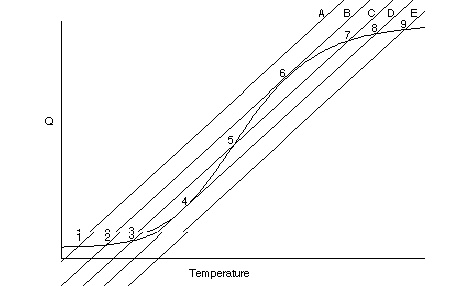
Figure 7 CSTR Energy Generated and Energy Removed as a Function of Reactor Temperature.
In Figure 7 we superimpose several possible linear heat removal curves with the S-shaped heat generation curve. Curve A intersects the heat generation curve at a low temperature; curve B intersects at a low temperature and is tangent at a high temperature; curve C intersects at low, intermediate and high temperatures; curve D is tangent to a low temperature and intersects at a high temperature; curve E has only a high temperature intersection. Curves A, B, C, D and E are all based on the same system parameters, except that the jacket temperature increases as we move from curve A to E (from equation (7) we see that changing the jacket temperature changes the intercept but not the slope of the heat removal curve). We can use Figure 7 to construct the steady-state input-output diagram shown in Figure 8, where jacket temperature is the input and reactor temperature is the output. Note that Figure 8 exhibits hysteresis behavior, which was first discussed in Chapter 15.
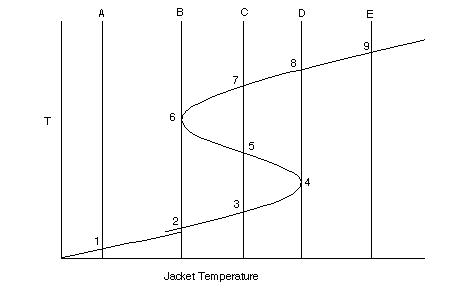
The term hysteresis is used to indicate that the behavior is different depending on the direction that the inputs are moved. For example, if we start at a low jacket temperature the reactor operates at a low temperature (point 1). As the jacket temperature is increased, the reactor temperature increases (points 2 and 3) until the low temperature limit point (point 4) is reached. If the jacket temperature is slightly increased further, the reactor temperature jumps (ignites) to a high temperature (point 8); further jacket temperature increases result in slight reactor temperature increases.
Contrast the input-output behavior discussed in the previous paragraph (starting at a low jacket temperature) with that of the case of starting at a high jacket temperature. If one starts at a high jacket temperature (point 9) there is a single high reactor temperature, which decreases as the jacket temperature is decreased (points 8 and 7). As we move slightly lower than the high temperature limit point (point 6), the reactor temperature drops (also known as extinction) to a low temperature (point 2). Further decreases in jacket temperature lead to small decreases in reactor temperature.
The hysteresis behavior discussed above is also known as ignition-extinction behavior, for obvious reasons. Notice that region between points 4 and 6 appears to be unstable, because the reactor does not appear to operate in this region (at least in a steady-state sense). Physical reasoning for stability is discussed in the following section.