Noise with a Normal Distribution, Mean = 0 and Variance = 100
Answer 3
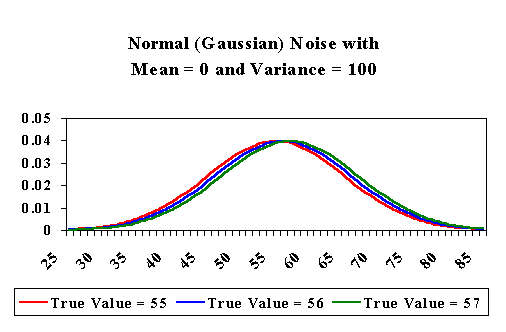
In this example, each of the 'received' values will have a mean
equal to its corresponding 'true' value, and a variance of 100. As
you can see from the diagram below, there is now a large degree of
overlap between most of the distributions. As in the case of
Standard Normal noise, the typical pixel has no noise, but
each true value now has about 60 different possibilities for its
received value! The probability of any pixel being close to the
mean is much smaller; the set bounded by 1 standard deviation on
either side of the mean is {45, 46, ..., 64, 65}. There is no
systematic shift toward light or dark of the type observed for a
large mean. Instead, as you have seen, the pattern of the image
begins to disappear: smoothness, texture and edges are obscured by
the increasing randomness of all the pixels.
Copyright
1998-1999
Rensselaer Polytechnic Institute. All Rights Reserved.