


 dimension of the code.
*parity check matrix has all columns pairwise linearly
independent.
Ex q=2, k=3, working over
dimension of the code.
*parity check matrix has all columns pairwise linearly
independent.
Ex q=2, k=3, working over ![$ \FF[2]$](img24.png)
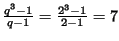
![$ \FF[2]^4\longrightarrow\FF[2]^7$](img273.png)
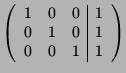
Ex q=2, k=2, n=

![$ \FF[2]^1\rightarrow\FF[2]^3$](img275.png)
 |
 |
 |
|
|
 |
||
|
 |
||
|
 |
||
|
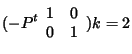
![$\displaystyle \left( \begin{array}{c\vert cc} 1&1&0\\ 1&0&1 \end{array}\right) \textrm{
over } \FF[2]$](img281.png) |
 P=(-1 -1)
 P)= (
P)= ( P)= (
P)= ( P)= (1 -1 -1)
 )
)
 G= generating matrix
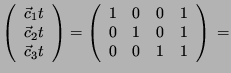 rows of a generating matrix for a basis for the codewords.
This matrix is in reduced-echelon form, and if not we can make it so.
rows of a generating matrix for a basis for the codewords.
This matrix is in reduced-echelon form, and if not we can make it so.
 write G = (
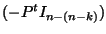
 P) is an n
 k matrix. is the
identity matrix for a k-dimensional code, and there are n rows
because the code is a subspace of
k matrix. is the
identity matrix for a k-dimensional code, and there are n rows
because the code is a subspace of ![$ \FF[2]^n$](img25.png) . C will always reduce
to a reduced echelon matrix or the columns wouldn't be independent
and C wouldn't be a code.
H= parity check matrix = (
. C will always reduce
to a reduced echelon matrix or the columns wouldn't be independent
and C wouldn't be a code.
H= parity check matrix = ( )
G= ( P)
Ex Parity
)
G= ( P)
Ex Parity
![$ \FF[q]^3 \longrightarrow \FF[q]^4$](img292.png)
 |
|
 |
|
|
|
 |
|
 |
|
 |
|
 |
|
 |
|
 |
|
 |

 = ( -1 -1 -1 1 ) [= ( 1 1 1 1 ) over ]
 x
x
![$ \epsilon \FF[q]^n$](img305.png) then
then


 is a codeword.
One way to define a code is through the parity check matrix.
Ex Parity codes have H=
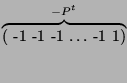 (there are k-ones)
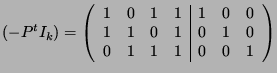
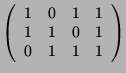
then G=( P)
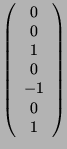
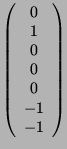
Ex q=1, k=3, n=7
![$ \FF[2]^4\rightarrow\FF[2]^7$](img310.png)
|
|
 |
|
|
|
 |
|
|
|
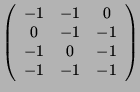 |
|
|
|
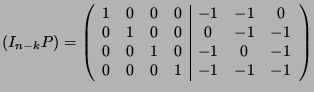 |
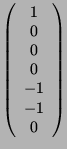
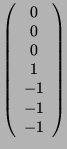
 4 elements in basis, C is dim-4.
 |
 |
 |
|
 |
|
 |
|
 |
|
 |
|
 |
|
 |
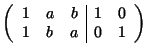
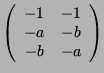
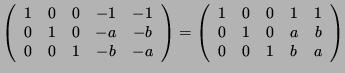
Ex q=4, k=2, n=5, dim(c)=n-k=5-2=3,
![$ \FF[4]^3 \rightarrow \FF[4]^5$](img324.png)
H=( ), now find peicewise linearly independent vectors in
 ![$ \FF[4]^2$](img326.png)
![$ \FF[4]=\{a+bx\vert a,b \epsilon \FF[4] \}$](img327.png) = 0, 1, a, b (a=x, b=x+1)
= 0, 1, a, b (a=x, b=x+1)
|
|
 |
|
|
|
 |
|
|
|
 |
|
 |
|
 |
![$\displaystyle \FF[4]^3$](img332.png) |
 |
![$\displaystyle \FF[4]^5$](img333.png) |
|
 |
|
 |
|
 |
|
 |
|
 |
|
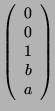 |
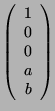 a codeword? Use parity check matrix.
Hx=
a codeword? Use parity check matrix.
Hx=
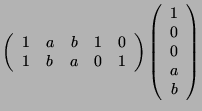 =
=
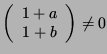 Not a codeword. If you had received x, it was
an error, and you would have to request it again.
Not a codeword. If you had received x, it was
an error, and you would have to request it again.
Where was the error in
?
*Can we change one element to get a codeword?
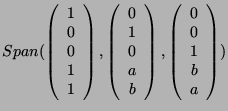
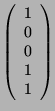
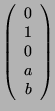
C= Span(

Theorem Hamming codes have a minimum distance of 3. (Perfect)
we can fix one error
If x had been
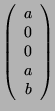 or some
such vector, then there would have only been one error and we
could have fixed it.
Below is a second applet displaying how a code works. This applet
encodes words using the Hamming Code(
or some
such vector, then there would have only been one error and we
could have fixed it.
Below is a second applet displaying how a code works. This applet
encodes words using the Hamming Code(
![$ \FF[2]^4,\FF[2]^7$](img345.png) ). This is
the same code that was used in examples in this section. At the
top, enter a word to be encoded. Upon hitting the ``encode"
button, a box displaying the binary representation of the word
will appear. Below the box with the binary string are boxes that
show the encoded words over
). This is
the same code that was used in examples in this section. At the
top, enter a word to be encoded. Upon hitting the ``encode"
button, a box displaying the binary representation of the word
will appear. Below the box with the binary string are boxes that
show the encoded words over ![$ \FF[2]^7$](img346.png) . Because this code takes in
words of four numbers, and our letters are represented by six
numbers, the encoded blocks do not correspond to letters
individually. After the codewords appear feel free to change the
numbers around, simulating how errors are created. Press the
``parity check" button and the number of the first block with an
error will appear. This applet only takes words six letters in
length. If the word entered is too short, it will be padded with
spaces. If the word is too long then the word will be trimmed to
the appropriate length.
. Because this code takes in
words of four numbers, and our letters are represented by six
numbers, the encoded blocks do not correspond to letters
individually. After the codewords appear feel free to change the
numbers around, simulating how errors are created. Press the
``parity check" button and the number of the first block with an
error will appear. This applet only takes words six letters in
length. If the word entered is too short, it will be padded with
spaces. If the word is too long then the word will be trimmed to
the appropriate length.