The World's Largest Computer Network
and Sun
Sun's relationship with and
support of the Internet is extensive
The Network is the Computer, claims Sun Microsystems(R), Inc., and
nothing proves the point more convincingly than a look at the Internet,
the world's largest interconnection of computer networks. It is no coincidence that
Sun has played and continues to hold such a key role in the development and expansion
of this worldwide communications infrastructure.
Definition
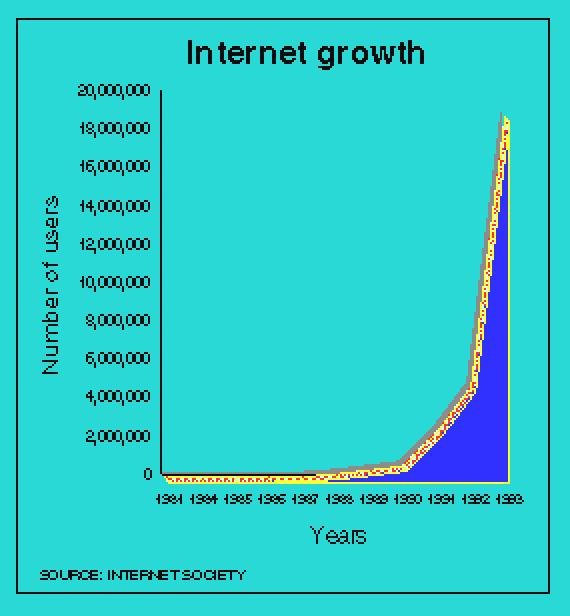
The Internet is the connection of thousands of computer networks.
It is estimated that as many as 45,000 of these networks are now connected,
serving approximately 20 million users. (1)
The current growth rate is reaching 15 percent a month; at this rate,
every person in the world will be connected sometime between the year
2001 and 2002!
(2)
To be a part of the Internet, these networks must employ a common set
of protocols for transmitting and receiving data which are
based on the Transmission
Control Protocol/ Internet Protocol (TCP/IP) standard.
Millions of documents and terabytes of information are available on every topic
from cooking recipes to advanced particle physics research.
Although electronic mail and plain text file transfers are still the bulk of activity on
the network, more sophisticated -- and user friendly -- tools are making the network
a multimedia, interactive system, able to transfer images, motion videos and
sound files. They enable navigation through a "hypertext" graphical user interface
(see "Surfing the `net,")
How it got started
The Internet's roots sprouted in 1969 when the Defense Department's Advanced
Research Projects Agency launched ARPAnet. The goal was to provide a computer
communications network linking heterogenous systems (and one that could,
incidentally, withstand a nuclear attack). The Defense Department continued
to support expansion of the network in the 1970s, and the system evolved into
a network among defense contractors, universities and research centers.
(3)
During the 1980s, the National Science Foundation took on a role in expanding this
network. ARPAnet was eventually phased out and by the early `90s the NSF essentially
took over the Defense Department's role, supporting the "backbone" that has become
the basis for the Internet.
Today, no one owns or controls the Internet.
The costs for maintaining the system are paid through users who essentially
maintain their own computers, servers and networks and gateways to the larger
network. The NSF still provides funding and is influential in decisions regarding
the Internet. Future rules of the road, however, are being established through the
nonprofit Internet Society, based in
Reston, Va. Membership
includes individuals, organizations, government agencies and businesses.
Internet usage

Changing usage
Despite its academic heritage, the Internet is quickly gaining popularity among
commercial users, who see a working prototype for the much ballyhooed
though still nonexistent Information Superhighway. In February, for instance,
Encyclopedia Brittanica, the nation's oldest and most prestigious reference-work
publisher, announced it would distribute information to universities and some
public libraries via the Internet. These for-fee services, however, are still in their
infancy, as businesses grapple with a number of issues, including document
authentication, security, the most efficient way to bill for services and the scalability
of the TCP/IP-based system.
Sun as Internet pioneer
Sun's roots in the Internet go back to the late 1970s and early `80s:
- John Gage, director of Sun's science office, is on advisory panels of the NSF;
vice president Ivan Sutherland is on the board of DARPA. Various Sun managers,
directors and executives have roles in the Internet Society
and are active in the Internet Engineering Task Force.
- Sun's philosophy of open systems meshes with the open Internet system.
In fact, Sun invented NFS(R), the open standard for network file system sharing and
one of the most common facilities built on top of TCP/IP.
- Nearly 70 percent of all applications written for the Internet were developed on
Sun technology. (4) These include WAIS,
a popular information search tool and Mosaic, one of the most popular and most
rapidly growing software applications that allows users to "surf" the
Internet through a graphical user interface.
- Sun has underwritten a number of education and research projects
related to the Internet. It also provided financial support for the
Internet
Multicasting Service, which has produced such programs as Internet Talk Radio,
the first radio show distributed over the Internet, and developed EDGAR, a project
to put the Securities and Exchange Commission financial filings of 4,000 companies on-line.
- Sun broadcasts its Sunergy SM educational television show across the Internet
using the Multicast backbone.
Sun's 12,700 employees use the Internet in conducting both internal and
external business, sending and receiving over 1 million electronic mail messages each
day.
More than that, Sun has been a pioneer in using the Internet as a research
database resource and as a customer service.
SunSITE(TM), an Internet server at the University of North Carolina that went on line
in June 1993, is a repository for information on not only Sun but White House papers,
Internet public domain software and other data. Current usage of the system has
reached as high as
100,000 file transfers a day. (5)
Additional Sun SITE servers have been established in Tokyo
and London and four
other sites are slated to go on-line this year.
Sun also was the first company to develop a unique service program using the Internet.
SunSolve not only answers technical questions about Sun software but can actually
transmit fixes to bugs in software directly to users over the network. Customers are
also alerted to any upgrades or new software via the Internet. This service went
on-line in August 1993.
The future of the Internet
While overall Internet usage is exploding, the most dynamic growth today is in the
World Wide Web, a global network of documents linked via "hypertext" protocols.
The Mosaic tool is rapidly gaining acceptance as the de facto standard interface for
using the web. Latest statistics place the World Wide Web as the 13th largest
network service in the world, up from 127th a year before. (6)
While the government and businesses wrangle over the most effective way of
establishing an information infrastructure, the Inter net is quietly blazing the path
as the prototype and may, in fact, become by default the true data highway.
Internet factoids

1. YankeeWatch white paper, November, 1993.
2. Internet Society presentation.
3. Krol, Ed, The Whole Internet Users Guide & Catalog, O'Reilly & Associates.
4. Sun Microsystems, Inc. research.
5. SunSITE documentation.
6. Hughes, Kevin, "Entering the World-Wide Web: A Guide to Cyberspace."
Although
electronic mail
is still the most
popular vehicle
for moving information over the
Internet, large
data files are
most commonly transferred in several
different ways.
"Surfing" (as in
channel surfing
with a remote
control on a
TV) for this
information, involves knowing a few basic commands. Among
them are:
- FTP: File Transfer Protocol. Allows a user on one host to
access, and transfer files to and from, another host over a net
work.
- Archie: A system to automatically gather, index and serve
information on the Internet.
- WAIS: Wide Area Information Servers. A distributed information service that offers simple natural language input,
indexed searching for fast retrieval, and a feedback mechanism
during searches.
- Gopher: A distributed information service that makes
available hierarchical collections of information.
- Telnet: The Internet standard protocol for logging on to
another host computer.
- TCP/IP: Transmission Control Protocol/Internet Protocol:
The Internet standard for transmitting data.
- World Wide Web: A global network of documents linked
via hypertext. Most common interface to date is the Mosaic
tool, which allows users to simply "point-and-click" on a word in
a document to find related information in other documents.
SOURCE: INTERNET USERS GLOSSARY
(C) 1994 Sun Microsystems, Inc. All rights reserved. Printed in the U.S.A. Sun, the Sun
logo, Sun Microsystems, Solaris, NFS, Sun SITE and SunSolve are trademarks or
registered trademarks of Sun Microsystems, Inc. Sunergy is a service mark of Sun
Microsystems, Inc. NCSA Mosaic was developed at the National Center for Super
computing Applications at the University of Illinois at Urbana-Champaign.
All other product or service names mentioned herin are trademarks of their
respective owners.