My obsession with a new theater form
with links to online resources
Charles Deemer
Copyright © 2012 by Charles Deemer
All rights reserved. Contact: cdeemer@yahoo.com
ISBN: 978-1-4661-9366-6
Smashwords
Editions, License Notes
This ebook is licensed for your personal enjoyment only. This ebook may not be re-sold or given away to other people. If you would like to share this book with another person, please purchase an additional copy for each recipient. If you’re reading this book and did not purchase it, or it was not purchased for your use only, then please return to Smashwords.com and purchase your own copy. Thank you for respecting the hard work of this author.
Playwright in electronic residence
Going for broke: Chekhov as hypedrama
Appendix: 2 hyperdrama scripts
I've been credited with coining the term “hyperdrama.”
In his book Canonising Hypertext: Explorations and Constructions, Astrid Ensslin writes: “The term was coined by hyperdramatist and theorist Charles Deemer, who understands 'traditional drama as a special case of hyperdrama' (The New Hyperdrama) because of its mono-perspectival approach.” (I was going to link to the book at Amazon but the least expensive edition is over $150! Esoteric scholarship doesn't come cheap.)
This may or may not be true. What is true is that I never used the term “mono-perspectival” in my life and am not even sure I know what it means. What is true is that in the mid-1980s I was commissioned to write a play that was to follow the dramaturgical method of a play taking L.A. by storm, which was being called “a living movie.” The play was Tamara by John Kriszanc. (Here's a 1987 review from The New York Times.)
What made this offer special, other than good money, was that the performance would take place in Portland's Pittock Mansion. This mansion, built at the turn of the century by the newspaper's publisher, is now managed by the city parks system and is a local treasure. The opportunity to write a play to take place there was mind-boggling but there was a hitch.
Steve Smith, a director employed by Portland Parks and Recreation (in the 1980s Portland had two theater directors fully employed by Parks & Rec!), who already had directed several of my plays at his Theatre Workshop, wanted me to head a team of writers for the project. He couldn't imagine a single writer undertaking such a massive project.
We were talking about a new kind of theater experience. “A living movie” story was told in “real space” (a movie location, not a stage set) with a branching narrative, the story splitting into different paths, different actions of the story taking place simultaneously in different locations. The audience was mobile. The play an audience member saw depended on the choices s/he made about which actor or actors to follow as the narrative split and players moved into new spaces.
I was doing a lot of reading in the new physics at the time, and the “reality” suggested by the story world in “a living movie” struck me as “quantum” rather than “Newtonian,” with its passive, immobile audience members being fed a play in the dark. However, I didn't like the idea of working with a group of writers, especially with a tight deadline. I'd done this before. In the 1970s I had headed a team of student writers at the University of Oregon to write a soap opera satire called “The Library of Our Lives” (scroll down). We spent far too much time arguing and not enough writing. Too many cooks were in the kitchen.
Somehow I convinced Steve to let me do this on my own. I was ready to begin.
My first task was to learn how “a living movie” worked. How would writing it be different from writing a traditional play? The first thing to do, it seemed to all of us, was to fly me down to L.A, to see Tamara. Another hitch. The play was sold out for almost a year! We felt like we were really up to something here. In retrospect, my ignorance was a blessing because I ended up writing with fewer audience restrictions than in the L.A. event (years later I was able to see Tamara),
I learned that the script would be written in hypertext, the natural language of the World Wide Web (as we called it then). So I began studying the history and practice of hypertext, which a decade later culminated in an essay that became a small success online, translated into several languages. This essay was discovered by a librarian at the University of North Carolina, who admired it so much she offered to host my work at their new electronic library, Ibiblio (a godsend, it turns out).
The essay is What Is Hypertext?
Soon enough I learned that theory and practice are two different things. I now understood hypertext but couldn't get started telling a story using it. How do I number the pages if the action isn't neatly linear? This frustration later led to another essay, How Do I Number the Pages?, which was anthologized in The Spirit of Writing.
As I was writing the script for a play I now was calling Chateau de Mort, or Murder in the Pittock Mansion (this title proved to be a mistake for several reasons, see below), the producers were discovering that “a living movie” had been registered as a trademark and could not be used in the publicity. I couldn't believe it. This was like a poet registering “sonnet” for a new form of writing. The bottom line was, we had to come up with a description for this new form of theater. We did a lousy job, “simultaneous-action theater” being the best we could do. Although hyperdrama is a logical extension of hypertext for describing it, no one thought of this at the time.
There was another problem relating to publicity. With the subtitle, the play got advertised as a “murder mystery,” which caused two problems, neither foreseen. One, we were associated with the audience-participation murder mystery theater games popular at the time, which had nothing to do with the new form; and two, since the play was a mystery, everybody wanted to know “who dun it.” This worked against the new theatrical strengths of the form.
Because what I quickly was discovering in the writing was that in hyperdrama the distinction between major and minor characters loses meaning. Everybody is on stage, that is, in the playing area, at all times. An exit is really a movement, going from one playing area to another in the large performance space. Indeed, at one time in the Pittock Mansion, we had eight scenes occurring simultaneously on four floors! For the writer, for me, this meant that each one of the fourteen characters had to have a full story.
It turned out that only some of these stories related to the murder mystery. To an audience wanting to know “who dun it,” characters clearly not a part of the mystery were ignored. This meant there were scenes, including some of my favorite ones, that played before few, or even no, audience members.
If you get the idea we didn't know what we were doing, you're right. Nonetheless Chateau de Mort sold out for its entire run in 1986 and even had a waiting list. It was a smash hit. Indeed Northwest Arts, a Seattle magazine, wrote: “For pure media hype and upscale audience adulation, however, Baryshnikov was the only act to upstage [Charles Deemer's] Chateau de Mort. An unprecedented full page in The Oregonian was devoted to the show.”
This was a spectacular theatrical event and today, over two decades later, I still enjoy telling war stories about the experience. Many of them I collected later in my essay Watch Out, Mama! Hyperdrama's Gonna Mess With Your Pittock Mansion!

I enjoyed a moment in the sun. I came to the play in a white tuxedo. And I became obsessed with this new form of theater and with a dramaturgy that expressed reality according to the new physics. I wanted to write more.
And, in fact, the play was so successful that I was commissioned to write a sequel.
In practical terms, the sequel was a disaster. In my terms, the script was better than the first one.
Chateau de Mort was once called a story of sex, drugs and rock and roll at the Pittock Mansion. Since the primary social event associated with the mansion prior to this were Sunday tea parties, the play was met with minor controversy, especially among the older set who liked the tea parties. In my story, a wealthy family, the Brodeys, is hosting a party to celebrate a successful year of supporting the arts in Portland. The Brodey son is a drug addict in debt, and his source for drugs comes off the mountain to collect. Narcotics agents learn of this and come to the party under-cover to catch the drug dealer. You get the picture.
For the sequel I stayed with the Brodey family. One thing I learned is that “the performance space” is practically a character in this form of theater. You write to the space because of all the movement involved, as actors go on and off script, on and off improvisation, as they move through the play along unique lines of action. For the sequel, not knowing any better, the producers selected the Columbia Gorge Sternwheeler. The play would be floating up and down the Willamette River.
For the mansion play, we limited the audience to 100 and this worked fine in the huge, sprawling space. On the sternwheeler, however, 100 people were crammed together like sardines. An audience of 30 would have been more like it. I doubt if many got to actually “see the play” on the boat because of the lack of mobility. Too bad, because I thought it was a better, more satiric story, centering on the Brodey daughter's wedding into a religious cult (the bride even delivered by another boat). Reviewers, however, didn't seem to be bothered by these facts and once again we had a hit on our hands.
But I was already frustrated. No one took the new form as seriously as I was taking it. These events were as much party-time as theater-time. The audiences had a ball, but no one seemed to care that a revolutionary new view of reality was implied by this new dramaturgy. I decided to produce hyperdrama on my own in order to make the productions less frivolous.
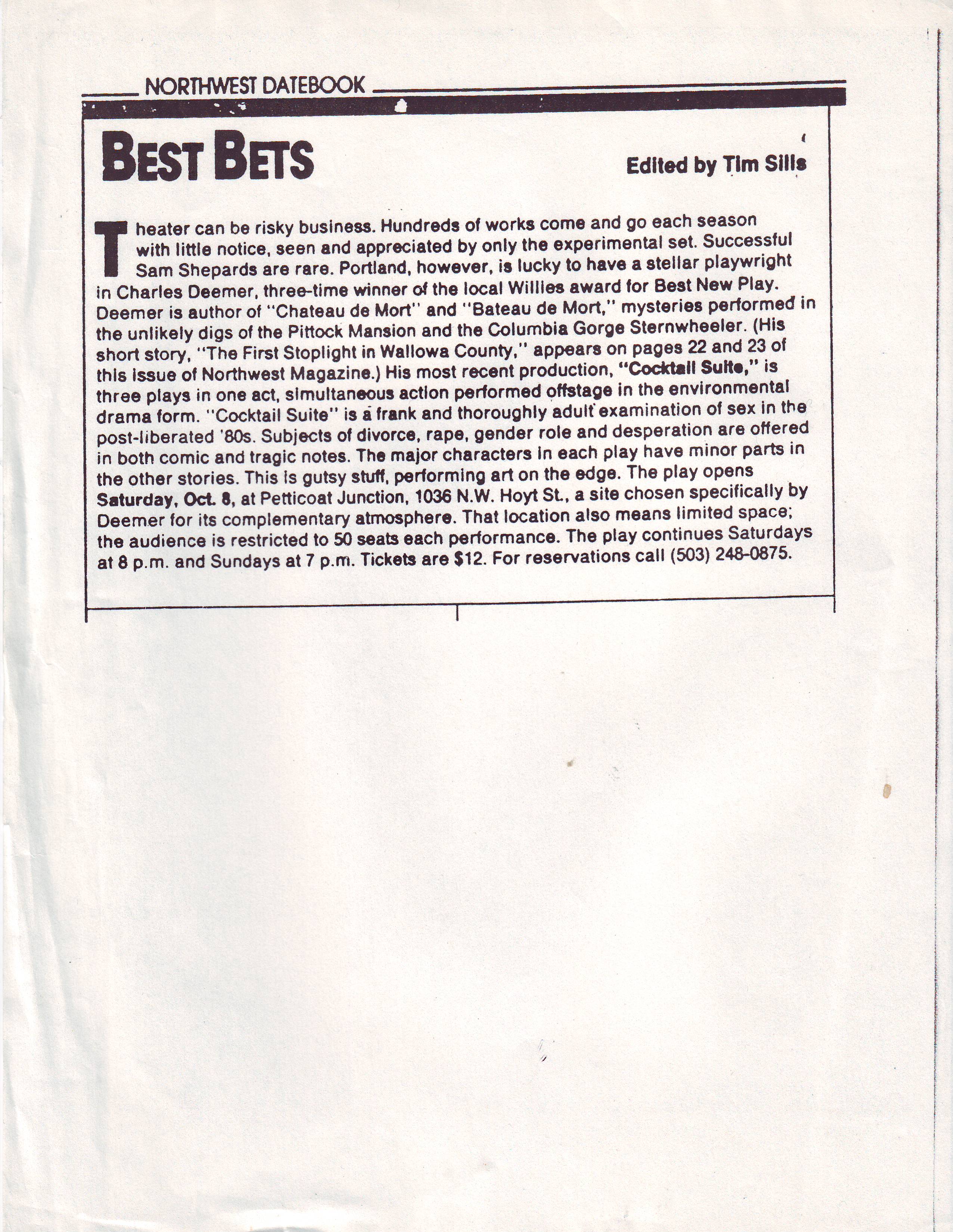
The most successful of several ventures in this direction was Cocktail Suite. I had learned that considerable audience education was necessary before hyperdrama would be accepted as the exciting new form it was. Watching hyperdrama required a new understanding of what it meant to “see a play.”
In Cocktail Suite I hoped to educate the audience by linking three short plays that stood on their own while at the same time taking advantage of the principles of hyperdrama storyteling. Thus major characters in one play became minor characters in another. The three plays were performed simultaneously in different areas of the bar-restaurant. The audience could sit to watch one play or follow an actor from play to play, as they wished. The strategy worked and we got many repeat audience members back to see what they had missed on previous viewings.
What made Cocktail Suite exciting and daring to me was that the three plays were so different: a sex comedy, a heavy drama, and a musical (!), all playing at once. This project was a success not only with audiences but with my actors. We formed a co-op, each with a share (I had two as writer and director), and split the box office. We had virtually no expenses, having made a deal with the owner of the bar, whom I knew, that he'd make enough in food and drink to give us the space free. We ran this successfully for many weeks and only stopped when we began to get bored with it and actors had to meet other obligations.
I went on to other hyperdrama projects. By now I had realized that what the form needed to “give it class” was a hyperdrama interpretation of a classic play. I began to look for one. In the meantime, I was discovering that hyperdrama was more exciting to European audiences than to American ones, and versions of Chateau de Mort were performed in Spain, Denmark, Turkey.
A director in Chile contacted me with an offer. He, too, was very excited about hyperdrama. Would I write a short hyperdrama for his theater company in Santiago? We could do it in a chat room online. I became a playwright-in-electronic-residence in Santiago.
PLAYWRIGHT IN ELECTRONIC RESIDENCE
I wrote about this extraordinary experience of hyperdrama development in my essay Hyperdrama and Virtual Development.
The resulting short hyperdrama, The Last Song of Violeta Parra, exists both in English and in Spanish, translated by the director in Santiago, Andres Espejo. Because it is short, this is a good place to begin an exposure to reading a hyperdrama script.
By this time I was an experienced fanatic, a true believer in hyperdrama. I summarized my enthusiasm for it in a new essay, The New Hyperdrama, which like my earlier essay on hypertext received considerable attention online, got translated into several languages, and later was collected in Theatre in Cyberspace.
In the meantime, I had settled on a classic play to retell as hyperdrama: Chekhov's The Seagull. I could do my own translation, and in the play itself is a plea for “new theater forms.” This was a natural!
GOING FOR BROKE: CHEKHOV AS HYPERDRAMA
It took me a decade to finish this project once I started it. The work was complex, tedious, a combination of grunt work and creative criticism. After all, my job was to write all the scenes “off of Chekhov's stage,” and this in effect was the most demanding interpretation of the play anyone could attempt. As Norman Brown wrote, “The proper response to poetry is not criticism but poetry.” My new play, the hyperdrama Seagull, was an ultimate interpretation of Chekhov.
I knew going in that this play would never get produced. It would require a setting impossible to find in the real world, I assumed. So I had decided to put it online. I wanted it there to inspire some future playwright who would become as obsessed with the form as I was.
Later I would learn, thanks to a student's explanation, that such playwrights already existed – but were not writing live theater but computer games, where all the money was. Of course! Narrative computer games depend on hyperdrama like no other popular form.
And yet there is something very special about seeing a hyperdrama in live performance. Recently I realized that one could design a high tech theater for producing hyperdrama exclusively. More about this later.
My hyperdrama Chekhov's The Seagull went online in the summer of 2002. It's now been online a decade but I doubt if half a dozen people actually have read a substantial part of it. And they all live in Europe.
I thought this would be my last work in hyperdrama. I was wrong.
CONCLUSION: STILL BEATING THE DRUM
I had attended the first Hypertext Conference at Yale University in the mid-1990s. I networked with a lot of interesting people, mostly computer folks rather than creative writer folks. This would pay off.
I was invited to make a hyperdrama presentation to the national Hypertext Conference taking place in Pittsburgh in the summer of 2008. This was an opportunity I didn't want to pass up but at the same time, I didn't want to fly across the country to do it. I made a counter-proposal: I'd write and produce a series of videos, putting them on YouTube for easy access, that would trace the history of hyperdrama, give production details for both live performance and hyperdrama on film, and present a dramatic example of the form. They accepted the proposal.
I already had started making dramatic videos, working mostly with the same group of actors and shooting with a Flip minicam. I roughed out a story, a script, and started shooting. I also prepared the other video material on history and production.
These videos are gathered at a website called Changing Key and present, in my view, an articulate and clear introduction to hyperdrama, along with a short dramatic video to illustrate how theory works in practice.
This, I thought, was my last work in hyperdrama.
Yes and no. Here I am, preparing this ebook “overview” that links to various material about hyperdrama I have online in the hyperdrama area of my archive.
Hyperdrama drives computer games, which make more money than feature films. Obviously the form has arrived. But the design for a theater space in which to produce hyperdrama, which I present in the concluding video “Nuts and Bolts” at the Changing Key project, will work. If I were younger, I'd make it happen in a heartbeat.
I hope someone reading this will be inspired to do it instead.
--Charles Deemer cdeemer@yahoo.com
APPENDIX: TWO HYPERDRAMA SCRIPTS
The Last Song of Violeta Parra