ASFFelix and WW2ASF
Signal Corps Training Center
Camp Crowder, Neosho, Missouri
 1942-1943
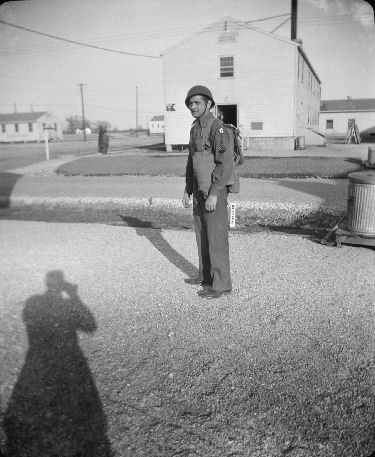
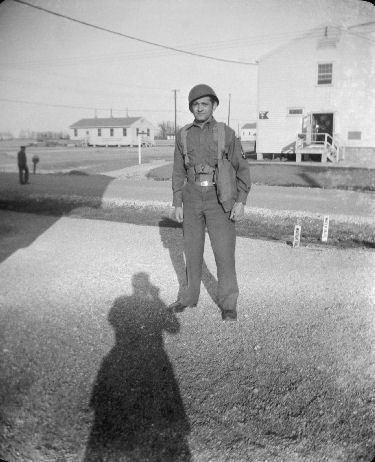
Armon
Private Armon Kalashian,
1916 -1943
The pages about Camp Crowder are dedicated to Private Armon Kalashian and his family.

Armon's family emigrated from the Armenian part of Turkey in the early 1900s, fleeing poverty and the persecutions which preceded the Turkish genocide of the Armenians during World War 1.

Armon arrived at Camp Crowder
in July, 1942, two months after Felix. We don't know if Armon and Felix ever met during their the 13 months they were in training. Armon died in August, 1943 in what the Army reported as an accident.

Armon's niece who was born after his death, contacted me through this web site. I shared with her what I learned about researching missing pieces of World War Two family history. Armon's family continues to search for more information on what happened to him.

I hope by sharing what I know about my father's training at Camp Crowder and artifacts that he saved, other families will be able to have more insight into what their relative experienced.

Too much information about World War Two family history has already been lost to routine records destruction and the 1973 fire at the National Personnel Records Center. That has made the efforts of family history researchers even more difficult. I especially hope that by my example of sharing, other families will share what they find about their relatives if not on the web, at least by donating their relative's artifacts to an archive, museum, or library rather than auctioning them off or throwing them away.

A World War Two veteran told me old soldiers need to take care of each other. Taking that the next step, the families of old soldiers need to take care of each other also.

From May, 1942 until December, 1943, Felix A. Cizewski trained as a Signalman at the Signal Corps Training Center, Camp Crowder, Neosho, Missouri.
May 12, 1942: arrived at Camp Crowder, Missouri, assigned to Company A, 33d Signal Training Battalion.
Trucks Training to Drive Trucks & Construct Communication Lines: Illustrations from Felix's collection of training manuals.
August 31, 1942: Private.
September 29, 1942: Promoted to Private First Class Co. A, 804th Signal Service Regiment.
October 5, 1942: T/5 (Technician 5th class), Co. A, 804th Signal Service Regiment.
licenseLicense October 25, 1943: Army drivers license for vehicles up to 4 tons & larger. Felix's Military Occupational Specialty: Truck Driver Light.

Note that Felix's rank is listed as Private, He was demoted from T/5 sometime between October, 1942 and October, 1943. Dad said he wanted "to go out the same as he came in". and never gave any more details as to why he was demoted.
November 13-16, 1943: Pass to Chicago.
November 25, 1943: Thanksgiving dinner, Company E, 840th Signal Training Battalion.
December 13, 1943: Transferred to Company C, 840th Signal Training Battalion.
December 15, 1943: Company redesignated as Company M, 847th Signal Training Battalion, Open Wire Repair Section.
December 24, 1943: Transferred to Camp Wood, Fort Monmouth, New Jersey.
December 27, 1943: Transferred to newly constituted and activated Company C, 3110th Signal Service Battalion. Company C was the battalion's Open Wire Repair Section with pole and wire responsibilities including construction and maintenance.

Felix A. Cizewski at Camp Crowder
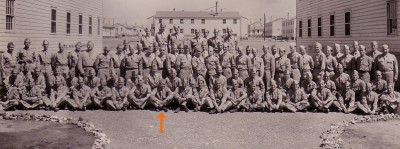
Training group underlined
Training group, Camp Crowder, Missouri, May, 1942. Felix Cizewski above orange arrow.
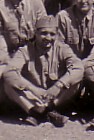
Close Up
Enlarged & cropped from training group photo
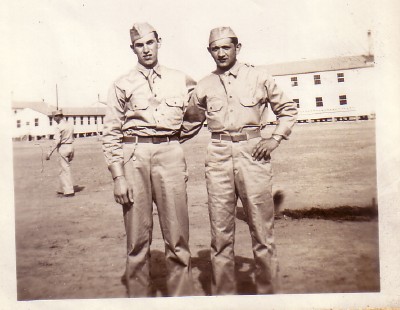
Back of barracks
Felix on the right.
Pipe
Felix with his pipe.
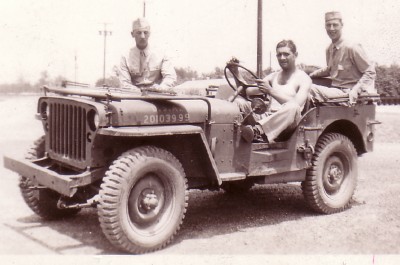
Jeep
Felix behind the wheel of a Ford GPW. (Vehicle identification by the editor of Olive Drab.)
One of my favorite WW2 photos of my father.
Felix A. Cizewski with T/5 (Technician 5th Class) stripes and Army Service Forces shoulder patch. The pouch under his left arm may contain a gas mask. These photos may be from sometime between October, 1942 when Felix was promoted to T/5 and October, 1943 when he was demoted to Private.
1 2
Digitally enhanced for clarity

Camp Crowder Map and Magazine
Grill
Roman Grill
The map and magazine are from the collection of the late Roman Grill. Roman Grill trained as Camp Crowder in 1943 and served in 16th Fighter Control Squadron, 6th United States Army Air Force, Albrook Field, Panama Canal Zone. His grandson and great-grandson shared these items.
Grill
Roman Grill at Camp Crowder
Map
Map of Camp Crowder
Cover A Camera Trip Through Camp Crowder, Missouri (PDF formatted for Adobe Reader 7.0 or higher)

Requires Adobe Reader 7.0 or higher
Get Adobe Reader

Overview: the Signal Corps in World War II

by George Raynor Thompson

Signal units by the hundreds were activated — companies and battalions for operations and construction as in former wars, and also new and previously unheard-of types, such as aircraft-warning companies and battalions (for radar-warning services to the Army Air Forces), and radio-intelligence and SIAM companies to support the Signal Corps' large radio security and intelligence responsibilities. Then there were JASCOs, — joint-assault signal companies — created to meet the amphibious-assault communications needs of joint Army/Navy operations.

Unit requirements were so pressing, and often arose so suddenly, that students were taken out of the schools, their course work incomplete, to fill requirements in signal companies and battalions. These units were trained more in huge unit training centers, especially at Camp Crowder, or they continued training in assignments overseas, on the job.

(emphasis added)

One trainee reports his training at Camp Crowder including climbing telephone poles. (John P. Redmond, Co. A., 49th Signal Heavy Construction Battalion. From World War II Stories -- In Their Own Words).

To handle the wartime flood of personnel, the Signal Corps opened a second replacement training center in February 1942 at Camp Crowder, Missouri, near the town of Neosho in the southwestern corner of the state. Camp Crowder now received most of the Army's signal recruits, including those entering through the Affiliated Plan, who traveled there to receive basic training. Recruits spent three weeks learning the basics of soldiering: drill; equipment, clothing, and tent pitching; first aid; defense against chemical attack; articles of war; basic signal communication; interior guard duty; military discipline; and rifle marksmanship. In July 1942 the Midwestern Signal Corps School opened its doors at Camp Crowder, with a capacity of 6,000 students, and the following month the Corps' first unit training center also opened there. The headquarters established in October 1942 to administer this group of schools was designated the Central Signal Corps Training Center.

From Raines, Rebecca Robbins, Getting the Message Through, A Branch History of the U.S. Army Signal Corps, Chapter VII, World War II:
Establishing the Circuits of Victory


Cizewski, Lovetere, Musbach, & Robinson
Family History Ibiblio Index
© 2007 Leonard H. Cizewski
Last Modified on January 12, 2008
hosted by ibiblio
ACKNOWLEDGMENTS | COPYRIGHT
Cizewski Robinson Family TDS Home Page