 Philip Lovetere & World War
1
Philip Lovetere & World War
1
Philip Lovetere served in Company C, 1st Battalion, 64th Infantry Regiment, 14th Infantry Brigade of the 7th Infantry Division
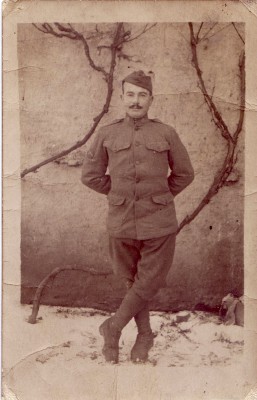
Philip Lovetere, place and date unknown.
Similar photos were taken in France.
   |
Maps
of Philip Lovetere's World War One Journey, 1918-1919. |
 Click for larger image |
| 64th
Infantry Regiment, 14th Infantry Brigade, 7th
Infantry Division Training, 1918 Undated Photo, Waco, Texas Stauts & Simpson, Waco, Texas |
The following is from History of the Seventh Division, Compiled by Captain Edgar Tremlett Fell (1927):
Philip Lovetere's experiences are traced by following the smallest of the unit in which he served and which is identified in Captain Fell's history: battalion, regiment, brigade, or division.
1918
April 28: Inducted. Photo of draftees departing Chicago by train.
~ Mid-May: Sent to Camp MacArthur, Waco, Texas and assigned to the 64th Infantry Regiment.
August 14: Departed Hoboken, New Jersey, aboard the Manchuria August 14th, 1918. En route the propeller bent requiring a return to New York.
August 16: Returned to the New York then sent to the embarkation camp at Camp Mills, Long Island, New York.
August 24: Departed Hoboken, New Jersey, aboard the La France.
September 3: Arrived Brest, France.
September: 15th Training Area: Ancy Le France. Co. C was billeted at Argentenay. 7th Division assigned to the 4th Corps, Second American Army.
September 27: Boarded trains for transfer closer to the front.
September 28 & 29: 14th Brigade detrained at Maron and Chaligny. Marched to Saizerais. 1st Battalion, 64th Regiment possibly to Domèvre-en Haye
September 30: 64th Regiment ordered to relieve 11th Regiment in Dieulouard on the west bank of the Moselle River. As Dieulouard is under fire, only one battalion enters the town and the others hold at Bois Brule.
The 64th Infantry may hold the U.S. Army World War One regimental record for shortest time between debarkation (September 4) and coming under fire (September 30).
While in Dieulouard, the 64th came under artillery and air attack but suffered no casualties.
October 8 to 10: 7th Division relieves the 90th Division in the Puvenelle Sector. The 14th Brigade relieved the 179th Brigade. The 1st Battalion, 64th Infantry Regiment relieved the 1st Battalion, 357th Infantry Regiment.south of Bois-du-Trou-de-la-Haie.
October 10: Relieves the 90th Division in the Puvenelle Sector west of the Moselle All four regiments are placed on the line.
The Germans fired an average of 720 shells per day at the 7th Division positions both gas and high explosive.
October 12: 4th Corps including 7th Division transferred to the Second Army.
October 15: The 64th Infantry sent out two patrols. One made contact and exchanged fire with Germans south of Bois-du-Trou-de-la-Haie. The other found La Soulevre Farm unoccupied.
October 16: Patrol from the 64th Infantry reached the west end of the valley south of Prény.
October 17: Continuous machine fire from the Germans. The 2nd Battalion relieved the 1st Battalion. The 1st Battalion went into support position.
October 18: The 1st Battalion moved from support position into reserve at Gezoncourt.
October 28: The 1st Battalion moved to support position in Thiaucourt.
October 29: The 64th Infantry completed relieving the 111th Infantry.
October 30: 13th Brigade began to relieve the14th Brigade, the 55th Regiment relieved the 64th.
November 1: The relief of the 14th Brigade completed. The 1st Battalion marched from Gezoncourt to Bois-du-Four.
November 1 & 2: Germans fire 5000 shells at the 7th Division, 2150 were mustard gas.
Early November: The 64th Regiment and other units of the 14th Brigade are designated 7th Division reserve in the Martincourt-Rogeville-Manonville region.
By November 8: The entire 14th Brigade was in division reserve in the Martincourt-Rogeville-Manonville region, 15 kilometers by a straight line, farther by road, from front line outpost positions. Officers estimate that under favorable conditions three nights would be needed to move the brigade to the front, get in line, and prepare to attack.
Night of November 8 - 10: 7th Division receives order to move into position for offensive actions to begin on November 10. The 14th Brigade begins movement to positions to implement these orders. They are ordered to immediately begin a march with field equipment and without their packs.
November 10: 1st Battalion is in Domèvre en route to positions for November 10 offensive.
November 11, 0740 A.M.: Notice received of armistice to take effect at 1100 A.M. Offensive infantry operations canceled.
November 11, 1100 A.M.: Armistice; All operations cease. Video of 64th Regiment celebration the announcement of the Armistice. Location, battalion and company are not specified. None of the soldiers appear to be Philip Lovetere.
 |
Photos
of Philip Lovetere's Regiment and Brigade when
they received news of the Armistice on November
11, 1918. |
 |
Map
with location of the 7th Infantry Division at 1100
on November 11, 1918 |
| The
64th Infantry suffered 18 killed, 155 gassed, 68
wounded, and 2 captured. While Philip Lovetere's discharge
does not list any injuries he apparently was exposed
to enough gas that he complained of impaired taste
and smell as a result of having inhaled gas. Philip Lovetere's discharge states her served in the following Battles, engagements, skirmishes, expeditions: October 2 to 10: Marbache sector. October 10 to November 9: Puvenelle Sector. November 9 to 11: Puvenelle Sector Defense. |
Post Armistice: The Second American Army remained in reserve in support of French and American troops advancing into areas from which the German were withdrawing. The 7th Division engaged in training, improved their living conditions, salvaged equipment, and located and buried the dead in their front.
The 7th Division history states one battalion engaged in further training at the Division Training Center in Domèvre. The battalion is not specified but the 1st was in Domèvre on November 10th.
Leaves and passes were granted. Philip Lovetere mentioned how much he enjoyed Paris.
December 1: 1st Battalion stationed Manonville.
1919
First week of April: 7th Division in the Colombey-les-Belles south of Nancy then to the Le Mans area.
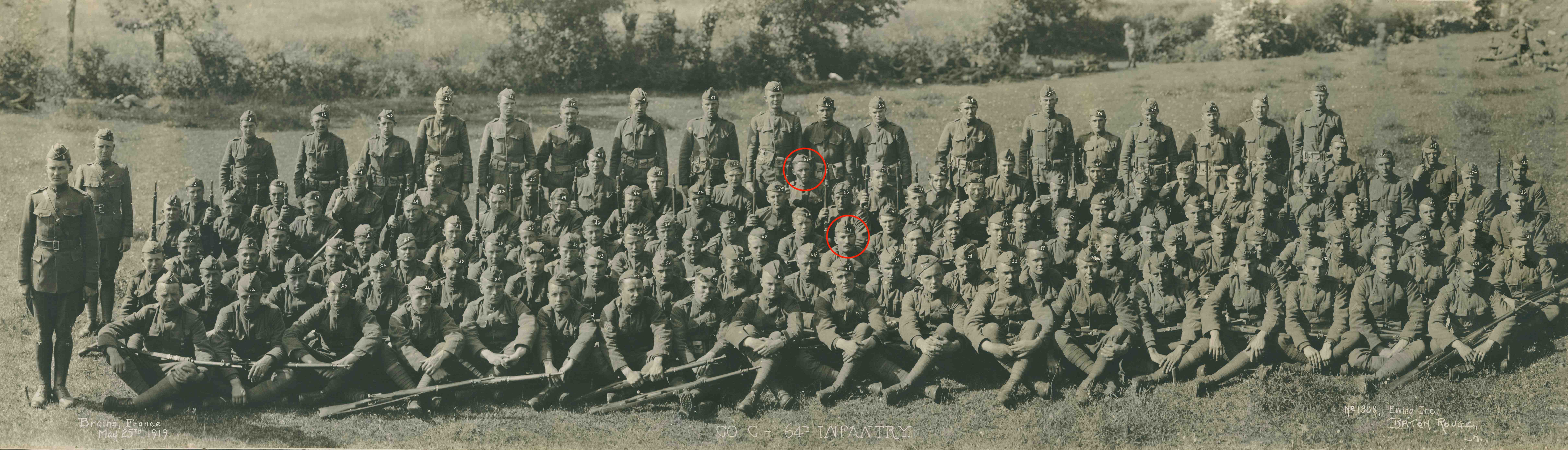 |
May 25: Company C, Brains, France |
Early June: 7th Division moved west through Camp Pontanezon, boarded transports to Brest.
~ June 10: 64th Regiment departed Brest, France.
June 18: Arrived in Hoboken, New Jersey.
After arrival in the U.S.: To demobilization camp, Camp Mills, Long Island, New York where soldiers who entered the Army for the emergency only were sent to demobilization camps near to their homes. Philip Lovetere's records indicate he was sent to Camp Grant, Rockford, Illinois.
|
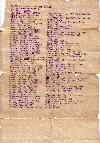
Undated Roster,
Company C, 64th Infantry Regiment, 14th Infantry
Brigade, 7th Infantry Division. Could this have
been compiled in June, 1919 at demobilization
camp, Camp Mills, Long Island, New York as that
was the last time these men of the 64th were
together?
|
||
| Click image or text for larger
image Larger images adjusted and enhanced for clarity and legibility |
||
 |
 |
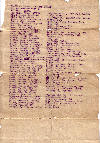 |
| Philip's daughter Anne says that after
the war one of the veterans contacted Philip for a
copy of this roster to use in documenting a claim
for veterans benefits. The veteran was from rural
Indiana and sent by truck to Philip and his family
in Chicago a live turkey as a thank you. |
||
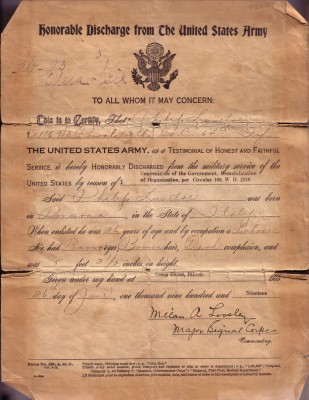 |
June 26, 1919: Discharged from Camp
Grant, Illinois |
 |
June 26, 1919: Naturalization from
Fort Bliss, El Paso, Texas. |
Acknowledgement: Research assistance for this page was provided by Professor Richard Nelson, grandson of John Frederick Edvard Nelson, Company K, 64th Infantry Regiment, 14th Infantry Brigade, 7th Infantry Division
LINKS: 7th Infantry Division |
||
| INDEX:
Cizewski, Lovetere, Musbach, & Robinson
Family History All material not in the public domain © 2004 - 2017 Leonard H. Cizewski Minor Revision: April 20, 2017 Last Major Update: April 20, 2017 Last Reviewed: Posted: On or before August 24, 2004 |
 |
|