it
T
mag
fps
Monte-Carlo simulations of spins dynamics in the XY magnetic model.
Similar to the Ising model spins with different orientation φ
are painted in different colors Hue(φ/2π).
Vortices and anti-vortices correspond to
the singular points (defects) where all colors meet together.
For T = 0.03 "hot" (random) spins are frozen in correlated clusters.
You can watch vortices and anti-vortices formation and annihilation.
Set in the T field T = 0.003 to freez spins.
1024x1024 lattice.
XY model
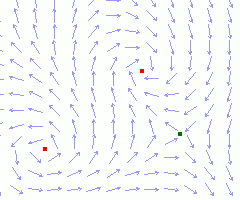
In the XY model spins rotate in a plane (see the picture to the left).
Interaction energy of nearest neighbours pair is
Eij =
-(si sj )
= -cos(φi - φj ) ,
where i-th spin phase φi
is measured e.g. from the horizontal axis in the counter-clockwise direction.
Energy of spin interaction is minimal in ordered state, when all spins
are aligned. Therefore on a 3D lattice at low temperatures there is a phase
transition in ordered state with non-zero magnetization. However on a 2D
lattice small fluctuations are accumulated on infinite lattice and destroy
long order at any finite temperature.
In 2D XY model there are excitations with nontrivial
topology - vortices and anti-vortices (marked by red and green
squares). Under path-tracing around a vortex or anti-vortex spins complete
revolution on ±2π.
2D XY model is dual to 2D Coulomb model. Vortices and anti-vortices
correspond to electrical charges with different signs. Vortex and
anti-vortex attract each other and annihilate.
Comments
Metropolis algorithm is used in this simulations.
Interactin energies are calculated as
ΔEi =
cos(φ + δφ - φi ) -
cos(φ - φi ) =
2 sin(δφ) sin(φ + δφ/2 - φi ).Contents
Previous: Potts model
Next: Exitations in 3D XY model updated 11 Oct 2015

 In the XY model spins rotate in a plane (see the picture to the left).
Interaction energy of nearest neighbours pair is
In the XY model spins rotate in a plane (see the picture to the left).
Interaction energy of nearest neighbours pair is