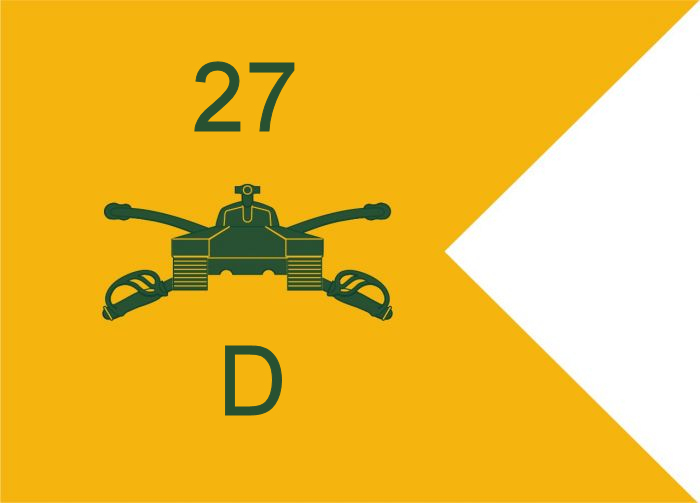
20th AD Shoulder Patch20th Armored Division27th TB Guidon

Liberation of Dachau
Frequently Asked Questions (FAQ)

Many family members of 20th Armored Division Veterans and others have questions about the Division's liberation of the main Dachau concentration camp and its sub-camps.

Here, FYI, are answers to some of the most Frequently Asked Questions (FAQs):

1.  What does recognition of the 20th AD as a co-Liberating unit of Dachau mean?

The U.S. Army Center of Military History (CMH) is the authority that recognizes liberating divisions of camps and subcamps.

Based on that recognition the division flag with streamers is displayed at the U.S. Holocaust Memorial Museum.

CMH states that the divisions of all units that arrived at Dachau during the 48 hours period which began with the arrival of the first unit are recognized as liberating units of Dachau.

The first unit arrived on the afternoon of April 29, 1945. The exact unit and time is beyond the scope of this FAQ.

D Company, and Assault Gun Platoon, 27th Tank Battalion, 20th Armored Division arrived at the Dachau concentration camp on April 29, 1945.
Document
Click for larger format

Documents from the CMH identifying the  D Company, and Assault Gun Platoon, 27th Tank Battalion, 20th AD attached to Company F, 222nd Infantry Regiment, 42nd Infantry Division at Dachau on April 29, 1945.

The exact time of their arrival has not been determined but the CMH identifies it within the CMH defined 48 hours of the liberation of Dachau. Determining the exact time is beyond the scope of this FAQ.


Because of the arrival of D Company, and Assault Gun Platoon, 27th Tank Battalion at Dachau on April, 29, 1945, the CMH recognizes the 20th AD as a liberating division of Dachau.

Therefore, the division flag with streamers of the 20th Armored Division is displayed in the lobby of the 14th Street entrance of the U.S. Holocaust Memorial Museum with the flags of the other liberating divisions and the 522nd Field Artillery Battalion.

https://encyclopedia.ushmm.org/content/en/photo/flags-of-liberating-divisions

2.  My relative said he liberated Dachau.  Was he there?

The photos and histories of Dachau on April 29, 1945 suggest that a few hundred soldiers from elements of ten units of the (3) co-liberating divisions were at Dachau on April 29, 1945.

As of yet we're unable to determine how many of those soldiers were of the four (4) 20th AD units which our research has identified as being at Dachau on April 29, 1945.  

The U.S. Army Center of Military History (CMH) recognized the 20th Armored Division as a co-liberating Division of Dachau, based on official reporting identifying the following 20th AD units:
Those units may be described as active participants in the liberation of Dachau.  

The details of their service are being researched.  However, based on history of the Liberation, informed speculation suggests that D Company, and Assault Gun Platoon, 27th Tank Battalion most likely performed support and relief for Company A, 1st Battalion, and Company F, 2nd Battalion, 222nd Infantry Regiment (the unit to which they were attached), 42nd ID, and provided security for the concentration camp until moving on to Munich, probably later on April 29, 1945.

While touched on in the 20th AD reporting which served the basis for USHMM’s official recognition as a Liberating Division, D Company, and Assault Gun Platoon, 27th Tank Battalion, are not mentioned in the 42nd ID's official history.  We urge research into 222nd IR, 42nd ID documents for information about these 20th Armored units at Dachau on April 29, 1945. (More details about the 42nd ID units at Dachau are found in Flint Whitlock's history of the 45th ID than in the 42nd ID's official history.)  

Neither have we, as yet, been able to determine the time of day which elements of the (3) co-liberating Divisions taking part in the initial stages of liberation were relieved by other units.

Nor have we been able to determine at what time D Company, and Assault Gun Platoon, 27th Tank Battalion left the concentration camp to be at Munich on April 30, 1945.

Further, soldiers from other 20th AD units en route to other assignments, mostly the drive on Munich, stopped and entered the concentration camp on April 29, 1945.  While those soldiers may not have actively participated in Dachau's actual Liberation, they were nonetheless present and may be described as witnesses to the April 29, 1945 Liberation.

3. Are any other units of the 20th Armored Division recognized co-Liberating Units of Dachau?

In addition to D Company, and Assault Gun Platoon, 27th Tank Battalion, the following liberating units of the 20th Armored Division are identified through letters, official documents, and photos:
As CMH does not cite these units in documents recognizing the 20th AD as a co-Liberating Division of Dachau, CMH documentation may arguably be viewed as superficial, minimal and incomplete.

At this time two 20th AD units are documented by photos or correlation of letters with official documents as having passed through the town of Dachau on April 29, 1945 en route to Munich.

On a table is a listing of all units mentioned in official documents as present at Dachau on April 29, 1945, correlating them with soldiers’ letters and oral histories.  This table should facilitate correlation of oral histories, letters, and diaries from soldiers of those units who report stopping and briefly entering the main Dachau concentration camp on April 29, 1945.

This table should facilitate correlation of oral histories, letters, and diaries from soldiers of those units who report stopping and briefly entering the main Dachau concentration camp on April 29, 1945.
Patch
Boxcars
Click for larger format

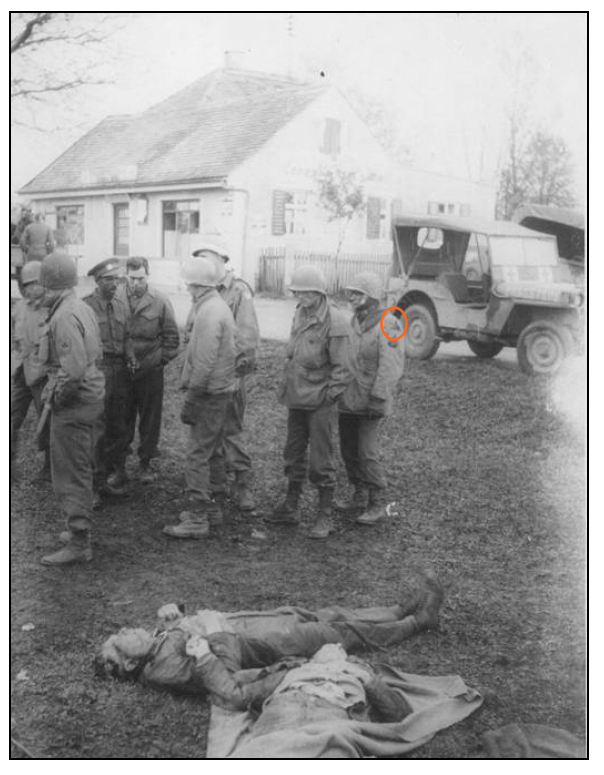
Soldiers of Headquarters Company, 220th Armored Engineers Battalion
.

This may be in the SS facility near the boxcars.

The bodies may be of SS guards killed by soldiers of the 45th.


20th AD shoulder patch is circled on the soldier on the right.

Photo from the collection of the late George Stuber, Headquarters Company, 220th Armored Engineers Battalion.
Click for larger format

Soldiers of Headquarters Company, 220th Armored Engineers Battalion
at the boxcars with dead Buchenwald inmates.

20th AD shoulder patch is circled on the soldier on the left.

Photo from the collection of the late George Stuber, Headquarters Company, 220th Armored Engineers Battalion.
SS Barracks

Click for larger format

20th AD soldiers at the Dachau SS barracks.


As the soldiers are wearing helmets, the photo appears to be from April 29, 1945 rather than from a postwar GI tourism. GIs wee not wearing helmets while on postwar GI tourist visits.

The handwritten caption "Hitlers (sic) office) is in error.


4. Where was the rest of the 20th AD on April 29, 1945?

On April 29, 1945, most of the other 14,000 soldiers of the 20th AD and attached units were en route to other assignments, mostly the drive on Munich.

5.  Could soldiers’ accounts of entering Dachau on April 29, 1945, while en route to Munich, have been misunderstood or misinterpreted as active participation in the Camp’s Liberation?

Yes.  Soldiers made good faith reports in their letters, diaries, and oral histories of their brief entrance into Dachau, while en route to other assignments, mostly the drive on Munich, without making claims to have actively participated in its Liberation.

Others may have misinterpreted or misunderstood such reporting as a claim to have actively participated in the Liberation.

Others may have, themselves, misrepresented such reporting as a claim to have actively participated in the Liberation soldier's Division recognition as a Liberating Division.

6. Did soldiers of the 20th AD have other opportunities to be at Dachau?

Yes.  Following V-E Day, while on occupation duty, soldiers of the 20th AD were able to visit the main Dachau concentration camp, as GI tourists.

We have not found GI tourist photos of 20th soldiers at Dachau among the 20th AD GI tourist photos in our collection. That suggests that touring Dachau after the war may not have been a priority.

7. Did 20th AD soldiers cut, shoot, or force the lock & chain off the camp gates with small arms, or a 75-mm tank gun?

A reasonable assumption is that D Company, and Assault Gun Platoon, 27th Tank Battalion initially entered the SS training facility through the same unlocked and unguarded railway gate used by the 45th and 42nd Infantry Divisions.
Map
Train Gate
Click for larger format

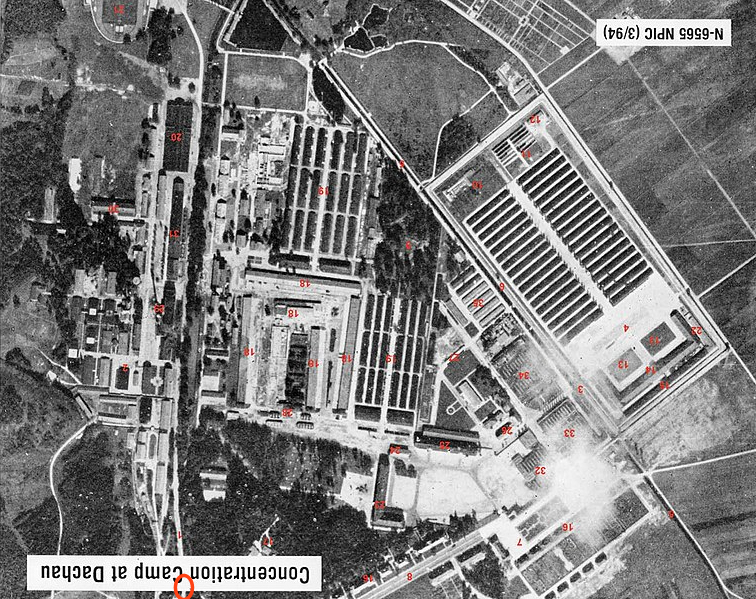
ORANGE CIRCLE LOWER LEFT: Approximate location of un
locked and unguarded gate on rail line where research indicates units of the 20th AD entered Dachau
Train
Click for larger format

Train near the unlocked and unguarded gate
where research suggests the units of the 20th Armored Division entered Dachau. The train contained bodies of dead Buchenwald inmates. These are among the dead bodies that 20th AD soldiers report seeing along with bodies inside buildings in the concentration camp.

Date and unit unknown.
Click for larger format

Research
suggests that D Company, and Assault Gun Platoon, 27th Tank Battalion entered the SS training facility through the unlocked and unguarded gate ORANGE CIRCLE LOWER LEFT then proceeded to concentration camp along the dotted line.

The dotted line is the roue units of the 42nd entered Dachau.


A reasonable assumption is that since D Company, and Assault Gun Platoon, 27th Tank Battalion was attached to the 42nd ID, entered the concentration camp the same way as the 45th and 42nd entered the other co-liberating divisions.

The soldiers of 45th and 42nd did not cut, shoot, or force the lock & chain off that railway gate.

After entering through the railway, they proceeded to the main gate. gate,

A reasonable assumption is that the soldiers of the 20th also entered through the railway gate then proceed to the main gate and entered the concentration camp through the mains gate.

The histories of the liberation report that the Dachau main gate was opened without force, likely by soldiers of the 42nd Infantry Division, with accompanying war correspondents and in the presence of SS guards, SS officers, and members of the International Red Cross.

Postwar histories are that the camp was intact and do not include reports of physical damage to any other locks or that any locks were broken or forced open.

Details in official Army documents are sparse.

8. Did 20th AD combat vehicles smash through a gate, smash down a wooden fence, or break through masonry walls?

No physical evidence exists to support those reports..

The gates, fences, and walls of both the SS training facility and the concentration camp were intact after liberation.

None of that is reported in the official reports of the 3 co-liberating divisions or the histories of Liberation.

A reasonable assumption is that since D Company, and Assault Gun Platoon, 27th Tank Battalion was attached to the 42nd ID, those units also entered the SS training facility through the same unlocked and unguarded railway gate used by the 45th and 42nd Infantry Divisions then proceed to the the concentration camp through the main gate.

(See map and photos in FAQ 7 above.)

The soldiers of 45th and 42nd did not use combat vehicles to force open that railway or any other gates to enter the concentration camp.

The histories of the liberation report that the Dachau main gate was opened without force, likely by soldiers of the 42nd Infantry Division, with accompanying war correspondents and in the presence of SS guards, SS officers, and members of the International Red Cross.

Details in official Army documents are sparse.

9. Did tanks of the 20th AD fire their machine guns at a Dachau guard tower?  

      Were the SS guards in the tower firing on the 20th AD tanks?

      Did 20th AD tank crews arm themselves with submachine guns, dismount
      their tanks, and engage SS soldiers at Dachau?

      Did infantry units of the 20th AD engage SS soldiers at Dachau?

      Did SS soldiers fire mortars from Dachau at the 20th AD?

      Did 20th AD M-7 self-propelled artillery fire phosphorus and high explosives
      into the concentration camp?

After Liberation, the camp was intact without signs of major battle damage.

The wall of the coal yard in the adjacent SS compound may have had damage from the small arms fire from the soldiers of the 45th killing SS guards.

The Dachau guard towers showed no signs of major battle damage. Tower B may have had damage from small arms fire where soldiers of 45th and possibly the 42nd killed SS soldiers.

No Army reports at the time nor the histories of the Liberation report significant resistance by SS soldiers, nor any combat at Dachau.

Soldiers of the 45th report they received fire from buildings in the SS compound and returned fire. Soldiers of the 42nd report they received sniper fire from somewhere in the Dachau facility.

The questions exist about the motivation for those reports and their reliability of those reports are beyond the scope of this FAQ.

10. GIs’ reports of combat at the concentration camp are similar to combat in which the 20th engaged on the roads near Dachau and in and around the town of Dachau on April 29, 1945 and the Battle of Munich on April 30, 1945. Is it possible soldiers misidentified or conflated those engagements as having occurred at the Dachau concentration camp?

Yes.   This is consistent with how the fog of war affects oral histories.

A soldier of the 20th observed that each combatant’s experience, view, and perspective of the war had a radius of about 15 feet.

That would make easy misidentification of location

11. Did soldiers of the 20th kill or wound members of the SS at Dachau?.

The Seventh Army Inspector General investigated the killing of SS soldiers at Dachau.

The only killings of SS soldiers at Dachau were by soldiers of the 157th Infantry Regiment, 45th Infantry Division.

No SS soldiers were killed at Dachau by soldiers of the 20th AD.

12. Did an SS Colonel surrender Dachau to a 20th AD lieutenant, and then the 20th AD turn Dachau over to Army Intelligence?

An SS lieutenant surrendered Dachau to a 42nd ID general in the presence of a U.S war correspondent and the International Red Cross.

The exact units to which Dachau was turned over following surrender is being researched.

The units of the 3 Divisions participating in Dachau’s Liberation were relieved by units of the 45th Infantry Division, and then units of the Seventh Army.

The units of the 42nd Infantry Division with the 2 attached 20th AD units were outside of their Divisions’ boundaries, and inside the 45th's.  The time on April 29, 1945, at which these units departed Dachau is unknown.

13. Did 20th AD soldiers find buildings stacked with thousands of bodies?

Yes.

Stacks of bodies are among the sights witnessed and photographed by soldiers of the 20th Armored Division

14. Did three tanks and a wrecker entering the camp observe bodies in train cars?

That is the account of soldiers of the 20th Armored Division who briefly stopped and entered the concentration camp while en route to Munich, who apparently witnessed train cars with the bodies of the Buchenwald inmates.

15. Did soldiers of the 20th AD observe inmates removing bodies from the train cars and dump them into a pit?

That is not consistent with US Army and other reports.

Order in the camp had broken down prior to Liberation.  Many of the SS guards had fled.  Deceased camp inmates were no longer being taken to the mass grave at Leitenberg, and inmates were refusing to process recently arrived bodies in the boxcars.

16. Did 20th AD soldiers find dead inmates around a flagpole and Nazi flag?

No official reporting of the 3 co-Liberating Divisions, nor the Seventh Army Office of Strategic Service Section, report inmates dead of gunshot wounds around the base of a flagpole.

17. Did 20th AD soldiers find SS guards in closets, killed by inmates?

Contrary to some, neither the Seventh Army Inspector General investigation of the killing of SS soldiers at Dachau, nor Jurgen Zarusky's research (link in Sources below), report that SS guards were found in closets with their throats cut by inmates.

18. Did 20th AD soldiers find bags filled with gold teeth, take the bags, then turn them over to General Eisenhower?

Neither official Army reports nor postwar Liberation histories relay Army personnel recovering gold teeth -- or gold taken from the teeth -- of Dachau inmates.

The Army did recover dental gold at Buchenwald.

If dental gold was recovered at Dachau, it was likely in searches by Seventh Army units after Liberation, rather than by 20th AD soldiers, who were briefly at Dachau for a few hours on April 29, 1945.

Further, if dental gold was found at Dachau, it’s highly unlikely it was carried off in bags by individual soldiers to be hand delivered to General Eisenhower.

Any Dachau dental gold would have been securely handled by Army units, similar to how Buchenwald dental gold was handled

It’s possible a 20th AD soldier added or conflated reports of Buchenwald gold to his WWII oral history, placing it at Dachau.


A display of boxes of gold caps and dentures removed from prisoners in Buchenwald and recovered by American troops after the liberation of the concentration camp.
 
https://collections.ushmm.org/search/catalog/pa1033251


19. My relative said he helped liberated Dachau inmates board a train to return home.

The earliest that liberated Dachau inmates were transported to return to their homes was in June, 1945.  This was in truck convoys of the 45th ID serving on Occupation duty.

At the time, the 20th AD was on Occupation duty in southeast Germany, near the Austrian border.

While on Occupation duty, the 12th Armored Division transported in their trucks 1300 Italians, probably liberated Dachau subcamp slave laborers, to Bolzano, Italy. They also transported 4300 Russians, also probably liberated Dachau subcamp slave laborers to the depot at Göppingen for trains to Russia.

Future research may find that the 20th AD performed a similar service while on Occupation duty.

20. Did two soldiers of the 20th Armored Division enter the main concentration camp shortly after midnight on April 29, 1945

In one story, an Officer and an Enlisted Man of a 20th AD Artillery company claim to have entered the main Dachau concentration camp shortly after midnight on April 29, 1945.   The 20th AD Artillery Officer claims to have been on his way to a meeting with the 42nd ID to coordinate artillery support for April 30, 1945 operations at Munich.

The 20th AD Officer's Artillery unit was not the one attached to the 42nd ID.

In another story, an Officer and Enlisted Man claim to have wandered across the 20th's and 42nd's division boundaries and into the 45th area of operations, risking friendly fire accidents, and then across and behind enemy lines.

When they realized they were behind enemy lines at risk of being killed or captured, rather than withdraw to safety, the Officer and Enlisted Man entered an enemy facility (Dachau) and buildings inside the facility.

Their oral history is reported to exist on a tape recording.   We urge a transcript be made for further research, analysis, and review of its credibility by WWII military history scholars.

If either of these reports can be substantiated, this would be another account of 20th AD soldiers witnessing but not participating in the Liberation of Dachau.

21. Did soldiers of the 20th spend the night of April 29 at SS training facility before moving on to Munich?

Spending the night of April 28 to 28, 1945 in the Dachau SS training facility does not meet the CMH definition of participating in the Liberation of the main Dachau concentration camp.   It is therefore extraneous to the 20th AD's recognition as a co-Liberating Division of the main Dachau concentration camp.

22. What if my relative's oral history or letters do not correlate with these FAQs?
 
Oral histories are to be handled with the utmost respect.  They are a valuable part of your family's history.  They need to be preserved and shared.  Historians consider them the raw material of history.

We suggest that where oral histories are not collaborated by official or scholarly histories, you include a statement acknowledging this fact with the oral history.

Our job is to correlate official documents with oral histories, letters, diaries, and other documents recording soldiers' experiences.    

That an individual soldier's documents or anecdotal history do not exactly match official reporting, does not by definition, diminish said individual accounts.

When writing the most complete and accurate history of events, historians draw on such oral and personal histories, official documents prepared at the time, and other documents to, best they can, reconstruct and present the most complete and accurate accounting possible.

The fog of war, external influences, and shifting memories can skew personal perspectives.

Just as individual soldiers and units cannot see and internalize the entire picture of a broad and sweeping military operation and fluid situation across a wide geography, neither can official reporting capture all possible movements, events, and scenarios.  

While we can't put ourselves in the place of our young family members as they stumbled on and witnessed the horrors of Dachau, we can afford these heroes the pride – and, sorrow -- they share through their memories, oral histories and letters.

The most accurate oral histories are those recorded closest to the events.   For a range of reasons, oral histories may become less accurate over time.

Over the years, veterans may have consciously or unconsciously added to their personal histories details they have acquired from other veterans, histories they have read, movies, general knowledge, and popular culture.  

It is the responsibility of all professional, amateur, and family historians, to correlate oral histories with official and scholarly histories.    

This is what our group tries to do.

23. Does a complete and accurate history of the 20th Armored Division and the liberation of Dachau exist?

No.  

Compiling a complete and accurate history of the 20th Armored Division and the Liberation of Dachau is an ongoing effort.

We are doing our best to compose a thorough and accurate history from our research.

We urge professional historians to assist this effort, and we advocate that the US Army’s Center for Military History (CMH) assemble and release an official history of the Liberation.

24. How can we help?

This is our first edition.

We are amateur historians who reviewed some scholarly sources as well as unit After Action Reports and the U.S. Army Center of Military History documentation.  

Hundreds of more documents related to the liberation of Dachau exists.

We appreciate your review.

Please send official records and personal accounts that can make future editions of the FAQ more complete and accurate and in compiling a complete and accurate history of the 20th Armored Division and the Liberation of Dachau


For more FAQs, see the 45th Infantry Division's Dachau Liberation FAQs, at:

http://www.ibiblio.org/45wwiiresources/dachau/faq/faq.html
________________________________________

Additional Research Resources (a partial list):

Center of Military History (CMH) Documentation Designating 20th AD Dachau Liberator


The decisive document that recognizes the 20th AD as a co-liberating division of Dachau

"Recognizing the Liberators. US Army Divisions Enter the Concentration Camps" by Edward J.Drea, Army History. The Professional Bulletin of Army History, Fall/Winter 1992/1993, 1-5.


Explains the CMH's processing of recognizing liberating divisions.

Jurgen Zarusky  "That is not the American Way of Fighting": The Shooting of Captured SS-Men During the Liberation of Dachau"

A scholarly history of the liberation of Dachau. Documents the killing of the SS guards. Documents that the soldiers of the 20th did not take part in the killings.

The Rock Of Anzio: From Sicily To Dachau, A History Of The U.S. 45th Infantry Division by Flint Whitlock

An excellent history of the liberation of Dachau. Identifies many units except for the 20th AD units.

Hardcover, paperback, and Kindle editions available.

7th Army OSS Section – Dachau Official Report, May, 1945

20th Armored Division site at the U.S. Holocuast Memorial Museum (USHMM): The USHMM has an extesnive colllection of Dachau material

KZ-Gedenkstätte Dachau

The 20th Armored Division in World War II free digital edition from the Bangor, Maine public library.

Comité International de Dachau; Organizers of anniversary memorials at Dachau.

National Archives: Has an extensive collection of Dachau material


"20th Armored Division and the Dachau Concentration Camp" by former 20th Armored Division Association President Arnold Rist , Undated document


Liberators: The Story of the 20th Armored Division in World War II Compiled and edited by Jeff Nichols.


Video: Alan Lukens,413th Armored Field Artillery Battalion 

By Leonard H. Cizewski and Rich Mintz

Leonard H. Cizewski is the son of late Private First Class Felix A. Cizewski, 45th Signal Company, 45th Infantry Division. On April 29, 1945, Felix A. Cizewski was outside the main Dachau concentration camp, providing communications support to the units of the Division.) and Rich Mintz

Rich Mintz is the son of late Staff Sergeant Murray C. Mintz, Company B, 65th Armored Infantry Battalion, 20th Armored Division. On April 29th, 1945, Murray Mintz was fighting north of Munich, as elements of the 27th Tank Battalion, 20th Armored Division, were at Dachau.

Leonard is the co-administrator of the The 45th Infantry Division in World War II: An Unofficial Guide to Resources and its affiliated Facebook Group.

Rich Mintz is the administrator of the The 20th Armored Division in World War II Facebook.

They work together to research and share complete and accurate history of the liberation of Dachau camp. They are committed to providing families of veterans with the details of their relatives experiences at the Dachau. That includes identifying the units of the three co-liberating divisions and other units that were at Dachau during the CMH defined 48 hours of liberation and those that provided care for the liberated inmates and buried the dead victims.

They also assist groups and associations of other liberating units of camps and subcamps doing similar research.
<< Dachau Index

<< The 45th Infantry Division in World War II: An Unofficial Guide to Resources

All items not in the public domain c 2021
The 45th Infantry Division in World War II: An Unofficial Guide to Resources

Minor Revision:
Last Major Update:
Last Reviewed:
Posted:

Administrators: Leonard H. Cizewski & Judy Erwin Branham

hosted by ibiblio
Permission and acknowledgements:

While almost all items on this site are in the public domain, please contact the administrators for instructions on how to acknowledge the source.

Many volunteer researchers at their own expense obtained many of these public domain items from sources such as the National Archives.