Atamasco lily meadows now a rarity
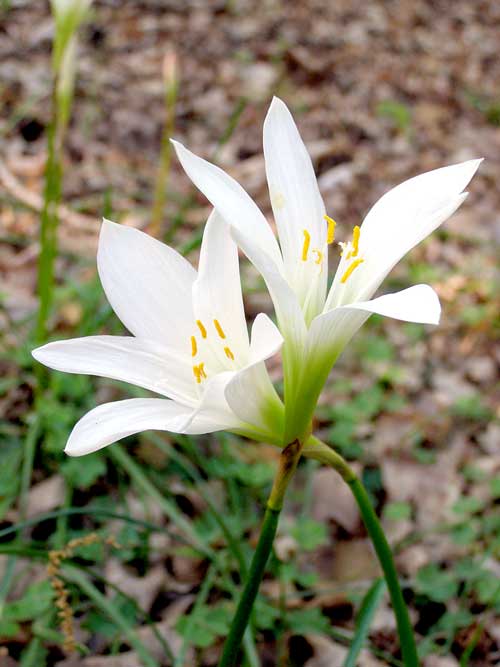
Atamasco lilies are one of our most beautiful wildflowers. Photo by Ken Moore.
By Ken Moore
William L. Hunt (1906-1996) introduced me to botany and horticulture when I began a master’s program in English here at UNC in 1962. Billy, as many of his contemporaries affectionately called him, grew up in his uncle’s Greensboro nursery. He was already an accomplished gardener when he arrived in Chapel Hill with a truckload of irises and other plants in 1927 to pursue a botany degree under W.C. Coker and Roland Totten.
He remained here for the rest of his life, growing native and exotic plants, lecturing throughout the Southeast and writing a weekly garden column. Though he was well known as a horticulturist, his real love was the study and growing of our native flora.
I vividly remember a late-April day in 1968 when Mr. Hunt took me to view an atamasco lily meadow north of town. I’ve never seen such a field since. He said that Eastgate Shopping Center and other low-lying developments were once lily-filled wet meadows.
Recently, while surveying some of Mr. Hunt’s archives, I discovered a copy of the January-February-March 1938 issue of The Gardener, published at Pocha’s Horticultural Press, Poona, India, for the avid-gardening public of that faraway land.
In that little publication was a short article, “Atamasco Lilies,†by William L.

Atamasco lily meadows are a rare sight these days. Photo by Ken Moore.
Hunt, which I want to share with you. A black-and-white photograph of one of our local lily fields filled half the page.
“One of the truly breath-taking sights in the Piedmont and Coastal regions from Virginia south, is to be found in certain meadows where the ‘Atamasco Lilies,’ Zephyranthes atamasca, abound. These members of the Amaryllis family are very easily cultivated, and will grow, quite accommodatingly, even under conditions somewhat different from their natural habitat of swamp of ‘Crawfish Land.’…
“They seem to put up with almost any conditions, so long as their requirements of moisture in Spring and a somewhat rich diet are supplied.
The wettish parts of gardens suit them best of all.
“The last week in April finds them in full flower in North Carolina. Each clump of bulbs sends up from five to 10 flowers, one after the other, in rapid succession, and a whole meadow of them is worth going many a mile to see.â€
Sadly, nowadays we see only remnants of those extensive former meadows, a plant or two still surviving in shady, wet woodlands and forest edges.
Surprisingly, atamasco lily is the N.C. Botanical Garden’s Wildflower of the Year for this year. You can get a free packet of seed from the garden. Better yet, visit the garden’s plant sales to get one or more plants grown from seed.
It takes a lot of seeds to provide for Wildflower of the Year, and the garden staff is indebted to a generous local family for sharing seeds from their horse-pasture meadow of thousands of atamasco lilies – a lingering, living heritage of an earlier time, when such lily fields were a common sight. Horses and deer won’t eat atamasco lilies!

Horses (and deer) won’t eat atamasco lilies. Photo by Ken Moore.
This lily field, now a rarity in our area, is approaching peak flowering, and I’m going out to view it. You’re welcome to join me if you’re willing to carpool. Meet me at the rear of the Eubanks Road Park-and-Ride Lot at 10 a.m. this Saturday. As Mr. Hunt said, “a whole meadow of them is worth going many a mile to see.â€
Comments are closed.