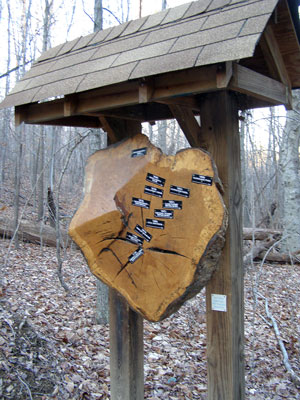
PHOTO BY KEN MOORE. This former giant white oak has 212 years of stories to tell.
Flora Columnist
Reading the landscape can be really engaging for those who take to our local trails with an intention to get more than exercise or a dog walk. Whether it’s a strand of rusted barbed wire captured inside the trunk of a tree or an unexpected area covered with English ivy or periwinkle, one may be curious enough to linger and consider what occurred there long ago. Sometimes the answer is quickly evident, as when an old gravesite is spied amidst the traditionally planted ivy or Vinca minor (commonly called periwinkle or myrtle).
Sometimes one spots brightly colored surveyors’ marking tape or freshly hacked saplings, indicating recent property line surveys. These sightings can easily send a concerned walker to Town Hall with inquiries about potential dramatic landscape alterations.
A pleasant read for inquisitive walkers is Reading the Landscape by May Thielgaard Watts, a book long out of print but generally found in libraries and used bookstores. Watts, a legendary naturalist at Morton Arboretum near Chicago, loved helping young and old alike “read†the meanings of local landscapes.
Last week, I discovered a trail that was new to me, in Duke Forest. Reserved for foot traffic only, it’s located just a short way along Duke Forest Durham Division trail C, which is accessed via N.C. 751, beyond the roundabout west of U.S. 15-501 bypass.
Interpretive signs along the trail help walkers understand the land-use history of the diversity of habitats the trail traverses.
At the bottom of the first slope, there’s a kiosk displaying a cross section of a 212-year-old white oak victim of Hurricane Fran’s devastation 15 years ago. One can feel insignificant while reflecting on all the human history that tree witnessed in a life that began when George Washington was president.
The forest landscape a walker encounters up beyond the fallen giant is a sharp contrast to the undisturbed north-facing slope of mature beech and tulip poplar that’s just been crossed. Ahead is a mix of struggling small trees, some of which may one day be forest giants like the ones that have fallen down all around them. Mounds of rocky red clay soil are scattered about on the forest floor; these remnants of the big trees felled by Hurricane Fran give an eerie, ghostly feel to their surroundings.
An interpretive marker in an area of scattered big trees where saplings fill the canopy gaps causes one to pause and consider the possibility that this may have been an early-settler “wood lot.†The forest would have been fenced off to contain the livestock foraging within. Suitable trees would have been selectively cut for building materials or firewood. This was certainly a gentler harvesting of forest resources than the visually unappealing practice of clear-cutting.
Other forest history stories are found along the trail, which continues up and down through different forest types, including some variously managed pine plantations.
If you explore this trail soon, I’ll wager you’ll discover spots you’ll want to revisit for wildflowers in the spring, like that north-facing beech slope.
Excellent maps for this and dozens of the other Duke Forest trails are available at Duke Garden’s gift shop or on line at dukeforest.duke.edu.
Email Ken Moore at flora@carrborocitizen.com.
Read more Ken Moore Citizen columns at The Annotated Flora.

PHOTO BY KEN MOORE. Prominent red clay mounds are eerie reminders of big-tree hurricane victims.

PHOTO BY KEN MOORE. One of many old live oaks of Springer's Point Preserve on Ocracoke Island.
By Ken Moore
Flora Columnist
What do Springer’s Point on Ocracoke Island and UNC’s Battle Park have in common? English ivy, Hedera helix – that’s what they have in common.
A decade ago, I first visited Springer’s Point, where there is a mature live oak, Quercus virginia, forest, an example of the maritime forest once common along southeastern coasts.
The historic “haunt†of the pirate Blackbeard was under invasion. English ivy was literally dripping from the tree canopy, where copious seed production was evident. The evergreen vine was smothering the smaller trees and shrubs beneath the big oaks. It was a scene of approaching disaster.
Fortunately, that forest has come under the stewardship of the N.C. Coastal Land Trust (coastallandtrust.org), which purchased the first portion of Springer’s Point Preserve in 2002. Since then, the 31-acre preserve has grown to 122 acres.
Ivy was introduced by early European settlers and commonly planted on island gravesites. The ivy that adorned the memorial site of Norfolk industrialist and Ocracoke philanthropist Samuel Jones and his horse, Ikey D, gradually escaped and spread throughout the forest.
The Land Trust contracted with an invasive plant-control firm to remove the ivy and rallied volunteers from the island and nearby mainland. The forest is now healthy, and the ivy is confined to where it covers Sam Jones and Ikey D.
On the local scene, the Botanical Garden has been pulling English ivy for years. Staff and volunteers have removed the ivy from Coker Arboretum and continue to battle it in the Coker Pinetum and the forest near the Visitor Education Center.
In recent years, the battle has appropriately moved to UNC’s Battle Park Preserve, which is under the care and management of the Botanical Garden. English ivy is just one of many exotic invasives that, over the years, have succeeded in disrupting the health of this once magnificent forest.
Under supervision of curator Stephen Keith, university work-study students and volunteers apply themselves almost weekly to literally rolling up tons of ivy to return the Battle Park forest to its former health. This effort is ongoing and seeing real results is enjoyable.
As for what you might accomplish on your home turf, Stephen advises, “Start with a small plot and be persistent and eventually you’ll reclaim your yard.â€
If you’re not inclined to reclaim your own yard, please at least help by cutting all the ivy vines growing up your trees. When ivy reaches the upper limbs of trees it flowers and produces berries from which birds distribute seed far and wide.
There are other opportunities for battling exotic ivy and other harmful invasives in local natural areas:
• Bill Bracey’s workdays, convening where Chapel Hill’s Bolin Creek Greenway crosses Bolinwood Drive, third Saturdays, 9 a.m. to noon (619-2160);
• Carolina North manager’s periodic invasives removal workdays (forestmanager@fac.unc.edu or Jerry McGovern at 201-7063); and
• Triangle Land Conservancy’s two invasives workshops scheduled for Jan. 20 and March 5 (triangleland.org).
It’s time to get involved doing your part at home or with others in the community.
Happy rolling and pulling!
Email Ken Moore at flora@carrborocitizen.com.

PHOTO BY KEN MOORE. Once rampant English ivy now confined to gravesite of Samuel Jones and his horse, Ikey D.
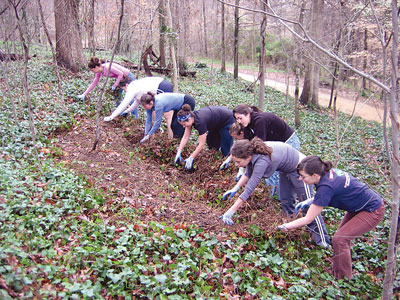
Members of UNC’s Episilon Eta, the nation’s first environmental honors fraternity, “roll up†English ivy in Battle Park. Photo by Stephen Keith.
A special place for flora and fauna
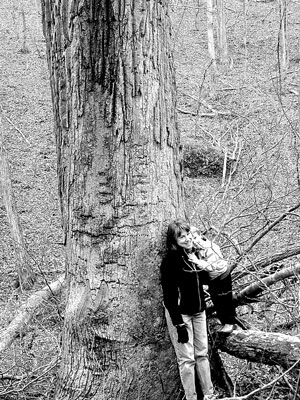
PHOTO BY JOHNNY RANDALL. Libby Thomas and son Max are dwarfed at the base of Stillhouse Bottom’s sentinel tulip poplar.
By Ken Moore
Flora Columnist
Not far from Chapel Hill’s Merritt Pasture stands Stillhouse Bottom. The Merritt family’s former land included the steep forested ravine known as Stillhouse Bottom, a name that initiates numerous stories from old-timers. The land was used for selective tree harvesting, farming on level terrain and, most likely, as the stories go, moonshining in the ravine bottoms.
Thankfully, the Merritts were thoughtful stewards of the land; the forest on the steep slopes was never timbered, meaning it has been essentially undisturbed since before European settlement. That’s why one is able to stumble upon 250- to 300-year-old trees, such as Stillhouse Bottom’s giant sentinel tulip poplar (see photo).
The land was sold in the early 1960s and subsequent years have seen ownership of various parcels change from time to time. During the same period, botany professors and students, as well as numerous local citizens, visited the site in the spring to view one of the area’s best displays of wildflowers.
The site, part of the greater Morgan Creek Bluffs Natural Area, is described in the Inventory of Natural Areas and Wildlife Habitats of Orange County as one of the most important natural areas in the county. Additionally, the site is within the larger Jordan Lake Macrosite, which includes the N.C. Botanical Garden Mason Farm Biological Reserve and New Hope Gamelands, all comprising a huge area of natural biological diversity.
As early as 1965, C. Ritchie Bell, the first director of the Botanical Garden, began conversations with various property owners about preserving the site.
This past Saturday was a very special day. Botanical Garden Assistant Director Johnny Randall held a press conference on the site to announce the purchase of 5.6 acres of undisturbed forest, bringing the Botanical Garden Foundation’s Stillhouse Bottom Nature Preserve to 23 acres.
This special purchase was made possible through the generosity of local landowners, an Orange County Lands Legacy Program grant, a Town of Chapel Hill contribution and more than two-thirds of the funding from private donations.
It was a magical moment, as officials from Orange County and Chapel Hill, Botanical Garden staff, Botanical Garden Foundation volunteers and several biologists joined Randall, in the midst of a dramatic passing snow shower, to express their enthusiasm for the preservation of this significant natural site.
The story continues. Randall described ongoing efforts to secure additional adjacent lands, enlarging the preserve to 100 acres. Folks interested in supporting this effort are welcome to contact him at the Botanical Garden.
There are no established human pathways in the preserve. Human impacts are limited to occasional seasonal walks scheduled by the Botanical Garden.
One of those present on Saturday expressed a feeling of quiet jubilation “simply knowing that Stillhouse Bottom Nature Preserve exists primarily as a sanctuary for native flora and fauna in an undisturbed forest.â€
For more information on Stillhouse Bottom and updates on scheduled walks, visit the Garden’s website: ncbg.unc.edu
Email Ken Moore at flora@carrborocitizen.com.
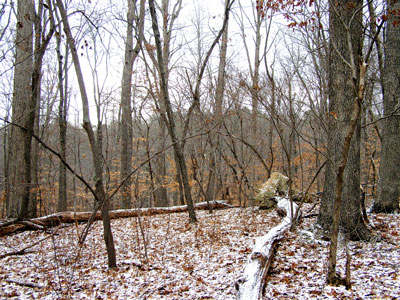
PHOTO BY KEN MOORE. Undisturbed Stillhouse Bottom forest provides a safe haven for flora and fauna, including migratory birds.
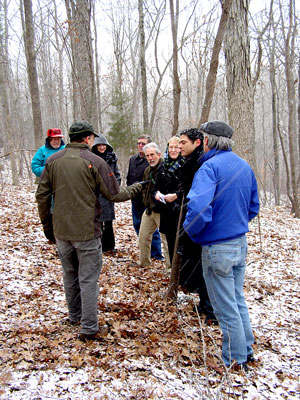
PHOTO BY KEN MOORE. Johnny Randall (front left) faces local officials to record comments celebrating the preservation of Stillhouse Bottom.

Little chickadee takes a turn at a tree-cavity watering hole. Photo by Ken Moore.
By Ken Moore
Flora Columnist
There are birders and there are botanizers. Birders are not necessarily ornithologists and botanizers are not necessarily botanists. Most of them, however, are passionate in their observational pursuits. Some botanizers, like many birders, keep life lists of their sightings.
I’ve begun many times to keep a life list of birds, wildflowers and trees. But making notes of what, when and where for each observation is simply beyond my powers to remain focused. “Oh, what is that bird up in that tree? Wow, let’s go gather some of those ripe persimmons. I’ll try to remember which blue aster that is when we return.â€
Keeping a life list is an enviable discipline, but it’s not for me. I am too easily excited about making the same observations over and over again. Each time I see or hear a common bird, like a red-bellied woodpecker, I respond as if it’s a first-time discovery. Similarly, every time I stop to admire a common tree, like the American beech, it’s a really, really special moment.
The Citizen’s December MILL included descriptions of several local birding resources and “hot spots.†Hopefully, that will be followed in the not-too-distant future by a description of botanizing hot spots. I’ve saved a copy of the birding hot spots for future reference, though for me a birding hot spot is wherever I manage to sight or hear a bird. Memorable experiences are those least anticipated.
I had such an experience recently while exploring the short Winmore neighborhood nature trail. I heard the busy chattering of what I thought was a wren. When I looked up, I was surprised to see a titmouse and chickadee fussing at one another. Both were perched about 12 feet above me near a cavity on the side of a sourwood tree. That cavity had become a kind of permanent water reservoir. Those two birds were obviously contesting which was first in line for a drink. It turned out that the titmouse exerted authority over the smaller chickadee. A sighting perhaps not of note to a life-lister, but for me it remains unforgettable.
Birders who are also botanizers are fortunate. When there’s a lull in bird activity, there are always plants to spot. Botanizers have an advantage in that plants can’t quickly relocate. Plant discoveries can be exciting and are more frequent than bird discoveries. Finding common plants along the way is like happening upon old friends. Most you never, ever find boring.
Smooth-barked beech trees, holding their copper-colored leaves in the winter, are always greeted with pleasure. One beech tree hot spot is Battle Park, particularly that extensive grove of big trees adjacent to the Forest Theatre. Another beech tree hot spot is the upland elfin forest on the upper heights of Triangle Land Conservancy’s Johnston Mill Nature Preserve between Mt. Sinai and Turkey Farm roads.
A new beech tree hot spot for me is that same short Winmore bird encounter trail where the giant trees create a Tolkien-like forest.
Wherever you go birding or botanizing, when armed with an appreciation for greeting old friends, you will always be rewarded with finding your own “hot spots.â€
Email Ken Moore at flora@carrborocitizen.com.
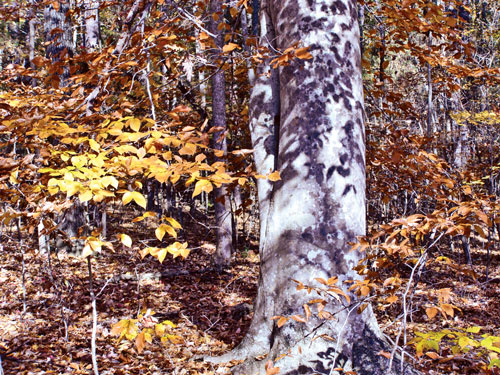
Standing before an American beech is like greeting an old friend. Photo by Ken Moore.
New Year’s resolve for weekly explorations

PHOTO BY ROBERT DICKSON. River-edge ice patterns reward a winter day’s walk.
By Ken Moore
Flora Columnist
This time every year, I encourage folks to resolve to walk a trail through local natural areas at least every weekend, beginning with New Year’s Day. That notion was long ago inspired by the Eno River Association (enoriver.org) New Year’s Day Hike. Subsequently, there are guided hikes along the Eno every Sunday through the end of spring.
You can avoid crowds if you plan your own walk. A good website to get you started is ncnatural.com/TriangleRec
When Citizen publisher Robert Dickson told me that he and his wife, Vicky, were going to explore the White Pines Preserve on Christmas Eve, I responded: “Wow, that area at the confluence of the Deep and Rocky rivers south of Pittsboro is one of my favorite places and I haven’t explored it in years! Take some pics for me.â€
Robert’s image of the icy pattern surrounding the moss-covered knee of a submerged log was just one of several appealing “closer looks†that he shared.
Vicky’s verbal image of the day’s hike was equally engaging: “There’s just something about a river – water that comes from somewhere else, and goes somewhere else – that’s awe inspiring. And the confluence of two rivers, like the Rocky and Deep, is even more so.
“The stark white sycamores at the edge of the river, the rusted cable that once was part of the bridge kids crossed to go to school, the high bluffs over the river and the silver and rainbow-colored ice that traps the river at its margins are all brought into vivid relief by the starkness of the winter landscape. Your attention is drawn to things you might not notice in any other season.â€
Kathy Buck and I followed in Vicky and Robert’s footsteps at the preserve on Christmas Day. We were impressed with the extensive forest of evergreen American hollies, some heavily berried, and most festive at this special winter solstice time. Medieval druids would be happy here.
The occurrence of white pines, Pinus strobus, 75 miles east of their normal range, is the special natural feature that led to the White Pines Preserve becoming the first of the Triangle Land Conservancy’s several preserves.
Download the preserve guide and map (triangleland.org) before you go. The map will keep you oriented as you explore.
Walking beneath the mature pines, noticing seedlings growing here and there beneath them, one can pause to consider that these characteristic mountain plants are relics isolated here following the retreat of the last glacial period 10,000 years ago. Specific environmental conditions of temperature and moisture, critical for survival of the species, still exist along the steep slopes at the confluence of the two rivers.
You can distinguish white pines from the preserve’s dominant loblolly pine, Pinus taeda, if you look for long narrow cones (like a short banana), bluish-green needles that occur five to a fascicle (bundle), tree limbs in whorls around the main stem, like the spokes of a wheel, and smooth dark bark.
Our Christmas Day walk was rejuvenating; I hope we will manage such an outing every week in 2011.
Celebrate this New Year with your own exploration of the White Pines or some other natural area, and resolve to explore a different place every weekend.
Email Ken Moore at flora@carrborocitizen.com.
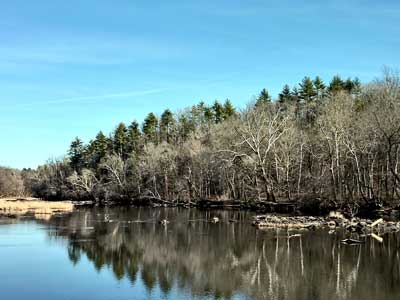
PHOTO BY ROBERT DICKSON. White pines, relics of the last glacial period, tower above sycamores along the Deep River.
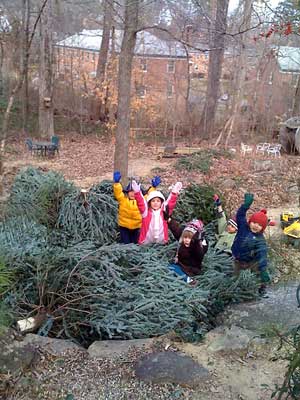
PHOTO BY DIANA STEELE. Willow Hill preschoolers celebrate their Fraser fir creation.
Flora Columnist
As we approach all the celebration and joys of Dec. 25, take a time out to reflect on the specialness of that tree you brought indoors to accompany your family traditions.
For some, the specialness of that tree began with selecting and cutting it from a local cut-your-own-tree farm. That takes old-timers back to the days of walking local fields and woods in search of the perfect tree.
For most, that tradition has been replaced by going to an in-town tree lot, where picking the perfect tree is still a special family ritual. Just about everyone will select a North Carolina Fraser fir, Abies fraseri, for that perfect tree.
The once-magnificent North Carolina high-altitude evergreen Fraser fir forests, described as “Christmas Tree Land†by B.W. Wells in The Natural Gardens of North Carolina, are much diminished now by the exotic balsam woolly adelgid insect pest.
Today, Fraser firs are more commonly seen on our mountain-county hillside Christmas tree farms. Though helping the economy of the region, much of the Christmas tree production depends upon heavy pesticide and herbicide use with resulting toxic runoff. A bright side is that some farms are now moving toward pollution-free organic operations. Your tree most likely “grew up†on one of those tree farms.
When the holidays are past, those trees are usually discarded along curbsides to be collected by public works crews. Don’t let this happen in your neighborhood! That tree represents so many memories and traditions for your family that it should be unthinkable to orphan it so callously on the street curb for offsite disposal. Your tree is deserving of more reverent appreciation by extending its usefulness outdoors on your home turf, which offers countless honorable ways for that special tree to slowly return to nourish the earth.
Staked upright near bird feeders, your tree provides multiple perches and excellent shelter. If not desired for a short-term evergreen effect in your winter garden, the branches can be cut and applied as mulch around trees and shrubs.
Residents of the Mason Farm Road neighborhood join together each year’s end to continue the life of their special trees on the woodland grounds of Diana Steele’s Willow Hill Preschool. Eventually, those trees make a journey down to become a forest-edge perimeter berm, defining the outer limits of the kids’ discovery/play grounds. In addition, the tree-brush berm provides perches and shelter for birds and other wildlife and helpfully captures far-flung balls.
However, before those trees make it to the destined perimeter, the kids move them around and, like budding architects, make tree fortresses, tree castles and even giant bird nests, all reflective of their young creative energies.
Hopefully, you will honor your tree this year by keeping it on your home turf, or at least on a neighborhood site where the kids may enjoy it on its way to a natural return to the soil.
Email Ken Moore at flora@carrborocitizen.com.
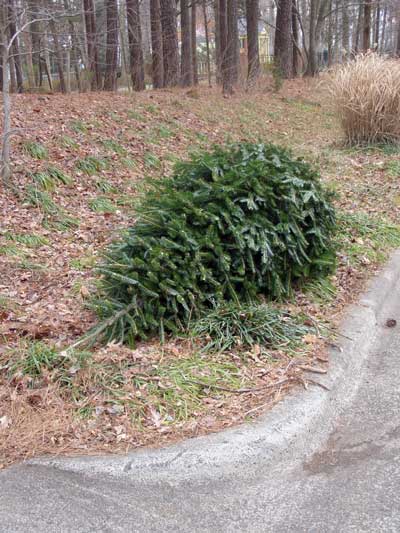
PHOTO BY KEN MOORE. Don't let this happen in your neighborhood!

PHOTO BY KEN MOORE. Evergreen mistletoe is a year-round magical plant.
Flora Columnist
Mistletoe was in the news last week. An article in Raleigh’s News & Observer described mistletoe gathering from canoes; there was mention in Flora that mistletoe might appear on Carrboro’s giant wreath (and it is, hanging up beneath the triple red bow); Chapel Hill News pictured the Carrboro Town wreath, including mention of mistletoe; and a friend shared the Guardian’s story describing the increasing rarity of mistletoe in England.
The story from the Guardian is worth a long pause:
“Conservationists warn today that mistletoe, favourite plant both of pagans and stealers of Christmas kisses, could vanish from the nation’s halls and doorways within 20 years.â€
The National Trust fears that the decline of traditional apple orchards may cause this curious plant to disappear or, at least, be much harder to obtain. European mistletoe, Viscum album, a tree parasite, is prolific in English apple orchards. National Trust ecologist Peter Brash the Guardian that such a result would be a sad loss: “Mistletoe is part of our Christmas heritage and has a special place in a wonderful winter landscape.â€
The Guardian wrote that environmental consultant and mistletoe expert Jonathan Briggs, a traditionalist who keeps mistletoe in his house all year to ward off evil spirits, said that “mistletoe would migrate to bigger, non-orchard trees and so become harder to reach. This could turn it into a much more expensive product or prompt people to rely on cheaper foreign imports. ‘A Christmas kiss could become more expensive.’â€
Well now, our own native mistletoe, Phoradendron serotinum, is already expensive, unless you happen to find it easy to pick low down in a nearby maple tree, as was my good fortune. That impressive bundle of mistletoe on the Carrboro wreath is hanging higher than it was in that maple. Nature was generous this time.
Accounts of mistletoe’s medicinal, sacred and magical attributes abound. It has a centuries-old heritage as a cure for epilepsy and other nervous disorders, but I’m not eager to give it a try. I do, however, find appeal in a combination of other attributes, dating back to druidic pre-Christian European cultures. Hanging sprigs of mistletoe inside all year long, from New Year to New Year, to insure prosperity as well as protection from witches and evil spirits is a tradition I will try.
Our native mistletoe is unlikely to be considered under threat of rarity as in England. It’s very common down east and frequently found here in the lower Piedmont. You’ll even spy it in town. Look for it in oaks along Franklin Street. You’ll see it in abundance in the ash trees on the UNC campus behind University Methodist Church.
Though a parasite, it does sport leaves, and is quite capable of photosynthesis and providing for some of its own needs. The plant spreads from tree to tree, carried by birds cleaning their beaks of the sticky seed coating.
As I am guarded about the location of my favorite female persimmon trees, I’m not about to disclose the location of the tree that sports female, berry-producing, mistletoe low down enough for me to reach.
I wish you luck with your own mistletoe search and may your whole year be free of witches and evil spirits.
Email Ken Moore at flora@carrborocitizen.com.
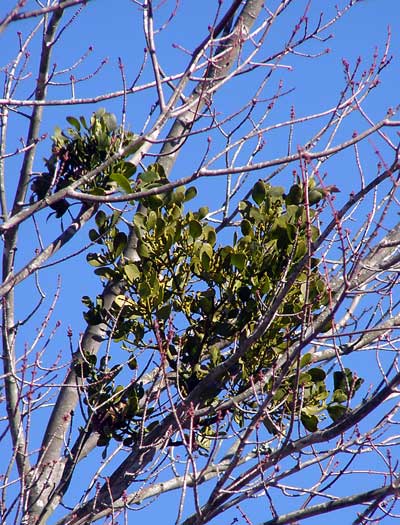
PHOTO BY KEN MOORE. Mistletoe is easy to spot high up in trees this time of year.

PHOTO BY KEN MOORE. Red-berried holly is a special tradition this time of year.
By Ken Moore
Flora Columnist
When I was a youngster, bringing evergreen holly branches indoors at Christmas time just seemed like the thing to do.
Now, because of protective landowners and deer hunters, it’s difficult and dangerous to attempt to collect a few holly branches from the local woods, like in the old days. Red-berried branches of American holly, Ilex opaca, bring premium prices at local markets. Some folks are fortunate to have specimens of this common forest tree growing on their property to carefully prune for indoor decoration.
How well I remember one Christmas when my dad and I cut a little holly tree from my aunt’s farm, thinking it would be a nice change from the traditional red cedar. We were pleased to have a different kind of tree for the holidays. I also remember how sad I felt when my mom, who grew up in the holly-barren Midwest, lamented: “It just doesn’t seem like Christmas without a real Christmas tree.â€
I didn’t know then about the heritage of bringing holly and other evergreens indoors during the winter solstice. Hollies were revered as sacred trees. Holly legends are legend themselves.
Christian symbolism includes references to the spiny-leaved holly branches being the “crown of thorns†of Christ, whose blood colored the berries red.
One story describes a little shepherd boy feeling sad that he had only a holly branch to offer the Christ child. When the baby Jesus touched the branch, the berries turned a beautiful red.
Alternatively, the Romans used gifts of holly as good-luck charms during Saturnalia festivities and, during that time, Christians were forbidden to decorate with holly.
The ancient Druids and other early Europeans considered the holly very sacred and hung branches outside entrances and brought branches indoors as protection against witches and evil spirits. Friendly forest elves and fairies were believed to inhabit the evergreen limbs of holly and were thus provided warmth and comfort inside dwellings during the cold winter solstice period.
Boughs of evergreen cedar, spruce, fir and pine were all similarly considered special plants during the winter solstice.
Mistletoe, a common plant parasite on oaks and hickories, was particularly revered by the Druids, who associated it with renewal and rejuvenation at the end of the year. It later became a symbol of love, a tradition still enjoyed by folks today.
Tomorrow, the big holiday wreath goes up on the front of Carrboro Town Hall, in time for the Friday evening tree lighting and carol singing. Take time in the next week or two to take a closer look at the evergreens on that giant wreath, a creation of members of the Carrboro Community Garden Club. For more than two decades, that group has provided the holiday greenery that adorns our Town Hall.
See if you can identify the diversity of the evergreens used. The group makes an effort to use only locally native plants. You will undoubtedly find holly, as well as pine and cedar. If you look really close, you may even find a sprig or two of mistletoe.
Whatever legends appeal to your personal feelings, pause this season when you bring holly and other greenery indoors, and consider it special, a symbol of warmth, protection and a connection with the natural world.
Email Ken Moore at flora@carrborocitizen.com.

PHOTO BY KEN MOORE. Carrboro Community Garden Club’s giant evergreen wreath is a seasonal tradition for Carrboro Town Hall.
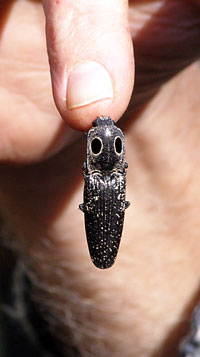
PHOTO BY KEN MOORE. Eyed elater click beetle joins the group.
By Ken Moore
Flora Columnist
Thanksgiving Day included a walk in the woods. Lingering fall color and the beautiful beginnings of the winter forest landscape were worthy of giving thanks.
We left the neighborhood behind at the end of the street as we entered Carolina North woods to walk the Nature Observation Trail, a trail for walkers only, where we like-minded folk enjoyed the nature of the place without interruption from dogs, bikes and joggers. We were alone on that deer path-like trail beneath giant trees beginning to show off winter forms and textures. Along the way, we became absorbed in the diversity of fallen leaves on the forest floor and the complexity of hidden activity beneath.
Our emergence back onto the street was a bit unsettling after the journey over the leafy forest carpet.
Curbs were piled with leaves removed from manicured landscapes upon which they had fallen. We surveyed that scene and reflected on how far we humans have diverged from living in harmony with nature. We wondered how town resources could be redirected if all those leaves were allowed to remain, to be recycled as nature intended, on the ground where they fall.
We further reflected on how thankful we are to have numerous public trails nearby to offer solace from the trappings of manicured neighborhoods.
However, sometimes it’s exhilarating to go farther afield to explore new places.
One such place I’ve wanted to explore is Howell Woods in nearby Johnston County. Several weeks ago, I joined like-minded folk in the able hands of N.C. Museum of Natural Sciences naturalists Jerry Reynolds and Jesse Perry on a day-long exploration of the 2,800-acre “outdoor classroom†associated with Johnston Community College’s Rudolph Howell and Son Environmental Learning Center.
You are welcome to visit Howell Woods (howellwoods.org) on your own. There are attractions to engage the entire family. Twenty-five miles of trails, 24 separate loop trails, introduce you to a diversity of habitats including bottomland hardwood forests, seasonal wetlands with boardwalks, sandhill pine and scrub oak and longleaf pine forest restorations.
If you visit on a weekend, look for Stephen Ashby, a staff member who cares for the wildflower and other gardens next to the learning center. He’s full of helpful information about the history and nature of the place.
Jerry and Jesse quickly identified discoveries made by the members of our group, who were scrambling in all directions like preschoolers. Highlights spotted were marble salamanders, late-fall grasses and wildflowers and the brilliant color of turkey oaks, which hold their leaves perpendicular to the ground to conserve moisture. I was most excited to see the eyed elater click beetle found beneath fallen leaves inside a rotting log. When asked, “Does it bite?†Jesse obliged in demonstrating that it does, and it tagged along on Jesse’s finger for quite a ways. (Jesse was good-natured about it!)
Jerry Reynolds schedules monthly Museum day trips (naturalsciences.org) to natural areas not far from Raleigh. The next one is Dec. 8 to Raven Rock State Park below Sanford. There may still be spaces left.
Whatever you do, get out into nature, leave your worries behind and let those leaves remain beneath the trees where they fall.
Email Ken Moore at flora@carrborocitizen.com.
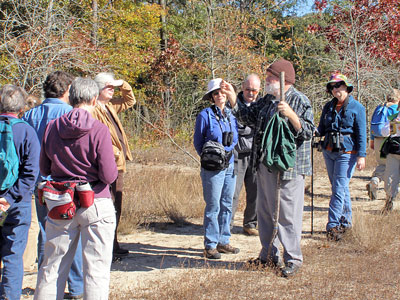
Photo by Ken Moore. Jesse Perry makes a point with lifelong hikers at Howell Woods.
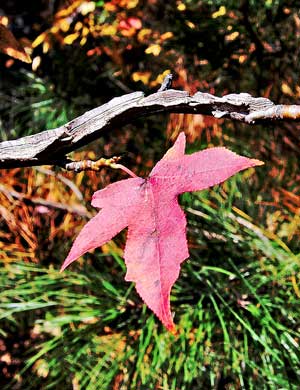
PHOTO BY DAVE OTTO. Lingering leaf gives way to the beauty of bare twig.
Flora Columnist
Here we are observing another Thanksgiving. Folks remaining here at home most likely have family and friends joining them for the seasonal tradition.
This observance is usually accompanied by a food feast beyond reason. Many hosts plan for “walks around the block†as a healthy endeavor or as a ploy to get folks out of the kitchen so the cooks have some room and quiet while they create or simply recover.
We are truly blessed to have many alternatives to “walks around the block.†Numerous trails for exploration of fields, forests and creek and river bottoms are close by. There are no excuses for failing to get out and explore the natural beauty surrounding us.
The brilliance of the last several weeks is subsiding, but foliage colors can still be found all around.
Though fall is my favorite season, I appreciate its progression to my other favorite season, winter, when, without all those leaves, we can absorb the beauty of individual trees and the dramatic contours of forest and field landscapes.
Several nature trail and greenway opportunities are convenient to neighborhoods, such as the trails of Cedar Falls Park in east Chapel Hill and Southern Community Park, south of us.
Carrboro’s Wilson Park provides access to the quiet warmth of pine needle-floored trails of the Adams Tract that lead down through an oak-hickory forest to Bolin Creek.
Neighborhoods near the UNC campus are close to the 93-acre Battle Park forest, stretching from Forest Theatre to the Chapel Hill Community Center. This historic forest is managed by the N.C. Botanical Garden (ncbg.unc.edu) and maps are available at several trailheads.
Northern Chapel Hill and Carrboro neighborhoods are fortunate to be close to Carolina North, some 750 acres of diverse woodlands bordering the Bolin Creek corridor with miles of trails maintained by UNC (fac.unc.edu/CarolinaNorth). In addition, the greenway and nature trail of the Winmore community are also close by.
If you wish to go farther out, there are natural areas with trails worthy of your Thanksgiving outing.
One of my favorite local adventures is walking up through the twisty old chestnut oaks and mountain laurels of Occoneechee Mountain State Natural Area (enoriver.org) overlooking Hillsborough.
Another is the gentle level walk around the giant oaks of Big Oak Woods of Mason Farm Biological Reserve, beyond Finley Golf Course. Peering into that island forest makes one pause and reverently reflect.
Triangle Land Conservancy’s Johnston Mill Nature Preserve (triangleland.org), between Chapel Hill and Hillsborough, offers trails through mature pine and deciduous forests along New Hope Creek and over higher ground, featuring an unusual elfin forest of American beech.
And last but not least, Duke Forest (dukeforest.duke.edu), 7,000-plus acres of fields and forests between Durham, Chapel Hill-Carrboro and Hillsborough, provides the opportunity to walk a different trail every week for three months. Duke’s forests include natural features like rhododendron bluffs along New Hope Creek and demonstration areas of forest-management practices.
During this special time of thanksgiving, get out and enjoy and be appreciative of our local natural treasures.
Email Ken Moore at flora@carrborocitizen.com.
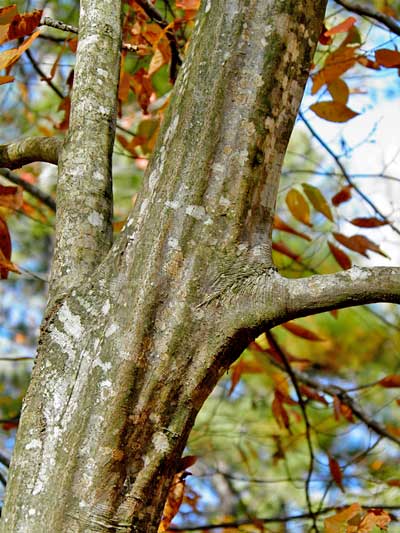
PHOTO BY DAVE OTTO. The color and texture of ironwood are part of the beauty of approaching winter.