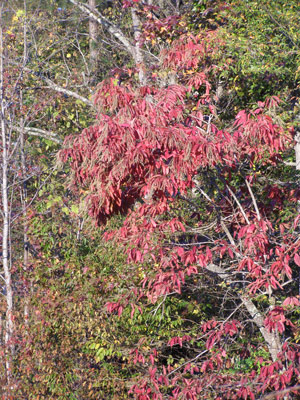
‘Peak’ burgundy-red foliage of sourwood persists for weeks. Photo by Ken Moore
Flora Columnist
At this time of year, I poke fun at the craze to travel far and wide to view “peak†fall color. I remain suspicious that “peak†is a ploy by the tourist industry to lure us up to our mountain counties for a once-in-a-lifetime experience to see all the colors at one perfect location on a single perfect day.
All the times I’ve traveled west for the “peak,†I’ve been greeted with: “Oh, you should have been here last week!†or “Sorry, you’re a bit early; you’ll have to come back next week to catch ‘peak.’â€
I may have caught “peak†one year, but through the fog and rain, I had to imagine it with the leaves clinging to the car windows.
This year is different! Driving for the past three weeks on back roads to and from the southwestern edge of Alamance County near Alamance Battleground, I’ve enjoyed a slow subtle progression of colors from greens to all shades of autumn. Last week, the shades were close to blindingly brilliant, so perhaps I’ve caught peak.
But on second thought, I’m not sure. There’s still quite a bit of green left on deciduous trees. The many different oaks are just beginning to show some of their red colors deep inside their spreading canopies. The burgundy-reds of the dogwoods and sourwoods have been evident for weeks, as have some of the shiny-reds of sumacs and red gum.
Leisurely strollers around the rolling landscape of Chapel Hill’s Merritt Pasture will have noted colorful mosaic patterns of the gold and yellow tulip poplars, hickories and southern sugar maples on distant forested hillsides. In contrast, one particular red maple out west along N.C. 54 has been having its very own singular peak of bright red for the past two weeks.
Maybe we simply don’t have peak around our region, at least not the all-at-once, one-to-two-week show that occurs in the mountains. We all need to keep a sharp lookout for the next week or so, just in case peak really is sneaking up on us from Alamance County. Maybe we can catch it!
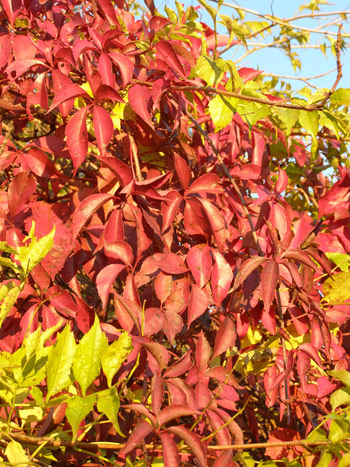
Brilliant red foliage of Virginia creeper is still evident climbing high everywhere. Photo by Ken Moore
I have a notion that peak is a condition of the mind, simply a manner of observing. Or perhaps our region has a much longer peak than the mountains. Some of our local dogwoods and sourwoods began turning back in early September, and I promise you there will be spots of peak all the way past Thanksgiving, with some beautiful burgundy and reds of numerous blueberries and sparkleberries.
My very own peak this year has been the Virginia creeper, Parthenocissus quinquefolia, unnoticed until recently, turning red within the greenery of the trumpet creeper, Campsis radicans, on the edge of my driveway.
Virginia creepers, beginning in late September, are still noticeable everywhere, clinging to utility poles and tall trees, and even climbing up beneath the Columbia Street overpass near the James Taylor bridge.
We’re fortunate to have so many “peaks†without having to travel far.
Email Ken Moore at flora@carrborocitizen.com. Find previous Ken Moore Citizen columns at The Annotated Flora (carrborocitizen.com/flora).
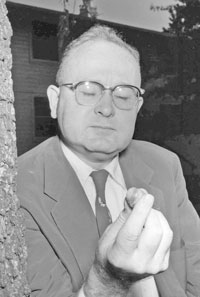
Pete Ivey contemplates a persimmon. Photo by Roland Giduz
Flora Columnist
Right here in the middle of persimmon season, I’m realizing that I don’t remember ever seeing such a bountiful crop from our native fruit tree, Diospyros virginiana. This fall’s heavy crop on trees along roads around town makes me aware of numerous specimens I’ve never before noticed.
Ever year during ’simmon season, I remember “Persimmon Pete†Ivey, who for 20 years was director of the UNC News Bureau. Pete died back in 1975, and though during those years I remember folks talking about Pete’s persimmon recipes, I never met him and I’m sad about that.

These Alamance County persimmons have breadth of more than 1.5 inches. Photo by Ken Moore
And every year during ’simmon season, I also remember Roland Giduz, lifelong Chapel Hill resident, 14-year member of the Chapel Hill Board of Aldermen and longtime photographer, reporter and columnist for the Chapel Hill News Leader. When Roland died in January 2009, our towns lost a wonderful friend, a man who so enthusiastically kept the community personalities, traditions and stories alive in our consciousness.
In the late 1950s, Roland described Pete Ivey’s enthusiasm for persimmons in the old Chapel Hill News Leader. Stories of “Persimmon Pete,†the self-proclaimed “patron saint of persimmonry,†and his persimmon recipes became legendary.
You’ll enjoy reading about Pete and his persimmons, and more, in Roland Giduz’s Who’s Gonna Cover ’Em Up?!: Chapel Hill Uncovered – 1950-1985.
Following Pete’s death, Roland carried on the “persimmonry†tradition, going so far as to initiate a campaign to have the persimmon declared the state fruit. Sadly, not enough enthusiasts gathered around that cause. The scuppernong grape (Vitus rotundifolia) was declared the official State Fruit in 2001. But scuppernong is a vine, so it’s appropriate to pick up the torch and lobby for the persimmon to become our official State Native Fruit Tree.
In the meantime, persimmons will be dropping fruit for several more weeks, so find yourself a tree and make daily visits to collect those ripened fruits from the ground before the possums and other critters beat you to it. Make certain the persimmon is ripe, soft to the touch; you’ll never put an un-ripened one in your mouth a second time!
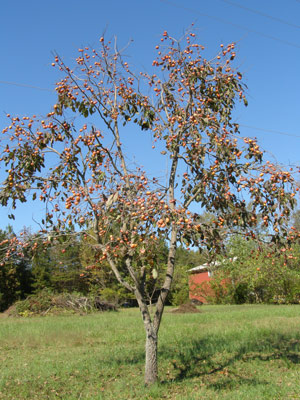
A robust dwarf persimmon tree grows in rural Alamance County. Photo by Ken Moore
Most folks use persimmons for pudding and bread recipes, or beer. I prefer simply eating a ripe one as it is, and the pure pulp makes a great ice cream topping. Save the flat, long-oval, dark-brown seeds and plant them in the ground where you want your own persimmon trees. Plant several seeds some feet apart, for you need male and female trees if you want fruit.
I have my eye on what may be a dwarf tree growing along a roadside near Alamance Battleground. It produces abundantly every year and has the largest, most delicious fruit I’ve ever tasted. I’m taking Matt Gocke, the botanical garden’s tree propagator extraordinaire, to see that tree. I hope Matt will succeed in producing lots of offspring from that tree, and I’d like to call them all, “Persimmon Pete’s Delight.â€
What I am missing is Pete Ivey’s persimmon recipe. Somehow I’ve missed obtaining it. I hope one of you out there has or remembers it. Please forward it to flora@carrborocitizen.com so it can be shared.
Editor’s Note: Following this Flora column on persimmons, the family of Pete Ivey shared his persimmon pudding recipe.
Persimmon Pete’s Persimmon Pudding

A caricature of Pete Ivey drawn by Bud Brexler, director of security for N.C. Memorial Hospital, for Pete’s 20th anniversary as director of the UNC News Bureau on Sept. 1, 1975
Persimmon pudding is good hot or cold, and some like to add vanilla ice cream or whipped cream. Pete Ivey often froze it and his kids would eat it right out of the freezer, little sliver by little sliver, hoping the shrinking delicacy would not be noticed.
Special thanks to Persimmon Pete’s daughter, Helene Ivey, for sharing his favorite recipe.
Ingredients
2 cups persimmon pulp (about two dozen persimmons strained through a colander)
3 eggs
1 ¼ cups sugar
1¼ cups all-purpose flour
1 teaspoon baking soda
1 teaspoon baking powder
½ teaspoon salt
½ cup melted butter
2½ cups whole milk
2 teaspoons cinnamon
1 teaspoon ginger
½ teaspoon fresh grated nutmeg
Procedure
Beat all ingredients together well and pour into a 9-by-9-inch well-greased baking dish. Bake at 325 degrees for about an hour or until firm.
Email Ken Moore at flora@carrborocitizen.com. Find previous Ken Moore Citizen columns at The Annotated Flora (carrborocitizen.com/flora).

Bizarre hybrid pitcher plant, Sarracenia ‘Mardi Gras,’ is easy to grow in pots. Photo by Ken Moore
By Ken Moore
Flora Columnist
The book Bizarre Botanicals, by Larry Mellichamp and Paula Gross, professors of botany and horticulture at UNC-Charlotte, quietly hit bookstores last year without its deserved fanfare. Perhaps one day this volume will be discussed by D.G. Martin, my favorite columnist, next to Andy Borowitz.
D.G.’s popular UNC-TV Book Watch series, as described in his weekly newspaper column, focuses on North Carolina’s stellar novelists, historians and other notable personalities. D.G. has little spare time to become entangled in the bizarre world of some of our native and cultivated plants.
However, knowing that he loves plants and nature, I suspect he would have a “romp†of a good time focusing on this lively volume that contains stories on numerous plants with such engaging names as voodoo lily, bat-faced cuphea, love-in-a-puff, love-lies-bleeding and hearts-a-burstin’.
Not surprisingly, this journey through the bizarre world of plants begins with the stories of carnivorous plants. North Carolina is famed as the native home turf of numerous species of pitcher plants, Sarracenia species and our most famous Venus flytrap, Dionaea muscipula.
For decades, the stellar display of carnivorous (insectivorous) plants at our local botanical garden has enlightened young and old alike with the clever ways these plants trick, trap and eventually digest a diversity of insect and small animal prey.
Mellichamp and former botanical garden curator Rob Gardner spent many years producing named cultivar hybrids of our native pitcher plants for the delight of gardeners everywhere. Many local gardeners enjoy growing these beautiful, bizarre hybrids in bog gardens and pots.
In addition to North Carolina representatives of carnivorous plants, images and stories of species from around the world are included in this colorful tour of botanical sex, death and wizardry.
The authors provide recommendations for home cultivation of all the plants featured, which is fortunate since many of the bizarre botanicals are from far-off tropical places and require indoor cultivation during our winter season.

Seeds of hearts-a-bustin’ literally burst from the heart of strawberry-shaped capsules. Photo by Larry Mellichamp
A surprising number of these “bizarre†curiosities are found in our near-by forests. The spring flowering Jack-in-the-pulpit (do you know it frequently changes its sex?) is always a delight when discovered in shady, wet areas. The garish, fruited hearts-a-burstin’ or strawberry bush would show off its fall seed capsules throughout our forests were it not a favorite food for local deer. Impressive specimens can be viewed behind the deer fencing at the botanical garden.
Make note that just before Halloween, you have an opportunity to hear Mellichamp describe and illustrate bizarre plant behaviors, including pyrotechnic spores that burst into flame, “shy†foliage that cowers from the slightest touch and even plants that fake death to attract pollinators. The free illustrated lecture and book signing at the botanical garden is at 2:30 p.m. on Sunday, Oct. 30. Please call 962-0522 to register so that garden staff can plan accordingly for this free event.
Though it may someday be featured on Book Watch, make note that you learned about Bizarre Botanicals first at The Carrboro Citizen.
Email Ken Moore at flora@carrborocitizen.com. Find previous Ken Moore Citizen columns at The Annotated Flora (carrborocitizen.com/flora).
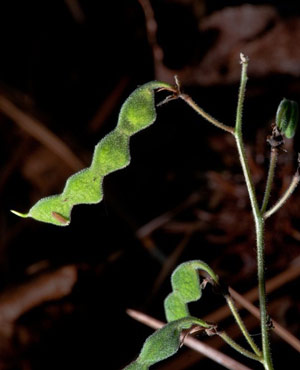
Hitchhikers are lurking everywhere. Photo by Parker Chesson
Flora Columnist
Beggar ticks, or hitchhikers, on pants legs are a sure prelude to fall. Two weeks ago, I described how the dollar leaf, Desmodium rotundifolium, was such a ground-hugger that its seeds were not likely to hitch rides on passersby. I was wrong.
This week, Parker Chesson shared the latest of his seasonal-photo studies of this plant, with the observation that, as with all the other species of Desmodium, this velcro-lined little segmented bean does indeed reach up from the ground high enough to hitch a ride.
Last week, I discovered lots of hitchhikers out in Merritt Pasture, now easily accessed via the new Chapel Hill Morgan Creek Trail. Three cheers for Chapel Hill for extending their creekside greenway system to provide us another destination for walking, jogging, biking with children and catching glimpses of the resident squirrel-chasing red-tailed hawks down beneath the James Taylor Bridge.
A walk around Merritt Pasture is a joy from bottom to top. Two weeks ago, Robert Johnson’s Nature Notes workshop participants enjoyed observing the bluebirds that disappeared when the hawk arrived. In addition, they were appreciative that Chapel Hill carefully protects, from seasonal mowing, several large populations of common milkweed to accommodate annual visitations by monarch butterflies.
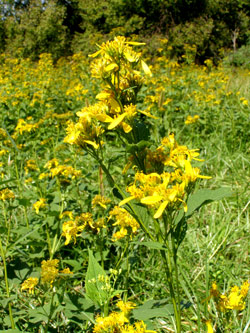
Wingstems colored the meadow yellow. Photo by Ken Moore
At the top of the meadow, near a bench thoughtfully placed beneath the big honey locust, Gleditsia triacanthos, class participants settled down to make quick sketches of the landscape. From the top, the rolling landscape seemed draped with a carpet of purple and yellow. Throughout the sea of native purpletop grass, Tridens flavus, were scattered populations of two species of yellow flowering wingstem, Verbesina alternifolia and V. occidentalis.
Though at the time the distant forest canopies were a cacophony of greens, it was noted that this is a prime spot to take in our leisurely progression of fall colors.
The various species of trees are just now donning their autumn coats and they will, one by one, show off for several weeks to come. Make plans to enjoy several walks to catch the seasonal show. And take along a copy of Fall Color and Woodland Harvests by Ritchie Bell and Anne Lindsey – your closer look adventure will be more fun as you learn to identify trees by their characteristic colors.
And capturing one’s walks out in nature with simple haiku lines is an easy way to preserve special moments.
Stately tall wingstems
Turn the rolling slopes yellow
Before fall begins
From top of the hill
Autumn tints all take a turn
On Merritt’s Pasture
If you think you’re not a poet, you’re wrong. As I’ve encouraged before, everyone can haiku. The North Carolina Haiku Society is leading folks out into the N.C. Botanical Garden and forest trails for a special haiku workshop on Saturday, Oct. 22 (more info at 962-0522). You’ll discover that haikus are a quick and easy way to remember the special fall moments that are about to explode all around us.
Whether or not you sketch or haiku, get outdoors to keep up with the fall.
Email Ken Moore at flora@carrborocitizen.com. Find previous Ken Moore Citizen columns at The Annotated Flora (carrborocitizen.com/flora).

Students of Robert Johnson (third from left) take in the view from atop Merritt Pasture. Photo by Ken Moore

Bushy-beard lichen (Usnea strigosa) is a common fruticose form found on trees. Photo by Gary Perlmutter
By Ken Moore
Flora Columnist
Lichens are pioneer plants, colonizers on boulders and other bare surfaces, slowly developing layers of soil particles for the establishment of larger plant communities.
They are diverse and beautiful, and frequently engage us to pause for an admiring closer look, after which, if you’re like me, you most likely move on wishing you knew more about lichens. These are the times we need the company of one of those rare lichenologists, and we are fortunate to have one, Gary Perlmutter, right here in our region.
Gary contributes an introduction to lichens for this week’s Flora:
“Just what are lichens anyway?”
When out in the woods or even in your backyards, you often admire the trees, shrubs and wildflowers. But if you look closer on the trees, rocks and soil, you’ll see little colorful, plant-like things quietly growing on them. They may look like splotches of paint, ruffled leaves or tiny shrubs. These aren’t plants at all, but strange life forms called lichens.
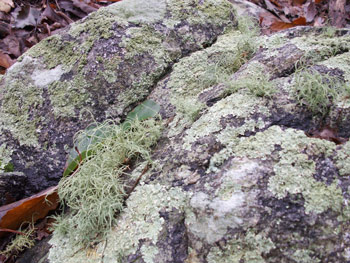
There are at least six species of crustose, foliose or fruticose lichens growing on this boulder surface. Photo by Gary Perlmutter
Lichens are symbiotic organisms, consisting of a fungus and a photosynthetic partner living together as one. I say ‘photosynthetic partner’ because it could be a green alga, which is a plant, or a blue-green alga, which is really a type of bacteria.
My old college buddy Greg who led hikes in northern California would say, ‘Freddy the fungus took a lichen to Angie the algae,’ to describe this unusual type of life form.
Recent research has revealed the relationship is even more complicated, with entire communities of bacteria living inside lichens. Some researchers consider lichens not as individuals but entire ecosystems in miniature.
We lichenologists use the term ‘thallus’ to describe a lichen body. To blur things further, a lichen thallus can be a single lichen or a colony of several lichens merged into one. So the concept of the individual is thrown out the window!
Generally, lichens come in three growth forms or body types: ‘crustose’ (crust-like), ‘foliose’ (leaf-like) and ‘fruticose’ (shrub-like). And they come in a wide array of colors, from black to brown, to green, blue, yellow, orange, red and white. Most are a grayish-green.
Given enough time, lichens grow on just about anything – bare soil, rocks, wood, mosses and even on the bark of trees, from the roots up the trunk and to the canopy branches and twigs. Some lichens grow on other lichens, crowding each other as they compete for light and space. Sometimes if you pick up a fallen branch, you’ll see it’s completely covered with several different kinds of lichens – a community unto itself. In the natural world, you are never far from a lichen.â€
Gary, who is engaged in surveying the lichens of the Piedmont region, will lead a one-day introductory class on the identification and weird ways of lichens at the N.C. Botanical Garden on Oct. 15. I’m definitely sitting in on this one. Call the garden at 962-0522 to register and become the first lichenologist in your neighborhood.
Thank you, Gary, for introducing Flora readers to the world of lichens.
Email Ken Moore at flora@carrborocitizen.com. Find previous Ken Moore Citizen columns at The Annotated Flora (carrborocitizen.com/flora).

The dark squiggly lines on the holly tree trunk are common script lichens (Graphis scripta). Photo by Gary Perlmutter
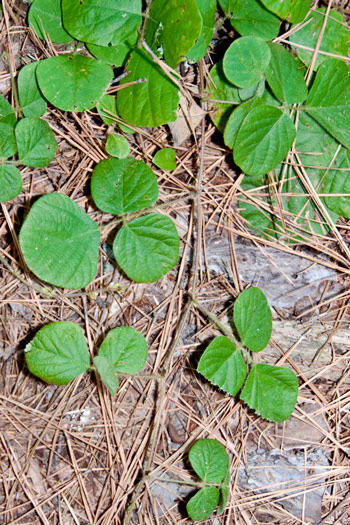
The round leaflets of dollar leaf are easy to spot. Photo by Parker Chesson
By Ken Moore
Flora Columnist
Desmodium is the genus name for beggar lice, beggar tick, tick-trefoil and whatever common name you may prefer for these common plants in the bean (pea) family. There are many species, and they can be very challenging to identify.
Desmodium, from the Greek word “demos,†means band or chain, referring to the chain-like attachment of single flattened bean seeds, forming a very curious looking bean pod.
You may recall times when you have returned from a walk through local fields to discover your pants covered with tiny, flat, triangular-shaped seeds that cling tenaciously, as if covered with Velcro-like hooks.
One of these, Desmodium rotundifolium, will probably not find pants legs on which to hitch rides because it tends to slink along the ground and prefers forests and shaded field edges rather than wide-open areas. The species epithet, “rotundifolium,†is appropriate, as the meaning is “rotund†– round, “folium†– leaf. This roundleaf tick-trefoil is easy to spot with its three-compound (trifoliate) leaves of silver-dollar shaped leaflets. I like to use dollar leaf as a common name because it is so visually descriptive.
Though not a rare plant, one doesn’t frequently encounter it because it remains mostly unnoticed, spreading quietly along the ground. Durham resident and Citizen reader Parker Chesson forwarded me an image of the foliage early in the summer, wondering about the plant’s name.
I always love plants that are easy to identify, so I was happy to give Parker an immediate response without any head-scratching or having to go to my shelf of frequently used botanical references.
Realizing that I have never observed the flowers of dollar leaf and knowing that Parker is a fine photographer, my response included a challenge. Learning that Parker has a population of dollar leaf in the woods edge of one of the trails where he frequently accompanies his grandchildren on nature excursions, I asked him to capture some images of the flowers whenever they may occur during the season.
The season flew by and I was about ready to assume there were no flowers on Parker’s plants this year, when I received some flower images and a happy story. Parker said he routinely passes along his woodland path on his way to the veggie garden. Here at summer’s end, he had not been visiting the garden as frequently and had just about given up on spotting any flowers this year.
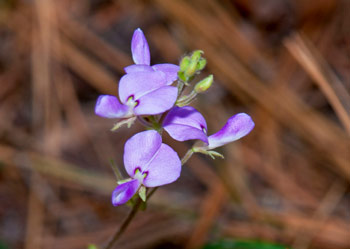
Dollar leaf flowers are close to the forest floor and seldom noticed. Photo by Parker Chesson
But one day two weeks ago, Parker was accompanied by his 5-year-old grandson, Cail Sullivan, who has learned from Parker how to take “a closer look.†Having run ahead, as is his habit, Cail surprised Parker when he came running back exclaiming: “Granddaddy, come look at this purple flower. You might want to take a picture of it.â€
And so it is that I have now finally seen an image of the dollar leaf flower, and Flora readers have young Cail to thank for discovering the flower that his granddaddy photographed to share with us.
There are always treasured surprises when we take the young ones along to help us see.
Email Ken Moore at flora@carrborocitizen.com. Find previous Ken Moore Citizen columns at The Annotated Flora (carrborocitizen.com/flora).
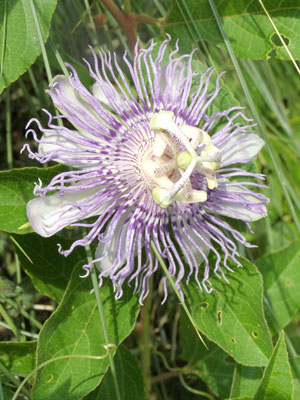
Passion flower is intricate and exotically beautiful. Photo by Ken Moore
By Ken Moore
Flora Columnist
One of my favorite native vines is passion flower, frequently called maypops and officially recognized as Passiflora incarnata.
The intricate structure and beauty of the flower inspired early Jesuit missionaries to honor it with multiple descriptions of religious symbolism. If you are curious about the details, simply go online and search for “passion flower religious symbolism,†and you should be more than satisfied.
Lauri Lawson, “plant whisperer†and Niche Gardens horticulturist, is downright passionate about passion flower. Recently she told me, “Native passion flower is one of my top favorite plants ever! It’s easy to grow, it’s exotically beautiful and it has special edible and medicinal qualities. It appeals to numerous important pollinators, particularly some of the big carpenter bee types, that appear to be on quite a carnival ride as they whirl ’round and ’round gathering pollen and nectar and pollinating while they’re at it. The fruit, maypops, that follow are full of succulent, tropical-sweet seed sacs. The leaves have a traditional use for calming the nerves, insomnia and hypertension.â€
Lauri and I both value Dr. Jim Duke’s herbal studies, and you will find his passion flower discussion in The Green Pharmacy very helpful and most interesting.
We also value this plant in the garden. It’s a vigorous vine, and Lauri cautions to make certain it has lots of space to twine and spread. I will add that once it is established, passion flower is certain to remain for a long time. But don’t expect its reappearance each season at the spot of your original planting (I discovered this from my own experience). Its roots run underground in all directions so that you never know where it may appear until it breaks dormancy in late spring. Telltale vertical, three-lobed leafy stems can appear anywhere in the lawn and garden beds.
I watch for the stems every year from late April to mid-May and when I spot them, I set mighty trellises at the base of the stems to help them reach for the sky. I am rewarded from mid-summer until frost with a succession of the most beautiful flowers imaginable.
And as Lauri described, one can become engaged in observing the bumblebees and other pollinators examining the intricate flowers.
During cool fall afternoons I have observed that some of those big solitary bees nestle down in the flowers, seemingly taking shelter within those closing flowers for the duration of the chilly night.
During these next several weeks, I plan to extend my observations of specific bee-sheltering flowers early in the mornings to discover whether or not those bees in fact do spend the night within the flower.
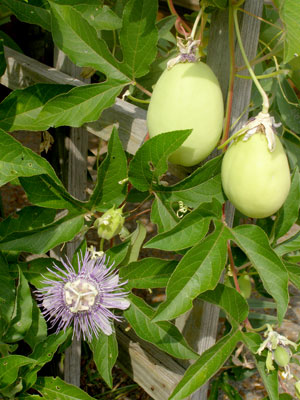
Passion flower egg-shaped fruits, maypops, and three-lobed leaves are distinctive. Photo by Ken Moore
If you desire to have your own passion flower, you’re in luck. The N.C. Botanical Garden will have a few passion flowers at their annual fall plant sale this coming Saturday morning (Friday evening preview for Garden members), and Niche Gardens always has a good supply available.
As no garden exists without passion, no garden should exist without a passion flower vine!
Email Ken Moore at flora@carrborocitizen.com. Find previous Ken Moore Citizen columns at The Annotated Flora (carrborocitizen.com/flora).
Sometimes native vines seem invasive

Young creeping cucumber berry is evident before the flower fully opens. Photo by Ken Moore
By Ken Moore
Flora Columnist
When asked by a Flora reader some weeks ago why I did not focus on vines, I didn’t realize that my response would be to become as compulsively focused as I have been lately. Please forgive, forbear and above all, take note.
While notorious exotic invasive wisteria, Japanese honeysuckle and oriental bittersweet are so obviously evident everywhere, the presence of our important native vines can easily slip beneath our cursory visual radar.
Now that I have been focusing on native vines, I am realizing that just about all of them are climbing or sprawling about somewhere on my home turf. From time to time, one or more of these natives become so vigorous that one could view them with the same disfavor we hold for the aforementioned exotics.

Creeping cucumbers are definitely pendulous. Photo by Ken Moore
In Bringing Nature Home, a book we should all read, biologist Doug Tallamy provides perspective on why our native vines may seem out of control. “In the old days, woody vines were restricted to edge habitats where there was plenty of sun. When a tree fell or a fire opened a gap in the woods, viney species would use the trees on the opening edge for support as they climbed into the canopy for sunlight. When the forest gap closed, the seeds from the vines no longer germinated, or if they did, the seedlings were unable to thrive in the shade of the closed canopy. So vines were ephemeral in their impact on the trees of mature forests.â€
Today the fragmented forest of human-altered landscapes has resulted in edge habitats everywhere. It may be necessary to step in and modestly curtail the exuberance of our valuable native vines from time to time, like the backyard morning-glory management I described in last week’s Flora. When dealing with the sometimes invasive qualities of our native vines, it is important to keep in mind that the natives provide critical food and shelter for our native fauna, whereas the value of the exotic vines is negligible or nonexistent.
In my wild yard I am managing another exuberant native vine; keeping it in check is easy, less than a half-hour weeding per year. Some of you may recognize this sprawling, small three- to five-lobed leaved vine with tiny yellow flowers followed by miniature watermelon-shaped fruit. It’s called creeping cucumber, Melothria pendula, and the species epithet is descriptive of the very pendulous oval berry.
I well remember years ago when an older friend of mine discovered it in my yard and began consuming it with gusto, but please be advised that though this little cuke is described on some websites as being edible while still green (before it ripens black), I don’t recommend it. My native plant guru, Dr. Jim Duke, does not include it in his Handbook of Edible Weeds and Ritchie Bell and Anne Lindsey, Wild Flowers of North Carolina, advise: “The berries have a strong laxative effect and are considered toxic; do not ingest!â€
Be like me and simply observe the miniature flowers and fruits and contemplate what manner of wildlife may depend on this diminutive native vine.
Email Ken Moore at flora@carrborocitizen.com. Find previous Ken Moore Citizen columns at The Annotated Flora (carrborocitizen.com/flora).
By Ken Moore
Flora Columnist
This is the time of year when I let the common morning glories, Ipomoea purpurea, run freely over my yard and garden. Until now, I’ve occasionally pulled the fast-growing vines from the veggies and other plants I didn’t want overwhelmed by the vigorous vines.

A wild, blue morning glory for Tar Heel fans. Photo by Ken Moore
Now I welcome the lushness and beauty of the heart-shaped morning glory leaves climbing and hanging everywhere. Early-morning displays of pink, blue and dark purple flowers are a delight. This year, Tar Heel blue flowers have appeared on the deer fence protecting my tomatoes and okra. Tar Heel fans should be happy to have this volunteer on their home turf.
This annual vine hails from tropical America and will produce seedlings everywhere next year. I’m not a bit worried, since I’ve been managing morning glory behavior for years.
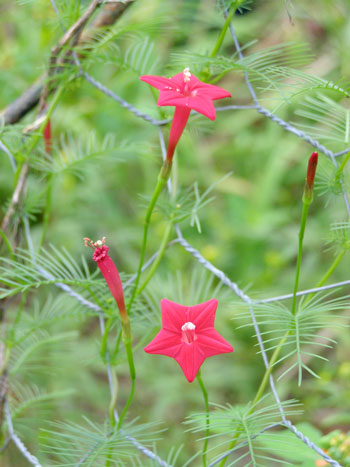
There are two other brightly colored morning glories you may find volunteering in your garden. One is cypress vine, Ipomoea quamoclit, which also originates in tropical America; the tiny, scarlet, trumpet-shaped flowers and compound leaves of numerous thread-like segments are unmistakable. The other one, also bearing brilliant red, tiny trumpets, is red morning glory, Ipomoea coccinea; it bears angular, heart-shaped leaves and is native to the southeastern U.S.
Both are annual and freely reseed each year.
Now, if you notice a white-flowered morning glory in or around your domain, you will want to take a much closer look. If the flower is large (2-4 inches) with a deep red center and the leaves are heart shaped, then you most likely have a manroot, or wild sweet potato, Ipomoea pandurata.
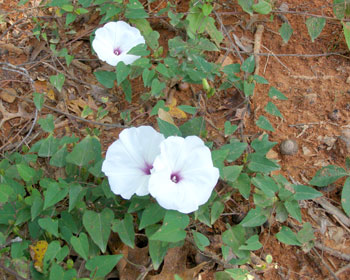
Beautiful manroot flowers are frequently seen on bare roadsides. Photo by Ken Moore
This plant is a native perennial with a large tuberous root and has the potential to become more aggressive than you may desire. It will continue to occur in the same spot each season, becoming more vigorous each season. Manroot has a heritage of Native-American medicinal use, and with a little searching you’ll find some suggestions for preparing the large edible, tuberous root. However, you won’t find it as delicious as the garden variety sweet potato, and you need to be aware that consumed raw or without proper preparation, those roots are mighty bitter, as in purgative.
The flowers of manroot are beautiful. I wish I had some in my landscape, but I’ve had to enjoy them as they climb up road signs and sprawl on bare road banks.
Beware of close-relative hedge bindweed, Calystegia sepium, which is a very vigorous perennial, capable of overwhelming adjacent preferred garden plants. The flower is white but lacks the deep red center of manroot, and has a leaf that’s arrow shaped with blunt or angled basal lobes.
I enjoyed discovering the red morning glory in several spots along the edge of Chapel Hill’s newly opened Morgan Creek Greenway on Labor Day. With a keen eye, you’ll discover all the other morning glories in surprising places up until frost time. One more point: their “glory†really is in the morning, so don’t expect to see them much past noontime on sunny days!
Email Ken Moore at flora@carrborocitizen.com.
Find previous Ken Moore Citizen columns at The Annotated Flora
Be certain you know the difference!
By Ken Moore
Flora Columnist
As described in last week’s Flora, you want to avoid close contact with ornamental smooth sumac’s viney cousin, poison ivy, Rhus radicans. Some of you will be eager to know that taxonomists have recently upgraded the name to its earlier nomenclature, Toxicodendron radicans. It sounds like “Tox-e-co-den-dron rad-e-cans†and is certainly more fun to roll off your tongue than is ‘rus rad-e-cans.’ Toxicodendron means poisonous tree, a clear warning to keep one’s distance.

Leaves of three, let them be/Leaves of five, stay alive. Photo by Ken Moore
I continue to be surprised that, when guiding school groups at a local nature center, I encounter so many youngsters that cannot identify this common poisonous native vine. The earth guide’s first action is to help the kids distinguish between the not-to-touch poison ivy and the, usually growing nearby, innocent Virginia creeper.
Compare in the photo above the poison ivy compound leaf of three with the Virginia creeper palmately (like a hand) compound leaf of five leaflets. Contact with sap of poison ivy causes a serious rash for most folks, while Virginia creeper is harmless.
Poison ivy can make a ground-covering carpet in sun and shade, and when it finds a tree to climb, the hairy stems are easy to spot as dark wooly cords clinging tightly to the trunk. In contrast, when Virginia creeper climbs a tree, the mature stems are free of such wooly hairs. The little holdfasts of young creeper stems resemble multiple tree frog feet clinging to vertical surfaces.
Both poison ivy and Virginia creeper have beautiful orange-red fall color that becomes noticeable in the interior of many trees at summer’s end.
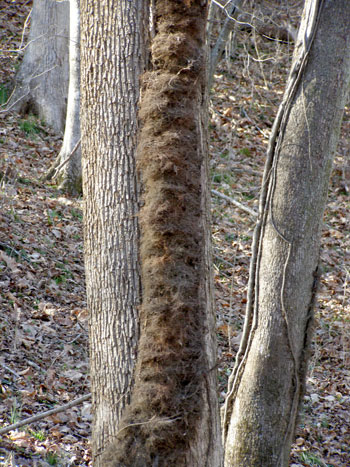
Tree-climbing poison ivy vines are dark and densely hairy. Photo by Ken Moore
At this time of year, you may spot the fleeting beauty of Virginia creeper berries turning dark blue on contrasting red stems. The berries of poison ivy are whitish and not very attractive.
The berries of both vines are important food for birds and other wildlife. Seeds of both are cleaned in the digestive tracts of birds and dropped everywhere. Appreciating the fall color and wildlife value of both vines, I am happy to welcome them in my wild landscape, allowing free reign to Virginia creeper, but trying to restrict poison ivy to the back edges, mostly beyond easy reach.
Virginia creeper’s official name, Parthenocissus quinguefolia, is even more melodious than poison ivy’s name. The genus name is derived from the Greek, parthenos – virgin – and cissos – ivy. Imagine a botanist naming this newly discovered “ivy†from the Virginia colony in honor of the “virgin†Queen Elizabeth I several hundred years ago. The species name, from the Latin, quinque – five – and folium – leaf – is purely descriptive of the vine’s five leaflets.
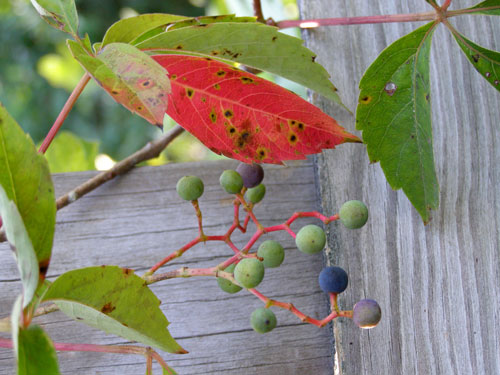
Beautiful Virginia creeper dark berries on red stems signal a tasty treat for birds. Photo by Ken Moore
Enjoy remembering the botanical name; it’s great fun to hear it roll off of your tongue. It sounds like “par-thee-no-siss-us quink-a-fo-lee-ah.†Now try saying the botanical names of both vines out loud and with a little practice, you’re armed to surprise your companions when you discover one or both on your next walk.

Virginia creeper vines climb via tiny holdfasts. Photo by Ken Moore
Email Ken Moore at flora@carrborocitizen.com.
Find previous Ken Moore Citizen columns at The Annotated Flora