By Ken Moore
Flora Columnist
Several years ago, purslane, Portulaca oleracea, began appearing in my vegetable garden. Just last week, I noticed tiny yellow flowers nestled in amongst all the succulent leaves.

PHOTO BY KEN MOORE. Tiny quarter-inch flowers of succulent purslane open for only a couple of hours, in mid-morning.
To quote from Paul Green’s Plant Book: “A curse in many a garden. This much-branched radiating annual is prolific as crabgrass and as common in all of the dry and sandy soils and waste ground of the Cape Fear Valley. It flowers in July and according to a book I read, like many other plants, it is good for nearly everything under the sun medicinally, being ‘emetic, expectorant, cathartic, diaphoretic, astringent, rubefacient, blistering, stimulant and is used in dropsy and as a powerful external stimulant.’ The Indians used it as a purgative.â€
And from James A. Duke’s Handbook of Edible Weeds: “Only in the United States has fame and favor eluded this hot-weather weed. Tender parts, leaves, flowers, pods, seeds and stems all may be served as potherbs, improved by adding egg and/or breadcrumbs. To me, the herb tastes like a slimy spinach. … The succulent stems may be pickled in brine or pickle vinegar … or to preserve this copious summer food for winter: put it into salt and dry white wine.â€
Alan Weakley, Flora of the Carolinas, Virginia and Georgia, places its origin in Asia, from where it has spread worldwide, with possibly numerous subspecies. I very much appreciate Alan’s assessment of this seemingly unlimited variation: “In North America, these genotypes appear to have intermixed; in our area, the recognition of infraspecific taxa appears to be unwarranted, difficult, and unmeaningful.â€
Now, I like that simplification! Alan goes on to add: “During the great depression, P. oleracea was eaten extensively in the Valley of Virginia as a potherb.â€
So with all these attributes and more, I’m not about to spend time weeding it out of the garden. Last year, it provided a living green mulch beneath my okra. I’m already encouraging it to spread freely beneath squash, pepper and tomato plants for this year’s mulch.
In fact, I can frequently be caught laboriously pulling unwanted plants of any kind when I see them emerging through my carpet of purslane. What I have here is the pursuit of a carpet of purslane as pure and clean as the most perfect weed-free carpet of green lawn pursued by energetic gardeners with similar, but opposed objectives. You are already familiar with that old notion that “one person’s weed is another one’s treasure.â€
This lowly ground cover is a true camel of the field. I am amazed each day as I notice how rapidly single plants can grow from seedlings to cover a foot or two of surface in utter defiance of days and days without water.
And just this past week, to practice what I describe, I enjoyed sautéing purslane with egg, of course with the necessary onions and olive oil, and, in addition, a fresh salad of conventional greens adorned with fresh succulent purslane leaves on the side. Both were delicious. The sautéed purslane was a nutty flavored delicacy, not at all the “slimy spinach†described by Dr. Duke.
Now that I reflect back, I realize that I forgot to add some of that spicy peppergrass growing along the drive.
Email Ken Moore at flora@carrborocitizen.com.
Find previous Ken Moore Citizen columns at The Annotated Flora.

PHOTO BY KEN MOORE. Drought-tolerant purslane makes a living green mulch beneath a squash plant.

PHOTO BY KEN MOORE. Peppergrass has flat, rounded seed capsules.
By Ken Moore
Flora Columnist
This week, I’m spicing up my yucca flower dishes (see last week’s Flora) with peppergrass harvested from the edge of the drive.
I’ve recognized peppergrass for years, but only this year have I taken a close-enough look to really value it. As long as I can remember, whenever I’ve seen the 1- to 2-foot-high stems with flat, round seed pods, I’ve remembered the plant and, though I’ve tasted its spicy flavor numerous times, I’ve just not given it serious consideration.
Perhaps the long, cool spring made me more observant this year. Several weeks ago, my eye was caught by tiny white flowers at the tops of rather nondescript weedy green plants growing along the drive. They had just begun flowering, and the characteristic flat, round seed capsules were not evident.
This time, I needed my trusty hand lens, which of course I always have in my pocket, to take a “closer look.†When I discerned four separate petals and six stamens, two of which were shorter than the other four, I immediately thought of the mustard family, the Cruciferae or Brassicaceae, depending on the botanical reference you may have at hand.
To verify my hunch, I reached down to taste a couple of leaves from the stem. The spicy, peppery taste is characteristic of the many native and exotic mustards we have so casually scattered throughout our yards and gardens.
It was easy to flip through images of the mustard family to identify this peppergrass, Lepidium virginicum, also called pepperweed. It’s definitely not a grass, though some may consider it a “weed.†I suspect earlier folks adopted these names because it tastes like pepper and is commonly found growing in fields with grasses and so-called “weeds.†Another name is poor man’s pepper, which makes sense if you consider relying on it in place of the store-bought spice.
Ethnobotanist Jim Duke enjoys nibbling the stem tops, including young leaves, fruit and flowers. I suggested this to a friend last week, and the surprise response was, “Sorta tastes like horseradish!†I’ve enjoyed adding the spicy plant tips fresh on salads and during the last stages of making omelets, sauces and soups.
Peppergrass is a natural source of protein and vitamins A and C and, if you do a little herbal sleuthing, you’ll find past and present medical uses.
This has been a most productive peppergrass season, and where there may be ample moisture, it will carry on through the fall. Look for it along walkways and edges of fields and forests in and around town. You probably have some savvy friends who may share some from their yards and gardens. If you don’t care to harvest any, pause in watchful contemplation. Peppergrass is a larval host plant for the checkered white butterfly, among others.
Email Ken Moore at flora@carrborocitizen.com.
Find previous Ken Moore Citizen columns at The Annotated Flora.
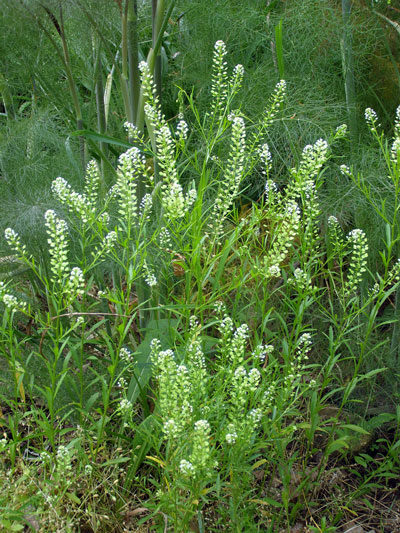
PHOTO BY KEN MOORE. Peppergrass is common now along walkways and edges of fields and forests.
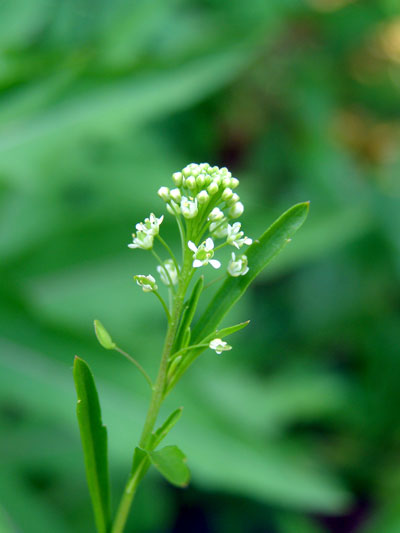
PHOTO BY KEN MOORE. Tiny four-petaled flowers are characteristic of the mustard family.
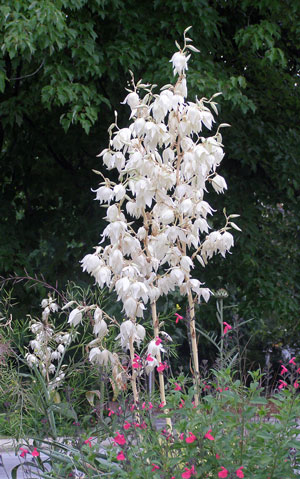
Flowering yuccas punctuate Chapel Hill Tire’s landscaped corner in Carrboro. Photo by Ken Moore
By Ken Moore
Flora Columnist
Now that yuccas are very noticeable as they approach full flowering, I remember a camping trip of a few years ago. It was early spring out in the Southwest, and our campsite was nestled down in desert vegetation, including many of the locally common yucca. The site is memorable; those yuccas were blooming, and the ground was literally carpeted with fallen flowers.
We quickly learned to carefully navigate in and around the campsite to avoid direct contact with the needle-pointed, spear-like foliage. A run-in with a leaf or two makes one appreciate the common name, Spanish bayonet.
I was in charge of hustling up the breakfast, and remembering that yucca flowers, as well as the buds and fruit, are edible, I thought I’d experiment. Having most of the desirable ingredients of primitive camping –olive oil, onions, garlic, peppers and eggs – I thought I’d add some fresh yucca flowers, just to see how edible they might be. Not surprisingly, my camping mates were skeptical, but willing to trust me. The resulting omelet-like concoction was delicious (like anything that includes onions sautéed in olive oil). So, for our several days there, we enjoyed yucca flower omelets as well as yucca flower-enhanced pasta sauces.
I’ve enjoyed watching a single yucca, Yucca filamentosa, just beyond my front porch, send up its giant asparagus-like stem of tightly clustered flower buds. Now the impressive flowering branch, a panicle, sporting buds and flowers, stands 7 feet tall above the basal rosette spear-like leaves.
My single plant is not nearly as spectacular as those so obvious now above the retaining walls along the bypass around Carrboro. Those most likely are volunteers, having found their way there thanks to traveling animals that have eaten the fruit.
More deliberate and quite engaging is the colorful ornamental Chapel Hill Tire landscape opposite the PTA Thrift Shop in Carrboro. Designed by Ginay Gregory of Beyond the Pail landscape design and consulting, that always-something-of-interest-to-see busy corner of our town now sports dramatic flowering stems of yucca – in this case, a variegated leaved cultivar.
Yuccas, like the onions and garlic in my camping concoction, are in the lily family, or at least they were until recently. Taxonomists are still working on new classifications within the former lily family. Meanwhile, take a closer look at a single yucca flower. It’s a perfect lily, characterized by three sepals (the outer set) and three petals (the inner set) appearing alike, thus called tepals. Inside the tepals you’ll spot six stamens surrounding a smallish, egg-shaped, superior ovary – superior because it’s situated above the stamens and tepals. Those are some of the basic characteristics of the lily family, with which you may impress friends and neighbors.

Yucca flowers are characteristic of the lily family. Photo by Ken Moore
By the way, just this past Memorial Day morning, I took advantage of my very own yucca flowers and, if I do say so myself, concocted a most delicious egg dish, including, of course, onions, garlic and olive oil.
Dr. Jim Duke’s Handbook of Edible Weeds describes other edible qualities of yucca. He also elaborates on the rich Native-American medicinal heritage of yucca root, including a root poultice used to prevent baldness. Well, I’m way too late to try that remedy!
Email Ken Moore at flora@carrborocitizen.com.
Find previous Ken Moore Citizen columns at The Annotated Flora.

PHOTO BY KEN MOORE. Yellow moth mullein is uncommon in our locale.
By Ken Moore
Flora Columnist
During the past week, I’ve been catching glimpses of little white flowers hovering just above the tops of grasses in rural areas outside Carrboro and in some of the unmowed roadside edges closer into town.
I’m particularly aware of them because I remember discovering a few some years ago in my infrequently mowed yard.
Most plants of moth mullein, Verbascum blattaria, are white-flowered, or at least that’s been my experience in observing them for more than 30 years. Whenever I see a yellow-flowering one, I always linger to enjoy, for me, a rare occurrence.
Earlier this spring, I spied a characteristic flat, round rosette of coarsely margined, deeply veined leaves at the end of my gravel driveway. Not having spotted any in the tall grasses of my yard yet this year, I took great care to avoid driving over this single plant.
Just this past week, I was pleasantly surprised to discover that it is a yellow-flowered specimen, and several of the more common white-flowered ones are beginning to express themselves above the grasses out in the yard.
Each flower opens for only a single day. The descriptive species name, blattaria, “moth-like,†is attributed to Roman naturalist Pliny the Elder’s description of the similarity of the flower’s hairy stamens to antennae on the heads of moths.
The flower is definitely worth a “closer look,†and you don’t need your trusty hand lens to see the beautiful purple-haired stamens crowned with vivid orange anthers. You can almost imagine some amorous moth approaching one of these flowers with more than food on its mind.
Bumblebees are frequently seen wrestling with the moth antenna-like stamens as they forage for the pollen. They must be effective pollinators, because the stems eventually display numerous round capsules holding countless seeds for dispersal later in the season.
In contrast to the common wooly mullein,Verbascum thapsus, with its large woolly leaved, cabbage-like basal rosette, the smaller moth mullein generally goes unnoticed. The basal leaf cluster of moth mullein hunkers flat on the ground like a pancake-sized, shiny, dark-green doily. You may notice the flat leaf rosettes in late fall and winter when the ground is more exposed to view. If you are lucky enough to spot some in your yard, mow around them to watch them flower next season.
Both mulleins are naturalized in open, sunny sites, having made their way across the Atlantic long ago with the settlers from Europe. Though in some states mulleins are considered invasive, they don’t pose a problem in North Carolina. The beautiful flowered moth mullein is hardly noticed as it struggles to compete with the lush, perennial vegetation of our open areas.
These plants will be in flower for the next couple of weeks, so keep a lookout for yellow ones.
Email Ken Moore at flora@carrborocitizen.com.
Find previous Ken Moore Citizen columns at The Annotated Flora.
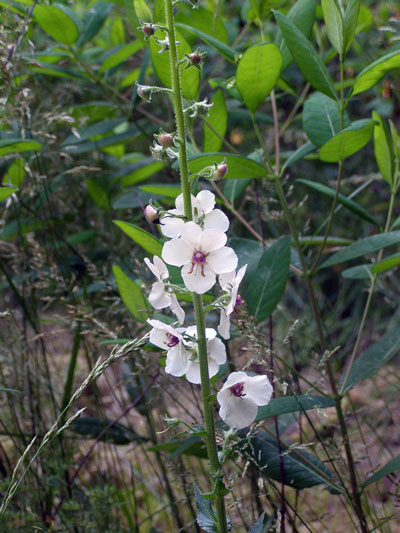
PHOTO BY KEN MOORE. Moth mulleins, most often white-flowered, occasionally show up in unmowed fields.
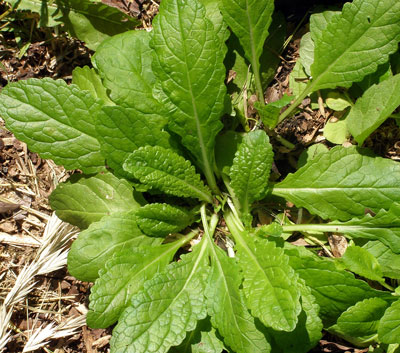
PHOTO BY KEN MOORE. Rosettes of shiny, deeply veined leaves characterize moth mullein.
Some cicadas stop to sniff the flowers
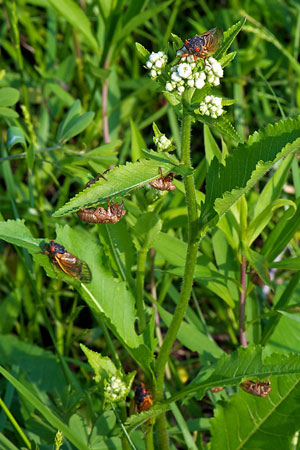
PHOTO BY PARKER CHESSON. This cicada sniffs wild quinine before taking to the treetops.
Flora Columnist
As described in last week’s Citizen, the media is abuzz with the sounds and sights of the 13-year cicada.
Members of Duke Garden’s spring flora class must be among the first to have spotted the early emerging members of this now famous Brood XIX. Three weeks ago, the class was exploring the flora of Penny’s Bend Nature Preserve to view some of the rare Piedmont prairie species. The glade wild quinine, Parthenium auriculatum, and eastern prairie wild blue indigo, Baptisia australis var. aberrans, were just beginning to peak. If you visit there in the next few days, you’ll most likely catch some still in flower.
The class was surprised to find these engaging red-eyed cicadas already there scattered throughout the low prairie vegetation. They were not yet in the trees of the adjacent forests, but, rather, seemed to be soaking up the sunshine while perched atop both the white-flowered quinine and the blue-flowered indigo.
They had emerged from the ground the evening before and climbed up the nearest vegetation – that being rare wildflower species – to shed their outside skeletons under cover of darkness. The cicadas were quite content to let folks get up close and even touch them. The adults require four to six days to fully mature before they begin several weeks of boisterous mating behavior in the treetops high above.
There is no concern that the rare quinine and indigo plants will be harmed by the visiting cicadas. For the most part, they are harmless to vegetation, even to the trees on which they feed and deposit their eggs. That will be particularly difficult to appreciate when we become alarmed at the sight of brown tree canopies in another week or so.
In those numerous, though isolated, areas where hundreds and thousands of cicadas have emerged, large deciduous trees, primarily oaks, will be littered with hanging peripheral twigs of brown foliage. The branch tips break and frequently fall to the ground because the female cicada has nibbled the twigs for nourishment and cut numerous slits to deposit eggs.
Healthy mature trees and shrubs will manage to survive this infrequent cicada occurrence. Serious harm may, however, result if cicadas choose recently planted ornamental trees and shrubs and fruit crops. You can protect smallish specimens by covering them with netting for the next several weeks. And, looking ahead, you can plan not to plant such cherished woody plants during years of anticipated large-scale cicada appearances.
Now, that’s easier said than done, isn’t it?
You’ll find lots of fascinating information on all the cicadas at magicicada.org. With a little browsing, you’ll learn not to plant tender young trees and shrubs in Rockingham and Yadkin counties in 2013 and definitely not in the Asheville environs in 2017, because broods of 17-year cicadas are scheduled to arrive then.
So for now, simply enjoy observing and learning more about another phenomenon of nature over which we have little influence.
Email Ken Moore at flora@carrborocitizen.com.
Find previous Ken Moore Citizen columns at The Annotated Flora.

PHOTO BY PARKER CHESSON. Two cicadas play hide-and-seek on blue indigo.

PHOTO BY PARKER CHESSON. This cicada bids farewell to its former self.
A spectacular Piedmont wildflower display

PHOTO BY KEN MOORE. The penstemons (beardtongues) are beginning to flower at Mason Farm.
By Ken Moore
Flora Columnist
Hey there folks, this is advance notice that the penstemons at Mason Farm are beginning to flower!!
Last week, a few early-flowering stems were evident. A “closer look†brought into focus hundreds upon hundreds of plants that will be coming into full, peak, flowering during the next two weeks.
Folks who enjoy walking the trail around Mason Farm’s Big Oak Woods during all the seasons may recall the charred, blackened appearance of some of the fields back in February and March. It’s unbelievable that spectacular masses of white flowers appear in those fields just two months after the N.C. Botanical Garden’s “fire crew†burned them.
The penstemon flowering will be more spectacular this year than last. Members of the garden’s fire crew said that prescribed burning (carefully planned and supervised fire used as a vegetation management tool) helps increase the diversity and flowering of plants in the fields. Fire also helps control some of the unwanted exotic invasives.
You’ll want to take a close look inside the snapdragon-like flowers to discover why they are called beardtongue. To avoid the poison ivy and ticks in the fields, I like to have binoculars handy for viewing flowers up close for surprising details. Those fields of wildflowers and grasses also attract all kinds of colorful pollinators, and binoculars help bring them in for close inspection.
We are fortunate to have such spectacular displays of wildflowers so easy to access without having to travel great distances.
Mason Farm is one of the most accessible nearby special places, and the entire experience is on easy-walking, level ground.
You can obtain a Mason Farm Biological Reserve visitor’s permit at the Botanical Garden reception desk. That permit allows you to enter the security gate that protects the natural area, which is open sunup to sundown. In the interest of protecting wildlife and ongoing biological research, dogs are not permitted, but you are very welcome to have children accompany you. Their eyes are keen and will show you things you most likely will miss.
Oh, I almost forgot: The official name of those beardtongues is Penstemon digitalis. It’s tall and white and covers the fields. Curiously, its natural range is limited to the mountains, and botanists are wondering how it arrived here, and when. Don’t be alarmed if you spot a few smaller, pinkish beardtongues scattered about among the taller white ones. Not certain what that one is, botanists simply say that it requires more study!
More importantly, make note that you have two weeks to view the penstemons, whatever species they are. Plan it as a peak penstemon break. It’s enough to rejuvenate both mind and spirit!
Find previous Ken Moore Citizen columns at The Annotated Flora.
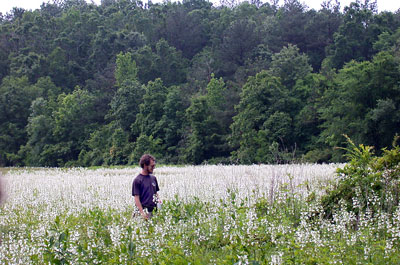
PHOTO BY JOHNNY RANDALL. The N.C. Botanical Garden's Dan Stern takes a “penstemon break†at Mason Farm.
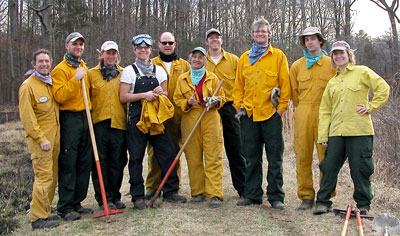
PHOTO BY JOHNNY RANDALL. The Botanical Garden's expert “fire crew†includes, left to right, Johnny Randall, Charlie Tomberlin, Monica Foley, Amanda Mixon, Andy Walker, Sally Heiney, Mike Kunz, Matt Gocke, JC Poythress and Irene Sadler.
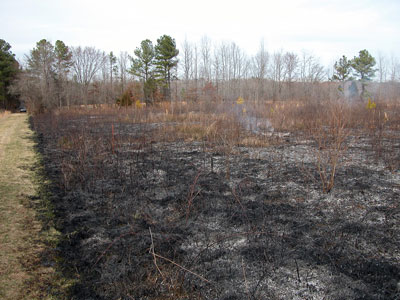
PHOTO BY JOHNNY RANDALL. This field, burned in March, is now a sea of flowering penstemon.
By Ken Moore
Flora Columnist
You may remember the Flora story last year of Muskie and Vikki Cates leading a group of paddlers down to explore the pond cypress, Taxodium ascendens, swamp of Horseshoe Lake in Suggs Mill Pond Game Lands. Seeing thousands of carnivorous trumpet pitcher plants, Sarracenia flava, in flower, as I described, was a “died-and-gone-to-heaven†botanical adventure definitely worth a paddle!
Well now, Muskie did it again and this time was joined by N.C. Botanical Garden assistant director for conservation Johnny Randall, accompanied by French student interns Lise Marchal and Arnaud Fâche, eager to experience, first-hand, some of the diversity of “wild North Carolina.â€
The day was memorable. As soon as he stepped from Johnny’s canoe-laden truck, Arnaud peered across cypress-rimmed Horseshoe Lake and exclaimed, “Wow, cypress trees growing in their natural habitat!†And that was just the beginning of a day paddle filled with countless botanical discoveries.
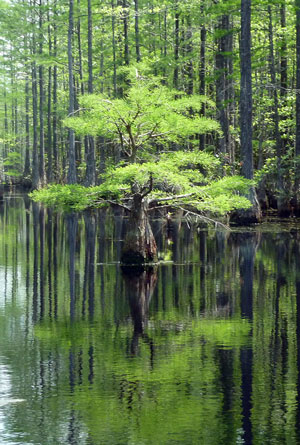
Some of the pond cypress trees resemble ancient bonsai. Photo by Lise Marchal
Lise and Arnaud are second-year students in a five-year landscape architecture program at the National School of Higher Studies in Blois, France. Their program requires an internship of practical botanical-garden training. Mutual good fortune brought them to Chapel Hill-Carrboro, where they are learning while assisting with the Botanical Garden’s new landscape installation, invasive-plant control and seed-cleaning, as well as working in the Coker Arboretum, Battle Park, Mason Farm Biological Reserve and local community gardens.

Lise Marchal and Arnaud Fâche, French landscape-architecture students, are studying “wild North Carolina†as spring interns at the N.C. Botanical Garden. Photo by Johnny Randall
While here, visiting “wild North Carolina†from the mountains to the sea is becoming an important part of their experience.
Lise says that the emphasis in the program at Blois “is not about memorizing a couple hundred landscape plants, but on learning to make close observations and developing skills in understanding the ‘nature’ of distinctive natural landscapes and making application to human-made landscapes.â€
Among Lise’s memorable images of Horseshoe Lake are the ancient-looking bonsai-type cypress trees scattered here and there beneath the high canopy of the cypress forest.
Muskie’s trip this time was a little later than last year and pitcher plants were past flowering prime. This time the spectacle of the day was acres of bladderworts, Utricularia spp., giving a yellow “buttercup-meadow†appearance over the pond surface. Arnaud’s keenness for botanical details had us all taking a “closer look†at the bladderwort flowers and, particularly, those tiny, insect-trapping bladder devices along the capillary, thread-like aquatic leaves that support the plants’ flowering stems.
To these exploring French students, Suggs Mill Pond was every bit as engaging as Monet’s famous garden’s water-lily pond.
In a few weeks, Lise and Arnaud will take leave to visit other regions of our country, carrying with them rich memories of “wild North Carolina.â€
Email Ken Moore at flora@carrborocitizen.com.
Find previous Ken Moore Citizen columns at The Annotated Flora.
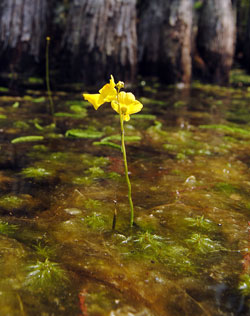
Flowers of bladderwort extend above the aquatic, thread-like leaves. Photo by Arnaud Fâche
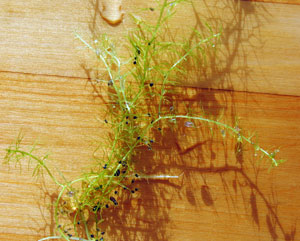
Tiny black dots on the canoe paddle are the insect-trapping “bladders†on bladderwort’s capillary leaves. Photo by Arnaud Fâche
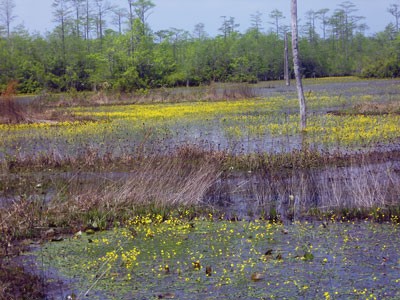
Yellow flowers of bladderworts cover the surface of Horseshoe Lake. Photo by Muskie Cates

PHOTO BY KEN MOORE. You must look up in the treetop for cross-vine flowers.
By Ken Moore
Flora Columnist
Crossing the Haw River in Saxapahaw last week, I glimpsed the flowers of cross vine, Bignonia capreolata, hanging in treetops where they reach for sunlight. Those vines were at peak flower a week or more ahead of the ones scrambling on my deck.
Wondering what early garden writers may have described of this seldom-noticed river-edge vine, a brief search led me to a multi-volume English work with a long descriptive title.
The Botanical Cabinet consisting of Coloured Delineations of Plants from all countries with a short Account of each, Directions for Management, etc. By Conrad Loddiges & Sons. The Plates by George Cooke.
“Even Solomon in all his glory was not arrayed like one of these.â€
There was great enthusiasm for new plans from America and other exotic places.
The introduction from Vol. 1, 1815 is worth sharing:
“We purpose to give such a representation of each plant as shall directly lead to what we may call a first-sight acquaintance with it; also some account of those peculiar qualities which any of them may be known to possess, a few hints on their cultivation, and any other remarks which may be thought interesting.â€
Sounds like a practical horticultural guide.
“This is assuredly no dry or abstruse study; it is a perpetual spring of the most genuine satisfaction. Even when cares and troubles assail the mind, and overshade all things with gloom (and no one is always exempted from such things) even then let us look at these beauties – let us contemplate them. Yes! We will ‘consider the Lilies how they grow.’ Our Divine Saviour himself commands us to do it, and never did He enjoin anything which was not for our truest felicity.â€
And definitely an invitation to nourish the inner spirit through gardening.
“We have only to add that our most esteemed and very particular friend, Mr. George Cooke, has devoted his talents (already so well known to the public) to this work. We are sure nothing more need to be said about its execution.â€
And, finally, an appreciation for the volumes’ illustrator.
George Cooke’s hand-colored copperplate engraving appeared in Vol. VIII in 1823 accompanied by the following description:
“A native of woods on the banks of rivers and lakes from Virginia to Florida. It is an elegant climbing plant, and although it will stand our usual winters in a defended place, out of doors, is yet seen to best advantage planted in a conservatory, in which situation we have had it for several years. It flowers beautifully in May and June. The soil should be loam and peat. It may be increased without much difficulty by cuttings and layers.â€
It needs no such “defending†here in its natural forest, where one generally sees flowers only after they have fallen to the ground from sunny treetops. However, some keen local gardeners have brought cross vine down to eye level on arbors or trellises.
While there are horticultural selections, I prefer the naturally occurring bi-colored beauty, so brilliantly captured by 19th century botanical illustrator George Cooke.
Email Ken Moore at flora@carrborocitizen.com.
Find previous Ken Moore Citizen columns at The Annotated Flora (carrborocitizen.com/flora).

PHOTO BY KEN MOORE. In 1823, botanical illustrator George Cooke captured the beauty of cross vine.

PHOTO BY KEN MOORE. Famed botanical illustrator Redouté's rendering of Magnolia macrophylla
By Ken Moore
Flora Columnist
Under the auspices of the French government, botanist André Michaux explored the former English colonies from 1785 to 1796. His principal mission was to find new tree species to reforest the French countryside, which had been depleted for shipbuilding during wars with Great Britain.
His tireless travels, with numerous excursions across North Carolina, including the environs of Hillsborough, provided a wealth of new plants for both the French and British gardening world. One of the standouts of the new American plants is bigleaf magnolia, Magnolia macrophylla, which was introduced to France in 1800 and flowered in Empress Josephine’s garden outside Paris as early as 1811.
I’m happily obsessed with this tree – and though I’ve featured it in past Floras, I’m describing it again because on April 30 you’ll have opportunity to see it in the wild, in the very vicinity, near Gastonia, where Michaux saw and studied it and introduced it to his son, François André.
Famed botanical illustrator Pierre-Joseph Redouté’s image of this magnolia, pictured above, graces multiple editions of François André Michaux’s North American Sylva, based on his father’s earlier Flora Boreali-Americana, field notes and his own additional observations from two American visits between 1801 and 1808.
Retired Charlotte librarian Charlie Williams is more obsessed with bigleaf and Michaux than I am. I have heard that Charlie has visited every known wild location of bigleaf in North Carolina and nearby states where it occurs.
After several years of scholarly studies of Michaux’s journals and herbarium specimens, Charlie unraveled the puzzle of where Michaux discovered populations of bigleaf in North Carolina. Michaux also found it in Tennessee, where he collected the specimen that accompanied his official naming and description of Magnolia macrophylla. Though bigleaf had been described several years earlier by famed American pioneer botanist/explorer William Bartram in Alabama, where it still occurs, Bartram called it something else and never officially described it as a new species. Michaux is unquestionably the father of bigleaf magnolia. Charlie’s research is published in Castanea, Journal of the Southern Appalachian Botanical Society, Vol. 64, No. 1, March 1999.
Fortunately, though bigleaf is rare, it is easily propagated by nurserymen and is available to the gardening public. More importantly, a number of the natural populations are protected, though not readily accessible to the public.
Now here’s your opportunity to see it in one of the original natural settings: Redlair NatureFest, Saturday, April 30, 11 a.m. to 4 p.m. (catawbalands.org/naturefest2011). It’ll be a great family outing just a couple of hours away.
Sabine and Haywood Rankin have made a conservation easement of their 730-acre Redlair farm and natural area to the Catawba Lands Conservancy. NatureFest is an annual event open to the public to explore the treasures of the land as well as to enjoy a day of kids activities, music and local artisans, from beekeepers to blacksmiths. You may choose among numerous themed walks, including one with botanical historian Charlie Williams, who will certainly describe André Michaux’s discovery of “the tree.â€
There’s so much more to know about bigleaf! Attend NatureFest to learn firsthand, and have fun doing it!
Email Ken Moore at flora@carrborocitizen.com.
Find more Ken Moore Citizen columns at The Annotated Flora

PHOTO COURTESY OF CATAWBA LANDS CONSERVANCY. Redlair owner Sabine Rankin admires bigleaf magnolia.
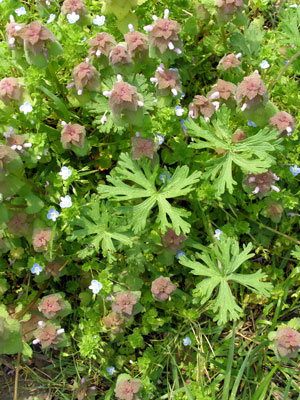
PHOTO BY KEN MOORE. Palmately dissected geranium leaves are easy to spot among speedwells and henbits.
By Ken Moore
Flora Columnist
This cool and moist spring allows my flowering yard to go on and on!!
My Welsh gardening friend, Sue Morgan, was impressed while carefully stepping through my un-mown sweep of flowering weeds. She was particularly keen on geranium-like leaves extending above the henbits and speedwells.
Normally the leaves of the inconspicuous little wild geranium, more commonly called Carolina crane’s-bill, Geranium carolinianum, are no larger than a half-dollar at best. This spring my usual crop of annual wild geranium displays leaves as large as any prized perennial garden-type geranium.
The characteristic round, palmately dissected geranium leaf easily contrasts with the still-flowering purple henbit, Lamium purpureum and bird’s-eye speedwell, Veronica persica. I receive numerous inquiries from folks describing the details of some little plant – like this little wild geranium – that is worrisome because it grows rampantly across lawns and flowerbeds. Take a good look at this geranium leaf. It’s likely that you have it slinking about somewhere in your lawn and garden.
I enjoy letting these early spring ‘weeds’ run cheerfully over my landscape. Unlike the colorful henbits and speedwells, the tiny pink geranium flower is so small that it goes unnoticed, except to the keen eye of friend Sue, who was downright charmed by the “perfect miniature geranium flower.â€
For me, the real beauty of this little native annual is not the flower. Taking a “closer look,†the real beauty for me is found in the red tinges of the aging leaves and the brilliant red color of the persistent sepals surrounding the five dark seeds at the base of the beak-like center.
Though friend Sue does not allow such flowering weeds similar freedom in her well-manicured garden, she’s happy to view them in my yard.
Words are not as effective as visual images in illustrating the subtle beauties. Before you pull it, take a closer look; you too may find some beauty there.
Email Ken Moore at flora@carrborocitizen.com.
Read more Ken Moore Citizen columns at The Annotated Flora
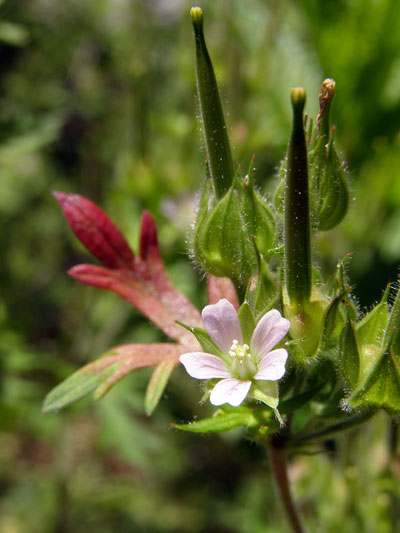
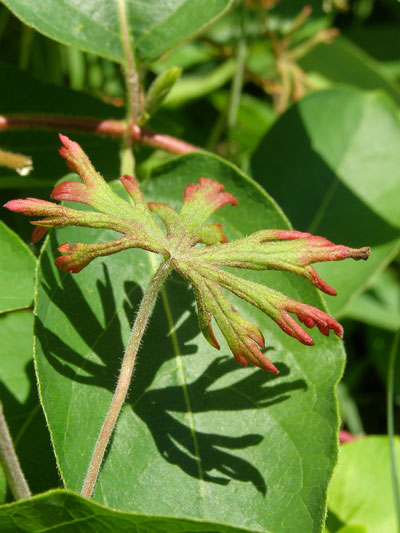
PHOTO BY KEN MOORE. There is subtle beauty in the aging geranium leaf.
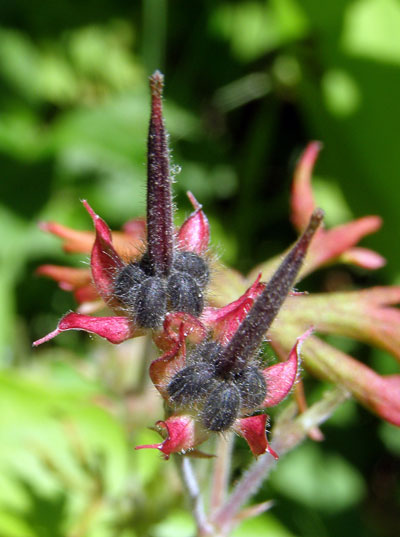
PHOTO BY KEN MOORE. When fully mature, each of the five geranium seeds will be catapulted from the base of the red sepals.