
Black locust flowers appear like white wisteria. Photo by Ken Moore
By Ken Moore
Flora Columnist
Last year, the purple wisteria draping the highway bypass around Carrboro-Chapel Hill ended its peak flowering on or about April 17. Appearing immediately afterward were grape-like clusters of white flowers hanging from trees like a late-flowering white wisteria.
As described in last week’s Flora, this spring’s flowering sequence is ahead of schedule, at least in our urban environment, where pavement and other factors provide warmer microclimates than what’s found in the cooler countryside.
Those of you who frequent the highway corridors around our town can anticipate seeing pendulous clusters of pure white flowers during the next week.
Those white flowers are the fragrant floral expression of common black locust, Robinia pseudocacia. But unlike the strangling wisteria, which is a vine, the locust is a tree. Both plants are in the bean family, and if you’ve been looking closely, you will have noticed small bean pods hanging from the bare locust branches all winter.
The original range of black locust is along the length of the Appalachians and in a large island-like area in Missouri, Arkansas and Oklahoma.
The locust’s strong wood was commonly used by Native Americans for their hunting bows. One explanation for the trees’ naturalization across our state is that this western species traveled east with the native people.
Pioneer botanist Mark Catesby observed that early settlers commonly used locust wood for the foundation support posts that stabilized their cabins. Because of its resistance to decay, locust has been so prized for fence posts and arbors that one must search far and wide these days to find a substantial source for traditional ‘locust posts.’
Though locust is not the common forest tree in the piedmont that it is in the mountains, it’s valuable here as a naturalized plant that thrives in harsh conditions on disturbed sites. Like other members of the bean family, the locust’s ‘nitrogen-fixing’ roots improve barren soils for eventual succession by a diversity of other plant species. Thickets of black locust also provide essential habitat for numerous wildlife species.
Insect pests like the locust borer keep the plant in check. Whole populations of black locust develop a ‘burned’ look about them during the summer months because of the ravenous appetites of the locust leaf minor.
Though black locust was introduced as an ornamental tree in England in the 17th century, its overabundance in parts of the European countryside is attributed to British journalist William Cobbett’s early 19th-century promotion of the locust for its fast growth and long-lasting hard wood, “superior to oak for ship and house-building.†Those uses for the locust never fulfilled Cobbett’s expectations, and this American native now runs wild across some of Europe’s countryside, looking like a white wisteria in early spring.
Email Ken Moore at flora@carrborocitizen.com.
Read more Ken Moore Citizen columns at The Annotated Flora
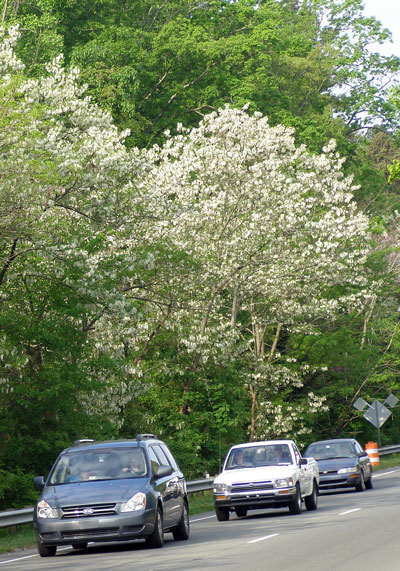
Look for white-flowering black locust on the bypass soon. Photo by Ken Moore
Following spring’s flowering sequence

PHOTO BY KEN MOORE. Pendulous green flowers of Southern sugar maple are worth a ‘closer look.’
By Ken Moore
Flora Columnist
Driving along the bypass last week, I remarked that the beautiful, but deadly, Chinese wisteria is flowering early this year. You can’t miss the walls of pale violet flower clusters hanging from trees being strangled by the notorious invasive.
My driving companion, Kathy, responded: “That’s what you say every year.†And she’s correct. Every year I expound that the flowering of one or another plant is not in its normal flowering sequence. I’m beginning to suspect that the reality in our area is that every year the sequence of spring flowers is atypical.
But really, think about it: This year you have to agree that the wisteria is ahead of schedule.
This year’s earlier-than-usual flowering of dogwoods assures me that I’m not off track. The trees are beginning to peak ahead of schedule. For the past four decades I have firmly repeated the seasoned observation of Dr. Ritchie Bell, the N.C. Botanical Garden’s first director: “For planning purposes, the peak flowering of dogwoods is the 10th of April.†For years weddings and other special occasions have been planned around that date. This year, however, you’ll have to move your plans up 10 days if you want to catch the “peak.†We’re in one of those special years when the white-flowered dogwoods come on early enough to overlap with the peak of the pink-flowered redbuds.
In addition to noticing differences in flowering sequences, every year I surprise myself by becoming aware of a seasonal re-awakening that, though so obvious, I’ve not appreciated before.
This year, for me, it’s the yellow-green flowering Southern sugar maple, Acer barbatum, which is abundant in our region. The specimen in my yard is filled with hanging flower clusters; the lower branches offer in-your-face closer looks at beauty so often missed. I have a weakness for little green flowers and these pendulous maple flowers are well worth a lingering appreciation.
These trees add a lovely pastel yellow-green touch to our Carrboro street-side landscapes. In a few spots you’ll notice the yellow-green flowers juxtaposed against the red colors of the winged samaras (seed) of the earlier flowering red maple, Acer rubrum. You may recall observing, several weeks ago, curious little red flowers on the bare branches of red maples; red maples are more noticeable now that the winged seeds are reaching maturity. In the next few weeks you’ll see these red winged seeds spiraling down to blanket yards and pavements beneath our feet. In contrast, the Southern sugar maple will hold its pairs of winged seeds until late summer and fall.
The yellow-green Southern sugar maples were very noticeable last week. Now they are being obscured by all the other forest canopy trees that are beginning to leaf out. This full awakening of the forest trees is also a bit early. I always think it won’t be until after the second full week of April passes that the big canopy trees fully shade our yards and the forest floor. This year I predict that phenomenon will occur at least a week earlier.
Keep your eyes on the trees and on the calendar. You be the judge about this spring’s sequence!
Email Ken Moore at flora@carrborocitizen.com.
Read more Ken Moore Citizen columns at The Annotated Flora.
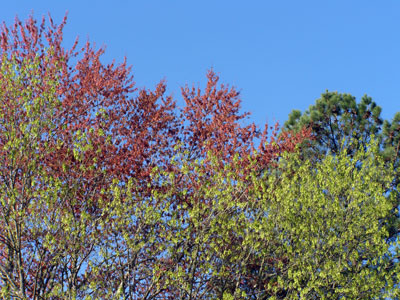
PHOTO BY KEN MOORE. Yellow-green flowered Southern sugar maple (in front) contrasts with the red seeds of red maple (behind).
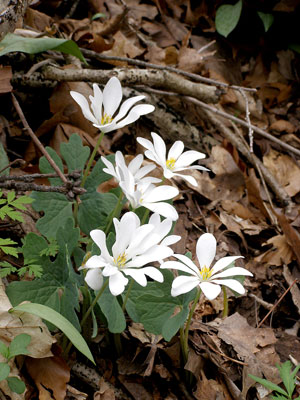
PHOTO BY KEN MOORE. Ephemeral bloodroot flowers are very short-lived.
By Ken Moore
Flora Columnist
There’s still time to catch most of the spring ephemerals, but you’d better get outdoors this week or next, or they’ll be gone again for another year.
A favorite spring ephemeral is bloodroot, Sanguinaria canadensis. While the rounded, oddly lobed leaf of bloodroot may stick around for several months before it yellows and disappears, the flower petals, which close in the evenings, will last only a day or two. If you dare touch those fragile petals, they most likely will fall to the ground.
Bloodroots are not nearly as common as trout lilies, which come to mind when one thinks about spring. Spring ephemerals tolerate early spring’s cool temperatures to take advantage of the sun’s rays before the forest canopy darkens the ground. Sometimes the plants will linger on into the early summer, but the flowers last just long enough for pollination and – if pollination is successful – to develop fruit and disperse seed before quietly fading from the woodland scene.
A thrill for wildflower ‘nuts’ is to catch a patch of Dutchman’s breeches, Dicentra cucullaria, during their brief flowering period. Upon close inspection, the white flowers resemble pantaloons on a miniature clothesline, making the common name easy to remember.
Last Sunday, I joined friend Pete Schubert, geologist and another wildflower ‘nut,’ to catch this year’s Dutchman’s breeches flowering in some of the few local sites. The plants are very rare in our area.
Pete’s description explains the rarity: “One of the showiest expanses of local Dutchman’s breeches is along the Flat River north of Durham. As with populations along nearby Eno River at Penny’s Bend and Willie Duke’s Bluff, the Flat River is underlain by resistant diabase, unusual erosion-resistant bedrock that controls the flow of the rivers and contributes a unique chemistry to the overlying soils.
Calcium and magnesium-rich minerals in diabase weather to provide these nutrients in abundance in the soils – unique in the Piedmont. The uncommon plants found here are calciphiles – calcium-loving – typically found in the sweeter soils of the Midwest.â€
Rare Isopyrum biternatum, false rue anemone, with delicate little white flowers that are similar to rue anemone, or windflower, Thalictrum thalictroides, occurs with Dutchman’s breeches on the Flat River. Numerous uncommon puttyroot orchids, Aplectrum hyemale, have appeared with hundreds of bloodroot just above the Dutchman’s breeches on the Eno.
Though these ephemeral beauties are visible for only a couple of weeks at any one location, you can extend your enjoyment at seeing them by walking different trails every week.
There were still a few trout lilies in flower on the cooler north slopes on Sunday but there’ll be no sign of them in a couple of weeks.
For a last chance opportunity to see these beauties this season, check out Duke Garden’s Sunday morning Penny’s Bend trip (call 668-5309) or conduct an Internet search for “Wildflower hikes on the Eno†for a Sunday afternoon Willie Duke’s Bluff trip.
You can follow wildflowers throughout this spring with wildflower classes beginning soon at Duke Gardens and the N.C. Botanical Garden.
Don’t linger; springtime is moving on.
Email Ken Moore at flora@carrborocitizen.com.
Read more Ken Moore Citizen columns at The Annotated Flora.
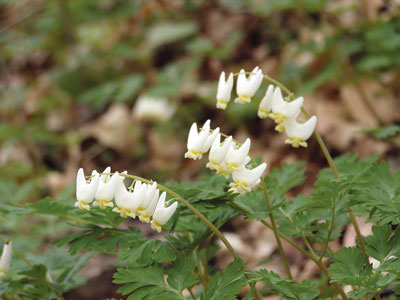
PHOTO BY KEN MOORE. Rare Dutchman's breeches look like pants on a miniature clothesline.
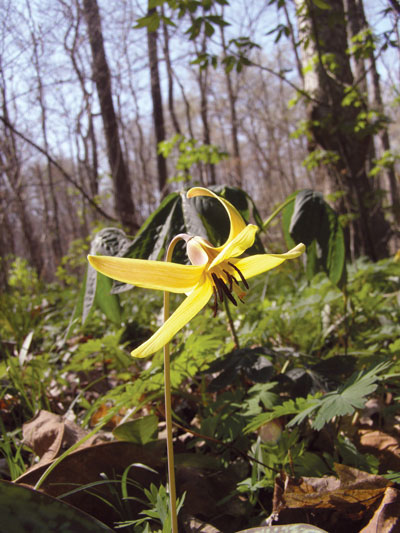
It's still possible to find harbinger-of-spring trout lilies on cool north slopes.
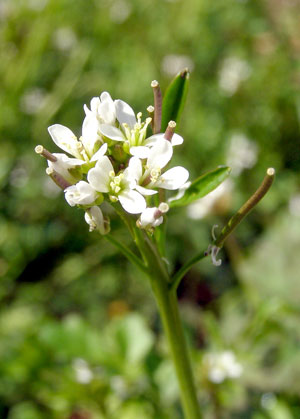
PHOTO BY KEN MOORE. Bittercress has tiny four-petaled flowers characteristic of the mustard family.
By Ken Moore
Flora Columnist
To weed, or not to weed?
Well now, that is a good question. Gardening friend Sally Heiney and I usually agree on which weed to keep and which to toss. We definitely agree on leaving a few pokeweeds every year, frequently comparing notes on who has the larger ones.
But this spring we’ve come to a bit of a crossroads. Sally has taken to weeding my favorite henbits and speedwells from her garden, and with volunteers following her lead, some of my favorite weeds have become forbidden in the developing gardens around the N.C. Botanical Garden’s new visitor center.
And Sally is pulling another favorite little annual weed, the white-flowered bittercress. Cardamine hirsuta is not as showy as the purple henbits and blue speedwells that are still noticeable on the roadsides, where to passing motorists their clumps appear a bit like short shag carpets.
In my wild yard, bittercress is moving in amongst the henbits and speedwells, which are still making a show. This little wild mustard makes solid carpets where the ground was bare last fall.
The tiny white flower of the bittercress exhibits the characteristic four petals of the flowers in the mustard or crucifer plant family, Brassicaceae. At this time every early spring, I pick a few leaves, with a pinch of the flowers and seedpods, to enjoy a spicy, healthy snack.
Last spring, Wendy Wenck, who manages the Botanical Garden’s Mercer Reeves Hubbard Herb Garden, described for me harvesting handfuls of the mustards and enjoying the spicy greens either in a fresh salad or cooked as a potherb. She admitted that it does take lots and lots of handfuls to make even a small dish. Though time consuming, wild foraging, even if only in one’s own garden, is enjoyable and frequently a source of fresh vitamins.
Sally gives me a hard time because this bittercress is a naturalized exotic that I should pull. But I don’t mind that it takes over for short periods; being an annual, I know it won’t compete well with perennials that move in during the growing season.
I’ve learned from Sally that we have a native bittercress growing in our area. Sally is an expert on weeds and I am relying on her to show me the differences between the native and the foreign one.
There’s a spot at the Botanical Garden where they are growing together and she’s saving them for use in her upcoming Weeds 101workshop on March 26. In addition to describing how to recognize common lawn and garden weeds, Sally will recommend strategies for eliminating the undesirable ones. She will also surprise you with her appreciation that some plants we consider weeds may be botanical or garden treasures that we simply don’t recognize before they are mature.
As so often expressed, one person’s flower is another person’s weed. So think twice before pulling any unknown plant. It could grow and flower and make you smile.
Email Ken Moore at flora@carrborocitizen.com.
Read more Ken Moore Citizen columns at The Annotated Flora.

PHOTO BY KEN MOORE. Bittercress can easily carpet disturbed ground.

PHOTO BY KEN MOORE. Spicy-tasting leaves of bittercress make 2-to-4-inch-diameter basal rosettes.

PHOTO BY KEN MOORE. The view is dramatic from Battle Park's Piney Prospect Overlook.
By Ken Moore
Flora Columnist
I have mentioned Battle Park a number of times in past Flora stories, but I’ve never participated in a guided walk there. Two Saturdays past, I did, and what a walk it was! Don’t miss an opportunity to sign up for one of N.C. Botanical Garden curator Stephen Keith’s occasional interpretive walks through Battle Park’s 93 acres of nature and history.
Though the fine interpretive trail guides available at trailheads are helpful, they can’t compare to Stephen’s personally guided walk, a delightful energetic ramble from historic point to historic point.
At the beginning, he set the stage, appropriately, next to UNC’s legendary Forest Theatre. Many of the trails, he explained, were personally laid out and cleared by university President Kemp Plummer Battle during his reign from 1876 to 1891.
Battle, for whom the forest park is named, sought peace and rejuvenation from the rigors of university responsibilities by blazing trails and experiencing the natural semi-wilderness so close to the heart of the university and the town.
Of note was a passage from Battle’s papers asserting that university students of his era spent far too much time indoors with their studies, when a fuller education and healthier mind and body were to be gained by more time spent in the nearby out-of-doors.
Our community is fortunate that Battle’s solitary refuge continues to remain available to us for the spiritual and emotional rejuvenation that a mature forest can provide.
At stops high and low along the land contours, Stephen engaged us in stories of the place, including one of the final skirmishes of the Civil War fought near the high vantage point, now named Piney Prospect Overlook, just below picturesque Gimghoul Castle.
At one spot, Lovers’ Stone Seat, participants took turns assessing the comfort of a boulder’s reclining configuration.
Of particular interest is the site of the tiered open-pit sewage system that serviced nearby faculty homes in the early years of the past century. The Orange Water and Sewer Authority was not even a vision back then. Little by little, the site will be cleared of the exotic invasive vegetation and this relict of one of the community’s first sewage systems will be more visible.
The day of our walk coincided with Stephen’s monthly scheduled university-student volunteer-work day. Some 25 students were busy pulling and rolling English ivy from tree trunks and the forest floor. During the course of our walk, we viewed several areas where invasive plants had been removed and the forest was returning to its former nature. As the years-long eradication effort continues, I believe an “exotics-free†Battle Park is an achievable goal.
Wildflowers are emerging now in the park, as they are along woodland trails throughout the Triangle. A variety of choices of guided walks and hikes are offered by area recreation departments, Duke Gardens, N.C. Botanical Garden, Triangle Land Conservancy, Eno River Association and others. New to me is the Chatham Conservation Partnership’s guided-trip schedule, including wildflowers, fire ecology and geology (chathamconservation.wikispaces.com/Announcements).
Opportunities abound. So whether with a guide or on your own, don’t let this season of nature’s grand reawakening slip by without being in it!
Email Ken Moore at flora@carrborocitizen.com.
Read more Ken Moore Citizen columns at The Annotated Flora.

PHOTO BY KEN MOORE. Standing tall, Stephen Keith describes an abandoned neighborhood sewage depot, one of several Battle Park historic relics.
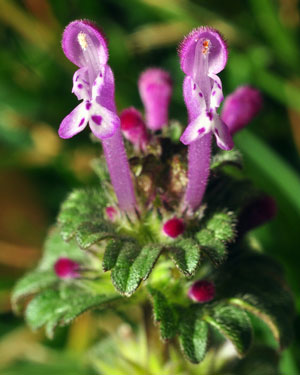
PHOTO BY STAN H. LEWIS. In close-up, henbit flowers seem to speak.
By Ken Moore
Flora Columnist
During the past week, a number of local folks have been curious about those blue and purple carpets of color on the roadsides and in the medians. Stopping for coffee at Johnny’s on Saturday morning, photographer Stan Lewis also quizzed me about the patches of color showing up on roadsides.
I explained to him that he was seeing purple-flowered henbits and blue-flowered speedwells, a sure sign that spring is upon us.
I’ve never succeeded in getting a nice close-up of purple henbit, Lamium amplexicaule. Up close, those little upright tubular flowers look like caricatures of gossipers. They always make me smile. Knowing Stan likes to photograph birds and insects, I challenged him to get down on his hands and knees for some belly-botany closer looks at these little flowers.
I was well into another Flora story for this week when I received Stan’s images of his roadside observations. So happy was I with Stan’s close-ups that I decided to focus instead on those close-to-the-ground flowers that thrive beneath roadside mowing machines. Those very same little beauties drive some home gardeners insane when they find colorful carpets in lawns meant to be uniformly green.
You don’t have to stop along busy roadsides to get a closer look. You can do it more safely along the grassy edges of the Carrboro Century Center, the lawn at the corner of Weaver and Greensboro streets or, if you’re lucky, you’ll have them frolicking about in your own yard and garden.
They are annuals, imported centuries ago from Europe, that grow in the winter, flower in early spring and are gone by the time many of us are planting our second or third sets of tomatoes to sacrifice to late frosts.
This year the speedwells outnumber the henbits in my yard. Veronica persica, common field speedwell, is the showiest of several common speedwells.
I enjoy Richard Mabey’s plant descriptions in Flora Britannica. About speedwells, he writes: “Speedwells are roadside plants which speed you on your journey. Just why they acquired this reputation is unknown, but in Ireland they were sometimes sewn onto the clothes of travelers for good luck. In the eighteenth century they acquired another odd reputation, for curing gout, and ‘Sir’ John Hill reported that ‘the dried leaves picked from the stalks were sold in our markets and the people made tea of them. The opinion was so prevalent, that the plant was in a manner destroyed for many miles about London, but like all other things want for truth for their foundation, it came to nothing.’â€
Well now, I rather like the notion of speedwell bringing good luck. I’m happy that it carpets my yard, beckoning springtime’s return.
Email Ken Moore at flora@carrborocitizen.com.
Read more Ken Moore Citizen columns at The Annotated Flora.

PHOTO BY STAN H. LEWIS. Speedwell's blue colors beckon spring's return.
The once and future Piedmont savanna

PHOTO BY JOHNNY RANDALL. A carefully managed prescribed burn at Mason Farm Biological Reserve will usher in the resurrection of our Piedmont savanna vegetation.
By Ken Moore
Flora Columnist
The 40-plus walkers accompanying me “in the footsteps of John Terres†around Mason Farm on Sunday saw something there that John never saw. Some of the fields and forests had been recently scarred by fire. I’ve invited my good friend Johnny Randall, assistant director for Natural Areas and Conservation Programs at the N.C. Botanical Garden, to tell the story in this week’s Flora:
“Like the mythological phoenix, many of our natural communities are periodically reborn through fire. If you perchance saw a plume of smoke rising from Mason Farm Biological Reserve last week, you witnessed evidence of an event that will usher in the resurrection of our Piedmont savanna vegetation. From the newly scorched landscape will emerge sun-loving grasses and wildflowers that create the habitat preferred by ground-nesting birds, turkeys and many other critters.
“You’ll recognize the names of these fire-responsive plants: blazing star (Liatris), wild blue indigo (Baptisia), sunflowers (Helianthus) and coneflowers (Echinacea). Native grasses such as Indiangrass (Sorghastrum), little bluestem (Schizachyrium) and big bluestem (Andropogon) also comprise this savanna matrix. Mown roadsides and other rights-of-way clearances have provided a refugium for these plants, while the former Piedmont vegetation succumbed to the shade of dense forests.
“Fire suppression, from early colonists to present day, represents one of the most pervasive threats to biodiversity conservation nationwide. Times are changing; the week of Feb. 7 was declared N.C. Prescribed Fire Awareness Week by Gov. Beverly Perdue!
“European explorers and American botanists of the 18th century described the Carolina Piedmont as having vast savannas, prairies and plains of ‘many spacious tracts of meadow-land … burdened with grass six feet high … with buffaloes ranging in droves feeding upon the open savannas morning and night.’
“Like the Native Americans before us, we at the N.C. Botanical Garden have taken up the torch. John Lawson, in his 1709 book, A New Voyage to Carolina, reports: ‘In February and March the inhabitants have a custom of burning the woods … an annual custom of the Indians in their huntings, of setting the woods on fire many miles in extent.’ Fires used by indigenous peoples rejuvenated hunting grounds, facilitated travel, and for at least 1,500 years, opened areas to sunlight for agriculture. I also believe that Native Americans knew, as we have learned, that regularly burned meadows and woodlands contain many fewer ticks!
“We also use prescribed fire to reduce wildfire hazards from lightning strikes or arson. In order to execute prescribed fire safely, the Botanical Garden has a N.C. Division of Forest Resources certified in-house burning crew and follows a very strict ‘prescription’ based on weather conditions and other parameters. Our closest neighbors in the Kings Mill/Morgan Creek neighborhood have been accustomed to the smell of smoke from the 30 years of annual burns in our sandhills and coastal plain habitat gardens next to the Totten Center.
“Visit Mason Farm frequently this spring to observe and celebrate with us the Phoenix-like savanna rebirth at Mason Farm and take a closer look at the sequence of vegetation and floral display that begins emerging almost immediately.â€
Many thanks to Johnny Randall for contributing this week’s Flora story and thanks to his dedicated garden colleagues and volunteers who help manage Mason Farm so wisely!
Email Ken Moore at flora@carrborocitizen.com.
Read more Ken Moore Citizen columns at The Annotated Flora.

PHOTO BY JOHNNY RANDALL. Mason Farm forests and fields burned two weeks ago are already turning green with vigorous spring growth.

PHOTO BY JOHNNY RANDALL. Professionally trained Botanical Garden fire crew, (left to right) Johnny Randall, Charlie Tomerlin, Monica Foley, Amanda Mixon, Andy Walker, Sally Heiney, Mike Kunz, Matt Gocke, JC Poythress and Irene Sadler, are happy with the success of their Mason Farm prescribed burn.

PHOTO BY KEN MOORE. Uncommon puttyroot orchid has a very distinctive winter leaf.
By Ken Moore
Flora Columnist
Now is the best time of the year to locate two obscure native orchids that show their leaves in the winter. Of the two, cranefly orchid, Tipularia discolor, is the more common – and with a keen eye to the ground, you will spot it everywhere.
Its elusive close cousin, Aplectrum hyemale, puttyroot, is much less common, preferring a less acidic soil than is typical of most of our forests. You will have to keep a really keen eye focused to find the single leaf of puttyroot – and what a quiet thrill to finally spot one.
The leaves of these two orchids are busy now absorbing the winter sun and actively growing, manufacturing and storing essential nutrients and resources necessary for annual flowering and seed production. Though green now, these plants are not evergreen. They disappear in spring as the tree canopy shades the forest floor. They seem to be going into dormancy just when most plants are coming out of it, but they remain very active underground and send up a flowering stem in summer that is unnoticed by most woods walkers. The next winter season’s leaves will begin appearing in September as the forest canopy is beginning to drop its leaves again.
Spotting a single leaf or two of cranefly here and there – or sometimes an informal line or mat of up to a dozen individual leaves – is easy. The two-to-four-inch-long ovate or egg-shaped leaves are characteristically burgundy or purplish in color. Often the upper leaf surface may be green, but the lower surface is distinctively purplish.
The puttyroot leaf is larger, four to six inches, and elliptic shaped. Distinguished with white-streaked, plicate veins, the leaf surface looks like a miniature accordion spread open a little. The underside of the leaf is sometimes purplish.
The crushed corms of puttyroot produce a mucilaginous fluid that was sometimes used by pioneers to mend cracked pottery – but there are certainly not enough plants for such use today! Some folks call it Adam-and-Eve orchid, because the tuberous root is a pair of swollen corms leading to a somewhat romantic notion.
If you want to see either of these terrestrial orchids in flower, you will have to make note of their locations now, so you’ll know precisely where to look when you return in the summer to catch them. (Images of cranefly orchid flowers from past Flora stories can be viewed on The Citizen website.)
Mark several separate plants or populations, because these terrestrial orchids may flower several years in succession or they may sit out a year or two. Each summer’s discovery is a special treat, and every summer some of them are flowering somewhere.
I’ve been fortunate to spot lots of the cranefly orchids in flower during July and August, but I’ve never caught puttyroot in flower. Last summer, I went to my marked locations to discover I was a month late. Now I know to go searching earlier, during May and June.
Locally, I’ve seen puttyroots scattered in the alluvial forest of Triangle Land Conservancy’s Johnston Mill Nature Preserve and I’ve spotted them on some of the bluffs above the Eno River. If you explore different trails with a keen eye, you’ll eventually discover some.
Email Ken Moore at flora@carrborocitizen.com.
Read more Ken Moore Citizen columns at The Annotated Flora.
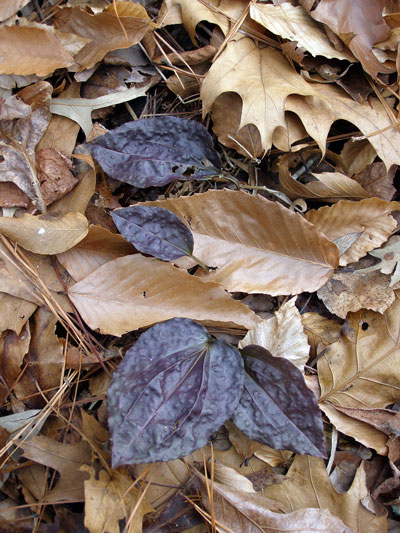
PHOTO BY KEN MOORE. Purplish winter leaves of cranefly orchids are common along local woodland trails.

PHOTO BY KEN MOORE. The open fields of Mason Farm make an impressive backdrop for close-up details like a mantis egg case on sweetgum.
By Ken Moore
Flora Columnist
How well I remember naturalist John Terres’ last visit to his beloved Mason Farm, back in 1981. During that visit, he led a walk for a group of devotees of From Laurel Hill to Siler’s Bog, his collection of stories covering six years of daily visits and observations in the fields and forests of the university’s Mason Farm property across Morgan Creek from Finley Golf Course.
John described his first visit: “I first saw the Mason Farm … in February 1961…. Crossing Morgan Creek over a concrete dam, I walked under the winter sun on a road that led over a grass-grown levee, built to hold back the spring floods. I had no thought of what might lie beyond. When I reached the top of the dike, I gasped. For two miles straightaway, and from east to west, windswept fields and woods lay under an enormous vault of blue. A thousand acres of swamps and fields and forest, to as far as I could see, were suddenly opened before me – a vast freedom of land and sky.…This was a wilderness of the land to match a wilderness of the heart.â€
Were he alive today, John would be as thrilled with Mason Farm as he was on that first day.
He would wisely reflect on the many changes across that former far-as-the-eye-could-see landscape. That first view from the top of the dike is now closed in by groves of tall trees. Some of John’s studied fields are now young emerging forests. Sadly, the quail field is now a dense forest thicket, but John’s endearing story of the quail that roamed and nested in that former cornfield brings nostalgia and joy with every rereading.
John would appreciate new fields opened under N.C. Botanical Garden management. In time, the bobwhite quail’s plaintive call may be heard from the edge of one of these new fields.
Special places remain, like the corner of Big Oak Woods where the old farm road crosses Yancey Brook. On that walk in October 1981, John stopped and described how he placed a possum carcass inside the base of a hollow tree to test his theory of the turkey vulture’s extraordinary power of smell.
Further along the way, we paused to hear John’s account of spending numerous nights along the roadside to observe the nocturnal habits of the flying squirrel that nested in a dead hickory just inside the forest edge.
Perhaps John’s happiest discovery was the elusive golden mouse, a mouse that makes a football-shaped nest high off the ground. I think of that golden mouse every time I pass the grove of oaks where the little mouse was finally found.
Mason Farm is vibrant in late winter. Signs of spring are everywhere: twigs of trees and shrubs take on brilliant colors, bird activity increases, demonstrative hawks circle high above and burgundy patches of Penstemon rosettes announce the sea of white beardtongue flowers to arrive in June.
Mason Farm is a community treasure to be visited over and over; John Terres’ book is a treasure to read over and over.
Honoring both, the Botanical Garden has scheduled a walkabout on Feb. 20, tracing John’s footsteps around Mason Farm.
See ncbg.unc.edu, “Guided Public Tours and Hikes,†for information and registration.
Email Ken Moore at flora@carrborocitizen.com.
Read more Ken Moore Citizen columns at The Annotated Flora.

PHOTO BY KEN MOORE. This grove of oaks is remembered as the site of John Terres' discovery of the little golden mouse.
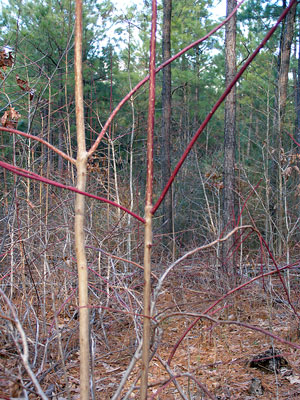
Burgundy red twigs characterize sourwood trees. Photo by Ken Moore
By Ken Moore
Flora Columnist
Participants in winter plant identification classes at Sarah P. Duke Gardens and the N.C. Botanical Garden are making friends with numerous trees that are easily recognized when they are bare and leafless.
Twig color is one of several easy-to-spot clues to the identification of some trees at this time of year. The burgundy reds of sourwood twigs are an immediate marker for that tree. To verify your identification, scrape a bit of the thin bark near the end of the twig and give it a sniff. A fresh, pungent smell will confirm that you are correct.
To further verify your identification, step back a bit to view the entire plant. The dark bark of sourwoods displays a pattern of deep vertical fissures that meet to form arrow-like points up and down along the trunk. The sourwood has another striking characteristic that you are unlikely to associate with other trees. In the wild, this understory tree seems incapable of growing straight. It has a most curious habit of leaning to one side or another as it grows upward, eventually making twists and turns that give it a truly bizarre personality.
Near sourwoods, you may spot the glossy yellow-green twigs of sweetgum saplings or stump sprouts. These twigs may be accompanied by corky growths along their sides. Such corky ridges can be quite pronounced on some of the larger specimens. Look around for the big sweetgums; in contrast to the sourwoods, you’ll find them reaching straight up high into the canopy and exhibiting a lighter, grayish bark that’s not nearly as deeply grooved as the sourwood’s.
The barks of some trees are so steadfastly true and distinctive that one can almost always recognize those trees. Both white oak and shagbark hickory are readily identified by their distinctive peeling or scaling bark. It’s easy to distinguish between the two.
The grayish bark of the oak peels or sloughs away from the tree horizontally. In contrast, the bark of the shagbark hickory peels off in thin vertical strips, with the lower and upper ends pulled away as though the center were glued to the trunk. Though it may take some thoughtful observation to discern this, the difference is really evident when you find the two in proximity. (Compare in photo.)
Shagbark hickory is not as common as white oak, but can be spotted beside oaks along some trails in our area. If you’re observant, you’ll find the two trees side by side at the Mason Farm Biological Reserve and along Trail 11 in Duke Forest’s Durham Division.
The beauty and interesting characteristics of some plants are more noticeable now than at any other time. One can look across forest contours and admire giant tree stems that are obscured in the overwhelming greenery of summer.
The snow-white upper trunks and limbs of sycamores along streams and rivers are one of winter’s most beautiful and easily recognizable features. Now is the perfect time to enjoy outdoor explorations and meet new tree friends.
Email Ken Moore at flora@carrborocitizen.com
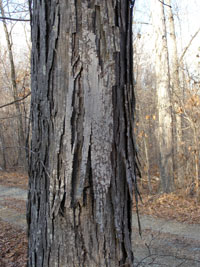
Shagbark hickory bark peels away as vertical strips. Photo by Ken Moore
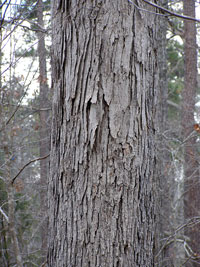
Bark of white oak peels away from the side. Photo by Ken Moore