The Panama Canal is 82 km (51 mi) long, connecting the Atlantic Ocean to the north of Panama with the Pacific Ocean to the south. Most of the Canal is on the level of Gatún Lake, a large reservoir fed by the Río Chagres. The lake surface is about 26 m (85 ft) above sea level. The Miraflores and Pedro Miguel Locks raise ships from the Pacific to this level, and the Gatún Locks lower them to the Atlantic. The Gaillard (Culebra) Cut, the narrow section passing through the mountains of the isthmus, is between the Pedo Miguel Locks and Gatún Lake. A ship's passage through the Canal takes about 9 hours.
The actual course of the Canal is quite crooked, but regardless of the actual direction northbound means toward the Atlantic and southbound means toward the Pacific. For the navigator the Canal consists of a series of straight sections called reaches connected by more-or-less sharp turns. Range lights are provided at both ends of every reach. There are more than 100 range lights in all, but most are simple post lights carrying diamond-shaped daymarkers, as seen in this photo.
Lighthouses were built where higher range lights were needed, generally at the ends of the longer reaches. All the lighthouses were built for the opening of the Canal in 1914. There were 35 lighthouse originally, and it was reported in 1999 that 28 were still active.
Spotting the lighthouses from ships passing through the Canal is not as easy as it might seem. Only about a dozen are located close to the route; the others are as much as 5 km (3 mi) beyond the ends of the reaches. Jungle vegetation hides most of the lighthouses except directly along the range line, so the best location for lighthouse spotters is in the bow or stern of the vessel.
The aerial photos below, reproduced from the web site of the Autoridad del Canal de Panama, provide views of the Canal route and some indication of how the lighthouses are used in navigating the route. Sharp eyes can locate a total of eleven lighthouses in the five photos, which are arranged in northbound order.
A note: all of these photos were taken before the beginning of construction to widen and deepen the canal. This expansion project is likely to result in the removal of at least some of the lighthouses.
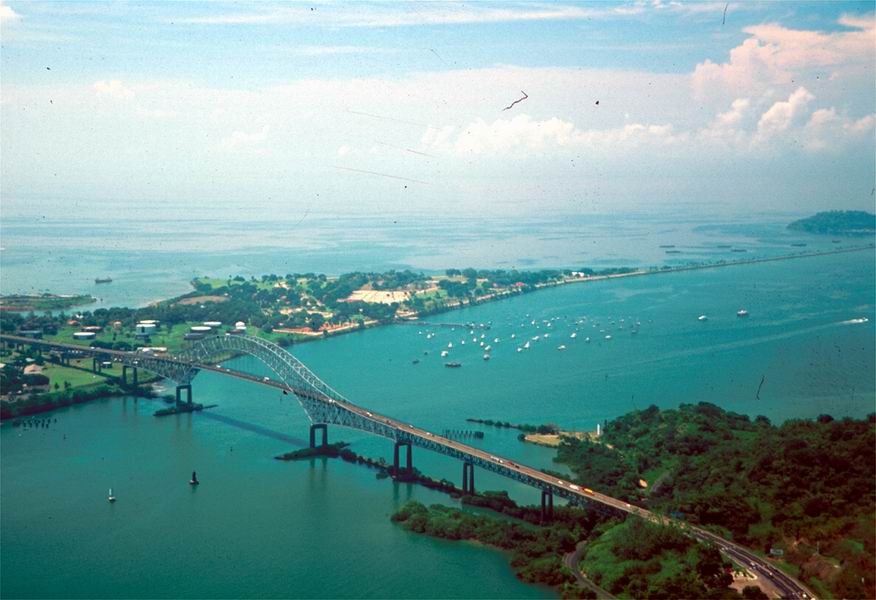
This view looks back toward the Pacific over the Bridge of the Americas at Balboa. Just beyond the bridge on the near (west) side of the canal is the Pacific Entrance Range Front Light.
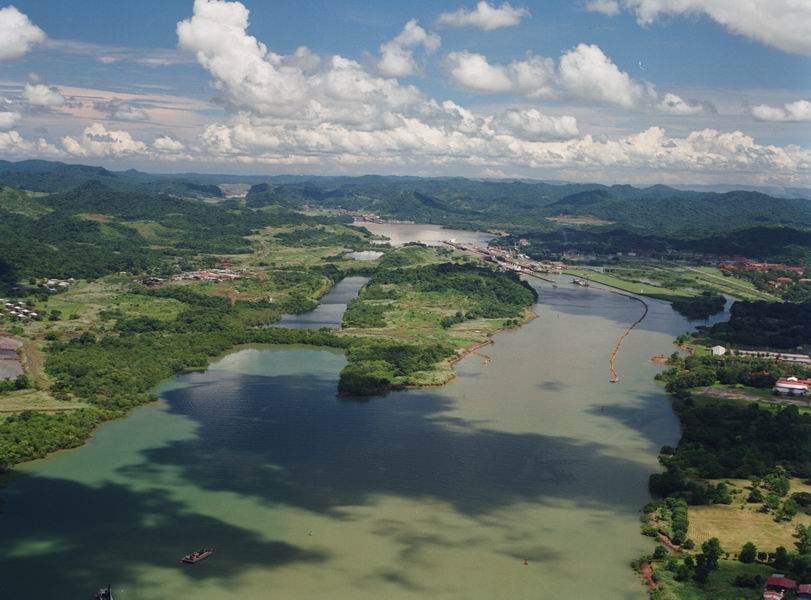
Here we are looking northbound up the Miraflores Reach to the Miraflores Locks, the first locks for northbound vessels. In the grassy area on the right (east) side of the canal, just beyond the cloud shadow, is the Miraflores Northbound Front Light. If we follow the range line, we can see, just inside the next cloud shadow, the taller Miraflores Northbound Rear Light. Behind the Miraflores Locks, the Canal goes through the Pedro Miguel Locks and on to the beginning of the Gaillard Cut in the distance.
This is a view from just beyond the Gaillard (Culebra) Cut, looking toward Gatún Lake in the distance. The town of Gamboa is at the bottom of the picture, at the point where the Canal intersects the Río Chagres. Just across the railroad bridge and to the right of the tracks is a white sign; behind it the dark Gamboa Southbound Front Light is visible at low contrast between a tree and a tall skeletal communications tower. Beyond Gamboa, we see the Gamboa Reach extending through the valley of the Chagres toward the Mamei Curve. At the end of the reach and the beginning of the curve we can just make out the two white Gamboa Reach Northbound Lights.

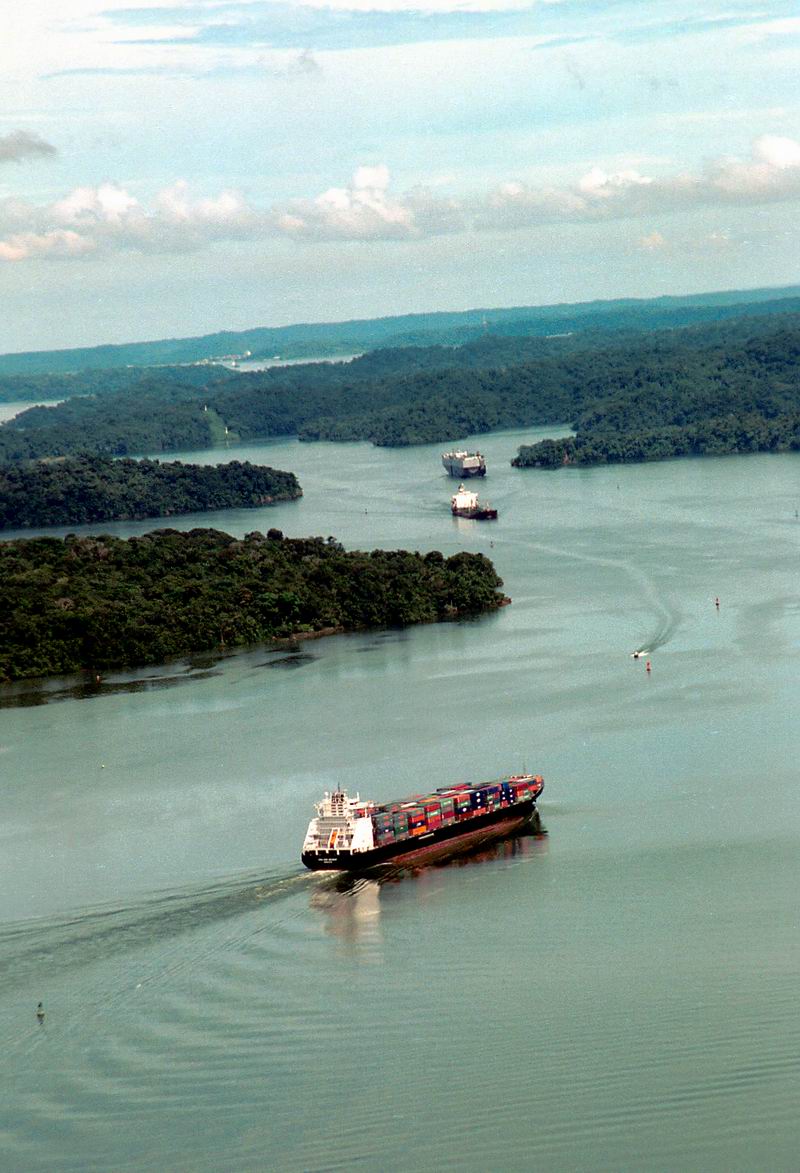
The ship at the bottom of this photo is beginning its turn out of the northbound Tabernilla Reach and into the Buena Vista Reach in the eastern part of Gatún Lake. In the distance we see the Buena Vista Northbound Range Lights on the forested Bohio Peninsula. A closeup photo of these lights is available.
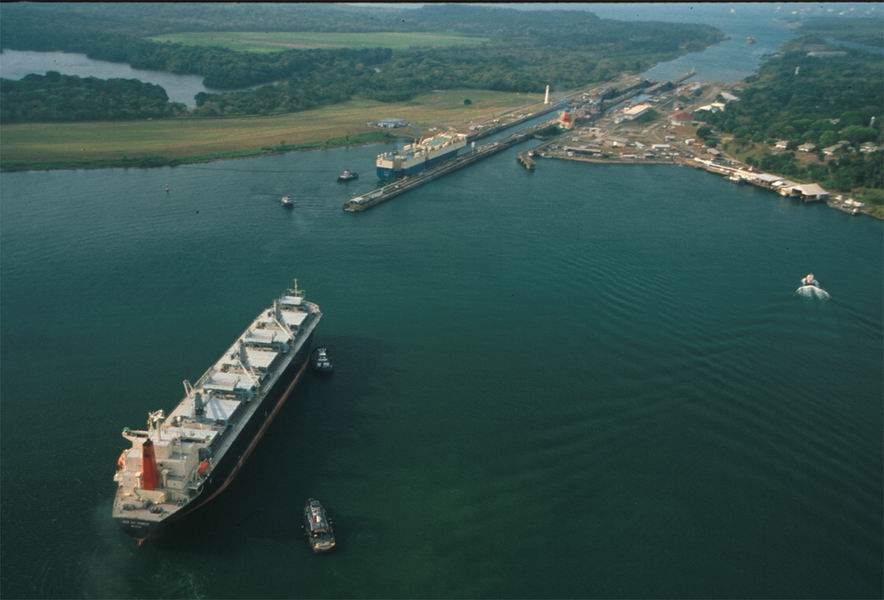
The tall Gatún Northbound Rear lighthouse, standing beside the Gatún Locks, is the most familiar lighthouse of the Canal. Dawson has a page of photos of it.
Two more lighthouses can be seen in the trees to the left (east) of the locks. Dawson has a photo of the light closer to us, captioned as the "Upper Southbound Range Light." It is in fact the Atlantic Entrance Range Rear light. The lighthouse farther away, but closer to the Canal, is the Atlantic Entrance Range Middle light.
Return to the Panama Directory page | Return to the Lighthouse Directory index
Posted August 15, 2005. Checked and revised July 27, 2014. Site copyright 2014 Russ Rowlett and the University of North Carolina at Chapel Hill.