Gerry Cohen notices, in a comment on this blog, that Fred Stutzman and his work on Facebook are quoted in a Daily Tar Heel OpEd called “Danger, Danger.” The article is full of Facebook Fear warning students that pictures on the Internet can lead to unintended consequences. Fred was amused to be identified as “local resident” as in Research by Fred Stutzman, a local resident, indicates that more than 90 percent of UNC-Chapel Hill undergraduates have a Facebook account[.]
Author: Paul (Page 107 of 147)
Jamie Boyle writes in his Financial Times (London) column on the “Web’s never-to-be-repeated revolution” which begins:
The web is having a birthday. This month, we will have the 15th anniversary of the creation of the first web page. It is the birthday of Tim Berners-Lee’s amazing idea that there could be a world wide web, linked not by spider silk but by hypertext links and transfer protocols and uniform resource locators.
How should we celebrate? We are too close to the web to understand it. And those who lost money in the dotcom boom greet any celebration of the web the way a person with a hangover greets a mention of the drink of which they overindulged. The knowledge of shameful excess produces a renunciant puritanism. No more tequila or web romanticism for me!
That is a shame, because there are three things that we need to understand about the web. First, it is more amazing than we think. Second, the conjunction of technologies that made the web successful was extremely unlikely. Third, we probably would not create it, or any technology like it, today. In fact, we would be more likely to cripple it, or declare it illegal.

Cory begins with talking about John Phillips Sousa and his opposition to to recording devices. “If the infernal talking machines were not curtailed, we will surely loose our voice boxes just as we lost out tails when we came down from the trees.”
Instead of requiring clearance of rights, we got compulsary licenses.
Next radio as pirates, they played recordings on the air for many many listeners.
Next p2p. We are taping this and will have it digitized in about a week or so.
John Buckman of Magnatune, Gene Hoffman founder of eMusic, Edward Klaris of New Yorker, Adam Toll of Big Champagne, Sam Yagan of MetaMachine (eDonkey), Tor Hansen of Yep Roc, Roger McGuinn and hosted by Koleman Strumpf, economist.
Quite a variety of voices here as you might guess from the affiliations.
In the audience, Cory Doctorow, Robert Kaye, Chris DiBona, Scott Adams, David Bollier, Marybeth Peters, Roy Kaufman, Chris Evans, Laurie Racine, Jocelyn Neal, Stephanie McGarrah (see this page for ids).
Michael Tiemann of Red Hat chairing. With Marshall Phelps of Microsoft, Chris DiBona of Google and David Hustace of open NMS.
Active audience discusses how to measure innovation. Robert Kaye says innovation should not be patents but patents and discoveries that are actually used and built on. Southhampton guy working on openNMS points beyond R&D budgets as does Sam Jelinek of College of William and Mary (who actually kicked on this line of discussion). Gene Hoffman founder of eMusic talks about not only the rate of change but how change accelerates and then stablizes.
Phelps and DiBona and Tiemann discuss the iPod as an innovation. What is the diff from orginal mp3 players and the iPod? How does innovation fit in here? Is business model the innovation or the design or what?
MT Try to access the option equation of the internet say. Cites: Massive Change.
David Bollier talks about making things free. MT says that more stuff is free now or is it?
Does capital serve society or does society serve capital? Bollier and Phelps and Hoffman are now into it over commerciality. David B talks about the changes in the market. David H talks about innovation in a smaller project and the relationship to his contributors and customers. (sorta the Eric von Hippel talk)
Next topic Google as a word and an innovation. Is the principle meaning of Google a noun or a verb? (MT) Innovation principally a property to be managed or as an activity?
DiBona says working at Google we have an idea about this. Engineers can take their 20% for innovation to scratch their itches. Surprises of innovation by not managing
Marshall says innovation can be directed and companies do that with R&D budgets. Serendipitousness (ouch i can’t spell) is not the only
David H says innovation might not be finding a new molecule but in finding new ways to find new molecules.
Marshall discusses innovation of Microsoft and says the experimental
John Buckman asks about how innovation works at MSFT. Do they use the same metheods as Open Source. Phelps talks about the culture of MSFT. MT talks about the 2 new open source-ish licenses. (not every once agrees that those licenses). End of Certainty (cited by MT). What draws the line between determinism and choice?
Robert Kaye – the good chaos of open source won’t work within a corp
Hoffman – says well known companies are structure models for successful open source projects
MT – customer satisfaction? what happens when enablement is a necessary component of customer satisfaction.
Andy Oram – Open Source is never finished. But windows is expected to be solid.
Wales – what is the danger of closed with protection
Hoffman – some business men would rather beat to market than to patent.
Phelps – hasn’t sued anyone but is defending 40+ suits against MSFT. why can we innovate despite IBM patents? MSFT wasn’t stopped from innovating by that.
Wales – open source cannot license in the same way
MT – space ship one vs the nasa shuttle. space ship one doesn’t explode thanks to fuel design.
MT – cites Montessori: The Genius behind the Science
MP – on software patents. some are good and some bad. he thinks that some things should definitely no patentable. Would MSFT be better off without software patents? Better than trade secrets. Great IP theft by employee story about IBM disk patents.
Having trouble keeping writing here. Discussion getting hot on software patents. Codec research should be patented says Hoffman. He also wants crypto patents. MT says that GH missing the third leg (ouch michael) how to include the community and the relationship in distributed colaborative models.
MP says there is a romantic vision of software about software development.
CDiB – is not happy with codec patents.
Chris Evans – talks about his companies and their experiences with patents. He was earlier on and dodged the IP bullets. Now he’s leary of patent holders who might come in on him.
James Besson – attacks the property model. that you can’t find who owns what is the barrier.
MP – 50% of all patents are overturned on appeal
Sam J – asks where is the failure point?
Shift from patent quality to quality of software says MT
Dan Bricklin – how to make software last 200 years.
Software postmortems mentioned.
What should happen in the next 6 months at the Center? (Center at the Law School)? Dubai’s innovation is a race over their wells going dry. They needed to transform their future without oil and to have it thrive.
Intro by Lolly Gasaway. Four ways to ruin a technological revolution. Jamie say he now has 7 ways. Three more for free. First it’s hard to ruin a revolution in tech. Law is particularly good at ruining tech advancement. Decentralized nature of innovation is fueled by copyright, patent, and trademark in the marketplace (when it works well). To do so the Public Domain must be protected. Patents are about disclosure. Copyrights used to expire (in the old days). This refuels the pubic domain.
IP Law distorted not only kills innovation but also once distorted also kills the relationship between public domain and ownership.
US law has always been atuned to balancing the rights and the public. Jefferson writes about that and especially the Isaac McPherson (spelling) letter.
1) policy should always be made without empirical evidence. before or after implimentation. don’t compare copyright in different countries for successes. without database protection, the US out performs Europe (which has strong protection) in the market.
public information policies. all public info in the USA from the government, is open and free creating a secondary market. in Europe tries to recoup public expences. US gets 39:1 and Europe gets 9:1
patents. better than trade secrets.
2) we must adopt a world view in which overprotection. totally abolishing protection would also kill the revolution. BTW. raising cost of outputs raises the cost of inputs. software copyrights worked well to screw up the recolution, but judges took them down.
a) impose the logic of control. whereever possible close things up. VCRs are a failure of this. Silicon Valley vs. Boston area. Weaker worker rights in Boston actually killed knowledge circulation whilst SV with more allowable employee mobility actually grew.
b) confusing IP vs physicial property.
c) 20-20 downside vision.
d) prejudice against destablizing technologies
3) the real number 3. don’t revise the copyright law to allow for new tech. have the current holders write the law.
4) vital to ditch the tech of the internet and go instead to “trusted computing.” open platforms are nothing but rights violating devices, spam sources and security holes. clamp down controls and hand controls to a monopolist. get back to minitel!
5) always make policy in international venues and harmonize upwards. WIPO is great for this as it closes out other voices in the policy formation.
6) critics should be apathetic. activists should be selfdestructive. screaming, not washing, no alternatives, etc.
7) avoid the creation of a broad environmental like movement.
Matthew Szulik talks about Facebook and IM, podcasts and wikis. The global instances of differences in education and access. After a much more tentative approach to IP law by NC First Lady, Mary Easley, Matthew takes a stronger support of Open Source. Matthew is wondering why there is more reception of openness internationally than say in the USA.

Tomorrow and Wednesday are the days for the Red Hat/UNC System sponsored Symposium on Intellectual Property, Creativity and the Innovation Process. Although the attendence at the conference site is extremely limited, we’ll be working with WUNC-TV to capture as much as possible on video and we’ll be making torrents available on ibiblio as soon we can process them.
For more on the Symposium see the UNC System site.
Sally and I became winners of a box of chocolate covered blueberries last night. At a local Halloween party, the costumed guests were encouraged to mix by participating in a hunt for clues about gruesome deaths of famous and nearly famous people. How is it that I would realize that Atilla the Hun died of a nosebleed, that William Klemmer was the first person killed in a not very effecient electric chair, that Tennesee Williams choked on the top of his nasal spray bottle, that Isadora Duncan was strangled by one of her flowing scraves, that Guy de Maupassant, the author of the Inn, killed himself after being driven mad by syphilis and about 15 other odd deaths? Paid off somehow though.
Factiod: For nutritional reporting the serving size of chocolate covered blueberries is 18!
Yesterday, Tucker and I were lucky to get to spend some time with Dr. Jocelyn Bell Burnell at the Morehead Science Center.
One of the delights was to see and hear Dr. Bell Burnell describe pulsars to middle schoolers, which means that even I could understand.
I’m spending a little fun time trying to be helpful to the Lyceum developers — JJB and Fred — by using their test environment and trying to find bugs.
If you visit my blog there, poke at it a bit and see if you can get a bug to show up. [Changed to point to Lyceum front page per JJB suggestion].
UPDATE: Lyceum has been reloaded a few times over the night. JJB has been working hard. That means I’ve recreated the test blog there a few times. Each time the location changes. That’s one thing to work on. Any how, when you test things may have changed and will likely change again.
Sally who has taught grammar tells me that my alright is either a misspelling or vulgar. I prefer the second of course. I would rather be vulgar than wrong.
The one-word spelling alright appeared some 75 years after all right itself had reappeared from a 400-year-long absence. Since the early 20th century some critics have insisted alright is wrong, but it has its defenders and its users. It is less frequent than all right but remains in common use especially in journalistic and business publications. It is quite common in fictional dialogue, and is used occasionally in other writing. “the first two years of medical school were alright” — Gertrude Stein.
But those 20th Century critics include the American Heritage Dictionary and Fowler’s Dictionary of Modern English Usage both of which nurtured Sally’s English PhD.
Still more recent versions (1996) of the American Heritage Book of English Usage are milder on alright while not giving in to it:
Is it all right to use alright? Despite the appearance of alright in the works of such well-known writers as Flannery O’Connor, Langston Hughes, and James Joyce, the merger of all and right has never been accepted as standard. This is peculiar, since similar fusions like already and altogether have never raised any objections. The difference may lie in the fact that already and altogether became single words back in the Middle Ages, whereas alright (at least in its current meaning) has only been around for a little over a century and was called out by language critics as a misspelling. You might think a century would be plenty of time for such an unimposing spelling to gain acceptance as a standard variant, and you will undoubtedly come across alright in magazine and newspaper articles. But if you decide to use alright, especially in formal writing, you run the risk that some of your readers will view it as an error, while others may think you are willfully breaking convention.
The Columbia Guide to Standard American English is blunt:
All right is the only spelling Standard English recognizes.
Evan Morris, aka Word Detective, is broader and gives a better feel for the what and why for alright. WD is a bit long but worth the read:
After mentioning how Fowler dismisses alright (in 1926) and later how Harper did as well, Morris gives us this:
On the other hand, Bergen and Cornelia Evans, in their “Dictionary of Contemporary Usage,” point out that there’s a case to be made for “alright.” Using “alright” as a synonym for “O.K.” or “satisfactory,” they note, “would allow us to make the distinction between ‘the answers are alright’ (satisfactory) and ‘the answers were all right’ (every one of them).”
Convinced me (but that didn’t take too much. Will it convince Sally?).
Morris also covers the rise of O.K. on the same web page.
The Word Maven at Random House has interesting tales to tell in the alright/all right wars including how people were outraged over the “Kids are alright” or are all the kids right as in the “Kids are all right“? Obviously the first is clearer but…
Well, read the article, alright?
Thanks to Roger for stirring this up. As he says “I trust everything will turn out all right” or is it “I Trust (Everything Is Gonna Work Out Alright)”?
UPDATE: Pam Nelson the NandO Gammar Mediator is not all right with alright either, but when it comes to rock and roll, the kids are more likely to be alright than all right even she somewhat admits.
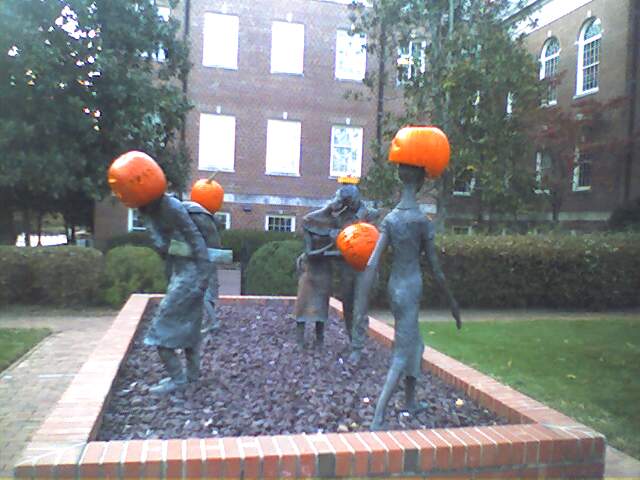
This group of starcrossed statues wandered around campus for a while before ending up in this nice little garden outside of Manning and Hamilton Halls. Once a year, the statues get new temporary heads. Some years these heads are more creative than others.
On the scale of creativity, this year was a year.
Comment spam has hit this blog today in a big way. Luckily the spam catcher grabbed it and kept it off the blog, but I still caught it in the moderation queue.
What was the flock of misspelled messages hawking besides a larger manhood and larger breasts?
Ringtones! Tons of ringtone adverts.
Update: I did install Link Right 2 (actually now it’s 3) and we’ll see what’s up.
From Andie of Africa:
Library that lets you take out people who are left on the shelf
By David Rennie in Brussels
(Filed: 25/08/2005)A public library in Holland has been swamped with queries after unveiling plans to “lend out” living people, including homosexuals, drug addicts, asylum seekers, gipsies and the physically handicapped.
Brewster Kahle was trying to get UNC involved in the Open Content Alliance for digitized public domain books while he was here for the Wilson Knowledge Trust meeting.
Now he announces that Microsoft Network will not only join the Alliance, but will commit to scanning 150,000 books in 2006!
Brewster’s brief press release includes a link to a Word version of the MSN release
The Open Library site which will house the collections has a very nice book browser.
It’s great to hear from an Internet pioneer, but this time a little embarrassing too. Doug Engelbart writes to tell us first that he loves ibiblio (thanks so much) and second that a very nice resource on ibiblio has his name misspelled throughout. Yikes!. It is a great site. Internet Pioneers even has an audio interview with Vint Cerf looking forward from 2000. But almost everywhere Doug’s name was wrong. The site was created in 2000 as part of a masters project to which I gave some technical and other assistance. I wasn’t the copyeditor ;->
The good news is that I have a corrected version of the site ready to install tomorrow. There are two image files with Englebart instead of Engelbart which will take a bit to match, but all others should be right.
IBM announced a very bold announcement regarding patents and sharing. The patent giant will allow folks from the health care and education industries free use of patents for development and use within certain open-software standards for Web services, electronic forms and open document formats.
IBM Press Release to be here as soon as I take it out of a proprietary format is here or at this web site ;->
Here is a slide presentation in PDF format.
Open, archival and exchangable health records here we come!
IBM Site quote: “Open software standards lead to greater efficiency and innovation, transforming both health care and education.”




Recent Comments