Accept no substitutes

Author: Paul (Page 120 of 147)

JCDL: Interacting with Media session

Cathy Marshall of Microsoft is chairing the session called “Users and Interaction Track: Interacting with Media”

  • *Addressing the Challenge of Visual Information Access from Digital Image and Video Archives
    Michael G. Christel, Ronald M. Conescu
    Mike Christel presenting. concept-based vs content-based retrieval of video. concept-based using manually described text descriptions of what is in the video. very labor intensive. annotation is incomplete and inconsistant and based on the annotators own experiences and knowledge. words have a tough time describing pictures. content-based is done by computers. good at color, texture and shapes and motion or lackthereof. but people don’t know how to ask for content-based systems. a symantic problem. even forming a query is difficult. can content-based get to concept desctiptions — know if the image is of buildings cars etc?
    TRECVID – is a TREC video search. NIST sponsored corpus of news videos. next year international news video. given a multimedia need and topic can a user find the document (aka video)?
    CMU created an interface of storyboards of keyframes. 3 kinds. one “best sets” like best roads. best people done imperfectly by machine. one color match — all with yellow background. third, text query. 24 novices in the study. independently worked for 15 mins to do 4 topices. full system vs video only.
    precission was very close between the two runs of the two systems. full system generally but no always wins. when does video only win? generic topics v specific copies. man-speaking v bill clinton say. on generic full always beats video only. and people liked the full system better. so full system (includes closed captions etc) always wins. same for experts as novices. people do better than automatic (run without interactive feedback).
    experts used “best search” much more than novices. novices even with video only used much more text in their searches than experts. why do novices use text even when there isn’t hardly any text there?
    see paper for more

    For novices, text annotated is much better than video only. Interfaces encourage text only.
    http://www.infomedia.cs.cmu.edu

    Questions:
    Cathy asked about improvements. how to get there and be as good as Google Image search? better detectors (like road detector) will get more precision even tho recall will still suck.
    what about color and texture searches? find more like this. worked sorta.

  • *Assessing Tools for Use with Webcasts
    Elaine Toms, Christine Dufour, Jonathan Lewis, Ron Baecker
    Christine Dufour speaking. Reusing webcasts is the topic. abstract here. How do people use the tools for webcast. ePresnece webcasting system used. 5 tools: video window, slide window, timeline, search button, table of contents. users given three tasks. n=16 students. 56% had never used ePresence. Not sure what to take from this one. Useful critique of who folks use ePresence and of ePresense Interactive Media I guess. Can we extend from this? And to what? Looks like text is the big winner again here.
    Questions:
    what is the user modivation? so far assigned tasks, not true user needs.
    rate of tool use. how much time spent with each and does that matter afterall?
    Cathy asks how was table of contents created? by powerpoint or by human annotation — inconsistant. since powerpoint was the most useful (since it had the most text i bet) how would people do if just given powerpoint (NB Cathy’s company owns powerpoint)?

  • Exploring User Perceptions of Digital Image Similarity
    Unmil P. Karadkar, Richard Furuta, Jin-Cheon Na
    Unmil speaking. Texas A&M. MIDAS Multi-device integrated dynamic a? systems. abstract here. MIDAS user studies here.

Chapel Hill Blog Teach-in

Anton aka Mister Sugar writes about the upcoming Chapel Hill Blog Teach-in.

Chapel Hill Blog Teach-in

Join us for a free event to learn about blogging and how to create your own blog:

* Saturday, June 11, 2005
* 12 noon – 2 p.m.
* UNC-CH Health Sciences Library Biogen Idec Classroom, a computer lab with 40 seats
* For anyone who wants one-on-one help becoming a blogger
* For new bloggers who want one-on-one help improving their blog or making the most of their blogware

More details at
http://mistersugar.com/tamtam/blogtogether/show/Chapel+Hill+Blog+Teach-in.

RSVP to anton@blogtogether.org.

JCDL: Is Digital Preservation an Oxymoron?

Panel on (mostly) born-digital preservation. MIT prof at retirement turns in his laptop as his personal archives.
Average life of a document on a government web site is only 44 days. Brewster gets props for some goodness but links are often broken. Long-term access fails (says she, she being Liz Bishoff).

Robert Horton – Minnesota Historical Society – speaks first.
largest of state historical society. 300 employees. broad collections including tv, video, audio of legislature, etc etc. every 20th century medium difficult to preserve. think of silent films and varieties of audio. what is the “use value”? the more something is used the more likely it will be preserved in some form.
government records perspectives now. move to egovernment makes records management extremely difficult. procedures now used are no longer sensible or even doable.
minnesota does not try to control behavior. everyone shouldn’t have to be a records manager (says minnesota). starting with lower hanging fruit with specific results. have to have partners. UCSD’s supercenter has been their partner. Using grid technologies and GIS resources via SDsupercenter. 1.5 terabytes there.
Technology is not the problem, but organizational change is. How to fund and educate and to manage partnerships. How to move lessons learned at the edges of the organization to the center.
From eGov. must connect to enterprise architecture.
Must build capacity by showing immediate return — to get funds. Like the plant in Little Shop of Horrors — Feed Me!

Mark Halbert from Emery U – part of DLF’s Aquifer Project also NDIIPP funded etc. Preservation is not boring, says he. Now he explains his NDIIPP project which is about getting 3 terabytes of Southern (that’s Southern North America) resources as a Metaarchive.
distributed preservation strategy – LOCKSS (lots of copies keeps stuff safe)
dim archiving – not necessarily high accessible. in fact. hold costs by not letting people see it!
flexible organization model
formals content selection process – use the farris encyclopedia of southern culture as the framework
project time line – network underway now. initial archiving will be done in august.
metadata schema – standards based http://www.metaarchive.org
cooperative agreement designed to grow and change over time.
copyright ambiguities are the biggest challenges. LOCKSS is not friendly to copyright restrictions. lawyers see copies are well copies; archivists see copies as preservation and necessary.

Taylor Surface next up. He’s from OCLC. Director of Content Management something or other (says intro). He too is part of NDIIPP with UIUC. OCLC on digital content preservation. OCLC as a service provider for other organizations. Two services. Web archiving service to provide permanent access via links and/or archived materials as captured from the web for certain constituents. Digital masters supports digitization services and preserving “digital masters” for control and management. Used by about 10 state libraries.
Preservation planning. the OCLC policy, which you can read on the web (says he). Global digital format registry. (my my spelling is bad). Specificially informed risk accessment methodology (INFORM). Trusted digital repository registry for a national and/or international repositories to show that your work will be preserved.
Question time.
What is a “dim archive”? Martin answers. That Dark Archiving is impenatrable, but they don’t like to provide high availability to preserved materials. That means that you can get to a registry but you may not be providing access especially high availablity.
Gary Marchionini asks about software for preservation etc. Emery uses LOCKSS (open source etc). Bob says storage resource broker from SDSC and contentVM in minnesota. OCLC guy makes his pitch and says they currently use Oracle but that that is changing even now. and there will continue to be changing.
selection at emery. the most difficult issue is what formats will preserve what including the relationships in software and in databases. how to preserve intellectual content? files of ?? format will have rotted (say like wordstar?). migtation will be concerned with the selection.
formats for gov records. only about 1% of gov records is preserved. content is more important than structure for gov docs says Bob of minnesota.
More on structure and on formats.

JCDL Keynote – Deanna Marcum of LC

Deanna Marcum of the Library of Congress gives the keynote here at JCDL. Good news is wireless access in all the conference meeting rooms and there is no charge.

“The Sum of the Parts: Turning Digital Library Initiatives into a Great Whole” Can there be a discussion of digital libraries without worrying over Google in various ways? — appearently not. American Memory project has grown to 9 million items from over 100 collections. Originally designed for school children but now 3.4 billion hits from all over the world by (as near as they can tell) from people of all ages. Various projects from Library of Congress discussed (whilst Jason Moore IMs me from Rhode Island to tell me about his new job at UC-Irvine where he will be Digital Services Manager at their Library). Now about starting and maintaining born-digital collections. Buncha stuff about Dspace which is called “a newly developed digital repository created to capture, distribute and preserver the intellectual output of MIT.” Project Gutenberg gets props. Digital Librares Federation has 600 collections. [frankly there are many many not in DLF for various reasons]. TEL (The European Library) still seeks a “single access point” [why do libraries still think like AOL? and why are they obcessed by portals? Why not be more open and more flexible? Funding? Egos? Nationalisms? Continentalism? Or ease of use?] DLF has 34 members in their Aquifer portal. A bit about Open Archive Initiatives. More about how portals are so wonderful [I’m much less sure about that — portals seem so AOL]. A “dream of a universal library” cited [bypasses Borges — is he too obvious?]
Four major things to allow for the universal library:

  1. Update copyright to allow better access and open the Commons. Jamie Boyle gets props for his fencing in the commons and enclosure essay. Fear of licenses supplanting copyright. Problems of extension. Database access problems. Need to protect fair use for public access. Public Library of Science and SPARC get props. As does J-STOR (which I love less because of their charging scheme blocks access). Fear of Google initiative — sorta. Publishers are up in arms — especially University Presses who should learn better. Section 108 study group (sec. 108 of copyright law) described as looking for balance. [but Google is forcing the issue] Orphan works not mentioned though.
  2. Ensure Long-term Preservation. Need procedures and techniques or we will experience massive loss of knowledge and of digital resources. NDIIPP is one attempt at helping this happen [UNC and ibiblio are working on an NDIIPP funded project now with open video. We are one of 8 projects in this area.]
  3. Link Libraries and Digital Collections. Open Archives gets props here. Metadata improvements and metadata sharing. $292K to DLF for Open Archives Initiative.
  4. Get more Funding. [love this one] Google Initiative is a result of lack of federal funding? Brewster gets noted for his concern of private control of public resources. But Google is serious about very large scale digitization (says Brewster who has his own massive digitization projects).

Question time:
Big institutions favored by these approaches. What about personal and unique collections?
[wikimedia projects are not noticed. that shows how much is missed here I think]
Gary Marchionini at the mike now. Asking about funding. “Let Google do it” vs national and international initiatives. [misses the obvious wiki answers. the wiki way is unmentioned at this conference so far. to me that’s the most interesting model and biggest growth area]
Organizations serve their members. This causes problems.
Copyright issues up now.
Digital divide questions up now. Stories of funding for collaboration projects in poorly served areas.
Postman and media education mentioned. Contextual access to information needed.


[The unnamed challenger is Wiki Commons. pj]

Hotel Peeves – Marriott edition

Michael Khoo and I were talking about the small things that hotels get wrong. We don’t want HDTV especially. We do want:

  • Better in-room coffee. It’s great to wake up and make coffee in the room, but why why why is it always crappy coffee? Only a few cents more and you would have some pleased people.
  • Thick sides the shampoo bottles. This is really annoying. You stand in the shower pinching the sides of the shampoo and nothing or next to nothing comes out. Those of us with luxuriant flowing hair are particularly annoyed. Better packaging please!
  • Annoying charges for Internet access. $10/day isn’t so bad, but at home we pay less than $10/week. Just roll the charges into the room fee and forget it. The hotel will pay less and we will be less annoyed. Everyone I’ve spoken to has been annoyed by this. Doc went on a rant in our room what the Emerging Tech Conference about this.

In Denver. Not too heroic.

Both of the finalists from UNC remained finalists at the Computerworld program Monday night. Sally has the story and pictures on her blog.
I’m in Denver for the Joint Conference on Digital Libraries and trying to adjust to the time zone changes. Staying at the Cosmos Club made me very sleepy. Now I’m in your standard issue Marriott in the middle of Denver. You can see the mountains from here tho.
John Reuning and his poster were supposed to have been here before me, but somehow his flights were completely messed up. (He’ll have a good tale to tell I’m sure). He’s still not here as of Wednesday morning.
Megan Barrett presented at the Doctoral Consortium and was walking around with a surprise gift of an iPod for her good work.

Skype-omania

Skype is on the front page of the News and Observer this morning! A long
article from the Washington Post is carried mostly whole in the Raleigh
paper. Here’s the original article from the Post.

A few interesting numbers from the article:

  • 30% of Skype’s customers are businesses
  • Skype gets more new customers in a single week than Vonage has in total
    for its entire life as a company
  • Skype has 171 employees; Verizon landlines has 142,000.

I’ll be on the way to and in DC. Skype me as smalljones. I loved catching up with Mark McCarthy in Sudan via Skype.

Misc. on Sunday

Packing up for the trips to DC and to Denver. The first for the Computerworld Awards. Got tux. Got medal. Etc. The second for the Joint Conference on Digital Libraries.
Took in the North Carolina Boys Choir’s Spring concert which was delightful and was a sort of preview to some of the music to be sung on their tour to the UK in a couple of weeks.
Over on that side of the pond, Kristina, along with Will, is heavily documenting her adventures in Paris with some great pictures and a discovery of the secret of Manga hair!

Carnivores – plants and lives

Not the Ritchie Bell Pitcher
The Celebration of Pitcher Plants and Bog Gardening at the NC Botanical Gardens today was really a surprise celebration of Gardens founder Ritchie Bell. Bell had been invited to come and sign copies of the new edition of his book, Wildflowers of North Carolina and to heard a talk about pitcher plants by Larry Mellichamp of UNC-Charlotte. What Dr. Bell had actually been invited to was the announcement of the naming of a special hybrid pitcher plant in his honor. Over half a century ago, Bell was already recognized as one of the world’s greatest experts on Sarracenia (aka pitcher plants). He later prompted and created the Botanical Gardens even to the point of signing the bank note with his home as collateral to pay for the current Totten Center.
As Mellicamp announced the hybrid, he noted that the plant like Bell was hardy, robust, showy and tall. Bell, himself interjected that he noticed that it also has a very big mouth and that that mouth is wide open and gaping.
Mellicamp then treated us all to a slide show of pitcher pictures, puns, personal tales and interesting facts with occasional commentary from Bell.
Among them:

  • Pitchers weren’t discovered to be carnivorous until 1875. Early botanists reported that the plants existed as shelters for small tree frogs. (Mellincamp showedNot Larry M's pica great picture of a tree frog in a pitcher — not this one).
  • Most pitchers, the exception being the purple, don’t like to get rain inside their pitchers. The varieties of hoods act in part to keep out raindrops.
  • Pitchers hybridize easily. Hardy hybrids even occur often in nature. Because all species of pitchers have the same number of chromosomes, the hybrids are fertile. The period of maturity assists those, who like Mellicamp and Rob Gardner, specialize in hybridization — only 3 years. “If we had decided to work on oak trees, we’d still be at work on the first generation.”
  • The nector found on the lips of the pitcher contains a mild narcotic which both attracts insects and makes them clumsy enough to topple into the pitcher. If, according to Mellicamp, you rub your finger on a nector moist pitcher then rub your lip with that finger, you will feel some numbness.
  • Pitchers tend to specialize in which insects they eat. The result is that there are a variety of insects to go around between species in the same area. Also they have adapted ways to keep their food insects separate from their polinators. The hooded pitcher, for example, thrives on ants and is difficult for other insects to enter.

The plants in my own bog garden that have succeeded are Mellicamp-Gardner hybrids, Marti Gras, ladies in waiting and others.

ibiblio in 30 Seconds

If we are announced as winners of the Computerworld 21st Century Achievement Award, I’m supposed to give a 30 second thank you speech. In theory, this is simple. But in practice, we have a few problems. First, as a college professor I never speak for less than 50 minutes so we’re cutting by a factor of 100. Next, we’re covering over 12 years of sunsite/metalab/ibiblio in which many many good folks helped out even if they were here for a very brief time. Third, we have over 1500 contributors; many of these folks could have won the Award entirely on their own. Fourth, we’ve had great partners who gave and still give us hardware, software and support — most notably over time Sun Microsystems and The Center for the Public Domain and IBM.
Can I say all of that and be amusing too?
Yes I asked for an extension (only good in the case of our winning of course) and got an additional second.

The future from 1956

Set for sales in 1956 when the future was consumed by promises of consumerism where the men announce the cars whilst the women announce the costumes (including silk casuals), where the dream trip to the motorama is interupted by a visit to the kitchen of tomorrow, where the mildly erotic Dance to the Future celebrates a cake having been cooked, where the Firebird is a turbo-electric spaceship like car is designed for the electric highway — “Design for Living” from the Prelinger Archives. Get your future on!
Having Danced to the Future Shadows of 1958 Dancing for Kitchen Improvement Balloons for the Touch of Magic

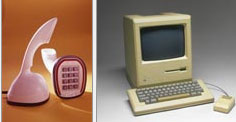
Note the phone in this Populuxe tribute to the American Look. (and see article below).

Wilbur the hipster yet balding cherub uses his wireless phone to talk to his boss in heaven in “Once Upon a Honeymoon” while trying to help Mary and Jeff, who’s honeymoon is delayed. Mary interestlingly enough doesn’t pine over the honeymoon, but moons instead over her kitchen. Her house is magically redone to include colored phones and in the bedroom — twin beds separated by a telephone table. Then Jeff is inspired by a busy signal to compose a new song freeing him from a work assignment so he can go on their honeymoon — a year late.

Prelinger has many more films on the American Look and the Future from the 1950s from Populuxe.

East Fed = More than Wicked?

While the Wicked Burrito owners have come round a bit, Eastern Federal the owners of Chapel Hill’s next greatest eyesore, the bulldozed remains of the Plaza Movie Theaters, have taken on an angry tact with Chapel Hill. So far, they’ve been into it with the adjoining shops and property management, with the Town and with anyone who has to drive by and see the razed fenced site of the former theatre. None of this is their fault as their letter to the Town explains.

More Heroic: Tux 2.0 (next Monday)

Getting lined up for a trip to DC for the next step in the Computerworld Honors Program. We are among the 5 finalists for the 21st Century Achievement Awards which will be announced at a ceremony at the National Building Museum next Monday evening. The Open Video project is a finalist in their area so we’ll be driving up with my collegue Barbara Wildemuth and will be met there by Gary Marchionini.
This event calls for tux and medal so I’ve ordered up the monkey suit again from the wonderful O’Neill’s.
We’ll be staying at the Cosmos Club (thanks to Jose-marie Griffiths) and although our time in DC will be brief (less than 24 hours), we’re looking forward to a grand time.
Directly after that I’ll be on the plane to Denver for the JCDL 2005.

« Older posts Newer posts »

© 2026 The Real Paul Jones

Theme by Anders NorenUp ↑