John Bachir traveled to DC last week to present a statement about the potential negative impact of the WIPO proposed “Webcasting rights.” He’s posted his piece on the IbibBlog.
Author: Paul (Page 97 of 147)
Peter Kramer, who along with his wife Susan Gladen loans me a place to write in a small shack in their chicken yard, writes to alert and invite us all to “An Evening With Friends” fund-raiser for AIDs patients in the Triangle.
What: An Evening with Friends
Where: Hillsborough Church of Christ
When: Saturday, February 18
Dinner: homemade meat and vegetarian lasagna, salad, bread and a huge array of homemade desserts at 5:30pm.
Music: by the “Flashbacksâ€, 7:00 pm, featuring recording artists Janet Stolp and Mary Rocap.
Special guest Bambi Linzsey, world class bass player from New Orleans.
Band members: drums-Rodger Tygard; lead guitar-Charles Ebel; guitar-Peter Kramer; bass guitar-Lew Wardell; fiddle-Bill Henderson; soprano sax-Reverdy Ransom
Dinner donation: Adults – $10.00 children – $5.00
Warning: Tables disappear after dinner for dancing.
GoogleBlog reports that gMail Chat supports the heart emoticon <3 which they translate into a nice pink heart.
The UNC Libraries and the School of Information and Library Science (of which ibiblio.org is part) have joined the Open Content Alliance. The School is the first School to do so. We join such good folks as Archive.org, MSN, Yahoo!, O’Reilly Media, Smithsonian Institution Libraries, National Archives (United Kingdom), Research Libraries Group (RLG), and several university libraries.
SILS press release here.
The Philip K Dick android has been missing since January! Dick was packed for a flight to California and was last seen being loaded for the plane.
He has not called home.
(report from The Age in .au)
Wisconsin Public Radio’s “To the Best of Our Knowledge” carried a supershow on the South and Race. It ran today, but you can still get the show from their website.
SEGMENT 1:
Doris Kearns Goodwin, Pulitzer Prize winning historian and the author of “A Team of Rivals: The Political Genius of Abraham Lincoln,” talks with Jim Fleming about the political genius of the man she considers America’s greatest President.
SEGMENT 2:
Steve Paulson produced this report on Abolitionist John Brown which explores the question of whether terrorism is ever justified. What are we to make of this enigmatic figure who committed murder in his efforts to end slavery?
SEGMENT 3:
E.L. Doctorow’s latest novel is called “The March” and is about the devastating effect on the South during the Civil War of General William Tecumseh Sherman. Doctorow talks about the book with Steve Paulson and we hear excerpts read by Karl Schmidt. Also, historian Tim Tyson tells Anne Strainchamps about the racially motivated murder that has informed much of his professional life. He writes about it in a book called “Blood Done Sign My Name.”
David Menconi recalls better times for Sly Stone in the News and Observer blog after Sly’s decidedly odd appearance at the Grammys. But Johnny Hong Kong has the more sensible story: Sly has evolved just as Gizmo evolved in part to Spike in “Gremlins.”
Because they carry mindcontrolling parasites, toxoplasma gondii. In rats, the infection causes the victims to commit suicidal acts (uninfected rats avoid the smell of cat urine, but infected rats seek it out). In humans, there seems to be a link between toxoplasma gondii and schizophrenia. Yahoo took the story from Technovelgy. Imperial College London has the Cat-parasite-schizophrenia research story.
Bill Graham recovers his name, Wolfgang Grajonca, and the music from the live shows he produced is set free for us all to hear at Wolfgang’s Vault. The concert recordings are streamed in a 128k radio-like format and are not yet available for download (I hear you’ll be able to purchase music sometime this summer. So far I’ve heard some very strong covers including Lighthouse’s take of the Byrds’ “Eight Miles High” (recorded in 1969) and the Staple Singers’ version of Buffalo Springfield’s “For What It’s Worth” (1968) as well as early live versions of James Taylor’s “Fire and Rain” (1970) and Bruce Springstein’s “Blinded by the Light” (1973).
Like radio, you have to take it as it comes. No pause. No playback. All surprises. Just now hearing Cream doing “Sunsite of Your Love” (1968).
Damn! Just caught Grace Slick and the Great Society doing “White Rabbit” at the Fillmore in 1966 before she joined the Jefferson Airplane.
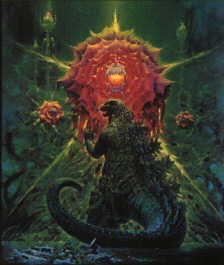
How did a giant monster eating plant, Biollante come to attach Godzilla? In three easy evolutionary steps, beginning with:
Little Shop of Horrors (1960) in which Audrey II gets hungry and says the famous line “Feed Me!” Her diet is limited to humans.
Next the plant walks and multiplies:
Day of the Triffids (1962) in which the prey, humans again, are struck blind as they watch a meteor shower. A shower that also brings plant spores!
Finally, the spirit of a young girl, a rose bush and Godzilla are blended, along with their DNA, to create Biollante:
Gojira tai Biorante (1989) aka “Godzilla vs. Biollante” in which the walking growing plant develops a taste for lizard — one of my favorite Godzilla movies, lyrical some call it. For the best review see StompTokyo.com.
If you know of other movies with similar plants, please let me know in the comments.
CRADLE Presentation, Friday, February 10, 2006
Location: Room 208, Manning Hall
Time: 12 – 1:00 PM
Title: The Archivist’s Toolkit
Presenter: Bradley Westbrook, UC-San DiegoThe Andrew W. Mellon Foundation has awarded $847,000.00 to the UCSD Libraries, the NYU Libraries, and the Five College Libraries to support development and implementation of a software application to support archival processing and the management of archival information. Key objectives of the project are to increase archival processing efficiencies and lower processing costs, including costs for specialized training; reduce the need for locally built tools; and promote standardization. When completed, the application will support collection accessioning and description, location tracking, and provenance registration, as well as outputs for the EAD and METS standards.
Bradley D. Westbrook is the Metadata Librarian and Digital Archivist at the University of California, San Diego. Prior positions include Manuscripts Librarian and University Archivist at UCSD, Exhibits Curator at Columbia University, and Rare Books Librarian at Kent State University. He has an MLS from UCLA and an MA in English from SUNY-Albany. He has been active in RBMS and SAA and is currently a member of the SAA Technical Subcommittee for Descriptive Standards. He has given numerous presentations on archives, special collections themes and has published on virtual collections and the Archivists’ Toolkit (forthcoming).
Bradley talks a lot about why they chose Open Source and community-building as an important part of their approach. Archivists’ Toolkit will be on SourceForge. Hooks to Institutional Repositories (like Fedora and Dspace) are planned. Plan to ship on June 2006 as Alpha, Beta to partners in July, and public release in November 2006.
“Suffer fools gladly, seeing you are wise” (oft quoted out of context from II Corinthians 11:19) meets “No fools, no fun” (official motto of the Hertford, NC Chapter of the Sweet Potato Queens). Shakespeare elevated fools oft making them the only wise speakers in his plays. Paul, earlier in the same chapter of Corinthians, claims to be a fool himself causing most serious readers of the verse to see it as sarcastic in tone really meaning “You are so smart, but you need to listen to me, a fool. So listen up.”
Bill Harmon posed the philosophical question in this way: “Paul says to suffer fools gladly, but he doesn’t say for how long.” Since hearing him, I’ve wondered about the time limit if there is one.
I am beginning to think the type of fool is the determinate. Fools such as those in Shakespeare or in the Hertford Chapter of the Sweet Potato Queens (whom I hope to meet some day) likely get a long period of suffering since they are gladdening and only cause suffering amongst the unwise.
My favorite fool is Nasrudin Hoja.

I had three different chats open when my son told me to shutdown iChat, gTalk and Gizmo and download Adium. Why? So I would only need one client to connect to all three services plus a local Jabber server. Those are all I’ve tested so far. He has MSN Messenger on his too so we know that works.
The client, Adium, requires a plug-in for Gizmo or as they call it an Xtra. I added Homestarrunner sounds (also an Xtra) and have turned off the other clients. I added the Aqua Plus Xtra to get the little Gizmo icon. Everything (icons, buddies, etc) moved over seamlessly.
Mac OSX only. Open Source. Community supported.
Anton Zuiker writes with this alert:
Join us for a technology teach-in. Learn about the history and development of weblogs, how to start your own blog in just 5 minutes, and how to read other blogs through theirnewsfeeds. We’ll also cover podcasts, wikis and other online communication tools. This free event is open to anyone who wants to learn about blogging. UNC staff Anton Zuiker and Brian Russell will lead.
* What: Blogging 101: Everything you need to knowabout weblogs, podcasts & newsfeeds.
* When: Tuesday, February 28, 12 noon – 1 p.m.
* Where: Health Sciences Library, Room 307-Biogen Classroom
* More Info: 919.966.2329 or www.blogtogether.org.
Can’t join us? Find local bloggers at the Chapel Hill Bloggers Meetup on the second and fourth Thursdays of each month at 7 p.m. at 3CUPS coffeebar in the West End Courtyard.
Collegue David Carr points us to a Chronicle of Higher Ed article called “The Professor as Instant Message.” After 5 days, the link above will vanish, but Chronicle subscribers can find the article here.
although i was amused by the article i found it to follow a familiar script:
new teacher (or old) tries new tech (email, chat, bboard, sms, im, etc).
teacher has less experience than students.
teacher projects uses and behaviors on tech and tech users.
the users (students) already have a social standard for use.
teacher is amused and slightly flummoxed by the tech and the social construction of the tech.
teacher reports mixed results after recounting a few tales.
i’ll bet there is a comm tech theory that covers this but what is it?
l8r
UNC’s Psychology Department will memorialize their former chair and collegue, David Galinsky who was struck down by a car on Fordham Blvd.
What: David Galinsky Memorial
When: Sunday, February 26 from 2 pm – 4 pm
Where: Auditorium of the School of Social Work, aka the Tate-Turner-Kuralt building
Parking: water tower lot (behind the Newman Center) and the Bell Tower lots.
Jeff Pomerantz alerts us to the upcoming NC Festival of the Book (April 25 – 30). He forgot to tell us that this great conference will be held at DUKE. I’ll be in Granada during part of the festival. Among the panels will be the “Light in the Piazza” trio Elizabeth Spencer, Adam Guettel, and Craig Lucas and some serious music talk from Chris Stamey, Don Dixon, and Mitch Easter.
Asked to help with technology for middle schoolers, Strong Bad responds in style.
When the summer comes, I get ticked. I’ll need this to get ticked off — or is that off-ticked?
My mother-in-law gave me a small book for my birthday. Brief but dense, allusive and slightly magical yet real in that Southern South American way. Indeed, it was by a Uruguayan Carlos Maria Dominguez. “House of Paper” is about obsessions with books, about literature and personalities, about intertextualities of all kinds, about how lives intertwine, about (the author claims, correctly I think) “how books change lives” (but he often means the physical books, rather than the contents), and about passions.
The book begins with a death. A scholar and lover of the tale-teller is hit by a car as she crosses a street in Cambridge, UK while reading Emily Dickinson. Then a package arrives. A book. Conrad’s “Shadow Line” with concrete on the cover and an inscription made by the dead woman to a former lover (not the tale-teller). With that we’re off on a quest with the writer/speaker that takes us to Uruguay by way of Argentina. Borges is a heavy influence here but others touch the brief (just over 100 page in small format) book. And of course, Conrad who is saluted throughout the book and specificially given praise at the last.
I haven’t read “Shadow Line” I suspect few living have. It’s not a well-known Conrad book. From my first probings I see that book is about crossing the line into full adulthood and like so much of Conrad a sea tale with the subtitle “A Confession.” The Conrad book is out of copyright and available in many forms including from Project Gutenberg (see link above).



Recent Comments