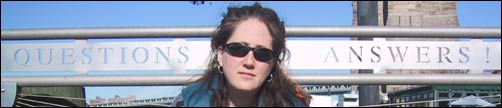
Accept no substitutes

Category: Alumni and other friends (Page 33 of 38)

Wireless in Laurinburg and the Triangle

Doc was nice enough to pick up on my references to Fiona’s stories over at his IT Garage, but he got a few things a bit off. First the article that has all of the links to Fiona’s stories on Muni-nets wireless and other is here.

Next, that’s Laurinburg, NC! Once called MacLaurinburg, it’s now called Laurinburg. The town is close to the South Carolina line — just above the famous South of the Border — but it is definitely in Nawth Cakalacky.

IP talks at Duke Law upcoming

Jennifer Jenkins of Duke Law’s Center for the Study of the Public Domain writes to tell us of their upcoming events.

What: Hot Topics in Intellectual Property Law Symposium
Date: Friday, April 1, 2005
Time: Registration/breakfast at 8:15 am, presentations begin at 9:00 am
Location: Duke Law School, Room 3043 and breakout rooms
Full Schedule: http://www.law.duke.edu/student/act/intprop/Symposium2005/sympinfo.htm

The day begins with experts from Red Hat, the European Union, and other major Software IP players discussing their views with one another in a topical panel debate entitled Software: Patents vs. Open Source.

Then, attend prolific author George Gilder’s exciting keynote presentation,
Patents vs. Latents – Invention and the Law.

This will be followed by informative breakout sessions given by IP experts from private practice, government, and academia.

View the full schedule and register at http://intprop.law.duke.edu.
Students attend free. CLE Credit available.

What: “Patenting Life and Its Parts: Ethics and Rights in the Political Economy of Intellectual Property”
Who: Professor Daniel Kevles of Yale University
Date: 04/07/05
Time: 12:15 p.m.
Location: Duke Law School, Room 3043
Lunch will be served

Since the late 1970s, patents have been issued on living organisms and their parts, including microrganisms, plants, animals, and genes. These developments enjoy strong support in a number of quarters, including the biotechnology industry, university technology transfer offices, and the patent bar, who hold that such patents guarantee to inventors the natural right to the fruits of their labors. However, they have also stimulated widespread dissent in the academy and among patients’ rights groups, religious groups, and social activists. Part of the dissent is ethical, a consideration that has no place in U.S. patent law but does explicitly appear in European patent law. Professor Kevles will discuss these and other issues during his lecture.

What: “Working Knowledge: Ownership of Workplace Knowledge and the Rise of Corporate Intellectual Property, 1800-1930”
Who: Duke Law Professor Catherine Fisk
Date: 04/14/05
Time: 12:15 p.m.
Location: Duke Law School, Room 3043
Lunch will be served
(More details to come)

Professor Fisk is currently writing a book on intellectual property rights in the nineteenth-century employment relationship. Her recent publications include “Knowledge Work: New Metaphors for the New Economy,” Chicago-Kent Law Review (2004); “Authors at Work: The Origins of the Work-for-Hire Doctrine,” Yale Journal of Law and the Humanities (2003); and “Working Knowledge: Trade Secrets, Restrictive Covenants in Employment, and the Rise of Corporate Intellectual Property, 1800-1920,” Hastings Law Journal (2001). Prior to entering law teaching, she was an attorney for the Civil Appellate Division of the United States Department of Justice in the District of Columbia; an associate at Rogovin, Huge & Schiller in the District of Columbia; a law clerk for the Honorable William A. Norris, United States Court of Appeals for the Ninth Circuit; and a staff attorney for the United States Court of Appeals for the Ninth Circuit.

Skype here

I finally signed up for Skype so I could talk to Brian Russell while my tween son is on the land line. The good news is that Skype was simple to install and use. The bad news is that some one already has PaulJones. But my AIM handle smalljones is now my Skype handle so all is well.

Podcaster Con – Help Make It So

Anton, who as MisterSugar created our Triangle Bloggers Con and the local blogger meet-ups, and Brian, who as AudioActivism was just featured on Voice of America’s story on podcasting, have come up with a plan (in the planning stage) for a Podcaster’s Convention.
You can get in on the planning now. Just go on over to the Podcastercon.org site and contribute to the Podcastercon wiki. Already some very good folks signed up and contributing.

OrphanWorks (and Duke Law)

Duke CSPD Proposal Cover
James Boyle write to tell us all about Duke Law’s Center for the Study of the Public Domain and their part in the presentations to the Library of Congress on Orphan Works and Orphan Films

I wrote about the problems of orphan works earlier by posting a note from Larry Lessig about it.

Jamie says:

Anyway, we put together a report for the copyright office on orphan films, and another on orphan works — For both of them we interviewed people around the country on their experiences.? Some amazing stories came out of that, and the orphan films research is tragic? At the end of the orphan works report, we offer a proposal to fix the problem.

The two Duke reports are in PDF, but have a good introduction to each of the two CSPD reports.

Wirelessness round here

Fiona Morgan has a long cover article in this week’s Independent about local wireless access. My favorite access place, Weaver Street Market, gets great coverage (yes Jeff that’s an intentional pun).
Back in January, I noticed an oddity in an Nextel advert. Fiona uses that same oddity to begin her story.
Also of note and also by Fiona is a sidebar about a Philly-like tale being played out in the smaller town of Laurinburg, NC (16,000 and once my home) between the town and BellSouth.

Two reasons to go to Raleigh

Two reasons to go to Raleigh.
woven stick bust by Patrick Dougherty
Artist Patrick Dougherty is creating a giant woven bust on the grounds of the NC Art Museum. The News and Observer did a good write up on the project, but it’s nowhere to be found on the Museum’s own site. Dougherty’s work is original and delightful. I recall his woven cacoons relaxing on the front porch of the house he rented near campus. Then the flowing forms that seems to appear around town and even, as I recall, at the NC Art Museum some years back. Patrick Dougherty has since created over 100 stick weavings all over the world. He’s just back from Wisconsin where his work was documented on a daily basis as he created a piece called “Putting Two and Two Together” for the Leigh Yawkey Woodson Art Museum.

From the Museum of Natural Sciences:

WHAT: Joint News Conference between N.C. Museum of Natural Sciences & N.C. State University

WHEN: Thursday, March 24, 2005, 2:30 p.m.

WHERE: N.C. Museum of Natural Sciences Auditorium, 11 W. Jones St., Raleigh

WHY: A remarkable dinosaur discovery in the Hell Creek Formation of Montana has exposed a never before seen specimen. This discovery
could change the way modern scientists view fossilization. This is part of an embargoed story that will appear in Science Magazine this week.

WHO:? Leading author, Mary Schweitzer, Ph.D, Dept. of Marine, Earth, and Atmospheric Sciences at N.C. State University, and Jack Horner, Curator of Paleontology, Museum of the Rockies in Bozeman, Montana will be available to answer questions.

Note: News Release will be available at 2 p.m. on Thursday when the embargo is lifted.

Patrick Herron and Kent Johnson – Saturday

Carrboro Poet/Gawd Patrick Herron writes to alert us of his reading on Saturday.

Who: Patrick Herron and Kent Johnson
When: Saturday March 26 @ 8 pm
Where: Internationalist Books on Franklin Street, Chapel Hill
What: High-energy Poetry Reading

More from Patrick:

Kent Johnson is the caretaker of perhaps the most controversial work of poetry in American history since Ginsberg’s _Howl_, and he has been my mentor and friend for the last six years. You can read about the Yasusada controversy extensively covered in the Boston Review in 1997 ( and
http://bostonreview.net/BR22.3/BR22.3.html). Or, alternately, you can read about his life that includes working with the Sandinistas.

Read a fine example of his poetry, a play on the children’s book _Goodnight Moon_ which is arguably the most remarkable poem in the famed _Poets Against The War_ collection.

Don’t come for me, come to hear Kent–he is truly phenomenal. Poets this good don’t come around often in a lifetime. This is not to be missed.

Patrick

Pam Samuelson at Duke Thursday

Jennifer Jenkins of Duke Law’s Center for the Study of the Public Domain sends us this announcement:

Professor Pamela Samuelson, an extremely influential expert on intellectual property in the information age, will be delivering the annual Meredith and Kip Frey Lecture in Intellectual Property at Duke Law School this Thursday, March 24, at 12:10. You are invited to attend. Details are below.

Please feel free to forward this announcement to anyone who may be interested in attending.

Professor Pamela Samuelson of the University of California at Berkeley

Enriching Discourse on the Public Domain

Date: 03/24/2005 Time: 12:10pm Location: Duke Law School, Room 3041 Reception to follow

Pamela Samuelson is a professor at the University of California at Berkeley, Pamela Samuelson is a professor at the University of California at Berkeley, with joint appointments to the School of Information Management Systems and the School of Law, where she is a Director of the Berkeley Center for Law and Technology. An internationally renowned expert on intellectual property in the information age, she teaches in the areas of intellectual property, cyberlaw and information policy, and has written extensively about the challenges that new information technologies pose for legal regimes, especially for intellectual property law. Professor Samuelson is an advisor for the Samuelson Law, Technology and Public Policy Clinic. She is a member of the Board of Directors of the Electronic Frontier Foundation and is a Fellow of the John D. and Catherine T. MacArthur Foundation.

The Meredith and Kip Frey Lecture in Intellectual Property is a lecture series that was established in 2000 by Duke Law School alumnus Kip Frey ’85 and his wife, Meredith, to increase discussion about emerging issues in the areas of intellectual property, cyberspace, and science and technology law. Noted intellectual property law scholars Lewis Branscomb, the Aetna Professor of Public Policy and Corporate Management emeritus at Harvard University’s Kennedy School of Government, Lawrence Lessig, professor of law at Stanford University, and Yochai Benkler, professor of law at New York University, delivered previous lectures in this series.

West-ern Culture

Spent yesterday with Jessamyn West. She spoke to my class of graduating seniors and later to a larger group of mostly grad students and faculty. The slides from her talks are online and have some links that she didn’t have time to follow during the talks.
Jeff Pomerantz’s class came over to the later class and Jeff has some good notes on that talk on his blog.
Locked in the Library
Jessamyn and I took a quick tour of some of the collections in Wilson Library including the North Carolina Collection, the Rare Book Room and the North Carolina Gallery. In the Gallery, Keeper Neil Fulghum gave us a tour of the collections and restored rooms, especially the private library from the Hayes Plantation once the largest private library in the state (in the late 1800s). We were so caught up the talk and in the presentation of the Siamese Twins, Eng and Chang Bunker, that we ended up locked inside the building! We were not alone. University Librarian Sarah Michalak and two visitors as well as a family touring the campus were stuck there with us. Luckily the Keeper appeared and didn’t keep us there.

Jessamyn West at UNC Tomorrow!

NOTE TIME CHANGE! NOW at 2:00

Jessamyn's got the answers
Who: librarian.net’s rarin’ librarian Jessamyn West
When: Monday March 21 2:00 (Vernal Equinox)
Where: Freedom Forum Conference Center, 3rd floor, Carroll Hall
What: Postcards from the Other Edge of the Digital Divide. Political Choices and the Information Poor

About the talk: While we read blogs, tag content and swap lifehacks, people in rural areas are still learning to type. Public libraries are making many more technological choices just to provide basic information and Internet resources nowadays, yet the paradigm for learning to work well with technology differs dramatically from learning to work well with books. Jessamyn West will be talking about being a tech-savvy librarian in a profession struggling into the 21st Century.

More about Jessamyn West:
Jessamyn West is wrapping up her job as an outreach librarian at a rural public library in Vermont. She has worked in public, special and college libraries and done stints of on-the-fly reference at Burning Man, the WTO and the Democratic National Convention. She has maintained librarian.net, a weblog for radical librarians and other interested parties, since 1999. She is fascinated by the intersection of technology, the public sphere and politics.

In Bloom for Spring

Toadshade
Spring in NC is solidly here. Everyone is out walking — until the games start. We took our walk down to the Botanical Gardens. Just a little hike through our neighborhood. Then a brief walk along the stream trails to see what’s in bloom.
The American Trout Lilies are incredible and everywhere. A few Trilliums are mixed in with the lilies. The trilliums that we saw all had dark red to purple blooms; these are the trilliums know as toadshade or Little Sweet Betsy. Dark tight flowers rising out of the mottled triple leaf.
Now on to basketball!

Fetishizing the Original

Dropped in on the 75th Anniversary of the Southern Historical Collection this evening. Dropped in only on the last session of a day and a half long symposium. Sally had been to the whole conference. I did get to drop in on two great talks.
One by John Hope Franklin who talked about his experience as a young African-American historian coming to work in the archives of North Carolina, Louisiana and Alabama during the 1940s.
One by Ed Ayers who talked about digital projects including his famous and wonderful Valley of the Shadow project.
So far not obvious fetishizing or at least not as pertains to the title of this post.
In question time, one concerned audience member spoke of the feel of the paper, the scrawls on the back of a photograph (never mind that the photo had faded so far from the state in which it was seen in the past), the smell of the archive (this the smell of the archive rotting like a slow compost), etc.
This impassioned talk reminded me of Walter Benjamin’s Work of Art in the Age of MechanicalReproduction. An essay in which Benjamin worries that photography will completely replace painting and that the value of the original, the aura, will be lost as seamless reproductions are made generally available.
Of course, we now see that Benjamin was completely wrong. That we rush to see the Mona Lisa because we are familiar with that painting. Our desire to see the “real” Mona Lisa is increased at each viewing of a reproduction, a surrogate.
What painting would we go to see by Grant Wood? Most likely the one we know from surrogates, from parodies, from endless reproductionsAmerican Gothic (it’s at the Art Institute of Chicago).
The ultimate fetishizing of the original resulted in the daring and somewhat bizzare theft of Edvard Munch’s Scream. Desire may have led to destruction of the desired and we will have been left with its many many many surrogates.

« Older posts Newer posts »

© 2026 The Real Paul Jones

Theme by Anders NorenUp ↑