Bruce Egan gets well-deserved good attention in today’s Chapel Hill News. The online version would rather show a picture of a hops toaster than of Bruce with his bass guitar for some reason though! The paper version features Bruce at front page center with a great photo and write up. (If I can find the picture, I’ll add a link here).
Page 29 of 147

Without even a real release, the band that provides real release Violet Vector and the Lovely Lovelies got the Number 1 spot on Idolator for “Can You Dig It?”
I prefer “Candyland” (any song that goes “Supply meets demand, when you wave the wand that’s in your hand. When we go to Candyland, we go to Candyland.” is fine by me).
Congrats to Amanda, Alex, Doug and the band.
I cooked a big mess of caldo verde over the weekend using last year’s recipe more or less — with collards not kale. So for today, I thought I’d make the non-puree-based version and serve it up with some masa harina based cornbread.
I found a great recipe for the cornbread on Chow. It turned out great. Distinctive flavors of corn and a very nice consistency.
Next I varied the caldo verde recipe a bit. The major change is to not puree the potato, onion, garlic, sausage, and stock. Instead I just kept it there clear (or as clear as that combination can become). I found some linguica (Portuguese sausage) and used that but it was a little mild so I also added a good bit of hard Spanish chorizo picante. I used two cans of locally produced Luck’s blackeyed peas rinsing them before adding them to the stew.
The result, a good spicy broth (thanks chorizo picante) with wonderful flavors in each bite. The two sausages were complimentary and the potatoes were great as bites instead of puree. The beans and collards gave us a promise of wealth and luck for the coming year and the carrots provided additional color and a slight crunch to the texture. I used a food processor to really shred the collards well — something my house prefers to dealing with the julienned bits — one upside was that the good collard flavor really penetrated the broth.
And it looks beautiful, the colors of the collards, sausage, potatoes, and carrots showing well and tasting great.
Happy New Year in the New South.
Some of this unconfirmed and sites still to be secured, but the week of February 4 – 9, 2008 will be a big one for speakers here at UNC-Chapel Hill and ibiblio.org.
- Monday February 4 at 3 pm, Cliff Missen of eGranary and Widernet.org will be speaking about his efforts and successes in bringing the Internet in a Box to places that the wires and wireless don’t reach — particularly in Africa. INTRAHealth and iblblio are sponsoring Cliff’s visit.
UPDATE: Cliff Missen will be speaking in the Pleasants Family Room of UNC’s Wilson Library.
-
Wednesday February 6 at 3 pm in the auditorium of the Frank Porter Graham Student Union, www.sivacracy.net founder Siva Vaidhyanathan will deliver the 2008 Henderson Lecture “The Human Knowledge Project (Part 1): Four Conceptual Errors concerning Massive Digital Library Projects.”
This is a program of the School of Information and Library Science.Part 2 of Vaidhyanathan’s talk will be presented at the John Hope Franklin Humanities Institute at Duke University on Feb. 22, 2008.
- Friday February 8 at 3 pm, DJ Spooky will give a demo/discussion/panel about his coming world premiere of VIDEO SOUL: WATTSTAX To The Avant Garde
This is a Performing Arts Special Activities fund program co-sponsored by the Department of Art, the University Program in Cultural Studies, the School of Information and Library Science’s Open Video Project, Carolina Free Culture, Carolina Union Activities Board and ibiblio.org with additional support from the Department of English and Comparative Literature.
- Saturday February 9 at 8 pm, Spooky’s world premiere of Video Soul will be part of the Soul Power series of performances at Duke Performances.
Generation Y loves public libraries, says Pew Survey (survey here). They are the highest percent visitors. But it’s not the books they are after, says the Reuters article on the report.
“Internet use seems to create an information hunger and it is information-savvy young people who are most likely to visit libraries,” [Leigh Estabrook, a professor emerita at the University of Illinois and co-author of a report on the survey results] said.
Internet users were more than twice as likely to patronize libraries as non-Internet users, according to the survey.
More than two-thirds of library visitors in all age groups said they used computers while at the library.Sixty-five percent of them looked up information on the Internet while 62 percent used computers to check into the library’s resources.
[…]
The survey showed 62 percent of Generation Y respondents said they visited a public library in the past year, with a steady decline in usage according to age. Some 57 percent of adults aged 43 to 52 said they visited a library in 2007, followed by 46 percent of adults aged 53 to 61; 42 percent of adults aged 62 to 71; and just 32 percent of adults over 72.
Note: this is a telephone based survey and so would likely undercount cell using Gen Ys.
Jason Fox of the Foxtrot comic and I are on the same track on many questions of the day — not just about Ent-mas Trees.
Adam Geller reports that the TeachFor.US blogosphere of unofficial Teach for American teachers has taken off this past semester. See his numbers here.

ibiblio is as trustworthy as Microsoft and the CIA! says Sunday Times (UK).
From The Sunday Times
December 30, 2007The truth’s out there – honestly
We all know the pitfalls of Wikipedia, so where can you find some real facts online?by James Knight
It has become a reflex reaction in the digital age. If you have a question that needs an answer or a fact to check, simply head online and tap it into Google. More often than not you will be directed to Wikipedia, where the answer is laid out for you.
The only problem is, it may not be the right answer.
Though many of us have come to rely on the online encyclopedia, every entry in it is available for anyone to edit, so you can’t always trust what you find there.
Fortunately, there are numerous more accurate resources on the web.
The trick is knowing where to look for them.
[…]
REFERENCE SOURCES
As an alternative to Wikipedia, try www.refdesk.com. This portal offers links to all manner of free dictionaries and encyclopedias, such as Microsoft’s Encarta, which has 42,000 articles. Conscientious researchers also have the option to head to sites with a better academic pedigree. Drawing together a range of global public-domain academic resources (of varying quality), www.ibiblio.org is worth dredging if you have a wide field of inquiry – cultural development in China, say.
For definitive statistics on any country in the world, the CIA World Factbook (www.tinyurl.com/2b2kg9) takes some beating. It contains up-to-date figures on everything from population to climate, life expectancy to natural resources and territorial disputes.
[…]
Carl Malamud of Public.Resource.org announces a plan to digitize a *lot* (60 Million pages) of your government documents held at the Boston Public Library. The project, with support of Archive.org and the Library, is funded in part by a challenge grant from the Omidyar Network and the Kahle-Austin Foundation fund.
See also John Markoff‘s NYTimes story (here).
(Note: ibiblio.org supports Public.Resource.org’s distributions with our Osprey Bittorrent service)
Today’s NYTimes features two creative pieces on the OpEd pages. A poem by Paul Muldoon, “Myrrh,” and a short short story, “The Box,” by Roddy Doyle. Both great and surprising. Merry Christmas.
In an interview in ComputerWorld, Craig Newmark, founder of Craig’s List, tells about his business, its successes and why it’s not what is killing newspapers.
At the New Yorker, correspondence between editor Gordon Lish and short story writer Raymond Carver shows something of their complex artistic relationship over time. And a version of “Beginners” (Carver) or “What we talk about when we talk about love” (Lish’s edit) shows what Lish did with or to Carver. My take isn’t one that late Carver lovers will like: Lish made the better story by far. (Note: I did the selection, headnote and teacher’s guide for the Health Anthology of American Literature section on Raymond Carver. There I chose “A Small Good Thing” the un-Lished version of “The Bath” I like both versions, but I prefer the longer one in this case.).
Ted Vaden, the News and Observer’s Public Editor, tries to explain the upcoming shrinkages to that paper. In the process, he goes to the expert on vanishing newspapers, Phil Meyer. But Vaden misses the most telling quote from Phil’s Vanishing Newspaper in which Gary Pruitt current CEO of McClatchy (now NandO’s owners) says:
“We always say to our papers, you challenge is no matter what, the paper must improve. It always drove me crazy … where in a downturn, news hold cuts were made and the paper got worse. … And I always thought restaurants don’t make food worse in a downturn. Car companies don’t make cars less safe in a downturn. … Why is it OK to make a newspaper worse in a recession? That’s your excuse for making your product worse? It makes no sense.”
The question to Ted and to NandO and, indeed, to Pruitt is: are you making your product worse?
Also not discussed is that McClatchey revenue took a dive of 9.2% in November. A 6% decline in circulation and a more than 30% drop in real estate classifieds were some of driving forces for the revenue drop.
A more local McClatchy property, the Chapel Hill News, took a page cut today as well. The Sunday paper will now barely cover the bottom of a birdcage and is much too thin for wrapping a fish. (sans inserts).
DJ Spooky, who will be at UNC and at Duke on February 8 and 9 respectively, is heading down to Antarctica to record ice melting from global warming.
John Maeda, author of the Laws of Simplicity (which I’ll be using in class this coming semester), is the new President of the Rhode Island School of Design. [page includes video]
The news was just breaking as the Doctor Who DVD was ending. Matthew Szulik, CEO and President of Red Hat, is stepping down from those positions but will remain Chairman of the Red Hat Board of Directors.
Matthew, himself, has a touching blog post in which he looks back to his start there in 1999 as CEO.
Jim Whitehurst, formerly COO of Delta Airlines, was named the new Red Hat CEO.
David Byrne’s Survival Strategies for Emerging Artists — and Megastars in Wired 16.01.
Dramatic Growth of Open Access: 2007 (Interim) and Predictions for 2008 at Heather Morrison’s IJPE.
Twitter is dangerous by Michael Krigsman at ZDnet. Mostly paranoid and kinda silly but one I want to remember.
Old buddy Andy Ihnatko’s iPhone Fully Loaded book. He should have been the Fake Steve Jobs. He’s funnier than Daniel Lyons.
eGranary the offline digital library project. Hope to get Cliff Missen the director here as an ibiblio speaker in early February.
W00t! W00t! is the Merriam-Webster’s top new word of 2007. Like it or not what we have been shouting by way of typing while playing video games, chatting or posting on our friends’ walls is now part of standard American English.
Computing culture has become more and more mainstream and accepted. How did this happen? Here’s one personal tale.
In 1991, we had been working on distributed searching and got some email from a researcher in Switzerland. He had a hypertext project that a few folks in high-energy physics were using. He thought more people would want to use it. He especially wanted to know if we could work on a gateway between our Wide Area Information Servers and his servers. We worked with him a bit and he used our servers for some demos there in Europe.
Then the big news came. He was coming to the US to do a presentation at Hypertext 91 in San Antonio. Almost immediately, he wrote disappointed. His paper had been turned down for being too simple. He would be allowed to do a poster and a small demo. But he was coming any way and would drop by North Carolina for a visit.
I called a local, not NCSU, computer science department and spoke to the folks there who were working on hypertext. They had seen the paper and rejected it.
Tim’s ideas were too simple. Anyone could implement such a server in an afternoon. And any graduate student could write a browser in a week! It was obvious from his description that he didn’t much understand hypertext markup languages. There were other objections.
But to me simplicity was the point, its elegance. That others could and did work on the code was a big plus. There was a community of developers that you could talk to. Even as a user you could make suggestions — and better they would often implement those ideas if you couldn’t do it yourself.
Tim Berners-Lee’s World Wide Web was running on my desktop – okay more a workstation than a desktop – a new NeXT computer from Steve Jobs.
And I was learning something about computing that I hadn’t been taught directly at NCSU — as told in three recent book titles:
The Wealth of Networks, how social production and sharing made great products and created opportunities and even new markets (thanks Yochai Benkler for writing a book describing the process in 2005 – his book is free or you can buy it from Yale Press, you can make translations on a wiki that Benkler supports).
I watched and participated in the process of Democratizing Innovation (thanks to Eric Von Hippel for naming and describing that process in his book which you can download or buy from MIT Press)
Through a series of events, I became perhaps overly involved in copyright and legal issues. I was also learning the power of Free Culture (thanks to Larry Lessig for writing that book which is free for download or you can buy it from Penguin Books)
I started comparing the Laws of Computing:
Moore’s law – processor speed doubles
Metcalf’s law – potential network connections grows by squaring the number of connections
But David Reed’s law — utility of a network grows exponentially, particularly in social networks, by the number of connections used.
I hope you’ve noticed that most of my story, the books mentioned and Reed’s law have been dependent on the social not just the technical. Indeed one of the surprises of computer science is not that it has social impact – technology usually has some sort of social impact – but the impact that our social selves have on technology.
“We shape our tools and afterwards our tools shape us” (Marshall McLuhan)
Our need to network, to have friends, to involve others in our work, our need to listen to and to be affected by our users – all of this is embedded in our work and in our creations.
No successful company sees Research and Development as a place that develops ideas separate from the rest of the company or from their customers – and then tosses those ideas, patents, and projects over the wall to others to use or to abandon.
Computer science is not done just by teams with roles, but by a constant flow of social interactions that never seems to end. Well, for successful projects at least.
Most software projects of size involve if not open source, then an SDK or API or other interface that allows social production and innovation that was not imagined by the original developers.
Every project has a user group, a mailing list, etc to encourage involvement.
Every project has impact as the social uses of that project grow.
And afterwards the experience helps us grow and changes us.
If not “w00t!” wouldn’t be word of the year. Dilbert and to some degree Foxtrot wouldn’t be funny to those outside the tech industry.
We who were kept in the basement and fed pizza and power drinks are creators of our common culture through our social contributions. Our software is global. Within the code is contained law and a social contract and to some degree our joint futures.
We are not just the people that our parents warned us about (Jimmy Buffet) as more and more we become “the ONES we have been waiting for” (June Jordan “Poem for South African Women”)
The mashup masters make their third year special. Santastic III is here for your downloading pleasure. Still available Santastic (the first) and Santastic II (Clausome).
Yesterday, we got our tree. We didn’t have time to decorate it, so I quickly turned it into an Ent. This morning I find that Jason Fox has the same idea.

Advent was once a mini-Lent, a time to confess and cleanse your soul of sins. In a kind of reversal of that spirit, and in honor of our modern remaking of the season, I wrote a very brief but very compacted piece of seven lines for the News and Observer. In “Seven Deadly Friends,” our old friends the seven deadly sins don’t get a line each, they shift for position and have a few others visiting.
In print, this morning or online at the link above. Enjoy.

Tim O’Reilly makes the business case for opening cells and phones in today’s NYTimes in Static on the Dream Phone.
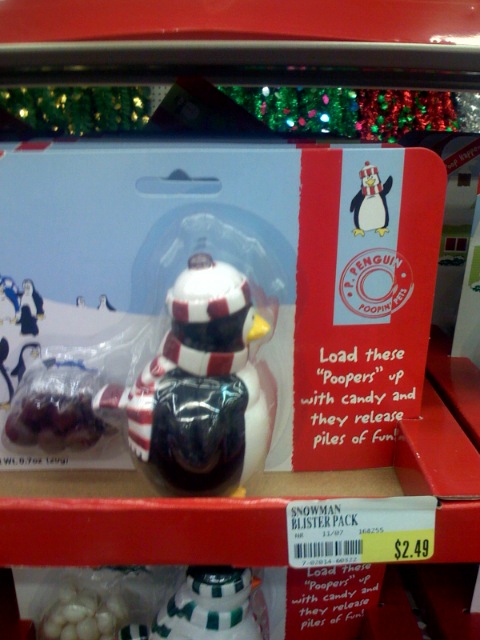
Found as a stocking stuffer at Kerr Drugs. No accounting for taste. I have not tasted.
A TARDIS, please Santa.



Recent Comments