ASFFelix & World War 2ASF
Army Service Forces
Communications Zone, Paris
September 15, 1944 to January 16, 1945

The Northern France Campaign ended on September 14. Paris was outside the geographic area for campaign partriciaption credit for the Rhineland and Ardennes-Alsace Campaigns which occured during this period

Paris was the center of support and supply services for the Army Ground and Air Forces.

The 3110th Signal Service Battalion provided commnications support for these efforts.

September 15, 1944: Detached members of Company C, including Felix, arrive in Paris.
December 10: Felix is hospitalized with frostbite.

January 1, 1945: Felix is promoted to Private First Class.

January 16: Felix reassigned to the 3rd Reinforcement Battalion, 16th Reinforcement Depot.

January 29: Felix is assigned to the 45th Signal Company, 45th Infantry Division.
Related links:
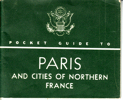
Paris Felix had a copy of the Pocket guide to Paris and the cities of northern France. 

Link to full copy:: http://www.archive.org/details/PocketGuideToParisAndTheCitiesOfNorthernFrance

on the
Internet Archive
"Seine Section, Paris France, 1945"  http://www.lonesentry.com/unithistory/seine/index.html

"Unit history published for the officers and men of the Seine Section, part of the Theater Service Forces, European Theater."
Cold + Wet = Cold Injuries: Frostbite & Trench Foot

This was an extremely difficult time for U.S. troops in Europe. The winter was very harsh. The Germans made a major counterattack in the Ardennes (the Battle of the Bulge) and minor counterattacks elsewhere. Troops that were usually to the rear, such as Felix, were sent front line.

Historian Steven Ambrose described the winter:

"It was Northern Europe's coldest winter in forty years...Night lasted so long in those northern latitudes. Dusk began to come on around 1600 or 1615. By 1645 it it was full dark. First light didn't come up for sixteen hours. It was bitterly cold, even for GIs from Montana or North Dakota. It was frequently below zero and generally damp, with low clouds blowing in from the North Sea and a fog that penetrated everywhere--when it wasn't snowing. The the wind blew like a gale, driving the pellets of snow into their faces...

"Northwest Europe in November and  December (1944) was a miserable place. A mixture of sleet, snow, rain, cold, fog, short days, long nights...Rivers were at flood stage. The already poor roads were churned into quagmires by military vehicles; veterans speak of the mud as knee-deep...

"Every veteran I've ever interviewed, from whatever side, agrees that this was the coldest they had ever been...How cold was it? So cold that if a man didn't do his business in a hurry he risked a frostbitten penis...It was so cold that oil in the engines froze. Weapons froze. Men pissed on them to get them working again, a good temporary solution, but one that played hell wit the weapons...

"Nights ranged from zero degrees Fahrenheit to minus ten and lower. Men without shelter--other than a foxhole--or heat either stayed awake, stomping their feet through the fourteen hour night, or they froze...

"The GIs, and the Germans opposite them, went through worse physical misery than the men of Valley Forge. Washington's troops had tents, some huts, fires to warm by and provide hot food. They were not involved in continuous battle. By contrast, the conditions in Northwest Europe in January, 1945 were as brutal as any in history, including the French and German retreats from Moscow in midwinter, 1812 and 1941.

"The infantrymen's clothing was woefully, even criminally inadequate...Their footwear--leather combat boots--was almost worse than useless. Whenever the temperature went above freezing, they were standing in two to twenty inches of water, which the leather soaked up.

"There were good boots available in Europe, of the type made popular by L. L. Bean after the war--well-insulated, with leather uppers but rubber bottoms--but...not until late January (1945) did the boots get to where they were needed...

"In place of boots, the men got directives on how to prevent trench foot. They were ordered to massage their feet and change their socks every day...

"Senior officers threatened court-martial to men who got trench foot...because they suspected the foxhole dwellers were getting it deliberately. They thought it was almost the equivalent of a self-inflicted wound."

From: "Citizen Soldiers" by Steven Ambrose, pp. 157; 258 - 259; 371 - 372.

"Many a soldier laughed at the idea that he should change his socks when he got his feet wet. But on the western front in the winter of 1944 trench foot became a grave threat to the health and efficiency of  the troops. At General Eisenhower's urgent request (to the Signal Corps) for a training film on the subject, combat cameramen in the field shot films concerning soldiers with bad cases of trench foot. The Medical Corps added instructions on prevention. Trench Foot, a useful example of a film bulletin, was rushed to completion in the record time of six weeks."

From: The Signal Corps: the  Outcome (mid-1943 through 1945) by George Raynor Thompson & Dixie R. Harris, pp. 549 - 550.
What Signalmen did that put them at risk for cold injury
The exact units or Signalmen are not identified. Felix served in areas near these under similar conditions and illustrate how Felix could have suffered cold injuries
Line Construction
Photo from:  The Signal Corps: The Outcome (Mid-1943 through 1945),  p. 160.

CAPTION: Signal lineman repairs wire in the Ardennes.

Splice
U.S. Army photo from: The story of the U.S. Army Signal Corps between pp. 114 & 115.

CAPTION: European Theatre of Operations, December, 1944. Soldier traces a broken field wire for splicing.
River
Photo from:  The Signal Corps: The Outcome (Mid-1943 through 1945),  p. 132.

CAPTION: Swimming wire across the Moselle (River in France).
Flood
Imperial War Museum photo from The Rhineland 1945: the final push into Germany (Praeger illustration military history), Ford, Ken, 2004, Osprey Publishing, p. 48.

Early February, 1945, in the Netherlands along the Nijmegen-Cleve road near the German border town of Kranenburg. British or Canadian Signalmen using amphibious DUKWs and Weasels to work in areas flooded when the Germans blew up nearby dykes.
Felix suffered severe frost bite on his hands and feet and was hospitalized. He may also have had "trench foot," a common cold injury among the troops caused by long periods of cold, wet feet. Felix said that the American doctors told him that they  would most likely have to amputate his hands and feet.
 
However, night after night, after the American doctors had gone, a captured German doctor working in the American hospital massaged Felix's hands and feet with a special salve. Eventually Dad healed enough to avoid amputations and return to duty.
 
A captured American soldier with "frozen feet" reported that from German medical supplies, the German guard gave him "something that looked like axle grease...which we rubbed on our feet." (From Alex Kershaw in The Longest Winter, Da Capo Press, 2004, page 168.) Could this be the special salve Felix described that the German POW doctor used?
Cold Injuries
Diorama in the Truschbaum Museum, Camp Elsenborn, Belgium. (Photo used by permission.)

Medic treating GI with trench foot and cold injuries to his hands and face. This illustrates what Felix might have suffered.
<< PREVIOUS: Normandy Signal Units in the Normandy Campaign NEXT >>
Cizewski, Lovetere, Musbach, & Robinson
Family History Ibiblio Index

© 2006 Leonard H. Cizewski
Last Modified on June 8, 2009
hosted by ibiblio