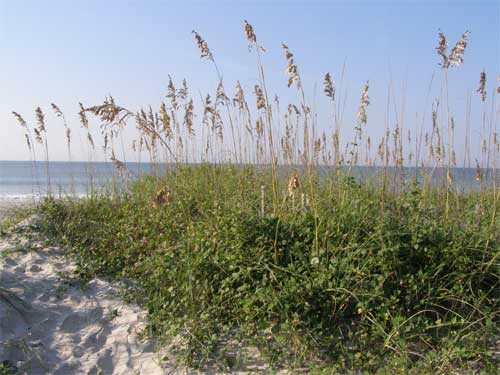
When walking over a beach dune, the stabilizing vegetation is seldom closely observed. Photo by Ken Moore.
By Ken Moore.
U.S. Fish and Wildlife botanist Julie Moore, who was with the N.C. Natural Heritage Program in the 1970s, returned last week to speak at the annual meeting of the B.W. Wells Association (bwwells.org) at the Rockcliff Farm Heritage site in Falls Lake State Park. Julie shared memories of legendary NCSU botanist/plant ecologist B. W. Wells, who in 1932 wrote The Natural Gardens of North Carolina, a very readable scientific exploration of the state’s plant diversity from seacoast to mountain tops. (For more on B. W. Wells, see Flora, March 27, 2009)
In addition to memorable stories about B.W. and his wife, Maude, Julie described Well’s special gift for describing scientific facts in an understandable and enjoyable language for lay people. Crediting Wells, she added: “It’s not necessary to travel away from home to find extraordinary plants and nature. Interesting things are always present, at home or wherever you may be. We just need to know where and how to look!â€
That was certainly the lesson I took away from last week’s beach gathering of friends on the Carolina coast. Whether crossing the dunes for fishing, swimming or shelling, folks’ attentions were focused ahead on the splashing surf. As is so characteristic of daily movements, whether at work or at play, we seldom take time to contemplate what surrounds us.
I was stopped in stride as I crossed over the lush dune-stabilizing vegetation sprawling beneath the easily observed sea oats. Taking “a closer look†by stooping down to practice belly botany, I discovered a vegetative sea of half-inch-size pink and cream-colored flowers and short upright stems of 2 ½-inch-long pea pods.
Referring to A Guide to Ocean Dune Plants Common to North Carolina by botany friend Jean Wilson Kraus, I quickly identified beach pea. It’s also called wild bean, and sand bean.
Strophostyles helvula is in the bean family. And even though it is an annual, it is a sturdy plant holding that dune sand in place during the growing season, and I suspect the lingering leathery leaves and root system contribute quite a bit of holding action in the winter months.
Observing those beach peas for several days, I noticed that the flowers open pink and turn creamy color later in the day after being pollinated by any number of flies, moths and butterflies, including painted ladies and cloudless sulphurs. Pea pods were emerging only from the creamy-colored flowers.

Beach pea flowers open pink and turn cream-colored after they have been pollinated. Peapods and the peas inside are edible. Photo by Ken Moore.
Jean described that the little peas can be cooked as vegetables. Since they were plentiful all over the dunes, I harvested a double handful. To onions and some spices sautéed in olive oil, I added those peas and water and cooked until tender. Beach peas made a tasty dish, I guess like anything prepared with onions and olive oil.
However, the labor-intensive shelling of those miniature peas suggests that we’ll not likely find them at the Carrboro Farmers’ Market any time soon.
But what fun to discover a wild bean patch while crossing a dune to fish and then to reflect that the original human inhabitants may actually have harvested those little dune peas for sustenance centuries ago.

Brilliant red stems of common pokeweed can stop you in your tracks. Photo by Ken Moore.
By Ken Moore
I was amused at Andy Borowitz’s description of Labor Day week “pointless Filler columns.†Tell-tale signs of columnists taking an out-of-town break, he describes, are rehashing older columns, using lengthy quotes and repeating themselves throughout the column.
I can’t imagine that serious writers would actually stoop to those tactics.
As I anticipate doing a little salt-water fishing, really going east to take that closer look at coastal plants, I am taking the time to describe my favorite plant, pokeweed!
“My poke’s bigger than your poke!â€
That brag has passed between more than two energetic gardeners in this area. While most folks consider the common American pokeberry, or poke salad, Phytolacca americana, a weed, really sophisticated gardeners admire and grow this giant native perennial.
Poke is a striking plant for all seasons. It flowers and fruits into the late fall, and it’s difficult for me describe my favorite aspect of the plant. It’s probably the stem; no other image stops me in my tracks more than the stark beauty of poke’s brilliant red stems in late summer and early fall!
The tiny pendulous flowers bloom throughout the growing season. A “closer look†reveals white petals surrounding emerald-green centers, contrasting with pink-to-burgundy-colored stems. I am always stopped in my stride, unbelieving such color schemes. Though I am known to sing the praises of any native plant presently in my view, no other wild plant evokes my exuberance more than the common poke!
I love everything about this plant. The flowers have little emerald-green centers that mature into berries turning from green to pink and finally shiny black. Daily entertainment is provided by our year-long resident mockingbird competing furiously with the summer resident catbird for the ripe berries.
From late summer through the entire fall, the 4-to-8 foot-tall branching stems of the poke are a brilliant scarlet to rhubarb burgundy-red. When highlighted by low-angle morning and evening sunlight, there is no more spectacular effect in the wild or managed landscape.
Even in the dormant months, the dried tan-colored stems of poke remain an interesting architectural feature. I never cut stems down until the emergence of the lush green leaves from the base of the plant in the early spring. Then we refer to this special plant as poke salad.
If you have never enjoyed eating poke salad, then you are missing out. Visit the farmers’ market in early spring to get cooking strategies from some of the old-timers there. Make certain you note the details, because poke is also a poisonous plant, so you have to know what you are doing to safely enjoy this culinary treat.
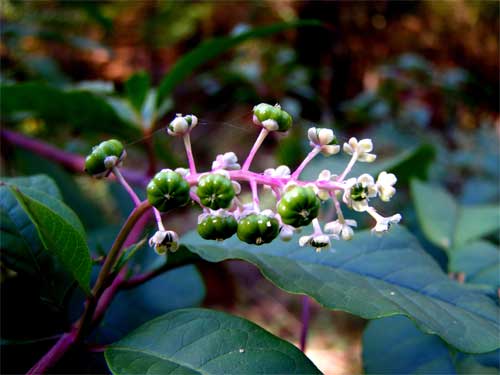
Pokeweed’s white petals surround a little green pumpkin-like fruit, attached to a ruby-pink stem, is unbelievably beautiful. Photo by Ken Moore.
Poke has everything. In addition to the sheer beauty of the plant, it is edible, it is poisonous and it is medicinal. Wish I had the space to relate my annual conversation with a friend who collects the dried berries by the pint jar and delivers them to her 90-year-old aunt, who concocts a special tea to relieve the pains of arthritis and rheumatism. Don’t you try it until you know what you are doing!
Poke stories abound. Some notable ones, recorded by local legend Paul Green, are found in Paul Green’s Plant Book. Check out the wild story about poke as a poison ivy cure. I suspect you won’t try the cure, but you will never forget the tale.

Sculptural Joe-Pye weed emerges proudly from a cascading border of “fireworks†goldenrod and woodferns. Photo by Ken Moore.
By Ken Moore
I enjoyed assisting artists place their sculptural art among the plants of the North Carolina Botanical Garden this past weekend.
In her quiet enthusiasm, Greensboro-area sculptor and horticulturist Carolyn Owen focused my attention with: “Now Ken, there’s a worthy sculpture right there.†She was referring to a single stemmed Joe-Pye weed, Eupatorium fistulosum, standing majestically along the entry walkway.
It made me reflect on past year’s sculpture shows; effective placements of the sculptures amongst the diverse vegetation encourages onlookers to become more aware of the plants. We begin to appreciate the sculptural and artistic qualities of the plants themselves. I so appreciated Carolyn’s channeling my attention to the art of nature during this day focused on human-created art.
I’ve always admired the artistic arching lines of the rough-leaf goldenrod cultivar, Solidago sempervirens, “fireworks.†This vigorous growing perennial usually presents itself as a cascading hedge-like border plant. Now and then, you’ll spot one that has escaped the crowd and is standing tall, simulating a single rocket-burst of fireworks for which this particular variety is aptly named. It stops me in my tracks every time I pass it.

A single stem of fireworks goldenrod draws attention to its spectacular aerial burst of tiny flowers. Photo by Ken Moore.
Another stop-in-your-tracks sculptural plant is woolgrass bulrush, Scirpus cyperinus. A sturdy clump will capture your eye as you walk along the coastal plain habitat boardwalk.
You will be well-rewarded if you visit the garden several times this season to admire the sculptures and to note how the character of each one changes as the plant surroundings change with fall’s progression. You’ll find as much to admire in the sculptural qualities of the plants as in the engaging sculptures sited throughout.
If you visit the garden this Saturday morning, the official beginning of the Sculpture in the Garden 2009: Celebrating Life Forces show, which runs through Nov. 15, you’ll have a double experience. The Botanical Garden also is hosting its annual fall plant sale on Saturday morning. Bird, butterfly and pollinator lovers will find this a Mecca of native species for planting during this traditional Fall Is for Planting season.
Butterfly lovers will find five species of milkweed and several lesser-known climbing milkweeds that are essential food plants for butterfly larva. There are more than 150 species of native perennials, trees, shrubs and ferns, and most of them provide the specific fruit, seed, nectar or leaves upon which our native insect pollinators and birds rely.

Woolgrass bulrush is just one of many plants of sculptural proportions seeking attention at the N.C. Botanical Garden. Photos by Ken Moore
Two of my favorite plants continue to be cardinal flower, Lobelia cardinalis, and coral honeysuckle, Lonicera sempervirens, because they attract hummingbirds. I have the coral honeysuckle on a trellis at the edge of my deck and cardinal flowers in pots sitting in trays of water, ensuring that hummingbirds fly in for close-up viewing, particularly now, as they are stocking up on nectar before their long early-fall migration.
Now is the perfect time to plant those special plants you will need for the bird and insect visitors you hope will return next year.
Don’t miss this year’s one-day biggest selection of native plants, and while doing it take your first of several nature art walks along the pathways to view the sculptural arts of humans and nature.

Individual flowers of pickerelweed bear some resemblance to tiny orchids. Photo by Ken Moore.
By Ken Moore
“An attractive perennial that grows in watery places in the swamps, usually reaching from one to four feet in height with showy spikes of blue flowers. A tea made from the root is supposed to be a good cathartic. The plant is becoming very popular for garden pools. My wife and I planted several of them near a spring below the house.â€
That is Paul Green’s description of pickerelweed, Pontederia cordata, from Paul Green’s Plant Book. I am repeatedly drawn to the plant notes from his daily observations and conversations with the local folks of the Cape Fear River valley, from Chapel Hill down through Lillington, Fayetteville and beyond. Plants take on a special dimension when accompanied with past and present human associations.
All summer, I have been enjoying the blue flowers and glossy-green leaves of this emergent aquatic. I have it growing in competition with water-dragon, also called lizard’s-tail (see Flora, 6/18/09), and cattail in a little pond that is slowly progressing to a cattail-dominated wetland. I also have the pickerelweed happily growing in pots submerged in plastic wading pools scattered around the yard.
None, however, bring me the up-close pleasure of having a water-filled pot of pickerelweed on the deck right outside the back door.
My deck plant is about to burst out of its pot, so this fall I will pull it out of its confinement and divide it into two or three additional water-filled containers. Few other plants, native or exotic, bring such continuous visual pleasure, and native pollinators love it.
The individual flowers have a superficial resemblance to orchids; and each day I take that “closer look,†I just want to pull up a stool and gaze at them until they begin to close in the early afternoon!
You’ll find it in the wild, growing along edges of rivers and ponds throughout the eastern U.S. The common name, pickerelweed, refers to the pickerel fish, which feed along the edges of such emergent aquatic vegetation.
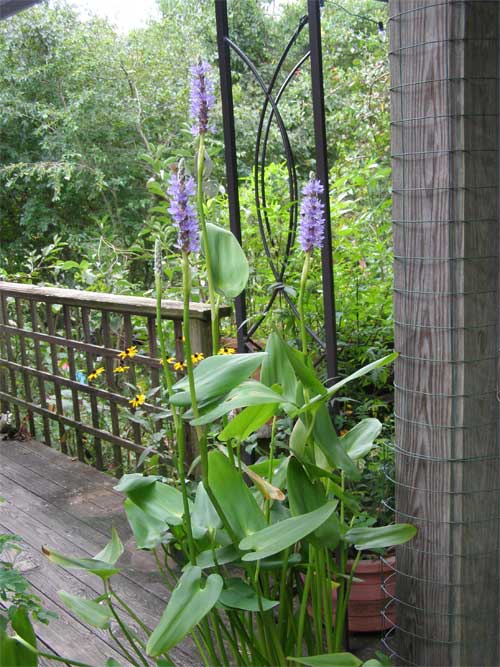
It’s easy to grow pickerelweed in a water-filled pot on a deck or patio. By Ken Moore.
I’ve recently learned that pickerelweed is a tasty edible. The young unfurled leaves can be chopped to add to salads or boiled and served with butter. Peterson’s Edible Wild Plants guide also describes that the ripe nut-like seed is nutritious eaten raw or dried and added to granola or roasted and ground into flour. Plan on getting mighty wet wading around in swampland to collect enough seed for making flour. I’m not going for the flour, but with the few plants I have close at hand I think I’ll pay closer attention to the maturing seed and make my own taste test.
If you’re keen to have a pot or two of your own, ask your favorite garden center to get some.
Nurseries that stock water lilies usually also stock some of the other interesting emergent aquatics that are suitable for home water gardens.
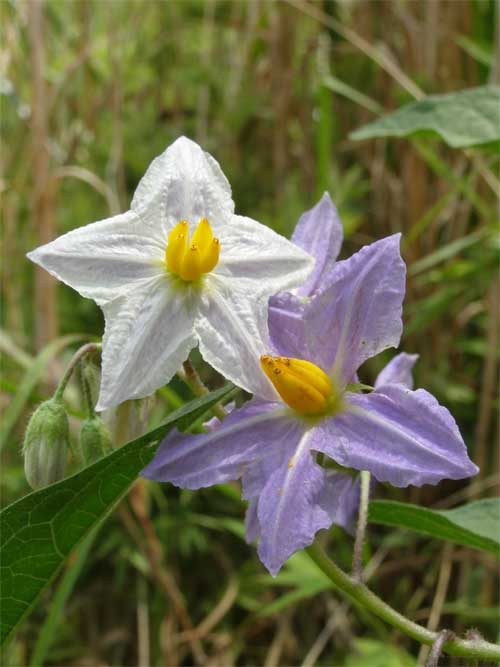
Quarter size flowers of weedy horse-nettle are as beautiful as any ‘garden’ flower. Photo by Ken Moore.
By Ken Moore
“I’m always nervous about reading in Flora that I have yanked out another one of those wild weeds for which you have such high regard.â€
That was the response from gardening friend Diana following my expressed enthusiasm in spying a horse nettle in her curbside garden along Mason Farm Road. She timidly admitted that it was one that had escaped her weeding earlier in the day.
Diana’s curbside, and the rest of her yard, is one of my favorite gardens because it is carefully managed so that it appears not to be managed.
Knowing that her garden is frequently being discovered and enjoyed by young children, I offered an understanding nod, because the very poisonous berries of horse nettle mimic the appearance of those tasty yellow-gold cherry tomatoes. Diana is wise to keep those low-to-the-ground tomato-looking fruit away from the natural curiosity of children, who likely have learned that anything looking like a cherry tomato must be a cherry tomato.
Where young ones are not likely to get their hands on the poisonous fruit, however, I encourage you to allow horse nettle, Solanum carolinense, a bit of freedom in your garden. Each time I see it in flower, I stoop down to admire those white and purplish-blue flowers, looking so much like tomato flowers on steroids.
Occasionally, you will stumble upon one that looks like a garden plant. That happened last week while I was walking along the fields of the Botanical Garden’s Mason Farm Biological Reserve. One such garden-plant specimen visually jumped out from the field edge. The oversized flowers were a real visual treat.
Some of you may remember an experience similar to that described by Paul Green (Paul Green’s Plant Book): “This pest used to play havoc with our bare feet as children, especially if the dead dried plants chopped up by the hoe were stepped on. The thorns were sharp as little needles.â€
If you take a closer look you will easily see the spines along the stems, as well as on both sides of the leaves. You definitely tread softly when moving barefoot among horse nettles.
It is commonly found in sunny disturbed areas, which is why this native is sometimes considered a pest in cultivated areas. But in the natural succession of plant growth, horse nettles give way to larger perennials and eventually to competition of shrubs and trees. In the meantime, this drought-tolerant perennial provides a service with its vigorous tap root breaking up barren, sterile soil, gradually improving it for other vegetation following in its path.
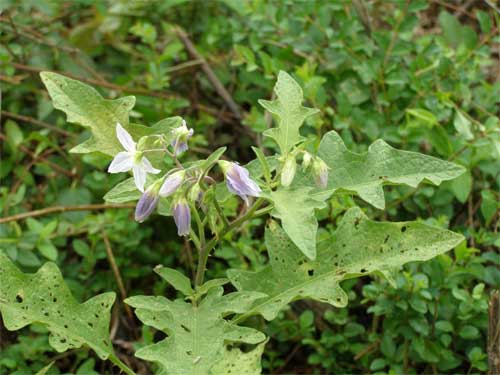
A closer look reveals the spines on stems and leaves of horse-nettle. Photo by Ken Moore.
Horse nettles are having a late-summer re-blooming fling just now, and though the little tomato-like fruit of the early-season’s flowers are already dispersed, you’ll likely be seeing fruit again later in the fall.
There are many descriptions of medicinal uses of horse nettles. The Cherokees, in particular, have an interesting heritage. Described remedies include stringing the roots around a baby’s neck for teething, making a grease of fried berries to treat mange on dogs and crushing leaves in milk to kill flies. One of the most intriguing to me is the application of wilted leaves to relieve irritation from poison ivy. I haven’t tried this yet, but certainly plan to do so.
So, take a closer look at those flowers and watch out for those spines!

The stem of boneset protrudes through the center of its perfoliate leaves. Photo by Ken Moore.
By Ken Moore
Boneset, Eupatorium perfoliatum, is one of those Native-American herbs reputed to heal all ailments.
I like Paul Green’s observations (Paul Green’s Plant Book): “A tea from its leaves or roots made a fine tonic and it was good for all kinds of diseases, including urinary troubles and female disorders. It was said that in the old, old days the doctors made bandages of the crushed leaves and wrapped then around a broken leg or arm to help it heal better, whence the name.â€
Well, that just about says it all!
Except, I have a recollection from some old-timer that the boneset name originated from observing the leaves. The opposite leaves completely wrap around the stem, which actually protrudes right up through the middle of the leaves.
Leaves wrapping around a stem are described as “perfoliate,†thus the Latin species epithet, perfoliatum. It’s helpful when the scientific name describes a real physical characteristic; that’s true of very few plants.
Back to the old-timer’s explanation. A plant leaf so tightly joined at the center suggested that the plant had some special powers to heal broken bones or at least assist in pulling the pieces back together. Well, that’s the world of herbal medicinal lore. Some described remedies are effective and some may merely be lore. I didn’t use boneset when, years ago, I broke my wrist, but I do sometimes use herbal remedies – at least the ones that work for me!
Eupatoriums is a big genus in the composite (aster) family. Remember from past Flora columns that the composite family is a huge assemblage of plants characterized by a few to hundreds of little flowers tightly compressed into a flowering head.
A typical composite is the Black-eyed Susan with a compact head of tiny tube (disc) flowers, surrounded by a ring of showy ray flowers. Other composites, like dandelions, are tight clusters of only ray flowers and still others, like the Eupatoriums, are a broad, usually rounded-flat top arrangement of hundreds of clusters of only tiny disc flowers. It takes a really close look to zero in on the individual disc flowers. Those threadlike structures extending from the tops of the flowers are the ripe stigmas of the female flower part, the pistil, reaching to grab some pollen from unsuspecting pollinators scrambling around on the flower heads.
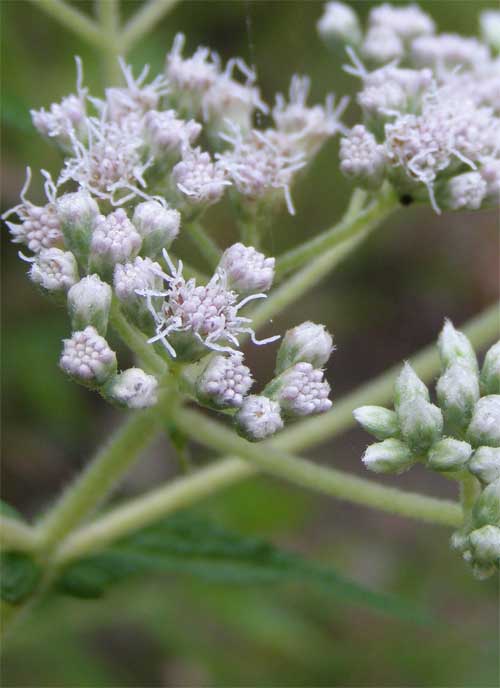
It takes a really close look to detect the tiny disc flowers of boneset. Photo by Ken Moore.
At least two dozen species of Eupatoriums, generally called thoroughworts, are flowering in fields and along roadsides these last weeks of summer. The easiest of the white-flowering ones to identify is the boneset, because of those perfoliate leaves! Boneset commonly grows in ditches and wet meadows throughout the state.
Tall stemmed Joe-Pye weed, with showy purple, dome-shape flower heads seen in roadside ditches these days, is also a Eupatorium. The botany types among you may be happy to know that Joe-Pye weed has recently been reclassified to Eupatoriadelphus. Tuck that melodious name away for the next time you want to impress your friends.
Regardless what name you select, boneset, like Joe-Pye weed, is a beautiful garden plant, but few gardeners consider boneset for their perennial border or wild garden. They should; those white flower heads are beautiful and those perfoliate leaves, wrapping around the stems, are an engaging accent throughout the growing season.
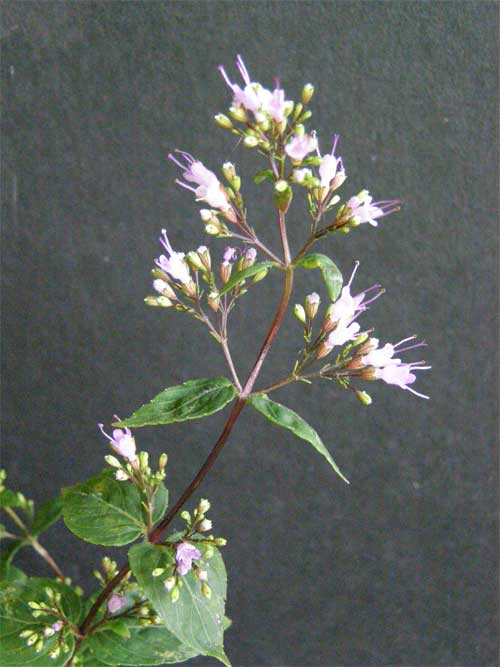
Square-stemmed, opposite-leaved wild oregano flowers more robustly in cultivation than in the wild. Photo by Ken Moore.
By Ken Moore
Don’t go looking for wild oregano, Cunilla origanoides, because you’ll probably become frustrated that you can’t locate it. But you can be aware of it, and then if you do stumble upon it during one of your woods walks it will be a very special moment.
I had such a special moment this past weekend, when exploring the labyrinth of trails of the university’s Carolina North natural area.
My first encounter with this obscure little plant was years ago, while walking through the open chestnut oak forest atop the dome of North Carolina’s Stone Mountain. The forest floor was covered with hundreds of wild oregano plants, which, with the burgundy-colored leaves of the fall, seemed to be a loose carpet beneath the tall oaks. I recall that as one of my memorable “oh, wow†botany experiences.
The few scattered plants along the upper reaches of the Botanical Garden’s nature trails do not make that same lasting impression, nor do the many scattered plants along the trail edges crisscrossing the forested hilltops of Carolina North.
But simply recognizing a few plants here and there is really special for me, and I can’t resist reaching down to gently crush a leaf to enjoy that mild turpentine-scented aroma, so characteristic of this native American herb.
Wild oregano is also known as American dittany, an obvious reference to the dittany of Crete, Origanum dictamnus, which was revered as a magical herb of many medicinal and fantastical properties. Though these plants are kindred spirits within the mint family, our native Cunilla makes no claims such as that magical herb of the ancient Greek isle.
The pleasantly pungent aroma of our wild oregano is definitely engaging. It was utilized by Native Americans throughout its natural range in eastern America for a tea to relieve the discomfort of colds, fevers, headaches and even snakebites.
I concocted a sun tea of a modest bundle of leaves and stems and found the result a pleasing pungent brew that certainly would have been enhanced with a bit of mint or lemon balm. I wonder how a few leaves spread over a homemade pizza would alter the flavor of the anchovies I’m inclined to layer across the surface? I don’t have a sense that this particular native herb has much of a future as a lucrative commercial crop.
Another common name, stone mint, must refer to the typical open rocky forest habitats where we find them scattered throughout our local Piedmont region.
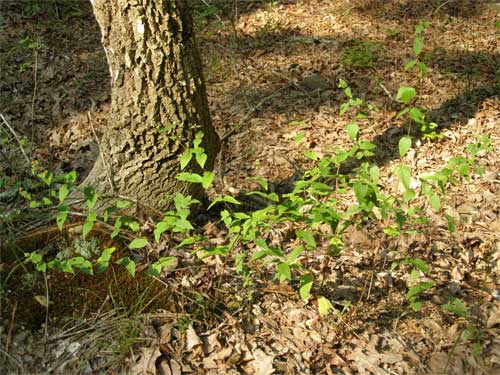
The diminutive wild-oregano, found in dry oak forests, is distinguished by opposite leaves that, when crushed, give a mildly turpentine-mint odor. Photo by Ken Moore.
So that you don’t have to depend on infrequent surprise encounters to appreciate and enjoy wild oregano, I suggest growing a plant or two in a sunny spot in your garden or even in a container. The Botanical Garden has a large container of this wild herb growing just outside the back entrance of the Totten Center. It’s in full flower now and definitely more robust than any plant you will find growing in the dry rocky woods. I procured a nice flowering specimen from the garden and though I’m happy to have a wild oregano of my very own, I will continue to consider it really special to find one in the wild.
By whatever name, Polymnia makes a show
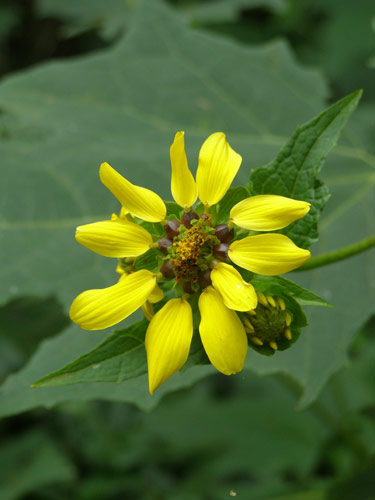
A close look at the composite flower head of Polymnia reveals that only the outer circle of ray flowers produces seed. Photo by Ken Moore.
By Ken Moore
A great place to see Polymnia, commonly called bearsfoot or leafcup, is along Bolin Creek Trail between the Chapel Hill Police Department and the community center. Walking along that trail last week, I was impressed with the multitude of miniature sunflower-like flowers of this wildflower, common everywhere along roadsides and forest edges, standing six feet tall or more along the length of the greenway.
Most trail frequenters jog, walk dogs or simply walk and talk too intently to take “a closer look†at the natural world about them.
However, it is hard for even the most unobservant to miss the giant leaf images on the above-ground sewer manholes. These images, painted by local artist Michael Brown, identify some of the most common trees, and there are some really big ones, growing along the edge.
For the renewed botanical diversity along the trail, we can thank Bill Bracey and his crew of dedicated Bolin Creek volunteers, who for years, on the third Saturday mornings of September through May, have been removing invasive exotic plants like privet, silverberry, bittersweet and Japanese honeysuckle. As a result, Polymnia, as well as a number of other native plants, like spicebush, Lindera benzoin, host plant of spicebush swallowtails, are making a dramatic comeback.
I’ve always been fascinated with the relatively large leaves of Polymnia; the coarsely toothed, three-to five-lobed leaves somewhat resemble, with a stretch of the imagination, a paw print of a bear, thus the common name bearsfoot.
You’ll have to stretch the imagination even further for the other common name, leafcup. Where the petioles of those leaves are attached to the stem, opposite one another, there is a hint of a cup-like reservoir at the point of attachment. I will be happy to know of a more obvious explanation for this name.
I am content to simply call it Polymnia, the scientific name I learned years ago. That name supposedly honors Polyhymnia, the Greek muse of sacred song and oratory. The species epithet, uvedalia, honors Robert Uvedale, an English school teacher and botanist who grew this American native in his English garden more than 200 years ago.
As happens frequently when I check myself on botanical names, I discovered that Polymnia uvedalia is no longer botanically correct. It has been reclassified, Smallanthus uvedalius, for those of you who wish to be taxonomically current. I don’t have to pass any more tests, so I will continue to call it Polymnia!
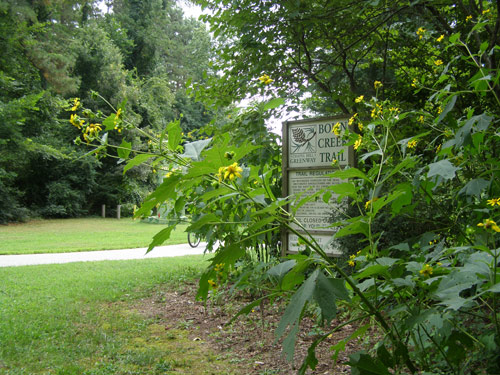
Tall stems of Polymnia stretch out to invite a closer look surrounding the Bolin Creek Trail entrance sign. Photo by Ken Moore.
Whatever name you prefer, wherever you happen upon this tall, flowering perennial of the aster (composite) family, take “a closer look†at the various stages of buds, flowers and seed heads. Find one that has a complete circle of ray flowers surrounding the center of tube flowers, and with a keen eye you will discover that only those outer ray flowers are producing seed. The seed is not unlike the typical seed of sunflowers, and you should not be surprised to see goldfinches and other birds flying away from the seed heads as you approach.
And while you’re examining the plant, what do you think of those leaves? Perhaps you can come up with a more descriptive common name.
A story of Gray’s lily and mountain balds
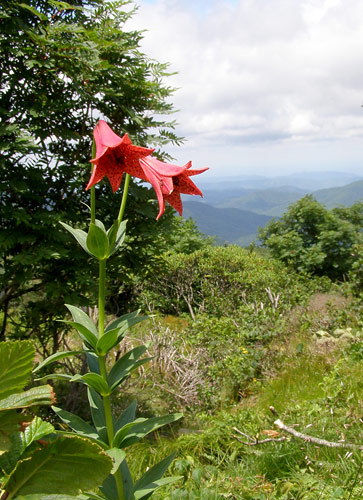
Rare Gray’s lily on Roan Mountain’s open grassy balds. Photo by Ken Moore.
By Ken Moore
Once in a while, I take leave of the wealth of local natural areas to see North Carolina treasures farther afield.
One of my favorite places is the string of Roan Mountain grassy balds striding the border of North Carolina and Tennessee, where there is a very special wildflower. Every time I see Gray’s lily, Lilium grayii, I am thankful for the Southern Appalachian Highland Conservancy’s (SAHC) efforts to preserve this and other highland areas of North Carolina. Since 1974, this group has protected more than 38,000 acres of significant natural areas in the highlands.
I first saw Gray’s lily on a botany field trip back in the 1960s. It was rare back then and it is rarer now. Its worldwide distribution is centered in a few mountain counties in the corner of Tennessee, North Carolina and Virginia.
The best viewing opportunities are on the balds of Roan Mountain. If you have never visited the Roan, you have missed an opportunity to fall in love with a mountain.
Most folks really do fall in love with it. That certainly is the feeling of the 42 people who participated in this year’s SAHC 15th Grassy Ridge Mow-Off, a thoughtfully planned effort to preserve the balds and rare plants like Gray’s lily. You see, that lily and other rarities are being displaced by the encroaching growth of blackberries, alders and that much-admired purple rhododendron, Rhododendron catawbiense.
Formerly, the balds of Roan were more extensive. In recent years, as the Roan highlands have moved from private ownership to conservation lands, grazing farm-animal activity has been eliminated. As a result, the once-extensive open balds began shrinking.
The origin of high-elevation mountaintop balds continues to be debated among regional ecologists; the one point of agreement is that, left undisturbed, the balds of North Carolina will perish. A diversity of management techniques including tractor mowing, grazing by cattle and goats and labor-intensive hand pruning are being evaluated.
For years, I have wanted to participate in one of the SAHC bald-clearing projects. I was happy to be a part of this year’s effort, where, with brush cutters and pruning loppers, we humans – in the old pioneer barn-raising, working-together spirit – cut and grubbed blackberry brambles, alder thickets and even those revered purple rhododendron to recover acres of formerly open grassy bald. Supervised by SAHC, in cooperation with the U.S. Forest Service, The Nature Conservancy and the Appalachian Trail Conservancy, we were simulating the work of mountaintop herbivores of past times.
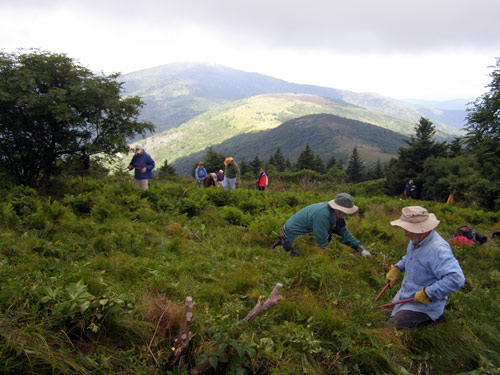
- Members of Southern Appalachian Highlands Conservancy working at 6,000-foot elevation to protect the Roan Mountain grassy balds from encroachment of woody vegetation.
Along the Appalachian Trail route to Grassy Ridge, we observed a fenced grazing area supervised by a goat herder keeping watch over 40 Angora goats. Some Carrboro residents may want to “Adopt a Goat†to help with the Roan Goat Grazing Project supported by Friends of Roan Mountain (friendsofroanmtn.org).
I am so in love with the Roan and its Gray’s lilies that I can’t give enough thanks for the stewardship efforts of the Southern Appalachian Highlands Conservancy. Becoming a member of SAHC, (appalachian.org) provides numerous opportunities during the year for walks and hikes over other SAHC western Carolina highland natural areas, as well as other Roan “mow-offs†scheduled this summer and fall. Go visit the Roan, and you’ll fall in love too!

Ruellia flowers are a welcome surprise wherever they occur.
By Ken Moore
An unassuming little wildflower that always surprises and delights me whenever and wherever I spot it is Ruellia caroliniensis. I generally call it simply ruellia [roo-ELL-e-ah]. It’s named for Jean de la Ruelle, the herbalist for Francois I of France in the early 16th century.
One common name is Carolina wild-petunia, though it looks nothing at all like the floppy petunias you find in gardens. Another common name, twin bluebells, seems more descriptive. The pale-purple flower is shaped something like the end of a trumpet. This upright plant stands from one to two feet tall and has one or two, sometimes more, blue flowers clustered in the upper axils of opposite-paired leaves. Individual trumpet-shaped flowers can be from one to two inches long and the open bell positioned up toward your face is usually the size of a nickel or quarter, though occasionally you’ll find one the size of a half dollar.
I’ve enjoyed spotting them here and there in my yard at the edge of the back steps and along the edge of the house foundation where the mower blade seldom travels.
Keep your eyes open and you’ll likely spot one or two along unmowed edges throughout town and along woods and field edges and sunny spots in the forests. It flowers for most of the second half of the summer. It’s a perennial, so leave it alone and it will probably stay around for several years and will proliferate as natural seedlings.
Recently, I was happy to see dozens and dozens of them in Marie Weiden’s “always-something-in-flower†curbside garden along the intersection of Boundary and North streets in Chapel Hill. I noticed them there two years ago and now there are more. When I first discovered them, Marie described that, “Oh yes, they volunteer in and they are most welcome wherever they choose to locate themselves in the curbside garden.â€
They are easily maintained. Just look out for them and be certain not to confuse them as unwanted weeds. Marie has some of the larger flowered variants and a few with four or more flowers open at once. A real thrill in allowing nature to establish seedlings in a garden is the variety of flower size and color tones produced as one surveys the results.
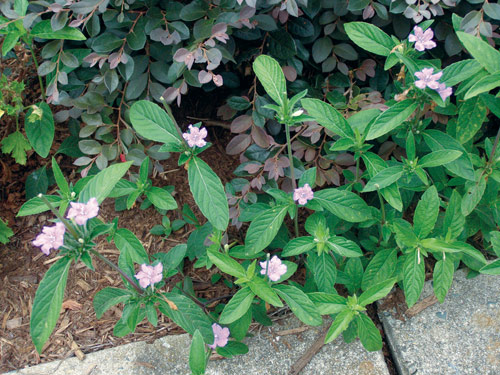
Shy ruellia plants are welcome where they volunteer along Marie Weiden’s curbside garden. Photo by Ken Moore.
The almost bashful presence of this wildflower is reason enough for it being seldom noticed by today’s rushed humanity. However, I know several folks in our community who cherish the ruellia as much as I. To have one or more appear in one’s own yard or garden is really special. They are not normally available at nurseries, so you’ll have to depend on luck to have them show up for you. One strategy is to keep that “closer look†with you and revisit some of
the plants you spot in the woods or about town and collect a few seed pods to scatter in some casually tended areas of your garden. Hopefully you’ll be happily surprised this.