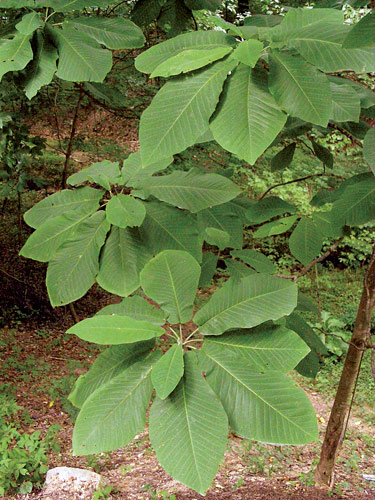
Looking down upon umbrella whorls of leaves of bigleaf magnolia.
By Ken Moore
Gardening friends Sally Heiney and Bill Bracey live on opposite sides of Carrboro and both have bigleaf magnolias planted where they can enjoy them from above – Sally from her deck and Bill from his hillside patio. I have been unable to shake the dramatic image of bigleaf’s summer foliage since sitting above them a week ago.
Colonial American botanist/naturalist William Bartram must have been equally impressed with this deciduous magnolia when he first saw it in the late spring of 1776. He was not only an energetic and brave wilderness explorer, but a keen observer, gifted in narrative descriptive skills.
He dedicated a very long paragraph in his The Travels of William Bartram to bigleaf magnolia, Magnolia macrophylla. Following is a selection of his single-sentence verbal portrait of the tree:
“This tree … rises eighteen to thirty feet in height, there are usually many stems from a root or source, which lean a little, or slightly diverge from each other, in this respect imitating the Magnolia tripetala; the crooked wreathing branches arising and subdividing from the main stem without order or uniformity, their extremities turn upwards, producing … the center of a radius of very large leaves, which are of a singular figure, somewhat lanceolate, but broad towards their extremities, terminating with an acuminated point, and backwards they attenuate and become very narrow towards their bases, terminating that way with two long, narrow ears or lappets, one on each side of the insertion of the petiole; the leaves … spread themselves after a regular order, like the spokes of a wheel, their margins touching or lightly lapping upon each other, form an expansive umbrella …â€
This excerpt gives a vivid account of the tree’s characteristic habit and the specifics of the leaves that are commonly more than two feet long. Whether looking down on them or peering up through the tree’s tropical-like canopy, Magnolia macro (big) phyla (leaf) is impressive.
Bartram included many more lines in his verbal painting of the tree’s flower. My favorite flower image is a ‘70s color slide of Gordon Butler, gently holding a flowering branch of the tree in the front yard of Butler’s Nursery just outside Fayetteville.
Way back before it was fashionable, Gordon Butler, first recipient, in 1972, of the North Carolina Nurseryman of the Year Award (D.S. Copeland Award) propagated, cultivated and promoted our native trees and shrubs for ornamental use in home and urban landscapes. Far out front and ahead of the times, was he!
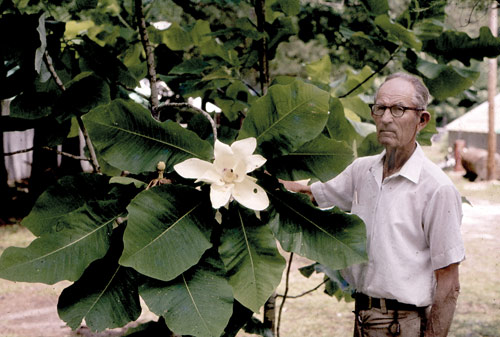
- Fayetteville nurseryman Gordan Butler’s pride in the bigleaf magnolia inspired him to grow and promote the tree more than 30 years ago. Photo by Jim Ward.
Bigleaf, infrequently and widely scattered throughout the Southeast, is only seen in our area in cultivation. It’s in cultivation at the Botanical Garden and the Coker Arboretum. Perhaps you have savvy garden friends like Sally and Bill who have their own bigleaf. Even without a high vantage point, you should have one growing in your garden. Plan now to have one procured for you by your local nursery or garden center for fall or winter planting.
Early in his description, Bartram referred to the commoner Magnolia tripetala, umbrella magnolia; that’s the one we see along stream banks in our local forests. The leaves are not as large as bigleaf’s and the leaf bases do not have those distinctive ear lobes, but it is still a dramatic tree and worthy of your inquiries at local nurseries.
Immersion in the nature of our communities

Frances Shetley, holding a purple coneflower, cherishes the sea of Queen Anne’s lace surrounding her. Photo by Dave Otto.
By Ken Moore
Carrboro’s own Frances Shetley is always smiling about special features of our community. Recently, she was immersed in the Queen Anne’s lace flowering at the entrance to the bikeway, named in her honor, through the woods behind Carrboro Elementary School. A decade ago, Frances envisioned a corridor of wildflowers and native grasses for birds and butterflies along that woodland corridor between Shelton Street and North Greensboro Street/Estes Drive intersection. Members of the Carrboro Community Garden Club, of which Frances is a founding member, took up that call and have been quietly managing that corridor, with support from Carrboro Public Works, ever since.
Wild columbine flowering in the spring, common milkweed in summer and goldenrods and asters in the fall, along with other species native to Orange County, were planted as seedlings by club members 10 years ago. Some of those original plants are still there as specimen perennials, like wild-blue indigo; others, including columbine, spiderworts and Black-eyed Susans, have moved around on their own; and still others, like American poke, evening primrose and common blackberry, have volunteered onto the site, welcome additions from nature.
The volunteers who help maintain the site are not your typical garden club members managing a clearly defined flower garden. These folks are faced with extracting the numerous woody exotic invasives, like privet, mulberry and multi-flora rose, constantly seeding in. Even some of the native blackberry must be pulled when it gets too exuberant. And the native poison ivy, a fine source of food for birds, remains a constant challenge to keep away from unsuspecting walkers.
When they are working there, volunteers always enjoy the expressions of appreciation from dog-walkers, bikers and strollers who comment that there is always something of interest to see along the pathway. If interested in joining this group, contact Marcia Mills at marmills@intrex.net.
But this is just one bikeway/greenway; there are countless others in our community. Opportunities to explore mature pine forests and hardwoods, open fields, rhododendron and mountain laurel bluffs and miles of rocky creek corridors abound.
There are so many trails, in fact, that were one to explore a different trail at least once each week, it would take months before the same trail would be repeated.
Without hours of travel and gallons of gas consumption, total immersion in the natural world is here at our doorsteps.

Humans are not the only visitors along Bolin Creek’s many greenways. Photo by Dave Otto.
Whether biking, hiking, running, dog-walking, exploring with the children or taking a “closer look†walk in the woods, you will want to know where all these trails are located. Descriptive trail guides of extensive Duke Forest are available at the Duke Gardens gift shop or dukeforest.duke.edu.
Guides for other natural areas, including the Carolina North forest trails, are available at Townsend Bertram & Company, Carr Mill Mall, or check out sustainfoundation.org.
There’s a great opportunity to learn more about our community’s many trails at Carrboro’s monthly Artwalk this coming Friday evening. Dave Otto will present a descriptive tour of his photo exhibit “Community Greenways: Today and Tomorrow†at 6:30 p.m. in Carrboro Town Hall. That exhibit, which extends through Aug. 28, is a fine visual story of the diverse people, places, flora and fauna to be discovered in the vast nature of our community.
Plan now for an evening primrose party

Evening primrose flowers open for a single night. Photo by Ken Moore.
Evening primrose has been flowering in some spots along Carrboro’s main streets for several weeks. I’ve been trying to capture a photograph because the plants in my yard don’t yet have flower buds, but I’ve not been up early enough in the mornings or out on the streets late enough in the evenings to have succeeded.
Finally, one evening this past week, I boldly knocked on the door of Bill Derey, one of Carr-boro’s premier gardeners. Bill’s garden, on the west side of North Greensboro Street near Southern States, has been lit up at night by several evening primroses. I learned from Bill that these flowers don’t fully open until well after sunset. He knows because he invited a friend over to view the evening primrose flower opening and they had to wait and watch until 8:30 p.m. When those brilliant, butter-yellow flowers finally do open to the pleasure of night-flying pollinators, the plants literally glow in the dark. For a photograph, Bill advised that I should return in the early morning.
So there I was the next morning at 6:30, to discover that most of the flowers had already begun closing. This is truly a flower of the nighttime and well worth going outdoors to view. Having several near one’s porch, as Bill has, makes night viewing really convenient.
Don’t be confused if you hear someone showing off with the Latin name, Oenothera biennis, saying either [ee-noth-EE-ra by-ENN-is] or [ee-NOTH-er-a by-ENN-is], because both pronunciations seem to be acceptable. The first part of the name, the genus, from Greek, means “wine booty.†Eating the root was thought to increase one’s capacity for wine. I don’t recommend this, though a number of Native-American tribes used root teas and poultices for medicinal purposes.
The second part of the name, the species epithet, describes the plant as a biennial. It grows as a leafy rosette the first year; the second year, it grows up to 4 or more feet, flowers, sets seed and dies. If you are not a real tidy gardener, new plants will always be present somewhere. In Bill’s case, he makes certain that he has a few plants coming along each year. He obtained seeds of this wild plant years ago when he lived and gardened a little ways out of town. At his Greensboro Street location, he scattered seed in his back garden, where they thrived until the town’s deer ate them. Fortunately, the plants moved themselves out to the front-street side, where the deer have let them be.
Bill and I share a long-time appreciation for this native American plant and we have no difficulty recognizing it in its first-year, leafy rosette stage. I generally look for a cream colored mid-vein on each leaf, but Bill simply recognizes the leaf as, “That’s just the way it looks.â€

Evening primrose is the centerpiece of Bill Derey’s curbside garden at night. Photo by Ken Moore.
I remember years ago my botany mentor responding similarly when I asked how to recognize a certain oak tree. He replied, “That’s just the way it looks!†Once you’ve identified it for yourself, you will most likely remember it that way too.
Evening primroses flower throughout the summer. I’m looking forward to having my own evening primrose viewing party in a few weeks.
Celebrating and helping pollinators
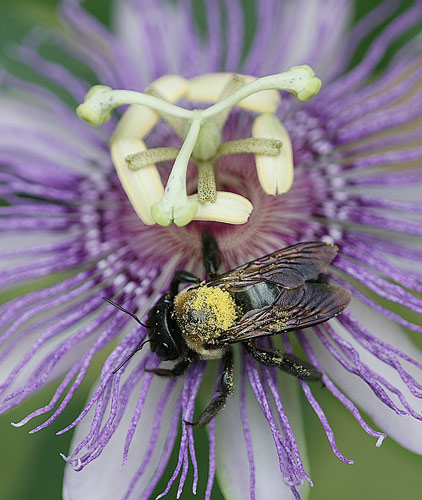
Pollen on the back of a carpenter bee is carried from passion flower to passion flower.
By Ken Moore
It’s National Pollinator Week and the third annual National Pollinator Week Celebration at Chatham Market Place in Pittsboro is this Saturday from 10:00 a.m. to 2:00 p.m.
This family-friendly celebration with special activities for children includes a treasure hunt, story telling, beekeeping demonstrations and guided tours of the onsite pollinator garden (for more information, ces.ncsu.edu/chatham/ag/SustAg/workshops.html).
Awareness of pollinators gives us reason for celebration, and for concern.
An engaging description of the plight of pollinators is Bee and Me, written by Elle McGuiness and illustrated by Heather Brown. In this beautifully illustrated children’s book, which should be required reading for adults, a bee, accidentally trapped inside a house, pleads, poetically, for release by the young boy inside:
We’re good for much more
Than just honey, you see
We bees help the flowers,
The bushes and trees
We gather their pollen
And spread it around
The only way to keep them
Growing, we’ve found …
If it weren’t for us bees, why the plants would be gone
No more peaches, no cherries, no trees to climb on,
There’d be no more apples, no flowers to smell
Still, you humans decide you don’t like us that well.
The serious lesson for young and old alike is to treat the diversity of bees and wasps and other pollinating critters with the same wonder and respect we allow colorful butterflies. These critters, buzzing or not, are necessary pollinators, without which our world would be in serious trouble. They are much too busy working to worry about people unless they are threatened or trying to protect their hives or solitary nests.
Several years ago, I learned the “bee wave†from staff at the Schoolhouse of Wonder nature school and camp at West Point on the Eno in Durham. There, children learn that all flying and crawling critters are respected – i.e., neither stomped nor swatted. Using the bee wave – a slow, gentle waving of the hand in front of the face – is very effective in making any curious flying critter move safely away.
In addition to thoughtless swatting by humans, pollinators face other challenges. The decline of honey bees is widely publicized, but less known is the critical decline in populations of native bees, which account for 85 percent of pollination of large-scale food crops, home gardens and wild plants. This decline results from habitat loss, pesticide use and invasion of non-native plants.
Home owners and gardeners, whether on large rural properties or small suburban lots, can play a positive role. National and state organizations encourage gardening with pollinators in mind by eliminating pesticides, replacing invasive exotic plants with natives and including a great diversity of species and habitats on home grounds.
My wild friend Pete, with a tiny half-acre residential vegetable and native-plant garden in Durham, is a certified pollinator gardener.
He has a beautiful sign on his front yard to prove it! I’m getting ready to apply for one. You can too. Some great folks in Georgia, associated with the Environmental Education Alliance of Georgia and the Georgia Native Plant Society, manage a Monarchs Across Georgia Pollinator Habitat Certification Program. (monarchacrossga.org/MAGCertification.php). North Carolina gardens are welcome to join the growing number of certified pollinator gardens around the country.
Enjoy the celebration in Pittsboro this Saturday, and do your part every day to encourage and protect pollinators.
Step softly among the water-dragons

Lizard’s-tail flowers seem left over from prehistoric landscapes. Photo by Ken Moore.
By Ken Moore
Though I’ve never heard it used locally, the common name, water-dragon, appeals to me more than the commoner name, lizard’s-tail. Every time I see this plant of swamps, pond edges and boggy stream sides, my imagination propels me back to a long-ago world of giant ferns and dinosaurs. If you find yourself poised on the edge of a lizard’s-tail environs, step softly, and even then you will most likely become mired in the plant’s preferred muddy ooze.
Saururus (saw-REW-us) cernuus (SER-new-us) is a truly descriptive botanical name. The genus name is derived from the Greek sauros, lizard, and oura, tail, and the descriptive second part of the binomial, the species epithet, is derived from cernuus, drooping or nodding, which perfectly characterizes the appearance of a mature flowering spike.
Common throughout eastern America and across to Texas in the South, lizard’s-tail has a significant heritage as a medicinal plant. Root poultices were used to treat sores and wounds. Teas brewed from the leaves were thought to be helpful in reducing chest and back pains. There are recent accounts that some researchers are pursuing components of the plant as a potentially powerful tranquilizer. Perhaps more about this research will come to light in the next year or so.
For me, the plant needs no justification other than simply being. I’m always stopped in my tracks whenever seeing it in the wild, where it provides habitat for many wetland invertebrates. It’s an easily cultivated plant for the home wetland or bog garden, whether in pots in a small pool or in normally wet spots on the ground. Gardeners will be pleased to know that deer don’t like it, probably because it’s aromatic. Lizard’s-tail is described as being strongly scented of orange peel.
I have to work hard to grasp a hint of orange peel when crushing the flowers and leaves of a plant, though it does have a distinctively pungent aroma to my senses. When not in flower, the long heart-shaped leaves on zig-zag stems are an attractive bit of green architecture in the garden.
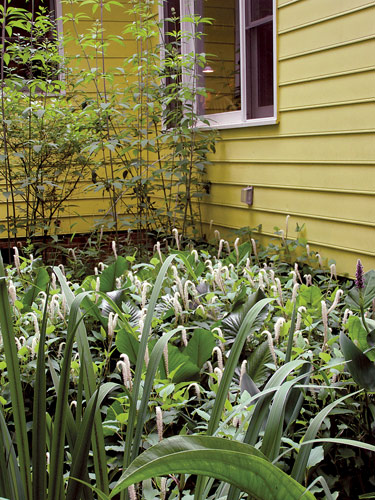
- Pete Schubert’s bog garden in Durham brings affords “a closer look†at lizard’s-tail from the kitchen window. Photo by Ken Moore.
My favorite outside-of-nature place to enjoy lizard’s-tail is in the wild garden of Pete Schubert in southeast Durham. Every time I visit, I must contain my envy that I’m not as successful at duplicating nature all around my house as is Pete. Right now, his bog garden just outside the kitchen is a lizard’s-tail spectacle. In full flower for the past two weeks, Pete’s plants are far ahead of the several populations just now coming into flower along the loop trail around Big Oak Woods in the Mason Farm Biological Reserve. You’ll also find some lizard’s-tail along the Bolin Creek trails in the vicinity of Chapel Hill High School.
The several plantings in and around the Botanical Garden’s Totten Center are perhaps the most accessible site for seeing this engaging plant. Another easy viewing vantage point is by canoe and kayak; if you’re planning such an outdoors excursion in the next week or so, keep your eyes alert for the drooping flower stems along pond and river edges and that “closer look†is only a few paddles away!
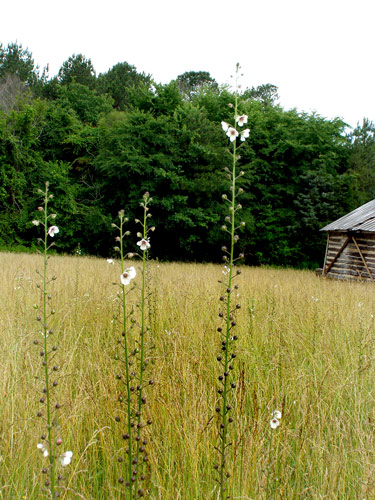
Moth mullein flowers hover above the tall grasses in a field near Carrboro. Photo by Ken Moore.
By Ken Moore
Even at speeds of 50 or more miles per hour, you may spot some distinctive plants standing out in roadside fields.
During the past week, I’ve been catching glimpses of little white flowers hovering just above the tops of grasses in rural areas outside Carrboro. These white flowers also hover midair-like along some of the unmowed roadside edges closer into town.
I’m particularly aware of them because I have a few quietly showing off in my wild yard just now. I remember being pleased some years ago to discover moth mullein, Verbascum blattaria, in my infrequently mowed yard.
The white, sometimes yellow, flowers of moth mullein begin opening in the evenings and remain fully open until late morning the following day. Though they linger a bit longer on cloudy days, you’re not likely to notice them past late morning.
Each flower opens for only a single day’s length. Moth species are likely pollinators of this night-opening flower. The descriptive species name, blattaria, “moth-like,†is attributed to the Roman naturalist Pliny the elder describing the similarity of the flower’s frilly stamens to antennae on the heads of moths.
Definitely worth “a closer look,†you don’t even need your trusty hand-lens to see the beautiful purple-haired stamens crowned with vivid orange anthers. You can almost imagine some amorous moth approaching one of these flowers in the evening dim, with more than food on its mind.
The plant and its pollinators must be an effective match, because the stems are loaded with round pea-like capsules, each holding numerous maturing seeds for dispersal later in the season.
In contrast to the common woolly mullein, Verbascum thapsus, with its noticeable woolly leaved, cabbage-like, basal rosette, the moth mullein goes unnoticed. The basal leaf cluster of moth mullein hunkers flat on the ground like a pancake-sized, shiny dark-green doily. You may notice the flat-leaf rosettes in late fall and winter when the ground is more exposed to view. If you are lucky enough to spot some in your yard, mow around them to watch them flower next season. You can make your own “Moth Garden†sign for display to curious neighbors.
Both mulleins are naturalized in open, sunny sites, having made their way across the Atlantic long ago with the settlers from Europe.

Photo by Ken Moore.
While you’re out scanning roadsides and fields for moth mulleins, keep an eye out for two other “out standing in the fields†plants: Indian hemp, Apocynun cannabinum, (see carrborocitizen.com/flora/ and search for “Indian hempâ€) and common milkweed, Asclepias syriaca, (search for “common milkweed†and refer to articles “Art of Nature,†7/10/08 and “Observing the common milkweed,†8/16/07). These two plants are true natives.
You will be mesmerized by colorful butterflies and other pollinators visiting Indian hemp stands in some of the fields of Mason Farm Biological Reserve. Common milkweeds with round clusters of purple-pink flowers are evident on the high berm bordering Finley Golf course on Mason Farm Road.
In Carrboro, viewing butterflies on milkweeds is easy along the Frances Shetley Bikeway wild garden behind Carrboro Elementary School.
Plan a walk soon to discover more plants “out standing in the fields.â€
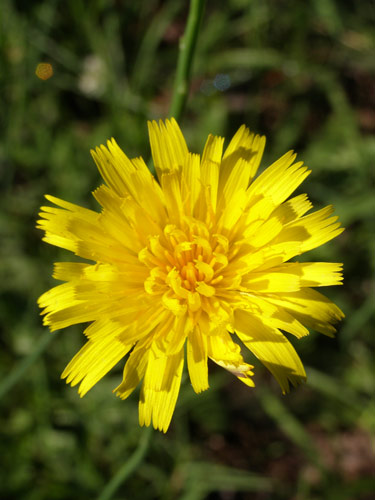
A closer look at cat’s-ear reveals a head of tightly clustered ray flowers. Photo by Ken Moore.
By Ken Moore
Every week, some little weedy wildflower will appear in an unmowed lawn, sounding the alarm for sentinels of homeowner associations. Watchdogs of Carrboro’s Homeowners’ Association (fictitious organization, I hope) must be out of town. I’ve enjoyed seeing numerous yards blooming vigorously during the past several weeks. The lawns of many front yards are refreshingly covered with white-flowering clover. Other yards appear to be infested with hundreds of little yellow flying-saucer-like flowers, hovering a foot or two above the green surface. And some yards are downright spectacular with the flying saucers hovering above drifts of white clover.
One well-tended front yard was brilliant with a sea of bright-yellow flowers floating across it. I was sad when I returned to find the lawn had been subdued, mowed flat to its former green mat. The color and effect of unmanaged growth is just too much natural exuberance for many folks.
The yellow weed we are seeing along unmowed road edges and in the lawns of more carefree gardeners these days is Hypochaeris radicata [hy-po-KEER-is rad-i-KAY-ta]. The common name, cat’s-ear, is a reference to the fuzzy-on-both-sides basal leaves of the plant. Some like to call it false dandelion because the flower head resembles the larger yellow dandelion. This one, however, stands 1 to 2 feet higher with several flower heads on a single leafless stem. Like the dandelion, cat’s-ear is a Eurasian introduction that has become naturalized.
Take a closer look at a flower head. This is an example of plants in the aster (composite) family that have a tight cluster of individual flowers that are all ray flowers, unlike the typical sunflower, which has a circle of ray flowers surrounding a tight swirl of disc or tubular flowers. Each little ray flower of the head has a discernible row of five teeth at the outer end of the flower.
This is also another of those plants with flowers that close up for the evening. The more you observe flowers, the more you will find that many of them have this opening-in-the-morning, closing-in-the-evening habit. Others, you will note, open in the evenings and close in the morning. Then there are the ones that stay open and demonstrate other characteristics. It all provides lots to ponder.
This past weekend, thousands of cat’s-ears were carefully mowed from our highway medians, but you may still see bright-yellow flowers swaying in the breezes along the outer roadsides before routine mowing makes the edges carpet clean.
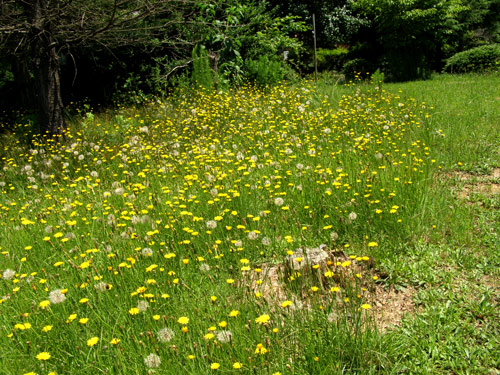
Colorful wildflowers and weeds like cat’s-ear can brighten a front yard if left unmowed for a few weeks. Photo by Ken Moore.
If you mow your lawn frequently enough to keep the weeds or wildflowers from blooming, I challenge you to leave a
few little grassy islands here and there during the next several mowing cycles; you may be pleasantly surprised at what reaches up and flowers for you. You may enjoy the little islands for the swaying grasses alone. However, if your homeowners’ association allows you to keep your little grassy islands, you may be required to fence them.
A more carefree yard-lawn saves you time, money, reduces pollution and can provide interesting and beautiful surprises through the seasons. Go ahead, it’s worth a try.
Himalaya-berry, as pretty as any rose
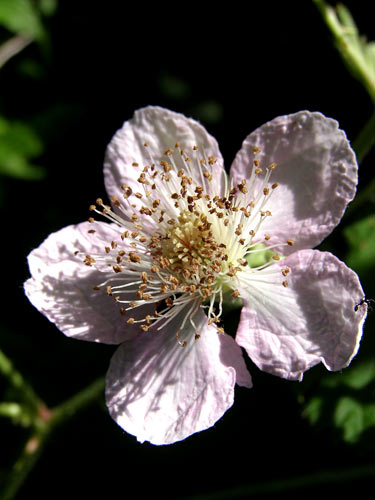
Single flower of Himalaya-berry is worth a search in your wild garden and along roadsides. Photo by Ken Moore.
By Ken Moore
You may remember the description in this column three weeks ago of the common wild blackberry, Rubus argutus, in full flower during our traditional blackberry winter. Coming into full flower this week is another one of those wild blackberries. This one, Rubus discolor, Himalaya-berry, bears a flowering branch of quarter-to-half-dollar-size, single-petaled, pale-pink flowers, as pretty as any rose, and it’s running loose in and around Carrboro. It is an “alien blackberry†because it was introduced from Europe long ago.
I know some of you are already thinking, “Oh, no; here comes another tirade about exotic invasives!†Surprise; I’m not concerned about this one. It can’t come close to competing with the aggressive true native blackberries. This one is uncommon and worth a search in your wild garden and along roadsides and field edges in your neighborhood.
Keep your eyes alert for arching, thorny blackberry stems. The Himalaya-berry is not as densely flowering as the common ones. The white-to-pink flowers are borne on more loosely branching flowering stems. The undersides of the leaves are white and pubescent (fuzzy to the touch) in contrast to leaves of the common blackberries, which are green on both surfaces. While you’re looking, notice that the leaves of the flowering branches, floricanes, have three leaflets and the leaves of the non-flowering stems, primocanes, have five leaflets, characteristic of all blackberries. Blackberry flowers and fruit are produced on the second-year stems (canes).
I have a few of these Himalaya-berries along the edge of my driveway. A few days ago, I was happy to see them begin flowering. I’ve been taking “closer looks†several times each day since. This year, I’m particularly taken by the beauty of each individual flower.

Photo by Ken Moore.
Each one appears to be a delicately pink-shaded rose, and that’s logical, since blackberries are in the rose family.
Very early one recent, misty morning, I went out to enjoy my stems of “miniature roses†and discovered they were all tightly closed. I know that some flowers regularly close up during the night, but I have never noticed this habit in blackberries. Now I know these flowers open and close regularly in response to the sunlight of day. What a natural way this may be to protect mature pollen from being washed away by night-time dew and sunless daytime rains. Now I’m more curious about the flowers of plants that don’t have the opening-closing habit, like the flowers of hollies. I remember an old friend explaining that long rainy periods during the spring may result in a sparse crop of holly berries in the fall. That makes sense: no pollen, no pollination. In addition, you don’t see many pollinators flying about in the rain. No pollinators, no pollination.

Closed flowers open on sunny days to reveal beautiful rose-like flowers on a stem of Himalaya-berry. Photo by Ken Moore.
I’m looking forward to the Himalaya-berry bearing fruit a few weeks after the traditional Fourth of July blackberry-picking time. I remember tasting the superior sweetness of this foreign berry some years ago. It’s well worth cultivating in the garden, where it can be well tended and trained along a trellis.
Good luck with your search, and along the way I suspect your keen eyes will make a few other discoveries.

Tall-standing penstemons in front of one of Mason Farms vast fields. Photo by Ken Moore.
By Ken Moore
Mason Farm’s penstemon fields are more spectacular this year than ever. The N.C. Botanical Garden’s careful management – a combination of select mowing and prescribed burning, simulating nature – encourages these impressive seasonal wildflower displays.
Each time I visit the Mason Farm Biological Reserve south of Finley Golf Course, I make new discoveries. Every visit makes me cherish the proximity of such an extensive wild area.
Editor of Audubon magazine John K. Terres fell under the spell of Mason Farm back in 1961, when he retreated to Chapel Hill from New York City to take on an assignment to write an encyclopedia of North American birds. Fortunately, he was introduced to Mason Farm soon after his arrival. Being a naturalist accustomed to daily forays into the wild, Mason Farm gave Terres a place for breaks from his indoor labors — a place to renew his energies and spirit.
The description of his first visit to the farm is memorable:
“I first saw the Mason Farm of the University of North Carolina at Chapel Hill in February 1961.… Crossing Morgan Creek over a concrete dam, I walked under the winter sun on a road that led over a grass-grown levee, built to hold back the spring floods. I had no thought of what might lie beyond. When I reached the top of the dike, I gasped. For two miles straightaway, and from east to west, windswept fields and woods lay under an enormous vault of blue.
A thousand acres of swamps and fields and forests, to as far as I could see, were suddenly opened before me – a vast freedom of land and sky. The farm, only two miles southeast of Chapel Hill, a city of 30,000, was near, yet isolated, a land few people knew. As I penetrated its old roads, I felt its loneliness that I was to know by day through silences broken only by a hawk’s screaming or the shouting of crows and by night through the moaning of owls and the barking of half-wild dogs and foxes. This was a wilderness of the land to match the wilderness of the heart.â€
You just can’t paraphrase that; John’s writing is that good!
For the next eight years, he roamed the fields and forests of Mason Farm day and night.
His written observations of the farm’s natural history rivaled his progress on the encyclopedia. Encouraged and supported by friends and publishers, a narrative of his Mason Farm adventures, From Laurel Hill to Siler’s Bog: The Walking Adventures of a Naturalist was published in 1969, years before he completed that encyclopedia.
Viewing the penstemon fields last week, I walked in reverence, following John’s footsteps everywhere. I paused frequently, as he must have, to wonder at the sea of penstemons before me.
I call this penstemon Penstemon laevigatus, eastern beardtongue. Others insist it is P. digitalis, tall white beardtongue. Since it has characteristics of both species, it makes for engaging conversation whenever botanist types get together.

Vast penstemon fields are just one of the attractions of a walk around Mason Farm. Photo by Ken Moore
Whatever it’s called, it also makes a handsome garden plant. This penstemon is available at the Botanical Garden. You will enjoy growing it almost as much as seeing those fields, almost as much as reading John’s walking adventures around the farm.
The Botanical Garden has scheduled a “From Laurel Hill to Siler’s Bog: In the footsteps of John Terres†walk this weekend. There may still be time to register for it by calling 962-0522.
Spectacular wildflowers in the Piedmont
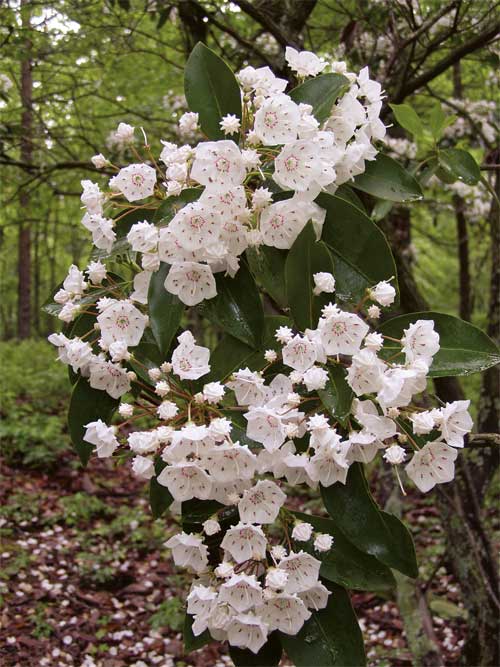
Individuals flowers of mountain laurel deserve a closer look. Photo by Ken Moore.
By Ken Moore
A friend visiting last week from the Carolina mountains inquired of some locals about locations of spectacular wildflower displays here in the Piedmont. He was surprised by the response. Spectacular wildflowers and the Piedmont don’t go together, he was told. It’s an oxymoron!
I didn’t have opportunity to convince my friend otherwise because he was intent to be on his way on a two-week journey chasing wildflowers in the eastern coastal swamps and savannahs. He had little enthusiasm for what our local Piedmont may have to offer.
I had wanted to show him the spectacular mountain laurels, Kalmia latifolia, but he was not interested in a plant so common around his home turf. My enthusiasm for this local mountain did not impress him. Before he left, however, I gave him lengthy descriptions of other Piedmont locations of spectacular wildflowers.
I described the far-as-the-eye-could-see display of Dutchman’s breeches on the Flat River north of Durham. I described the river bottom, white with spring beauties, along the Eno River at Hillsborough. I described Mason Farm Biological Reserve, where fields still spectacular with sweeps of copper-brown broom sedge will give way in another week to knock-your-socks-off spectacular Penstemons. Mason Farm alone provides year-round occurrences of impressive seasonal displays. The number of local wild flora sites is endless.
This past weekend I discovered a spectacular new trail. The 2.2 mile Occoneechee Mountain loop trail begins at the western edge of the official parking area and leisurely meanders around the western mid-slope of the mountain dominated by mature rock chestnut oaks, Quercus montana. I was so engaged in the various flowering patches of fetterbush, Lyonia mariana, and deerberry, Vaccinium stamineum, that I was downright startled when I looked up to see, in full flower, alone in the open forest, a specimen of tree-form mountain laurel. My objective of the walk was to view the mountain laurel that is usually in full flower on Mother’s Day. Far out from the north-slope and mountain-top population of laurel, this fine specimen was a surprising sentinel of the spectacle to come.
I soon found myself dwarfed beneath a canopy of flowering laurel with, in places, a groundcover of galax, Galax aphylla, so characteristic of the mountains farther west.
The laurel seemed to be at peak, but many buds were still closed. A closer look at just-opened flowers will reveal 10 dark burgundy-red stamens embedded in the petal surface. Examining older flowers, you will discover stamens in an inverted curved position, having sprung upward, when ripe, tossing pollen out onto unsuspecting insect pollinators.
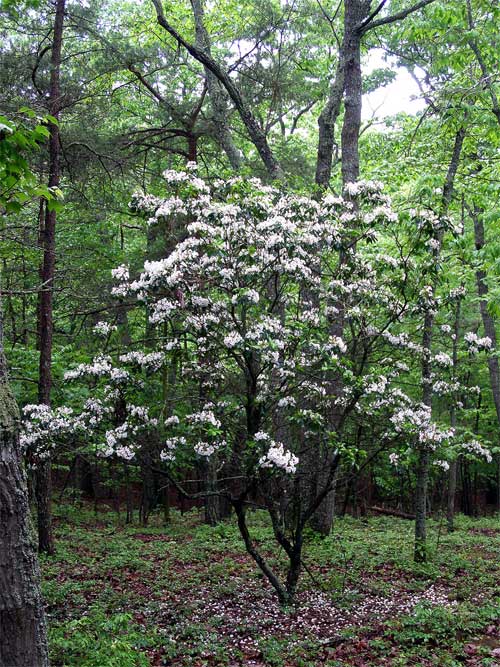
A sentinel mountain laurel announces a spectacular flower display further beyond. Photo by Ken Moore
I felt myself in the heart of the Carolina mountains. Some many thousands of years ago, I would have been correct. How fortunate we are that a few “relict†plant communities still linger nearby on sites where just a few degrees of temperature differences and slope orientation allow a few characteristic mountain species to survive following the last southern glacial episode.
The mountain laurels are still in flower. Get out in the next week to see them, and make note that we do have spectacular Piedmont wildflower displays!!