Blackberry winter flower competition
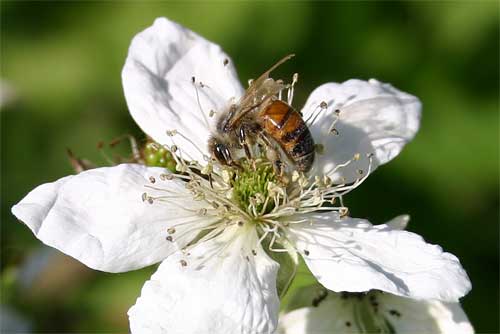
Honey bee on common wild blackberry. Photo by Debbie Roos
By Ken Moore
For years, I was aware of the common wild blackberry, Rubus argutus, around the Fourth of July, when, along roadsides and fencerows, they were pickin’-ripe for cobblers and ice cream toppings. Now I look forward to blackberries earlier, when they begin flowering during the cool temperatures of early May, the season that old timers call “blackberry winter.â€
On a walk around the Botanical Garden’s Mason Farm Biological Reserve, I was enjoying the edges of flowering blackberries, when I came upon one edge where a mound of the invasive exotic multiflora rose, Rosa multiflora, was vigorously competing for space with the blackberry. Not only was space an issue between these two competing plants, but the presence/absence of pollinators was dramatic. There in the warm late-morning sun, all the honey bees and other pollinators were covering the flowers of the exotic rose. No pollinators were visiting flowers of the adjacent blackberry.
Now, I’m not an expert on honey bees or pollination ecology, but if this spreading and high-climbing rose is out-competing our delicious wild blackberries in attracting pollinators, we have a serious problem.
Before I proceed with my usual tirade against invasive exotics, let me acknowledge that a friend of mine frequently criticizes me for being negative every time I mention an exotic plant. In defense, I have no objections to the numerous exotic garden plants that do not freely jump the garden fence to out-compete native plants in the wild. I do recommend vigorous battle against recognized destructive exotics like the privets, eleagnus, oriental wisterias, Japanese honeysuckle and kudzu, as well as the multiflora rose.
The foreigners growing so happily here, without their homeland diseases and predators to keep them in check, each year cause millions of dollars of damage to natural areas and horticultural crops.
If the multiflora rose receives preferred pollination over the blackberry, the greater production of rose hips, spread far and wide by birds and other animals, will result in less area available for colonization by blackberries and other native species. Numerous native butterfly species and other wildlife are critically dependent on specific native plants; much of the plant-specific native fauna is not adapted to utilize the invading exotic flora.

Flowers of multiflora rose at top compete for pollinators with blackberry flowers, below. Photo by Ken Moore.
Along our roadsides and forest edges, blackberries and multiflora roses are making quite a show now. From a distance, the plants are similar. Both are thorny and form impenetrable thickets. But only the rose can climb high in trees and scramble over shrubs and small trees, giving it a physical advantage. The flowers are similar, but a closer look will reveal the rose flowers are smaller and in tighter, roundish conical clusters with yellow stamens. In contrast, flowers of blackberries are larger, in looser horizontal clusters, and the stamens are not yellow. Sadly, it may be that, offered a choice, the pollinators prefer the rose.
If you are cultivating blackberries, you certainly don’t want the multiflora rose near by. Without blackberries, you still don’t want this climbing rose nearby. Please do the right thing and take advantage of this cool blackberry winter and cut and grub out all the multiflora rose within your domain.
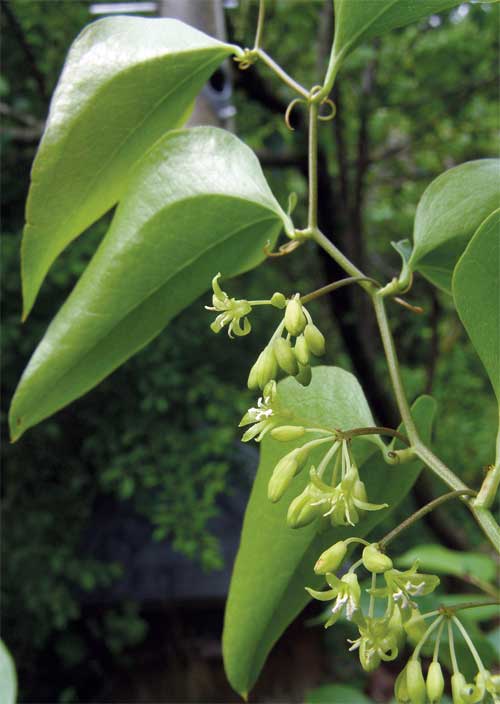
Clusters of little green flowers hang beneath Smilax leaves. Photo by Ken Moore.
By Ken Moore
I’ve always been fascinated with greenish flowers and I wonder why so many of our native vines have them.
On your next outdoors excursion, keep a keen eye focused on the native greenbriers or catbriers, wild grapes and the not-so-welcome poison ivy. During this mid-spring season, you can spy clusters of greenish-yellow flowers hanging beneath the leaves of these common vines climbing trees and fences and scrambling over field edges everywhere.
My favorite is the greenbrier, Smilax rotundifolia, being the most common of several species in our region. I have allowed a volunteer smilax full reign over the trellis along my deck where I look forward to the return of little green flower clusters each spring. I also never tire of the heart-shaped leaves sprawling here and there.
If you take a closer look, you’ll find clusters of tiny green lily-like flowers hanging beneath the leaves. The smilax vine scrambling along my deck is a male, so I don’t get the clusters of black berries that birds enjoy on the female vines in the late fall. The shoots and berries of the many species of smilax are important food for a diversity of wildlife, including black bear.
Cut stems are effective in flower arrangements throughout the year. Being drought tolerant, smilax vines are attractive all during the growing season and birds take advantage of the climbing stems on my deck for cover and easy access to the bird feeder. Whenever it begins to over stretch, it is easily trimmed back. Not all greenbriers are thorny catbriers, so we need not curse them.
Native-American ethnobotany references describe countless medicinal, culinary and other uses, including grinding tubers for making bread, using stems and leaves for herbal teas and salves, use of the thorns as a type of acupuncture, tying thorny vines together for protective barriers and using vines in basket making, a rich heritage indeed.
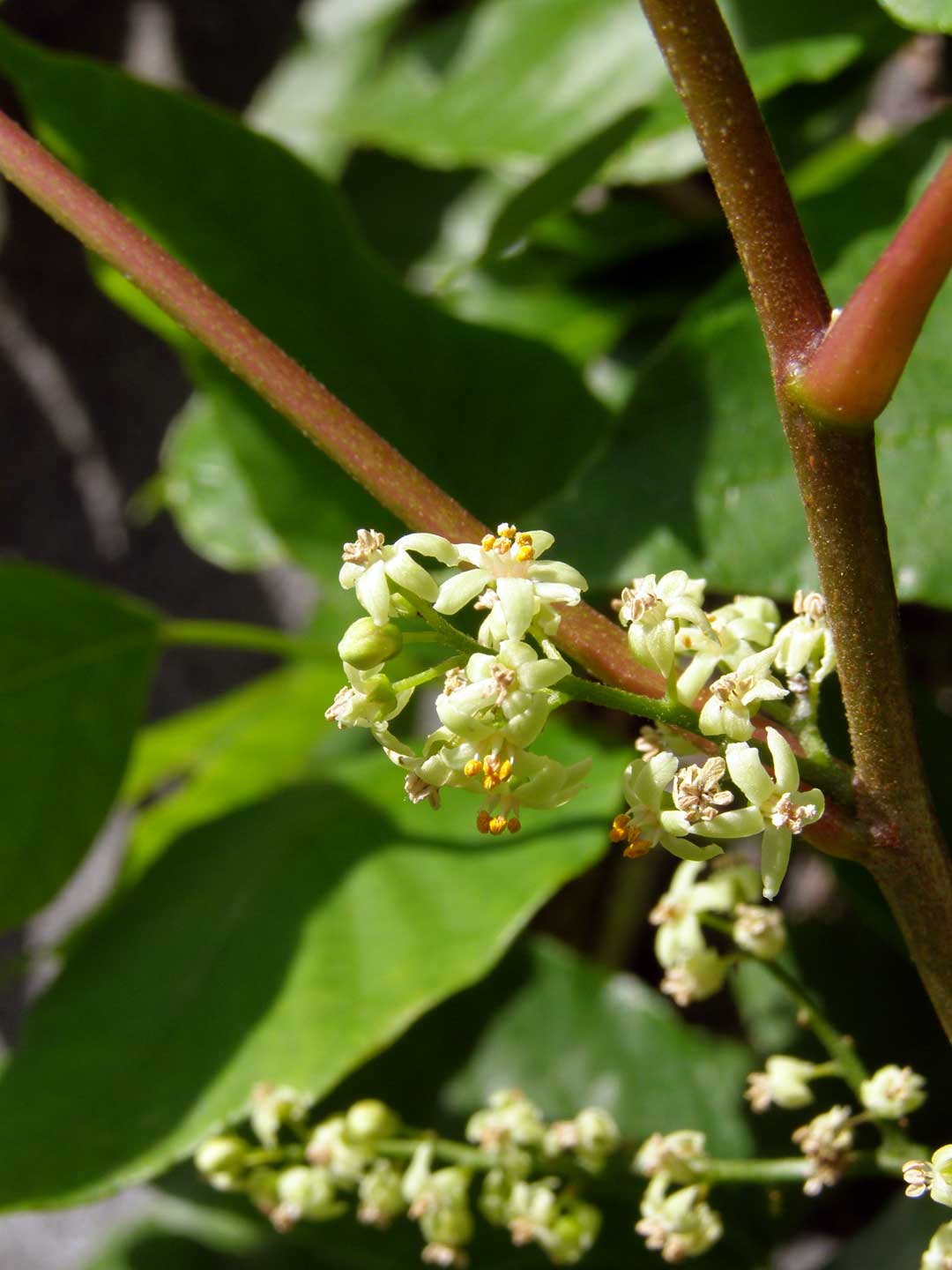
With caution, you can get close enough to see the greenish flowers of poison ivy. Photo by Ken Moore
In addition to wild grapes, you’ll find greenish flowers on that vine-to-avoid, poison ivy, Toxicodendron radicans. Now, I don’t expect many of you even think of getting close enough to see the flowers. You have to be very careful not to touch any part of the vine as you take that closer look at the clusters of green flower buds, opening with cream-colored petals and contrasting orange stamens. Poison ivy is another valuable food plant for pollinating insects as well as birds and small mammals, and the fall color can provide spectacular red tints where the vine is climbing high in pines.
The best way to observe poison ivy flowers is with binoculars. I use binoculars for wildflower viewing all the time. You can take closer looks at flowers without leaving the trail and you certainly won’t have to walk through the poison ivy.
For the next couple of weeks, keep your eyes alert for the yellow-green flowers hidden under the leaves of these vines and perhaps you can discover an advantage for being green.
There’s still time to catch the boys sporting around in pink
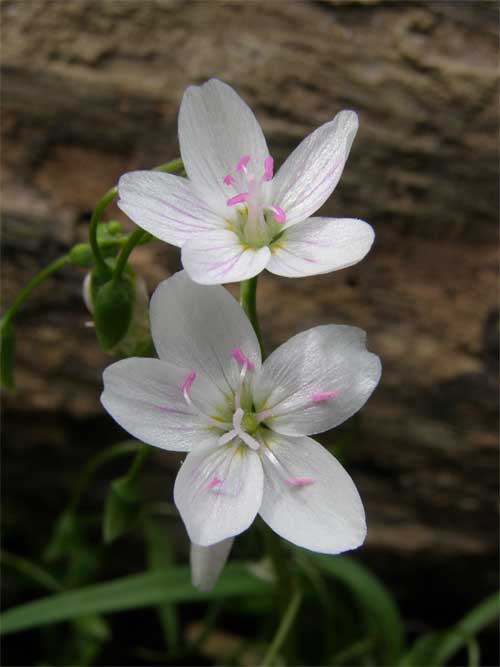
In the upper, younger spring beauty flower, the lady pistil remains closed while the boy stamens strut around. In the lower, older flower, the boys have moved away and the lady is displaying a three-parted crown, preferring pollen from the boys of other flowers. Photo by Ken Moore.
By Ken Moore
Wow, spring beauties’ pink boys are still going strong!
Late this past February, a group of us discovered spring beauty, Claytonia virginica, already in flower, on the slopes and creek bottoms of Carrboro’s Adams Tract. Last week, I followed that same path and found, seven weeks later, mid-April, spring beauties still going strong.
They have passed their peak of flower, but most of them still have buds coming along. I believe this must be the spring wildflower champion for length of bloom time.
Spring beauties have always intrigued me because the stamens, the male parts of a flower, are vivid pink. I am accustomed to stamens being decked out in yellow. I have generally considered pollen to be yellow. Just remember smelling a buttercup or Easter lily and coming away with yellow pollen on your nose. Taking a closer look into the flower of spring beauty is something you won’t forget. And those boys, the stamens, sporting around in pink, are a real curiosity, but your nose doesn’t pick up pink pollen.
I keep pondering pink pollen, but have never, even with a hand lens, detected it, and I’ve never seen yellow pollen on those pink anthers. Finally, this past week, I examined several of those pink-clad boys under a dissecting scope and, behold, there were several open anther sacs revealing almost translucent, pearly-white pollen grains. So my mystery is solved, at least to my satisfaction, and I still marvel at the beauty of the flower.
So if you get out into the woods during this next week, you’ll still have opportunity to spy on those boys sporting around in pink. Don’t put off too long, because with the new leafy tree canopy plunging the forest floor into deep shade, the spring beauties with those thread-thin leaves are bound to consider finishing up for the season.
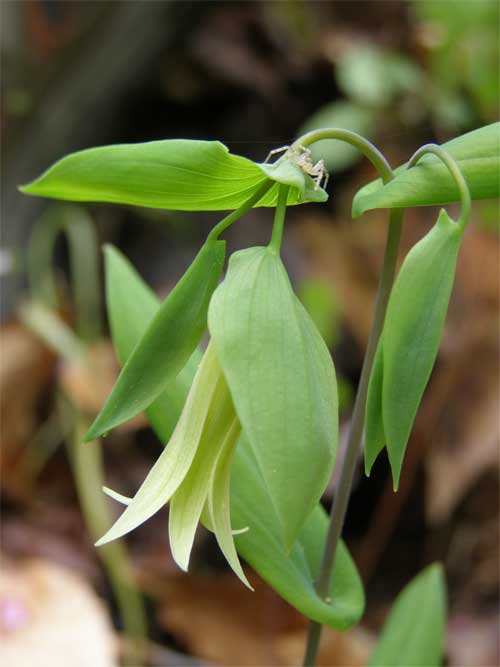
The yellow lily-like bellwort flower hangs below a perfoliate leaf; a “closer look†reveals a tiny spider lying in wait for a meal. Photo by Ken Moore.
While enjoying the spring beauties, I was happy to spot another common, though not so numerous, spring woodland flower: bellwort, Uvularia perfoliata. The bellworts used to be included in the lily family, but current plant taxonomists have moved them to another. However, it’s still a beautiful little nodding, lily-like flower on a stem of “perfoliate†leaves – i.e., the base of the leaf blade is wrapped completely around the stem of the plant. There are other plants with this characteristic and many of them bear the descriptive Latin species epithet, perfoliata.
The bellwort (and if you take that “closer look†you’ll spy a spider lying in wait, as on so many flowers) is just one of many plants you’ll find showing off right now, as you go in search for a final look at spring beauties. From the tiny emerging heart-shaped leaves of red bud trees to the upright clusters of creamy-yellow flowers of painted buckeyes, you’ll be on sensory overload as you take part in celebrating another Earth Day week. But, hey, we all do that every week, don’t we?!
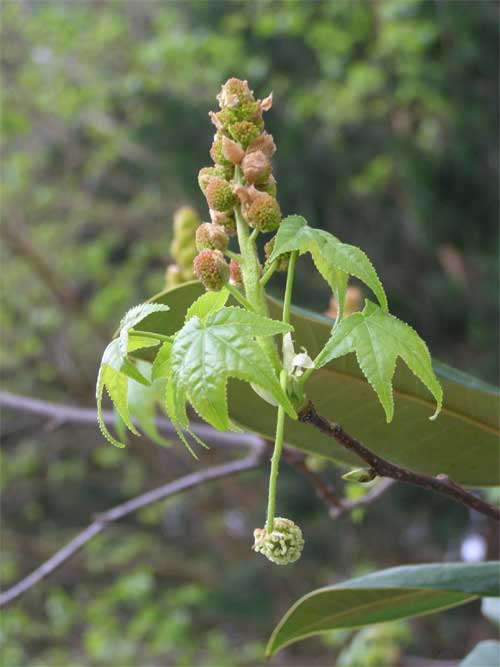
Male flowers of sweet gum standing proudly above the round cluster of female flowers hanging below. Photo by Ken Moore.
By Ken Moore
Sitting on the modest deck of Johnny’s on West Main Street, a short way from downtown Carrboro, one has an engaging view of a stately in-town sweet gum tree, Liquidambar styraciflua, in full flower. I have a hunch that you’ve not given much time to considering sweet gum flowers. Well, we can’t have all those generally despised sweet gum balls without first having the flowers.
I don’t recall when I first became aware of flowers on this tree; but now that I am, I look forward to them every spring.
Though it sports some of the most magnificent fall color of any native tree, the sweet gum is most often maligned as a “trash tree†because it is so common and it has all those messy spiked balls that litter the ground beneath. I rather like those spiky dried balls. While still hanging in the trees during the fall and winter, those dried gum balls hold seed that provide a favorite food for chickadees. Some years, I cut a big branch of sweet gum balls for indoor holiday decoration.
I remember a description in the esteemed garden publication of the English Royal Horticultural Society some years ago praising sweet gum balls as a suitable garden mulch. The English prize our native sweet gum as a single specimen tree with beautiful “autumn tints.â€
Go outside and find a sweet gum that is standing on the edge of a forest or out in an open landscape and take a “closer look.†The healthy mature ones at this time of year are decorated with what appear to be miniature candelabras, one at each leafy branch tip.
Those vertical clusters of reddish-green balls are the male flowers that will soon be bearing pollen for those singular little greenish balls hanging down beneath the young leaves at the branch tips. That little hanging ball is the female flower of many pistils awaiting airborne pollen to fall down upon them from all those proud guys sporting pollen above. If you can find one low enough, take a really good look, or use binoculars to bring them into closer view. You may be impressed. The flowers don’t have colorful petals, but they are beautiful in their own way.
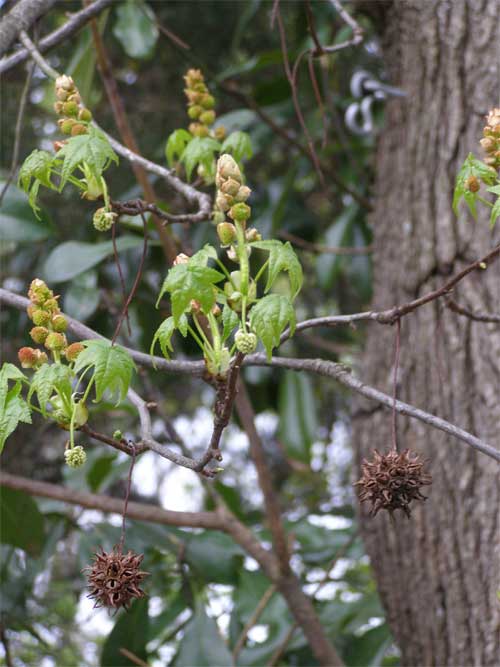
Last year’s sweet gum balls still hanging while this year’s leaves and male and female flowers emerge above. Photo by Ken Moore.
Like so many of our native trees, the sweet gum is associated with a wealth of folk medicines and lore. Gum bark teas were used for numerous complaints and the sweet rosin (sweet gum) exuding from the cut bark and crushed leaves were applied to open wounds. The dried gum was used for gum disease or, as described in Paul Green’s Plant Book: “We children used to chop gashes in these trees and then later get the exuded gum and use it for chewing gum.â€
My favorite description is from Dr. Jim Duke’s Northeastern Indian Medicinal Plants: “Water or brandy-soaked twigs are chewed to clean the teeth in some areas of Appalachia.†Now that sounds a lot more fun than using conventional dental floss!
Give the sweet gum a closer look. For sheer beauty and architectural interest, I remain firm in holding the common sweet gum among my very favorite native trees.
By Ken Moore
Podophyllum peltatum (sounds like: po-dough-FILL-lum pel-TAY-tum), now there’s a plant name that just lingers in your mouth before rolling off your tongue. Throw it into a springtime conversation and you’ll attract immediate attention.
The genus name for mayapple is derived from the Greek and Latin, podos (a foot), and phyllon (a leaf). How a “foot leaf†relates to the mayapple is obscure. Perhaps it refers to how the flat rounded leaves are borne on solidly footed petioles. Personally, whenever I see the leaves hovering above the forest floor I think of a herd of light-footed elephants leaving green footprint impressions.
The species name, peltatum, is more obviously descriptive, referring to the Latin for shield; the flat rounded leaf, sturdily attached to the petiole at the center of its underside, looks a bit like a shield protecting the earth beneath. A peltate leaf is distinctive enough to catch your attention.
The full arrival of springtime for me is the return of great swaths of mayapple leaves in the flood plains and lower forest slopes. Even though some frosty temperatures remain, spring is here!
Any plant sporting two leaves will have a single heavy-textured, cream-colored flower hidden beneath the leaves. The flowers are most easily viewed from your on-the-ground “belly botany†position. In rainy weather, the water-laden flower petals become almost translucent, presenting a study in fragile beauty.
Just now, the flowers are still mostly in bud. They’ll be ready for pollinators in the next week or two. The real joy of anticipation is watching the slow emergence of the mayapple leaves as they emerge like tiny, opening umbrellas above the leaf litter.
You may be able to spot a few timid plants still just emerging. Look for any that have two leaves beginning to emerge and you will discover a flower bud tucked between them. A two-leaved plant is mature and strong enough to spend energy on producing a flower and a fruit. That fruit, the mayapple, will ripen sometime in May.
Ethnobotanist and herbalist Dr. Jim Duke and others say that when fully ripe the fruit is tasty and makes good sauces and jellies. He also adds that the plant is very dangerous. I wouldn’t pick it. The root, stem (petiole), leaf and unripe fruit are highly toxic; I would leave the harvesting to the forest critters!
Like so many poisonous plants, mayapple has an extensive heritage of past and present medicinal and insecticidal use and it has demonstrated potential in cancer research.
Since the plant is rhizomatous, spreading horizontally by underground stems, you will find great undulating patches covering the forest floor like giant green carpets. Infrequently, you may spot a large carpet-like patch extending from a forest edge onto a hillside pasture where livestock have enough sense to step around the poisonous patch.
The official name is perfect for the middle line of a haiku.
Springtime emerging
Podophyllum peltatum
A joy to behold
So go outside and discover the mayapples, and you too can haiku!!!

Flowers of heartleaf wild ginger are usually hidden beneath leaf litter on the forest floor. Photo by Dave Otto
By Ken Moore
Two weeks ago, Dave Otto shared photos of wild gingers in full flower along Bolin Creek. The wild ginger flowers, generally hidden beneath the leaf litter, had been exposed by recent rains.
The leather-textured flowers are long lasting; you can still see them. If you practice that “take a closer look†walking strategy, you will most likely find two species of wild ginger on the forest floor.
In fact, if you take yourself outdoors this next week, you will catch the fullest peak of early-spring flowering we’ve had in years! This abnormal spring, the earliest flowering species are lingering in an unusual overlap with later-flowering species. read more…
B.W. Wells gained power from a flower
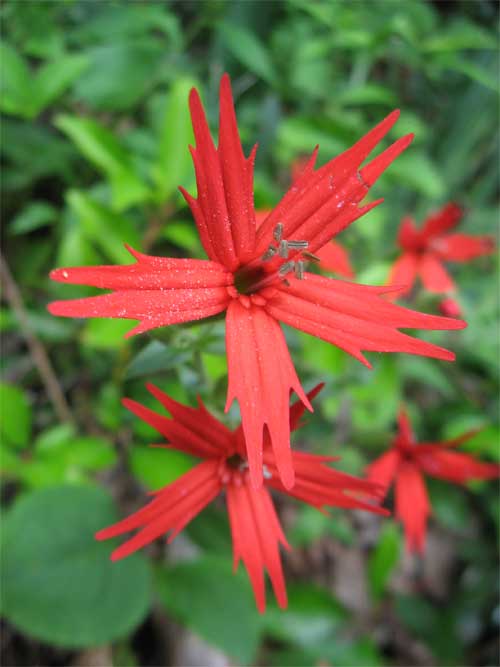
Late spring-flowering fire pink inspired B.W. Wells to become a botanist. Photo by Tom Wentworth
By Ken Moore
In 1932, The Natural Gardens of North Carolina, written by Dr. Bertram Whittier (B.W.) Wells, professor of botany at N.C. State University, was published by the University of North Carolina Press. How well I remember, back in 1966, my mentor presenting me with a copy of Natural Gardens with the comment, “If you are going to study the botany of North Carolina, then you need to become acquainted with B. W. Wells!†That began for me a life-long pursuit of discovering and enjoying the natural gardens of our state.
As a high school freshman in Ohio, B.W., with the help of a plant key, saw and identified a fire pink, Silene virginica, a brilliant red wildflower we can discover in our North Carolina forests in early May.
B.W.’s discovery is worth describing:
“One day, a week into the botany course, he spied a brilliant scarlet flower while walking along a creek bank. Strangely struck by it, he opened his manual of plants and attempted his first identification by means of a descriptive key. A thrill of triumph surged through him when he successfully found that the plant was known as the fire pink. ‘From that moment on I knew what my life’s work would be. I was so terribly excited about identifying that flower. And I’m still as excited as ever about botany. The more you see, the more you have to see.’†(From Nature’s Champion: B.W. Wells, Tar Heel Ecologist by James R. Troyer.)
B.W. went on to receive his Ph.D. at the University of Chicago and in 1919 accepted an appointment at N.C. State College (now University) where he remained as head of the botany department until 1949 and professor until 1954.
Immediately, he was inspired and challenged by the beauty and diversity of North Carolina plants and plant communities. He was an engaging teacher and a competent researcher, making great contributions to the new discipline of plant ecology. He was an excellent communicator and writer. Natural Gardens is a very readable description of the natural vegetation of North Carolina, east to west, from the ocean spray dunes to the high-mountain evergreen forests. For him, the diversity of seasonal wildflower displays in distinct plant communities across the state were, indeed, spectacular natural gardens. read more…
Originally published December , 2008
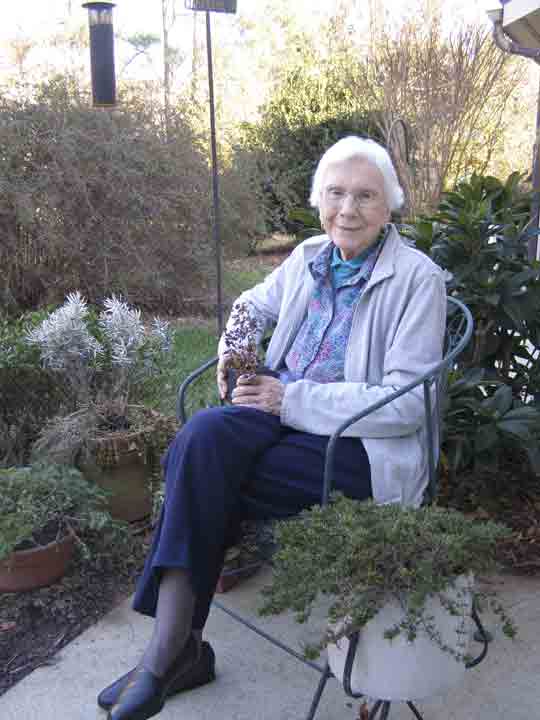
Photo by Ken Moore. Evelyn Sims holding a native oregano for her garden.
Ken Moore
When asked, “Why do you garden?†Evelyn McNeill Sims was at first a bit startled as she leaned back in her seat, and after a few moments of thoughtful silence responded, “Well, that’s just what you do! I can’t imagine not doing it!â€
That sentiment was expressed last spring, a few days before I presented the Botanical Garden’s 9th Annual Evelyn McNeill Sims Native Plant Lecture, an annual celebration of wildflowers endowed by Evelyn’s daughter and son-in-law, Nancy and Ed Preston, in 1990, on the occasion of Evelyn’s 90th birthday.
read more…

Photo by Ken Moore. The beautiful blue berries of Virginia creeper are not edible.
By Ken Moore
Unnoticed most of the year, Virginia creeper turns the interior of many trees shades of red during the fall. It is so lush in some trees that it appears to spray over some of the outreaching limbs like a crimson waterfall.
Just a few years ago, I discovered the vine’s dark blue berries on contrasting red stems. That color combination against green and multicolored foliage increased my appreciation.
read more…

This emergence of painted buckeye shows the reddish scales of the terminal bud with immature five-fingered leaves surrounding the infant cluster of pale-yellow flower buds. Photo by Ken Moore
By Ken Moore
I look forward to the spring awakening of the painted buckeye, Aesculus sylvatica, locally common in old erosion gullies and flood plains.
I think of tiny hands when I see those five-fingered (palmately compound) leaves emerge from the large buds of this small tree that we see mostly as a large open shrub. It seldom attains a height of more than 20 feet. Some of the buds began opening a couple of weeks ago and by now those distinctive leaves are fairly well formed.
This past weekend, some buds were still holding their reddish protective bud scales with infant leaves reaching out, some surrounding a cluster of pale lime-green flower buds. read more…