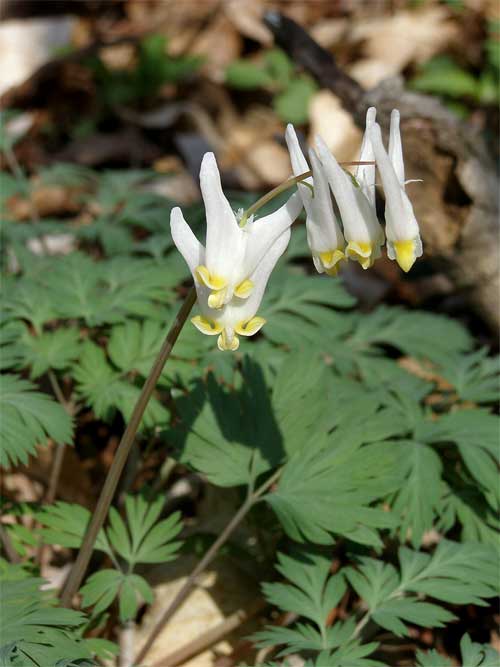
Flowers of seldom-seen Dutchman’s breeches seem to be hung out to dry. Photo by Ken Moore
By Ken Moore
Dutchman’s breeches – now there’s a truly descriptive common name. Most plant names, both the common ones and the official two-part (binomial) Latin names, are descriptive. In this case, the common name is “in your face†descriptive of a Dutchman’s wide flaring pantaloons, but you have to see it to believe it. If you practice “belly botany†to get a “closer look†at those flowers, you may be inclined to call them flying breeches, because they seem to be flying on a miniature clothesline close to the ground.
The official botanical name, Dicentra cucullaria, is a bit obscure. Dicentra, originally from the Greek “dis†(two) and “centrum†(spur), describes the two spurs of the base of the flower; cucullaria is from “cucullaris†(hood-like.) You really do have to see it! read more…
Originally published March 5, 2009
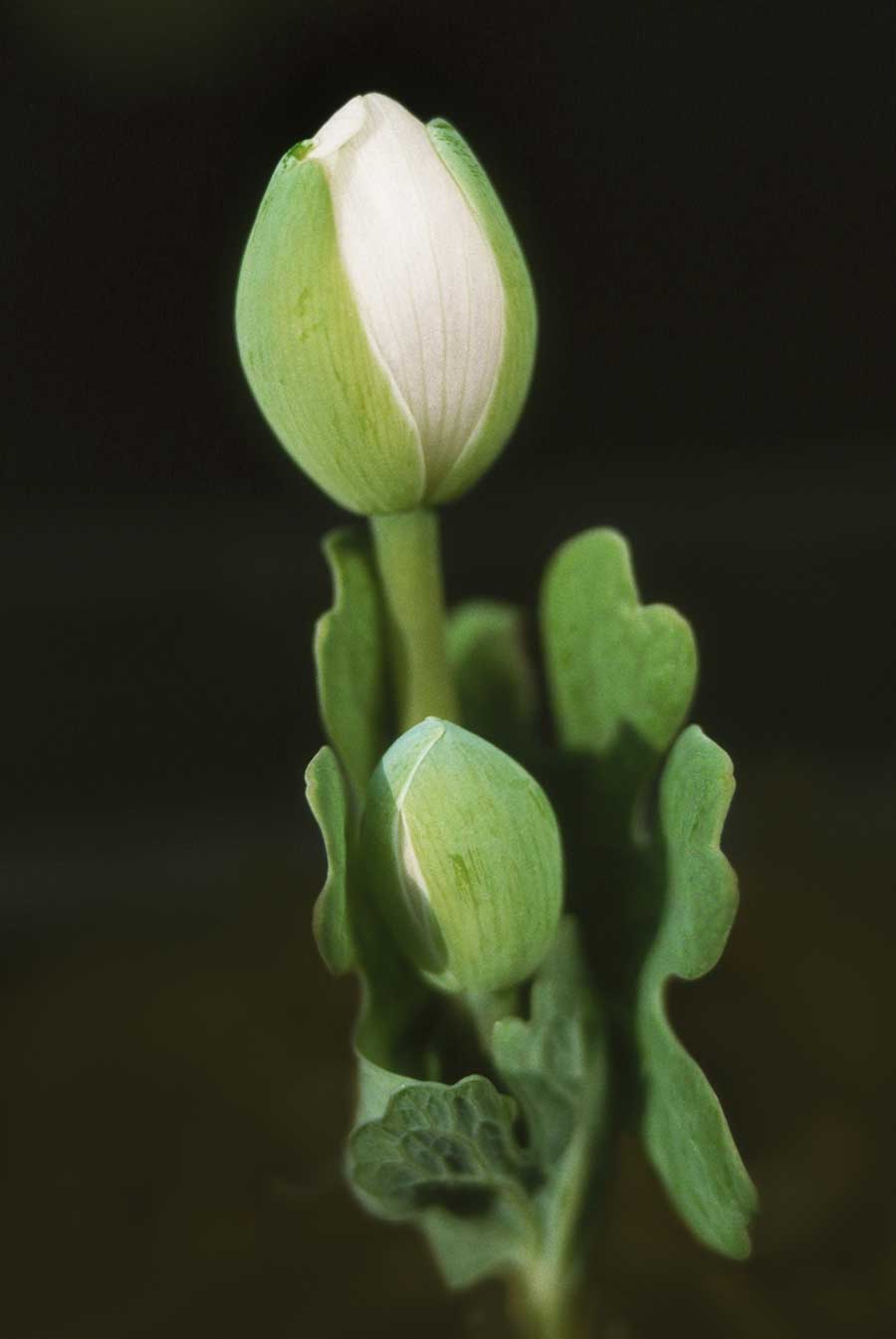
Bloodroot buds timidly rise in search of the warming sunlight. Photo by Betsy Green Moyer
By Ken Moore
I’m anticipating seeing bloodroot, Sanguinaria Canadensis, on a woods walk in the next couple of weeks. The common name refers to the reddish milky sap that exudes from a cut along the side of the finger-size rhizome. The root was a source for yellow to red-orange body painting and dyeing of clothing and baskets by Native Americans.
The petals of this common eastern American wildflower are as brilliant white as our recent fresh snowfall. Look for it on deciduous forest slopes scattered among ferns and other woodland plants. To catch the bloodroot in flower, you will have to take regular walks beginning soon. Once a bloodroot presents itself, you have only a few days time to catch the flower.
Plan your walk after mid-morning to catch the flower fully open in the warming sunlight. As the day cools, the petals close up. This action is repeated for several days and then the petals drop off, leaving an elongated pod that slowly swells through the spring to drop seeds that are quickly carried underground by ants. You may enjoy pondering why it spends so much energy closing and opening its petals. read more…
Originally published February 26, 2008
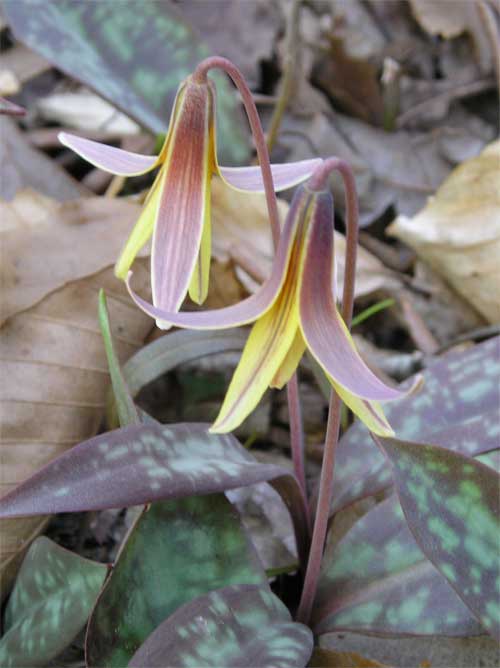
The dimpled trout lilies are visible for a very few weeks. Photo by Ken Moore
It’s here again, that time I year I dread most: springtime!
Terra cotta tints of elm trees and red hues of red maples announced the arrival of spring weeks ago. The tiny flowers of these native trees depend on wind currents for pollination because it’s too cold for flying insects to be effective.
Bolin Creek walker Dave Otto reported seeing trout lilies in flower on Valentine’s Day. Some folks call them dog-toothed violets, adder’s tongues or fawn lilies. Taking “a closer look†will give you some hints about these common names.
For me, the onslaught of springtime is symbolized by the first appearance of the speckled-patterned leaves of the trout lily, and every year that sends me into a panic. During the springtime, too much happens too quickly. I can’t keep up with it all! read more…
Influenced by African-American gardens
Originally published February 19, 2009

Grancy graybeard (fringe tree), a popular small tree collected from the woods for African-American gardens, is often seen in Carrboro front yards. Photo by Ken Moore
By Ken Moore
Talking about the upcoming “African-American Gardening†presentation by University of Georgia professor emeritus Richard Westmacott, gardening friend Juel Duke and I discovered that we share a similar Southern gardening heritage.
Juel grew up near Norlina remembering seeing all the interesting and colorful plants and yard ornaments throughout rural Warren County. At the age of 3, I began spending my summers in Warren County with my widowed aunt who shared her small tobacco farm with two African-American tenant families.
As Westmacott describes in his book, the term “garden†in the rural South referred to an area away from the house managed for the production of vegetables. Flowers were grown in the “yard,†generally in front of the house where, when there was time, families enjoyed sitting on the porch welcoming passers-by. read more…
There’s still time for winter botany
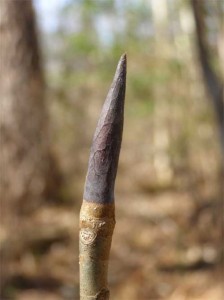
The bud of the umbrella magnolia looks like a spear. Photo by Ken Moore
By Ken Moore
I tagged along with a friend last weekend in his search to rediscover a favorite very early spring wildflower. Along the way, he came to an abrupt halt, admiring a single long, smooth bud, appearing like a spear tip. He immediately recognized it as the deciduous umbrella magnolia, Magnolia tripetela. You may spot it down along your favor creek or river path. Remember its location, because you will want to go back in the middle of spring to admire the large leaves clustered at the ends of the branches like an umbrella. The flowers are often missed because of the freshly emerged foliage of other trees all around.
So, in spite of early signs of spring, we still have several weeks to practice winter botany.
I have a favorite memory of a summer botanical survey in the early 1970s. I was assisted by a young couple who had taken a basic plant identification class. I noticed the young woman was carefully pulling all the leaves from a twig in her hand. Her response to my obvious inquiry was: “I have to get rid of all these confusing leaves because I learned to identify plants in the winter.†She was serious and, furthermore, once she had the twig in hand, bare of leaves, she was able to identify it.
And so it is that plants can often be easily identified in the winter.
Striking contrasts of bark and shapes of trees are obvious identifying features. Less often appreciated are the buds.
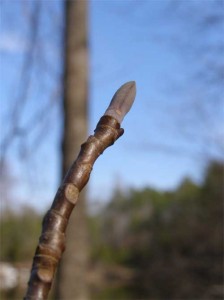
Another distinctive bud we noticed on last weekend’s excursion was the smooth, duck bill-like bud of a magnolia relative, the handsome tulip poplar, Liriodendron tulipifera. You can begin looking high up in the trees for beautiful green and yellow tulip-shaped flowers in mid-April.
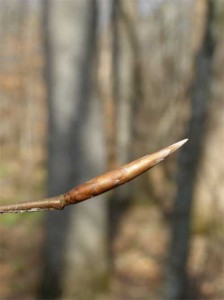
Beech trees, Fagus grandifolia, easily known by their smooth trunks and for holding onto their copper-brown leaves, have a long narrow copper-colored spear-point bud at the ends of horizontal branches. Keep an eye on those buds and observe how the old leaves are pushed off overnight on or just before April 1. That time clock is predictable.
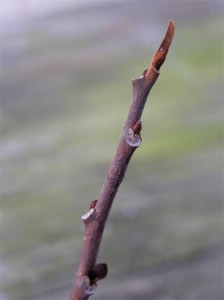
Red maples, Acer rubrum, are easily recognized by those deeply red-colored twigs sporting red buds at the tips and oppositely arranged along the sides. The closely related southern sugar maple, Acer barbatum, is similar, except it is brown rather than red.
If you’re really lucky, you may discover a grove of pawpaws, Asimina triloba. Pawpaw buds are distinguished by the exposed young leaf protected with dark, velvet-like hairs. Further down, there may be a similarly textured fat, round flower bud. Definitely go back during late March and early April to see those pawpaw flowers.
Obviously, there are many more buds out there, each beautiful and interesting in distinctive ways. On your next woods walk, take time to “take a closer look†at the buds. And take that walk soon, because before long we won’t be able to see the forest for the leaves.
Buds (in order top to bottom) of tulip poplar, American beech, red maple and pawpaw (Photos by Ken Moore).

Originally published January 31, 2009
By Ken Moore
Winter in the woods is the best time to appreciate land contours, the striking differences of tree bark, the stature of individual specimens and the leaves of evergreen wildflowers.
It’s also the best opportunity to locate two obscure native orchids. Of the two, cranefly orchid, Tipularia discolor, is the more common. Most often you’ll spy a single leaf or two here and there, sometimes an informal line of them and infrequently a loose mat of them. The one-and-a-half-to-three-plus-inch-long ovate, or egg-shaped, leaves are evident now. The leaf is green on the upper surface and burgundy below, sometimes almost purple on both surfaces.
read more…
Four Easy-to Spot Evergreen Wildflowers

Flower buds of liverleaf signal spring’s early emergence in the dead of winter. Photo by Ken Moore.
By Ken Moore
I was not alone on the Adams Tract trails this past Saturday; numerous other folks, including moms and dads shepherding their lucky youngsters.
I was out trying to photo-capture four common evergreen wildflowers, specifically: liverwort, Anenome americana (formerly Hepatica americana); wild gingers, Hexastylis arifolia, or H. virginica or H. minor; spotted wintergreen, Chimaphila maculata; rattlesnake plantain, Goodyera pubescens. All of them have distinctive leather-textured leaves that most often sport mottled patterns on the leaf surface.
read more…
Originally published January 8, 2009
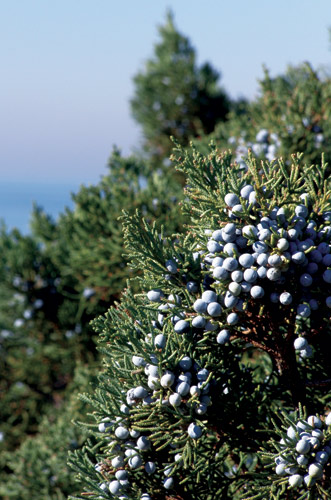
The bluish berries and scale-like leaves of this coastal red cedar are very similar to the berries and leaves of the common eastern red cedar. Photo by Ken Moore.
By Ken Moore
It was the driest of years and the wettest of years. North Carolina’s two red cedars stood strong and green during the year of drought and rains.
The eastern red cedar, Juniperus virginiana, surrounds us in the Piedmont. Except for the outer coastal regions and the high mountain elevations, the eastern cedar tree is common throughout the eastern U.S., extending into Texas and northward up through the Midwestern states. It is adapted to a wide range of soil types, moisture regimes and temperature extremes. It grows in all but water-logged soils.
read more…
Originally published January 1, 2009
By Ken Moore
Get outdoors on New Year’s Day
The annual Eno River Association’s New Year’s Day walk is a decades-old tradition. This year, hundreds of folks, young and old, will enjoy another well-organized walk along the river, welcoming the New Year and celebrating that long corridor of preserved wild lands. read more…