Way down yonder in the pawpaw patch
By Ken Moore
Flora Columnist
Wow, we now know that because of that recent record-breaking late cold snap, peaches, strawberries and blueberries are going to be really pricey this harvest season. Wait till you see the prices on pawpaws! Well, you probably won’t see any pawpaws (Asimina triloba). You may even be wondering: “What’s a pawpaw?â€
Remember that childhood song, “Way down yonder in the pawpaw patch� Back in earlier years, many folks knew about pawpaws and lots of folks looked forward to harvesting them in the late summer. In Indiana, this largest of all native American fruits is called the Hoosier banana; the 3-to-6-inch-long, mango-like fruit has a mixed banana and pineapple flavor. They are definitely worth finding, scattered throughout the low woods along our local streams and rivers. You’ll have to beat the raccoons and possums to them, however, because the wild critters are expert at harvesting them as soon as they ripen.
I anticipate the flowering of the pawpaw more than any other native tree. It doesn’t present a colorful roadside spectacle like the redbuds and dogwoods, but the subtle beauty of green and burgundy flowers on bare branches are memorable. The individual buds initially expand as green nickel-size, bell-shaped flowers, then mature to a deep burgundy color as the flower opens widely to the size of a half dollar.
Though the recent nights of record-breaking freezes “burned†most of the pawpaw flowers, you can still find a few in the pawpaw patches in our local forests. To enjoy seeing pawpaw flowers without the challenge of searching along woodland trails, visit the two fine specimens in cultivation behind the Totten Center at the Botanical Garden on the east side of Fordham Boulevard. Both of those trees are loaded with flowers, many of them still in good condition with a few buds left to open, so make a visit this week to catch them. And while there, take a real close look at the clusters of tiny fruit beginning to develop. The freezing temperatures were not so severe over the warmth-retaining surfaces of the display gardens behind the Totten Center. The trees are labeled, but if you have difficulty finding them one of the garden staff members will be happy to introduce you to this special plant.
Seeing the pawpaws in cultivation at the Botanical Garden may encourage you to have your own pawpaw patch. They are easy to grow and you’ll want to have two separate plants because fruit set is dependent upon cross pollination of separate plants. Once established, a pawpaw tree typically extends roots laterally to produce numerous upright stems that will eventually create a multi-stemmed “patch†similar to the groves you find in the wild. Knowing this trait, you will want to site your tree where you are willing to be happy with a little grove rather than a single stemmed plant.
The folks at the Botanical Garden sometimes have a few pawpaws available, and Niche Gardens and Cure Nursery currently have a few. When procuring new plants for your home landscape, you will be wise to purchase locally produced plants and select smaller rather than larger plants.
You may enjoy searching the Internet for more information about pawpaws. You will discover the Pawpaw Foundation, which seeks “to reacquaint Americans with this distinctively native fruit and to lay the groundwork for a pawpaw revival by promoting scientific research in the areas of pawpaw breeding, growing, managing, harvesting and use.†The foundation’s goal is to have the pawpaw become as valued a part of the domestic garden as the apple and pear. Just imagine, in years to come we may be able to travel out to one or more local “pick-your-own†pawpaw patches.But in the meantime, I encourage you to enjoy a pawpaw patch in your own yard.
Email Ken Moore at flora@carrborocitizen.com.
Another “regular, irregular†Carolina Piedmont spring
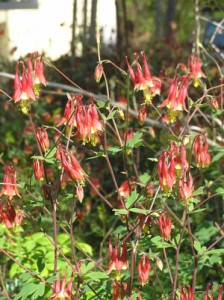
Columbine (Aquilegia canadensis). Photo by Ken Moore.
By Ken Moore
Flora Columnist
It’s spring again in the Carolina Piedmont. That means another round of predictably unpredictable weather that sets serious and not-so-serious gardeners into an annual frenzy. Over the years I’ve come to anticipate that when the exotic Star magnolias and the Bradford pears come into flower it’s time for the typical Carolina Piedmont killing frost. That didn’t occur this year. Global warming, hmmm? The killing frosts came later this year. I have also observed that our native species are generally not significantly bothered by these “regular, irregular†cold spells following really warm periods in early spring. Only once during my time (a sorta long time), back in the early 1980s, do I recall that native plants have been harmed by a late spring freeze. I remember, during a Wildflower Society excursion in the Charlotte area, that a late freeze had killed back the fresh fiddleheads of Christmas ferns and all along Interstate 85 the new leaves of the oak trees were blackened. That was the only time in my lifetime.
I have always sounded off in favor of gardening with native plants if you want to avoid disappointment during the “regular, irregular’ Piedmont spring freezes. I still hold strongly to this philosophy. But I am truly humbled by this past weekend. In an earlier column for The Carrboro Citizen, I had predicted this past weekend’s cold spell to occur a week earlier. I was off, though my announcement of the April 10th peak of Dogwood flowering is still fairly accurate. This past weekend’s low temperatures have significantly reduced my sour (pie) cherry crop. And, thankfully, much of the Chinese Wisteria, strangling numerous trees along my border, has been harmed, so hopefully fewer seed will be produced to spread this tree-strangling pest onto other grounds.
On Sunday afternoon I traveled the local environs to check on the weekend’s frost damage, eager to once again observe the superior hardiness of our native plants that over thousands of years of being here are well-adapted to surviving such challenging weather patterns. I visited my favorite garden, a little “postage stamp†of horticultural exuberance, the front-door garden of Chapel Hill resident Bill Bracey, whose “Shelby’s Bottom†sunken garden on Hillsborough Road is right now a little spectacle of the native columbine (Aquilegia canadensis). None of these red and yellow flowers, beckoning the return of the hummingbirds, were ill-effected by the frost. I was ecstatic. Once again my theory about natives was holding true. Then Bill emerged from his front door to make me aware that not only had his so-called hardy non-native kiwi fruit been “burned†by the cold, but we both surprisingly observed “burnt†tender leaves and flower buds on his native Fringe tree, as well as on the numerous native Paw Paw trees strategically sited around his modest landscape. Curiously, only half of his Paw Paw flowers were damaged and hopefully the Fringe trees will recover with some flowering for this spring. Returning home on the western edge of Carrboro, I realized that the new foliage at the tips of some of the branches of my several volunteer Redbuds had been damaged by the low Saturday night temperatures, but the effect seemed minimal.
This is one of those dramatic springs, occurring every other decade or so, that damages some of our native plants, in addition to many of our exotic ornamental plants and early fruit crops. There are lessons, however, for all of us:
Our Piedmont springs always have harmful freezes following really warm spells in March and into mid-April.
Our native plants rarely suffer and they recover quickly.
We should avoid the enthusiasm and disappointment of planting out tender annuals and summer veggies until the soil temperature really warms up in early to mid-May. But then there are those of us who really enjoy planting out, again and again, in the early spring, what we have come to recognize as “sacrificial†tomatoes and marigolds. Garden centers love us because we purchase the same plants two or three times each season. Helps their cash flow.
In the meantime, hey, it’s spring; enjoy another walk in the woods. The wildflowers there have been little affected by the “regular, irregularities†of the weather we have in the spring in the Carolina Piedmont.
Email Ken Moore at flora@carrborocitizen.com.
Beware the march of the Bradford pears
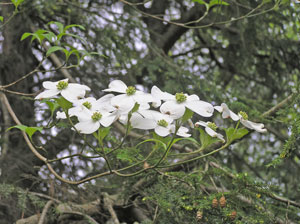
The natural beauty of the Dogwood is under increasing competition from the Bradford pear. Photo by Ken Moore.
By Ken Moore
Flora Columnist
Approaching Carrboro along Jones Ferry Road is always a botanically joyful experience of viewing our seasonal wild flora from the spectacular flowering trees in the spring to the more subtle beauty of native grasses in the late summer and fall. Right now the roadsides are magical with the overlap of the flowering of the pink-colored redbuds (Cercis Canadensis) and the pure white of the dogwood tree (Cornus florida), the official state flower. Our North Carolina redbud and dogwood are just two of the numerous native plants that are ideal for urban and residential landscaping. Local nurseries and garden centers are well stocked right now with special cultivars of these two beauties. These cultivars, special forms of wild occurring plants, have been propagated by nurseries for sales to the admiring public, who always want to plant something special.
I, however, am a lazy gardener, preferring to let the redbuds and dogwoods plant themselves, with a little help from nature. My minimal gardening activity alllows these plants to remain in place where they volunteer. My reward is a month-long floral display free of any planting and watering responsibility for me. By reinquishiing a need to be rigidly in control of nature and a dictator of my garden design, my “gardening with Nature†practices allow me more time to enjoy the seasons. Each year the experience is different because I let Nature guide where I plant, where I weed and where I may seldom mow a pathway. Most homeowner associations will not approve of such relaxing and environmental gardening.
So what do dogwoods and redbuds have to do with Bradford pears—that short flowering, ever so popular, white flowering tree that has been unimaginatively over-planted in parking lots and along residential streets throughout our region? Well now, in contrast to the lovely Jones Ferry roadside (and other local roadsides), over on the other side of Chapel Hill near Research Triangle Park, in areas adjacent to Bradford pear-filled parking lots, there is frightening evidence of the threat posed by this exotic (i.e., not native to our region) plant so innocently introduced into our region. Open fields that in former times, left to nature, would have returned to forests of native pines, red cedars, sweetgums, maples and oaks, and, yes, even our favorite redbuds and dogwoods, are now in many places 50 percent to 75 percent young forest of Bradford pears, crowding and shading out the native species that should be there. Last week, back on our side of town, I noticed Bradford pears flowering along the wooded roadside just west of the Carrboro Post Office, innocent-looking enough, nestled in there with several dogwoods, with very few people noticing and being aware that in time those beautiful dogwoods and redbuds, that flower many days longer than the pear, will be crowded out by the more aggressive introduced exotic plant.
So, if you value our redbuds and dogwoods and other such desirable native species, please don’t plant Bradford pears, and if you really want to accomplish a good deed—get rid of the Bradford pears you already have—our future roadsides and fields and forests will appreciate your action.
Email Ken Moore at flora@carrborocitizen.com.
Take a Walk in the Woods and Pay Attention to the Beech Leaves
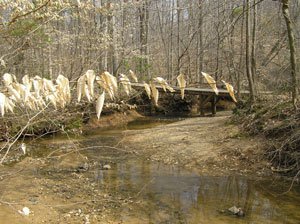
Beech leaves hanging on at Morgan Creek. Photo by Ken Moore.
By Ken Moore
Flora Columnist
As Dave Cook engagingly describes in The Piedmont Almanac, “There is something conclusive about the day the old brown beech leaves fall.†Dave’s observation is for the fourth week of March — and he is right on target for this seasonal occurrence in our local Piedmont region around Carrboro and Chapel Hill.
It took me more than two decades to become aware of this recurring seasonal phenomenon. Ten years ago, while driving into town, I realized that the beautiful pale copper-brown leaves that had been clinging to the low horizontal branches of a grove of beech trees the evening before were suddenly absent, having overnight carpeted the forest floor. That morning 10 years ago was April 1, an easy date to remember. I was so intrigued by that observation that I made a mental note to be acutely watchful of the lingering beech tree leaves in future years to determine whether or not an April 1 overnight dropping of beech leaves is one of those actions to anticipate as regularly as the return of the swallows or that reappearance of the hummingbird with the opening of the first columbine flower.
I haven’t maintained a precise journal, but my recollections of observations over the past ten years do note that an overnight drop of beech leaves has indeed occurred on the eve of April 1, give or take one day.
While walking two Sundays ago along the Bolin Creek through the University’s Horace Williams Tract and Carrboro’s Adams tract to enjoy the peak displays of numerous wildflowers, I was startled to realize that the forest floor was carpeted with a fresh covering of beech leaves, an entire two weeks before my, by now, anticipated sacred date of April 1. How could this be? My very own little scientific observation of a few years suddenly shattered. But wait — there may be some explanation for this irregularity. I noticed that in spite of the fresh carpet of beech leaves on the ground, there was still a dramatic display of beech leaves clinging in profusion along the limbs and branches of the beech trees throughout the forest. That recent fresh carpeting of beech leaves must have resulted from the previous evening’s heavy rain and wind dislodging those leaves less inclined to hang firm until April Fool’s eve.
So here’s a challenge for you. Make your own set of observations. Locate a grove of young beech trees in your favorite wooded area and take note of those leaves each morning and each evening during this next week. Note the day or night that they drop, seemingly all at once. Will it be April 1 again this year? And be aware of your sensation. I suspect that as you observe this seasonal event you will sense, as does Dave Cook, that indeed: “There is something conclusive about the day the old brown beech leaves fall.â€
What that conclusiveness may be for each of us will vary. But I can tell you for certain that if by the day of the beech leaf drop, you have not allowed time for a walk in the woods, you will have already missed this year’s peak display of carpets of Trout Lilies (Erythronium americanum) and the isolated patches of Liverwort (Hepatica americana) and scattered Spicebushes (Lindera benzion), where they have not been displaced by the two nuisance exotic invasive shrubs, Chinese Privet (Ligustrum sinense) and Autumn Olive (Eleagnus umbellata). There is still time, however, to get out into the fields and forests to enjoy clumps of Wild Ginger (Hexastylis virginica and H. arifolia), little patches of Windflower (Thalictrum thalictroides) and carpets of Spring Beauty (Claytonia virginica) and so many other wildflowers to appear as the season progresses. One need not travel far to enjoy North Carolina wildflowers. They occur in profusion all around us in our own local fields and forests. Give yourself a healthy break—take a weekly woods walk and enjoy the nature around you.
And, here are two more seasonal notes recalled from so many past years: Look for the peak flowering of our Dogwood (Cornus florida) to be centered around April 10. And I’ll predict that one of the most bone-chilling days of the spring will be one of those three days of the first full weekend in April. It always has been, so I expect it again. But who knows, this year, perhaps not. That’s for you to observe.
Email Ken Moore at flora@carrborocitizen.com.