The wild white flowers of early summer
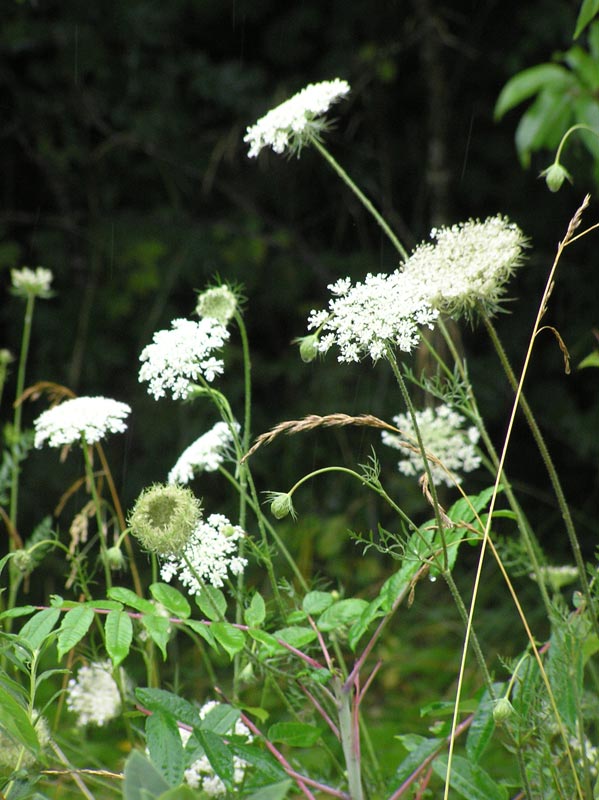
Queen Anne’s Lace, a “wild carrot.†Photo by Ken Moore
By Ken Moore
Flora Columnist
They began flowering weeks ago and they are still making a show along roadsides and wherever folks allow them to move about freely on their lawns and in their gardens.
I learned to recognize the green winter leafy rosettes of Daisy Fleabane (Erigeron annuus) some years ago and I deliberately give them freedom wherever they appear in my wild landscape. My reward is masses of tiny white daisy flowers on multi-branching stems, three to five feet tall, cheering up my yard and garden areas for weeks and weeks. And this year, for whatever reason, they seem to be flowering in profusion everywhere, inspite of the continuing drought.
Trumpet-creeper: Just one of our great native vines
By Ken Moore
Flora Columnist
Our roadsides are so filled with flowering wild plants that it frustrates me to focus on just one or two for description in The Citizen.
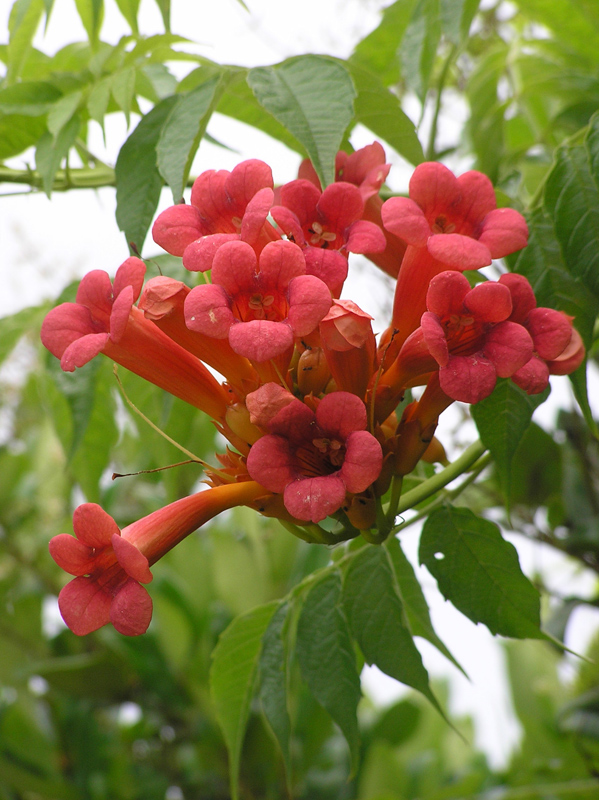
Right now, I have to celebrate the Trumpet-creeper. Some folks call it Trumpet Vine or Cow-itch Vine. There are likely other names associated with this common native weedy vine, of which the bright orange tubular flowers are guaranteed to attract nearby hummingbirds. Keep an eye out to find occasional peach- and yellow-colored variations. The flowers seem to hang singly or in clusters in the air at the tips of long stems reaching down from varying heights, be it low fence posts or abandoned barn chimneys. read more…
By Ken Moore
Flora Columnist
“The other day I saw an ad in the local paper – ‘Catalpa worms for sale, twenty-five cents a dozen.’â€
No, that’s not from last week’s Citizen. It’s from Paul Green’s Plant Book. I’m wondering if he was referring to a long-ago issue of the paper from our neighboring town. The reference to Catalpa worms (the larva of the Catalpa Sphinx Moth) makes me remember my childhood summers spent on my aunt’s small tobacco farm just south of Macon, NC. I was fascinated how her front-yard Catalpa tree leafed out again after total defoliation by Catalpa worms. Some of the local men frequently gathered cans of those worms for fish bait. I remember also how “grossed-out†I was whenever I stepped on one with my bare foot and green ooze covered one or more toes. Apparently that green ooze is considered mighty tasty to catfish. Experienced fishermen can make that worm really tasty by turning it inside out before threading it on the hook. And to have a year-round supply, there’s a description on the Big Fish website (www.bigfishtackle.com) that says Catalpa worms can be packed in a glass jar of cornmeal or sawdust, frozen and later thawed to their original wiggling vigor. Now there’s a little summertime experiment for the curious among you.
Since the early 1700s, we have been cultivating both the Southern Catalpa (Catalpa bignonioides) and Northern Catalpa (Catalpa speciosa), which are very similar in appearance. An impressive, widely spreading specimen is showing off right now in the front yard of an old home on Martin Luther King Boulevard, near Timberlyne. A few weeks earlier, you may have noticed the tall slender specimens in full flower in the Coker Arboretum and at the base of the Kenan Chemistry tower on South Road. That stately Catalpa, reaching almost to the top of the chemistry tower, is well worth a visit. We are indebted to local poet and botany librarian Jeffrey Beam and university forester Tom Bythell for looking out for that tree during the recent years of construction.
For the beautiful flowering Catalpa, with it’s curious long, thin bean-pod-like fruits, we have a rich assortment of common names: Fish Bait Tree, Cigar Tree, Indian Cigar, Indian Bean Tree, and I used to call my aunt’s tree a Monkey Cigar Tree, a name I can’t find referenced anywhere. There are accounts that native Americans did smoke those bean pods. Paul Green recorded, from his chats with old timers of the Cape Fear River valley, that, “Smoke inhaled from the parched and powdered Catalpa leaves, like Jimson leaves, was a good asthma treatment.†Please note: Don’t try these remedies without direct supervision of your physician! But do plant a Catalpa tree of your own, for fishing, for shade and for the beauty of it!
Email Ken Moore at flora@carrborocitizen.com.
Wow, it’s a drought and we have water to throw away!
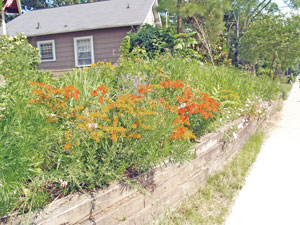
Pete Lucey’s Carrboro curbside garden of drought-tolerant plants, including yellow and orange Butterfly Weed (Asclepias tuberosa) and pink form of White Evening Primrose (Oenothera speciosa). Photo by Ken Moore.
By Ken Moore
Flora Columnist
Walking and driving through the downtown and old neighborhoods of Carrboro is a real treat. There are so many wonderful and colorful gardens that reflect an unbelievable diversity of imagination, horticultural expertise and a dedication to gardening in an environmentally friendly manner. One of my favorite such gardens is Pete Lucey’s curbside garden at the curved intersection of Pleasant and North Greensboro streets. For years, I have watched that garden mature and make a show of color and plant architectural interest in all the seasons. It is truly a “xeriscape†garden. Ten years ago, Pete planted drought-resistant species of perennials and grasses, carefully “watered them in†during the first year, and for the past nine years they have survived and multiplied on the site with only the water provided by nature. That curbside was downright spectacular with its oranges and pinks last week before the rainfall.
Also, I enjoy watching the busy routines of Carrboro’s Public Works landscape staff moving in and around the town carefully tending their garden beds, actually hand-extracting unwanted weeds, hand-pruning the roses, carefully pruning the town’s trees and shrubs and, during dry periods, effectively hand-watering from truck-mounted water tanks.
Thank you, Carrboro and citizens of old neighborhoods, for giving us reason to be proud.
And thank you, thank you, whatever spirit and forces, for our weekend of rain. It is a challenge now for us to stay seriously concerned about our drought conditions. That rainfall was ample for only the very short term. We need that weekly rainfall, at least an inch per week, throughout the growing season for the vigor of our native forests as well as our vegetable production and ornamental landscapes, not to mention that 4th of July blackberry harvest.
In spite of the rain, the drought continues. Don’t be surprised by the return to dry yards and gardens by week’s end. Recommendations for xeriscape gardening will be more frequent than usual. But don’t be misled about the concept. The idea of xeriscape ideally promotes responsible (the overused terms environmental and sustainable are frequently used here) gardening by designing landscapes, planting plants and creating special garden plots that can be maintained by the natural resources of the physical site and climatic conditions or with minimal and carefully applied supplemental watering during the first year of establishment. Be like Pete Lucey. It should be evident that the establishment and maintenance of emerald green turf in such areas as the dunes of coastal Carolina homes and the countless square miles of green turf covering the desert region of Phoenix, Arizona are inappropriate and glaringly contrary to responsible gardening.
Sadly, the xeriscape concept has been recruited as a grand promotional scheme by the irrigation industry. The well-intentioned gardener, homeowner and urban and corporate landscape supervisor are all advised that a well-designed automated irrigation system is required for the survival of their landscapes. It is declared that irrigation systems guarantee that plants get the water they need when they require it and this is generally once a week – frequently, daily. This is described as responsible (i.e., environmental, sustainable) watering.
We are steered away from realizing that in nature plants and whole landscapes can survive long periods without rainfall. The great diversity of irrigation options from homeowner-designed and -installed trickle-and-drip hose systems to highly elaborate, computer-automated, professionally designed and installed mist and overhead impact systems are designed to turn plants and landscapes into “water addicts†far from the true meaning of xeriscape. Frequent shallow watering results in shallow root growth and thus the plants become addicted to frequent watering. Slow, deep watering, evident when there is no water runoff, encourages deep root growth; and with well-established deep roots, all plants are better conditioned to survive droughts.
Daily observations of typical irrigation systems operating in our community include: water streaming off of well-watered sidewalks and roadways into adjoining storm drains rather than settling into the root zones of plants in need; clouds of fine mists carried off by gentle breezes away from the intended plants; and perhaps most disgusting are the frequent sprinkler systems throwing out water at full throttle during periods of natural rainfall. My complaint to the manager of one local bank about the huge lawn being watered during a downpour was met with the response: “Oh, our landscape contractor has the irrigation system on a timer and we can’t do anything about it.†Such systems seem to be justified with accompanying signage: “We use well water to irrigate.†Whether private wells or our public water resource, all the water comes from our region’s waterways and the underground water resource. We should not be wasting our precious water resources as storm water runoff, especially keeping acres and acres of grass green during droughts. Have any of you noticed how green all those unwatered, brown lawns following the recent rain have turned? Now I may be able to appreciate keeping a small plot of turf green as a special feature in a garden, if a grassy plot is held as special as flowering plants, but keeping acres and acres of lawn areas green by supplemental watering during droughts is sadly reflective of our society’s general disregard for living responsibly.
After many years of observing multitudes of irrigation systems, I freely admit that I have an intense disregard for such mechanized technology. They are expensive, inefficient, wasteful and require constant repairs and maintenance vigilance. The only dependable irrigation system is a thoughtful gardener on the end of a hose. This singular watering system will insure that needed water does not flow away from the intended plants, but is applied slowly around plants, encouraging deep root growth. Be observant next time you water; if you see water flowing away over the soil surface, it’s not helping your plants and you need to correct your watering technique.
As a responsible citizen, you have great influence. On the home front, you can began by designing a drought-tolerant landscape, selectively watering stressed plants by hand from water collected in rain barrels and, most importantly, when you see an irrigation system performing wastefully – i.e., water flowing off streets and sidewalks and operating during rainfalls, go inside and let the manager or homeowner know that they are wasting our water! Go ahead, you can do it – and enough of us expressing ourselves will make some meaningful waves!
Email Ken Moore at flora@carrborocitizen.com.

Can you identify the location of this high profile landscape that is so typical of irrigation systems at work throughout our two towns and the University campus?. Photo by Ken Moore.
Native plants show off in spite of drought and heat

A group of local folks stopped in their tracks on the edge of one of Mason Farm’s Penstemon fields. Photo by Ken Moore.
By Ken Moore
Flora Columnist
Summer has not officially arrived, but the summer heat made its dramatic entry this past Memorial Day weekend. And we are well along into the predicted drought; without ample rainfall soon, that anticipated bumper crop of “4th of July blackberries†will be sparse indeed.
While we’re having to provide supplemental water to maintain the health of our cultivated gardens, the native plants along our roadsides and woodland borders are continuing to put on a show without the additional help from our watering hoses.
I was happy to be joined this past Saturday by a small band of other energetic older locals for a walk around the Botanical Garden’s Mason Farm Biological Reserve, where nature’s flower show was evident in both spectacular and subtle ways. The occasion was an annual visit to take in the vast vistas of Beard Tongue (Penstemon laevigatus) in several of the open areas of the old Mason Farm. Fields full of the white spires of thousands and thousands of Penstemon plants were a spectacular contrast to one field with very few Penstemon. This one particular field, with a wide-open vista of tawny and copper-colored grasses and dried stems of last year, was spotted throughout with the bright yellows of our local Sundrops (Oenothera fruticosa), making for a less intense visual experience, but quietly spectacular in such a subtle way.
Another notable native in full flower was the Elderberry, that exuberantly spreading shrub with masses of giant Queen Anne’s lace-type white flower heads. Also present in the same wet ditch edges is Swamp Dogwood and some significant patches of Lizard’s Tail growing in the mucky bottoms of ditches, with lower than normal water levels due to our early drought. Buds of the upright-drooping tight clusters of white flowers of Lizard’s Tail are now evident and will be making a dramatic show in another couple of weeks.
The Mason Farm Biological Reserve is a real local treasure. The story of the return to nature of the former working farm belonging to the Morgan and Mason families of past centuries is beautifully described in John Terres’ From Laurel Hill to Siler’s Bog. In the early 1960s, Terres, in residence in Chapel Hill to complete the American Encyclopaedia of Birds, became sidetracked when he fell in love with making daily and nightly forays to observe the natural histories of plants and animals of the old farm. His account has become a classic, and is well worth reading to make your visits out there more exciting. The area is open to the general public by obtaining a yearlong renewable permit from the Botanical Garden. If you are intent on walking your dog, however, don’t plan on visiting; dogs are not permitted because natural history academic research is actively conducted there.
We are indebted to the dedication and expertise of Dr. Johnny Randall and his team of staff and volunteers at the Botanical Garden who are active throughout the seasons with various habitat management techniques, including controlled, winter-season fires that help maintain the great natural diversity of the reserve.
Plan now to visit within the next several days and you’ll most likely catch the waning spectacle of this season’s Penstemon fields. Whenever you visit, there are always wonderful sights and sounds to surprise and thrill you.
Email Ken Moore at flora@carrborocitizen.com.
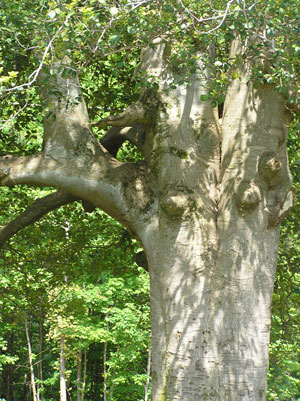
Holly tree that is located at Carrboro’s future fire station site is estimated to be 200 years old. Photo by Ken Moore.
By Ken Moore
Flora Columnist
Please Note: In my enthusiasm last week for “hugging†that 200-year-old Persimmon tree on the university campus, I failed to credit Betsy Green Moyer, photographer and co-editor of Paul Green’s Plant Book, for the image of that grand old specimen. (Betsy Moyer’s photo of the seldom-noticed tiny Persimmon flower appears on The Citizen website.)
A similarly aged specimen of American Holly, Ilex opaca, is located along the edge of Homestead Road near the entrance drive to the former homestead that is now the site of the much-needed and anticipated Northern Carrboro Fire Station. Oh, the stories that tree contains of the comings and goings along that well-traveled roadway during the past 150 or more years. This holly tree is very nearly the same stature as the big male holly still present on the UNC campus, not far from Silent Sam. During his campus landscape walks in the early 1990s, legendary local horticulturist William Lanier Hunt always enjoyed stopping under that big specimen to describe: “This big holly was standing here near the Davy Poplar when the ‘old boys’ were deciding to put the university on this site over 200 years ago. This holly is a male and is big enough to service all the lady hollies this side of South Building.â€
Here’s another one of our great native trees that populates our local forests with separate male and female plants. Folks always admire the female hollies in the winter months, showing off their brilliant red berries against shiny evergreen leaves, unless of course it’s a deciduous holly, and that’s a description for another time. The less noticed male holly, however, is just as important, because without him, well, no red fruit to adorn the ladies.
Now a lot of folks have been driving by this old holly on Homestead Road over the decades, and more than a few of them apparently have come to cherish it as an old friend, an important visible reminder of times gone by. When the old home place was removed to open up the site for the new fire station, that holly became even more prominent. Also prominently visible is another impressive holly, partnering with an equally impressive Red Cedar, (Juniperus virginiana) and several other groups of nice trees, including a good size Pecan (Carya illinoensis).
It was with anticipation that some of those holly-admiring citizens attended this week’s well-publicized fire station charrette in the Century Center. There was a lively discussion, but the session was disappointing. There were less than a dozen citizens present. I suspect they will come out with complaints and protests months and months of meetings and decisions from now when the first shovel goes in the ground. More disappointing is that the gathering was not a charrette. It was an information session with the usual shortcomings of PowerPoint presentations – i.e., charts too small to read and significant images just not to be found in that clever little device and too few copies of the presentation for general distribution.
In spite of the design team’s invitation to interrupt with comments and questions, some of the few citizens in attendance left midway through, possibly also disappointed that a true charrette was not taking place. The town’s selected architectural team is certainly well credentialed, with 160 Public Safety Facility designs, most of them fire stations. My personal response to this information session is that good work has been accomplished in programming the needs for a safe and efficient operation within a new facility, a facility of approximately 9,000 square feet plus necessary adjoining paved areas.
Addressing citizens’ concerns for a “green†facility, the design team explained that the town wanted the most efficient sustainable design that was affordable. A short discussion followed about the $40,000-$60,000 cost of the procedures and paperwork necessary for the project to be an officially certified green building. Though there was no strong protest about saving the money and forfeiting the official recognition, there was concern voiced that there would be no individual responsible for enthusiastically pushing for the green aspects of the facility through the entire planning and construction process. An environmental consultant was introduced as a member of the team, but unfortunately was not provided much expressive opportunity. Rather alarming were the parts of the session that included a description that the big holly simply could not be saved and images of several suggested facility-design solutions. Though admittedly far from final, and shown primarily to illustrate space requirements, these proposed solutions in no way seemed to be designed to create a structure that would conform to the site. Rather, as has been the situation throughout our two towns, the site seemed headed for reconfiguration to suit the easiest and cheapest facility design.
While the narrow triangular site does present real challenges for a design team, the site has positive aspects of favorable open solar orientations and some very worthy mature tree specimens that offer great potential for a creative facility design conforming to the site. Carrboro has the opportunity to create an exemplary green facility, beginning with the first component of “greenness,†which is designing with the site in mind.
There is so much more to this ongoing “Holly Tree on a Fire Station Site†challenge. Whether or not Carrboro succeeds in having a truly green facility that fulfills the needs of the staff working and living there will largely depend on Carrboro citizens becoming actively involved in the entire process from now to occupancy. Citizens can urge town staff and board members to push the design team “out of the box†to create something that works with the site. Now that would be unusual.
For the immediate future, as was recommended at the so-called charrette, the town will be wise in allowing the town horticulturist and staff to take measures to improve the health of that old holly, as it was so successful in improving the health of that old elm in front of Town Hall. In addition, the town, if it really wants to pursue green, will also be wise to gate the driveway onto the site now and to place fencing at least as far out as the drip line of all the significant trees. Periodically, construction or other trucks are already seen parked beneath the shade of the old holly, and that means inappropriate treading on the old tree’s root system.
Email Ken Moore at flora@carrborocitizen.com.
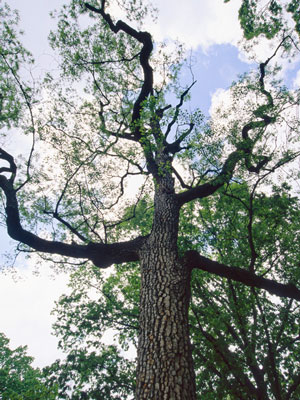
Giant 200-year-old Persimmon tree on UNC campus’ Polk Place. Photo by Ken Moore.
By Ken Moore
Flora Columnist
“Wow, how about that Persimmon flower!â€
“I don’t see any flower!â€
“There it is, right there in that little angle, where the leaf is attached to the stem.â€
“All I see is a little green thing!â€
“Yeah; that’s it! A tiny little green flower. How many tiny little green flowers do you ever get to see? Is that cool, or what!!!â€
I was so excited years ago to discover my first Persimmon flower. Well, it isn’t one of those neon knock-your-socks-off floral experiences unless you get excited about little green flowers, think they’re beautiful, and especially hope to be gathering tasty ripe Persimmons following fall’s first really hard frost.
The Persimmon (Diospyros virginiana) is a special tree. “Usually pronounced ‘simmon. Often called ‘possum apple.’ A popular wild fruit in the Cape Fear River Valley. A liquid concoction from the inner bark of the tree is supposed to be one of the best gargles for ulcerated or sore throats.â€
So goes part of the description of the Persimmon from Paul Green’s Plant Book, published in late 2005 by the North Carolina Botanical Garden Foundation. Beyond his better known writings, Green kept lifelong notes on the cultural and natural history of his Cape Fear River Valley homeland, including Carrboro and Chapel Hill. His many notes and observations on how local folks appreciated and depended upon the local flora were extracted from the two-volume Paul Green’s Wordbook to produce the Plant Book, beautifully illustrated with the color photographs of one of his daughters, Betsy Green Moyer. Included is a full description of the preparation of Persimmon beer, about which Green concluded: “Man never could drink enough to get drunk on it, and now that legitimate beer has come in, making of persimmon beer has just about passed out.â€
Today many local folks still cherish the fall tradition of collecting ripe Persimmons for Persimmon pudding and bread. Taste a green or less than fully ripe one and you’ll never forget that mouth-puckering experience. My preferred Persimmon treat is very simple. I extract the seed and use the sweet cinnamon-colored pulp directly as a sauce for vanilla ice cream. Persimmon lovers will keep the locations of their favorite female trees a secret because the possums and other wild critters are more than enough competition for these tasty treats. Trust me, Persimmons are best when the freshly fallen fruit are quickly plucked from the ground.
There are some mighty Persimmon trees scattered about our community. Don’t expect me to tell you exactly where they are, because I am one of those avid fall Persimmon pickers. I will mention that one of them is a stately female specimen in full view of a bus stop, and it is such a prolific producer of delicious fruit that, if you are observant enough to discover it, I’m happy to share it.
There is a 200-plus-year-old specimen on the Polk Place quad on the UNC campus. Its odd position on the edge of the green, out from the double row of oaks planted in the 1930s, indicates that it was a part of the original forest cleared south of South Building to make way for university expansion.
Decades ago the local folk had great appreciation for the old ‘simmons and left them standing in place when clearing land. The tree on Polk Place is a female, but don’t expect to find many Persimmons; most of the former adjoining forest has long since been cleared, and I fear the lone male or two left standing are too far distant for insect pollinators to travel. It is, however, well worth a stroll on campus to see that tree, which, though not as large as the sacred Davie Poplar located north of South Building, is memorably impressive. When standing under that grand old Persimmon tree, observe the characteristic dark chinky bark, look straight up at the real character of the tree and then step up and hug it. Haven’t you ever hugged a tree? It will take at least two to hug this tree, and it’s worth it.
Go ahead, no one’s looking; it’s OK to hug the tree. And then you’ll know how to identify a tree for your own ‘simmon picking, come next fall.
Email Ken Moore at flora@carrborocitizen.com.

Close inspection will reveal the green ‘baby’ blackberry fruit in the center of the white petals. Photo by Ken Moore.
By Ken Moore
Flora Columnist
It’s early May and the blackberry “brambles†are brightening field edges and roadsides with masses of pure white flowers. When these same blackberry flower-filled days and nights are really, really chilly, the old timers refer to it as “Blackberry Winter.†That description certainly is appropriate for this early May in and around Carrboro. Blackberry flowers (Rubus argutus is the most common of about a dozen edible blackberry species in our state) are particularly beautiful this year, perhaps due to the cool temperatures prolonging their freshness. Or perhaps my pronouncement is the result of over-stimulation by the excessive masses of flowering brambles beginning to overtake more than the edges of my wild garden. Well, very few would describe my yard a “garden†since nature is far more in charge than am I.
Have you ever taken a close look at the flowers of a blackberry? It really is quite beautiful. After all, it is in the rose family, and with all those thorns it must have something wonderful to protect. Five pure white petals, sometimes flushed with pink, surround an emerald-green center, which upon closer inspection you will recognize as tiny blackberry fruit beginning a two-month-long journey to becoming a fully ripened and very tasty berry during the week of the Fourth of July, the traditional blackberry picking season here in the South.
If you don’t have a wild berry bramble in your landscape, you can visit one along the paved walkway of the Frances Shetley Bikeway behind Carrboro Elementary School. There a few of the members of the Carrboro Community Garden Club make certain that a portion of that loosely controlled garden of wildflowers and native vines and grasses and shrubs contains a blackberry thicket for walkers to enjoy the flowers now and try to beat the birds to the berries in mid-summer.
This native blackberry is a vigorous grower and would take over much of the wild garden if not regularly thinned. Care is taken to leave a good number of this year’s non-fruiting stems, as they are the canes that will bear flowers and berries next year.
It may surprise you that blackberries make a fine flower arrangement for indoor use. Though a sturdy pair of garden gloves makes the cutting and arranging a less prickly affair, very few folks go out of their way to treat themselves to such an unexpected floral display.
Blackberries are one of the most nutritious of our native fruits. I’m eagerly anticipating a bountiful midsummer harvest from my very own backyard berry brambles. There is, however, the “pucker factor†– that this summer’s predicted drought will deny the quantity of rainfall necessary for a plentiful crop of well-developed fruit, and I’m not about to test my well by watering the yard. However, this year I do intend to get into my own wild berry thicket with a little more control in order to designate a few managed berry patches to which I may be able to add collected rainwater in future years of drought. Local garden centers have cultivars of blackberries and other tasty fruits; whether with the wild species or one or more cultivars, I encourage you to have your own berry patch. It takes a lot of oil to get those berries to us from the Washington and Oregon berry-producing region, and if the fruit are the result of your own labor you will definitely enjoy them more, and just think of all that potential for floral arrangements.
Pray for rain and plan time for blackberry picking during this year’s Fourth of July break.
Email Ken Moore at flora@carrborocitizen.com.
By Ken Moore
Flora Columnist
“Grass is the most abused of all plants!†decried Steve Warner, a cherished older friend of mine, an Ohio landscape architect who many years ago retired down on a farm on the White Oak River near Swansboro. Part of his property is now a streamside nature trail of the North Carolina Coastal Federation. Steve was a lively, talkative and very opinionated individual whose life experiences gave him credibility as he worked hard to protect the wild nature of our landscapes. I remember him describing to me his response, soon after settling in coastal Carolina, to the sincere question: “Steve, when did you become an ‘environmentalist’?â€
His response – “What’s an ‘environmentalist’?†– was so typical of Steve, who was simply living the life of what he expressed. And if striving to place a softer footprint on our turf is called an “environmentalist,†then so be it.
So I find myself reflecting on Steve’s wisdom daily as I move back and forth along our local community’s roadways. This past week I have been driving (I should have been cycling) back and forth, while substituting at Wood’s Charter School (a great new experience for me), to Cole Park Plaza at the Chatham County line and Carrboro. What a pleasure it has been to enjoy the exuberant hummocks of white and yellow and pink clovers filling the median from the county line until their termination at the town limits, where both Chapel Hill and Carrboro Public Works personnel are doing a superb job of responding to our citizenry’s demand for a weekly mowed short-turf effect. For years I have grieved during late April and into May, when our town’s medians were just becoming so festive with the clover flowering, to find how swiftly that six-to-ten-inch exuberance of clovers was swiftly cut short, returning us once again to the boring uniformity of tightly trimmed turf, to which Americans have been addicted since the British invaded our wild landscape centuries ago.
My mind can’t help but jump across our town’s border to that slope of frequently mowed turf in Meadowmont. I think Lawnmont is a more appropriate signature. That clipped turf is such a contrast to the beautiful natural brooms edge and wildflower meadow of pre-Meadowmont days. If the mowing of that meadow could be curtailed to only a couple of times a year, wow, just imagine the savings of money, not to mention the reduction of pollutants into our air, plus the beauty of that former meadow would slowly return.
On a more intimate scale, I was just this week admiring Bill Bracey’s curbside landscape along Arbor Realty, just over the Carrboro city limits into Chapel Hill on Rosemary Street. The white clover festooned curbside and the sweeps of clover up toward the entrance porch are so satisfying as an attractive landscape and a garden requiring nothing in the way of polluting chemicals and energy-wasting resources to maintain. If we all would only become aware of the polluting effects of our mowing machines, leaf blowers and other urban and residential landscape management equipment, we could perhaps find that mowing half as frequently (better only once a month and even less) would significantly move us toward reducing air pollution, and some of our lawn plants – like dandelions, violets, blue-eyed grass and lyre-leaf sage, to mention only a few – would be allowed to add some color to our otherwise short-cropped uniform green turf. Even the grasses, like our native brooms edge, when allowed to flower and persist through the winter, are quite ornamental.
When will we ever gain freedom from our rigid homeowners’ associations and feel secure that turf allowed to grow tall enough to flower and otherwise express itself is not a life-threatening situation?
Hurry down the highway toward Chatham County to view the clover, because the DOT mowers are not far behind our municipal crews doing their jobs so well.
Email Ken Moore at flora@carrborocitizen.com.
Your best landscape plants may already be in place
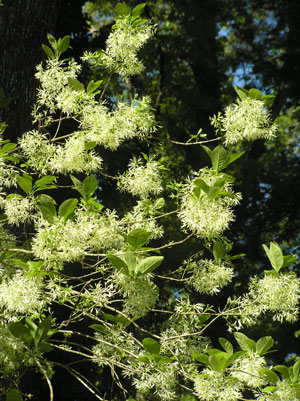
Frilly flowers of the Fringe tree hang like clouds. Photo by Ken Moore.
By Ken Moore
Flora Columnist
A group of folks on the Haw River Assembly’s Earth Day walk along the new Haw River Natural area this past Saturday were happy to discover one of those pawpaw patches described in last week’s Citizen. A few of the flowers had survived the recent cold, so the walkers got a good look at the seldom-noticed burgundy flowers, and, sure enough, the main tree had suckered so that numerous stems had indeed formed a patch.
In the woods that day we also noticed the beautiful flowers of the wild azalea, sometimes called wild honeysuckle because the native azalea flowers do resemble the long flowers of that fragrant vine that is such a weed in our gardens and natural areas. Our local forests are filled with beautiful shrubs and small trees that make handsome landscape specimens. Two such shrubs in full flower now are the Downy Arrow-wood (Viburnum rafinesquianum) and the Fringe tree (Chionanthus virginicus). The arrow-wood, one of four species of native Viburnums growing in our local woods, displays a profusion of flat-top clusters of tiny white flowers. A good place to view an extensive natural population is the Botanical Garden’s visitor parking area. Frequently, you will notice them when in flower along roadsides where mowing crews can’t get to them. A particularly nice such specimen is on West Poplar Avenue at the base of a power pole cable just around the corner from the Carrboro Fire Department. Dramatic specimens of the Fringe tree, looking like fleecy white clouds, can be seen in yards throughout Carrboro. Some of these may be large specimens, relocated from the local woods by Carrboro citizens decades ago.
It is sad to see our forests cleared so completely for new residential construction and the all-too-frequent “tidying up†of wooded properties throughout our neighborhoods. Unknowingly, homeowners are eradicating fine landscape plants already set in place by nature. One should never “tidy up†one’s property without first making an inventory of what plants are growing there. In addition to the obvious dogwoods and redbuds, you may discover Fringe trees, wild azaleas, some of the four arrow-woods, strawberry bush, blueberry and deerberry already in place, and numerous other potentially fine shrubs and trees plus a variety of ferns and wild perennials.
To help you identify your native plants, there are numerous good guides in local libraries and bookstores, frequent classes and walks led by knowledgeable individuals, and you are welcome to take specimens for identification by master gardeners and the staff at the Botanical Garden during noontimes on weekdays. Staff members at the Botanical Garden know the merits of our native plants and they feature many of them from time to time at the plant sales. You will most likely find the Downy Arrow-wood there now, and the local nurseries in our area are offering more and more of our native plants as good landscape and garden plants.
Now the next time you walk in your woods or along a forest trail, take a closer look and imagine the unaltered forest as a pleasing landscape and focus on the interest and beauty of individual elements from a little clump of wood rush or wild sedge to the dramatic bark textures of the big trees. Begin now to learn the local plants; knowing them and the stories they tell is like making new friends.
Email Ken Moore at flora@carrborocitizen.com.