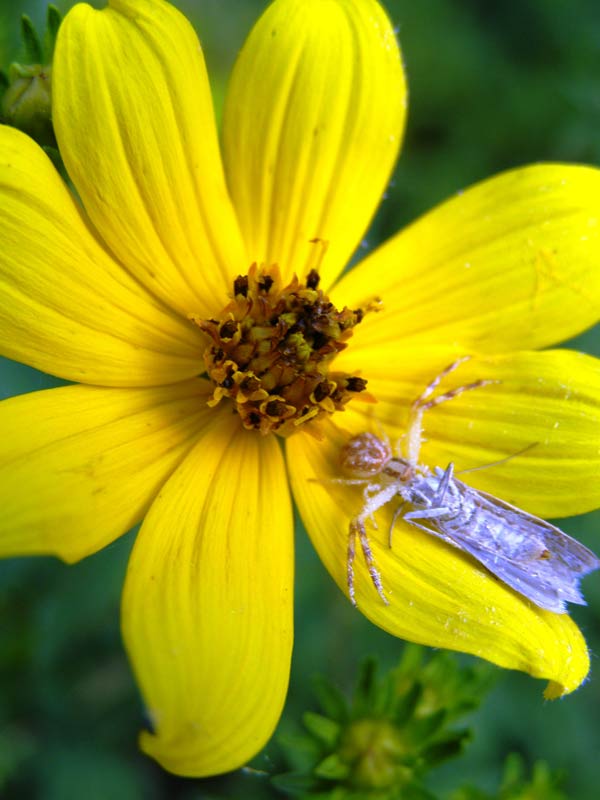
Closeup of Bidens flower head showing central tiny disc flowers surrounded by ray flowers hosting a crab spider with captured prey. Photo by Ken Moore
By Ken Moore
Flora Columnist
One plant
To me, Labor Day means the flowering of Bidens aristosa and Bidens polylepis. Don’t worry about which is which. Their golden-yellow, daisy-like flowers are so similar that I leave it to the younger botanists to devote long hours to sorting them. It’s enough for me to know that the former occurs in the coastal plain and the later occurs in the mountains and both commonly overlap in our piedmont.
The Latin name, Bidens, means two teeth; it’s descriptive of two tooth-like projections on top of the flattened seed of some species. You will recognize and cuss the seed of the very common Spanish Needles, Bidens bipinnata, with three and four long needle-like teeth that grab your clothes by the hundreds during fall walks. Spanish Needles don’t have showy flowers like the first two species mentioned above. The showy-flowered Bidens go by numerous common names: Bur Marigold, Tickseed, Ditch Daisy, Ozark Tickseed Sunflower, and the list goes on. You take your pick. Go ahead, make up your own name and you’re more likely to remember it.
Look for Bidens making spectacular displays along roadsides and, once in a while, filling an entire abandoned or fallow field. You most likely won’t see the same Bidens-filled field more than one year, because this brilliant fall flower is one of our state’s few true annuals – i.e., it sprouts, flowers, sets seed and dies in one season. The annuals are replaced by longer-lived perennials like asters, goldenrods and native grasses that remain in that field until they, in turn, are displaced by naturally invading shrubs and trees. Watching “old-field succession†is a yearly adventure of floral and faunal discoveries.
Like so many fall wildflowers – including asters, goldenrods and wild sunflowers, of which there are dozens of species – Bidens is a member of the Aster or Composite family. Take a close look and you will observe a “head†of dozens, sometimes hundreds, of tiny tubular (disc) flowers surrounded by a circle of more obvious ray flowers. A single Bidens plant can reach a height of six feet and sport several hundred separate flower heads. Some other composites, like dandelion and chicory, have all ray flowers and some, like Joe-Pye Weed, have all disc flowers.
Now if this doesn’t excite you, then take a closer look for a whole world of insects, from butterflies, flies, fireflies, bees and spiders (which are not true insects) on each Bidens head. You won’t examine many flower heads before discovering some unfortunate insect in the jaws of a spider, probably one of the crab spiders that changes color to match the flower and lies in wait for the unsuspecting victim.
In my wild garden, I make certain that I have some bare ground for Bidens to return every year. I even have some in pots to bring up on the deck when in flower. I enjoy watching those tricky spiders!
The other plant
Also growing along my driveway is ragweed, Ambrosia artemisiifolia, another annual that intermingles with Bidens, as it often does with the showy goldenrods (see The Carrboro Citizen, August 23). The cut-leaf foliage is very similar on both plants. But take note: ragweed lacks the showy, colorful flowers of other composites. The female flowers of ragweed are hard-to-spot little nutlets forming in the leaf axils; the male flowers are vertical columns of pollen-bearing structures, the real culprit for hay fever sufferers. The showy flowers get the bad rap. Now you know better. Ragweed’s Latin name, ambrosia, is very inappropriate; it is definitely not a “nectar of the Gods.â€
Email Ken Moore at flora@carrborocitizen.com.
Find all of Ken Moore’s Citizen columns at The Annotated Flora
.
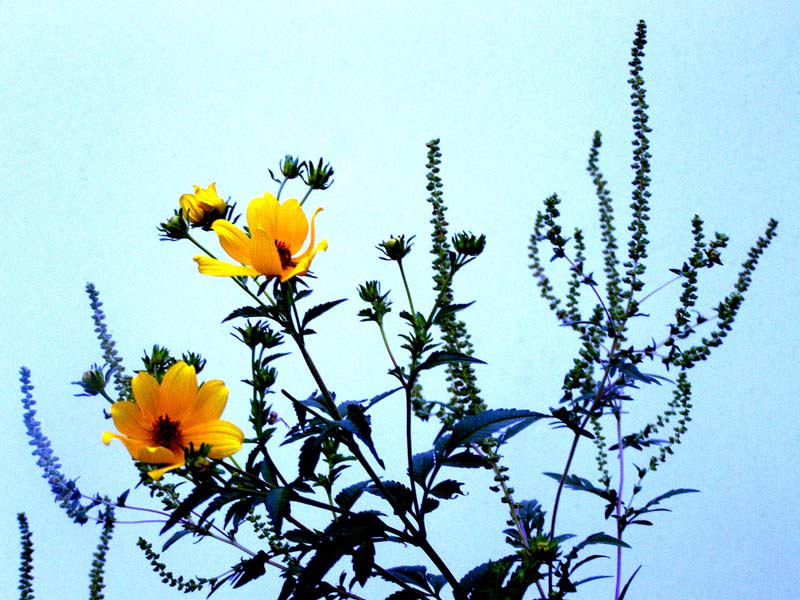
Compare the spiked male pollen-bearing flowers of hay fever culprit Ragweed with the larger showy flowers of innocent Bidens. Photo by Ken Moore
Appreciating sumac from Carolina to Maine
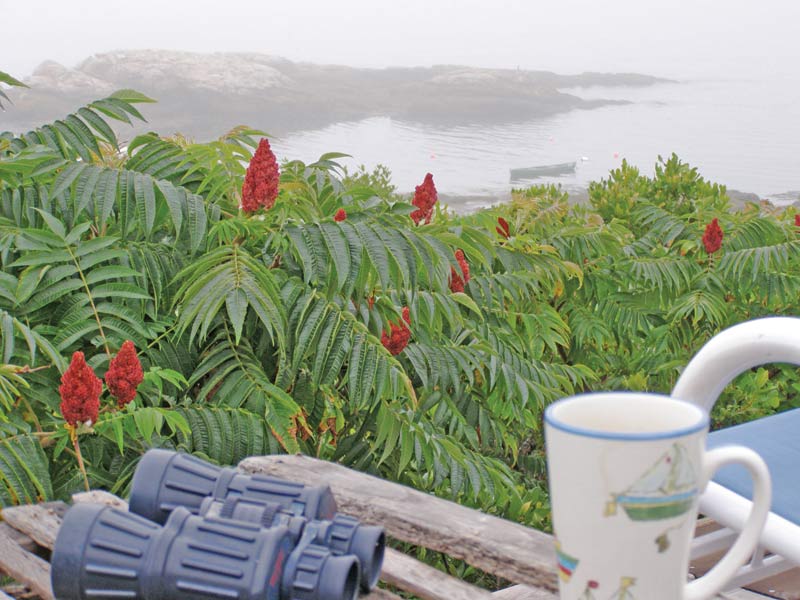
Maine Island deck-level Sumac. Photo by Ken Moore
strong>By Ken Moore
Flora Columnist
I was not looking forward to the long drive to visit cousins in New England, but the tediousness and hazards of highway travels can be pleasantly calmed by viewing roadside vegetation along the way.
Like any wild botanist, I’m most content when identifying plants at 60-plus miles per hour. That’s why my wife prefers to drive. That’s fine with me, and she remains much calmer.
Along the way we enjoyed many patches of sumac. In some states, mowing crews had left the patches; sadly, in others, similar patches had been mowed or killed by herbicide application.
It was like the sumac at our Carrboro mailbox followed us all the way to the edge of our cousin’s island cottage deck. The smooth-stemmed Smooth Sumac, Rhus glabra, grows throughout the Eastern states and overlaps with its hairy-stemmed bigger cousin, Staghorn Sumac, Rhus typhina, in the Northern states and our Carolina mountains. Sumac patches add dramatic landscape effect along roadsides through all the seasons. Green foliage layers during spring and summer, red seed cone accents in late summer, brilliant red/orange foliage in the fall and red cone-topped bare stems during the winter months – truly a plant for all seasons!!
I was thankful for the sumac that volunteered along our wild front bank. It took just a couple of years to establish colonies up and down on both sides of the drive and now it’s moving across the waist-high lawn toward the house. I don’t mind hacking it down where I prefer some other wild plant to locate itself. A more controlling gardener will have less patience with the exuberance of sumac. I have both male and female patches. The males will not produce those red seed cones. For the first time this year I enjoyed observing the dramatic closing of the open branches of little yellow female flowers to form those tight conical seed heads. Wow, always something new to discover!
Sumacs are a popular plant for fall color in English gardens and there are several notable cut-leaf cultivars, such as R. glabra laciniata and R. typhina laciniata for fashion-conscious gardeners.
Sumacs are valued for more than their beauty. Daniel Moerman’s Native American Ethnobotany devotes several pages to a rich medicinal heritage. A refreshing tea concocted from the crushed berries is enjoyed by many. Food uses are engagingly described in Euell Gibbons’ Stalking the Wild Asparagus, Tom Brown’s Field Guide to Wild Edible and Medicinal Plants and James Duke’s Handbook of Edible Weeds.
Sumacs are members of the Cashew plant family, Anacardiaceae, which provides us with the popular cashews, pistachios and mangos. Be aware, however, that parts of some of the plants in this family contain poisonous components. Fortunately, most of us are not allergic to these edibles and the safe sumacs, but most all of us must avoid contact with the closely related poison ivy, Rhus radicans, poison oak, Rhus toxicodendron and poison sumac, Rhus vernix. Visit the Botanical Garden to see all three of these ones to be avoided and please make every opportunity to appreciate and enjoy our several “safe†native Sumacs.
Email Ken Moore at flora@carrborocitizen.com.
Find more Ken Moore Citizen columns at The Annotated Flora
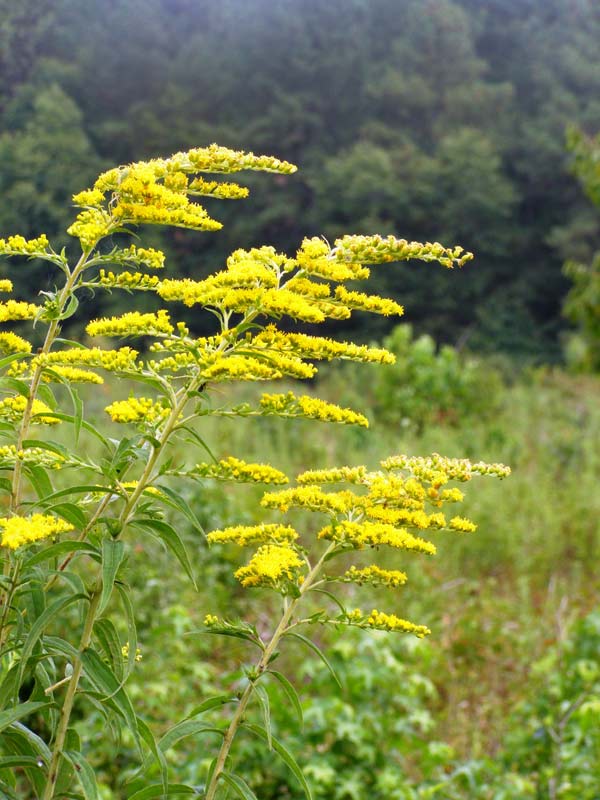
Common Tall Goldenrod at Mason Farm Biological Reserve. Photo by Ken Moore
strong>By Ken Moore
Flora Columnist
Goldenrods – particularly the Pineywoods Goldenrod, Solidago pinetorum, a welcome sign of approaching fall – have begun coloring up the roadsides in spite of the drought. It was one of the first plants carried over to England, where it quickly became a standard flower of the famed perennial border and the English cottage garden. Some fine goldenrod cultivars have been produced by keen English gardeners and I remember walking into the Great Autumn Flower Show of the Royal Horticultural Society at Vincent Square in London in 1981 to see a magnificent tub of the tall, common goldenrod high up on the center display. Some folks may still consider goldenrod to cause hay fever. I may feature ragweed, the true hay fever plant, later on, but for now, trust me, you won’t get hay fever from sniffing goldenrod. You may get a bee or some other flying insect up your nose – for those colorful critters, not the wind, are necessary for transporting all that pollen from plant to plant!
We’ll be seeing goldenrods now for another two months. Of the more than 30 species native to North Carolina, there are two that represent the classic common Tall Goldenrod, standing 4–6 feet-plus, along roadsides and in fields throughout. One with glabrous (smooth) stems is an early bloomer, Solidago gigantea. It’s noticeable along some roadsides and in the fields of the Botanical Garden’s Mason Farm right now. The other has pubescent (fuzzy) stems and it flowers about a month later. It’s fun to enjoy a repeat performance at the Mason Farm with this second Solidago altissima. Goldenrods are generally available at the Totten Center and local garden centers for gardeners to establish in their own gardens. And some of you may have noticed that the goldenrod is frequently showing up in flower shops and expensive florists’ arrangements.
I enjoyed a walk around Mason Farm a few days ago and discovered that I had forgotten another of my favorite flowers of late summer, the bright mustard-yellow Partridge Pea, Cassia fasciculata (Chamaecrista fasciculate). In the fall, the two-inch-long pea pods snap, crackle and pop, catapulting their little brown beans far and wide. The little beans are considered a fine food for any remaining Bobwhite Quail that used to be so common out on the Farm.
There’s a whole field of it mixed in with another late-summer bloomer, Thoroughwort, Eupatorium serotinum, close kin to the Joe-Pye-Weed, Eupatorium fistulosum (Eupatoriadelphus fistulosus), and here and there a few stems of brilliant purple-flowered Ironweed, Vernonia noveboracensis. All these flowers were providing nectar for at least four different butterfly species fluttering over the whole wild banquet. Don’t know where the butterflies were obtaining their moisture since the ditches all around the Farm are very dry just now. It is so amazing how wild nature survives such harsh conditions.
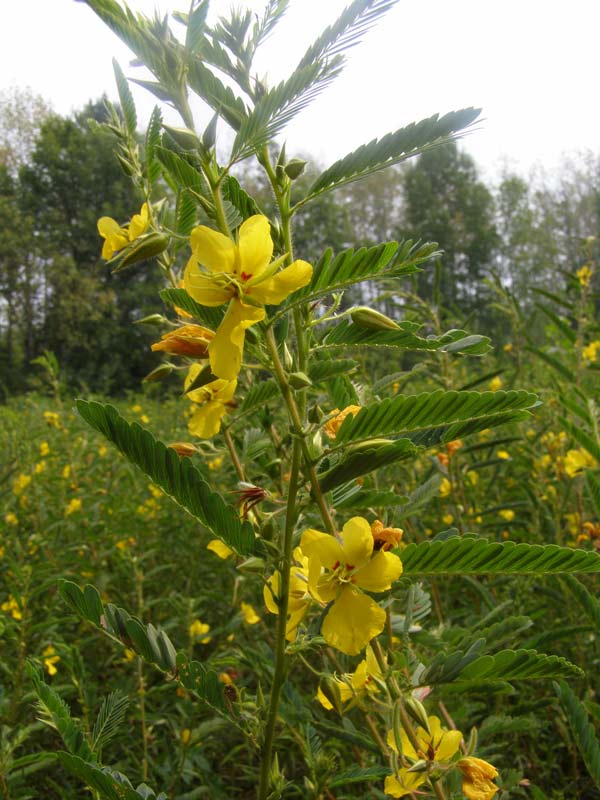
Mustard yellow flowers of Partridge Pea at Mason Farm. Photo by Ken Moore
Another happy observation in this extreme drought is the continuing flowering of that common native vine, the Trumpet Creeper, Campsis radicans, that was in full flower back during the middle of June and continues to provide nectar for the hummingbirds preparing for their big journey south.
Some Water Strategies
I believe this drought is the most serious one in my lifetime, and I’m old enough for that to be really serious. Dying trees are making me think back to that April freeze. My several redbuds, Cersis canadensis, which nature planted, and my two pawpaws, Asimina triloba, which I planted, suffered greatly during that freeze. You will recall that many of the trees of our forests and roadsides suffered similar setbacks.
The second challenge of this extreme drought is simply too much; many plants won’t recover and we are witnessing the decline and death of many, many big ones. How I wish I could go water the forest, but only nature has that option.
My redbuds and pawpaws have crisp foliage and a few limbs are already dead to the main trunk. What green leaves are left seem to be hanging on with my cautious hand-watering from a well that will not tolerate unwise or wasteful use. I’m taking a big step back to consider which among the plants in my landscape are the really important ones. In addition to my little redbuds and pawpaws are two Southern Sugar Maples, Acer saccharum ssp. floridanum (Acer barbatum), a big one in the front transplanted from the woods back in 1939 when the house was built and a second smaller one that planted itself next to our deck and is now a welcome shade canopy. They’re holding up fine, but I’m watching them carefully and they’ll get my priority hand-watering when needed. With my limited water supply, I have to be philosophical when the flowers and shrubs I planted in well-prepared beds years ago are slowly dying. Curiously, many of the volunteer plants out in the unimproved yard are faring better.
Thankfully, my real gardening activity the past few seasons has been confined to containers of all sizes on and around the deck. In this water shortage, I have all the pots in large saucers and lots of them grouped together in several plastic kiddie wading pools. This way none of the water is wasted and I can go one or more days without watering.
I’ve always described that the only effective irrigation system is a thoughtful gardener on the end of a hose. When watering your landscape, consider that your most important plants are your big trees. If you have lots of trees, consider which ones you will be most unhappy to lose. Think of Weaver Street Market without its big trees. One of them now is downright dead. Look up into the branches to notice a few others in real decline. All those pattering feet on the root zone and no regular watering will eventually turn the Weaver Street gathering place into Weaver Street Beach. Sun worshipers will love it, but the rest of us will be seeking chairs under the side canopy.
When watering your trees, or any plants, make certain your application is slow, so that water doesn’t run off the surface, away from the root zone. Make certain water is getting down through any layer of mulch to actually penetrate the soil root zone. The general advice is to provide the equivalent of one inch of rain to the whole root zone on a weekly basis. And please be aware that the significant root zone of plants, especially mature trees, extends far beyond the canopy – i.e., the overhang of the tree branches – so that watering just at the base of a plant is not going to do it!
Rain barrels are a must. My three are empty right now, but they are so useful when filled. I need to install several more. It’s rewarding to discover how quickly a single barrel will fill during even a short shower. This is a resource well worth the cost and time to install. If you have the space, better yet, install a large cistern or two. Go look at the big one Bill Bracey has installed at Arbor Reality on Rosemary Street.
Email Ken Moore at flora@carrborocitizen.com.
Find more Ken Moore Citizen columns at The Annotated Flora
Observing the Common Milkweed: A walk on the wild side
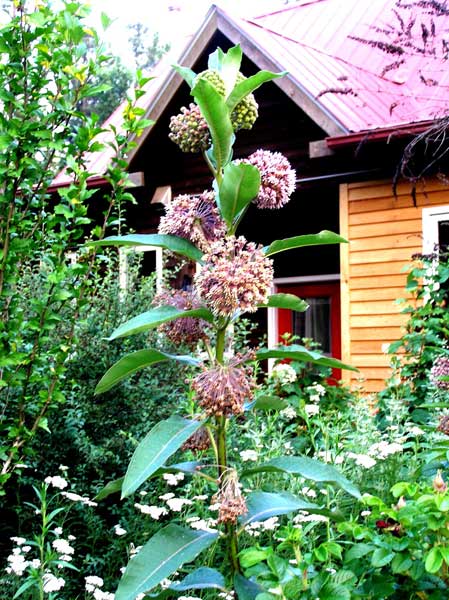
Common Milkweed standing tall in Arcadia Community. Photo by Ken Moore
By Ken Moore
Flora Columnist
An early-morning walk through the Chapel Hill Merritt Pasture near the James Taylor Bridge is a real pleasure. The wild part is gaining access to the rolling pasture site. You are well advised to plan your visit during the Sunday morning hours. There is a little parking available along the bikeway at the intersection of Culbreth Road and Highway 15-501. It’s a challenging intersection to negotiate on foot, even with the traffic light, and though Sunday morning is light, please remain constantly alert to the speeding vehicles until you have safely made it to the pasture. Eventually the town will have the planned parking and pedestrian safety measures in place so that access to Merritt Pasture will not be such a wild experience.
And wow, once in the pasture, thanks to town efforts, you will have a real “meadow†experience. Several years ago, Chapel Hill added to staff responsibilities by making a commitment to managing the Merritt open space to provide habitat for butterflies and other wildlife. Observant citizens had described the healthy population of Common Milkweed there and a few folks began monitoring butterfly activity associated with those milkweeds. Except for a general winter mowing of the whole pasture to prevent the occurrence of forest, separate areas have been staked to protect the milkweed populations during spring and fall haying of portions of the field.
Walking through the meadow one recent Sunday morning was a real adventure of discovery. There were a couple of Monarchs fluttering about. There were hundreds and hundreds of milkweed stems ranging from two feet to six feet. Some were still in flower – and what a sweet fragrance there – and some were exhibiting those odd-shaped warty green capsules that in the fall will turn brown and split open to send plumed seeds aloft on fall breezes.
The Common Milkweed, Asclepias syriaca, is a handsome plant worthy of cultivating in the wild or a contained garden for its fragrance and visual appeal, as well as for attracting butterflies. Be aware, however, that, once established, the Common Milkweed will increase, freely moving about on its own by underground lateral stems. This is a plant for a carefree gardener, not one who keeps everything controlled and in line. I have enjoyed seeing them in gardens in the Carrboro Arcadia Co-housing Community and I have delighted in seeing them become established in that wonderful curbside garden outside Carolina Crafts Gallery. They must have become too aggressive there, however, for they were recently weeded out. I hope a few will come back. It was nice having that butterfly habitat in downtown Carrboro.
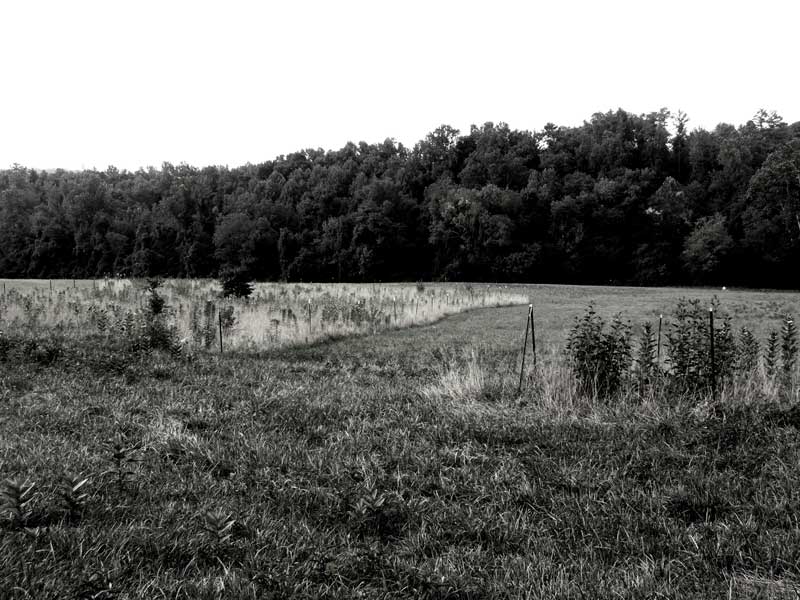
Butterfly milkweed habitat set aside in Merritt Pasture. Photo by Ken Moore
Other surprises in the Merritt meadow that morning were orange-flowered Butterfly Weed, white-flowered Moth Mullein and the pale summer-green of lots of Broom Sedge, that common native grass that turns fields copper brown for the winter months. There is so much more to observe in that open hilly meadow. Do visit it some Sunday morning.
Email Ken Moore at flora@carrborocitizen.com.
Find more Ken Moore Citizen columns at The Annotated Flora

Joe-Pye-Weed flower heads. Photo by Ken Moore
By Ken Moore
Flora Columnist
Common names and the meanings and tales associated with them are the source of endless wisdom, humor and trivia. I’ve always wondered who Joe-Pye really was. The familiar description is of a Native American herb doctor in the Massachusetts Bay Colony region.
The Indian’s name was Joe-Pye and he used a special plant to ease the discomfort of a common disease known as typhus, or typhoid fever. So the plant was commonly identified by early settlers as Joe-Pye-Weed.
My favorite plant this week is Joe-Pye-Weed, Eupatorium fistulosum. The local champion clump is behind the stone wall gathering circle in front of the Totten Center of the Botanical Garden. I’m really serious. If you have not seen this plant, then make certain you visit it sometime during the next week or so. I promise you’ll be impressed – and with only a little effort, you can have one in your very own garden. The Botanical Garden usually has some for sale or you can seek it out at local garden centers. I look forward every year to the one at the base of my deck that stands up to 12 feet tall so that I can enjoy it from the kitchen window where I am always dutifully washing dishes, uh huh!! Another common name for this impressive plant is Queen-of-the- Meadow, which is appropriate, for when you see it standing regally tall in Carolina mountain meadows, you will quickly agree that this plant is truly a queen among neighboring plants.
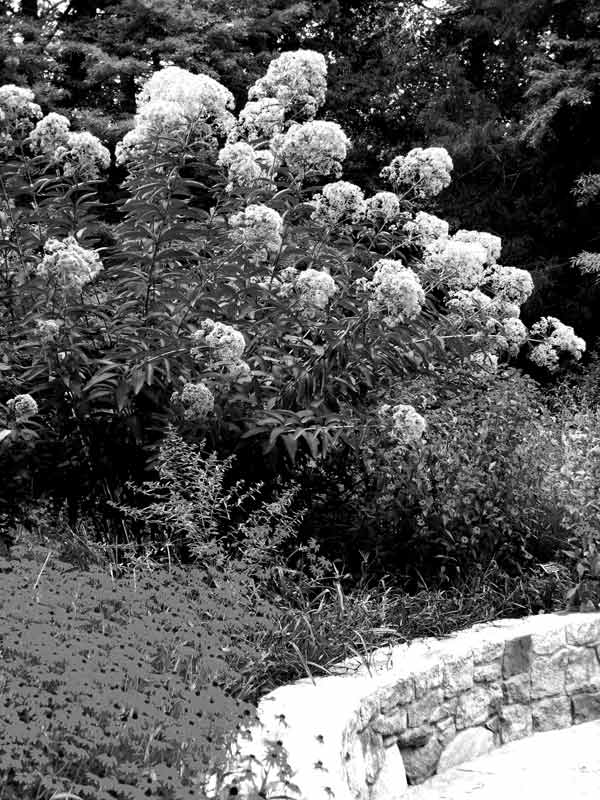
Giant clump of Joe-Pye-Weed at N.C. Botanical Garden. Photo by Ken Moore
Architecturally, this plant is a year-round knockout. In mid-summer, its rounded conical pink-to-purple flower heads are covered with one to a dozen butterflies gingerly searching the thousands of tiny flowers for nectar. It will take a keen eye, easier with a botanist’s hand lens, to detect that each tiny flower cylinder is really a tight cluster of minute disc or tubular flowers, like the ones you find in the center of a Black-eyed Susan or other daisy-like flower in the Composite or Aster Family. Sadly, this year’s late freeze and extreme drought have reduced the usual abundance of butterflies – but if butterflies are about, you will find them on the heads of Joe-Pye-Weed.
Now pay attention to this horticultural tip! Once you have a clump established – a naturally wet area is perfect – please do not cut it back in the fall. The stems are hollow, and if you cut them to the base in the fall, as part of that awful “putting the garden to bed for the winter†action, you will lose your plant. The reality is that those hollow stems cut close to the ground in the fall become reservoirs for rain water, and when winter’s freezing temperatures exert themselves, the crowns, or bases of the plant, are frozen and split and the plant dies. Better to leave those handsome flowering stalks standing tall through the winter months in which birds will perch and for the sheer beauty of garden architecture that winter conditions produce.
Email Ken Moore at flora@carrborocitizen.com.
Find more Ken Moore Citizen columns at The Annotated Flora
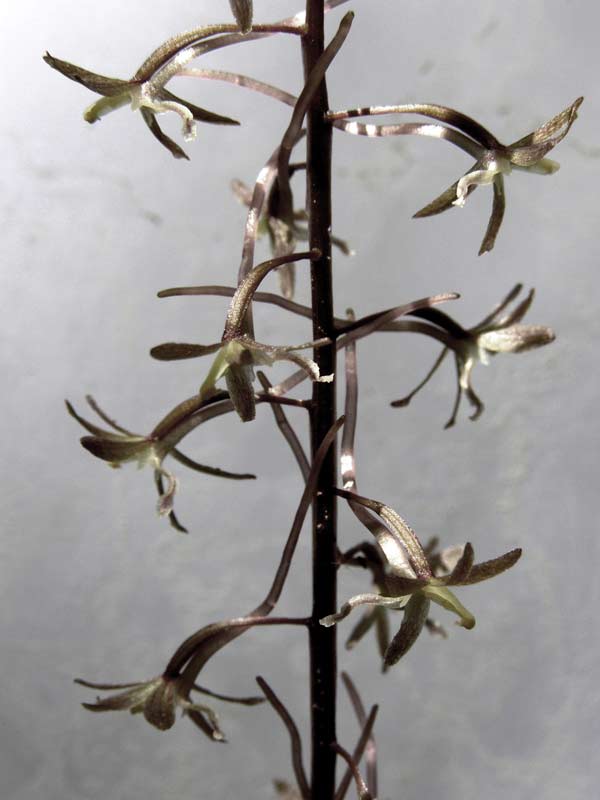
A hand lens or magnifying glass is helpful for viewing the Crane-fly Orchid flower. Photo by Ken Moore
By Ken Moore Flora Columnist
They’re late this year. The specimens in my parched woodland have not yet shown themselves. Over in the middle of Carrboro – more showers over there – they’re up but not in flower, and along the trails of the Botanical Garden – lots more showers over there – they’re in full flower!
Well now, unlike most wildflowers these are not going to knock your socks off with a showy display of color. You can easily complete your woodland stroll without ever seeing this diminutive native orchid down by your footsteps. Sadly, a number of them, growing too close to the edge of the path, sometimes in the path, will be trampled by innocent feet.
Those unfortunate ones will not have opportunity for pollination and production of the talcum powder-like seed this season.
Even the experienced wildflower enthusiast is challenged to find the Crane-fly Orchid, Tipularia discolor. I am always surprised whenever I spy my first one of the summer.
Usually I am aided by a serendipitous beam of sunlight streaming through the tree canopy, momentarily spotlighting that stalk of greenish-brown – or is that brownish-green? – little orchid flowers. The flower color is hard to discern and there are no leaves. The flowering stalk is a wire-like stem from 8†to 18†tall. So it’s really easy to miss.
But once you do see it, and now you’re down on hands and knees for a closer look, you’ll most likely spy several more close by. They generally occur in small colonies and often those colonies are lined up as if in an orderly march. If you observe the forest floor carefully, you may detect the remains of a long-ago-fallen tree that has ever so slowly decomposed to provide a favorable nursery bed appropriate for the very particular growth requirements of this terrestrial orchid. As you pull yourself up from the ground and continue your woodland stroll, you will surprise yourself at how readily you may find more of these Crane-fly Orchids.
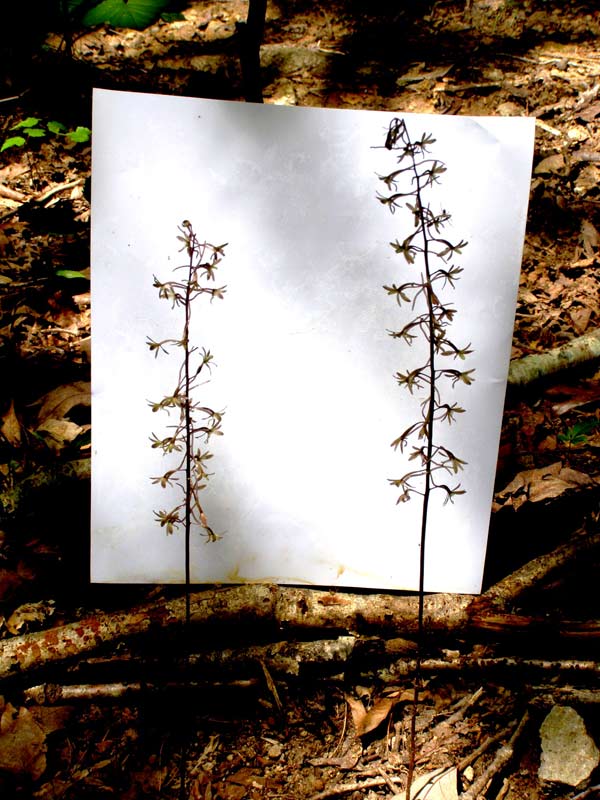
Without a contrasting background, Crane-fly Orchids are almost invisible on the forest floor. Photo by Ken Moore.
These obscure, but abundant, orchids are more easily located during winter walks. The single, egg-shaped leaf, dark green above and burgundy colored beneath, emerges in the early fall to take advantage of the winter sunlight reaching the forest floor through the bare branches of the forest canopy. One would be inclined to describe it as evergreen, but it goes dormant in the spring of the year, a sort of reversal of the dormancy of most deciduous plants.
Good luck in your search. Take a hand lens or magnifying glass with you for a closer look.
Your imagination may even allow you to see some similarity to the crane-fly insect with which its name is associated. Most likely, you’ll be happy to have seen this wildflower; if not, just think – now you have a perfectly logical explanation if some day you are caught lying down along some woodland pathway.
Email Ken Moore at flora@carrborocitizen.com.
Find more Ken Moore Citizen columns at The Annotated Flora
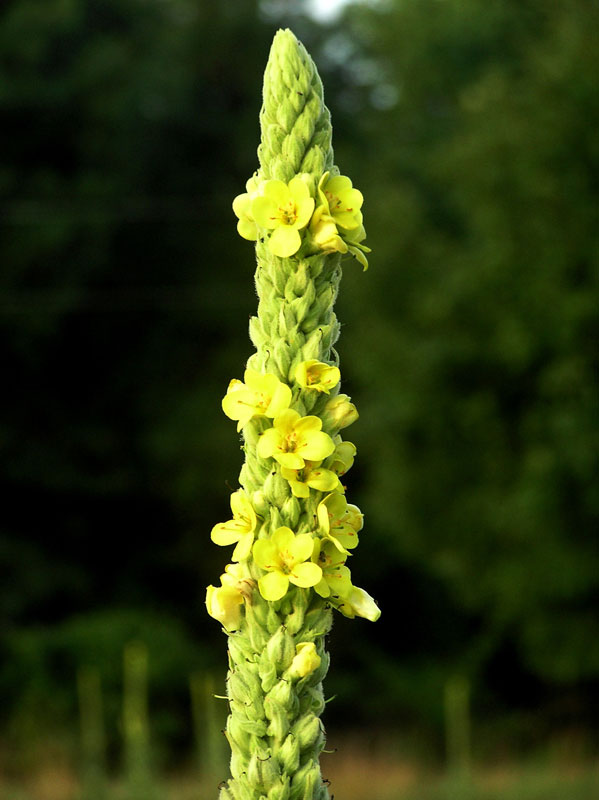
Yellow flowers spiralling around the tall Mullein stalk. Photo by Ken Moore.
By Ken Moore Flora Columnist
First I offer a sincere apology that Marie Weiden was not properly identified in last week’s column about Ruellia regarding her colorful curb in Chapel Hill. Beginning with Marie’s garden, I’m looking forward to describing more curbsides as folks share more and more garden enthusiasm and expertise right up front for all to enjoy!
This week my favorite plant is mullein, Verbascum thapsus, also called Wooly Mullein, Velvet-leaf, Flannel-leaf, Jacob’s Staff and even Quaker Rouge. It’s in abandoned fields, on roadsides and even in pavement openings, singly or clustered in patches. But nowhere have I seen a patch equaling what is occurring just south of town. Being very mindful of the busy traffic on Smith Level Road, you may be quick enough to glimpse a magnificent field on the east side, just south of the new Carrboro High School. Hundreds of sage-green mullein, standing tall in that field, provide a southwestern dessert-like scene.
Generally a biennial – growing one year; flowering, fruiting and dying the second year – mullein can also germinate, grow, fruit and die in one year or linger into a third year. It requires a bare patch of ground to survive, so you won’t find it in forests or open spaces dominated by perennials and shrubs. However, its seeds remain viable for up to a hundred years, so it’s ready to take advantage of disturbances to any site.
We have the Quakers to thank for one of the humorous descriptions of mullein. These early settlers were not allowed to use makeup, but rubbing a Wooly Mullein leaf on their faces resulted in a long-lasting ruby blush, thus Quaker Rouge, effective makeup without breaking rules. Having arrived in America with the earliest settlers, mullein has become as honored by Native Americans as are truly native species. Descriptions of medicinal and utilitarian uses are endless. The Lumbee Indians stuffed the flannel-like leaves in their moccasins for added warmth in cold months. Native Americans quickly learned the use of the tall dried flower stems (Jacob’s Staff) as fire torches and, amazingly, the hardness of the dried stems makes mullein a preferred woody stem for the Native American fire-making hand-drill.
Fresh and dried mullein leaves and its yellow flowers have been used effectively as inhalants, teas, infusions, poultices and salves for countless injuries and ailments.
Engaging descriptions of traditional uses of mullein are offered by Tom Brown Jr., the guru of outdoor survival training, in his Tom Brown’s Field Guide: Wild Edible and Medicinal Plants. I also recommend Tom Brown’s The Tracker and The Search for anyone wanting compelling reading about growing up learning the Native American ways of living in harmony with the earth.
And I highly recommend Wooly Mullein as a wild or garden plant. I vividly remember a visit to that grand garden at Chatsworth, home of the Duchess of Devonshire, in central England. Walking along the otherwise immaculately swept wide garden paths, I was curious at all the Wooly Mulleins growing haphazardly on the pathway. The response to my obvious inquiry of one of the gardeners was: “Oh, that’s mullein, a favorite of the Duchess, and we’re instructed not to weed a one of them!â€
My yard pathways are barely obvious, but I could not go through a year without nurturing some Wooly Mullein rosettes to enjoy throughout cold months, anticipating their tall stems in mid-summer.
Email Ken Moore at flora@carrborocitizen.com.
Find more Ken Moore Citizen columns at The Annotated Flora
Ruellia: Now you can say it in Latin

Ruellia standing tall in ditch in lower Bynum. Photo by Ken Moore
By Ken Moore Flora Columnist
I spied it three weeks ago along a roadside ditch in lower Bynum while helping volunteers clear a site for the Haw River Assembly’s new storage building. Then, this past week, some of us were back down there helping move stuff into the new shed.
There it was again, and this time there were more lining the weedy roadside.
I’ve been happy to spot it here and there in my yard, at the edge of the back steps and along the edge of the house foundation where the mower blade seldom travels.
I spy it throughout Carrboro where mowing activity is not too frequent. It is frequently seen along woods edges and in sunny spots in the forest.
Two weeks ago I was stopped in my tracks while enjoying Marie Weiden’s “always something in flower†curbside garden along the intersection of Boundary and North streets in our neighboring community to the east. Upon voicing my enthusiasm, Marie calmly described that, “Oh yes, they volunteer in and they are most welcome scattered throughout my curb garden and are easily maintained.†Some of the specimens in her garden displayed numerous flowers, some plants with significantly larger flowers than other plants. A real thrill in allowing nature to establish seedlings in a garden is the variety of flower size and color tones produced as one surveys the results.
The almost bashful presence of this diminutive wildflower is reason enough for it being seldom noticed by today’s rushed humanity. However, I know folks in our community who are as enthusiastic as I whenever this wildflower appears. To have one or more appear in one’s own yard or garden is really special.
This wildflower is Ruellia caroliniensis; most simply, it’s named Ruellia. So there, you folks who don’t think you can pronounce, much less remember, a plant’s official Latin name, here you’ve done it. It’s pronounced like it looks, so you have just crossed over from the ranks of all those of us who prefer the common name. One common name is Wild-petunia, though it looks nothing at all like the floppy petunias I see in gardens everywhere. The common name, Twin Bluebells, seems more descriptive. It is pale blue and shaped something like a handbell in upright position.
This upright plant stands from one to two feet tall and has one or two, sometimes more, blue flowers clustered in the upper axils of opposite-paired stem leaves.
Individual trumpet-shaped flowers can be from one to two inches long and the open bell positioned right up toward your face is usually the size of a nickel or quarter, though occasionally you’ll find one the size of a half dollar.
You won’t spy this beautiful native perennial speeding along our roadways, but you will most likely find it along your walking routes, wherever they may be, if you remember to look along the un-mowed edges.
Email Ken Moore at flora@carrborocitizen.com.
Find more Ken Moore Citizen columns at The Annotated Flora

By Ken Moore Flora Columnist
One of the childhood memories I hold vividly is the neighbor’s giant mimosa tree, under which I spent many days playing with fragrant silky flowers in summer and twisted little bean pods in the fall. The mimosa, also called silk tree (Albizia julibrissin), remains for me one of the most exotically beautiful of all trees.
And exotic it is. Having been introduced from Asia in the mid-1700s, it has now made itself at home throughout North Carolina and the entire southeast. I’m still trying to get rid of one I set in my yard two decades ago. Similarly, staff of the N. C. Botanical Garden continue to eradicate a persistent population along the Coker Pinetum on Manning Drive.
Magnificent specimens thrive throughout Carrboro and Chapel Hill. I’m not going to insist that you go out and cut down your mimosa right now, but I am being serious about you being aware that those bean pods can spread beyond your yard. Seed distribution is aided by animals and water. That’s why we should be concerned about the big specimen along Morgan Creek below the bridge across from Frank Porter Graham Elementary School on Smith Level Road. That tree has direct seed dispersal into Morgan Creek for future establishment all the way down to Jordan Lake and beyond. And those two magnificent specimens street side and in the parking lot of the Courtyard on West Franklin Street pose a similar threat. Those seeds reach Jordan Lake by being washed down the storm drains into that same Morgan Creek.
Another vigorous exotic expressing itself now along field and woodland edges, as well as in some of our most inhospitable paved urban sites, is the Tree of Heaven, (Ailanthus altissima). This tree was introduced in the late 1700s from Europe, to where it had earlier been imported from China for potential silkworm production.
The intended silkworm industry failed in Europe and America, but that tree has succeeded all too well and is now displacing our native trees and shrubs with little effort. It is easily recognized along the woods’ edges of the northern Calvander approach to Carrboro. In your neighborhood, you can easily spot single specimens or thickets of upright stems with compound leaves – i.e., each leaf is comprised of 10 to 40 smaller leaflets along each leaf rachis. Vigorous clusters of yellow-green winged fruit on the female trees maturing to a striking rusty red and brown in the late summer are eye catching.
Both of these trees are described in the U.S. Forest Service’s “Nonnative Invasive Plants of Southern Forests, A Field Guide for Identification and Control.†I am content, though sad, to continue the effort to rid my wild landscape of the mimosa and I will not allow the Tree of Heaven a foothold on my little property, even though I find it quite dramatic when in fruit. The future and health of our natural forests is in our hands. You will have to decide how responsible you are going to be.
Email Ken Moore at flora@carrborocitizen.com.
Find more Ken Moore Citizen columns at The Annotated Flora
There’s more than one kind of blackberry
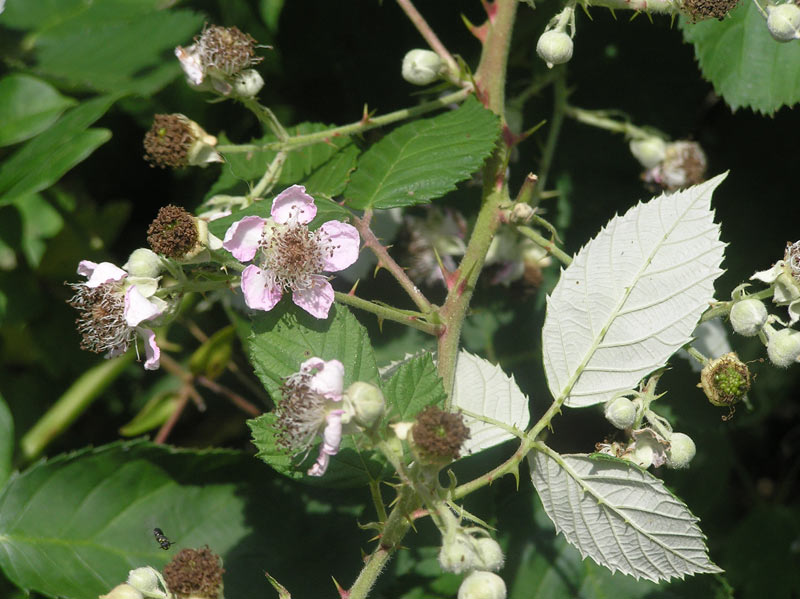
Distinctive white leaf underside of pink-flowered Himalaya-berry. Photo by Ken Moore
By Ken Moore Flora Columnist
The Fourth of July is here, traditional blackberry-picking time. I enjoyed seeing a Dad and two youngsters out on bikes picking berries along one of Carrboro’s inner-city country lanes during the past weekend. The huge briery berry patch in my wild yard is heavy with fruit, though sadly not as large as hoped for. Our little climatic dry spot on the western edge of Carrboro simply has not been blessed with the recent rains falling all around us. read more…