Lighthouses of Japan: Northern Iwate

The nation of Japan, known in Japanese as Nihon or Nippon (日本), occupies an archipelago off the east coast of Asia. The four main islands are Hokkaidō in the north, Honshū (the largest) in the center, Shikoku in the south, and Kyūshū in the southwest. The country includes thousands of other islands of all sizes; among them the Ryūkyū (Nansei) Islands are a long chain extending to the southwest and including the large island of Okinawa, and the Nanpō Islands are another long chain extending south into the Pacific Ocean. Much of Japan is mountainous but the coastal regions are densely populated and urbanized; the country's population is about 126 million.

Japan is divided into 47 prefectures. This page lists lighthouses of the northern half of Iwate Prefecture, near the northeastern corner of Honshū, Japan's largest island. Iwate is the largest prefecture of Honshū. The coast of Iwate, called the Rikuchū Coast (Rikuchū Kaigan), is mostly rugged and spectacular--and dangerous to navigation. For 180 km (115 mi) south of Kuji a narrow strip of land along the coast has been preserved as the Rikuchū Kaigan National Park. Most of these lighthouses are located in the park.

This coast was devastated by the Tōhoku earthquake and tsunami of 2011 March 11. Most of the lighthouses are high enough above the sea to escape the tsunami; most were damaged by the earthquake but all have been returned to service. A number of harbor lights were overturned or destroyed by the tsunami; most but not all have been replaced.

In Japanese the word for a lighthouse is tōdai or toudai (灯台). The words saki and misaki are for capes and headlands, hana ("nose") is a promontory, hantō is a peninsula, shima (also spelled sima or jima) is an island, bae is a reef, iwa or shi is a rocky reef, amase or se is a shoal, wan is a bay, nada is a sound or basin, kaikyō is a strait, kawa is a river, and or minato is a harbor.

Lighthouses in Japan are operated and maintained by the Japanese Coast Guard's Maritime Safety Agency. On Honshū there is usually one Coast Guard Section Office in each prefecture; for Iwate the section office is at Kamaishi.

ARLHS numbers are from the ARLHS World List of Lights. JCG numbers are the Japanese Coast Guard's light list numbers. Admiralty numbers are from volume M of the Admiralty List of Lights & Fog Signals. U.S. NGA List numbers are from Publication 112.

General Sources
Online List of Lights - Japan - Honshu East Coast
Photos by various photographers posted by Alexander Trabas.
Lighthouse-Japan.com - Iwate
A comprehensive site with photos and notes from visits to many of the lighthouses.
Lighthouse Visits
Another excellent source of photos of Japanese lighthouses.
Misty's Japanese Lighthouse Tour - Iwate
Photos and notes for lighthouses in all parts of the country.
Lighthouses in Iwate Prefecture
Photos by various photographers available from Wikimedia.
Second Region Lighthouse Story
Posted by the Coast Guard region office in Aomori, an interactive map linking to information on the major lighthouses.
Google Maps
Satellite view of the Iwate coastline.


Kuro Saki Light, Fudai, September 2024
Instagram photo by atsem758

Hiruno Town Lighthouses
Taneichi Kō East Breakwater
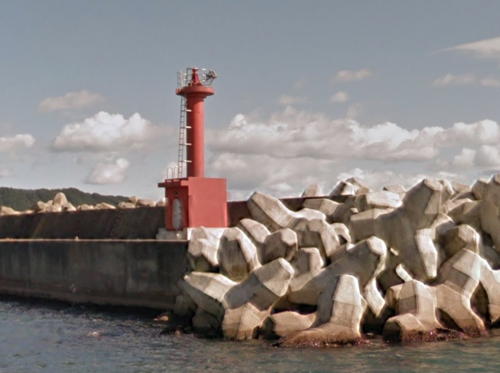
Date unknown. Active; focal plane 13 m (43 ft); two red flashes every 6 s. 10 m (33 ft) concrete post rising from a square 1-story equipment room. Entire lighthouse is red. Trabas has a 2024 photo and and Google has a satellite view and a distant 2014 street view. The tsunami's waves at Taneichi were 5.5 m (18 ft) high, enough to do major damage, but the lighthouses survived. Located at the end of the detached outer breakwater of Taneichi, a fishing port about 20 km (13 mi) southeast of Hachinohe. Accessible only by boat. Site open, tower closed. ARLHS JPN-1133; JCG-1627; Admiralty M6615; NGA 3948.
* Taneichi Kō
Date unknown. Active; focal plane 16 m (52 ft); continuous light, white, red or green depending on direction. 14 m (46 ft) round cylindrical white concrete tower. Trabas has a 2024 photo, Xùn Fùměinán has a 2008 closeup, and Google has a 2023 street view (a portion is seen at right) and a satellite view. This is a leading light for vessels entering Taneichi. Located just behind the waterfront at Taneichi. Site open, tower closed. ARLHS JPN-1132; JCG-1628; Admiralty M6614; NGA 3952.
Yagi Kō East Breakwater
Date unknown. Active; focal plane 14 m (46 ft); continuous red light with a more intense flash every 3 s. 10 m (33 ft) round concrete tower with a flared top, attached to a small 1-story equipment room. Entire lighthouse is red. This light survived the tsunami. Trabas has a 2024 photo, Yoshihiro Jumonji has a 2022 photo, a view from the habor is available, and Google has a 2014 street view and a satellite view. Located at the end of the main breakwater of Yagi, about 10 km (6 mi) southeast of Taneichi. May be accessible by walking the pier. Site status unknown. ARLHS JPN-1140; JCG-1629; Admiralty M6613.3; NGA 3968.
Yagi Kō Entrance Range Front
Date unknown. Active; focal plane 29 m (95 ft); continuous green light. 7.5 m (25 ft) concrete post rising from a square 1-story equipment room. Entire lighthouse is white. Trabas has a 2024 photo, Yoshihiro Jumonji has a 2022 photo, and Google has a satellite view. Located on the slope above Yagi harbor. Site status unknown. ARLHS JPN-1141; JCG-1631; Admiralty M6612; NGA 3956.
Yagi Kō Entrance Range Rear
Date unknown. Active; focal plane 29 m (95 ft); continuous green light. 7.5 m (25 ft) concrete post rising from a square 1-story equipment room. Entire lighthouse is white. Trabas has a 2024 photo and Google has a satellite view. Located on the slope above Yagi harbor. Site and tower closed (private property). ARLHS JPN-1142; JCG-1632; Admiralty M6612.1; NGA 3960.

Taneichi Kō Light, Taneichi, May 2023
Google Maps street view

Kuji City Lighthouses
Ushi Shima
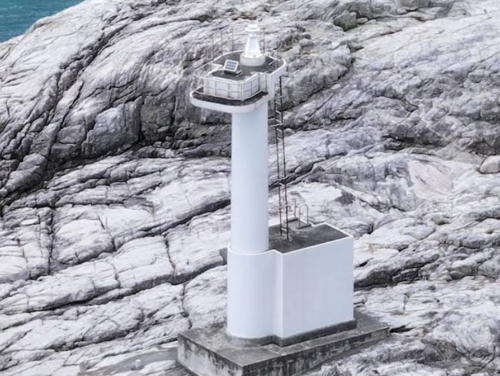
Date unknown. Active; focal plane 71 m (233 ft); white light, 3 s on, 3 s off. 11 m (36 ft) concrete post rising from a square 1-story equipment room. Entire lighthouse is white. A closeup photo is available, Trabas has a drone view (light on the right), and Google has a sea view and a satellite view. Located atop a steep-sided rock off a promontory about 5 km (3 mi) northeast of the Kuji waterfront. The rock is accessible by a walkway that is probably underwater at high tide. Site probably open with caution, tower closed. ARLHS JPN-320; JCG-1633; Admiralty M6608; NGA 3972.
Ushi Shima Hazard Beacon
Date unknown. Active; focal plane about 70 m (230 ft); continuous white light. 10 m (33 ft) semielliptical white concrete tower; the light is shown through a window. A closeup photo is available,Trabas has a drone view (light on the left), A. Kikuchi has a sea view and Google has a sea view and a satellite view. The light illuminates a reef about 1.1 km (0.7 mi) to the southeast. Located 40 m (45 yd) south of the main light. Site probably open with caution, tower closed. JCG-1634.
Kuji Outer Breakwater
Date unknown. Active; focal plane 14 m (46 ft); red light, 3 s on, 3 s off. 8.5 m (28 ft) concrete post attached to a square 1-story equipment room. Entire lighthouse is red. Trabas has a 2024 photo, a 2021 view from the sea is available, and Google has a satellite view and a very distant street view across the harbor. Caution: there is another Kuji Kō in Ibaraki Prefecture. Located at the end of the main breakwater of Kuji. Site status unknown. ARLHS JPN-1137; JCG-1635.5; Admiralty M6610.3; NGA 3978.
* Kuji North Breakwater
Date unknown. Active; focal plane 15 m (49 ft); continuous red light with a more intense flash every 6 s. 10 m (33 ft) concrete post attached to a square 1-story equipment room. Entire lighthouse is red. Trabas has a 2024 photo and Google has a distant street view and a satellite view. Located at the end of the north breakwater of Kuji harbor. Accessible by walking the pier. Site open, tower closed. ARLHS JPN-1136; JCG-1635; Admiralty M6610; NGA 3976.
* Kuji South Breakwater
Date unknown. Active; focal plane 15 m (49 ft); continuous green light with a more intense flash every 6 s. 10 m (33 ft) concrete post attached to a square 1-story equipment room. Entire lighthouse is white. Trabas has a 2024 photo, a 2021 view from the sea is available, and Google has a street view and a satellite view. Located at the end of the south breakwater of Kuji harbor. Accessible by walking the pier. Site open, tower closed. ARLHS JPN-1138; JCG-1636; Admiralty M6609; NGA 3980.

Noda Village Lighthouse
Noda Breakwater (Noda Wan)
Date unknown. Active; focal plane 13 m (43 ft); continuous red light with a more intense flash every 3 s. 9.5 m (31 ft) concrete post rising from a square 1-story equipment room. Entire lighthouse is red. trabas has a 2024 photo and Google has a sea view (also seen at right) and a satellite view. Note: There is another Noda Wan lighthouse in Shimane Prefecture. Located at the end of the main breakwater of Noda harbor, about 15 km (9 mi) south of Kuji. May be accessible by walking the pier. Site open, tower closed. JCG-1636.5; Admiralty M6607.5; NGA 3984.

Breakwater Light, Noda, October 2015
Google Maps sea view

Fudai Village Lighthouses
* Otanabe Kō
Date unknown. Active; focal plane 14 m (46 ft); green light, 2 s on, 2 s off. 10 m (33 ft) concrete post attached to a square 1-story equipment room. Entire lighthouse is white. Trabas has a 2024 photo and Google has a sea view and a satellite view. Located at the end of the south breakwater of Otanabe harbor, on the north side of the Kuro Saki headland. Accessible by walking the pier. Site open, tower closed. ARLHS JPN-1121; JCG-1637; Admiralty M6607; NGA 3988.
*** Kuro Saki (Fudai, Rikuchū Kuro Saki)
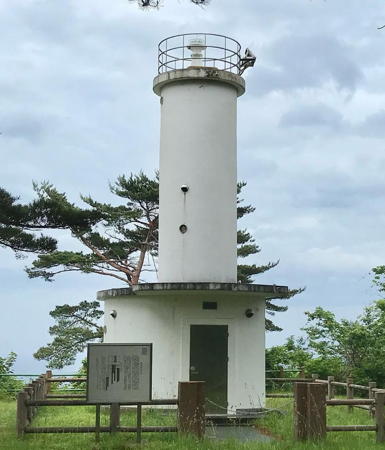
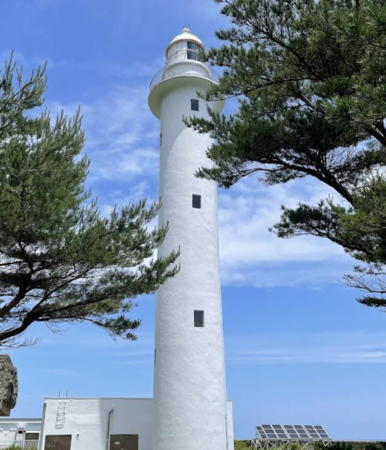
1947. Active; focal plane 143 m (469 ft); white flash every 5 s. 12 m (39 ft) round cylindrical concrete tower with lantern and gallery, rising from a 1-story equipment shelter. Entire lighthouse painted white. A 2024 photo is at the top of this page, Trabas also has a 2024 photo, Taeko Nishizuka has a 2023 photo, Misty's Tour has a photo, a 2021 closeup is available, and Google has a 2019 street view and a satellite view of the station. The light commands a spectacular view of the Pacific. Known locally as the Fudai Lighthouse, it is a very popular tourist attraction; there is a visitor center and museum and ample parking is provided. A monument on the path to the lighthouse marks latitude 40° north. Located on a high promontory at Otanable, about 25 km (15 mi) southeast of Kuji. Site open, tower closed. . ARLHS JPN-503; JCG-1638; Admiralty M6606; NGA 3992.

Tanohata Village Lighthouses
* Rikuchū Benten Saki
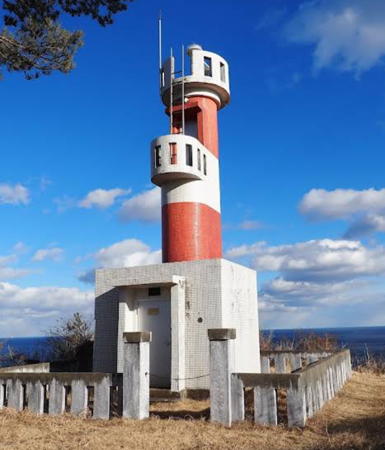
1966. Active; focal plane 98 m (322 ft); two white flashes every 7 s. 10 m (33 ft) round concrete tower with two galleries, mounted atop a square 1-story concrete equipment room. No lantern. Lighthouse painted with red and white horizontal bands. Jō Yamada's 2022 photo is at right, Takayuki Fujiwara has a 2019 photo, Trabas has a 2024 closeup, a 2021 closeup is available, and Google has a satellite view and a closeup street view. This lighthouse appears to be a twin of the Torii Saki Light in Western Aomori Prefecture, also built in 1966. It was reported out of service following the 2011 earthquake but it was repaired within a few months. Located about 4 km (2.5 mi) south of the Kuro Saki lighthouse; the two lights warn ships away from a dangerous bulge in the coastline. Accessible by a short walk from the Sankai Fireside Restaurant on highway 44. Site open, tower closed. . ARLHS JPN-502; JCG-1639; Admiralty M6605.8; NGA 3996.
Shimano Koshi (Shimanokoshi) Kō
Date unknown. Active; focal plane 14 m (46 ft); green light, 3 s on, 3 s off. 9.5 m (31 ft) concrete post attached to a square 1-story equipment room. Entire lighthouse is white. Trabas has a 2024 photo and Google has a street view and a satellite view. The breakwater was largely destroyed by the tsunami but the lighthouse survived. Located at the end of the south breakwater of Shimano Koshi harbor, about 15 km (9 mi) south of Kuro Saki. Site status unknown. ARLHS JPN-1130; JCG-1640; Admiralty M6605.4; NGA 4000.

Benten Saki Light, Tanohata, February 2022
Google Maps photo by Jō Yamada

Imaizumi Village Lighthouses
 
* #Omoto (Kumanohana)
1963. Inactive since 2013 and demolished almost immediately. This was an 8.5 m (28 ft) round cylindrical concrete tower rising from a 1-story equipment room. Lighthouse-Japan.com has a page with good 2009 photos, a view from above the light is available, and Google has a satellite view of the tower's empty concrete pad. The National Park has developed the site as a viewpoint. Formerly located atop a bluff south of Omoto, about 25 km (15 mi) north of Miyako. Site open. ARLHS JPN-488; ex-JCG-1641; ex-Admiralty M6605.2; ex-NGA 4004.

Miyako City Lighthouses
Located at the head of a funnel-shaped bay, Miyako was among the communities hardest hit by the 2011 tsunami. The water reached a height of 37.9 m (124 ft) above sea level and 512 people were killed or never located. A YouTube video shows some of the appalling destruction caused by the great waves. In late 2011 the Admiralty reported that all of Miyako's harbor lights were destroyed and that buoys were in place.

*
Ma Saki (Rikuchū Ma Saki)
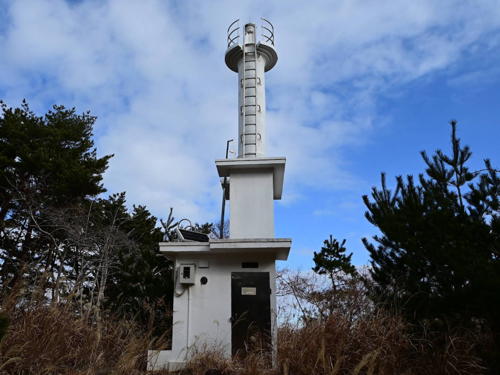
1959. Active; focal plane 79 m (259 ft); two white flashes every 10 s. 9 m (30 ft) round cylindrical concrete tower rising from a 1-story equipment room. Yukihiro Matsumura's 2022 photo is at right, Yuji Sawai also has a 2022 photo, Trabas has a 2024 closeup, Misty's Tour also has a photo, A. Kikuchi has a 2020 street view, and Google has a satellite view. Located atop a steep, scenic promontory about 4 km (2.5 mi) northeast of Taro and 13 km (8 mi) north of Miyako. Accessible by a short but steep hiking trail. Site open, tower closed. . ARLHS JPN-504; JCG-1642; Admiralty M6605; NGA 4008.
[Tarō Kō (2)]
2013. Active; focal plane 13 m (43 ft); red flash every 3 s. 8 m (26 ft) post attached to a small equipment cabinet. Entire lighthouse is red. Trabas has a 2024 photo and Google has a sea view and a satellite view. The March 2011 tsunami destroyed the original light. Located at the south end of a short detached breakwater at the entrance to the harbor, on the north side of Miyako. Accessible only by boat. Site open, tower closed. ARLHS JPN-1134; JCG-1643; Admiralty M6604.5; NGA 4012.

Rikuchū Ma Saki Light, Miyako, June 2022
Instagram photo by Yukihiro Matsumura
[Miyako North Breakwater (2)]
2014. Active; focal plane 11 m (36 ft); red flash every 4 s. 9 m (30 ft) post, painted red. Trabas has a 2024 photo and Google has a sea view and a satellite view. The original lighthouse was destroyed by the 2011 tsunami; its replacement was activated in July 2014. Located at the end of the breakwater of Miyako's north harbor. Site status unknown. ARLHS JPN-1111; JCG-1644; Admiralty M6603; NGA 4020.
[Miyako Main (South) Breakwater (2)]
2014. Active; focal plane 12 m (39 ft); two red flashes every 6 s. 9 m (30 ft) post attached to a small equipment cabinet. Entire lighthouse is red. Trabas has a 2024 photo and Google has a sea view and a satellite view. The original light was destroyed by the 2011 tsunami; its replacement was activated in July 2014. Located at the end of the breakwater of Miyako's north harbor. Site status unknown. ARLHS JPN-1110; JCG-1644.5; Admiralty M6603.5; NGA 4018.
Hei Saki
Date unknown. Active; focal plane 56 m (184 ft); white light, 3 s on, 3 s off. 10 m (33 ft) concrete post mounted at one corner of a 2-story concrete equipment building. Entire lighthouse painted white. Gonzaburou Kitakaze's 2025 photo is at right, Trabas has a 2024 photo, a 2018 photo is available, and Google has a satellite view. The attached structure seems to have been replaced sometime before the 2009 photo. Located on a promontory at the end of a long peninsula on the south side of the entrance to the harbor of Miyako. Accessible by a hiking trail from the nearby Ohana Fishing Port; local guidance will be needed. Site open, tower closed. . ARLHS JPN-103; JCG-1646; Admiralty M6602; NGA 4024.

Hei Saki Light, Miyakp, January 2025
Google Maps photo by Gonzaburou Kitakaze
Todo Saki (Todogasaki, Todo Ga Saki)
1902. Active; focal plane 58 m (190 ft); white flash every 15 s; a continuous red light is shone to the south southeast. 33.5 m (110 ft) concrete tower with lantern and gallery. A 3rd order (?) clamshell style Fresnel lens is in use. Entire lighthouse is white. A 2025 photo is at right, Trabas has a 2024 drone view, a 2025 closeup is available, Colum Duffy has a good closeup, Makoto Kuroda has closeup street view, and Google has a sea view and a satellite view. This handsome and historic lighthouse marks the easternmost cape of the island of Honshū. It was reported out of service following the earthquake and tsunami, but it was repaired within a few months. The lighthouse is in a rugged area accessible by a hike of about 2-1/2 hours round trip. Hikers are rewarded by spectacular views of the Pacific. Parking is available at the trailhead. Located about 25 km (15 mi) southeast of Miyako. Site open, tower closed. . ARLHS JPN-660; JCG-1647; Admiralty M6598; NGA 4028.

Yamada Town Lighthouses
Yamada Kasana Hana
Date unknown. Active; focal plane 11 m (36 ft); white flash every 4 s. 8 m (26 ft) concrete post attached to a square 1-story equipment room. Takayuki Fujiwara has a 2022 photo, a 2023 closeup is available, Trabas has a 2024 drone view, and Google has a 2015 sea view and an indistinct satellite view. This light seems to have survived the 2011 tsunami. NGA misspells the name as Kasano, and ARLHS misspells it as Kasaga. Located on a promontory at the entrance to Yamada Bay. Accessible only by boat. Site open, tower closed. ARLHS JPN-750; JCG-1649; Admiralty M6596; NGA 4040.
#Yamada Kō (1?)
Date unknown. Replaced in 2018. This was a 10 m (33 ft) concrete post attached to a square 1-story equiment shelter. Entire lighthouse is white. Google has a 2015 street view and a 2015 sea view. The Admiralty reported in late 2011 that the harbor lights of Yamada had been destroyed and replaced by light buoys, but the street view shows that this light survived. However it was replaced in 2018 by a post light (focal plane 12 m (39 ft); continuous green light with a more intense flash every 4 s). Trabas has a 2024 closeup, a 2023 photo is available, and Google has a 2023 street view and a satellite view. Located at the end of the main breakwater of Yamada. Site status unknown. ARLHS JPN-1143. Active light: JCG-1652; Admiralty M6597.35; NGA 4044.

Todo Saki (Todogasaki) Light, Miyako, July 2025
Google Maps photo by Marunao
Tarai Shima
Date unknown. 9 m (30 ft); two white flashes every 5 s. 7.5 m (25 ft) round concrete tower, painted black with one red horizontal band. Trabas has a 2024 photo, Gonzaburou Kitakaze has a 2020 view, and Google has a sea view and a satellite view. Offshore lights generally survived the tsunami; the waves may have submerged them briefly but did not break over them. Located on a reef in the southeastern part of Yamada Bay. Accessible only by boat. Site open, tower closed. JCG-1654; Admiralty M6597; NGA 4048.
Rikuchū Ōshima
Date unknown. Active; focal plane 28 m (92 ft); white flash every 3 s. 11 m (36 ft) concrete post rising from a square 1-story equipment room. Entire lighthouse is white. Trabas has a 2024 photo and Google has a sea view and an indistinct satellite view. Located on the south end of an island at the entrance to Funakoshi. Accessible only by boat. Site open, tower closed. ARLHS JPN-1112; JCG-1656; Admiralty M6595.1; NGA 4060.
Rikuchū Benten Shima
Date unknown. Active; focal plane 18 m (59 ft); white flash every 4 s. 11 m (36 ft) concrete post attached to a square 1-story equipment room. Entire lighthouse is white. Yuji Sato has the 2023 drone view at right, Trabas has a closeup 2024 photo, a distant view (halfway down the page) is available, and Google has sea view and a satellite view. Located on the southeast end of an island at the entrance to Funakoshi, about 2.5 km (1.5 mi) northwest of the Ōshima light. Accessible only by boat. Site open, tower closed. ARLHS JPN-1099; JCG-1657; Admiralty M6595.5; NGA 4064.
#Funakoshi East Breakwater (1)
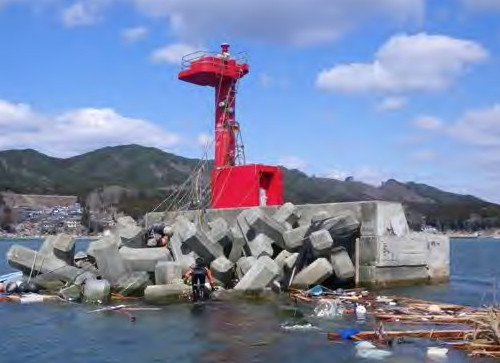
Date unknown. Demolished in 2011 after being damaged by the tsunami. This was a 9 m (30 ft) concrete post rising from a square 1-story equipment room. Entire lighthouse was red. The Coast Guard has a post-tsunami photo of the original light showing JCG personnel searching for bodies that might be snagged at the end of the breakwater. The lighthouse was replaced by a post light (focal plane 10 m (33 ft); red flash every 3 s). Trabas has a 2024 photo and Google has a satellite view. Located at the end of the main breakwater (NGA calls it the north breakwater) at Funakoshi, a harbor on the south side of Yamada. Accessible only by boat. Site open, tower closed. Current light: JCG-1659; Admiralty M6595.7; NGA 4072.

Rikuchū Benten Shima Light, Funakoshi, October 2023
Google Maps photo by Yuji Sato


Information available on lost lighthouses:

Notable faux lighthouses:

Adjoining pages: North: Eastern Aomori | South: Southern Iwate

Return to the Lighthouse Directory index | Ratings key

Posted August 15, 2006. Checked and revised April 4, 2026. Lighthouses: 28. Site copyright 2026 Russ Rowlett and the University of North Carolina at Chapel Hill.