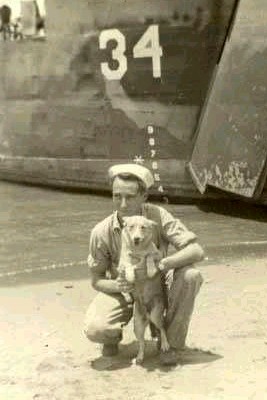
Ralph
E.
Robinson & World War 2

Ralph & Gizmo
History
of Ralph Robinson's War Experiences
by Ralph E. Robinson
This is my story starting with the invasion
of the Philippines. It is
not a horrible story or a beautiful story but it will give you an idea
of an amphibious sailor has to do to make a campaign a success.
When we arrived in Manus, Admiralty
Islands early October, 1944
even
though we had never been near a battlefront before, we could see that
there was a very obvious reason for our presence there. The
half-round
harbor was full of ships--fighting
ships, battle wagons, cruisers,
destroyers, LCIs,
LCMs
and the LSTs
loaded
with LCVPs.Also,
the huge
LSDs,
transports, Army Personnel Attach and Army Cargo Attach and, last
but not least, the Tug Boats. With the first sight of the warships over
the palm-treed jettys, jutting out from the edge of the harbor the
scuttlebutt
started. Already the crew caught the thrill of approaching
battle and were guessing where this strong arm of the United States'
forces would strike. The whole crew was wondering what an invasion
would be like. They were destined to learn more than they had expected
to.
In the next few days we got supplies. There GSK
(dry goods), Dry Stores
(canned goods), Fresh Stores (chilled and frozen food from refrigerator
ship), Fuel Oil and Lubricating Oil--enough provisions for a long while.
The eleventh of October we
began loading up, and the scuttlebutt
(rumor) began getting more accurate, being centered in the Philippines.
Just before noon I found out for sure. Seeing some army officers on the
beach just in front of our ramp with charts,
I got out the binoculars
and began watching intently to catch th e outline of an island or a
name. Soon my vigil was rewarded. I spelled out the words that were
bottom side up. Leyte
Gulf! Now I knew something the Japs would have
paid highly for. My first military secret. It was a thrill to think of
it.
That afternoon the convoy left Manus and our
first hectic night in a
convoy was approaching. Our skipper's warning that a convoy of
amphibious ships was "quite a rat race" was well put because that night
was a thriller. I had the midnight-to-four watch. Being stormy that
night left us depending, at times, solely on our radar. That was ok for
us but the LSTs didn't have radar and it really got dark. Everything
was going fine until one of the LSTs in front of us stopped and we had
to stop too. Immediately all the ships in the column began to drift out
of place. The other ships ahead of us, leaving the LST set where she
was, began pulling out around her. To our horror, just as we were
approaching her hug black bow of another LST loomed up in the fog about
five hundred yards off our port
side coming directly at us. We
immediately backed down full, let the second "T"
go past, pulled around behind her and started ahead full to catch up
with our column. Just getting started good a third lost "T" loomed up
ahead of us, completely broadside, dead in the water. It was back full
again, then out around again then full speed ahead to catch up with the
convoy, which is now seven miles ahead by radar. When we finally got
back with our convoy the captain said, Well, I hope this is the right
convoy." By that time my watch was nearly up. I left the conning tower,
grateful that there had been no enemy subs around. There had been
white, green and red flashes from signal lights, and warning flares
shot up for the last four hours. The next morning the convoy arrived in
port with an array of many bright colored signal flag hoists.
Humboldt Bay, Hollandia, New Guinea was a small circular bay
surrounded
by steep jungle hills which came down in a steep slant to the water's
edge. The jungle was so thick that there was practically no visible
evidence of an army base, but we knew that there was a large one there.
Right at that moment, that little bay was the most important spot in
the Pacific. From that spot was to sail the largest (at that time)
invasion fleet in the world.
After staying in the Bay for four hours, the convoy pulled out for
Leyte. The attack plans were for the main bombardment to be on White
Beach and the main amphibious forced to land there. The second
amphibious force and the lighter bombardment were to be on Red Beach.
White
Beach was about seven hundred yards long, running south of
Tacloban. Red Beach was at Dulag. "D Day" was October 20 . "H Hour" was at 10
AM. We, with out ship, were to hit the beach at "H Hour plus 30
(10:30)". We had aboard mostly army engineers and equipment (mostly
trucks, bulldozers, etc.), including one hundred fifty men.
The trip up was quiet except for a sub scare on the nineteenth. The destroyer escort
dropped about a dozen depth charges about a mile off our starboard
beam,
just at the edge of the convoy. All the way up we had GQ (General
quarters, "Battle stations") each sunrise and sunset. In general,
everyone was doing a lot of thinking and some praying. The army was
thinking of the job of setting up another beachhead, being veterans of
the long New
Guinea Campaign.
October 20, 1944 -- San Pedro
Bay, Leyte
Having breakfast at about four AM was a ritual which we carried o
through the rest of our invasions. The army cooks fixed breakfast. The
main food was pancakes with syrup which we later nicknamed "Invasion
Cakes". At five AM we went to GQ. Everything was quiet at sunrise but
at about eight a Jap plane flew over. It was higher than gun range. All
hell broke loose as all the ships shot at it. However, it went over
undamaged but passing over the convoy it came lower. One of our
outlaying destroyers downed it.
Soon we were far enough up in the bay to see and really hear the
battleships and cruisers firing on the beach. They were really pounding
it, and had been for a good many hours, Coming closer we could the
little destroyers running up and down the beach firing everything they
had. One thing we will never forget is a little black destroyer which
was shelling a small island just off from Tacloban, between Leyte and
Samar. After firing his forward batteries, he would swing around to
give his after-batteries a chance. She kept swinging around and around
cutting loose all hell. It look like she was putting out more
ammunition in fifteen minutes than any other destroyer in the whole
invasion. With her and the two LCI rocket boats, every palm tree on
the
island was shattered. About 9:45 the noise really began as the rocket
boats cut loose o the beach. It was just a steady roar.
At 10:00 the noise stopped and the first small boats landed. We were
the second LSM to hit the beach at 10:30. The first LCM, dropping her
anchor too far out, had too much cable out and was afraid she would
lose her cable. She retracted and hit again, so as far as I know we
were the first LSM to make a successful landing on an enemy beachhead.
There was practically no trouble on White Beach that morning, only a
few snipers and one pillbox which we heard the story of later. A
soldier, seeing a pillbox, approached it to look it over and was shot.
Several soldiers, upon seeing this, opened up on it with machine guns
and rifles, shooting into the door as much as possible. Another
solider, thinking all the Japs were dead, walked up to it and was shot
from within the pillbox. The rest of the soldiers, seeing this, made up
a bomb with hand grenades and dynamite and threw it into the door. Two
of the Japs flew right through the heavy screen and dirt sides of the
pillbox, throwing one of them more than fifty feet. That was the end of
that.
There was only one trouble with the invasion that morning. If the Japs
had known we were coming, they would have been fortifying their base on
White Beach. They would have been practically demolished but as it was,
they were holding maneuvers near Dulag (Red Beach) which was not
bombarded so much. A lighter force landed there and really had a
surprise t meet a large Jap force. It was really
tough at Dulag. That
was our first of may lucky happenings in the Philippines. We hadn’t
been chosen for Red Beach.
After unloading we pulled out about a mile off the beach and anchored.
Everything remained quiet that afternoon except for an occasional rifle
shot, rattle of a machine gun or mortar burst.
We had General Quarters that evening but it was still quiet. As it got
darker we could see that bright flares, Jap flares, landing near the
beach. Hours after, the flares disappeared behind the hills. As it got
darker, things got quieter. Only the occasional crackling of a machine
gun was audible from back in the jungle.
About midnight, one of the officers on the com said “It looks like
they’re firing this way”. He was right. It went over us with an angry
hissing and exploded about a half mile beyond, near the water. They
were shooting at a group of LSTs setting in a group. They were falling
short, and we were directly between the gun and their target. From the
appearance of the explosion, it must have been about a three inch
shell. After several more shells went over we called the captain. He
came up on the conn, sat down, and after a few more shells went over,
he said, “disconcerting, isn’t it?”. It did n’t seem to bother him a
bit.
The next day and night were quiet for us, but was very noisy on shore.
We remained at anchor.
On October 23rd we saw the
first Jap dive-bomber. It dropped its bomb and missed. A few seconds
later, it was hit by anti-aircraft and its engines began burning.
Seeing that he was going down, he headed for an LCI with a Wildcat
right on his tail, but nothing could stop him. He crashed right into
the LCI which immediately burst into flame. It burned for about an hour
and a half, rolled over and sank. That gave us an awfully queer
feeling. It was the first ship we had ever seen going down and we hoped
it was the last.
After that day, it was one raid after another–morning, noon and night.
There were certain things that stood out more though. On the night of
the first sea battle of the Philippines, one of our light carriers was
sunk. It was about nine PM when the radio message came in that around
twenty-four Wildcats
would be landing on the unfinished air strips at
Tacloban. At this time we had no land-based planes in the Philippines.
The particulars were that we could identify them as they would have
their landing lights on. In a short while they began coming in, landing
one after another. We were not more than a mile off shore. We could
watch everything that was going on. As the last plane was coming in, he
suddenly zoomed up and there was a large explosion in the center of the
air strip. Immediately all the guns around opened up on him, and they
shot him down back over the island. That was one of the Japs’ side.
They picked up our message immediately, sent out one of their own
planes to follow our own planes in under cover of the darkness to join
our planes, turn on her running lights and bomb our air strip that we
were trying to build as quickly as we could. I could go on telling
these things by the hour, but writing them all down would become very
tiresome and lengthy.
All through the month of November
we continued to unload liberty ships and weather out the air raids.
About the first of December we
loaded up with army engineers and equipment and prepared to leave for
the invasion
of Mindoro, but about then the second sea battle of the
Philippines started. This blocked our passage to Mindoro, so we
unloaded, and on the third of December
prepared for another mission. The Japs were reinforcing their troops in
Leyte through Ormoc on the other side of the island, so we were to take
reinforcements to Bay Bay about forty miles below Ormoc. The trip
around the island was uneventful, but on landing we found that our
navigation had been faulty. We had landed about Bay Bay, almost on the
Jap beach. We landed about one AM and it was very dark that morning on
the fifth of December. The army
told us that we would have to pull off and rebeach at Bay Bay. Our
commander told them that either we unloaded there or were taking our
loads back to Dulag. We unloaded.
About ten AM we were rounding the bottom of the island, and I was
sitting topside leisurely watching our small convoy–three destroys, six
LCIs and 12 LSMs. There was a spotty covering of clouds and the day was
bright and hot. I happened to glance back and saw a plane diving at top
speed not five hundred feet above a destroyer. It was Kamikaze. The
destroyer never altered course or fired a shot as it all happened too
quickly, but the plane exploded in the water, missing its target by at
least a hundred feet. Our GQ buzzer sounded and then all hell broke
loose. Two planes headed for us almost at the same time. Our guns got
one about fifty feet from the starboard side of our ship. The second
one exploded and crashed a few yards from our bow. Gasoline, water and
parts of planes were flying all over the place. Then a third came in
straight for our conn from the starboard side. The skipped had stopped,
and the Nip shot in from our conn down over the lifelines on the port
side, into the water and exploded. The ship lurched the other way. This
all happened in about five minutes, but it was almost lifetime. The
attack continued on furiously. A plane had crashed into the stern of
the LSM 20 and she was taking on more water than she could stand. A
plane had crashed into the radio shack of the LSM 23, and she was
burning from the splattered gasoline. In about twenty minutes, the 20
began going down stern first. We began picking up survivors s and the
planes were still coming in. Our ship picked up three men, two badly
burned, and the third unharmed. They were blown off a destroyer by an
explosion. We had several other raids before the day was over.
They hit two of the destroyers, one just behind the conn, and flame
shot up the ship all the way to the bow. The second, at just about
dark, was hit by two bombs midship, and we ended up towing that
destroyer for four hours until she got one of her engines fixed.
Upon arriving at Dulag, we loaded again and left again, only this time
for the invasion of Ormoc. We went out with twelve LCIs, four APDs
(World War I destroyed converted to carry troops and land them, with
attack boats that they launch), three destroyers, six LSTs and twelve
LSMs. If those aren’t the exact numbers, it is close and to the best of
my memory.
The morning of December seventh,
we hit Ormoc with little opposition on the beach. Only a few snipers
were there, but while pulling off the beach, a few planes came over and
one hit an APDs.
It began burning badly. They had to abandon it and our
destroyers
sank it. We found out then that when we were pulling in,
three Jap transports and three Jap destroyers had been coming in. The
were only about twenty miles away when we landed, but our planes went
out and sank them all that day. We had been just in time. We pulled out
about ten leaving three LSMs and 1 LCI stuck on the beach Two of the
LSMs and the LCI came back. The third LSM was sunk that day. We had
plenty of excitement that day, but we had better cover of our own
planes. Out of sixty planes that the Japs sent for us, forty were shot
down by our planes, mostly P38's.
They kept coming in the rest of the day. Every twenty to thirty minutes
we could expect three or four of them the rest of the afternoon. The
sank one destroyer and hit an LSTs with little damage.
However, after those exciting times in such a short number of days, our
ship had not been hit. No one was hurt on our ship so they decided we
were ready to go on the invasion they had listed us for a week before.
Our fleet had chased the remainder of the Jap fleet away and our way to
Mindoro was clear. This was a much longer convoy with several cruisers
and aircraft carriers along. This was a much longer convoy with several
cruisers and aircraft carriers along. On the way up, two Japs hit the
cruiser Nashville. They had one hundred twenty-some killed and over two
hundred injured. Nothing else happened until D Day, December fifteenth. When, just as we
were pulling off the beach, five Nips came over and hit
two LSTs. They started burning badly. As the LSMs started warming
up to pull out, we got a call from the Admiral in charge to pick up
survivors from one of the LSTs so we headed for her. The ammunition on
her began going off by then, and it looked like regular fireworks. The
tracers shot out in all directions and splashed in the water. There
were little streaks of fire all over the where oil and gasoline had
poured out. The water was filled with men in life jackets, both Army
and Navy. We opened our bow doors and lowered our ramp and began
picking up men from the water and PT boats. In about an hour, the well
deck was full of wet and frightened men. Just as we began picking up
the men, the “T” blew straight up with a huge explosion blowing a big
black rolling smoke ring into the air about a thousand feet. It looked
as though any men left on the ship when it exploded would be gone. But,
I talked with many men after ward that were on her then and were not
even bruised. We picked up about five hundred men, mostly army. We put
all the army men that could walk off on PT boats, and they were taken
ashore as our troops hadn’t even met a Jap on the beach yet. We
had ten casualties, aboard, nine army and one navy. The were all badly
burned, and one had a broken back and almost died. We had most of the
ship’s crew aboard and some were aboard a destroyer. The navy men got
their heads together, and as far as they could tell, none had been
killed. The planes hit midship where she was loaded with eight hundred
Air Force ground crew, aviation gasoline and five hundred pound aerial
bombs–a hot load.
When we finally left, the convoy had been gone about two hours and we
were all alone. It didn’t make us feel so good as we knew there was a
continual threat of air attack. One lonely LSM wouldn’t be able to do
much about it so we took out at flank speed, cutting all the corners
the convoy had taken. The engineers put screw drivers in the governors
and held them down. We caught up to the convoy without seeing another
planes, and we felt greatly relieved. Our navigator figured we made
seventeen knots, as far as I know, it is still the record for LSMs.
That thirty-six hundred horsepower did its job.
The trip back to Leyte was quiet, and we were glad to be
back. Even though they were still having air raids every
day, the planes were more interested in the air strip and the larger
ships than us.
We were still in Leyte at Christmastime
(1944). Christmas Eve we had a
movie in the aft troop compartment. It was the first movie I had
seen since we had left Manus.
There was an air raid that night,
but we did not go to GQ as the planes were a long way off. We
never went to GQ any more unless it looked as though the planes were
coming close to us.
Christmas Day was a day we had
looked forward to for a long time like a
bunch of kids waiting to open their packages. To build up the
feeling of surprise, the deck force, the ship's control and the
engineering force had each separately planned a program for
entertainment of the rest of the crew. A prize was to be given
for the best program. It wasn't really much, but it was something
to keep our minds off the Japs, if that were really possible.
After a wonderful meal of turkey, sweet potatoes, ice cream, pie, and
all the extras such as nuts, celery and cranberry sauce, we put on the
program. (I ate so much that I was uncomfortable for the rest of
the day). The program was really funny-one of our fellows sang a
song that he had made up about the ship, another did a southern
shuffle. Between singing songs and imitating our engineering
officer going to GQ loaded down with life jacket, two rifles, two
forty-fives, a pair of binoculars, and a trench knife, the show was a
success. That night we had the usual air raid.
New Years (1945), we were still
in Leyte Gulf, but we were getting restless,
and the day was rather dull. Although we had another big meal and
the day off, the coming of the New Year didn't seem much to look
forward to. It was just a time to rest and think about the last
year and how much longer the war would last.
On January we left on a
long, rough and tedious trip to
Lingayen Gulf in
a large convoy made up mostly of LSTs. Our
average speed was from three to five knots. The LSTs were towing
LCMs which took a terrible beating. One lost its ramp and had to
get underway under its own power and pull out. Another, that had
a LCM loaded in her, was swept by a big wave. The LCM, including
a truck that was in her, was swept out to sea. We arrived at
Lingayen Gulf about two weeks after the
invasion there. We
unloaded liberty ships for a while and carried supplies for
battleships. Then we got repairs and left for Subic Bay.
We
arrived at Subic about two days after the invasion there. We
unloaded at the small village of Subic. When we beached there, it
was really funny. The native huts were built about fifty feet
from the water, and as every ship beached, the huts in front of them
got their yards washed down. Some of the natives had their
outrigger canoes in front of their huts. After the wave receded, most
of the canoes were in back of the
huts. One of the natives, seeing the water coming at him, jumped
into a canoe. He really yelled as the wash carried him about
thirty feet. He really looked surprised.
When we loaded up again, we knew from the load that we were headed for
another invasion. We soon found out that we were going to hit
Marevales, Bataan, and that our ship was to be the first ship to hit
the beach, going in with the fifth wave of small boats to take the
beach master in. It seems like we always caught such duty.
Thinking about going on this invasion worried me more than any other as
we had to go within three miles of Corrigidor to get into the
harbor. We had to beach within five miles of the rock, and
everyone knew what Corrigidor was-a fortress. In the afternoon of
Feb. 14, we left Subic and headed straight out to sea to mislead
any
Japs that might be watching from the hills. Marevales was only
fifty miles down the coast. When we came in the next morning,
Corrigidor was receiving all the ammo we could drop on her, both from
ships and planes.
That morning I saw the most wonderful show of
fireworks and destruction that I had ever seen. Every minute was
filled with excitement. P38's were
dropping two
one-thousand pound bombs apiece, two motored bombers dropping loads of
demolition bombs, destroyers, cruisers and battleships giving her
everything they had. More P38's were
dropping belly tanks full of
gasoline with detonators in their noses-everything that you could think
of. We were about five miles from the rock when the Japs got out
their first and last shots that morning, three shots from a three-inch
gun. The shells landed among some APD's, just in front of us, who
were just lowering their landing boats. It didn't take our guns
long to get their range. Two destroyers let them have
everything. A few seconds later, a P38 spotted
the
position. The Japs didn't have a chance.
In the meantime, two gunboats and a destroyer were pounding the small
harbor of Marevales where we were to make our landing. Just as we
were preparing to enter the harbor, a flight of B-24s
appeared.
There were twelve of them, and they were flying about five thousand
feet above the harbor. That was when we found out what precision
bombing was. They came in straight in over Marevales, never
changing their course. As they passed over, the
whole west side of the harbor bloomed into hundreds of dust colored
roses. The sound of the explosions came in gusts, flapping our
pants. The explosions strung out along the edge of the harbor,
every one bursting on or near the beach. Not a one hit the
water. A second flight of bombers came over giving the north side
of the harbor the works. Then a third flight hit the east
side. Each one dropped its bombs with no apparent difficulty and
disappeared over the horizon. It must have been very noisy for
those ships in the harbor for it is small and completely surrounded by
mountains.
Everything quieted down for a few minutes while the dust settled. Then
we proceeded into the harbor. Everything proceeded as scheduled
on Corrigidor-fifteen
minutes of bombardment from ships and planes, and then fifteen minutes
for the dust and smoke to settle, and then start all over
again. The further we got into the harbor, the noisier and the
smokier it got as the beach was lined with gun boats and rocket boats
with their bows shoved into the sand of the beach. They were emptying
their ammo lockers into those hills. Everything was going fine
when there was a thump and the whole ship shuddered. The damaged
starboard screw, which had struck some unknown object, was
stopped. This was very bad as it meant we would have to hit the
beach and pull off again as soon as possible with only one screw.
Sometimes this took all the power we had. But, this time we were
lucky as the beach was perfect, and we hit the beach easily and dropped
a dry ramp. As we unloaded, the noise was terrific. The
smoke was so thick that we could hardly see the beach as we were right
between a gun boat and a rocket boat. After pulling off the
beach, and as we were heading back out again, we could see the first
wave of LSMs coming in. One ship, the 169, was quite a distance
from the rest of the ships. They were calling them over the radio
to get back into position. But, just then there was a terrible
explosion. A column of water rose straight through the center of
the ship, and the ship seemed to raise straight out of the water.
A Jeep shot over the conn and a half track landed in the gun tub in
front of the conn. As the ship settled back, it started to
burn-that is how a mine is. We pulled back out to the entrance of
Manila Bay and laid off about ten miles from Corrigidor for several
hours. We watched the shelling of the rock and then returned to
Subic Bay, getting back that evening on one screw. It was a
rather full day. We were disappointed that the screw was damaged
as that spoiled our chances of returning to make the landing on the
rock. That was one show we had really wanted to see. There would
be Liberators
dropping blockbusters, transports dropping paratroops,
and more
transports dropping supplies on the end of multi-colored chutes.
It would be a big show and we wanted to be in it.
Repairs were very slow. A week later, even though we were not yet
repaired, we were ordered to go with a group of LSMs to go to Marevales
as an undesignated number of ships were needed to haul supplies to the
rock from Marevales. So, we headed out on one screw.
Upon
arriving at the entrance to Manila Bay, we saw some men in the water
and prepared to pick them up. Upon getting closer, we noticed the
close- cropped hair of Japs, and we realized that they had probably
left the rock to save their skins but some of them were still
fated. When those bitter sailors saw them, it wasn't the right
thing to do, but a lot of things a man will do in the thick of war
can't be justified. It's just the release of a pent-up
bitterness. We passed another Jap in the water, this one was dead
and bloated to about four times his size and would probably soon
burst.
There was smoke pouring from all the tunnels in the rock
as they were burning out the Japs. No matter where you looked, it
was plain to see that the Japs were completely
licked. We weren't needed that day so we just laid off while some
of the ships made the run from Marevales to that conquered rock that
lay there smoking and covered with the colored parachutes. We
returned to Subic again this time to get repairs.
When we went into dry dock, we had to have the tail shaft pulled as it
was bent at almost a forty-five degree angle. The screw was
almost completely ruined. We also scraped the bottom and painted
it.
When we left the drydock in Subic Bay, the captain took over and took a
shortcut out of the small bay where the drydock ship was. This
was a bad move, and we immediately hit something, probably a sunken
ship, and damaged the screw that had just been repaired. The
captain then ordered full astern. The damaged screw then backed
right off the drive shaft and dropped off-lost. We sent a quick
message to the drydock and went right back in. The captain then
asked me to give him the logbook, and we never saw what was entered
about the incident.
After the ship was repaired, we pulled out into the main Subic Bay and
tied up next to LSM l69
which had been towed back from Marevales with a
large (about
15 ft. diameter) hole straight through the ship, bottom to
well deck. The sealed compartments kept it from sinking.
After returning to Leyte, we loaded up with troops and vehicles and
headed for the south of the island. On March 10th, l945 we made
an invasion
landing at Zamboanga, Mindanao. Just
before the early
morning landing at daybreak, I recorded the air temperature at over 100
degrees. I told the captain that that was going to be the
temperature for the day. I wasn't going to look at the
thermometer again. He approved. The ocean water temperature
was 85 degrees.
This beach was heavily defended, and there were large guns and mortars
being fired at the invading ships all day and that night. After
making several supply runs to the beach, we anchored off shore. A
message was sent to the fleet that there were enemy swimming out under
the cover of floating palm logs trying to attach charges to the
anchored ships' screws. I spent several hours of watch that night
walking around the ship carrying a machine gun and watching for
floating objects in the pitch-black night. At one point we
spotted a log that came by the ship and then went right around to the
other side. It might have been carried by the currents, but it
didn't seem right.
On April l7 we made an
invasion landing on northern Mindanao but this
was not a heavily defended position. Things were quieting
down. We continued to make many supply trips around the islands
and then were at Banon, Batangus, Luzon training with the army for the
Japanese invasion when the news came about the atomic bombing of
Japan. Our officers left our ship to go to another to celebrate,
and we brought out our supply of Japanese beer.
After two trips to
Japan and one more typhoon, we started home.