Originally published September 25, 2008
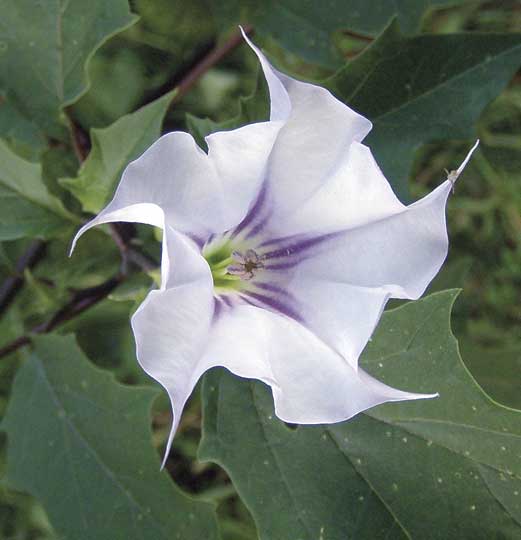
Photo by Ken Moore. Jimson weed flower opens in the late afternoon and continues through the night.
By Ken Moore
This time of year is beautiful beyond description. I’m challenged to focus on a single plant.
A morning glory, Ipomoea purpurea, is scrambling over a cultivated coastal beauty-berry, Callicarpa americana. The vine’s pale purple flowers call attention to the iridescent purple-pink berries of the shrub. The tall burgundy-and-green-colored pokeweed, Phytolacca americana, towering over golden-yellow plumes of common goldenrod, Solidago altissima, make me thankful that I did not pull them earlier in the summer. On the deck, several volunteer bur marigolds, Bidens aristosa, in pots of peppers and tomatoes, stand head high with hundreds of bright yellow daisy-like flowers. The still vigorously flowering near-by scarlet-red coral honeysuckle, Lonicera sempervirens, helps sustain lingering hummingbirds. The engaging beauty of all this wild floral extravagance is my reward for encouraging nature’s impulses.
read more…
Originally published September 18, 2008

Photo by Ken Moore. Young gray tree frog on pickerelweed stem in Natural Science Museum’s wild garden on Raleigh’s Jones Street
By Ken Moore
Next week, Sep 24-30, is “Take a Child Outside Week,†and the North Carolina Museum of Natural Sciences has planned some specific activities to promote awareness (www.naturalsciences.org).
A visit to the Museum of Natural Sciences in Raleigh begins with awareness on the outside. Along the half-block-long north side of the museum facing Jones Street, there is a wild garden in dramatic contrast to the strictly regimented lawn and shrub monoculture of the North Carolina Legislature across the street.
read more…
Originally published September 10, 2008

Photo by Dave Otto. Green lynx spider with black wasp prey on cluster of Eupatorium rotundifolium disc flowers
By Ken Moore
From time to time, I have the use of the visual images of local nature photographer Dave Otto. In his continual pursuit to learn and photograph new wildflowers, he has noted more and more close-up encounters of insect dramas on the flowers. Many of these encounters, caught in his camera lens, depict a fatal end for one of the insect participants. While sharing with me a recent wildflower image, he expressed that these unexpected encounters seemed like a type of bioterrorism. His observation continues to circulate around in my imagination.
read more…
Originally published September 4, 2008
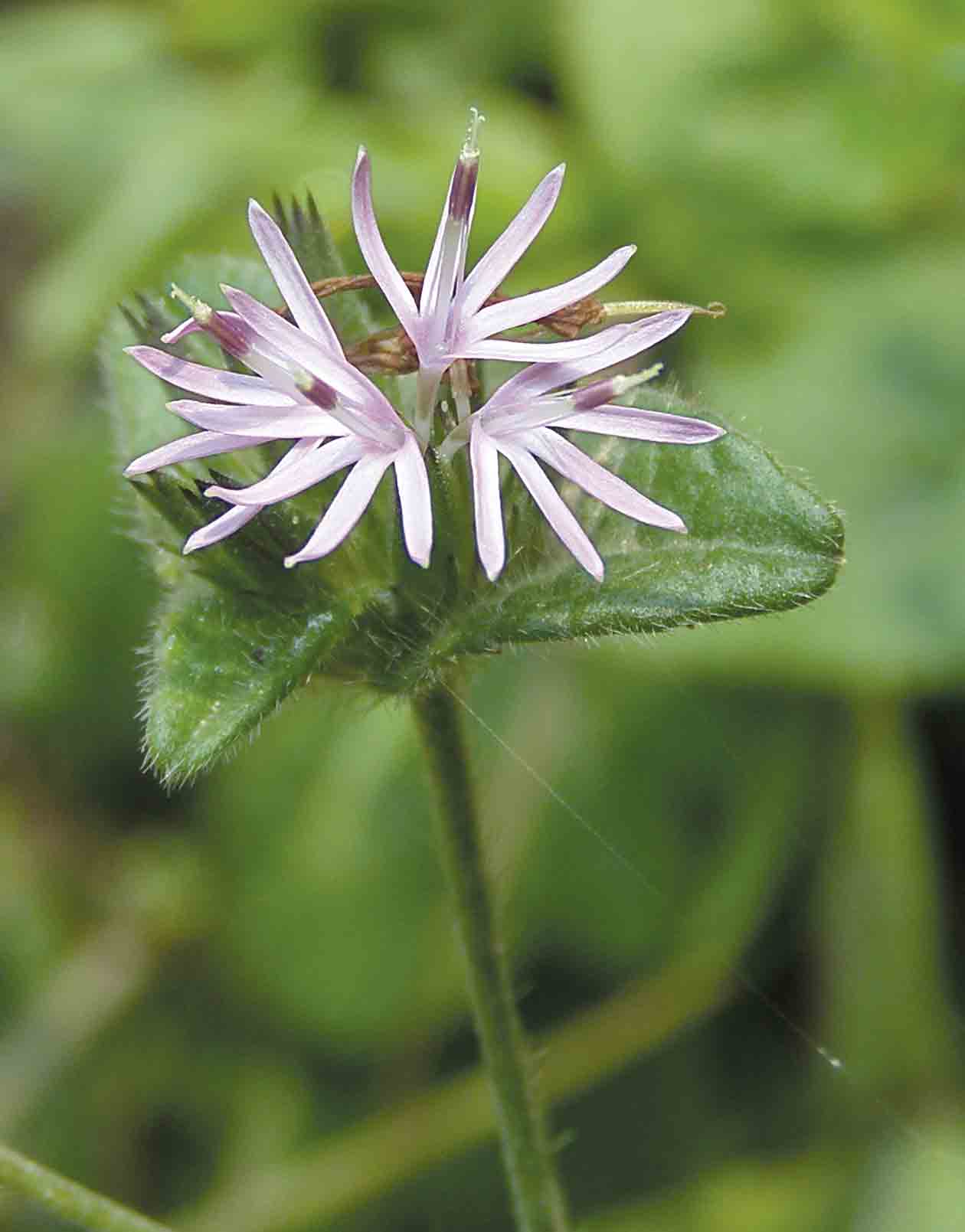
A close-up view reveals the beauty of the tiny disc flowers of elephant’s-foot
By Ken Moore
The current flowering exuberance of local roadsides and fields clearly demonstrates fall’s domination by the great diversity of composites, plants of the aster family. This week’s featured plant is another one of those multiple, tiny-flowered composites.
You probably need not venture beyond your own home ground to find elephant’s-foot, Elephantopus tomentosus. That rosette of leaves lying flat on the ground in your lawn, on a moss-covered ground or on the edge of your driveway or woodland border, may have sparked your curiosity from time to time. My hunch is that most of these leafy rosettes scattered about our well-tended landscapes have been dug out as weeds or regularly mown so as never to have opportunity to send up one- to one-and-a-half-foot-tall flowering stems.
read more…
A one-day flower with a two-day appeal
Originally published August 28, 2008
Halberd-leaved swamp mallow remains fully open for one day. Photo by Ken Moore
Ken Moore
Locally we frequently spot the common white-flowered, swamp mallow, Hibiscus moscheutos, growing in wet depressions and along the edges of Jordan Lake. Fortunately, they have numerous buds, for each flower remains open for only one day. However, in my opinion there’s a finer wild hibiscus out there, but you’ll have to go further afield to find it. This one sports a rose-pink flower with a two-day appeal.
read more…
Originally published August 21, 2008
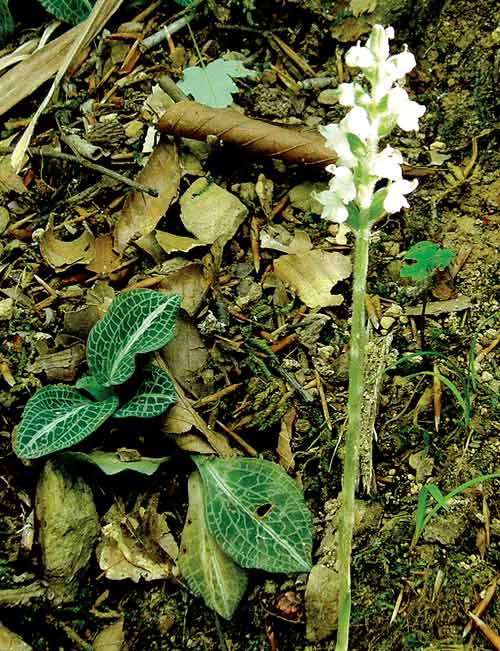
The downy rattlesnake plantain has a rosette of distinctive white veined, evergreen leaves. Photo by Dave Otto
By Ken Moore
The downy rattlesnake plantain, Goodyera pubescens, another little native orchid, is not nearly as hard to spot in the local woods as is the cranefly orchid described last week. Keeping an eye out for the distinctive basal rosette of three or more white-veined, evergreen leaves helps you discover the three-to-six-inch-tall flowering spike of snow-white flowers at the end of mid-summer. You’ll find it in piney woods and hardwoods forest everywhere.
read more…
Rescuing cranefly orchids from English ivy
Originally published August 14, 2008
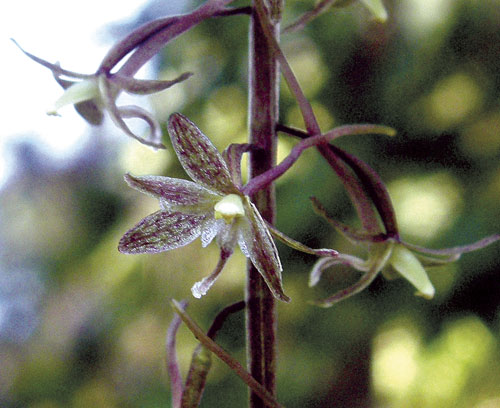
You’ll have to lie on the ground with a hand lens to get a closer look at a single cranefly orchid flower. Photo by Dave Otto
By Ken Moore
Last summer, I described the elusive cranefly orchid, Tipularia discolor (see Flora in the Aug. 2, 2007 issue of The Carrboro Citizen). I’m as excited about its once-a-year flowering recurrence now as last summer. If you didn’t catch them last year, I encourage you to search for them now while they’re in peak bloom. This beautiful little native terrestrial orchid is common in both piney woods and deciduous forests. You’ll need your keen eyes to spot them. The single two-to-four-inch leaf – green above, burgundy below – grows close to the ground from September through March. It captures the winter sunlight. Without that leaf showing, the 12-to-18-inch-tall stem of 20 to 40 tiny greenish-brown orchid flowers are even more difficult to spot. The discovery is definitely worth lying on the ground with a hand lens for a closer look.
read more…
Originally published August 7, 2008
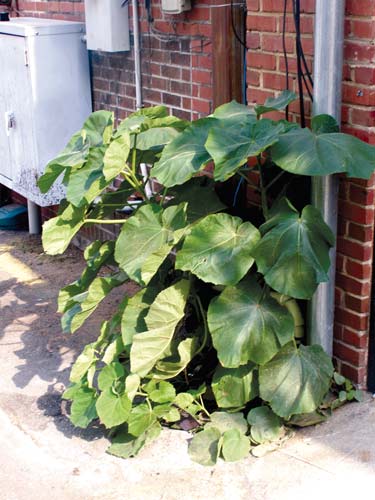
Non-native Paulownia can grow anywhere! Photo by Ken Moore
by Ken Moore
I’m always impressed by those large round leafy stems that seem to have grown six to 12 feet overnight along roadside banks and ditches. This fast-growing plant is promoted by the nursery industry as a miracle tree, the fastest growing one in America. For the homeowner, this exotic (non-native) royal paulownia, royal empress or princess tree, Paulownia tomentosa, is an easy sell.
This tree is more noticeable in the urban landscape, where vigorous clumps thrive in sidewalk cracks, edges of building foundations, on rooftops and even on fire escapes. In spite of eradication efforts, several impressive clumps persist behind a popular West Franklin Street watering hole. One of the many survival characteristics of this tree is rapid recovery following drastic pruning.
read more…
Originally published July 31, 2008

A congregation of dayflowers “holding court†behind Weaver Street Market. Photo by Ken Moore
By Ken Moore
Every time I walk by one of these little flowers, I feel a smile inside and my instinct is to pause long enough to say: “Hi, how you doin’?â€
Early this week, I took one of these little flowers to Padgett Station, one of my Carrboro coffee spots, and set it in front of Jami and Logan, who were working behind the counter.
read more…
Originally published July 24, 2008
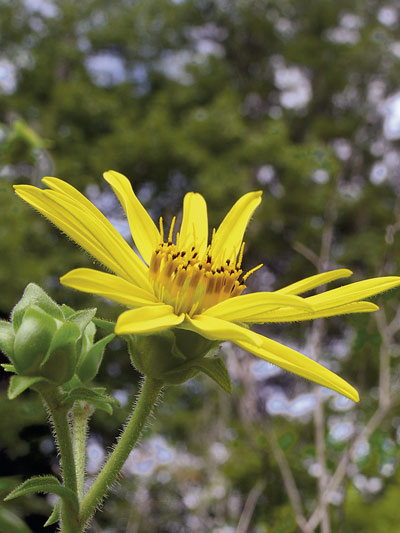
A silphium flower head contains a tight cluster of male tube flowers surrouned by a circle of lady ray flowers. A closer look may reveal to you the double thread-like female stigma at the base of the ray flowers. Photo by Ken Moore
By Ken Moore
Several days ago, I spied lots of yellow flowers along the edge of the power line crossing Poplar Avenue in west Carrboro. Infrequently cleared power line right-of-ways are great places to observe a diversity of both native and exotic plants and the critters that depend on them.
This past weekend, I walked through the tall grasses for a closer look. I found a vigorous stand of six-foot-tall rosinweeds, Silphium asteriscus. The Latin, silphium, refers to the rosin content. There are several species of silphium in our state, occurring mostly on dry prairie-like fields and roadsides. They have an interesting heritage of medicinal uses, including tonics given to horses. The rosin was used for gum and candy for the children. The frequently described action of burning the dried root as a charm against lightning during storms really fires the imagination.
read more…