Originally published July 19, 2008
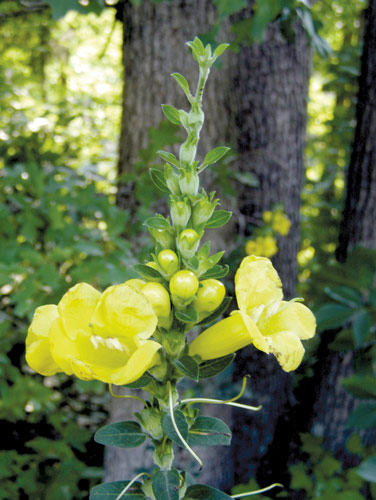
False-foxglove, Aureolaria, is found beneath the canopy of oak trees. Photo by Ken Moore
By Ken Moore
Now, how can a flower be false? A flower either is or it isn’t! It seems irreverent to call any plant “false.â€
But I’m getting ahead of myself. I was all set to focus on yellow roadside composites (flowers in the aster and sunflower family) for this week’s Flora when I was redirected by a chance spotting of a different yellow wildflower on MLK Boulevard.
They are just now coming into peak flowering. Driving north you will find them on the right woods-edge just beyond Blossom Lane. There is a little satellite dish just inside the woods-edge behind a sizeable population of Aureolaria virginica, false-foxglove. The common name, false-foxglove, refers to the similarity to the cultivated pink foxgloves of western Europe.
read more…
Originally published July 10, 2008
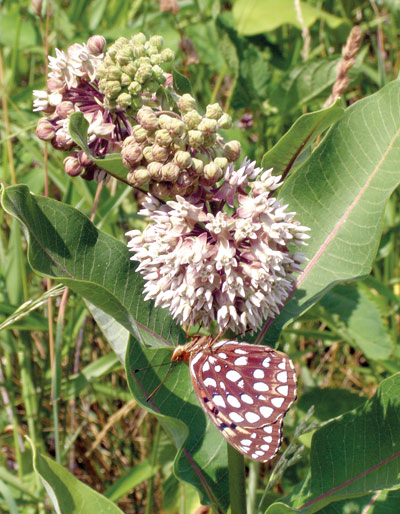
An Aphrodite Fritillary is just one of several butterfly species attracted to the common milkweed. Photo by Ken Moore
By Ken Moore
Perhaps it’s really the nature of art! Art and nature were inseparable during the recent two-week Session 3 at Penland School of Crafts in Western North Carolina. Fifteen different studios — including glass blowing, metal sculpture, ceramics, photography, weaving and sketching — demonstrated that images and experiences of nature were dominant sources of inspiration expressed in the works of instructors and students.
read more…
A native vine for hummingbirds and goldfinches
Originally published July 3, 2008
by Ken Moore
Staff Writer
Right now I celebrate the native trumpet vine, Campsis radicans. Some folks call it trumpet creeper or cow-itch vine. There are likely other names associated with this common weedy vine with bright-orange, tubular flowers that are guaranteed to attract hummingbirds. Keep an eye out for the occasional peach- or yellow-colored variations. The flowers seem to hang in the air, singly or in clusters, at the tips of long stems reaching down from varying heights, be it low fence posts or abandoned barn chimneys.
One of my favorite specimens is a vine on a utility pole on Weaver Dairy Road between Carol Woods and Timberlyne Shopping Center. That vine-covered pole looks like a mop-headed giant having a bad-hair day when it’s covered with those orange flowers reaching out all around.
Equally dramatic is the trumpet vine-covered privet hedge in front of Peck and Artisans Studio between Auto Logic and Akai Hana restaurant in Carrboro. Owner Tim Peck is sophisticated enough to allow it to creep onto his building.
I am fortunate to have one that sprouted at the base of the tall cedar post on which my mailbox is mounted. It’s now reached the top, and is sending orange flowers out from way up high as well as having some lower-reaching stems to tickle the postman at the letter box.
My very favorite urban specimen trumpet vine is the robust one along the front driveway on Rosemary Street just opposite Padgett Station. I enjoy watching it produce flowers for weeks during these long, hot, dry, summer days. read more…
Originally published June 26, 2008
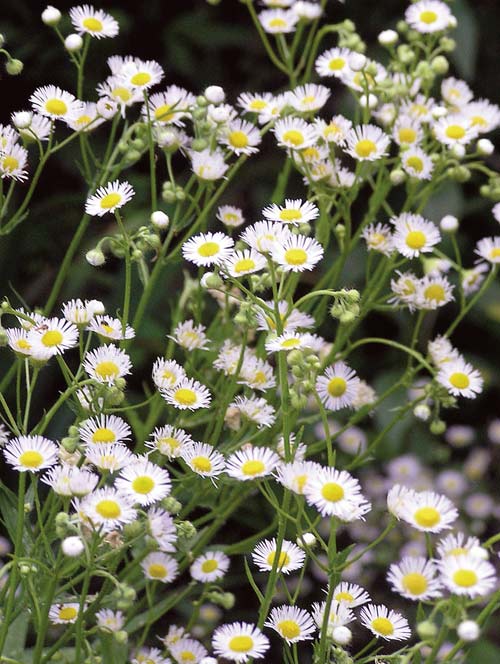
Daisy fleabane is drought-tolerant and attracts goldfinches. Photo by Ken Moore
By Ken Moore
They began flowering weeks ago and they are still making a show along roadsides and wherever folks allow them on their lawns and in their gardens.
I give native daisy fleabane, Erigeron annuus, freedom to grow wherever it suits itself in my wild landscape. Masses of tiny white daisy flowers on multi-branching stems, three to five feet tall, cheer up my yard and garden areas for weeks and weeks. This year, they’re flowering in profusion everywhere, in spite of the continuing drought.
read more…
Originally published June 19, 2008
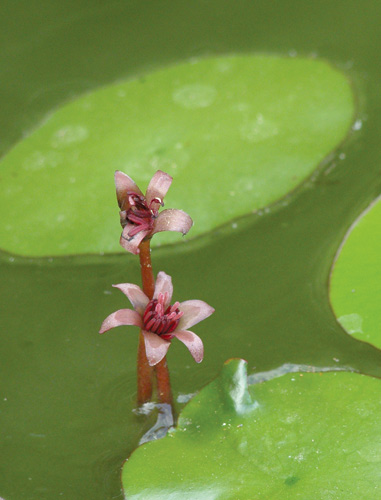
Enjoy a close up look at the flowers of water shield and don’t forget to feel the underside of one of those elliptical leaves. Photo by Ken Moore
By Ken Moore
Last week, I rushed to the Botanical Garden for a quick photograph of those Carolina Blue spiderworts. Walking quickly out, I made the mistake of glancing over the surface of those water lily tanks behind the Totten Center. The other aquatic plants usually go unnoticed, but this time my eye was captured by a very small, ruby-red flower reaching an inch or two above the surface. What a beautiful little flower!
read more…
Originally published June 12, 2008
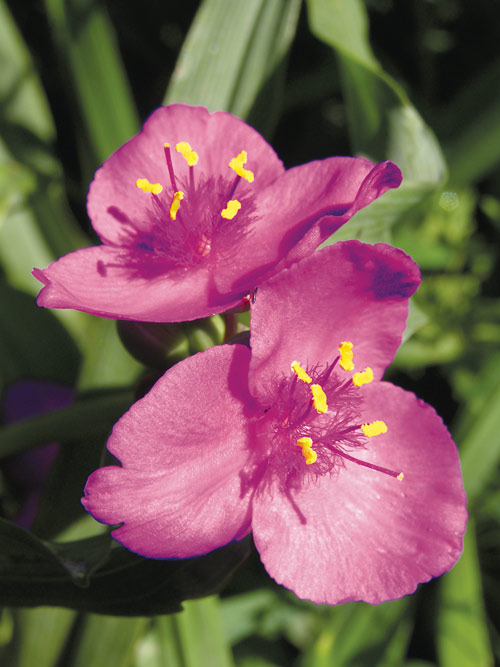
Rosy color variation of blue spiderwort. Note how the slender female pistil is remaing aloof from her six stamen brothers. That encourages healthy cross pollination! Photo by Ken Moore
By Ken Moore
In spite of the early heat wave, cool shades of spiderwort flowers continue to cheer up the early morning hours. The one moving around my yard is most likely Tradescantia ohiensis, Smooth Spiderwort, with leaves having a somewhat whitish cast (glaucous) to them. The pair of leaves immediately below the flower clusters are as wide as the stem leaves.
read more…
Beauty and drama is where you find it!
Originally published June 5, 2008
By Ken Moore
Another reflection on catalpas!
Remember the Northern and Southern Catalpas? The taller, northern one flowers earlier than the broader, southern one. Last week, some of you may have inspected the southern one finishing its flowering, overhanging Weaver Street in Carrboro. Now the bigger, broader specimen set back on the cool green yard on the east side of MLK Blvd. near Timberlyne Shopping Center is just beginning to burst into flower. It’s possibly the grandest specimen in Orange County, worth a drive-by this weekend to see.
read more…
Originally published May 29, 2008
 One of thousands of tall beardtongues in Mason Farm fields. Photo by Ken Moore
By Ken Moore
Last week, I described my delight in finding a snakeroot with two flowers. This past weekend, my gardening friend, Sally, was downright apologetic in inviting me over to see several snakeroots growing in her wild garden. They were not only taller than ones I have seen, but at the base of one clump we counted as many as a dozen little flowers in various stages, from bud to fruit. Sally and I share a wonderful competition as wild gardeners.
read more…
Originally published May 19, 2008

The tall flower-covered Northern Catalpa behind Weaver Street Market. Photo by Ken Moore
By Ken Moore
As usual, Mother’s Day and the university’s commencement have been accompanied by the typical cool stormy weather of “blackberry winter,†signaled by the flowering of wild blackberries along roadsides and woodland edges.
This past weekend’s blackberry winter weather was particularly stormy, as it delivered more needed rainfall, hopefully not the last before a harsh drought, as occurred last year.
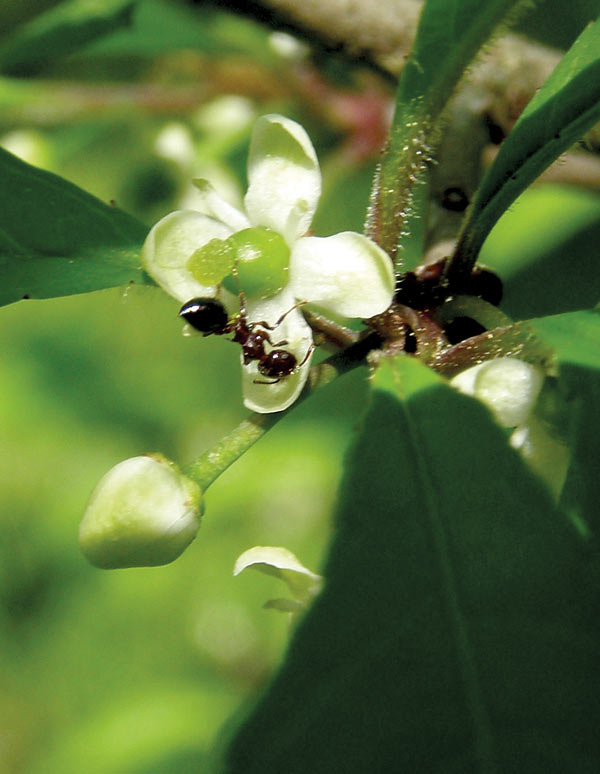
An ant exploring a female holly flower. Note the immature berry at the flower center. Photo by Ken Moore
By Ken Moore
Holly flowers are really neat. Though not big and showy like dogwoods and magnolias, once you have looked closely at a cluster of holly flowers you may get hooked on looking forward to them each spring. And you’ll feel really special when you can determine for your neighbors and friends whether or not a particular holly will have berries in the fall.
Knowing that holly trees are either male or female, you can describe that a winter berry display on a female tree depends upon the presence of a male holly within flying distance for insects to carry pollen from the male to the female tree.
read more…